• Category Archives Architecture
  • Old New York, Part 2

    Posted on by Brian Dubé

    (see Part 1 here)
    The good news is that Greenwich Village is extraordinarily unique. The bad news is that if you want a piece of its history, good luck. The housing stock is very limited. And if you are like I am and attracted to row houses, the selection of available units is even more limited. Over the decades, I have from time to time looked at apartments to buy but rarely found anything I really liked, and if I did, the cost was extremely high.

    I am forever asked why I am a renter and have not purchased a home after living in New York for over 40 years. The market in New York City is very different from anywhere else. There are over 2 million apartments for rent in the city with 65% rent regulated in some way. These regulations provide for below market rents and are a strong disincentive to move. The longer you remain in a regulated apartment, the greater the spread between your rent and the open market non-regulated places becomes – it is not uncommon for the difference to be 100% or more.

    This anomaly in pricing just exacerbates the problem – tenants never move with a resultant lesser supply and higher prices for the free market apartments, whether rentals or purchases. If you are fortunate enough to rent an apartment in an historic building, it is unlikely you will ever find a place like it at any price, for rent or sale. In my own building, 3 out of four residents have lived in their apartments for over 30 years. Often, rentals in regulated apartments are no more than the cost of maintenance fees on a similar unit for sale. So why buy? Many analyses have been done demonstrating that in New York City, it can be more prudent to rent than to buy.

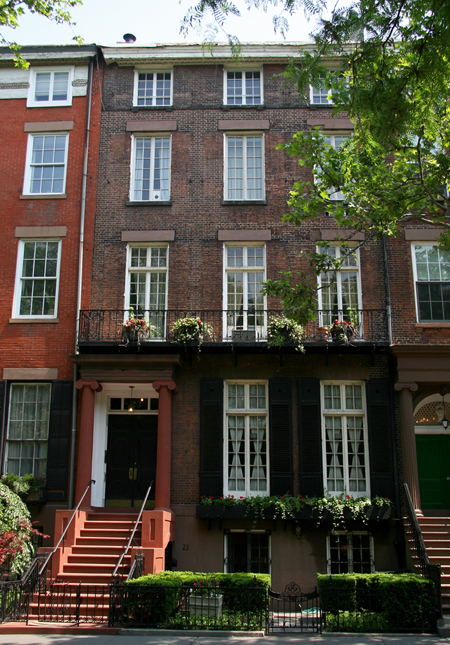
    The 1830 Greek Revival townhouse at 23 Washington Square North has not been available for sale for half a century. It can be yours, however, the asking price is $25 million dollars. The size is 8,528 square feet or a cost of $2,931 per square foot. There are only 7 apartments on 5 floors. Do the math and you will see the problem – if this building were converted to units for sale, the cost per apartment including carrying charges would be stratospheric. Many buildings like this will often sell to one individual who will convert it to a single family home.

    The rentals in this property illustrate what happens in this marketplace. A one bedroom was asking $4,775/month with the penthouse for $8,900 in 2010 and $12,500 per month in 2011. If you would like to get the flavor of what a parlor floor can look like in this type of historic building, see my photos here on the interior of number 24 next door, which one reader described as “real estate porn.”

    By day or night, looking out or peering in, the extraordinary historic charm is available in this rare window of opportunity to own a piece of old New York’s Washington Square. Spare $25 million anyone?

    Other Related Posts: The Feeling Passes, Overused and Abused, Bomb Factory, Left Bank New York
    Posted on by Brian Dubé

  • Old New York, Part 1

    Posted on by Brian Dubé


    There are things you can’t have in New York City. Many things. You can’t watch the sunrise from a mountain top, hear the wind blow through alpine forests, or see the black of night. Much of what nature giveth, New York City taketh away.

    The sound levels are very different here. I spoke to a friend recently from the suburbs who spent a night down the block – on the very same street where I live with the identical exposure. He said he could not sleep at all with the noise of constant traffic. The sounds of the city are only a familiar song to me – I sleep easily without window shades drawn and with all the city’s ambient light and noise.

    Here and there one can find tiny corners, places, culs de sac, alleys, parks, beaches, lakes, rivers – little pieces of the other world, the world outside cities. These special and often little known places in New York City provide magic carpets, that for brief moments can provide transport to a quieter, gentler city. I have shared these places with you over the years in this website.

    I do love the city – the energy, vibrancy, and stimulation are extraordinary. But the problem is that you can’t turn it off. So for those times when I need respite and do not have the opportunity or inclination to leave the city, I seek solace in those special spots that hearken to a time gone by or a world apart.

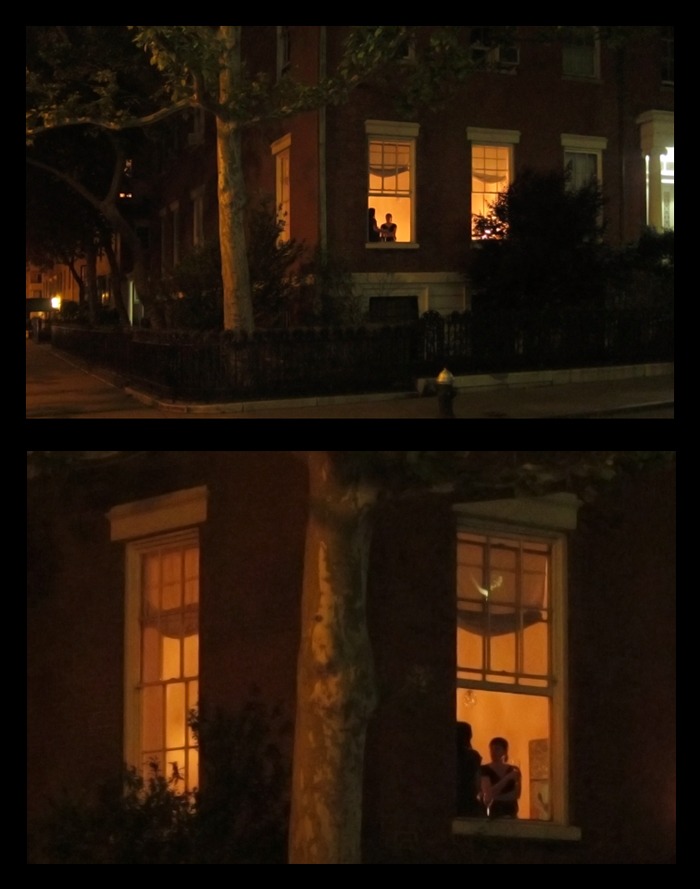
    The Greek Revival houses of Washington Square North evoke the gentility of a bygone age. Here, at the corner of Washington Square North and Fifth Avenue is a row house where I have often seen windows open, lights on and a handful of people milling about. This is the world of Henry James, 1881, setting for his novel Washington Square.

    A couple relaxes with glasses of wine, one resting on the sill, complemented by the exquisite air of warm evening, which has, after a long wet and cool spring, arrived at last. There’s a canopy of trees overhead and the yellow-orange glow of lamps. Everything is soft. Pause on this corner with me and enjoy the soul of old New York…

    Note: If you want a piece of Old New York at Washington Square, see Part 2.

    Posted on by Brian Dubé

  • Everything Looks Like a Screw

    Posted on by Brian Dubé


    Surgeons like to cut.
    I have always had a morbid fear of surgery. There’s just something about all that cutting that bothers me. However, I do understand that surgeons like to cut and I can imagine why. As a small manufacturer, I often have to troubleshoot products and there is nothing as effective as opening something up and getting inside to really see where the problem lies. Why play with less direct solutions if the problem lends itself to a mechanical solution?

    Builders like to build.
    Robert Moses was New York City’s master builder. He the most often cited figure in this website. This New York City planning czar had an unstoppable drive. He was never elected to public office, yet was responsible for the creation and leadership of numerous public authorities. He built bridges, tunnels, highways and shaped shorelines in New York City and environs.

    One of Moses’ projects which never came to fruition was the Lower Manhattan Expressway. This extremely controversial plan was to be a ten-lane elevated highway, I-78 & I-478, extending from the Hudson River to the East River, connecting the Holland Tunnel to the Williamsburg and Manhattan Bridges. It was seen by Moses as a much needed thoroughfare to ease congestion in Manhattan providing a roadway connecting traffic from New Jersey to Brooklyn and Queens. It was conceived by Moses in 1941 but delayed until the early 1960s.

    The highway plan would have required many structures to be demolished along Broome Street, passing through Little Italy and what is now known as SoHo. Community activists led by Jane Jacobs effectively thwarted the project. The effort is now seen by many as instrumental in preserving the character of lower Manhattan.

    Robert Moses and his works saw much public criticism. In 1974, The Power Broker was published. From the New York Times:

    He indicated no wish to change with the times, but held to his views more ardently than ever in his later years, dismissing community opposition to his vast projects by saying, as he did in a 1974 statement, ”I raise my stein to the builder who can remove ghettos without removing people as I hail the chef who can make omelets without breaking eggs.”

    The statement came in a much-publicized 3,500-word rebuttal that Mr. Moses offered to a highly critical biography of him by Robert Caro published in 1974, ”The Power Broker.” The exhaustive 1,246-page work, which won the Pulitzer Prize, was written from the perspective of the newer approach to planning and redevelopment, and it contended that Mr. Moses had callously removed residents of neighborhoods undergoing urban renewal, had destroyed the traditional fabric of urban neighborhoods in favor of a landscape of red-brick towers and throughout his career had worked somewhat outside the normal democratic process.

    Screwdrivers.
    Surgeons like to cut, lawyers like to litigate, and builders like to build. For someone with a screwdriver, everything looks like a screw…

    Photos: The upper photo is one of the supports of the Manhattan Bridge as seen from the walkway. The lower photo is a plan of the proposed Lower Manhattan Expressway.

    Note: It is ironic that Robert Moses, a man who favored highways over public transit, did not hold a driver’s license.

    Posted on by Brian Dubé

  • Dot My I

    Posted on by Brian Dubé

    Poor surfaces. So often maligned. One should always look below the surface. See what lies beneath the surface because there is more than what meets the eye. On the surface of it, beauty is only skin deep.

    Sometimes we love a surface – so smooth and shiny. It may be important to restore the surface, polish the surface or resurface.

    Most of the world we see is surface. We admire and appreciate it, yet if we learn that what lies beneath the surface is somehow less than we expected, we are disappointed and it diminishes the surface itself.

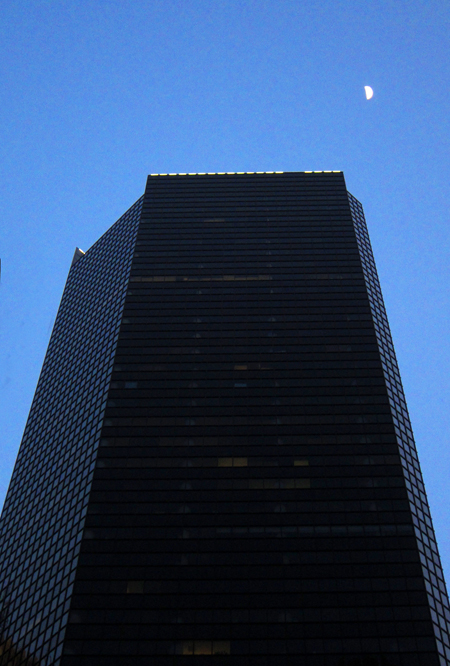
    New York City is a place of buildings, so we have lots and lots of large surfaces, looming over us daily. Here at 101 Park Avenue is a 49 story, 629 foot skyscraper. Eli Attia Architects designed the building, completed in 1982. It is the 64th tallest in New York.
    Park Avenue and 41st Street is prime real estate, only steps from Grand Central Terminal. The building has its own Wikipedia page and has been used in film and television – in the 1990 film Gremlins 2, in Seinfeld as the site of George Costanza’s office and as Dudley Moore’s office in the film Crazy People. It affords, as would be expected, spectacular views. You can see a gallery of photos of the building here.

    Uniquely shaped, strikingly positioned at 45 degrees to the street grid and glistening with reflective glass, 101 Park Avenue makes an impressive statement on the Manhattan skyline. The day I photographed it, there was an evening moon strategically located. Looking up at that surface, everything was so perfectly placed in a scene of urban penmanship, not forgetting while I crossed the streets to dot my I 🙂

    Posted on by Brian Dubé

  • Down to the Cellular Level

    Posted on by Brian Dubé

    A friend once so aptly said: everything is a competition, right down to the cellular level. All is poised, the net result of competing forces. In the world of physics, chemistry and biology it makes so much sense. In the world of human/animal relations however, it’s often a bitter pill to swallow, and I don’t really like the idea much better than anyone else. I always hate seeing that springbok losing to the lioness.

    I don’t like to see everything as a contest, however I don’t believe things can really be win-win either. Resources are limited, particularly money and time, so how can everyone win? Or win as much as they would like. I hate to say it, but life feels like a zero-sum game. Whether it is shopping, dating prospects, jobs, admission to a great college, sports, games, vacation choices, ranking in your class, what you will read, the blogs you visit, what you will do with your spare time, or who you will call, choosing something is not choosing something else. We are besieged with unending decisions and we must choose (or be chosen) from the competing options.

    I am a competitive person by nature and so my worldview is tainted by wearing those glasses. I do love working with a team, but honestly I work best when the team is on my side. I am a poor loser so I avoid direct competition as much as possible, particularly contests I know I will likely lose. I did not know growing up that I was a biggish fish in a small pond. Like many, I had a lot to learn about the size of fish and ponds.

    I came to New York City in 1969. At that time, this city was the best to me – the biggest, fastest, and most amazing place I could imagine. It had the most and best of everything – restaurants, buildings, people, opportunities, culture, money, street life, intellectual stimulation, merchants. As far as places go, it won the contest, and I wanted to be with the winner.

    Of course I have learned much over the years – the merits of other places and other cities, the relative meaning of best and that New York City is not the end all and be all. Even in the realm of cities, it is arguable whether New York is the greatest city in the world. Places like Paris eclipse New York in many ways.
    Some tire of the urban grind (see Dwanna, Duffy, and I Know). Most of my friends, many born in the city, have left and with no regrets. There are quality of life issues here – so many things that are undeniably easier and better in the country, suburbs, or smaller cities. For most, even if they have the means, New York will always be the stereotypical “it’s a nice place to visit, but I wouldn’t want to live there.”

    New York City is not for the faint of heart. The stakes are higher, the costs are greater, competition much fiercer, and the penalty for failure more severe. New York City is a magnet, attracting some of the world’s best competitors, from gladiators in the ring right down to the cellular level…

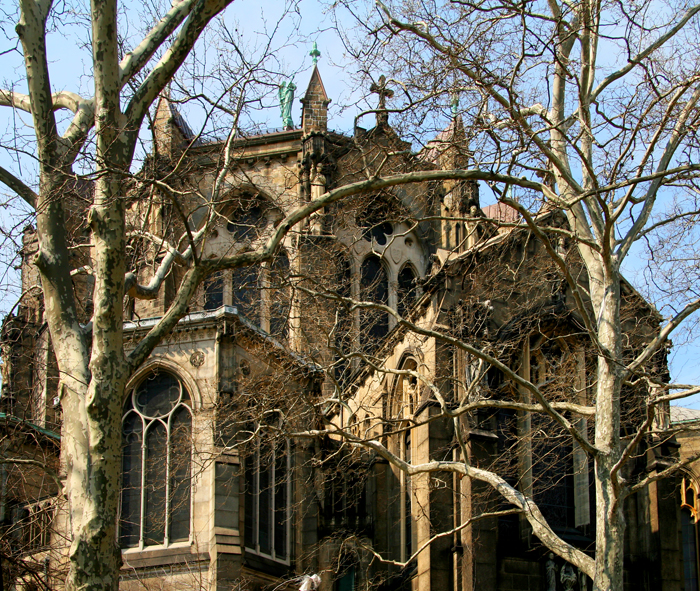
    Photo Note: New York City is not usually thought of as a city with a plethora of cathedrals and churches, as is Europe. However, surprisingly, New York City is home to the world’s largest church – the Cathedral of St. John the Divine. This photo was taken from the rear. You can see more photos of the interior and the story here.

    Posted on by Brian Dubé

  • Fort Schuyler


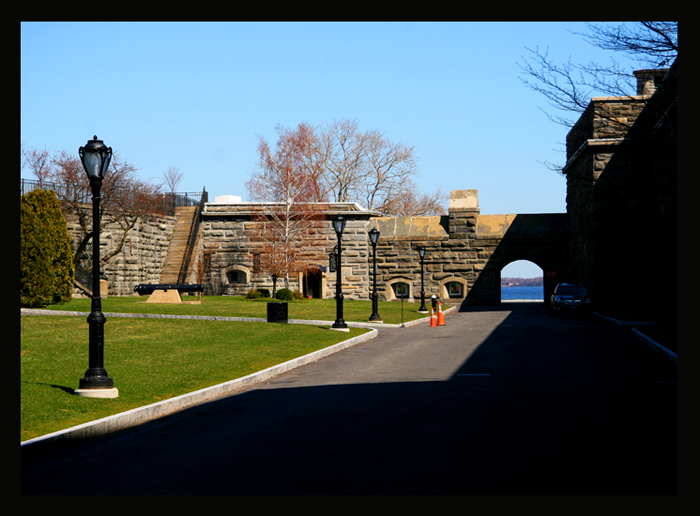
    There are not a lot of forts in New York City, and you certainly do not expect to run across a huge one, unbeknownst to yourself. It is unlikely you will ever run into this one by accident – Fort Schuyler and the Maritime College are not on the way to anywhere – they are destinations, located at the very tip of the Throgs Neck peninsula in the Bronx. On my recent excursion to the area, my intention was to explore Silver Beach. It is here by accident, that I discovered Fort Schuyler and the State University of New York Maritime College, founded in 1874 and the first of its kind in the United States.

    I met a couple of cadets, and like all the military men I have encountered, they were very approachable. They answered a number of my questions regarding the Maritime College and explained the reason for small sailboats – there was a regatta under way, with the boaters undaunted by the cold weather. They also informed me that the entire area was open to visitors with the entrance way nearby.

    I was surprised at how free and easy I was able to tour the area with no restriction and virtually no other visitors. Post-9/11, virtually everything in New York City has an added layer of security, including some of the most innocuous office buildings requiring photo ID. Places like the lobby of the Woolworth Building, one of my favorite spots to take visitors, is, sadly, completely off limits unless you have specific business in the building. As far as Fort Schuyler, however, I suppose a man in a small automobile armed only with cameras, poses little threat to a massive fort with military presence.

    The location of the fort and college is at the very tip of the peninsula, where Long Island Sound meets the East River, affording sweeping vistas including Long Island, the Bronx, Queens and a panorama of the Manhattan skyline (essentially the same as that of Silver Beach). The Throgs Neck Bridge is ever present, juxtaposed against nearly every structure as can be seen in many of my photos of the excursion – see the full gallery here.
    Fort Schuyler was one of many forts built along the east coast of the United States after the War of 1812, when it became apparent that the U.S. coast was poorly defended against foreign invasion. The French Style fortification was dedicated in 1875. The site also has a maritime museum, open to the public. Read more here.

    Everything was pristine and immaculate – the grounds, buildings, roadways and artifacts. It was quite chilly, but this is the best of weather conditions for seeing New York City outdoors – crisp air, clear blue skies and greater visibility. Although the warmer months are preferable for walking and touring, the heat of summer also usually means hazy skies with poor visibility and, if you are taking photographs, poorer results. If you’re looking for something truly off the beaten path, try the Throgs Neck peninsula with Silver Beach and Fort Schuyler 🙂


  • New York Rockies

    110 York Street – Part 2 (See Part 1 here.) (see complete photo gallery here)

    For years, on return trips home from Brooklyn to Manhattan via the Manhattan Bridge, I have observed this rooftop structure both by day and night. I promised myself that one day I would get to the bottom of this – a literal pursuit since this structure was atop a building located in Brooklyn, meaning I would literally have to venture down and explore under the Manhattan Bridge.
    What was particularly compelling about it was the four exposed white steel truss system on the roof of the building which was illuminated at night, bathed in blues, greens, purples, and reds.
    Recently, this came up in conversation with someone familiar with the structure – he told me that it was occupied by architects and located on York Street. This rekindled my interest to bring this mystery to a close. On my first excursion, I did a cursory drive-by to confirm its location – 110 York Street.

    On Sunday, I made a trip to Vinegar Hill, Brooklyn, with the intent of returning to Manhattan by foot over the Manhattan Bridge and taking a series of photos. I intended to time my afternoon so that I would cross the bridge after dark when the rooftop was illuminated. My return, however, was too early.
    But I was on a mission, and I decided that I would return the following day after work when dark to cross the bridge again by foot. I had a burning desire and intention with my own mantra: Neither snow, nor rain, nor ice, nor gloom of night stays this courageous ambassador from the swift completion of his appointed rounds.*
    There was snow and ice and gloom of night. But was I courageous?

    There are two pedestrian pathways on the Manhattan Bridge – the one the north side is for bicycles – this is the side I needed to view the York Street building. However, a chain link fence obstructs a clear line of sight most of the way, so I found it necessary to climb and stand on a railing for the taking of photos. The roar and vibration of vehicles and the elevated subway was bad enough, but worse was having to use two hands to stabilize the camera while balancing atop a 4″ wide steel railing which may or may not have been icy. See this in better detail at my photo gallery here.

    The building at 110 York Street serves as the offices for a number of construction firms and, most notably, Robert Scarano Architects, who originally occupied the top floor of this 100-year-old former factory building in Vinegar Hill. For a needed expansion, a 5,200-square-foot rooftop two story addition was designed by a member of the Scarano firm, Dedy Blaustein. The addition was completed in 2005. The lights used are a Color Kinetics LED system.

    Blaustein’s inspiration for the rooftop structure was the bridge: “We’re not the main thing here,” he says, gesturing toward the bridge. “That is the main thing here. It’s so dynamic. I had to do something crazy.” Some have referred to it as the “Jetsons Building.” In response to critics, he said: “I didn’t design it for people to like it, I designed it for people not to be able to ignore it.” The project received a 2005 Design Award from Metal Architecture magazine and a 2005 Certificate of Appreciation from the Brooklyn AIA. From the Sarano website:

    The Manhattan Bridge is the most visibly striking element of the site, running parallel to it only 20 feet away. For this reason, we designed an exposed steel truss system for the skeleton to intensify the dialogue between the structures. The design embodies a strong sense of dynamics. The structural axis is separated from the building exterior finish, providing a sense of movement, which is enhanced by the flying roof, sharp angles, and horizontal texture on the surface.

    My affair has finally come to a close. I feel quite worn, perhaps not unlike the mountain climber who finally tastes the bittersweet success of arriving at the summit. Driven by an illuminated outline not unlike that drawn by a friend to describe the mountains of Colorado (see Part 1), I found this journey’s end at 110 York Street in the foothills of the New York Rockies…

    *The original seen on the General Post Office building reads:
    “Neither snow, nor rain, nor heat, nor gloom of night stays these courageous couriers from the swift completion of their appointed rounds.”
    The sentence appears in the works of Herodotus, describing the expedition of the Greeks against the Persians under Cyrus, about 500 B.C.
    Note: The firm of Robert Sarano is the subject of much controversy – both acclaim and official censure. Robert Sarano is a New York City native, born in Brooklyn. He became a registered architect and started his own firm, Scarano Architects PLLC, in 1985. His academic credentials and awards are many. The firm has been responsible for over 600 buildings in New York City. However, sometimes referred to as the bad boy of architecture, Sarano has also seen a loss of self-certification privileges, loss of filing privileges, numerous lawsuits, and worker deaths on 3 of his projects and has been charged with violation of zoning or building codes on 25 projects in Brooklyn.


  • New York Rockies

    ColoradoPart 1 (see Part 2 here)

    I do so love the mountains, and here, in New York City, unlike perhaps San Francisco (a mountain lover’s dream city), I must make do with the skyscrapers of glass and steel. ‘Tis better, I suppose, than the lowlands of Holland. But it pales in comparison to the experience of the American West. I journeyed there in the early 1970s for the first time by car. I cannot imagine a more compelling road trip than going west by auto.

    Before leaving, I discussed my trip with a close friend who vividly described what I would see. “Do you know the way you drew mountains as a kid?” He illustrated with his finger in the air a typical jagged outline. “That’s what it will look like.” “As you drive through Colorado, it will be flat. And suddenly, the Rockies will pop up.” The whole image of a child’s jagged outline and mountains popping into view was burned in my mind forever.

    And it was all true. As we drove through eastern Colorado, the landscape was no different than the flats of Kansas which we had spent a day passing through. Heat waves rose from the road and landscape in a classic mirage. I squinted for hours for those Rocky Mountains, only to find an my eyes fooled in one way or another. It became very tiring. Then there appeared the faintest mountain outline, which did not disappear, but only grew in size, jagged and dramatic beyond belief.
    The first night, the wind howled in the trees with a certain sound only heard in the mountains. I still listen for that sound. Everything was so big and grand. Colorado was everything John Denver had promised in his song Rocky Mountain High.

    We examined our maps the next morning for the steepest roads, the ones marked dangerous for what I assumed would offer the most dramatic views. We navigated the narrowest, most precipitous two lane mountain roads I have ever seen. The unobstructed views through crisp clean air were absolutely astonishing. It seemed unbelievable that motorists would even be allowed to travel such roads at altitudes over 10,000 feet – one tiny error in judgement, and it was sayonara.

    More remarkable was our conversation that night with two fellow campers who were Colorado residents. When we expressed our harrowing but exciting journey of the day, they only laughed as they told how they enjoyed riding at night, driving as fast as possible on the most treacherous of roads. To me, this was sheer lunacy. Not only did one have to contend with serpentine roads and hairpin turns, but Colorado was also PITCH BLACK at night – there were no street lights in those mountains. I certainly was a risk taker, but this couple was truly out of their minds.

    We journeyed on through Wyoming, Oregon, and California that summer in a 30-day, 10,000 mile trip. To this date, it was the longest I have been away from New York City since 1970. For the resident here, spending long periods away from the city really gives a new, fresh perspective. Returning from that trip, I could see and feel its gritty, dirty, and very hard character. The mountains of Manhattan were different now.

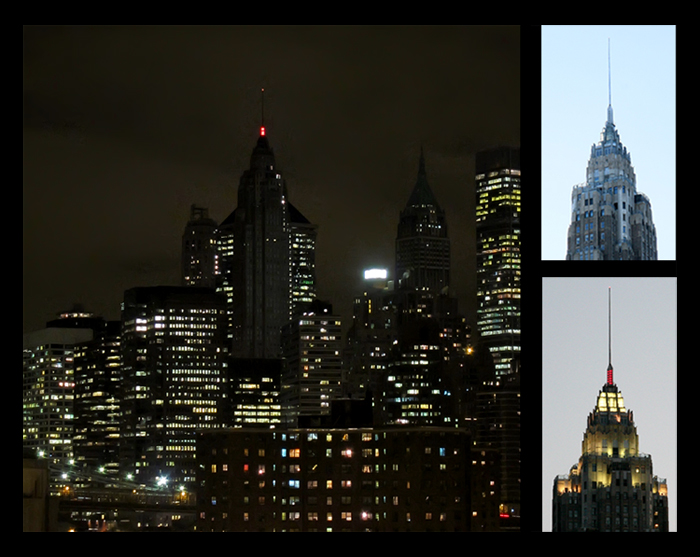
    On November 5, 2007, I wrote Magic Mountain, about the American International Building: “It is famous for its motif of a snow-capped mountain – the base of the building is clad in granite while the upper portion, clad in limestone, becomes lighter in color until one reaches the very top, where it is white.” The upper and lower right photos are from that story. A bit of the Rockies, popping up from the canyon floor of lower Manhattan.

    But the night vista from the Manhattan Bridge in today’s photo was not the reason I went on a journey as a Mountain Man, high in the New York Rockies…


  • The Perfect Gift

    In 1978, High Tech: The Industrial Style and Source Book for The Home, written by design journalists Joan Kron and Suzanne Slesin, was published. This and White By Design were two hardcover coffee table books that I frequently saw in bookstores and promised myself I would buy but never did. The raison d’etre of the Hi Tech design movement is seen as an evolution of the scientific and technical advances of the 1970s and abundance of high-tech devices in common use, leading to the appropriation of industrial and technical products in the home. The book was seminal and influential in use of the term Hi Tech – read more about it here.

    As a manufacturer for many decades, I found the use of the Hi Tech products in the home to be appealing for other reasons as well – the generally superior construction and cleaner, simpler design of industrial or commercial products. Those who use products in a commercial environment typically value function over form and durability over anything else. The foolishness of saving a few dollars purchasing equipment quickly becomes apparent when having to stop the wheels of production. Someone in business simply needs products that work well and reliably. And although aesthetics does not typically drive the design of commercial equipment, it does evolve towards the simplest form and construction that does the job properly. Often, this design becomes iconic and attractive from a minimalist perspective. One example is the bullet styled garbage can in stainless steel.

    Industrial elements have other appeals. Around New York City, in the outer fringes and edges, one will often find photo shoots with fashion models superimposed over gritty or industrial urban backdrops. The juxtaposition of the very disparate elements is quite effective in making the subject stand out.

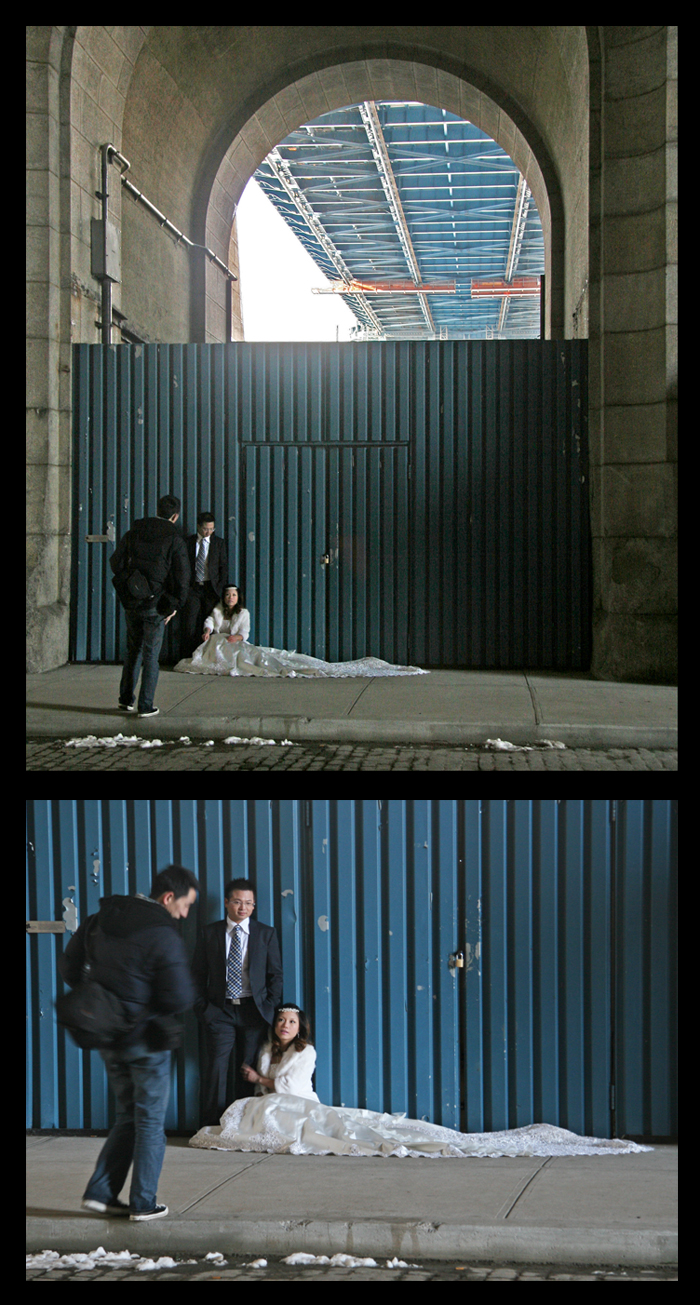
    All this considered, I was stunned to see the couple in today’s photos under the Manhattan Bridge on a freezing cold January day. The wedding is still a rather traditional affair, and this was an extremely radical departure from the ever popular New York City locales used for wedding photo shoots, such as Central Park on a beautiful spring or summer day.

    I wish I was friends with this couple because I have such the perfect wedding gift that I really think they would love: a set of two books – Hi Tech and White by Design 🙂

    Note: For more White by Design, go here and here.


  • The Porter House

    Branding existed long before it became a studied concept in business or a buzz word in the vocabulary of marketers. And, rich or poor, there are many words that in and of themselves connote exclusivity, privilege, wealth, and the special.

    This was an explanation I have read as to why those of ordinary means often buy a very expensive gourmet food product, such as artisanal ice cream. Because, at least for a brief time, they can enjoy the best of something. This certainly was the case growing up on the poor side, when we would occasionally “splurge” on a food item. For my parents, this might mean a porterhouse steak, ordering, “I’ll take the porterhouse,” as if “the” (as opposed to “a”) conferred even greater scarcity or mythic status, leaving a child to wonder – was there only one porterhouse steak back in the kitchen?

    I have noticed the structure atop another building in today’s photo for some years now, always wondering about its raison d’être. This is the Porter House, a residential building which consists of both a conversion of an historic building and an expansion sitting atop the the historic yellow-brick building. The property abuts the Old Homestead Steakhouse in the meat packing district. From the New York Times:

    The Porter House, a new condominium rising 10 stories above the rapidly changing area known both as Gansevoort Market and the meatpacking district, takes its name from the cut of steak. Completing the circle, that cut of meat had, long ago, taken its name from a type of building.

    The 22-apartment luxury development on the corner of Ninth Avenue and 15th Street offers high ceilings, large layouts and asking prices of $1.1 million for the smallest two-bedroom apartments.

    The lower part of the $22 million project is a careful restoration of a brick Renaissance Revival warehouse built for Julius Wile, wine importers, in 1905. Until recently the building was owned and occupied by a furniture manufacturer.

    The old part of the condominium is topped with four new sleek full stories with a facade of zinc and glass that cantilevers eight feet over the top of an adjoining building, and two partial floors that wrap down on the back of the old six-story structure. The zinc panels are to be laced with vertical lights that will glow softly in the evening light.

    The project will have 5 one-bedroom apartments; 13 two-bedrooms, some with studies or terraces; 3 three-bedrooms and a four-bedroom duplex with a private rooftop deck. Prices range from $735,000 for one-bedrooms to $4.15 million for the penthouse. Taxes and maintenance on a typical two-bedroom costing $1.3 million are about $2,700 a month.

    The Porter House was named after the porterhouse cut of steak to link the marketing of the building to the Gansevoort Market, according to Bruce Ehrmann of Stribling Marketing Associates, which is selling the condominium units. The name of the steak, in turn, is widely attributed to porter houses, coach stops that served steak and ale in the 1800’s.

    Much as the restaurant patron who has saved for that dinner splurge, I’m guessing the developers were hoping that prospective buyers would be thinking, I’ll take the Porter House 🙂


  • Hide and Seek, Show and Tell


    There’s a brilliant and frustratingly absurd Monty Python comedy sketch called Olympic Hide and Seek. One competitor is allowed to travel by any means and hide anywhere in the world while the other competitor counts to one thousand, then begins to search. Winning times are over 11 years.

    Whether you are in the real world or that of Monty Python, if you are looking for hide and seek activities which are not mainstream, success is usually found in the geographical edges and neglected fringes. The balloon of conformity and mainstream behavior presses the unconventional and unaccepted into the edges, corners, fringes, and remote hinterlands of the landscape.

    Look at the large gay communities in the United States. Many are located in remote or isolated areas – Key West, Florida, Provincetown, Massachusetts, and the West Village. Even in Fire Island (which is beautiful), the predominantly gay communities are located geographically out of the mainstream – Cherry Grove and Fire Island Pines.

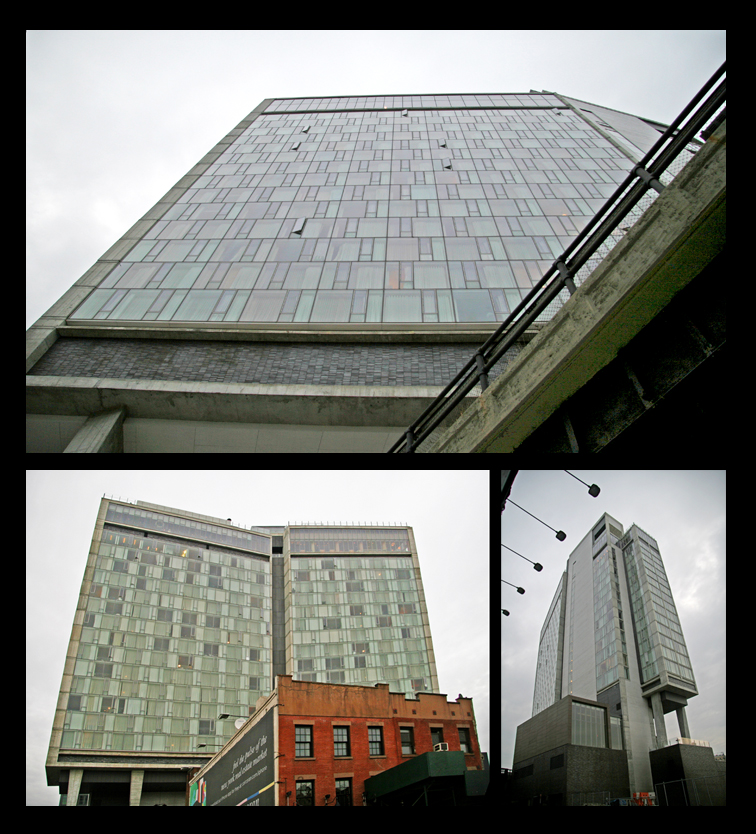
    However, once an area becomes more well known as an enclave for the unconventional, hide and seek often becomes show and tell. And there is no better example than the Standard. This hotel was developed by Andre Balázs and straddles over the High Line, an elevated park created from an abandoned elevated railway, 1.45 miles long, in the west side of Manhattan (see here). The hotel itself is located in the stretch in the far West Village near the meat packing district, what has become one of the trendiest neighborhoods in New York City.

    The place became a scandal with a flurry of media coverage in July of 2009. There were reports of nudity and every manner of lewd activity displayed in the windows of the hotel, including shooting of porn films and couples having sex. The exhibitionist activities were actually encouraged by the management, even putting in writing on their Facebook page:

    “We encourage you to exercise your inner exhibitionist,” and their website asks, “Whatever you do, just make sure the shots are HOT and that you get them to us in whichever way you can. It’s all about sex all the time, and you’re our star.”

    After public and neighborhood outcry over the “peep show”, the hotel removed the explicit encouragements and tried to tone things down. If this is the kind of thing you’re looking for, explore the outer fringes and there is where you will find the world of Hide and Seek, Show and Tell 🙂


  • A Slice of Cheesecake, Part 2

    The Brittany – Temple of the Gods of Debauchery (see Part 1 here)


    It was clear after moving into Brittany Residence Hall and a brief visit to NYU’s primary other residence at the time, Weinstein, that fortune has bestowed us with a better choice.
    The Brittany, as it was known at the time, is located at 55 East 10th Street and Broadway. It is a former hotel, built in 1929. The structure has larger, airier rooms and a prewar ambiance.
    The Brittany penthouse was a speak-easy at one time with many well-known guests such as Walter Winchell, Al Pacino, and Grateful Dead’s Jerry Garcia. The ground floor currently functions as a gallery, Broadway Windows, with displays of student art.

    At the time of my stay there, the Brittany was a truly a temple to the gods of debauchery. It was a coed dormitory, and in many cases, the rooms themselves became coed with couples living together in suites. Drugs were rampant as were drug dealers, even selling to those outside the student body. One evening, while sitting in a hallway, I had a jacket bloodied by someone who, half asleep on the way to the bathroom, had smashed his hand through a glass door and was running and screaming. I was told by a close friend of a first hand account of a group of students in the nude, high on Quaaludes, playing Frisbee in a hallway.

    One of my earliest memories there was visiting a room completely outfitted in UV blacklight for the entertainment of visitors. One fellow student represented himself as a cat burglar and demonstrated his skills by walking on window ledges of this high rise building. Brittany Residence Hall is also where I resided at the time of one of my favorite stories, involving Jimi Hendrix (see Crime Scene here).

    Somewhat controversial, The Princeton Review not only provides its well known university ratings in a Best College guide, but also provides a “Top 20 Party School List.” NYU has typically made the list. Today however, the university is better known for its coveted #1 Dream School status, rising prominence and the strength of many departments – Courant Institute of Mathematics, NYU Law School, the Film School, and Stern School of Business. According to Forbes Magazine, in 2008, NYU was ranked 7th among universities that have produced the largest number of living billionaires.

    I recently visited the dorm for the first time since 1970, escorted by an NYU student currently residing there. There were changes of course, most notably increased security – turnstiles requiring student ID card swipes. Things appeared to be much more subdued. However, I did learn that Brittany Hall is considered haunted, with reports of unexplained music, lights, footsteps, and claims from people who believe that others are watching them. Perhaps the final stirrings of the gods of debauchery…


  • A Slice of Cheesecake

    Part 1 – The Arrival  (see Part 2 here)


    I knew nothing of the world and almost nothing about New York City. I had only visited twice on day trips. I had never spent one night away from home alone. There were no ATM machines, and I had no bank account. Only some cash.
    I had one suitcase and arrived at Port Authority bus terminal, never a beautiful or inviting place for the newcomer. I was excited and scared. This is where I had dreamed of living for some time, but now I was really here, and it was big.

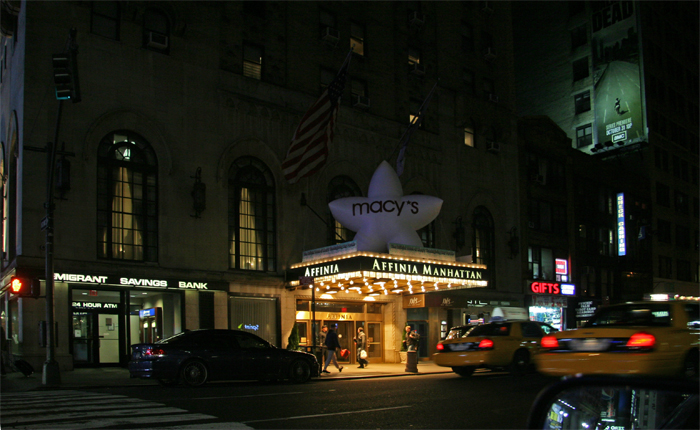
    I was neither homeless nor on the road. It was 1969, I was 18 and had been accepted to New York University. I had chosen a dorm and was very disappointed that my first choice, Weinstein Hall (the most modern), had been rejected. I was to stay at the older Brittany Residence, a former hotel, under renovation and not quite completed. As an interim measure, for a few weeks, we were housed at the Penn Garden Hotel* on 7th Avenue at 31st Street. I was later to learn that the Brittany, with its prewar ambiance and much larger rooms, was actually highly preferable.

    I entered my hotel room and met my roommates. I had never shared a room before either, having grown up with two sisters, so this was another adjustment to be made. We chatted a bit.

    It was evening and I was hungry. I had never eaten out alone, had little money to spend on dinner, and I did not want to stray far from the hotel. I recall going to a place resembling a diner and eating at the counter.
    Things were expensive here. I could not afford a real dinner, so I ordered cheesecake and a soda. Although a poor meal, on reflection, a slice of New York style cheesecake was quite befitting. My first day trips to the city involved more notable restaurants such as the Albert French Restaurant at 65 University Place, dating to 1868 and once a haven for writers including Thomas Wolfe, Nathan’s at Times Square, or Luchow’s on 14th Street. This place, however, was of no import and, as is often the case for a New Yorker, decided on the basis of proximity.

    The identity of the restaurant where I first ate on that evening in 1969 shall remain unknown to me, and assuredly it was not the “best cheesecake in New York City.” But it was only my first night, and there would be plenty of time to ferret out the good, the better, and the bests in Gotham City. Street cred would come in time, and for the newbie in New York, I could have done worse than a slice of cheesecake…

    *The Penn Garden Hotel has gone through numerous incarnations in the last 40 years. The thirty-two story structure was designed by the architects Murgatroyd & Ogden and built in 1929. It was originally called the Hotel Governor Clinton, named for George Clinton (1739-1812), the first governor of New York State. In 1967, the name was changed to the Penn Garden Hotel. In 1971, it became Southgate Tower, and in 2004 the Affinia.


  • I’ve Got a Feeling


    I looked for symbols and icons of the city, and they were everywhere to be found in people, places, and things. My business logo was inspired by the Bloomingdales typeface. Woody Allen’s films seemed to say everything I felt about New York. The Washington Square Arch was a gateway to bohemian life. There was Grand Central Station, the Empire State Building, the Chrysler Building, Fifth Avenue, Macy’s, Central Park, and Times Square.

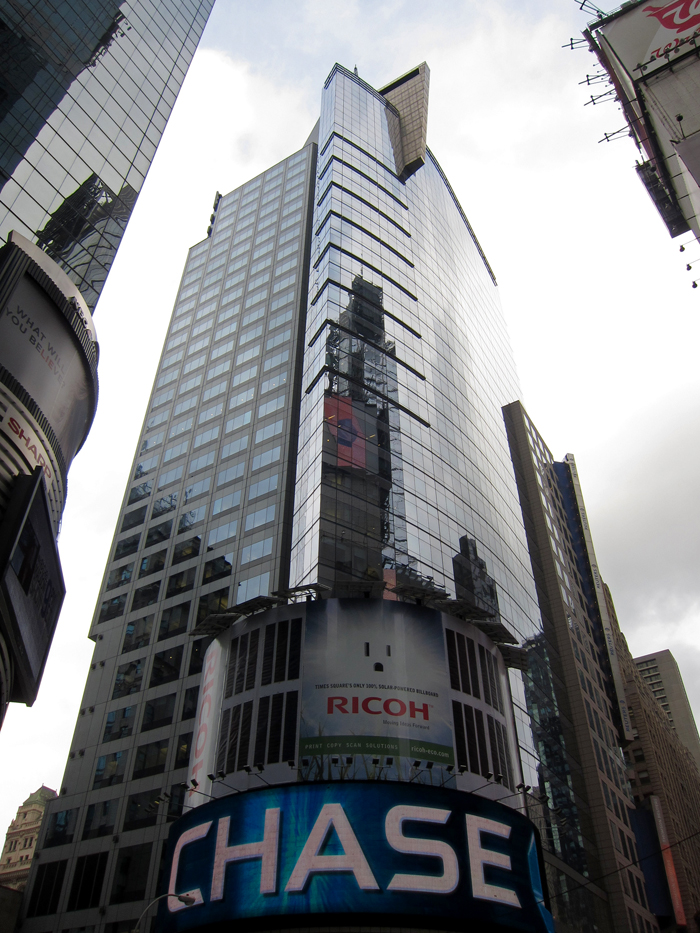
    I needed a bank account, and I was flying over the airport in San Juan, Puerto Rico. As we circled for our final approach, there was a giant Chase logo in the grass below. The geometric octagonal logo* seemed so bold and strong, like a bank should be. And, I thought, it must be a substantial enterprise to have a presence so far from New York City.

    My banking decision was made there on that final landing. On returning home, I opened my first small business account with Chase Manhattan. And my instincts and luck as an inexperienced man were good. Chase has weathered many economic storms and has fared quite well.
    But this is not a story about or a promotion for Chase.

    New York City is a place that you either get or you don’t. Or, perhaps better said, it gets you or it doesn’t. We can make lists of pros and cons. We can make charts and graphs, but like any affair of the heart, love is not about statistics or arguments for or against. New York should make you feel like the impassioned Paul McCartney in the Beatles concert of 1969, where he proclaimed I’ve Got A Feeling from the rooftop.

    When I moved to New York City in 1969, you certainly would be hard pressed to make much of a rational case for the Big Apple. Things were falling apart with the city teetering on bankruptcy. Crime was high, quality of life was low. Graffiti and garbage were everywhere. For myself and my college friends, all of this was just part of the fabric of the city. Shortcomings were only small hurdles to jump over or nuisances to slalom around, but nothing served as a deterrent to living here whatsoever.

    As a place to visit, New York City is certainly easier to sell now. But as a place to live, there are all the same inconveniences of any big city, with new hurdles and slalom poles. If you’re looking for sensible reasons to live here, look elsewhere. If you’re looking for a place to love and one that will love you back, welcome to our world. I hope to find you on a rooftop one day singing I’ve Got a Feeling 🙂

    *The Chase Logo was designed in 1960 by the firm of Chermayeff & Geismar Inc., whose portfolio of work shows an astonishing array of company logos.

    Photo Note: This is the Chase Building at Times Square.


  • Where Sleeping Giants Lie


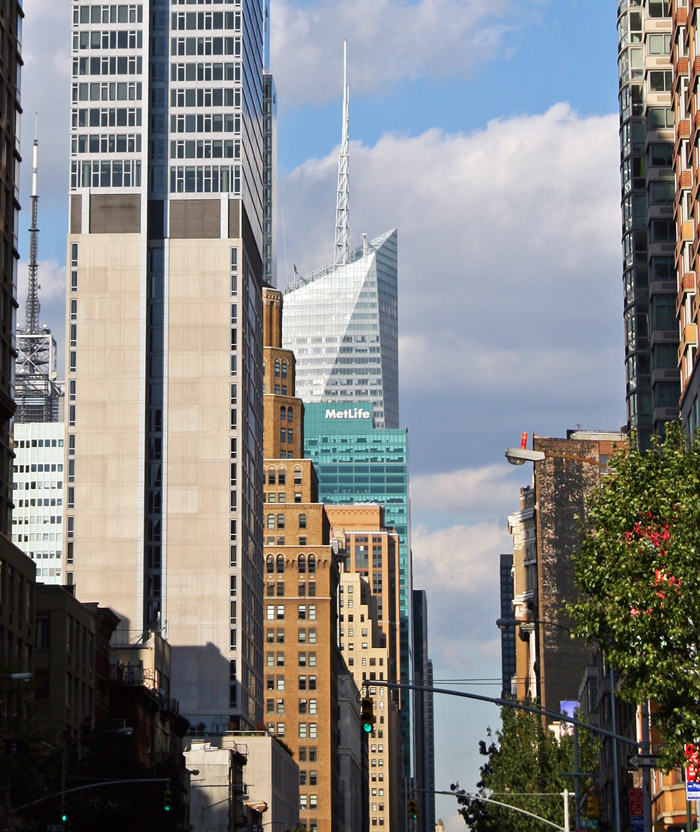
    How absolutely absurd and embarrassing. A small group of us were on a building rooftop admiring the spectacular views of Manhattan when someone asked about the identity of a spired skyscraper. A few of us briefly deliberated and offered our conclusion, which was not called into question – after all, we were New Yorkers speaking and there with natives among us. Why do I say absolutely absurd? Because this is the second tallest building in New York City after the Empire State Building and we misidentified it. In our defense, however, depending on the vantage point and perspective, many a tall building can be out sized by a shorter one, as is the case in today’s photo.

    The Bank of America Tower at One Bryant Park is located on 6th Avenue, between 42nd and 43rd Street. The $1 billion project, completed in 2009, was designed by Cook+Fox Architects and is one of the most efficient and ecologically friendly buildings in the world. It was the recipient of the 2010 Best Tall Building Americas award by the Council on Tall Buildings and Urban Habitat.

    The tower received LEED Platinum certification on May 20, 2010. This is the first time in U.S. history that a high-rise commercial office building has attained the highest LEED green building rating for environmental performance and sustainability. Here are just a few of its green features (see more here from the Bank of America press release):

    Air filtration removes 95 percent of particulates. Most outside air is taken in at 800 feet above street level.
    Water savings of approximately 7.7 million gallons per year are achieved through graywater treatment and reuse, waterless urinals, and low-flow plumbing fixtures. Graywater system captures and reuses nearly all 48 inches of annual precipitation.
    Structural materials include steel made of 87 percent recycled content and concrete made from cement containing 45 percent recycled content (blast furnace slag).
    Ninety-one percent of all construction and demolition waste was recycled or otherwise diverted from landfill.
    On-site co-generation system provides approx. 65 percent of building’s annual electricity requirements, and reduces daytime peak electricity demand by 30 percent.
    The Urban Garden Room provides green public space, reinforcing building’s street-level interactions as well as its connection to Bryant Park.

    How could a number of Manhattan residents not be acquainted with a structure 1250 feet tall? Where could a world renowned, cutting edge, award-winning, 55-story building hide and a resident not even be familiar with its existence? In New York City, of course. Whether it is an Afghani rock star eating at a nearby table, a regular in a park wearing tattered clothes who is a concert pianist with two PhDs in pharmacology (see here), or one of the world’s tallest and greenest buildings – hidden in the crowds of people and buildings among us, this is where sleeping giants lie


  • dinamic_sidebar 4 none

©2026 New York Daily Photo Entries (RSS) and Comments (RSS)  Raindrops Theme