• Category Archives Art and Sculpture
  • Whet Their Appetites

    For two weeks, ending July 5, 2010, 60 pianos will be located in the public parks, plazas, and streets in all five boroughs of New York City. All are welcome to play. I visited a number of these and witnessed all manner of players, listeners, and playing skills.

    Play Me, I’m Yours is an art installation resented by Sing for Hope. The idea was created by British artist Luke Jerram, who has been touring the project globally since 2008 (London is being presented simultaneously with New York).

    The comments on forums online vary wildly – some individuals are in love with the idea and its efforts to bring music to the people. Others are infuriated or just highly cynical. Why are they located primarily in affluent areas, where they are least needed? What about vandalism? Who will tune them? How will chaining them to a cinder block prevent theft? Why did they allow painting of the keys themselves, which will affect playability? Some see its approval by the Bloomberg administration as posturing to feign support of street artists.

    There are certainly worse things to do with people’s time and money. In the few instances I watched at various locations, there were a number of highly skilled pianists and children with audiences. Learning to play a musical instrument is a long process requiring substantial time on a consistent basis. I wish these could be permanent installations, indoors and out, installed in all communities, particularly where there is a real need. The availability of these instruments would go a long way to making an impact and fostering musical interest.

    For those who can already play, this installation provides for many impromptu performances and summer fun. For those who don’t play, perhaps some moments with all that ivory will whet their appetites 🙂

    More about the installation: The 60 pianos will be available to play across New York City from 9am-10pm each day. The pianos are attended by individuals who lock and unlock the keyboards daily. Plastic tarps are on hand for protection from rain. On July 5th, to celebrate the culmination of the Play Me, I’m Yours, the street piano at Lincoln Center’s Damrosch Park will be brought to life by some of New York City’s most talented artists. A map with locations can be found here.


  • Creative Expert

    Years ago, I used to spend many summer afternoons in Washington Square Park watching Dave, a Christian evangelist, make a presentation arguing for the existence of God. Anyone was invited to join the discussion, which, at times, became a quite lively debate. On one occasion, in frustration with someone who was making a number of unfounded statements, Dave retorted, “Saying it doesn’t make it so.” This was the first time I had heard this adage, and I liked it. It applied to so many scenarios, particularly regarding assertions made when asking about someone’s livelihood and answering by giving one’s aspirations.

    Pardon my cynicism, but in New York City, I am forever meeting individuals who are self-proclaimed artists, writers, composers, producers, and recently, fashion designers. I say self-proclaimed because saying it doesn’t make it so and in the art world, credentials can be as simple as a proclamation or business card.

    I once met a fellow tenant in my office building who worked for a company specializing in branding. He offered his services and card – below his name was printed “Creative Expert.” Rather incredulous that anyone would not only make such a bold assertion but then commit it to print, I showed my graphic artist the card.

    Unfettered, my friend assured me that many people will believe what you say, particularly if it is printed on your card. She told me of an instance where she was called for a job – the client had been told that she was a Photoshop expert, which she was not. But it had been said. To this day, we use the phrase Creative Expert as a source of amusement in our office.

    So when I met Geary Marcello and he told me he was a fashion designer in the ensuing conversation, I just filed it for future investigation. His business card read, “Creative Director. Couture Women’s Wear Special Occasion and Costume Design.” Now my antenna went up. Creative director. Fashion designer. These are real jobs, not the more incredulous and nebulous Creative Expert. And certainly a man with a septum curl, tongue chain, goatee, and tattoos is not an ordinary man. But none of this saying makes it so.

    Some online searching and a visit to his website certainly showed that Geary was, in fact, who he said he is. I’m giving him the benefit of the doubt. After all, this is New York, center of the American fashion industry and a city whose streets are populated with many exceptional people. This website is filled with examples of celebrated individuals whom I have met in ordinary places. I am reminded of my encounter with Afghan popstar Walid Soroor, whom I met in an Indian restaurant in Jackson Heights, Queens.

    Of course, the eternal cynic sees the Internet as just another incarnation of the devil’s playground – a new place where saying it doesn’t make it so and a forum for the Creative Expert 🙂

    Note: Geary was extremely congenial and happy to pose for passersby like myself. He hails from Los Angeles, California. His long list of clients includes: Lucy Liu, Bill Cosby, Lena Horne, Lindsay Lohan, Jim Carrey, et. al. You can find his website here.


  • Window of Opportunity

    This is a daily photo website, and although it has evolved to become much more story- and text-driven than at its inception (where the text served as more of a caption), I assume that many of you are interested in photography and imaging.

    The advent of digital cameras has brought many more individuals into photography. The Internet and digital media have provided a myriad of online forums, all easily available to the masses. Camera technology has made it much easier for the average person to get very good results. Preview screens provide immediate feedback, providing an excellent learning tool for identifying problems, rather than having to wait for film processing.

    The cost of photos is essentially free, less amortization of the equipment. This means more photos can be taken, important in difficult shooting situations where a number of shots increases the chances of capturing that special moment. Post-processing on a PC with applications such as Photoshop essentially brings the darkroom to the desktop. For me, this is one of the most important tools in the digital photography process.

    So, with all this technology and increasing numbers of photographers, one problem remains – how do you differentiate your photos?
    Subject and setting. If you are interested in color photography, for example, it is going to be difficult to get the kinds of results Steve McCurry gets just by being in India, Kashmir, Tibet, or another exotic locale, and getting such unique subjects and settings.

    However, few have the ability to travel to locations like these very frequently, if at all. It is unlikely that one will find many unique subjects in and of themselves – in a city like New York, nearly everything has been combed over. A rarely seen subject will require research and travel – places such as the Hole, the Black Cowboys, etc.

    One strategy is to shoot familiar subjects from different vantage points (see Dachshund Octoberfest here) and at different times. Although the magic hour (early morning and at sunset) is often celebrated as the optimal time of day for shooting because of the quality of light (see Light on Bobst here), I also see the early morning as a time to capture activities particular to the early morning (such as deliveries to the meat packing district) or familiar subjects in an atypical way – quieter settings free of traffic and pedestrians and subjects illuminated by the sun in a unique way, like today’s photo of the Washington Square Arch with light pouring through it.
    See you in the morning for that window of opportunity 🙂

    Posts taken in the morning: Hawk Fest, Quietude, 23 Skidoo, Homeless Art Scene, You Don’t Say, Out There, Little in the Middle, Kristen, For Whom the Knell Tolled, Hua Mei Bird Garden, Coup De Grace, Eight Twenty Five, Slummin’, Fresh Meat, True North, Snow Play


  • So Where’s David?

    The ugly American does exist, and I saw him in Florence, Italy, in 2003. He was the poster child, the mold from which all others were cast. I was in the lobby of the Galleria dell’Accademia, where Michelangelo’s David is housed. An American man with his daughter in tow was in line for admission tickets. When I say in tow, I mean it literally. This young girl was being dragged by her father around the museum lobby much like a skier going through compulsory slalom training.

    When his turn came at the window, he was extremely upset that the admission would have to be paid in local currency. Loudly, and for all to hear, the man, in the most critical and incredulous tone imaginable, barked, “You don’t take American?” Not the more appropriate US dollar or even perhaps the American dollar, just American, as if the dollar had such importance, it did not even need to be spoken.

    After getting his ticket, disgusted with the inconvenience of it all, he asked in an impatient tone, “So where’s David?” After being directed, he stormed off, dragging his daughter, as if seeing David was a dirty job to be done, obligated for many reasons, including perhaps the parental responsibility for giving his daughter some culture – the whole event sweetened, perhaps, by a good Italian meal later on.

    The whole situation was quite embarrassing and certainly did nothing to dispel the stereotype of the American as loud, rude, boorish, overly nationalistic, and ignorant and disrespectful of other cultures.

    Seeing the great art museums when in Europe really is a must. However, there are many tourists who do not particularly like art but, for any number of reasons, find themselves slogging through art museums and galleries in an obligatory manner – perhaps as part of a tour, taken by a friend or family member, or as part of a written or hidden agenda.

    On March 26, 2010, Antony Gormley unveiled Event Horizon, 31 cast iron and fiberglass casts of the artist’s body perched on rooftops, ledges of buildings, and the grounds around Madison Square Park/Flatiron District (one is atop the Flatiron Building itself, and one is on the 26th floor of the Empire State Building). For those unaware of the exhibit, naked men looming above the park, peering down from buildings everywhere, can be startling.

    Gormley is an English sculptor and was a Turner Prize winner in 1994. Event Horizon is his NYC art debut. The same sculptures were exhibited in 2007 in London – read more about him and the show here.

    Our American friend in Florence would find this sculpture much more to his liking, I am sure – no currency of any kind is needed, no lines, and the sculpture is everywhere around to be discovered. Perfect for a man who, in one of the world’s great art galleries, finds the prospect of navigating to one of Michelangelo’s masterpieces to be a chore and can only think to ask, “So Where’s David?”


  • The Duke Lives On

    It is hard to believe, but in 1997, when this statue of Duke Ellington was erected, it was the first-ever New York City monument to a black artist and the first memorial in the U.S. to Ellington. The project, originally conceived by American cabaret singer and pianist Bobby Short, took 18 years to come to fruition. Money was not the issue – the $1 million dollars needed was raised rather quickly. It was permission from the various city agencies, commissions, and community boards that became a quagmire.

    Short was inspired by a visit to Paris. From the New York Times:

    The project had its beginning in a stroll Mr. Short took in 1979 through a park in Nice, France, five years after Ellington’s death.

    ”I simply came across this very modest bust of Louis Armstrong and I thought, how strange that here, in France, they have found time and space for a tribute to a black American jazz musician, but in New York I could think of nothing like that,” Mr. Short said. 

    His initial idea was to get friends to put up the money for a similar modest bust of Duke Ellington somewhere in the city.

    Mr. Short formed a nonprofit organization, the Duke Ellington Memorial Fund, and went looking for an artist. The search led him to Robert Graham, a California-based sculptor whose work includes the Olympic Gateway constructed for the 1984 Olympic Games in Los Angeles and the Joe Louis Memorial in Detroit.
    It was Mr. Graham who felt that a bust of Ellington was not appropriate. ”He felt it should be something grand and elegant, the way he perceived Duke Ellington to be,” Mr. Short said.

    A number of sites were considered, eventually settling on Frawley Circle at 110th Street and Fifth Avenue, at the Northeast corner of Central Park – a symbolic gateway to Harlem, where Ellington spent most of his life. An 8-foot-tall statue of Duke Ellington and an open grand piano stand atop a disk supported by three pillars – each pillar comprised of three nude caryatid figures representing the muses, nine in all. The entire 25-foot-tall memorial is done in a black patinated bronze.

    The intersection, renamed the Duke Ellington Circle, was redesigned as two semicircular plazas and forms an amphitheater for musical performances. Now, in memory, music, and bronze, the Duke lives on…


  • Benefactors of History

    Although black and white photography is clearly a result of the historical/technological development of photography, it is interesting to note that its continued use has not been solely related to the momentum of historical precedence or the cost. Color photography dates back to 1861, black and white to 1822. Black and white continued to dominate even after color film was readily available. Cost was a big factor, but there is a classic look preferred by many photographers for certain applications,  such as portraiture, and for its use in film or TV, such as film noir or Rod Serling’s Twilight Zone.

    There is certainly a cult phenomenon around black and white and those who shun color for what they believe is an artistic superiority of the media. Many devotees find color a distraction from the subject and that the lack of color forces the viewer to look at other elements more closely – form, line, etc. Also, many see black and white as more dramatic and better at capturing a mood than color. Portraiture, weddings, and head shots are areas where black and white still continues to have an important role, often supplementing color.

    Of course, many of those hope that the use of black and white will immediately confer a sense of authenticity and historical significance to their photos.

    Typically, advancing technology improves a craft. Sometimes, however, the early limitations of a technology conspire for the greater good. People hearken back to that early technology, not only for romantic reasons but also because under certain conditions, the older tools and techniques produce a superior result to newer technology. This can be seen in many areas. I am certainly not saying that black and white is superior to color – I love color and prefer to shoot in color. The world is in color. But there is a place for black and white, and we are the benefactors of history…

    About the Photo: Pylones is a gift shop featuring housewares, inspired by the elements of childhood – bright colors, bugs – with a strong cuteness factor. Here you will find an creative selection of items for the office, kitchen, beauty, decoration, jewelry, tools, and, of course, for children. Pylones is a small international chain founded in France in 1985 by Alan Ceppos and FrĂ©dĂ©ric Rambaud. There are 5 shops in the US (all in New York City), as well as locations in Brazil, Asia, and Europe. They also distribute their product to other shops. You can see their website here.

    I don’t think Pylones or its products work in black and white 🙂

    Related Postings: Coup de Grâce , Tale of Two Colors, Hispanic Day Parade, Color Brigade, Flamboyant,Building Gone Wild, That’s Quite a Briefcase, Fashion Forward, Taste, Krishna Festival, Police Riot Concert, Narcissism Gone Wild, A Colorful Life, Who See the Red


  • Head for the Hills

    He was a little ungainly and awkward, like Basil Fawlty, John Cleese’s character in Fawlty Towers. But, unlike Basil, who, though incompetent, is basically harmless, my innkeeper had a slightly uncomfortably mysterious side, like Norman Bates of Alfred Hitchcock’s film Psycho.

    The inn, in Southern New England, was perched on a hilltop and had extraordinary views. Most local residents were not even aware that the place existed or that access to this hilltop with such exceptional vistas was possible, much less that an inn was perched atop the mountain. The place was atmospheric and had been hand-built in stone by the owner’s parents with a wonderful flagstone terrace.

    I was compelled to book a room there. I just love the mountains. The innkeeper appeared to be the only one present, and at night, he disappeared to some unseen cottage on the property, or so he said. There were only two rooms in the inn, and on my stay, only my room was occupied. The place was musty. Books were everywhere. At night it was pitch black everywhere and, though intrigued to explore, with my imagination running wild, I decided it best to stay in my room.

    I spoke at length with the innkeeper on one occasion about hill or mountain lovers, and he put it quite succinctly – there are hill people and valley people. If this is how humanity is divided, then I must be a hill person. I do love a mountain drive – the more precipitous, the better. If a Michelin map to a European country I am traveling in indicates a difficult and dangerous road, that’s the road I prefer.
    The hilltop perch is what first drew me to the Tibetan retreat on Lighthouse Hill in Staten Island. Very few visit this remarkable place, and, like my hilltop inn in New England, it is virtually unknown. See additional photos here.

    The Jacques Marchais Museum of Tibetan Art was founded in 1945 and officially opened in 1947 by Jacques Marchais (the professional name used by Jacqueline Klauber), a collector and expert in Tibetan art who acquired the largest collection in the Western world. She never visited Tibet during her lifetime and sadly passed away the year following its opening.

    The rustic complex of fieldstone buildings was designed by Marchais – the architecture, gardens, fish pond, and terraces resemble a Tibetan Buddhist mountain monastery, or gompah. You will also find sculptures on the grounds, as well as bright-hued prayer flags. It was the first Himalayan-style structure to be built in the United States and the first museum in the world devoted exclusively to Tibetan art. The Dalai Lama himself paid a visit in 1991. In addition to the museum’s display of art and objects, there are classes and special programs. My first visit was for a Tibetan festival.

    Of course, the love of mountains as a building site is far from being my exclusive passion – Lighthouse Hill, along with nearby Todt Hill, has some of the most opulent homes on Staten Island. The preference of hills and valleys is replayed around the world by the well-heeled. Some will live in the valleys or by the ocean, while others, with a penchant for drama, danger, and vistas, will head for the hills 🙂


  • Finger Painting


    I never really liked finger painting, but between K-12 in the public school system where I grew up, that was my first and only exposure to art. At the time I entered university in New York City, I had neither seen even one work of art nor was exposed to any form of classical music or opera. Music class in grade school consisted of mass embarrassment and faces buried in songbooks, with a handful singing and the rest lip-syncing.

    There were some art electives in high school, but not many boys are going to take an art class when the sciences are championed above all else and defended on the basis of utility. Of course, preparing for the future is sensible, but somewhere in the education of an American student, shouldn’t there be some exposure to the fine arts, if only that it is part of what makes an educated person in a civilized world?

    My first exposures to art in galleries and museums of New York City were not good. I did not understand what I was seeing or what art was. The explanations, interpretations, and definitions were more vexing than my initial frustration, so I became defensive, seeing the world of fine art as one of impostors and charlatans. The fact that many artists are iconoclastic made matters worse – the lack of definitions and ways to measure art made it seem all the more whimsical and arbitrary to anyone inclined to numbers.

    New York City has been a mecca for art and artists of every type for eons, and in time, a reasonable person begins to look at art seriously. Only the most obstinate can live in this city and maintain a militant anti-art posture for long.

    In the last decade, over 250 galleries have moved to Chelsea. Only vestiges remain in neighborhoods such as SoHo. The more recent exodus has been out of Manhattan entirely to areas such as Williamsburg and Red Hook in Brooklyn.

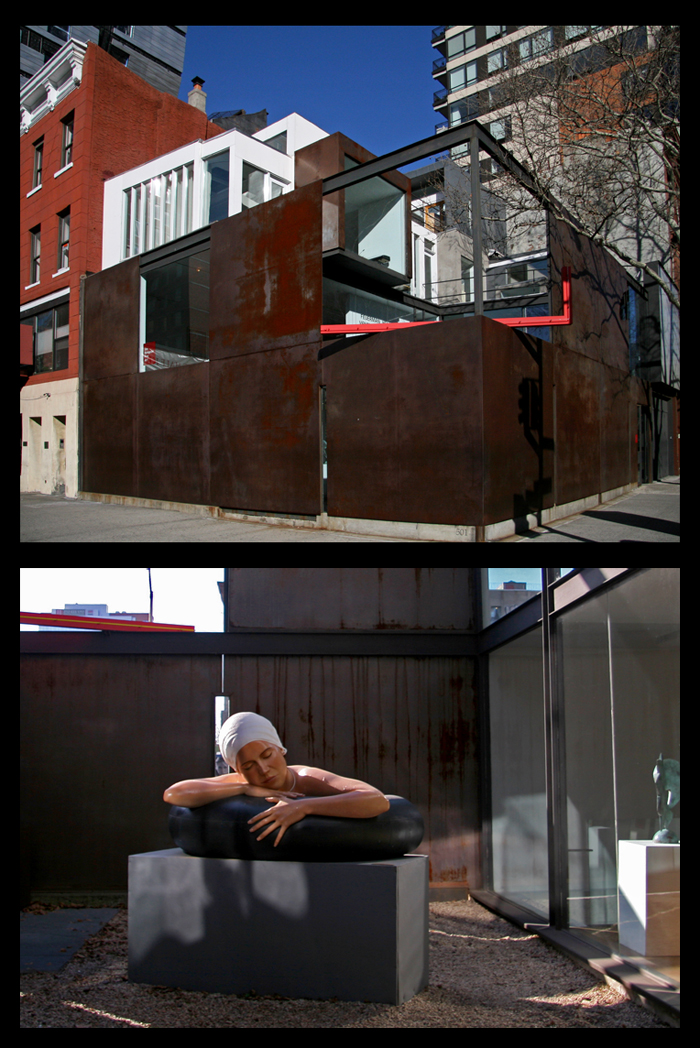
    The gallery in the photo is located at 501 West 23rd Street at Tenth Avenue and was the work of architects G. Phillip Smith and Douglas Thompson. The building was a work in progress over ten years, starting with a vacant lot. The design was inspired by the projecting balconies and walled courtyards Cairo houses of the 17th century. The exterior of the structure was built from sheets of cold-rolled steel and glass – the interior uses timber framing, stucco and fiberglass. See the New York Times article here.

    The building houses Jim Kempner Fine Art, which specializes in contemporary art in all media and has shown world renowned artists since its opening in 1997. The courtyard currently features the sculptural work The Survival of Sirena (seen in the photo) by Carole Feuerman, part of her exhibition Swimmers, Bathers, Nudes. I’m just really happy I can enjoy art in New York City and no longer have to do finger painting 🙂


  • The Lomo Look

    I do believe that there can be great value in de-emphasizing the tools in many endeavors. Technology has advanced so far that in many fields, it is very easy to get lost in the tools of the trade. In photography, particularly, the number of devices and accoutrement is extraordinary, and many photographers do become obsessed with the gadgetry.

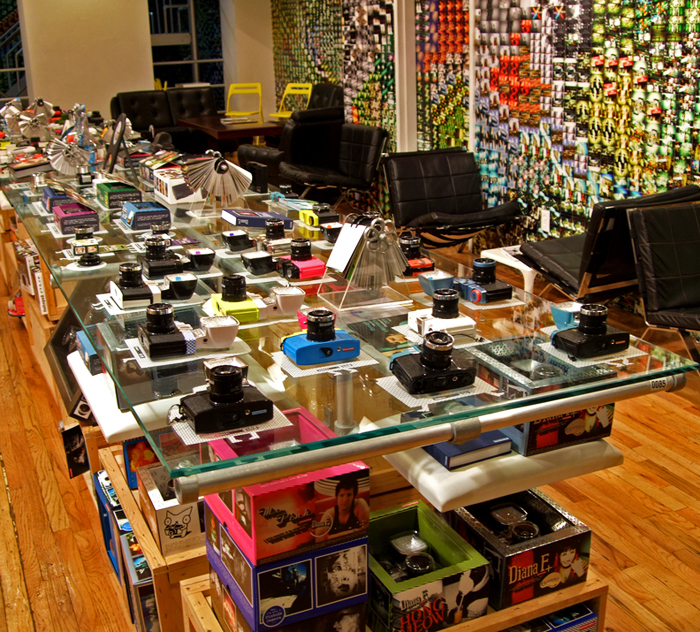
    There are numerous cameras in the “toy” camera category which have found favor with members of the photographic community and students. They typically were inexpensive plastic cameras, many produced as novelties, which often produce strange and unpredictable results. Some cameras in this class will even display evidence of light leaks. Many, like the Holga, Diana, and Lomo, have developed cult followings, owing to these photographic effects. The Diana was originally produced in the 1960s in Hong Kong and was a predecessor to the Holga, which was made in China (first appearing in Hong Kong in 1982).

    In 1991, two Austrian marketing students discovered the LOMO LC-A, a camera introduced in 1984 by a state-run optics company in St. Petersburg, Russia. They became enchanted with the photographic results of the Lomo camera, which will show any combination of bright colors with somewhat garish, contrasty images, often with blurring and vignetting.

    Use of low fidelity toy cameras can be a very useful exercise in learning to focus on the art of photography, training the eye, and playing down the technology. There is no question that good work can be produced using low tech camera equipment and conversely that poor work can be done with top equipment. Some award-winning photos were created using Lomos and other cameras of this class.

    However, the bottom line with this type of camera is that you give up a lot of control. Using it becomes an exercise in working with (or around) the camera’s “flaws.” If you are interested in controlling depth of field for portraiture, shooting in very low light with high ISO, achieving sharpness with high quality lenses, exposure compensation, white balance, etc., these types of cameras will show their limitations. However, the lack of control is not only their weakness but also the appeal of these cameras. The fact there is a very distinctive Holga or Lomo “look” is a result of these cameras’ anomalies or limitations.

    Lomography is the trademark of Lomographische AG, founded by the two Austrian students, who, in early 1995, negotiated exclusive distribution of the Lomo LC-A. Lomography also distributes a number of low cost analogue cameras, such as the Diana and the Holga.

    The photo is from their new shop located at 41 West 8th Street. Lomography has 20 retail store/galleries worldwide – the New York City shop is currently the only location in the United States. The shop sells cameras, film, accessories, and books. It will be introducing on-site film processing. They offer classes, workshops, and meetings each month. The store also features North America’s largest LomoWall, with 35,000 Lomographs on display. If you visit, you can see the equipment, as well as examples of the photography, and decide for yourself what you think of the Lomo Look 🙂


  • White by Design

    In the beginning, I would take the conversations seriously. By seriously, I mean attentively, with a reasonable expectation that I would get different responses regarding suggestions for color. Soon, however, I realized that each of my best friend’s answers would be presented and argued differently but the preferred color in almost any situation was the same: white.

    It became a private joke between this long-time friend and other close friends. Her design choice appeared to always be white. Drapes, wall color, clothing – anything that was available in white was usually chosen or recommended.

    With absolute serendipity, many years later, I discovered a hardcover book: White By Design by Bo Niles (published in 1984 and still in print). It was a virtual tribute to white and its use for interior decoration. The perfect gift. But, alas, I was too lazy to purchase it. One of life’s small regrets.

    White is so important to visual artists. It is the color of light itself, and artists love and need light – it is one of their primary tools. I remember how surprised and disappointed I was when Apple Computer went from their six-color rainbow logo to white in 1998. Eventually, even their pioneering success in translucent color iMacs gave way to white. Now I love the white that dominates the color theme for Apple’s packaging, graphics, and product line.

    White has an elegance when used well as a decor choice. It not only gives a clean look but also allows other objects to shine. Used badly, white can be a horrific choice – everything is mercilessly revealed with white. It is also deliberately and conspicuously impractical, making a statement about luxury and the ability and willingness for maintenance. The decision to use white in an unforgiving city such as New York makes a particularly strong statement.

    White has cultural significance and is associated with purity, freedom, and cleanliness. There is a litany of positive associations in so many areas of life. We have white sugar, pure sand, snow, cotton, clouds, milk, white uniforms, white rooms, the White House, the white dove of peace, white robes of clergy, white bridal dresses, and white magic.

    This shop in SoHo, the Cyrus Company, was arresting in its use of white. I was reminded, however, of the book I never purchased. But then, as now, there is always time, because the world never tires of white. In many ways, much of our world is White by Design 🙂

    For more White by Design, go here and here.

    Related Postings: That’s Quite a Briefcase, Who See the Red?, Coleur du Jour, Tale of Two Colors, A Colorful Life, Color Brigade, Eye Candy


  • Montmartre and Peillon


    I love my places high and my neighborhoods charming – bucolic and oozing with character, history, fine architecture, and artists. My neighborhood in New York City, the Village, certainly has many of these attributes. But to get the full package, I go to France.

    My favorite indulgences are the village perchĂ© (perched villages) in the South of France – small, hilltop medieval villages. I have been obsessed with these places, at one time compiling a database of 269 of the most wonderful and cross-referencing them with my collection of books on French villages. I created database entries for comments and checkboxes to note which books recommended which villages.

    Too small to find in the Michelin Map index, I laboriously located all of the villages through map exploration, tagged them in the maps, and added the map coordinates to my database for future reference. I included the official French département. The printed result became a guide for my travel to Provence, the Alpes-Maritimes, and Vaucluse.
    I visited dozens of these villages, often to the chagrin of my travel companions. On one family trip, my sister was completely befuddled as to why I would do this and why anyone would want to travel that way. I think she saw it as analogous to painting by number. I like numbers, and my desire to accumulate villages visited knew no bounds. My favorite is Peillon, perched in the hills, with stone houses clinging to a cliff face at 1000 feet.

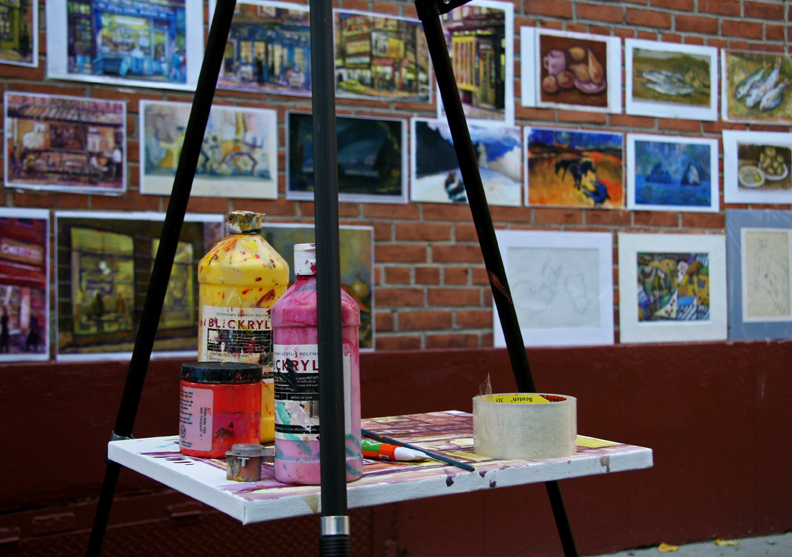
    There is still some artistic flavor to Greenwich Village, but most of its art history is in the past. Its legacy of beat poets, artists, musicians, writers, dancers, actors, and performers reads like a who’s who of the American arts. The neighborhood has become much too expensive to really qualify as any type of artistic bohemia. However, musicians and performers are common, and occasionally, one may still see someone painting in the streets or parks of the Village.

    Today’s artists here typically either travel in and out of the city or are some of the few remaining beneficiaries of rent controls, living in below-market rentals.
    Much of the Village has been commercialized and is heavily touristed, but no one has taken away the charm of many of the neighborhood streets and its collection of hundreds of 19th century row houses. The West Village is particularly beautiful.

    In Paris, I get all this with hills (over 400 feet) in Montmartre, an area also known for its history of artists. Those who worked in or around Montmartre include Vincent van Gogh, Picasso, Salvador DalĂ­, Modigliani, Claude Monet, Raymond Duchamp-Villon, Henri Matisse, Renoir, Degas, and Henri de Toulouse-Lautrec. Somehow, street painters there today still seem to have a little more authenticity, but I would imagine a Parisian might see them the way we see painters in New York City – as exploiters and sellers of an artistic past to tourists.

    As I stroll the Village, I head for the hills. In the distance, I think I see Montmartre and Peillon…


  • Criminal Suspect

    Why was I being followed by a police vehicle while driving slowly down Main Street? I was not stalling traffic in any way.  In fact, I was the only automobile going down Main Street in Bristol, Connecticut, the town in which I grew up. I was showing a friend, who was an architect, the tragedy that was Main Street in this factory town. The left side of the street had original structures and was actually charming.

    But the right side had been completely ripped down to make way for a small shopping mall, destroying all future possibility of any historic revitalization of this downtown. I expressed my frustration to my companion of how emblematic this was of the type of thinking – to modernize rather than preserve – that one might have found at one time in towns across America. I think that today there are more examples of preservation of older architecture/districts and the value and positive results in doing so.

    The policeman actually followed us into the shopping mall parking lot and watched us leave the car. It was eerie and scary, honestly. I have a theory of why I was followed, part of which is that apparently anyone perusing the architecture in Bristol, Connecticut, is a criminal suspect, particularly someone in a vehicle with New York license plates.

    Being ostracized for thinking differently is one reason why I moved to New York City. Things have changed, of course, and with the plethora of media and the Internet, perhaps one is less of an outcast for being different in the small town today.

    In New York City, however, with time and effort, you can not only be tolerated but also create a persona and become a small living legend by being different. Whether it is Adam Purple, graffiti artist Adam Cost, streetlamp Mosaic Man Jim Power, Tower of Toys builder Eddie Boros, or gender bender and fashionista André, you can turn eccentricity into celebrity. You can take a singular passion or talent and run with it.

    It can be a very singular interest, perhaps decorating a bicycle over a period of 24 years, like that of Hector Robles in the photo. Hector grew up on the Lower East Side of New York City, on 7th Street between Avenues C and D. He currently lives in Staten Island and makes the journey to Manhattan with a combination of bus, ferry, and subway, toting his bicycle the entire way. The vehicle is in a constant state of flux, a work in progress. Hector, who is of Puerto Rican ancestry, is quite religious, as can be seen by the numerous figures and images adorning his bike.

    I don’t think Hector would fare well in Bristol with his bicycle. I am sure he would be tolerated, but I doubt he would be celebrated. And I hope he wouldn’t be treated like a criminal suspect 🙂


  • DUMBO Arts Festival 2009


    “Everything has been done” is a commonly repeated mantra in the art world. The truth in this is often seen in various art forms such as music, where creating new, interesting, and durable work becomes more and more difficult. Occasionally, a prodigy is hailed as the next Mozart and, of course, never is.

    In the world of contemporary art, new technologies, materials, and media are often introduced to create works previously impossible. Availing oneself of these elements does not guarantee success, but sometimes creative applications give pleasing results.

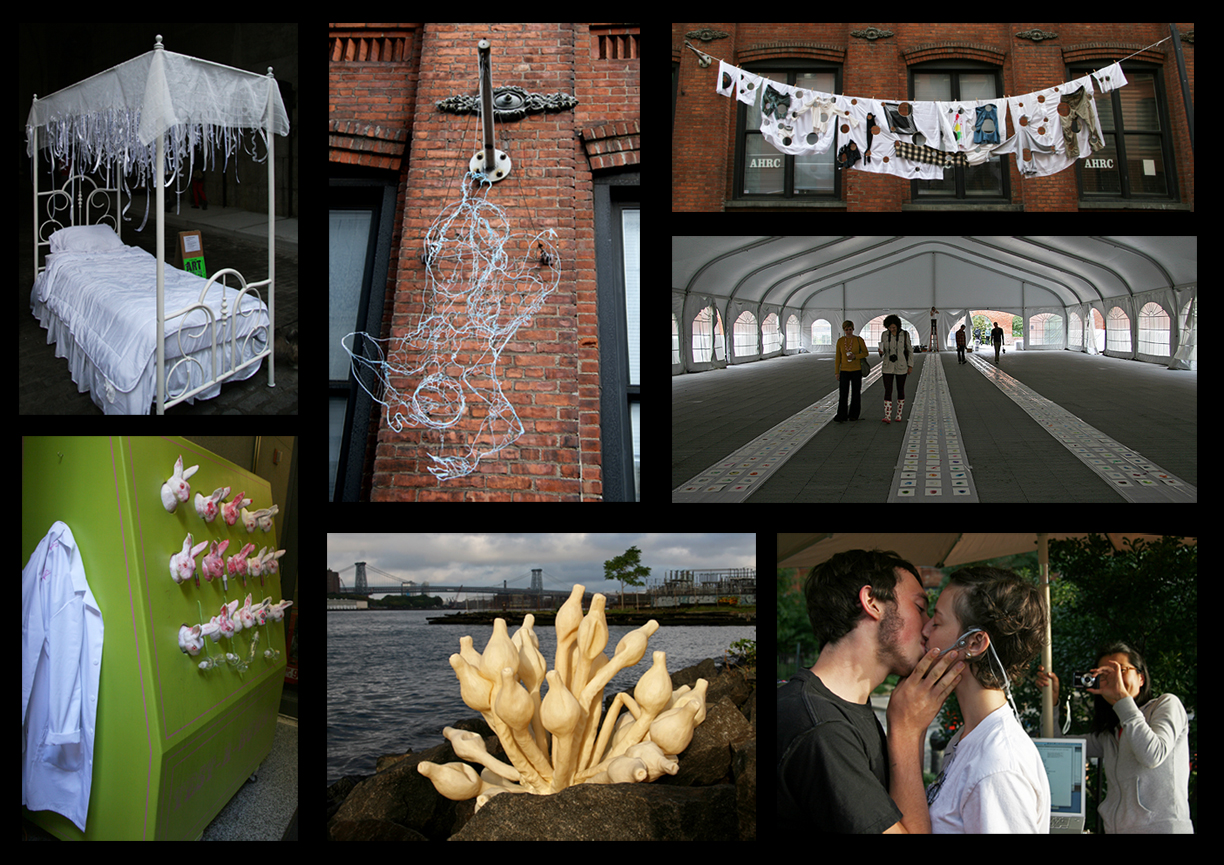
    This weekend was the 13th annual DUMBO Art Under the Bridge Festival:

    The three-day multi-site neighborhood-wide event is a one-of-a-kind art happening: where serendipity meets the haphazard and where the unpredictable, spontaneous and downright weird thrive. The now teenage D.U.M.B.O. Art Under the Bridge Festival® presents touchable, accessible, and interactive art, on a scale that makes it the nation’s largest urban forum for experimental art.

    Art Under the Bridge is an opportunity for young artists to use any medium imaginable to create temporary projects on-the-spot everywhere and anywhere, completely transforming the Dumbo section of Brooklyn, New York, into a vibrant platform for self-expression. In addition to the 80+ projects throughout the historical post-industrial waterfront span, visitors can tour local artists’ studios or check out the indoor video_dumbo, a non-stop program of cutting-edge video art from New York City and around the world.

    The festival itself is somewhat unstructured and unpredictable. Many of the artists on the program map were nowhere to be found (inclement weather may have been a factor), and many of the exhibits required some diligent searching to be found. Typically, the artists creating the work were on hand and were quite approachable, eager to discuss their work. See gallery of photos here.

    One interactive work which many found engaging was Kissing Under the Bridge by Hye Yeon Nam. In this, a couple volunteers to digitize their kissing:

    The Sound of Kiss facilitates an amorous ambiance in which couples digitize their love while kissing. One wears a headset and the other’s tongue is affixed to a magnet. When they kiss, the magnet and the electro-magnetic sensor interact to create spontaneous music. The musical composition depends on how far one’s tongue is away from the other’s lips/tongue and their style of action.

    I empathize with the artist, particularly after working on this website for 3 1/2 years and endeavoring to show the places, people, and things of New York City from a new perspective through the lens of my personal experience.

    When the going gets tough and one’s work is called into question, perhaps an artist should be prepared to defend it using the words of Robert Rauschenberg: “This is art if I say so.”:)

    Related Posts: DUMBO Arts Fest 2006, Sink or Swim, Gallery View, Night in Bloom, One Front Street, DUMBO


  • Commitments

    Even with peer influences, I was never able to bring myself to get a tattoo. I entertained the idea briefly – some tattoo work was and is quite impressive.

    However, there is the issue of an ever present statement being made to others, and then there is the near permanent commitment. That’s the real horror for me – what if I change my mind?
    In a 2008 Harris Poll, 84% of those with a tattoo say they did not regret having a tattoo. That leaves 16% who do regret it, and I’m sure I would be one of those. Laser removal is an option, but with no guarantee of 100% success. Plus, the whole thing is such an ordeal. Better to admire the body art of others and marvel at their bravery (or reckless abandon).

    I recently happened upon this building in the East Village at 324 East 4th Street between Avenues C and D while visiting the community garden El Jardin del Paraiso. I found it stunning. There is much public art in New York City, large and small, both graffiti and sanctioned work.

    What’s unusual here is that we have the face of an occupied residential building in Manhattan fully painted with a mural. One of my first reactions when I saw the facade of this building was, “Wow, that’s a serious commitment.” Of course, unlike a body tattoo, a change can be more easily made – the building’s surface can always be repainted or stripped, but I would guess that this is unlikely in the short term. Nonetheless, a statement and a commitment have been made…

    About the mural and its artists: This mural was done in 2005 by two artists from Chile: Cern and Cekis. Their work can actually be seen all over New York City.
    If you examine the painting closely (click photo to enlarge it), you will notice at its base a cluster of tall buildings with birds, both perched and in flight. At the top, the main figure (with blue toenail polish matching her blouse) appears to be carrying a suitcase, while being watched by a cat. A tree frames the right side of the building, extending onto the cornice. Any interpretations?


  • Local Color

    The Howl! festival and its umbrella organization FEVA (Federation of East Village Artists) were the brainchilds of Phil Hartman, filmmaker and owner of Two Boots Pizza. Hartman was motivated to start FEVA to arrest what he saw as the rapid erosion of the spirit of the counter culture in the East Village. Learn more about Howl! at my 2007 posting here

    There are inherent contradictions with avoiding the commercialization and institutionalization of any successful counter cultural event such as Burning Man or Howl! Ultimately, these efforts do need some sort of financing and thus do not escape the grip of business. From the New York Times:

    Mr. Hartman, an entrepreneur whose main form of transportation is his bicycle, is not oblivious to the paradox of his ambition. “The idea of institutionalizing downtown culture obviously has inherent contradictions in it,” he acknowledged. “The counterculture isn’t dead but it needs some institutions to keep it alive.”

    As early as 1969, when Theodore Roszak wrote his groundbreaking work, “The Making of a Counter Culture ,” the notion of the free-spirited 60’s was being co-opted, patented and packaged. The process has become more sophisticated now, in an era when Bob Dylan became a shill for Victoria’s Secret – and Pepsi, which long ago recognized the marketing potential in the avant-garde, is a sponsor of the Howl! Festival.

    “Some people have gone so far as to say the counterculture was hopelessly naĂŻve if it thought it could escape institutionalization, that nothing does” said Todd Gitlin, a professor of journalism and sociology at Columbia University and a former president of Students for a Democratic Society. “I have some sympathy with that argument. People will be glad to see their old Grateful Dead posters enshrined in a proper museum setting.”

    The success of the art community and events such as Howl! create more interest in neighborhoods such as the East Village and only exacerbate the problem of real estate development and rising rents. The older regime of artists hangs on, protected by rent-controlled and rent-stabilized apartments, but it is essentially impossible for any new generation of developing artists to get a foothold in an area such as the East Village/Lower East Side. New neighborhoods, such as Williamsburg, Brooklyn, become the new “art districts.” However, a desperate environment and rapid communication give these areas a very short window of opportunity. The lack of rent regulations in newly converted properties means that any favorable rents will last only as long as the length of a lease. Yesterday’s opportunity becomes today’s liability.

    Even in a  recessionary climate, New York City has virtually run out of affordable housing. Enjoy the local color while you can…


  • dinamic_sidebar 4 none

©2026 New York Daily Photo Entries (RSS) and Comments (RSS)  Raindrops Theme