• Category Archives Extreme NYC
  • Explorin’ Part 2 – Dead Horse Bay

    Posted on by Brian Dubé

    (see Part 1 here)


    The name Dead Horse Bay is provocative enough, and the place easily lives up to its name.

    A coworker told me about this beach in Brooklyn, along with a requisite piece of information – go during low tide. So, I examined the tide tables for Jamaica Bay, New York City, and timed my trip accordingly. I parked my vehicle at the ranger station at Floyd Bennett Field. A walk across the main thoroughfare and short hike through the beach forest trail opens up to the bay. Surprisingly, none of the rangers had made the hike and were eager to hear my report upon return.

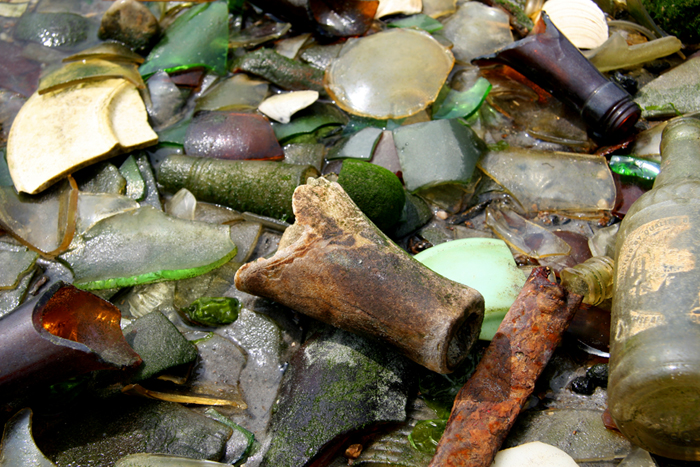
    The beach is strewn with a myriad of artifacts – primarily glass bottles, forming a blue-green carpet of glass. Make no mistake, however – Dead Horse Bay is essentially a beach of trash, albeit very interesting trash. There are dishes, toys, parts of sinks, rusted metal devices, and even mating horseshoe crabs. See my gallery of photos here. The history of this bizarre place is always the first question asked. From the New York Times:

    Dead Horse Bay sits at the western edge of a marshland once dotted by more than two dozen horse-rendering plants, fish oil factories and garbage incinerators. From the 1850’s until the 1930’s, the carcasses of dead horses and other animals from New York City streets were used to manufacture glue, fertilizer and other products at the site. The chopped-up, boiled bones were later dumped into the water. The squalid bay, then accessible only by boat, was reviled for the putrid fumes that hung overhead.

    Once marshland, the area became slowly filled with trash and the landfill capped. The cap burst in the 1950’s, spewing articles from the early 20th century into the surrounding beach water.

    After walking the entire beach, I was prepared to leave. However, the fact that I had seen no evidence of dead horses was nagging at me, so I decided to backtrack and question a woman who, I had noticed earlier, had been combing with the intent of a repeat visitor. Alas, good that I did – Angela pointed out that horse bones were, in fact, everywhere – you just had to know what to look for. Sure enough, once they were pointed out to me and my companion, we saw them everywhere. Angela had found what appeared to be a 32-sided game die and asked if I could take photos for her. You can see it here.

    If you visit Dead Horse Bay, remember to wear good shoes/boots to protect you from all the shards of glass and other sharp objects. Oh, and happy explorin’ 🙂

    Posted on by Brian Dubé

  • Explorin’ Part 1

    Posted on by Brian Dubé

    We learned to travel through the forest canopy ala Tarzan (sans vines) by climbing atop young saplings and swinging side to side, gaining enough movement to grab a neighboring tree and cross over. We crossed swamps, jumping from one tufted outcropping to another. We fell from trees and into swamps too.
    We found snakes under hot rocks – we learned that they loved to bask in the heat of the summer sun. We found newts, tadpoles, turtles, and salamanders. We marveled at nature’s iridescence in the damsel fly. We believed in the dangers of a dragon fly sewing your eyes shut, as well as other myths, not knowing they were myths at all.

    My summer days were filled with exploring, from sunup to sundown, until my mother’s call brought me back from the wild. More correctly, I should say explorin’, because that is precisely what we called it – the lack of a “g” conferring a certain sense of casual authority of the experienced adventurer. “Explorin'” was always the answer to the daily “Whataya want to do?”

    Later, I read the wonderful tales of African adventure by Jean Pierre HalletCongo Kitabu and Animal Kitabu. Although my native habitat was not Africa and no real treasures were ever found, it mattered not in the least.
    We made primitive toys and weapons. With crudely fashioned bows that rarely worked, we stalked the woods like Robin Hood. We made kites that would not fly from salvaged fabric and twigs. A string, stick, and small hook was enough to spend a day fishing lost items from below the steps of a basement hatchway. We rolled down hills in reclaimed appliance boxes. There was no particular agenda or mission when explorin’ – just the joy of looking. And we loved the woods best of all.

    These days, although I have yet to travel to the Amazon or Congo, I find New York City serves as a fine place for any Jungle Lover with a hankerin’ for explorin’. There are plenty of woods, beaches, alleys, rivers, lakes, bays, wildlife, and backroads.

    On Saturday, armed with that childhood spirit of explorin’ and on the recommendation of a coworker, I set out to explore a most bizarre place, the result of a strange twist in New York City history. Tomorrow, I will show you what I found on the other side of those dunes in Part 2 of Explorin’…

    Posted on by Brian Dubé

  • Eyes on the Signs

    Posted on by Brian Dubé

    As Jerry Seinfeld once pointed out in one of his comedy routines, the beauty of clothing is that adjustments and improvements can always be made. But in the case of nudity, no tweaks are possible. Essentially, the naked person is saying, this is the best that I can do.

    In the classic episode The Apology, the distinction is made between good naked and bad naked – they were not talking about morality, only aesthetics. And when you get a large group who come from the general population and not the world of modeling or body building, you are sure to get plenty of bad naked. I know there are those who defend all bodies as beautiful, but I think in this case, I side with Seinfeld over artistic idealists.

    Appropriate or inappropriate, legal or illegal, good naked or bad naked, public nudity is sure to draw attention, which is just what demonstrators get when “clothing optional” is part of the equation. See more of my photos of this event here.

    However, anyone inclined to this type of strategy to make a political point had better realize that what will be remembered is often only the nudity. Lively discussions will occur during and after such a protest, but mostly over the details of how naked any participants were and how various body parts were covered or decorated. In fact, after the members of this ride left Washington Square Park, I showed a number of friends some of the photos I had taken – there was surprise regarding the rider who had painted “Oil is dead” on his back. Apparently the message and numerous signs regarding oil did not make itself clear.

    Many observers will likely believe that this ride is just an expression of personal freedom or wild reckless abandon. There is an element of that, of course, once an event like this is under way. It is doubtful a ride like this will be dominated by the shy or prudish. The event does become an exhibitionist theater on wheels. However, the World Naked Bike Ride is an international annual event “to celebrate cycling and the human body. The ride demonstrates the vulnerability of cyclists on the road and is a protest against oil dependency.”

    The demonstration went smoothly in the park – there was plenty of reveling in the park’s fountain. The police were quite tolerant, even though many of the male participants were completely nude and technically breaking the law. One officer was making his compulsory rounds, chanting an obligatory “Put your clothes back on.” The event is best served if riders keep their eyes on the road and observers keep their eyes on the signs 🙂

    Posted on by Brian Dubé

  • Catch Em If You Can

    Posted on by Brian Dubé


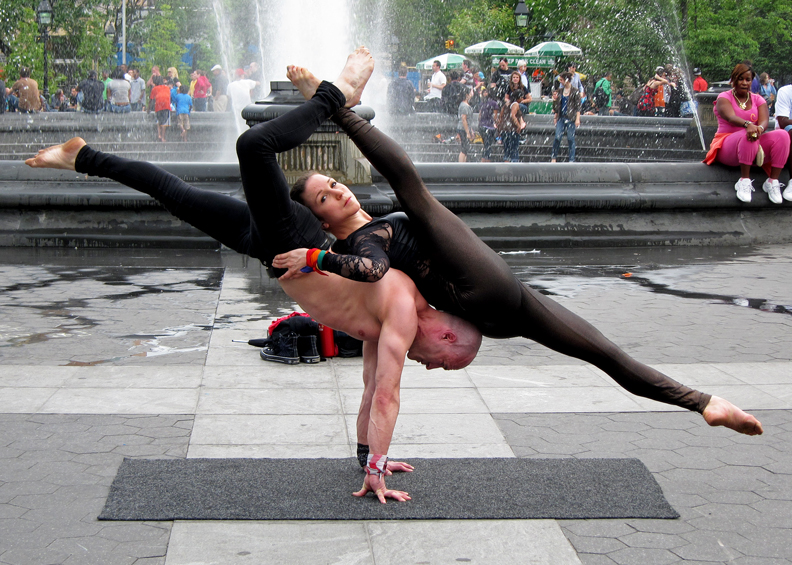
    When you happen upon a hand balancing act on the street and are reminded of the Alexis Brothers* from Cirque du Soleil, you know you are seeing world-class professional talent. I have done many stories on street performers, particularly in Washington Square Park, including a recent one on street acrobats. In the interest of variety of subject and setting, I try to limit posts on a particular topic.

    However, watching the duo in the park on Sunday afternoon, shown in today’s photo, it was immediately apparent that this was not your average street show. The display of strength, skill, movement, and presentation was remarkable in this hand balancing act with Rudi Macaggi and Lea McGowan. The audience was transfixed.

    Rudi is a third-generation entertainer and acrobat from Milan, Italy, who has traveled the globe, performing on stage since the age of 7. He has worked venues in Las Vegas and Atlantic City and has had national television appearances on Penn and Teller’s Sin City Spectacular and The Tonight show with Jay Leno. In 2006, Rudi won first place in the Crazy Caliber category of the TV show America’s Got Talent.

    Rudi’s one-man show has been seen around New York City at clubs such as the Slipper Room and the Box (both in the Lower East Side). The Acromedian does a one and a half-hour show – an amalgam of visual comedy, hand balancing, acrobatics, story telling, and standup, peppered with his famous quip, “I like you.”

    His street show featured his hand balancing routine with Lea along with a number of stunts, such as doing a one-armed handstand while dribbling a basketball, as well as his finale of a back somersault landing in a one-armed handstand. Always on the move, catch ’em if you can 🙂

    *Note: If you have never seen the hand balancing act of brothers Marco and Paulo Lorador, who performed in Cirque du Soleil’s shows Saltimbanco and Mystère, you can see a video from their act here.

    Posted on by Brian Dubé

  • White by Desire

    Posted on by Brian Dubé

    I can’t say that New Yorkers have an exclusive on making impractical choices, but examples do abound that give evidence that it is at least a worthy contender in any competition for foolish choices. Trends and fads drive residents of this city as much as anywhere else, where it often seems that displays of extreme lack of sensibility is its own form of rebellion.

    And what better way for some to display that defiance by sporting a large dog with roots from a climate completely antithetical to that of New York City? Breeds inappropriate in any number of ways for city life, or ones requiring extreme maintenance.

    I recall the 1980s, when the Shar Pei, with its heavily wrinkled skin, was all the rage. Rapid breeding resulted in many health problems, such as allergy-induced skin problems. Many required eye surgery, with some owners seeking the skills of a eye surgeon for people. I rarely see the Shar Pei here any longer. Akitas were also quite popular at one time. Now I often see the Shiba Inu, a small hunting dog from Japan with a cute, foxlike appearance.

    On Sunday, I met Sofie, a beautiful, cheerful, friendly Samoyed – a breed originating from Siberia that is a nomadic reindeer herder. They have a dense double coat, which means lots of hair shedding. They are very youthful, energetic dogs with a desire to pull sleds and a love of the cold. Perfect for the Manhattan apartment resident, n’est-ce pas?

    Their cheerful nature and beautiful white coat, for many, outweigh any practical considerations. The breed’s ear-to-ear smile has given the Samoyed its alternate name, “smiling sammy.”

    In fairness, after speaking to the owner, I found that Sofie is very well cared for. It is possible to keep a dog like this healthy and happy in a New York City apartment with work, and many pet owners are ready, willing, and able to do whatever is necessary.

    Samoyeds are extremely well-insulated. Sofie actually loves sleeping in the snow. In their native environment, Samoyeds kept their owners warm at night by sleeping on top of them. The dog’s owner told me that once it begins to get warm at all, she runs her air conditioning 24/7.

    I was surprised to learn that early Samoyeds also came in black – white has become dominant due to popularity. If not for the constant care and responsibility, I could easily fall for the cheerful charm of the Samoyed. I, like many others, do love that white color, and the Samoyed that we see today, more than White by Design, is White by Desire 🙂

    Note: For lovers of white, see my stories White by Design, White by Design 2, and White by Design 3.

    Posted on by Brian Dubé

  • Swaggertist in Blue

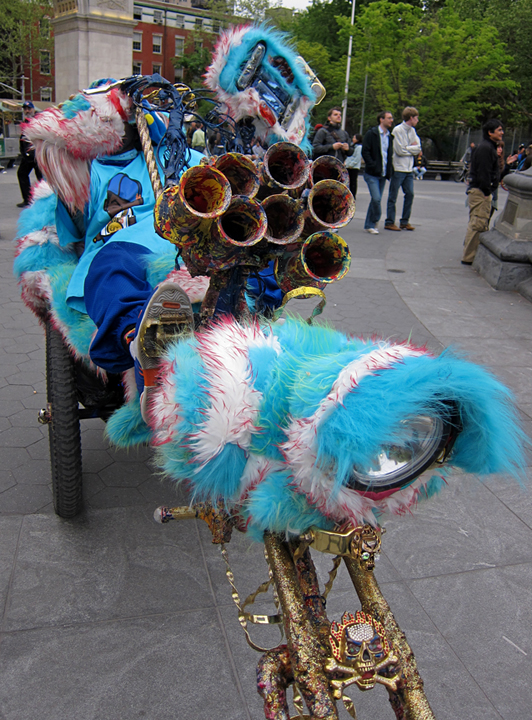
    Where would you find a man who is a roller skater, saxophonist, writer, composer, recording artist, and inline skate trainer, who had a hit single on Billboard for 13 weeks (“Funky Bebop”), has a Masters degree in group therapy (with work done towards a Ph.D), and travels on an outrageous fur-covered trike? In New York City. See additional photo here.

    And, of course, a man with this many incarnations would be expected to have had as many names – Bladie aka Bladie Flowness, Vin Zee, Vinzerelli, Vincent Brown. Now reinvented on his trike as the Swaggertist. I cannot attest to all his claims, but it would be fair to say that the man is a one-man self promotional campaign on wheels.

    Bladie was involved in musifying the roller skating scene in Central Park, what he calls the ultimate dance party on wheels. The New York Times wrote: “There are the old-timers, like Bladie Flowness, who has dreadlocks and a dyed beard and sails against traffic doing tai chi in multicolored Bedouin pants.”

    After meeting Bladie and introducing myself, Bladie gave me one of his music CDs and a DVD compilation of various clips of him. This bike is not his first, and he has been known for colorful dress since his early days on the skating scene.

    However, it takes more that just chutzpah, bright colors, and a turquoise fur-covered trike to become successful or get attention in New York City. Although Bladie certainly gets attention when he cruises the city, park regulars barely give him a glance. After all, he has to compete with Piercing Al Fresco, Hector, André (Out There), Spike, Narcissism Gone Wild, Water Sprites, Wood Nymph, the Misfits, the Dance Parade, Flamboyant, the Krishna Fest, the Dyke March, Singing Bowls, Eight Twenty Five, Twelve Tribes, Penny Farthings, Superheroes, Snake Charmer, Circus Amok, and Fashion Forward.

    And Bladie has plenty of musical talent to deal with. For now, Gershwin has not to worry about the Swaggertist in Blue 🙂


  • SantaCon


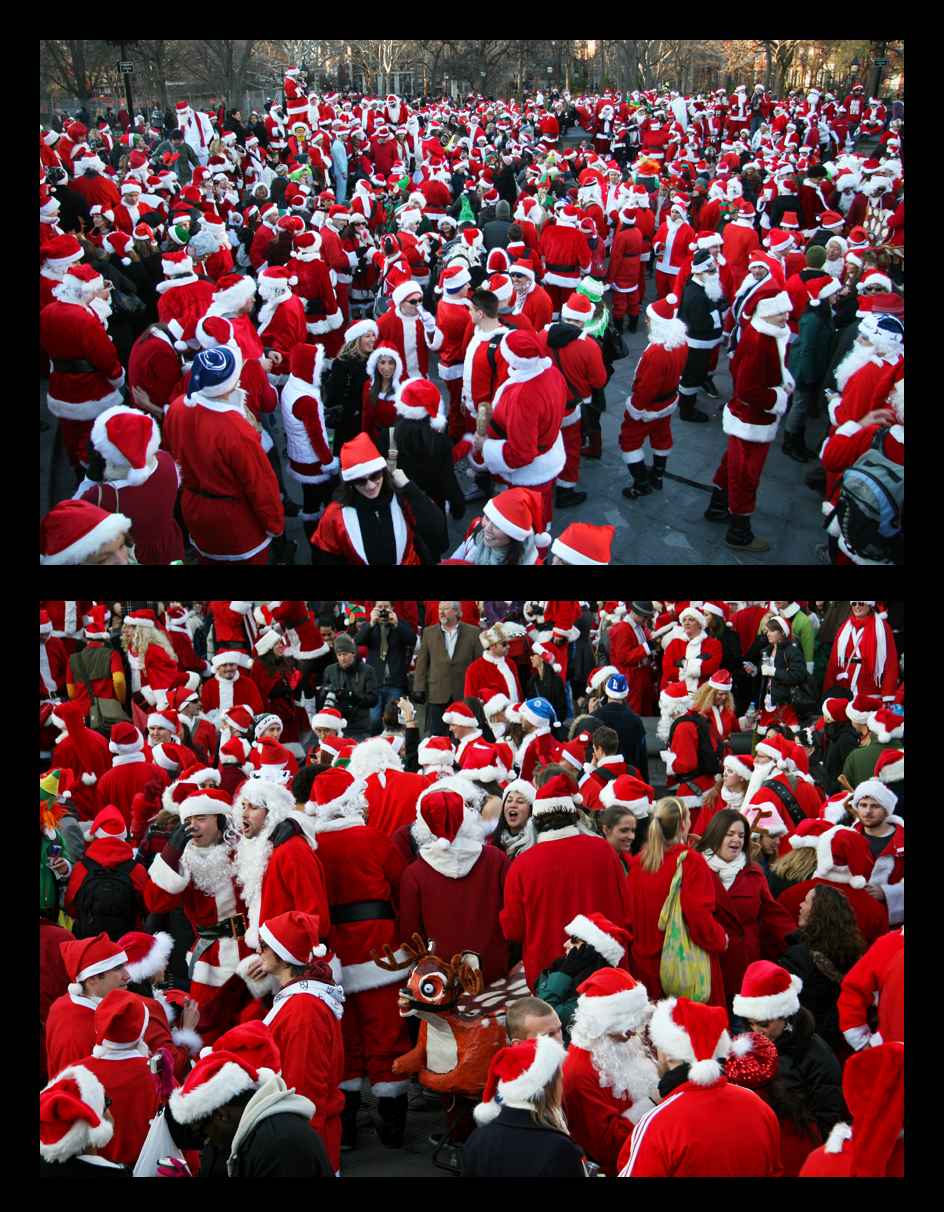
    It was red Santas as far as the eye could see, and fair to say that this was not a typical sight at Christmas time. This was the 2009 annual SantaCon in New York City, and some say this humongous gathering of Santas in Washington Square Park may be the event’s largest. See my gallery of photos here.

    If you were in the city on Sunday, December 12, you may have run across groups of Santas roaming the streets. Washington Square Park was one of the stops on the convention, a flash mob of sorts which includes meandering the streets and spreading yuletime cheer. Creative costuming is encouraged, as well as gift giving.

    There is a debaucherous tone to the event, through intent and their own admission. There are naughty Christmas carols and other mischievousness. However, four rules are to be observed:

    Don’t mess with kids.
    Don’t mess with cops.
    Don’t mess with security.
    Don’t mess with Santa.

    There are no organizers, and revelers need to be connected for the whereabouts. The NYC SantaCon website does give starting locations and times.

    The event started in 1994, sponsored by The San Francisco Cacophony Society, which held the first Santarchy. The original inspiration came from an earlier SF adventure club called the Suicide Club. The Founder and Avatar of the Suicide Club, Gary Warne, decided to organize a non-political, purely surreal Santa prank event after reading a Mother Jones article about a Danish political group dressing as Santas and mobbing a Copenhagen department store just before Christmas. Read the history here. The event is celebrated in cities worldwide – New York City has been involved since 1998.

    According to the SantaCon website, the event is a convention, not a bar crawl. There is a lot of non-alcoholic celebratory activity. But libations are encouraged, and by late evening, the streets of the Village start looking more like a Santarchy 🙂


  • Criminal Suspect

    Why was I being followed by a police vehicle while driving slowly down Main Street? I was not stalling traffic in any way.  In fact, I was the only automobile going down Main Street in Bristol, Connecticut, the town in which I grew up. I was showing a friend, who was an architect, the tragedy that was Main Street in this factory town. The left side of the street had original structures and was actually charming.

    But the right side had been completely ripped down to make way for a small shopping mall, destroying all future possibility of any historic revitalization of this downtown. I expressed my frustration to my companion of how emblematic this was of the type of thinking – to modernize rather than preserve – that one might have found at one time in towns across America. I think that today there are more examples of preservation of older architecture/districts and the value and positive results in doing so.

    The policeman actually followed us into the shopping mall parking lot and watched us leave the car. It was eerie and scary, honestly. I have a theory of why I was followed, part of which is that apparently anyone perusing the architecture in Bristol, Connecticut, is a criminal suspect, particularly someone in a vehicle with New York license plates.

    Being ostracized for thinking differently is one reason why I moved to New York City. Things have changed, of course, and with the plethora of media and the Internet, perhaps one is less of an outcast for being different in the small town today.

    In New York City, however, with time and effort, you can not only be tolerated but also create a persona and become a small living legend by being different. Whether it is Adam Purple, graffiti artist Adam Cost, streetlamp Mosaic Man Jim Power, Tower of Toys builder Eddie Boros, or gender bender and fashionista André, you can turn eccentricity into celebrity. You can take a singular passion or talent and run with it.

    It can be a very singular interest, perhaps decorating a bicycle over a period of 24 years, like that of Hector Robles in the photo. Hector grew up on the Lower East Side of New York City, on 7th Street between Avenues C and D. He currently lives in Staten Island and makes the journey to Manhattan with a combination of bus, ferry, and subway, toting his bicycle the entire way. The vehicle is in a constant state of flux, a work in progress. Hector, who is of Puerto Rican ancestry, is quite religious, as can be seen by the numerous figures and images adorning his bike.

    I don’t think Hector would fare well in Bristol with his bicycle. I am sure he would be tolerated, but I doubt he would be celebrated. And I hope he wouldn’t be treated like a criminal suspect 🙂


  • ReWarded


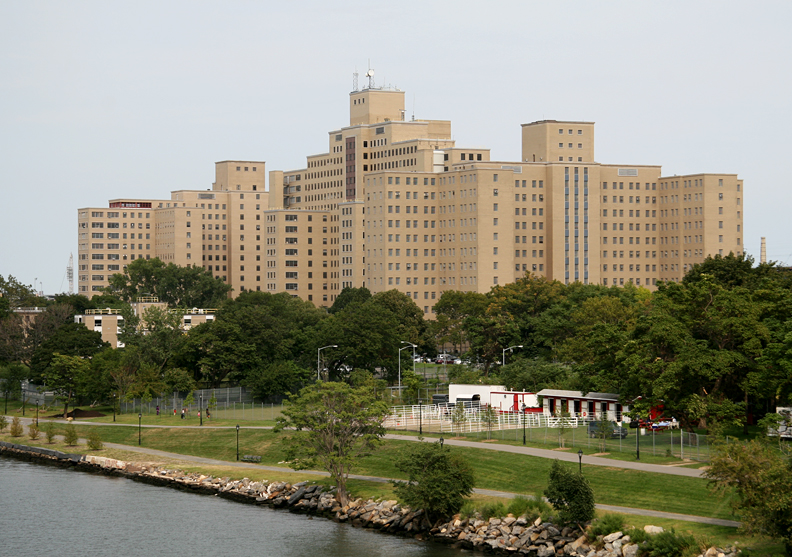
    Traveling over the Ward’s Island Bridge, in sapphire blue and emerald green, leads to an island of contrasts, an amalgam of environments and elements. Here you will find beautiful vistas, Ward’s Island Park, viaducts overhead from the Triborough and Hell Gate bridges, Little Hell Gate bridge (providing vehicular access to Manhattan), ball fields, the Manhattan Psychiatric Center, Kirby Forensic Psychiatric Center (which serves the criminally insane), one of the city’s largest homeless shelters (the Charles H. Gay Center with 960 beds), and a New York City Department of Environmental Protection wastewater treatment plant.

    On February 19, 2008, I wrote Sin of Omission about Ward’s Island Bridge (although I had not yet crossed it). On this occasion, I crossed the bridge and visited the island (see my gallery of photos here). Crossing the foot bridge is a wonderful experience, owing to its very human scale and the complete lack of motor vehicles (open to pedestrians and bicycles only). Your first steps off the bridge bring you to Ward’s Island Park, which wraps around the island along the waterfront. The day I arrived, families were picnicking and barbecuing. Walking the waterfront park affords vistas of Mill Rock Park, Manhattan, Queens, the Harlem and East Rivers, and the numerous aforementioned bridges.

    Leaving the park, however, and making a foray into the hinterlands gives a much different experience. The omnipresent Manhattan Psychiatric Hospital looms and is visible from nearly everywhere. Opened in 1899, it was the largest psychiatric hospital in the world. Knowing the nature of its occupancy was rather sobering. A stroll by the Charles H. Gay center was unsettling. Fenced off, the entrance was guarded by police while I observed a handful of rather threatening-looking individuals. At the time of my visit, I did not know that the facility was a homeless shelter. City buses provide transportation to and from Manhattan. The standard fare for bus is charged for the homeless (see article here).

    If you enjoy exploring the lesser-travelled corners, then Ward’s Island is your place. If not, crossing the Ward’s Island Bridge will provide a unique experience. On this visit, by crossing the bridge and visiting the island, rather than just taking a photo from afar, I found myself well reWarded…

    Note: Ward’s Island (along with Castle Clinton in lower Manhattan) was the original point of entry for immigration into the United States prior to the use of Ellis Island. For a history of the island and park, see the NYC Parks website here.


  • Just the Messenger

    These sightseers certainly got to see the sights. Typically the offerings of TV programs such as Cops, residents and visitors of New York City often witness crimes, lunatic outbursts, and other acts requiring police intervention.

    We all have heard about the increase in strength when a person is angry or under stress. Whether or not this is literally true I don’t know, but there certainly is the appearance of such an adrenaline-driven reaction in many police apprehensions. This summer, I saw an altercation where it took three policemen to restrain an uncooperative man, wrestling him to the ground before he could be handcuffed.

    More recently, I saw what might be considered a minor event on Broadway in the middle of a business day. Traffic was completely stopped. When I arrived, the subject was being shoehorned into the rear of a patrol car. The man apprehended was violent and uncooperative, flailing about in the rear of the car – note his foot extending out the window in the bottom photo. An ambulance and additional police arrived – at one point, there were no less than seven police officers on the scene.

    Police are often accused of being overzealous. In some cases they are, but a situation like this gives one an appreciation of the unknowns in dealing with a crazed individual.
    Those of us watching were most concerned with how the officers were going to transfer such an unruly person from the police car to the ambulance. We were surprised to see this go so smoothly. The man was removed from the police vehicle and strapped securely to a stretcher, and off he went.

    His gripe? As the man was carted away, he warned, “Jews will kill you,” repeatedly to the crowd of spectators. Not the kind of thing I expect to hear in New York. I’m just the messenger on this one…


  • The Hole

    Do you really want to be a pioneer? Find a place that may not quickly become overbought or overhyped? Then welcome to the Hole, a “hood” which I can assure you will not become the “next neighborhood” or be dotted with interesting cafes and nightclubs, like in Williamsburg, Brooklyn. See the photo gallery of my excursion here.

    I recently was forwarded an article by a friend on a small, virtually unknown area on the Queens/Brooklyn border known as the Hole. A handful of articles have been written, with features on sites such as Gothamist, Impose Magazine, Satan’s Laundromat, and Forgotten New York, which referred to it as “the true New York, this is NYC with pretense and artifice stripped away.”
    This wasteland certainly lived up to my expectations. I anticipated spending considerable time there, walking around, and photographing the area, but a few minutes there and I realized this did not have the charm of an abandoned ghost town in the West. This place truly was blighted, with outsiders clearly seen as outsiders.

    The Hole is a small triangular neighborhood bounded by South Conduit Boulevard, Linden Boulevard, and Drew Street, an area roughly five blocks by three blocks, surrounded by the neighborhoods of East New York, Ozone Park, Spring Creek, and Howard Beach. The area straddles Brooklyn and Queens, hence the reason the New York Times, in an article in 2004, said, “It is the closest thing New York has to a border town.” Ironically, the Hole also contains the “jewel” streets: Ruby, Emerald, Amber, and Sapphire Streets (now 78th Street).

    There are a handful of houses, inhabited and uninhabited, strewn across an area of weeded open lots, flooded streets with stray garbage, and no sidewalks. At one time occupied by farms and horses, this was also the former home of the Federation of Black Cowboys.

    The term “Hole” has a literal meaning in this neighborhood, which lies below grade and only a few feet above the water table. It is built on landfill over Spring Creek and is subject to frequent flooding – you can see this in today’s photo. The area is also not incorporated into New York City’s sewer system – the handful of homes here use cesspools.

    Any apprehension or creepiness you may feel here is not unfounded – the area is most notorious as a dumping ground for bodies in mafia mob wars for over 50 years. There are stories of 200 bodies being found. According to the New York Times, a lot of Ruby Street between Blake and Dumont Avenues was a suspected Gambino family burial ground. Alphonse Indelicato, Phillip Giaccone, and Dominick Trinchera, of the Bonnano family mob, were murdered and buried in a vacant lot in the Hole.

    There has been real estate speculation here – see the new row houses here on Ruby Street. However, projects here have stalled. The mountain of rubble in my photo series is an 8-acre plot which was slated to become Cobblestone Estates, a gated community. It is now in limbo – you can read about it here.


  • Trash and Treasure

    What, in most places, would be an occasional chore or the domain of established businesses often becomes a cottage industry in New York City for the poor, homeless, disenfranchised, unemployed, or those living an alternative lifestyle: selling umbrellas on rainy days, sidewalk book selling, street vending, dumpster diving, and can/bottle collecting. Many of our problems or unfortunate circumstances in New York City become an Opportunity.

    Contrary to one’s intuition, can/bottle collecting is not necessarily the exclusive realm of the homeless. After reading about a man living in Windsor Terrace, Brooklyn, supporting himself and maintaining a small apartment on bottle/can collecting, I will no longer assume anything about those pursuing this activity. And those who are homeless can not so easily be characterized as a class of human which is insolent and indolent. Many are quite hardworking and ambitious. I would venture to say that “keeping busy” keeps a person sane and also gives a sense of self-respect, societal value, and entrepreneurial independence.

    I caught this older Chinese woman on Spring Street in SoHo during rush hour, her bags of cans and bottles balanced on poles across her shoulders. This mode of transport is not often seen in the city – can collectors typically have smaller caches or use carts when their booties grow.

    At one time, recycling in New York City was threatened – analysis showed that recycling was a net loser from a financial point of view. A well-known cover article appeared in the New York Times in 1996 – Recycling is Garbage by Jack Tierney.

    In 2002, Mayor Bloomberg suspended plastic and glass recycling, which, of course, incited outrage. In 2004, the decision was reversed. Since 2008, NYC has passed a number of recycling bills, making the city’s recycling program one of the most comprehensive and aggressive in the nation, including electronics and plastic bags. Rag picking, can collecting, dumpster diving, or eBay trading – times and techniques may change, but opportunity always lurks for those who seek it. For now, bottle/can collecting looks secure – as always, one man’s trash is another man’s treasure…

    Note: In researching this article, I came across a very interesting blog: invisiblepeople.tv. Here, you will find the stories of many homeless who have startling stories and backgrounds which may challenge stereotypical views of the homeless.


  • Floyd Bennett Field

    Posted on by Brian Dubé

    One of the most amazing and interesting places I have ever visited in the five boroughs of New York City is Floyd Bennett Field. This enormous space, with huge undeveloped tracts of land, is startling for this city. Nearly all of the airfield is drivable, providing an easy way to explore for a first-time visitor. See the gallery of photos here.

    Knowing of my visiting friend’s interest in aviation and model planes, I recently investigated the details about Floyd Bennett Field, a place which I had been looking to explore for some time. In a replay of Morphic Resonance, the New York Times just happened to be running a feature article that very day (see it here).
    Unfortunately, my friend was not able to join me, so I made the visit without him. After my first visit, I know that I will be making other visits in the future.

    Completed in 1930, primarily on landfill, Floyd Bennett Field was New York City’s first municipal airport, later used as a military training and testing facility until the airfield was decommissioned in the early 1970s. Now it is a virtual playground. Weeds sprout from crevices on unused runways.  From the New York Times article:

    The Park Service has preserved the historic look and feel of the airfield while seeding an area larger than Central Park with things to do and see, from camping and gardening to bicycle races, kayaking, fishing, golf and indoor sports. There’s even an archery range and a cricket pitch.

    Add to that radio control jet aircraft flying and land sailing, which I will feature in later posts.
    The airfield also boasts a number of antique hangars. Hangar B houses a number of retired military planes – some can be boarded. (The photos in today’s collage were all taken in or immediately outside Hangar B.)

    The hangar is also home to the Historic Aircraft Restoration Project, a volunteer organization of aircraft enthusiasts, engineers, and pilots, who rebuild vintage aircraft and assemble full-size replicas. Fortunately, I was able to tour Hangar B and the workshop; it is only opened Tuesday, Thursday, and Saturday.

    Posted on by Brian Dubé

  • Time Has Come

    Posted on by Brian Dubé

    Although there are some very outrageous participants in the annual Gay Pride Parade, most New Yorkers realize that, like any other parade, the dress and manner of the paraders does not typify their everyday life. They only represent a small number of the huge LGBT community – many members of the gay community do not participate at all.  Certainly there are members of any group who are flamboyant, but I always point out to those who are new to the parade that this is their day to act out, just like revelers on many other occasions. As the photos indicate, this is, literally and figuratively, a rainbow coalition.

    The parade is enormous at this point in time – hundreds of thousands attend. The parade begins at 52nd Street and works its way down Fifth Avenue, ending in the West Village. There are floats and groups representing teachers, other professionals, civil servants, and politicians (both members of the gay community and those with a strong support for their causes). Apart from the serious agenda, the event has an extremely festive character – it could easily be mistaken for a dance parade. The event is part of Gay Pride week; some of the photos are from Friday’s Dyke Parade.

    With much of the road already paved after decades of struggles, same-sex marriage is one of the last important hurdles to the gay movement. The push for same-sex marriage shows a serious interest in committed relationships. The passing of such laws should do much to stabilizing lifestyles and gaining greater acceptance by societies at large – the gay community’s ultimate goal.

    Six states have already legalized same-sex marriages (Massachusetts, Connecticut, Iowa, Maine, New Hampshire, and Vermont) – some currently being performed, others to begin in the near future. Ironically, New York State, which is liberal with one of the largest numbers of gays in the United States, is lagging in passing its own legislation.  But I am sure it is just a question of how long for legislation, whose time has come…

    Related Posts: Steal the Show, Dyke March, Rubyfruit Bar and Grill, Gay Liberation Monument, Pride March 2007, Gay Pride Parade 2006

    Posted on by Brian Dubé

  • Cosmetics

    Posted on by Brian Dubé


    What is more unsettling than contact with a crustie? How about a crustie wearing a pet rat? (If you are not familiar with crusties, see my previous posting here). Take a close look at the photo, and you will see that this girl is sporting a white rat under her hair on the back of her neck. A crustie’s dreadlocks typically goes unwashed, so I imagine her hair provides not only a secluded spot for her companion but also a nesting ground for a variety of flora, fauna, and other edibles.

    You expect many strange things in New York City – it is a magnet for the fringe elements of society. But there are things that shock even a seasoned New Yorker. For me, a crustie with a rat around her neck was one of them.
    People know the city is extremely liberal and, most of all, tolerant. There are individuals involved in all manner of activities in public; frequently, authorities and law enforcement just turn a blind eye. Two nights ago, two mounted police officers observed the onset of a fight, one individual wielding a guitar as a weapon. The officers left – no one knows why. The fight escalated, and one individual was knocked unconscious, required an ambulance, and was taken to a hospital. Those of us who witnessed the occurrence are convinced that in any other locale, there is no way that someone that menacing would have been left unchecked.

    One issue is, of course, that many activities which are disturbing or distasteful are technically not against the law, and individuals here are brazen enough to have tested the law many times, risking arrest. Many criminals are quite street savvy and know exactly what is required to be arrested. Even those who are technically engaging in activities for which they can be arrested are a problem; most are released the next day and are back out on the street. My contact with crusties has been rather benign, but they have been a serious problem – see this New York Times article here.

    But what to do with the “undesirables” or homeless? It would seem that outreach programs would make sense, but I rarely see or hear of any efforts like this anymore. Many homeless prefer the freedom of the streets to shelters or programs, so there is resistance to being helped.

    New York City is a center of fashion, and even the homeless often have a sense of style, putting together an outfit from whatever is available. I like our crustie’s earpiece made from a small twig and flower…

    Note: One posting that many readers commented on was about Stephanie, a young homeless woman who lived on Spring Street for quite some time. I saw Stephanie using makeup a number of times – somewhat repellent to watch and sad, but in another way heartening to see that the girl still had human dignity and enough pride to make an effort using cosmetics.

    Posted on by Brian Dubé


  • dinamic_sidebar 4 none

©2026 New York Daily Photo Entries (RSS) and Comments (RSS)  Raindrops Theme