• Category Archives Food and Restaurants
  • Caravan of Greens

    I would say that the best milemarkers for my life, particularly of my taste in food and cuisine, has been my evolving choice of salad greens (and dressings and cheese). Let me explain…

    Once upon a time, there was iceberg lettuce. I ate the lettuce, and I saw that it was good. At least for awhile. A vegetarian for many years, salads were always an important part of my diet, particularly when I was younger and focused on raw foods. So, eating so much salad, I grew to tire of iceberg lettuce and needed more variety. I soon discovered romaine lettuce. I saw that it was better – leafier with more green. It seemed to strike the ultimate balance, and I abandoned iceberg, which, over time, I grew to hate.

    I thought I had found the ultimate lettuce with romaine. Until I discovered loose leafs – red leaf and green leaf lettuce. This variety had the least amount of woodiness – it was all leaf, and I loved it. I was growing up in many ways. Living in New York City offered so many new experiences, and I was discovering the world of taste and texture and saw that not all greens were created equal. My exploration included Boston and Bibb.
    I went wild with greens and occasionally added endive, arugula, or radicchio. Spinach and mushroom salad became popular in New York City restaurants, and I added spinach to my own salad repertoire as well.
    Increasingly sophisticated dressings followed on a parallel track – moving from standard bottled dressings to Newman’s. Soon I began to make my own dressing, inspired by avocado and spinach dressings which I had gotten in vegetarian restaurants. These were thick and creamy dressings made in a blender and were very satisfying – important when salads were often my entire meal. However, I eventually became more tired of the heavy and thick blended dressings and began to dabble in vinaigrette.

    Sometime in the 1980s, mesclun mix (or spring mix) shattered the world of greens and lettuce. This mixture of field greens, originating from Provence, France, was extraordinary, a revolution. The large number of varied greens in this mix are a delight, and it is my choice to this day for salads, as is the case in many good restaurants.

    I have simultaneously seen an evolution in vegetarian cuisine and natural foods, which has historically been defined more by what is NOT than by taste. Some might go as far as to agree with celebrity chef Anthony Bourdain, who said “Vegetarians are the enemy of everything good and decent in the human spirit, and an affront to all I stand for, the pure enjoyment of food” (read the entire quote in Butter and Ice Cream). Ethnic cuisines, on the other hand, have evolved over time to please the palate as much as possible and are not driven by health concerns, as I wrote about in Sundey. Fried foods, cream, cheese, fatty meats, sugary desserts, white flour – all the evils of the natural foodist, vegan or vegetarian. In my early days as vegetarian in New York City, I soon learned that many ethnic cuisines, particularly Asian, Indian, or Middle Eastern, have much better culinary choices than the typical vegetarian or natural food restaurant. So I have generally eschewed vegetarian restaurants in favor of ethnic cuisines. A few restaurateurs have struck out, trying to offer a much finer vegetarian cuisine – places such as Gobo and Caravan of Dreams. From their website:

    Caravan Of Dreams has been providing the East Village and New York City with healthy, flavorful food since 1991. All organic, all vegan, kosher certified, and with extensive live food options, Caravan Of Dreams is the destination for anyone who has ever felt the need to eat better.

    Caravan Of Dreams creates world fusion cuisine, inspired by the plant-based diets of indigenous cultures all over the planet, with particular influence from the Spanish and Mediterranean home of Angel, the restaurant’s founder and owner.
    The ethos of Caravan Of Dreams is to begin with the freshest, healthiest organic ingredients and create a dish that is flavorful, surprising, and delightful. Few restaurants in New York would claim to care so much about nutrition, nor would they have the knowledge base that is Caravan’s greatest asset. We make good food better.

    Caravan Of Dreams also features a full juice and smoothie bar, organic wine and draft beer, and live music nightly.
    Caravan Of Dreams began as the dream project of Angel Moreno, a Spanish expat in New York. Angel saw the restaurant as an opportunity to combine his passions for food, health, music, and community.

    Built plank-by-plank and brick-by-brick by Angel, Caravan Of Dreams opened in late 1991 as the vanguard of a new mode of living and has since become one of the established stalwarts of the East Village scene and a symbol of the Zeitgeist.
    Caravan Of Dreams has come to embody delicious, healthy food, live music-everything from jazz to world to singer-songwriter piano-and a permanent and evolving community dedicated to better living.

    The restaurant now is a home base for that community, a place where Angel and others are reaching out to countless people and developing new ideas for a greater world, that all have at its core the Caravan Of Dreams tenet: around good food and health, music and dance, and friends and family and lovers, lies the wellspring of happiness.

    I had heard of Caravan of Dreams for many years, but only recently, on a friend’s recommendation, I visited for the first time. The ambiance is woodsy, classic old-school, but the cuisine is not – it was decidedly the best vegetarian food I have had in New York City. My friend also introduced me to the owner, Angel Moreno, who was on the premises. Angel was extremely congenial, and I complemented him on his efforts to elevate vegetarian cuisine to a new sophisticated level. The food was pricey but in a class of its own. The night I was there, we even had a celebrity sighting – Ben Stiller and Peter Strauss sat a few tables away. Angel told me that he has had numerous celebrities over the years.

    My tastes in cheese have evolved much, like dressings and greens. I was ecstatic when I discovered French goat cheeses and began adding them to my salads. Much like Caravan of Dreams raised the bar for vegetarian food, I have bettered my salads by using my own balsamic mustard vinaigrette with herbs de Provence, French goat cheese, and mesclun mix. As I look back, as we all do, I see how my life has changed and how many things have improved, such as vegetarian food in the city. Angel has had his Caravan of Dreams while I have watched from a Caravan of Greens 🙂

    Related Posts: Joe’s Dairy, the Movie, Part 1, Watch Out for Moose, Part 1, Quantum Leap, Veggie Pride, Purple, Union Square Greenmarket

  • Joe’s Dairy, The Movie, Part 2

    (see Part 1 here)

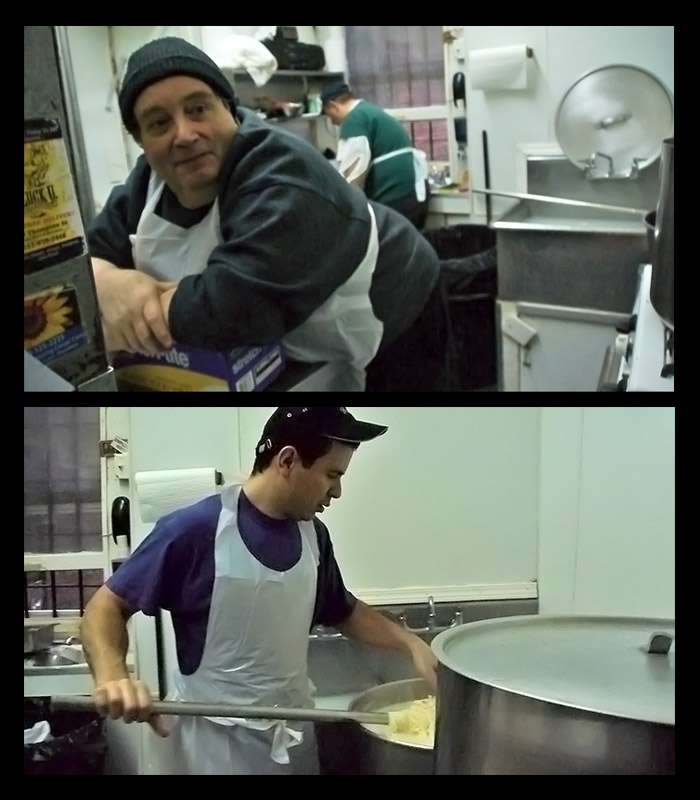
    Vincent and Anthony Campanelli were extremely cordial throughout my initial encounter. I asked if I might be able to film the mozzarella-making process. They only requested that I return on a day less busy, so on Wednesday, February 1, at 11 AM, I came armed with cameras.

    A moment in the kitchen quickly explained why they do not entertain drive-by shootings. The cooking area is miniscule, with barely enough workspace for two people and the cooking equipment. I was most impressed by their cook, who toils 10 hours per day making only a handful of movements. I told him that he should be sainted for his ability to do this daily for over 5 years.

    Everything is done by hand – very old-school. When I saw the cook drain water by hand, one small pot at a time, I asked why they might not install a small pump. I was told that nothing was going to be modernized in any way. If you’re looking for stability in a world of change, visit Joe’s Dairy.

    Enjoy the Movie 🙂

    Related Posts: At the Door, For Whom the Knell Tolled, Donato, Nativity, Raffetto’s, Secret Society, Vesuvio


  • Joe’s Dairy, The Movie, Part 1

    On September 16, 2008, I wrote a story about Joe’s Dairy, located at 156 Sullivan Street. In this Italian area of the South Village/SoHo, we have Pino’s Prime Meats as well as St. Anthony’s Church (see here and here), both on Sullivan Street facing Joe’s Dairy. Just across Houston Street, there is Raffetto’s, Delmonico’s, and Tiro a Segno. Trattoria Spaghetto lies just a few short blocks away. These are the final vestiges of the Italian neighborhood – places such as Vesuvio and Zito’s Bakery, neighborhood icons, are now closed.

    However, the full experience of Joe’s Dairy – meeting Vincent and Anthony Campanelli, grandpa staking out the front retail area, and the making of mozzarella cheese in that tiny backroom – is something which only video or film can capture.

    I made two additional visits. During the first, on December 15, 2011, I chatted with Vincent and his father. I captured the conversation on video as Vincent shared his views on retailing, the changes in the world, the value of family, and many pearls of wisdom. He is very intolerant of mass merchandising, chain stores – anything not done the old-fashioned way. Joe’s Dairy is an example of the Slow Food movement.

    Today, I will feature my initial conversation with Vincent and grandpa in the front room. I was invited back to see and film the actual making of mozzarella cheese in the tiny back room kitchen. With Part 2 on Monday…

    Related Post: One Short Block


  • At the Door

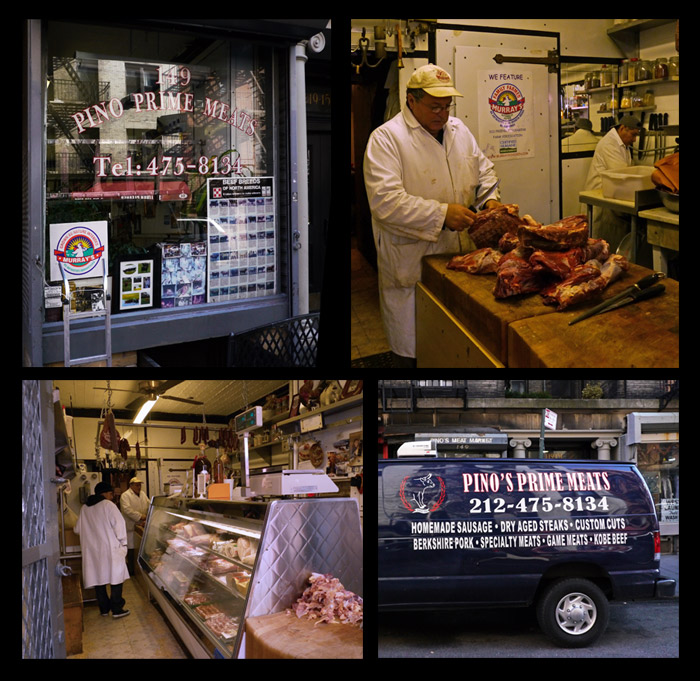
    Being a butcher has little allure, and today, like most jobs that involve physical labor, there is no appeal for the young, restless, and upwardly mobile. At one time, butcher shops dotted the city, but now, a shop like Pino’s Prime Meat is rare and noteworthy, the subject of articles that bemoan their loss and extol the pluses of getting one’s meats from a skilled, multi-generational specialist, like Pino Cinquemani of Pino’s Meat Market.

    Supermarkets, case-ready meats, the increasing costs of retailing in New York City, and the glamourlessness of the job have all conspired to make the old-fashioned butcher shop a rare commodity. To visit a place like Pino’s is truly an opportunity to step in the past and experience old New York. The shop, located in an Italian area of the South Village, has been in existence since 1904, taken over by Pino in 1990. From an article in Food and Wine Magazine:

    Pino has been carving up sheep, pigs and cattle since he was a teenager in the Sicilian town of Castrofilippo, and you might say that meat is in his blood. When I asked him about his family, this was his answer: “My grandfather was a butcher. My father was a butcher. My brothers are butchers. My brother-in-law. My sister-in-law. My nephew and my other nephew—butchers. My son is a butcher.”

    I had passed by this shop for decades, but, not being a meat eater, I had neither stepped in the door nor met the owner. I recently made a visit, photographing and filming my encounter and recording our conversation. Pino was quite cordial and accommodating. We discussed Italy, my travels there and love of small Italian hill villages, and his home in Sicily:

    I am no judge of meat quality, cuts, or the skill of butchers, but everything I have read about Pino indicates that he is the ne plus ultra in his business. This is old school, where the skill of the trained artisan triumphs over the mass merchants. Here at Pino’s, genuine, authentic European tradition lives on in a small shop in SoHo, encroached by a wave of high-end merchants that have essentially engulfed the entire area, if not the entire borough of Manhattan.

    I have a number of close friends and acquaintances who are vegetarian, as I was for 30 years (I now eat fish). Decisions whether to eat meat or not are highly contentious, and I have stopped debating such subjects long ago. Here, at Pino’s, to understand and appreciate the man and his family tradition, it is perhaps best to leave dietary preferences At the Door 🙂

    Related Posts: Pork and Power, Mystery Meat, Shrine to Beef, Fisherman’s Widow


  • Watch Out For Moose, Part 2

    The Hazards of Oil (see Part 1 here)

    Hear this story as a podcast:

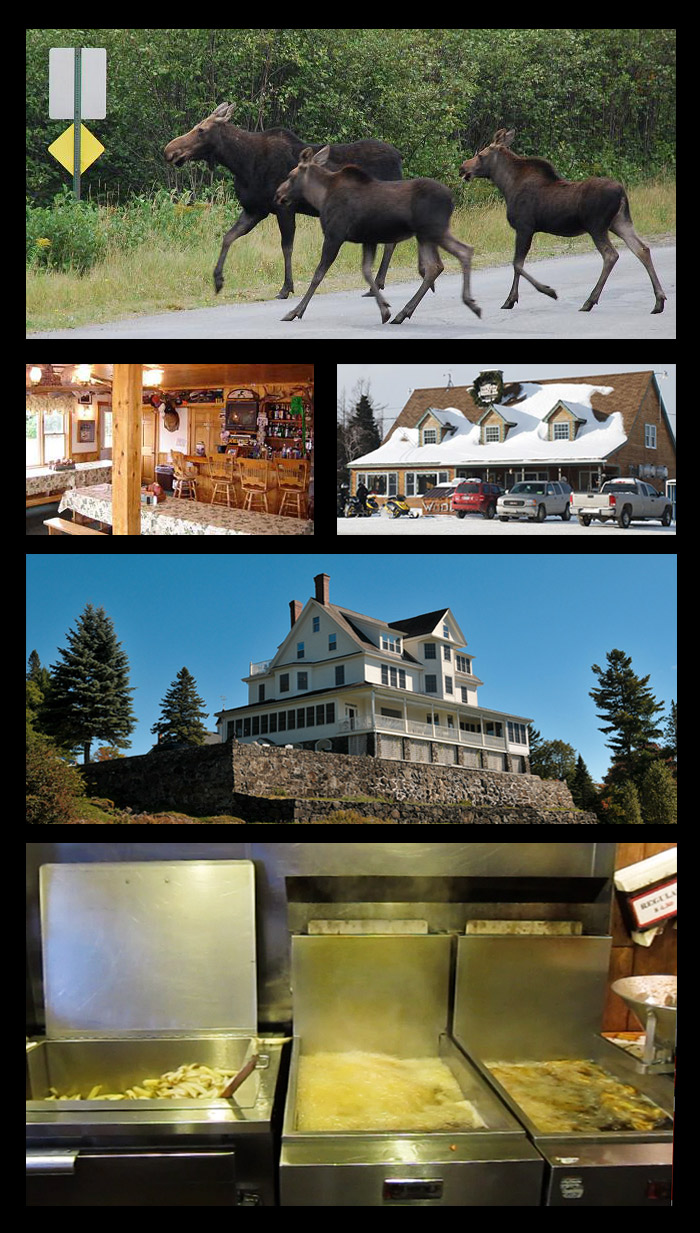
    There is something about fried food that is so good, isn’t there? But with health concerns being what they are, like many, I keep my consumption of fried foods to a minimum.  However, one evening while vacationing in Maine and eating dinner at Kokadjo, I was feeling that life was truly good and decided to throw caution to the wind. I had not only pizza but also French fries, onion rings, and fried sea food. For those not accustomed to so much fried food at one meal, the impact can be severe. And so it was.

    There are perils at night in a big city like New York, but one of them is not moose. In Maine, however, watch out for moose is the friendly admonition almost always heard as one departs from a group of friends in the evening or night. Moose are big (some males weighing as much as 1500 pounds), and they sometimes travel in groups, often along the roadside. They are very dangerous, with hundreds of accidents every year in Maine with the collision of vehicles and moose, some resulting in death.

    I left Kokadjo, heading back to my inn, and after just a short time on the road, I began to experience severe intestinal rumblings. Mother Nature was not calling but screaming. So here I was, the better part of 18 miles from my destination, it was pitch black, moose were everywhere, and I was developing the most severe case of diarrhea the world has ever known.

    This was now a WAR of mind over body. My fellow companions were repeatedly telling me to pull over and do my business roadside. But that would be lunacy – this bodily evacuation would be a monumental mess for sure, and the prospect of squatting in the dark in the woods of Maine, surrounded by moose, and with diarrhea and no paper or running water was just unfathomable to me. And so I pressed on in the dark, driving much too fast and trying to avoid hitting moose as large as my car and killing myself and my family. At one point, I had a near collision with an entire group of moose crossing the road.

    We have all experienced something either boring or painful where time seems interminable. But please believe me when I tell you that NOTHING felt as long as the time needed to drive those many miles back to our inn.

    When I finally arrived at Blair Hill Inn, I drove into the parking area with my car careening and tires screeching. I recall neither turning off the car lights nor closing the car door. I ran for the bathroom. When I say ran, I mean sprinting like a man in a horror film with the most unimaginable terror close behind him. Now, with my goal in sight, the urgency seemed all the greater while I battled the final throws of my intestinal nightmare. Up a flight of stairs, down hallways, and into my room. Doors were thrown open and left open behind me. Nothing mattered except that bathroom, where a toilet seat now was THE most joyous sight I had ever seen.

    I made the seat with no more than a nanosecond to spare and had one of the most explosive of movements in my life. From that moment forward, I would always remember how to really spell relief.
    So, when I am inclined to overeat fried food, it is so easy to reign in the appetite. I just think about the hazards of oil: too many fried foods at a place called Kokadjo, 18 miles of sheer intestinal torture driving through the woods of Maine in the blackest night, and what it means to me when told Watch Out for Moose 🙂

    Related Posts: Ice Cream Sandwiches, Hot Dogs and Fries, Nathan’s


  • Watch Out For Moose, Part 1

    The Joys of Oil

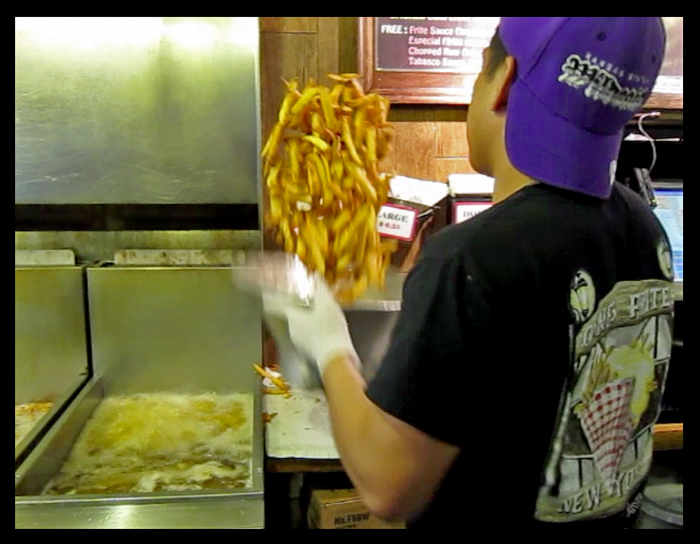
    Recently, I paid a visit to introduce a friend to the wonderful fries at Pommes Frites in the East Village, which I wrote about on August 7, 2006. On this recent trip, I made a brief video of the process:

    While there, I was reminded of my visit to Kokadjo in Maine. On April 7, 2010, I told of the waste of food in New York City restaurants and my experience of how food leftovers were handled at Kokadjo. However, there was a much bigger story about fried food that I left out and that tomorrow will be told in Part 2.

    Warning: Part 2 will not be the most appetizing story ever told. For those with a delicate stomach, perhaps it is best to avoid, like fried food itself. For those who don’t mind a rather indelicate tale of bodily functions, see you tomorrow 🙂

    Related Posts: Ice Cream Sandwiches, Hot Dogs and Fries, Nathan’s


  • The Damned

    There is an entire group of people in New York City who never eat at home, i.e., they eat out every meal, less perhaps a quick snack or light breakfast. This city, better than anywhere in the United States, easily enables such a lifestyle with its staggering array of choices in restaurants, both in number and type. And for a very large number of New Yorkers, particularly living in Manhattan, restaurants are literally steps from their home. Being able to walk within a neighborhood such as the Village, for example, with its plethora of eating establishments, is one of the great joys and perks of being a resident of New York. For many visitors, restaurants are the number one reason to be here.

    However, these establishments have to be staffed, and we are talking about a lot of staffing. For most, there are a number of driving forces in being a waiter: a large number of establishments to choose from with lots of job openings, potentially higher pay than many unskilled jobs, ready cash, and in many establishments, little or no experience is required, particularly in places with high turnover due to poor business.

    On the other hand, there are many fine restaurants where the standards are high, the wait staff is very professional, and the jobs are coveted. But the equation is not always a simple one: expensive does not always equal great service, inexpensive does not always equal poorer service, and often, for any number of reasons, one can find a neighborhood spot where there is a very experienced veteran of the restaurant business – someone with a great memory and is fast, attentive and astute. Gerald at Olive Tree Cafe is one of these individuals.

    One of my great frustrations is that one can often find great service in the least expensive of restaurants, such as diners, while being virtually ignored in a very expensive, highly-rated place. I imagine that the uneven nature of service, even where prices would dictate otherwise, is universal and offers an opportunity – the quest of most who dine out often – to find great food and service without spending a king’s ransom.

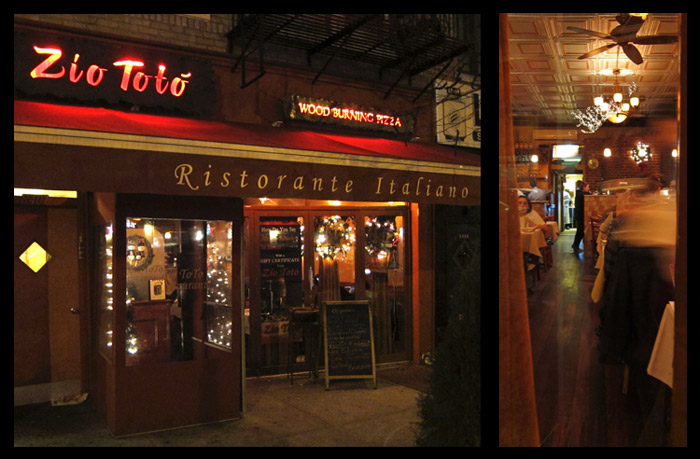
    Zio Toto in Bay Ridge, Brooklyn, is what would be considered moderately priced in NYC. On my first visit recently, my companion and I were served by someone older who immediately conveyed authority and experience. Nothing was forgotten and everything was done right the first time. We immediately felt secure and confident that we were in good hands.

    I have frequently had to get up and get napkins and cutlery from other tables or snag condiments from a waiter’s station. Nothing is worse than having to do a waiter’s job, particularly since it is typically frowned upon. The choice becomes do-it-yourself and get caught and be punished, or wait for every little thing – damned if you do and damned if you don’t. Here, at Zio Toto, we could relax while the waiter did what waiters do and not worry that we may become the damned 🙂

    Note: Zio Toto is located at 8407 3rd Ave (between 84th St & 85th St) in Bay Ridge, Brooklyn. The cuisine is southern Italian with a large selection of brick oven pizza as well as pastas, antipasto, salads, paninis, and a wide range of meat and fish entrees.

    Related Posts: Sundey, La Cote Basque, War Against Disservice Part 1, Take It, Poor Winnie Part 2, Poor Winnie Part 1


  • Ice Cream Sandwiches

    I clearly remember the day a classmate sat across from me in the lunchroom with only ice cream sandwiches and milk for lunch. How envious I was. Wow. Just ice cream sandwiches for lunch, washed down with a small milk.

    A full lunch at the time was 30 cents. Apparently, there was no law that said someone had to buy lunch and could not buy a number of ice cream sandwiches instead. However, such a thought never even occurred to us, much less doing it. Please note the plural on sandwiches, because, I believe at the time, they were five cents each. Which likely means that he had five plus the milk.

    He sat and ate slowly, deliberately, and proudly for all to see. He was cool and calm, committing what he knew for us was unthinkable, a crime to us. This small act of defiance was huge to me at the time. Who would defy their parents and purchase only dessert for lunch? The fear of parental crucifixion would prevent me or anyone I knew from doing such a thing. This transgression pales by today’s standards, where we have guns in schools and sex runs rampant. I was in the last class to have a dress code. But it was the late 1960s, and when your parents gave you 30 cents for a proper lunch, that is what you had, not desserts.

    It would take adulthood to indulge in such an act without penalty. However, now I had a new hurdle – guilt. Prudence and good health precluded such an act, now to be seen as just foolish. Not to mention feeling rather ill from eating too much dessert.

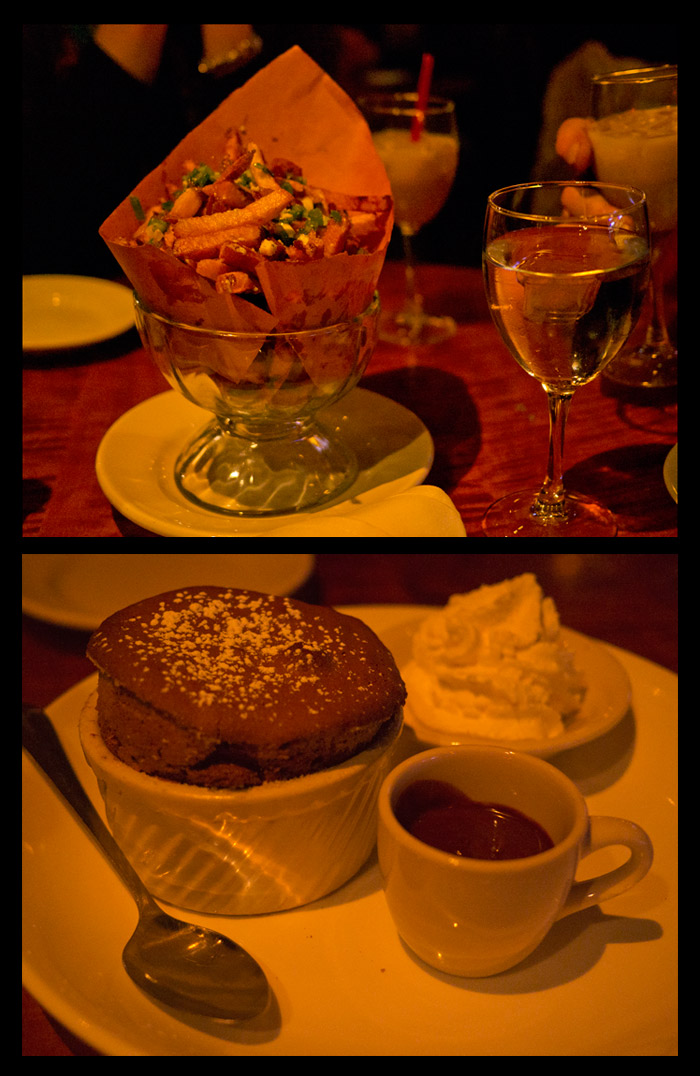
    Recently, I went to Knickerbockers with friends for an anniversary drink. They did not forewarn me that they would also indulge in an extraordinary dynamic duo, reminiscent of the high school episode. Knickerbockers offers truffle bleu cheese fries ($9.75) and Chocolate Soufflé for Two (made to order), both of which they ordered along with drinks.

    They ate not with defiance or concern but with great joy, celebrating their anniversary. I sampled both and they were extraordinary, as they had represented. Pricey, but befitting a small indulgence. No sin, no punishment, no angst. Just like my classmate making a lunch of Ice Cream Sandwiches 🙂

    Note: Knickerbocker Bar & Grill is a Village institution, established in 1977, located at 33 University Place at East 9th Street. They feature live jazz music on weekends. View their website here and their menu here.

    Related Posts: La Cote Basque, Pure Chocolate, Doughnuts, Hot Dogs and Fries, Trucks and Things, Bon Appetit, Chocolate Bar, Jacques Torres, Pommes Frites, Nathan’s


  • The Way You Like It

    When I was a child and was displeased in any way with food being served, perhaps requesting a change, my mother would invariably say, “This is not a restaurant,” or “If you don’t like it, go to a restaurant.” So, more and more, I was looking forward to a time when I could explore such a place called a “restaurant” and, ostensibly, get things the way I wanted them. I saw early evidence of the wonders of restaurant service on one of my first family trips to Virginia, where aiming to please by waitstaff was the the highest priority and raison d’être, as it should be.

    Unfortunately, I chose to settle in New York City, not Virginia, and I was to learn that this city was not the ideal place to fulfill my mother’s promise. Here, a diner is often made to feel like a waiter is doing them a favor. Special requests are often greeted with an expression of annoyance. Frequently, you are told that something cannot be done when, in reality, it is the waiter that is unwilling to do it. Multiple requests mean multiple trips for the waiter, and soon one begins to learn that living with things the way they are is better than getting what you want at the expense of having a surly waiter, someone often disgruntled, frustrated, and resentful in having to work tables rather than their chosen profession.

    Of course, someone with chutzpah pays none of this any mind, so perfectly illustrated in The Last Detail. In the film, Jack Nicholson and a buddy, both sailors, are entrusted with escorting a young sailor, Larry Meadows, to naval prison to serve eight years for a petty crime committed. Feeling badly for such a harsh sentence, Nicholson and companion try to show Meadows a good time on their last detail from Norfolk, Virginia, to the Portsmouth Naval Prison in New Hampshire. On the journey, there is a scene in a diner where Meadows is served a cheeseburger with the cheese not melted, as he had hoped. As many of us would, he is ready to accept his fate, but Nicholson notices the kid’s displeasure, sends the burger back, and makes a statement that I will always remember: “See Meadows? It’s just as easy to have it the way you want it.” Easy for Nicholson, the perennial assertive bad boy.

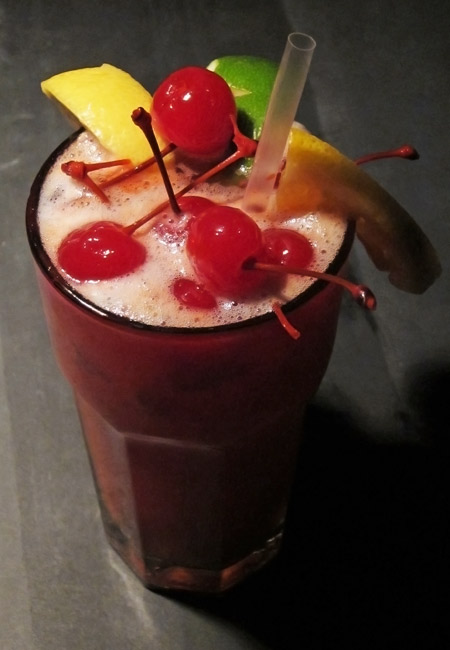
    Recently, while eating at the Olive Tree Cafe on MacDougal Street, I ordered my favorite drink, Passion Punch. This beverage (which I order with no alcohol) is made from a variety of juices and laced with pieces of fresh fruit and maraschino cherries. Perhaps not the acme of cuisine, but nonetheless I have a small fondness for these cherries, which are something of a prize as each one is found in this punch. As of late, however, there has been a decline in the number of cherries, with even as few as one solitary cherry on a recent visit.

    On my last visit, however, I was served by Gerald, who has worked the place for eons. Gerald is astute and fast and gets it right the first time. There is nothing like a waiter who has much experience and is good. When he delivered my drink, it was awash in maraschino cherries. I complimented him, mentioning my recent misfortune in the dearth of cherries and the extraordinarily good fortune I now found clustered at the top of my drink. Gerald responded that the bartender was busy and that he had made the drink himself. Aha. Good fortune and service explained. Much like Bill Schimmel, who was the Redeemer for the torture of accordion of my youth, Gerald restored my faith that somewhere out there, when you’re lucky, a restaurant is a place like my mother promised, and without traveling to Virginia, even in New York City, you can get things the way you like it 🙂

    Related Posts: War Against Disservice, The Yellow Kind, I Guess, Kokadjo


  • Amorino


    I have walked by Amorino numerous times. Its beautiful interior led me to believe that it would be very overpriced and more likely selling the decor rather than the product. I learned otherwise. I recently was with a friend, also a nearby resident, and neither of us had yet ventured in. So, both ice cream lovers, we went in on a whim. Given the decor, our first surprise was that the pricing was in line with others like Cones, not more – reasonable by current standards for a gourmet gelato. And the flavors looked awesome, so sampling was de rigeur. And the quality was, let us say, extraordinary.

    The exclusivity of retailers to New York City has become virtually a thing of the past. Many shops here are just part of national chains. And, places such as Amorino that establish themselves in New York City often open shops nationwide. Icons closely associated with the city, such as Tiffany’s, Bergdorf’s, Saks, Louis Vuitton, Cartier, Bloomingdale’s, Abercrombie & Fitch, Brooks Brothers, Henri Bendel, Macy’s, et. al., can now be found in high-profile shopping malls. In Short Hills, New Jersey, the entire foregoing list of retailers can be found under one roof.

    The lure of New York City is its unique character, merchants, and culture. Where is our future if the city’s leading edge is dulled quickly by the dilution of locations everywhere else? I see this daily – both the rolling out nationwide of successful businesses started in New York City and, conversely, the migration of national retailers to the city – what the New York Times called the “malling of New York.” Fortunately, the culture of people of various ethnicities and interests brought together in a salad bowl sustains the city’s unique draw. And the enormous number and variety of residents and visitors still keeps some special businesses and food establishments afloat that could never survive elsewhere.

    I was surprised and pleased to learn that Amorino, with 50 locations in Europe, has only one location in the United States – New York City at University Place in Manhattan, around the corner from my home. One of the most unique things about Amorino is that any number of different flavors can be combined at no additional charge, even in their smallest size. Another unique touch is that cones are fashioned into a flower using a spatula and flat slabs of the gelato. Amarino has gone the extra mile – everything is superb, from the store design and presentation to the product itself. The interior has a warm and organic feeling, with dark woods, stone floors, brickwork, and soothing lighting. Bas reliefs adorn the walls, and the place is replete with a fireplace.

    This place is authentic all the way to its roots. Amorino was founded in Paris in 2002 by two Italian childhood friends, Cristiano Sereni and Paolo Benassi. The crowds in front of their shops are now much a part of Paris’s summer scene. An artisanal product, the ice cream is made from organic and natural products with the highest quality ingredients possible and according to their own secret recipe. They also have a menu of pastry items and beverages. I suggest a visit. I’ll be back to Amarino 🙂


  • Sundey

    I was a vegetarian for decades and quickly learned that for good vegetarian food, it is better to find ethnic cuisines that have large concentrations of vegetarian dishes than to eat at vegetarian or natural food restaurants. Historically, the establishments of these restaurants are driven more by what the food is NOT than by the desire to offer great cuisine. Of course, taste is a consideration, but not the primary raison d’etre.

    On the other hand, ethnic cuisine is tried and true, the result of a long history of refinement, catering to the human palate. In New York City, virtually every cuisine can be found, even exotic ones such as Burmese, Malaysian, Ethiopian, Hungarian, Vietnamese, etc. Food is one of the greatest joys in this city, and the salad bowl of ethnicities makes it one of the best places on the planet to eat, whether vegetarian or not. Areas like Jackson Heights, Queens, are veritable smorgasbords of international foods.

    Very early in my exploration of foods, I discovered, as most vegetarians have, that for tasty non-meat entrees, the best can be found in Asian, Indian, and Middle Eastern foods. So, although I am no longer a strict vegetarian, my food tastes were weaned early in life on these cuisines, which have become my favorites, particularly Indian and Middle Eastern. I am often found dining in places like First Oasis (in Bay Ridge, Brooklyn), Moustache, or the Olive Tree.

    Over time, Manhattan has become much more of a center of commerce and quite expensive with the cost of living, with a few exceptions, such as Chinatown, which preclude the ethnic neighborhoods of the past. Many cuisines have become more difficult to find, such as Greek. So for authentic ethnic cuisines, it behooves one to travel to the outer boroughs, where there are many ethnic enclaves with merchants and restaurants catering to them.

    When touring Bayside, Queens, recently, I was excited to learn about Avli, a restaurant specializing in Greek and Mediterranean foods. So my visit there necessitated a stop at 38-31 Bell Boulevard.
    I was accompanied by a strict vegetarian who was pleased with the very extensive menu with so many vegetable options – things like hummus, stuffed grape leaves, tzatziki, spinach pie, lemon potatoes, various salads, side vegetables, cheese dishes, wraps, and combination platters.

    The staff was friendly, buoyant, and helpful. It was a Sunday evening, things were good, and our waitress was Greek and appropriately named Sundey 🙂


  • Not Chewing Gum

    Many of the things I pursued as an adult were things that, lacking money and adequate knowledge, foiled my efforts as a child – kite flying, juggling, photography, and eating enough marshmallows.

    It was summer, sometime around 1960, and I found myself in a backlot in Bristol, CT, with a couple of friends. We had built a makeshift campsite. Everything we did was makeshift. We had dug out a shallow foxhole (I don’t know why) and had fashioned an A-frame tent-like structure which we placed over our dugout. The tent was made from corrugated cardboard, the scrounger’s building material of choice – ubiquitous and free.

    All that remained was something to barbecue or toast. Our meager funds ruled out any food, including marshmallows. The few cents we could pull together only allowed us to purchase one pack of chewing gum. Very sad, but true. And that is how, on that summer day, you would have found me and my entourage toasting chewing gum (skewered on sticks) rather than marshmallows. Our feast of burnt and melted gum was inedible – one could easily say that the outing was a failure. Marshmallows would have to wait for another time, when I had money.

    I do recall one occasion in Fire Island where I was first introduced to S’mores. Indulging in such things seemed very appropriate for summer at the beach.
    Marshmallow, however, is everything that New York City is not – soft, fluffy, sweet, and benign. So, even as an adult, with money to buy a room full of marshmallows, it was never forefront in my mind. I don’t recall ever being offered a marshmallow in New York City.

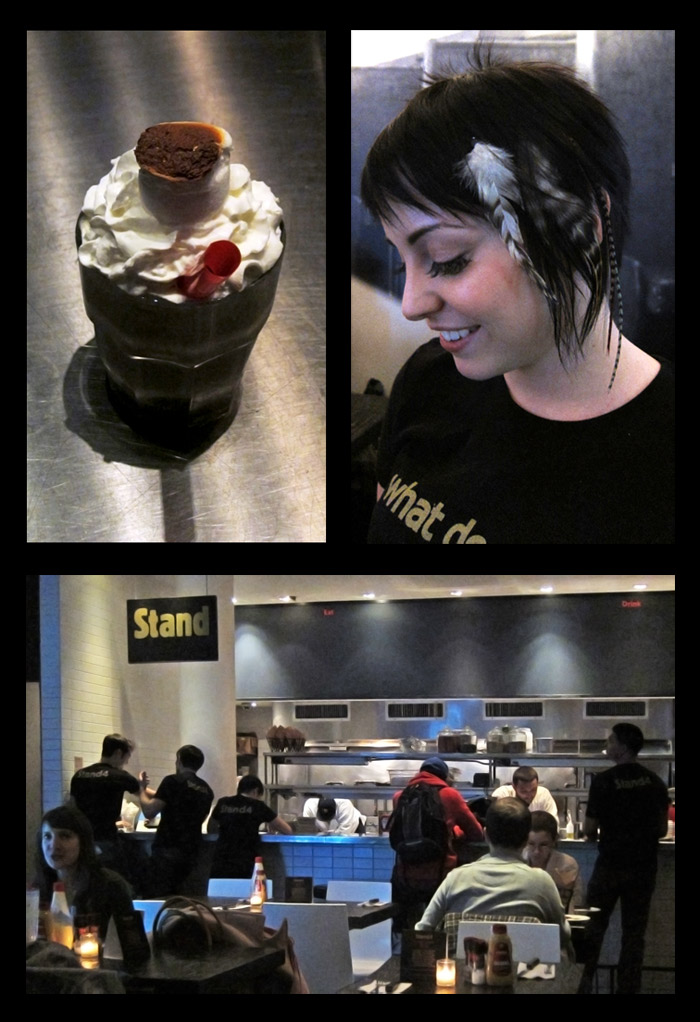
    So when a friend told me that the Toasted Marshmallow Milkshake at Stand 4 was a must have, I was on my way and at the bar within minutes, placing an order for this milkshake which is taken quite seriously. It comes highly recommended and reviewed. It was featured on the Food Network’s “Best Thing I Ever Ate.” Like many of the artisanal food places in NYC, Stand 4 goes the extra mile. According to Gourmet Magazine, the ingredients list consists of 3 scoops of vanilla ice cream (they use Laboratorio del Gelato), 1 tablespoon of whole milk, 1 large dollop of Woodstock Water Buffalo Milk yogurt, 5 Kraft Jumbo Jet-Puffed marshmallows, and whipped cream.

    The Toasted Marshmallow Shake arrived shortly, delivered by a finely feathered waitress. The shake was delicious. Now, here was the unrequited love of my youth, brought vividly to mind in a new, extraordinary concoction. It feels like the summer of 1960, only I have enough money and we are toasting marshmallows, not chewing gum 🙂

    Related Posts: Kick in the Shins, Cones, Trucks and Things, Fluff, Bon Appetit, Peanut Butter & Co.


  • I Am a Liar

    I have written many times about my feelings regarding the good old days and how, often, fond memories of people, places, and things are really only that – fond memories. If one really examines the subjects of these memories and can be brutally honest, the reality was often not that great at all. And yet we hang on to and lionize scraps of the past, bemoan the loss of old retail shops, and express dislike for the new retailer in its place or perhaps a radical change in decor or operations of an old establishment. The realist, like Joe Plourde, looks life squarely in the face and judges strictly on merit and not on nostalgia. Read about Joe here.

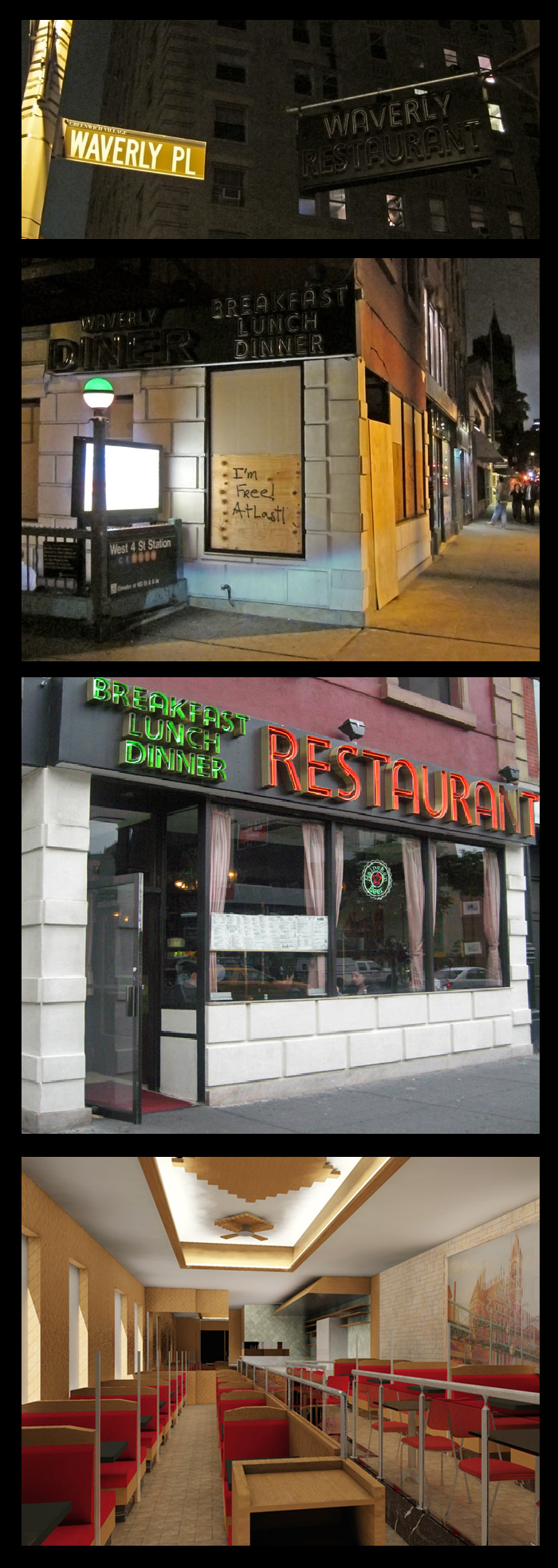
    On December 3, 2008, I wrote Greasy Spoon. However, I did not reveal that the subject of my poor diner experience was the Waverly Restaurant. I avoided mentioning the name of the diner for a number of reasons. One is that I avoid writing stories which essentially serve as negative reviews. There is nothing fundamentally wrong with helping the restaurant patron avoid the poorer dining establishments, but personally, I have decided to leave this type of reporting to the review sites, of which there are many good ones, such as Yelp.com.

    The other reason I avoided slamming the Waverly is that I, too, am a sucker for nostalgizing, the very type of person whom I characterized in paragraph one. The Waverly, good or bad, was a Village icon and landmark. To see it was a great comfort, a balm in a city of harsh extremes. To know that the Waverly was open 24 hours likened it to the Chinatown restaurant of Woody Allen – a constant, something steadfast and reliable.

    So recently, when I went by the Waverly and saw it boarded up, I was shocked and ALARMED. My first GUT REACTION WAS DISMAY. I bemoaned the loss. Regardless of how good or bad it was, who wants a homogenized New York City, populated only by chain stores?  It’s places like the Waverly that give New York its unique character.

    Then I saw and learned that it was closed for renovation. I was SO RELIEVED. Because, as you can see, I LOVE THAT OLD CRAP, and WHEN IT REOPENS, I’LL BE THE FIRST IN LINE. Really, in all of my writings and diatribes about the old and new, I have been lying to you. Yes, that’s correct, and I am willing to put it in writing. I am a LIAR.

    Photo Notes: The bottom photo is an artist’s rendering of the new Waverly Diner from the architectural firm of Jorge Fontan. The restaurant is being expanded into an adjoining commercial space and is undergoing its first renovation in the 30 years it has been open. The interiors will be fully renovated, keeping the original atmosphere while modernizing and enlarging the space.

    Related Posts: Nice Man on Death Row, Levi’s Film and Corn, Diner Be Aware of the Diner, Joe Jr’s


  • Business as Usual

    Do you trust me? Yes? Good.

    I’m going to tell you about a restaurant where you will not be disappointed. This is a place that locals love. There are restaurants that are very good and there are restaurants that are very expensive. But as diners know, unfortunately, expensive does not always equal good. Restaurants tend to be overpriced in New York City, and plenty of places offer the convenience of eating out only with high prices and just average food.

    North Square restaurant is located in the Washington Square Hotel at 103 Waverly Place in the Village. They run a TIGHT ship. Everything is professionally done. And lest we overlook the most important – the food is outstanding. The restaurant, like the hotel, is owned by the Paul family. The kitchen is headed by executive chef Yoel Cruz. You can find the restaurant’s website here.

    When my family announced that they were coming to New York City for Thanksgiving, I began perusing lists online of restaurants offering holiday specials. I was pleased to find that North Square was among those open and offering a prix fixe dinner. Only steps from my home, why go elsewhere? However, Thanksgiving was only two days away and, as I feared, it was fully booked. I returned on Wednesday in person in the off chance that there was a cancellation. Through some small miracle, a table for 4 was available.

    The 3-course Thanksgiving extravaganza was $55 per person, including a choice of appetizer, entrée, dessert, and coffee/tea – not bad in the scheme of things for this city, and a real value for the extraordinary selection of nine appetizers, ten entrées, and eleven desserts. Everything went without a hitch, smooth as silk. Our waiter, Nick, provided sterling service. The dining room was elegant and perfectly lit. We were not rushed at all, as is often the case on holidays in restaurants where patrons are often treated as cattle to be moved.

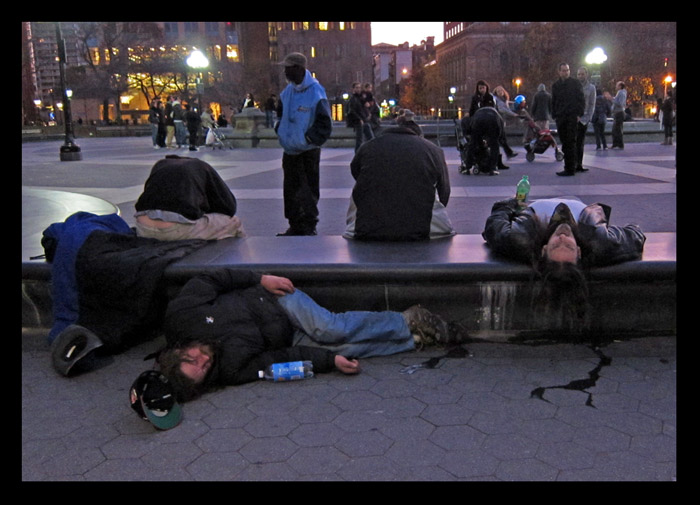
    After our meal, and before returning to Connecticut, my family and I took a quick stroll in Washington Square Park, which is footsteps away from the restaurant. It was a very pleasant afternoon where temperatures had reached 60 degrees. The park was more populated than is typical for a Thanksgiving Day. As you can see from the bottom photo, holidays make no difference for some, where it’s Business as Usual…

    Related Post: Pick Two


  • Instincts

    I was a little uneasy writing this story. As a small business owner, I have a very strong feeling as to the key reason for entrepreneurial success. However, I have been reading pages and pages without seeing any validation. I did not find studying the key reasons businesses succeed or fail very useful – if you can think of any reason(s) at all, you will almost certainly find it somewhere in any one of numerous lists of key factors in failure or success. None will come as a surprise – right location, management, adequate capital, cost control, knowledge, luck, persistence, vision, customer service, growth plan, marketing, key vision, etc. With such an enormous number of factors, managing their interplay becomes an impossible task for any human being. How will anyone learn all of the key ingredients and the balancing act necessary to succeed?

    Then I finally found exactly the single word I was looking for in an article on David Geffen in a Stanford School of Business newsletter:

    David Geffen Says Good Instincts Play Better for Him Than Good Plans

    A self-made billionaire, Geffen told Graduate School of Business students that he relies instead on his instincts, his keen eye for talent, honesty, and a knack for surrounding himself with smart people.
    “I wish I could give you a better answer. I didn’t have a clue about managing business. I never went to business school. I was just bumbling through a lot of my life,” said Geffen. “I was like the guy behind the curtain in The Wizard of Oz.”

    The operative word I was looking for was INSTINCTS. Successful business owners have business instincts – an innate sense of what people want or need and how to address those needs. Of course, as a business grows, many of those key factors in the litany of ingredients of success do come into play, but the best strategy is finding talented individuals and delegating.

    In my experience meeting business entrepreneurs, they just seem to be different. You can sense it and see evidence of it even at a very early age. This instinct seems to be the most common thread among  success stories. Most of the great successes I have met have little or no business schooling. Many have been high school graduates or college dropouts.

    Of course, luck is a factor, but opportunity abounds. The entrepreneur not only recognizes opportunity but also seizes that opportunity and capitalizes on it as well. An estimated 80% of restaurants fail in New York City within five years. If learning the key factors of success was the secret, we would not see such an enormous fatality rate.

    Every day in New York City, I see restaurants bulging with customers in lines spilling into the streets. A few doors away, I will often see another neighboring restaurant, even with with identical cuisine, virtually empty. In post game analysis, it is easy to pontificate, analyze, speculate, and theorize as to why some fail and others succeed. Reams have been written. However, reading the Tipping Point or Freakonomics is not going to help the business owner identify the myriad of factors to success and properly deploy and manage them. All of those factors are part of the equation. But to me, the most important is Instincts…

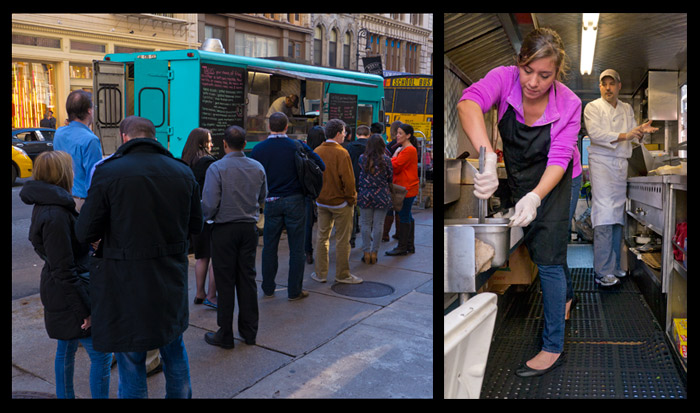
    Photo Note: This is the further incarnation of the food cart I wrote about on August 3, 2007. The cart is now the Tribeca Taco Truck. The truck is owned by Percy, but on this occasion, his daughter Alycia (seen in the photo) informed me that he was purchasing a second, larger truck – one will remain stationed at the original location (Broadway between Prince and Spring Streets) while the other roams. Tenacity is also a key ingredient to success, and Percy has stuck with his endeavor for some years. He now has long lunch lines every day. Get there early and tell him I sent you. Percy and crew are wonderful and will treat you like family.

    Related Posts: Not Enough Dough, Brawling Over Brands, Trucks and Things, You’re Not in Kansas, Pearl Paint, End of an Era, Canal Rubber, Space Surplus Metals


  • dinamic_sidebar 4 none

©2026 New York Daily Photo Entries (RSS) and Comments (RSS)  Raindrops Theme