• Category Archives Parks
  • Window of Opportunity

    Posted on by Brian Dubé

    This is a daily photo website, and although it has evolved to become much more story- and text-driven than at its inception (where the text served as more of a caption), I assume that many of you are interested in photography and imaging.

    The advent of digital cameras has brought many more individuals into photography. The Internet and digital media have provided a myriad of online forums, all easily available to the masses. Camera technology has made it much easier for the average person to get very good results. Preview screens provide immediate feedback, providing an excellent learning tool for identifying problems, rather than having to wait for film processing.

    The cost of photos is essentially free, less amortization of the equipment. This means more photos can be taken, important in difficult shooting situations where a number of shots increases the chances of capturing that special moment. Post-processing on a PC with applications such as Photoshop essentially brings the darkroom to the desktop. For me, this is one of the most important tools in the digital photography process.

    So, with all this technology and increasing numbers of photographers, one problem remains – how do you differentiate your photos?
    Subject and setting. If you are interested in color photography, for example, it is going to be difficult to get the kinds of results Steve McCurry gets just by being in India, Kashmir, Tibet, or another exotic locale, and getting such unique subjects and settings.

    However, few have the ability to travel to locations like these very frequently, if at all. It is unlikely that one will find many unique subjects in and of themselves – in a city like New York, nearly everything has been combed over. A rarely seen subject will require research and travel – places such as the Hole, the Black Cowboys, etc.

    One strategy is to shoot familiar subjects from different vantage points (see Dachshund Octoberfest here) and at different times. Although the magic hour (early morning and at sunset) is often celebrated as the optimal time of day for shooting because of the quality of light (see Light on Bobst here), I also see the early morning as a time to capture activities particular to the early morning (such as deliveries to the meat packing district) or familiar subjects in an atypical way – quieter settings free of traffic and pedestrians and subjects illuminated by the sun in a unique way, like today’s photo of the Washington Square Arch with light pouring through it.
    See you in the morning for that window of opportunity 🙂

    Posts taken in the morning: Hawk Fest, Quietude, 23 Skidoo, Homeless Art Scene, You Don’t Say, Out There, Little in the Middle, Kristen, For Whom the Knell Tolled, Hua Mei Bird Garden, Coup De Grace, Eight Twenty Five, Slummin’, Fresh Meat, True North, Snow Play
    Posted on by Brian Dubé

  • Comic Relief

    There have been numerous television shows which are virtually synonymous with New York City and have achieved legendary iconic status. Many open with recognizable shots of the city. Some, like the Letterman show, even have images of Manhattan as a backdrop to the set.

    New York City has hosted The Tonight Show (with Steve Allen, Jack Paar, Johnny Carson), the Ed Sullivan Show, The Cosby Show, Sex and the City, Law and Order, The Late Show with David Letterman, Seinfeld, The Daily Show, Live with Regis and Kelly, and Saturday Night Live. These shows were not only produced and filmed here but also had New York City as part of its motif.

    Saturday Night Live is a New York City-based sketch comedy show that began in 1975, with Lorne Michaels initially as writer/producer and now as executive producer. It achieved such wide cult status that the 3 letter acronym, SNL, soon replaced the name of the show in conversation and became widely adopted. Watching the program, singly or in groups, became de rigeuer for young people. I recall the regular Saturday night ritual. Excusing oneself from a social gathering to make it home to watch SNL was quite socially acceptable. In fact, it spoke highly of one’s love and dedication to an important part of New York City.

    Many of the cast members launched careers in comedy and film after working on the show: Eddie Murphy, Dan Ackroyd, Bill Murray, John Belushi, Gilda Radner, Chevy Chase, Julia Louis-Dreyfus, Chris Rock, Chris Farley, David Spade, Mike Myers, Dana Carvey, et al.
    Some of the show’s popular sketches also inspired films such as the The Blues Brothers and Wayne’s World.

    The show’s allure has drawn celebrities, who both host the show (starting the opening monologue) and perform in sketches with the cast. The show also features a musical guest. The list of those who have appeared on the show reads like a who’s who of the entertainment world, with hundreds of names. The show has had cameo appearances of political figures such as Barack Obama, George W. Bush, Al Gore, Hillary Clinton, and NYC Mayor Rudy Giuliani.

    In the early years of the program, New York was troubled, and SNL put a welcome and much needed positive spin on a city mired in financial woes and crime. Then, as now, SNL has provided necessary comic relief 🙂

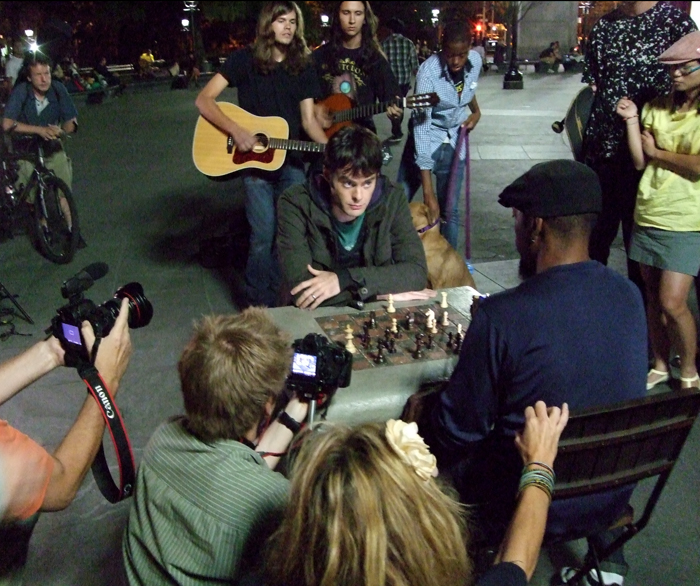
    About the Photo: Tuesday evening in Washington Square Park, a chess table (resembling those in the chess area of the park) was set up in the fountain plaza for filming of what will be used as an opener in the upcoming SNL season. Bill Hader was the star on the set. Hader is an American actor, comedian, writer, producer, and cast member of SNL since 2005. He has won both Emmy and Peabody awards and has appeared in over 20 films. So it was very surprising that the filming was being done with so little fanfare. A small audience gathered around the subjects with no interference from the film crew – their only admonition was “no flash photography.”


  • Hua Mei Bird Garden

    My excitement in learning about the existence of the Hua Mei Bird Garden in Sara Delano Roosevelt Park was greeted with skepticism, particularly by those I know who are very familiar with Chinatown. Sara Delano Roosevelt Park is a ribbon of green extending from Houston to Canal Street, flanked along its length by Chrystie and Forsyth Streets and straddling both the Lower East Side and Chinatown.

    In these neighborhoods, however, most visitors, both New York City residents and tourists, do their business and leave – that business in Chinatown being primarily eating on or near Mott Street, Chinatown’s central artery, or shopping by day and visiting clubs by night in the Lower East Side’s vibrant community.

    The park here, however, is not a destination. The 7.8 acres is much more of a utilitarian urban space dominated by areas designated to various activities – basketball, roller skating, soccer, etc. The center of the park is cut by Delancey Street. On the south side, you will find the Hua Mei Bird Garden. See more photos here.

    In 1995, three men, a Chinese banker and two former waiters, approached Anna Magenta, who, with Federico Sabini, had started the Forsyth Street Garden Conservancy in 1994 to improve the park. With her help, they petitioned the Parks Department, and in 1995, the Hua Mei Bird Garden was hatched. Bird gardens are common in China, and there are even restaurants that cater to patrons with their birds in tow.

    Every morning, a group of Chinese men gather with their songbirds, finches, sparrows, and blue jays among them. But the raison d’être of this garden is the Hua Mei with its songs. On weekends, the population of men and birds reaches its zenith, with dozens of cages along the walkway and hanging from lines. Most of the birds’ owners are retired Chinese men.

    The Hua Mei is a fighting song thrush – in the company of other males, it fights, and for females, it sings. The distinguishing physical feature is a white line that circles the eye and extends towards the back of the head. The birds are kept in ornate handmade bamboo cages, frequently with a white cloth covering the cage to shield them from the impact of the city. The birds are imported from China and Vietnam – they are quite costly, requiring quarantine before being brought into a domestic environment.

    The gathering is a social one for both the owners and the birds. The Hua Mei needs exercise, and the owners take the opportunity to introduce the birds to each other while bird talk dominates the conversation…


  • The Rockaways

    Just a subway ride away on the A train, you will find not a bay, inlet, or river, but rather, the Atlantic Ocean. This is the Rockaways, a peninsula, most of which lies within the borough of Queens, New York.

    The beach has an active surfing community – there are three surf shops in the area. The approach of hurricane Bill was seen by most as worrisome, but surfers heralded the storm as a joyful rare opportunity to surf the big waves. So, this seemed the perfect time to take a trip out to the Rockaways to catch some waves with a camera. Beaches were closed to bathers but open to surfers. See more photos here.

    The 6.2 mile boardwalk is a huge feature of the area, extending from Beach 9th Street to Beach 126th Steet. The central area of Rockaway Beach is fronted with large, hulking public housing projects, many of which became riddled with crime. There are new apartment condominiums newly built and in the works. Strings of closed stores line 116th Street, the main shopping district.

    Driving from one end of Rockaways to the other through the varied communities – Belle Harbor, Far Rockaway, Arverne, Neponsit, Rockaway Beach, Rockaway Park, Breezy Point, and Edgemere – is one of the most shockingly diverse demographic ranges of humankind I have seen, from lower to upper middle class. Driving amongst the virtual mansions in Belle Harbor, the ramshackle nature of central Rockaway seemed a flawed memory.

    I missed many of the interesting areas, such as the historic bungalows off the boardwalk at Beach 108th St. that have become summer rentals and the scenic area at the end of the boardwalk from 121st to 126th Streets. I intend to return and explore more of the area on foot.

    This is truly the land of the haves and have-nots, but the ocean and the boardwalk looms large and mitigates much of the area’s depressed pockets. The ocean is a curative for the human soul, and I believe all feel fortunate to have such a fine strip of ocean, sand, and boardwalk…

    NOTE: The Rockaways have a rich history: from 1902 to 1985, there was a large amusement park called Rockaways’ Playland. See a photo history here.


  • Double Your Pleasure

    In America, we love numbers, bargains, more, and doubling. Two is such a convenient multiple for the real world – double your pleasure, double your fun, double your money, double your results, double down, double trouble.

    Washington, D.C. was the first big city I visited, and the Washington Monument was the first tall structure I ever saw. My obsession with it knew no bounds. I had many facts memorized, such as that it was 555 feet tall and 55 feet across the base.
    One of the beautiful things about the Washington Monument is positioning near the Lincoln Memorial Reflecting Pool. I love gazing in it and seeing the monument’s reflection, getting a visual bargain: two images for the price of one.

    When I moved to New York City, Greenwich Village was my first home, and the Washington Square Arch became the natural and perfect object for transference of my monument fixation. It was not as tall, but it was white, stone, also named after our first president, and had a lot of its own history and character. It also became a symbol for the neighborhood, with its bohemian and iconoclastic history, of which I believed myself a member.

    In the previous design of Washington Square Park, prior to its recent renovation, when the fountain was turned off, the water would drain completely within minutes. However, the new fountain’s system recirculates the water, and after being turned off (at approximately 10:30 PM), a shallow pool several inches deep remains. If the wind is light, the water stills and in a short time becomes a wavy mirror, reflecting the arch, any individuals sitting on the perimeter of the fountain and, if you are positioned correctly, the added bonus of the Empire State Building framed inside the arch itself.

    If you’re in Greenwich Village at night, take a stroll by the fountain, and the odds are very good that you may double your pleasure 🙂


  • Xiangqi

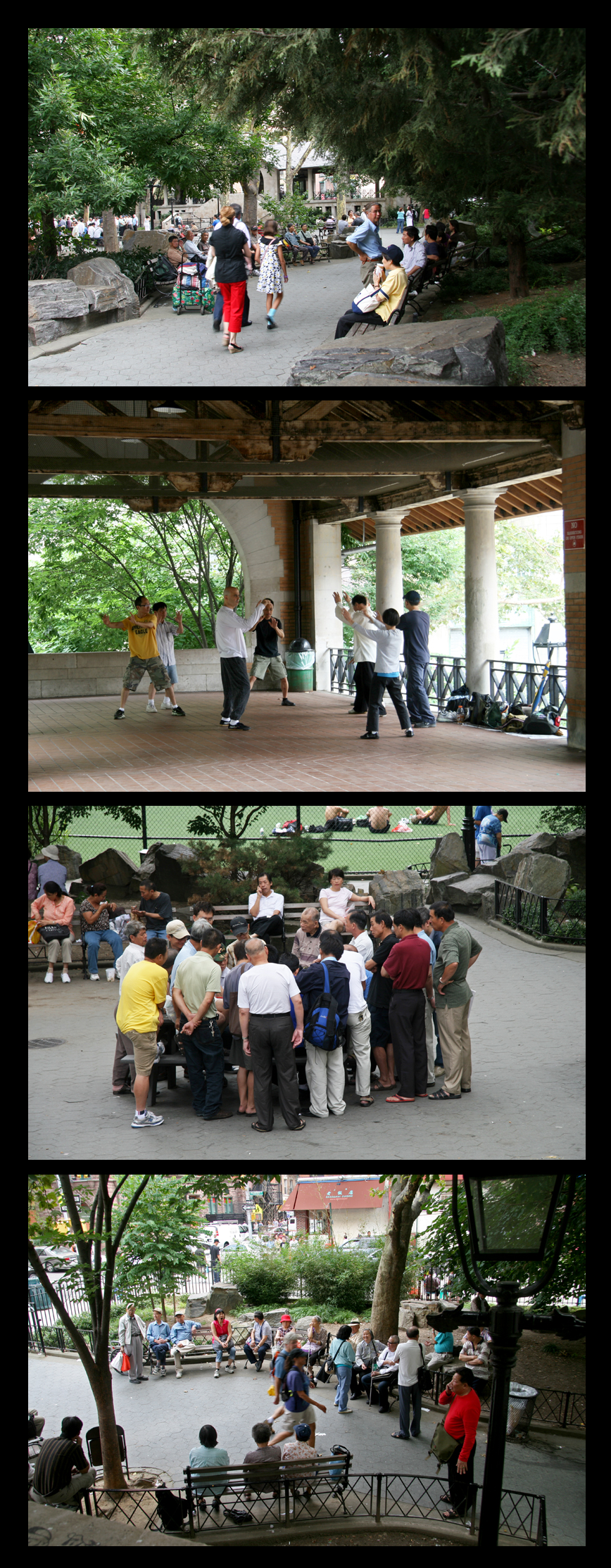
    If you want a full cultural immersion experience, head to Columbus Park on a Sunday in Chinatown. This tiny park is Chinatown’s playground, home to a wide gamut of traditional Chinese recreational activities. Here, you will find people doing Tai Chi or practicing martial arts in the pavilion, playing folk music, displaying caged birds, singing Peking Opera, women playing mahjong, and hundreds of men engaged in numerous games of Xiangqi (Chinese or elephant chess). You may find cobblers, watch repairers, and fortune tellers. There is also a children’s playground and basketball courts. See more photos here.

    Columbus Park is one of the city’s first major urban parks (the park has alternatively been named Mulberry Bend Park, Five Points Park, and Paradise Park). The 3.23 acre park was planned in the 1880’s by Calvert Vaux, co-designer of Central Park, and opened in 1897. It was named Columbus Park in 1911. Read more about Columbus Park at the New York City Parks Department website here. From their website:

    It is situated in the heart of one of the oldest residential areas in Manhattan. The southern end is adjacent to the infamous “Five Points.” Until 1808, the site for the park was a swampy area near the Collect Pond (now Foley Square) and hosted a set of tanneries. In 1808 the pond was filled and became Pearl Street. When the filling began to sink, a foul odor emerged which depressed the living conditions of that neighborhood. As a consequence, the area became host to one of the world’s most notorious tenements, known for its wretched living conditions and rampant crime, earning such names as “murderer’s alley” and “den of thieves.”

    This notorious slum, Five Points, was dominated by rival gangs such as the Roach Guards, Dead Rabbits, and Bowery Boys, a central subject of the book The Gangs of New York by Herbert Asbury, published in 1928. This, in turn, inspired the 2002 Martin Scorsese film, Gangs of New York.

    To survive in New York City, unless you have enormous wealth to buffer the harsh environment, you must learn to be resourceful. Ethnic immigrant groups find ways to import their cultures. Regardless of how inhospitable the city might be or incongruous the activity, New Yorkers improvise, adopt, and adapt. The Chinese have done that remarkably well…

    Location: Columbus Park is located one block south of Canal Street and one block west of Mott Street in Chinatown. It is bounded by Baxter, Mulberry, Bayard, and Worth Streets.

    Related Postings: No MSG, T?t, Big Buddha, Hallmarks and Earmarks, Durian, At Arm’s Length, Year of the Rat, Pearl River Mart, Buried Treasure, Tea Time


  • Gallivanting

    When I was young, a popular refrain from my mother was, “No daughter of mine will be gallivanting all over town.” This meant my sister, of course, who was easily bored and quite social and mobile at a very young age, earning herself the nickname “the roadrunner.”

    So I grew up believing that gallivanting must have been an accidental omission in the list of deadly sins or biblical commandments. Certainly there was nothing worse than to gallivant – the mere expression of youthful freedom appeared to be a mortal sin. Let’s not even imagine the things a girl might actually do while gallivanting. Even worse, at night.

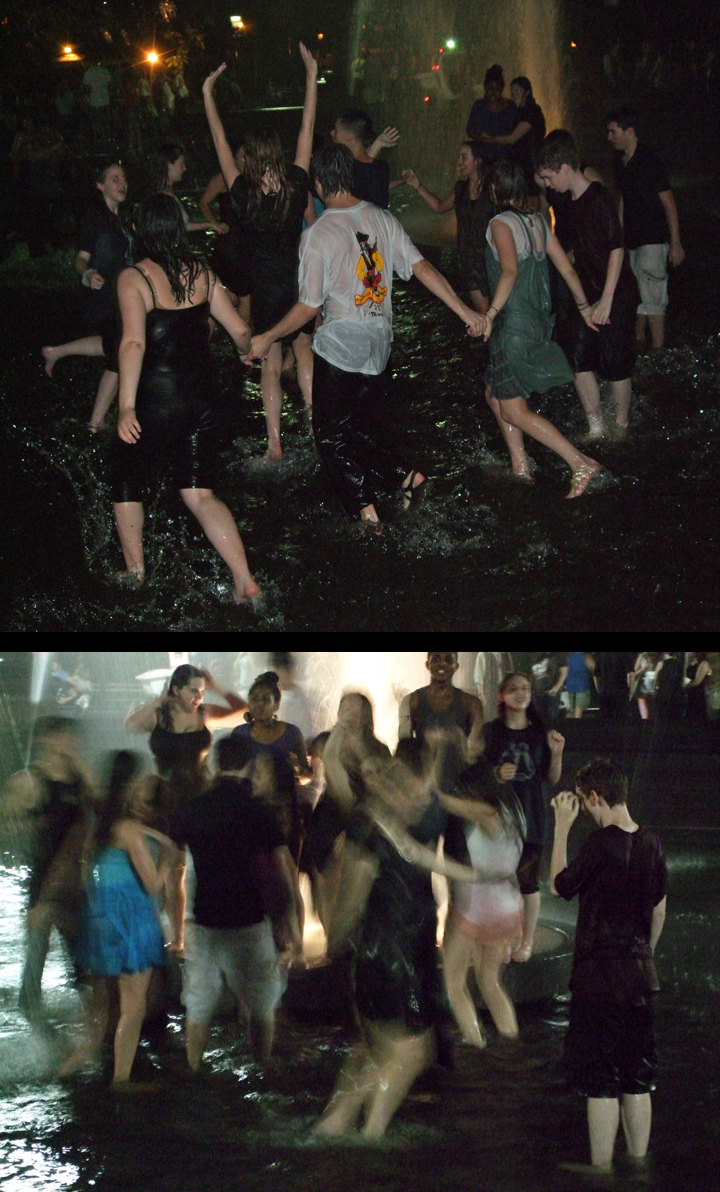
    Without parental controls, what better time and place to gallivant with your friends than New York City at night? With the recent restoration of Washington Square Park, the fountain now sports a massive center plume and powerful side jets and has been a center for late night revelry, virtually without concern for temperature or rain. It has become a theater for bravado – will you take the challenge and go in with your street clothes on? They do, and they get soaking wet, with spectators watching in amusement. I saw a girl moon the audience and a man do a head stand on the steel grate over the center plume. More photos here.

    There is squealing, shrieking, dancing, splashing, and jumping. The cavorting and play appears to be the most fun anyone has ever had. I don’t know whether this is a case of pure joy or if there is an element of the classic “stolen watermelon tastes best.” Some of these girls must know how much their mothers would be disappointed if they knew their daughters were out late at night gallivanting 🙂


  • Chess Monsters

    The last great chess player I saw in Washington Square Park was Yaacov Norowitz; this was to be his story, as well as that of the other great players who have graced the southwest corner of the park. But I have not seen Yaacov playing in some time.

    On and off, for a few decades, I have spent many a Sunday afternoon watching the games of many masters, international masters, grandmasters, and blitz players. I never got to see Hikaru Nakamura, reputed to be one of the undisputed monsters of blitz chess. I did often see Israel Zilber, a former Latvian chess champion who was homeless during most of the 1980s and was one of the best players in the park.

    One of the wildest incidents I have witnessed in this area was a shooting. As all the players scurried for cover behind the low concrete wall which encircled the tables, one chess fan who had been watching the games actually made the rounds pausing everyone’s clocks. Once the smoke had cleared and the police had reestablished law and order, the players jumped backed and resumed playing as if nothing had happened. We were told that that the incident was motivated by a previous drug deal gone awry. On this day, one party encountered the other, pulled out a gun in broad daylight, and fired.

    One of the highlights for me was the regular appearance in the 1980s of Grandmaster Roman Dzindzichashvili, a two-time U.S. chess champion. He played blitz chess for money, as is common there. Blitz is speed chess, where each opponent is limited to 5 minutes total per game. Accumulated time for each player is tracked using a chess clock. A player whose time runs out loses (unless his opponent does not have enough material to win).

    There is a spectrum of playing styles here. Much of street or park chess played for money involves hustling, which can take the form of anything from the classic hustle (i.e. disguising one’s skill level) to outright cheating, which I have witnessed. Skills are honed specifically for speed chess, an aggressive style of playing and a mastery of all the tricks and traps of the game, along with distractions such as chess trash talk. Time odds are frequently offered to players of lesser strength. When played for money, games range from a few dollars and up – I have seen sessions played for as much as $100 per game. Side bets are also frequently made. Some regulars (such as Bobby Plummer, aka Sweet P) essentially set up office, staking out a good table early and barking the offer of a game to passersby. Some are able to eke out a subsistence living. This area is known worldwide to chess players, and many come here for a challenging encounter, prepared to lose some cash. Read article here.

    This corner of the park was the setting for the 1993 film Searching for Bobby Fischer, a story based on the life of chess prodigy and Village resident Joshua Waitzkin. Bobby Fischer was a player here in the 1960s – unfortunately, this was before my time in New York City, and I never got a chance to see this legendary chess icon play.

    The quality of player has gone down decidedly in the park, as has the physical environment in this area, which badly needs an update (scheduled as part of a future phase of the park renovation). I hope for a return of the chess monsters 🙂

    Notable chess players who have played in Washington Square Park:
    Joel Benjamin, Roman Dzindzichashvili, Kamran Shirazi, Joshua Waitzkin, Bruce Pandolfini, Vincent Livermore, Russian Paul, Hikaru Nakamura, Yaacov Norowitz, Luis Busquets, Bobby Fischer (early 1950s), Maurice Ashley, Asa Hoffman, and Israel Zilber. There are also regular games played in Union Square, Times Square, and Central Park.

    Related Postings: Good Fortune, Marshall Chess Club


  • Plum Beach

    Posted on by Brian Dubé

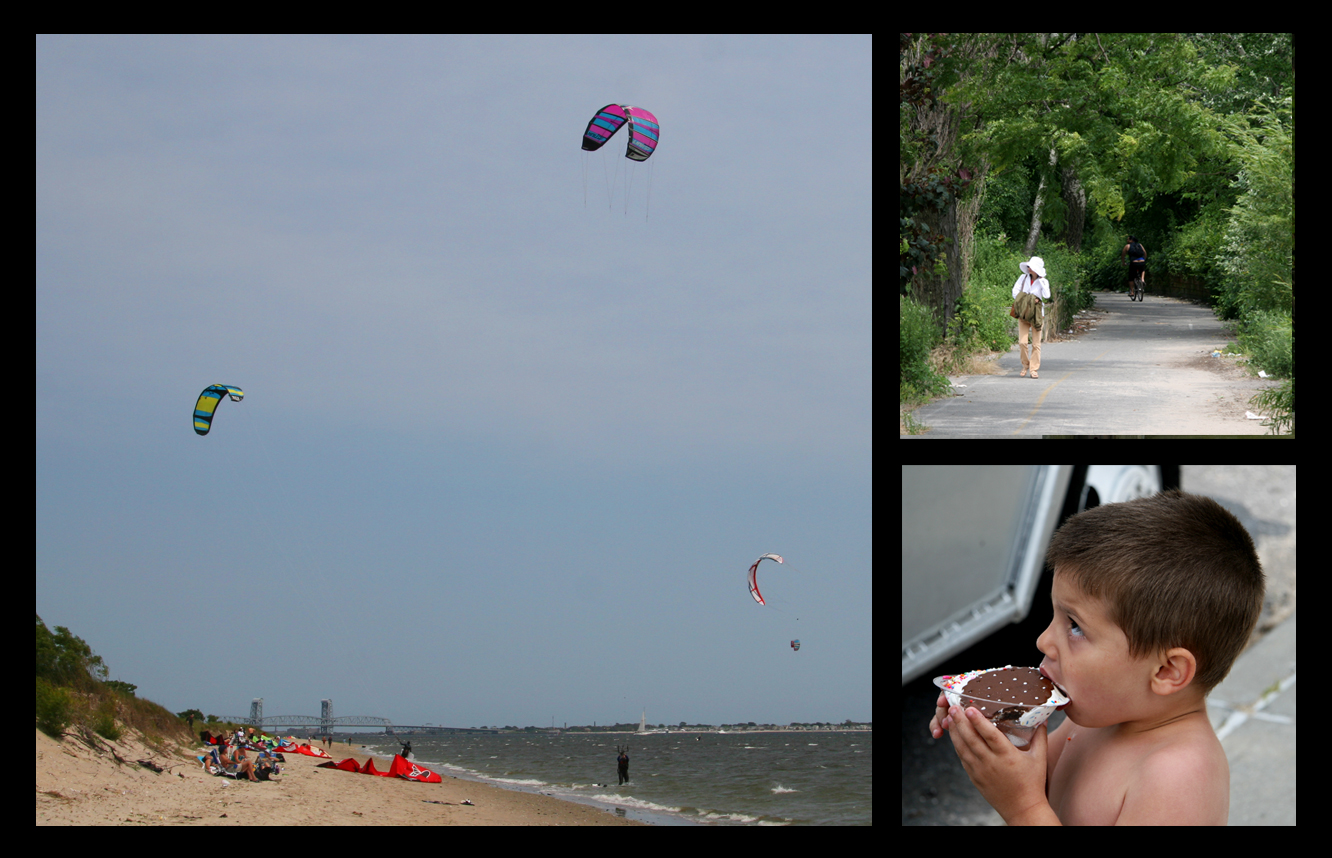
    The sight of kite surfers and the convenient access to Plum Beach from the Belt Parkway prompted a quick detour from my recent excursion to Floyd Bennett Field. Unfortunately, this convenience in a major metropolitan area, combined with relative isolation, has given Plum Beach a rather unsavory and spotted past.

    Older residents reminisce about days when Plum Beach was a lover’s lane. Since that time, it has become known as a gay spot. From a New York Times article from 2006, Deadly Days at a Lovers’ Lane:

    Decades ago, the beach’s parking lot was notorious as a lovers’ lane for the neighborhood’s besotted boys and girls. In recent years, the area has become better known as a gay trysting spot. The police say that the four men accused in the death of 29-year-old Michael Sandy of Williamsburg this month were aware of the area’s reputation when they lured him there.

    The incident refers to an attack by four men who lured the gay victim to Plum Beach using an Internet website. A planned robbery scheme derailed when the victim ran from his assailants onto the Belt Parkway, where he was struck by a car. Those familiar with the area also warn of drug use and needles on the beach. An article from Citynoise on Plum Beach in 2005 opens:

    Plum Beach is a grimy spit of sand that is just past Sheepshead Bay and part of Gateway National Park. It’s beautiful and filthy and therefore gloriously neglected, unkempt and various.

    The article goes on to discuss the various activities. Reading the comments, which span four years from 2005 to 2009, provides an informative history based on personal experiences.

    When I stopped at Plum Beach, I was not aware of any of this history or reputation. I also visited after a cleanup effort in April of 2009 by the American Littoral Society, so my visit was untainted by garbage, which apparently used to be a huge problem.

    The beach, named after the beach plums that grow there, is part of the Jamaica Bay Unit of the Gateway National Recreation Area, which includes the Jamaica Bay Wildlife Refuge (see here and here). There are many great beaches, along with great spots for nature and wildlife lovers in this area of Brooklyn and Queens. At Plum Beach, you will find kiteboarding and windsurfing – rare sights in New York City, and not what the average visitor is looking for. But, hey, we got the little stuff too* 🙂

    *This is my first use of a personal inside joke.

    Posted on by Brian Dubé

  • Bronx Zoo

    Posted on by Brian Dubé

    Zoos have gone through numerous incarnations, a mirror of society’s relationships with and views of animals. From the early menageries in Europe, we have moved away from cages and entertainment to habitats and education. There was no hiding from the populace that the conditions in most zoos at one time was deplorable. Eventually, the cages themselves became more difficult to justify. The emphasis today is the conservation message – the graphic for the Wildlife Conservation Society gets equal time with the Bronx Zoo on all of the literature, merchandise, and entrance gates.

    The Bronx Zoo was founded in 1899 as the New York Zoological Park, with 843 animals in 22 exhibits. A group of beautiful Beaux-Arts buildings designed by Heins & LaFarge surround a sea lion pool (seen in the photo) at the main entrance, which also features beautiful gardens. This is the largest zoo in the United States, covering 265 acres with more than 4,000 animals, many of them endangered species.

    The transformation can be seen at locations such as the Lion House, one of the original Beaux-Arts buildings, which no longer houses the big cats. All have been moved to larger areas. Some exhibits, such as the World of Darkness, have closed due to budget cuts.

    Efforts have been made to place animals in as natural an environment as possible. Ultimately, however, the overriding feeling I have in any zoo is still one of exhibits of animals in confined spaces. Some argue that if conservation is the motive, money would be better spent in open wildlife sanctuaries and contributions made towards the animals’ native environments in their home countries.

    At one time, when the Bronx Zoo made the transition to habitats, everything seemed to be so dramatically large and the animals so free. As I have visited the zoos since that time, the habitats feel smaller. I can’t help but compare these environments to the areas which the same animals must inhabit in the wild.

    Many of the inhabitants of the zoo are rescued animals whose fate would likely have been grim had not the zoo adopted them. Endangered species are protected, bred, and some even reintroduced to the wild. And I am sure that the place is staffed with dedicated animal lovers who cannot be expected to argue for their own demise. But when I peer into the eyes of those gorillas, I always wonder how happy they are and what they are thinking…

    Related Posts: Feeding at the Zoo, Rain Forest, Red Panda

    Posted on by Brian Dubé

  • Dreams

    Posted on by Brian Dubé

    There can be comfort in unrealized and unattainable dreams. A basket of these can provide a hidden agenda, and false hopes of realization can give one’s life purpose. These aspirations can be wielded in conversation: “One day I hope to…” And, perhaps, one is better without the realization, because not only is the dream lost, but also, with the accumulated expectations over time, the reality could be a disappointment.

    And so it has been for me with my love affair with Washington Square Arch, a monument which I have looked at nearly every day of my adult life and dreamed to enter and ascend to its roof. As a boy, I had the same passion for reaching the summit of the Washington Monument, which was an easily attainable goal: pay the admission fee and take the elevator.

    The Washington Square Arch stairway is rarely open to the public. Until recently. Late one night, I was informed by a park habitué that the small door at the foot of the west end of the base of the arch was open – or, in fairness, I should say ajar. My first reaction was indignation – how dare I not be told about this opportunity! After waiting for decades, wasn’t I the most worthy?
    It soon occurred to me, however, that rather than spend time being self-righteous, perhaps I should consider taking advantage of this rare opportunity and actually entering the Arch. After all, goals are attained by those who act, not whiners.

    There was no sign of prohibition at the door. Many an opportunity is missed by overthinking, overplanning, and excessive worry, so with little fanfare or deliberation, I entered.

    An extremely narrow spiral staircase winds its way to the top. Fortunately, it was left lit, so my journey was easy enough. At the top, there is a large, cavernous chamber. A staircase ascends further to a skylight trap door, leading to the roof of the arch (photo lower left). It appeared to be easily opened, but I decided not to press my luck. I took several photos through the transparent domed roof hatch (photo lower right).

    There is not a tremendous amount of information about this interior Guastavino terra cotta tile staircase and upper chamber. Typically, the story of Marcel Duchamp and his cronies is told – see my story here. I have done nearly ten stories involving the arch (see the list of links below).

    What do you do when a small lifetime dream is realized? Just refine and redefine. After all, what I really wanted to do was to exit that domed hatch and go the roof. I am told that such a thing can be arranged if one speaks to the right people. When I do that, you will be the first to know 🙂

    Related Posts: Flash of Light, Comfort and Joy, Arch Rebels, Constant, Evening Arch, Cello, Nested Embraces, Singing Bowls

    Posted on by Brian Dubé

  • The Reservoir

    Posted on by Brian Dubé

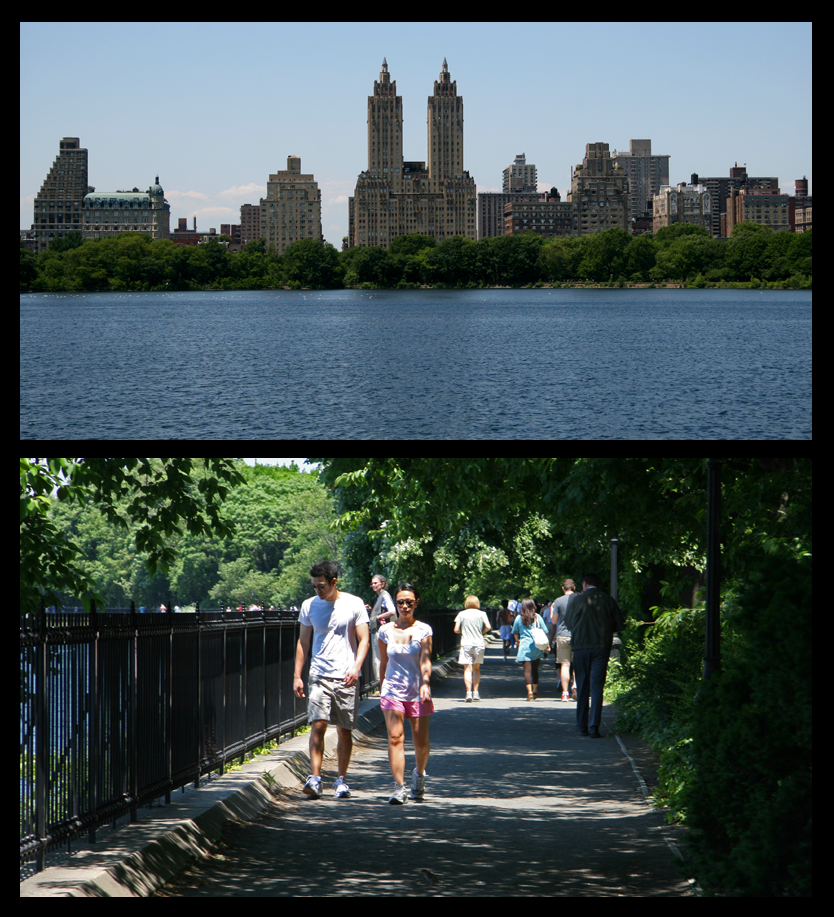
    Seeing the Central Park Reservoir for the first time is quite stunning. In the congested, densely packed borough of Manhattan, the last thing one expects to discover is such a enormous body of water. The reservoir covers 106 acres and holds over one billion gallons of water.

    This was built to the Olmstead and Vaux original plan for Central Park between 1858 and 1862, designed to receive water from the Croton Aqueduct and distribute it to Manhattan. It ceased functioning as a reservoir in 1993 when it was considered obsolete because of a new water main connecting to the New York City Water Tunnel No. 3.
    Anything this large and prominent in Manhattan is going to take on a life of its own, its use maximized. There is a 1.58 mile running track that completely circles it, on which there are weekly races sponsored by the New York Road Runners Club.

    Take a walk around all or part of the reservoir, and you will find many things – ornamental cherry trees, over 20 species of aquatic birds which have been sighted, three ornamental stone gatehouses designed by Calvert Vaux, three pedestrian cast-iron bridges that span the bridle path, ( one of which is the Gothic Bridge, one of the park’s most beautiful and distinctive), and, of course, vistas of the skyline surrounding the park.

    The photo was taken at the Engineers Gate entrance with the Purroy Mithcell Monnument. Looking across the Reservoir, you see Central Park West. The tall building in the center is the El Dorado, one of four twin-towered luxury apartment buildings designed by Emery Roth along Central Park West between 1928 and 1932: the El Dorado, the Beresford, the San Remo, and the Ardsley. Read Christopher Gray’s New York Times Streetscapes article about the El Dorado here.

    Note: The Central Park Reservoir is now officially known as the Jacqueline Kennedy Onassis Reservoir. The 1994 naming commemorated her contributions to New York City. Jacqueline, who had a Fifth Avenue residence, enjoyed jogging in the area.

    Posted on by Brian Dubé

  • Please Be Gentle

    Posted on by Brian Dubé


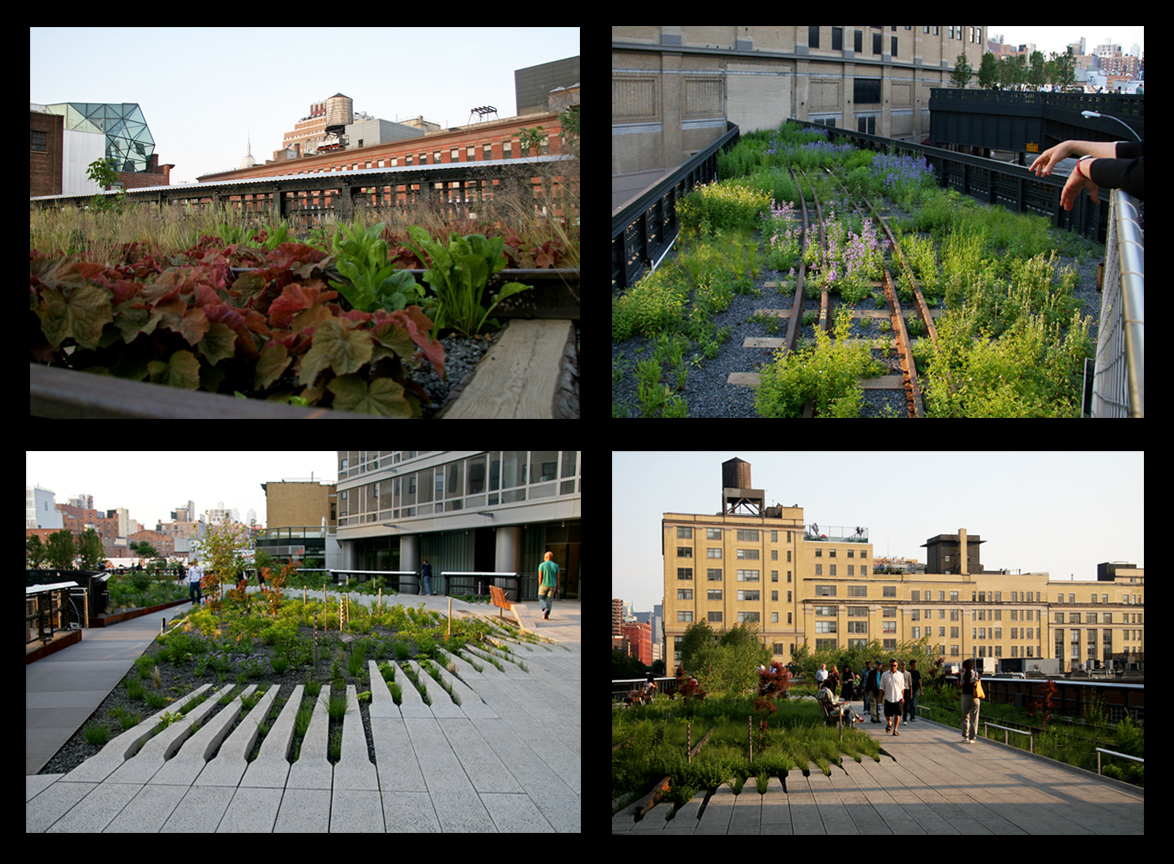
    Yesterday, June 8, 2009, was the highly awaited grand opening of the High Line. All the top officials in city government were there for the ribbon cutting – Mayor Bloomberg; Amanda M. Burden, the city planning commissioner; Adrian Benepe, the parks commissioner; Scott M. Stringer, Manhattan borough president; and City Council speaker Christine C. Quinn.

    This project was in the making for 20 years. The idea to save and restore the abandoned elevated freight railroad was first conceived in 1999 by Joshua David, a writer, and Robert Hammond, a painter. The project, named the High Line, broke ground in 2006 and is now an elevated park converted from a section of the West Side Line, built in the 1930s by the New York Central Railroad and unused since 1980. The railroad actually passed through several buildings – evidence of this still exists. See my entire photo collection here.

    The greenway is similar to the Promenade Plantée in Paris, a 4.5 km-long elevated park in the 12th arrondissement of Paris, France, constructed on an abandoned 19th-century railway viaduct. The High Line consists of three sections – the southernmost currently open runs from Gansevoort Street in the West Village to 20th Street. Upon completion, the entire park will extend to 34th Street.

    Over 30 projects are planned along its route, including a new branch of the Whitney Museum of American Art, designed by Renzo Piano.
    The design itself is the most artfully created public space I have seen in New York City. The High Line was designed by landscape firm Field Operations and architects Diller Scofidio and Renfro.

    Yesterday’s “soft” opening was pleasant, with a small number of visitors. Once its opening is generally known, there is a concern of overuse – the design work is beautiful yet delicate and rather fragile. The parkway is only 30 to 60 feet wide. If necessary, entry to the park may be limited. I recommend visiting – please be gentle…

    Posted on by Brian Dubé

  • Free Laura and Euna

    Posted on by Brian Dubé


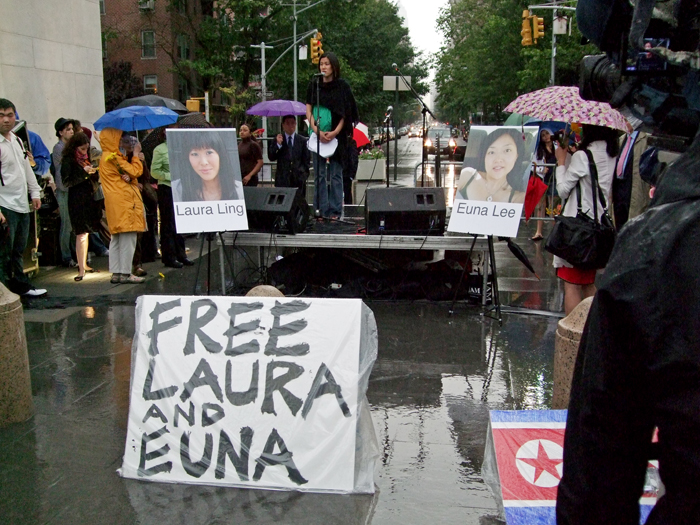
    Last night, I unexpectedly encountered this scene under Washington Square Park’s arch. Something important was obviously afoot, with a small crowd standing in the rain and speakers making statements from a small impromptu stage. Major networks were present, filming and conducting interviews.

    The flyers, speakers, posters, and sign which read “Free Laura and Euna” quickly illuminated the reason for the gathering. This was New York City’s vigil to bring attention to two American journalists who have been detained in North Korea since March 17, 2009 and stand trial today, June 4th.
    The two journalists, Chinese American Laura Ling and Korean American Euna Lee, were captured by the North Korean government and charged with illegal entry of North Korea with “hostile intent.” Working for Current TV (a network co-founded by former U.S. Vice President Al Gore), the women had entered China to interview North Korean refugees along the Tumen River, separating China and North Korea. Little is known about the precise details regarding their activities and alleged crossing into North Korea – the two women have been in solitary confinement since their arrest and have not been permitted contact with the outside world.

    If convicted, they face up to 10 years in prison doing hard labor. Some say North Korea will use the women’s release as a bargaining chip. The incident is particularly frightening, as North Korean prisons have a reputation for torture and brutal treatment of inmates. Families, friends, government officials, and the public remain hopeful for the release of Laura Ling and Euna Lee and their return to the United States…

    Posted on by Brian Dubé

  • Cello Class

    Posted on by Brian Dubé

    Some years ago, I fancied to learn the cello. New York City has some of the finest music schools in the country, and they all offer alumni lists of musicians ready, willing, and able to teach (at very reasonable prices). So, it was with this in mind that I found a great teacher/professional cellist, walking distance from my home, to teach me. This woman was both a Juilliard School and Manhattan School of Music graduate and had extensive performing and teaching experience, both privately and in a well-respected school for children.

    I was, however, somewhat remiss in my studies, barely getting through the lesson material each week. Learning a classical stringed instrument as an adult is a daunting task – practicing as I did at night after a day’s work. On one particular lesson, my instructor was getting rather frustrated with me. She asked what a particular note was as she placed a finger on one of her strings. I said that I did not know. She then asked, if one knew a note on one string (she gave an example), what was the note on a neighboring string? I did not know. Backtracking further, she then asked what was the interval between the strings on a cello? Embarrassed and panicked, I just said I did not know that, either (answer: one fifth apart).
    At this point, she said, “If you were one of my student children, I would insist that you learn this material. However, being that you are an adult, I strongly recommend that you learn it, unless you would rather pay me $25 per hour to learn in class what you should be doing at home.”

    This story came to mind on Sunday afternoon, as I strolled down the tree-canopied sidewalk on Fifth Avenue, flanked on one side by some of the finest residential buildings in the world and abutting Central Park on the other side. A walk here is one of the most extraordinarily beautiful, bucolic, and genteel experiences you will ever have in this city. The extra-wide pathway is shaded by mature trees, arching overhead to form a tunnel of green. Dappled light falls on the cobblestone and hexagonal pavers.

    If you were one of my children, I would insist that on the next warm, sunny day, you accompany me as we promenade down Fifth Avenue. But since you are not one of my children and rather an adult, I strongly recommend that you do this, unless you just want to read about this now, when you should be doing your life lessons outside of class 🙂

    Photo Note: The photo was taken between 94th and 95th Street. The stretch between 96th and 89th Streets is one of the quietest on Fifth Avenue. Parades do not go north of 86th Street. It becomes much busier starting at 89th Street (location of the Guggenheim Museum), followed by the Metropolitan Museum of Art at 82nd Street.

    Related Postings: Free Lunch, Cello, Bargemusic

    Posted on by Brian Dubé


  • dinamic_sidebar 4 none

©2026 New York Daily Photo Entries (RSS) and Comments (RSS)  Raindrops Theme