• Category Archives Slings and Arrows of NYC
  • That’s What You Pay For

    A Shocking Story of Discarded Peanut Shells
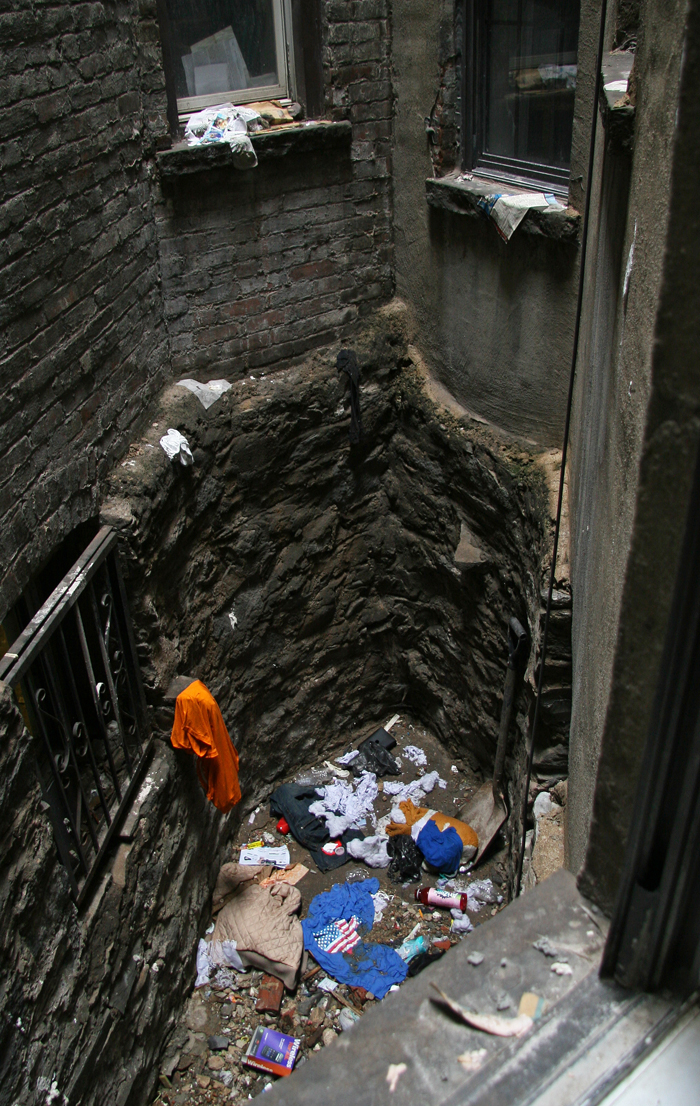
    I was told by a friend who lives in Bedford-Stuyvesant, Brooklyn, about the throwing of trash into the air shaft outside her building. She told me that not only was there an accumulation of trash at the bottom, but also that many articles thrown out find their home on her window sills, air conditioner, etc.
    On a recent visit to her apartment, I was able to look at and photograph the mess. She encouraged me to do so – documenting this would aid her in any action to remedy the situation.

    She told me that the litter was not just the product of things dropped accidentally but also a deliberate throwing of goods. One of those committing the offense is the owner of the neighboring building, making it even more difficult to put a stop to this activity. Among the treasure trove was what appeared to be a used condom.
    One often wonders what drives individuals to behave in such disgusting ways. Let me share with you a story that illustrates one man’s thinking.

    I had a high school classmate whom I did not really know at the time I was attending school. Years later, he opened a shop in my hometown in Connecticut, which I began to frequent. I quickly saw that we had little in common, and I understood why we had different circles of friends in school that did not overlap. As I would learn, however, his values were much further from mine than I could imagine.

    There are always at least a few common interests between any two people, so on my visits shopping at his store, I would have a chat. We maintained a casual acquaintance. As one is sometimes inclined to do, I extended an open invitation to him to stay with me in New York City. The lure of this city is great, and the prospect of a free stay in town is, for many, too much to resist. So, one day, Bob took me up on my offer, and I found him at my doorstep.

    In the time he stayed in my home, he developed a romantic interest with a friend whom I had introduced him to. On one trip to my hometown to visit family, this friend asked to come along to visit Bob.
    I don’t recall why, but they stayed at a cheap motel for that weekend. On my return to New York City, I stopped to pick up my friend. When I entered the room, I witnessed a scene that, to me, was quite shocking.

    Both were dressed and ready to go. Bob, however, was lying clothed on the bed, eating shelled peanuts from a bag. As he ate and conversed, he would take the shells and deliberately throw them one by one on the floor. When I say deliberately, I mean just that. Not dropping them or trying to throw them in a receptacle, but throwing them some distance with GLEE. A pile of shells and debris had formed, and he seemed quite pleased.

    When I confronted him, he responded with one of the most shocking things I have heard in my life. I asked him why he was doing this and, even though he was in a motel with maids, didn’t he feel badly about making such a mess on purpose? And he said:

    “That’s what you pay for.”

    Related Posts: Shortly Before Execution, Random Acts of Consideration, $7.95 a Pound, Insult to Injury, PDA

  • Mine

    One of my earliest childhood experiences wass flying simple balsa model airplanes with my friend Jaime. Portuguese in ancestry, Jaime’s English as a very young child was virtually non-existent. I only remember him using one word in English, and that was when we flew our planes in our yards together. As we chased them to recover them at the end of their flights, Jaime would run for his saying, “Mine.” What better word to learn for a boy playing with his toys?

    As a child, I was fascinated with all things that could fly – kites, birds, butterflies, damsel flies, rockets, planes, parachutes, balloons. However, lack of money and proper understanding of aeronautics foiled many of these endeavors. I recall jumping from the top of my father’s automobile with an umbrella in a desperate attempt to fly or parachute. I built small parachutes from napkins or pieces of cloth, suspending objects from it. Fabricating kites from found objects – sheets and tree branches – resulted in craft much too heavy to fly. I saw paper hot air balloons in catalogs such as Edmund Scientific but never was able to purchase one.

    Only as a teenager or adult was I able to take these childhood interests to fruition. In high school, I became very actively involved in the model rocketry club. In my 20s, I took ten hours of flight training towards a pilot’s license. In the parks and beaches of New York City, I flew kites of many styles and sizes.

    I still dream of owning a small plane. This and occasional nightly dreams of flying have become metaphors for freedom and release from a life of increasing stresses, responsibilities, and the slings and arrows of urban life.

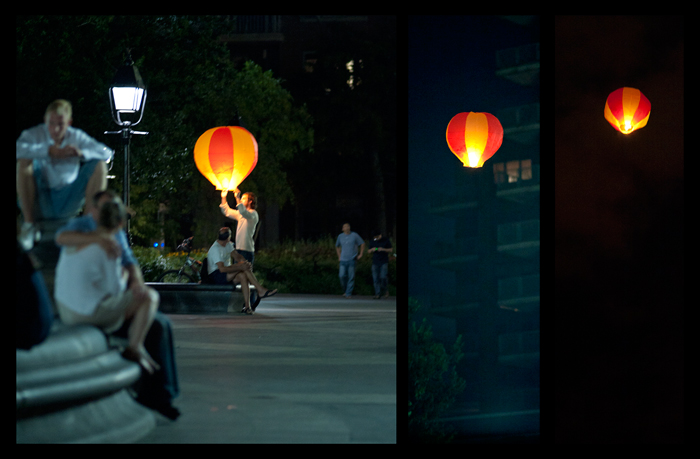
    On Tuesday night, I witnessed something I have never seen before anywhere in New York City – the launch and flight of a paper hot air balloon. The owner appeared suddenly from nowhere, quickly lighting and releasing the balloon, barely allowing time to make our way towards the launch area. Powered and illuminated by a small flame, we watched the glowing orb rise into the clear night sky, becoming smaller and smaller until it finally disappeared.

    Jaime, and I know that you are reading this, please know that as I ran towards that balloon, my mind drifted to those days of childhood when we chased our dreams through the grasses of our yards. I hope you caught some of your dreams, because I have caught a few of mine 🙂

    Photo Note: All the photos on the website are typically taken by me. However, it was impossible for this sequence of balloon photos, since I would have been unable to capture reasonable quality photos at night with a point and shoot camera. My photographer friend, Bill Shatto, had his Nikon D3, a pro camera with extraordinary low light capability, faster focus, tracking, and low noise. Today’s photos are courtesy of Bill Shatto. Photoshop work is mine.

    Related Posts: A Small World, Under the Sun, Floyd Bennett Field


  • A Story About Nothing

    I have been told that in Switzerland, people will always wait for a walk light, even in a small rural town at an intersection with no visible traffic in any direction.

    I have been told that in California, if a pedestrian steps into a street, cars will stop.

    I will tell you that as a New Yorker, it’s every man or woman for himself or herself. Cars, regardless of laws or unfair size advantage, will compete with you for the roadway and will nearly run you down. And, traffic or not, we run through intersections without walk lights in our favor and dodge traffic.

    In addition to issues of impatience waiting for walk lights, we also have a condition here of such severe crowds on the sidewalks, that many resort to walking in the curb or even in the roadway itself. Bicyclists are also aggressive. For some, these brazen acts of pedestrian and vehicular defiance confer Street Cred.

    In 1998, Mayor Rudy Giuliani, as part of his Quality of Life campaign, decided to initiate a crackdown on jaywalking. This short-lived effort was rather laughable and barely enforced, with only 99 tickets being issued that year. New York City is not Singapore.

    The reckless attitude of motorists towards pedestrians does not end with civilians. Police can also be rather overzealous. In Washington Square Park, for example, many are displeased with the rather aggressive habits of many officers speeding through narrow pedestrian walkways inside the park.

    In the 1970s, my girlfriend was arrested for kicking a police car with her roller skates. An altercation had occurred between a police officer and a skater who was tapping electricity from a lamppost to power his boombox for playing music for roller skaters. A chase ensued, backup police were called, and a police vehicle came careening recklessly into the park, nearly hitting pedestrians. My girlfriend, furious at the near hit, kicked and dented the squad car with her skates and was arrested along with the perpetrator.

    Ever the city of opportunity and opportunists, here on the highways, in moving traffic with little clearance, we have sellers of fruit, flowers, and water. I rarely need the flowers or water, but now I regret not having purchased a bag of fruit.* It would have made a nice snack, perhaps a quick chat with the vendor, and not have left me with a story about nothing 🙂

    *I believe the fruit is Melicoccus bijugatus, grown over a wide area of the tropics, including South and Central America, Mexico, the Caribbean, parts of Africa and the Pacific. It is called Spanish lime, chenette, guaya, guinea, genip, genipe, quenepa, mamoncillo, mamón, ackee, skinnip, kenepa, xenepa, canapé, knippa, limoncillo, anoncillo, or honeyberry.

    Related Posts: Hearts of Palm, Bygones Be Bygones, Durian


  • Unforgiving, Ye Who Enter Here


    I recall seeing physicist Michio Kaku speaking against nuclear power after the Three Mile Island incident. His central argument was that the risk was too great and that nuclear power was an UNFORGIVING technology. Whether or not someone agrees with his assessment, in a world where forgiveness is the hallmark of the loving person, unforgiving is a very powerful word.

    Life is a fragile business, and nothing illustrates that more than living in New York City. Better have all your ducks in row or you will will find yourself on the street rapidly – New York City is an unforgiving environment. I’ve written numerous times about this city’s revolving door nature. They come and they go – only the hardy survive the Sieve of Darwin.

    It is remarkable that such a place as New York City could feel like home to anyone. There is opportunity to make a nest here and have intimate relations with neighbors and merchants. One can find places to relax, even experience nature’s bounty. I seek these respites from urban assault and have featured many of these places in these pages. It is a great city, and there are many great and generous people. But there is a decided edge here, and all these things require work. Dwanna learned that very quickly, and Duffy explained what was needed quite well.

    However, a seasoned New Yorker’s antenna is always up and radar active. I have been conditioned at a core level and permanently rewired. I can fall asleep on a park bench or the subway, but the carrying strap of my bag is woven through crossed arms. I do occasionally walk at night alone on quiet streets, ever wary of those around me. Yes, New York is much safer now, but make no mistake, crime exists in large numbers. In 2010 there were 536 murders, 1,370 rapes, 19,359 robberies, 17,054 assaults, 18,695 burglaries and 38,136 grand larcenies. I lock my car doors everywhere I go, even in a driveway in the suburbs. Even with doors locked, many have returned to their vehicles to be rewarded with an Urban Coral Atoll and No Radio.

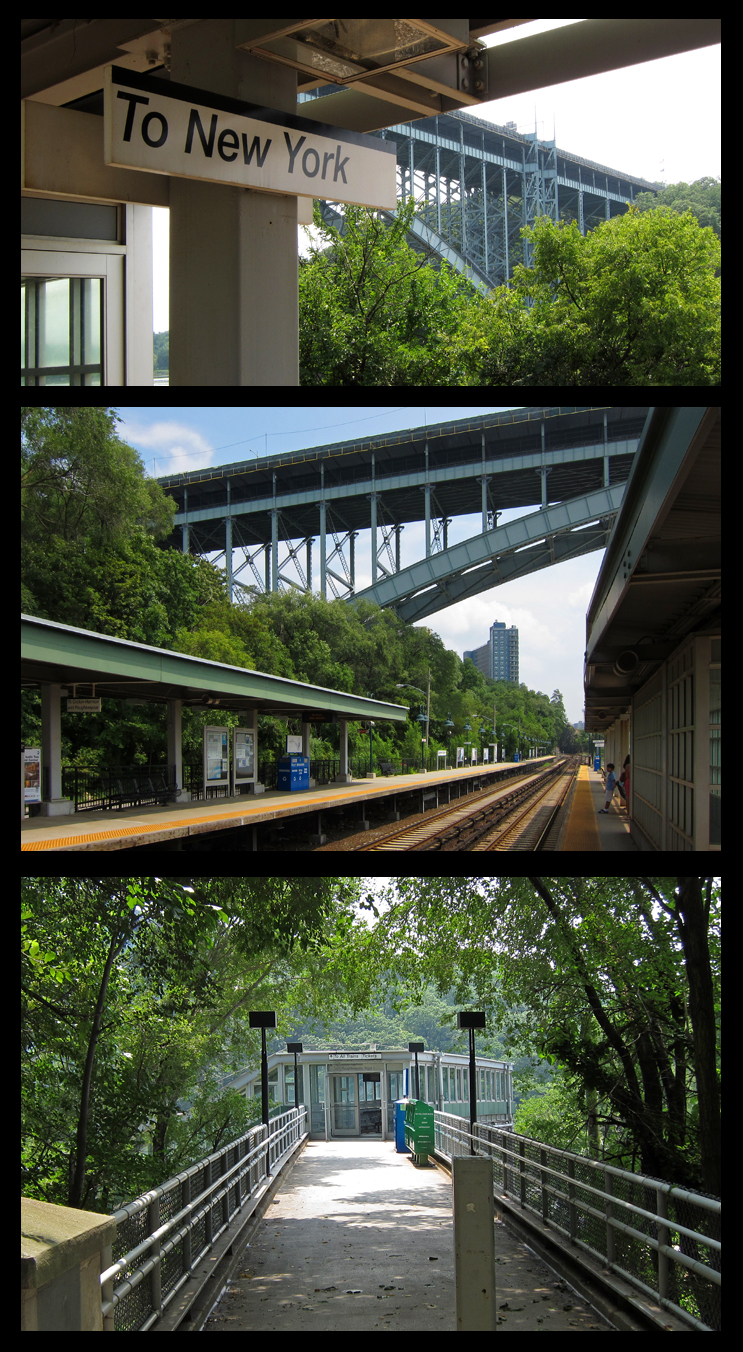
    Here on the Metro-North in the Bronx at the Spuyten Duyvil stop on a hot humid Sunday with virtually no one in sight, I caught this sign framed against the Henry Hudson Bridge spanning Spuyten Duyvil creek to Manhattan. To New York it says – a sight I have seen often. To me, it means home. But it also a warning sign: Unforgiving, Ye Who Enter Here

    Related Posts: Steaming Masses of New York, Afraid of Snakes, Jungle Lovers


  • Keep Flying

    I spent my childhood with a best friend exploring. This was our mission statement, and our summer quests knew no bounds. Only my mother’s distant call for dinner would bring our daily expeditions to an end.

    As young boys, we were never content to just observe. There was a desire to possess. We captured (and typically released) all manner of snakes, tadpoles, salamanders, frogs, wild birds, and butterflies. Butterflies are beautiful and fragile, but we did not understand the fragility. The brutish manner of young boys would seem to preclude such an understanding, only learning of such things after damage has been done.

    This is masterfully illustrated in one of the most beloved episodes of the Andy Griffith show, “Opie the Birdman” (aired in 1963). In this episode, a young boy, Opie, accidentally kills a mother bird with his slingshot and leaves her three babies orphaned. Ever the wise father, rather than punish the boy, Andy open’s Opie’s bedroom window so he will hear the chicks calling after the mother, who will never come home. Opie takes care of them until they are to be released into the wild. Without conventional punishment, Opie learns the meaning of responsibility, accountability, loss, and the consequences of one’s actions.

    The story also illustrates the fragility of life. And what is more fragile and beautiful than a butterfly with a lifespan of only a few weeks? New York City is not the place for the delicate or fragile. Such things, if they exist at all, must typically be protected and sheltered from the masses. Seeing a butterfly in a natural environment takes on a very special meaning here – it feels like nothing short of a remarkable event.

    This Tiger Swallowtail looks like it had suffered some damage. A little faded, a little bruised – reminders that we are in New York City and that to live here, you must be a survivor, get hurt and keep flying 🙂

    Related Post: Explorin’ Part 1, Horrible and Miserable


  • Rain of Terror

    Posted on by Brian Dubé

    The Wicked Witch of the West is exactly my type of woman. She always carries an umbrella and dreads water.*

    I grew up very rarely drinking water. This is so puzzling to many, but I have a hypothesis. My parents, growing up poor, saw water as the drink of those unable to afford milk. Of course, once we reached a certain age, we were told that milk was no longer needed for growth, leaving us with nothing to drink. See?

    When dying of thirst, I do drink things like carbonated beverages or fruit juices. Excepting in restaurants, I can never bring myself to drink water, and if suggested, the prospect seems so distasteful and unsatisfying. Better just to avoid the entire dilemma – I often go most of the day without drinking.

    I have one friend who has the same camel-like character. Our shared dislike of drinking water and ability to go long stretches without drinking has been a bond and great source of private jokes.

    Today, a water bottle seems to be de rigueur for young people. It is a standard accoutrement – bags are manufactured with mesh holders for water bottles. Observe anyone under 30, and a water bottle is not too far away.

    Any good thing is marketed to death. Water and even the concept of drinking itself are the targets of promotion. There are proponents of superhydration, where copious amounts of water are consumed in a day – a gallon or more. Inconceivable to me.

    I don’t care much for water getting on me either, and there’s nothing like an umbrella as a weapon against precipitation. In the suburbs, where transport and shelter is never far away, umbrellas do not have the importance that they do in a city like New York, where walking the streets is the norm. I do like showers, swimming and the beach, but I really dislike getting wet when clothed. It is so obviously repellent to me that I have often been asked, “Do you think that you are going to melt?” To which I always reply, “yes.”

    So many questions I am asked about my aqueous dislikes. Things I would never have to explain to the Wicked Witch of the West, who shares my feelings about nature’s Rain of Terror 🙂

    *It is never clearly explained why the Wicked Witch of the West in the Wizard of Oz is killed by water being dumped on her. There is much speculation, but most who have investigated this question believe that the witch’s dryness is what led her to melt when doused with water. The best hint seems to be a passage from the book The Wonderful Wizard of Oz by L. Frank Baum:

    The Witch did not bleed where she was bitten, for she was so wicked that the blood in her had dried up many years before.

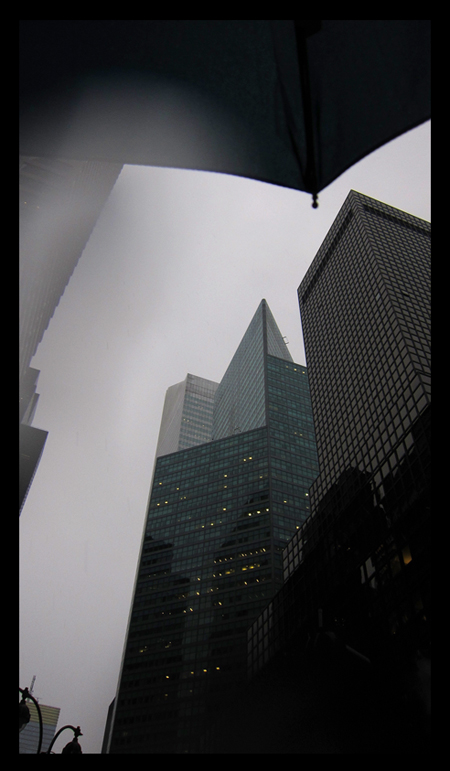
    Photo Note: This photo was taken at 50th Street and Lexington Avenue looking northeast.

    Related Posts: Electronics, Not Acid, Let’s Share a Drum, Water 4 DogsAt Least It’s Water, Water Sprites

    Posted on by Brian Dubé

  • Grace of a Boombox God

    Posted on by Brian Dubé

    Those of us who lived in New York City in the 1970s and 80s can testify to the very serious quality of life issues – graffiti covered subways, vandalism, garbage, crime, noise, drugs. The streets were minefields of dog poop just waiting for the next victim – those unfamiliar with the terrain or seasoned New Yorkers who had a momentary lapse of attention to the sidewalks. It was a very rough time and not the promised land at all. The most common question I was asked at the time about my choice to live in New York City was “Why?”

    In hindsight, those times are examined at arms length, analyzed, discussed, debated, romanticized and even missed. A case in point is a recent book reviewed in the New York Times:

    Mr. Owerko’s interest grew into a book, “The Boombox Project: The Machines, the Music, and the Urban Underground,” published this month by Abrams Image. It features his lovingly detailed close-up photographs of vintage portable stereos, as well as commentary by Spike Lee, L L Cool J and members of the Beastie Boys and the Fugees about the role the devices played in New York’s street culture from the late 1970s to the mid-’80s.

    In shot after full-page shot, Mr. Owerko — best known for his image of the smashed World Trade Center on the cover of Time magazine on Sept. 14, 2001 — venerates an audio technology that, to eyes accustomed to the iPod’s futuristic smoothness, seems practically steampunk: hard, square-edged metal casing; wheel-size speakers protected by silvery-black grilles; lots of clunky knobs and buttons. And at the heart of every boombox is a cassette deck.

    Many who bemoan the loss of the edge, grit, authenticity, lack of over gentrification, etc., were either not there or perhaps with selective memory, forget that living in that environment was in numerous ways quite awful. Many of the pleasant memories of that era often have more to do with the youthful enthusiasm and a spirit of reckless abandon and fearless adventure of young urban cowboys than any inherent charm of the city. New York City provided its own flavor of the lawless wild west.

    One of the most annoying and dreadful elements of the late 1970s and 1980s was the boombox. This portable party machine could be cranked to deafening levels, even outdoors against the ambient din of the city. At times it felt like there was no escaping it – the ghetto blasters were everywhere to be found including spaces where one expected quiet enjoyment like parks. To make matters worse, the music played was very limited, typically disco, a genre I quickly grew to abhor, or hip hop. You would not hear anything else, certainly not classical, country, blues or classic rock. We prayed for the death of disco and these infernal machines. Our wishes were eventually granted but it was an interminable wait of a decade.

    Boomboxes were HEAVY. It was a job to carry them all day. Some required as many as 20 D-cell batteries, which, allowing for continuous play and volumes, would only last the day. The cost of these batteries became major budgetary items for those who carried their boxes daily. They were essentially the Walkmans or iPods of their day, but as a broadcast device, they could hardly be considered personal audio players.

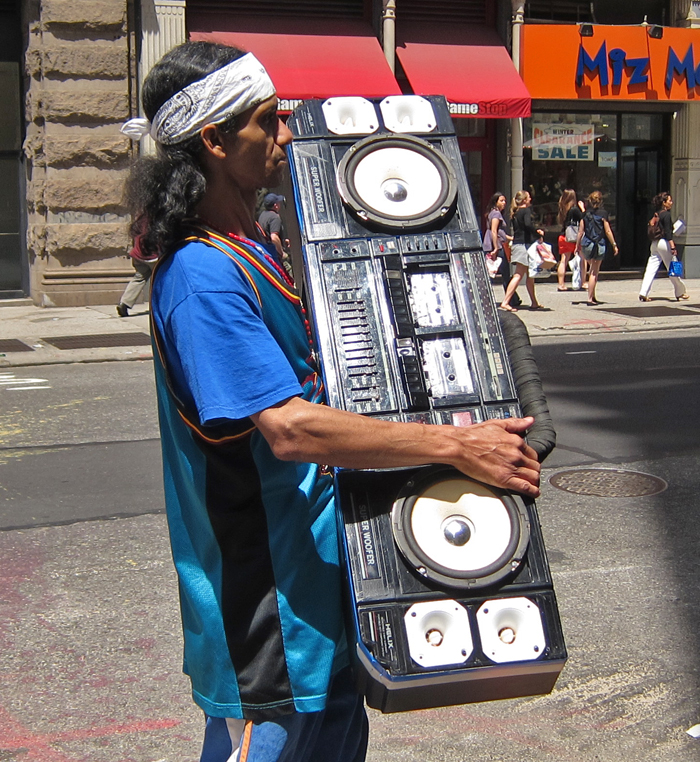
    On Monday, while walking on Broadway, I encountered what had to be the largest boombox I have ever seen. A pedestrian nearby commented to me “I feel like its the 90s again.” Perhaps he was not aware that if his only experience of boomboxes was the in the 90s, then he had not enjoyed true noise pollution.

    The owner was walking very briskly. I fumbled for my camera and ran after him, asking if he would permit a photo. With a pompous attitude and only a side glance, he made a beckoning motion with one hand, indicating I follow him as we both ran through Broadway traffic. He stopped for a second, giving me no time to compose a decent photo. I was a bit frustrated, however, I had to remind myself, that even though it was only for a brief moment, I had gotten a free trip in time and had been granted the Grace of a Boombox God 🙂

    Related Posts: Float Master, Part 2, Float Master, Part 1, Too Too New York, Deaf Jam, I’ve Got a Feeling, 5 Pointz, Columbo, Monk and CSI, Men Making Noise, New York State of Mind

    Posted on by Brian Dubé

  • Steaming Masses of New York

    Posted on by Brian Dubé


    I’m going to tell you a few things most New Yorkers are not going to admit to outsiders. Many of the bad things you have heard about this city are true. People move out, are happy to leave and don’t come back. I am not talking about dabblers, I am talking about tried and true, dyed in the wool, born and bred, loved it to death, New Yorkers. And many who visit here often or commute here daily, love the city and have the means to settle here do not chose to do so.

    Why am I telling you this? Because this site is not a foil – it is not a veiled marketing campaign for New York City. There’s a stoic pride in surviving here. Many New Yorkers hate the city as much as they love it – it’s a love/hate thing.

    New York is touted as one of the safest cities in the United States, on a per capita basis. This is misleading since crime rates are averaged across all boroughs and neighborhoods. In reality, many neighborhoods have very high crime rates. Many a suburb or smaller city is unlikely to see the tremendous disparity in crime rates across neighborhoods and thus averaging rates outside the big cities gives a better indication of what someone might experience than doing so in a place like New York. Also, big cities under report crime and many laws are not enforced here that would be elsewhere. Vandalism and theft is a constant.

    I personally have come back home to see Bleecker Street cordoned off because of a murder with open firing on the streets. I have witnessed someone pulling a gun out and firing it. I have been burglarized more than once. I have been held up at gunpoint. I see drug dealers daily. I witnessed a fight on Broadway in daylight between a man with a knife and one with a chain which was fortunately stopped by an attorney carrying a gun. I have had my car broken into with the entire rear window of a hatchback smashed into pieces. Meaningless anecdotal evidence? Hardly. The sarcasm and cynicism of New Yorkers, seen in comics like David Letterman or Woody Allen, are testimony to the fact that edgy is a word based on the harsh reality of the city life, not just a term used to describe style.

    Most people who have made a large personal investment coupled with self sacrifice are not eager to own up to New York City’s shortcomings, failings and problems. Because in a way, to do so is an admission that perhaps a person has made a poor decision to live here – who is courageous enough to admit that? Don’t believe the politicians who have an incentive to promote New York and are often chaperoned, escorted or chauffeured daily.

    I am also not going to bring out the cliches like New York is the greatest city in the world. Saying it does not make it so. I would not want to engage in a contest with cities like San Francisco, Paris, Venice or London. The city has become too expensive for most. Much has been over gentrified. National chains dominate retail – one has to hunt more to ferret out the special places that made New York great.

    And then there are quality of life issues, one of the biggest reason that many leave. The city is crowded, dirty and noisy. See one woman lose control in my story Mad as Hell. Natural oases have to be sought out. Although culture, restaurants and services abound, many of life’s simple chores are extraordinarily difficult – laundry, biking, transporting things too large to carry, driving, parking, grocery shopping or even having to walk up six flights of stairs several times per day to get home. Services and conditions in many of the city’s apartment buildings can be abominable – steam heat that can not be adjusted, inadequate ventilation, the roar of window air conditioners and intercoms that never work. This is not necessarily the realm of the low rent tenant – many very expensive apartments have the same poor conditions.

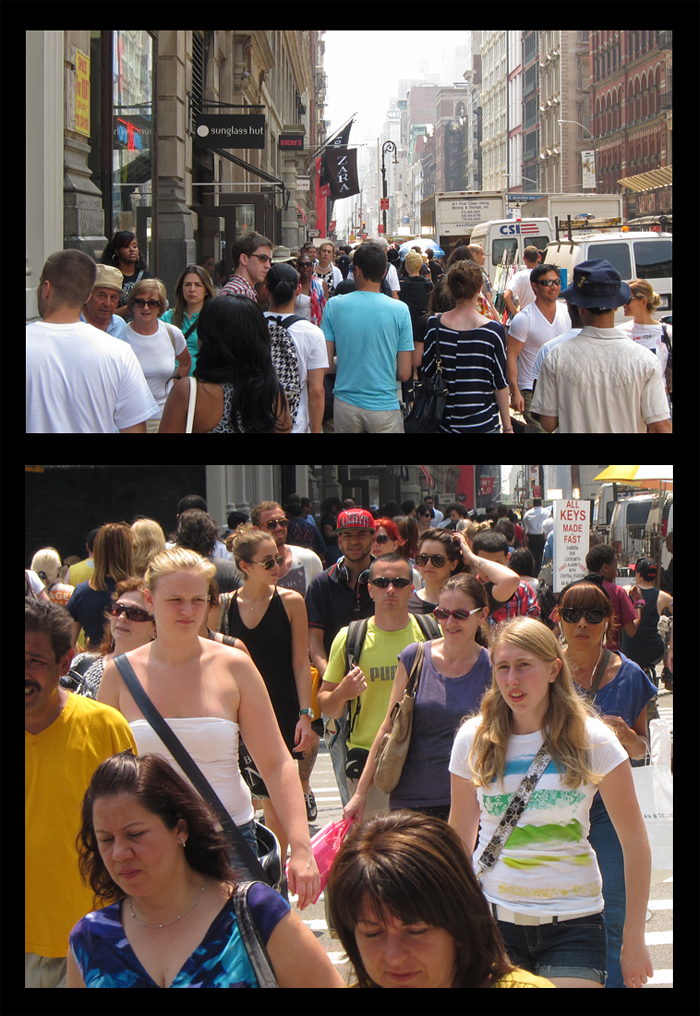
    New York is fundamentally a town where everyone has to walk to some degree. There are those who love walking and those who don’t. I have stated personally and on these pages how walking is one of the great joys of New York City, however, not in blistering heat with high humidity. Our recent heat wave is evidence of one of the grimmest times in this city. I look down Broadway and I know that many in that crowd are very uncomfortable, angry and in more ways than one, are members of the Steaming Masses of New York

    Related Posts: Hell, Mad as Hell, Mad as Hell 2, The Dark Ages, Unguent.

    Posted on by Brian Dubé

  • Too Too New York

    A New York comic: “Are any of you here from out of town? Yes? For those of you unfamiliar with the subway, it’s an underground system of urinals connected by trains.” Perhaps I should add, “patrolled by rats.” 

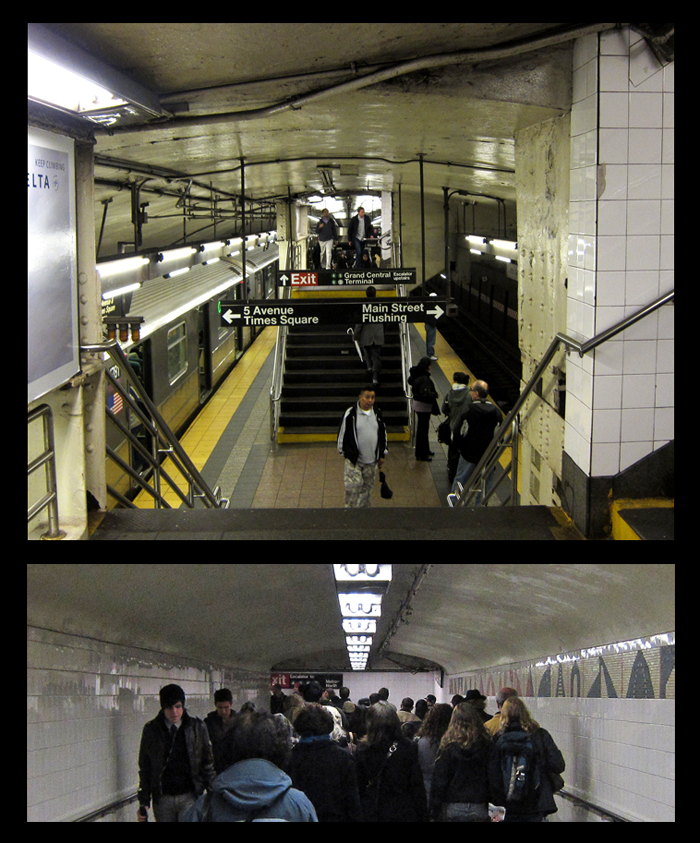
    There is little that says New York like the subway system, lying just beneath the city’s surface, acting as its central nervous system. Trains and train service is a highly contentious subject, often maligned and frequently praised. Its failings are many as are the reasons for the problems. One reader response to a subway article on Gothamist says:

    The NYC subway system is evocative of some third-world country.
    All you need are some goats and chickens in the subway cars to complete the picture.

    Perhaps the most common word used in explanations regarding things that ail New York residents and visitors is TOO. Many have commented as I have over the years of how nice it would be to have subway trains with rubber tires as do many other cities. However, a transit authority spokesperson said it was not possible – too much wear and our trains are too heavy.

    The enormous number of people in a non-heterogeneous mix is one of the key factors to make New York what many tout as the greatest city in the world. Of course, population size alone does not insure greatness, but it certainly is a contributing factor, providing support for a seemingly endless number of services, businesses and cultural opportunities. How else could you support the world’s only 24 hour subway system? But there are numerous serious issues, not the least of which is that it is literally deafening – noise levels in the Spring Street station running the Lexington Avenue line having been measured at 105 decibels (see article here). Noise at this level for one or two minutes each day can do permanent hearing damage over time. For now, too bad.

    The New York City subway is one of the world’s cheapest rides. Many feel that cost and the 24/7 service trump all negative concerns. But for others, the TOOs are a deal breaker: too dirty, too loud, too hot in the summer, too dilapidated, too outdated, too smelly, too crowded, too many stairs, too confusing, too many shutdowns and reroutings and too few attended token booths. Got to go now. I hear a train coming and it’s screaming TOO TOO New York 🙂


  • Cookies in the Afternoon

    What are the chances of finding an object whose function it is to apportion chances? I found this die sitting on a park bench, crying out to be photographed. The six outcomes seemed to speak well to chances of success in life, although it did not weigh the outcomes to accurately reflect the chances of success and failure in New York City.

    I was once speaking to a friend of an employee in my office. He appeared to be quite irritated and frustrated by my outlook relative to his. He apparently was steeped in workshops and readings which promoted ideas of positive thinking and affirmations. But, in spite of a positive outlook, success for him was Outlook Negative. On the other hand, he saw me as being rather negative, but my die was turning up Outlook Positive.

    I explained that I was actually a very enthusiastic person, tenacious and optimistic, but with, however, a very strong dosage of realism. I don’t believe in spending time using positive affirmations – saying it does not make it so and as everyone has heard, the road to success is paved with failure. The real estate at the top is very crowded, despite the disingenuous messages of the late night self help and get rich quick evangelists that buying their product will insure success – It Is Certain. After receiving it, any reasonable person will see that it Cannot Be Certain. When it comes to predictives of success, we live in a world of Insufficient Data or Data Error and the only solution is to Retry.

    Immigrants and transplants to New York City are risk takers by nature. However, although I have had a history of perhaps taking more risk than others, I never liked it and often dreamed of a lifestyle with less risk. I had a very insightful conversation with a woman with whom I was discussing my aversion to risk – that I had been self-employed my entire life, yet the inherent uncertainty of being in business in New York City was always somewhat stressful to me. In response, she made a very poignant remark about how I reminded her of her husband who had once said: “I should have been a baker. You buy your sugar and flour in the morning and sell cookies in the afternoon.”

    As attractive as this pearl of wisdom may appear, in New York City, becoming a baker may minimize potential loss, but will not guarantee success. The demise of iconic bakeries, Vesuvio and Zito makes abundantly clear what every business owner knows. There are many elements to business success, and minimizing inventory with high turnover is only part of the equation. There’s fierce competition, startup costs, changing tastes and in the city, extremely high rents. It’s still a roll of the dice, because it will takes lots of customers and no matter how much or little sugar and flour you buy in the morning, you may never sell enough cookies in the afternoon 🙂


  • Let’s Share a Drum


    Have you ever been seasick? My first experience with this was a return ferry ride of two hours from Nantucket. We had rough seas at night and I quickly became very queasy. I had only one thought – get me off this boat. Being at the lower level with odors of fuel was not helpful so I decided to move to the rear and go outside. Here I found a man with his girlfriend – she was in a similar, but more advanced state.

    I was surprised to learn that he was a Norwegian sailor, so at least I had the benefit of well seasoned companionship. He invited me to join his girlfriend who now had her head over a 55 gallon drum serving as a garbage can. I had nothing against her, but the prospect of both of our heads in the same oil drum was not what I had in mind, because I was not really ready to vomit – I was holding on at all costs.

    Our sailor could sense this and gave me advice that made a lasting impression. He said that the key to this situation was DONT FIGHT IT. GO WITH THE BODY. He repeated this many times. No, I don’t want to go with the body. I don’t want to vomit – I hate that feeling. Forget it.
    He elaborated, repeated and also informed me that eventually, being sick at sea catches up with every sailor. This surprised me. He said given enough time and extreme weather conditions, every sailor has his day. This was my day and I was not enjoying it at all. I can still hear him with a Norwegian accent – go with the body.

    His admonition, however, seemed well suited outside the world of sailing, seasickness, nausea and vomiting. Go with the body was tantamount to the old adage, go with the flow. Many unpleasantries are worsened by resisting circumstances beyond one’s CONTROL. This is the secret to dealing with stress in New York City – rush hour crowds, horrendous traffic, long lines, etc. Visitors, often coming from the suburbs where the logistics of life are easier, are perplexed at how New Yorkers can tolerate the stress of the city. The key is not just to pick your battles but not to engage in battle at all. Don’t’ fight it – go with the flow.

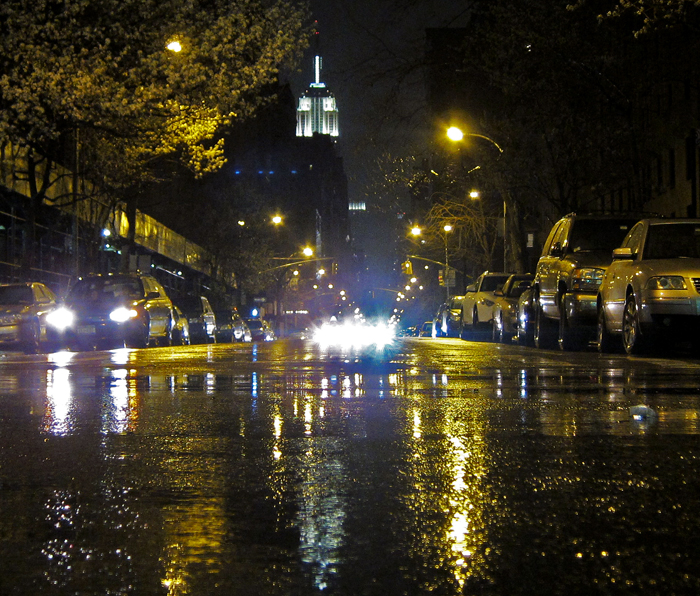
    I dislike rainy days like today. I find them so dreary and rather than embrace them, like the nauseous seafarer, I fight them, hoping and waiting for signs of clearing, wishing for the sun to peek through. But here, as elsewhere, rain can be comforting. It can be an opportunity to refocus and participate in things better suited to a rainy day. Stay indoors to work on some overdue projects. Relax and read, go online, watch a movie or TV. Perhaps dress appropriately, go out and enjoy the glistening city. When seasick, don’t fight it, go with the body. In New York City, don’t fight it, go with the flow. And if we find ourselves together, let’s share a drum 🙂

    Related Post: Landlubber


  • Down to the Cellular Level

    Posted on by Brian Dubé

    A friend once so aptly said: everything is a competition, right down to the cellular level. All is poised, the net result of competing forces. In the world of physics, chemistry and biology it makes so much sense. In the world of human/animal relations however, it’s often a bitter pill to swallow, and I don’t really like the idea much better than anyone else. I always hate seeing that springbok losing to the lioness.

    I don’t like to see everything as a contest, however I don’t believe things can really be win-win either. Resources are limited, particularly money and time, so how can everyone win? Or win as much as they would like. I hate to say it, but life feels like a zero-sum game. Whether it is shopping, dating prospects, jobs, admission to a great college, sports, games, vacation choices, ranking in your class, what you will read, the blogs you visit, what you will do with your spare time, or who you will call, choosing something is not choosing something else. We are besieged with unending decisions and we must choose (or be chosen) from the competing options.

    I am a competitive person by nature and so my worldview is tainted by wearing those glasses. I do love working with a team, but honestly I work best when the team is on my side. I am a poor loser so I avoid direct competition as much as possible, particularly contests I know I will likely lose. I did not know growing up that I was a biggish fish in a small pond. Like many, I had a lot to learn about the size of fish and ponds.

    I came to New York City in 1969. At that time, this city was the best to me – the biggest, fastest, and most amazing place I could imagine. It had the most and best of everything – restaurants, buildings, people, opportunities, culture, money, street life, intellectual stimulation, merchants. As far as places go, it won the contest, and I wanted to be with the winner.

    Of course I have learned much over the years – the merits of other places and other cities, the relative meaning of best and that New York City is not the end all and be all. Even in the realm of cities, it is arguable whether New York is the greatest city in the world. Places like Paris eclipse New York in many ways.
    Some tire of the urban grind (see Dwanna, Duffy, and I Know). Most of my friends, many born in the city, have left and with no regrets. There are quality of life issues here – so many things that are undeniably easier and better in the country, suburbs, or smaller cities. For most, even if they have the means, New York will always be the stereotypical “it’s a nice place to visit, but I wouldn’t want to live there.”

    New York City is not for the faint of heart. The stakes are higher, the costs are greater, competition much fiercer, and the penalty for failure more severe. New York City is a magnet, attracting some of the world’s best competitors, from gladiators in the ring right down to the cellular level…

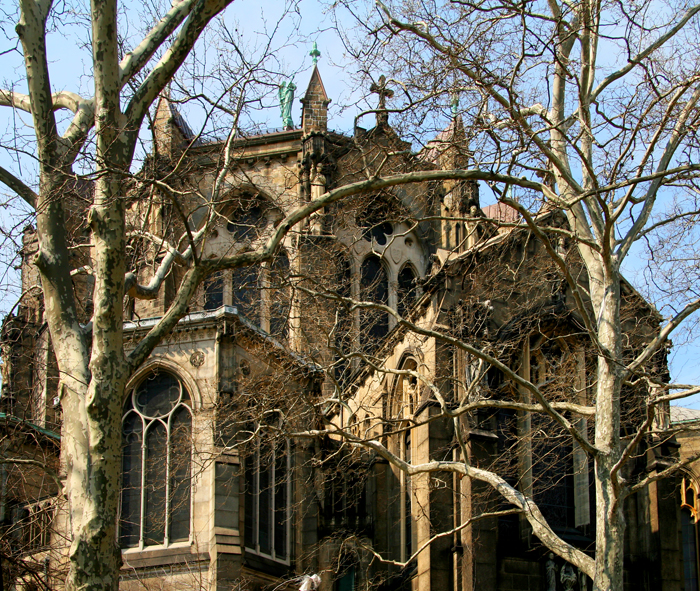
    Photo Note: New York City is not usually thought of as a city with a plethora of cathedrals and churches, as is Europe. However, surprisingly, New York City is home to the world’s largest church – the Cathedral of St. John the Divine. This photo was taken from the rear. You can see more photos of the interior and the story here.

    Posted on by Brian Dubé

  • Le mieux est l’ennemi du bien

    Posted on by Brian Dubé

    There is nothing that seems more unproductive than time spent on precautionary measures. A token gesture here and there is perhaps tolerable, but time spent on any tedious, methodical practice feels like time better spent elsewhere. Prevention and insurance are contrary to human nature – and with good reason. Most will never really experience a catastrophic event, so why not take a chance and save time and/or money?
    Professionals dealing with disaster, repairs and medical emergencies know these things all too well – a mixed bag for them I am sure, since their livelihood depends on the misfortune (and hopefully repair) of others. Fortunately, they also understand that the moment of crisis is no time for lectures – everyone is well aware of what should have been done.

    On Saturday morning, April 2, 2011, my laptop had a complete hard drive failure. This was where I do all my work for this website and store files and images going back over 10 years, both personal and for New York Daily Photo.

    I do regular backups, but not regularly enough and I do them manually. Manual backups are very tricky propositions because these require that rare trait of unfailing routine and discipline. For computer backups, better to go with an automated solution, taking the human element out of the equation entirely. Apple makes an excellent, sophisticated product for backup called Time Machine (included with every Mac), which can be custom configured by the user for scheduled backups and direct them to wherever and whatever device the user desires. This software utility will save and restore an exact mirror of a computer’s contents right down to placement of icons on the desktop.

    I had started to set this up when I purchased my laptop in 2008, but because I was unable to configure wirelessly to my satisfaction, I left the project for “another time.” I had fallen victim to one of my customary habits, best summarized by one of my favorite adages: don’t let the perfect be the enemy of the good.*
    I already have had two good computer scares which I wrote about: Foolish Crash on 12/11/2007 and Not Good At All on 12/21/2009. The 2009 event should have been the ideal lesson – frightening but where there is little or no loss.

    Fortunately, I am in New York City, where there are a myriad of service centers and individuals specializing in Apple computers. But who to choose on a Saturday morning? Some online reviews, and I was off to Dr. Brendan’s computer repair. I had a nervous afternoon and finally received a phone call – the drive was restored. However, some of the files were corrupted – the technician had already worked after closing time and I was given my drive in a portable enclosure to take home with the task of examining and backing up files. In another near miraculous scenario, all the new files for which I had no backup were retrieved and for all the files corrupted, I had backups! With some hours of file comparison, I was able to rebuild the drive and external backups of every file and folder.

    I hope you do not succumb to instinct but instead, listen to reason. Do not wait for a better time or, like me, a better solution. because le mieux est l’ennemi du bien 🙂

    *This saying is attributed to Voltaire, from La Bégueule (1772):
    Dans ses écrits, un sage italien? dit que
    le mieux est l’ennemi du bien

    Literally, le mieux est l’ennemi du bien translates as the best is the enemy of the good, but more typically as the perfect is the enemy of the good.

    Posted on by Brian Dubé

  • Random Acts of Rudeness

    A Door Drama

    I have shared many stories of the good and remarkable I have found in the people of this city. I have recounted very few tales of rude or hostile behavior, not in an effort to distort the city’s image, but in order not to focus on negativity. The media does a more than adequate job of covering hostile or criminal acts in New York City. In fairness, however, if we really had to do a study, I am sure that the rudeness quotient would be much higher in New York City than in a rural or suburban environment. A small incident yesterday serves as an apt example.

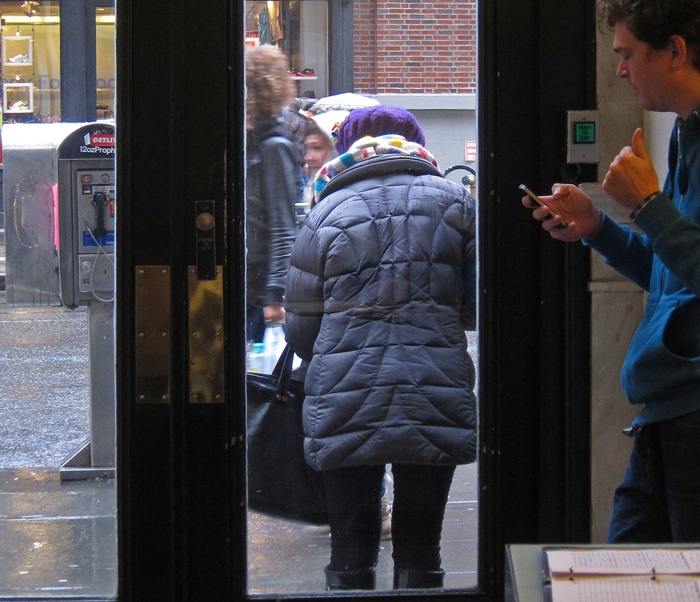
    Upon arriving at my office building midday, I was met with a woman engrossed in something in front of the door. The entrance way has two doors, only one of which is available for access in and out. Let us even grant that she did not know this. She was standing only inches in front of the doorway where I had to enter. You can see this in today’s photo. She made no effort to move at all. It was raining, but she could have easily just moved a couple feet in front of the adjoining door. I did not excuse myself, expecting that as I opened the door against her back, she would become aware of the situation and certainly move. Perhaps even offer the obligatory and insincere “I’m sorry.” But no.

    I opened the door no more than 12 inches and SQUEEZED through the opening. Apparently desensitized to humanity and anything around her, she did not move at all – it was a case of rudeness to the point of obliviousness. I turned to look at her from the back as I waited for the elevator. She was in the same position, unaware of the incident and that she was still blocking the entrance to an office building.

    In the business environment, particularly business to business sales, New York City can be hostile, even with well-articulated policies of apparent rudeness, such as a sign posted on a door stating: “NO STUDENTS AFTER 1 PM” – see the story here. Admittedly, with the hordes of people in such a large city, brusque behavior towards others can easily develop. However, it is not a fait accompli, and many businesses with the same streetside exposure to masses of shoppers do not become hostile to their customers. New York City just demands a little more effort to stay on the polite side of the line.

    Typically, I would become quite irritated by an experience such as this door drama. However, I now view any extreme acts, whether kindness or rudeness, as an opportunity for my writing. Using this website as a forum, the negative incidents can be defused through public ventilation and discourse. At the same time, on occasion, it provides an opportunity to illuminate New York’s more extreme behaviors and, Rather than Respond with Road Rage, to just Report these Random Acts of Rudeness…


  • I Know

    There are a number of life scenarios where someone expresses the sentiment that he/she just knows. I have often heard this regarding house hunting – something like, “As soon as we walked in, we knew.” Some feel this way about their belief in God. That it is not the result of any cognitive process – they just know that God exists.

    And many, of course, feel this way about their significant other, even on first meeting – it was love at first sight – they just knew. Of course, there is always the possibility of over exuberance or self-delusion. Nonetheless, valid or not, the conviction of a strong, knowing feeling does give a person direction and focus and not squander energy on hapless searching. The middle way can be no way. Take it from someone who, in many ways, has been a perennial fence sitter.

    I cannot say that I have often had a strong feeling that I just knew something was right, except when I arrived in New York City for the first time. I will admit, of course, that at that age, in tandem with being starved for culture and stimulation, perhaps I would have had that feeling about any city. That I cannot know.

    There is an episode of the Andy Griffith Show where the lead character, Andy, a sheriff in a small town in North Carolina, tries to reconnect with an old high school girlfriend at a class reunion. She, however, has moved to the big city, Chicago, and the episode revolves around their bittersweet attempt at reconnection. It becomes clear why their relationship never was successful – they are just fundamentally different people.
    There is a scene in the episode which is particularly poignant to me and really captures the essence of people attracted and repelled by cities. Andy’s friend is frustrated by his apparent lack of need to go to the big city to broaden one’s horizons and explore beyond the bounds of his small rural hometown. She cannot fathom how he can really and truly be happy with what he has if he has never been to the big city to see what he does not have. To this, he responds that he just knows.

    To me, that is an extraordinarily profound statement of the utmost self-confidence and awareness. Some may say it is extraordinarily naive. However, I have met many intelligent, educated, sophisticated, and worldly people who are content to live their lives in a rural environment, even in the small town they grew up in.
    The urbanite often sneers at the country bumpkin, seeing him or her as unsophisticated. But perhaps the differences between people has more to do with different styles. I wrote of this in my story, Quite Refreshing, Really:

    I am reminded of the film The Way We Were where the ability of two very different people (Robert Redford and Barbra Streisand) to get along is painfully tested and results in a parting of ways. In the end, Redford explains that his decision to separate is due to their different styles.

    I have questioned the value of living in New York City and bearing its hardships, one of the dilemmas most New Yorkers face (see Dwanna). I have toyed with leaving many, many times in the four decades I have lived here. I have entertained the country, other cities, and other countries. However, although it has taken some time, I can, at last, peer into my soul and see what lies inside. And lest I need any reminder, I can look up at a vista, like that at 42nd Street and Park Avenue, and I know.


  • dinamic_sidebar 4 none

©2026 New York Daily Photo Entries (RSS) and Comments (RSS)  Raindrops Theme