• Category Archives New York at Night
  • Dot My I

    Posted on by Brian Dubé

    Poor surfaces. So often maligned. One should always look below the surface. See what lies beneath the surface because there is more than what meets the eye. On the surface of it, beauty is only skin deep.

    Sometimes we love a surface – so smooth and shiny. It may be important to restore the surface, polish the surface or resurface.

    Most of the world we see is surface. We admire and appreciate it, yet if we learn that what lies beneath the surface is somehow less than we expected, we are disappointed and it diminishes the surface itself.

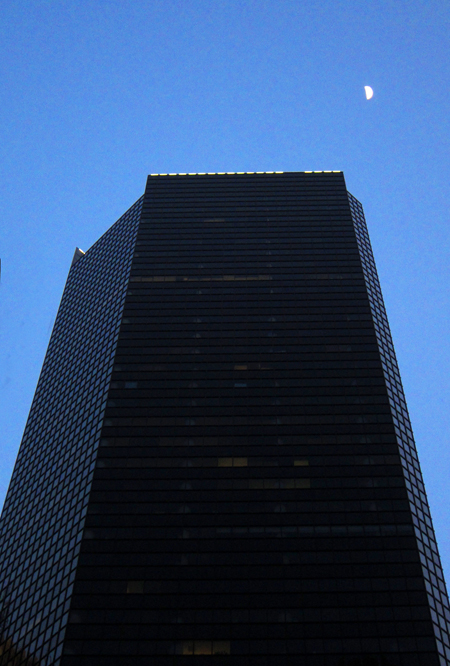
    New York City is a place of buildings, so we have lots and lots of large surfaces, looming over us daily. Here at 101 Park Avenue is a 49 story, 629 foot skyscraper. Eli Attia Architects designed the building, completed in 1982. It is the 64th tallest in New York.
    Park Avenue and 41st Street is prime real estate, only steps from Grand Central Terminal. The building has its own Wikipedia page and has been used in film and television – in the 1990 film Gremlins 2, in Seinfeld as the site of George Costanza’s office and as Dudley Moore’s office in the film Crazy People. It affords, as would be expected, spectacular views. You can see a gallery of photos of the building here.

    Uniquely shaped, strikingly positioned at 45 degrees to the street grid and glistening with reflective glass, 101 Park Avenue makes an impressive statement on the Manhattan skyline. The day I photographed it, there was an evening moon strategically located. Looking up at that surface, everything was so perfectly placed in a scene of urban penmanship, not forgetting while I crossed the streets to dot my I 🙂

    Posted on by Brian Dubé

  • The Real New York

    Posted on by Brian Dubé


    One of my favorite childhood toys was the homemade periscope. With this, one could spy, i.e. see other people secretly in a candid state. Media often tries to provide a periscopic look at the world with the investigative report, the behind the scenes inside look, and with programs such as 20/20 or 60 Minutes.
    We want to see people, places and things in their natural setting. We want it all and we want it unadulterated, unexpurgated, uncensored, uncut. We want to see what’s behind the curtain or that closed door.

    There is a New York City guidebook called Not For Tourists Guide to New York City, as well as a little tome I really enjoy from 2002: City Secrets – New York City. There are numerous websites promising to show you the hidden side of New York City: forgotten-ny, vanishing new york, Lost City, Ephemeral New York, Undercity, and Overheard in New York.

    In this website, I have endeavored to show you New York City in as real a light as possible. I am not a particularly private person and have revealed to you many aspects of my personal life, work, family, background, and interactions with others, as well as my personal perspectives and experiences in the city.
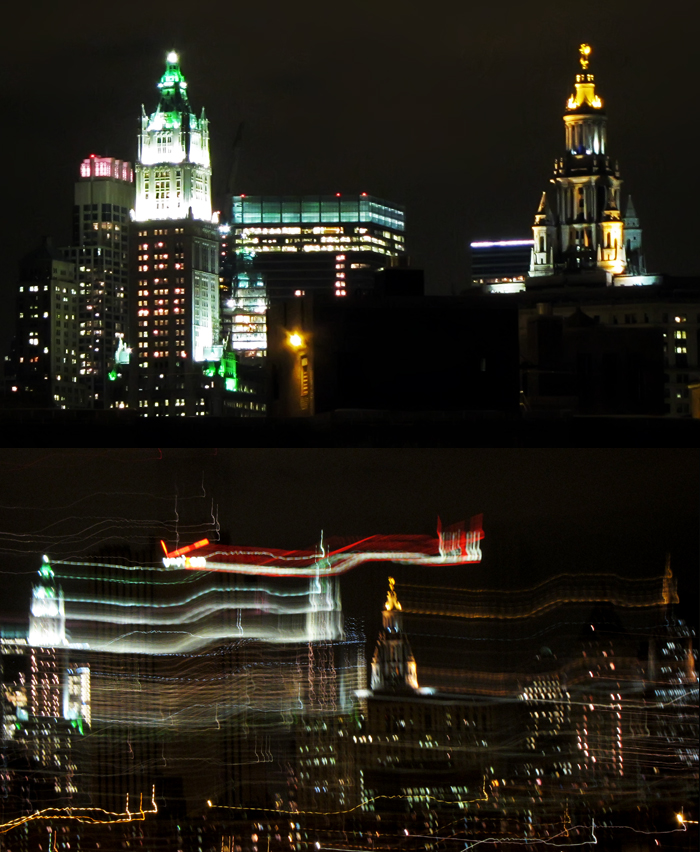
    Whether visitor or native, we grasp at all the things promising to show us the secrets because we want to see the Real New York – unvarnished, unsanitized, and uncolored by the Curse of Trade. The city we have read about, heard about, dreamed about, and portrayed in film. We want to see what lurks behind the shadows and fog and experience The Real New York…

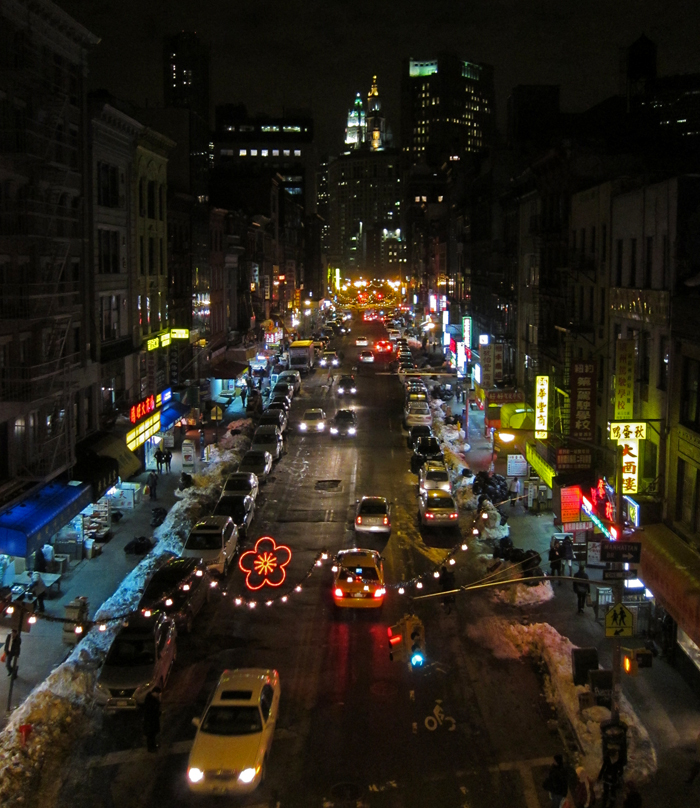
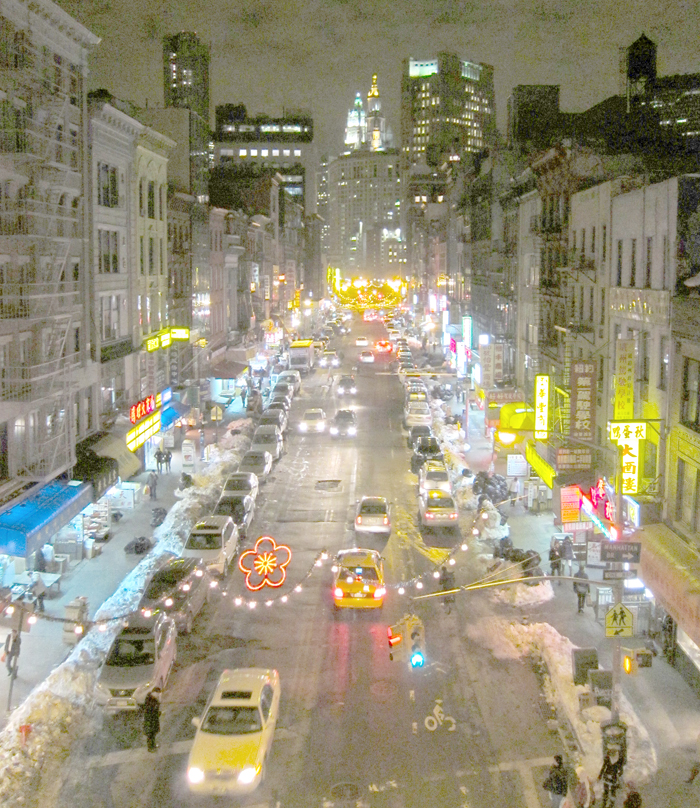
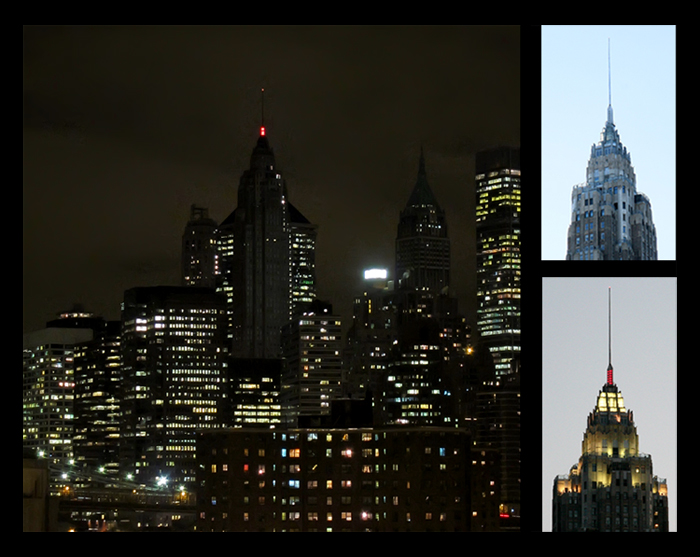
    Photo Note: this is a view looking south along East Broadway from the Manhattan Bridge. The two illuminated towers in the rear center are the Woolworth and Municipal Buildings. The photo effect was achieved using a Photoshop filter to remove the shadows and reveal all.

    Posted on by Brian Dubé

  • This Way for a Recharge ->

    To say that electrical power is the backbone of modern industrial society is really an understatement. The world as we know it would grind to a halt without it. Our dependance on electricity only grows with technology leading the way.

    As I write this, I am listening to a YouTube video with a musician playing electric guitar, delivered over the Internet on a laptop, in a room illuminated by an electric light bulb. I am charging a number of portable electrical devices over the ConEd grid. Electrical power and devices permeate our world to such an extent that it is impossible to stand outside it and assess its importance. In New York, public transportation is critical and our subways also run electrically.

    In the world of human interactions, we often speak using words such as chemistry, with electricity as the ultimate metaphor to characterize positive current between people. The electricity generated by the friction of humans rubbing together is one of the biggest lures of New York City. Without the dynamism and synergy of its people, what do we have?

    If you are seeking this type of energy, both literal and metaphorical, human and technological, perhaps no place in the United States better delivers the voltage then midtown Manhattan. This is the electrical generator that powers New York City and where most visitors first start to be properly charged.

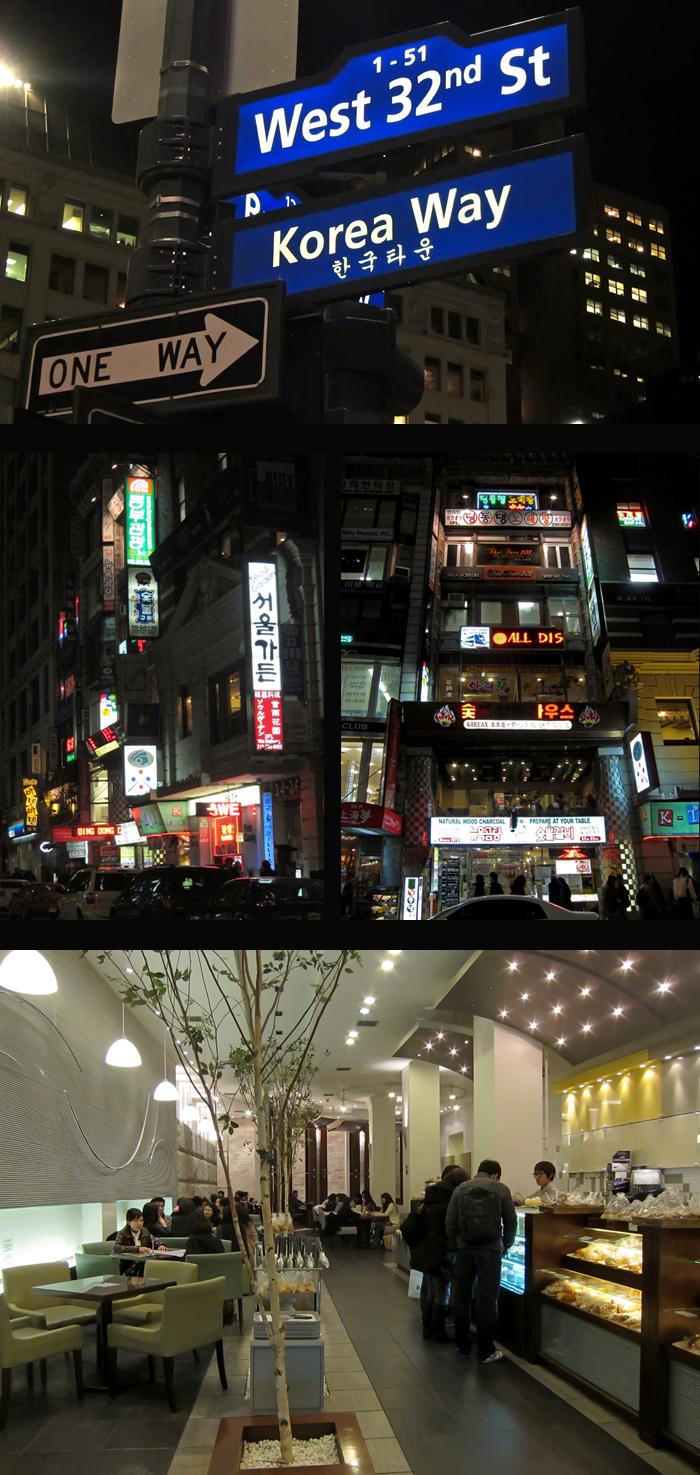
    One of most important things that electrical power has brought mankind is the ability to illuminate our world at night and make possible a 24-hour city. Koreatown is one of the best examples of this in the entire five boroughs. This neighborhood extends from 31st to 36th Streets between Fifth Avenue and Sixth Avenues with 32nd Street as its central artery. It’s a 24 hour extravaganza.
    Here you will find all things Korean – restaurants, tea shops, grocery stores, hair and nail salons, spas, karaoke clubs, internet cafes, banks, and hotels. In the late 1970s, the redevelopment of West 32nd Street was led by Korean business owners – in 1995, Broadway between West 31st and 32nd was officially named Korea Way.

    New York City is home to over 200,000 Korean-Americans – the second largest population outside Korea. Koreatown in Manhattan, is however, largely a commercial/business district with very few residents, although the residential population is growing (the largest Korean residential community is located in Flushing, Queens). K-Town, Manhattan, is attractive to the international business community and ideally suited to a growing number who want to live in Midtown. And those who just want to be energized know that it’s this way for a recharge ->


  • View Master

    I grew up with very few photographic images of any sort. We had no coffee table or travel books and few magazines. And, of course, we had no PCs or Internet, so moving images were limited to TV and movies. Our television reception was limited to 3 networks, one of which did not come in well at all. Programming was rather mundane from an imaging perspective – there was no Travel or Discovery Channel. There was no videotapes or DVDs. On rare occasion, we went to a movie theater or drive-in (see With Six You Get Eggroll here).

    There were a few family vacations to scenic destinations and the occasional family Sunday afternoon drive in the country. There was certainly nothing locally.

    Primarily, we had imagination, the world children live in, and it was a ripe fertile ground for me when growing up. And I had a View-Master.
    The only memory I have of any inspiring photos were those from a set of paper disks for my View-Master, with its remarkable stereo 3D images. I never tired of this small device and its ability to awe me with those three dimensional photos. Our collection of disks was small, and I remember viewing them repeatedly, particularly the disk of Switzerland and its alpine wonders.

    The occasional movie, such as Heidi with Shirley Temple, did much to cement my impressions of Switzerland as the dream alpine destination, only to be fulfilled much later in life on a whirlwind tour of Europe. In the 1980s, I made a number of trips to the West Indies, where I always looked for tropical mountains, explaining my obsession with the island of Dominica, as I wrote about in Miracles In Our Midst (see Part 2 here). It was always mountains and vistas – best, of course, were mountain vistas.

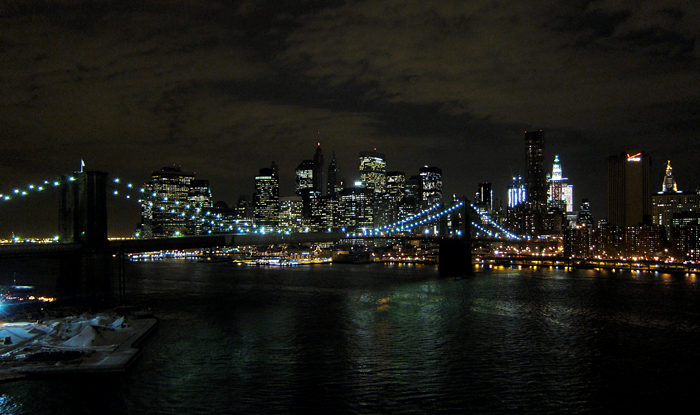
    On my recent excursion via the Manhattan Bridge to photograph the enigmatic 110 York Street, I decided to proceed across to the Brooklyn side, looping around and returning to Manhattan via the footpath on the south side of the bridge, affording spectacular views of the East River, Brooklyn Bridge, South Street Seaport, the Municipal and Woolworth buildings, and the financial district (see more photos here) with the American International Building and its mountain motif (see Magic Mountain here). If you enjoy panoramas, I do recommend a walk or bike ride across the Manhattan Bridge by day or night. You won’t need your View-Master 🙂


  • New York Rockies

    110 York Street – Part 2 (See Part 1 here.) (see complete photo gallery here)

    For years, on return trips home from Brooklyn to Manhattan via the Manhattan Bridge, I have observed this rooftop structure both by day and night. I promised myself that one day I would get to the bottom of this – a literal pursuit since this structure was atop a building located in Brooklyn, meaning I would literally have to venture down and explore under the Manhattan Bridge.
    What was particularly compelling about it was the four exposed white steel truss system on the roof of the building which was illuminated at night, bathed in blues, greens, purples, and reds.
    Recently, this came up in conversation with someone familiar with the structure – he told me that it was occupied by architects and located on York Street. This rekindled my interest to bring this mystery to a close. On my first excursion, I did a cursory drive-by to confirm its location – 110 York Street.

    On Sunday, I made a trip to Vinegar Hill, Brooklyn, with the intent of returning to Manhattan by foot over the Manhattan Bridge and taking a series of photos. I intended to time my afternoon so that I would cross the bridge after dark when the rooftop was illuminated. My return, however, was too early.
    But I was on a mission, and I decided that I would return the following day after work when dark to cross the bridge again by foot. I had a burning desire and intention with my own mantra: Neither snow, nor rain, nor ice, nor gloom of night stays this courageous ambassador from the swift completion of his appointed rounds.*
    There was snow and ice and gloom of night. But was I courageous?

    There are two pedestrian pathways on the Manhattan Bridge – the one the north side is for bicycles – this is the side I needed to view the York Street building. However, a chain link fence obstructs a clear line of sight most of the way, so I found it necessary to climb and stand on a railing for the taking of photos. The roar and vibration of vehicles and the elevated subway was bad enough, but worse was having to use two hands to stabilize the camera while balancing atop a 4″ wide steel railing which may or may not have been icy. See this in better detail at my photo gallery here.

    The building at 110 York Street serves as the offices for a number of construction firms and, most notably, Robert Scarano Architects, who originally occupied the top floor of this 100-year-old former factory building in Vinegar Hill. For a needed expansion, a 5,200-square-foot rooftop two story addition was designed by a member of the Scarano firm, Dedy Blaustein. The addition was completed in 2005. The lights used are a Color Kinetics LED system.

    Blaustein’s inspiration for the rooftop structure was the bridge: “We’re not the main thing here,” he says, gesturing toward the bridge. “That is the main thing here. It’s so dynamic. I had to do something crazy.” Some have referred to it as the “Jetsons Building.” In response to critics, he said: “I didn’t design it for people to like it, I designed it for people not to be able to ignore it.” The project received a 2005 Design Award from Metal Architecture magazine and a 2005 Certificate of Appreciation from the Brooklyn AIA. From the Sarano website:

    The Manhattan Bridge is the most visibly striking element of the site, running parallel to it only 20 feet away. For this reason, we designed an exposed steel truss system for the skeleton to intensify the dialogue between the structures. The design embodies a strong sense of dynamics. The structural axis is separated from the building exterior finish, providing a sense of movement, which is enhanced by the flying roof, sharp angles, and horizontal texture on the surface.

    My affair has finally come to a close. I feel quite worn, perhaps not unlike the mountain climber who finally tastes the bittersweet success of arriving at the summit. Driven by an illuminated outline not unlike that drawn by a friend to describe the mountains of Colorado (see Part 1), I found this journey’s end at 110 York Street in the foothills of the New York Rockies…

    *The original seen on the General Post Office building reads:
    “Neither snow, nor rain, nor heat, nor gloom of night stays these courageous couriers from the swift completion of their appointed rounds.”
    The sentence appears in the works of Herodotus, describing the expedition of the Greeks against the Persians under Cyrus, about 500 B.C.
    Note: The firm of Robert Sarano is the subject of much controversy – both acclaim and official censure. Robert Sarano is a New York City native, born in Brooklyn. He became a registered architect and started his own firm, Scarano Architects PLLC, in 1985. His academic credentials and awards are many. The firm has been responsible for over 600 buildings in New York City. However, sometimes referred to as the bad boy of architecture, Sarano has also seen a loss of self-certification privileges, loss of filing privileges, numerous lawsuits, and worker deaths on 3 of his projects and has been charged with violation of zoning or building codes on 25 projects in Brooklyn.


  • New York Rockies

    ColoradoPart 1 (see Part 2 here)

    I do so love the mountains, and here, in New York City, unlike perhaps San Francisco (a mountain lover’s dream city), I must make do with the skyscrapers of glass and steel. ‘Tis better, I suppose, than the lowlands of Holland. But it pales in comparison to the experience of the American West. I journeyed there in the early 1970s for the first time by car. I cannot imagine a more compelling road trip than going west by auto.

    Before leaving, I discussed my trip with a close friend who vividly described what I would see. “Do you know the way you drew mountains as a kid?” He illustrated with his finger in the air a typical jagged outline. “That’s what it will look like.” “As you drive through Colorado, it will be flat. And suddenly, the Rockies will pop up.” The whole image of a child’s jagged outline and mountains popping into view was burned in my mind forever.

    And it was all true. As we drove through eastern Colorado, the landscape was no different than the flats of Kansas which we had spent a day passing through. Heat waves rose from the road and landscape in a classic mirage. I squinted for hours for those Rocky Mountains, only to find an my eyes fooled in one way or another. It became very tiring. Then there appeared the faintest mountain outline, which did not disappear, but only grew in size, jagged and dramatic beyond belief.
    The first night, the wind howled in the trees with a certain sound only heard in the mountains. I still listen for that sound. Everything was so big and grand. Colorado was everything John Denver had promised in his song Rocky Mountain High.

    We examined our maps the next morning for the steepest roads, the ones marked dangerous for what I assumed would offer the most dramatic views. We navigated the narrowest, most precipitous two lane mountain roads I have ever seen. The unobstructed views through crisp clean air were absolutely astonishing. It seemed unbelievable that motorists would even be allowed to travel such roads at altitudes over 10,000 feet – one tiny error in judgement, and it was sayonara.

    More remarkable was our conversation that night with two fellow campers who were Colorado residents. When we expressed our harrowing but exciting journey of the day, they only laughed as they told how they enjoyed riding at night, driving as fast as possible on the most treacherous of roads. To me, this was sheer lunacy. Not only did one have to contend with serpentine roads and hairpin turns, but Colorado was also PITCH BLACK at night – there were no street lights in those mountains. I certainly was a risk taker, but this couple was truly out of their minds.

    We journeyed on through Wyoming, Oregon, and California that summer in a 30-day, 10,000 mile trip. To this date, it was the longest I have been away from New York City since 1970. For the resident here, spending long periods away from the city really gives a new, fresh perspective. Returning from that trip, I could see and feel its gritty, dirty, and very hard character. The mountains of Manhattan were different now.

    On November 5, 2007, I wrote Magic Mountain, about the American International Building: “It is famous for its motif of a snow-capped mountain – the base of the building is clad in granite while the upper portion, clad in limestone, becomes lighter in color until one reaches the very top, where it is white.” The upper and lower right photos are from that story. A bit of the Rockies, popping up from the canyon floor of lower Manhattan.

    But the night vista from the Manhattan Bridge in today’s photo was not the reason I went on a journey as a Mountain Man, high in the New York Rockies…


  • Everything is Going To Be Alright

    I was surprised yesterday to hear two young coworkers in their 20s listening to and enjoying the holiday tunes of Bing Crosby. I commented on how there was an extraordinary soothing quality to his voice that just made you feel that, no matter what, everything is going to be alright. At my family holiday gatherings, Christmas isn’t Christmas without the White Christmas of Bing Crosby.

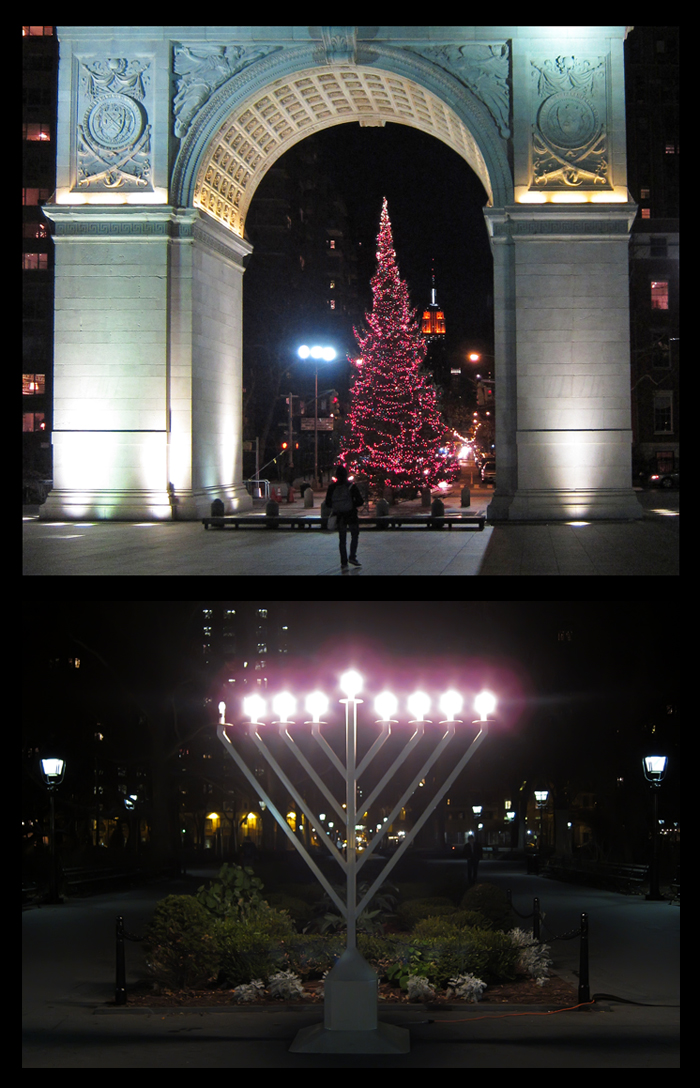
    Whether you see New York City as a melting pot or a salad bowl, pluralism is the reality and tolerance is what holds it together. New York City is where you will find the world’s largest public menorah, located in one of the most prime locations in the entire city – 59th Street and Fifth Avenue, just a few blocks from Rockefeller Center’s national Christmas tree and St. Patrick’s Cathedral. In today’s photos, the Christmas tree at the Washington Square arch (with views of the Empire State Building in the background) is just a short distance from a menorah, also located in Washington Square Park.

    On one hand, pluralism has become much more prevalent in the United States and, in tandem with the doctrine of separation of church and state, it is not unreasonable to revisit the issue of public displays of religious symbols. Bing Crosby or not, we can’t shut our eyes and sweep everything under the umbrella of the “holidays” or the “winter/holiday season” in an effort to obfuscate the very divergent religious practices. Efforts are made to link Christianity and Judaism in an attempt to demonstrate that they are just two sides of the same coin.

    On the other hand, as I wrote in Let’s Have a Parade, celebration is part of the human condition, and to become a curmudgeon during the holidays and dismiss the entire season as nothing but crass commercialism (or to aver how many of the symbols and customs that are associated with Christmas were originally syncretized from pre-Christian pagan festivals and traditions) does nothing to enliven and uplift the human spirit and spread proverbial love and joy throughout the land.

    Managing religious pluralism is difficult. Even the Supreme Court of the United States was very divided in County of Allegheny v. ACLU, where the court considered the constitutionality of the annually recurring displays of a nativity scene (crèche) and a Hanukkah menorah, both placed outside the City-County Building in downtown Pittsburgh, Pennsylvania.

    I don’t want to bury my head in the sand in an effort to oversimplify reality, be disrespectful, and lump everyone together or paint the entire season one color. But for just a moment, please forgive me. I’m just going to relax, let Bing Crosby’s voice wash over me, and feel that everything is going to be alright 🙂


  • When Brian Met Sally…

    A Tale of the Fortuitous, Serendipitous, and a Late Night Offer
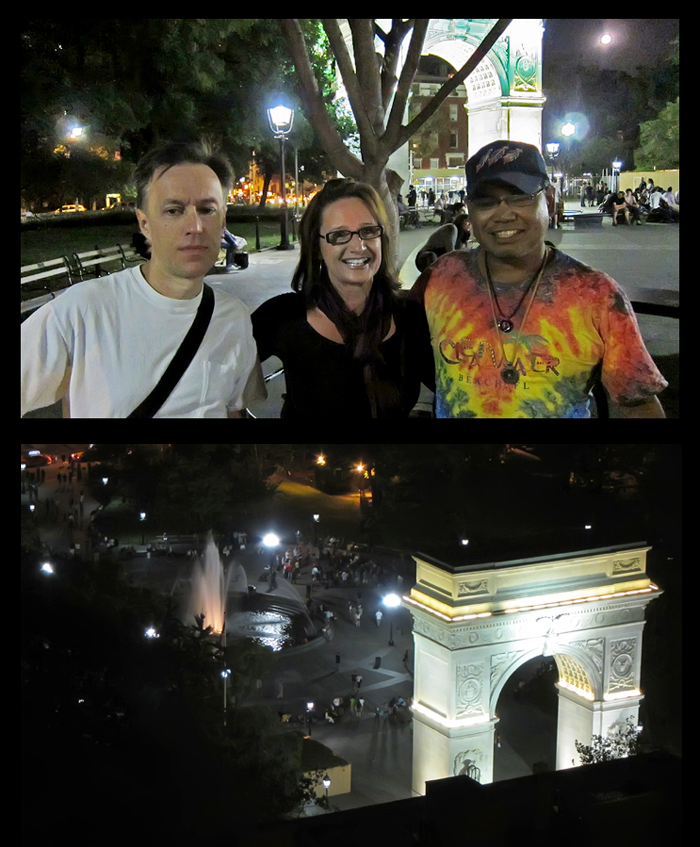

    Sally Darling is a regular reader of this website and is one of the most effusive, ebullient individuals who has graced these cyberpages. She lives in Kansas, a virtual metaphor for all that is not New York City.
    On September 9th, 2010, she commented:

    Me again. Sorry, I’m your new stalker now 🙂 I literally can not stop reading your posts. I can’t explain how there is something in my bones that has always, my whole life, made me feel like I belong there, that I should be living there, but life’s events didn’t see it that way. Thank you so much for letting me have my little NYC Oasis right here in Kansas!

    On September 10th she commented, announcing her upcoming visit to New York City:

    Thanks Brian! I stayed up last night and read almost all of your 2010 posts. Not quite through with them, but I’m enjoying every second! I hope you know, my passion and thrill for your fascinating city is only getting fueled by your incredible photos and writing! I can’t wait until we arrive on September 25th! My mind is racing a mile a minute with my itinerary selections!

    But the Plot Thickens.

    On September 24th at 12:41 PM, the day before leaving for New York, Sally commented:

    I just love all your adventures that you have in your splendid park! I can’t wait to be there Saturday! All I want to do is sit, watch, enjoy, and take in all the wonderment WSP [Washington Square Park] has to bring. You are so lucky that you have it at the tip of your fingertips! I’m counting the minutes until I walk through that wonderful Arch!

    A fortuitous turn of events started as a dishwasher disaster at Sally’s home in Kansas the night before leaving for New York City. Read the entire story here in her own words. Prompted by or nearly prevented by this accident, at 4:30 AM with 6 minutes left at home before leaving for the airport, Sally decided to make a quick examination of the comments on the blog with no expectations. She was surprised to find my late night offer posted at 11PM:

    Sally – welcome to our world. Ask for me if ur in the park.

    You’re way ahead of me, I am sure, but the devil is in the details.

    On Saturday night, September 25th, I was in Washington Square Park. The weather was superb and the evening glorious. Music was everywhere to be found, and the park regulars were all there. Jeff, one of the habitués, approached me and said, “Brian, you have some visitors looking for you.” And there was Sally with her husband and daughter! After a mutual round of OMGs, I told them how they had picked the absolute best night.

    I gave them a tour of the plaza, introducing them to all the important regulars, some of which have appeared on this website. Gaby, who was featured on September 8th, 2010, was also there. His story is another tale of the serendipitous (read On The Road and Part 2 of his story here). A photo was taken of the three of us, which you see here today.

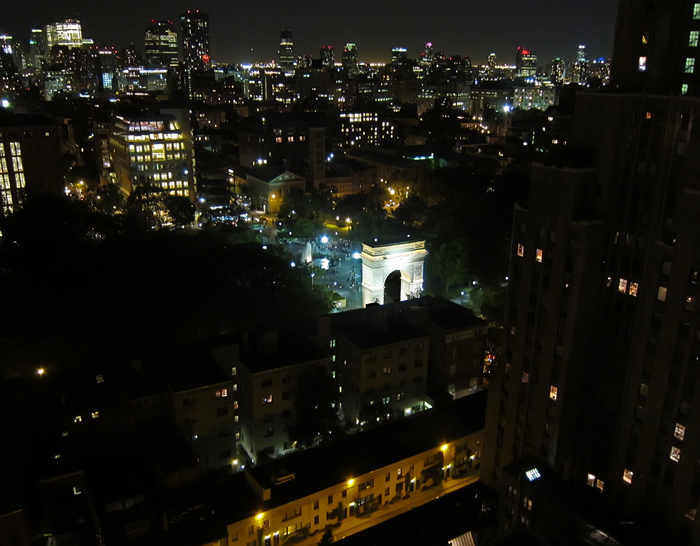
    Two friends, Hellen and Harvey, a married couple living in a nearby high-rise, met Sally and her family and made a spectacular offer – to take them up to the roof deck on the 26th floor of their apartment building. The views from there are spectacular, a virtual unobstructed 360 degrees, including south views directly to Washington Square Park (lower photo). Sally was, of course, just brimming with enthusiasm. When it was time for our guests to leave, Hellen, the ever gracious hostess, insisted on walking them right to the subway platform.

    On September 28th, after Sally’s return to Kansas, I got this email:

    Hello Brian I hope this is your email, and I hope you don’t mind that I’m sending you this note. I just want to thank you for one of the most amazing evenings I’ve ever experienced. It was literally one of those unexpected moments that one might never experience in their lifetime. Please, Please, pass along my thanks to Harvey & Helen, for opening up their home and allowing us to see something my eyes will never forget! How can I ever repay you and them! And I thank you for not only introducing us to them, but for introducing us to your other wonderful Park friends. Sandy Vitamin, Hans, Gabby…..what a wonderful night! I wish we could have all sat down over a cocktail someplace and continued our visit. I knew my daughter was getting tired, and was not feeling good, so unfortunately we had to end our evening. I only hope that one day our paths will cross again, and we can continue where we left off. Your friend, Sally

    ‘Twas a case of the Fortuitous, Serendipitous, and a Late Night Offer, When Brian Met Sally…*

    Please Note: All correspondence between Sally and myself were reproduced here only after obtaining her permission. Thanks Sally.

    *When Brian Met Sally is a play on the award winning 1989 comedy classic When Harry Met Sally…, starring Billy Crystal and Meg Ryan. Read more here.

  • Urban Night Climbers


    Texte alternatif
    For a full night climbing experience, click and play audio link to accompany your reading.

    Many years ago, in a conversation with a customer, the subject somehow turned to my childhood love of tree climbing. My customer was VERY pleased to hear this, and encouraged me to rekindle this interest, embrace some trees, or perhaps even join him and his friends in their nocturnal sojourns. He was a night climber. Of buildings.

    New York City is a city that never sleeps. We are known for our night clubs, night life, and night people – but night climbers of buildings? I was not aware that there was an underground fraternity of those who practice buildering, aka urban climbing, stegophily, or structuring.

    The press has covered the various climbing spectaculars of the city – Philippe Petit’s legendary walk between the world trade towers on August 7, 1974. George Willig, a mountain-climber from Queens, New York, United States, climbed the South Tower of the World Trade Center on May 26, 1977. Alain Robert is a French rock and urban climber who in 1994 scaled the Empire State Building and on June 5, 2008, climbed the New York Times Building (later that day, Renaldo Clarke also climbed the building). Dan Goodwin, using suction cups and a camming device, climbed the North Tower of the World Trade Center on May 30, 1983.

    But recreational buildering goes back much further than might be expected, at least to Victorian times in England, where students had been climbing the architecture of Cambridge University. Geoffrey Winthrop Young was roof climbing there in the 1890s and published The Roof Climber’s Guide to Trinity in 1900. In 1937, The Night Climbers of Cambridge was written (under the pseudonym Whipplesnaith) about the nocturnal climbing on the town buildings and colleges of Cambridge, England in the 1930s.

    In the United States, two men, George Polley and Harry Gardiner, both nicknamed the Human Fly, pioneered buildering as early as 1905. In 1920, George Polley climbed 30 floors of the Woolworth building before being arrested. Not much, however, is written about current recreational nighttime buildering in New York City, for obvious reasons. In 2008, the New York Times published an article with a little on the activity.

    Apart from legality or prudence, I do understand the lure of urban climbing. Much as the alpine areas of the world are magnets for rock climbers, the buildings and skyscrapers of New York City provide the same challenges and draw in masonry, steel, and glass. Perhaps I may yet get to witness the activities of these urban night climbers…

    Photo Note: I was recently privy to access to one of the very few rooftops in the Village affording a direct view of Washington Square Park. The building and friends kind enough to invite me to share the view, will, in the spirit of buildering, remain a secret 🙂


  • Just Like Old Times

    In most places, eight police vehicles and a swarm of officers pursuing a drug bust is a serious event. On Saturday night in Washington Square Park, at 11:30 PM, various vehicles came hurtling at high speed from all directions – two unmarked black cars, a taxi (used by police), and several regular NYPD vehicles. They easily and quickly trapped the perpetrator, who offered no resistance, only saying, “What?”

    It had all the drama of a major arrest of one of America’s Most Wanted, but my understanding was that this huge show of force was just for the arrest of a drug dealer caught making a transaction. I say “just” because selling drugs is an everyday and all day activity in this park.
    If you look at all like a potential customer and are strolling through Washington Square on a busy day, you will be offered drugs by numerous dealers at a number of key locations – strategic intersections where most pedestrians have to pass through. The mantra “smoke, smoke” is familiar to all habitués here and is just laughed off as part of the natural environment and business as usual.

    Drugs have been regularly sold in Washington Square Park since time immemorial. Dealers are well-known by regulars in the park and the police. The miscreants are quite well-versed in the law and know how to operate their business in a way to generally avoid arrest. The activity had virtually disappeared since the recent renovation (see here) but, as would be expected in New York City, and particularly in this park, drug activity has crept back in and often feels just like old times.

    What is ironic, and would be perhaps astounding to nonregulars, is that a regular group of musicians and singers continued their musical activity just steps away from all the commotion, completely undaunted, unfettered, and apparently uninterested.

    Rather than a cause for alarm, surprise, disruption, or curiosity, the whole affair just seemed to add voices to the backup singers. Guns, police running, screeching tires, searchlights in the bushes, sirens, and handcuffs were all part of a comforting ambiance that made everyone feel that it was just like old times 🙂

    Note: On August 6, 2009, I wrote Chess Monsters and told of an incident where I witnessed a shooting, yet incredulously, while players ran for cover, an onlooker stopped the chess clocks during the incident and playing resumed, barely missing a beat. You can read the story here.

    Postings on Washington Square Park: Out There, Conflux, Hawk Fest, Evening Arch, Twelve Tribes Arrive, New York Nymph, Bluegrass Reunion, Cloud Appreciation, I Am Legend, Birds Sing at Night, Rats Gone Wild, Piercing Al Fresco, Police Riot Concert, Artiste Extraordinaire, Comfort and Joy, Livid, Flash of Light, Delivery, Dog Run, Sounds of Summer, Krishna, Spring Madness, Back to Boyhood, Hookah, Lockout, Danger and Caution, Obama, YouTube Meetup, Dachshund Octoberfest, Music Speaks for Itself, Park Night, Petanque, Washington Square North, Nested Embraces, Left Bank New York


  • We Read at Night

    Posted on by Brian Dubé

    I have been to some of those places so dark at night that you can not see your own hand. I don’t like those places. I will confess that after living in New York City most of my life, I am somewhat afraid of the dark because I don’t really know what it is anymore. A case of Fear of the Unknown.

    I have read about the health benefits of sleeping in total darkness. I am sure it is healthier, but I find greater comfort with light. I can sleep in well-lit rooms, a bedroom at night without shades drawn, at the beach, or on park benches during the day. It’s much easier to see anyone sneaking up on you, and vampires hate the light.

    Although there are conveniences of living in a place where it is well lit at night, this plethora of illumination is light pollution, and it is a well-documented problem worldwide, particularly in urban areas like New York City. The Dark-Sky Association (IDA) defines light pollution as any adverse effect of artificial light, including sky glow, glare, light trespass, light clutter, decreased visibility at night, and energy waste.

    Links have been found between light pollution and cancer, increase in blood pressure, alertness, and mood. Sleep and circadian disruption, along with melatonin suppression, may have long-term health risks. In a larger sphere, ecosystems are disrupted. On March 26th, 2009, I wrote of the effect on our fine feathered friends in Birds Sing at Night.

    We grow accustomed to the everlasting light of the city. In most areas, it is easy to read at any hour of the night in the parks or on the streets. Bill Hayes, a writer for the New York Times, in a piece called “Insomniac City,” describes a phenomenon he discovered – people who took to the parks on summer nights to read all manner of printed materials – books, newspapers, novels, and poetry.

    On summer trips when I have vacationed in rural areas, I found a flashlight a necessary tool to carry at night. In the city, I use my flashlight during the day to find that lost item that has rolled under a desk and rarely to illuminate my way at night.

    In a city that never sleeps, and where everything is illuminated, birds sing and we read at night…

    Posted on by Brian Dubé

  • At Least It’s Water

    Posted on by Brian Dubé

    In Back to Our Main Feature, I wrote that “the gifts nature bestows and the power she wields often feel secondary in a city like New York.” Often, however, does not mean always, and even in the Big Apple, Mother Nature can show a dominant hand and deal a heavy blow – particularly, summer heat. As with other areas of the country, this summer has set all-time records. Nothing is more oppressive than summer in the city – ambition to do anything withers in the blistering heat.

    I had a friend who went to school in Miami, Florida. I asked how anyone could tolerate summers there. He assured me that no one spends time or walks outdoors – all human movement is from one air conditioned environment to another – car, store, home, etc. The problem in New York City is that everything you do involves some walking. Even getting a taxi means standing in the street, sometimes with no success.

    Subway platforms, although underground, offer no respite. They are subterranean infernos. The asphalt streets are like beds of lava, conducting heat to all who dare to stand on them. Tree shaded streets are few, and we walk in the shadows of buildings if the time of day is right.

    Virtually everyone I have spoken to has had the same solution – stay in during the day, go out in the evening (if at all), and wait the heat wave out. Even in this fast-paced city, where residents are undaunted by virtually anything, summer heat is suffocating and its effects visible everywhere and affecting virtually everything – shopping habits, work, and recreation.

    For those who do not leave the city, heading for water is one solution, but New York City has few options. Sprinklers are sometimes mounted on fire hydrants for children. The beaches of Coney Island, Brighton Beach, Jacob Riis Park, and Rockaway are popular. For those who do not live nearby, you could travel there, given that you are willing to make the long journey and be accompanied by (literally) a million other relief seekers. Buses are also available to places such as Jones Beach.

    In Washington Square Park, the newly renovated fountain has been a water park both day and night for adults and children, with spectators sitting around the fountain’s edge, watching the aquatic antics, and cooled by overspray.

    Lincoln Center’s fountain (in today’s photo) lures people in all year, and although immersion is not an option here, no matter how real or illusory its cooling effect is, at times like this, at least it’s water

    Other Fountain Posts: Water Sprites, Bethesda Fountain, Signs of Summer, Bad Hair Day, Trapped in Paradise, Remembering, Double Your Pleasure, Verdant Oasis, Gallivanting, Shag Carpeting, Cup Runneth Over

    Posted on by Brian Dubé

  • Back to Our Main Feature

    Posted on by Brian Dubé

    Please understand that I, like most New Yorkers, do love Mother Nature, but the gifts nature bestows and the power she wields often feel secondary in a city like New York.

    Additionally, unlike California, the Rocky Mountains, the Pacific Northwest, the coast of Maine, Florida, or the southwest, where someone might move for quality of life and nature’s bounty, people live in New York City for culture, work, and all the things and opportunities that are man-made.

    Often, nature feels like a corporate perk or, at times, even like an irritant, standing between us and what we want. This is a city on the move, and nothing will stop a New Yorker from getting what he or she wants. Or at least trying until his or her tank is clearly empty.

    Most New York City residents use a combination of walking and public transportation to get around town. Few of us do more to adapt to changing seasons or weather than change wardrobe – this is one of many reasons why the impact of nature is mitigated. We typically do not shovel snow, salt our own walkways, put on snow tires, rake leaves, mow lawns, water the grass, or clean gutters – all the activities that connect humans with nature.

    Unfortunately, New York City is not ideally suited for those who want a comfortable ride in a roomy vehicle. That’s OK – not everyone is a driven Type A or has the need to be. There are many days when I question the prudence of the self-inflicted wounds from voluntary immersion in America’s biggest rat race.

    Last night, there was a brief lightning storm dramatic enough to make many of us look up and say wow. But unlike our country brethren, who may spend a pleasant evening watching shooting stars, we rarely indulge these natural phenomenon for very long. Glancing up to the sky, seeing a spectacular display of lightning complemented by a waxing moon, we acknowledge when nature has spoken. Yes, like any great commercial, we hear you, but now, back to our main feature 🙂

    Posted on by Brian Dubé

  • Rocket Man

    Posted on by Brian Dubé

    Note: Please click and play audio link to accompany your reading.

    I recently discussed with my cousin the fireworks displays we saw as children in Pope Park, Hartford, Connecticut. These Fourth of July outings were all-night affairs – our families arrived early with blankets and picnics, staking out ground for a display which seemed like it lasted forever. Perhaps the childhood memory of this spectacular event looms larger than it really was for both of us, but we agreed that it lasted nearly one hour and was the best thing we had ever seen.

    As I grew up, I was no stranger to the boyhood love of pyrotechnics. This followed me into high school, where I became involved in the rocketry club. In my early years in New York City, we managed to put on our own bottle rocket displays for the Fourth of July.

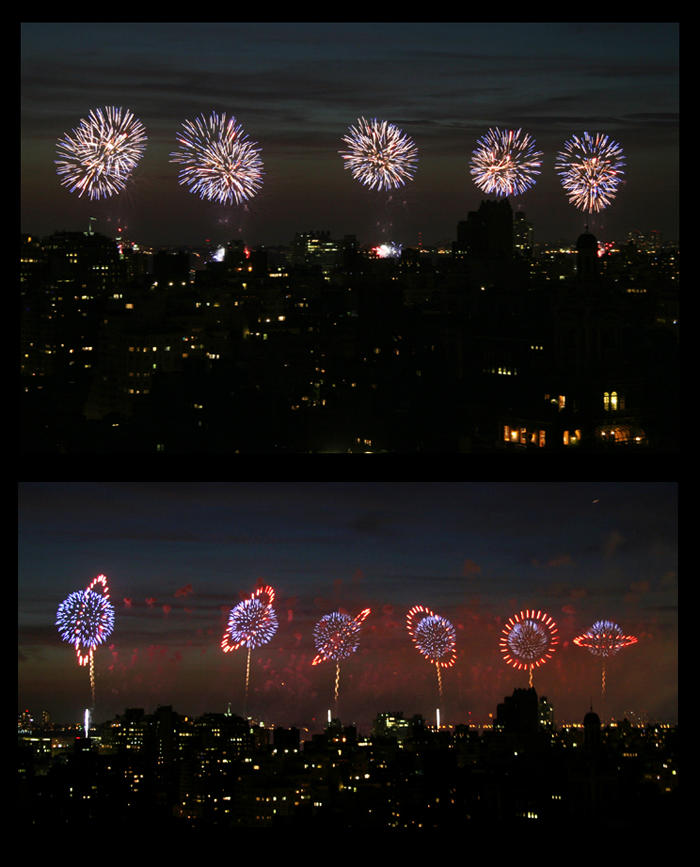
    Of course, little compares to Fireworks by Grucci or Pyro Spectaculars by Souza, which has been putting on the annual Macy’s fireworks display since 1982. Last night’s display was beautiful as always, with many new pyrotechnic effects.

    This year, my spectating experience was particularly pleasant. Rather than battle the masses on the west side of Manhattan for Hudson River views, I was invited by friends to the 26th floor rooftop deck of their apartment building. We were joined by a small number of building residents for a pleasant, trouble-free bird’s-eye view.

    In a extraordinary twist of fate, I learned today that Pope Park was designed by the Olmsted Brothers Landscape Architects in 1898. This company, the nation’s first landscape architecture company, was founded by Frederick Law Olmsted, designer of Central Park and Prospect Park in New York City. Olmstead’s sons, John Charles Olmsted and Frederick Law Olmsted, Jr. inherited the firm from their father. This company has an enormous portfolio of projects to their credit, including Pope Park. I have been unknowingly following the footsteps of the Olmstead Brothers.

    I am pleased to have echos of pyrotechnics and the Olmstead legacy here in New York City, because leaving my home and childhood behind is the fate of any Rocket Man 🙂

Posted on by Brian Dubé

  • World Domination

    Posted on by Brian Dubé

    There is an episode of the Twilight Zone, The Little People, where astronauts William Fletcher and Peter Craig are marooned on another planet. In exploring the planet, Craig discovers a Lilliputian city with miniature people. Soon, Craig becomes an obsessed lunatic and appoints himself as a god over these people, terrorizing them into submission. At one point, he even forces the populace to build a life-size statue of himself. In an ironic ending, Craig himself becomes a victim when two enormous spacemen visit the planet. One of them picks up the ant-sized Craig, accidentally crushing him to death.

    We can easily understand Craig’s dark side – what child (or child within the adult) is not fascinated observing people and cars from extreme heights? Can’t you just hear them remarking to one another how tiny they are and how they look like toys? As if they could reach down and pick them up.

    I recall my first visit to the Empire State Building, where, at the observation deck on the 86th floor, I was able to squeeze my head through the fencing and look straight down, seeing for the first time the toylike world I had only imagined or seen on TV.
    There’s a touch of megalomania in many of us, and viewing the world from atop skyscrapers gives just the vantage point to fantasize our domination over the world below. And what better place to reign than New York City? 

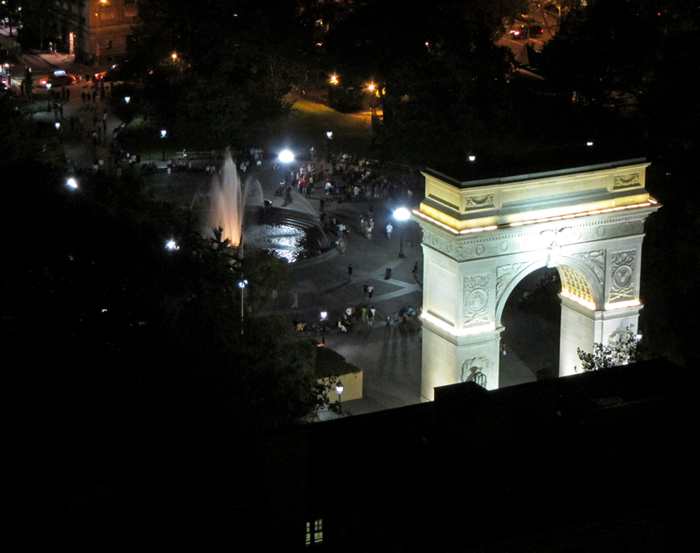
    Many urban jungle lovers (see Jungle Lovers and Urban Safari) relish exploration of the city, following the beaten paths or cutting their own swaths. But from time to time, there comes a desire to see the forest from the treetops. New York City affords a myriad of opportunities to do this via observation decks, bridges, and high-rise apartment and office buildings. Today’s photo is a rooftop view looking straight down from the 26th floor of a luxury high-rise apartment building in Greenwich Village.

    I love the culture, arts, architecture, and people of the city, but from time to time I want to see the little cars and people below. So, next time you get the chance, take a trip to the top of a New York City skyscraper and join Peter Craig and me in a game of World Domination 🙂

    Posted on by Brian Dubé


  • ©2026 New York Daily Photo Entries (RSS) and Comments (RSS)  Raindrops Theme