web analytics

  • Category Archives Architecture
  • They’ll Go Broke

    My mother had called very alarmed that a member of our extended family would go broke. He had been on a shopping spree. She accused him of being reckless with his money – he had purchased Calvin Klein sheets for his entire house. She did not understand the math behind the assets of the extremely wealthy. I went over some numbers with her and estimated the monthly return on the money that I guessed he might have. I showed her how he could likely buy a new house every few months with interest alone. In awe, she repeated this information to my father. However, she then just went on to show concern that this family member might still go broke.
    More recently, an incident echoed the same type of lunacy. A friend told me of a mutual friend’s concern that she was witnessing a myriad of NYU students charging every manner of food or small purchase and that surely they’ll go broke. This was more ludicrous than my mother’s comment since this woman was college educated and surely should understand the underlying economics. NYU now costs a small fortune and parents are typically funding educations and giving their children credit cards for everyday expenses. How are even hundreds of $5 coffees going to break the bank of a family spending $40,000 per year for tuition alone? They’ll go broke has become a private joke with the friend who told me this tale.

    New York City is awash in money, so much so that it befuddles the mind of the average wage earner. There are people who seemingly have access to an endless fountain of money. For them, the cost of things is completely irrelevant. Budget is not part of their vocabulary. Purchasing decisions are only based on what they want, not what they can afford. Even in a poor economy, expensive restaurants are packed.

    There is no better example of the wealth of city residents than Manhattan real estate. In July 2012, an apartment went on the market in Manhattan that had the highest asking price in history – $100 million. A townhouse here typically fetches at least $10 million. A two-bedroom apartment can run $2 million plus.
    Tuesday night I was strolling only a few blocks from my home in NoHo on the cobbled Bond Street when I discovered an very imposing building with an extremely ornate skeletal front. It was the ultimate in gleaming glitz with an enormous door. I noted the address – 40 Bond Street.

    The developer was no other than the legendary Ian Schrager, co-founder of Studio 54. Schrager lives in the property itself in a penthouse valued at least $50 million. Everything about the condo development with its signature Coke bottle-green glass exterior screams luxury – 11-foot ceilings, dual gas and wood-burning fireplaces, wide plank oak floors, top of the line everything, and concierge services provided by the Gramercy Park Hotel on 24-hour call.
    A cast aluminum gate – 140 feet long by 22 feet high – is graffiti-inspired. Apart from the 27 loft-style apartments, the building has five, three-story townhouses with 22-foot-high living rooms, front yards behind the gate along, and private gardens at the rear of the building. The 11-story property was designed by the renowned architectural firm and Pritzker Prize-winning Swiss duo Herzog & de Meuron in their first ever project in New York City. Opinions vary dramatically, as would be expected. Everything from positives to expletives. A block resident since 1958 called it “Frank Lloyd Wrong.”

    All this conspicuous consumption, flagrant displays of wealth, ostentatious trappings, and arrogance that often accompanies the rich New Yorker is what gives many a distaste for this city and everything and everyone in it.  An understandable feeling that in New York, it’s all about money. For these, there will be little concern whether the residents of 40 Bond Street are living within their means or They’ll Go Broke :)


  • The Special is More Special


    One of the special things about New York City is its architecture – a visual treat, particularly in a young nation defined largely by suburban sprawl. Wonders abound in the city, however, since 9/11, security has become much tighter, and buildings with extraordinary interiors, such as the Woolworth Building, are often, sadly, off-limits to the visitor. Sometimes, events are held in such a space or the building serves a public function, affording the attendee with a special treat – seeing the interior while going about one’s business. Places like Grand Central Station or the New York Public Library, both of which are worthy of a visit just for admiring the architecture.

    On October 20, 2010, I wrote Brooklyn’s Got Magic about the Williamsburgh Savings Bank Tower at 1 Hanson Place (and its conversion in 2008 to luxury condominium apartments). It is one of the borough’s architectural icons and can be seen from afar. I have used it as a landmark for as long as I have lived in New York. It was once the tallest building in the borough – 37 stories and 512 feet tall. The clock faces, 17 feet in diameter, were the world’s largest when they were installed and remain among the tallest four-sided clock towers in the world.

    Although the structure itself and exterior warrants accolades and superlatives, it is the interior that really shines. And, remarkably, until a week ago, I had never been inside. While in Brooklyn, a friend suggested that we drop in to visit the Brooklyn Flea Market, which has occupied the lobby of the building for the last few years. I was astounded. Apart from perusing the merchandise, attending the market affords a rare glimpse of an amazing interior space. Everyone is aglow at the opportunity to visit. Here is what the New York Times had to say:

    One of the great urban experiences New York offered this winter was the Brooklyn Flea in exile. When the weather turned cold, the market moved indoors to One Hanson Place, bringing along its motley host of antiques dealers, artists, designers, vintage-workboot purveyors and–let’s get to the point here–food vendors.
    One Hanson Place is an almost deliriously lavish setting for a flea market. Shoppers trying on old Borsalinos and inspecting new art prints huddle beneath spectacularly rich mosaic ceilings in a crazy, echt-New-York mishmash of Byzantine, Romanesque, Art Deco and who knows what else. … The food now is found downstairs in the vaults, behind the kind of enormous heavy doors banks had when robbers still stole things like cash and bars of gold.

    Who knows the accessibility of such a space in the future? The savvy visitor or resident who loves architecture will put places like this on their must-see list because now, more than ever, The Special is More Special.


  • Hope Springs Eternal

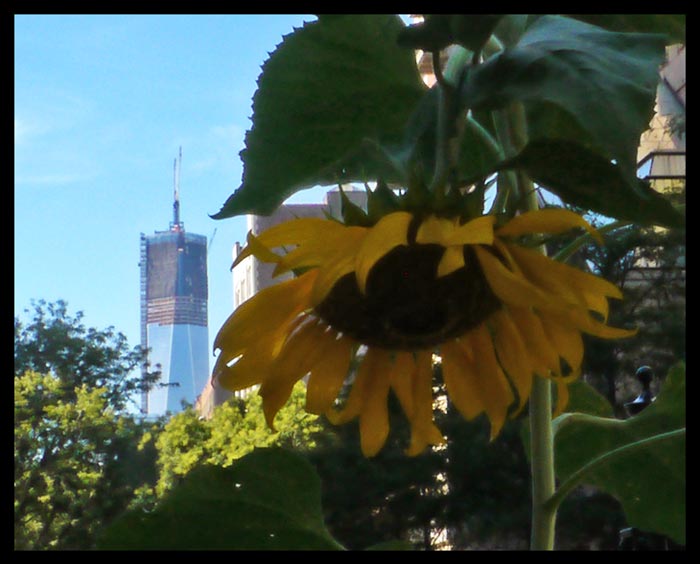
    One World Trade Center, 9/11/2012


  • The Caryatids

    There is much sensory input at street level in New York City that it is easy to miss those things which are above ground. Look up and you can explore the architecture so often overlooked by visitors and residents alike.

    Here, at 91 Fifth Avenue in the Flatiron District of Manhattan, is a commercial loft building built in 1894 and designed by Louis Korn. At the sixth floor level are six caryatids under four Corinthian columns and two matching pilasters. A caryatid is a sculpted female figure serving as an architectural support, taking the place of a column or a pillar supporting an entablature on her head.

    I have been by this property hundreds if not thousands of times, but it took only a friend to point it out on a stroll down lower 5th Avenue. I saw this set of caryatids as a metaphor for the burdens that women have shared in many ways – women’s rights, the glass ceiling, misogyny, women’s right to vote, their role as social enablers, and physical burdens, like the entablatures of The Caryatids

    Related Posts: I Know, I’ve Got a Feeling, Gargoyles, Cybele


  • A Narrow Path

    Many years ago, I became entangled in an argument regarding aspects of Christianity with a cousin and his wife in my family’s home in Connecticut. It was Christmas time, and I felt particularly bad to have gotten into a heated debate with family about their faith. I learned that they were born-again Christians. At one point, I expressed my dismay and told them that I was very sorry. However, they said that they were not upset at all but that, to the contrary, they valued the opportunity to defend their faith and that debates of this nature only made them more resolute in their beliefs.

    I only recall one small part of that evening’s conversation – a point where, after a litany of their dos and don’ts, I said to them that following their road appeared to me to be an absurdly narrow path, virtually unwalkable. They were pleased by this comment and concurred, telling me that Christ said exactly that in Matthew 7:13-14 :

    Enter through the narrow gate. For wide is the gate and broad is the road that leads to destruction, and many enter through it. But small is the gate and narrow the road that leads to life, and only a few find it.

    This passage was unbeknownst to me at the time and certainly gave me cause for reflection. After millennia of debate, argument, and discussion, well-schooled Christians, like others who are serious about their faith, are well-armed with answers to the myriad of objections and issues with biblical matters. Religious doctrine is not so easily dismissed as dogma of the unthinking masses.

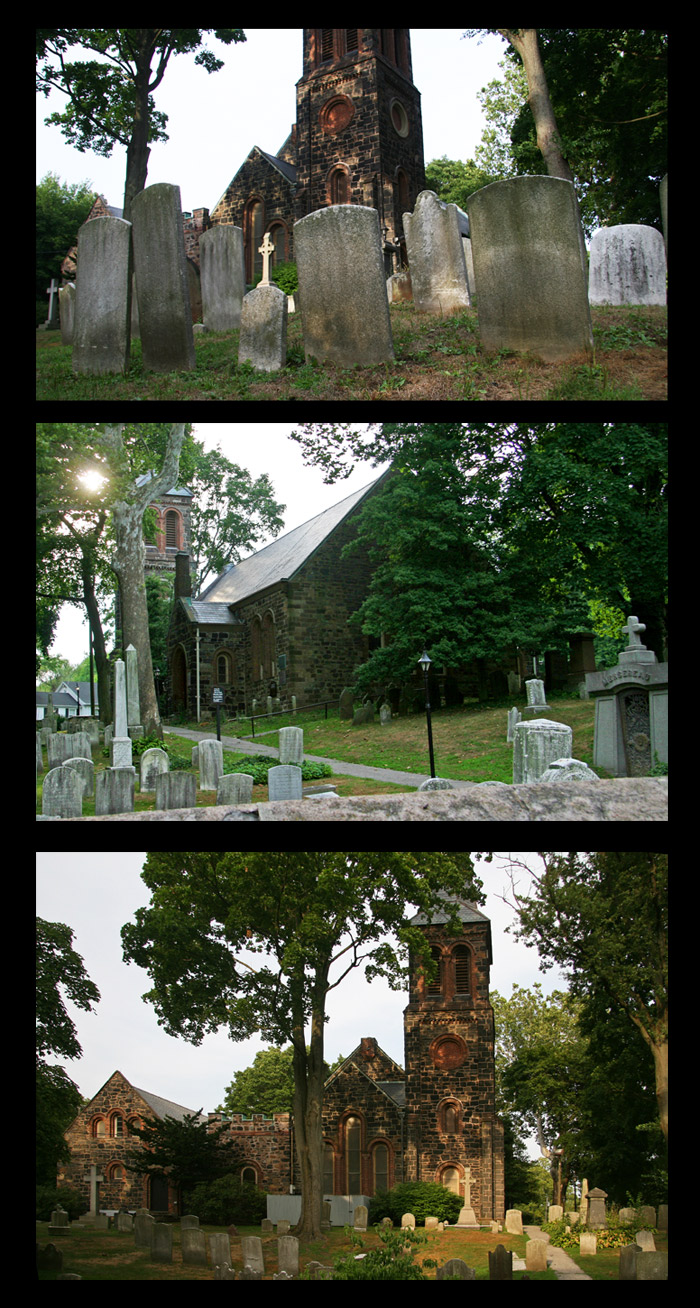
    In 2010, I made a trip through historic Richmond Town in Staten Island. The area is replete with beautiful antique structures in bucolic settings. I featured a number of postings on Staten Island and decided to leave the images of The Church of St. Andrew for a later time. Today I discovered the images in my archives of this 300-year-old church in the Richmond Town section of Staten Island.

    The Church of Saint Andrew was founded in 1708 and chartered by Queen Anne in 1713. The Church  served as a hospital and headquarters for the British soldiers as the New Colonies fought for their freedom. The Rev. Richard Charlton served as the Rector of Saint Andrew’s during this time. He was the maternal grandfather of Elizabeth Ann Bayley Seton, who was the first canonized American Saint of the Roman Catholic Church. Along with her grandparents; her father, brother and sister are buried in our historic cemetery. The Rev. Samuel Seabury was called to be the first Bishop of the Episcopal Church while he was serving as Rector of the Church of Saint Andrew from 1777 until 1780.

    I toured the church property. Everything conspired to persuade me that my cousins were right; as I navigated the sidewalks and walked between the headstones of the departed, indeed it did appear that good things lay along a narrow path :)

    Related Posts: Not Under the Gowanus (Part 1, Part 2, and Sorry About That), Green-Wood, Everything Yes, Veneer of Their Lives, Cold Stone, Little Church Around the Corner, St. Mark’s Church-in-the-Bowery


  • Only Silver

    My best friend was very excited and asked if I had a small glass jar. When I asked why, he said that a number of conveyer systems had been thrown out behind the local supermarket and there were mercury switches in them. “So what?” I responded. He said that this was a rare window of opportunity to collect mercury. By breaking the glass vials in the switches, he was able to collect a substantial amount of mercury. He appeared to have been more interested in the adventure than the goods, and he gave me the entire jar. And so this is how, as a young boy, I came to own a jar of pure elemental mercury.

    Playing with it always produced wonderment to observe the unique properties of a silvery metal which was liquid at room temperature. I would marvel at the effect the mercury would have while rubbing it on a coin. The jar was left behind when I left my family’s home, and sadly, I believe it was discarded long ago.

    Perhaps not so sad, since I later learned that playing with mercury is not the most prudent past time. Silver would be a much better candidate for elemental curiosity, and later as a young adult, I became intrigued with silver – here was a precious metal that was affordable and attainable, and although it was not as much fun as mercury, it was at least non-toxic. Unlike gold or platinum, a person of ordinary means could obtain large chunks of it. It is inexpensive enough that it can be used in pure form to fabricate items of jewelry and other commodities.

    It has many unique properties and has served as a storehouse of value as currency, dating to 700 BC by the Lydians. Like gold, it has positive connotations, and applying a label of silver to anything, such as the word cream, implies great things. The reflective properties of silver also makes the word synonymous with glitter, glitz, sparkle, shine, and shimmer. So, what better word to use in the name of a skyscraper in New York City?

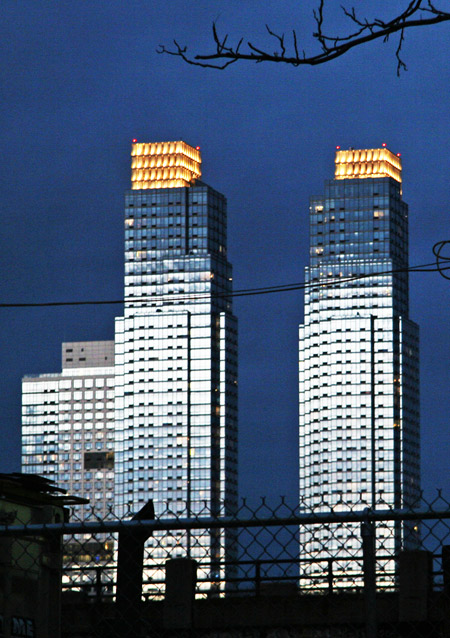
    The day I discovered the buildings in today’s photo, they were glimmering in the light of sunset with a look of metallic gleam, like the mercury of my youth and the silver of my adulthood. However, the photo was taken some time ago at quite some distance with no thought of their precise location or future use – until today, when I became enamored of their silvery sheen and wanted to identify them for use.

    I often have taken photos of buildings where the subject must be identified at a later time. Fortunately, using online resources – mapping, street views, satellite views, image searches, etc., one can usually positively identify any building in New York City. However, this may require more or less time depending on how distinct its character is, the photo, other nearby structures, and a myriad of other factors.

    Today’s quest was easy. Here, the first impression that came to mind was silvery towers, and a search for “silver towers” in New York City. It immediately returned images of the buildings in question, conveniently and appropriately named Silver Towers.

    I learned that these buildings were in planning for an extraordinarily long time. The property, developed by the appropriately named Larry Silverstein, took 25 years to bring to fruition. You can read more about them here. But what I really wonder about is if Larry ever played with mercury, or was it Only Silver :)

    Related Posts: ‘Tis a Sight to Behold, Buy Magnesium, Dot My I, New York Rockies, Where Sleeping Giants Lie, One Fifth Avenue


  • Three-Toed Smoth

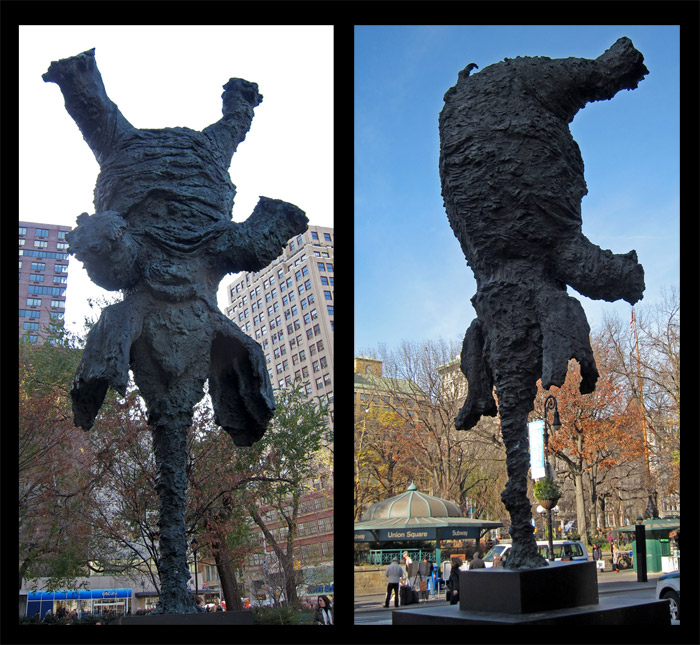
    The elephant looms large in the lives and minds of children. After all, children do naturally gravitate to the big, and what suits that better the world’s largest living land animal? Here, at Union Square, we have Gran Elefandret by renowned artist Miquel Barceló.* I’m sure many a child and parent have been enjoying Barcelo’s 26-foot sculpture.

    Marlborough Gallery is pleased to announce that the monumental sculpture Gran Elefandret, 2008, by renowned artist Miquel Barceló will be on view at the Union Square Triangle beginning September 13, 2011 through the end of May 2012. It is with great pleasure
    that the Gallery brings this monumental bronze sculpture to Union Square, a place that epitomizes New York’s unrivaled energy and serves as both a transportation and cultural bridge between uptown and downtown Manhattan. Barcelo’s immense Gran Elefandret, balances upright on its trunk, its four massive legs outspread searching for equilibrium. At twenty-six feet tall the sculpture brilliantly portrays an extraordinary, if not impossible physical and cultural feat; this contemporary monument believably captures with humor, scale and Spanish courage the essence of what a public monument can be today.

    To further communicate the gravity-defying feat beyond the surprisingly slim trunk and large body, Barceló imparts the mass and weight of the creature through the downward sag of the heavily wrinkled skin, the off-kilter positioning of the huge legs, and the complete overturning of the floppy ears. The highly textured surface of the elephant recalls the artist’s tactile paintings, in which he creates rich topographic, sculpted surfaces on canvas.

    I never had children, but I do love them. Not having them, many things are a novelty to me, like the spongelike absorption often found when children are exposed to new things. One of my most memorable examples of this behavior was subsequent to a class trip made to my business – see Little Burnt Out.

    I once made an acquaintance of a very learned and educated couple whose children had a frightening knowledge of things that I, as a child, barely had a cursory knowledge of. I recall going through a book of dinosaurs with one of their children, who was able to identify every one by name. At the time, I had read an article on the three-toed sloth and was fascinated by many of the facts surrounding this remarkable animal, such as its odorless nature and the extraordinary length of time it actually requires to make a journey down a tree, truly befitting its name being used as a metaphor for the slow.

    As the child attempted to elaborate on her knowledge of dinosaurs, I endeavored to communicate my newfound enthusiasm for the sloth. She appeared uninterested; I was not making an impression. Or so I thought.

    Some weeks later, a friend was on the phone with the mother of the child. At one point, she told me that someone had something to tell me. When I took the phone, the young girl whom I had met was on the other end. I don’t recall the conversation exactly, except that she was quite intent on telling me of her new found interest in the Three-Toed Smoth :)

    *Miquel Barceló was born in Mallorca in 1957. After studying briefly at the Arts and Crafts School of Palma and the Fine Arts School of Barcelona, he became involved with the conceptualist group Taller Llunátic, which opposed the stagnation of both the socio-political climate of Spain during the late 1970’s and the “official” art scene. Originally focusing on painting, Barceló worked at first in a non- representational style, influenced by Jackson Pollock, Willem de Kooning, and Cy Twombly. As his career progressed, he began to integrate figurative elements in his paintings, and started creating sculptures in both ceramics and bronze. The artist collaborates with the Fundación Vicente Ferrer and the Eyes of the World Foundation and participates in projects for Sahrawi refugee camps. He divides his time between Paris, Mallorca, and Mali.

    Related Posts: Kids, Childhood’s End, Bronx Zoo


  • Fountains

    Depending on who’s counting, the Palace of Versailles has more than 1,400 fountains. Due to the enormous amount of water required to fuel them, they are turned on infrequently. Even at the time of Louis XIV, the water supply was inadequate to run all of the fountains at once. There was even talk of diverting the River Eure to supply water to the fountains.

    Sunday afternoons from April through October, there is the Grandes Eaux, a musical fountain show in the gardens to the accompaniment of recorded music. Although I have been to Versailles twice, I was not fortunate enough to experience the spectacle. Paris has 350 fountains; to a visitor from the United States, they seem to be at every turn and virtually are.

    New York City has a much less lavish feel to it, as observed by one of my Swedish clients, which I wrote about in Very Practical. Fountains will never be a priority here, although it certainly was for George Vellonakis, architect for the redesign of Washington Square Park. Upon reconstruction, the central fountain was moved to be centered with the Washington Square Arch as viewed coming down Fifth Avenue. George was virtually crucified for this, the cost of which was often misrepresented since the fountain needed to be dug up for plumbing work anyway, with the additional cost of moving being incidental.

    But to me, the entire fiasco and controversy is just indicative of the fixation of Americans on the bottom line, even if at the cost of aesthetics or the occasional jubilant indulgence.
    As I wrote in Let’s Have a Parade, in the light of hardship, it often is hard to justify celebration. After all, there is always a better place to spend money.

    We do not have a large number of fountains in New York City, but there are a handful. Conservatory Garden, the fountain and the gilded statue of Prometheus in the sunken plaza of Rockefeller, the fountain cascade at Rockefeller Center, the fountain at Columbus Circle, the Pulitzer Fountain at 59th and Fifth Avenue, Angel of the Waters Fountain at Bethesda Terrace in Central Park, the Unisphere in Flushing Meadows Corona Park in Queens, Temperance Fountain, Tompkins Square Park, James Fountain at Union Square Park, City Hall Park Fountain, and Washington Square Park.

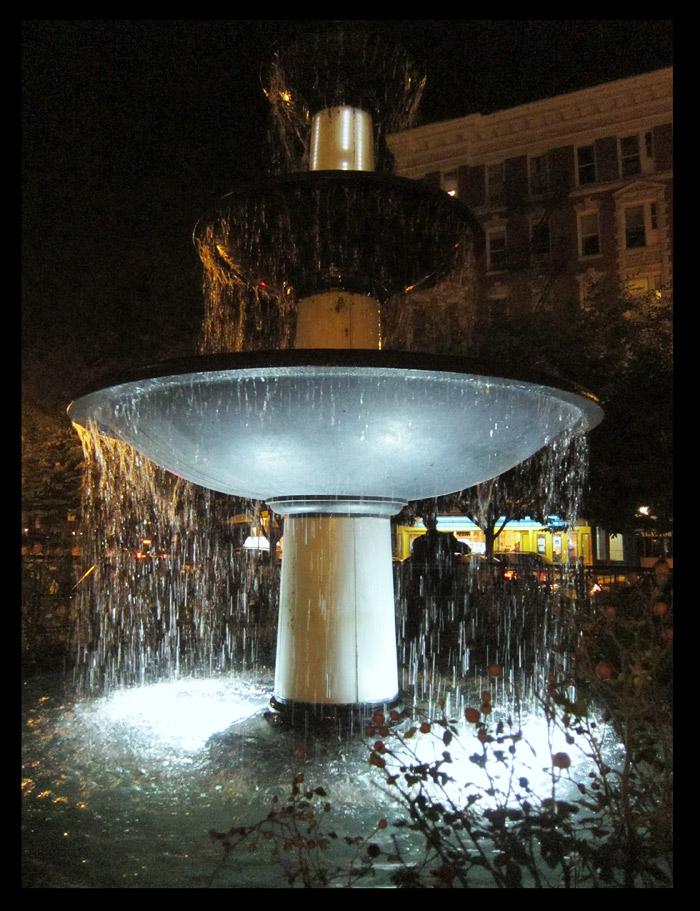
    Here, at Father Demo Square at the intersection of Carmine Street, Bleecker Street, and Sixth Avenue, is a tiny park with a beautiful charcoal gray stone fountain as centerpiece. The park completed a renovation in 2007 and is an ideal resting spot located in one of the most intensely trafficked areas of New York City, surrounded by a plethora of restaurants and shops. It’s ideal for people watching, a rest after dinner, or a place to eat a snack. Or, for those inclined to indulge, enjoy one of New York City’s very few fountains :)


  • ‘Tis a Sight to Behold

    I have made another secret discovery.

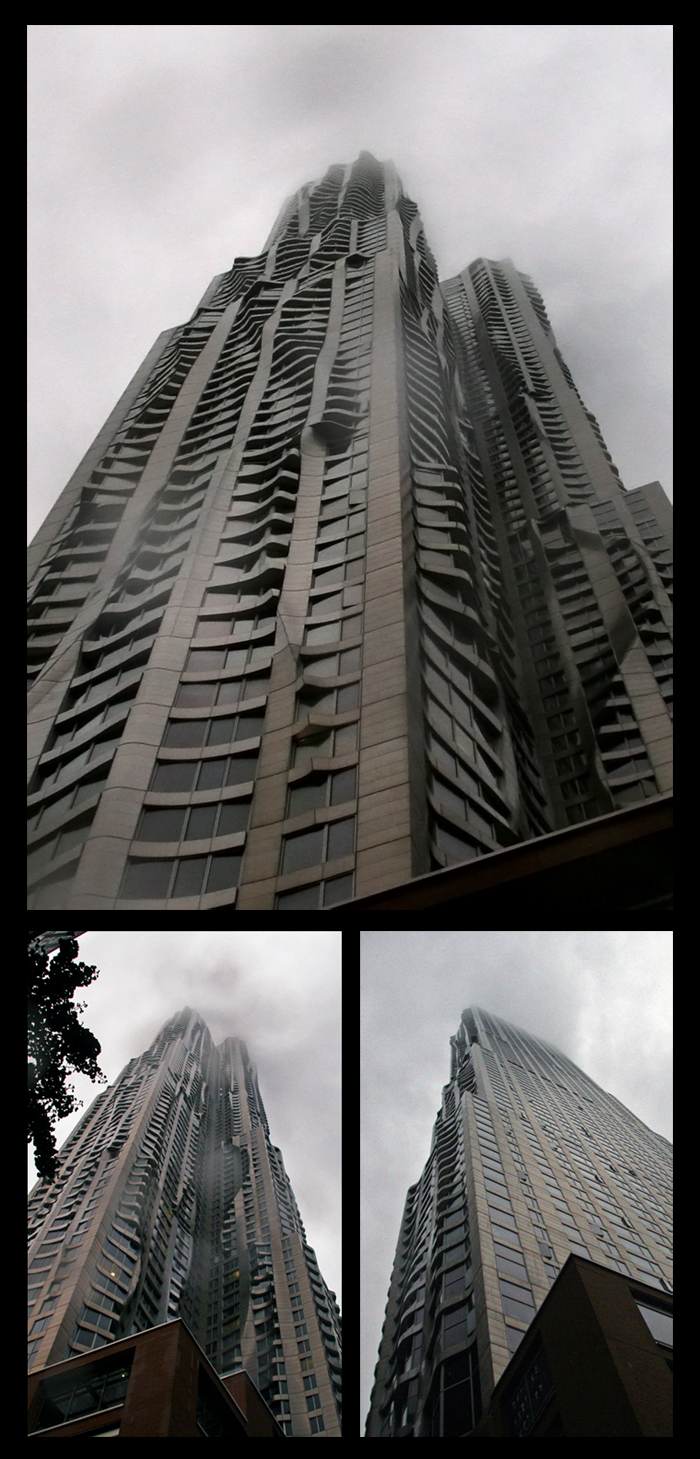
    You could easily find millions of New Yorkers who have no idea that this spectacular structure at 8 Spruce Street exists or that it is the tallest residential structure in the Western Hemisphere. I would be included in that group. However, as I approached the building, I began to recall the media attention surrounding this highly applauded residential tower, formerly the Beekman Tower and currently known as New York by Gehry, designed by renowned architect Frank Gehry.

    I made this secret discovery on a foggy Sunday evening while cruising lower Manhattan – one does not have to look hard to find a 76-story, 867-foot building. A foggy, stormy night is a great time for observing New York City’s skyscrapers. With their heads in the clouds, these towers provide all of the ambiance and drama of Batman’s Gotham city.

    New York Times architecture critic Nicolai Ouroussoff called it “the finest skyscraper to rise in New York since Eero Saarinen’s CBS building went up 46 years ago.” New Yorker magazine’s Paul Goldberger described it as “one of the most beautiful towers downtown.” Goldberger compared Gehry’s tower to the nearby Woolworth Building, completed in 1913, and said that “it is the first thing built downtown since then that actually deserves to stand beside it.” These are extraordinary accolades from New York City’s premier architecture critics who are hard to please and prone to dissect and crucify. But the accolades are justified.

    I circumnavigated it at nearby street level. However, I highly recommend seeing this tower from various vantage points, since one of the primary distinctions about this structure is its changing form when viewed from different perspectives. From the New York Times:

    … once you see the tower in the skyline, a view that seems to lift Lower Manhattan out of its decade-long gloom. The building is particularly mesmerizing from the Brooklyn waterfront, where it’s possible to make out one of the deep setbacks that give the building its reassuringly old-fashioned feel. In daylight the furrowed surfaces of the facades look as if they’ve been etched by rivulets of water, an effect that is all the more dramatic next to the clunky 1980s glass towers just to the south. Closer up, from City Hall Park, the same ripples look softer, like crumpled fabric.

    The building’s exterior is made up of 10,500 individual steel panels, almost all of them different shapes, so that as you move around it, its shape is constantly changing. And by using the same kind of computer modeling that he used for his Guggenheim Museum in Bilbao, Spain, more than a decade ago, he was able to achieve this quality at a close to negligible increase in cost.
    But Mr. Gehry is also making a statement. The building’s endlessly shifting surfaces are an attack against the kind of corporate standardization so evident in the buildings to the south and the conformity that it embodied.

    ‘Tis a sight to behold :)

    Other buildings and skyscrapers: New York Rockies, I’ve Got a Feeling, Where Sleeping Giants LieAll of These Pleasures, Color of Money, Trump Soho, Beacon of Hope, Towers, Pan Am Building, Crisis at Citicorp, Hearst Tower, Trumped Again, Time Warner Center


  • Serenity, Tranquility, Peace


    Although technically in the borough of Manhattan, I have always felt it was almost a little undeserving for any New York borough to take claim to something so special as the Cloisters – it is located at the northernmost end of the island, as far as one can get from Uptown, Midtown, Downtown or any other area of that one would typically associate with New York City. Apart from the small number of residents in Washington Heights/Inwood, this area is really a destination for New Yorkers and visitors alike.

    The Cloisters is a museum of medieval art and architecture, a branch of the Metropolitan Museum of Art. Everyone loves this extraordinary complex – it’s a close as you are going to get to genuine French architecture in the city. Germain Bazin, former director of the Musée du Louvre in Paris, described the Cloisters as “the crowning achievement of American museology.”

    The museum buildings were designed by Charles Collens and constructed from elements salvaged from five cloistered abbeys in France: Saint-Michel-de-Cuxa, Saint-Guilhem-le-Désert, Bonnefont-en-Comminges, Trie-en-Bigorre, and Froville. The sections used were disassembled brick-by-brick, shipped to New York City and reassembled between 1934 and 1938. From the Cloisters website:

    Three of the cloisters reconstructed at the branch museum feature gardens planted according to horticultural information found in medieval treatises and poetry, garden documents and herbals, and medieval works of art, such as tapestries, stained-glass windows, and column capitals. Approximately three thousand works of art from medieval Europe, dating from the ninth to the sixteenth century, are exhibited in this unique and sympathetic context.

    Located on four acres overlooking the Hudson River in northern Manhattan’s Fort Tryon Park, the Cloisters is a world apart from the glitter, glamour, hustle bustle and frenetic energy of the city. For most New Yorkers, Fort Tryon Park and the Cloisters is a country getaway, a mini vacation. Visit the Cloisters if you want a small vacation from the city and Serenity, Tranquility and Peace :)

    Related Posts: Down to the Cellular Level, Le Petit Chambord, Fire and Ice, Affront to Dignity, Paraiso, Steps From Paradise, Belvedere Castle, Devil’s Playground


  • Stopped In My Tracks


    In New York City, vagaries define the special. There is nothing more appealing than the lack of specific information or the secret. We just love “there’s this guy” or “there’s this place” with a lack of precise information as to where. Particularly in our current time, nothing is more unappealing to a New Yorker than a place that is part of a national brand or regional chain and has been marketed and branded to death.

    No one wants what everyone else has or wants to shop at places everyone knows about. This is at the heart of “being the best,” an obsession in New York City. How can something be one of New York’s best if it is part of a national franchise? Street cred for a business has to start with a minimum requirement of existing only in New York. The problem, however, is that unique places and services are fast disappearing. In the span of this website’s existence, many iconic places I have written about have gone out of business.

    I have even experienced a holding back of information, as if to be worthy of the knowledge, one must venture forth and ferret out a person or place’s whereabouts on one’s own. No pain, no gain. This holding back is often justified in that overexposure may ruin a business’s character. Although this may be true, I think the real motive stems more from selfishness – those desiring the special want if for themselves. After all, how special can it be if everyone knows about it?

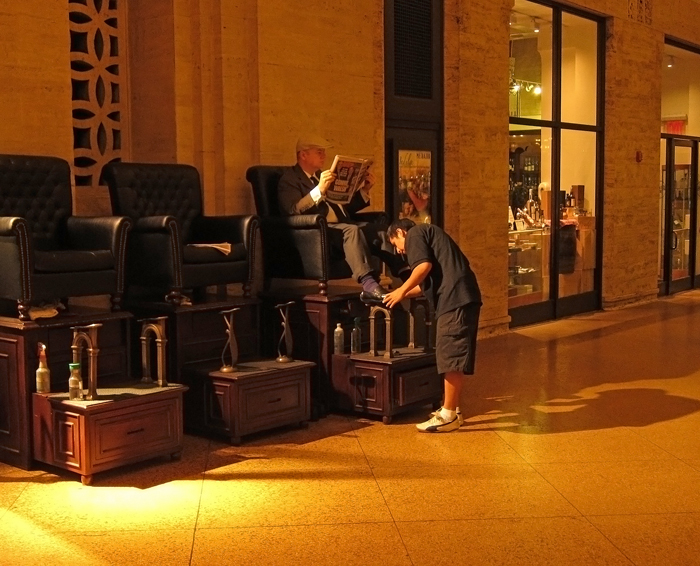
    The shoe shiner is a perfect candidate for the New Yorker’s lust for “there’s this guy.” By their nature, those involved in the business are sole operators and are often transient. In New York City, one should never underestimate the potential of any activity if done by an astute, aggressive, streetwise individual that can promote him or herself. Transient does not equal unsuccessful. Don Ward is a good example (not the man in today’s photo). Located at 47th Street and 6th Avenue, Don has been shining shoes for over 20 years. He does an average of 50 customers per day at $5 per shine plus tips. This man has interesting insights*, aggressive solicitation and clever patter. He is quite the character and a bit of a celebrity, reminiscent of the Gentlemen Peeler (see my story here).

    I have never felt comfortable with shoe shining. Although it is, perhaps, no worse than someone doing your laundry, shining shoes seems so transparently servile, too close to kissing someone’s feet. Perhaps it is my French ancestry rearing its head. In an article from the New York Times in 2008, The Politics of the Shoe Shine, Roger Cohen writes:

    Broadly speaking, there are two kinds of societies: those where you can get a shoe shine and those where you can’t. France falls into the latter category. Search Paris high and low for a seat to kick back and se faire cirer les bottes: you’ll search in vain. There’s something about the idea of having someone stooped at the feet of a client applying polish to his or her boots that rubs the Gallic egalitarian spirit the wrong way. It’s just not what 1789 was about.

    In the United States, of course, it’s a different story. Unlike humor, which is in short supply, or banned, a shoe shine is freely available at U.S. airports. Walk a few Manhattan or Chicago blocks and someone will be there to make your shoes gleam. There’s something about having someone applying polish to a blithe client’s boots that comforts American notions of free enterprise, make-a-buck opportunism, and the survival of the fittest.

    Nonetheless, on my way to the Metro-North train on Saturday, I could not help but be stunned by what I saw entering Grand Central Terminal. It was like a still frame from an old film set in New York City. Everything was perfect – two men alone on a quiet morning, the customer reading a paper while the shiner plied his trade, both basking in the yellow-orange sunlight streaming in. The whole scene gave me chills. Like the train that awaited me on track 24, I was Stopped In My Tracks

    *From Don: “Ninety-nine percent of the time, women will look at your shoes and immediately dismiss you if they’re below standard. If you can’t keep your shoes looking decent, you can’t do anything else.” “If you can’t take care of this one small detail, I’d hate to see your living conditions.”

    Related Posts: One Size Too Small, Urban Road Warrior, Very Resilient, Entombed, Uggly or Not, Mania, Just Passing Through, Camper, Grand Central


  • Uptown

    The territory north of 14th Street truly is a world apart. There is much behind the downtown mantra, I never go north of 14th Street. There is a stoic pride and conviction that virtually anything one needs can be found downtown and it is not far from the truth.

    I cannot speak for other downtown residents, but I go north for specific purposes and so infrequently that going uptown is like a small vacation. I literally feel like a tourist. I walk a neighborhood, often craning my neck and standing in wonderment at the massive stone, steel and glass edifices built on the island’s bedrock of Manhattan schist.

    The advent of the Internet had greatly facilitated price shopping for most products and services, including New York City hotels. Since that time, my family has been able to snag deals at the Waldorf Astoria Hotel, which has become their residence of choice when visiting the city. I enjoy traveling and visiting the hotel during their occasional stays.

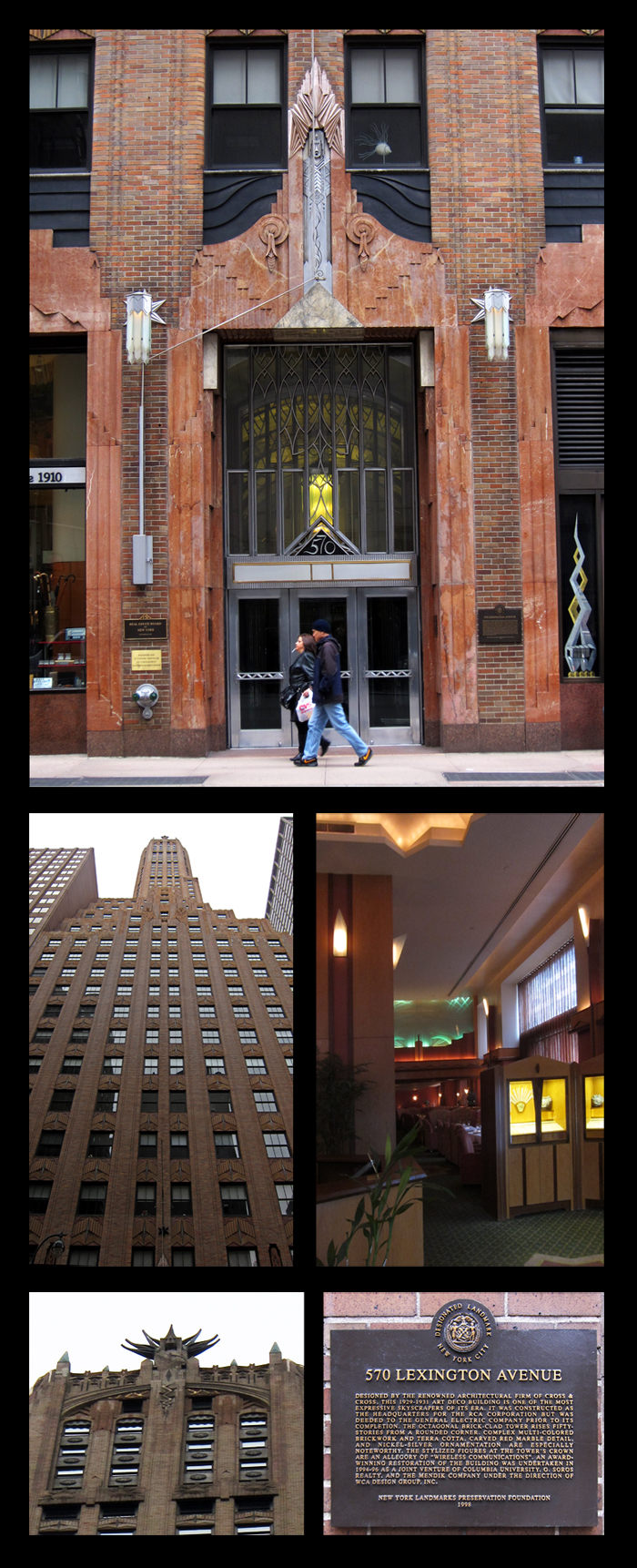
    Next door to the Waldorf Astoria Hotel is the General Electric Building. The building is sometimes referred to as 570 Lexington Avenue to avoid confusion with the GE Building built later at 30 Rockefeller Plaza. The 50-story, 640 foot Art Deco masterpiece was designed in 1931 by John W. Cross of Cross and Cross. Unable to lease the building profitably, in 1993, GE donated the building to Columbia University, gaining a $40 million tax deduction. Find more on the building here.

    The base contains elaborate masonry, figural sculpture. On the corner above the main entrance, a conspicuous corner clock with the curvy GE logo and a pair of silver disembodied forearms. On August 25, 2006, I featured the lobby of the building – you can see it here.
    Christopher Gray of the New York Times describes the building as a “suave fantasy of polished marble and modern metals.”

    Its signature crown of lacy radio-wave figures is a well-known midtown landmark, but the decoration of the lower floors is just as startling. Here a shrouded mechanistic figure huddles in a modernistic cloister, there an armored fist grabs an electric bolt. The entire facade is of a lightly variegated orange brick, which plays to St. Bartholomew’s Church next to it on the Park Avenue corner.
    See my photos of the church here.

    When I visit the area, I am never able to resist stepping into Mr. K’s restaurant, an upscale Chinese establishment located at 570 Lex. The plush banquette seating, the lush art deco interior, soft lighting all seem so befitting of the building it is in. For a little vacation, I just take the 6 train. Uptown.

    Related Posts: The Last to Know, A Bottle of Schweppes, Cello Class, Ice Skating in October, The Plaza, Stamp of Approval, When Worlds Collide, 23 Skidoo, The Sherry, Saks Fifth Avenue, St. Patrick’s Cathedral, Life at Night, Met Life Tower, St. Patrick’s from the Rock, ESB Straight Up


  • Old New York, Part 2

    (see Part 1 here)
    The good news is that Greenwich Village is extraordinarily unique. The bad news is that if you want a piece of its history, good luck. The housing stock is very limited. And if you are like I am and attracted to row houses, the selection of available units is even more limited. Over the decades, I have from time to time looked at apartments to buy but rarely found anything I really liked, and if I did, the cost was extremely high.

    I am forever asked why I am a renter and have not purchased a home after living in New York for over 40 years. The market in New York City is very different from anywhere else. There are over 2 million apartments for rent in the city with 65% rent regulated in some way. These regulations provide for below market rents and are a strong disincentive to move. The longer you remain in a regulated apartment, the greater the spread between your rent and the open market non-regulated places becomes – it is not uncommon for the difference to be 100% or more.

    This anomaly in pricing just exacerbates the problem – tenants never move with a resultant lesser supply and higher prices for the free market apartments, whether rentals or purchases. If you are fortunate enough to rent an apartment in an historic building, it is unlikely you will ever find a place like it at any price, for rent or sale. In my own building, 3 out of four residents have lived in their apartments for over 30 years. Often, rentals in regulated apartments are no more than the cost of maintenance fees on a similar unit for sale. So why buy? Many analyses have been done demonstrating that in New York City, it can be more prudent to rent than to buy.

    The 1830 Greek Revival townhouse at 23 Washington Square North has not been available for sale for half a century. It can be yours, however, the asking price is $25 million dollars. The size is 8,528 square feet or a cost of $2,931 per square foot. There are only 7 apartments on 5 floors. Do the math and you will see the problem – if this building were converted to units for sale, the cost per apartment including carrying charges would be stratospheric. Many buildings like this will often sell to one individual who will convert it to a single family home.

    The rentals in this property illustrate what happens in this marketplace. A one bedroom was asking $4,775/month with the penthouse for $8,900 in 2010 and $12,500 per month in 2011. If you would like to get the flavor of what a parlor floor can look like in this type of historic building, see my photos here on the interior of number 24 next door, which one reader described as “real estate porn.”

    By day or night, looking out or peering in, the extraordinary historic charm is available in this rare window of opportunity to own a piece of old New York’s Washington Square. Spare $25 million anyone?

    Other Related Posts: The Feeling Passes, Overused and Abused, Bomb Factory, Left Bank New York


  • Old New York, Part 1


    There are things you can’t have in New York City. Many things. You can’t watch the sunrise from a mountain top, hear the wind blow through alpine forests, or see the black of night. Much of what nature giveth, New York City taketh away.

    The sound levels are very different here. I spoke to a friend recently from the suburbs who spent a night down the block – on the very same street where I live with the identical exposure. He said he could not sleep at all with the noise of constant traffic. The sounds of the city are only a familiar song to me – I sleep easily without window shades drawn and with all the city’s ambient light and noise.

    Here and there one can find tiny corners, places, culs de sac, alleys, parks, beaches, lakes, rivers – little pieces of the other world, the world outside cities. These special and often little known places in New York City provide magic carpets, that for brief moments can provide transport to a quieter, gentler city. I have shared these places with you over the years in this website.

    I do love the city – the energy, vibrancy, and stimulation are extraordinary. But the problem is that you can’t turn it off. So for those times when I need respite and do not have the opportunity or inclination to leave the city, I seek solace in those special spots that hearken to a time gone by or a world apart.

    The Greek Revival houses of Washington Square North evoke the gentility of a bygone age. Here, at the corner of Washington Square North and Fifth Avenue is a row house where I have often seen windows open, lights on and a handful of people milling about. This is the world of Henry James, 1881, setting for his novel Washington Square.

    A couple relaxes with glasses of wine, one resting on the sill, complemented by the exquisite air of warm evening, which has, after a long wet and cool spring, arrived at last. There’s a canopy of trees overhead and the yellow-orange glow of lamps. Everything is soft. Pause on this corner with me and enjoy the soul of old New York…

    Note: If you want a piece of Old New York at Washington Square, see Part 2.


  • Everything Looks Like a Screw


    Surgeons like to cut.
    I have always had a morbid fear of surgery. There’s just something about all that cutting that bothers me. However, I do understand that surgeons like to cut and I can imagine why. As a small manufacturer, I often have to troubleshoot products and there is nothing as effective as opening something up and getting inside to really see where the problem lies. Why play with less direct solutions if the problem lends itself to a mechanical solution?

    Builders like to build.
    Robert Moses was New York City’s master builder. He the most often cited figure in this website. This New York City planning czar had an unstoppable drive. He was never elected to public office, yet was responsible for the creation and leadership of numerous public authorities. He built bridges, tunnels, highways and shaped shorelines in New York City and environs.

    One of Moses’ projects which never came to fruition was the Lower Manhattan Expressway. This extremely controversial plan was to be a ten-lane elevated highway, I-78 & I-478, extending from the Hudson River to the East River, connecting the Holland Tunnel to the Williamsburg and Manhattan Bridges. It was seen by Moses as a much needed thoroughfare to ease congestion in Manhattan providing a roadway connecting traffic from New Jersey to Brooklyn and Queens. It was conceived by Moses in 1941 but delayed until the early 1960s.

    The highway plan would have required many structures to be demolished along Broome Street, passing through Little Italy and what is now known as SoHo. Community activists led by Jane Jacobs effectively thwarted the project. The effort is now seen by many as instrumental in preserving the character of lower Manhattan.

    Robert Moses and his works saw much public criticism. In 1974, The Power Broker was published. From the New York Times:

    He indicated no wish to change with the times, but held to his views more ardently than ever in his later years, dismissing community opposition to his vast projects by saying, as he did in a 1974 statement, ”I raise my stein to the builder who can remove ghettos without removing people as I hail the chef who can make omelets without breaking eggs.”

    The statement came in a much-publicized 3,500-word rebuttal that Mr. Moses offered to a highly critical biography of him by Robert Caro published in 1974, ”The Power Broker.” The exhaustive 1,246-page work, which won the Pulitzer Prize, was written from the perspective of the newer approach to planning and redevelopment, and it contended that Mr. Moses had callously removed residents of neighborhoods undergoing urban renewal, had destroyed the traditional fabric of urban neighborhoods in favor of a landscape of red-brick towers and throughout his career had worked somewhat outside the normal democratic process.

    Screwdrivers.
    Surgeons like to cut, lawyers like to litigate, and builders like to build. For someone with a screwdriver, everything looks like a screw…

    Photos: The upper photo is one of the supports of the Manhattan Bridge as seen from the walkway. The lower photo is a plan of the proposed Lower Manhattan Expressway.

    Note: It is ironic that Robert Moses, a man who favored highways over public transit, did not hold a driver’s license.


  • dinamic_sidebar 4 none

©2013 New York Daily Photo Entries (RSS) and Comments (RSS)  Raindrops Theme