• Six Geese a-Laying

    Not so long ago, only in the early 1990s, when walking through SoHo, I would see large bales of rags with the streets littered with small remnants. I would often pickup a piece, examine it and postulate as to its composition and history. A little known fact about SoHo is that for a time it was known as the rags, woolens and remnants district.

    SoHo was also a manufacturing district and an absolute ghost town during the evenings and weekends. So extraordinary, owing to the fact that it was centrally located and circumscribed by Greenwich Village, Little Italy, Chinatown and Canal Street. You can read about my first acquaintance with the terms “loft” and “SoHo” in my story Cast Iron Stomach. Given its cast-iron architecture and location, the rapid development and gentrification of SoHo comes as no surprise.

    But one of the most startling encounters, an anomaly even for that time, was a fully operational blow molding factory making dolls on the ground floor at Mercer and Prince Streets, now occupied by the Mercer Hotel, an upscale boutique hotel. When passing by in the morning, I would often jump up on a standpipe or on the ground floor window ledge to peer into the windows which had been masked in the lower portions. I was just fascinated to see dolls popping out of blow molding machines. This is one of my strongest memories of SoHo – such a contrast to today’s environment, that I often replay those memories just to ensure their veracity. I wish I had photos for you and I, but alas, I do not.

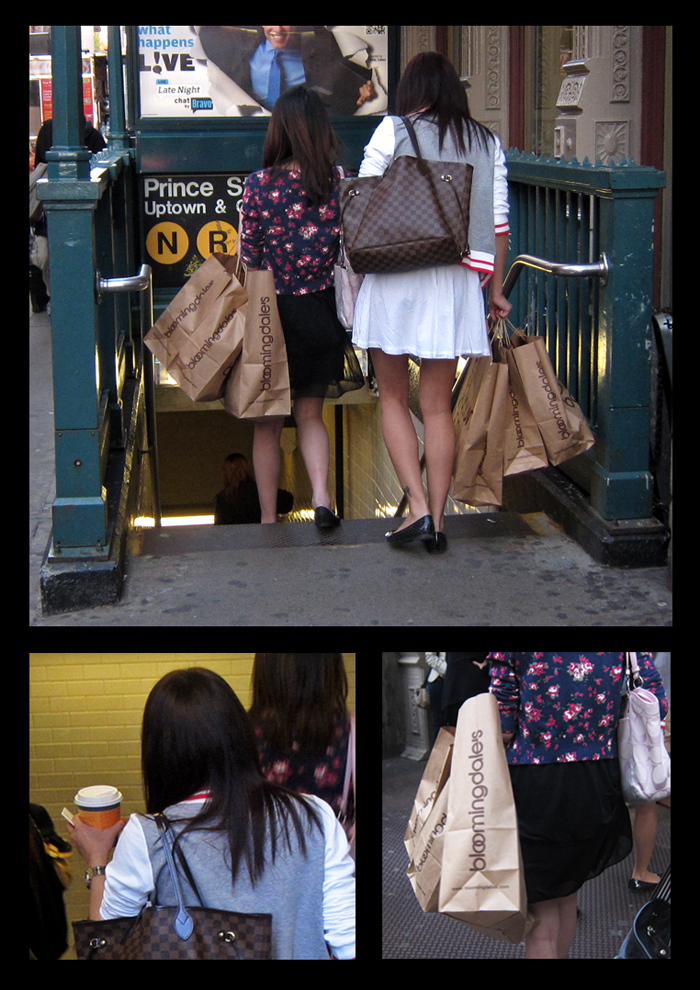
    Sans Fanelli Cafe, there was no retail. Even ground floor spaces were used for commercial/industrial purposes – unthinkable today with the high rents. So to see two girls carrying six Bloomingdale’s shopping bags between them and one girl shouldering a Louis Vuitton bag* while carrying a cup of coffee from Dean and Deluca was a jolt, both as a flagrant act of conspicuous consumption as well as a memory jog of how SoHo has changed.

    I have often joked that we should make Christmas a perennial holiday, since advertising and shopping begin earlier each year. Here, however, the hordes on the streets of SoHo are often virtually indistinguishable from the huddled masses we expect during the holiday season. One of my first reactions was that these bags did not look full at all and that the contents could easily have been consolidated into fewer bags. But, perhaps these girls just started Christmas shopping a little early and in the bottoms of their sacks, we would find Six Geese a-Laying 🙂

    *Yes, I realize in all likelihood this bag is a fake, easily procured in the vicinity of Chinatown. Not many are willing to spend $1000 plus for the genuine article.

  • Aspiring Rebel


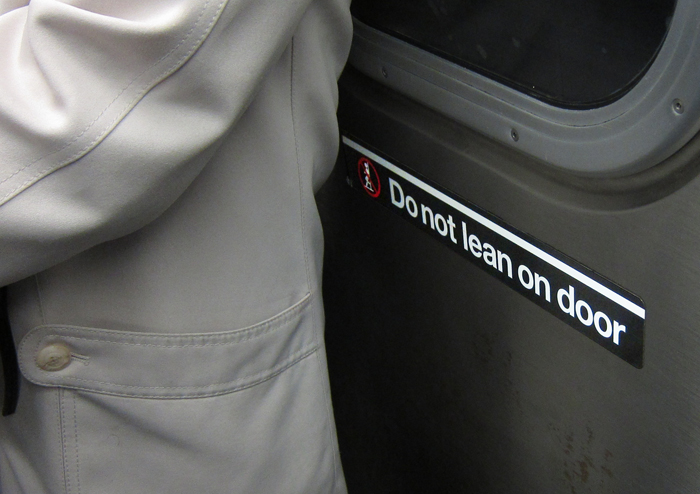
    In a city as large as New York, we are blessed with many nerds and a number of obsessed New Yorkers with a passion for the minutiae of city life. I say blessed, because how else would you learn about the horrors of certain trains using mixed fonts in the Do Not Lean on Door signs? The primary font in the subway system is Helvetica – see Train of Thought, my story of June 9, 2010, about subway fonts and other obsessions, such as H I K O P T U X Y.

    It was noticed by some, however, that there were a number of trains where signs were actually using a mixture of fonts. Apparently, the possible dangers of falling out of trains or any other obvious reasons for not leaning on (and blocking) subway doors is secondary to the nuances of typography. In a 2009 Gothamist article about this discovery, a war of words in the comments section reveals this gem:

    I noticed these when the R160s were new. I wanted to take my copy of Massimo Vignelli’s 1970 New York City Transit Authority Graphics Standards Manual and thwack someone over the head with it, but that wouldn’t be a good idea since I might damage a valuable book.

    Regulations like Do Not Lean on Door mean very little in New York City. Often, all available seating is taken and with trains lurching, leaning, and stopping abruptly, riders who are standing need to stabilize themselves. Holding onto vertical or overhead poles for extended periods is tiring. Leaning against exit doors becomes a preferred resting spot for many, with each individual door just right for one person. The eight doors (4 pairs per car) become coveted spots.

    Like jaywalking, these regulations are virtually never enforced. The signs do provide many functions however – a good opportunity for study of fonts, a record of unenforced policies, a clean surface to lean against, a chance to display requisite New York City Street Cred and attitude, and an opportunity for the less courageous for an act of defiance which will assuredly go unpunished. A sign and siren for the amateur lawbreaker and Aspiring Rebel 🙂


  • Cookies in the Afternoon

    What are the chances of finding an object whose function it is to apportion chances? I found this die sitting on a park bench, crying out to be photographed. The six outcomes seemed to speak well to chances of success in life, although it did not weigh the outcomes to accurately reflect the chances of success and failure in New York City.

    I was once speaking to a friend of an employee in my office. He appeared to be quite irritated and frustrated by my outlook relative to his. He apparently was steeped in workshops and readings which promoted ideas of positive thinking and affirmations. But, in spite of a positive outlook, success for him was Outlook Negative. On the other hand, he saw me as being rather negative, but my die was turning up Outlook Positive.

    I explained that I was actually a very enthusiastic person, tenacious and optimistic, but with, however, a very strong dosage of realism. I don’t believe in spending time using positive affirmations – saying it does not make it so and as everyone has heard, the road to success is paved with failure. The real estate at the top is very crowded, despite the disingenuous messages of the late night self help and get rich quick evangelists that buying their product will insure success – It Is Certain. After receiving it, any reasonable person will see that it Cannot Be Certain. When it comes to predictives of success, we live in a world of Insufficient Data or Data Error and the only solution is to Retry.

    Immigrants and transplants to New York City are risk takers by nature. However, although I have had a history of perhaps taking more risk than others, I never liked it and often dreamed of a lifestyle with less risk. I had a very insightful conversation with a woman with whom I was discussing my aversion to risk – that I had been self-employed my entire life, yet the inherent uncertainty of being in business in New York City was always somewhat stressful to me. In response, she made a very poignant remark about how I reminded her of her husband who had once said: “I should have been a baker. You buy your sugar and flour in the morning and sell cookies in the afternoon.”

    As attractive as this pearl of wisdom may appear, in New York City, becoming a baker may minimize potential loss, but will not guarantee success. The demise of iconic bakeries, Vesuvio and Zito makes abundantly clear what every business owner knows. There are many elements to business success, and minimizing inventory with high turnover is only part of the equation. There’s fierce competition, startup costs, changing tastes and in the city, extremely high rents. It’s still a roll of the dice, because it will takes lots of customers and no matter how much or little sugar and flour you buy in the morning, you may never sell enough cookies in the afternoon 🙂


  • Triangle Shirtwaist Factory Fire

    March 25, 2011 was the 100th anniversary date of the Triangle Shirtwaist Factory fire, the deadliest industrial disaster in the history of New York City (and fourth largest in the United States.) There were 146 deaths. The immigrant garment workers died as a result of being trapped in the fire or by jumping to their deaths.

    The Triangle Shirtwaist Factory occupied the 8th, 9th and 10th floors of the 10-story Asch Building at 23-29 Washington Place, now known as the Brown Building, owned by New York University and used for their biology and chemistry departments (upper left photo). The building is designated as both a New York City landmark and a National Historic Landmark.

    The factory employed approximately 500 workers, primarily women, in the manufacture of shirtwaists*. The workweek was 6 days, nine hours on weekdays and 7 hours on Saturday. At 4:40 Pm on Saturday March 25, 1911, a fired started in a scrap bin on the 8th floor. A bookkeeper contacted the 10th Floor where the owners, Max Blanck and Isaac Harris were located. The worker who received the call on the 10th Floor never hung up the phone, preventing anyone from alerting the 9th Floor where 250 workers were present. The spread of fire was rapid – within 30 minutes, fire had swept through the floor and only a small number were able to escape via elevator. It is believed that exit doors were locked. Some burned while others jumped to their death while onlookers watched helpless below. Firetrucks had appeared on the scene in minutes, but ladders were only able to reach the 6th Floor.

    The company owners, who had manage to survive by fleeing to the roof of the building were indicted on charges of manslaughter. They were acquitted but later lost a civil suit in 1913 with the plaintiffs winning $75 per deceased victim.

    This landmark industrial disaster led to changes in national laws, particularly regarding improved factory safety standards and working conditions. There are many more details and stories regarding the fire, the victims, families, labor laws and immigration from that time period. See a New York Times article here with links to many other articles on the Triangle Shirtwaist Factory fire…

    *From the New York Times:

    Triangle was one of the nation’s largest makers of high-collar blouses that were part of the shirtwaist style, a sensible fusion of tailored shirt and skirt. Designed for utility, the style was embraced at the turn of the century by legions of young women who preferred its hiked hemline and unfettered curves to the confining, street-sweeping dresses that had hobbled their mothers and aunts.


  • Really? Like What?


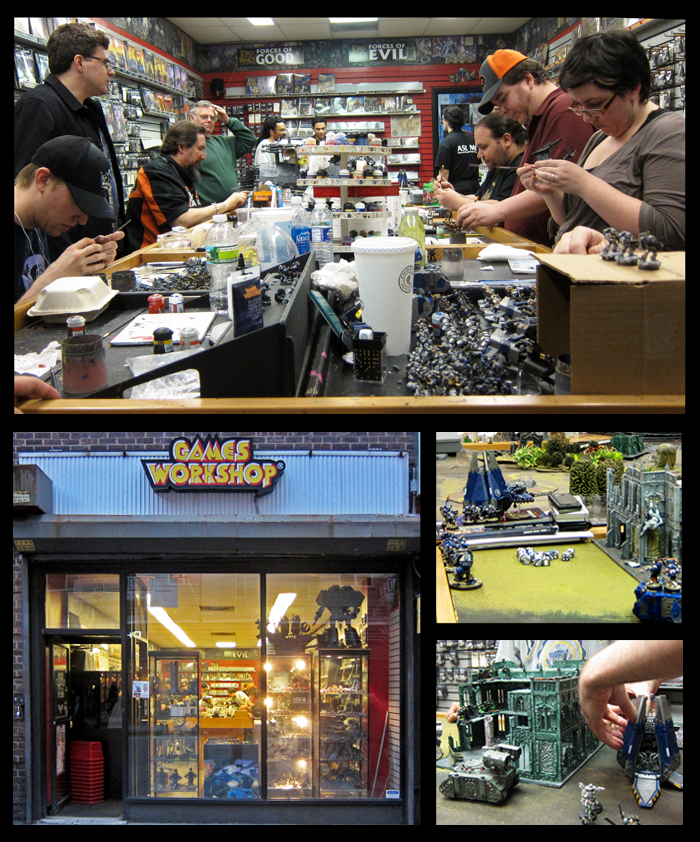
    This place was a real eye-opener for me. I have been by this rather nondescript retail shop for over a decade with nary a thought. Two things drew me to investigate. One is that it is a retail game shop surviving in 2011. There have been others in the Village, but all are now long gone. Two, there always appeared to be a large gathering of customers socializing and/or playing. Peering inside, it appeared that this was some sort of fantasy game environment, ala Dungeons and Dragons. And it is.

    One second in the Game Workshop and it is immediately clear you have entered a world with passionate participants. The cultish feeling was not new to me – in high school, I was a player of both chess and the strategic board games of Avalon Hill and Wff N Proof. The games attracted the nerd crowd, which according to my sister, I was clearly a member of. However, a close friend and fellow game player from those years recently pointed out to me that I had girlfriends (who were not nerds) – I am not sure if that disqualifies me from full membership in nerdom.

    The camaraderie of Games Workshop had the feel of the chess world – indulgence, extreme focus and lively banter – the conversation here was dominated by analysis and commentary on military capabilities of other countries and what-ifs. I was very surprised to learn about the history of this company. Founded in 1975 in the UK, there are now over 380 stores in 19 countries worldwide with thousands more that sell their products. The British based corporation is traded on the London Stock Exchange. Yearly revenues are in excess of $200 million.

    I found this statement from their website:

    A hobby is something people make time for. It is not a pass-time and therefore not usually analogous to watching TV or playing computer games. In our case, as with most hobbies, it involves commitment, collection, craft or manual skills and imagination. Someone who is involved in the Games Workshop Hobby collects large numbers of miniatures, paints them, modifies them, builds terrain and war games with them in our imaginary universe. This involves huge amounts of time.

    Games Workshop Hobbyists play war games with large numbers of metal or plastic miniatures they have carefully chosen and, usually, painstakingly painted, on a table top face to face with their friends. It is a social and convivial activity loved by Hobbyists the world over.

    The game involves a lot of activity rather than passivity – making and decorating figures, creating playing space and learning the daunting amount of information and rules. Much like fantasy role playing games like Dungeons and Dragons, the games become an alternate world.

    I asked the sales staff if they minded I take photos. The response was essentially No Problema and I was already feeling this was another place with a policy of No Negativity. I stayed for some time watching the game playing and work, chatting with the sales staff to get some insight into this world. Game Workshop provides free space for customers to paint their figures and also play their signature proprietary games – Warhammer, Warhammer 40,000 and the newer Lord of the Rings. The wall space displays merchandise for sale – all the various figure model sets and also the voluminous manuals and magazines like their own, White Dwarf. I was told that the shop at 54 East 8th Street is the only store in the Northeast and is one of the largest revenue grossing operations in the United States.

    There are worse ways to spend time than to be actively involved in a social activity and strategic game playing requiring a skill, memory, and imagination. I think the entire experience drew out the nerd deep inside because my first reaction to this place was: These “boys” (and girls) are too old to be playing with toys. They have too much time on their hands. There are much better things to do with one’s time. However, I found myself answering Really? Like What? 🙂


  • Irony Candy

    For an insightful view into the soul of New York City, turn to its comics. If their material really resonates with you, then you’re a New Yorker, if not by address, then in spirit. Some, like Woody Allen, are virtual spokespeople for all that is New York. Shows like Seinfeld capture the essence of city life, right down to the minutiae. One of my favorite New York City comics is Todd Barry. His has a brilliant, understated style, characterized with the necessary ingredients – smug indifference, cynicism, skepticism, sarcasm. Todd effectively illustrates the irony of the high priced accoutrement of defiance in a routine about Kmart coming to New York City:

    Some New Yorkers were pissed off when Kmart came to town. They were outside the store protesting. They didn’t even know what to say. They were like, ‘Down with Kmart and their merchandise that people can afford. Down with Kmart and their 300 gallon drum of laundry detergent for 99 cents. Why don’t you go take your good values to another town?’ Let’s turn that building into a vintage clothing store. The kind that sells used Kmart shirts for $700.

    I had a similar insight in the early 1970s when I saw Jefferson Airplane at the Fillmore East. They were singing one of their popular hits about revolution, Volunteers. Somehow it seemed hypocritical or perhaps to be a bit nicer about it, filled with apparent contradiction. This group had money – limos, mansions, etc. and their lifestyle did not seem to bespeak of those revolting against the world order and materialism. But when the spokesperson is generally perceived as cool, they can get away with a lot of contradiction. On April 8, 2008, I wrote a story called Unguent, about the effects of money: “Money is like an unguent and when applied liberally, it usually is absorbed readily with predictable effects. It doesn’t appear that one has to rub the salve that hard or long to take off most edges.”

    We see that irony replayed here at Search and Destroy at 25 St. Marks Place, with underground, subculture and vintage punk clothing and goods being sold for a king’s ransom. Whether a shopper sees irony or not with merchandise priced as luxury items and taglines like “chaotic and anarchy” or “dangerous clothing store”, explains the wildly disparate ratings at a site like Yelp.com that go from 1 to 5 stars. Many bristle at what they consider outrageous pricing and others appreciate the merchandise, some apparently difficult to find.

    I have zero knowledge regarding the products I saw there – it was primarily eye candy for me. Or perhaps we should say, Irony Candy 🙂


  • Let’s Share a Drum


    Have you ever been seasick? My first experience with this was a return ferry ride of two hours from Nantucket. We had rough seas at night and I quickly became very queasy. I had only one thought – get me off this boat. Being at the lower level with odors of fuel was not helpful so I decided to move to the rear and go outside. Here I found a man with his girlfriend – she was in a similar, but more advanced state.

    I was surprised to learn that he was a Norwegian sailor, so at least I had the benefit of well seasoned companionship. He invited me to join his girlfriend who now had her head over a 55 gallon drum serving as a garbage can. I had nothing against her, but the prospect of both of our heads in the same oil drum was not what I had in mind, because I was not really ready to vomit – I was holding on at all costs.

    Our sailor could sense this and gave me advice that made a lasting impression. He said that the key to this situation was DONT FIGHT IT. GO WITH THE BODY. He repeated this many times. No, I don’t want to go with the body. I don’t want to vomit – I hate that feeling. Forget it.
    He elaborated, repeated and also informed me that eventually, being sick at sea catches up with every sailor. This surprised me. He said given enough time and extreme weather conditions, every sailor has his day. This was my day and I was not enjoying it at all. I can still hear him with a Norwegian accent – go with the body.

    His admonition, however, seemed well suited outside the world of sailing, seasickness, nausea and vomiting. Go with the body was tantamount to the old adage, go with the flow. Many unpleasantries are worsened by resisting circumstances beyond one’s CONTROL. This is the secret to dealing with stress in New York City – rush hour crowds, horrendous traffic, long lines, etc. Visitors, often coming from the suburbs where the logistics of life are easier, are perplexed at how New Yorkers can tolerate the stress of the city. The key is not just to pick your battles but not to engage in battle at all. Don’t’ fight it – go with the flow.

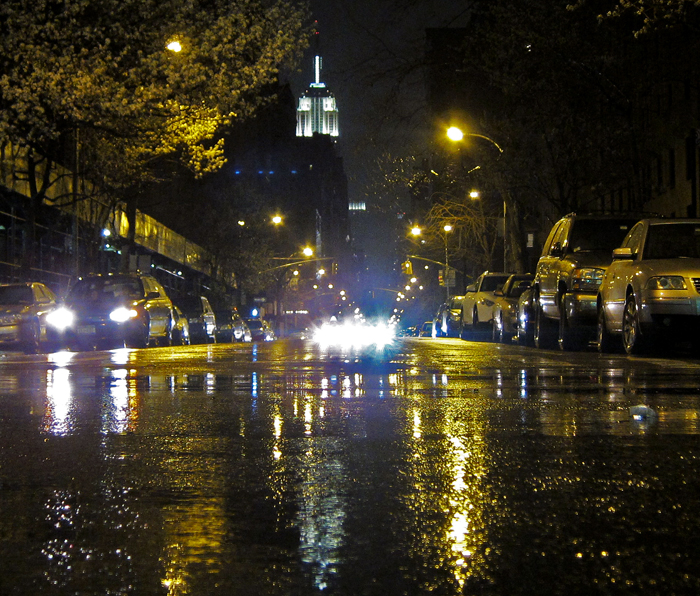
    I dislike rainy days like today. I find them so dreary and rather than embrace them, like the nauseous seafarer, I fight them, hoping and waiting for signs of clearing, wishing for the sun to peek through. But here, as elsewhere, rain can be comforting. It can be an opportunity to refocus and participate in things better suited to a rainy day. Stay indoors to work on some overdue projects. Relax and read, go online, watch a movie or TV. Perhaps dress appropriately, go out and enjoy the glistening city. When seasick, don’t fight it, go with the body. In New York City, don’t fight it, go with the flow. And if we find ourselves together, let’s share a drum 🙂

    Related Post: Landlubber


  • They Are a-Changin’


    I grew up in a quite conservative New England environment – a place and a time where homosexuality was completely invisible. However, once moving to New York City in 1969 and settling in Greenwich Village, I was immediately exposed to a relatively open world of gays. At first, it was shocking and a little unsettling. See my story No Red Faces here. However, in a short time, I was educated at Sidewalk University and came to see homosexuality as just a fact of life, a part of the human condition, across cultures, and going back as long as humans have been on planet earth. My education came from many sources, including association with gays and my employment of a number of gay individuals in my business. What is puzzling is the continuing hostility towards gays and the struggle for gay rights.

    Anyone exposed to members of the gay community knows that the breadth of personalities mirrors that in the straight community. Yes, there are gays who are quite outlandish in their dress and manner, however, just examining the stories in the website alone should be ample evidence that the flamboyant is not the exclusive domain of either the gay or straight community. The annual gay parade, like any parade, is self selective – many parade participants will be that small number who are more exhibitionistic by nature. I would hope the straight community is not judged by the drunken revelry found in the annual Santacon.

    However, even at this juncture in time in New York City, I still see a fair amount of polarization of the straight and gay communities with minimal involvement of one group within the other. Some are concerned, and rightly so, that being an advocate of one lifestyle implies hostility towards the other. The small group of marchers who met in Washington Square Park on Sunday, Straight without Hate, were a new twist on sexual orientation advocacy.

    In my own large extended family, we have, like most, learned over recent years of a number of gays. Only one cousin has been open with me about this. The last I spoke to him, he had moved to Manhattan. The rest still live in a shroud of secrecy and embarrassment with quiet gossip. Sad, as I am sure this is stressful and a heavy cross to bear for them, their families and friends.
    No reason to resist, because as always, the times they are a-changin’


  • Fifth Anniversary

    Posted on by Brian Dubé

    NAVIGATION NOTE: Each of the images below is linked to the original posting.

    New York Daily Photo started on March 17, 2006 – there have been 1487 postings to date.
    As in the previous four anniversaries (see links below), I have put together a collage of 48 photos from the last 12 months, featuring many favorite postings of mine and visitors to this site. I have assembled a wide a spectrum of photos in keeping with the spirit of this website – street life, festivals, architecture, special people, food, vistas, music, nature, local businesses, the unusual, the lesser known and the whimsical.
    I have increasingly woven more personal stories and unique experiences from my life both here and outside of New York into my writings, with this site becoming not only a guide to New York City but also a place to share the view from my window. Thanks to all of you for visiting and reading 🙂

    Anniversary Postings: First Anniversary, Second Anniversary, Third Anniversary, Fourth Anniversary

    Posted on by Brian Dubé

  • Dot My I

    Posted on by Brian Dubé

    Poor surfaces. So often maligned. One should always look below the surface. See what lies beneath the surface because there is more than what meets the eye. On the surface of it, beauty is only skin deep.

    Sometimes we love a surface – so smooth and shiny. It may be important to restore the surface, polish the surface or resurface.

    Most of the world we see is surface. We admire and appreciate it, yet if we learn that what lies beneath the surface is somehow less than we expected, we are disappointed and it diminishes the surface itself.

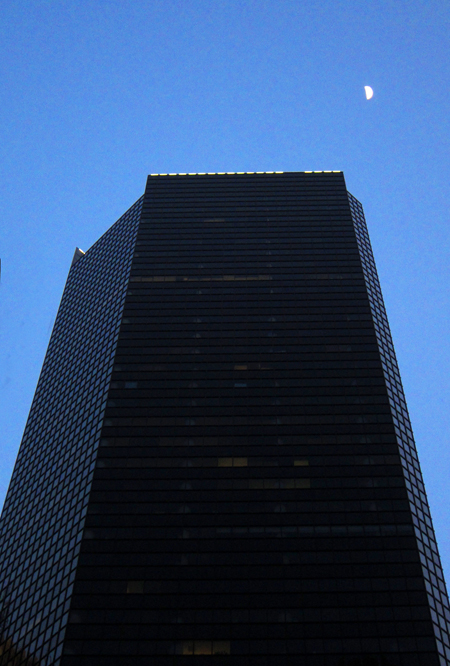
    New York City is a place of buildings, so we have lots and lots of large surfaces, looming over us daily. Here at 101 Park Avenue is a 49 story, 629 foot skyscraper. Eli Attia Architects designed the building, completed in 1982. It is the 64th tallest in New York.
    Park Avenue and 41st Street is prime real estate, only steps from Grand Central Terminal. The building has its own Wikipedia page and has been used in film and television – in the 1990 film Gremlins 2, in Seinfeld as the site of George Costanza’s office and as Dudley Moore’s office in the film Crazy People. It affords, as would be expected, spectacular views. You can see a gallery of photos of the building here.

    Uniquely shaped, strikingly positioned at 45 degrees to the street grid and glistening with reflective glass, 101 Park Avenue makes an impressive statement on the Manhattan skyline. The day I photographed it, there was an evening moon strategically located. Looking up at that surface, everything was so perfectly placed in a scene of urban penmanship, not forgetting while I crossed the streets to dot my I 🙂

    Posted on by Brian Dubé

  • Down to the Cellular Level

    Posted on by Brian Dubé

    A friend once so aptly said: everything is a competition, right down to the cellular level. All is poised, the net result of competing forces. In the world of physics, chemistry and biology it makes so much sense. In the world of human/animal relations however, it’s often a bitter pill to swallow, and I don’t really like the idea much better than anyone else. I always hate seeing that springbok losing to the lioness.

    I don’t like to see everything as a contest, however I don’t believe things can really be win-win either. Resources are limited, particularly money and time, so how can everyone win? Or win as much as they would like. I hate to say it, but life feels like a zero-sum game. Whether it is shopping, dating prospects, jobs, admission to a great college, sports, games, vacation choices, ranking in your class, what you will read, the blogs you visit, what you will do with your spare time, or who you will call, choosing something is not choosing something else. We are besieged with unending decisions and we must choose (or be chosen) from the competing options.

    I am a competitive person by nature and so my worldview is tainted by wearing those glasses. I do love working with a team, but honestly I work best when the team is on my side. I am a poor loser so I avoid direct competition as much as possible, particularly contests I know I will likely lose. I did not know growing up that I was a biggish fish in a small pond. Like many, I had a lot to learn about the size of fish and ponds.

    I came to New York City in 1969. At that time, this city was the best to me – the biggest, fastest, and most amazing place I could imagine. It had the most and best of everything – restaurants, buildings, people, opportunities, culture, money, street life, intellectual stimulation, merchants. As far as places go, it won the contest, and I wanted to be with the winner.

    Of course I have learned much over the years – the merits of other places and other cities, the relative meaning of best and that New York City is not the end all and be all. Even in the realm of cities, it is arguable whether New York is the greatest city in the world. Places like Paris eclipse New York in many ways.
    Some tire of the urban grind (see Dwanna, Duffy, and I Know). Most of my friends, many born in the city, have left and with no regrets. There are quality of life issues here – so many things that are undeniably easier and better in the country, suburbs, or smaller cities. For most, even if they have the means, New York will always be the stereotypical “it’s a nice place to visit, but I wouldn’t want to live there.”

    New York City is not for the faint of heart. The stakes are higher, the costs are greater, competition much fiercer, and the penalty for failure more severe. New York City is a magnet, attracting some of the world’s best competitors, from gladiators in the ring right down to the cellular level…

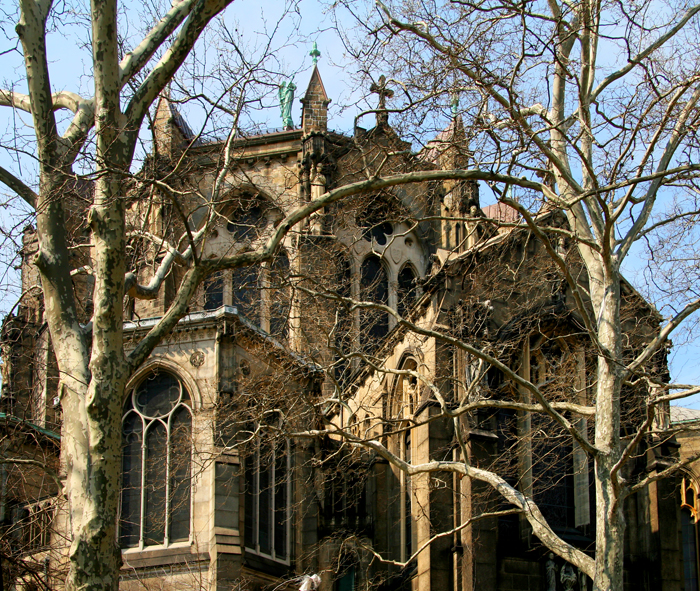
    Photo Note: New York City is not usually thought of as a city with a plethora of cathedrals and churches, as is Europe. However, surprisingly, New York City is home to the world’s largest church – the Cathedral of St. John the Divine. This photo was taken from the rear. You can see more photos of the interior and the story here.

    Posted on by Brian Dubé

  • On Parallel Tracks

    Posted on by Brian Dubé

    It is so peculiar and serendipitous that in researching Duke Riley, who created the art in the photo, I found that on September 15, 2010, I had already written about Riley and his exploration of U Thant Island. On further examination, I see that we have many other interests in common, particularly a strong passion for islands and exploring the edges and unknown areas of the New York City. Riley says of his work:

    My work addresses the prospect of residual but forgotten unclaimed frontiers on the edge and inside overdeveloped urban areas, and their unsuspected autonomy.

    Other shared passions include Bequia, a lesser known island in the West Indies neighboring St. Vincent. In the many years and visits I made to the Caribbean islands, Bequia was always on my to go list, but I never made it there. Riley once visited the island, where he became inspired to make boats. He also has an interest in Plum Beach and Dead Horse Bay.

    I discovered Riley’s work in the photo on a recent ride in the E train. The poster was quite long – hence the two photos. The work was commissioned by the MTA Arts For Transit in 2010. It is available as an art card from the MTA website – see here.

    A Brooklyn resident, Riley has a BFA in painting from the Rhode Island School of Design and a MFA in Sculpture from the Pratt Institute. His work is noted for its nautical themes. Riley has also built many seacraft. In 2007, with two companions, he built and launched a small wooden submarine, the Turtle, a replica of a Revolutionary War era craft. They were arrested by the New York City police when they came within 200 feet (without authorization) of the Queen Mary 2, docked at the Red Hook Brooklyn cruise ship terminal. Riley has circumnavigated the city’s waters in a homemade rowboat and built ships for staging a sea battle.

    Although I do not share his love of all things nautical, I still hope to run into him combing Dead Horse Bay or in the subway, somewhere On Parallel Tracks 🙂

    Related Post: Explorin’ Part 1

    Posted on by Brian Dubé

  • Le mieux est l’ennemi du bien

    Posted on by Brian Dubé

    There is nothing that seems more unproductive than time spent on precautionary measures. A token gesture here and there is perhaps tolerable, but time spent on any tedious, methodical practice feels like time better spent elsewhere. Prevention and insurance are contrary to human nature – and with good reason. Most will never really experience a catastrophic event, so why not take a chance and save time and/or money?


    Professionals dealing with disaster, repairs and medical emergencies know these things all too well – a mixed bag for them I am sure, since their livelihood depends on the misfortune (and hopefully repair) of others. Fortunately, they also understand that the moment of crisis is no time for lectures – everyone is well aware of what should have been done.

    On Saturday morning, April 2, 2011, my laptop had a complete hard drive failure. This was where I do all my work for this website and store files and images going back over 10 years, both personal and for New York Daily Photo.

    I do regular backups, but not regularly enough and I do them manually. Manual backups are very tricky propositions because these require that rare trait of unfailing routine and discipline. For computer backups, better to go with an automated solution, taking the human element out of the equation entirely. Apple makes an excellent, sophisticated product for backup called Time Machine (included with every Mac), which can be custom configured by the user for scheduled backups and direct them to wherever and whatever device the user desires. This software utility will save and restore an exact mirror of a computer’s contents right down to placement of icons on the desktop.

    I had started to set this up when I purchased my laptop in 2008, but because I was unable to configure wirelessly to my satisfaction, I left the project for “another time.” I had fallen victim to one of my customary habits, best summarized by one of my favorite adages: don’t let the perfect be the enemy of the good.*
    I already have had two good computer scares which I wrote about: Foolish Crash on 12/11/2007 and Not Good At All on 12/21/2009. The 2009 event should have been the ideal lesson – frightening but where there is little or no loss.

    Fortunately, I am in New York City, where there are a myriad of service centers and individuals specializing in Apple computers. But who to choose on a Saturday morning? Some online reviews, and I was off to Dr. Brendan’s computer repair. I had a nervous afternoon and finally received a phone call – the drive was restored. However, some of the files were corrupted – the technician had already worked after closing time and I was given my drive in a portable enclosure to take home with the task of examining and backing up files. In another near miraculous scenario, all the new files for which I had no backup were retrieved and for all the files corrupted, I had backups! With some hours of file comparison, I was able to rebuild the drive and external backups of every file and folder.

    I hope you do not succumb to instinct but instead, listen to reason. Do not wait for a better time or, like me, a better solution. because le mieux est l’ennemi du bien 🙂

    *This saying is attributed to Voltaire, from La Bégueule (1772):
    Dans ses écrits, un sage italien? dit que
    le mieux est l’ennemi du bien

    Literally, le mieux est l’ennemi du bien translates as the best is the enemy of the good, but more typically as the perfect is the enemy of the good.

    Posted on by Brian Dubé

  • no title entry linkThis entry has no title posted on April 1, 2011

    Posted on by Brian Dubé

    Posted on by Brian Dubé

  • Fort Schuyler


    There are not a lot of forts in New York City, and you certainly do not expect to run across a huge one, unbeknownst to yourself. It is unlikely you will ever run into this one by accident – Fort Schuyler and the Maritime College are not on the way to anywhere – they are destinations, located at the very tip of the Throgs Neck peninsula in the Bronx. On my recent excursion to the area, my intention was to explore Silver Beach. It is here by accident, that I discovered Fort Schuyler and the State University of New York Maritime College, founded in 1874 and the first of its kind in the United States.

    I met a couple of cadets, and like all the military men I have encountered, they were very approachable. They answered a number of my questions regarding the Maritime College and explained the reason for small sailboats – there was a regatta under way, with the boaters undaunted by the cold weather. They also informed me that the entire area was open to visitors with the entrance way nearby.

    I was surprised at how free and easy I was able to tour the area with no restriction and virtually no other visitors. Post-9/11, virtually everything in New York City has an added layer of security, including some of the most innocuous office buildings requiring photo ID. Places like the lobby of the Woolworth Building, one of my favorite spots to take visitors, is, sadly, completely off limits unless you have specific business in the building. As far as Fort Schuyler, however, I suppose a man in a small automobile armed only with cameras, poses little threat to a massive fort with military presence.

    The location of the fort and college is at the very tip of the peninsula, where Long Island Sound meets the East River, affording sweeping vistas including Long Island, the Bronx, Queens and a panorama of the Manhattan skyline (essentially the same as that of Silver Beach). The Throgs Neck Bridge is ever present, juxtaposed against nearly every structure as can be seen in many of my photos of the excursion – see the full gallery here.
    Fort Schuyler was one of many forts built along the east coast of the United States after the War of 1812, when it became apparent that the U.S. coast was poorly defended against foreign invasion. The French Style fortification was dedicated in 1875. The site also has a maritime museum, open to the public. Read more here.

    Everything was pristine and immaculate – the grounds, buildings, roadways and artifacts. It was quite chilly, but this is the best of weather conditions for seeing New York City outdoors – crisp air, clear blue skies and greater visibility. Although the warmer months are preferable for walking and touring, the heat of summer also usually means hazy skies with poor visibility and, if you are taking photographs, poorer results. If you’re looking for something truly off the beaten path, try the Throgs Neck peninsula with Silver Beach and Fort Schuyler 🙂


  • dinamic_sidebar 4 none

©2026 New York Daily Photo Entries (RSS) and Comments (RSS)  Raindrops Theme