• Wherever You Go, There You Are

    There are many distinct neighborhoods in the five boroughs of New York City each with its own flavor, architecture, and often a concentration of one or more ethnic groups. Many of these, however, can appear to be rather nondescript and uninteresting to a visitor just passing through. The numbered Streets, Avenues, and Places of Queens connote nothing, and row houses are virtually indistinguishable from one another.

    A little homework, i.e. reading, goes a long way. I always look to the New York Times, which has done a series entitled If You Are Thinking of Living In... on virtually every neighborhood in the city. This is a great launching point, along with some other online reading – Wikipedia typically has an entry for all the New York City neighborhoods.

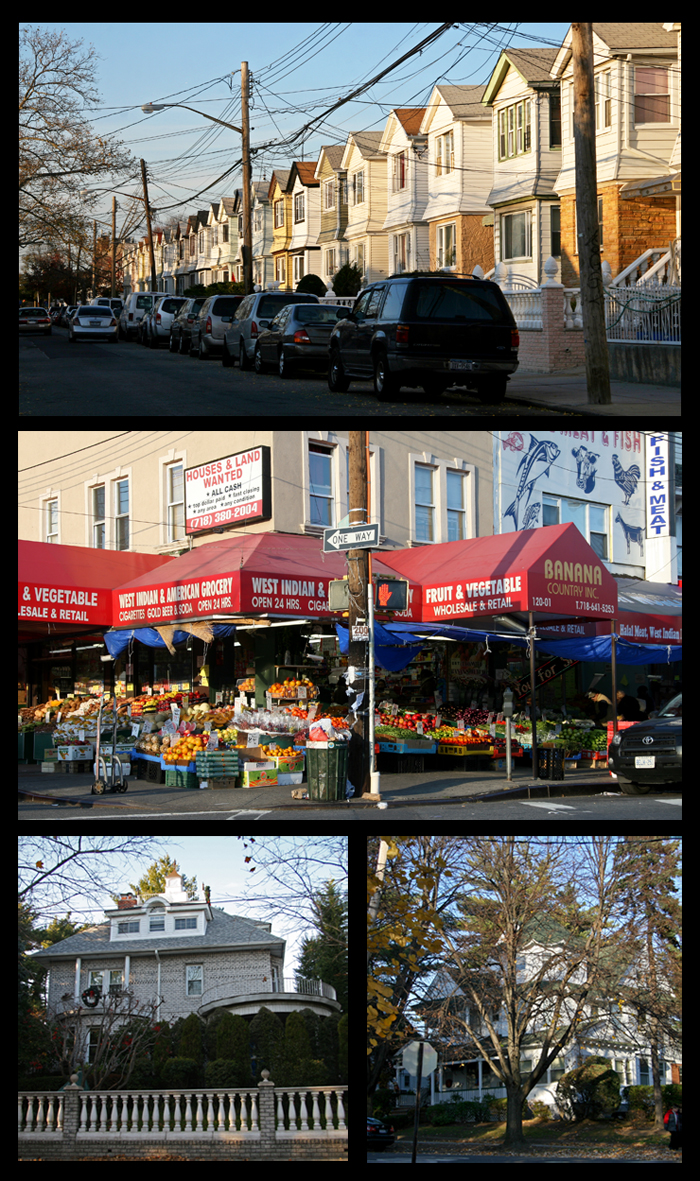
    The formation of Richmond Hill came about as a result of the 1869 purchase of the Lefferts and Welling farms by one Albon Platt Man, a prominent New York attorney. Cookie cutter row houses dominate Richmond Hill, but the neighborhood has a small number of Victorian homes located in a newly proposed historic district. The neighborhood is home to a large number of Indian immigrants from the West Indies and Guyana, evidenced by the merchants on the main shopping thoroughfares – Liberty, Jamaica, and Atlantic Avenues.

    Ideally, having a native or former native is a great way to get a real feel for a place, and on this journey to Richmond Hill, Queens, I had a friend who had grown up there. So, this expedition was both an exploration for me and simultaneously a walk down memory lane for my friend. There is always such a vicarious thrill taking someone by their old home. The featureless and anonymous comes alive with the recounting of memories of people and activities and gives the lifeless set a cast of characters.

    One of my destinations was to be Jahn’s, an ice cream parlor with several locations – their first establishment was in the Bronx, dating back to 1897. I had assumed that the Richmond Hill location was still in operation. Sadly, however, I discovered that it had closed in 2007.

    A number of notable individuals hail from Richmond Hill. Jack Kerouac lived from 1950-1955 at 94-21 134th Street in Richmond Hill, NY, and also in Ozone Park with his mother where he wrote On the Road. Kerouac included Queens subject matter not only in On the Road, but also in The Vanity of Duluoz.
    The Marx Brothers lived on 134th Street during the 1920s. Fred Gretsch, Jr. manufacturer of Gretsch Guitars, attended Richmond Hill High School, as did comic Rodney Dangerfield. New York columnist and Pulitzer Prize writer Jimmy Breslin attended St. Benedict Joseph Labre School in Richmond Hill. Anaïs Nin, known for her erotic writings, lived in Richmond Hill prior to moving to Paris in 1924. Jacob A. Riis was also a resident.

    Although the value of the cultural breweries of New York City’s well-known neighborhoods such as Greenwich Village or SoHo can not be discounted, a place like Richmond Hill and the notables who lived there demonstrates the diversity of places that not only are home to many, but also from which greatness incubates. Perhaps there is truth in the old cowboy adage – wherever you go, there you are 🙂

  • Walk Like Di Fara

    I first learned of Totonno’s while visiting the hobby shop Precision RC in Bath Beach, Brooklyn. A number of regulars were socializing and I told of a recent visit to Di Fara Pizza in Brooklyn. They were familiar with the place and queried me about the current pricing of slices. When I reported $5 each, the room was abuzz with incredulousness as one repeated my findings to another. I was advised to visit Totonno in Coney Island where, according to them, I would find better value and pizza. So the name was filed away for a future excursion.

    On Sunday, I made the journey out to 1524 Neptune Avenue on Coney Island. Timing, hunger, and circumstance found me there early evening between shifts, so my first experience was an unusually quiet one. They are often mobbed with lines. I was privileged to have nearly the entire place alone.

    Totonno’s began in 1905 when Anthony “Totonno” Pero distinguished himself as one of N.Y.’s first Master Pizziolas. In 1924, he opened his own pizzeria in Coney Island. The establishment is currently run by three individuals who operate it from Wednesday to Sunday. Michael, Maddie, and Totonno’s niece, Louise Ciminieri. Learn more here.

    The service was a bit cool, but I knew that this was likely just a little armor that comes from working for decades in a retail environment in New York City. I surmised a little lubrication would release the humanity.
    I began taking photos – it was clear from the walls of articles, awards, and photos, that Totonno’s was a mecca and photography was standard fare. See my entire photo gallery here. I began to tell the story of my visit to Di Fara, my subsequent visit to the hobby shop, and the recommendation I was given to seek out Totonno’s. I also told of the crowds and lines at Di Fara and how at $5 per slice, that little old man must have accumulated some serious money by now.

    Louise was unimpressed – she quickly retorted that Di Fara insists on doing everything himself, accounting for much of the slowness in service. Apparently a demonstration was needed, and Louise cajoled Michael: “Come on, walk like Di Fara,” Michael obliged, as seen in the photo.
    The elixir of humor was flowing now, and Michael and Maddie took a seat in a booth next to us. I asked Michael what he did outside of Totonno’s, to which he replied he did standup in Rockaway two nights per week. He laughed, and I realized I had been taken.

    A new customer walked in and ordered a small pie. Louise asked how many were left, to which Michael answered, “two.” I asked the meaning of this. Did they make dough DAILY and sold until they ran out? Louise said yes, and I asked, “Do others do this?”
    “No one does what we do.” She followed with a discussion of ingredients and the pains they go through to get them and maintain the same quality pizza made in 1924. They still use a coal oven pizza, with coal deliveries made every two weeks. Louise also told me how Totonno was now a destination and how travelers from around the world visit the Neptune Avenue pizzeria.

    I told them of this website and that I would be featuring the pizzeria. I left in a great mood, so fortunate to have had a New York City moment in an iconic restaurant. It all served as a good review in basic science, that a little warmth melts any ice and a little oil unhinges any armor. Out comes humanity, and if you’re lucky, a little free theater entitled “Walk like Di Fara.” 🙂


  • Paused and Poised


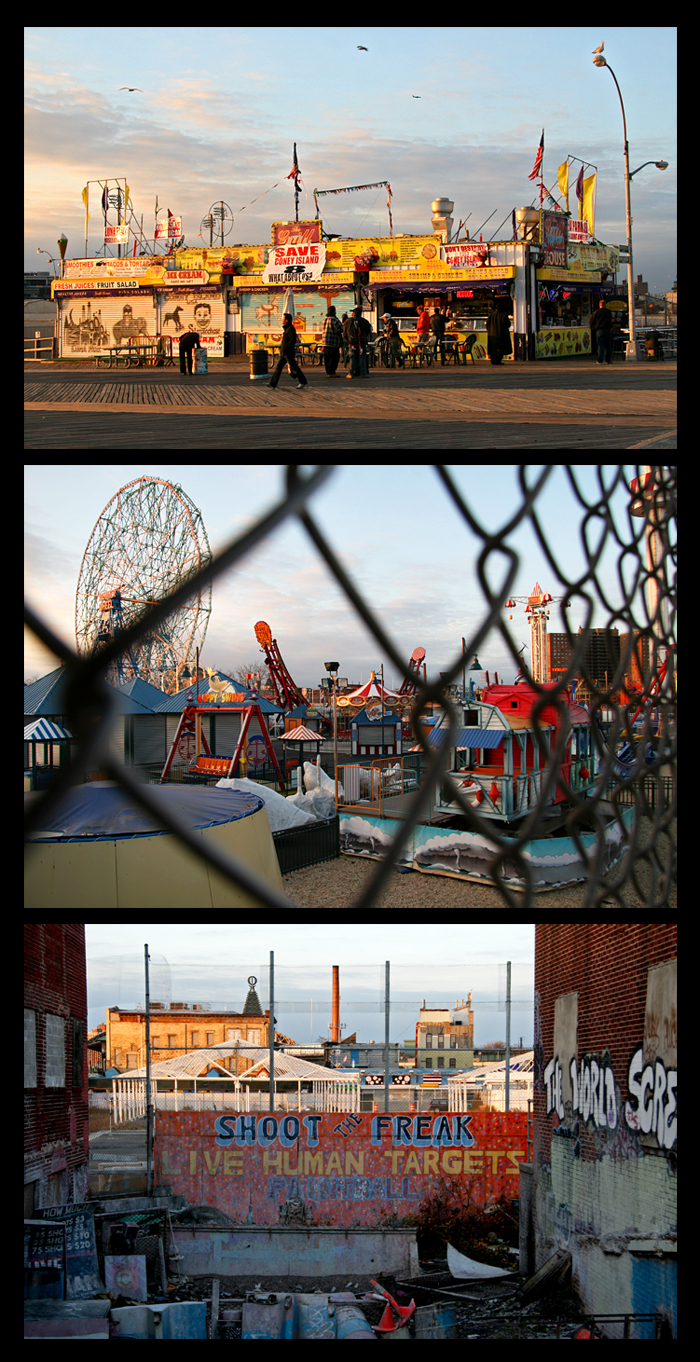
    I read articles, one after another, and yet I still have no idea what exactly is planned for Coney Island or what will actually come to fruition. Apparently, wide-scale development is coming. And, as might be expected, the sentiment is all over the spectrum – the detractors, the disgusted, and the hopeful.

    The passions are completely understandable. Coney Island is a very important piece of real estate, and it is amazing that beachfront property in New York City can sit fallow in such a disgraceful state for decades.
    You are also not just dealing with a piece of real estate here. Coney Island is, for many, a world of nostalgia, childhood memories, sights, sounds, smells, play, a world-renowned boardwalk, and for some, a neighborhood to call home. Many have memories of it as a world-class resort. And this is New York City, where multi-generational family is heralded and neighborhood pride runs deep.

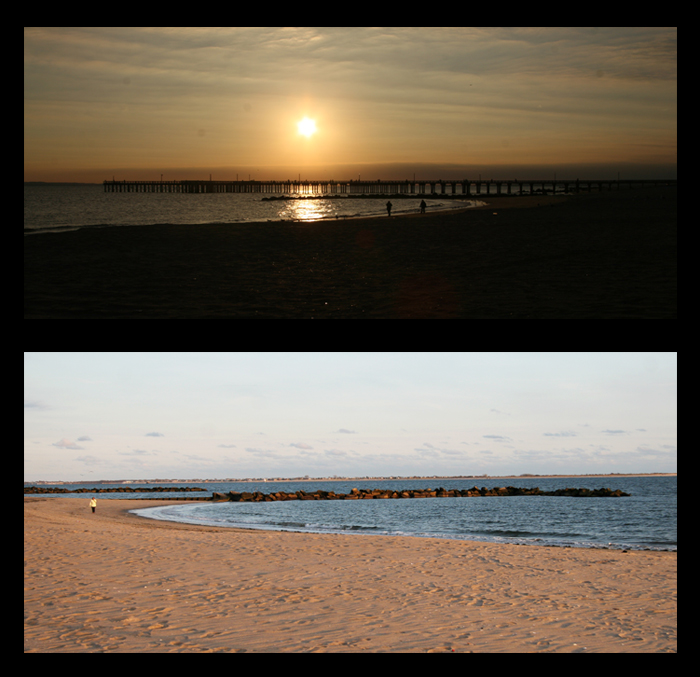
    I visited yesterday, a somewhat bleak but clear November afternoon. It was like a ghost town before sunset. A few photographers were setting up tripods for a sunset shot. Seagulls soared overhead. A few food concessions were open with a handful of patrons. The boardwalk was free of debris. The beach was empty as far as the eye could see, less one woman. The rides were eerily quiet – the various parks closed, the Cyclone and Wonder Wheel idle. Everything paused and poised…


  • "The Women"


    When I was a child at family gatherings, people grouped by sex and age, some occurring naturally and some of it planned. Often, when large numbers came together and it was mealtime, children would be relegated to the basement to sit together at a folding card table. We made the best of it to sit and eat in that dank, dreary, sunless, subterranean place. It was clear we did not have adult status and that kitchen or dining room tables were prime real estate.

    At other times there was a division of the sexes, a natural tendency. In our household, however, my mother would make an announcement, something like, “why don’t the men go in the other room and the women can stay here and talk.” The sexes were referred to in the third person, even the announcer and her entourage. It was always “the men” and “the women.”

    The problem is, I never really liked being with “the men” – it was typically synonymous with watching sports on TV. I sought out the women, who appeared to have more meaningful conversations on a variety of subjects and were very comfortable socially.

    I recently attended a hooping event at a bar in midtown Manhattan. Although there were a handful of men attending, this event was primarily dominated by women, to be expected in the hooping community. I was there as an equipment maker to meet, greet, show, and tell. However, it should come as no surprise that I soon found a room where “the women” were socializing.
    I was drawn to Bex Burton, fascinated with her mountain of hair.

    Bex is a woman whose life straddles many of the alternative worlds of occupation and recreation. Perhaps surprising to some, but New York City is no stranger to new agism, body work, healing, or even Burning Man devotees (she has attended 3 years). People adorned like Rebecca typically do not shun attention (she has over 1000 images on her Facebook page), so it is not surprising that she was very receptive to allowing me to photograph her, agree to this story, supply a detailed life history, and, of course, tell me about her hair:

    “I have yarn and synthetic hair extensions, installed by Dana Devine, The Goddess Maker. The yarn that comprises my hair is a combination of wool, mohair, roving (equivalent to the same lambs’ wool I once lined my point shoes with!) acrylic gold (which makes it sparkle), and a silk yarn that’s made from sari’s from India. The extensions were installed on Friday 8/13, the day before my birthday and massive boat party, and 2 weeks before my departure to Burning Man. Dana was at my house for 12 hours, though I believe we actually worked for about 8-9 hours. We took many breaks, as it’s pretty intense work for a long haul.”

    “Over time the yarn will “felt” together, forming dreadlocks. I encouraged the felting by braiding and wrapping each yarn cluster to keep them tidy and avoid cross-cluster felting. The conditions of Burning Man are extremely conducive to this type of hair, as the dust encourages the felting, the wool keeps your body warm at night, and the segmentation of hair at the scalp keeps you air conditioned during the daytime. I washed the yarn the first time after Burning Man in Reno with organic dish soap. Other detergents are more likely to leave residue. I suppose Woolite would work too, as the process is similar to washing your favorite wool sweater. The wool dried within hours thanks to Reno’s desert climate, and thank goodness because a head full of wet wool is h-e-a-v-y. Drying in NYC takes quite a bit longer, more like 24 hours. I employ the sham-wow technique cityside.”

    Bex was born in Newport, Rhode Island, and moved to New York City in 2005. I asked about her education:

    “I have a Bachelor of Science degree in Television / Radio production from Ithaca College. My focus of study was Video Production. I held four internships in college in two different cities. After which I determined I didn’t want to work in television, so I completed my studies producing video art (and earning the highest grades of my academic career). Following school I pursued Video, but quickly realized I wanted to create movement, rather than capture it.”

    Currently, she is a Pilates Instructor, Thai Massage practitioner, Hula Hoop Performer and teacher. She also told me some about her family life:

    “I come from a military family. My dad is a retired Naval Captain, and my brother is an active duty Lt. Commander helicopter pilot. When I was young there was discussion of me following the same path. (gasp!) At this point, I am fully committed to my artistic life and look, and my family is wonderfully supportive and happy for me.”

    Today, Bex is removing her yarn extensions, a process she says will take all day. After reading a few stories on this website, she says:

    “Also, similar to Jenn’s story, your timing is amazing. I’m scheduled to remove the extensions TOMORROW. I’ll quickly cut and color, and prep for FEATHER locks on Monday.”

    Good luck to Rebecca and thanks, for these are the things you can learn if you spend time with “the women.” 🙂


  • Kind Of

    I am pleased to learn that although my photographic talents are not in the league of Henri Cartier-Bresson and Ansel Adams, at least my thinking is. In 1952, Cartier-Bresson published his book Images à la sauvette. The English edition was titled The Decisive Moment, not The Machine Gun.

    It is easy to fall into a machine gun approach, a style favored by so many photographers today, particularly with digital photography, where shooting is essentially free. For many, there is a secure in thinking that if you take enough photos, you will assuredly get a good one.

    Remarkably, Bresson believed in composing his photographs completely in the camera’s viewfinder, not in the darkroom – nearly all his photographs are printed only at full-frame and completely free of any cropping or other darkroom manipulation. Ansel Adams was notorious for his patience and circumspection in waiting for the right moment to take a photograph.

    In addition, the entire process of shooting in a machine gun approach and reviewing hundreds of photos is mind numbing and works against the production of interesting photographs. When shooting events like parades, I am lured into this practice, seeing the event as an opportunity at cataloging and results that show it, with very few, if any, memorable photos.

    I recall having a conversation with a student at a major art school in New York City who was near completion of a degree in photography. When I asked about Ansel Adams, I was told they were not familiar with his work and had only “kind of” heard of him – they did not study him at school. I found it incredulous, really. This is not an issue of likes or dislikes. How can you give someone a degree in photography and not do at least a cursory examination of Ansel Adams?

    The black-and-white photographs of the American West by Ansel Adams are recognizable around the world. With Fred Archer, Adams developed the Zone System, still in use by some today and applicable to color and digital photography. He has been the subject of a Ric Burns PBS documentary. In 1932, Adams formed Group f/64 with Edward Weston. Adams played a key role in the establishment of the first museum department of photography, at the Museum of Modern Art in New York City. You can find the websites of Ansel Adams here and here. The website of Henri Cartier-Bresson is here.

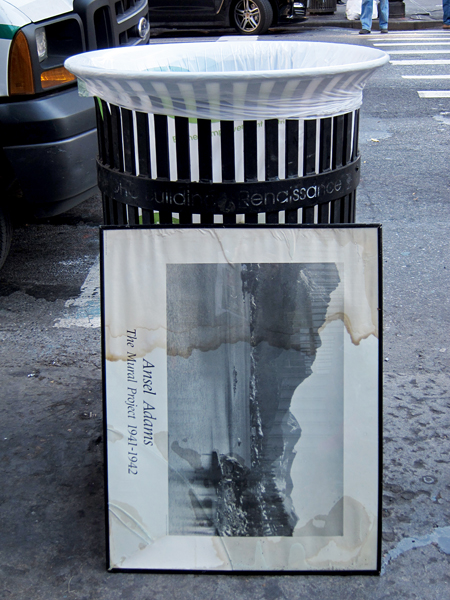
    The conversation with the photography student prompted me to notice the framed poster in today’s photo, placed prominently near a garbage can on Broadway in NoHo. Apparently the owner had heard of Ansel Adams, and disposing of this poster was due to the apparent water damage and not any “kind of” statement about Adams 🙂


  • Eternal Vigilance and Tenacity


    I know a man who has trained domestic cats that do an entire circus act, including jumping through hoops of fire*. Remarkable, really. I have had a number of cats in my lifetime, and as anyone can attest, they are extremely difficult to train or discipline. Much as it has been said that the price of freedom is eternal vigilance – it is also the price of having a disciplined feline. Cats are extraordinarily persistent, patient, and unrelenting in getting what they want and ultimately will wear an owner down the moment he or she relaxes.

    New York City is also quite unrelenting. Thieves never give up, new measures to secure property are foiled, drug dealers move back into areas cleaned up, and new variants on vandalism arise. Only massive diligence and constant attention have a permanent effect. Few areas of the city get that kind of attention. When things do improve, the tendency is to relax. And then that damn cat is back on the kitchen counter.

    There is a lot of whining and howling from bicyclers in New York City who want to see a more bike-friendly city. Understandable, since on the surface of it, bicycling would seem like a wonderful mode of transport, like it is elsewhere. Efficient, clean, lean, and green. I love bicycles and have always had one in the city, although I use it much less frequently now.

    However – and New York is the city of howevers – bicycling in New York has had a plethora of problems and roadblocks, daunting to all but the toughest and most tenacious. The dangers and deaths are realities (see the ghost bike of Derek Lake here). Two of my coworkers are regular bikers and commute from Brooklyn to Manhattan daily. One has pledged that she is essentially boycotting the city’s transit system due to cost. It requires the use of heavy locks, chains, and bravery to navigate the streets of New York.

    Bicycling has seen numerous setbacks and obstacles to progress. In other parts of the United States and Europe, we see many innovative and progressive ideas regarding bicycle use and storage. Hearing of things like The Yellow Bike Project of Portland Oregon or the BikeValet Automated parking system of Europe (there are plans to install this in NYC) just adds insult to injury for the New York cyclist who only aspires to getting from here to there safely and parking without their bike being stolen or vandalized.

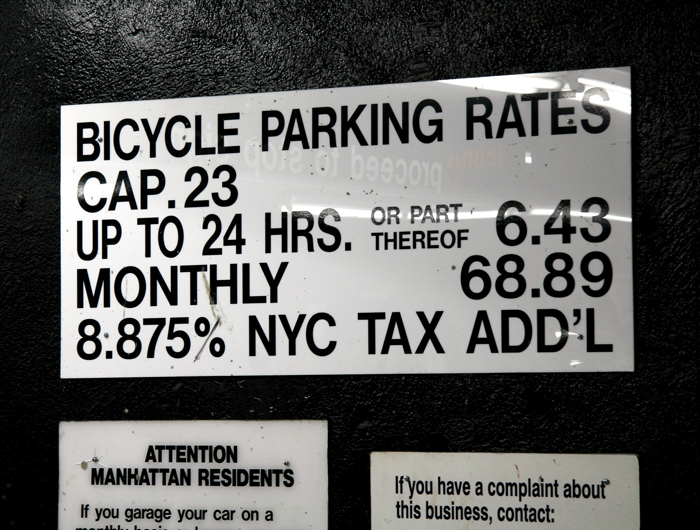
    But the bike community in New York City is militant and relentless. Recently, a number of steps forward have been taken. Bike lanes have been more seriously implemented, and new legislation has been passed: buildings with freight elevators are required to allow employees to bring their bikes upstairs and parking garages of certain sizes are now required to offer parking for bicycles (see the NY times article here). Many question, though, whether $68.89 per month is progressive or draconian. Rates as high as $160 per month have been reported.

    Ultimately, improvements and positive change in New York City are incremental and arduous as we move two steps forward and one step back. Whether cats, freedom, crime, or bicycles in New York, the price is always eternal vigilance and tenacity…

    *The act is known as Dominique and his Flying House Cats. Dominique LeFort performs regularly at Westin Pier for Sunset Celebration adjacent to Mallory Square in Key West, Florida. Valery Tsoraev with Clyde Beatty-Cole Bros Circus has an act with trained house cats. Yuri Kuklachev, a clown with the Bolshoi Circus, created the Moscow Cats Theatre featuring 120 domestic cats. Gregory Popovich started Comedy Pet Theatre with 14 cats, eight dogs, three rats, and two pigeons.

    Other Bicycling Posts: Derek Lake (ghost bike), Orange You Glad, Get Well Curve, Jungle Gym, Left For Dead, Urban Bike Polo, Wild Crash, Art Bikes, Penny Farthing


  • Abandon All Preconceived Notions Ye Who Enter Here

    The continuing story of Gaby Lampkey with new surprises and a live broadcast.

    I have written numerous stories about remarkable New Yorkers, many whose accomplishments are hidden beneath an unassuming or unlikely exterior. But all of these have been images captured at one moment in time. The timespan of this website has not typically been conducive to multipart stories showing an individual’s changing life. Until today.

    On July 7, I had a remarkable experience meeting Gaby Lampkey, an Alaskan Indian who had been on the road for 10 years without a home. However, our chance encounter also had a amazing twist – we had a previous connection 26 years prior which we were both unaware of. If you have not read my story, you can find it here.
    A regular reader from Kansas, familiar with the individuals featured here, paid a visit to New York City and, in another twist of fate, met me and also Gaby. See that story here.

    Since that first meeting on July 27, in a short 3 months, Gaby has found a home, met a woman, gotten a job, and is working towards his goal at becoming a professional musician. Gaby has a positive aura and has endeared himself to everyone who meets him, including virtually all the local musicians who play regularly in Washington Square Park. I envisioned a part 2 to Gaby’s story, but only a farewell as he continued his life on the road, certainly no reincarnation that would qualify Gaby for my “Abandon All Preconceived Notions Ye Who Enter Here.”

    He has proven to be quite ambitious, rising at 5 AM, resume writing, job hunting, etc. On Friday, November 12, he made a surprise visit to my office. I had not yet arrived at the office and was called at my home. I sped to the office to meet a man in a sport jacket who now had limited time – he was on his lunch hour. We joked at the irony of his waiting for a business owner not yet at work by a man who, 3 months prior, had all the time in the world. When I asked if my story had any influence on his life, he said yes, it was a mirror. “I read it and said, hey, that’s me.”

    I asked if he would return to play and sing for our staff. He readily agreed. This casual suggestion turned into an event, as I saw this as the perfect opportunity to record a live performance before an audience for a demo DVD that we had discussed making for Gaby to pursue music gigs.

    I have equipped the showroom with a webcam and will be broadcasting the performance live with an audience of fans and friends. Join us in this celebration of this man who is transforming his life before our very eyes.


  • Levis, Film and Corn


    Some years ago I was gifted the Encyclopedia of Bad Taste – A Celebration of American Pop Culture at Its Most Joyfully Outrageous. Many of the entries were hilarious, and the book provided many hours of entertainment. It’s very easy to find things to complain about regarding America in a land of excess and absurdity, with examples in virtually every facet of life – supersized meals, morbid obesity, SUVs, shopping malls, monster trucks, Elvisiana, fuzzy dice, lava lamps, aerosol cheese, etc.

    The subject of the shortcomings of the USA was also a frequent topic of conversation with a former coworker. On one occasion, rather discouraged, I quipped, “What does the USA have of quality anyway apart from Levis and Film?” To which he replied, “Corn.” That’s true. So I included corn as a 3rd element in the list of quality American products. The trinity became a favorite private joke, included in conversations as we saw fit.

    More and more, however, we find that many of the quality products we have in the USA are legacy products, whether they are Levi jeans, Corvettes, Broadway shows, and theme restaurants – such as diners. Many of these legacy products, however, are dusted off, remanufactured and repackaged in a shoddy way, riding on reputation, only to become another manifestation of the “triumph of image over substance” (see Zeckendorf here). Nostalgia is such a strong force and we are drawn to these things.
    Diners. I want to love them all. But reality is that many have poor food. And beyond this, the standards for healthy food have risen, and much diner food is really out of step with what many want to eat. This is one element that perhaps accounts for such a staggering range of reviews for places like the Jackson Hole Diner in Bayside, Queens.

    I recently made a visit, after only seeing the exterior on an excursion to Bayside (see All the Way here) in 2009. My companion and I were extremely excited – everything was so retro and perfectly agleam with chrome, steel, glass, neon, polished floors, and shiny vinyl seating. The root beer ice cream float was encouraging. The rest of the meal was basic. As I have written before, at least as far as my New York City experience goes, if going to a diner, best to pick your battles and order accordingly. See my stories Diner Beware of the Diner and Greasy Spoon.

    I hate to break up a trinity – they are so strong structurally, whether branches of government, tripods, or the Catholic Triune God. So for now, the trinity of America’s best stands – Levis, film, and corn 🙂


  • I’ve Got a Feeling


    I looked for symbols and icons of the city, and they were everywhere to be found in people, places, and things. My business logo was inspired by the Bloomingdales typeface. Woody Allen’s films seemed to say everything I felt about New York. The Washington Square Arch was a gateway to bohemian life. There was Grand Central Station, the Empire State Building, the Chrysler Building, Fifth Avenue, Macy’s, Central Park, and Times Square.

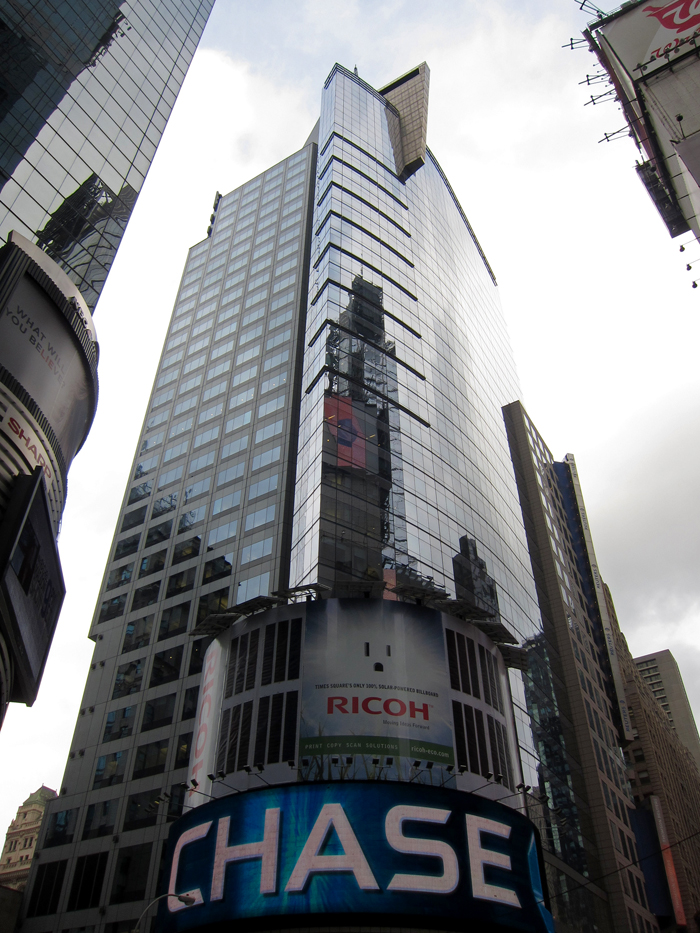
    I needed a bank account, and I was flying over the airport in San Juan, Puerto Rico. As we circled for our final approach, there was a giant Chase logo in the grass below. The geometric octagonal logo* seemed so bold and strong, like a bank should be. And, I thought, it must be a substantial enterprise to have a presence so far from New York City.

    My banking decision was made there on that final landing. On returning home, I opened my first small business account with Chase Manhattan. And my instincts and luck as an inexperienced man were good. Chase has weathered many economic storms and has fared quite well.
    But this is not a story about or a promotion for Chase.

    New York City is a place that you either get or you don’t. Or, perhaps better said, it gets you or it doesn’t. We can make lists of pros and cons. We can make charts and graphs, but like any affair of the heart, love is not about statistics or arguments for or against. New York should make you feel like the impassioned Paul McCartney in the Beatles concert of 1969, where he proclaimed I’ve Got A Feeling from the rooftop.

    When I moved to New York City in 1969, you certainly would be hard pressed to make much of a rational case for the Big Apple. Things were falling apart with the city teetering on bankruptcy. Crime was high, quality of life was low. Graffiti and garbage were everywhere. For myself and my college friends, all of this was just part of the fabric of the city. Shortcomings were only small hurdles to jump over or nuisances to slalom around, but nothing served as a deterrent to living here whatsoever.

    As a place to visit, New York City is certainly easier to sell now. But as a place to live, there are all the same inconveniences of any big city, with new hurdles and slalom poles. If you’re looking for sensible reasons to live here, look elsewhere. If you’re looking for a place to love and one that will love you back, welcome to our world. I hope to find you on a rooftop one day singing I’ve Got a Feeling 🙂

    *The Chase Logo was designed in 1960 by the firm of Chermayeff & Geismar Inc., whose portfolio of work shows an astonishing array of company logos.

    Photo Note: This is the Chase Building at Times Square.


  • Quantum Leap


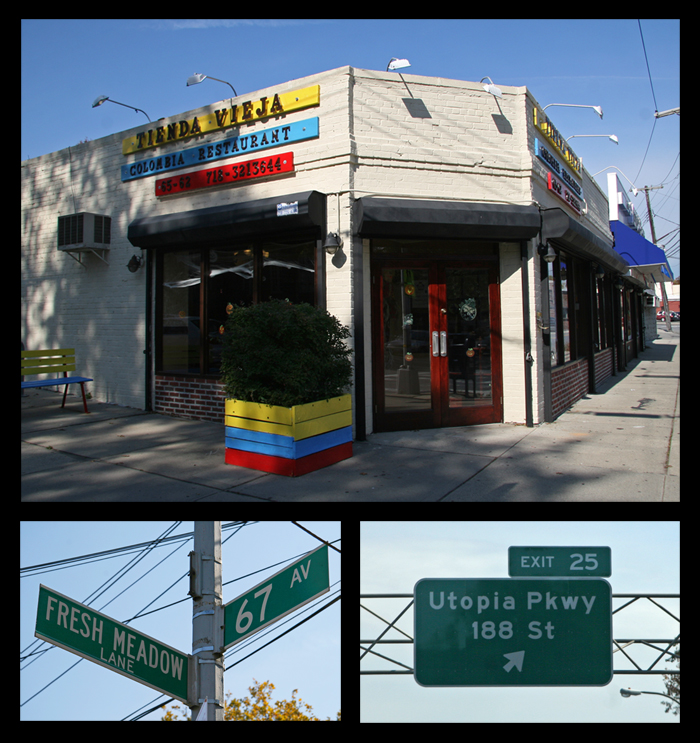
    Absolutely everything conspired to fulfill our fantasy of Shangri-la. The Long Island Expressway exit was Utopia Parkway. The neighborhood was Fresh Meadows. The address was Fresh Meadow Lane. The restaurant was called Quantum Leap.

    The menu had a small mission statement with an explanation of the reason for the restaurant’s name. It said that the secret of life was in the orbital quantum leaps of subatomic particles made in photosynthesis. That was just magical enough to add to the image and scientific enough to enable retelling.

    There was no subway service there, but we had access to a car. With a number of us packed inside a Honda Civic, we must not have looked too dissimilar to the cover of R. Crumb’s Carload O’Comics. Our visits to Quantum Leap were spirited pilgrimages with empty stomachs and tremendous anticipation for the food, which was to us at the time like nectar from the gods.

    We knew what we wanted before we arrived. Rituals are important, and we had ours. A salad called the Big Wood (which I still miss) was a meal in itself – one or more was shared. At the time, we eschewed cooked food as much as possible. If budgets allowed, raw carrot juice (a rarity at the time) was ordered by the more affluent. The kitchen was well regarded for its desserts, and an excursion to Quantum Leap was never complete without their Banana Creme Crumb. Our desire to limit our dairy intake was thrown aside for these events.

    The space included a natural foods store – browsing the wares was part of every trip, as was meeting and greeting the manager, someone who became a dear friend and the subject of my story All The Way. I bought one of their T-shirts at the time – it was too small then and still too small – another episode of my life’s backstory of things too small and tight.

    On a recent trip to Queens, I decided to revisit the restaurant. When arriving at the address 6564 Fresh Meadow Lane, however, Quantum Leap was nowhere to be found, with Tienda Vieja in its place. After a brief visual survey of the area, it appeared to be the same neighborhood I remembered. A brief visit inside Tienda Vieja confirmed that this was the former home of Quantum Leap – a current staff member told me that they had closed at this location in the beginning of the year.

    In the 1980s, the owner opened the first Manhattan location near my home – I was ecstatic. I still eat there on occasion, likely their oldest customer. When I tell the owner that he should bring back the Big Wood, he laughs. Silly boy, I bet you believe in Santa Claus, the Easter Bunny, the Tooth Fairy, and that the secret of life is in a Quantum Leap 🙂


  • White Birch Canoe

    I am disheartened to read “How the city hurts your brain” from the Boston Globe, January 2, 2009 (see it here). Many nature lovers both in and out of the city have, of course, long maintained that the city was injurious to mental health while nature was restorative. And city lovers have extolled the benefits of a stimulatory environment rich in culture and the deadening of suburban and rural life.

    However, there are now scientific studies which demonstrate that just being in an urban environment impairs our mental functions. The Boston Globe article cites these studies, including that of Marc Berman, a psychologist at the University of Michigan. “Just being in an urban environment, they have found, impairs our basic mental processes.” “This new research suggests that cities actually dull our thinking, sometimes dramatically so.” This is of increasing concern, since the number of people in cities now exceeds that in the country.

    And, although stimulation can be a good thing, there can always be too much of a good thing, and apparently New York City provides just that:

    “The mind is a limited machine,”says Marc Berman, a psychologist at the University of Michigan and lead author of a new study that measured the cognitive deficits caused by a short urban walk. “And we’re beginning to understand the different ways that a city can exceed those limitations.”
    Perhaps this was the reason that a friend and regular reader of this blog (Mary P) chose to feast her newly functioning eye1 on this lone white birch tree2 last night at dinner. As she described her fascination with the gentle motions of the branches in the wind, my mind traveled. The window was not just a clichéd metaphor, but it also provided a literal view of a tree which was for me, in turn, a vehicle to other times and places – my upbringing and frequent travel in New England and the birch forests there.

    I reflected on my love of white birch trees, their distinctive bark and the wood, influenced no doubt by my father’s occupation as a wood cutter in Maine with his love of fly fishing and birch bark canoes. We had discussed many times the beauty of the white bark. Its gracefulness with delicate branches and slender trunk were never spoken of, but I could see that now, contrasted with the concrete urbanity around it.

    I pledge to get out of the city more often – the Boston Globe article jogged what my subconscious mind must already know and desire. But until then, I’m going to take a ride in a birch bark canoe 🙂

    1) Mary P has has recently undergone laser eye surgery (one eye at a time) for her deteriorating eyesight. She is finding the new and vastly improved vision in one eye a new lease on life. Enjoy, Mary.

    2) The white birch is relatively rare in New York City. The 10 most common trees are: 1. London plane tree (15.3%) 2. Norway maple (14.1%), 3. Callery pear (10.9%), 4. Honey locust (8.9%), 5. Pin oak (7.5%), 6. Little leaf linden (4.7%), 7. Green ash (3.5%), 8. Red maple (3.5%), 9. Silver maple (3.2%), 10. Ginkgo (2.8%)


  • Who Your Friends Are


    Things are good when everything is going well, and there usually is no trouble when there are no problems. The test of a friendship or business is how they fare under adversity. Smooth sales are smooth sailing.

    I once read a recommendation from a business CEO who suggested that one of the best ways to assess the customer service of your own business is to call your company, fabricate a problem or complaint, and see how it is handled.

    The business environment is extremely competitive, and over the years, return policies have become more and more lenient. However, although a very liberal return policy is something that most quality businesses want to proudly offer, the true measure of this policy is how readily the company embraces it and in the customer experience of the return process itself.

    In the 1980s, I was located in lower Manhattan near J&R Music World. Prices were competitive, inventory good, and the sales staff very knowledgeable, so this is where I found myself making virtually all of my electronic purchases. Salesmen would extol the lenient return policy in making the sale. However, when we needed to make a visit to their return department, it was with great trepidation.

    The return department was located in the basement – the perfect metaphor for what was often a short hellish experience of being put through a fire of questioning as to why an item was being returned. There was always a “scary guy” serving as gatekeeper to getting the coveted store credit. Telling him that the salesman had said that any reason for return was adequate was apparently no longer really adequate on the day of return. Sometimes a small interrogation and/or debate ensued, with the customer having to justify his or her return. The customer typically prevailed, but the experience served as a warning to the whimsical returner.

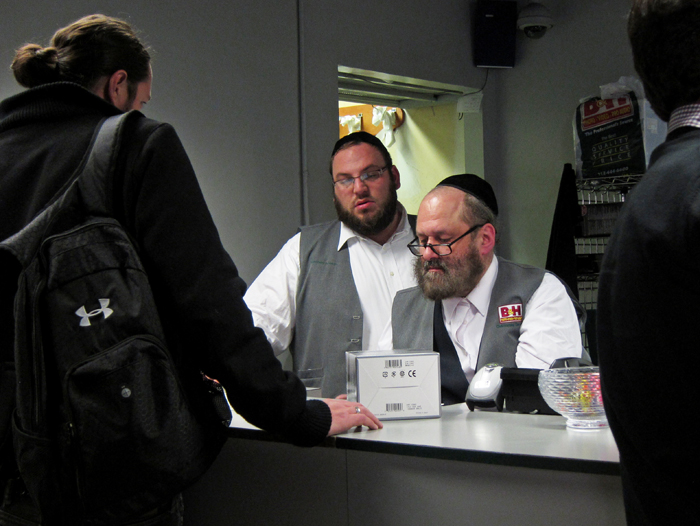
    Things have changed since then – we are in a different world. Most retailers have learned that if you make an offer, don’t punish the customer for accepting it. At B&H Photo (see You’re Not in Kansas) e.g., returns are done without a question (other than perhaps if the product was broken), even with products in the thousands of dollars.

    Retail giants are quite routinized in their handling of returns. The volume of returns prohibits customer interrogation, and the size of the companies allows for absorption of monetary loss. Companies such as Nordstrom’s and LL Bean are legendary, with no time limits on returns. In New York City, Macy’s is well-known for a very liberal return process.

    With the small independent shop, however, taking many returns can be a financial hardship. This is where the customer may find many terms and conditions, difficulties, and charlatans. In times of personal hardship or when returning goods in New York City, you will quickly find out who your friends are 🙂


  • Abandon All Preconceived Notions Ye Who Enter Here

    The Story of Jenn Kabacinski, Part 2 (see Part 1 here)

    Jenn has been stressing a little bit about her birthday. Today is Jenn’s 30th.

    From her first email last week:

    My birthday is actually next week. The big 3-0. I know turning 30 won’t change a damn thing about me but I can’t resist complaining about it anyway.

    From her second email to me:

    My birthday on the 8th. Pee Wee on Broadway on the 10th. [Pee Wee Herman was my high school sweetheart… only he never knew anything about it]. My anniversary on the 11th. I’m excited about everything except the turning 30 part.

    What can I tell Jenn to reassure her about aging? That 30 is really young and her whole life is before her? That she can still do virtually anything she wants? All true. But empty words when you hit those mile markers on life’s highway. I won’t lie to you Jenn or insult by giving you the “wisdom” of an older person. I don’t like aging either.

    Jenn speaks of her heritage:

    My last name is Kabacinski. It’s pronounced how it’s spelled. I didn’t take my husband’s name because I almost find that disrespectful to my dad. I’ll always be my dad’s daughter – married or not. I think the world of him. … I’m a European mutt. Dad’s Polish and German. Mom’s Irish, German, Swedish, Scottish, English, Welsh, and Danish too.

    Jenn is no poser. She is as authentic a New Yorker as they come:

    I was born and raised in Brooklyn – Gowanus… South Slope… whatever people are calling it now. … My parents were born and raised in Brooklyn. Their parents, if not born and raised in Brooklyn, at least lived here most of their lives. Same neighborhood too actually. So I have Gowanus Brooklyn blood running through these veins.

    Jenn is very close to her family:

    And I lived with my parents for most of my life. I lived with them until I got married. Even when I moved three blocks away from them, I was there all of the time so I might as well have been paying them rent then too. Ha.

    I did the whole move in with the current boyfriend [while dragging my sister along] stint in 2005 but that only lasted the year. I moved back home shortly after the MTA hired me.

    I’m super super close with my parents. My mom and I used to joke about us being our version of Grey Gardens if it was just us. And I’m definitely daddy’s little girl even though I’m the oldest.

    Her marriage to Anthony:

    This is my one and only marriage. I never really believed in monogamy or *love and marriage* in the traditional sense before Anthony. I didn’t think any of that was natural but getting to know him instantly screwed those beliefs all up. I was suggesting to him within that first month that we should get married and three months later, we were in Vegas exchanging vows and rings in front of Elvis.

    I ended up moving to Staten Island last year for a few months after Anthony and I got married. He was born in Brooklyn but lived in Staten Island most of his life. I’m a Brooklyn girl at heart but you’re supposed to sacrifice for the ones you love, right? Anyway, I couldn’t take that ferry anymore [I can’t drive] so I kidnapped him and we’ve been back in Brooklyn since June.

    Jenn talks of her love of school and work:

    I took the 6-year plan in college [I went to Brooklyn College] because I wasn’t sure what I wanted to study. I actually liked school. If I could be a professional student, I would. But I ended up majoring in both Philosophy and Early Childhood Education and minoring in Math. I wanted to teach Pre-K or Kindergarten but the MTA ended up calling me once I graduated. I did tutor and work for summer camps and after school centers but that was all part-time. I loved it but I love money and benefits more so now the MTA owns my soul. I’m a Train Conductor. Yes. I’m that person in the middle of the train opening and closing the doors and making those wonderful announcements.

    The MTA also introduced me to my husband [he’s a Conductor also and that’s how I met him] so it makes it all the better. And my sister is actually a Conductor too. We’re taking them over. They just don’t know it yet.

    Jenn talks of her appearance:

    As for my “goth” look… I don’t know what to say about it. I wouldn’t actually consider myself goth. I wouldn’t actually consider myself anything. How original… I know. It takes me maybe a half hour to put the face on. It used to be more dramatic and colorful years ago but I don’t have the patience for that anymore. I don’t really encounter any problems. Some looks. Some comments. Some bad. Some good. I like it so I’ll continue to do it as long as I do like it. I think it works for me. It doesn’t bother my family as far as I know. My parents are used to it and any other family should be too. My sister’s look is kinda sorta similar so I’m sure they all realize that’s just us by now. And now that I think about it, my mom had that crazy permed poofy 80s hair with the black eyeliner and red lipstick when I was growing up so I guess we can blame my offshoot on her. The look runs in the family. 😉

    And her final words to me:

    But yes, I think it’s time to get lost in your website for a bit before Anthony gets home from practice. I hope this is what you wanted and I hope it didn’t end up being too wordy. My fingers can get carried away. Thanks again and it was awesome meeting you Brian.

    …thanks for giving me the opportunity to ramble about myself. Broads usually love that. And I think you found yourself a new soon to be regular reader of your blog. I did lose myself in it for almost two hours last night. I love reading about your own personal experiences in NYC and abroad and I love how you highlight things that would normally just be overlooked by the typical NYer you find now [that happens not to be an actual NYer]. So thank you again.

    Thank you, Jenn, for being so candid and forthcoming and letting the world share the life of a real New Yorker. It was awesome meeting you too. Oh, and Happy Birthday and Happy Anniversary from all of us!


  • Abandon All Preconceived Notions Ye Who Enter Here

    The Story of Jenn, Part 1 (See Part 2 here)


    There is a very good reason this story must be told TODAY, before Monday, when I will reveal why.

    I was at a concert October 23rd in Tompkins Square Park featuring a number of bands, including David Peel. Scanning the sparse crowd, the photo subject du jour was immediately obvious – a Goth Girl accompanied by a Man in Black.

    Just take a photo – you don’t need permission. This is a public park, many are taking photos, and certainly a woman that looks like this must be somewhat of an attention hound.

    Yes, but to take a photo or two at close range is a bit awkward. This is not a crowd shot – it will be very obvious you are taking her photo. And if you get her cooperation, not only will you be comfortable taking more photos, you will also feel better as a human and will likely have an opportunity to chat about her appearance.

    So I decided to approach the couple and ask if they minded if I take photos. The response was an immediate “Us? Sure!” A few photos later, and we were on to the interview portion of the afternoon. I had already made a number of assessments – she was a rebel, not particularly well-employed or educated, and perhaps a resident of the East Village.

    The Man in Black, Anthony, told me that in fact they were married. Surprise number one. I asked him if his wife, Jenn, looks like this just for special occasions. He told me that she looks like this “pretty much all the time.” To which I thought, where does this person work, if at all? At an East Village boutique? I was not interested in tempering my inquiry, so I just asked Jenn, “Do you work?” “Yes” “Where do you work?” (wanting to add “looking like that”) “I AM A SUBWAY CONDUCTOR”

    WOW. Of course – what better place for a Morticia lookalike to work than the subterranean depths of New York City. “Do they care that you look like this?” “Not at all.” Perfect. And her husband, Anthony? ALSO A SUBWAY CONDUCTOR. The MTA is where they met. A friend in tow was a conductor too. Jenn’s sister is a subway conductor. They’re taking over.

    I still had many unanswered questions about her childhood, family life, where she grew up, her education, etc. Jenn agreed to continue the dialog by email. I emailed Jenn with a number of questions on October 28.

    I was very disappointed however. My email to her was not answered (nor bounced back). Six days later, on November 3, and after giving up, I finally received a response explaining that my email had found its way into a spam folder, similarly to my experience with Driss Aqil.

    Jenn provided not just answers but an 840-word biography. A simple follow-up question returned a 540-word clarification. I now had enough material for a documentary. Everyone has a life story. But this is Jenn’s, and like many New Yorkers, it’s has many surprises and some edge. With a Special Event on Monday… (see Part 2 here)


  • Horse Trading


    The Internet has provided new opportunities, including the ability for individuals to hide easily behind a cloak of anonymity in cyberspace. In the case of online businesses, it has also enabled many to create barriers between customers and live agents, one of the frustrations of the modern consumer.

    I have owned a business for 35 years in New York City. I am old-school when it comes to customer service and believe a business that takes your money has an obligation to provide easy phone access and transparency. Many companies do pride themselves on this and advertise as such on their websites. Others, even though reputable such as Amazon, offer no phone number on their websites. There are sites that do nothing but provide customer service telephone numbers for large companies.

    Unfortunately, even when businesses have a physical presence, a visit in person to the offending store is no guarantee of satisfaction. When it comes to unscrupulous merchants, New York City has had a long history as a place with a fair number of weasels who drastically overcharge, lie, and cheat in a variety of ways. Electronic shops in Times Square are notorious. But overcharging alone is not a crime, so let the buyer beware, even in the world of bricks and mortar.

    I was recently in the market for a no-contract cell phone. The phone options for this are often limited. An unlocked phone can be configured by the phone carrier, and just a short stroll away from Verizon and AT&T on Broadway in NoHo is the CeX (Complete Entertainment Exchange), a dealer who buys and sells unlocked cell phones (along with video games, DVDs,CDs, computers, and other digital electronic products).* My single previous experience was when I had accompanied someone who purchased a unlocked iPhone.

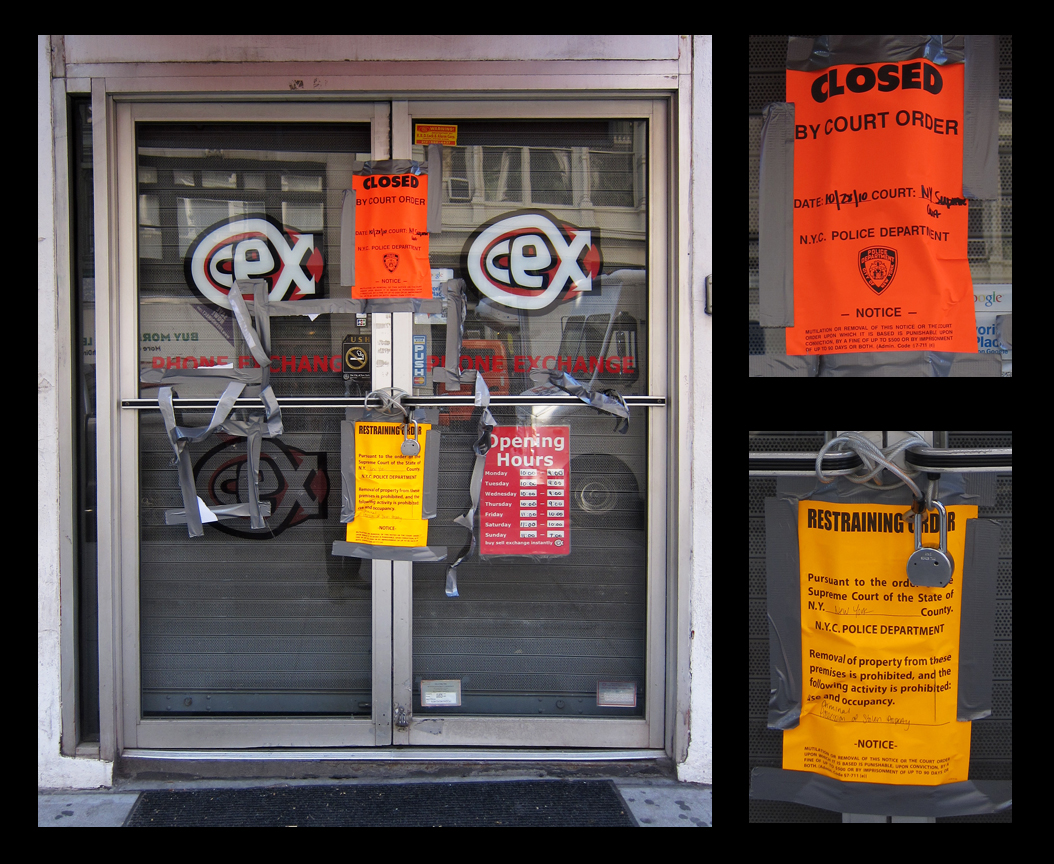
    So, before my visit to Verizon, I decided to quickly drop into CeX and peruse the wares. I was greeted with locked doors, gates down and a number of ominous looking documents duct-taped to the shop doors and windows: CLOSED BY COURT ORDER and RESTRAINING ORDER, which warned that “Removal of property from these premises is prohibited, and the following activity is prohibited: use and occupancy.” Below that was the reason: “Criminal possession of Stolen Property.” In looking at online reviews, some alleged that CeX knowingly traded in stolen laptops. Apparently the NYPD was also aware. Whether in cyberspace, Times Square, or any place with the character of the Wild West, beware of horse traders 🙂

    *I was surprised to learn that CeX is not a mom and pop operation but one of over 100 stores in the US, Canada, and the UK, where the corporation was founded in 1992.


  • dinamic_sidebar 4 none

©2026 New York Daily Photo Entries (RSS) and Comments (RSS)  Raindrops Theme