• Look at Them Go


    Please click and play audio link to accompany your reading.

    One of the most startling differences between New York City and most other places is the life at night. It is late at night, you are alone, and perhaps you are in need of some human companionship. Step out into the streets of New York City and see signs of activity everywhere.

    My family loves the city and has visited on a regular basis. At one time, they would camp out in my living room. My mother was fascinated with all the activity. She would stand, stare out my window, and exclaim, “Look at them go. They don’t stop going. They go all night.” As if it was one person or one group with insomnia who patrol the city 24/7, perhaps to die of exhaustion. The city never sleeps, however, individuals do – but why tell her that when she was having so much fun?

    Visiting my family in Bristol, CT, and driving the streets on a Sunday or especially on a Saturday evening before returning home, I was astounded as to how dead this suburban town of over 60,000 could be – it was a virtual ghost town with nary a person in sight.

    Two hours later and back home, particularly in the summer, I would find Manhattan mobbed. In the Village, I would encounter bumper-to-bumper traffic jams. Reflecting back on the town I had just left, it was impossible to fathom – after every trip, I would question my memory of the town I had left.

    Of course, I realize that it is unfair to compare the two places, but nonetheless, it was the extreme contrast that to this day still astounds me. Driving through that suburban town where almost no one walks the streets and there are no cafes and no signs of life at all at night, minus perhaps a gas station or all night convenience store. That is why the discovery of the Tangerine Dream coffee house in high school was nothing short of a miracle.

    I was once discussing all these matters with a friend, now living in the city, who for a time lived in a neighboring town in CT. He can be rather caustic and blunt with his opinions – in this case, his response was that the “suburbs are death.” Dislike of the suburbs is one of the most commonly shared feelings you will find in this city.

    If you are a visitor, you may never be privy to this sentiment. A polite person will show due respect, and a reasonable person is aware that there are different strokes for different folks and that the city is not to everyone’s liking. And, admittedly, there are tremendous conveniences of living in the suburbs. See my story of Dwanna here.

    My parents no longer live in Bristol, but from time to time, I still like to pass through for nostalgic reasons. On a bleak winter night, I am intrigued by the deadly quiet. Soon I will be home, where, if I want to see human activity, I will only need to step out onto to the streets or even just peer out my window, and any time, day or night, I can Look at Them Go

    Photo Note: The photos were taken at 10 PM at Union Square – a major subway hub, a nexus of streets, and a major shopping district. The area is active day and night. The lower photo is of the mezzanine cafe at Whole Foods Market.


  • Tired of Crumbs

    I have a long-time friend who, like I, has been self-employed for his entire adult life. He was a carpenter and, like any freelancer and unlike a small business owner, constantly needed to hunt for future jobs. From time to time, I would inquire about his existing work prospects. If he was between big jobs and only had small jobs here and there, he would just comment that all he had were “crumbs, just crumbs.” Crumbs became our private metaphor for those things which are relatively inconsequential to life. Akin to panning for gold in a world of miners.

    There has been lots of talk lately about gold as an investment and store of value in a time of economic uncertainty. Many have come to America and New York City to stake their claim.
    The very nature of New York City is a place of transients. People come and go for a variety of reasons. Many find that it is not to their liking or fulfilling the dreams they had. The streets are not paved with gold but rather with gold ore, and now require lots of mining.

    Perhaps the prospect of finding gold is one reason I came to New York City, but like any gold strike, e.g. the Internet, the easy money has been made, and little gold will be found lying in plain view. Panning for gold has given way to higher technology. Mining in the modern world and extracting precious metals from ore is going to be competitive and will require special equipment, training, expertise, and investment in tools. Otherwise, if you’re lucky, you are going to get crumbs.

    Of course, in any boom town, the crumbs will be much better than crumbs elsewhere. Street performers, as others, can make much more here than anywhere else. The lure is a mirage and a bit of a catch-22. The potential earnings from vending in a boom town are offset by the cost of living there. Perhaps you can sell eggs for a dollar a piece, but come time to eat, you’re in the same predicament as everyone else. There is opportunity to pick up a few dollars for the wanderer passing through, but how is he or she to live here for any extended time? There are very few margins left to live in.

    At first, the prospect of easy and immediate cash is very appealing, as is a life without a 9-to-5 job routine or other obligations. However, the free spirits that pass through New York City find out very quickly how inhospitable the city is to the less-than-well-heeled. And soon they will see those dollars in their hat or suitcase, just like my friend and me. They, too, will be tired of crumbs…


  • Swaggertist in Blue

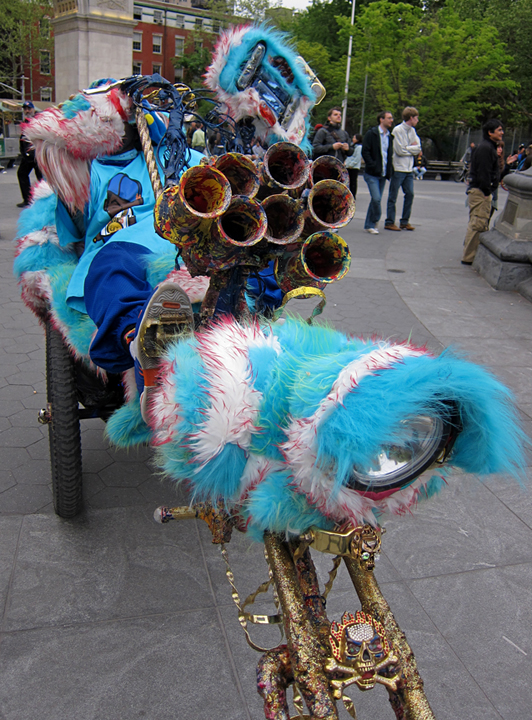
    Where would you find a man who is a roller skater, saxophonist, writer, composer, recording artist, and inline skate trainer, who had a hit single on Billboard for 13 weeks (“Funky Bebop”), has a Masters degree in group therapy (with work done towards a Ph.D), and travels on an outrageous fur-covered trike? In New York City. See additional photo here.

    And, of course, a man with this many incarnations would be expected to have had as many names – Bladie aka Bladie Flowness, Vin Zee, Vinzerelli, Vincent Brown. Now reinvented on his trike as the Swaggertist. I cannot attest to all his claims, but it would be fair to say that the man is a one-man self promotional campaign on wheels.

    Bladie was involved in musifying the roller skating scene in Central Park, what he calls the ultimate dance party on wheels. The New York Times wrote: “There are the old-timers, like Bladie Flowness, who has dreadlocks and a dyed beard and sails against traffic doing tai chi in multicolored Bedouin pants.”

    After meeting Bladie and introducing myself, Bladie gave me one of his music CDs and a DVD compilation of various clips of him. This bike is not his first, and he has been known for colorful dress since his early days on the skating scene.

    However, it takes more that just chutzpah, bright colors, and a turquoise fur-covered trike to become successful or get attention in New York City. Although Bladie certainly gets attention when he cruises the city, park regulars barely give him a glance. After all, he has to compete with Piercing Al Fresco, Hector, André (Out There), Spike, Narcissism Gone Wild, Water Sprites, Wood Nymph, the Misfits, the Dance Parade, Flamboyant, the Krishna Fest, the Dyke March, Singing Bowls, Eight Twenty Five, Twelve Tribes, Penny Farthings, Superheroes, Snake Charmer, Circus Amok, and Fashion Forward.

    And Bladie has plenty of musical talent to deal with. For now, Gershwin has not to worry about the Swaggertist in Blue 🙂


  • Rhapsody in Blue

    Have you ever tried to hide an obsession? Perhaps a strong color preference where, when asked for a color suggestion, you feign to weigh and carefully consider options, but as long as it can even be vaguely justified, your choice is always that special favorite color?
    Of course, these maneuvers will become transparent to close friends and family, as I wrote in White by Design.

    Years ago, I had a friend who was a distributor for my products and accompanied me to trade fairs. When discussing colors for products, I would inevitably suggest turquoise blue, often just using color examples to avoid my obvious preference for blue. To no avail – he saw through me like blue-colored glass. Finally, in frustration, he suggested, “Why don’t you buy a house and paint the whole thing turquoise blue?”

    I am happy to learn that not only was George Gershwin a Brooklyn-born native New Yorker, but also the title of his composition, originally American Rhapsody, was changed to Rhapsody in Blue. This highly effusive piece of music was used by Woody Allen in the opening sequence to his film Manhattan (see my story Connections here).

    For those fellow lovers of turquoise blue, I am pleased to know that Pantone, the global authority on color and provider of professional color standards for the design industries, announced:

    PANTONE® 15-5519 Turquoise, an inviting, luminous hue, as the color of the year for 2010. Combining the serene qualities of blue and the invigorating aspects of green, Turquoise evokes thoughts of soothing, tropical waters and a languorous, effective escape from the everyday troubles of the world, while at the same time restoring our sense of well being.

    In 1999, Pantone announced Cerulean Blue as the Color of the Millennium. And, interestingly, Pantone, Inc. founder Lawrence Herbert is also from New York.

    I am far from alone in my love of blue – according to Pantone, blue is the favorite color of 35% of the American public. The official colors for New York City are orange and blue – coincidentally, the color of the Empire State Building the night the photo was taken was orange.

    Regardless of shade, and whether an official New York City color, musical composition, NYPD uniform, or Pantone Color of the Year or the Millennium, even the sky reflects that for many of us, New York is a Rhapsody in Blue 🙂

    Related Colorful Postings: That’s Quite a Briefcase, Who See the Red?, Coleur du Jour, Tale of Two Colors, A Colorful Life, Color Brigade, Eye Candy, White By Design 2


  • The Yellow Kind, I Guess

    Many of my generation became very interested in the back-to-the-land movement, natural living, and healthy food. However, I learned a painful lesson that rural does not necessarily mean healthy, often quite the contrary.

    Regular readers know that my family comes from northern Maine – Aroostook County, which abuts the Canadian border. This area is quite poor, and the cuisine reflects it. There are a few good home-cooked specialties that can be had, but it is not the place for restaurant dining.

    On one trip there as an adult, having not visited in decades, I was quite enthused about exploring my roots and this remote, isolated area. One evening, my companion and I decided to eat out. My mother had warned me that no good places existed and that it was a waste of time.
    “Not to worry,” I said, “because I am a resourceful New Yorker, and I am quite capable of eating simply.” Certainly I would ferret out that small casual eatery with tasty local dishes.
    Or so I thought.

    Finding any place at all was a challenge, and we finally settled on one of the only candidates – a restaurant in an inn for hunters. The whole place did not look very promising. My companion ordered a cheeseburger and politely asked what kind of cheese they had. The waitress answered, “The yellow kind, I guess.”

    This was not sarcasm. We knew we were in trouble. I also felt it was inexcusable for a waiter to not know what type of cheese was available, even if only American. Even in the smallest towns in this region, stores did carry more than one type of cheese and they were labeled. Our food arrived, and it was truly dreadful. The cheeseburger was inedible.

    As to be expected, we were quizzed about our dining experience as soon as we returned to my family, and after giving an honest report, my mother launched a barrage of I-told-you-sos. She won that round handily.

    High quality food is never really a simple affair, and watching the numerous videos of the farms which supply Blue Hill Restaurant is an education as to the levels that farming and animal husbandry can reach. Artisanal techniques and the best possible conditions for livestock and produce are all used. Blue Hill Restaurant, at 75 Washington Place in Greenwich Village, is renowned for its use of farm-fresh, local, seasonal, organic, and sustainable ingredients in its cuisine.

    The restaurant was opened in 2000 and is owned by brothers Dan and David Barber and David’s wife Laureen. The accolades for Blue Hill are many. The Zagat survey gives the food a 27 (out of a possible 28) rating. Serious Eats ran an article: “Blue Hill at Stone Barns: The Most Important Restaurant in America.” In May 2009, it was visited by President Obama and his wife. See more at the Blue Hill website here and a menu here.

    I imagine, when inquiring about the type of cheese used in one of Blue Hill’s offerings, that they could do a little better than “the yellow kind, I guess” 🙂

    Note: Blue Hill also has a location at Stone Barns Center for Food and Agriculture in Pocantico Hills, New York. It operates as farm, kitchen, classroom – an exhibit, a laboratory, and campus. The farm is one of several suppliers to the restaurant. See more at their website here.


  • Squadron A Armory

    I try not to overuse the word juxtaposition, because if I was not vigilant in its use, I could easily justify using it ad nauseum in regards to the diversity of structures in New York City.

    One of the supreme examples of juxtaposition is the palace of Versailles and the town of Versailles in France. In the area neighboring the palace, one finds a town that is pleasant but nothing to prepare one for the grandeur of the palace.
    For the residents of Versailles, however, I imagine the palace becomes just another fixture, something one becomes inured to over time. At least that is the experience I have often in New York City. I certainly appreciate our iconic structures, but often it takes spectacular or unusual conditions to bring these things to one’s attention.

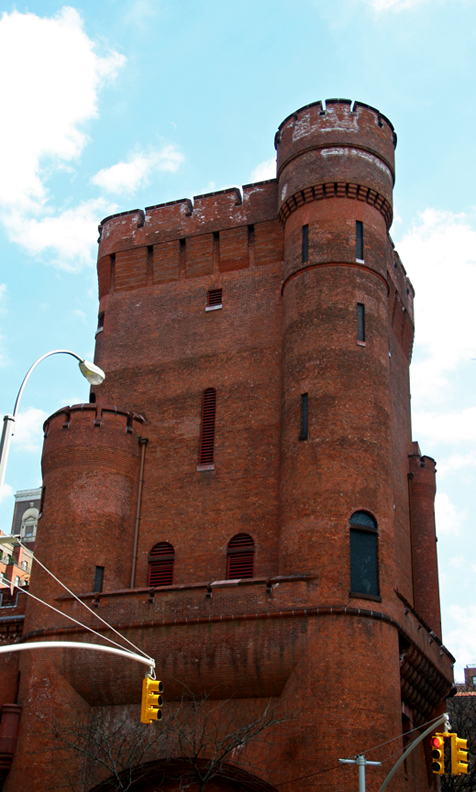
    Where else but in New York City could you discover something this large, having never been aware of its existence? I don’t recall even seeing this medieval behemoth, which occupies a full city block on Madison Avenue between 94th and 95th Streets. See 2nd photo here.

    This is the Squadron A Armory facade. Facade, because in 1966, demolition began to make way for a new junior high school and apartment complex. However, the Landmarks Preservation Commission intervened, and the demolition was stopped.
    Squadron A refers to an historic cavalry unit based out of New York City’s Upper East Side. It was formed by a group of wealthy young men with an interest in equestrianism. Read more here.

    If you travel up Madison Avenue, don’t be so distracted by all the high-profile boutiques that you miss Rhinelander’s Dream and the medieval ruins of Squadron A Armory…


  • Top of the Glass Staircase

    What is one of the most vexing problems for the visitor to New York City? Finding a bathroom. Because you need to use a bathroom. Or perhaps you are just tired and need to sit down and regroup. Sound familiar?
    It is no secret that New York City is not particularly bathroom-friendly. Signs abound proclaiming “Bathroom for customers only” or the ridiculous “No Bathroom” – does anyone actually believe that store employees work all day without a bathroom?

    New York City is an exciting wonderland for the resident and visitor. Like most large cities, most visitors will be traveling locally by a variety of methods other than their own vehicle – taxis, trains, buses, and by foot. All this trekking leaves your body in need of service.
    Most likely you have a base station (hotel) and you would like to go back to your room, but, unlike travel in the countryside, your room is not really very convenient, is it? It’s not just a quick drive away, and to go there is a bit of a hassle, taking time and energy. It also means leaving where you are – perhaps you have more to do.

    For the city resident, the situation is not much better – once out, we are even more reluctant to travel back to our homes just for bathroom use or to take a rest. Our only advantage is, occasionally, better knowledge of those places that are easy about use of their facilities. Some of the more upscale retailers are bathroom user-friendly – Whole Foods Markets, Starbucks, et al.
    But there is a better option if you are downtown. So, it is time for a quiz.

    Question: Where can you go in Manhattan and relax in a theater with upholstered seats in an award-winning skylit environment with clean bathrooms, relax as long as you like, and even get your email and access the Internet for free?

    Answer: The Apple Store on Prince Street in SoHo. I have previously written about this store. The theater, one flight up the glass staircase, is used for free presentations, as you can see in today’s photo. In my experience, however, the theater is generally unused. While you’re there, peruse the goods – the store is a mecca and meeting place. Please don’t abuse your privileges at the top of the glass staircase


  • Enchanted April


    Please click and play audio link to accompany your reading.

    I will never forget one particular scene in the film Enchanted April. Four women from England in the 1920s decide to leave the damp and rainy climate of home for a vacation on the coast of Italy, only to arrive to a rain more hellish than what they left behind.

    However, one morning, unbeknownst to them, the rain has finally stopped, and when they throw open the shuttered windows, they are just flooded with light and witness the most stunning scene of natural beauty imaginable. I recall seeing this in the theater, seated relatively close to the screen and nearly having to shield my eyes from the brilliant light after my eyes had adjusted to the dark, dreary, and rainy start of the film.

    One of the banes of New York City life is the window unit air conditioner. In a city with such an inventory of older buildings, window units are the norm, even in very large multi-story buildings. Look up when you are walking the city, and you will see an abundance of these unsightly, ungainly, and noisy metal boxes hanging from windows everywhere. Tying up windows with air conditioners is particularly egregious in the city since most of us have few windows to begin with and spend most of our time in one or two rooms.

    Also, the vast majority of windows in New York City are the standard up/down double hung style. French windows are a rarity, even in smaller historic townhouses. I am extremely fortunate in this regard. However, my windows were in extreme disrepair, and two out of three were encumbered with window unit air conditioners. Recently were my windows replaced and my window A/C units removed. I have full access to all the sashes and can open my windows completely.

    So if you want to reenact and relive that scene with me, let me throw my windows open for you today and give you a peek at a New York style Enchanted April 🙂

    For other views of the seasons outside my window, see White by Design 2, Wood, Glass, Brass, and Trees, and Signs of Summer.


  • We Don’t Do Windows

    We live a world of immediate gratification, but not if you are in manufacturing. Generally speaking, you are going to be dealing with lead times, whether it is for sampling or production. You also cannot expect the level of customer service that you will find in the retail sector, where salespeople wait to indulge your every whim.
    The best manufacturers are going to be busy, which often means that contact with key personnel may be difficult. Unreturned phone calls are not uncommon. Thick skin and tenacity are necessary attributes to being successful. Face-to-face meetings can often solve problems and move projects along quickly.

    However, not only has manufacturing eroded in the United States, but in New York City, it is virtually nonexistent – most of my suppliers are located out of the region or country. The prospect of finding manufacturing suppliers in New York City is virtually nil.
    Or so I thought.

    I recently was acquainted with two plastics manufacturers, both in the Bronx, who had the capability to make products for me – Streamline Plastics and Pulse Plastics. Streamline had given me tremendously aggressive price quotations, so I was hopeful that we could do business together. They supply companies who distribute novelty items, many made in Asia. Amazing, really.

    A new project at Streamline, however, had stalled a bit over various details, so I scheduled a meeting in person. When I arrived, there was concern that I had street parked – Streamline has their own parking. Barbed wired and the absence of windows did worry me.
    It was immediately clear on meeting the owner that this was a no-nonsense operation. His cell phone was ringing nonstop – this was a man in business to make products. Samples were waiting for me in the conference room. After just a short meeting with all the details worked out, Joe Bartner asked how many pieces I wanted and if I wanted him to run the job now.

    I was perplexed. I asked what he meant by now – like right now? He said yes – a machine was free, and he could run 8,000 pieces of plastic as we spoke. And so he did. The very next day, I was informed that the order was ready to go – how did I want it shipped?

    I also had arranged to meet with Pulse Plastics, located across the Bronx. This company breaks the rules and delivers on the unattainable trinity – Fast, Good, and Cheap (well, at least very reasonable, as I wrote in Pick Two on April 27, 2009). After 35 years in business, Pulse is on my short list of top suppliers and is a contender for the Congeniality Award. Our office staff loves them – great service, good quality parts, the president is always available by phone, and they often run production the same day an order is received.

    When I arrived, there was concern again that I had parked on the street – the owners routinely parked inside on the factory floor. I had previously discussed security issues in operating a business in many areas of the Bronx.
    When I showed dismay about the prospect of being in windowless buildings, owner Al Backleman laughed and joked that businesses don’t have windows in the Bronx. Perhaps I should call the Bronx borough president and suggest a new slogan – Welcome to the Bronx – We Don’t Do Windows 🙂


  • Knock, Knock.

    New York is a city of immigrants, very unlike the rest of the country. It is estimated that approximately 40% of the city’s population is foreign-born, as contrasted with only 11% of the United States overall.
    New York has always been a point of entry for a multitude of immigrants. One need look no further than Ellis Island – 12 million people entered the United States in a period of 62 years.

    There has been a substantial growth in the immigrant population – in 1970, the proportion of foreign-born in New York was less than 18%. The 40% number of immigrants in New York City today has not been seen since 1910, at the peak of the 1880-1920 wave of immigration.
    Many attribute this in part to the growing divide between the haves and the have-nots worldwide, with many people from underdeveloped nations looking to emigrate to the United States and other more economically advanced countries.

    Dealing with immigration has been an eye opening process. Like everything else, there is theory and there is practice, and the reality of immigration, citizenship, green cards, visas, etc. are academic until you are somehow involved.

    Recently, I accompanied a friend for an interview with the USCIS at 26 Federal Plaza. The process was very bureaucratic, as would be expected – the immigration official was looking for very specific things and was rather dismissive of the evidence provided.

    Of course, then there is the very real world of immigrants. Speaking to attorneys working in the field and immigrants themselves, it surprised me to learn that even when an immigrant has illegal status and this is known by the immigration authorities, in New York City, these immigrants will generally not be pursued. Unless the individual is arrested for other reasons, deportation is unlikely. On April 11, 2006, I photographed and wrote about a demonstration of illegal aliens and immigrants. It was both surprising and ironic to see people whose very status was illegal make this known publicly by their active participation in a march.

    Historically, the United States has been a Beacon of Hope and a magnet for those seeking opportunity and a better life. Recently, however, I have heard a number of people both here and outside the country say that there is greater opportunity now in parts of Asia than here at home.

    I know of individuals who have left to return home. I have read other articles about how America will never be the same, that our economic hegemony is finished. Perhaps our Lady of Liberty is a little tarnished, the magnet no longer pulls as hard, and when a land of opportunity says Knock, Knock, we may have to answer, Who’s There?


  • La Vie En Rose

    Note: Please click and play audio link to accompany your reading.

    One of my fondest memories was seeing the Cherry Blossom festival in Washington, D.C. as a child. This was my first big family vacation, and to be in Washington on a perfect spring day with pink blossoms everywhere and a parade with all the stately buildings in marble as backdrop was just exquisite.

    Pink is not a color typically associated with New York City – the color pink has had a large number of associations in the course of history.  At one time, pink was considered to be a color associated with boys and blue for girls. More recently, pink has been associated with negative gender stereotypes, so a city that prides itself on being edgy, dynamic, and fast-paced is not going to embrace pink as the school color. If you had to choose a color to represent New York, black would come to mind before pink.

    But what can elevate the human spirit more than flowers and pink blossoms on a spring day? What can be a better palliative for what can at times be a hostile and caustic environment?
    Not to worry, however. New York City has pink if you want it. See my story and photos here about the Pink Ladies.
    If you want pink blossoms, you can find them here too. On April 25, 2007, I wrote about the Sakura Matsuri cherry blossom festival (May 2 & 3), a weekend celebration, and Hanami, a month celebration of the Japanese cultural tradition of enjoying each moment of the cherry blossom season (April 3- May 2). See more information here.

    Secretly, I think many New Yorkers love pink but posture to only show a passing appreciation for perhaps a blossom or flower. One solution is to deliberately wear pink in spite of any consideration that it may be too benign – in itself an act of rebellion. However you have to do it, why not, at least for now, enjoy La Vie en Rose? 🙂


  • Urban Safari

    I do love a good mountain or two, however, New York City is a place for Jungle Lovers, not mountain lovers. Many cities like San Francisco are not only known for their exquisite natural beauty but also are virtually defined by it. San Francisco’s hills, like the Twin Peaks at over 900 feet, offer extraordinary vistas of the city and surrounding seascapes. See my story here about Hill People and Valley People.

    The majority of Manhattan is relatively flat. As one travels north from lower Manhattan, the topography does become somewhat hillier, with the highest altitudes in the northernmost areas in Washington Heights and Inwood. The Cloisters in Fort Tryon Park is known for its sweeping views of the Hudson River. The highest point in Manhattan is 265 feet above sea level, in Bennett Park.

    For most New Yorkers and visitors, the necessity of building a viaduct to span a valley may come as a surprise. The reality will be abundantly clear if you are traveling north on the number 1 train and suddenly find yourself breaking out from the tunnel into daylight on an elevated train track.

    When New York City began building its subway system in 1900, a decision had to be made regarding Manhattan Valley – tunnel under the valley with steep grades at either end, or build a bridge over it. A viaduct made more sense. The viaduct, 2174 feet long, spans the valley between 122nd Street to 135th Street, with a subway station at 125th Street and Broadway on the number 1 train. The steel arch spanning 125th Street is 168.5 feet long and 54 feet above the street. The 125th Street station opened in 1904. The viaduct was designated a landmark in 1981 by the Landmarks Preservation Commission. Read more here from the New York Times.

    Every day the trains are busy, transporting Jungle Lovers, Hill People, and Valley People through New York City. Join us on an urban safari 🙂


  • So Where’s David?

    The ugly American does exist, and I saw him in Florence, Italy, in 2003. He was the poster child, the mold from which all others were cast. I was in the lobby of the Galleria dell’Accademia, where Michelangelo’s David is housed. An American man with his daughter in tow was in line for admission tickets. When I say in tow, I mean it literally. This young girl was being dragged by her father around the museum lobby much like a skier going through compulsory slalom training.

    When his turn came at the window, he was extremely upset that the admission would have to be paid in local currency. Loudly, and for all to hear, the man, in the most critical and incredulous tone imaginable, barked, “You don’t take American?” Not the more appropriate US dollar or even perhaps the American dollar, just American, as if the dollar had such importance, it did not even need to be spoken.

    After getting his ticket, disgusted with the inconvenience of it all, he asked in an impatient tone, “So where’s David?” After being directed, he stormed off, dragging his daughter, as if seeing David was a dirty job to be done, obligated for many reasons, including perhaps the parental responsibility for giving his daughter some culture – the whole event sweetened, perhaps, by a good Italian meal later on.

    The whole situation was quite embarrassing and certainly did nothing to dispel the stereotype of the American as loud, rude, boorish, overly nationalistic, and ignorant and disrespectful of other cultures.

    Seeing the great art museums when in Europe really is a must. However, there are many tourists who do not particularly like art but, for any number of reasons, find themselves slogging through art museums and galleries in an obligatory manner – perhaps as part of a tour, taken by a friend or family member, or as part of a written or hidden agenda.

    On March 26, 2010, Antony Gormley unveiled Event Horizon, 31 cast iron and fiberglass casts of the artist’s body perched on rooftops, ledges of buildings, and the grounds around Madison Square Park/Flatiron District (one is atop the Flatiron Building itself, and one is on the 26th floor of the Empire State Building). For those unaware of the exhibit, naked men looming above the park, peering down from buildings everywhere, can be startling.

    Gormley is an English sculptor and was a Turner Prize winner in 1994. Event Horizon is his NYC art debut. The same sculptures were exhibited in 2007 in London – read more about him and the show here.

    Our American friend in Florence would find this sculpture much more to his liking, I am sure – no currency of any kind is needed, no lines, and the sculpture is everywhere around to be discovered. Perfect for a man who, in one of the world’s great art galleries, finds the prospect of navigating to one of Michelangelo’s masterpieces to be a chore and can only think to ask, “So Where’s David?”


  • The Total Call

    Posted on by Brian Dubé

    There are things that are iconic about certain places – the Eiffel Tower, the Great Pyramid of Giza, the Great Wall of China, the Empire State Building, the Taj Mahal, Stonehenge, the Colosseum, or the Grand Canyon. Some things which are emblematic involve natural phenomena that may require special conditions and a particularly unique vantage point. These things are often seen in photos and rarely seen in person by the visitor, like the Golden Gate Bridge and San Francisco draped in fog.

    San Francisco is notorious for its fog and its myriad of variants around the city and its neighborhoods, with one of the most unique climatic conditions in the world. Known for its microclimates and submicroclimates, temperature conditions can vary by as much as 9°F (5°C) from one block to another. One neighborhood can be sunny and warm, another foggy and cool.

    On one vacation to San Francisco many years ago, on the recommendation of a native (see Weather Means Whether), I traveled north over the Golden Gate Bridge to Marin County to hike to the summit of Mount Tamalpais, the tallest hill in the county. Marin County is known for its natural beauty, protected natural environments, and spectacular views of San Francisco and the Golden Gate Bridge.

    On this day, I was extremely fortunate and was rewarded with one of the most spectacular things I have ever seen. Fog, as thick as a blanket, completely covered everything in view except for the uppermost sections of the two towers of the bridge.

    Observing this next to me was a fellow hiker, to whom I commented about this spectacular event. He responded, in a slightly hushed voice, with slang completely unfamiliar to me, “It’s the move, man, it’s the total call.” I had never heard the words “move” or “call” used in that way, but his intonation had an air of biblical gravity, and perhaps, not unlike Genesis 1:31, assured me that it was very good. I heartily agreed.

    Fog in New York City is much less common, and we certainly do not get the spectacular conditions seen in San Francisco. Recently, however, when driving on the Belt Parkway in Brooklyn, an unusual temperature drop and high humidity gave rise to an extremely dense fog, at times almost completely obscuring the Verrazano-Narrows Bridge, in conditions somewhat the inverse of the classic Golden Gate Bridge phenomenon. On July 8, 2008, I wrote about the Verrazano using photos taken under foggy conditions, but not nearly as heavy.

    Capturing today’s photos was particularly problematic, driving alone on an expressway with only a point-and-shoot camera. But opportunity was calling, so I took this photo blind with my arm extended up through an open sun roof.

    I hope someday you get to see the Verrazano Bridge like this. And I am sure you will agree that it’s the move, man, it’s the total call 🙂

    Posted on by Brian Dubé

  • Get Your Doing Done

    Posted on by Brian Dubé

    I had a close friend who was extremely neurotic and driven. Often, when discussing options for plans with others, one could see his impatience and edginess growing. Once, I recall speaking to him on the phone in the early evening. He was already finished with his plans for that night. When I expressed surprise, he said that if he was going to do something, “I like to get my doing done.” He appeared to be turning recreation into a job guided by an efficiency engineer.

    This website was inspired by Eric Tenin, who started Paris Daily Photo in 2005. The original concept was to share daily life, one photo per day. New York Daily Photo, however, has metamorphosed over time. 

    There is merit to the original concept, however, everyday life is filled with routine, and I did not want this site to become a tribute to the mundane without some special or personal ingredient added. The TV series Seinfeld, which purported to be a show about nothing, was really quite more than that. Although, on the surface, many of the plot elements were about the trite and trivial, without cleverly crafted comedic writing, plot twists, surprises, and great characters, a show that is truly about nothing would bore audiences to tears and never survive. 

    Today, I left home for the office earlier than usual. For those who are early risers, the streets in the early morning are a special and pleasant time. There is the freshness of a new day, construction workers toiling away. In New York City, this is also a time where photo shoots and filming can often be seen on the streets – there is good light and the streets are less crowded. And best of all, for those who are so inclined, there is comfort in knowing that by starting the day early, there will be plenty of time to get your doing done 🙂

    Posted on by Brian Dubé


  • dinamic_sidebar 4 none

©2026 New York Daily Photo Entries (RSS) and Comments (RSS)  Raindrops Theme