• Because I’m the Best, Part 1

    Many things were not so great in Olde New York of the 1970s – car windows broken for the theft of radios, vandalized subway trains, sanitation strikes, drug addicts, and perhaps the worst aspect, crime and a heightened sense of danger. I’m doubtful that even the most romantic or nostalgic wishes those things back.

    But there are some things I miss, and one is the character of small shops and the opportunity for nearly anyone with a reasonable idea or craft to stake out his or her claim in the retail environment. There are still a handful of small shops along some side streets, but rents are generally prohibitive for the lone artisan.

    I was involved in the leather craft movement for some years and made routine visits to many small shops, owned and operated by a crafts person(s). Some were my clients, others just acquaintances. Nearly all of these shops are gone. A few artisans still remain in business – Dick Whalen of Native Leather (formerly Natural Leather) at 203 Bleecker Street and legendary sandal maker Barbara Schaum on East 4th Street.

    I have been involved in product manufacture since those days and do pride myself on having some level of expertise using tools. However, some years ago, to perform a simple task at home, I made the mistake of asking a friend for scissors. She was an architect, and I was appropriately reprimanded for not using an Exacto knife or razor blade. I was told that those were tools of precision and that no good crafts person uses scissors for the type of work I was doing. She pointed out that in the architecture firm where she worked at the time, the model-making department used only knives and razor blades and that scissors could only be found in the marketing department.

    This was extremely interesting to me, because one of my most memorable life experiences involved virtually the very same subject, only with a little more drama. I recounted the story for her. For that, however, you have to meet Jim Murnak. And we will do that tomorrow in Part 2…


  • Diner Be Aware of the Diner

    My first apartment in New York City was in Chelsea, on 22nd Street between 9th and 10th Avenues. When my roommate read the ad, standing on the street at a pay phone with the Village Voice in hand, we had no idea what or where Chelsea was, and even less what “renov brnstn with fplc” meant.
    At $299 per month for a renovated brownstone with a fireplace, 14-foot ceilings, and a skylit living room, what it really meant was that we were very lucky and had no idea of what we had. This was a beautiful, tree-lined street, lined with rowhouses and walkable to New York University.

    The Empire Diner was around the corner, but I did not fancy diner food at the time, and it was not until last week that I actually stepped inside this diner and sat down for a meal.

    The history of the “rail car” diner is a bit muddled. The origins of diners was rooted in the lunch wagon, but there were also railroad dining cars which were deactivated from rail service, parked along train stations, and used as diners. In time, diners were styled along the railcar lines, many using stainless steel and Art Deco elements.

    One of the number of companies who manufactured these railcar diners was the Fodero Dining Car Company (1933-1981) of Newark, New Jersey, which built the Empire Diner. This diner is legendary, with its striking exterior, roof-mounted Empire State Building, its gleaming interior, and beautiful Deco clock. It has been used in numerous films, referenced in song, and frequented by a long list of celebrities: FDR, Charles Lindberg, Barbra Streisand, Al Pacino, Madonna, Will Smith, David Bowie, Steven Spielberg, Bruce Springsteen, et. al.

    This place has been tres chic for decades and is typically packed, inside and out (it has sidewalk seating in warm weather).
    Food and service reviews are all across the spectrum, and a reading of comments on a site such as Yelp.com will show very impassioned reviews with one- to five-star ratings. A friend and I visited on a weekday, mid-morning, and the place was virtually empty. I cannot speak of a typical experience here – they were overstaffed for two of us. The food is very pricey, and the breakfast food we ordered was basic. But the Empire Diner is worth a look at if you are in the area.

    However, like any place whose reputation is larger than life, and particularly in the case of a place that bills itself as the “Hippest Diner on Earth,” let the diner be aware of the diner 🙂

    Update: The Empire Diner has since closed.


  • DiFara

    Generally, conversation about legendary pizza usually involves a lot of evaluations and comparisons of sauces and crusts. But in the case of DiFara Pizzeria, the conversation these days usually involves a lot of debate about the cost – $5 for one plain slice. It’s funny that people are so passionate in this debate.  On one New York Times forum, someone questioned why diners could not make an allowance for a pricey slice when the world of consumer goods is already filled with very disparate and often accepted pricing on luxury items and gourmet foods.

    Perhaps it is the elevation of what is perceived to be a staple food item in tandem with DiFara being located in a working-class neighborhood that makes the price such an effrontery to so many. Coming from Manhattan, I am used to pricing anomalies, so when my friend and I sat down to eat our slices, we tried to focus on the character and taste of the pizza rather than its value.

    I had heard about this place, particularly after writing my story on John’s Pizzeria on Bleecker Street, when readers commented on the contenders in New York City for their favorite pizza.
    DiFara is located at a very busy corner location in Midwood, Brooklyn. The place is small, and the walls are covered with awards and reviews. Lines are standard at DiFara, often one to two hours. On our visit, mid-week and mid-afternoon, we were lucky – there were no lines at all. We were able to chat with the owner and his daughter, Louisa, who was managing the orders and register.

    One thing that is particularly unique about DiFara is that every single pizza is still personally made by the owner/founder, Domenico DeMarco, age 72, who has been plying his trade here for 45 years. The owner hails from Provincia di Caserta in Italy, near Naples, birthplace of the modern pizza. After starting a pizzeria in Sunset Park, Brooklyn, with his brother, DeMarco opened at his current location in 1964 with partner Farina (hence the name DiFara).

    DeMarco prides himself on the quality of his ingredients, imported from places such as Israel, the Netherlands, and Italy. The pizza uses three cheeses – Buffalo mozzarella from Caserta, Fior di Latte, and Parmigiano Reggiano. His sauce is also homemade, using San Marzano tomatoes from Salerno, Italy. The pies are topped off with olive oil and fresh basil leaves.

    Is the pizza worth $5 for a plain slice? The opinions run the gamut. Some say that no pizza is worth that, while others think it is the best on the planet and worth every penny. You could spend your money more extravagantly – unless $5 is just too extravagant, why not try it and decide for yourself? 🙂

    Location: DiFara Pizzeria is located at 1424 Avenue J, at East 15th Street in the Midwood section of Brooklyn. They are closed Monday and Tuesday (and occasionally at other times if DeMarco is unable to work).


  • Fire and Ice


    I have seen fire and ice, and it was spectacular.

    Sunsets are a bit like Japanese restaurants in New York City – everyone knows the best one. In the case of sunsets, everyone has seen the most spectacular at some special time and place. So I am not going to tell you that I have seen the best sunset ever. However, I will say that this was the most remarkable sunset I personally recall seeing in New York City. While taking these photos, a woman ran out of a neighboring building into the frigid cold with camera in hand to capture the fleeting moments. See my entire gallery of photos here.

    After a day of adventure seeking with a friend, Red Hook, Brooklyn, was on our late-day agenda. We were not looking for a sunset, but as we approached the waterfront at dusk, I had a sense that something good lurked around the low-rise building known as the Beard Pier Warehouse. We explored the southeastern side of the warehouse, which was extremely nice, but I was getting antsy knowing that the sun was rapidly setting on the other side.

    A UPS truck blocked our exit on the narrow roadway which flanks each side of the pier building. Waiting to back out of the one-way street was like watching the sands of time.

    Have you ever driven around a corner or bend in the road where an extraordinary vista is suddenly revealed? This was our experience as we crossed a small alley on to the west facing side on Beard Street Pier and nature’s full glory burst into view. As I scurried to the water’s edge, I was equally stunned to see what at first look appeared to be an array of white glass – they were, in fact, smooth stones covered with a layer of ice. The red-orange sun illuminated the arched cast iron doorways and red brick of the pier building. The whole set looked like an installation art piece entitled Fire and Ice


  • A Small World

    I have often dreamed of living in some small French village where everything is on a very human scale. Where old men gather in the town center and play boule, there is no traffic, everyone knows everyone, and even the outsider is greeted like family. Where people really care and will go that extra mile to help. And the quality of one’s life is measured by his or her relationships.
    A place where time is stopped, there is no sense of urgency, and things are done deliberately.

    There are many places like this, and I have seen them. However, to live in a small town, I would miss all the things New York City has to offer. So at times, foolish that I am, I try to find a microcosm like that in New York City. If you look hard, you can find a place where it’s a small world after all.

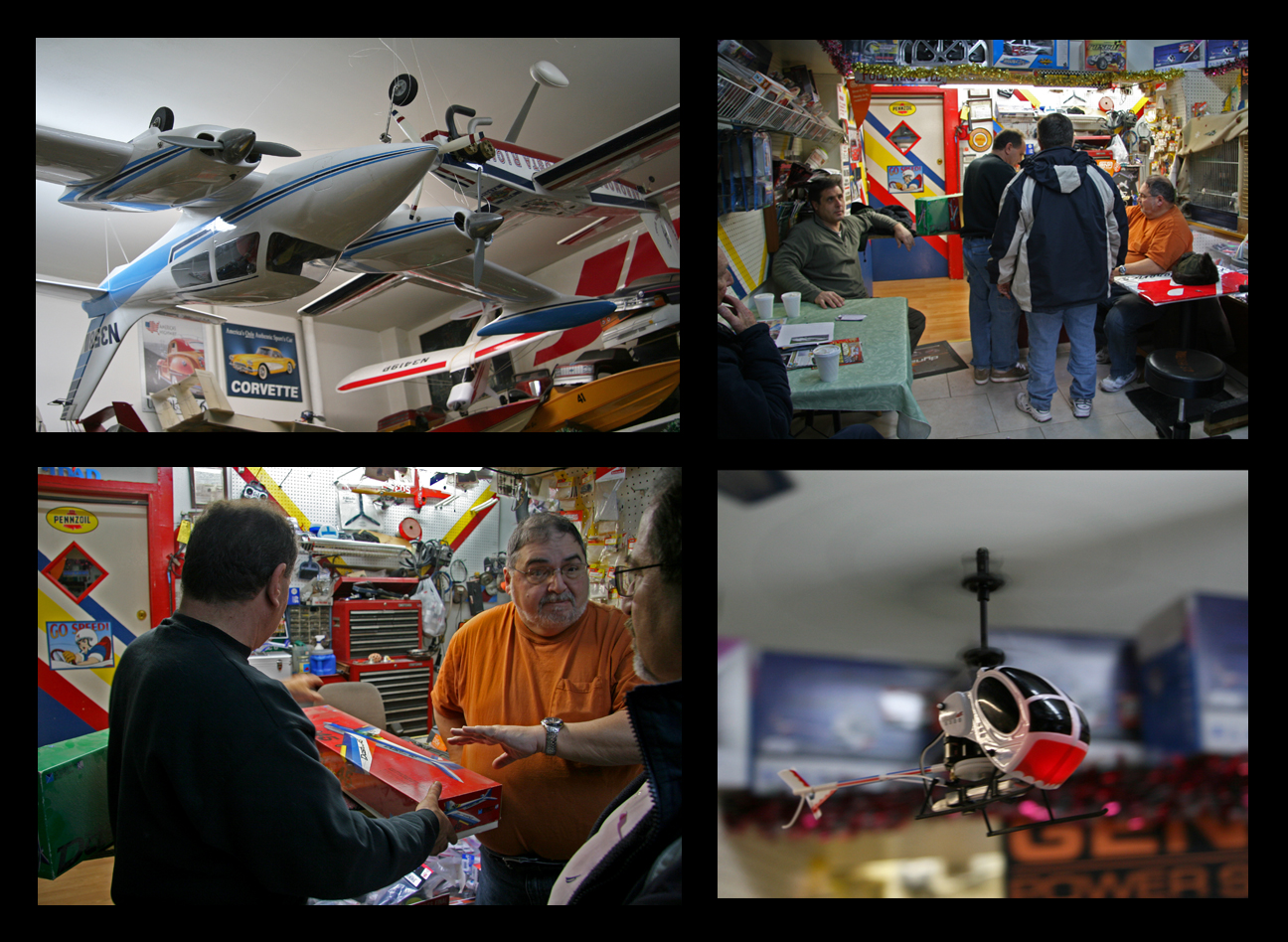
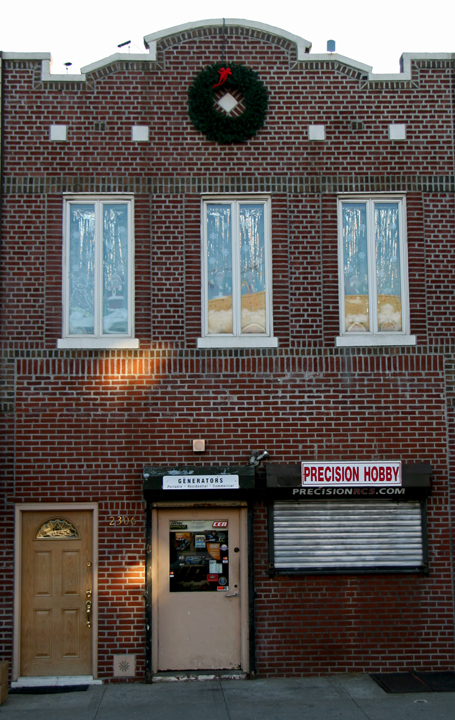
    At Precisions RCs, the metaphor becomes literal – the diminutive size of the place is matched by its scale models, mostly radio-controlled (RC), for the serious hobbyist. Here, in this tiny shop, you will find an inventory of radio-controlled airplanes, cars, helicopters, and boats. There are also trains, rockets, and plastic models. The owner carries a line of current models, has an online business, and also specializes in many discontinued models – of interest to the aficionado. I accompanied a friend from out of town who has an interest in RC planes and purchased an out-of-production wood frame model.

    Technology has made a huge impact in this hobby, as in most other areas of our lives. Although nitro-powered engines are still manufactured and sold here, there has been a shift to electric engines/motors for many types of RC models, fuel- and maintenance-free.

    The value for the dollar is amazing – the result of a combination of technological advances and Asian manufacturing. The owner demonstrated an amazing little RC helicopter which can be flown indoors (photo lower right), controlled by a sophisticated multi-channel radio – all for only $100.

    What I enjoyed most was the clubhouse atmosphere with valuable floor space given over to regular visitors. When we arrived, four men were sitting at tables in the tiny shop. We were immediately welcomed and included in the conversations. Many of the customers are members of the flying club which meets at Floyd Bennett Field.

    Everything conspired to send one message – that even in New York City, you really can find a small world 🙂

    Note: Precision RC is located in a small two-story building (see the outside here) at 2306 Bath Avenue in the Bath Beach neighborhood of Brooklyn. Bath Beach is located in southwestern Brooklyn along Gravesend Bay.


  • Hearts of Palm


    I didn’t know exactly where I was or the reason for going. But, like many social expeditions in college, we often traveled in packs with an ill-defined leader, led to some unknown location for reasons unclear. Not that any of this information was really withheld. It was just that we really didn’t care, because we had confidence that the outing would be an adventure.

    It was a party of sorts and was most likely somewhere on the Lower East Side, where the problem was never rent, only the decision to live in a war zone. Places could be rented for as little as $60 per month, and yes, even at that time, in those dollars, it was very affordable. That amount of money could be earned in one or two days in an unskilled job, something impossible in today’s market.

    A woman, who I believe was Brazilian, offered me a long white object from a can. As she slid it out, it reminded me of Vienna sausages, which I ate from a can as a child (and which I loved). These, however, were some type of vegetable, with a texture not so unlike an artichoke.

    But I never knew what they were called, and finding these was not going to be easy. I suspected that they were of South American origin, but at the time, international foods were a relative rarity, relegated to some small section of the supermarket, with each store having what appeared to be a whimsical selection of goods.

    There were no Korean green grocers with all things imaginable. Delicatessens were the convenience stores of choice, and for those of us coming from Anytown, USA, these all-night delis were nothing short of miraculous. We were ecstatic to have places open 24/7. The selection of packaged or canned goods, however was very limited. Fruit would typically consist of a Rome or Delicious apple of unknown age behind glass in the center of a showcase. No one was expected to actually buy it, but at least that food group was represented.

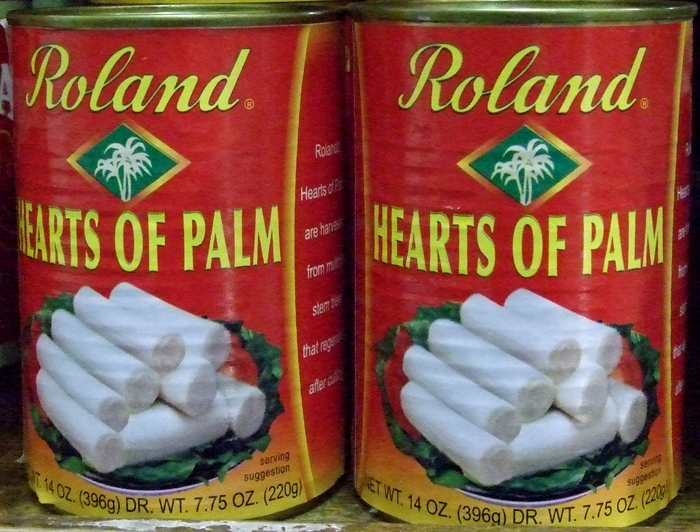
    So it was in this environment that the identity of that smooth, silky, ivory-colored, edible plant remained a mystery for years. A small, nagging, unclosed gestalt. Until I met an older woman from Puerto Rico who, from a loose description, immediately identified the suspect as hearts of palm (or palm hearts).
    Visits to various supermarkets proved successful. There was a bit of sticker shock – these were imported from Brazil and were pricey (I have since learned that they were uncultivated at that time.) But I really had no choice, and I purchased a can. They were as unique and wonderful as I remembered and became a regular (if infrequent) addition to my diet.

    Of course now, hearts of palm are a common ingredient in salads and can be found in virtually any market. For me, seeing a can of these represents closure on a long affair. For everyone else, just hearts of palm 🙂


  • Food Bubbles

    We are in what the online publication Slate calls a Cupcake Bubble, which they predict will soon be followed by a crash. I wrote about cupcakery Magnolia Bakery in September 2009, but I was not aware of the true breadth of this craze – that it is a national and international phenomenon.

    Numerous articles have been written going back several years. There is a cupcake blog, Martha Stewart has a cupcake book, and shops are everywhere: Sprinkles Cupcakes (international chain) based in California, Toot Sweet Cupcakes in Austin, Texas, Lovely Confections in Denver. Crumbs has two dozen locations, with 18 in the New York metro area. Also in New York, there is Sweet Revenge, Babycakes, and Sugar Sweet Sunshine. In Washington, D.C., there is Georgetown Cupcake, Red Velvet, and Hello Cupcake.

    This is not the first time that a food fad with shops specializing in one product has taken New York City by storm. In the 1980s, gelaterias sprouted up everywhere and all closed in a short time. Recently, we have seen a similar thing with frozen yogurt shops such as Pinkberry and Red Mango.

    A recent New York Times blog posting discussed the sustainability of cupcakes as a business and was accompanied by 99 comments. After reading these comments and several other articles, I see that the numerous debates boil down to a few issues: 1) Can all these cupcakeries make it? 2) Is a cupcake worth $3-$4? 3) Why are they so fashionable at a time when health consciousness is at a zenith? And, of course, 4) Who has the best cupcakes? In New York City alone, there are many cupcake shops.

    Many find the confections much too sweet or just not healthy, while others see it as a small guilty pleasure and comfort food, perfect for such times. Some people see buying them at these prices as foolish, particularly in an economic downturn, and others add that the entire restaurant business is built on paying for convenience and that most things made at home cost a fraction of what is charged for the ready-made equivalent. Business experts have entered the debate, with most showing how this is a flawed business model. A few, however, do not agree. And there are many analogies – and critiques of these analogies – made with places such as Starbucks, Krispy Kreme, and Dunkin Donuts.

    Cupcake bakers have used several business approaches – cupcake shops, online selling, wholesale distribution, trucks, kiosks, or any combination of sales avenues.
    The Cupcake Stop is a mobile gourmet cupcake shop in a truck which frequents different locations in Manhattan on different days of the week. It is run by Lev Ekster, and the cupcakes are baked by Manal Mady in Brooklyn. If you just want a small confection, they also offer mini cupcakes for $1 each, as does Baked by Melissa, who sells from a street kiosk on Spring Street in SoHo. Buying a tray of minis in an assortment of flavors is a common solution to the flavor selection dilemma.

    I love the street vending of food and mobile trucks, such as the Dessert Truck or NY Dosas. Making foods available on the street is perfect for the visitor or native New Yorker on the run. Personally, I find cupcakes to be a little too sweet, so an occasional tasting goes a long way…


  • We Got Religion

    When I first met a friend several years ago, in the course of our initial conversation, he referred to himself as a card-carrying atheist. Of course, I never thought he meant this literally, but, in fact, he proceeded to show me his membership ID for the New York City Atheists.

    Incidents like this, as well as the urban environment with its iconoclastic populace, would lead one to believe that the religious in this city must be a much smaller percentage than that found in the United States population at large. Surprisingly, the percentages are not so different. A recent 346-page report, Religious Change Around the World, was released in October 2009 by the National Opinion Research Center at the University of Chicago (if you are interested in perusing the report, you can download the document here.) The massive study – the most comprehensive analysis to date of global religious trends – reveals that religious change around the world is very complex and that no simple conclusions can be drawn.

    The percentage of citizens who regularly attend religious services is typically quoted as 40%, a number gleaned from surveys such as the Gallup Poll. This number is now in question, however, as individuals polled often answer in a way to reflect what they would like others to hear and perhaps believe themselves. Some studies have shown that the real number may be closer to 20%.

    Although it is generally believed that scientists and doctors are less likely to believe in God or be particularly religious, the report shows, surprisingly, that the difference in religious belief between the scientific and non-scientific community is actually not that large. Also, in spite of declining church attendance and religious affiliation, studies show that there has been an increasing number of those who consider themselves to be spiritual. Many faiths are looking to repackage their religious practices to address the changing needs of their communities.

    There are thousands of places of worship in the five boroughs of New York City – churches, synagogues, mosques, etc. A small number are major attractions, such as St. Patrick’s Cathedral and the Cathedral of St. John the Divine. Others, either architecturally and/or by the nature of an unusual amount of free land surrounding them and manicured grounds, virtually demand the attention of passersby. The Gothic masterpiece Grace Church is a good example (see here as well).

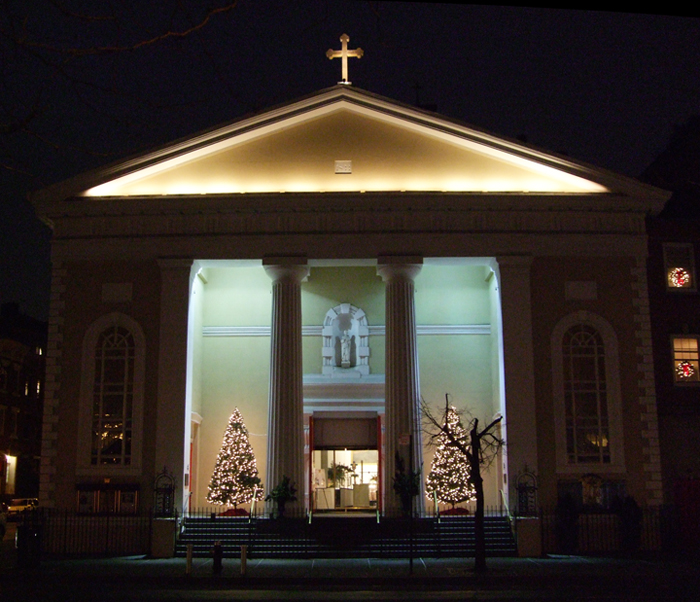
    However, unless the doors are open or perhaps the scene is graced with a spring or summer wedding precession, most houses of worship remained unnoticed, competing as they do with commercial establishments. The church in the photo, although architecturally striking, lies amidst the hustle and bustle of 6th Avenue in the Village. Unusual elements made it particularly photogenic on the night it was photographed: open doors, interior illumination, Christmas trees flanking its massive columns, and everything aglow, including the rooftop crucifix. In spite of changing definitions and practices, in New York City, like the rest of America, we got religion…

    About the Church: St. Joseph’s Church in Greenwich Village is the second oldest Catholic church in Manhattan. The Greek Revival structure was built in 1834. In 2005, NYU merged with St. Josephs, and the church is now known as the University Parish of St. Joseph & the Catholic Center at NYU. The Catholic Center at New York University, previously housed in the Holy Trinity Chapel on West 4th Street, has been demolished. The property, previously owned by the Archdiocese, was sold to NYU.


  • Jungle Lovers

    “What is New York City like?” I asked. My guidance counselor put his hands behind his head with elbows spread wide, leaned back, and with great deliberateness and the authority of a worldly, street-smart, experienced man, answered, “Have you heard of the concrete jungle, kid? Because that’s what it’s like. Between 23rd Street and 59th Street. It’s a jungle. A concrete jungle.”

    With that and some college catalogs, I was supposed to make an informed decision about the merits of attending university in New York City, a decision that would shape my entire life.

    I am not sure if his depiction of midtown Manhattan was intended as a deterrent, a strong warning, or just meant to impress me with his knowledge of this city, but we all know that if you tell a child not to do something, he/she will just be spurred on to do it. I was.

    At 18, a jungle is just what I wanted. After all, I had read numerous African adventure books and even took out a book in Swahili in high school, in the event that I found myself in equatorial Africa. If I couldn’t have vines, monkeys in trees, and tropical birds, then concrete would do fine. And, like the jungle, New York City would be an adventure. That is what I wanted most.

    A jungle is a great, even if overused, metaphor for New York City. It has a density of growth and, at times and places, can appear nearly impenetrable. Scary to some, and exciting to those who like a sense of adventure and the unexpected.

    If you want to truly enjoy NYC, then treat it like a jungle. Just walk with your eyes open. Don’t be afraid to interact with strangers, and you will meet some incredible people. There are many treasure maps, both online and offline, to New York City. Use them, of course, but also cut a swath and blaze your own paths. Enjoy the adventure. Happy New Year, jungle lovers 🙂


  • Thank You, Mr. Dupal

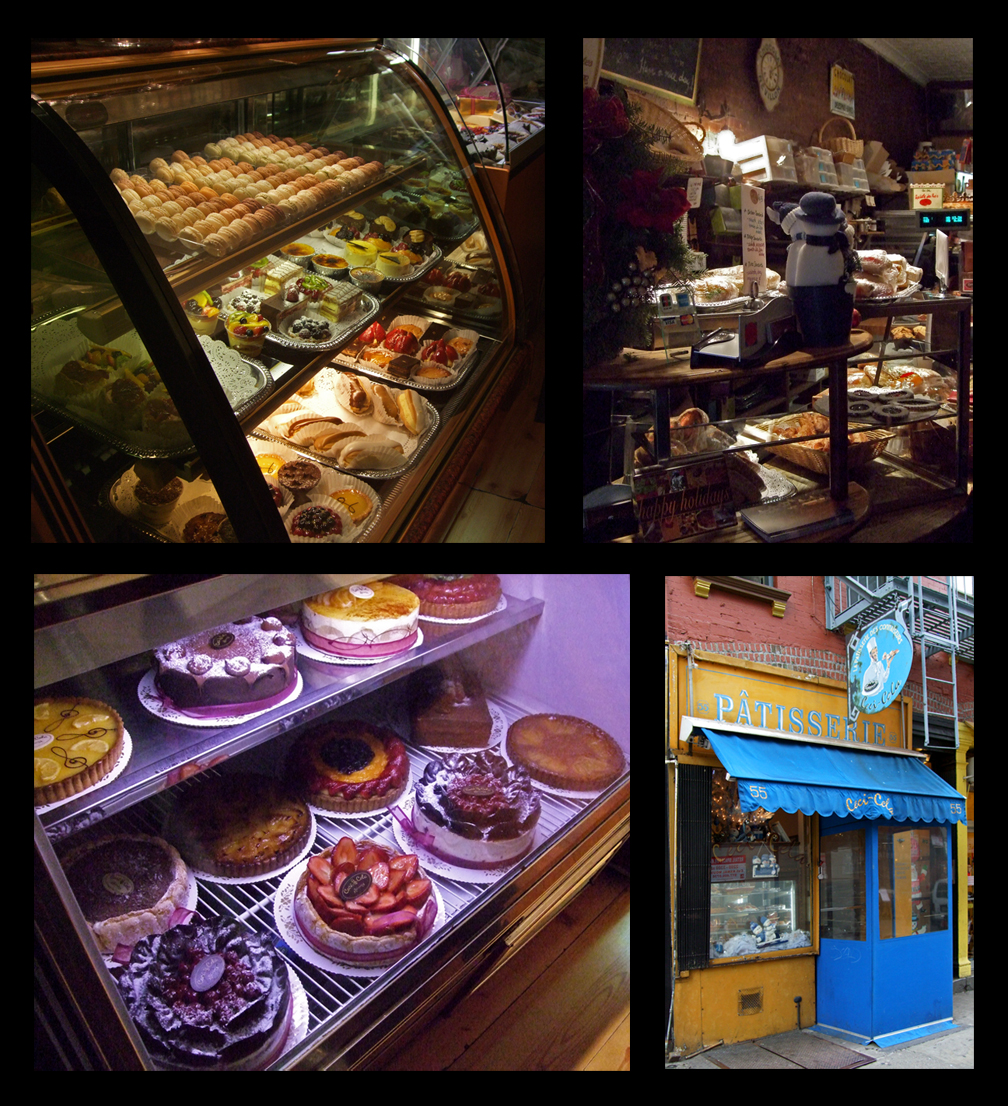
    I imagine that there are people who don’t like butter. I am not sure I have met any, and I doubt that you will find many here at Ceci-cela. I love writing about a place like this – there is no worry that I will disappoint you. Along with other places such as Cones, the Doughnut Plant, Eileen’s Cheesecake, Raffetto’s, and Il Laboratorio del Gelato, this place uses only the finest ingredients and is run by a hands-on, uncompromising artisan, Chef Laurent Dupal.

    Ceci-cela is only a couple of blocks from my office – we began patronizing this pastry shop long ago, and it quickly became our regular place to get our cakes for birthday celebrations in our company.
    Ceci-cela was started in 1991 by master chef Laurent Dupal, now partnered with longtime friend and celebrated restaurateur Georges Forgeois. Dupal is, as would be expected, a well-trained and experienced French chef – read about him here.

    The shop is located at 55 Spring Street in NoLita (North of Little Italy). The secret of the survival of the character of neighborhoods such as this is the smaller tenement buildings, which permit limited retail space and prohibit larger stores or retail chains (although rents do escalate and there are changing tenancies).

    The exterior of this patisserie is quaint but unassuming. Inside, it is a tiny, narrow place with a Parisian ambiance. Congestion is common as regular patrons jockey for position in line. There is a cafe area in the rear for those wanting to eat on the premises. The bakery also does a wholesale business.

    Everything I have had here is superb. You will find a full gamut of French pastries, cakes, and tarts: éclairs, Napoleons, crème brulée, tartes, chocolate truffles, all manner of croissant, brioche, danishes, and their classic tuiles. From the New York Times:

    TRADITIONALLY, the tuile, the French almond cookie, is a curved concoction of butter, sugar, flour, and almonds that is named after the rounded roof tiles found throughout France. The cookie bakes flat, and as it comes out of the oven, warm and pliable, it is wrapped around a rolling pin to give it the shape. But the tuile from Ceci-Cela is different.

    ”I make them flat,” said Laurent Dupal, the chef and co-owner of the patisserie at 55 Spring Street, ”because they are very, very fragile.”

    In the world of pastry making, fragility is often a sign of excellence.

    The Ceci-Cela tuile is so buttery, and so delicate, that the moment you put it into your mouth, and touch it with your tongue, it begins to crumble into crisp, buttery, almond-flavored morsels. A near-perfect cookie, it can stand alone and be eaten by itself, one after another, until a half-pound box is suddenly empty, or used as an accompaniment to a simple summer dessert of fresh strawberries, mangoes or Asian pear.

    The secret of its evanescence is to use ”as little flour as possible,” Mr. Dupal said, adding, ”The way we make them is to whip the butter and the sugar and make them very light. After that we incorporate the egg whites, one by one, and then a little bit of flour, and finally the minced almonds.”

    Our office favorite is the Paradise Cake – a lady finger and vanilla genoise cake with fresh tropical fruit mix. See the menu here.

    I know that after you sample their delectables, I will look like an expert in discovering the best-kept secrets of New York City. However, let’s give credit where it is due. Thank you, Mr. Dupal 🙂


  • Dwanna

    Her name was Dwanna – a twist on Dwayne because her father had really wanted a boy. She was my sales rep for my catalog printing for some time, and I had occasion to meet her once in person while she was on a business trip to the city.
    When she called to tell me she was moving to New York City, I was quite happy. This could become a nice friendship. She would even be living with her boyfriend in my neighborhood. She had that southern charm but was also an aggressive business woman, and she had plans to make some serious money here.
    But she was gone before I even had time to meet her here once. When I asked her why she was leaving so quickly, her answer could be summarized in two words – too hard.

    I was shocked, really – this was not an unambitious woman at all. But she said it was just too hard. Every little thing which used to be easy, whether laundry, getting groceries, traveling, etc. was just more work than she ever imagined. It wasn’t worth it to her.

    If you live in New York City, you know exactly of what I speak. If you want to live here, you had better be ready for an adjustment. Unless you have enormous wealth, you will be making a number of big changes – you will be walking and lugging, unloading packages from a car or taxi in the rain, walking up flights of stairs, suffering unbearable heat on a subway platform in mid summer, and worrying about your valuables wherever you go.

    The typical, successful New Yorker who has adapted to life here is a survivor – resourceful, tough, and able to switch gears quickly and turn on a dime. Someone who can see and leverage opportunity. That’s why when the weather breaks for one day, musicians will gather in the park just like it’s a summer day. We had a 50-degree sunny day on Sunday, and these musicians turned up in holiday red. Today’s photo captured them doing a spirited rendition of Jingle Bells.

    The question is not Clint Eastwood’s “Do I feel lucky?” but rather “is it worth it?” Luck won’t go that far here when it comes to day-to-day life.

    Whenever I have a tough time, tire of the machinations of ordinary tasks, or think of leaving New York City for an easier lifestyle, I think of Dwanna


  • Veterans Memorial Pier

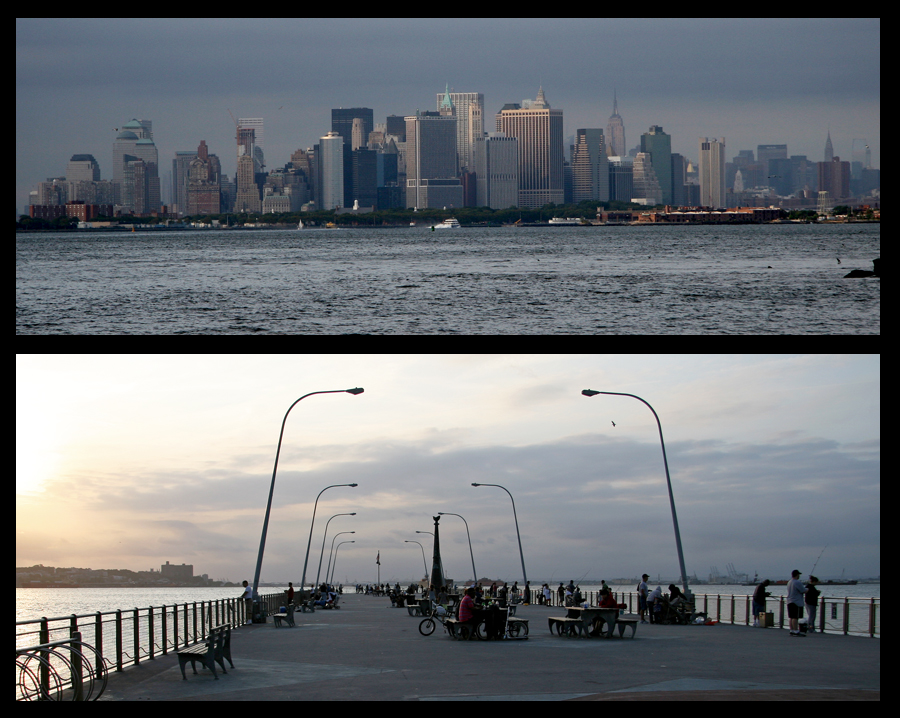
    The best views of Manhattan are from the boroughs of Brooklyn, Queens, and Staten Island (including the ferry), the East River Bridges, Roosevelt Island (and Tram), and New Jersey. In Brooklyn, the BQE coming towards the city affords some of the most dramatic views of New York City, as does the promenade in Brooklyn Heights, which is cantilevered over the highway.

    Recently, I was tipped off by a Brooklyn native of a spot relatively unknown to those in Brooklyn – the American Veterans Memorial Pier, aka the 69th Street Pier.
    In 2005, a memorial was installed to honor the 283 Brooklyn residents who were lost in the World Trade Center attack. Soaring 25 feet in the air, the “Beacon” memorial is shaped like a speaking trumpet. The device was once used by the volunteer fire brigades of New York City to transmit warnings to the crowd and orders to firefighters, as well as alerting neighbors of a crisis in progress. Made of bronze, the memorial features a beacon of light shining from the top that will be illuminated from 9:00 pm to 11:00 pm daily. The design, selected through a competition, was designed and built by Brooklyn artist Robert Ressler and cast from bronze at Bedi-Macky, a foundry in Greenpoint, Brooklyn – the oldest in New York City, best known for having cast the Iwo Jima Memorial.

    The pier is located opposite 69th Street in the Bay Ridge neighborhood of Brooklyn. Beautiful vistas can also be had from Owl’s Head Park, perched on a hillside overlooking the pier and the water.

    Fishing is a popular activity here. Unfortunately, with the downturn in the economy, many are fishing more for sustenance than for sport. Numbers of fishermen have increased substantially recently,  and some families are eating fish caught here several times per week – much more than what is recommended. Warnings have been made about the high PCB and mercury content in the fish.

    For decades, there was ferry service from the pier to Staten Island – service ended after the Verrazano Bridge opened in 1964. The pier was originally built in wood but was rebuilt in concrete in the 1980s and again in 2000. The pier can also be accessed by the pedestrian/bike path which flanks Shore Parkway and the Upper Bay…


  • Substance Abuse

    In a city like New York, there is a lot of substance abuse. But it takes many forms, and one that may not immediately come to mind is the company that oversells and underdelivers by taking what quality it has and abusing it through excessive marketing.

    I want to believe that behind great companies lie great products. That reputations are built on merit. That marketing is a recent addition. That the maxim most businesses want to follow is the pithy undersell and overdeliver. That they understand the disappointment and bad taste left by a product where the operative was to oversell and underdeliver.

    However, when a few raise their voices at the dinner table, soon everyone must do the same to be heard, and a screaming match ensues. And so it is with an overcrowded marketplace of products and services. To undersell is perhaps to risk not being heard at all, regardless of the quality you have to offer. Developing a cult following for a product through word of mouth and evangelism is not the easiest to orchestrate. Companies such as Apple have done well, however, this approach is often initially an organic process, not part of a marketing plan.

    Louis Vuitton is a company that was built on merit – quality of product and innovation. I cannot speak for the quality or durability of the products today. They are so pricey, and I would be frightened to use them – its stores display their wares more as works of art in a contemporary museum than as products to be used. Bags run $1000 to $2000 dollars, and their signature piece of luggage in leather is $6000. In my recent travels seeking out holiday windows, I decided to drop in to the Vuitton flagship store at 5th Avenue and 57th Street. The store is sleek and modern.

    Louis Vuitton was born in France and began designing flat-bottomed trunks in the 1850s. Even at that time, his distinctive designs were copied, and the problem of counterfeiting remains today. Vuitton employs a full-time team of lawyers and investigators just to curtail piracy. Read more about the company here.

    It is difficult, if not impossible, to find any company that flies by the quality of their content or products alone. Marketing and branding is absolutely part of the business model today, even more so with a legacy brand name. The question is whether any product lives up to its marketing. Perhaps some of you have experience with Louis Vuitton products and can let us know – is this still a quality product or a case of substance abuse?


  • Have a Witty Holiday!

    In New York City, the vast majority of residents are still largely Christian, but the percentage of non-Christian groups is quite significant and in numbers that translate easily to over one million people.

    Outside of the city, (in New England, for example, where I am writing this), meet and greets with family and friends at this time of year always include “Merry Christmas” and a handshake. In the city, I try to be much more conscious of the implications of Christmas in my greetings and the possible religious affiliation of those I greet.

    The increasingly secular nature of the holiday certainly makes this aspect of Christmas in the city more comfortable – wishing others a Merry Christmas without knowing their religious background is much less likely to offend. I am often inclined to use “Happy Holidays” in my cards enclosing the numerous gratuities I give at this time of year.

    The festive nature of the holiday and time off from work is enjoyed by many. Although this may not be embracing the original meaning of Christmas, it is a reality that most practicing Christians accept in a country founded on religious tolerance.

    The non-religious emphasis is particularly noticeable in the holiday window displays. The more traditional displays, such as that of Saks, Bloomingdales, Lord and Taylor, and Macy’s, do show gifts and the occasional Christmas tree. Others, such as Bergdorf Goodman, have windows that are devoid of any holiday or even seasonal themes, using the holiday season as time for an extravaganza.

    I had been told that Barney’s at 660 Madison Avenue had a particularly creative window display. A trip there confirmed that, however, I was surprised to see such a non-Christmasy Saturday Night Live theme, with the greeting “Have a Witty Holiday!” In its heyday, this TV show was legendary and its relationship to New York City known to everyone. The opening of each show, “Live From New York, it’s Saturday Night!” made it very clear. The windows were done by Simon Doonan, creative director of window dressing for Barney’s since 1986.

    As I write this, I look out to a snow-covered landscape – the white Christmas that Bing Crosby and Irving Berlin dreamed of. The day ahead will be one of socializing with family and friends, exchanging gifts, and a holiday dinner.

    For those of you who celebrate, I wish you a merry Christmas – for everyone else, have a witty holiday 🙂


  • Sun, Moon and Stars

    This is Christmas Eve, and for many children, it is a time of hope for wishes to be granted. For so many, New York City is a place for adults to find their wishes granted too, or for some, as a place they hope to see or live in. On October 11, 2007, I wrote Beacon of Hope, about the Chrysler Building as a metaphor for aspirations, dreams, and hopes.

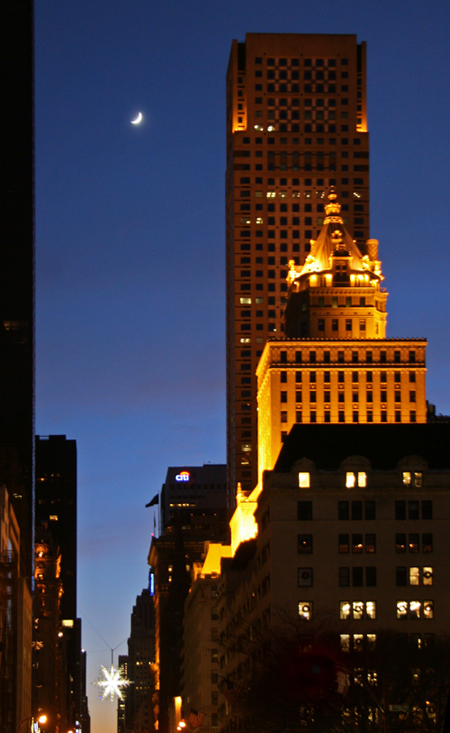
    While walking down Fifth Avenue, I was struck by this perfectly positioned moon, centered on the street above the baccarat crystal star designed by Ingo Maurer and complemented by the sunny gold of the illuminated Crown Building.

    The moon has a lot of competition in New York City, but at times like this, it still manages to get the awed respect it deserves. Friends and I have commented on many a summer or autumn night about a beautiful moon over the city skyline.

    This Christmas, I do not wish for things. There are so many larger problems that loom over and worry all of us all about our economy and world. But fundamentally, I am an optimist and have great faith in the resourcefulness of men and women to repair that which is broken, even in the eleventh hour.

    So today, I wish and believe in better times to come. If you encounter those who say do not be foolish and reach for the sun, the moon, and the stars, tell them you know someone who found them on Fifth Avenue 🙂


  • dinamic_sidebar 4 none

©2026 New York Daily Photo Entries (RSS) and Comments (RSS)  Raindrops Theme