• Mamoun’s

    Falafel has gone from being an obscure specialty to one which is familiar to most across the land. The pita bread sandwich is the vehicle most often used to deliver the deep-fried crusty balls or patties, along with salad and tahini sauce.

    To many aficionados, the secret ingredient that separates the good from the mediocre is the use of fava beans. Falafel originated in Egypt, where it was made with fava beans. As falafel migrated north to areas such as Israel and Palestine, chickpeas were substituted for the fava beans. Falafel is now typically made with chickpeas, fava beans (to a much lesser extent), or a mixture of the two. See my story here on Ful Mudammas, a delectable salad made with fava beans.

    Located on MacDougal Street between West 3rd and Bleecker Streets, Mamoun’s is easy to find. Just look for lines spilling out the door. Mamoun’s is famous, and the number of reviews reflects that – on Yelp.com alone, there are over 400 reviews to date. They were the first to introduce falafel to New York City and one of the first Middle Eastern restaurants in the United States.

    Mamoun’s averages high rankings on most food sites. However, there are naysayers – some of the reviewers who were disappointed with the food were puzzled by the lines. But this is usually easy to explain. Restaurants generally have lines for only a few reasons: hype, food quality, quantity, pricing, and overall value. And although many things are subject to debate about Mamoun’s, pricing is not one of them – a falafel sandwich there is only $2.95, explaining why Mamoun’s has been a perennial favorite of college students.

    The place is primarily takeout, and there is very limited seating. It is a tiny, cramped, and not particularly pleasant shop. Turning out the volume of food that the place serves is nothing short of a miracle. To watch the man scooping small balls of falafel into the deep frier is mesmerizing – the unending production must be a mind-numbing task. The menu features a handful of items.

    Mamoun’s, at 119 MacDougal Street, was opened in 1971. They have two other locations – one in the East Village on St. Marks Place and one in New Haven, Connecticut. Some love the place, others deplore it. Many say there are much better places to get falafel, and yet some feel that a full New York experience cannot be had without at least one trip to Mamoun’s…


  • Criminal Suspect

    Why was I being followed by a police vehicle while driving slowly down Main Street? I was not stalling traffic in any way.  In fact, I was the only automobile going down Main Street in Bristol, Connecticut, the town in which I grew up. I was showing a friend, who was an architect, the tragedy that was Main Street in this factory town. The left side of the street had original structures and was actually charming.

    But the right side had been completely ripped down to make way for a small shopping mall, destroying all future possibility of any historic revitalization of this downtown. I expressed my frustration to my companion of how emblematic this was of the type of thinking – to modernize rather than preserve – that one might have found at one time in towns across America. I think that today there are more examples of preservation of older architecture/districts and the value and positive results in doing so.

    The policeman actually followed us into the shopping mall parking lot and watched us leave the car. It was eerie and scary, honestly. I have a theory of why I was followed, part of which is that apparently anyone perusing the architecture in Bristol, Connecticut, is a criminal suspect, particularly someone in a vehicle with New York license plates.

    Being ostracized for thinking differently is one reason why I moved to New York City. Things have changed, of course, and with the plethora of media and the Internet, perhaps one is less of an outcast for being different in the small town today.

    In New York City, however, with time and effort, you can not only be tolerated but also create a persona and become a small living legend by being different. Whether it is Adam Purple, graffiti artist Adam Cost, streetlamp Mosaic Man Jim Power, Tower of Toys builder Eddie Boros, or gender bender and fashionista André, you can turn eccentricity into celebrity. You can take a singular passion or talent and run with it.

    It can be a very singular interest, perhaps decorating a bicycle over a period of 24 years, like that of Hector Robles in the photo. Hector grew up on the Lower East Side of New York City, on 7th Street between Avenues C and D. He currently lives in Staten Island and makes the journey to Manhattan with a combination of bus, ferry, and subway, toting his bicycle the entire way. The vehicle is in a constant state of flux, a work in progress. Hector, who is of Puerto Rican ancestry, is quite religious, as can be seen by the numerous figures and images adorning his bike.

    I don’t think Hector would fare well in Bristol with his bicycle. I am sure he would be tolerated, but I doubt he would be celebrated. And I hope he wouldn’t be treated like a criminal suspect 🙂


  • Pawns

    New York City is a good place for raising public awareness on any issue. The large populace and spotlight cast on it means that any reasonably sized gathering will garner some attention – if organized well enough, perhaps with TV and media coverage. Union Square has a long history of being a place for demonstrations (see here as well). Washington Square Park has also been a venue for public gatherings, demonstrations, marches, and vigils.

    The story of Shane Bauer, Josh Fattal, and Sarah Shourd was new to me. The three young Americans, all graduates of the University of California at Berkeley, have been detained in Tehran, Iran, since July 31, 2009, when they accidentally crossed an unmarked border during a hiking trip in a scenic area in the mountains of Iraqi Kurdistan. Swiss diplomats, who represent U.S. interests in Iran, were permitted to visit Shane, Sarah, and Josh on September 29, 2009 for the first time. The hikers’ families have not been able to speak with them.

    The press reports appear to make it clear that the three were on vacation with no malintentions and were simply lost in the mountains. A report from the Associated Press says:

    Their case has become the latest source of friction between Washington and Tehran, with Secretary of State Hillary Rodham Clinton, above, appealing for their release. American officials and authorities in Iraq’s Kurdish region say the hikers crossed the border by mistake. But Iran’s state television has said they disregarded warnings from border guards, and an Iranian lawmaker has said they may be charged with espionage.

    The Vigil of Hope took place in Washington Square Park on Sunday afternoon, sponsored by FreeTheHikers.org. It was followed by a fundraiser at Town Tavern. The vigil marked the 100th day that the hikers have been detained in Iran. I find it deplorable that individuals like this are used as pawns in a larger game. I love chess, but I prefer when it’s played with real pawns, not people…


  • Word Freaks

    One of the defining characteristics of New York City is the passion, fervor, and obsession of many individuals in pursuit of activities, some of which might not seem worthy of an adult’s time and effort.
    Most people understand that chess is a serious game – various pieces, each with its own special movement abilities and rules, make it somewhat formidable to the newcomer. And a number of its champions are known to the public, most notably Bobby Fischer.

    But Scrabble is a game that is seen by most as a past time, most often associated with their childhood. A game that can be easily learned and enjoyed by all. To see it taken seriously by adults may come as a surprise. Except in New York City, where nearly everything is taken seriously by someone or some group and where board games are no exception – the perfect activities for a city limited in free space.

    Stefan Fatsis, a former journalist for the Wall Street Journal, took time off from his job to investigate the world of top-level tournament Scrabble. He became obsessed with the game, and the book Word Freak emerged from his more than three years of nonstop Scrabbling. Published in 2001, the book became a New York Times bestseller.
    Fatsis describes the exotic subculture of characters he met in the Manhattan Scrabble Club and in the northwest corner of Washington Square Park, such as:
    G.I. Joel Sherman, a jobless, gastrointestinally challenged, full-time Scrabble player,
    Marlon Hill, an anagramming Malcolm X,
    Matt Graham, a pill-popping stand-up comic,
    Joe Edley, a nonconfrontational human-potential devotee who nonetheless irritates fellow players in his dual role as champion player and National Scrabble Association executive,
    Lester Schonbrun, an armchair Communist who began playing in the early 1960s.

    The northwest corner of Washington Square Park, seen in the photo, has been the haunt of Scrabble players for years. In fact, this area’s use for Scrabble play was taken into consideration in the recent redesign of the park. Here, on the new enlarged stone tables, you will find serious Scrabble players with time clocks, Scrabble dictionaries, and score sheets. World-class championship players can be found among them.
    The Scrabble players in Washington Square Park were also featured in the 2004 documentary film Word Wars.

    What type of people take an ordinary game to the level of obsession? Johns D. Williams, Jr. of the National Scrabble Association says: “Scratch the surface of any champion in any individual sport and you’re often going to find an obsessed misfit who’s deficient in many parts of his life.”
    You have to give up something to be a world-class word freak 🙂

    Note: The Southwest corner of the park is the realm of chess. See Chess Monsters here.

    Related Postings: Good Fortune, Marshall Chess Club


  • Dead Man Walking

    A few years ago, while crossing the intersection at West 4th Street and Washington Square East, I was hit with a glancing blow to my side by a car, swept completely off my feet, bounced off the hood, landed feet first, and continued walking without breaking my stride one bit. I turned while walking and scowled at the driver, who looked like he recognized the massive impending doom to come. But, to his and the onlookers’ amazement, I only kept walking.
    The expectation was, of course, that there would be the confrontation and requisite berating. There would be exchange of personal details, the police, implicit threat of lawsuits, claims of pain, and suffering with symptoms both real and imagined. The fun would be all mine – there could be no defense in hitting a pedestrian. And I was even in the crosswalk, with the walk light in my favor.

    I am not a hero or Superman, only very lucky. After landing on my feet, I just knew instinctively that I was not injured, so why not enjoy a bit of self-righteous arrogant indignation, with the world and perpetrator all on my side? How often does an opportunity like this present itself – to look like a victim and a hero at the same time?

    An anecdote like this does not, however, make a case for walking in the streets with reckless abandon, jay walking, or other pedestrian transgressions. Or walking up the center of Broadway in rush hour traffic, as seen in the photo.

    At times, the sidewalks of Manhattan are jammed with teaming masses and are almost unwalkable. No one likes traffic, and most drivers will strive to take shortcuts and alternate routes to avoid congestion. Often, however, for both the pedestrian or automobile driver, only one road leads to Rome, and we must suffer that route.

    Pedestrians do have other options, though – take it to the streets and walk curbside. This style, along with walking diagonally across streets and through intersections rather than perpendicular at crosswalks, is a good indicator that the individual is a New Yorker. Tourists will rarely walk in such a manner – only when absolutely necessary, but certainly not as the regular habit common with so many city residents.

    For the long time New Yorker on the go, the crawl of pedestrians at rush hour, the hordes of shoppers, and the amble of tourists in awe of our great city are all just irritants. Walking in the streets is the balm to soothe. Many would say that life has numerous irritants, crowds, and traffic, and that dealing with congestion is part of the contract which one signs to be in New York City in the first place. And to flaunt with traffic is to be nothing less than a Dead Man Walking

    Photo Note: This was taken in the evening rush hour from the center of Broadway in SoHo looking north. The Chrysler Building can be seen in the distant center. I do not walk in the center of a street or avenue long or often – in this case, for only a moment to capture the photo. I received no honking horns or other admonitions from drivers.

    “Dead Man Walking” is slang used by prison guards when escorting death row prisoners from their cells to the execution chambers. Dead Man Walking is also the title of a 1995 film starring Sean Penn.


  • Zena


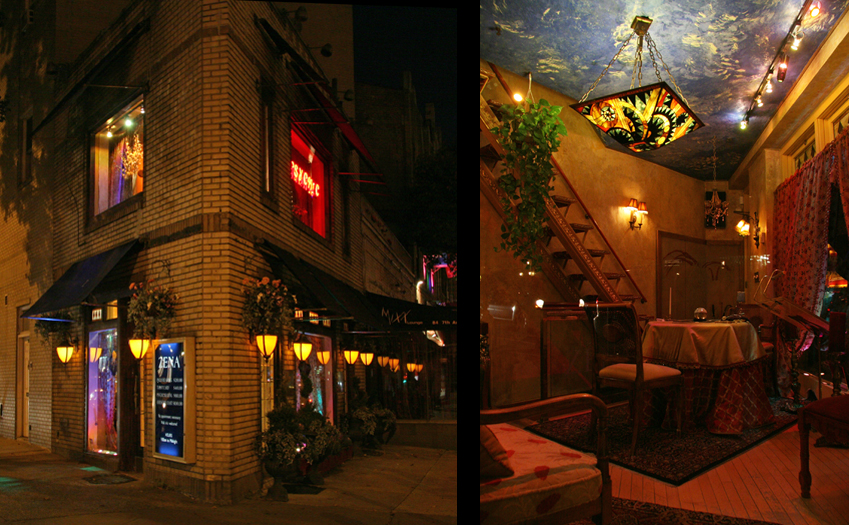
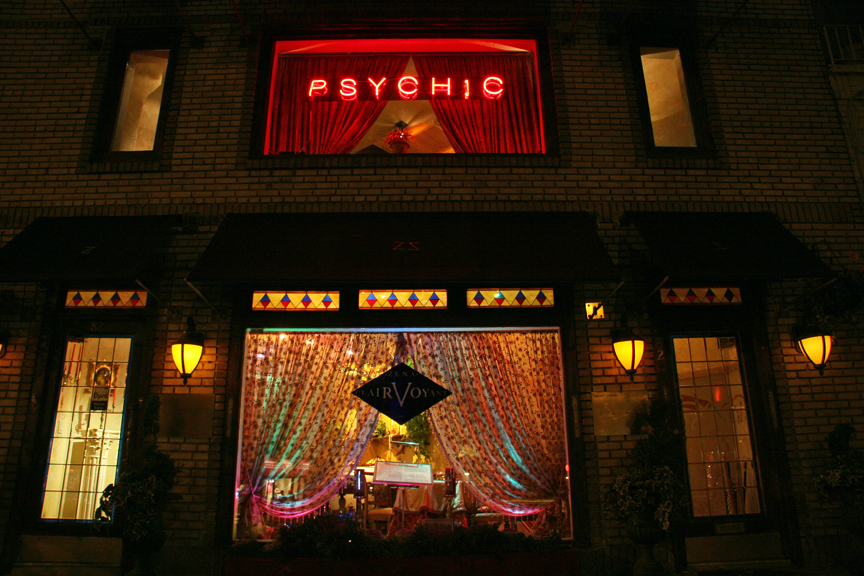
    I love small buildings and small mysteries. Here, at 82 7th Avenue and 301 Bleecker Street in the West Village, there is a remarkable, tiny, two-story building occupied only by Zena and her daughter, Sylvia, who practice their trade as psychic readers. The triangular building dates from 1910 and is only 468 square feet, 234 per floor. The place just exudes charm – windows face both Bleecker Street and 7th Avenue South and allow easy viewing of the interior from the street. A brass placard on the exterior wall says “Zena, New York & Cannes.” See the gallery of photos here.
    I have passed by this shop for decades. It is quiet, with its glowing interior beckoning to me. Last night, it was time to probe this mystery. As fate had it, while shooting from the outside, pressed up against the beveled glass windows, Zena came by to enter her shop and asked if I would prefer taking photos from the inside. I accepted the invitation and entered for the first time.

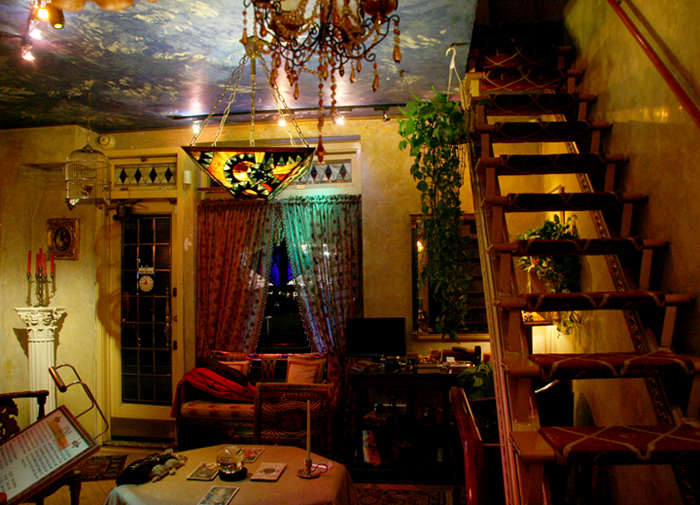
    This is one of the most comfortable small spaces I have ever been in. Everything is arranged and appointed just so. Soft fabrics, lighting, and warm colors are everywhere. There are stained glass lamps, solid brass finishes, and hardwood floors. A small stairway leads to the second floor, where more plush furnishings could be found, including a sofa. Zena told me that Architectural Digest had visited to do a story illustrating what can be done with small spaces.

    I always wondered how such a small enterprise could support a shop in a high-profile, high-rent district. There are many possible answers, but Zena gave me one that made the most sense: she has owned the building for the last 25 years.

    An elegant diamond-shaped sign hanging in the window proclaims “Clairvoyant.” A promo piece with a price schedule below lies below it. I cannot speak to claims of psychic abilities, and I have no experience with Zena or her daughter. For me, it was the mystery of the place that drew me to Zena’s…


  • The Dark Time

    I felt a little embarrassed when I opened a Christmas gift from my late sister and found a travel guide to Finland with a note which said, “Go for it.”
    This gift and note were fueled by my obsession at that time with something I had read – an article about an article. The article, in Whole Earth Review, referenced a New Yorker article regarding the “dark time” in northern Finland – that period of time in the winter where the sun does not rise for two months.

    The New Yorker article (which I never got to read) discussed the culture and how they dealt with this extraordinary situation – lanterns, various activities, etc.
    But as fascinating as all this was, I knew that I would not really travel to Finland in the winter to experience polar nights firsthand. I smiled after I opened that gift, but I felt guilty knowing that I would likely never use it. I still keep the book in my library.

    I am fascinated by extreme environments and how they affect culture, mindsets, etc. In many ways, New York City is an extreme environment, particularly given that four out of five boroughs are on islands.
    Of course, if you are going to indulge yourself in fantasies of heading to the extreme North in winter, a study of maps will be required, something which I am always happy to get lost in. I chose Finland because over 25% of its landmass is north of the Arctic Circle. I looked to the province of Lapland, where the northernmost village is Nuorgam, in the Utsjoki municipality. This is also the northernmost point in the EU. (I recently learned, however, that Knivskjellodden, Norway is further north – the northernmost point on the European continent.) This seemed to be the perfect travel destination for my dream of experiencing the dark time.

    Sunday, as every American knows, was the resetting of clocks to standard time, which means the sun sets an hour earlier than during Daylight Savings Time – currently at 4:50 PM. Not only does this mean that I rise before sunrise, but most of us also leave our workplaces after sunset. Most everyone I have spoken to is not enamored with the shorter days and early sunsets. Every year at this time, I think of the Arctic Circle and days with no sunshine, only twilight.

    Some may find occupying one’s mind with notions of polar nights, the Arctic Circle, and winter in Finland to be rather morose, adding insult to the injury of early sunsets and shortening days. But for me, when I contrast my life here with these remote, northern locales, I am happy that I do not really ever have to live in the Dark Time…

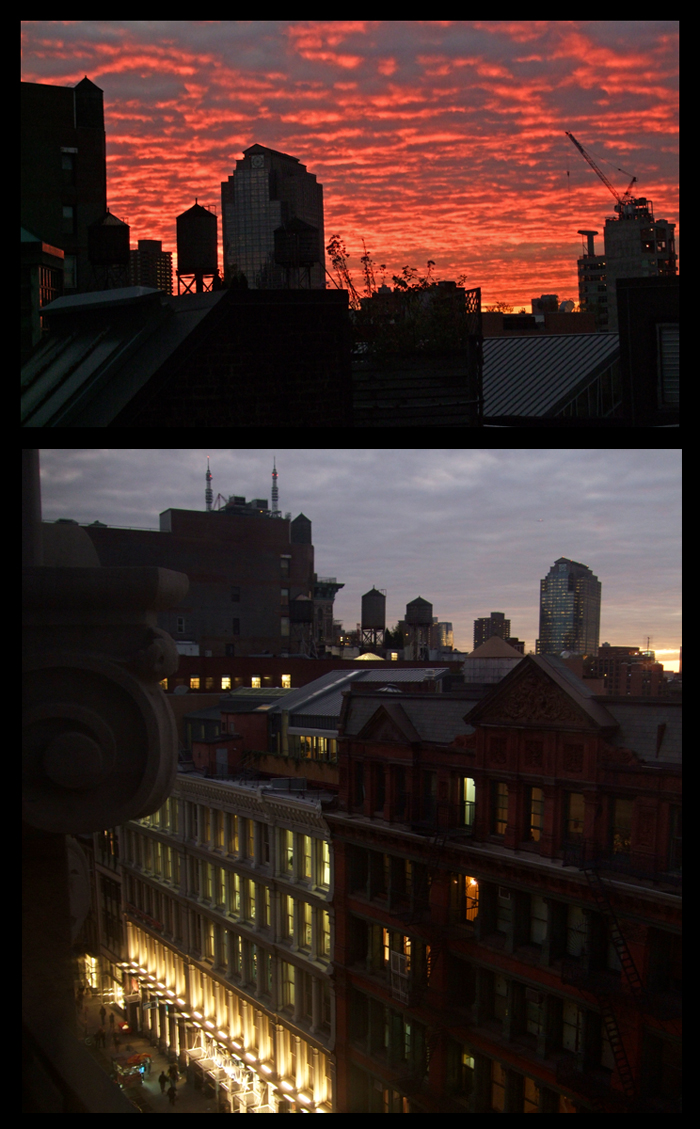
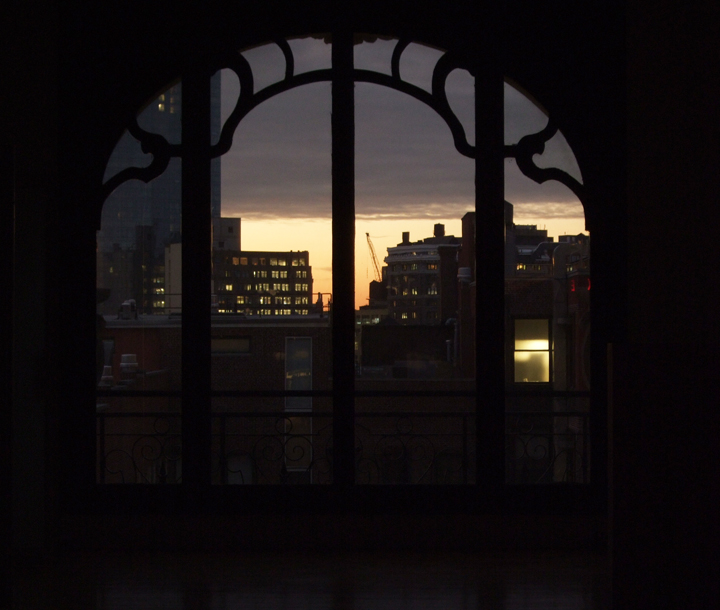
    Photo Note: I was granted access to a vacant floor in SoHo on Broadway with vistas west to the Hudson River. I took a series of photos during and after sunset. The photos were taken between 4:50 PM and 5:09PM. See additional photo here.


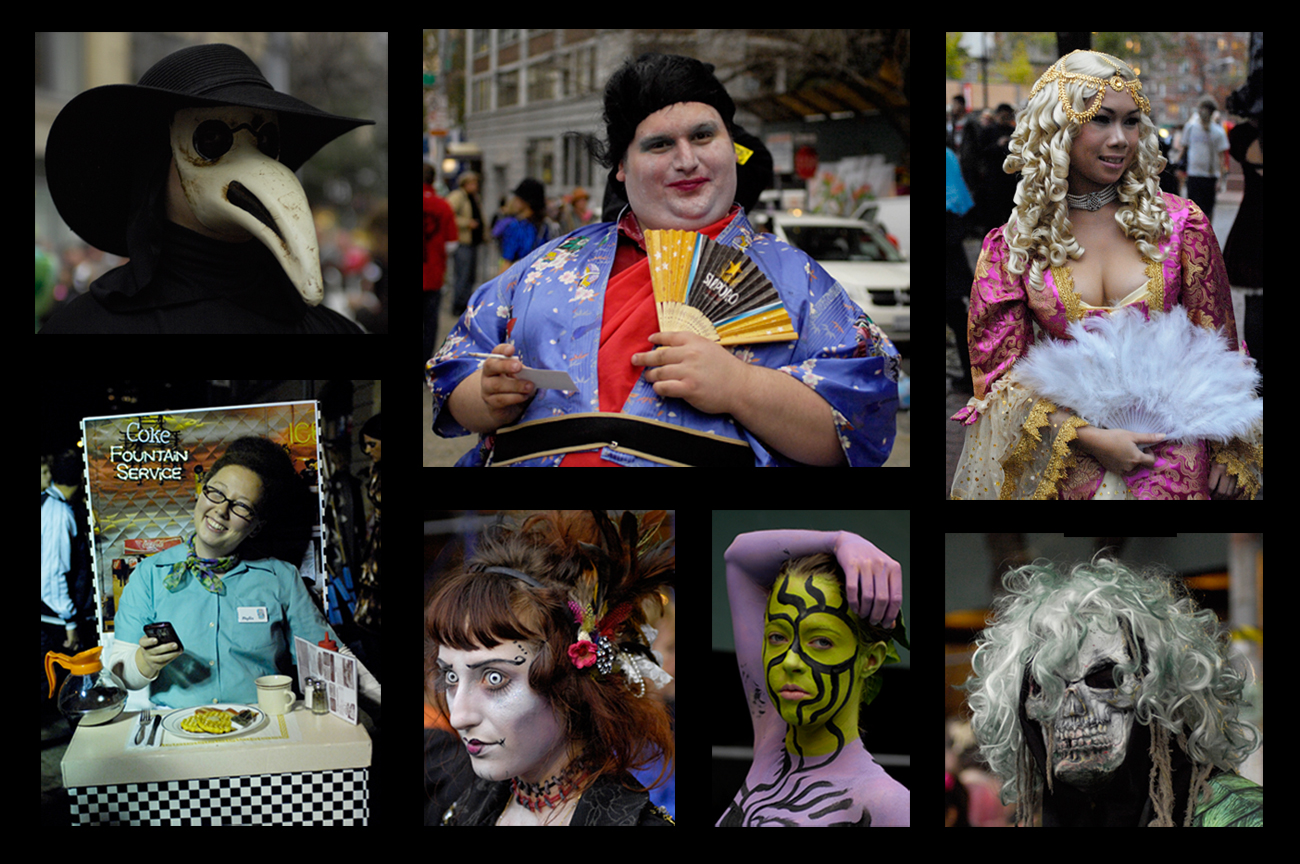
  • Halloween Parade 2009

    Preparations for the annual Village Halloween Parade start at 2 PM, five hours in advance of the parade itself. For more information about the parade and previous years’ photos, see the links below. This year, with the parade on a Saturday, I decided to head to the setup area early in the day. This is actually a good time for perusing and photographing the many participants who arrive early – there are no crowds and still some daylight.

    It was a very fortuitous decision, because as the parade began, slowly did the rain, starting as a light drizzle and building to a rain heavy enough to put a damper on the event. What began as crowds crushing to see the parade became a mass exodus as paraders and spectators began fleeing. I have no idea how many marchers remained, but I imagine a good number were not daunted after all the work and preparations that many put into this yearly extravaganza.

    I did some photography for a short time in the rain, holding a umbrella at the same time, but this quickly became too tedious, with risk of damaging my camera equipment.
    Participating in the parade, either as a photographer or a parader, requires planning and strategy. In all the years I have been to the parade, I do not remember rain. But nature is not guaranteed to cooperate…

    NOTE: A history of the parade, with links and photos from the past three years, can be found on my previous postings: Halloween Parade Preview 2006, Halloween Parade 2006, Village Parade 2007 Preview, Village Halloween Parade 2007, Village Halloween Parade 2007 Part 2, Halloween Parade 2008, Halloween Parade 2008 Part 2


  • Luray Caverns

    My first big family trip was to Luray Caverns and the Blue Ridge Mountains in Virginia. For wide-eyed children, the trip met all of our expectations, with the unexpected perk of Southern hospitality, which we all found so disarmingly wonderful that the family still talks of it today, decades later.

    Of course, after a long ride down, a road stop was in order for a hungry family. There was a spirit of vacation esprit, and I was able to order the deluxe breakfast, which, if I recall, was somewhere in the order of 50 cents and came with everything. My father, whose capacity for coffee knew no bounds, was delighted with the unlimited refills policy, something which he had not experienced before. We were all in heaven and had not even set foot in the caverns yet.

    The commercial cavern was an astounding display of dripstone – limestone formations created by the deposit of minerals which precipitate from dripping water. I learned about stalagmites and stalactites and how to remember the difference (“g” for ground, “c” for ceiling).

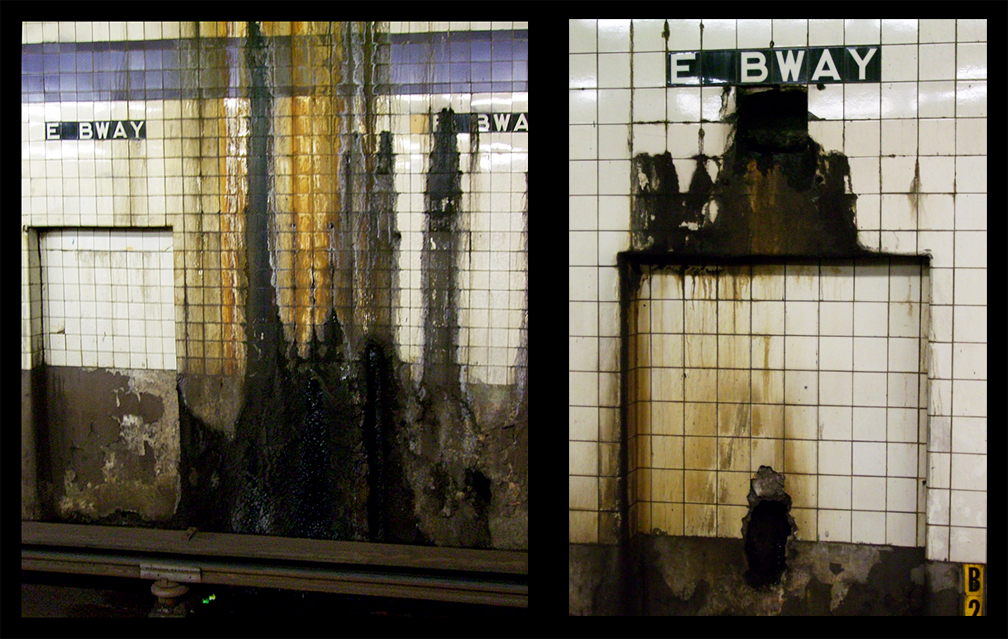
    While looking at the black ooze coming from openings in the hideous walls in the East Broadway subway station while waiting for the F train in New York City, it occurred to me that the same type of mineral sedimentation might be occurring. A conversation with two friends who have worked for a long time at the Transit Authority said the black ooze was a sedimentation of sorts, specifically insulation. They explained the reasons for this in detail – the construction of the walls, tunnels, rainfall, water accumulation, saturation, and oozing.

    The display is certainly not as dramatic or colorful as the world’s renowned show caves, and I doubt that anyone will be running tours. But the black color is so appropriate for a New York City subterranean gothic feel. Our own secret Luray Caverns 🙂


  • Wood, Glass, Brass and Trees

    I could have bought, I should have bought, I would have bought, but instead, I have rented my current apartment for 27 years. Many ask why I have not bought a residence, the quintessential American investment. I hope the photo helps answer that question. This is the view from my apartment overlooking a park. Only a handful of people in a city of millions are blessed with a vista like this every day.

    I overlook Washington Square Park in Greenwich Village, something which no money can buy because nothing is for sale on this square. Most property around the park is owned by New York University – the handful of residential apartments here are all rentals. I am not the only long-term renter on my street; tenants in my building have been here for 30+ years, as have other renters in the few neighboring townhouses which are not university owned.

    There is a very unique situation here in New York City that skews and exacerbates everything: rent regulation. Rent stabilization and rent control laws regulate rent increases, resulting in a market where unregulated apartments have dramatically outpaced rent-regulated ones.

    So, many city residents who have lived here for long periods of time have artificially low rents, often fractions of the market rate. Many assume that rental apartments in prime locations and buildings are extremely expensive and occupied by the wealthy and privileged. This can be true, but often, the ability to occupy such places is more a function of how long a long tenancy than of extreme wealth.

    This is not all that it seems, however, since there is a strong incentive for landlords to do as little work as possible in buildings and apartments where rent stabilization exists. Apartments are typically neglected and in disrepair.

    In my case, I have desperately needed new windows since I moved in, but frequent pleas to the landlord fell on deaf ears. Until this summer, when, for reasons unexplained, a man came to measure and, a short time later, scheduled the installation. Voilà – I had new French windows with solid brass hardware. At last it’s quieter and draft-free. All I see now is wood, glass, brass, and trees…


  • Content Is King

    Here is one secret about New York City: don’t be misled by the user interface, because content is king. In the various stories on this website, I have written of many individuals who have surprised and often awed me once I spoke to them and learned about them. “Don’t judge a book by its cover” has become my modus operandi and not just a hackneyed cliché.

    This extends beyond the skin of people. Institutions, businesses, etc. all have to be approached the same way – look below the surface, if that is where value is to be found. If you prefer the comfort of a Cadillac or plush carpeting, then New York City is probably not your place unless you have lots of money to provide the cushioning and insulation.

    In spite of this, one of the last places where an individual wants to overlook appearances is a hospital. This is a place which provides some of the most important services for the human condition, many of which are life-saving. When it comes to medical treatment, having competent doctors is what really matters – window dressing does not make up for malpractice. But being in a hospital which is showing signs of wear or is dirty or disorganized is not going to help a patient’s confidence.

    I recently visited the Gouverneur Hospital walk-in clinic in lower Manhattan with a friend who had previously been there. The walk itself through an impoverished neighborhood was preparatory. The situation in the clinic was relatively under control – an hour’s wait to see a doctor was to be expected in a walk-in clinic with no appointment on a Sunday afternoon. However, I imagine that those arriving while the front desk was unattended with an “Out to Lunch” sign would not find it heartening, nor would they be assured by the very small cockroach crossing the floor of the waiting room – I believe I was not the only one who noticed it.

    The physician himself was good and, in spite of an overloaded waiting room, did not make us feel rushed, taking the time that was needed. He mentioned that he was moonlighting at Gouverneur and that his regular workplace was New York Hospital Cornell Medical Center on the Upper East Side. I commented that Cornell was like a country club by comparison. He agreed and we both laughed, knowing full well that appearances in a hospital in this city are not a reliable barometer for the medical expertise. In a way, we were both really acknowledging that in New York City, content is king…

    Note: Note the “Out to Lunch” sign in the lower left.


  • Handle With Care

    Don’t give something important to citizens if you ever plan to take it away – people do not respond well to “temporary.” A good example is the rent stabilization and rent control laws of New York City – highly contentious legislation between landlords and tenants, slowly and painfully being phased out. Regardless of very specific historical reasons for such laws and irrespective of whether they are any longer fair or reasonable, the past is now irrelevant to those who are reaping the benefits.

    In 1999, to quell public uproar and facing three lawsuits, Mayor Rudolph Giuliani negotiated to sell 63 gardens to the Trust for Public Land, a national private conservation group. Decades ago, when the city was plagued with urban decay and was in severe financial condition, the city permitted community groups to transform vacant lots into gardens as part of an open-ended agreement. The Giuliani administration ended that agreement by attempting to auction the plots of land to developers, but he ultimately sold the plots to the Trust for Public Land for $3 million.

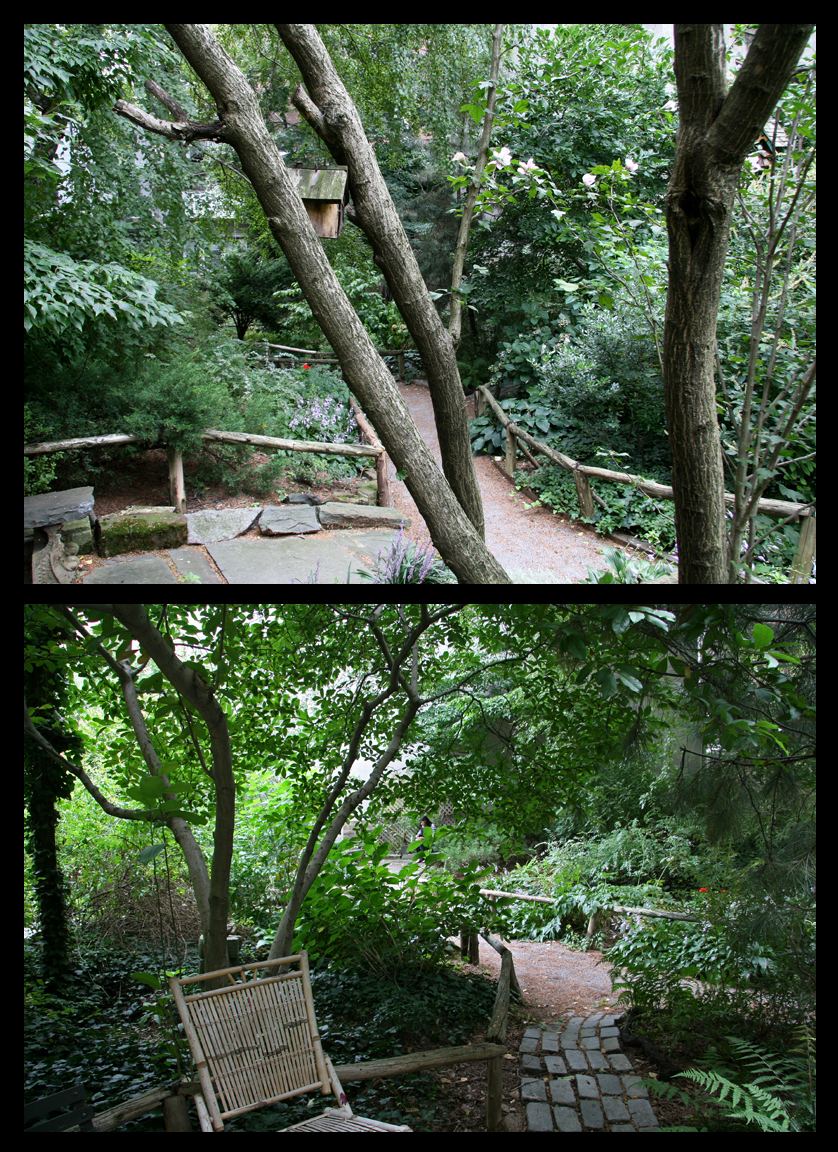
    The garden in today’s photo is the Parque de Tranquilidad, located at 314-318 East 4th Street between Avenues C & D in the East Village on the site of a former synagogue. The garden is located directly across the street from the much larger El Jardin del Paraiso.

    This verdant oasis is carefully and beautifully manicured – it is one of the most meticulously maintained public gardens I have seen. It is a densely planted haven with winding stone pathways, wood fencing, flower gardens, and birdhouses.

    This minipark is arguably the best example of the design work of the late urban garden pioneer Liz Christy, of the Council on the Environment of New York City. Christy is widely known for starting the first New York City community garden in 1973 at Bowery and Houston streets, now named in her honor. TPL expects to convey the entire garden to the Manhattan Land Trust in 2009.

    Not everything can or should be reduced to a business proposition. In a city with so much concrete, park land really provides important respite from the urban environment. To some, seeing prime real estate like this being used as a small park or community garden may appear to be a colossal waste of resources or a lost investment opportunity. But consider that any new housing built here would accommodate very few tenants at market prices. In aggregate, even if all of these gardens were converted to residential properties, they would only house a tiny number of people and make relatively no impact on the housing crisis, which involves those seeking lower cost housing and not the affluent.

    Although a human being has basic needs for survival, the human spirit needs care too…

    Related Posts: Guerillas in our Midst, Shangri-La, Devil’s Playground, La Plaza Cultural Garden, Grapes, Stay Lean Stay Hungry, Urban Oasis, Alberts Garden, West Side Community Garden, Bird Country, Hua Mei Bird Garden


  • Law School

    If you want to be confused and perplexed, try wading through the regulations regarding vending on the streets of New York City. If you want to be disheartened, try looking at some of the facts and figures regarding the vending of merchandise. And if you want to be discouraged from earning a living this way, look at the costs of vending, fines, confiscation of goods, and the uneven application of the law.
    Welcome to the circle of confusion: the world of street vending, where laws are difficult to understand by both vendors and police alike.

    In this economic climate, jobs are difficult to nonexistent. Street vending is a way to earn a living and, for some, a way into the world of business. The costs involved in setting up a retail establishment are prohibitive in New York for most individuals. Many well-known businesses in New York City started on the streets, such as Bloomingdales, Macy’s, Cohen’s Fashion Optical, and Goldman Sachs.

    There are approximately 12,000 street vendors in New York City. There are four categories of vendors: food vendors, general merchandise vendors, veteran vendors, and First Amendment vendors, who may sell newspapers, magazines, cd’s, books, and art on the street without a vending license. There certainly are abuses with First Amendment vendors – a lot of merchandise is sold under this class to avoid the difficulties in dealing with vendor’s licenses and permits, which are extremely difficult to get and have created a black market.

    It is virtually impossible in New York City to get a general merchandise vendor’s license. In 1979, City Council created a cap of 853 on the number of merchandise licenses. There is such a long waiting list that the Department of Consumer Affairs has not taken new names since 1992.

    Food vendors need a license, on which there is no limit. However, they also need a Department of Health permit, which are limited at about 3,000 city-wide. Lotteries are held every few years to distribute any excess permits, but the average wait is still many years. Many food vendors who do not have their own permits enter into relationships with permit holders to use their permits for a fee. There are no limits on veterans’ permits.

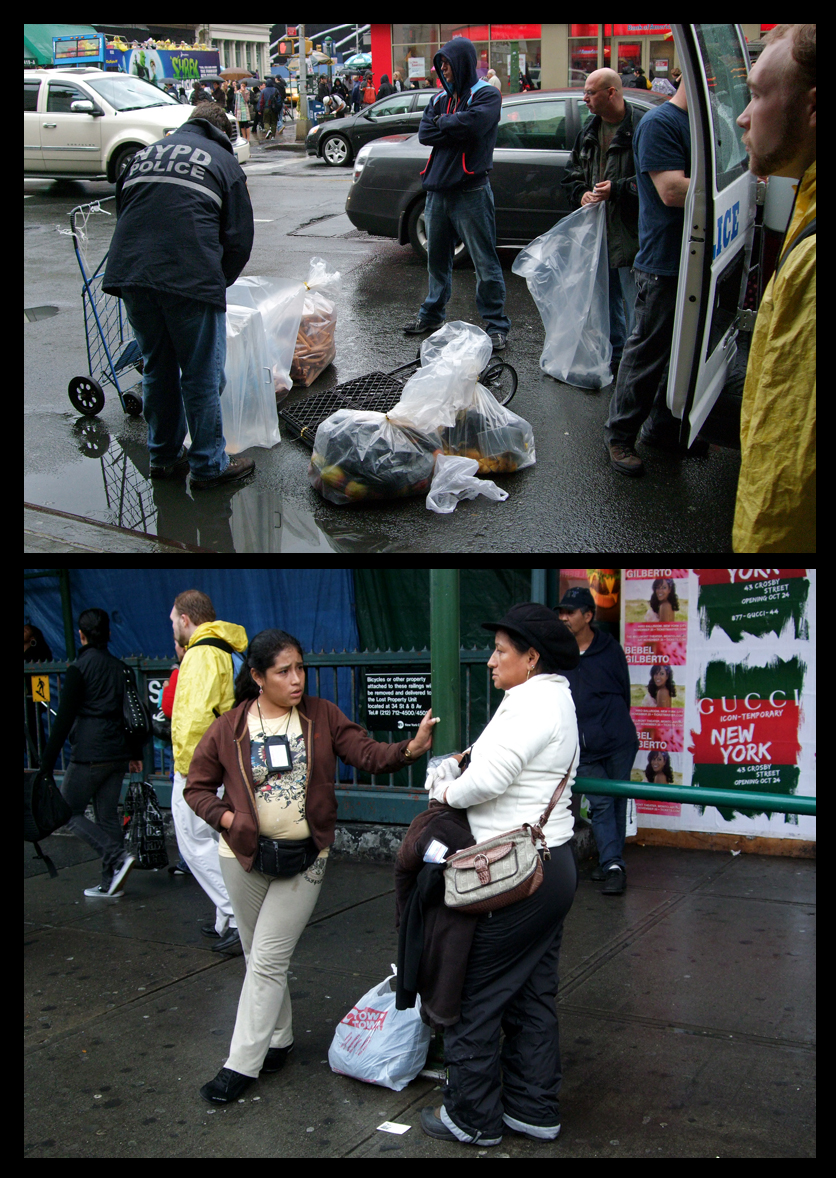
    The women in the photo (on Canal Street) had a vendor’s license but not a food permit to sell fruit. In addition to fines, their merchandise was hauled away by the police. Each year in New York City, approximately 50,000 tickets are issued and 7,000 vendors are arrested. In 2005, the Bloomberg administration raised maximum fines from $250 to $1000.

    There are regulations regarding where and how you can sell: The sidewalk must be at least 12 feet wide (veterans are exempt), and you must be at least 20 feet from any store entrance, 10 feet from a crosswalk, 5 feet from a bus shelter, 20 feet from a sidewalk cafe, and less than 18 inches from the curb. You can not set up over a ventilation grill or touch a fire hydrant or lamp post. There are also regulations regarding the vending table’s size as well as other details. See here for a brochure outlining the facts and regulations.

    Everything considered, a little more money and study will get you a civil service job or admission to law school 🙂


  • No Students After 1

    I would guess that you will not find another sign like this in New York City. Students are typically afforded privileges, and their regular business is encouraged – student loans, student discounts, etc. (These days, student discounts are ironic. In New York City, many students appear to be better off than many of the residents.)

    In the garment district, you will often see signs which read “wholesale only” – a warning that business is open only to manufacturers and the trade, not to retail customers. This is strictly a business issue – merchants posting signs such as this one work on smaller profit margins and are not interested in selling a yard or fraction of a yard of fabric. They cater to those who buy one or more entire bolts of fabric at discounted pricing.

    Being a wholesaler/distributor in the city, however, poses a unique problem for many vendors since they often occupy ground floor spaces on streets with retailers and foot traffic. Even neighborhoods which at one time were predominantly commercial or industrial now have many residential tenants and visitors.

    At Kaufman Shoe Repair Supplies at 346 Lafayette, even though the business caters to the shoe repair industry, many of the products are of interest to the consumer or art student and are sold in sizes and quantities reasonable to someone outside the trade. Items such as foam crepe rubbers, specialty leathers, dyes, and adhesives are virtually nonexistent elsewhere in the city.

    Kaufman opens at 6:30 AM and closes at 2 PM. In their final hour of business, there is no time for casual shoppers and perusers of merchandise. You must know what you want and not make it difficult to service regular accounts who come just before closing. I have done business with Kaufman from time to time over the last 30 years and have found them professional and helpful overall.

    I am reminded, however, of an incident which is indelibly branded in my mind as one of the most hostile retail encounters I have ever witnessed in New York City. I was waiting for service in a very busy lumberyard whose core business was the contracting trade but was certainly open to retail. Dealing with customers who are often unsure of what they want or what they are doing can be tiring to someone accustomed to tradespeople who know exactly what they want, and one salesman in particular was at the breaking point. With a room full of customers, he glared at an individual who was asking too many questions and said, “Sir, this is not a f**king university! If you don’t know what you want, leave.” I wonder, would this mean no students after 1?


  • The Ear Inn

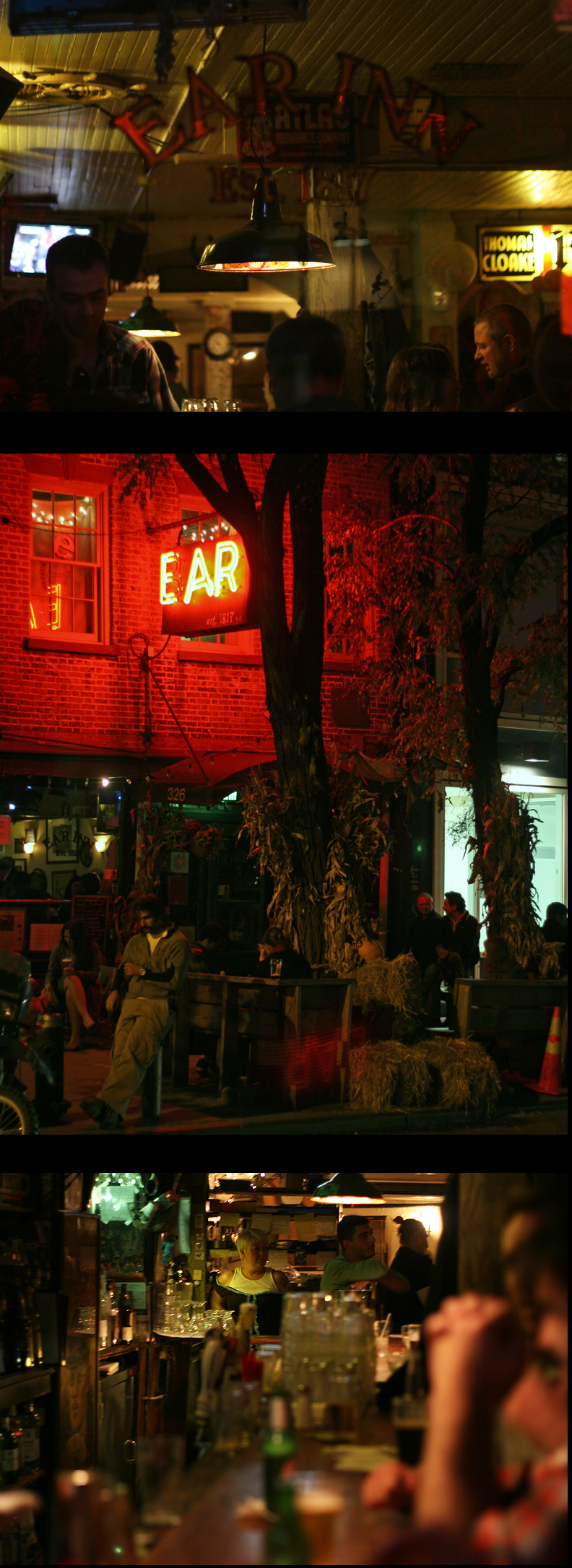
    One of the best ways to experience Olde, intimate, atmospheric New York is to visit its vintage bars. There are a number vying for the title of New York City’s oldest, such as Fraunces Tavern, Pete’s Tavern, and The Ear Inn, located on the ground floor of the James Brown House, a historic landmark listed on the National Register of Historic Places. See more photos here.

    The James Brown House is one of the very few Federal houses left in the city. It is in largely original condition of 2 1/2 stories with dormers, double splayed keystone lintels, and a gambrel roof. The construction is all wood posts and beams set with pegs, with a facade of Flemish bond brick. The restaurant doors and window are late 19th-century. The panel to the right of the main door is a night shudder cover to the original shop window, an 18th-century-style feature unique to this building. Once there were cellar windows and fireplaces in the bar area.
    It was built in 1817 for James Brown, a prosperous African-American tobacco merchant, reputed to have been an aide to General Washington during the Revolutionary War.

    At the time of its construction, the house was only five feet from the Hudson River shoreline. After James Brown’s death, the city was booming with ship traffic. The river was filled out to West Street. New piers were built and rebuilt ever larger. From Spring Street, ships left for California, China, and Hoboken. The proximity to the water made it popular with sailors and longshoremen. It had a brewery that was later turned into a restaurant.

    The property changed hands several times. In 1890, it was purchased by an Irish immigrant named Thomas Cloke. Cloke sold the business in 1919 in anticipation of the Eighteenth Amendment to the United States Constitution, which prohibited the sale of alcohol. During Prohibition, the restaurant became a speakeasy, while the upstairs apartment was variously a boarding house, a smugglers den, and a brothel. Ghosts have been heard and seen, in particular, “Mickey,” a sailor still waiting for his clipper ship to come in. Read more about the bar at its website here.

    One of the most interesting features of this place is the sign. A Columbia University student, Rip Hayman, rented a room in the house in 1973. In 1977, Hayman and friends bought the building and christened it the Ear Inn after a new music journal, The Ear, which was published upstairs. To avoid the Landmark Commission’s lengthy review on changing signage on historic buildings, portions of the letter “B” in the neon BAR sign were painted black to read EAR…


  • dinamic_sidebar 4 none

©2026 New York Daily Photo Entries (RSS) and Comments (RSS)  Raindrops Theme