• Crossing Delancey

    Subcultures have their own languages, and the art community is no different. Over time, I have been privy to bits and pieces of artspeak, with words such as iconography, a word not often used outside the world of the arts. I say bits and pieces, because the special vocabulary is not wasted on the outsider, and perhaps there is even an element of secrecy, lest we learn enough to do an effective job of posing as one who is knowledgeable in the arts, thereby diminishing the special and exclusive nature of the “club.”

    I recall once trying my hand at creative design for my business. Upon presenting it to an artist friend, I was immediately told, in a very critical way, that my efforts did not have to be so literal – a new use of the word for me.

    I must admit, however, that I liked that use of the word and have added it to my arsenal of word weaponry, to be used when necessary. Recently, while crossing Delancey, the film of the same name came to mind, and it occurred to me that taking a photo would be an opportunity for a literal interpretation of the film’s title. Perhaps an art faux pas, but my photography is not being subjected to an art school group crit (see a New York Times article here).

    Literally crossing the street can be an undertaking – Delancey is a major thoroughfare with eight lanes extending from the Bowery to the Williamsburg Bridge, which crosses the East River to Brooklyn.
    The Delanceys were a rich, pre-revolutionary French Huguenot family. Their large estate became what is now the Lower East Side. Read more about the history of the neighborhood here at the New York Songlines website.

    At one time, until the 1920s, Delancey Street was a high-end shopping district. Over time, however, Delancey fell on hard times, and the character of the businesses changed, becoming the primary shopping district of the Jewish Lower East Side, known for discount merchandise and businesses such as Ratner’s Kosher Restaurant (closed 2002), the Bowery Ballroom, and the Essex Street Market.

    Delancey Street is also the site of one of my earliest postings in 2006 – the Live Poultry Market.There has been some gentrification, and the neighborhood is now a blend of older shops, a smattering of Chinatown and discount merchants, and newer retailers and night clubs.

    The film Crossing Delancey is the story of Isabelle, an Upper West Side Jewish resident, who, matched to a pickle maker on the more ethnically authentic Lower East Side, finds love crossing to the south of Delancey Street, literally 🙂


  • Street Poet

    If you were guiding a young person and making a list of things not to plan on doing for a livelihood, writing poetry would be somewhere near the top. So, poets must think out of the box and, in doing so, take it to the streets. There are many benefits to taking your writing to the sidewalks of New York City: no persuading agents of the merit of your work, you receive 100% of the proceeds, and payment is immediate.

    And often, skills and arts honed on the streets, for an audience of passersby who are cynical and jaded, will fare well in a more conventional venue. Many well-known performers worked the streets early in their careers. Their material is the product of sifting out the unsuccessful material, leaving that which grabs and holds an audience, frequently with many other options.

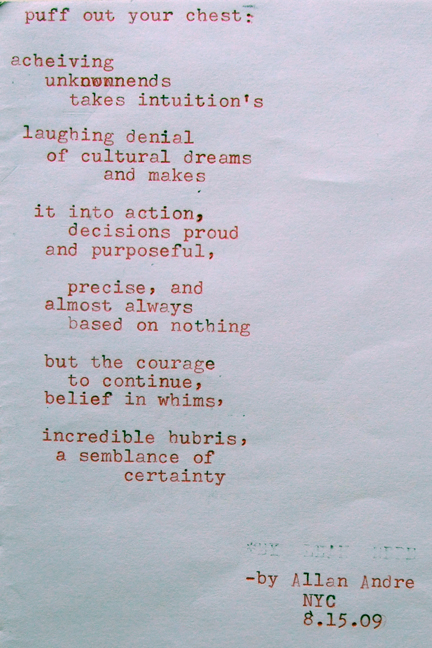
    Allan Andre hails from New York City. Online searches, however, find him plying his trade in other locales, including San Francisco. I met him in Washington Square Park and offered the subject “indecision.” Only some minutes later, typing away on a manual typewriter with a carbon copy, he offered me his poem. I made a contribution. See the text of my poem here.

    As novel as this enterprise may sound, Allan is not the first or only to try his hand at Poetry While You Wait. Only a few blocks away, on University Place near Union Square, is the Poem Shop of Anayvelyse. German poet William Chrome was also found on the streets of New York City.

    Outside of New York, Typing Explosion was a Los Angeles team of three who wrote poetry with the audience choosing titles. They worked regularly from 1998 to 2004. Zach Houston worked in San Francisco and inspired William Chrome to do the same in New York.

    I recall reading a quote by a former French President that he could not imagine going to bed at night without reading some Verlaine. Difficult to imagine this as de rigueur for many of our former White House residents. But perhaps the proliferation of street poets is a harbinger of times to come…

    Interesting Note: If you type “Verlaine” into Wikipedia, the search only returns Verlaine, the municipality in Belgium. To get the poet, you must enter Paul Verlaine. Is this the result of a poor search engine or commentary of the importance of poetry? 🙂


  • Mulberry Street


    I so looked forward to my visit to Aix en Provence in the South of France. Everything I had read spoke of it as the quintessential cafe society experience. In New York City, there is a limited amount of quality street side cafe or restaurant seating. In most cases one must suffer the slings and arrows of anything and everything that passes by. Often, tables are placed on sidewalks much too narrow for adequate separation; the sense is that you really are eating on the street. Diners are often accosted by panhandlers and the like.
    So for a New Yorker, Aix was paradisaical – wide sidewalks and a clean environment. However, this is Mulberry Street in the heart of Little Italy. Beginning in 1996, three blocks from Broome to Canal Streets are closed to vehicles during the summer months, turning the street into a pedestrian mall. In September, the street is closed for the annual Feast of San Gennaro festival.

    Outdoor seating for restaurants and cafes line Mulberry Street. Restaurant barkers solicit business from passersby. Add heat to the equation, and it will take a certain je ne sais quoi to enjoy eating in this zoo-like atmosphere.

    A visitor to the area will also find the surrounding area dominated by Chinese merchants. Neighboring streets (such as Mott Street, one block east of Mulberry) have seen the encroachment of Chinatown. Little Italy has become essentially a small pocket of nostalgia, a virtual postcard snapshot of this historic neighborhood.

    I cannot heartily recommend any particular restaurants here (or eating on the street). If you choose to try something on the street, I recommend eating guides such as the Zagat Survey or Yelp. Many residents pan the eating establishments here, but there are endorsers – in 2004, Mayor Rudy Giuliani cited Da Nico as his top pick for Italian in Little Italy. And yes, there has been Mafia mob presence on the street, as well as scandals.

    If you have not been down Mulberry Street during the times it is closed to traffic, I do recommend a summer evening stroll where you can walk among the teeming masses. For an online virtual walking tour of Mulberry Street, go here to New York Songlines…

    Photo Note: There is a very enjoyable book, New York Then and Now, which shows specific New York City locales using two photos, one earlier in time and one taken at the time of the book’s publishing. In this spirit, today I have added a second archival photo showing a stretch of Mulberry Street, circa 1900.


  • Double Your Pleasure

    In America, we love numbers, bargains, more, and doubling. Two is such a convenient multiple for the real world – double your pleasure, double your fun, double your money, double your results, double down, double trouble.

    Washington, D.C. was the first big city I visited, and the Washington Monument was the first tall structure I ever saw. My obsession with it knew no bounds. I had many facts memorized, such as that it was 555 feet tall and 55 feet across the base.
    One of the beautiful things about the Washington Monument is positioning near the Lincoln Memorial Reflecting Pool. I love gazing in it and seeing the monument’s reflection, getting a visual bargain: two images for the price of one.

    When I moved to New York City, Greenwich Village was my first home, and the Washington Square Arch became the natural and perfect object for transference of my monument fixation. It was not as tall, but it was white, stone, also named after our first president, and had a lot of its own history and character. It also became a symbol for the neighborhood, with its bohemian and iconoclastic history, of which I believed myself a member.

    In the previous design of Washington Square Park, prior to its recent renovation, when the fountain was turned off, the water would drain completely within minutes. However, the new fountain’s system recirculates the water, and after being turned off (at approximately 10:30 PM), a shallow pool several inches deep remains. If the wind is light, the water stills and in a short time becomes a wavy mirror, reflecting the arch, any individuals sitting on the perimeter of the fountain and, if you are positioned correctly, the added bonus of the Empire State Building framed inside the arch itself.

    If you’re in Greenwich Village at night, take a stroll by the fountain, and the odds are very good that you may double your pleasure 🙂


  • Xiangqi

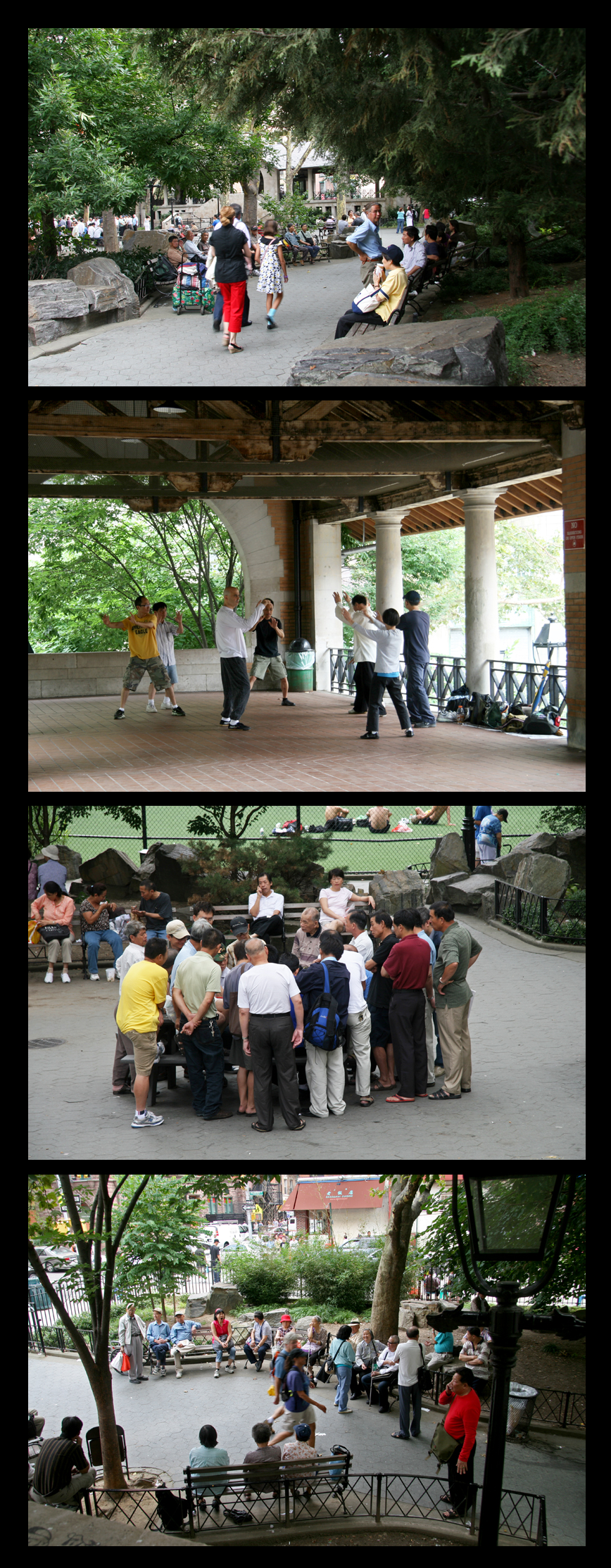
    If you want a full cultural immersion experience, head to Columbus Park on a Sunday in Chinatown. This tiny park is Chinatown’s playground, home to a wide gamut of traditional Chinese recreational activities. Here, you will find people doing Tai Chi or practicing martial arts in the pavilion, playing folk music, displaying caged birds, singing Peking Opera, women playing mahjong, and hundreds of men engaged in numerous games of Xiangqi (Chinese or elephant chess). You may find cobblers, watch repairers, and fortune tellers. There is also a children’s playground and basketball courts. See more photos here.

    Columbus Park is one of the city’s first major urban parks (the park has alternatively been named Mulberry Bend Park, Five Points Park, and Paradise Park). The 3.23 acre park was planned in the 1880’s by Calvert Vaux, co-designer of Central Park, and opened in 1897. It was named Columbus Park in 1911. Read more about Columbus Park at the New York City Parks Department website here. From their website:

    It is situated in the heart of one of the oldest residential areas in Manhattan. The southern end is adjacent to the infamous “Five Points.” Until 1808, the site for the park was a swampy area near the Collect Pond (now Foley Square) and hosted a set of tanneries. In 1808 the pond was filled and became Pearl Street. When the filling began to sink, a foul odor emerged which depressed the living conditions of that neighborhood. As a consequence, the area became host to one of the world’s most notorious tenements, known for its wretched living conditions and rampant crime, earning such names as “murderer’s alley” and “den of thieves.”

    This notorious slum, Five Points, was dominated by rival gangs such as the Roach Guards, Dead Rabbits, and Bowery Boys, a central subject of the book The Gangs of New York by Herbert Asbury, published in 1928. This, in turn, inspired the 2002 Martin Scorsese film, Gangs of New York.

    To survive in New York City, unless you have enormous wealth to buffer the harsh environment, you must learn to be resourceful. Ethnic immigrant groups find ways to import their cultures. Regardless of how inhospitable the city might be or incongruous the activity, New Yorkers improvise, adopt, and adapt. The Chinese have done that remarkably well…

    Location: Columbus Park is located one block south of Canal Street and one block west of Mott Street in Chinatown. It is bounded by Baxter, Mulberry, Bayard, and Worth Streets.

    Related Postings: No MSG, T?t, Big Buddha, Hallmarks and Earmarks, Durian, At Arm’s Length, Year of the Rat, Pearl River Mart, Buried Treasure, Tea Time


  • Tic-Tac-Toe Playing Chickens

    Spoiler: This story has a happy ending.

    The sign in this photo at the Chinatown Fair at 8 Mott Street, is missing a very critical word: Chickens. The sign used to read “World Famous Dancing & Tic-Tac-Toe Chickens.” Since the 1960s, a number of dancing and tic-tac-toe playing chickens have been home here. Chinatown Fair was originally a museum. In Manhattan’s Chinatown (2008) by Daniel Ostrow, there is a 1958 photo showing Chinatown Fair located at 7-9 Mott Street with an amusement arcade. Reference is made to Clarabelle, a scientifically trained chicken. According to the book, she was trained to play tic-tac-toe when Chinatown Fair relocated across the street to 8 Mott Street. The shop evolved to a gaming shop; today it is a popular video gaming arcade.

    According to a story in the New Yorker from 1999, chickens were trained in Hot Springs Arkansas, by Animal Behavior Enterprises, started by Keller and Marian Breland, both psychologists. After Keller’s death, Marian married animal trainer Bob Brailey. Dr. Marian Bailey was one of B. F. Skinner’s earliest graduate students.

    Animal Behavior Enterprises trained chickens to walk tightrope and trained dolphins for Marineland. In the 1970s, the Bailey’s produced a couple hundred “Bird Brain” chickens who, with the assistance of a primitive version of a computer, could play tic-tac-toe without losing. One was installed in Chinatown Fair in 1974.
    There was also a Dancing Chicken, which was a sadder situation – claims have been made that it danced because of electrical shocks to a metal plate on which the chicken stood.

    But the real attraction was the tic-tac-toe playing chicken. For fifty cents, you could match your wits against the chicken. The chicken was housed in a glass cage which taunted, “Can you Beat This Bird?” Backlit letters indicated “Your Turn” or “Bird’s Turn.” If you won, you got a bag of fortune cookies.

    The New York Times ran a story in 1993 about a chicken named Willy when he died in a heat wave after two years of service, replacing a previous chicken that lived to be eight. The owner was uncertain about replacing the bird, but a tic-tac-toe playing hen named Lily did eventually appear.

    In 1998, there was an article in the Poultry Press which tells the story of the release of Lily, the last tic-tac-toe playing chicken. The rescuer, in a plea to owner Mr. Samuel, was able to win Lily’s release on January 29, 1998. After a few days in the rescuer’s apartment, Lily was moved to Massachusetts to live with other rescued animals. Read the story here.

    Chinatown Fair no longer has any dancing or tic-tac-toe playing chickens 🙂


  • Coup de Grâce

    Irrespective of my interest in photography, sometimes I forget that we live in a world of color. This is easy – it is a full time job to take in all the sights and sounds of this great city. However, on occasion, a color op takes you by surprise and demands attention.

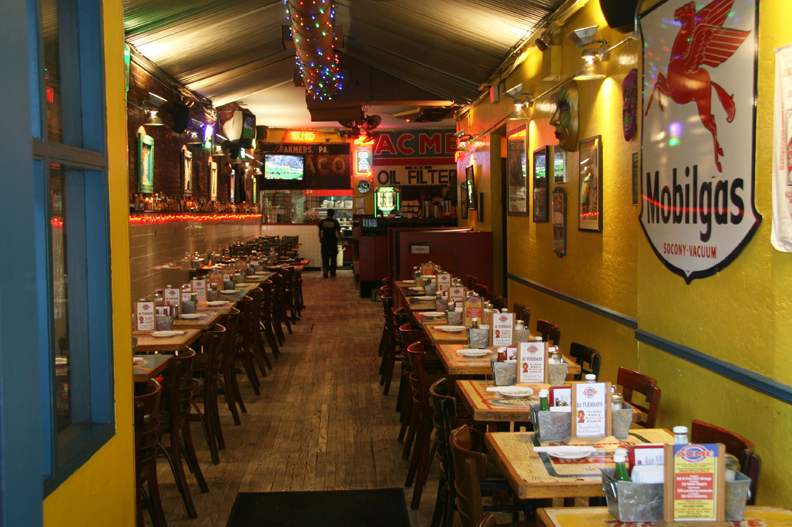
    And so it was on Sunday morning, passing by the Acme Bar and Grill at 9 Great Jones Street, where a number of elements conspired in a riot of color.* Early morning, before businesses start, is often a great time to visit a restaurant. Everything is clean and tidy before the masses arrive.  See the interior here.

    I entered to inquire about the aqua blue Chevrolet truck, assuming, like Caliente Cab, that this was an intentional decorative motif. It turns out that the truck was an employee’s vehicle. I complemented the staff member on the arrangement, but I received a rather nonplussed response – he was unaware of the fortuitous combination of elements that made their establishment so photo worthy.

    This was a tribute to reds and blues. Even the parking sign cooperated with its red lettering, as did the scaffolding and pink fire escape. And, unbeknownst to him, a man nearby with an aqua shirt provided the final coup de grâce…

    *Note on Riot of Color: Fellow photographer Bill Shatto shares a love of color – the phrase “riot of color” has become a frequently uttered pronouncement on our urban travels.

    Related Postings: Tale of Two ColorsHispanic Day Parade, Color Brigade, Flamboyant, Building Gone Wild, That’s Quite a Briefcase,  Fashion Forward, Taste,  Krishna Festival, Police Riot Concert, Narcissism Gone Wild, A Colorful LifeWho See the Red


  • The Tombs

    I’ve never been in prison. I never want to be in prison. And I certainly don’t want to be in a New York City prison called the Tombs.
    I visited the Tombs on Sunday at midday. Why I would do such a thing is a different story: I was in the neighborhood.

    No one looked happy at the detention complex, and there is no way to give this place a happy spin. I spoke to several corrections officers – all polite – but I could sense an air of incredulousness of why I would be there on Sunday, taking photos and asking questions. Virtually every New Yorker has heard of the Tombs, but why would anyone really need to know exactly where or want to visit?  I had never seen the buildings and was curious. So after numerous inquiries (and incorrect directions), I finally arrived at 125 White Street, the home of New York City’s Manhattan Detention Complex, aka The Tombs.

    Like many New Yorkers, I assumed that the colloquial name was given perhaps because the jail facilities are underground or some other grim reality. This is, in fact, not the case. The complex was nicknamed the Tombs after its first structure, built in 1838, designed by John Haviland and based on an Egyptian mausoleum. This complex occupied a full city block and was called the New York Halls of Justice and House of Detention.

    The Tombs has gone through several incarnations: the original from 1838 was replaced with a new building in 1902 and connected to the neighboring Criminal Courts Building by the Bridge of Sighs. That building was replaced in 1941, and in 1974, due to health and security problems, part of the building was taken down and replaced with a new structure. The current complex consists of two buildings connected by a pedestrian bridge: the North Tower from 1990 with 500 beds (seen in the photo) and the South Tower which incorporates part of the original 1941 building.

    The various warnings to visitors posted on the entrances made clear the harsh realities and no-nonsense atmosphere inside:

    POSSESSION
    OF
    CONTRABAND
    (WEAPONS)
    RAZORS KNIVES SHANKS SHIVS BULLETS
    And any other weapon capable of causing injury and/or
    otherwise endangering the safety of the institution
    WILL RESULT IN YOUR IMMEDIATE
    ARREST

    Other prohibitions include chewing gum, electronic devices, camera, mirrors, aluminum foil, pencil sharpeners, glass, and mace. I got the message, loud and clear.

    Many believed, as I did, that this is strictly a detention center, housing those arrested until arraignment. However, I was told that many are here for months or years and that this complex operates as a prison.
    My advice to residents and visitors: stay on the outside…

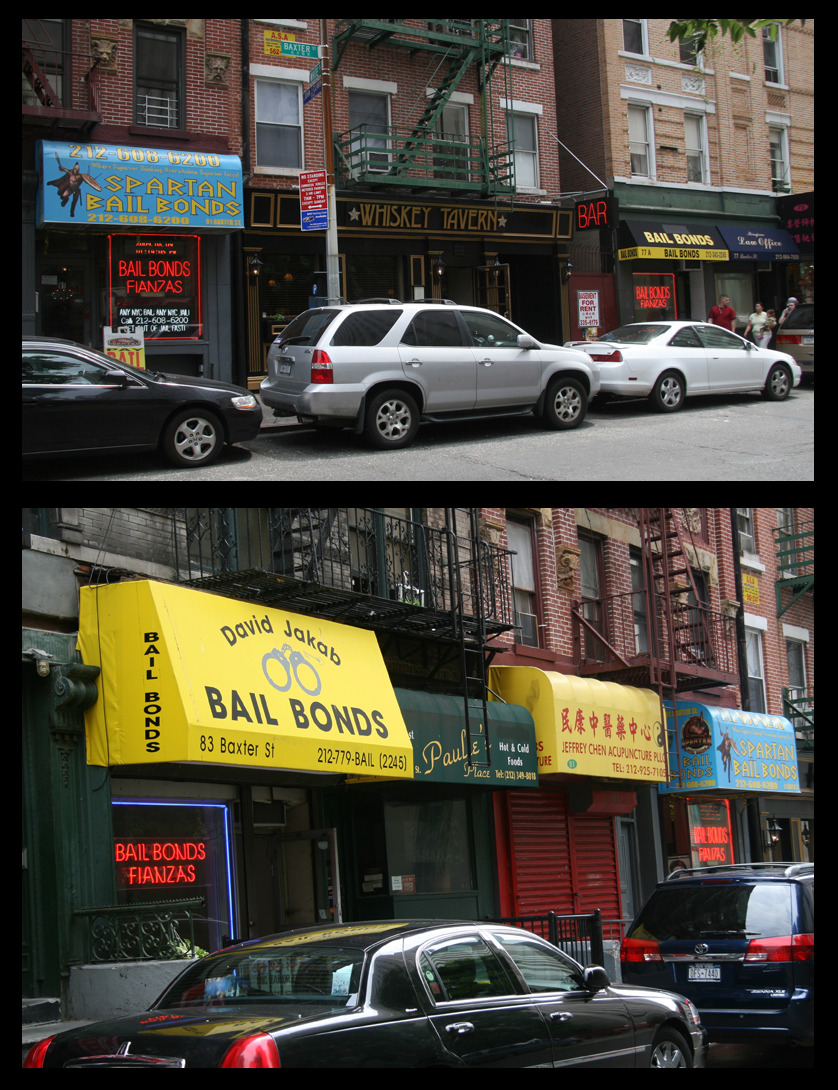
    Note: As one might expect, services for those apprehended were next door on Baxter Street. I found it interesting that sandwiched between three bail bondsmen and a law office was a whiskey tavern. See photos here.


  • Gallivanting

    When I was young, a popular refrain from my mother was, “No daughter of mine will be gallivanting all over town.” This meant my sister, of course, who was easily bored and quite social and mobile at a very young age, earning herself the nickname “the roadrunner.”

    So I grew up believing that gallivanting must have been an accidental omission in the list of deadly sins or biblical commandments. Certainly there was nothing worse than to gallivant – the mere expression of youthful freedom appeared to be a mortal sin. Let’s not even imagine the things a girl might actually do while gallivanting. Even worse, at night.

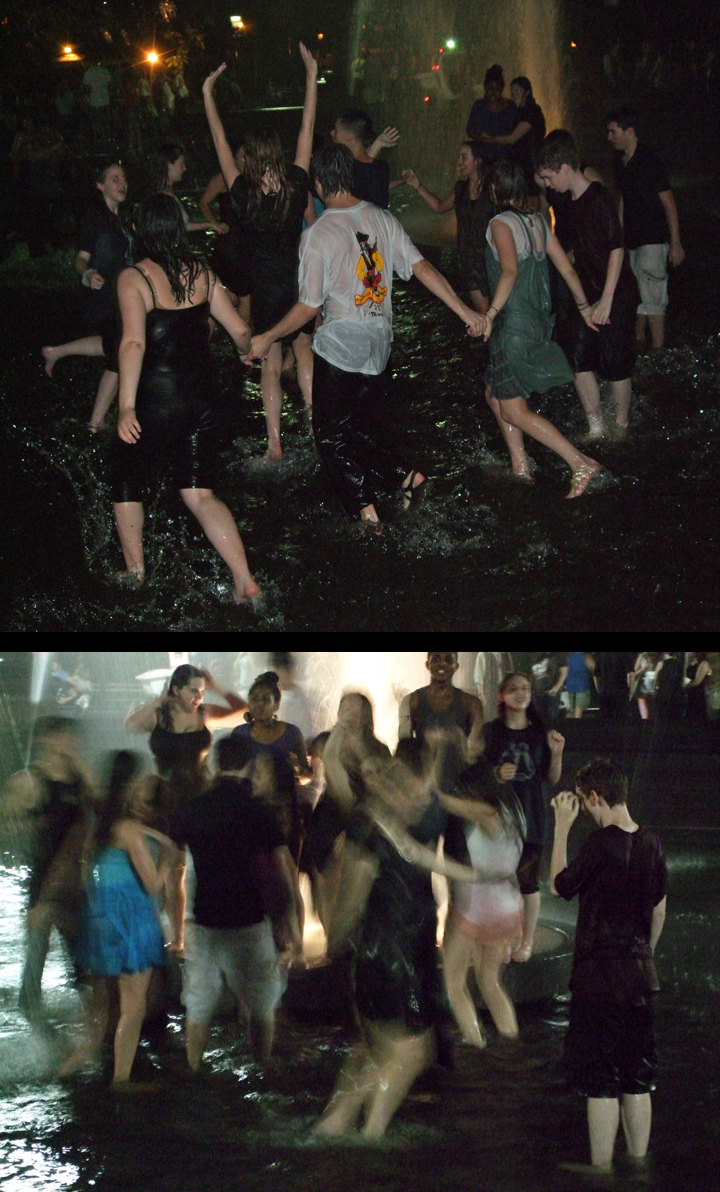
    Without parental controls, what better time and place to gallivant with your friends than New York City at night? With the recent restoration of Washington Square Park, the fountain now sports a massive center plume and powerful side jets and has been a center for late night revelry, virtually without concern for temperature or rain. It has become a theater for bravado – will you take the challenge and go in with your street clothes on? They do, and they get soaking wet, with spectators watching in amusement. I saw a girl moon the audience and a man do a head stand on the steel grate over the center plume. More photos here.

    There is squealing, shrieking, dancing, splashing, and jumping. The cavorting and play appears to be the most fun anyone has ever had. I don’t know whether this is a case of pure joy or if there is an element of the classic “stolen watermelon tastes best.” Some of these girls must know how much their mothers would be disappointed if they knew their daughters were out late at night gallivanting 🙂


  • Chess Monsters

    The last great chess player I saw in Washington Square Park was Yaacov Norowitz; this was to be his story, as well as that of the other great players who have graced the southwest corner of the park. But I have not seen Yaacov playing in some time.

    On and off, for a few decades, I have spent many a Sunday afternoon watching the games of many masters, international masters, grandmasters, and blitz players. I never got to see Hikaru Nakamura, reputed to be one of the undisputed monsters of blitz chess. I did often see Israel Zilber, a former Latvian chess champion who was homeless during most of the 1980s and was one of the best players in the park.

    One of the wildest incidents I have witnessed in this area was a shooting. As all the players scurried for cover behind the low concrete wall which encircled the tables, one chess fan who had been watching the games actually made the rounds pausing everyone’s clocks. Once the smoke had cleared and the police had reestablished law and order, the players jumped backed and resumed playing as if nothing had happened. We were told that that the incident was motivated by a previous drug deal gone awry. On this day, one party encountered the other, pulled out a gun in broad daylight, and fired.

    One of the highlights for me was the regular appearance in the 1980s of Grandmaster Roman Dzindzichashvili, a two-time U.S. chess champion. He played blitz chess for money, as is common there. Blitz is speed chess, where each opponent is limited to 5 minutes total per game. Accumulated time for each player is tracked using a chess clock. A player whose time runs out loses (unless his opponent does not have enough material to win).

    There is a spectrum of playing styles here. Much of street or park chess played for money involves hustling, which can take the form of anything from the classic hustle (i.e. disguising one’s skill level) to outright cheating, which I have witnessed. Skills are honed specifically for speed chess, an aggressive style of playing and a mastery of all the tricks and traps of the game, along with distractions such as chess trash talk. Time odds are frequently offered to players of lesser strength. When played for money, games range from a few dollars and up – I have seen sessions played for as much as $100 per game. Side bets are also frequently made. Some regulars (such as Bobby Plummer, aka Sweet P) essentially set up office, staking out a good table early and barking the offer of a game to passersby. Some are able to eke out a subsistence living. This area is known worldwide to chess players, and many come here for a challenging encounter, prepared to lose some cash. Read article here.

    This corner of the park was the setting for the 1993 film Searching for Bobby Fischer, a story based on the life of chess prodigy and Village resident Joshua Waitzkin. Bobby Fischer was a player here in the 1960s – unfortunately, this was before my time in New York City, and I never got a chance to see this legendary chess icon play.

    The quality of player has gone down decidedly in the park, as has the physical environment in this area, which badly needs an update (scheduled as part of a future phase of the park renovation). I hope for a return of the chess monsters 🙂

    Notable chess players who have played in Washington Square Park:
    Joel Benjamin, Roman Dzindzichashvili, Kamran Shirazi, Joshua Waitzkin, Bruce Pandolfini, Vincent Livermore, Russian Paul, Hikaru Nakamura, Yaacov Norowitz, Luis Busquets, Bobby Fischer (early 1950s), Maurice Ashley, Asa Hoffman, and Israel Zilber. There are also regular games played in Union Square, Times Square, and Central Park.

    Related Postings: Good Fortune, Marshall Chess Club


  • Sahadi’s

    In New York City, ethnic diversity takes on different flavors. There are neighborhoods with one large ethnic group or a number of ethnic groups, and there are ethnic enclaves – neighborhoods dominated by one ethnicity. Jackson Heights, Queens, considered one of the most ethnically diverse neighborhoods in the world, is a good example of the former.

    Ethnic pockets, large and small, are scattered throughout the boroughs of New York City: Ukrainians in the East Village, Jamaicans in Jamaica, Queens, Koreans in Koreatown in Manhattan, Greeks in Astoria, Queens, Russians in Brighton Beach, Brooklyn, Hassidic Jews in Borough Park, Brooklyn, Mexicans in Spanish Harlem, Filipinos in Woodside and Flushing, Queens, Dominicans in Washington Heights, Indians in the East Village. There are also concentrations of many older European immigrant groups – e.g. Irish, Italian, and German.

    Along Atlantic Avenue near Clinton Street, in the Cobble Hill neighborhood of Brooklyn, there is a handful of Middle Eastern merchants. There are few Middle Eastern residents in this neighborhood today – there were many early in the 20th century.

    Sahadi’s (updated 12/9/11), at 187 Atlantic Avenue, has been in Brooklyn since 1948 and is the most well known of the Middle Eastern shops in the area. You will also find others here, such as the Yemen Cafe, Damascus Bakery and Bread, Malko Karkanni Brothers, the Oriental Pastry and Grocery Company, and the Lebanese restaurant Tripoli.

    At Sahadi’s, you will find a place that does not pander to the tourist or outsider. This is the real deal, catering to a select clientele of Middle Eastern residents or food aficionados, all looking for authentic foods. Since there founding, Sahadi’s has broadened its selection and has evolved into a gourmet shop where many other products can be found.

    The company has a three-generation Lebanese family history, with its origins when Abrahim Sahadi opened A. Sahadi & Co. on Washington Street in New York City in 1895.
    Sahadi’s is now also a wholesaler, distributor, and manufacturer, known throughout the Middle Eastern community nationwide. This arm of the company, Sahadi Fine Foods, was formed in 1999 and is located in the Sunset Park neighborhood of Brooklyn.

    When it comes to my Middle Eastern training in cuisine, I have had several teachers. One of them was Sahadi’s 🙂

    Related Postings: First Oasis Restaurant, Kalustyan’s, Moustache, Ful Mudammas, Mystery Meat


  • Under the Sun


    When I saw the tip of a sail at a distance, darting to and fro, I was so excited. I knew what I was seeing: land sailing (aka land yachting or sand yachting). My first exposure to this activity was on television many years ago from the flats of Utah or Nevada. At the time I was fascinated – the whole thing looked so exhilarating and novel. However, I assumed I would never see this type of thing, lest I make a trip out west with a specific agenda to find a land sailing locale.

    Land sailing in New York City? Floyd Bennett Field, with all of its unused runways, is a natural for this, but it still caught me by surprise to see an activity that requires such a large amount of unobstructed space. Years of living in New York City conditions you to negating an activity like this from contemplation.

    It took some circumnavigating by car to find the runway being used. I was greeted cordially by the sole sailer at the time, Rick Honor, who had just done an interview for a piece on Floyd Bennett Field by the New York Times. Some would say it was another case of Morphic Resonance.
    Rick was extremely generous, answering whatever questions I had about the activity and the equipment. He showed me his car, which was packed with a variety of air-powered vehicles, including equipment for kite boarding. He told me that on many weekends, there were land sailers who would be happy to teach me and let me sail one of their rigs. Here’s a video of Rick land sailing:

    I was also surprised to learn that this activity was not born recently but had variations going back to China and Egypt. The modern precursor is credited to Flemish scientist Simon Levin in the 16th century (updated 12/9/11).
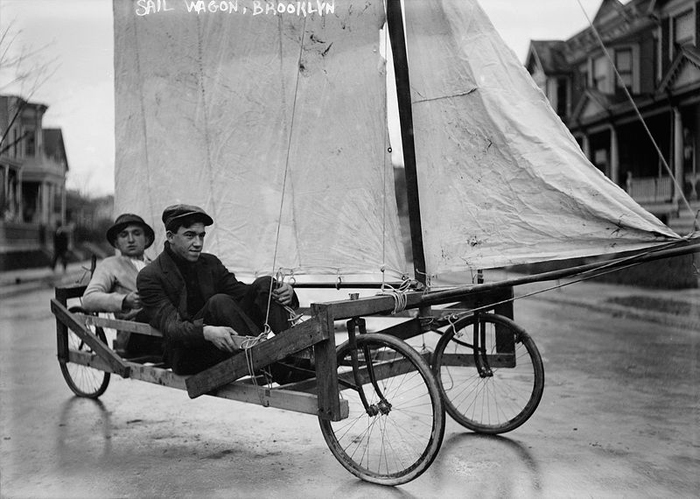
    In its current incarnation, land sailing equipment is high-tech, with eight classes of vehicles including kite buggying. The standard construction today consists of a tricycle buggy with a main sail. Land yachting competitions take place worldwide. I was astounded to find a photo of a sail wagon on the streets of Brooklyn from the early 20th century, circa 1910-15. There is truly nothing new under the sun…

    Related Posts: Floyd Bennett Field, Umbrella and Chevy


  • Mysteries of Science

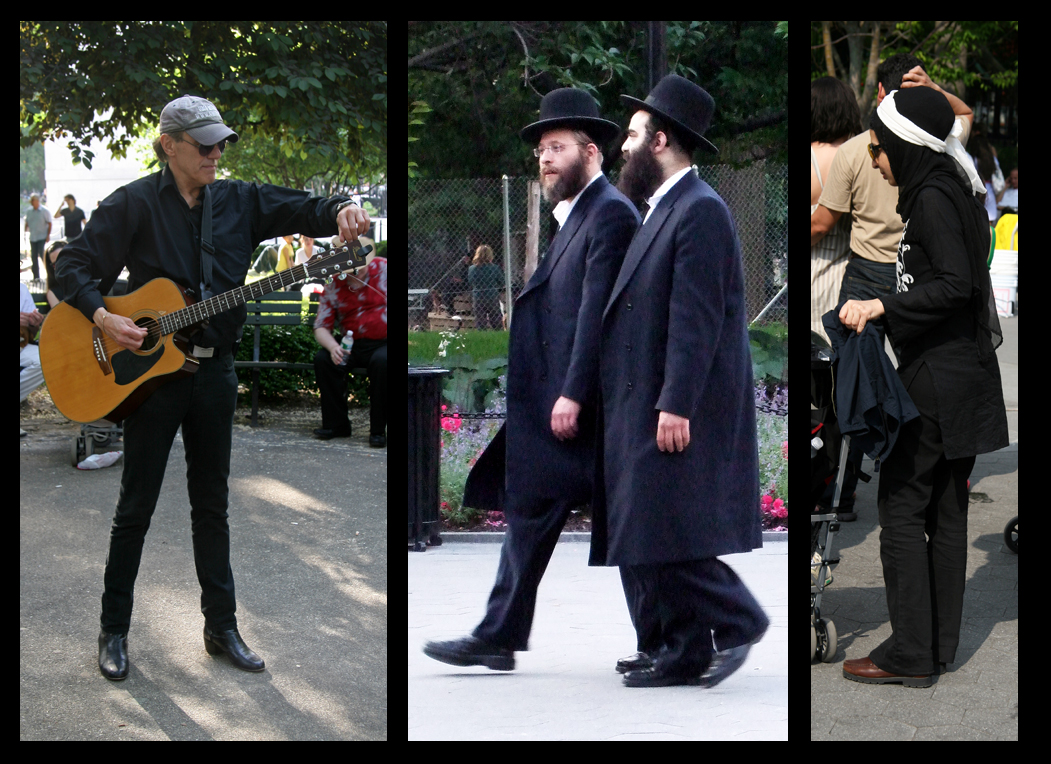
    I have seen Hasidic Jews in Brooklyn strolling on the absolute hottest days fully dressed – layered in black (or navy), even with wool hats (streimel), in what appears to be the most uncomfortable wardrobe imaginable. And on occasion, we do see Islamic women fully draped in black on hot summer days. Of course there are religious elements at work here, and when one is dealing with religion, fashion and comfort play second fiddle.

    But there are many others, as shown in today’s photo collage, where the appearance alone of wardrobe appears to trump cooling comfort. Even on a blistering hot and humid August day, take a walk through the East Village, and you will witness any number dressed in tight black jeans and heavy boots.

    Unfortunately, the issue of black versus white clothing and heat is not as simple as the fact that black absorbs heat from sunlight and white reflects it. There are additional considerations – how tight the garments are, wind speed, and the reflection/absorption by the clothing of heat from the body. White will reflect body heat back, and black will absorb body heat, so the net effect of loose white clothing is actually less cooling.
    From an article from the Straight Dope by Cecil Adams, Does black clothing keep you cooler?

    Desert-dwelling nomadic people such as the Tuaregs wear loose-fitting black clothing, and have been doing so for a very, very long time. If there were an advantage to wearing white clothes, you’d certainly expect they’d have figured that out by now.

    Apart from color, there is also the issue of full dress. I have also met numerous individuals, both men and women, who will not wear shorts, skirts, sandals, or any wardrobe elements that expose the legs or feet – only what summer heat requires for maximum cooling. In these cases, there is also no religious dogma; perhaps the operative factors are vanity and/or self-consciousness about their bodies.

    Or maybe there are some fundamental differences in human physiology. Have you ever noticed people in a wardrobe of dress clothes on a hot day who do not look the least bit uncomfortable or even show one drop of perspiration? Another mystery of science…

    Photo Note: These photos were all taken in Washington Square Park on very hot days during this summer.


  • Columbo, Monk and CSI

    Posted on by Brian Dubé

    Very often, one hears an accusation of someone or something being boring. However, it is often the one making the claim who is just not digging deep enough or bringing anything to the table.
    In the last three and a half years of writing and doing the photography for this website, I have learned to examine things more closely by reading and researching. In doing so, I have been most often surprised by what lies beneath the book’s cover.

    Part of this process has been taking greater interest in things that have been part of the New York City landscape, seemingly forever like a virtual white noise. One of these things is urban art or graffiti. Artists like Keith Haring started their careers using building surfaces as their canvas. Remnants of these works can be seen from time to time, like the graffiti of two of the most prolific in the city’s history: Cost and Revs (whose identity still goes unknown).

    I was startled recently when I came across this mural in a SoHo parking lot. I had never seen it in its entirety – it is typically occluded by any number of vehicles. On this walk, however, it was very early in the morning before opening, and so I was rewarded with a unique, unobstructed view of the entire mural. Seeing this reminded me of how the murals, I Am the Best Artist by René, were everywhere in the 1980s & 90s in SoHo.

    Typical of graffiti artists, the facts about René are shrouded in mystery. The New York Times ran one article about René’s war over wall space with French artist Le Pointre. René refers to himself on his website as René IATBA or I.A.T.B.A. (an acronym for I Am The Best Artist.) He appears to have grown up in Venezuela, according to his website, which itself is layered in abstruse writing and design elements. It is as enigmatic as the man.
    If you want to learn the details of a street artist, be prepared to become an amateur forensic scientist. You will enjoy the work, if like many, you are a fan of Columbo, Monk, or CSI 🙂

    Posted on by Brian Dubé

  • Plum Beach

    Posted on by Brian Dubé

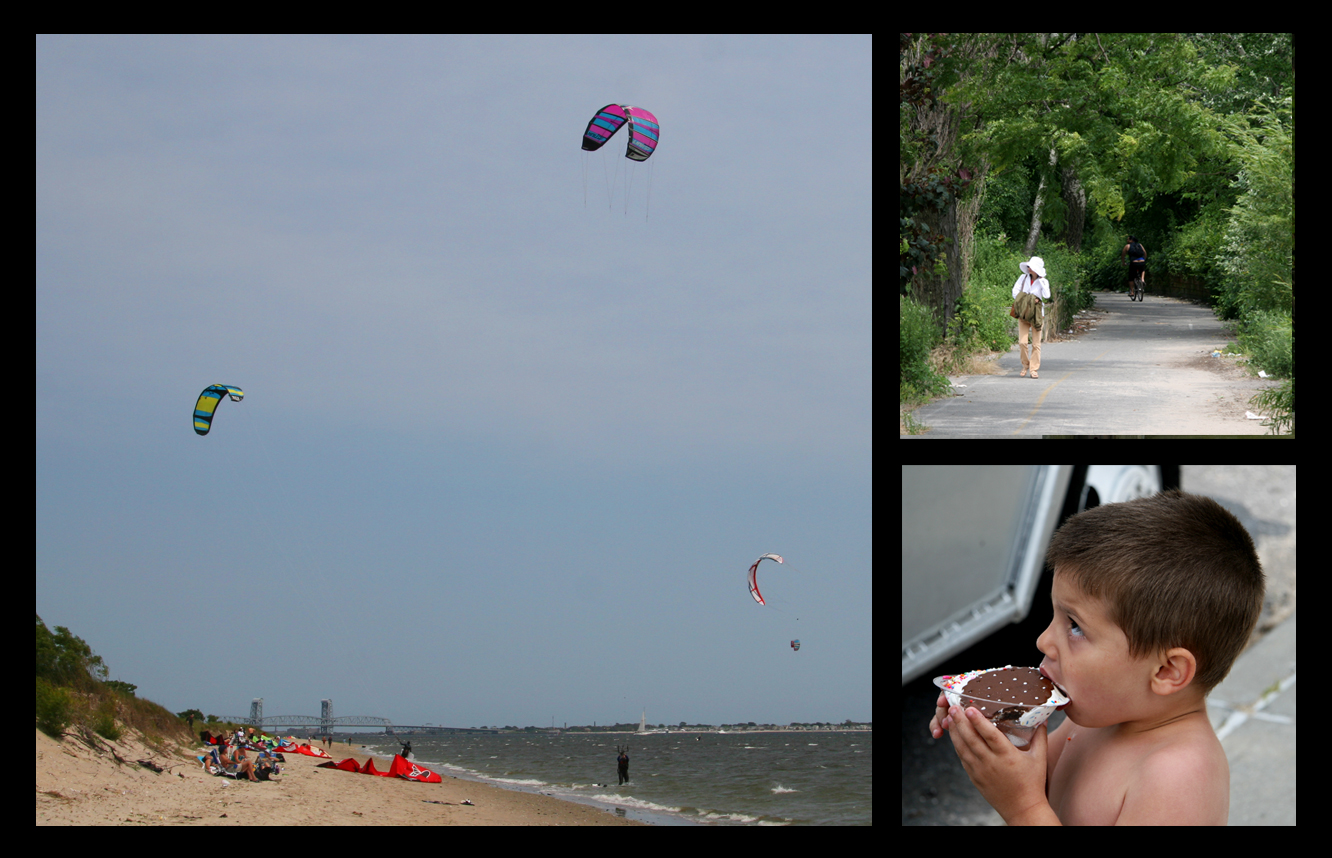
    The sight of kite surfers and the convenient access to Plum Beach from the Belt Parkway prompted a quick detour from my recent excursion to Floyd Bennett Field. Unfortunately, this convenience in a major metropolitan area, combined with relative isolation, has given Plum Beach a rather unsavory and spotted past.

    Older residents reminisce about days when Plum Beach was a lover’s lane. Since that time, it has become known as a gay spot. From a New York Times article from 2006, Deadly Days at a Lovers’ Lane:

    Decades ago, the beach’s parking lot was notorious as a lovers’ lane for the neighborhood’s besotted boys and girls. In recent years, the area has become better known as a gay trysting spot. The police say that the four men accused in the death of 29-year-old Michael Sandy of Williamsburg this month were aware of the area’s reputation when they lured him there.

    The incident refers to an attack by four men who lured the gay victim to Plum Beach using an Internet website. A planned robbery scheme derailed when the victim ran from his assailants onto the Belt Parkway, where he was struck by a car. Those familiar with the area also warn of drug use and needles on the beach. An article from Citynoise on Plum Beach in 2005 opens:

    Plum Beach is a grimy spit of sand that is just past Sheepshead Bay and part of Gateway National Park. It’s beautiful and filthy and therefore gloriously neglected, unkempt and various.

    The article goes on to discuss the various activities. Reading the comments, which span four years from 2005 to 2009, provides an informative history based on personal experiences.

    When I stopped at Plum Beach, I was not aware of any of this history or reputation. I also visited after a cleanup effort in April of 2009 by the American Littoral Society, so my visit was untainted by garbage, which apparently used to be a huge problem.

    The beach, named after the beach plums that grow there, is part of the Jamaica Bay Unit of the Gateway National Recreation Area, which includes the Jamaica Bay Wildlife Refuge (see here and here). There are many great beaches, along with great spots for nature and wildlife lovers in this area of Brooklyn and Queens. At Plum Beach, you will find kiteboarding and windsurfing – rare sights in New York City, and not what the average visitor is looking for. But, hey, we got the little stuff too* 🙂

    *This is my first use of a personal inside joke.

    Posted on by Brian Dubé


  • dinamic_sidebar 4 none

©2026 New York Daily Photo Entries (RSS) and Comments (RSS)  Raindrops Theme