• Mad as Hell, Part 2

    Posted on by Brian Dubé

    (See Part 1 here)

    Life does imitate art – the end of this story was remarkably like the classic scene in the Academy Award-winning 1976 film Network, where news anchor Howard Beale is so angry, he persuades TV viewers across the nation to stick their heads out of a window and scream, “I’m as mad as hell, and I’m not gonna take this anymore!” If you are not familiar with it, I suggest you see it here before you continue this story.

    Trust me when I tell you that in all the decades I have lived in this city, I have seen many hostile interventions during street performers’ acts. Very belligerent heckling, some nearly stopping the show. But I have never seen anything like this.
    An older woman appeared with her dog in tow, stood prominently in the center of the group, and began screaming “SHUT UP” repeatedly to the audience and the singers. The group, not to be upstaged, continued singing.

    This woman was SCREAMING at the top of her lungs – shrieking, clenching her fists, and shaking. I was genuinely concerned that she would have a heart attack and that her next battle with noise would be with an ambulance siren.
    She would not stop, and when audience members began responding that they were enjoying a quality performance, she screamed, “Take them home with you.” She vehemently stated that she was a neighborhood resident living across the street, facing the area where the singers and crowd were located. She further claimed that they had been singing for at least 6 hours per day for three days in a row and that she was at wits end – apparently she was mad as hell and was not gonna take it anymore.
    After some time, one of the singers apologized to her and the audience, stating that her wishes should be respected. Another one of the singers told her to calm down and assured her, “You win”.

    I spoke for a short time to this woman. I expressed my understanding of the dilemma and told her that I also was a long-time neighborhood resident living over a park and have had my own issues with noise. I, along with others, pointed out that this is New York City. Worse, it was Greenwich Village on Bleecker Street. If she lived on the Upper East Side on a side street, I am sure that she would have the quiet enjoyment she is entitled to. But this is Greenwich Village, and I would guess she chose this neighborhood for its iconoclastic nature, but with that comes a price. It is a mecca for culture, the arts, and entertainment, with clubs, restaurants, theaters, galleries, shops, and plenty of street life. This environment will attract both tourists and performers.

    There is also a lot of noise and a greater tolerance by all, including the police. I asked if she ever called the police. She said she has but nothing happens. My own personal solution is to plan around noisy events – I often will just leave my home. Principle and rights are one thing, but City Hall opens on Monday morning, and this is Saturday night. Accuse me of resignation or of being a man unwilling to fight for his rights. I’m a pragmatist, and being mad as hell will get me nowhere.

    Posted on by Brian Dubé

  • Mad as Hell, Part 1

    Posted on by Brian Dubé

    Occasionally, you can have it all, and Sunday was one of those days – perfect weather, a dinner better than expected (with no line where there usually is one), and then free, first-class entertainment on the street on a summer evening. Spontaneous and varied street life is one of the perks of living in New York City and is what many visitors have heard about and anticipate in their meanderings around the streets. Clear evidence that You’re Not in Kansas anymore.

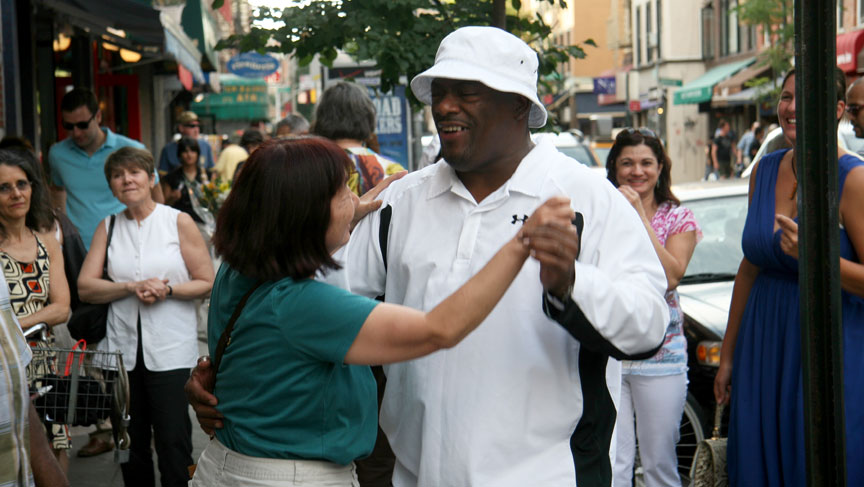
    The group of singers in today’s photo, calling themselves Select Blendz, was performing on Bleecker Street, accompanied by one acoustic guitarist. The songs were primarily 50s, 60s, doo-wop, and soul – all classics immediately recognized by the audience. Little encouragement was needed for any type of audience participation, whether rhythmic clapping or singing choruses. The crowd flowed off the sidewalk into the heavily trafficked thoroughfare. The vibe was absolutely infectious, and there literally was dancing in the street.

    At one point, one of the singers took a highly animated woman for a dance. Others were moved to shake, rattle, and roll. The tip bucket was brimming with bills – I saw one five dollar tip and even a $20 dollar tip being given. If the public votes with its dollars, these guys were clearly the consumer’s choice.

    I couldn’t help thinking about a juice bar I used to frequent on my way to my office on Houston Street called Lucky’s. A place just brimming with youthful enthusiasm, positive feelings, and a great affirmation scrawled on a chalkboard above the menu items which explained the name of the store: Lucky to be Alive.

    But not every story has a happy ending, and there was rain on this parade – stay tuned tomorrow (see Part 2 here), when I explain why, in the second and final shocking episode of this real-life mini soap opera, someone is Mad as Hell…

    Posted on by Brian Dubé

  • Big Bang

    Posted on by Brian Dubé

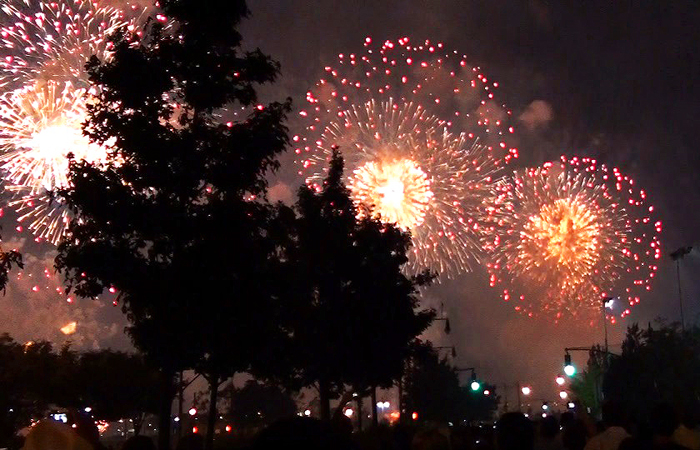
    I had not been to a Fourth of July celebration in New York City for many, many years, generally opting for seeing them on TV. This year, however, I was with a friend who had never been to a live fireworks display at all, so it seemed criminal not to take a short stroll to the river and let her witness the Big Bang, New York City-style.

    The display, sponsored by Macy’s since 1958, was originally over the Hudson River. Since 1976, Macy’s fireworks became a tradition over the East River. This year’s display was back over the Hudson and better than ever. The display lasted 26 minutes, with 40,000 shells fired from six barges, located opposite 23rd to 50th Streets in Manhattan, where the West Side Highway was closed to pedestrians for the event. A Hudson River display also affords views from New Jersey, with the added eye candy of the Manhattan skyline as backdrop.

    However, getting a viewing location was not as leisurely as one would hope. Police barricades restricted entry to just a handful of crosstown streets; frustrated crowds were directed to streets which in turn had also been closed. We paced up and down 10th Avenue to find entry to the West Side Highway, at last getting in at 24th Street. After a little jockeying for a good position for viewing/photography, we settled in for a spectacular display, on time as always. At the conclusion, traffic was snarled beyond belief – masochism by auto. I recommend seeing the NYC Independence Day fireworks in person, but the only way it makes sense to see any event of this size is by using a combination of subways and walking…

    Posted on by Brian Dubé

  • Brooklyn Heights

    Posted on by Brian Dubé


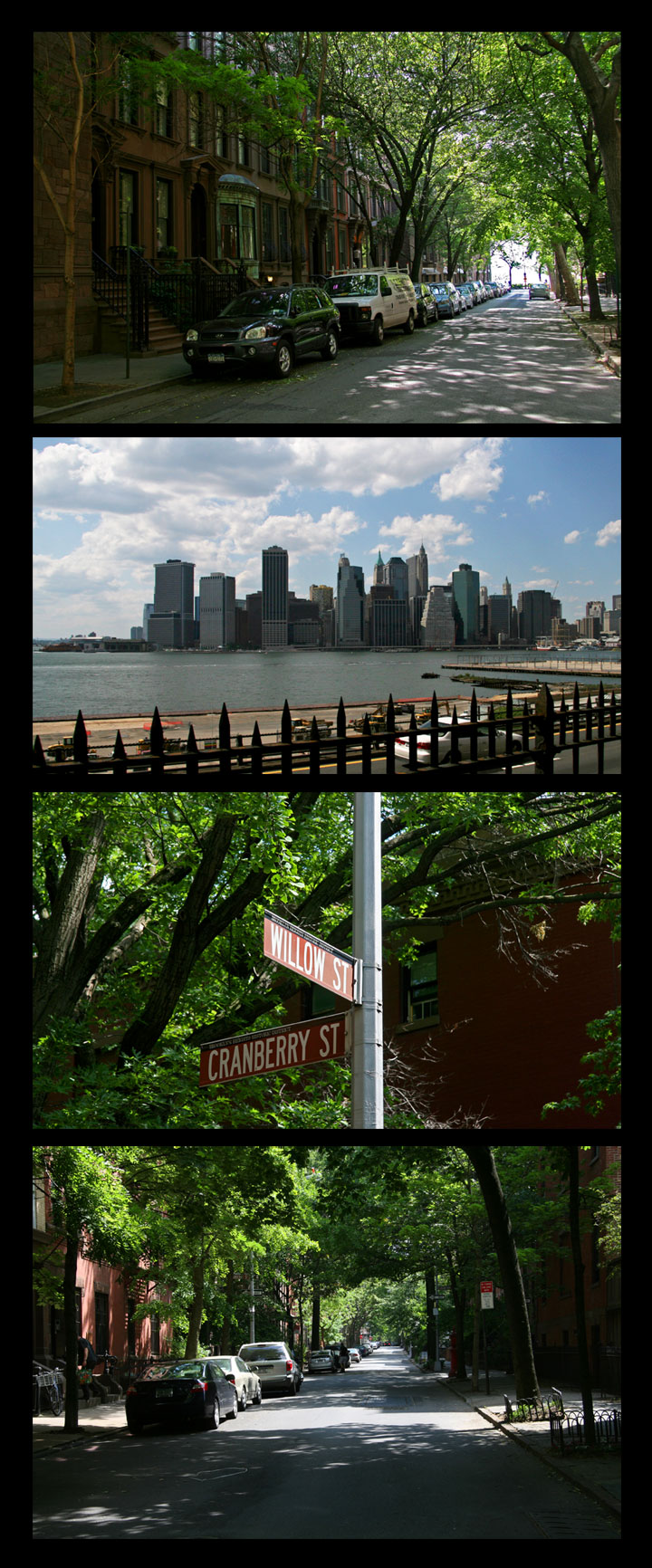
    What is more inviting than a neighborhood with street names like Orange, Pineapple, Cranberry, Willow, Poplar, Grace Court, Garden Place, and Love Lane? Brooklyn Heights is truly a special enclave, buffered from the world on 4 sides by the Brooklyn Bridge to the North, Cadman Plaza to the East, Atlantic Avenue to the South and the promenade/esplanade abutting the East River to the West. The promenade is a huge feature here, one which has brought me back many times. Flanking the entire length of the neighborhood, it affords magnificent views of Manhattan, the East River, the Statue of Liberty, the Brooklyn Bridge, and the Manhattan Bridge. Both daytime and nighttime views are worth a trip. See more photos here.

    This is New York City’s first historic district, established in 1965 as a product of opposition to a Robert Moses plan to run the Brooklyn Queens Expressway through the center of the neighborhood. The rerouting of the expressway to the Western edge of the neighborhood (which sits on a bluff), permitted the building of the esplanade. The neighborhood has virtually no tall buildings and is characterized by blocks of row houses of Federal, Greek Revival, Gothic Revival, Italianate brownstones, and some mansions.

    Brooklyn Heights has also been known for its stable of renowned writers who have lived there: Truman Capote, Norman Mailer, Hart Crane, Andrea Dworkin, Arthur Miller, Walt Whitman, and Thomas Wolfe.
    Genteel, pristine, picturesque, bucolic, charming – hard to imagine that this area was considered somewhat unsafe and undesirable at one time.

    There is essentially no through traffic in the neighborhood, so it is extremely quiet and peaceful. Street scenes as shown in my photos typify day to day life here. And yet, it is an incredibly convenient location – one subway stop from Manhattan and with immediate access to bridges or the expressway. As you have most likely guessed, inexpensive is not one of the features here 🙂

    Posted on by Brian Dubé

  • i’m lovin’ it

    Posted on by Brian Dubé

    I thought I had a very special photo opportunity when I caught this squirrel enjoying a french fry. Upon reflection, however, it occurred to me that this my observation might not be a particularly unique phenomenon, New York City or otherwise. A little searching turned up other photos on Flickr and videos on YouTube.

    Everything about this city conspires to make it a haven for scavengers. The population density along with the waste so conveniently available makes it a veritable smorgasbord for those creatures who find the city hospitable. It is estimated that there are more rats than people in New York.

    Squirrels are a curious phenomenon. As rodents, they share a family (technically an Order) with rats and mice but are looked at more fondly. They scavenge but yet are still fed, watched, and even doted over. The attraction is understandable; they are not as furtive in their behavior, and they don’t slink through the darkness of subways. And they are arguably much more attractive than other rodents – many would say beautiful. I’m not sure why, but I see many visitors to the city stop and interact with squirrels with a look of extreme fascination. I’m not sure whether it is the relative rarity of squirrels in their home locale or perhaps the emboldened character of a city squirrel and how easily and closely they can be approached.

    I’ve looked over the list of slogans used by McDonalds over the years, beginning in 1961, to see what might be an adequate caption for this photo if the golden arches were to use it for their advertising. How about their 2003 slogan based on Justin Timberlake’s song: “i’m lovin’ it” ?

    Posted on by Brian Dubé

  • Entombed

    Posted on by Brian Dubé

    Either you wear shoes without socks or you don’t. We had quite a discussion about this in my office. Some find the prospect disgusting while others love it. I enjoyed reading a long forum online where opinions ranged the gamut. There is not only the practical/convenience issue of wearing no socks, but the no-sock look is also seen favorably as a style.

    I am not talking about sandals or flip-flops – there, we have aeration and more likely candidates for hand cleaning. I am talking about regular closed shoes, including deck shoes or top siders. The blackened soles of your feet from the accumulation of soot and grime after a good day’s walk sockless in New York City should be a clear warning.

    There are many solutions for those who prefer to go au naturel, including Odor Eaters and foot powder. There are other options. For the style-driven, no-show or low rise socks are available.
    But the habits of the wearer are all unknowns with someone else’s shoes. Buying used shoes in New York City requires some thought and a reputable dealer.

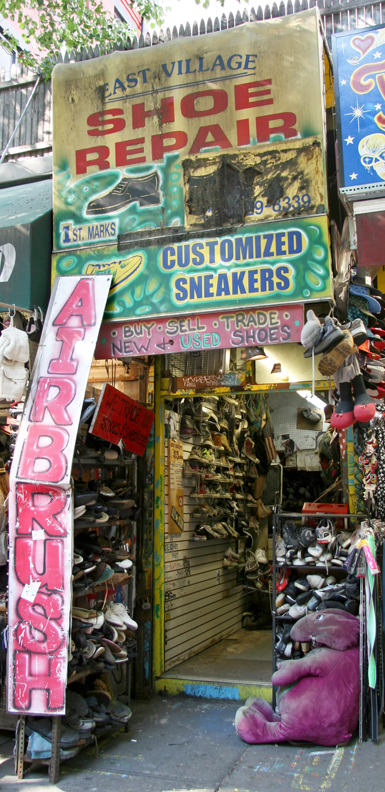
    East Village Shoe Repair is located at 1 St. Marks Place. This tiny place, crammed with goods, has been a cobbler’s shop since 1985. Boris Zuborev took it over with his nephew, Eugene Finkelberg, 14 years ago. Both hail from Belarus. They sell used footwear, customize sneakers and make shoes. From an article in The Villager:

    They also make cowboy boots, sandals and high heels. They’ll dye your pumps hot pink, spray-paint pictures on your sneakers or raise your heels up 17 inches. In the ’90s, one could witness Zuborev’s creations on the feet of certain well-known musicians and dancers. In his platform shoes, clubbers he designed for rose above others.

    It’s a hole in the wall, the place itself showing little evidence of fine design. The yellow awning has been spray-painted green and white, and signs hang by old shoelaces. Graffiti surrounds the door. Industrial metal shelving stuffed with thick-soled boots, multicolored pumps, sneakers and roughed-up ballet slippers obscures the entrance.

    The place gets rave reviews from customers who purchased shoes or had customizations or repairs done. Perhaps one day I will try them for repair. I have purchased used/vintage clothing before, but as far as buying used shoes go, I’ll pass for now. I can’t help but think about the perspiration which may be entombed 🙂

    Posted on by Brian Dubé

  • Buzz and Bling

    Posted on by Brian Dubé

    In France, I have seen lines to get into small restaurants which look empty. The first time I saw this, I was quite puzzled. A little examination, however, revealed what every seasoned restaurant goer already knows: they were waiting for tables outside. Al fresco dining and the search for pleasant garden space is a quest made by diners around the world. In New York City, we are not blessed with very many pleasant streetside cafe spaces (see Insult to Injury here and this great New York Times article: “Curbside, We’ll Never Have Paris”).

    This is the time of year where many relish being outdoors, so if you want a really pleasant al fresco meal insulated from the elements of urban assault, a back garden is the place to find. Often, these places are completely hidden from view – a front sign may or may not be present announcing the garden’s existence. So for those of us who like urban adventure and the process of discovery, this is not the technique best employed. Better to do a bit of research prior to meal time.

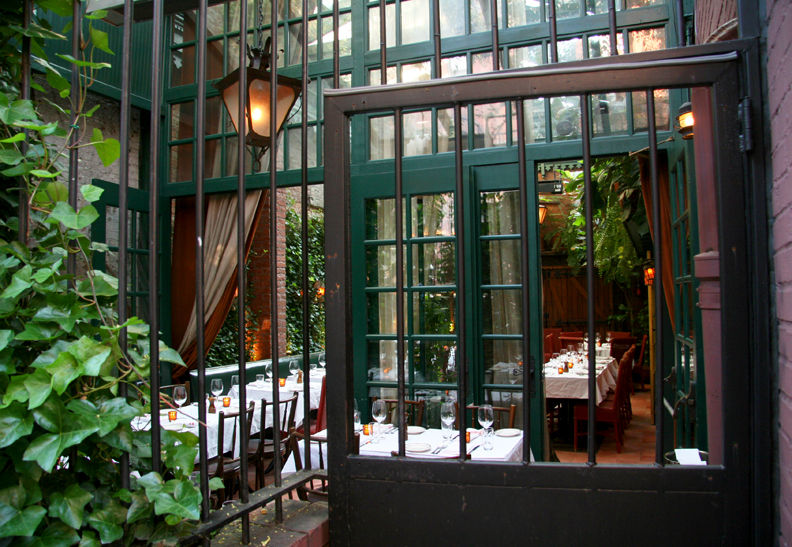
    In the case of The Waverly Inn and Garden, at 16 Bank Street, the garden has a side entrance visible from Waverly Place. The location is in the heart of prime West Village, one of the most charming and bucolic areas in the entire city of New York. I have written of this neighborhood several times before (see the links below).
    Regarding the restaurant itself, I have not eaten there, but I enjoyed reading the reviews, which range from 1 to 5 stars. If you want to have fun, read some of the 74 reviews here at Yelp.com. Apparently, this place is a magnet for the rich and famous, and many of the very negative reviews reflect customer experiences with snobbery, service, and attitude. On August 12, 2008, the New York times wrote an article: “An Insiders’ Clubhouse (Apply at the Door).” One of the owners is Vanity Fair editor Graydon Carter; some have referred to the establishment as “Graydon’s private club.”

    The article speaks of the “combination of billionaires, movie stars, intellectuals and fashion designers, with a rock icon or sports legend thrown in” who frequent there. “There are still powerful folk who would rather dine uptown at the Four Seasons, Michael’s or Le Cirque. But for celebrity power deep enough to lure paparazzi night after night, few outposts in New York today rival the Waverly Inn.”

    This historic place exudes charm inside and out. For now, it appears it’s the got the buzz and bling 🙂

    Related Posts: 121 CharlesGrove Court, Cherry Lane Theater, The Garden at St. Lukes, 17 Grove Street, Paris In New York

    Posted on by Brian Dubé

  • Time Has Come

    Posted on by Brian Dubé

    Although there are some very outrageous participants in the annual Gay Pride Parade, most New Yorkers realize that, like any other parade, the dress and manner of the paraders does not typify their everyday life. They only represent a small number of the huge LGBT community – many members of the gay community do not participate at all.  Certainly there are members of any group who are flamboyant, but I always point out to those who are new to the parade that this is their day to act out, just like revelers on many other occasions. As the photos indicate, this is, literally and figuratively, a rainbow coalition.

    The parade is enormous at this point in time – hundreds of thousands attend. The parade begins at 52nd Street and works its way down Fifth Avenue, ending in the West Village. There are floats and groups representing teachers, other professionals, civil servants, and politicians (both members of the gay community and those with a strong support for their causes). Apart from the serious agenda, the event has an extremely festive character – it could easily be mistaken for a dance parade. The event is part of Gay Pride week; some of the photos are from Friday’s Dyke Parade.

    With much of the road already paved after decades of struggles, same-sex marriage is one of the last important hurdles to the gay movement. The push for same-sex marriage shows a serious interest in committed relationships. The passing of such laws should do much to stabilizing lifestyles and gaining greater acceptance by societies at large – the gay community’s ultimate goal.

    Six states have already legalized same-sex marriages (Massachusetts, Connecticut, Iowa, Maine, New Hampshire, and Vermont) – some currently being performed, others to begin in the near future. Ironically, New York State, which is liberal with one of the largest numbers of gays in the United States, is lagging in passing its own legislation.  But I am sure it is just a question of how long for legislation, whose time has come…

    Related Posts: Steal the Show, Dyke March, Rubyfruit Bar and Grill, Gay Liberation Monument, Pride March 2007, Gay Pride Parade 2006

    Posted on by Brian Dubé

  • Michael Jackson

    Posted on by Brian Dubé

    By now, most of the world knows that the King of Pop, Michael Jackson, died yesterday afternoon in Los Angeles. By yesterday evening in New York City, spontaneous memorial music jams and sing-alongs were everywhere.
    At 10 PM, I suggested to a few companions that we make a trip to Union Square, always a mecca for events of this nature and magnitude. As expected, hundreds of fans had gathered – a boombox supplied music while a group sang Michael Jackson songs together. At one point, a white glove with sequins was passed through the group to one of the prominent singers.

    Fans waved illuminated cellphones and candles. Here and there, some initiated small vigils. A similar but smaller scene could be found in Washington Square Park. On Laguardia Place and Bleecker Street, there was crowd of singers that could be heard two blocks away. I was informed last night that a huge crowd gathered at the Apollo Theater in Harlem (confirmed by the press today), where Michael had performed many times as a member of the Jackson Five. I am sure that in the coming days and weeks, there will be numerous tributes and memorials, both planned and unplanned, in the theaters, streets, and parks of New York City.

    With over 750 million records sold, Michael Jackson was the best selling solo pop artist of all time. Of course, anyone who looms larger than life, as Jackson did, will have his life under a microscope. Jackson was both lionized and demonized by the media, with his later life plagued and darkened by scandal. However, I think that his work will outshine any darkness, leaving a legacy brighter than than shadow of his final years…

    Posted on by Brian Dubé

  • Cosmetics

    Posted on by Brian Dubé


    What is more unsettling than contact with a crustie? How about a crustie wearing a pet rat? (If you are not familiar with crusties, see my previous posting here). Take a close look at the photo, and you will see that this girl is sporting a white rat under her hair on the back of her neck. A crustie’s dreadlocks typically goes unwashed, so I imagine her hair provides not only a secluded spot for her companion but also a nesting ground for a variety of flora, fauna, and other edibles.

    You expect many strange things in New York City – it is a magnet for the fringe elements of society. But there are things that shock even a seasoned New Yorker. For me, a crustie with a rat around her neck was one of them.
    People know the city is extremely liberal and, most of all, tolerant. There are individuals involved in all manner of activities in public; frequently, authorities and law enforcement just turn a blind eye. Two nights ago, two mounted police officers observed the onset of a fight, one individual wielding a guitar as a weapon. The officers left – no one knows why. The fight escalated, and one individual was knocked unconscious, required an ambulance, and was taken to a hospital. Those of us who witnessed the occurrence are convinced that in any other locale, there is no way that someone that menacing would have been left unchecked.

    One issue is, of course, that many activities which are disturbing or distasteful are technically not against the law, and individuals here are brazen enough to have tested the law many times, risking arrest. Many criminals are quite street savvy and know exactly what is required to be arrested. Even those who are technically engaging in activities for which they can be arrested are a problem; most are released the next day and are back out on the street. My contact with crusties has been rather benign, but they have been a serious problem – see this New York Times article here.

    But what to do with the “undesirables” or homeless? It would seem that outreach programs would make sense, but I rarely see or hear of any efforts like this anymore. Many homeless prefer the freedom of the streets to shelters or programs, so there is resistance to being helped.

    New York City is a center of fashion, and even the homeless often have a sense of style, putting together an outfit from whatever is available. I like our crustie’s earpiece made from a small twig and flower…

    Note: One posting that many readers commented on was about Stephanie, a young homeless woman who lived on Spring Street for quite some time. I saw Stephanie using makeup a number of times – somewhat repellent to watch and sad, but in another way heartening to see that the girl still had human dignity and enough pride to make an effort using cosmetics.

    Posted on by Brian Dubé

  • New Yawk Style

    Posted on by Brian Dubé

    I enjoy observing New Yorkers I see in public who make a strong presence, whether brash, eccentric, or unusual in some way. However, drawing conclusions based on a few pieces of information can be dangerous – see my posting on Walid Soroor and Facts and Fiction.

    There is a New York style and a New Yawk accent. This has been depicted in numerous characters of film and television. John Travolta in Saturday Night Fever is classic New York attitude and accent (in this case Brooklyn Italian), as are others such as Fran Drescher (Queens) or journalist Jimmy Breslin.
    The classic New York style is characterized by someone who is confident, tough, blase, brave, street smart, and aggressive. Fierce borough pride. Regardless of gentrification or any other talk of improving conditions and reduction of crime, New York City is still a rough place. For a woman (or a man) who makes her/his way here, working, traveling the trains, and walking the streets requires a certain intestinal fortitude and stoicism just learning to navigate and survive.

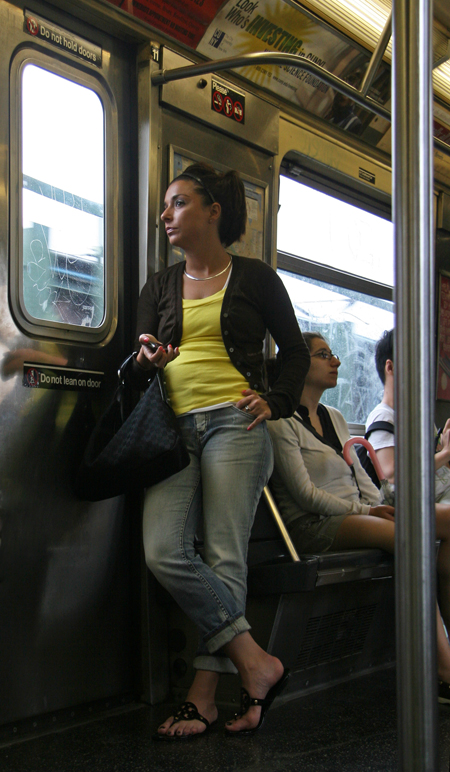
    On my trip to the Coney Island Mermaid Parade, this woman and her friend caught my eye. She had a dash of all the classic elements of New Yawk style – her posture and attitude on the train speaks volumes. A real New Yawker’s gotta have chutzpah…

    Note about the New Yawk accent: Also known as Brooklynese or New Yorkese, the accent consists of dropping r’s (fatha for father), adding oi (like the classic Toidy Toid for Thirty Third), adding r’s where they don’t belong (erster for oyster), pronouncing “th” like “d” or “t” (through as trew or the as da). From the New York Times: “Tawk to a young New Yawkuh dese days and de foist ting you may notice is dat he aw she don’t tawk like dis no maw.”
    Many say the accent, along with Yiddishisms (such as shlemiel or oy vey), is disappearing. Others say it is moving to the suburbs of New Jersey and Long Island. Some believe that NYC police officers are keeping it alive as a badge of honor.

    Related Postings: Out There, Spike, Narcissism Gone Wild, Superheroes, Snake Charmer, Circus Amok, Fashion Forward, Piercing Al Fresco

    Posted on by Brian Dubé

  • Mermaid Parade 2009

    Posted on by Brian Dubé

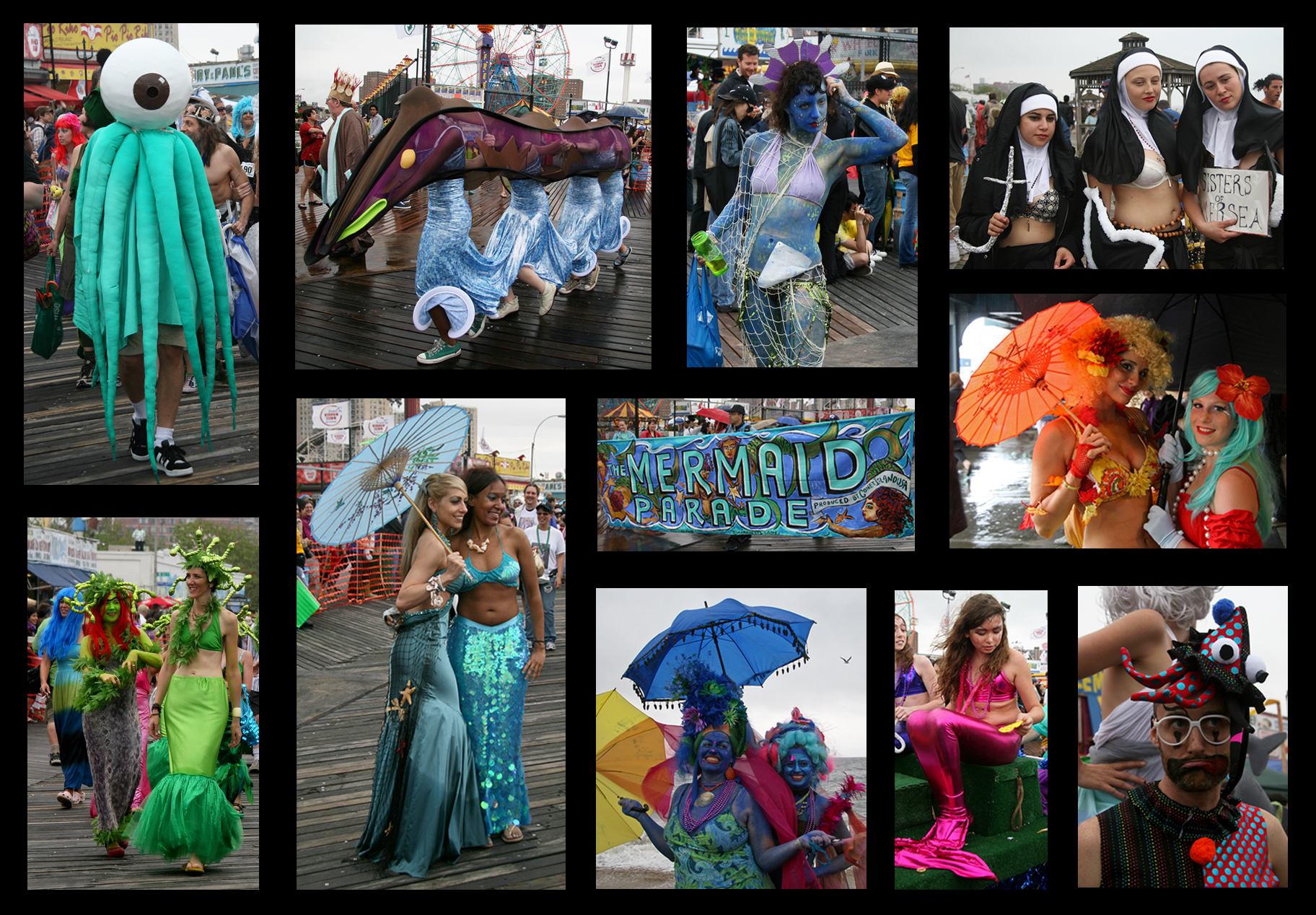
    This is the 2009 annual Coney Island Mermaid Parade. The weather was chilly and rainy, but the turnout was good and fun was had by all. This annual parade is one of the most enjoyable in New York City. The parade route includes the Coney Island boardwalk. The Atlantic Ocean is a wonderful locale to view the creative costuming with a mermaid and start of summer theme. See the full gallery of photos here.

    Photo Note: Make sure to click on photo to enlarge for detailed view!

    Related Posts: Mermaid Parade 2006, Mermaid Parade 2007

    Posted on by Brian Dubé

  • Summer

    Posted on by Brian Dubé

    I have attended the annual Coney Island Mermaid Parade in 2006 and 2007, but I would always miss the start of summer ritual. This is easy to miss, given all of the festivities and the lack of itemized agenda. The Mermaid Parade, this year on Saturday, June 20, is a celebration ushering in the summer season.

    The ribbon cutting ceremony is an unannounced event occurring after the parade’s completion. I always assumed it took place first. Wandering in the parade’s aftermath along 10th street (abutting the Cyclone), I fortuitously bumped into the small procession headed to the beach led by Harvey Keitel playing King Neptune (seen in the center of the photo), Queen Mermaid, bearers of fruit, a small entourage of followers, photographers, and security. Excited by my good fortune, I quickly joined the party.

    Four ribbons, each symbolizing a season, are set up and cut in sequence – Autumn, Winter, Spring, and Summer. The final cutting of the Summer ribbon starts the season. Baskets of fruit are thrown into the ocean to appease the gods. A mechanical thermometer was placed in the ocean showing a rise in temperature of 110 degrees. The hearty members in the crowd entered the ocean, a particularly daunting task this year – Saturday’s weather was uncooperative, cool, and raining on and off all day. The previous two years were bright and sunny. From a photographer’s perspective, however, cloudy days actually provide better lighting conditions – harsh shadows are greatly reduced and colors really pop.

    But the Parade and festivities for this event march on, rain or shine – neither summer solstice nor Mermaids are not daunted by a little rain 🙂

    NOTE: Tomorrow I will feature the parade itself with a full gallery of photos and video.

    Related Posts: Mermaid Parade 2006, Mermaid Parade 2007

    Posted on by Brian Dubé

  • Sheepshead Bay

    Posted on by Brian Dubé


    The problem is simple – I have spent too much time looking for the Manhattan in Brooklyn. My travels there have focused on neighborhoods such as Park Slope or Brooklyn Heights – historic enclaves with row houses most similar to those in Manhattan.

    One will often hear a Brooklynite use the phrase “going into the city,” one of the prime examples of a city which is Manhattan-centric. In many ways, Manhattan does drive the city as an economic engine and is a mecca for culture and the arts. It is the center of the financial world and of many other industries for which New York City is known. However, Manhattan is not the only place on earth, with Brooklyn playing second fiddle – an attitude many Manhattanites share, as I did for most of my life here.

    Welcome to Sheepshead Bay, both a neighborhood and a bay separating the mainland of Brooklyn from the peninsula Manhattan Beach (see my previous article here). Sheepshead Bay is named for the sheepshead, an edible fish once found in the bay. Read more about the neighborhood here.

    On my recent excursion to the area, I crossed the footbridge (Ocean Beach Bridge) which spans the bay and connects Manhattan Beach to Sheepshead Bay’s commercial strip, Emmons Avenue. It is here that I also found Stella Maris, the last fishing and tackle shop in the area. The bridge is a must do – it affords great vistas of the bay, both neighborhoods, and the maritime activities. See my gallery of photos here.

    I think differently now. Brooklyn is steeped in character and history. Brooklyn has its own style and attitude. I am disappointed that I didn’t take better advantage of Brooklyn and really explore it when I was younger and had a few good friends there.
    But I am doing makeup work, busy discovering the neighborhoods of Brooklyn and learning things every Brooklynite always knew: Brooklyn is its own world.

    Posted on by Brian Dubé

  • Chefs and Plumbers

    Posted on by Brian Dubé

    Trades in America are largely devalued. However, as big an advocate as I am of higher education, not every one is suited for white-collar jobs, and someone has to do the plumbing. Clerks, drivers, and service jobs cannot all be filled with college students and immigrants, and I am not sure that such a world would be desirable. And these jobs cannot be outsourced or automated.

    In New York City, complaints have been made about taxi drivers for time immemorial. The problem is that there is no serious training for this job. The test for a taxi license is laughable – virtually anyone who can drive can get a license. In London, for example, a cabdriver candidate must complete two years of full-time study. I am fascinated by Les Compagnons, French trade guilds dating back to the Middle Ages. See a New York Times article on the Compagnons here.

    Many find the level of craftsmanship in New York to be deplorable – stories abound regarding the poor workmanship in jobs done. Many have horror stories of their own. The problem is that many individuals doing blue-collar work are not trained or poorly trained. The workers are not professionals, as is the case with many waiters, who are working while pursuing other life goals and careers or perhaps feeling that they have no better options.

    None of this is the case at the French Culinary Institute, located in SoHo at 462 Broadway. This extraordinary school provides an intense training in the culinary arts on a par with schools in Europe – many of the faculty and deans are European, trained, renowned chefs. The school offers a very broad spectrum of classes.

    Employment needs are often cyclical. As need develops for a given skill set, people train for those opportunities. Often, an over supply develops, with shortages in other fields. I often speculated that skill tradespeople may see their time come in a world where manual labor is looked down upon and everyone trains for white-collar work. I have often joked that in a world full of web developers, plumbers may rule.
    I love the scene in the film Moonstruck where we have revenge of the tradesman. A couple, needing bathroom work done and lacking knowledge about construction, are persuaded by contractor Cosmo Castorini to buy the most expensive solution:

    “There are three kinds of pipe. There’s aluminum, which is garbage. There’s bronze, which is pretty good, unless something goes wrong. And something always goes wrong. Then, there’s copper, which is the only pipe I use. It costs money. It costs money because it saves money.”

    The future of technology rapidly evolves – who knows what future generations will need and where the jobs may lie? But most likely, there will always be a need for chefs and plumbers 🙂

    Photo Note: This shot was taken on Grand Street, where French Culinary students were on a break from classes. The sight of so many chefs in classic white uniforms on this street is quite startling. The school also runs a highly regarded restaurant – L’Ecole, located at street level at the same address.

    Posted on by Brian Dubé


  • dinamic_sidebar 4 none

©2026 New York Daily Photo Entries (RSS) and Comments (RSS)  Raindrops Theme