• More of Us

    As I wrote in Weather Means Whether, I usually feel that there comes a day which undeniably heralds the start of spring. Winter coats are put away for good, even if there are a few times where they would be appropriate.
    This year, however, I’m not feeling it. We have had a roller coaster ride as far as temperatures go with a preponderance of colder days than normal.

    Flowers are blooming and trees are budding, but they feel like an empty victory over winter. A battle not really quite won, and certainly not a trouncing. The problem for a place like New York City, with an ill-defined spring, is that when the warm weather finally and clearly arrives for good, the pent-up desires released will manifest like a siege. Masses rain down on the streets and parks like starving animals, irrationally driven to just be outside at any cost.

    Visitors arrive in hordes almost as reminders of the unpleasant hot, humid, and crowded days of summer to come. It’s not that I dislike spring or summer – it’s that they often come too abruptly after teasing in fits and starts.

    The other consideration with seasonal changes in the city is the lack of a full immersion experience. In many areas, there are virtually no indications of season other than temperature. I have the good fortune of overlooking a park – my views are filled with trees and birds. But even so, the contrast of the seasonal experience in Manhattan with the countryside is extraordinary. The overwhelming smell of earth in the spring is one sensation missed here. A ride in the country will quickly dispel any illusions that you are having a full Spring experience.

    The flowers and new green growth are wonderful, of course, but they often appear to be window dressing in a man-made world of concrete, asphalt, glass, and steel that always appears as foreground or background. Perhaps the real problem with nature’s bounty in the city is that there are more of us then them…

  • WFF ‘N PROOF

    When I was in high school, I used to enjoy a game called WFF ‘N PROOF – The Game of Modern Logic. This 1961 classic, developed by University professor Layman Allen, was said to have the “complexity of chess and the excitement of poker.” Not everyone felt that way, of course, and I must admit that the circle of friends enjoying the game was rather small.

    I liked the study of logic, but I never realized these skills would be necessary to understanding something as mundane as New York City parking regulations. Often, multiple signs are placed on one block with rules of inclusion and exclusion. Some throw up their hands and just take other parked cars as a sign of permissibility. At times, I see nervous visitors puzzling over the arcane and cryptic signs, worried if they are legally parked. Depending on their apparent level of angst, I usually try to throw out my interpretation of the signs to allay their fears. They would be much more worried if they knew the consequences of being towed in New York City: the outrageous costs of the parking ticket and towing (at least $255), not to mention the nightmare of traveling to the car pound and retrieving your vehicle.

    I was surprised and pleased to see this graphic solution to making the parking regulations understandable. This, in tandem with the relatively new Muni Meters (replacing coin-operated parking meters), makes parking less painful than it used to be. However, getting a spot still requires the same set of skills: patience of a saint, luck of the draw, tenacity of snapping turtle, aggressiveness of a badger, and often the skill of a surgeon and understanding of geometry to parallel park in spots only slightly larger than the vehicle itself. I have seen many flustered drivers actually abort and abandon a parking spot which was, in fact, large enough.

    However, these signs only simplify an already daunting and nearly impossible task – parking here will never approach the relative effortlessness found outside the city. When in very rural areas, I never cease to enjoy just parking at the curb wherever I need to go. I stand outside my car and marvel at the ease. Somehow, however, I feel that something is wrong – there must be some local parking ordinance I am violating that everyone knows except me. And where I am to use my skills in geometry or WFF ‘N PROOF?

    Note: You can see WFF ‘N PROOF at their website here.


  • Easter Parade 2009

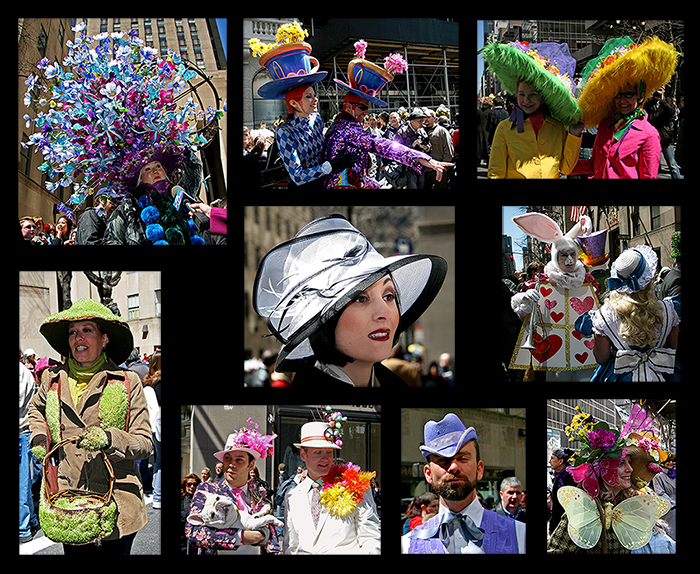
    This is my 4th year at the annual Easter Parade and Easter Bonnet Festival. The dress goes way beyond the traditional bonnet and fancy dresses for Easter Sunday. There are some extravagant and outrageous outfits. The “parade” is really is more of a loose gathering – there is no marching or parade movement from one destination to another. It takes place along Fifth Avenue from 49th to 57th Streets, which is closed to traffic from 10 a.m. until 4 p.m. The best spot is around St Patrick’s Cathedral, which is where I concentrated my strolling and shooting. The weather was rather brisk but sunny, and a good time was had by all.

    If you want to get a look at what the Easter Parade is like, you can see my blog postings and photos from the last three years here:
    Easter Parade 2006
    Easter Parade 2007
    Easter Parade 2008


  • Bubbles

    There are few things that are as benign and such an expression of unmitigated joy as bubbles. Joy – now there’s a word used so carefully and sparingly. We find it book titles, such as The Joy of Cooking, but spoken of alone as an emotional state, it is rarely used.

    Perhaps unadulterated joy, like play, is often seen as the domain of children, whose innocence carries no responsibility of deservedness or permission. For most adults, happiness as the result of play must be earned, and judging from the actions of most New Yorkers, apparently few have earned enough to spend it playing.

    When you watch the SoHo bubble man in action on the corner of Spring Street and Broadway, you can see the range of feelings about play by the reactions of passersby. Most will ply their way through the congestion around the vendor, seeing the whole thing as an inconvenience, an irritation, or waste of time. Others, will stop to capture a little moment of joy as respite from stresses of the day. There are those who will stop in wonderment. And I am sure there are some that are thinking, is this activity suitable for a grown man? As often is the case, they have made the mistake of judging a book by its cover.

    Dondi McKellar is a man. In fact, he is a disabled veteran, having served six years in the United States Navy. He hails from North Carolina, and he has been a New Yorker since 1985 and selling Bubble Guns on the streets of SoHo for the last four years. A short conversation with Dondi quickly established that beneath his smile lived a warm human being. He was quite happy to share details of his life, show me his vendor permit, and encourage my photography.

    Personally, I think I will heed with the words of Willy Wonka: a little nonsense now and then, is cherished by the wisest men. 🙂

    NOTE: An interesting study on how happiness can be contagious was done by Dr. Nicholas A. Christakis, a physician and social scientist at Harvard Medical School. See the article here in the New York Times.


  • Finest

    Posted on by Brian Dubé

    New Yorkers have grown accustomed to a litany of superlatives regarding many facets of human endeavor and achievement in this city. Best, largest, first, oldest, most…
    Conveniently, the NYPD fits right in – the New York Police Department is not only the largest in the United States, it was also the first, established in 1845.
    And here, in today’s photo, we have, appropriately, the 1st precinct, located in lower Manhattan at 16 Ericsson Place at Varick Street. This precinct is also one of the few that stables horses – see my article with photos here.

    The city has used various nicknames for groups of uniformed city employees. New York has the Finest (police), Bravest (fire), Strongest (sanitation), and Boldest (corrections), and recently, a marketing campaign to recruit teachers has asked them to “Join New York’s Brightest.” The use of Finest for the NYPD is, according to etymologist Barry Popik, probably the oldest:

    Several sources claim that it was coined by police chief George W. Matsell. “Finest” probably started life as “Best” and probably dates from 1874. The comedian Gus Williams starred in the play One of the Finest in the early 1880s. I believe that “the finest police in the world” is meant to be a similar phrase to Civil War General Joseph Hooker’s “finest army on the planet.”

    Popik gives many other references from this time period – you can read them at his site here, along with the origins of Bravest, Strongest, and Boldest and their earliest usage in regards to uniformed workers. These terms, including New York’s Finest, are primarily media terms. Citizens rarely use these words, most often just referring to the police as the “cops.”

    Of course, whether or not the NYPD lives up to its nickname given to them 135 years ago is another question. Certainly the NYPD has had its share of scandals, perhaps to be expected allowing for such a large police force, large city population, the number of crimes committed, and the violent nature of America.

    I am sure that working in an environment where an individual is constantly exposed to the dark side has an impact. Also, being in situations which are potentially life threatening means that serious judgements have to be made, often with only a moment to make them, and of course, some of these decisions will be flawed.

    And, of course, there are always the bad apples in the barrel who give others a bad name. Many of them are the raison d’être behind the big public scandals of New York’s Finest…

    TIDBIT: When registering the domain name for this website, New York Daily Photo, I noticed that the initials NYDP used the same four letters as the NYPD. This would make a very short and simple website address. Excited by the prospect of using NYDP.com, a little research turned up the fact that it was, of course, already taken 🙁

    Posted on by Brian Dubé

  • Queens West

    Posted on by Brian Dubé

    I was shocked when I discovered this unfamiliar area of Queens with new buildings sprouting everywhere, Gantry Plaza State Park, waterfront vistas of the Manhattan skyline, and the 59th Street Bridge. When investigating the neighborhood behind the photos from my excursion, I was equally surprised to learn of the scale of this huge development going on in my back yard, unbeknownst to me. See my series of photos here.

    This area, now being called Queens West, is essentially the Hunters Point neighborhood of Long Island City, Queens. A large number of high-rise residential buildings are planned (map here). The building in the photo is the Powerhouse. Ground was broken in 1994 for this 74-acre commercial and residential development. Read all the details at the Queens West website here. You can also read the 1994 New York Times article by architecture critic Herbert Muschamp.
    Citylights was the first completed structure in 1998, a 43-story, 522-apartment building designed by renowned architect Cesar Pelli.

    There are so many elements to the success of a redeveloped area – location, transportation, views, housing, and building stock. Architecture critics analyze these elements along with the merits and demerits of the architecture of the buildings built or proposed.

    DUMBO, Brooklyn is a great example of a neighborhood that had all the right elements just waiting to be discovered: one subway stop from Manhattan, views of Manhattan and the bridges, cobbled streets, and great industrial buildings.

    The difference with Queens West, like Battery Park City to which it has been compared, is that all the residential and commercial structures are to be newly built which, like most urban planning, is a highly contentious and risky proposition. With an area like DUMBO, with the architecture already existent, there were no unknowns. People started moving there because they liked what they saw. In the case of Queens West, developers have to create what they hope will be successful, and everyone has a different vision of what that should be. Many planned neighborhoods and cities, even with large budgets and great minds, have been controversial, like Brasilia. Creating an entire environment en masse, rather than a place developing organically, is a great challenge. I hope Queens West is a success. The site is spectacular – I suggest you visit if you can…

    Posted on by Brian Dubé

  • Mother Teresa

    Posted on by Brian Dubé

    When you start to hear things like “You can’t make everyone happy” or “There will always be people who complain” in reference to a business, I start to worry that these words may be those of defenders of a place with problems. Because there are differences, and some places are just better or worse than others.

    It’s a question of fundamental attitude with a customer problem or complaint. Is the customer guilty until proven innocent or innocent until proven guilty? Where is the burden of proof placed?

    Admittedly, industry profit margins and product lines probably do make a difference. If you are selling high-priced musical instruments, you cannot be as cavalier about returns as, perhaps, clothing retailers with larger markups. With expensive products, the dealer and/or manufacturer must deal with returned products. However, you have a similar scenario at B&H Photo, where margins are razor-thin on high ticket items. But you are not put through the inquisition on a return. You can return delicate products costing thousands of dollars with no trouble.

    In reading about Sam Ash, I did see an inordinate number of negative reviews. Even Mother Teresa has her detractors (notably Christopher Hitchens), but certainly not as many as Benito Mussolini. I also acknowledge that individuals are perhaps more inclined to publicly complain rather than praise, and the Internet has made this process infinitely easier, but customer reviews do count for something. There are only so many of these complaints; it is hard to dismiss them as being part of the normal state of affairs in a retail business. At some point these complaints and admonitions have to be seriously examined.

    My visit to Sam Ash was pleasant. I had a brief conversation with some of the staff about how businesses like theirs are often seen as the evil empire pitted against the small mom-and-pop stores such as Manny’s Music. We agreed that it would be interesting to see the how customers would view Sam Ash in the future. Perhaps some blend of those bemoaning the disappearance of “real” places like Manny’s and other, younger customers who, with no experience of the past, have just adapted.

    When I was there, a teenage boy was in the midst of a guitar purchase. The boy was busy coveting his possession to be while his parents were embroiled in how the finances were to be handled. For the time being, no one seemed concerned with the past, the future, customer reviews, Benito Mussolini, Christopher Hitchens, or Mother Teresa 🙂

    Note: Sam Ash is a national chain of musical instrument retailers, founded in 1924, with over 50 locations in the USA. The one photographed is located on music row, i.e. West 48th Street, across the street from Manny’s Music.

    Posted on by Brian Dubé

  • traPt

    Posted on by Brian Dubé

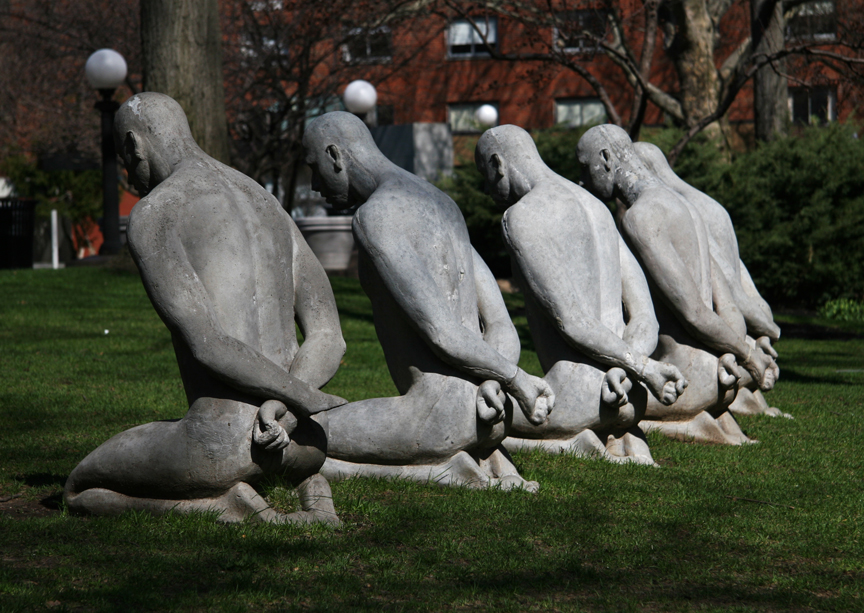
    Pratt Institute is considered one of the finest art schools in the United States, known for its programs in architecture, art, fashion, photography, design, illustration, interior design, and digital arts. Unlike NYU or Hunter College in Manhattan, whose campuses are essentially the city of New York, Pratt is cloistered – the campus is completely closed and gated. Add to this its location in Clinton Hill, Brooklyn, which at one time was one of the most dangerous neighborhoods in the city, and you can appreciate how clever I thought a student’s T-shirt was that he was brandishing some years ago. It read “traPt” – an anagram of the word Pratt which was indicative of how some students have felt. Nearby Myrtle Avenue was nicknamed Murder Avenue in the 1990s.

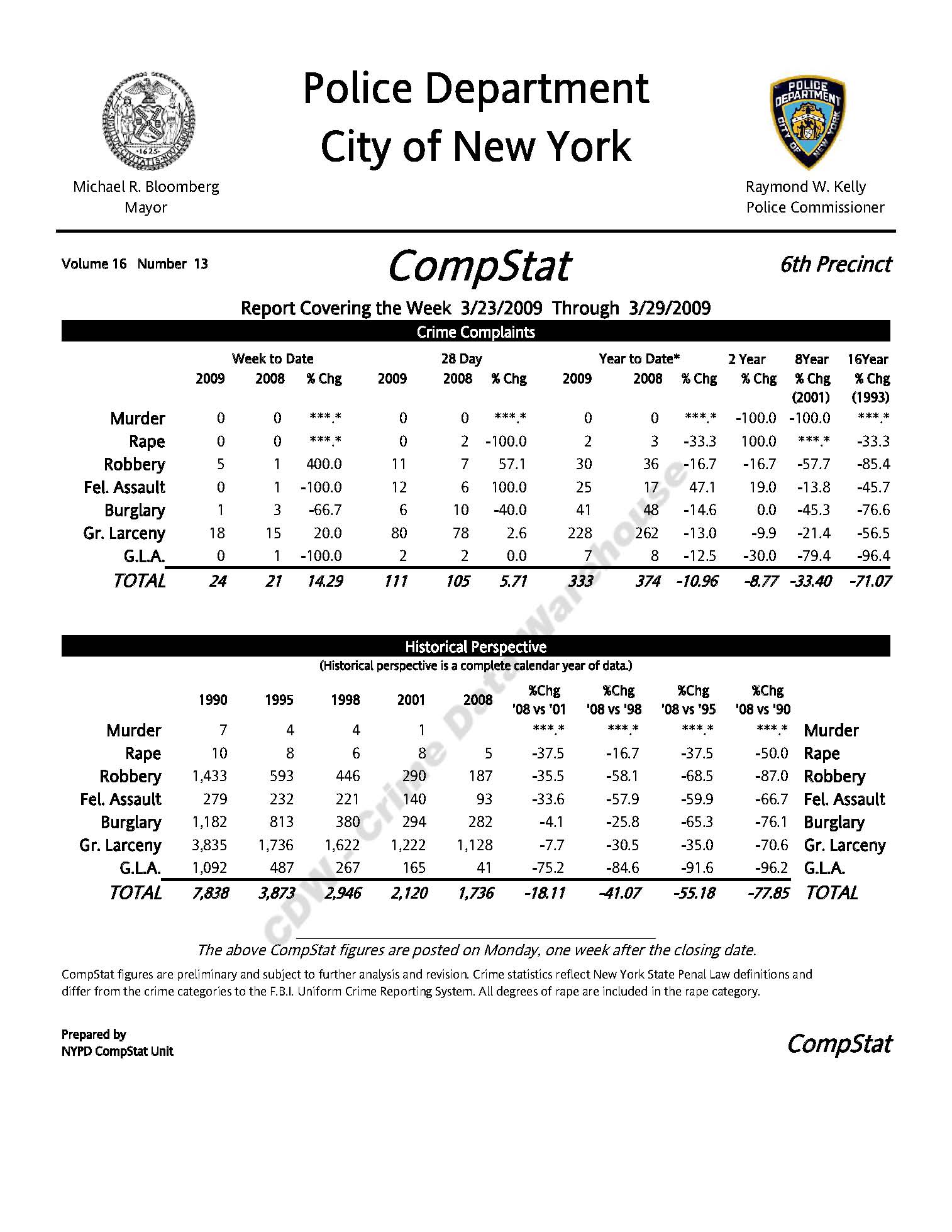
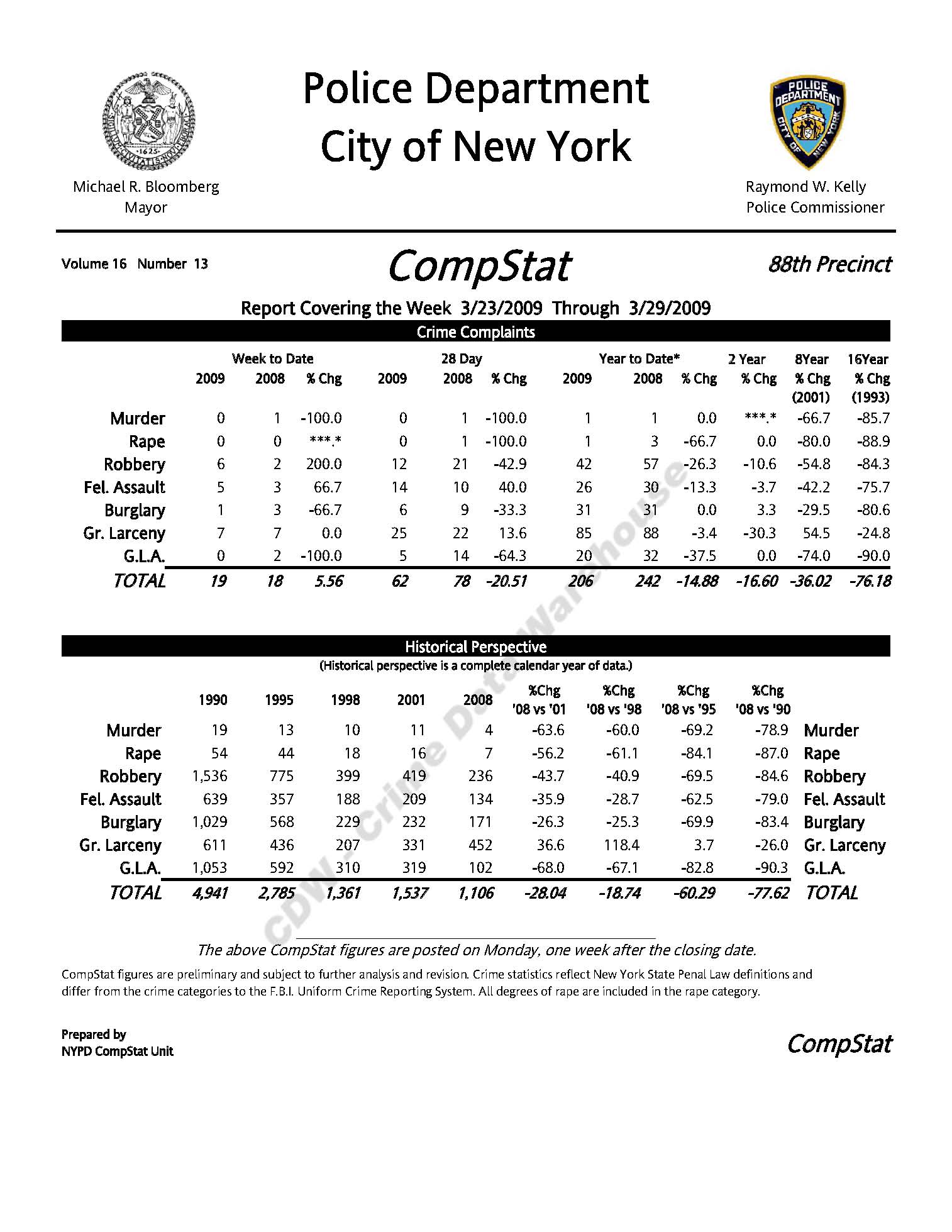
    Certainly the neighborhood has gentrified significantly over the years and has benefited by a tremendous reduction of crime city-wide, attributed to the NYPD’s Compstat program and an increase in the numbers of police officers in NYC, starting in 1990. I was curious about the actual crime statistics in the neighborhood, so rather than rely on perceptions or anecdotal evidence, I decided to go right to the source – the NYPD website – and look at the Compstat statistics for the 88th precinct, which covers Pratt Institute. I compared it to the 6th precinct in Greenwich Village, home of NYU. I expected to see a much greater disparity but was surprised to see that the crime statistics were not that disparate. You can see them here: the 6th Precinct and the 88th Precinct.

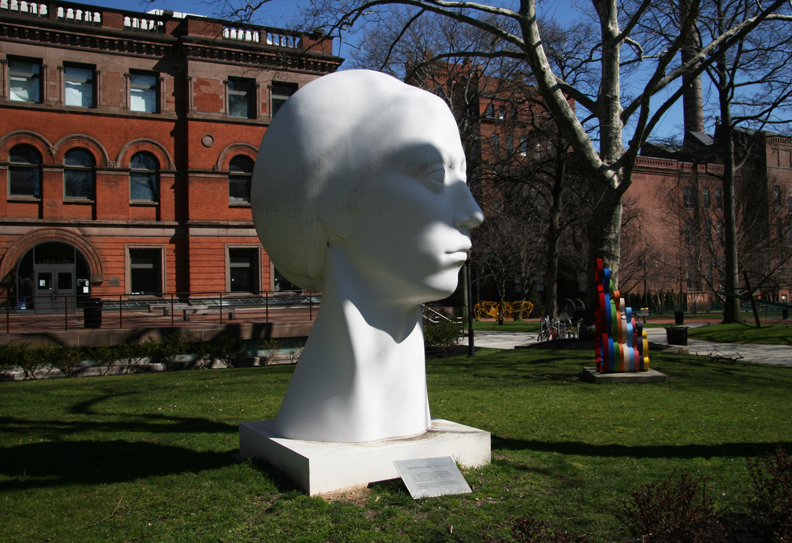
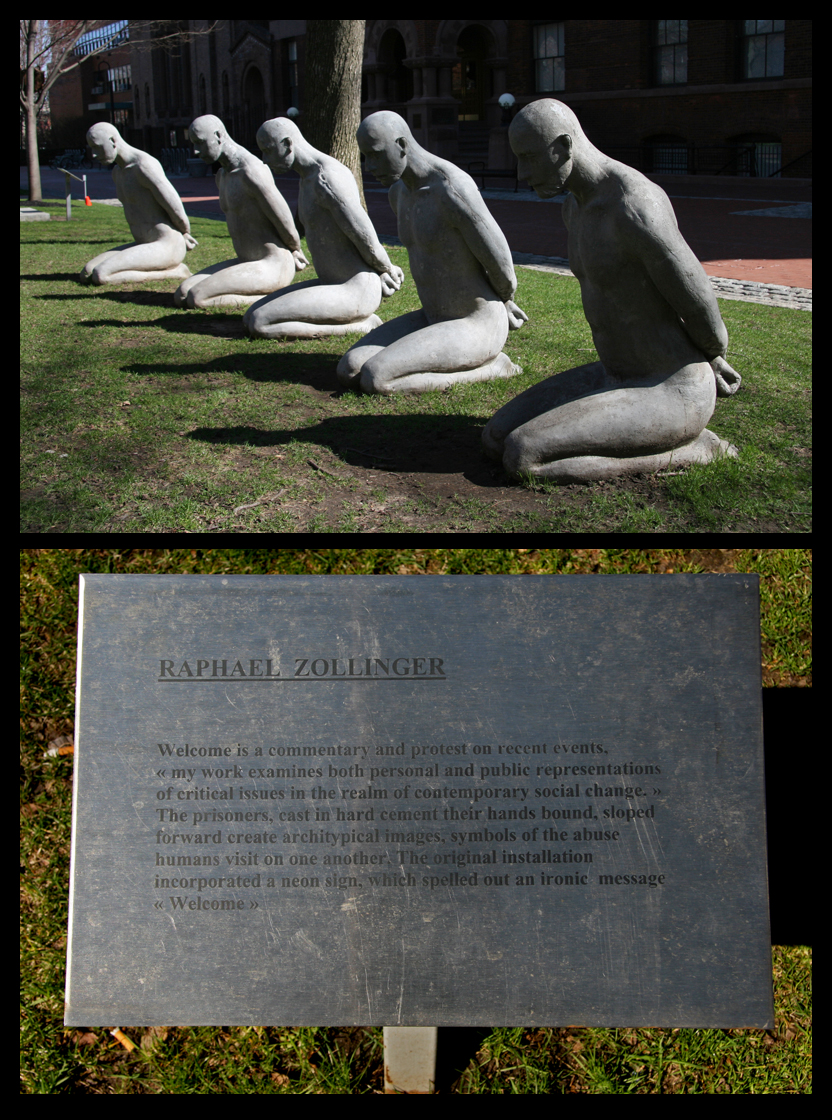
    The atmosphere of a real university campus is quite special in New York City, and Pratt is graced with 25 acres, which includes a sculpture garden featuring a variety of works. The work in the photo, Welcome II by alumni Raphale Zollinger, is one of the most arresting, along with Philip Grausman’s large idealized white female fiberglass head, Leucantha. Welcome II’s 5 naked prisoners are cast in concrete. See front view and read the the plaque here.

    An ironic work for such a beautiful garden – perhaps relics of feeling traPt…

    Posted on by Brian Dubé

  • Times Are A-Changin’

    Posted on by Brian Dubé

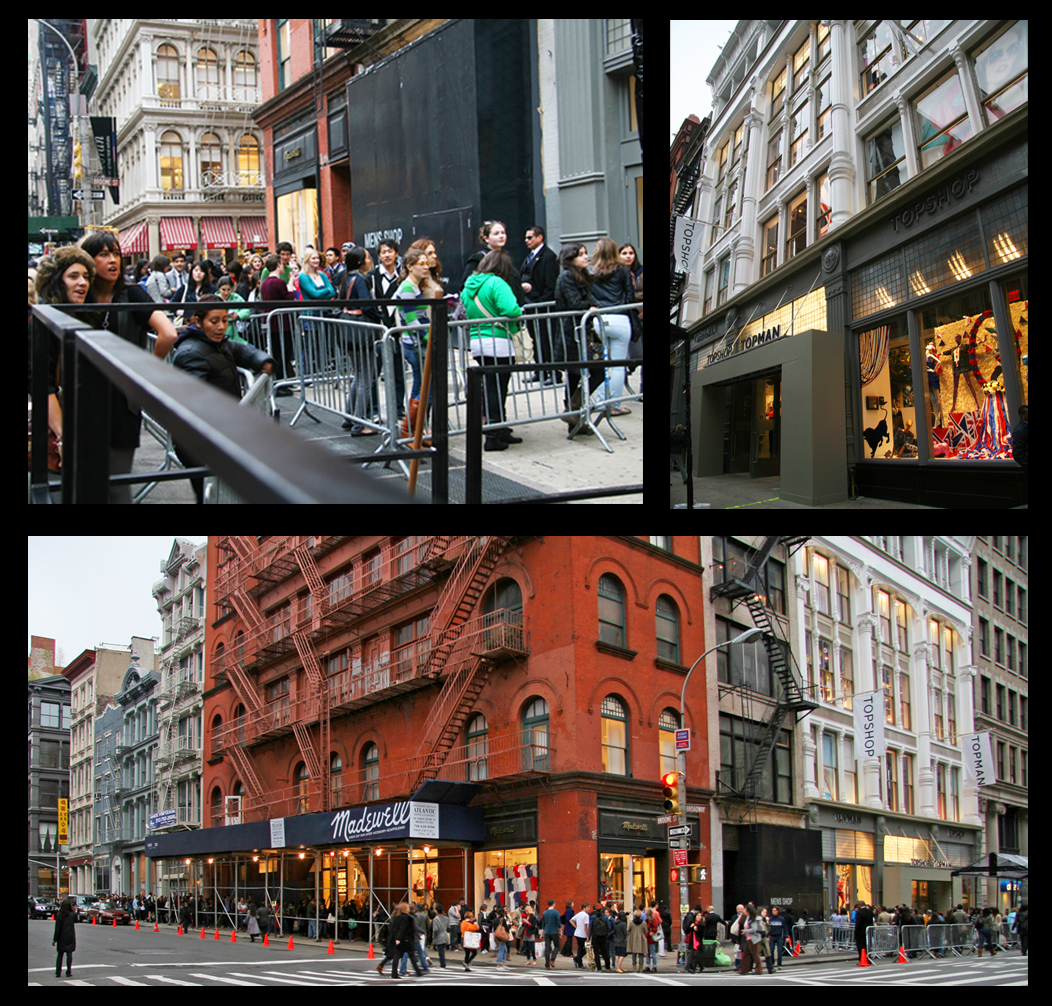
    Yes, in NYC, stores openings are occasionally media events. Topshop, a British-based clothing chain of over 100 stores, opened its first US store yesterday at 478 Broadway (south of Broome Street) in SoHo. What we have here is where buzz meets the American passion for shopping. The awaited opening was covered by every local media group. For over a week before the opening, a pink Topshop van had been busy giving out free tote bags which included gift cards worth up to $500.

    Model Kate Moss, Jennifer Lopez, and Marc Anthony were at the ribbon cutting on Thursday, April 2, as was owner Sir Philip and Lady Green. Kate Moss, who has been doing a fashion collection with Topshop since 2006, will be introducing her spring line with the opening of the SoHo store. I arrived in the evening. A tented press area with seating had been installed. Evidence was still on hand of a media event, with network TV, professional video cameras, photographers, and security. Customers were being corralled through gates. Lines wrapped around three sides of a block – Broadway, Broome, and Crosby Streets.

    Topshop’s flagship store is on Oxford Street in London and is the world’s largest fashion store – 90,000 square feet on four floors with as many as 30,000 visitors per day. The New York City store occupies 25,000 square feet on four floors.

    The store is only two blocks from Canal Street, which is remarkable since Broadway is decidedly rougher the closer one gets to Canal and historically has been rather downscale and most immune to gentrification. The arrival of Topman, with Citibank flanking one side, a new J. Crew coming soon on the other side, and Bloomingdales less than one block away, certainly heralds a new age for this immediate area, extending the boundaries of SoHo chic and stamping out the last vestiges of industry along these blocks of Broadway just north of Canal.

    Canal Street and the area around it has been known for many things: industrial supplies such as Space Surplus Metals (gone), Canal Rubber, Industrial Plastics (gone), and Tunnel Machinery (gone); Chinatown and the Manhattan Bridge going East, the Holland Tunnel, and discount shops with fake designer products. Adjectives such as cheap, tawdry, seedy, and dirty would all apply. But the times they are a-changin’…

    Posted on by Brian Dubé

  • Eye Candy

    Posted on by Brian Dubé

    Business moves in mysterious ways, and there come times when forces seem to point one way. Right now, for many retailers, the merchandising road is pointing to Times Square, an area beleaguered and blighted for eons, improving in fits and starts, but always drawn back to some variant, displaying elements of its historic sleazy character. Rents are high, and even well-heeled retailers during its recent improvement phase have closed, such as the Disney and Warner Brothers stores.

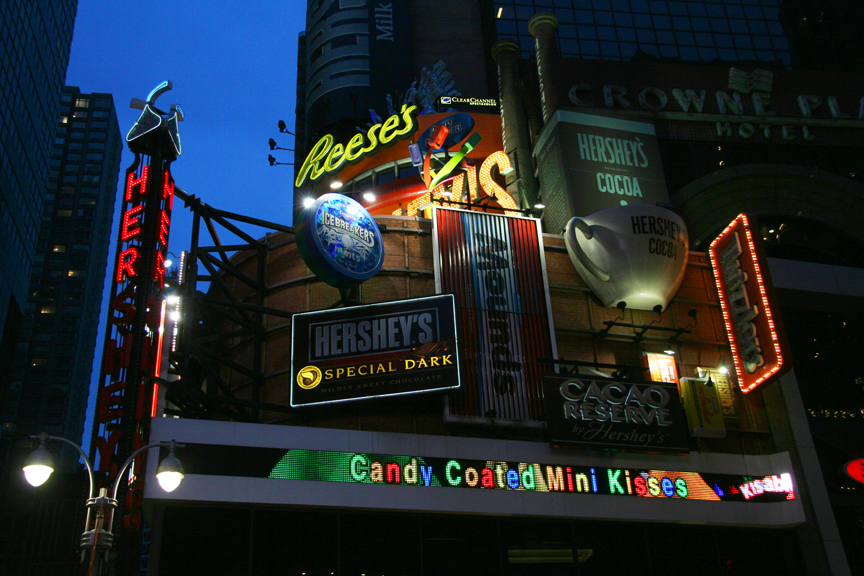
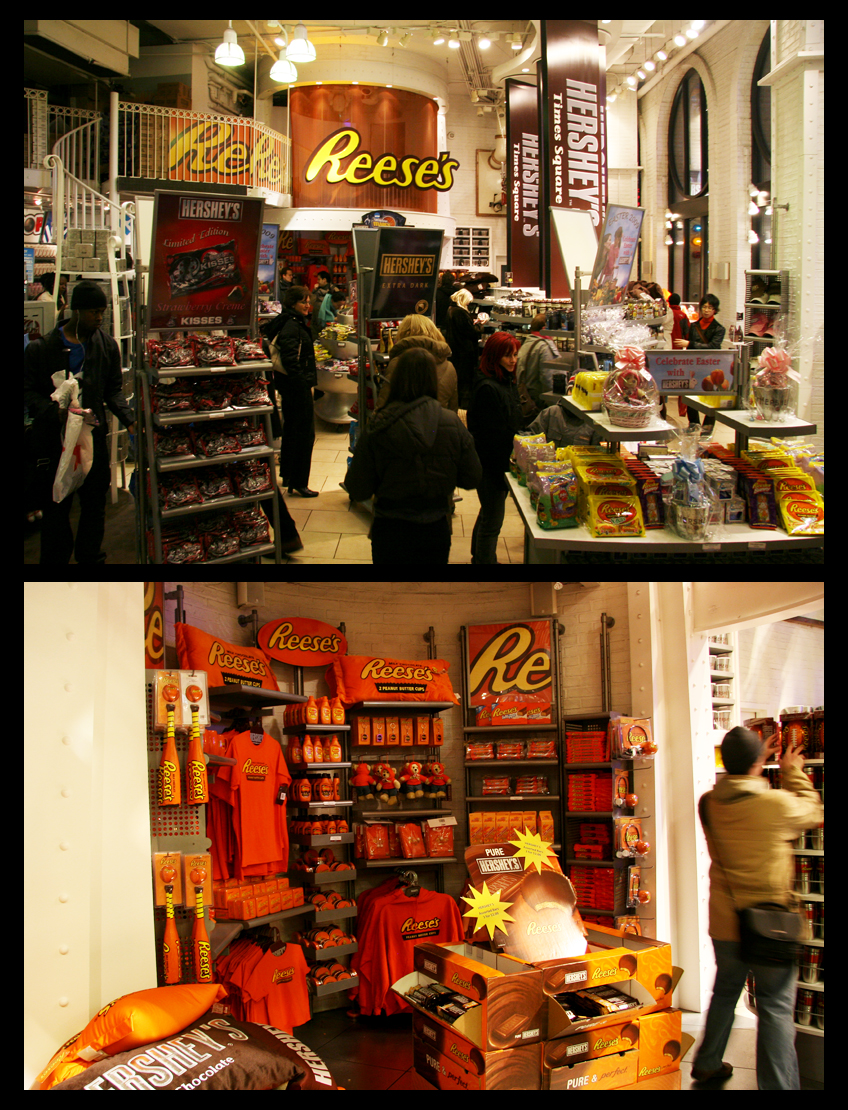
    I have written about the M&Ms Store at Times Square (see Branding Gone Wild and Let’s Have a Parade). Literally across the street at 48th and Broadway is competitor Hershey, with its own shrine to chocolate. This store is a much bigger experience on the outside – many visitors have been nonplussed by the inside. But the small one-floor interior space is certainly a place to get your Hershey’s chocolate fix and sample their extensive line. See my photos of the interior here. Unlike the much larger themed M&Ms store, however, it is not a total immersion experience or world.

    The thing to see here is the exterior, purportedly the largest permanent fixture ever built in Times Square. From their opening press release from October 28, 2002:

    HERSHEY’S spectacular — towering 215 ft. tall and 60 ft. wide, making it the largest permanent fixture ever constructed in Times Square — features a whimsical version of the original HERSHEY’S chocolate factory, complete with smokestacks, just like the one in Milton Hershey’s hometown, Hershey, PA. Thanks to 34 dimensional props, four steam machines, over 4,000 chasing lights, 30 programmable gel lights, 56 neon channel letters, 14 front-lit signs, and just about every other major signage technique utilized today, the chocolate factory spectacular will:

    Feature an over-sized HERSHEY(R)’S milk chocolate bar
    Light up a pyramid of HERSHEY(R)’S KISSES(R) with colors that change with the seasons
    Showcase a JOLLY RANCHER(R) candy wind sculpture
    Spout steam from the HERSHEY(R)’S cocoa cup
    Spin BREATH SAVERS(R) mints above the sidewalks of New York

    The Hershey Company is no longer just the chocolate company of Milton Snavely Hershey, who in 1907 created the Hershey’s Kiss. Read their history here. They now manufacture a myriad of chocolate and non-chocolate confections, including Reese’s, Milk Duds, Kit Kat, Krackel, Rolo, Skor, Cadbury’s, Almond Joy, Mounds, O’Henry, Mr. Goodbar, York Peppermint Pattie, Jolly Rancher, PayDay, Ice Breakers, Good and Plenty, and Twizzlers.

    I would not make the store a travel destination, but if you are visiting Times Square, take a look above you at 1593 Broadway at what (like the M&M’s display across the street) is literally Eye Candy…

    Posted on by Brian Dubé

  • Bovine Love

    Posted on by Brian Dubé

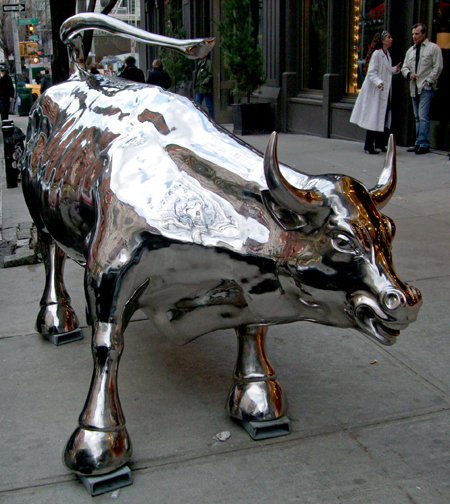
    Generally speaking, you do not walk down a familiar street and expect to be greeted by a newly installed massive steel bull. This fellow was in front of Cipriani’s in SoHo on West Broadway, discovered after an expedition to the Peter Lik gallery just up the street.

    Speaking to a waiter at the restaurant, I was informed that this was the work of Arturo Di Modica and that it just mysteriously appeared on the sidewalk with no explanation.

    Di Modica is best known for his charging bull in the financial district. That bull was originally installed after the 1987 stock market crash. It was placed in front of the New York Stock Exchange by the artist on December 15, 1989 without permission as a Christmas gift to the city. It was seized by the police but, due to public furor, was reinstalled downtown in the plaza at Bowling Green. The bull is extremely popular as a photo subject, often with visitors on, besides, or grasping the bull in some manner.

    There seems to be a fascination with the bovine family. In 2000, the streets of New York City were graced with cows as part of an international public art exhibit. This is an interesting choice of animal, since I have not thought of cows as being seen as particularly charming or attractive. The concept for the Cow Parade originated in Switzerland with art director Walter Knapp and sculptor Pascal Knapp, who holds the copyrights to the various cow shapes seen in the exhibits. Perhaps the Swiss connection provides some explanation of the choice of cows as animal subject.

    When confronted with the Di Modica sculpture on West Broadway, I, like many others, was seized with the inexplicable desire to embrace a bull and be photographed by a friend. There’s just something about a bull that makes you want to hug him, especially when he is frozen in time and unable to charge 🙂

    Posted on by Brian Dubé

  • Ready or Not

    Ready or not, here I come. The popular chant of children playing hide-and-seek could perhaps be the official slogan of some technologies which were begging to be made but were a failed concept, such as Motorola’s Iridium Satellite phone, a debacle which costed them billions.

    A myriad of other reasons have been responsible for the failure of products and/or services which once seemed like a great idea. Wrong time, wrong place, not enough support services, not enough content, not scalable, not monetizable, too expensive, or other competing technologies. Betamax, Apple Newton, Qube, ebook readers, Urbanfetch, and other dot com failures.

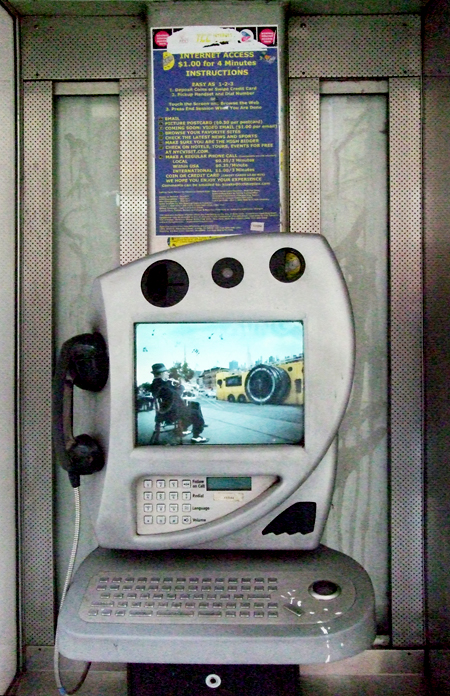
    I don’t wish them ill, but the Internet phone (on the streets here since 2002), which I saw recently on West Broadway in SoHo, seems like something that, for many, would only be useful in an absolutely desperate situation. Of course, that does not doom them to failure. Many a business model has been built around urgent needs. However, handheld Internet-capable devices are ubiquitous and may have the impact on this technology that cell phones have had on regular payphones themselves.

    The Internet phone, the Neptune 800 web phone, was developed by Marconi Corp. a London-based company (now owned by Ericsson). Initially, over 100 phones were installed city-wide for the NYC payphone company, TCC Teleplex, headed by Dennis Novick. Starting in 2002, British Telecom had very ambitious plans to roll out tens of thousands of these internet phone kiosks in the UK.

    As I have written before, anything on the streets of New York City will be subjected to wartime conditions – various combinations of vandalism, abuse, and misuse. The Neptune phone has a die-cast aluminum chassis, a 10 millimeter toughened-glass touchscreen, an armored cash box, and a metallic, sealed keyboard to withstand vandalism and tolerate adverse weather conditions and humidity. It has a trackball and color touch-sensitive screen.

    Services include email, video email, picture postcards, high-speed web browsing, or local information. Hot buttons give access to news, sports, shopping, games, weather forecasts, local maps, and information about shops and restaurants.
    Ready or not for wide adoption, it has come…


  • Land Sharks

    Fire Island has very few amenities and no cars – it is loved for this very reason. A quiet refuge with red wagons and walkers, it is one of the most remarkable environments considering its proximity to New York City. Typically, the very few bars and restaurants that do exist in some communities are quite poor, catering to a captive audience. But invariably, a combination of boredom and curiosity does set in, and a visit to the local watering hole at least once is inevitable.

    While weekending there many years ago, a friend returned from the only bar in town. When asked about the nature of his adventure and the type of people he found, he replied, “Land sharks, nothing but land sharks.” By land sharks, he meant men who had no purpose other than a very focused and singular mission to score with women. Perhaps we found it repugnant because there was not even the artifice of a mating ritual at a bar at that time. Or perhaps we were just jealous that we did not have the chutzpah to join the mix and endure the slings and arrows of female rejection.

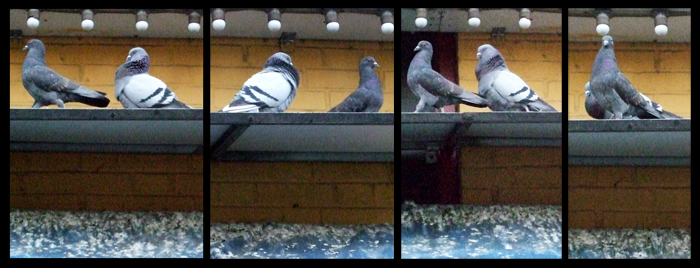
    The nice thing about being a pigeon is that courtship rituals are so well scripted. There is no anxiety, trepidation, or self consciousness in their application. Best of all there appears to be no stigma or concern with rejection.

    The recently vacated Mexican restaurant, Senor Swanky in Greenwich Village at Bleecker and Laguardia, was a place that proclaimed itself as a “celebrity hangout” on its signs, a source of hilarity for a number of us neighborhood residents. It has been closed since July 2008, and its awnings and ledges have become a very busy pigeon roost, with droppings everywhere. In observing this appropriately consecrated place (the restaurant was dreadful, from what I have read), I observed the mating ritual of two pigeons in a very linear style, confined as they were to the edge of the canopy. Left to right, right to left, left to right. Persistence is part of the game.

    The mating rituals of the feral pigeon (Columba Livia – Rock Pigeon or Rock Dove) are, of course, well documented with behaviors such as bowing, tailing, driving, and cooing. But we may never know whether some males, unsuccessful in their courting efforts, will return to some of their brethren and, when asked about the doves at Senor Swanky’s, will respond in defense, “Land sharks, nothing but land sharks.” 🙂


  • Ray’s

    There are subjects which are complex and extremely difficult to understand, such as theoretical physics and abstract mathematics. And some have taken the already difficult a step further, like Wittgenstein, Hegel, and Jacques Derrida – try fathoming their writing and you can see why they have been accused of deliberate obscurantism.

    Mix the already complex with deliberate obscurantism, and what do you get? The saga of Ray’s Pizza. Residents know, and visitors quickly become aware of the endless parade of Ray’s Pizzas and their variants in this city: Ray’s Original Pizza, Famous Ray’s Pizza, World-Famous Original Ray’s Pizza, and even Not Ray’s Pizza.

    I have dug into this story, giving myself adequate time to study the details. It does appear that Ray’s Pizza at 27 Prince Street (in Little Italy) is the first NYC pizzeria bearing that name. It has been in business since 1959, and according to an investigative article in the New York Times in 1991, Ray’s Pizza was first listed in the 1960 Manhattan telephone book. On my recent visit, a red banner strung indoors proclaimed their 50th anniversary. A faded photo of Joe DiMaggio hung near a framed, yellowing front page from the New York Times, all in the understated style characteristic of Cuomo’s pizzeria.

    Ray’s was opened by Ralph Cuomo, the 22-year-old son of immigrants from southern Italy, using his mother’s recipe. Problems began when Rosolino Mangano began opening Ray’s around town. According to the 1991 article in the New York Times:

    “In the early 1960’s he [Ralph Cuomo] briefly had another Ray’s Pizza at 1073 First Avenue near 59th Street, but he sold that, and in 1964 it ended up in the hands of . . .
    A Ray Named Rosolino. The expansionist era began with Rosolino Mangano, an immigrant from Sicily, who used that First Avenue Ray’s to found an empire which now includes a dozen Famous Original Ray’s pizzerias in Manhattan, each adorned with a coat of arms featuring tomatoes, wheat and a cow.”

    And then there was a Ray named Gary:

    “In 1981 Mr. Mangano sold a Ray’s pizzeria at Second Avenue and 51st Street to Gary Esposito, who grew up in Floral Park, Queens. Mr. Esposito opened five more Original Ray’s pizzerias on Long Island and in New Jersey, but he showed one remarkable bit of restraint. ‘I have never said that I am Ray,’ he declared last week. ‘That’s my claim to originality.’ “

    For more of this fascinating story, see the original Times article here.

    The pizza? Excellent and one of my favorites in New York City, along with Two Boots. I love the pesto…

    Ray’s features six types of pizza: Pesto with Basil and Black Olives; Fresh Tomato, Garlic & Ricotta; White Pie with Spinach Mushrooms & Ricotta; Black Olives & Tomatoes, Pepperoni & Ricotta, and Ray’s Special – Pepperoni, Mushrooms, Sausage, Onions, & Peppers.


  • Birds Sing at Night

    Have you ever been to a place where on a moonless night it is so black that you can not see your own hand? Perhaps you live in such a place. But I can assure you – you will not find that here.

    Have you ever been to a place where you can read a magazine virtually anywhere at any time at night unaided? Welcome to New York City, where the difference between day and night is blurry enough to confuse birds who sing at night and fly to exhaustion and, in some cases, death. An estimated 100 million birds die annually hitting various structures. New York City makes a sizable contribution. Campaigns have been initiated to reduce building lighting at night in urban areas, saving both energy and birds.

    In cities like New York, Chicago, and Las Vegas, where there is tremendous man-made light at night, circadian rhythms and all manner of habits of humans and other fauna are disrupted. I have not made any major study of this, but recently I have been using a black out shade in my bedroom and have found improved sleeping habits.

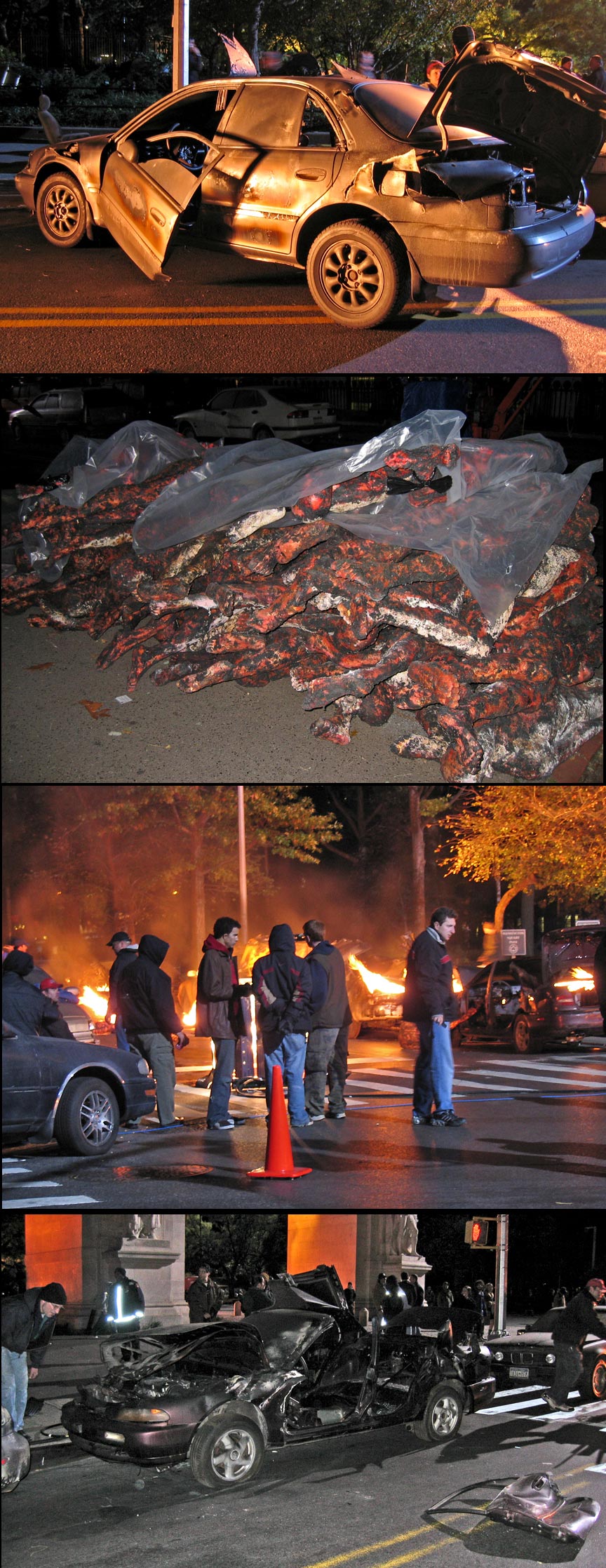
    In spite of this existing ambient light level at night, we still occasionally run across night time movie sets where areas are lit at levels like that of a sports stadium. In October 2006, local filming for the film I Am Legend took place in Washington Square Park over a two week period of time. This became a nightly social event and afforded some spectacular photo opportunities. I got a series of very atmospheric and dramatic shots – fog, cars in flames, burnt human bodies (see my postings and photos here and here).

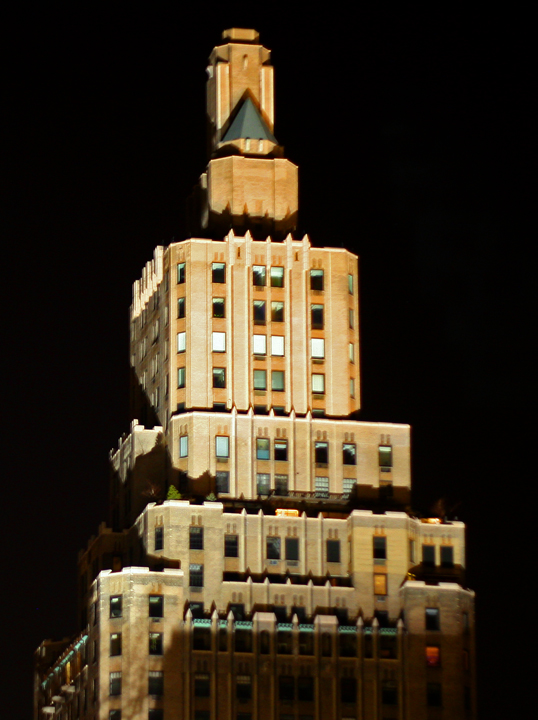
    A few nights ago, I became aware of spectacular lighting of the Village prewar building at One Fifth Avenue from several blocks away. The height of the building with art deco elements being lit from directly below created some very unusual harsh shadowing reminiscent of the flashlight under the chin monster effects.
    ‘Twas enough light to make birds sing at night and wake up the dead. But I’m sure the residents of One Fifth Avenue, as inured as New Yorkers are, slept fine 🙂


  • dinamic_sidebar 4 none

©2026 New York Daily Photo Entries (RSS) and Comments (RSS)  Raindrops Theme