• Mother Nature

    Posted on by Brian Dubé

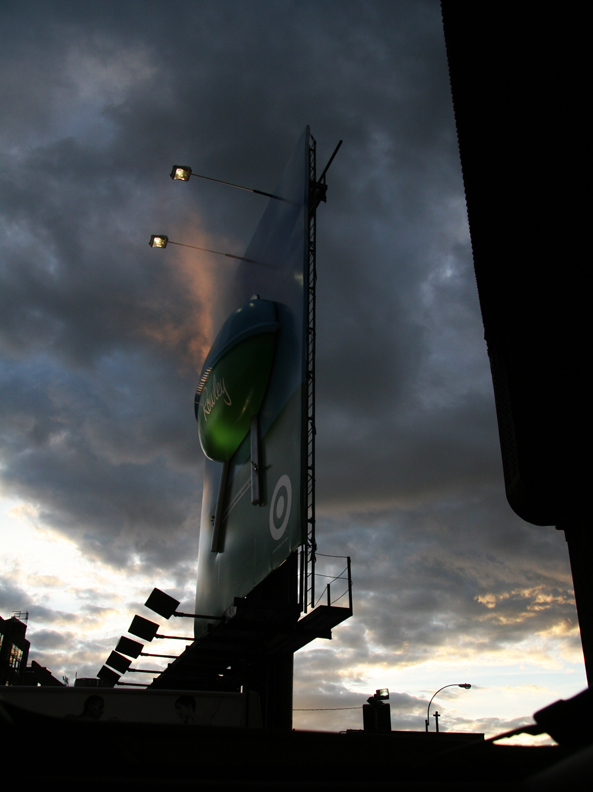
    I have had this photo for some time but knew nothing of the advertiser – Rowley. But the setting was so dramatic that I thought I would share it anyway. After all, we can let things speak for themselves on occasion, can’t we?

    This illuminated billboard was located on the West Side Highway in Chelsea, a neighborhood in the West 20s, abutting the Hudson River and the highway. Chelsea has become somewhat of an art district, as there has been a migration of galleries from areas such as SoHo due to extraordinarily high rents.

    I am not a fan of billboards. I find that they are typically a blight on the landscape. But there can be beauty, particularly dramatic beauty, at times with industrial and commercial subjects. Smokestacks, oil refineries, bridges, power plants, and power lines can all show a striking profile when the lighting conditions are right. I have written of this before in my posting Hell’s Gate.

    I don’t think I want to champion this type of display or give encouragement for more signage and billboards. And I think the credit here goes to Mother Nature, not Rowley…
    Posted on by Brian Dubé

  • Promises

    Posted on by Brian Dubé

    The 1960s held promises, many which did not live up to expectations, such as drug-induced insights, free love, and geodesic domes. Domes captured the imagination of the youth at the time, as did most things that broke with tradition. In the case of geodesics, the break was visually very obvious. Built from a network of triangles, the resultant structure was aesthetically pleasing. Many were the advantages and benefits. And many were the disadvantages and problems, largely unspoken of at the time but obvious to those who made a commitment to this type of structure for a home.

    Geodesic domes were popularized by R. Buckminster Fuller. They were promoted for their efficiency, strength, stability, light weight, and ability to be built quickly. There was hope that the geodesic dome would become a housing solution. But many problems surfaced – curved rooms with attendant difficulty in design and furniture placement, many seams prone to leaking, higher window costs, triangular panels resulting in more material waste, etc. Their success has now been primarily in its adoption for specialized commercial applications, such as pavilions, auditoriums, weather observatories, and storage facilities.

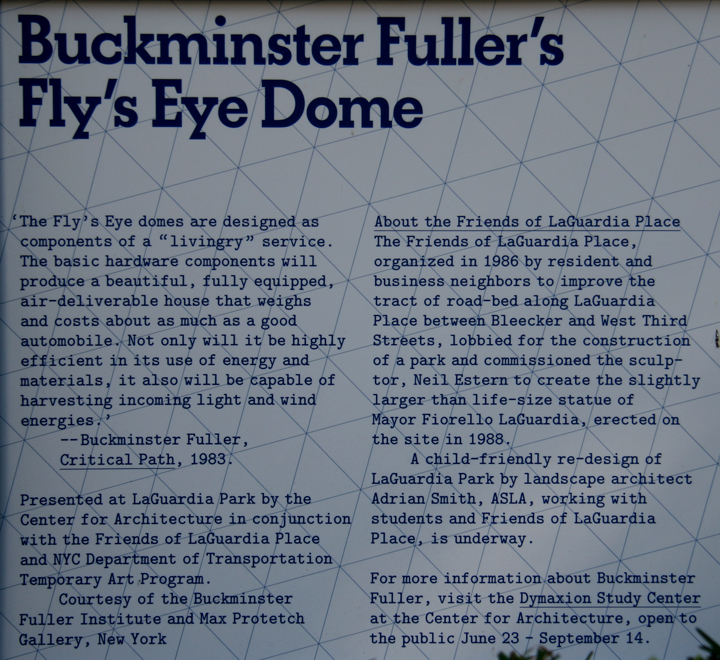
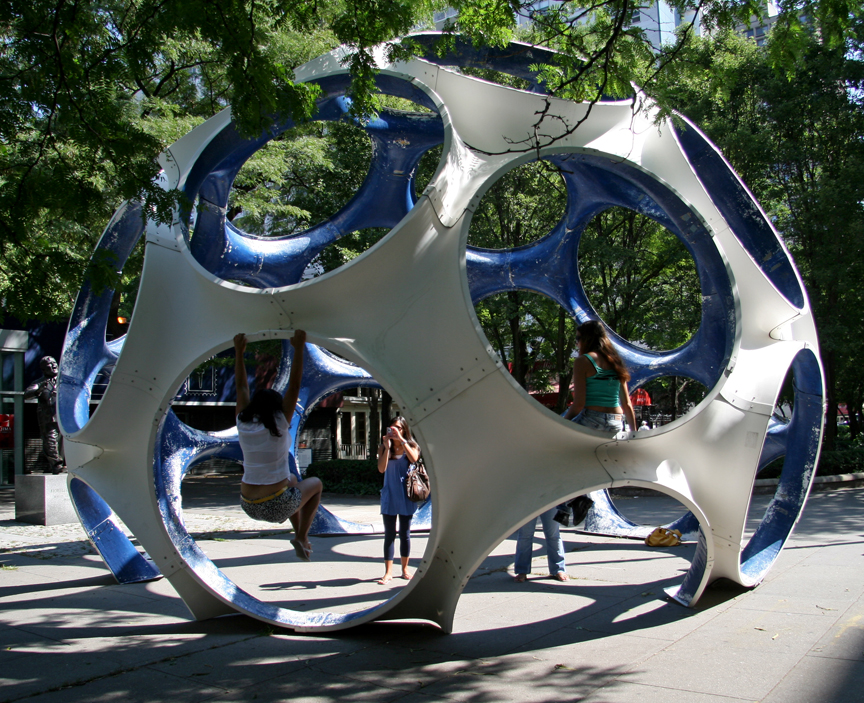
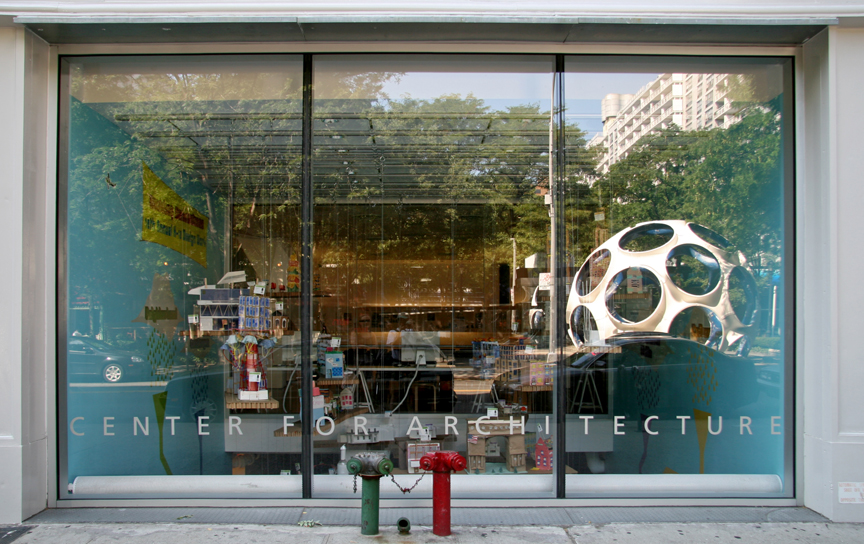
    The one in the photo that can be seen in the window reflection is Fuller’s Fly’s Eye Dome, which has been erected in LaGuardia Park across from the AIA center. Read about the sign here.  See here for photo of dome with a few visitors climbing the structure.

    The window is that of the Center for Architecture, the New York chapter of the American Institute of Architects. Buckminster Fuller and his work is an enormous subject. Read about him here. There is also more information about Fuller at the Dymaxion Study Center at the AIA Center at 536 LaGuardia Place from 6/23/08-9/14/08.

    Posted on by Brian Dubé

  • Gratuitous in Nature

    Posted on by Brian Dubé

    When I was younger, I did not understand the concept behind cut flowers. As someone interested in the sciences, their purchase made no sense whatsoever. They appeared to have no practical value and to be a poor investment, dying only days after purchase.

    I did not appreciate their beauty enough, either – they may have been fun to identify or interesting from the perspective of analysis and study, but buying them was anathema to me.

    But I have since learned the value of nature’s extravagance and exuberance. In a place like NYC, where utility rules and problems abound, beautification could be seen as a low priority item and a frivolous use of monetary resources. But, as I wrote recently in Let’s Have a Parade, not everything should be reduced to practical terms (see Very Practical here). Quality of life has been a recently articulated public policy, and efforts to make the city more attractive are welcome.

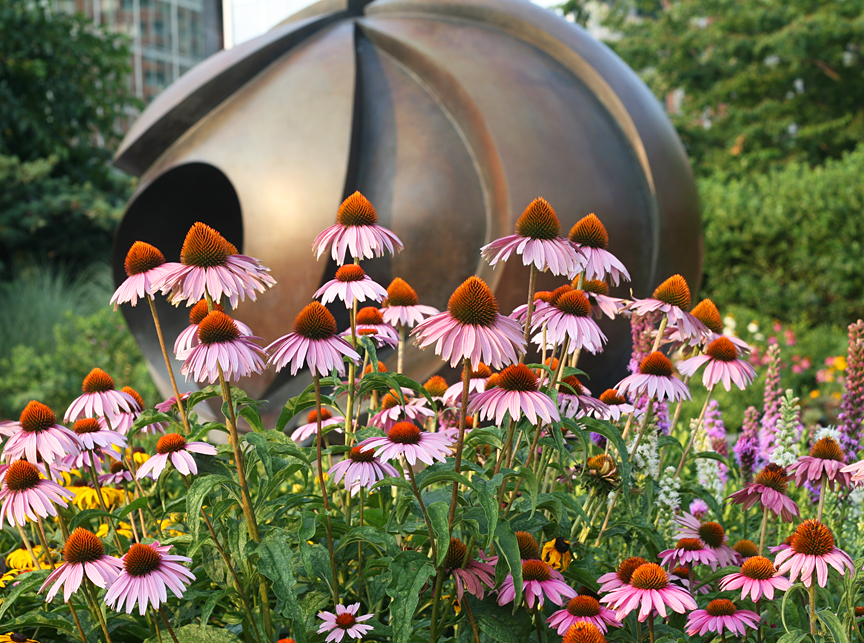
    So a display like that in today’s photo, taken at the Hudson River Park, is true eye candy for New Yorkers. And although flowers maybe gratuitous in nature, that’s a good thing 🙂

    Posted on by Brian Dubé

  • Interruption

    Posted on by Brian Dubé

    Regular readers of this site will have observed an interruption yesterday in this online publication for the first time in its 2-and-a-half-year history. This is not a harbinger for times to come or any lessened interested on my part. There is good reason for this interruption, as the photo and the tale to be told will tell. A tale of interruption, disruption, and commencement.

    It is rumored that a particular residential tenant had contracted to perform much-needed repairs in his home. Residents of this city know that the services rendered by landlords can frequently be poor or nonexistent and that unless matters are taken into one’s own hands, one can be forced to live in a manner not too dissimilar from the Dark Ages. I am not an advocate of vigilantism or reckless activity, but at times, one must do what one must do.

    So on Thursday, July 10, 2008, a crew of men was employed to make said repairs when all concerned were suddenly informed by the building management that work must stop immediately.

    Now it was extraordinarily distressing to have materials, a work crew, and money committed and then be told that work must STOP and that a representative of the landlord would be making a personal visit. The mood was quite anxious as nine people alternated between waves of silence and nervous speculation, both positive and negative.

    But good luck prevailed, and for reasons not completely understood but amid much speculation, after conversations with attorneys and the owner herself, work was permitted to continue, with no discussion of money, changes, or other negotiations.
    Now in NYC, this is to be considered nothing less than a small miracle, perhaps even a large one. It goes without saying that doing a blog entry in a construction site and under these conditions is reasonable grounds for interruption…

    Posted on by Brian Dubé

  • Real Deal

    Posted on by Brian Dubé

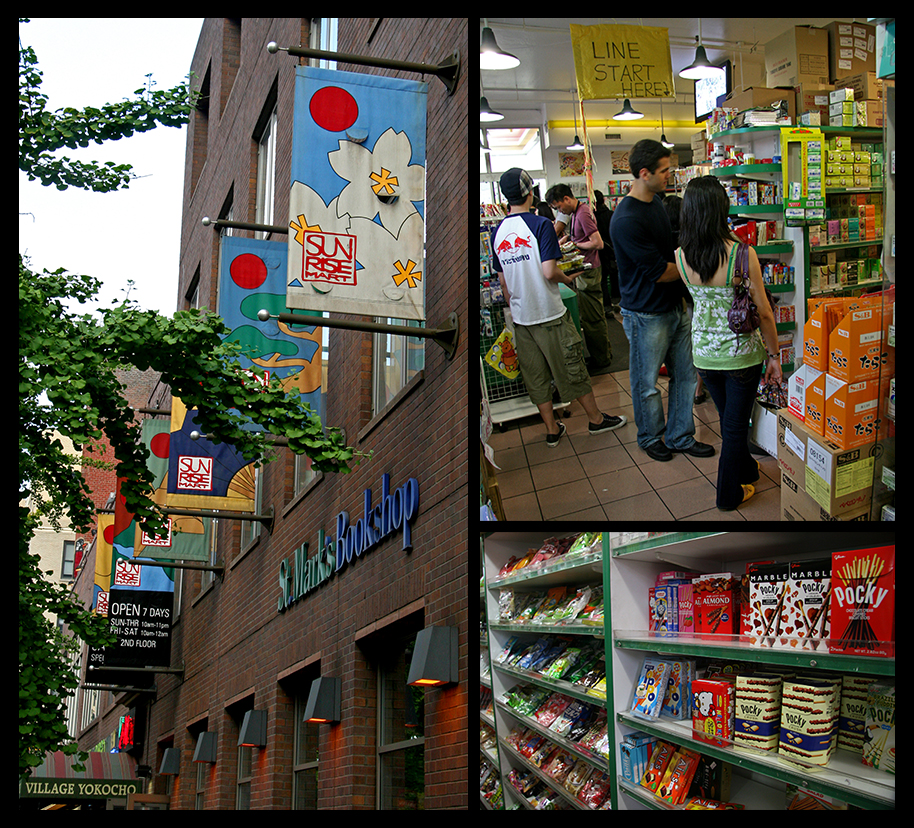
    To me, the phrase real deal is a superlative. And, like any superlative, one must use it judiciously for it to retain its meaning and impact. So when I tell you that Sunrise Mart at 4 Stuyvesant Street is the real deal, you know that I am speaking of a place that is authentic and very serious. No artifice or posing in this place – the kind of place you would only find in New York, Japan, or a very large urban area – if you’re lucky.

    Sunrise Mart is a small specialized Japanese grocery store located in an area of the East Village around St. Marks Place sometimes referred to as Little Tokyo. There’s no pandering to tourists here, although if you are in the area, I would recommend a visit to this very unique shop. The place is located on a second floor above St. Marks Bookshop and goes unnoticed to most except customers. Access is via a small elevator in a rather innocuous doorway. Also, the staff is Japanese, as is most of the clientele.

    The products range from packaged to fresh foods, divided into various departments, including meats, produce, housewares, clothing, and even DVDs. Japanese is spoken here, as one might expect in a place that is the real deal

    Posted on by Brian Dubé

  • Cooperation

    Posted on by Brian Dubé

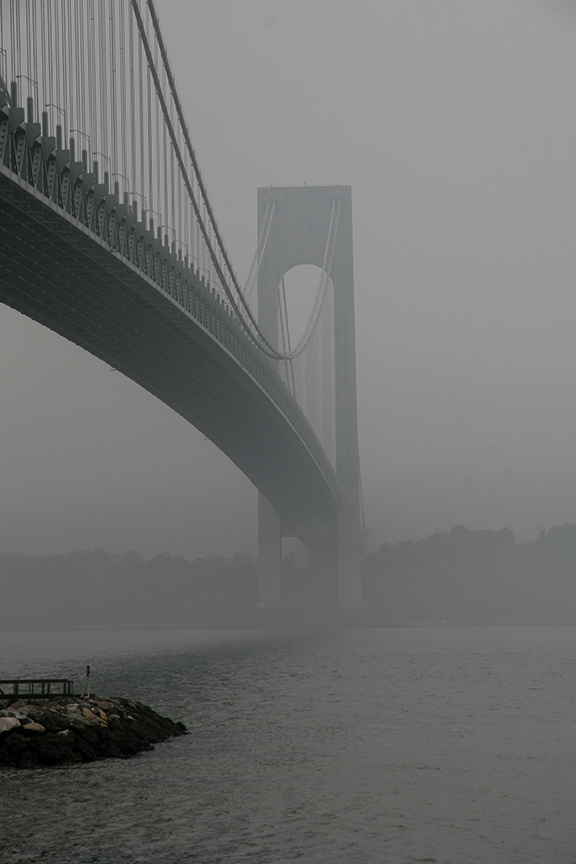
    What an easy and enjoyable thing photography can be when the subject cooperates. I have been planning to do a posting on the Verrazano Bridge for some time, but this requires a special trip and is quite some distance from my home in Manhattan. And one must find a good vantage point, negotiating around the Belt Parkway (a major highway with some limited parking) and the many other thoroughfares: 4th Avenue, Shore Road, Route 278 to the bridge, and a cloverleaf of highway ramps.

    However, I could not have picked a better day. A heavy fog had settled in, just occluding the more distant tower. See here for a series of photos.

    The Verrazano-Narrows Bridge is a relatively modern bridge, only completed in 1964. I have always found its lines rather clean and elegant. The bridge is omnipresent in the NYC skyline and is visible from every borough of the city. It connects Brooklyn and Staten Island. Although controversial during its construction, it is a lifeline, providing a roadway not only to Staten Island but also a connection between New Jersey, Brooklyn, and Long Island.

    At the time of its construction, it was the longest suspension bridge in the world (4,260 feet (1,298 m) and held that position until 1981. It still remains the longest suspension bridge in the United States. You can read more about it here.

    Every opportunity and subject element presented itself – a cargo ship, sailboats, fishermen, jellyfish in tidal pools, rocky outcroppings, a cruise ship, and, of course, fog. Everything just working together in a paradigm of cooperation…

    Posted on by Brian Dubé

  • Dead Sea Scrolls

    Posted on by Brian Dubé

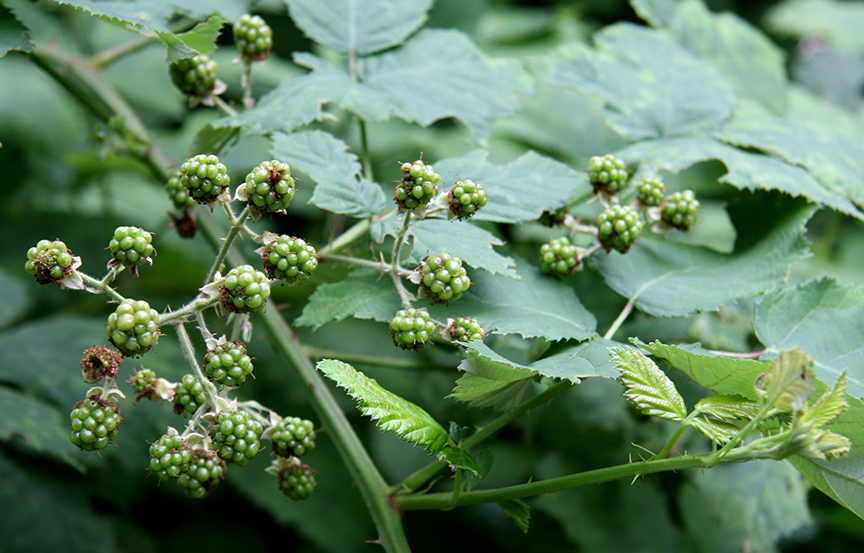
    I’m not saying that this was an ordinary or everyday experience. But yesterday, I was picking wild blackberries and apples in New York City. Finding such things here is exciting, like finding a Dead Sea Scroll.
    What was even more amazing is that the apple trees were in the center of a traffic island, surrounded by ramps and highways, with the blackberries nearby. I had to jump across a trafficked ramp to access the isolated island. I was rewarded with a number of very green, unripe apples. Very sour, but I grew up eating many unripe fruits which I foraged as a child.

    I have learned, however, that blackberries are not the fortuitous find I believed them to be in my youth. Apparently they are quite hardy plants and will grow in the most unforgiving environments – they can survive in poor soil and have been found in building sites, wastelands, and along roadsides. In some areas, they are considered invasive and a weed. And technically, they are not considered true berries.

    But fruit is fruit. Why split hairs over whether these are worthy for consideration? I’m starting to sound like a typical new Yorker who extols the virtues of simple things but, in reality, thinks they must be the right kind of simple, such as a certain brand of pushcart hot dog (Sabrett) or chocolate for a New York egg cream (Fox’s U-Bet). I suppose authenticity is always important when looking for Dead Sea Scrolls…

    Photo Note: The location of these will be revealed tomorrow’s posting on a nearby subject.

    Related Postings: New York Survivor, Grapes, Bird Country, Time Landscape, The Garden at St. Lukes

    Posted on by Brian Dubé

  • Gold Mining

    Posted on by Brian Dubé

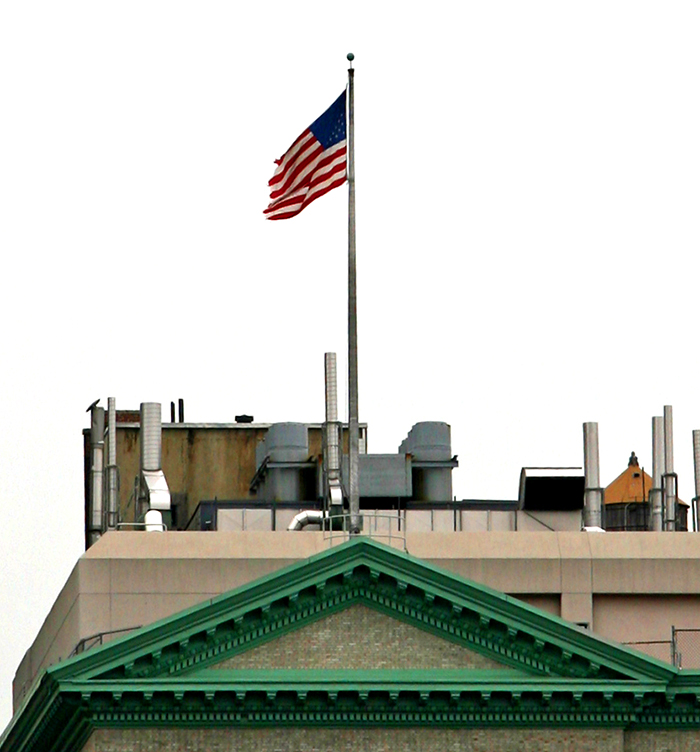
    Today, of course, is July 4th, Independence Day in the USA. I have never been a flag-waving American. In fact, my generation was particularly unpatriotic. I grew up in a time of protest – the Vietnam War, draft card burning, and marches to Washington. But as I have aged and learned, I have a greater appreciation for what this country has to offer.

    I am not blind to the problems here – over emphasis on money and capitalism, extreme ethnocentrism, racism, lack of national medical coverage, exportation of American values and culture, dumbing down of society, decline in educational achievement, and decline of the dollar and rise of the Euro.
    But in the course of my business and personal life, I have met thousands of individuals from across the world, and conversation frequently turns to culture and countries. I get positive impressions of this country from them.

    There is a clamor to get into this country – an average of one half of a million immigration applications are filed each month. Of course, the quality of life is certainly excellent in many other places (some would argue better), and most non-USA citizens are happy to live in their native land.

    I think the biggest thing I have learned is that freedom and opportunity are not hollow words. For the ambitious, skilled, and hard-working, there is opportunity in America. But here, like anywhere else, there is competition, and many outsiders are deluded into thinking that all Americans are wealthy and that the streets are paved with gold. TV, film, and the desire for instant gratification all contribute to these false ideas about the American Dream. There is plenty of gold here, but it has to be mined

    Posted on by Brian Dubé

  • Steps From Paradise

    Posted on by Brian Dubé

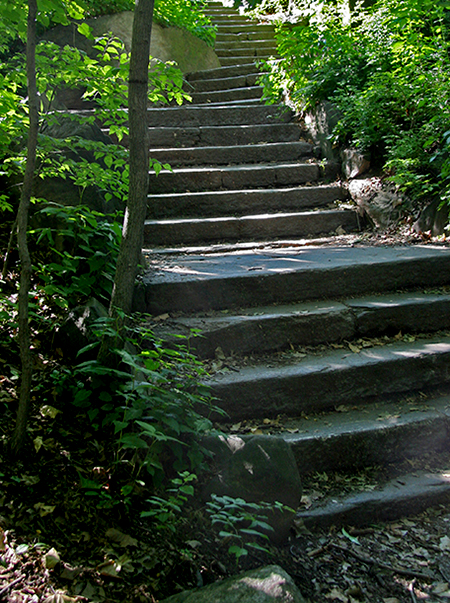
    Do you want to find one of the most idyllic, bucolic areas in Manhattan? One where you feel virtually removed from the city itself? Then step into the Ramble, a 38-acre “wild garden” in Central Park (in the words of Park designer Olmsted) with rocky outcrops, secluded glades, and a tumbling stream called The Gill.

    The designers of the Park literally sculpted the Ramble out of a wooded hillside. One of the first parts of the Park to be built, the Ramble is totally artificial except for its bedrock base. Even the water running in the Gill is turned on and off with a water tap.

    What is extraordinary about the Ramble is how one can be completely secluded in a heavily wooded environment in the center of Manhattan with no visual sense of being in an urban setting. You have to look hard in New York City to find spots of nature which are capable of really acting as a retreat and providing a respite from city life. Some of my favorite spots are the various community gardens (see Shangri-La).

    The Ramble is a major bird-watching area due to its location on the Atlantic flyway (the migration route that birds follow during the spring and fall). It is one of the top 15 birdwatching sites in the entire United States – 230 species have been spotted.

    One aspect of the Ramble, which has kept some visitors away, is its use since the early 20th century for gay encounters. The heavily wooded seclusion which the Ramble affords has made this an ideal location in the city for outdoor gay sex. However, I have been to the Ramble many times over the years, and personally I have never witnessed anything of this nature, so I would not let any of this deter you from visiting this area.

    I am frequently surprised at many people I meet who are unaware of the Ramble’s existence. If you are in Central Park, always remember – you are only a few steps from paradise…

    Posted on by Brian Dubé

  • Light Anyone?

    Posted on by Brian Dubé

    There are people who are afraid of light. Those with heliophobia have fear of sunlight. Some have a condition known as photophobia, an extreme sensitivity to light. But apart from these relatively atypical, draculean individuals, most people love light and shun the darkness. How often we experience down spirits on a dark and cloudy day or see children afraid of the dark.

    On the other side of the coin, we have an endless capacity to enjoy light in every variation, produced from sources both natural and man-made. The sun, the moon, LEDs, neon, southern exposures, fire, fireflies, illuminated toys, or Times Square. It’s built into our vocabulary – light up your life…

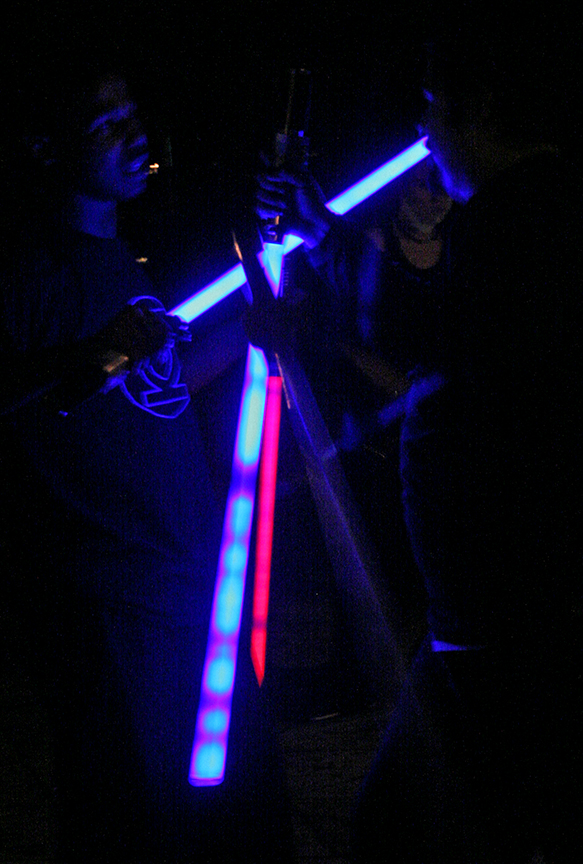
    Here in this photo, we have the latest incarnation of fascination with light and a recreation based on its manipulation: Jedi light saber play with NY Jedi, a group that is now 2.5 years old. Judging from their website, this appears to be a growing phenomenon many of us might have missed. And yes, there is now equipment, forums, meetings, events, teams, costumes, classes, films, videos, and a vocabulary, all specific to the activity. Some of the Light Sabers can run up to hundreds of dollars. If you want to know more about activities, meetings, or equipment, check their website here.

    The concept of light is virtually synonymous with things good and positive – we have acknowledgement in Genesis:

    And the earth was without form, and void; and darkness was upon the face of the deep. And the Spirit of God moved upon the face of the waters. And God said, Let there be light: and there was light. And God saw the light, that it was good: and God divided the light from the darkness.

    Light anyone?…

    Related Postings: Spinning, Signature, Let’s Have a Parade

    Posted on by Brian Dubé

  • When Worlds Collide

    Posted on by Brian Dubé

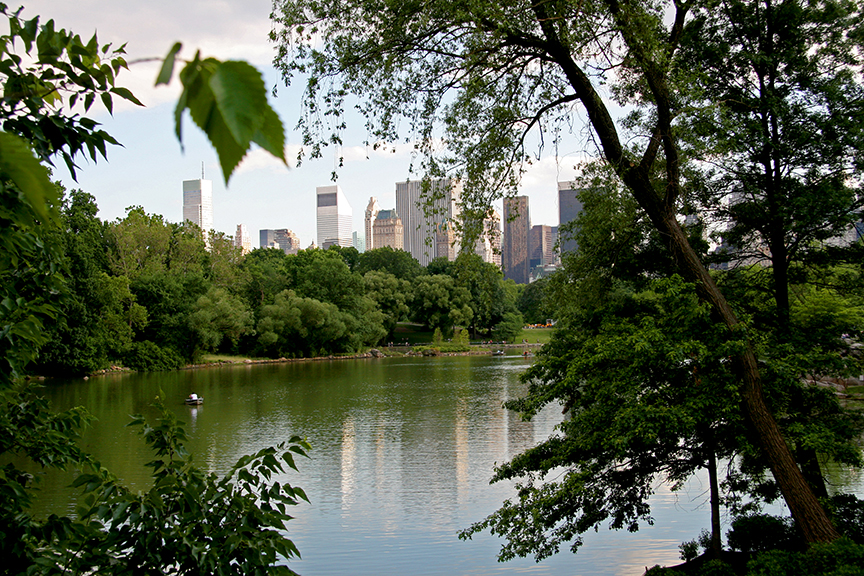
    There are things one never tires of, and for me, Central Park is one of them. What is there to get tired of in this idyllic urban oasis? I place it at the pinnacle of any must-see list for visitors.
    Given the lack of outdoor space for city residents, parks take on a much greater significance – they effectively become our backyards and recreational playgrounds. So the reason for my bias is obvious.

    I can easily be accused of being a one-man campaign for Central Park and taking every visitor I have known there for an obligatory visit. This landmark was designed by Frederick Law Olmstead and Calvert Vaux and was completed in 1873. The landscaping and architectural elements are exquisite. As I wrote in my article on the conservatory water, on a perfect day, I feel like I have been transported to Seurat’s Sunday Afternoon on the Island of La Grande Jatte.

    This 843-acre wonderland is remarkable for many reasons, including its myriad of different environments and areas set aside for a variety of uses (see the list of articles and photos I have done in related listings below). There are extensive walking/running tracks, two ice-skating rinks, tennis courts, the Central Park Zoo, the Central Park Conservatory Garden, a wildlife sanctuary, the Ramble, a 106-acre/billion gallon reservoir (with an encircling running track), ponds, the Lake, a Conservatory for model boats, the Delacorte Theater (which hosts “Shakespeare in the Park”), Belvedere Castle, the Swedish Cottage Marionette Theatre, and the historic Carousel. There are numerous major and minor grassy areas, some used for sports, some are set aside as quiet areas, and there are a number of enclosed playgrounds for children.

    From many vantage points in the park, the city’s skyline is visible – the juxtaposition of the urban landscape and the bucolic is a potent reminder of where you are and how fortunate we are to have both worlds…

    Related Postings: Conservatory Water, Kerbs Boathouse, Bethesda Fountain, The Beresford, Not So Kleine, Belvedere Castle, Red Panda, Feeding at the Zoo, Albino Burmese Python, The Boathouse Restaurant, Alice, Strawberry Fields, The Bow Bridge, The Dakota, Central Park Mall, Going Tribal, Vivid View

    Posted on by Brian Dubé

  • Dead or Alive

    Posted on by Brian Dubé

    I thrive on holdouts. And this website is slowly becoming a tribute site to many of them, a commemorative site for legendary businesses, both present and past. As time passes, I am accumulating a growing number of postings on places which are no longer with us – tombstones in the graveyard of NYC.

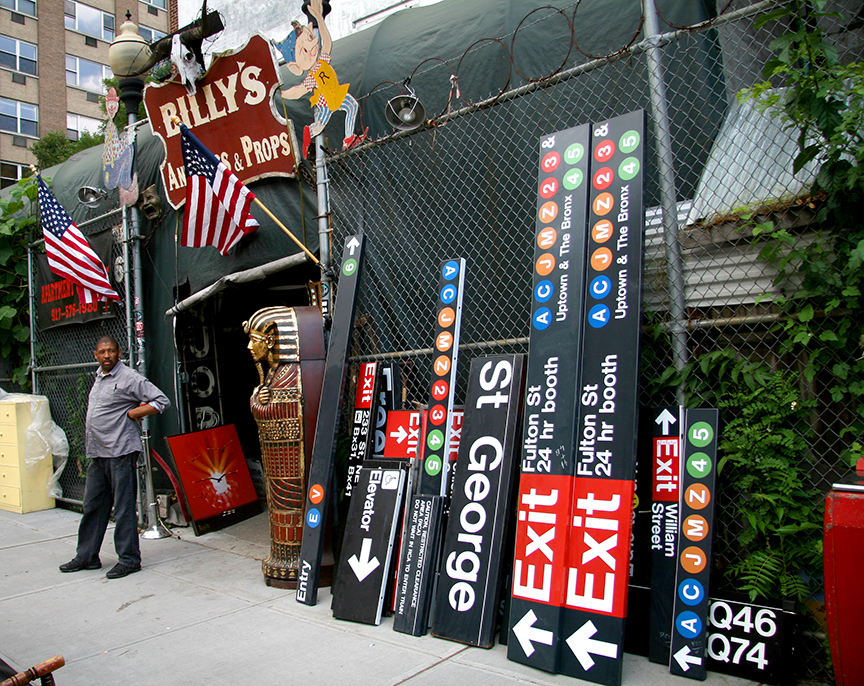
    Billy’s Antiques is one of those places. What kind of place? The kind that is the raison d’etre to be here in the first place and that you won’t find anywhere else. The kind you expect to read about on this website and visit in person.
    Billy Leroy is as iconoclastic as the business itself. Growing up on the Upper East Side, he attended boarding schools and studied at the Art Institute of Boston. Here, at Billy’s Antiques and Props, you can find all manner of things: meteorites, subway signs, furniture, paintings, etc. It’s a place the New York Times referred to as a “green circuslike tent whose lineage seems equal parts flea market, carnival midway and antiques shop.”

    From Billy’s Antique website:

    “The strange green tent that has been at 76 East Houston Street since 1986 is the last eclectic antique and prop store on the Bowery. Billy’s first incarnation was called Lot 76.In those days the Bowery was like the Wild West. Only the adventurous came downtown. As the sun would set on East Houston the junkies and alcoholics would lurk around like Zombies, asking for handouts.
    The creator of lot 76 was Rob Fennick a forward thinking antique dealer from Detroit. The tent has provided countless objects to thousands of New Yorkers. All walks of life have passed through the doors: movie stars, rock stars, artists, junkies, hookers, gangsters entrepreneurs, hipsters, and today there is a new breed on the Bowery; the metro-suburbanites. But the spirit of old New York is still alive at Billy’s, a good deal at a fair price. All the people involved in the operation of Billy’s have been down the boulevard of broken dreams and take their jobs seriously. We treat people the way they treat us. Ask a silly question get a silly answer. We at Billy’s want to thank our customers for keeping this tradition alive.”

    These types of businesses are disappearing fast; I love them and I will continue to chronicle them, dead or alive…

    Also wanted dead or alive: Space Surplus Metals, CBGB, Gotta Go, The Bitter End, Bowery Poetry Club, Kristal Palace, Claremont, Hurry, Canal Rubber

    Posted on by Brian Dubé

  • Rite of Passage

    Posted on by Brian Dubé

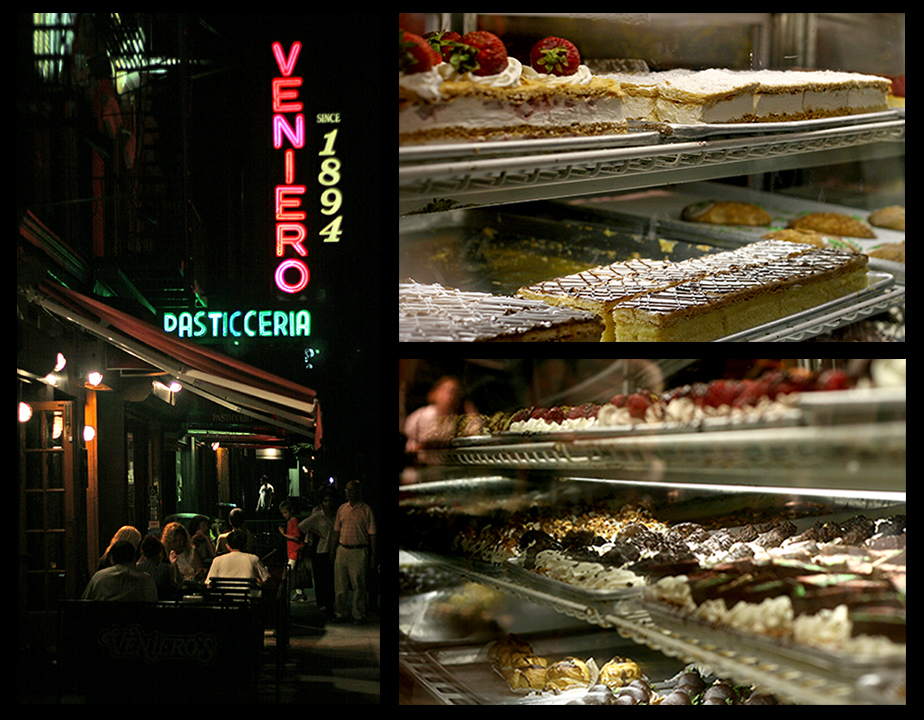
    Now there are people who do not like pastries at all. I have met them. But you won’t find them in line here at 342 East 11th Street, home of Veniero’s Pasticceria & Caffé.
    I won’t claim that desserts at Veniero’s are the ne plus ultra of the pastry world, but they are excellent and well-respected. Veniero’s is a New York City institution, started in 1894 by Antonio Veniero and kept as a family-run business ever since. You can read more about them here. The bulk of the business is takeout and suppliers to restaurants around the city. You can also eat in their café from their extensive menu.

    There are certain rites of passage which I believe every city dweller should go through to be a bona fide New Yorker. After all, imagine being at a social gathering where discussion turns to a discussion of favorite cheesecakes – Junior’s or Eileen’s – and the embarrassment when you have to admit that you have never been to either. Be prepared for the conversational snub and relegation to social Siberia.

    Of course, a rite of passage is not always pleasant, just de rigueur for initiation (or should I say di rigore?). They come in many forms: hazing, breeching, scarfication, baptism, Bar Mitzvah, the aboriginal walkabout, Masonic rituals, and the debutante ball. But here at Veniero’s, your compulsory initiation rite will include requisites like biscotti, miniature pastries, a myriad of cookies, cannoli, tiramisu, sfogliatelle, and my personal favorite: strawberry millefoligie. That’s not such a painful, bad rite of passage, is it?

    Posted on by Brian Dubé

  • Keith

    Posted on by Brian Dubé

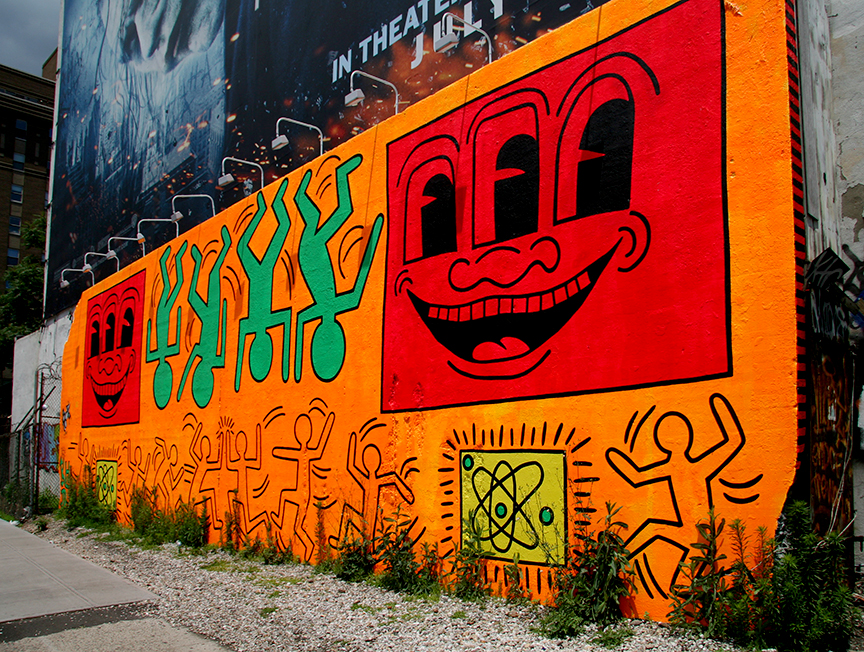
    Keith Haring was a NYC-based artist and sculptor, known for his graffiti art and social activism. In the early 1980s, I had the privilege of meeting Keith numerous times while working on a collaborative business venture. People frequently ask what he was like. My experience was that he was always charming and really knew his Pantone colors. You can read more about him here. The work in the photo is a recreation of a piece done by Keith in 1982. From the Deitch Foundation website:

    “The Keith Haring Foundation, Goldman Properties and Deitch Projects announce the recreation of Keith Haring’s celebrated Houston Street and Bowery mural. The mural became an instant downtown landmark after Keith painted it in the summer of 1982. The mural was up for only a few months in the summer of 1982 before it was painted out but its image remains imprinted in the memory of many people who were part of the downtown artist community in the early 1980s.
    The mural is being repainted by Gotham Scenic using the extensive photographic documentation of the original work. The work will be unveiled on May 4, 2008 the day that would have been Keith Haring’s 50th Birthday.”

    In this photo, you can see some of Keith’s signature images, including his atomic symbol, dancing men, and funhouse characters. I find it apropos that the work is done on a slab of concrete, with weeds growing in front and framed on one side with barbed wire chain link fencing. I think Keith would have approved…

    Posted on by Brian Dubé

  • Store Policies

    Posted on by Brian Dubé

    There was a time in NYC where if you needed to use a public bathroom, you were in deep trouble. The city was harsh – there was no sympathy for body functions.

    Reading magazines or newspapers was also forbidden. Newstands had signs posted that reading was not allowed. Signs like “No Reading. This is not a library” were common. If you wanted to check the time of a movie in a newspaper or magazine, you had to either buy it or suffer some unknown consequences.

    Admittedly, the tremendous volume of tourist traffic, commuters, and the local population, including many homeless, make it difficult to maintain a friendly policy.
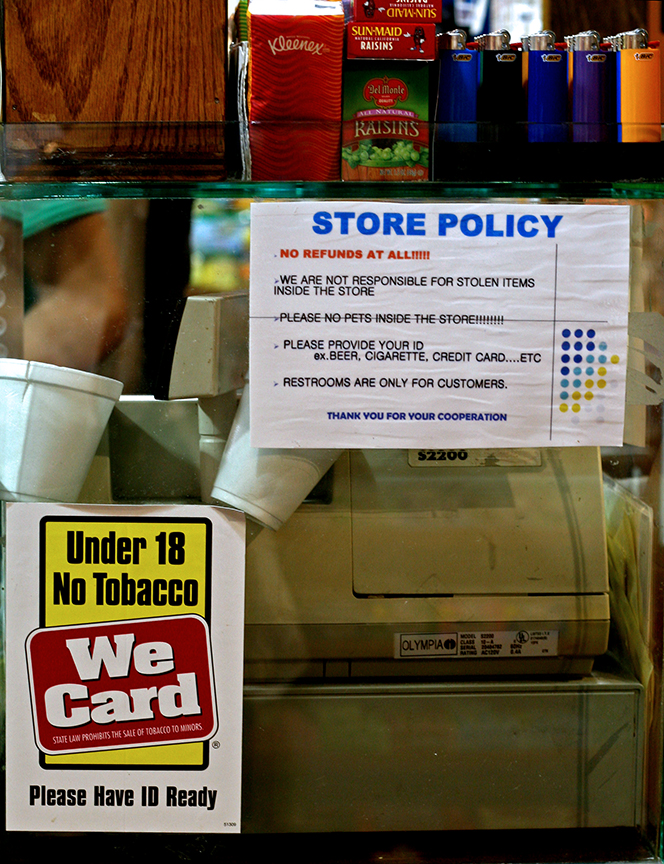
    Times have improved, but the bathroom situation is still a problem. Some business establishments actually claim that there is no bathroom, which is ludicrous if there are any humans working there. Others are more honest, like the green grocer whose sign in the photo clearly states that “restrooms are only for customers.”

    Why have things changed? I believe it’s because of the invasion of national chain stores. The more liberal policies of suburban retailers have migrated to the city, along with the stores themselves. Barnes and Noble superstores and Starbucks are two who have had an impact. When Barnes and Noble started carrying magazines, created in-store cafes, and provided extremely liberal reading policies, magazine stands really had no choice but to follow in order to compete.

    Although many bemoan the influx of large national chains into the city and worry that they will destroy the character of New York, I do reluctantly admit that the bits of comfort that these stores offer in a city that can at times be cold and inhospitable are welcome. In the love/hate world that is New York, I embrace these store policies

    Postings of Interest: No Salga Afuera, Cuts One Way

    Posted on by Brian Dubé


  • dinamic_sidebar 4 none

©2026 New York Daily Photo Entries (RSS) and Comments (RSS)  Raindrops Theme