• Le Figaro Cafe

    Posted on by Brian Dubé

    I remember reading a long time ago in a book that “what draws and keeps so many in California is not so much what the state has as what it suggests.” When I quoted this to a friend at the time who was a recent transplant from New York to the West Coast, he bristled. There certainly are wonderful things about this remarkable state, but I still think that quote still makes a valid point.

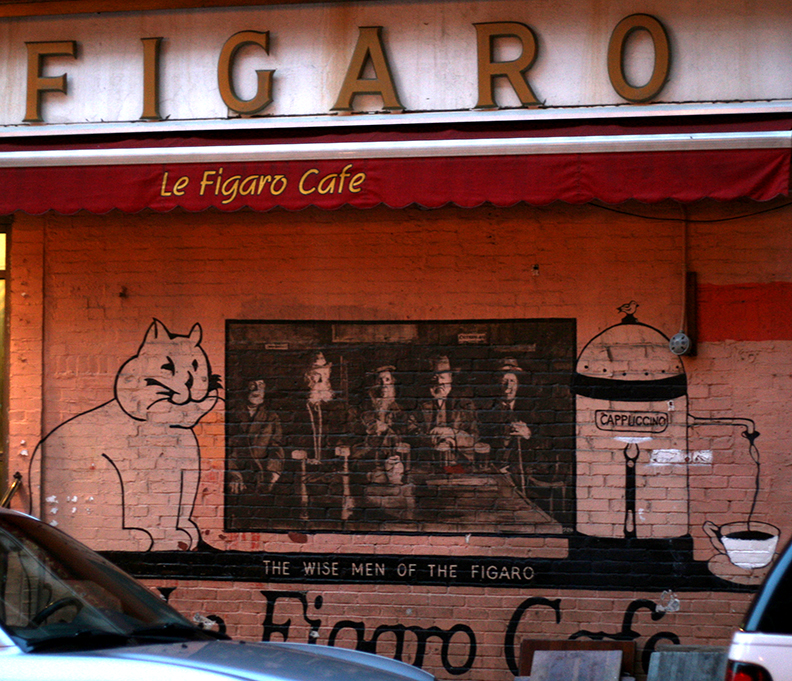
    In the same way, I think this has been the case with Le Figaro Cafe for many years, if not decades. The location and place itself has been a mecca more for what the Village represented than what it has been in recent years. And Le Figaro Cafe was certainly not a window into the history of this neighborhood, steeped in bohemian history – once a hangout for Bob Dylan and Beatniks.

    Recently, Le Figaro Cafe, at 186 Bleecker Street, closed shop after over 50 years in business. It was a bittersweet announcement, but for most, I think their recent Figaro Cafe experience was more bitter than sweet. Many complained of bad service and mediocre food. The place had basically been a tourist draw for eons. This is not surprising, being located at Bleecker and MacDougal Streets.

    The saddest thing about a place like this closing is that we lose a piece of history. And the replacement will most likely be a place that is part of our new, temporal world…

    Posted on by Brian Dubé

  • Two Boots

    Posted on by Brian Dubé

    I really have very little love of classic New York City-style pizza – especially the cookie cutter, formulaic, boring stuff. I have images of harried New Yorkers running down the street with a slice folded lengthwise, excessive cheese and oil dripping off. This is one New York “tradition” which I can easily live without. I have also found that many legendary pizza parlors are highly overrated, yet many experience crowds and lines.

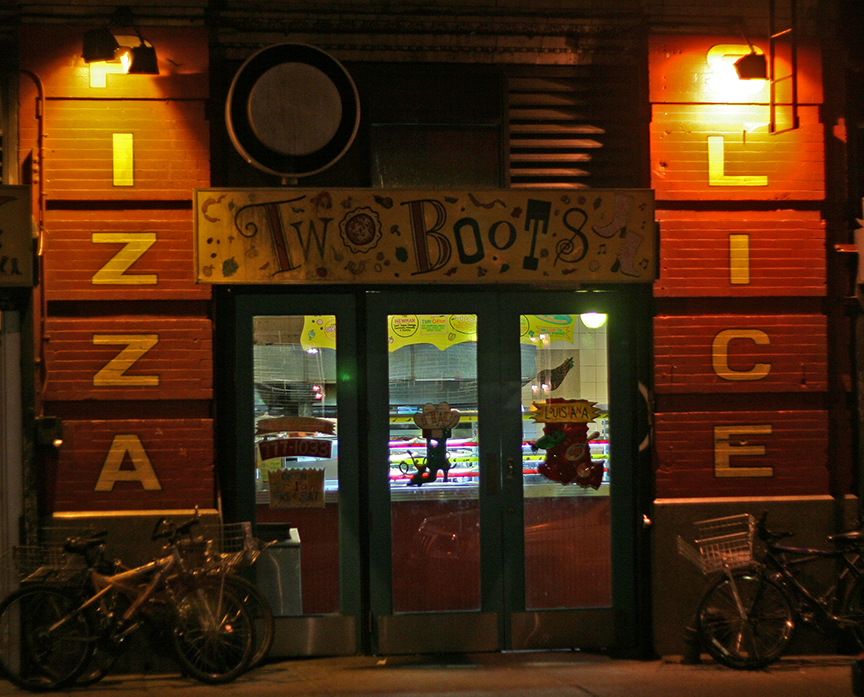
    I personally much prefer a more “gourmet” style pizza. And you can find that at Two Boots. I love their pizza with its unique cornmeal crust. They have created a number of topping configurations with names like Mel Cooley, Tony Clifton, Newman, the Bird, and the Earth Mother.

    The business, named for the shapes of Italy and Louisiana, was started as Two Boots Restaurant in 1987 at 37 Avenue A in the East Village. Original partners Dorish Kornish and Phil Hartman teamed up with local developer John Touhey to create a restaurant featuring Cajun-Italian cooking. In 1989, they opened Two Boots To Go – pizza by the slice and delivery. They currently have 7 locations in NYC, one in Bridgeport, and one in Los Angeles. Of course, there are many quality, more traditional pizza parlors in the city, but if you want a break from tradition, start your adventure at Two Boots…

    Posted on by Brian Dubé

  • Belvedere Castle

    Posted on by Brian Dubé

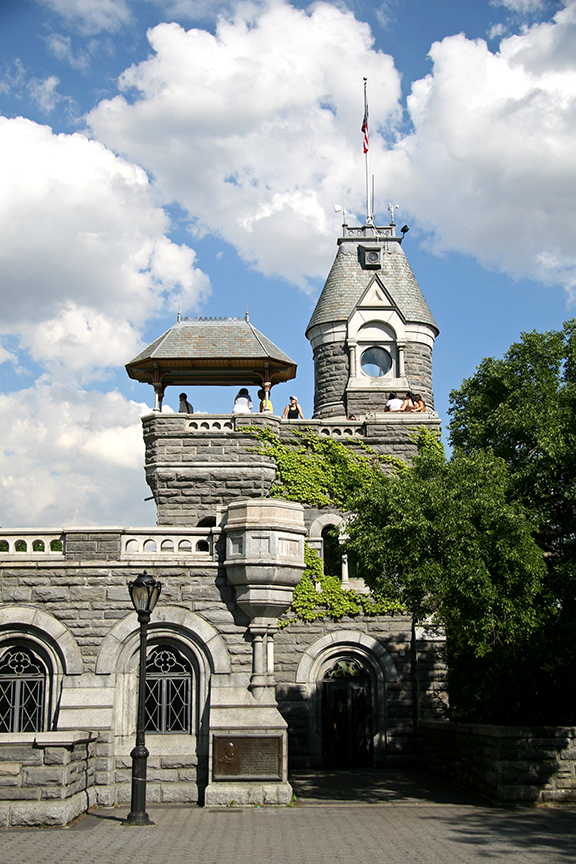
    Yes, we do have castles too, albeit small ones. This is not one of the most well-known or often visited spots in the city, but given good weather, I would put Central Park and Belvedere Castle on a must-do list. The castle, built from Manhattan schist, is in a secluded area near the Ramble. Two narrow staircases each bring you to an observatory level. There are excellent vistas, greenery, the Shakespeare Garden, the Duck Pond, and the Great Lawn. For those of you interested in the Castle’s history and purpose, read this description from the official Central Park website:

    In 1867, Central Park designer and architect Calvert Vaux (1824-1895) created an observation tower atop Vista Rock to overlook the old reservoir that is now the Great Lawn. The Gothic-style Castle was designed as a landmark for the pedestrian park visitor. The castle’s United States flag could be seen from the Mall, drawing the walkers down to Bethesda Terrace, over Bow Bridge, and through the Ramble to the castle itself.
    The original plans for the building included another elaborate two-story structure on the site of today’s pavilion, but financial concerns halted construction and left the castle in its present state. Portions of the castle are made from the same type of schist as the Vista Rock, creating the illusion of a castle rising out of the park itself. Its light colored stone trim is made of granite quarried from Quincy, Massachusetts. Its roofs are made of colored slate from Vermont, Virginia, and New York.
    Belvedere Castle was once an open-air structure, with no doors or windows. This changed in 1919 when the United States Weather Bureau moved the Central Park Observatory to the castle. Until that time, weather measurements were taken from the Arsenal at Fifth Avenue and 64th Street where Dr. Daniel Draper founded a meteorological observatory in 1869. The Weather Bureau took over the operation in 1911, and moved it here eight years later, enclosing the castle and altering the turret’s shape to accommodate their scientific instruments.
    In the early 1960s, the Weather Bureau replaced the lab with automated instruments and closed the castle offices. The empty building was left to deteriorate until 1983, when the Central Park Conservancy replaced the original turret, rebuilt the pavilions, and converted the castle into a visitor’s center. The Henry Luce Nature Observatory in the castle, created in 1996, provides interactive nature exhibits inside the castle as well as bird-watching kits, which can be used throughout the park.

    Note: Belvedere is an architectural term from the Italian “beautiful view”, referring to any architectural structure sited to take advantage of such a view.

    Posted on by Brian Dubé

  • Post-9/11 World

    Posted on by Brian Dubé

    I remember the first time I heard someone say, “Everything is different now, we’re in a post-9/11 world.”
    At this point in time, the events and impact of 9/11 are not looming so much in the conscious mind but more as an ever-present background tapestry. But it still is there, altering the collective unconscious permanently.

    However, from time to time, there are reminders, typically witnessed as increased security. Some of it appears to function a bit like public pacifiers, such as tight security in relatively small, nondescript office buildings of no import where a terrorist threat seems inconceivable.

    Occasionally, we find national guardsmen with machine guns in subway stations. The most frustrating are the restrictions in areas of interest to visitors, both resident and non-resident. One primary example is the lobby of the Woolworth Building. The lobby was a favorite “secret” of mine. At night, one could visit and see the magnificent vaulted lobby with blue and gold glass mosaics, murals, marble, and the sculptured caricatures. Now, you cannot enter the lobby unless you have specific business in the building. And this type of saga is replayed in various ways and places throughout the city.

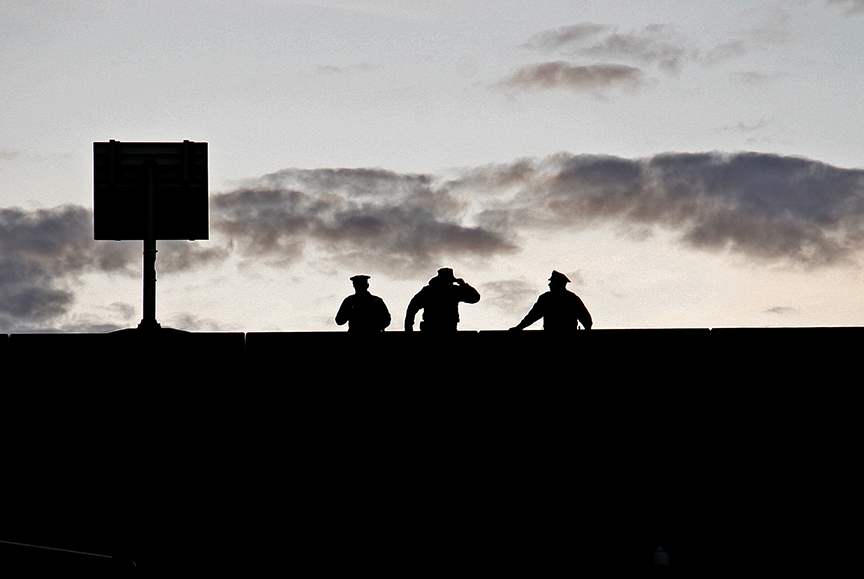
    The sentry guards in the photo were on the upper level of the West Side Highway during Fleet Week, near the Kearsarge. Their silhouettes, cutting out shapes in the skyline against a dramatic sunset, was a silent and poignant reminder that we are in a post-9/11 world…

    Posted on by Brian Dubé

  • Tribute

    Posted on by Brian Dubé

    The beauty of doing a posting on a building like this is that there is no competition. And little to say. Little to read. No real history. No links. No fascinating tidbits.

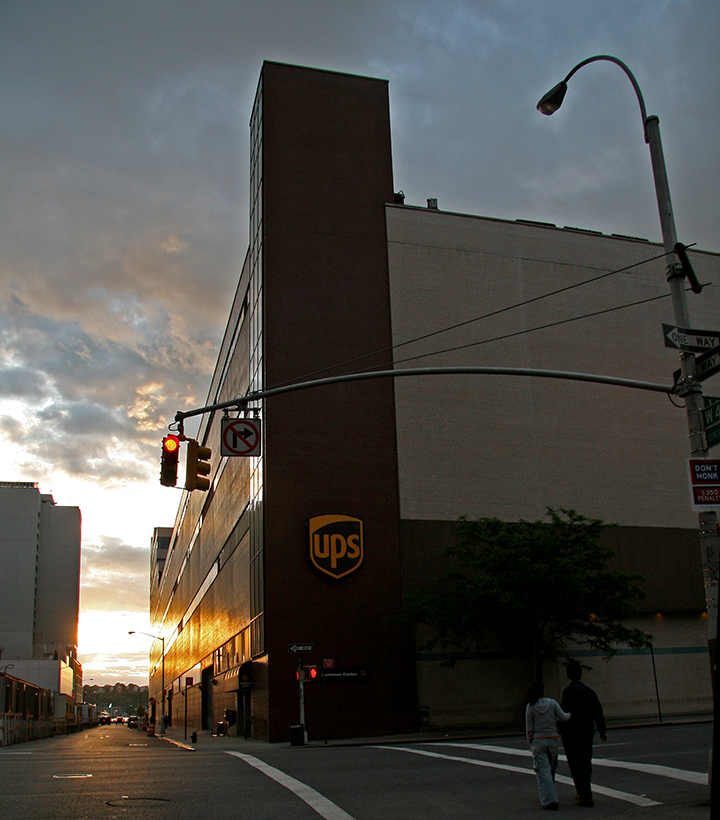
    This virtually windowless, monolithic, hulking behemoth quietly sits at 601 West 43rd Street, relatively unnoticed by most, with perhaps the exception of those whose business takes them there. It is the main headquarters for UPS (United Parcel Service). It occupies a full city block from 43rd to 44th Street and from 11th to 12th Avenues. With the exception of the Jacob Javits Center or excursions to Hudson River waterfront attractions, visitors rarely make it to or through here. This area of Eleventh Avenue is populated with auto dealers and other commercial businesses.

    And yet, I find the extremely mundane to be fascinating in its ability to be so. The focus is typically on the glamorous, exciting, chic, trendy, stylish, beautiful, dramatic, dynamic, sensational, and spectacular.
    This is a tribute to the ordinary, mundane, unprepossessing, unremarkable, unexciting, and nondescript…

    Posted on by Brian Dubé

  • Street Cred

    Posted on by Brian Dubé

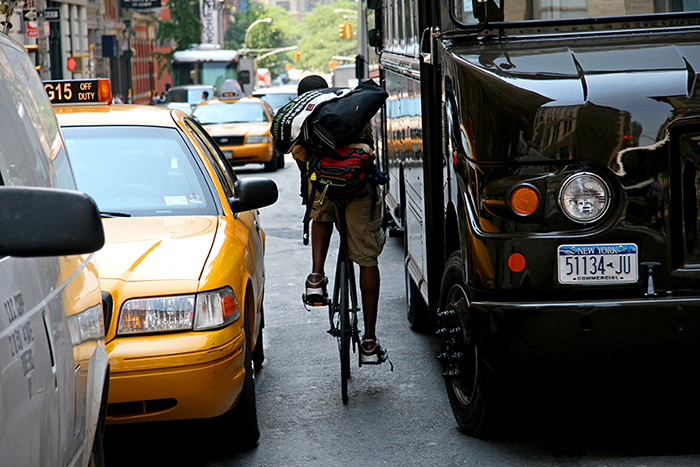
    The NYC bike messenger epitomizes New York on edge. These people put their lives on the line for little money and no benefits. Of course, a comparison to the Police or Fire Department is unfair – bike messengers are not public servants hired to protect citizens. And it is a for-profit business. But they risk their lives for no glory. An extraordinarily dangerous job with no recognition.

    The job itself demands the ultimate in utility. A whole style of bike outfitting and accoutrement has been spawned by the riders, some of it spilling over to those interested in sporting a street style. Perhaps the most notable item adopted by non-bikers is the messenger bag – the Manhattan Portage.
    Many experienced messengers (like the one in the photo) will use a fixed gear bike (aka track bike). There is a minimum of parts and maintenance. They offer control, light weight, and quick acceleration. There has been an up trend in use and interest in these bikes.

    Also de rigeur is the heavy duty 3-foot bike chain and locks – this is a whole discussion unto itself. Theft is a huge problem here, and virtually every type of innovative lock has been used. In the end, the simple heavy-duty chain and American-style lock have proven most reliable. Thieves have used huge bolt cutters and all manner of tools and techniques to break locks and chains. And it is not unknown for a thief to take the bike and the thing it is locked to if feasible. Or take parts and leave the frame (see Left for Dead here). You can read about these and other matters at the NYMBF (New York Bike Messengers Foundation) website.

    Here are two quotes from their website about the job as told by messengers Hermes and Tone.

    Hermes: “It is a job where you’ll encounter people who’ll attempt to kill you, disrespect you, and unwittingly put your life in danger. You’ll ride in the worst weather imaginable, and deliver heavy, bulky items for an extra $1. You’ll wake up tired in the morning and go to bed defeated. You’ll be bored out of your mind sometimes, just sitting around and waiting.), and you’ll be stressed to the breaking point.”

    Tone: “It is however incredibly dangerous, yet exhilaratingly fun at the same time. I seriously consider it an extreme sport. Imagine running with a pack of wolves made of metal as fast as you can with the wind in your hair, but sometimes the wolves bite and you have to evade them as well as the moving trees, called pedestrians, in this konkrete jungle we call New York. I guess it’s hard. It’s definitely not for the weak hearted.”

    In the final analysis, the job is the ultimate in street cred…

    NOTE: In an amazing happenstance, while shooting this, a messenger approached me, Eugene Carrington. He told me that he was actually known in the messenger world and pulled out a small booklet: Messenger Blues and Other Poems. I bought a copy for $3 🙂

    Posted on by Brian Dubé

  • Skinny

    Posted on by Brian Dubé

    I love small and/or skinny places., and not just aesthetically. Their very nature leads one to imagine that perhaps this place has been missed by others and is off the beaten path. Or perhaps the place is unusual in other ways – after all, a mainstream business would not typically rent a space only seven feet wide. And the architectural history of tiny or narrow buildings is always fascinating, like 75 1/2 Bedford St. in the West Village, which is only 9 1/2 feet wide, considered the narrowest house in NYC, and occupied in the 1920s by Edna St Vincent Millay. There is a remarkable, very unique, tiny triangular building that houses the restaurant Bite. And I love the beautiful tiny building that houses Vilebrequin.

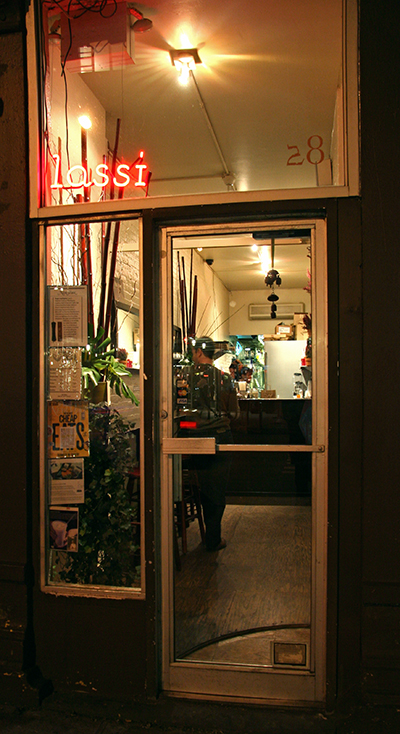
    Lassi is an Indian restaurant at 28 Greenwich Avenue. This tiny, narrow space is where Heather Carlucci-Rodriguez plies her craft. She was a former pastry chef at L’Impero, Veritas, and Judson Grill, each receiving 3 stars from The New York Times, as well as working for a consultant for France’s Michel Cluizel Chocolat and Domori Chocolate in Bologna, Italy. She has a culinary education from the Restaurant School in Philadelphia and also in France. An unusual pedigree for a restaurant specializing in northern Indian cuisine.

    Lassi is essentially a take-out operation, but there are stools for those who want to eat in. The location was previously an equally interesting restaurant – Thali, a vegetarian restaurant serving only one prix fixe dinner selection per night. Lassi’s menu includes a variety of curries, parathas, and lassis. You can read about them at their website and see the menu here. Just watch yourself if you like skinny 🙂

    Related Postings: 121 Charles, Bomb Factory

    Posted on by Brian Dubé

  • Let’s Have a Parade

    Posted on by Brian Dubé

    This extraordinary display is typical of a new generation of high-performance LED signage which has virtually replaced all of the older neon of Times Square, a trend which is universal. Like most New Yorkers, I rarely travel to Times Square, and I do so only when there are specific reasons. On a recent trip, I unexpectedly ran across this massive display which is part of the new M&M’s Retail World. See here for the set of photos.

    I am not so fond of over zealous business establishments which are essentially mega-branding and marketing tools. Legacy businesses such as Coca-Cola, Disney, Warner Brothers, and many others have entered this new world of advertising, selling lines of branded products via their own retail stores. But I had to grant that this enormous LED display was just fascinating as I watched it cycle through image after image.

    What can easily be seen as a gratuitous display and waste of money reminds me of a conversation I had with someone many years ago. My friend’s concluding assertion always bothered me, because at one level I didn’t like it, but at another, it rang true. He and I were discussing extravagance and celebrations. I mentioned how, in many cases, money could be better used for any one of a myriad of needy causes. His response was, “Yeah, but you gotta have parades.” This really hit me. People really do occasionally need to express joy and exuberance even if it is not always “practical” or “sensible.” We can’t live life with the souls of accountants. A world without love, flowers, laughter, and parades would be a dreary one.

    So for now, just for a few minutes, let’s put aside aside our criticism, skepticism, and cynicism. Let’s have a parade 🙂

    About the display and store: The 32½-foot-high by 31¼-foot-wide LED panel display was done by Union City, NJ-based D3 LED. The display content was designed by New York-based Show & Tell Productions. Store 25000-sq ft, 3-story design by Ohio firm Chute Gerdeman Retail.

    Posted on by Brian Dubé

  • Underscore

    Posted on by Brian Dubé

    You could spend your life just admiring and learning about NYC architecture. Before moving to this city, I had essentially no knowledge or appreciation of buildings. But architecture is one of the greatest things about New York, and to not make an effort to really learn about the great structures here is to miss out on one of this city’s greatest assets. On nearly any block or at every turn, there is something of merit – row houses, skyscrapers, art deco masterpieces.

    Evening light is the best time for photography, and when you have a building which is readily enhanced by yellow-orange hues, you have the ideal subject. See here for another magnificent example.
    When I photographed this from the west side of Manhattan, I had no idea what this building was or its exact location, so ferreting out this information based on visuals and a guess at location is always challenging.

    The building in the photo, One Worldwide Plaza, turns out to be somewhat more than the average skyscraper. It was built in 1989 on the site of a former (the third) incarnation of Madison Square Garden. Designed by David Childs of Skidmore, Owings and Merrill, it is a part of a three-building complex with mixed commercial and residential use. It is one of the worlds tallest buildings, at 49 stories, 778 feet (238 m). You can read more about it here.

    In spite of all this, it is easy to not notice, and most will pass it by. So even here, with this beautiful tall building, its brick exterior and copper roof, all bathed in golden light – just to assure it will be noticed, it still needs an underscore…

    Related Posts: Hell’s Gate, Sink or Swim, Evening Arch

    Posted on by Brian Dubé

  • Insult to Injury

    Posted on by Brian Dubé

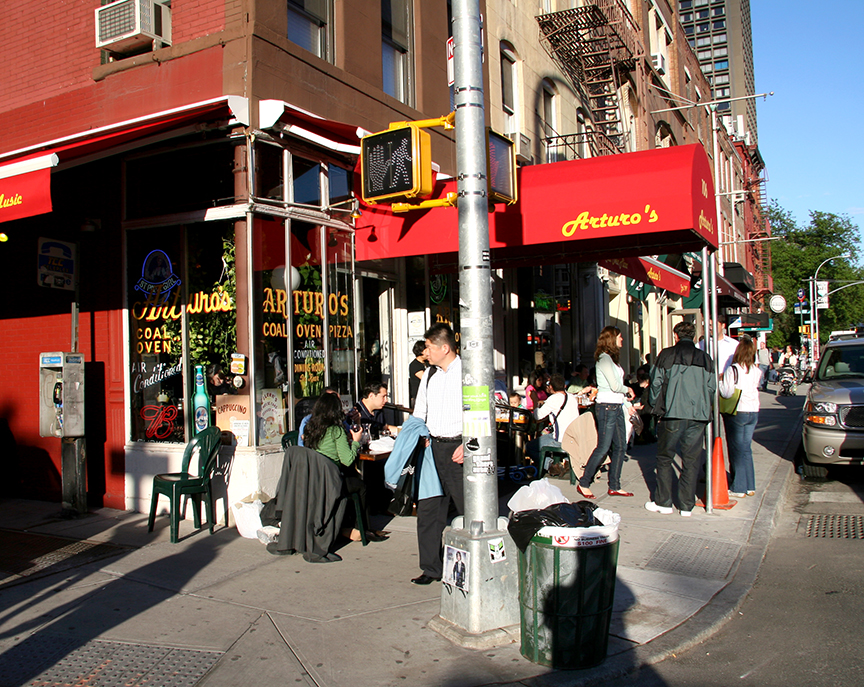
    Let’s try to create the most inhospitable outdoor dining situation imaginable and see if anyone comes. First, let’s pick the largest city in the United States – New York – to make sure we have potential for congestion.

    Second, pick one of the busiest thoroughfares in Manhattan – Houston Street – so it’s like eating on a super highway. Third, we make sure we choose a really crowded area to insure opportunity for the maximum numbers of passersby. Fourth, while we’re at it, provide no separation between diners and those passersby, guaranteeing a complete lack of privacy.

    Fifth, let’s use inexpensive, plastic chairs (the kind you get for a few dollars at a discount shop) so the experience feels really cheap. Sixth, let’s make sure we have a garbage can nearby filled with trash. Add in a fluorescent orange traffic cone for color. Seventh, let’s put some of the tables around the corner next to the kitchen exhaust system for those who really want more ambiance.

    So there you have it. Dining al fresco at Arturo’s, New York City-style. And do we get any customers? You bet, and there are no tables available.

    Oh – I almost forgot – let’s serve wine so we can add insult to injury 🙂

    Related Posts: Piercing Al Fresco, Luna Park Cafe, Esperanto, a la Chien, Paris in New York

    Posted on by Brian Dubé

  • Steal the Show

    Posted on by Brian Dubé

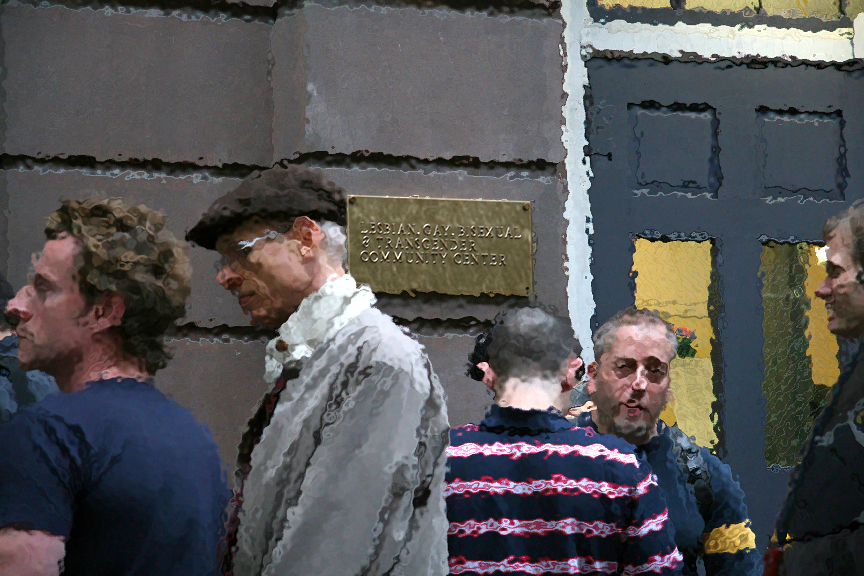
    If you are uncomfortable with the gay community, I would not suggest taking up residence in New York City, particularly in the West Village. New York has some of the largest communities in the United States for individuals whose sexual orientation is other than heterosexual. And there are many orientations, as seen in the Lesbian, Gay, Bisexual & Transgender Community Center at 281 West 13th Street. You can read about them here.

    The gay community suffers from many stereotypes. As with any group, those who stand out are not necessarily those who typify the group. In fact, usually not. Religious fanatics don’t generally represent the constituents of their faith.
    Many of the gay men or lesbians seen acting out, i.e. involved in wild activity, excessive promiscuity, or gyrating on floats in the Gay Parade, are just a small sampling. This may be something which is discussed frequently, but I believe that it is perhaps only given lip service. The real problem is that most individuals in the straight community do not have interactions with or friends within the gay community.

    I have worked with gay men and employed them. At one time, I made close acquaintances with a large number of gay men whom I saw on a semi-regular basis. At parties, my girlfriend at the time and I were the only heterosexual couple who attended. This was a great opportunity for me to really get to know a number of gay men well. I was always made to feel completely comfortable. The personalities, temperaments, and livelihoods spanned the gamut. There were artists, pharmacists, bankers, and real estate developers. Many were in very long-term committed relationships. Some were quite conservative – “you would never know.” Of course, as to be expected, the flamboyant always stole the show…

    Posted on by Brian Dubé

  • Privileges

    Posted on by Brian Dubé

    I am fortunate to have friends with an extraordinary view of the city and was able to capture a series of photos in the evening sunset light.

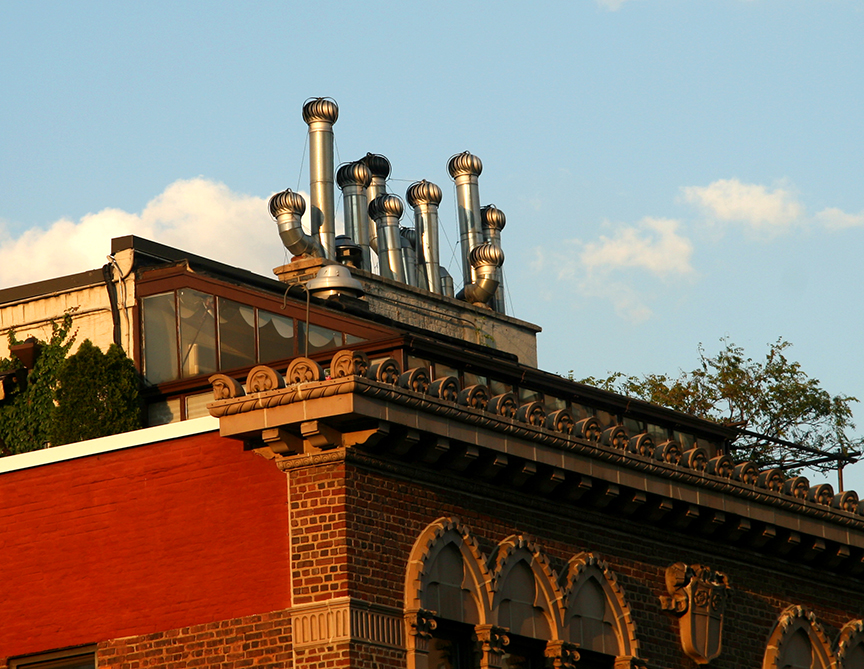
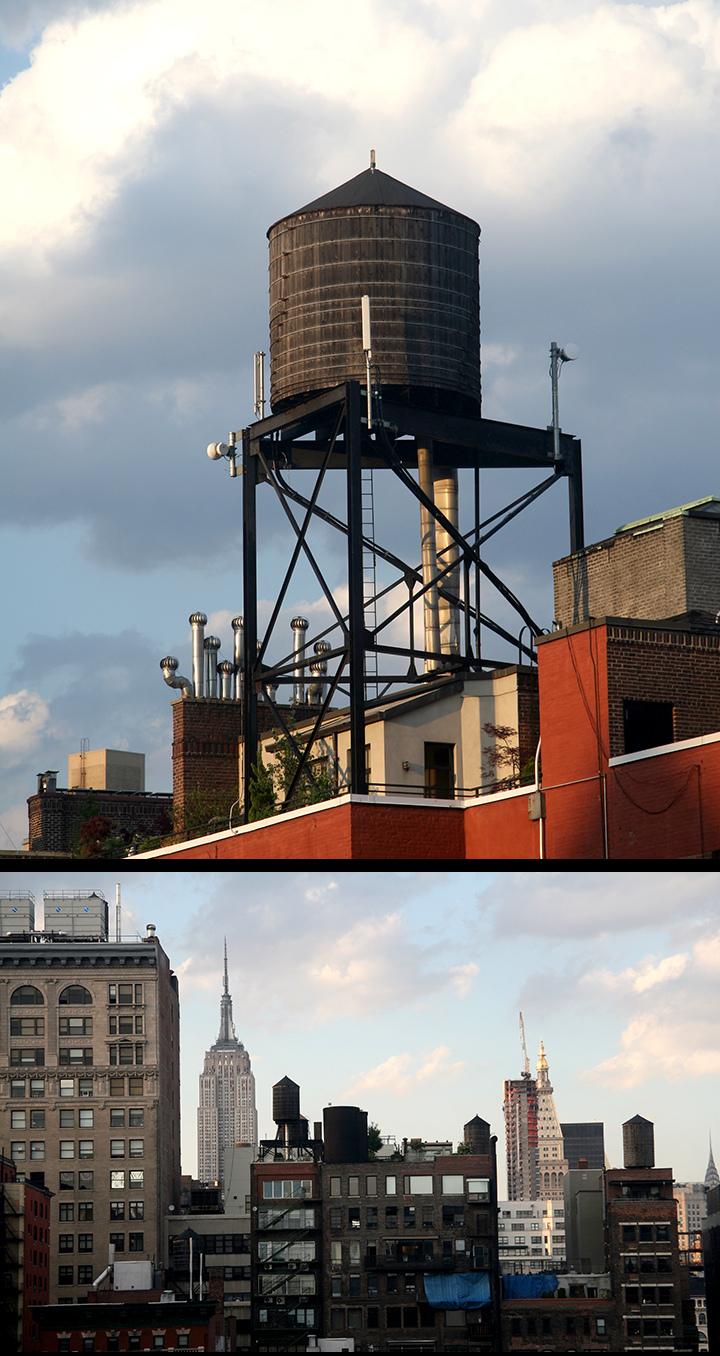
    These rooftop turbine ventilators make a very visual accent on the city’s skyline. They can be seen everywhere in New York, along with the ubiquitous water tanks, which I have previously posted on.

    In this photo, the ventilators are directly above what appears to be a penthouse apartment with a terrace. It may come as a surprise, but there are a number of people in Manhattan who have garden space and actually use landscaping services. These gardens are typically hidden from view – either at ground level in the rear of buildings or annexed to top floor apartments. Of course, a substantial premium is paid for this type of privilege, as is for air and views.

    As I have written here before, I find many of the structural and functional elements of buildings to be attractive, and they offer a myriad of opportunities for photography. These ventilators evoke a number of images for me: people, minarets, chessmen, chef hats. Peering out over the city from above, craning their necks for perhaps a better view or a breath of fresh air…

    Posted on by Brian Dubé

  • Wake Up Call

    Posted on by Brian Dubé

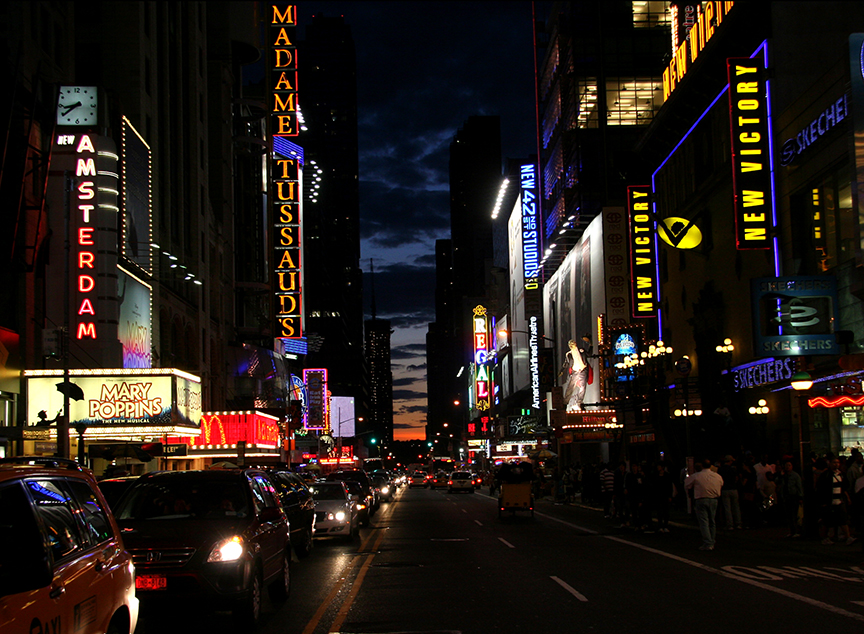
    Wow is all I could say as I stood at Times Square looking west along 42nd Street into one of the most amazing sunsets I have seen. This stretch of 42nd Street is already quite dramatic at dusk or at night. But this sunset was remarkable, with the heavily stratified clouds and beautiful color gradation of orange to deep blue. One could have easily seen the sky as part of the artificial spectacle. Drama added to drama. Perfect for a world that knows no bounds when it comes to sensory overload. It really looked like Batman’s Gotham City.

    One can easily live a lifetime in New York City without hardly a hint of the natural world. With the exception of the sky, occasional tree, squirrels, and birds, we live in a place that is almost entirely man-made. Some are fortunate and have park, river, or garden views. But for most, this is a life of concrete, stone, brick, steel, and glass. We look to other things – culture, business, restaurants, architecture, and human interaction.

    Some seek out nature in the city. It is can be found in promenades, parks, gardens, and waterways. And occasionally, when you least expect it, it slaps you in the face. A wake up call to nature…

    Posted on by Brian Dubé

  • Bagels

    Posted on by Brian Dubé

    When I first moved to New York City to attend college, I had never heard of a bagel or deli. Hard to believe? Not at all. Before the Internet or cable television, life was much more insular and information much more local. Growing up in a small, blue-collar town in New England, I was exposed to very little. Cappuccino was unheard of.
    But it was only minutes after arriving in the Big Apple, however, that I sampled my first New York style cheesecake. And bagels and heros (“grinders” where I came from) were soon to follow in my full immersion in NYC culture.

    Along with the Sabrett hot dog, NY Pretzel, and egg cream, I can’t think of many food items that better epitomize New York City than the bagel.
    My best friends in college were Jewish, and I quickly learned the ways and means of New York from them, with Yiddish expressions: schlamiel, schlamazel, oy vey. The bagel became a staple in my life. Satisfying and substantial. The quintessential NYC breakfast for a New Yorker on the run.

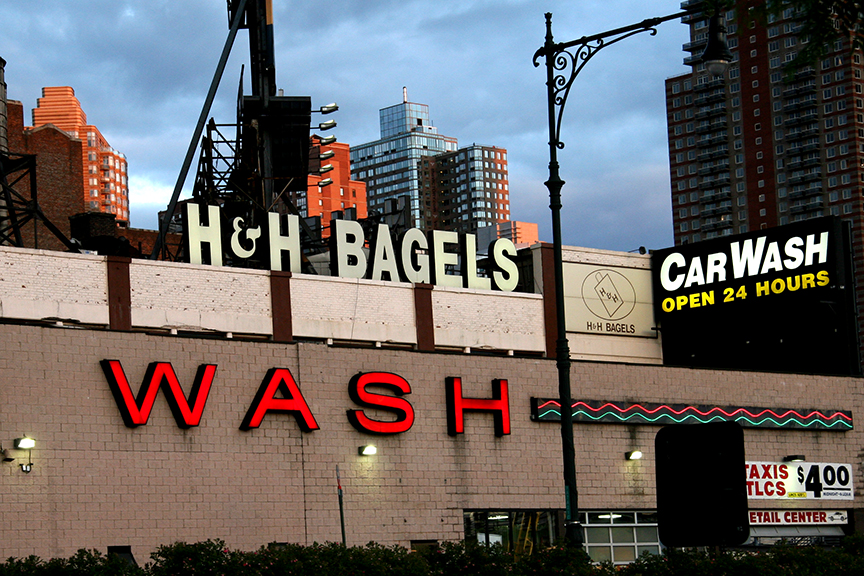
    H&H Bagels is the city’s largest manufacturer of bagels, producing millions per year from their factory on 12th Avenue and 46th Street. The sign, along with the Car Wash, is a familiar site to those who have traveled along the West Side Highway.
    H&H was founded in 1972 by Helmer Toro. You can find them at many locations, including their flagship shop at 2239 Broadway.

    New Yorkers need to always feel on top of the game. We constantly look for ways to shout biggest, best, first, most, and largest. H&H Bagels is one of those NYC icons, a name people love to show and tell. They have been seen in Seinfeld, a Woody Allen film, and Sex and the City – all classic New York and befitting the H&H Bagel…

    Posted on by Brian Dubé

  • Cult Meets Attitude

    Posted on by Brian Dubé

    The cult-like phenomenon surrounding Apple Mac users is well-known. In fact, Guy Kawasaki wrote of it in his book The Macintosh Way. He advances the concept of marketing a business by creating an evangelical customer base. This may sound farfetched, but only if you haven’t met some hardcore Mac users.

    But we have a small problem. Even with the tremendous success of the Apple computer and Steve Jobs bringing it back from the brink of disaster, the market share of Macs is quite small. And the architecture of the Mac is not as open as with the PC world – people don’t build and customize their own machines. It is a very proprietary world. So what about service? There’s the big problem. Prior to the Apple stores, there was virtually nowhere to go. And when you pay a premium for a product, you want your machine treated like a special baby by dedicated experts who are as zealous about Macs as you are. Ideally people who belong to the same religion and don’t even service other machines. Is there such a place?

    Yes there is: Tekserve at 119 W. 23 Street in Manhattan. Founded in 1987 by David Lerner and Dick Demenus, their original location (also on 23rd Street) was on an upper floor. Getting off the elevator, you were greeted with sound of a Mac chime. You entered a secret world that you knew immediately was Mac-centric and cool – there was an antique Coke machine and a swing.

    Until the recent openings of Apple stores, Tekserve was the only game in town – the only place to get walk-in Mac service. There was definitely a strong attitude at the old location – not unusual for a business that has no competition and holds all the cards.

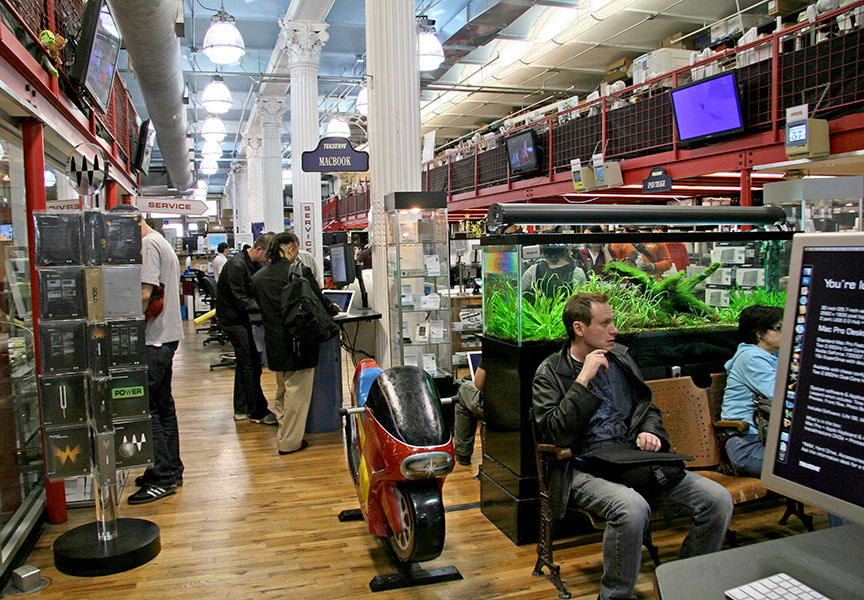
    The new location is greatly expanded and occupies a retail space on 23rd Street. It still has a number of unique things in the store, such as a giant fish tank (seen in the photo) and the old Coke machine from the previous location. I’m not sure if things have changed, but I still see a waiting area for service – people take numbers and sit and wait, reminiscent of a doctor’s office. In a more competitive environment, this would be a serious Achilles Heel. I understand that the Apple store service areas are also very busy, with lines and waiting for service.

    The Tekserve staff has a reputation for competence and even gives free phone advice. Clients are still willing to wait for what they believe is the best in town – some are pleased with the experience, some are not. Try an online search for “Tekserve” and “attitude.” You’ll see what I mean 🙂

    Posted on by Brian Dubé


  • dinamic_sidebar 4 none

©2026 New York Daily Photo Entries (RSS) and Comments (RSS)  Raindrops Theme