• No Salga Afuera

    Posted on by Brian Dubé

    I used to know a Puerto Rican woman who roared when I used to demonstrate my limited command of the Spanish language, defined by the NYC experience. My favorite was the recitation of a sign which appeared in the subway cars for as long as I can remember. I used to just recite two lines:
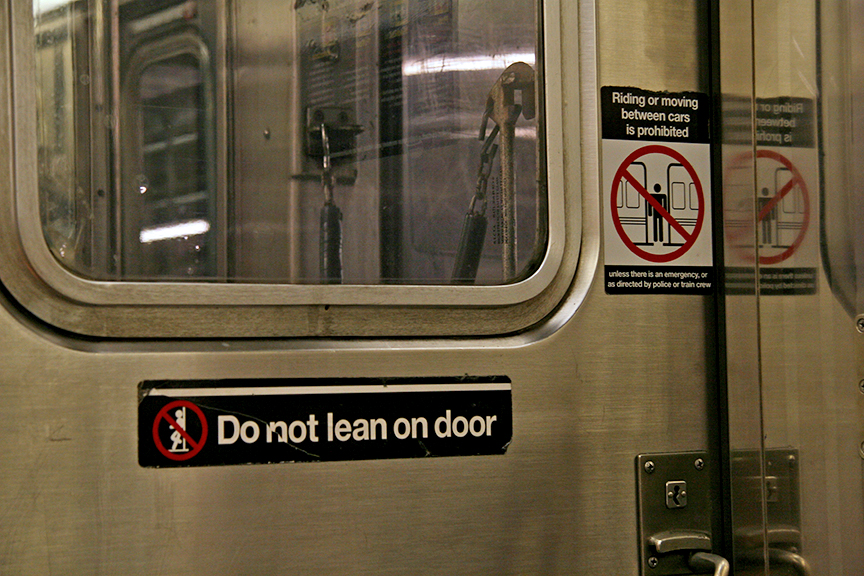
    “La via del tren subterraneo es peligrosa…No salga afuera.” This warning alerted passengers to many dangers, including the the electrified third rail. (See full wording and translation below.)

    My other favorite sign was one I frequently saw in parks: “Aviso. Veneno de Rata.” (Danger. Rat poison). Now I realize that this knowledge will not get me far in conversation in a Spanish-speaking country, nor will it help me charm a Latin American, but in New York City, it may be useful in avoiding premature death in certain situations.

    Every living environment has an effect on its inhabitants, and in New York City, that environment is one that has an element of brutality. New York is a great city and has improved markedly over the years, but this is a harsh place and breeds cynicism, skepticism, and cautiousness. Survival skills. And one of the results is a rather unusual foreign language vocabulary.

    The photo shows the current signage on subway doors. Many New Yorkers, including myself, have frequently walked between cars to position oneself at the proper end of the train so that you are in the best location when exiting (most doors are locked these days). The experience of walking between cars of a moving subway is not for the faint of heart, but it does make good use of travel time, admittedly at the risk of being killed. But, hey, that’s just makes you feel like a real fearless New Yorker. But I am not recommending this behavior – this posting is for informational purposes only. Just remember, “La via del tren subterraneo es pelgrosa”!

    Note: The original sign in its entirety with translation is as follows:
    “La via del tren subterraneo es peligrosa. Si el tren se para entre las estaciones, quedese adentro. No salga afuera. Siga los instrucciones de los operadores del tren o la policia.”
    “The subway route is dangerous. If the trains stops between stations, do not go outside. Remain inside! Follow the instructions from the operators or the police.”
    Posted on by Brian Dubé

  • Lucky

    Posted on by Brian Dubé

    It’s a shame that Disney is seen by some as an evil empire. Pejoratives such as Disneyfication are virtually synonymous with the sanitization and degradation of American culture. Why do I say a shame? Because Walt Disney was a real visionary and one of the most influential men of the 20th century – one of the creators of some of the most durable fictional characters. In his lifetime, Disney won fifty-nine Academy Award nominations and twenty-six Oscars.

    Perhaps it’s just an inherent downside to anything really good – that it will be overdone, spun, extended, commercialized, branded, and marketed. We live in a time when the means to overdo are readily available – powerful tools, technologies, and ways of distribution. And, of course, the tremendous money behind it all drives everything.

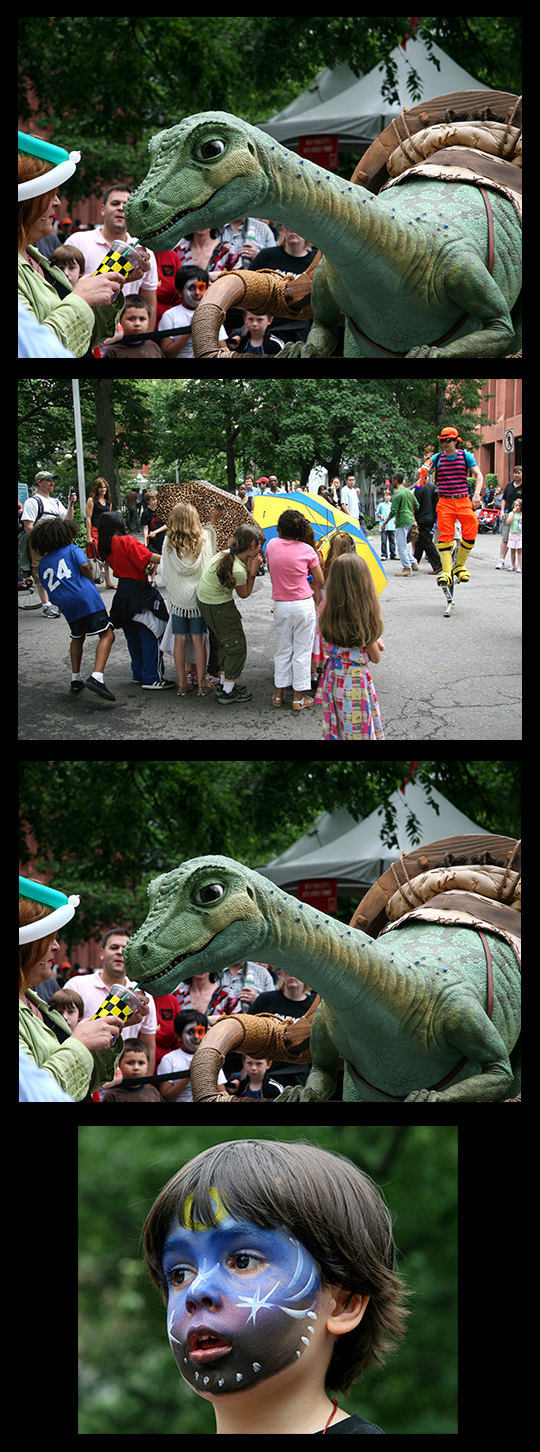
    Over the weekend, NYC was host to the first World Science Festival. This was a combination free outdoor street festival and series of programs with renowned scientists, including many Nobel laureates. The programs were ticketed events held around the city in various venues. Many were sold out. The free outdoor festival, held in and around Washington Square Park, was oriented towards the entertainment and education of children. See here for more photos of the event.

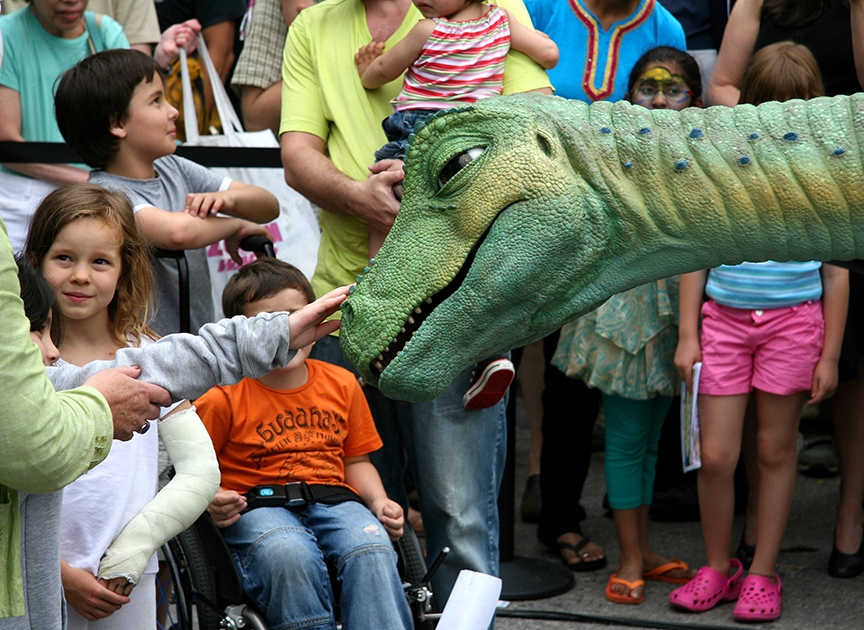
    The central event was Lucky the Dinosaur, a free-roving audio-animatronic figure created by Disney’s Imagineers over a period of five years and unveiled in 2005 (audio-animatronics were invented by Disney and made their major debut in 1963 with a display of singing birds and flowers at The Enchanted Tiki Room at Disneyland Resort).

    Dinosaurs are ever-popular with children, so it should come as no surprise that Lucky is an enormous hit wherever he goes. He can walk, talk, and interact with people. He also can sniffle, burp, hiccup, sneeze, yawn, cough, giggle, snort, and purr…

    Posted on by Brian Dubé

  • Model for Decorum

    Posted on by Brian Dubé

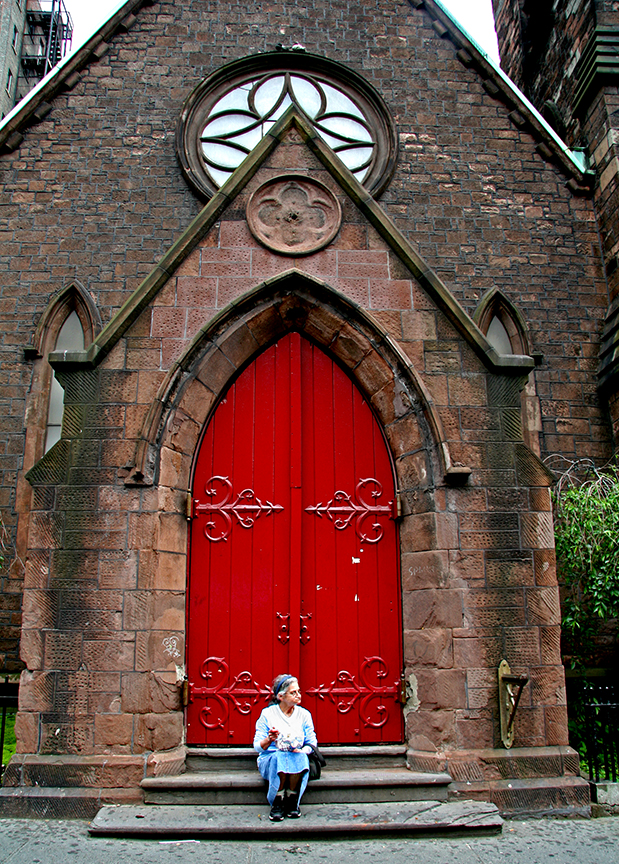
    Gothic meets drugs, sex, and rock and roll. Not such an unusual mix, actually. It’s just that we generally don’t think Gothic church. This place has actually been a neighborhood problem and has had a sordid history. It has been a nightclub since 1983, when it opened as The Limelight, owned by Peter Gatien and designed by Ari Bahat. Gatien owned a number of Limelight nightclubs (read about it here).
    The space benefits, of course, from the incredible architecture – huge rooms, soaring ceilings, stained glass windows, and a labyrinth of chambers.

    In 1996, club attendee Michael Alig was arrested and later convicted for the killing and dismemberment of Angel Melendez, a drug dealer based at The Limelight (read about it here). Opened and closed in the 1990s for drug trafficking, it was reincarnated in 2003 as the club Avalon.

    The brownstone structure, at 47 W. 20th Street and 6th Avenue, was built in 1846 as the Church of the Holy Communion for an Episcopalian congregation. It was designed by renowned architect Richard Upjohn, cofounder and first president of the AIA (American Institute of Architects). Upjohn, a British immigrant, was most well known for his Gothic revival churches. Trinity Church is one of his best-known works.
    This church building was saved in the 1960s when it became designated as a landmark. It was subsequently sold and used as a drug rehabilitation center.

    It’s not the idea of a church being converted to a den of debauchery that is so disappointing. It’s the state of decay that graces the exterior. I thought the lone figure of an older woman eating her lunch on the steps of the church was an appropriate statement.

    Its such a shame for an important historic structure to deteriorate this way. But then again, a rock and roll club can’t be expected to be a model for decorum…

    Posted on by Brian Dubé

  • View of the World

    Posted on by Brian Dubé

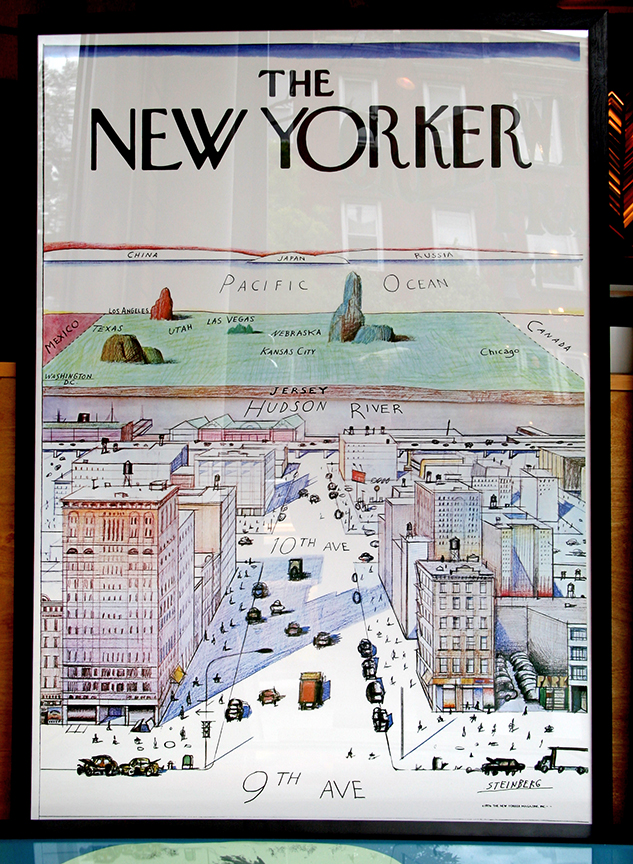
    I hate to use the phrase de rigueur again, but if there ever was a need for it, this is a prime example. Because familiarity with this image, View of the World from 9th Avenue, is de rigueur for every New Yorker and anyone who wants to understand this city’s people. This really is how many of us see New York City. I actually visualize the world much like this at times. When I first saw this work, I was stunned as to how close it was to my mind’s perspective of the world.

    Note how inconsequential things outside the city are depicted. Ironically, the area of Manhattan shown is itself one of the least important, yet it still looms large over other cities, states, and countries.

    The density of people and services is so great here that it really is possible to go quite some time without leaving; many Greenwich Village residents joke about how they never go north of 14th Street for months or even years at a time. Manhattan is literally a world unto to itself and is a center for a myriad of industries. It is very easy to adopt a worldview not too far from this work of art.

    The image itself is a New Yorker magazine cover from March 29, 1976, created by Saul Steinberg, who did 85 covers and 1,200 drawings for the magazine. The photo was taken of a poster hanging in a shop in the Village. I didn’t even have to go to 9th Avenue, seek out the original, or step inside a shop. My view of the world from 9th avenue was had from the comfort of my own neighborhood in a gallery window. Now that’s a New Yorker 🙂

    Posted on by Brian Dubé

  • Sea of Yellow

    Posted on by Brian Dubé

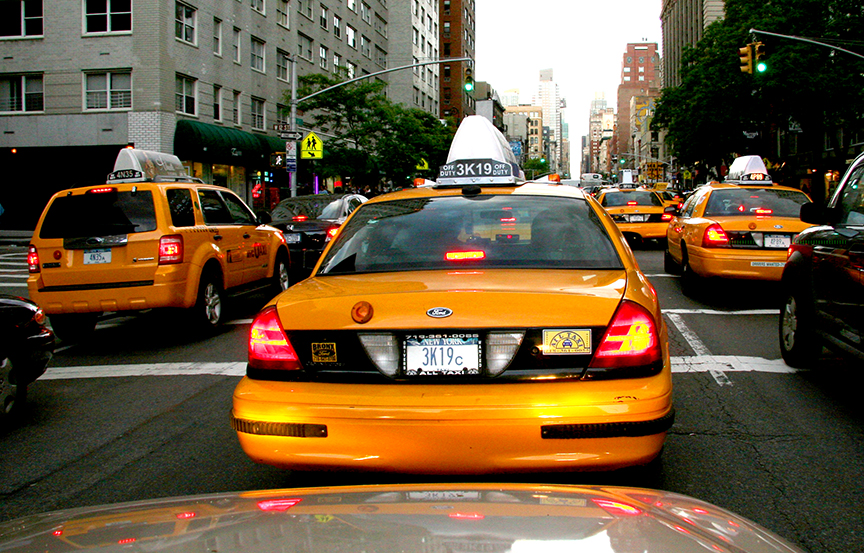
    What was most remarkable about my journey in this vehicle was the comment my friend Joey made while driving me uptown; he referred to what we saw as a “sea of yellow.” That is exactly the phrase I have used many times and what was in my mind as we crept through slow-moving traffic. I shot a number of photos “blind” by raising the camera through his open sunroof. The evening light really enhanced the already yellow hue of the taxis.

    Taxis are part of the fabric of this city. Perhaps fabric is too flattering and some would prefer background noise. But, in either case, there are many times, as seen in this photo, where yellow dominates the street and rules the eye.

    When I was a college student, I drove a taxi for about a year and a half. Those were rough times, and it was the Wild West. It was exciting, though and I learned more about the city more quickly than any other way. It was like orientation on steroids. Although driving is brutal and stressful, it is immediate cash money, so for the student or individual who is living hand-to-mouth, it can be a good source of income. But it is not for the faint of heart. One of my most popular images in the last two years of doing this photo site is of a taxi crash into a post.

    Driving a taxi is a competitive sport – jockeying for position, cursing other players, and fighting for that passenger fare. There are winners and losers. And if you don’t score, just pick yourself up and keep running…

    Posted on by Brian Dubé

  • Kearsarge

    Posted on by Brian Dubé

    I am not the type of man who reads about military technology or Soldiers of Fortune magazine or wears camouflage clothing. And I never forget that, like a gun, instruments of war are just that. I think many men frequently look at weaponry divorced from their real function, which should be understood and respected. Armed forces should be honored, but weaponry should not be glamorized.

    That said, military technology is impressive. Virtually unlimited sums of money are available to develop extremely sophisticated weaponry, ships, aircraft, vehicles, and support systems. Costs play a much smaller role – expense never has to be justified as it would in a business venture.

    The ship in the photo, shot at sunset on the pier at West 48th Street, is the USS Kearsarge LHD3. The size is remarkable and is absolutely amazing when seen in a place so unexpected, such asNew York City. There is a lot to know about this wasp-class amphibious assault ship. You can read about it here.

    The ship was part of Fleet Week, a really unique event where not only does the crew get to explore the city but civilians also get to board and tour the ship. Lines were huge, of course, compounded by the fact that it was a holiday weekend with good weather…

    Posted on by Brian Dubé

  • Men In Uniform

    Posted on by Brian Dubé

    I was particularly shocked many years ago when a woman friend, who was not that conservative, commented that she loved men in uniform. Any uniform. I have learned that there is an element of appeal for many women even with police officers. There is an element of authority and masculinity in the design and wear of men’s uniforms.

    As to be expected, the internet has fueled this interest. I found that there are dating sites specifically for those in uniform and those who desire someone in uniform: MilitarySinglesConnection.com, 911Singles.com, uniformdating.com, MilitaryLoveLinks.com, etc.

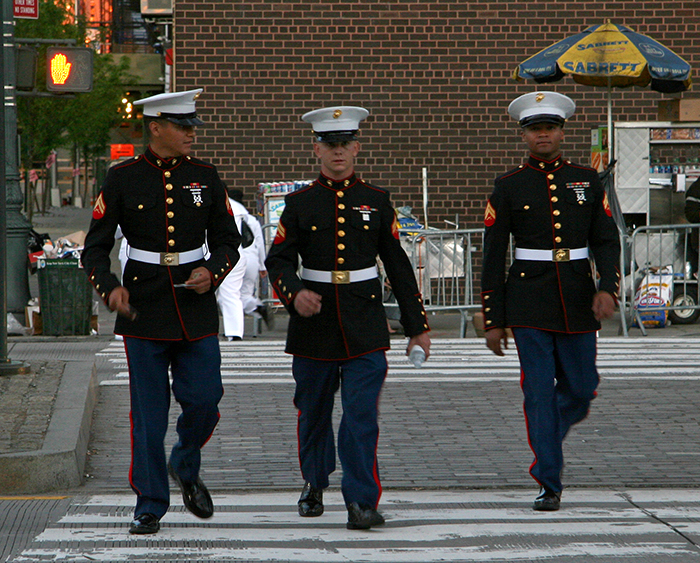
    The appeal of men in uniform always passes through my mind whenever I see officers/sailors, like these three gentlemen who were headed back to the Kearsarge battleship which is docked in NYC harbor as part of Fleet Week. Sailors could be seen throughout the city in the last few days, but, unsuccessful in getting the photo I wanted, I found myself making a pilgrimage uptown to the West Side Piers (the location of the ships), where I would certainly find the men I was looking for. And there were thousands, coming and going to the Times Square area, just a short stroll from their berth at West 48th Street.

    Some attribute the cache of men in uniform to have been significantly enhanced by the film Officer and a Gentleman starring Richard Gere. The title of the film uses a phrase from the U.S. Uniform Code of Military Justice which makes reference to being charged with “conduct unbecoming an officer and a gentleman.”
    On this Memorial Day, 2008, we commemorate those Men in Uniform who gave their lives in service to their country…

    Posted on by Brian Dubé

  • Quietude

    Posted on by Brian Dubé

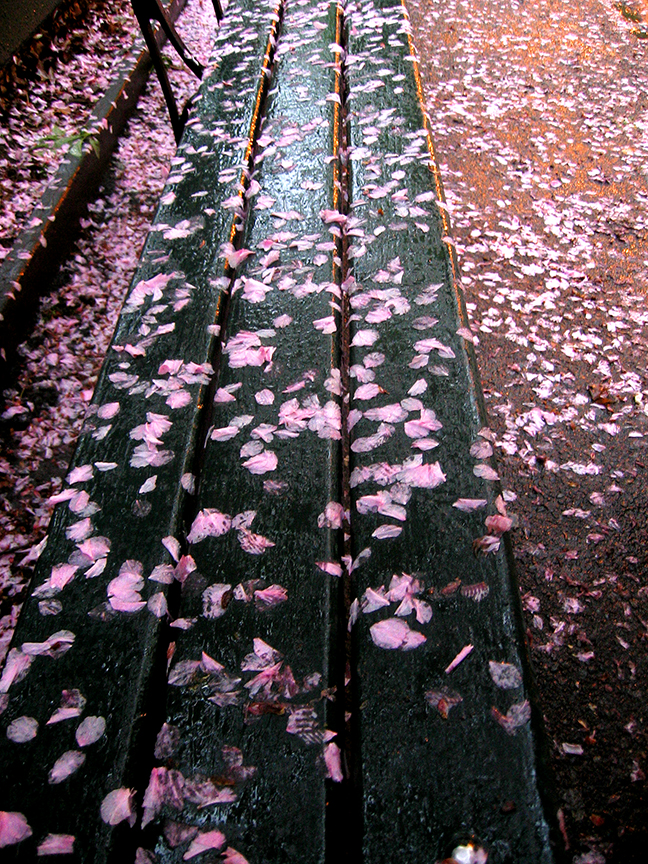
    It’s been raining a lot this spring. Personally, I hate the rain, but it does set a mood and has its merits. And in the big city, one perk is quiet.
    There are places and times where there is little opportunity for quietude or a place to sit. Like a well-located park bench on a sunny day.
    So to see a bench like this, with flower petals undisturbed, is unusual – this is something one can see perhaps in the early morning, off-hours, in remote, out-of-the-way places or in inclement weather, like the rain.

    I am a social person. I love people, and that is one of the great things about living in New York City – eight million people from every corner of the globe. Today I will meet a woman from French Polynesia to do a photo tour – I look forward to meeting her.
    But there are times when I yearn for a moment when I can be alone. When there are no people.
    Days when I’ve had enough and want to take that quiet side street, alley, or obscure path in Central Park – where I can’t see a person or building. Walk by a solitary neon sign in front of an empty restaurant.
    And then there are sunny days when I just want to walk right down Fifth Avenue and rub shoulders with humanity. 🙂

    Posted on by Brian Dubé

  • Sieve

    Posted on by Brian Dubé

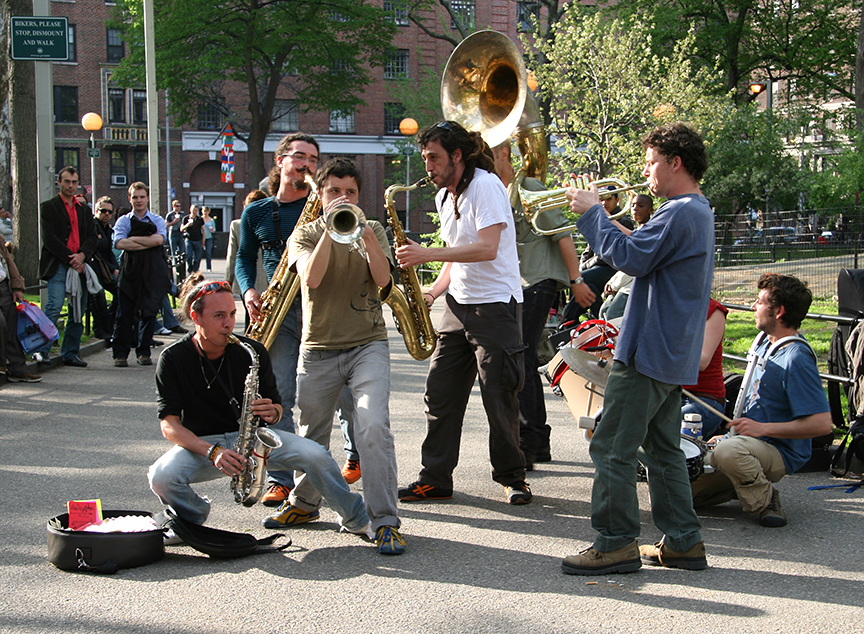
    New York is an international magnet. It’s like the whole world is on a tilt and anyone who isn’t tied down ends up in the city at one time or another. And for most musicians and performers, working in NYC is a right of passage.
    For a brass band from Marseille, I guess it would be de rigueur.

    On the same day that I met renowned Will Galison, we had this brass band from Marseille only a few hundred feet away. They called themselves Samenakoa and used a number of unique devices, including a megaphone for the singer.

    We are so spoiled in this city. We have one cultural tour de force after another. Even on the streets, we have extraordinary talent and, in some cases, people who work professionally on stages worldwide. I have seen Philippe Petit (who walked between the twin towers), David Blaine, and a plethora of others.
    The streets are a good training ground for performers. Unlike a theater, you do not a have a captive audience – they need to be gathered and held. A tough job in a city with so many distractions and so much talent. If your act is not immediately compelling, most will just walk away.

    Performers I have known who honed their craft this way have become extraordinary performers – not just showmen, but true entertainers. People like Penn and Teller. On the streets, an astute performer can easily ascertain what works and what doesn’t. That which doesn’t work is discarded. It’s liking working with a sieve, sifting for the nuggets of gold that remain after discarding the sand. Separating wheat from chaff.

    All those nuggets of gold and kernels of wheat – that’s why I love this city.

    Related Postings: One Man Band, The Naked Cowboy, Street Revival, Reverend Billy, Missionaries Meet Their Match, Fête de la Musique, Palehorse Productions

    Posted on by Brian Dubé

  • Very Practical

    Posted on by Brian Dubé

    I once had a customer from Sweden who made a comment that had a lasting impression. I have many international customers, and I am frequently curious about their impressions of the city. So when I asked, “What do you think of New York?” there was a pause, and I could see that he was looking for a very diplomatic answer. “Very practical,” was his response.

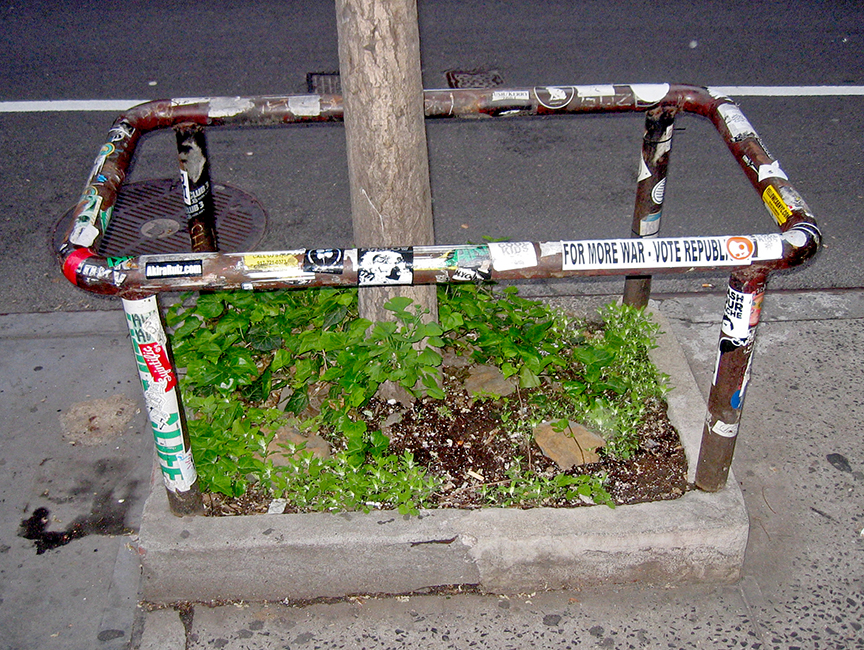
    Now I knew immediately what he meant. My mind’s eye raced around the city streets as I visualized those things that could be best described as “very practical” looking – our trash cans, lampposts, heavy chains around bikes, steel-reinforced concrete curbstones, roll down gates – so many things where function triumphs and utilitarian is the operative word.

    Virtually everything on the city streets of New York is designed with the lowest common denominator in mind, and in the biggest city in America, that denominator is very low. The key concerns that define the design and construction of most things accessible on the streets are vandalism and theft (not to mention heavy wear and tear). Don’t be misled by articles and statistics on low crime rates in NYC. Much of this is not due to any inherent improvement in the goodness of people but rather by the actions of law enforcement and protective measures by individuals and businesses. Also, the general increase in the costs of living in the city has changed the demographic – where’s a heroin addict to live?

    One big thing that we residents tend to overlook is not so much what is as what is not – decorative elements and architectural details. These are found primarily in those things which benefit from historical treatment. This can be easily seen if one compares post-war and prewar buildings. With enough time spent here, these decorative deficits and the triumph of the utilitarian become so inculcated that it takes a fresh eye to really notice.

    I found the tree guard in the photo to be one of the most hideous examples of the practical I have ever seen. Even more surprising, it is located in central SoHo, one of the most upscale neighborhoods in the United States. But the tree needs protection. The solution may not be attractive, but it is very practical

    Posted on by Brian Dubé

  • Do it in the Road

    Posted on by Brian Dubé

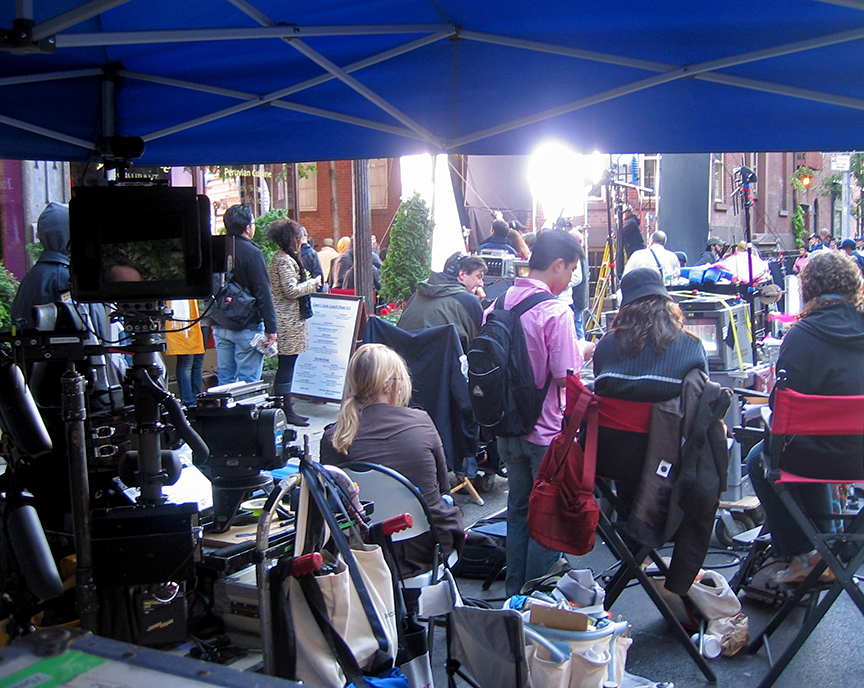
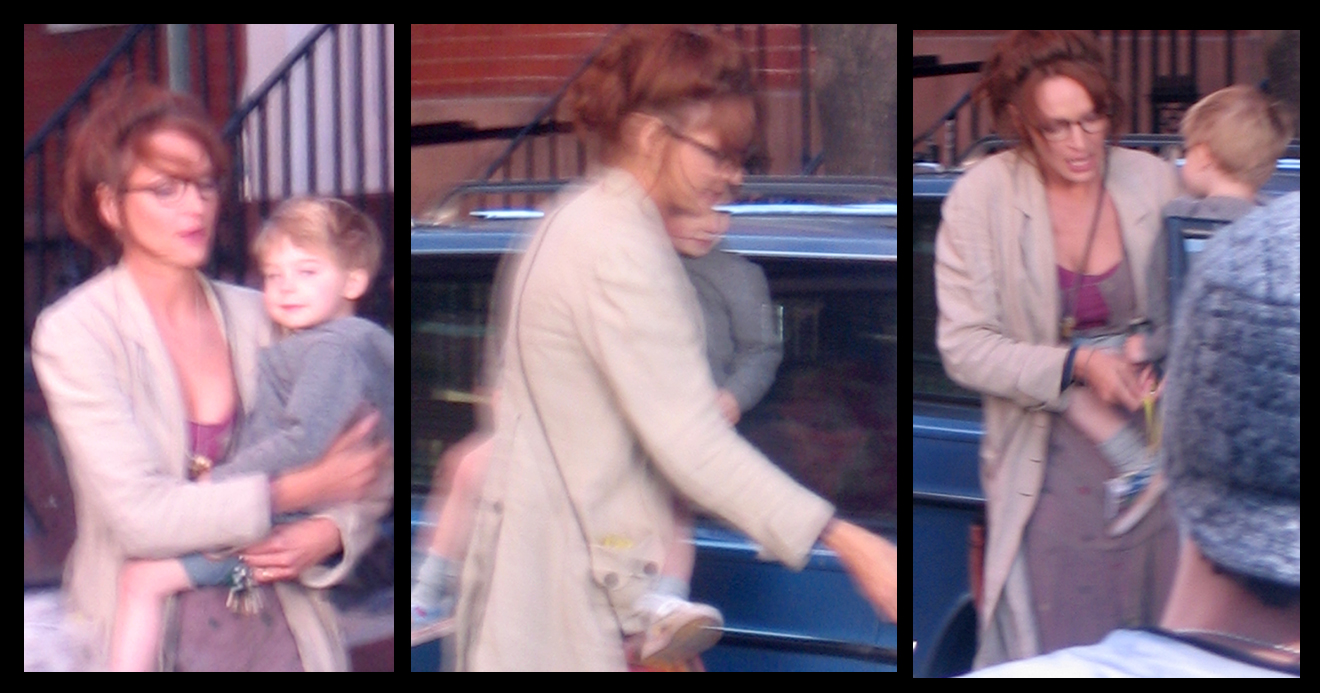
    We do it in the road. We have a real street life in NYC. The street is our front yard, backyard, driveway, and secondary sidewalk. We eat in the streets, walk in the streets, and fix our cars in the streets. Children play in the streets and we have fairs and parades in the streets. We make movies and commercials in the streets – where else is there? Last night, on the way to dinner on Christopher Street in the West Village, I ran across a movie set. They were filming Motherhood with Uma Thurman (see photos here).

    These occurrences appear suddenly and are quite common – the crowd watching was surprisingly small. Paparazzi with telephoto lenses were on hand. But we are jaded in NYC, and the novelty wears off quickly. Most onlookers only spend a short time observing, catch a celebrity, and move on. And most don’t even bother to do that. They just walk and navigate the street, slightly annoyed with the congestion, simultaneously avoiding the traffic. Cars and buses are a nuisance, really – they just get in our way…

    Posted on by Brian Dubé

  • Veggie Pride

    Posted on by Brian Dubé

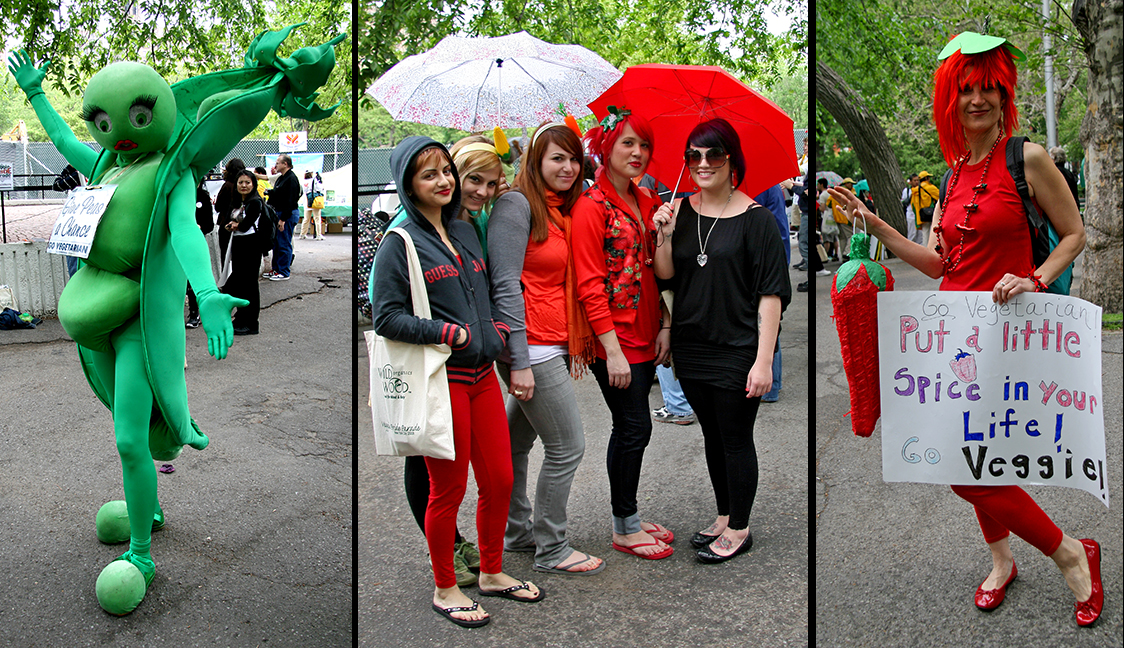
    Sunday was the first Veggie Pride Parade in America. Ironically, it started in the meatpacking district and ended in Washington Square Park, with various activities and speakers. The world’s first was held in Paris in 2001 – a surprise coming from the country that brought us foie gras. Marchers donned a variety of vegetable and fruit-inspired costumes. I am somewhat sympathetic to the cause, having been a vegetarian for decades and now only adding fish to my diet.

    A very interesting aspect of this movement are the various semi-vegetarian practices which, for many, are seen as types of vegetarianism. Many individuals now add certain flesh and animal foods to their diet, like poultry, fish, eggs, or dairy. So we have terms such as pollo vegetarianism, semi-vegetarianism, flexitarianism, pescetarianism, pesce-pollotarianism, ovo-vegetarianism, lacto vegetarianism, and lacto-ovo vegetarianism.
    And, of course, there are the hardcore adherents who consider many of these terms to be misnomers and abstain from any animal products. At the extreme end of the spectrum, we have vegans, fruitarians, natural hygienists, and raw foodists. Macrobiotic followers may or may not be strict vegetarians.

    The motivations also vary. People are vegetarians for a number of reasons: religious, ethical/ animal rights, cultural, economic, and environmental. For an overview of vegetarianism, see here.

    A number of us found one odd thing about the participants: the large number present who wore tattoos, piercings, and other manifestations some might consider out of character with a natural, vegetarian lifestyle (including a loud hard-rock band). One gets the feeling that for some, vegetarianism is more a faddish, style-driven choice. I wrote about this in my posting Vegan Chic.

    But overall, I think the message of reduction of meat is a useful one – over consumption of food in the USA is a general problem, and the reduction of red meat is a laudable goal for many, including members of the medical community…

    Posted on by Brian Dubé

  • Little Burnt Out

    Posted on by Brian Dubé

    Want to feel special? Be the focus of a school field trip with 28 kids. Judy, a previous employee who has gone on to become a school teacher, came to visit me yesterday with her class of 2nd graders from elementary school PS 124 in Chinatown.

    This was a real eye opener for me, and I quickly saw the rewards and joys of teaching children. Certainly a handful of work, of course, but I had it good, like a grandparent. Judy and her associates did all the work of managing the kids; I had all the fun.

    There were squeals, giggles, and screams at every opportunity. And I was the center of attraction as they toured my facility, attentive to my every word and demonstration. They asked questions of me and vice versa. Every one of our staff was quite charmed.

    What is particularly interesting is how kids absorb things. I was asked if I still juggle, and I responded that I enjoyed many aspects of the business but that I was a little burnt out after 33 years. I proceeded to explain what “burnt out” meant. I thought it would be over their heads. I later learned that one of the kids said to the principal of the school, in response to a comment she made, that perhaps she was burnt out and should consider retiring 🙂

    Posted on by Brian Dubé

  • Mesmerized

    Posted on by Brian Dubé

    When I was a young boy, I couldn’t stay away from fire – there is some allure for boys. Playing with fire was not a metaphor but rather a real activity. We got matches, we tried rubbing sticks, and we lit grass clumps from mowed lawns with magnifying glasses. And I became a Boy Scout – one of the benefits was that it legitimized using fire – what’s camping without a campfire? We were just mesmerized by fire and flames.

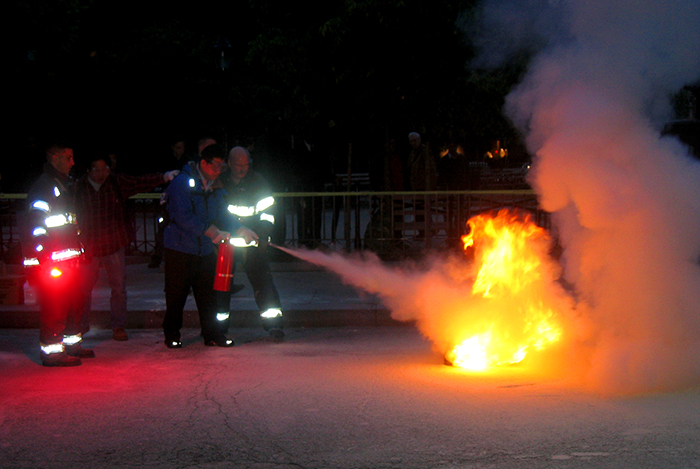
    The photo was taken on Carmine Street in the Village. It was a practice session involving members of CERT, or Community Emergency Response Team – a group of neighborhood and community-based volunteers who undergo an intensive, 11-week training program in disaster preparedness and basic response skills. Volunteers took turns putting out a small fire. The billowing flames in the evening light was quite a spectacle.
    But, regardless of the merits of the program, everyone observing was drawn by the mesmerizing effect of those flames.

    Whenever I see firemen, I always feel that somewhere in there is a little boy who never outgrew his interest in fire and just transmuted it into a profession. Good for all concerned, n’est-ce pas?

    Posted on by Brian Dubé

  • Mary Celeste

    Posted on by Brian Dubé

    I have been frequently asked by visitors, “Where do you get gas in the city? I don’t see any gas stations.” Or, “Are there any supermarkets?”
    Blinded by the oversaturation of stimuli and the plethora of all things manmade, the last thing noticed in the city are the mundane, particularly those places which provide basic services. But all the basic services do exist, tucked away here and there, perhaps in atypical and unlikely places. Laundry, dry cleaning, shoe repair, auto repair shops, street level doctors’ offices, hardware, paint supplies, plumbing supplies, lumberyards, gas stations, supermarkets, schools, and playgrounds. The number of many of these has declined substantially as the real estate market has heated up, but they all can still be found.

    One of the most mysterious things to me is the public and private schools. Virtually invisible, yet there are 1,400 schools in the five boroughs.
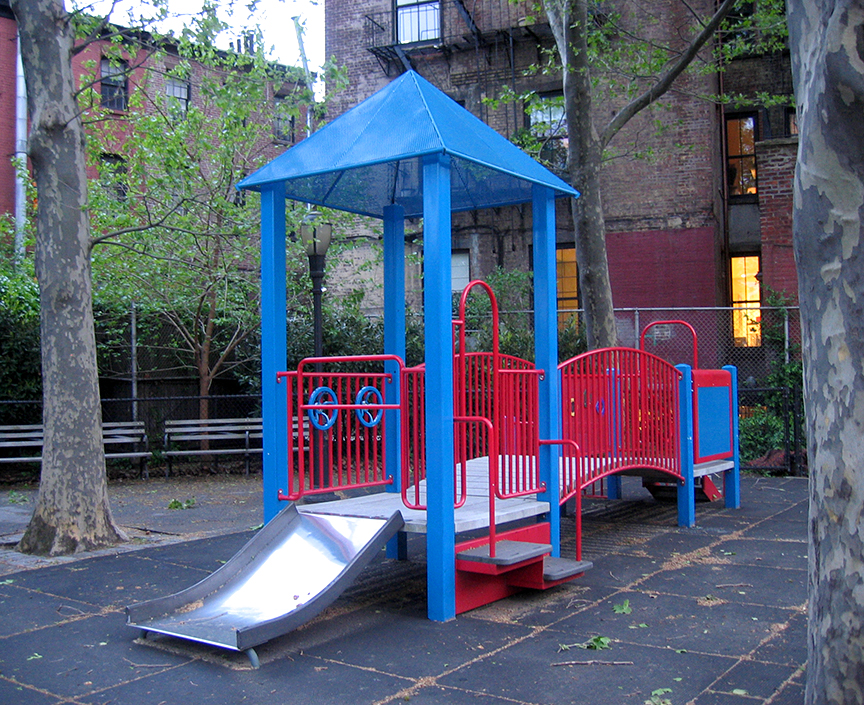
    And children need to play. Here, at one of the busiest intersections in Manhattan, Houston Street and 6th Avenue, we have the Playground of the Americas. But you never really notice it. In fact, I have walked by this playground for years, and this is the first time I have really looked at it.

    Due to my daily work schedule, I rarely see school children in action in the city, so schools and playgrounds are like the ghost ship Mary Celeste to me – cigarettes still burning in the ashtrays and food still cooking in the stove, but the crew and passengers have vanished…

    Note: The story of the Mary Celeste is a fascinating tale.

    Posted on by Brian Dubé


  • dinamic_sidebar 4 none

©2026 New York Daily Photo Entries (RSS) and Comments (RSS)  Raindrops Theme