• Travesty in Travertine

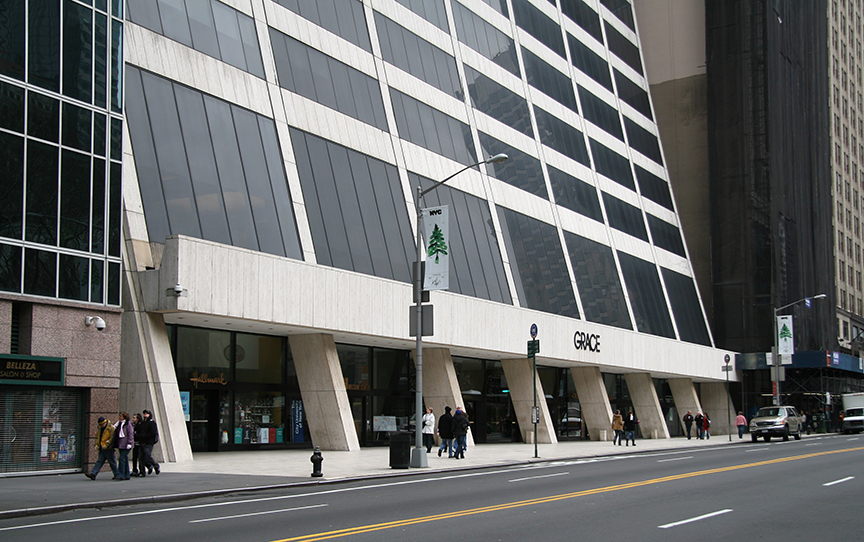
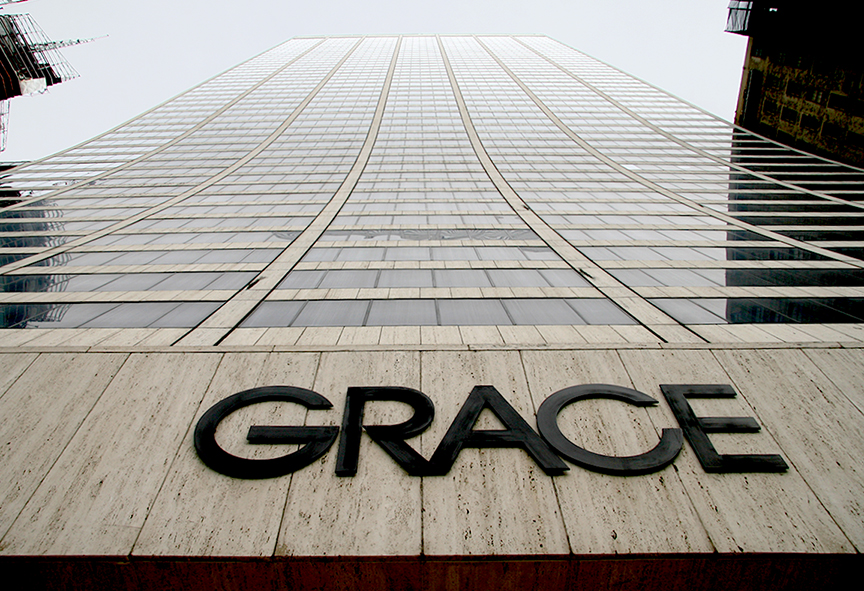
    No Fall from Grace, Thickens and Sickens, and Travesty in Travertine were all competing titles for this story. The W.R. Grace Building at West 42nd Street was commissioned by the W.R. Grace Corporation, designed by Gordon Bunshaft of Skidmore, Owings, and Merrill, and completed in 1971 (the resemblance to the Solow Building at 9 West 57th St. is no coincidence – the initial, rejected design for the facade of that building was used by Bunshaft for the Grace Building). A casual perusal of Internet sources will give relatively neutral to positive reviews of this building. Wikipedia’s entry is perfunctory. 50 stories with signature curved sloping bases (the same on 43rd Street) (click here for photo). Exterior in white travertine.

    But if you dig further, you will find that many architects HATE this building. Architecture critic Paul Goldberger said, “The Grace Building’s front – I call it swooping, others call it a ski-jump – is an arrogant, exhibitionistic form that breaks the line of building-fronts that is important to any New York City Street … Mr. Bunshaft, it would seem, cares nothing about Bryant Park or about anything except the shape of his own building, which from the northwest, at the corner of 43rd Street and Sixth Avenue, looks like nothing so much as an immense piece of furniture squeezed awkwardly into the wrong place. At that corner, as a zoning bonus permitting extra height, is one of the coldest and most unwelcoming plazas any architect has created anywhere.” The AIA Guide to NYC calls it “a disgrace to the street.”

    But the plot thickens and sickens. W.R. Grace and Company was founded by William Russell Grace (1832-1904) in 1854 in Peru – he had left Ireland due to the potato famine. He moved to NYC in 1865. He was also the city’s first Roman Catholic Mayor, serving two terms from 1880-1888. Initially, the company was in fertilizer and machinery. Later, there were acquisitions of chemical companies, and here the problems started.

    It was found that in the 1970s, the W. R. Grace Company had improperly disposed of trichloroethylene, an industrial solvent, which entered the groundwater of Woburn, Mass, causing six deaths from leukemia and numerous illnesses in the town’s families. They were indicted in 1987. However, this is only the start. Grace was also plagued with asbestos injury claims and lawsuits as a result of vermiculite mining in Libby, Montana (the vermiculite was found to contain asbestos). In 2001, they filed for bankruptcy protection. The U.S. Department of Justice determined that Grace had transferred 4-5 billion dollars to spin-off companies it had purchased just before declaring bankruptcy (the bankruptcy court ordered the various companies to return nearly $1 billion to Grace). This story has been the subject of TV, PBS, and NPR specials, and even a film (A Civil Action, starring John Travolta).

    The company, now located in Maryland, no longer has offices in the Grace Building. W.R. Grace is still in business, is traded on the NY Stock Exchange, and has a valuation of $1.5 billion. So far, there’s been grace for Grace…
  • Disruption

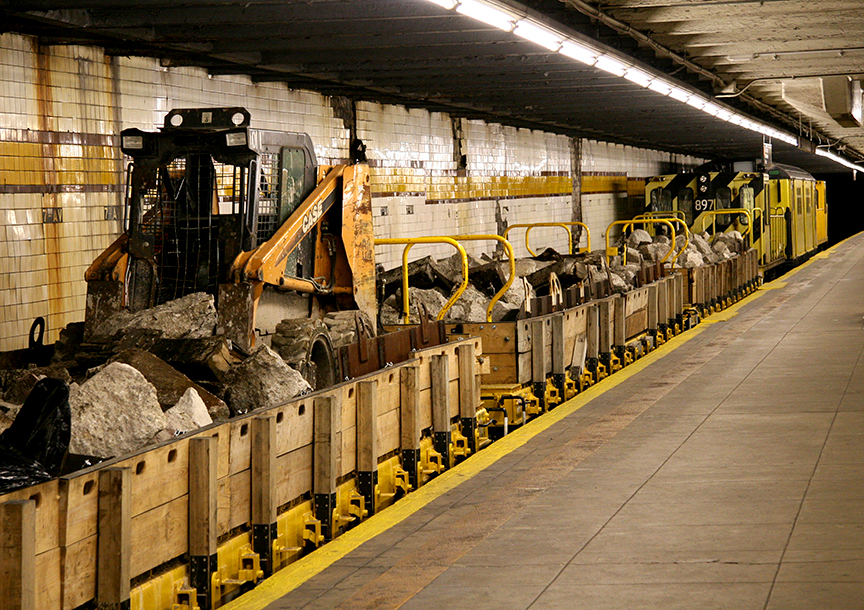
    One of the biggest frustrations of daily commuters or frequent users of the New York Subway System is what feels like the constant disruption in services. Skipping stops, delays, rerouting, stalled trains, and variations. Unlike other cities, New Yorkers really depend on the transit system. For most, there is no other transportation option – few New Yorkers own a car, and travel by car during the business day (with parking costs) is really not feasible.

    I had the opportunity to ask the question “Why?” to two acquaintances – one working for the MTA, the other a retired engineer who had been in management. What I was told makes sense, albeit not satisfying to those who bear the brunt of disruption. Here’s what they said: The primary problem is that the NYC transit system, unlike others, runs 24/7. Hence, repairs and maintenance must be made while the system is operating, not to mention in narrow, tight, confined spaces. There is no parallel system which can be used during repairs.

    Add to this that 1) The system is extremely old and everything about it is antiquated, 2) It is one of the largest systems in the world with hundreds of miles of track, 3) It is one of the most heavily used systems in the world with over 5 million passengers on a work day, 4) Most subway lines are operating at or near maximum capacity, 5) During various periods (1970s-80s), when the city was less prosperous, the system was seriously neglected so now we have to play catchup, and 6) It is a public entity with all the bureaucratic inefficiency and inertia. There is a tendency to do things the same old way.

    With such a massive around-the-clock system, every effort at overhaul or service becomes a big ordeal. My bet (not my wish) is that disruption is here to stay…

    Photo note: I took this photo at the 7th Avenue stop on the F line in Brooklyn. I thought it would show evidence that work really is being done. I imagine, however, that it could be a decoy, driven and parked throughout the system to make it appear that work is being done 🙂


  • American Radiator

    Many young people hated history class in my high school days – all the memorizing of facts. Even if your memory was quite good, why waste it leaning about things and events long gone, most with no remaining vestiges whatsoever? And things that seemingly had no relevance to our young lives.

    Growing up in a blue-collar factory town, there wasn’t much history to pique a young person’s interest anyway. Oh, I had plenty of interests: math, rocketry, German language, chess, origami, Africa, adventure, music, and books (and girls). I belonged to plenty of clubs. But history was not part of the agenda at all. Things started to change when I started traveling to Europe and when I moved to NYC. Here, history is alive and well – it’s with us everyday, everywhere you walk or look. To fully understand a building or place, one has to know the history, and it’s not long before one wants to know the history and likes history. Soon, you’re watching the History Channel (I wish my history teacher was alive to witness the success of this network).

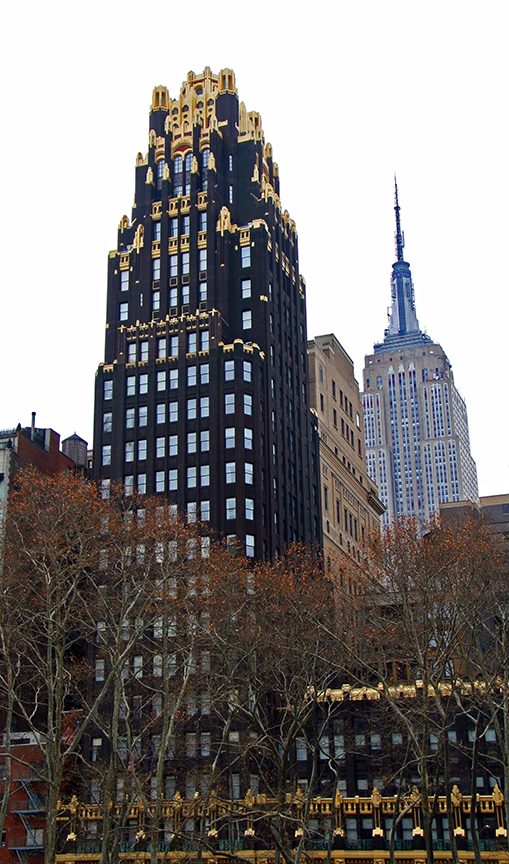
    Today’s photo is a great illustration of all this. The American Radiator Building, now the American Standard Building, was
    designed by architects Raymond Hood and John Howells and built in 1924 for the American Radiator and Standard Sanitary Company. It is based on the Chicago Tribune building. The building is located at 40 w. 40th Street on a block with many brownstones and Renaissance club facades from the turn of the century. It is on the south side of Bryant Park, thus affording unobstructed views of it from some distance. The stark contrast in colors is a distinguishing characteristic and a remarkable sight, well-known to city dwellers who frequent the area. The brick is black – Hood wanted the appearance of a large mass, unbroken by dark windows in a building typically constructed using lighter-colored stone. The building is topped with Gothic style pinnacles and terra-cotta friezes covered in gold. The design was to recall the furnaces of the time, with their black iron and glowing embers.

    Another important feature of this building is that it is set back from the lot line – unattached on all four sides. This freestanding construction permits architectural treatment all around and allows more natural light into the interior. The base is black granite with bronze plating, the lobby black marble. The building is landmarked and listed on the National Register of Historic Places. In 1998, it was sold and later converted to the Bryant Park Hotel. When you are in the neighborhood, make sure to take a look. This history serves us well, does it not?


  • Big Deal

    Everything is a big deal in New York – big things and little things. Whether it’s the tree at Rock Center or doing laundry. But with the enormous, virtually unimaginable plethora of services, isn’t everything supposed to be more convenient? Well, yes and no. Only if you have the stomach for it. Because to live well and for your life to run smoothly here, everything requires navigation, negotiation, inside knowledge, strategy, stamina, persistence, attitude, contacts, resourcefulness, and a slightly masochistic streak (and yes, money doesn’t hurt). Plus, you have to want all that the city has to offer – it has to be worth it. Things we consider easy are only easy by New York standards. And if something truly easy actually occurs, then call CNN, because this is a Really Big Deal and merits celebration, conversation, and is newsworthy. Like a parking spot right in front of your apartment building when you need it.

    What does all of this have to do with ice skating? I think you know by now. There are only a few places in Manhattan where you can ice skate, and, of course, they are all a big deal – Rockefeller Center, Central Park, and this seasonal ice skating pond in Bryant Park (nice website here). When I arrived, the ice cleaning machine was just finishing up, and the kids were chomping on the bit to get on that ice. The New York City skyline and Bryant Park itself make a beautiful backdrop for the urban ice skating experience.

    NYC is a revolving door, and those who can’t keep up just get spit back out. I remember a woman who was a very aggressive, successful salesperson in the printing business from the south who relocated to the big city. She moved to my neighborhood, so I was looking forward to her becoming an addition to my (shrinking) circle of friends. After only a few months and before I could even visit her once, she was gone. In a phone conversation, I asked her what had happened. She said she didn’t understand why people would live here. Things were just too HARD. Not that she couldn’t handle it, but why would anyone want to? I was going to say it’s really no big deal, but then I realized that’s not exactly true. New Yorkers are a different breed, and we feed on big deals…


  • Times Square Ball Drop

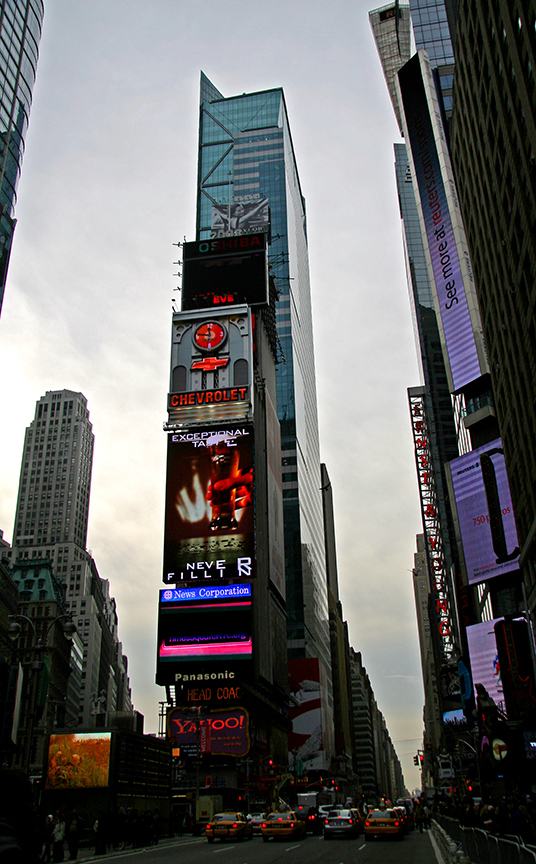
    Dropping the ball in Times Square is the world’s most well-known New Year’s Eve celebration. Nearly one million people attend in person, with millions around the world watching the televised event. The millennium celebration saw two million people – I was one of them. The photo was taken on Sunday afternoon, and preparations were already underway – television crews were setting up. (Note: click on the photo to enlarge it – if you look carefully, you can see the 2008 sign and pole for the ball above it.)

    The ball drop has been an annual event since 1907, making this year the 100th anniversary. The ball itself has gone through numerous incarnations over the last one hundred years. Its earliest construction was of iron and wood with 25-watt bulbs, weighing 700 lbs. In 1920, it was replaced with a ball entirely of iron (400 lbs) and then in 1955 with an aluminum ball weighing only 150 lbs. It remained unchanged until the 1980s, when red light bulbs and a green stem converted the Ball into an apple for the “I Love New York” marketing campaign (from 1981 to 1988). In 1989, the traditional ball with white light bulbs reappeared. In 1995, the Ball got an aluminum skin, rhinestones, strobe lights, and computerized controls. The aluminum ball was lowered for the last time in 1998, when it was replaced by an all-new geodesic design from Waterford Crystal with the latest lighting technology for the millennium celebration – 504 crystal triangles, 696 lights including 96 strobes, and 90 rotating pyramids. Read more about this remarkable, dazzling creation and the event here. This ball has been retired and is the property of the owners of the One Times Square building.

    An entirely new ball has been crafted for this year’s 100th anniversary by Waterford Crystal with 672 double cut crystal triangles. An all-new lighting design was created by Focus Lighting utilizing Philips LED technology (replacing the halogen bulbs of the previous design). With 9,576 Philips Luxeon LEDs, it is more than twice as bright with enhanced color capabilities – 16.7 million to be exact. The ball was unveiled in October and was on display at Macy’s until December 10th – sorry I missed it. Had it not been for researching this article, I would have been completely unaware of the anniversary and new ball. I look forward to watching the televised drop and hope you do the same. Happy New Year!

    Note: Time Balls actually date back to 1829, when the first one was erected in England by its inventor, Robert Wauchope, a Captain in the Royal Navy. These were used for sailors to check their chronometers. They became obsolete with the advent of radio time signals. Over sixty still remain worldwide.


  • Lockout

    I joke around about my fascination with prison documentaries, typically entitled something like Lockdown, which are presented with great drama. The drama here in the Village is at least as great with a war that has gone on for some time between community activists and the Parks Department and their plan to completely redo Washington Square Park, with activists preferring a rehab versus wholesale reconstruction. All agree that the park is in serious need of repair – the last renovation was done in 1967. The details of this battle (which is a replay of previous ones in this activist community) and its raison d’etre have been told blow by blow from the local papers all the way to the New York Times. My previous posting from May gives an overview of the various issues at hand, with links and more photos. Lawsuits have been brought against the City of New York (the last of which the city won), and on the week of December 10th, workers moved in, fenced off over half of the park, and began construction (which will be done in two phases in an estimated 2-3 years). Phase 1 is larger and includes the fountain area and plaza around it, where most gatherings and activities take place. In the warmer weather, it will be interesting to see how the regulars and visitors adapt to the very limited space.

    I am a regular user of the park and long-time community resident, and I have been involved as a close observer of this process. I understand the viewpoints of both sides in this debate, and I think it is important to remember that although opponents see the new design as radical, it will still remain a public park with a very similar layout. A radical proposition would have been the construction of high-rise condominiums in the Park’s place.

    The battle between opposing sides has appeared large, but I do not think most residents have really studied or weighed in on this situation at all, leaving the decisions to the powers that be. The number of voices on both sides are actually quite small when viewed in the context of a community with an estimated population of 150-200,00 people. There are aspects of the new design which some feel will substantially change the character of the park, such as a 4-foot high perimeter fence (to secure it at night). It will be interesting to see if the character or mood of the park and its activities and users change significantly once the project is completed.

    Architecture alone does not define a place, and New Yorkers are adaptable, resilient, and strong-willed. My prediction in the outcome of this card game is that the character of the neighborhood and will of the users easily trumps the design…


  • Slow and Steady

    There are neighborhood restaurants that seem to have been around forever and yet are rarely mentioned and infrequently reviewed. They exist quietly, like the Tiro A Segno New York Rifle Club that fascinated me for decades. Or the missionary union in Manhattan that has not had one article written about it yet – when I catch a friar on camera entering or leaving, you’ll be the first to see it.

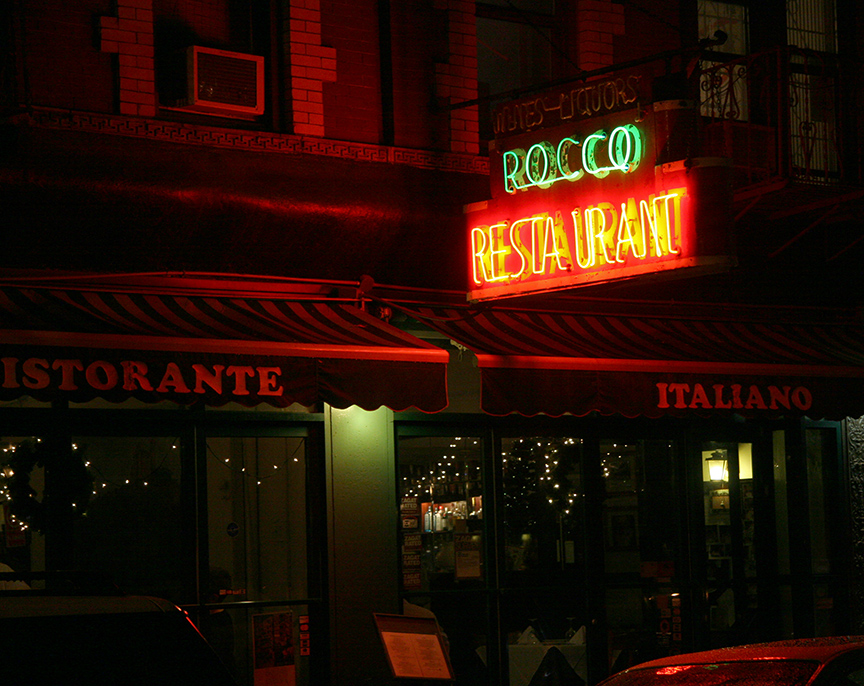
    Rocco Ristorante at 181 Thompson Street is a vintage home-style Italian restaurant founded by Rocco Stanziano in 1922 – 85 years must mean something. I have not eaten there yet, but the reviews are quite favorable, even from newer online sites such as yelp.com. It’s just not glamorous, trendy, or chic. Old, historic business establishments go down different roads. Some maintain quality but raise prices substantially as they become real legacy businesses. Others just sell out and become money machines without any regard for quality (frequently cutting costs by outsourcing); sometimes entire towns become tourist traps with businesses like this, such as Boothbay Harbor, Maine. Some catch a trend and reinvent themselves, like Astor Place Haircutters. And then there are those places that are sleepy backwaters, just doing things the same way, patronized by customers who like it exactly the way it is. Slow and steady wins the race…


  • Über Peek

    Honesty can be a good policy, and honestly, after a stressful holiday weekend with all the preparations and travel, I did not have the energy this morning to do a posting. So I perused my photos with disappointment and tried to figure out how to spin straw into gold, or at least silver.

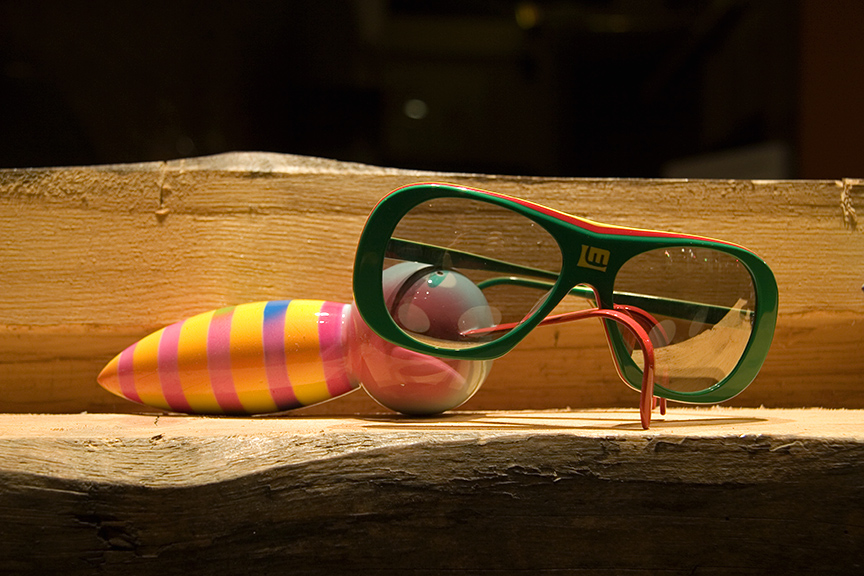
    The photos of the window display of Disrespectacles Eyewear at 82 Christopher Street was always interesting to me but had been previously nixed as not worthy. But in doing an online search for this store, interesting things popped up. Using the singular Disrespectacle returned only 5 items from Google, while the plural returned 2450 – quite unusual. Typically, the singular brings back more than the plural (?). I also found a website on lovewords that defined Disrespectacle as “To be publicly disrespected.” Finally, I arrived at the store’s website. I found descriptions of their product line such as funky, trend-setting, hip, über-sleek, industrial-sleek, high fashion, hard-to-find, and ultra high-end boutique, with features and reviews from all the top fashion publications.

    Retailing is very competitive – merchants must be increasingly creative to stay alive in a crowded marketplace. And they are protective of their efforts. I am more and more frequently told that I can not take photographs in stores. In some cases (like restaurants), this is to protect the privacy of patrons, but often it is due to paranoia – i.e. that others will steal their ideas for displays and decor. All the newer, trendy establishments which are hyper-designed are like this. Pinkberry (a new frozen dessert place) is a good example – they have a no photography icon on their windows. In shooting from the street through the windows at the French restaurant Balthazar in SoHo, I had a waiter inside waving his arms at me to signal that no photos are to be taken. So, from time to time, when I can manage to take a photo surreptitiously, I will offer you über-peeks of the verboten…


  • Being There

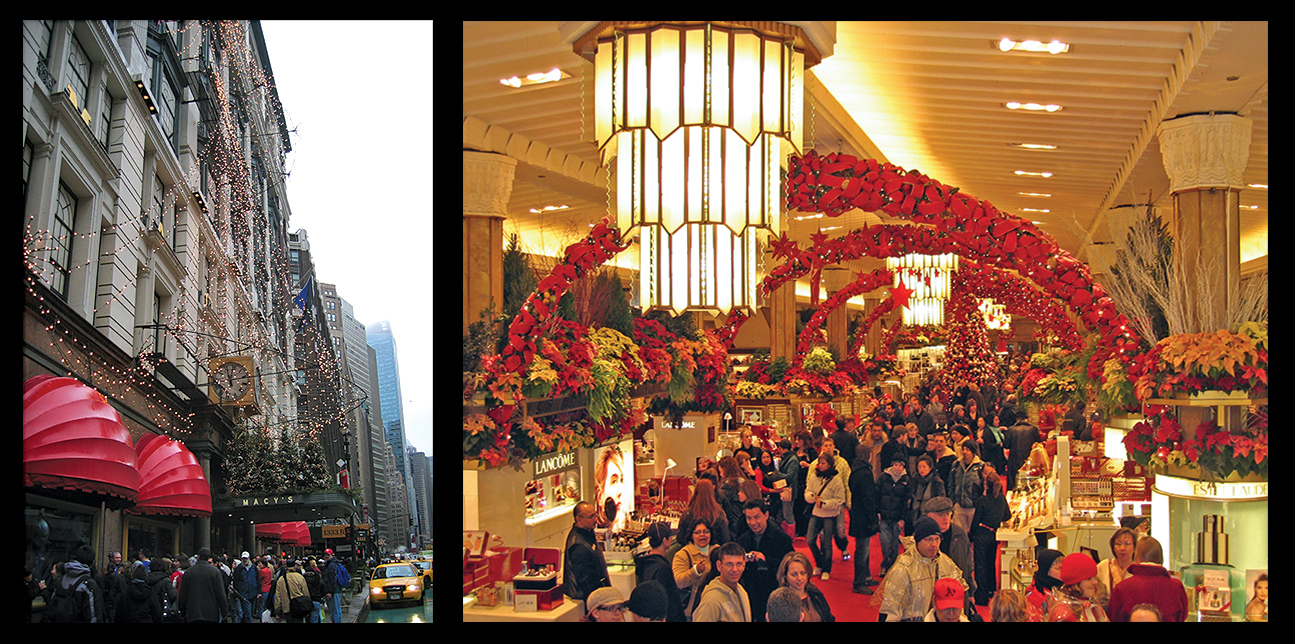
    Can you have too much Macy’s? Perhaps. But regular readers of this website know that I do bemoan the disappearance of so many NYC places and things which have given New York the character it is known for. As I wrote in my recent post Constant, many of the feelings that the best things and times have passed are nostaligic and a complaint of every generation. Championing a merchant may appear to be unnecessary – they do get paid already as a business. And I have complained about excess consumption in this country with an over emphasis on materialism.

    However, we do need merchants, and Macy’s is not an ordinary merchant. To lose them would be sad. Their sponsorship and historic relationship with the Thanksgiving Day Parade (over 80 years) and the July 4th fireworks set them apart. They are part of the physical and psychic fabric of the city. There is a security in knowing they are there, particularly as the world becomes more temporal, fragile, and mutable. We need anchors. It reminds me of a Woody Allen comment about why he needs to live in NYC – that there’s a restaurant in Chinatown where he can get a certain favorite dish at four o’clock in the morning. Not that he every has or will go there at that time. It’s just knowing it’s there. Macy’s is one of those places that whether you go patronize them or not, for a New Yorker, it’s important to know they are there, especially at Christmas…

    Posting Note: This posting will remain for two days (Monday and Tuesday) – I will be away with my family in New England. New postings will resume Wednesday. Happy Holidays.


  • Bleecker Street

    The problem with Bleecker Street is nothing new – a place being a victim of its own success. Over time, the South Village has gone through several incarnations. In the early 19th century, the area around Minetta Street became known as Little Africa. A large portion of the city’s black population was living within a few blocks of Minetta Street; these were freed African-Americans (New York State abolished slavery in 1827). The area saw the nation’s first black church, the first black theater (African Grove), and the first black newspaper (Freedom Journal).

    By the 1850s, the area just slightly east, where the Washington Square Village apartment complex now stands, became settled with an immigrant French community – in fact, the area was known as Frenchtown. By the 1870s, most of the French had moved uptown, tourists invaded, and the area became commercialized. Known as the Latin Quarter, it was populated with brothels and taverns.

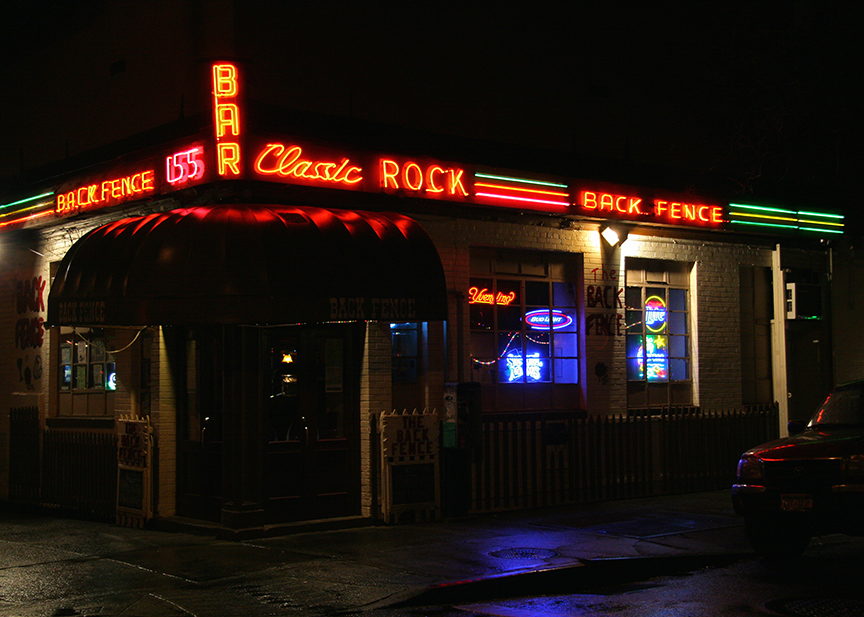
    Later, of course, from the early 20th century through the 1950s and 60s, the area became a renowned bohemian center and still has that reputation to this day. Where does that leave us? Well, it leaves me with very mixed feelings about a street that has had quite a run and been virtually synonymous with Greenwich Village. The few blocks just between 6th Avenue and LaGuardia Place has had many landmark establishments: the Village Gate, Bleecker Street Cinema, the Back Fence, Kenny’s Castaways, Terra Blues, the Little Red Schoolhouse, Le Figaro Cafe, the Bitter End, Peculier Pub, Cafe Au Go Go, and the Actor’s Studio Drama School.

    In fairness, I must say that there are still many quality business establishments on the street, such as Terra Blues. When a place has been beaten hard with an onslaught of tourists for over a century, you do the best you can. And on a quiet weeknight with a little drizzle in the air and the soft neon glow of the Back Fence’s neon signs, things don’t look all that bad…

    A note about the street name: Bleecker Street is named for Anthony Bleecker (1770–1827), a poet and friend of Washington Irving and William Cullen Bryant. The street ran through his farm, and in 1807, Bleecker and his wife deeded the land to the city.


  • Nativity

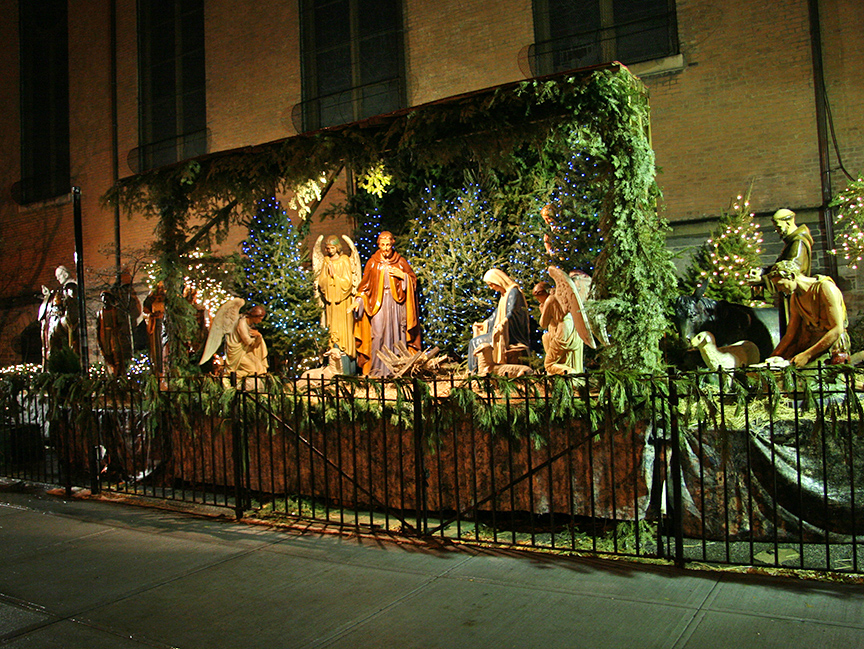
    It is amazing how inured we can become of things with constant exposure, like a beautiful vista seen daily. If someone had asked the existence or whereabouts of a nativity scene in NYC, I’m not sure if I would remembered this one, although it is essentially a city block long on one of the busiest streets in Manhattan: Houston Street, a veritable crosstown highway, the dividing line between the Village and SoHo. It is not a street typically used by pedestrians for strolling; although there are retailers (like Rafetto’s), the street does not have the ambiance of the surrounding smaller streets. Not to mention I cross this street daily and have done eight postings on subjects found on it.

    The photo shows the life-size nativity which is erected annually by St. Anthony’s Church, officially the Church of St. Anthony of Padua at 154 Sullivan Street. The Roman Catholic Shrine church was built in 1866. It is staffed by the Franciscan Friars and is the oldest existing parish founded for ministry to Italian immigrants in the United States. In the 1930s, Houston Street was widened for the construction of the subway. Tenement buildings on abutting the north side of the church were demolished, leaving a narrow space between the church’s north wall and Houston Street, where the nativity scene is installed.

    Interesting note: Convicted Mafia mobster, Vincent “The Chin” Gigante, was a habitue of Greenwich Village. He died December 19, 2005; his funeral was held at St. Anthony’s Church.


  • Stay Lean Stay Hungry

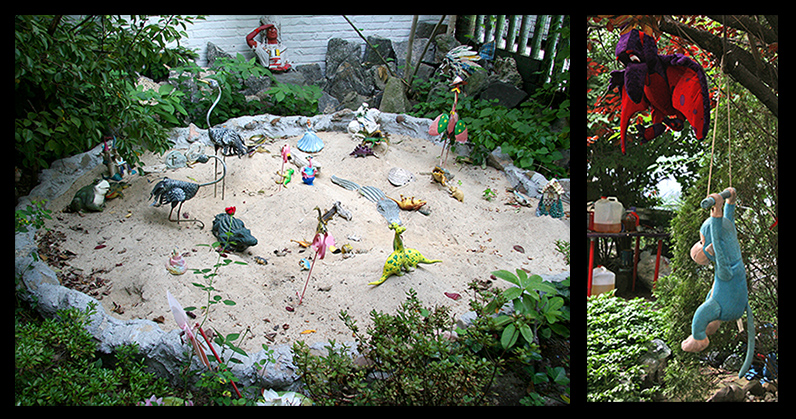
    These photos were taken in October, when I was actively touring the East Village community gardens. I ran a number of garden postings, so this modest one was left to the archives. The Earth People Garden is one of those places which slips under the radar – it certainly is not in any guides or must-see lists. Yet its charms were such that I thought it merited a posting. It is located on 8th Street between Avenues B and C in the heart of Losaida territory – the community members were primarily Hispanic. We were greeted cordially and invited to enjoy. We were also encouraged to come back for Halloween (which I did not do), when apparently they did a major redecoration for the holiday. I found the place extremely inspiring; their efforts and use of simple toys were a testament to resourcefulness and provided a breath of fresh air in an over-the-top world of excess.

    I feel that whatever creative talents I have are the product of a relatively spartan upbringing. Generally I made my own toys and fun. There was a popular phrase I heard a lot at one time – “Stay lean, stay hungry” – a warning not to get too fat and lazy. This was not to be taken literally (sports and exercise fans sometimes now use it that way); the message was that doing with less will do more to drive an individual. Although I am not an advocate of eschewing all modernity and good tools, there is some merit to the concept of seeing what can be done by leveraging one’s mind and personal skills rather than relying on outside resources. These are the thoughts that ran through my mind as I wandered about the garden, with its quaint displays and proud people…


  • Constant

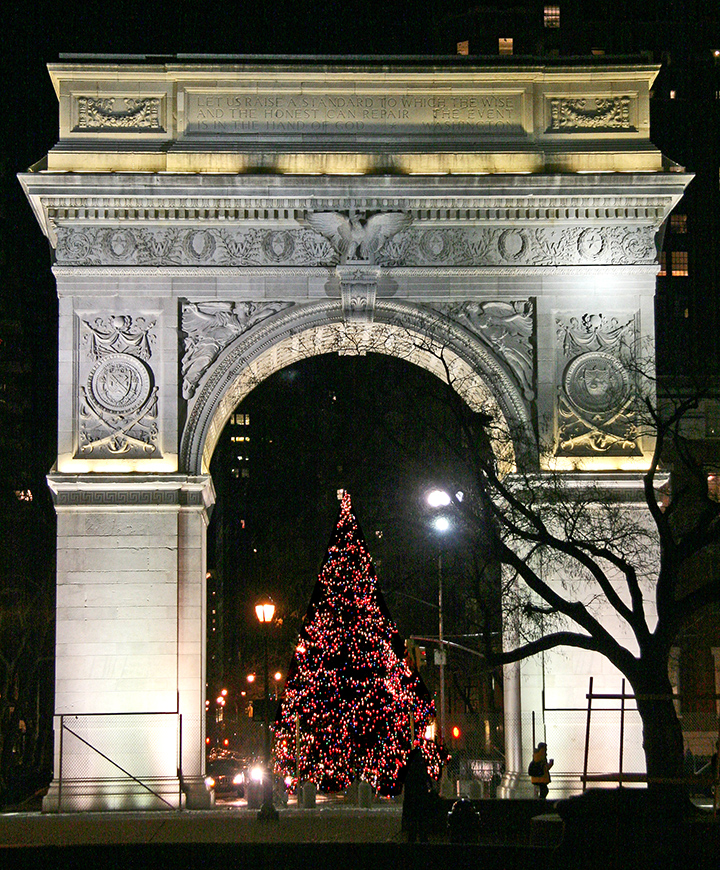
    In today’s assignment, I will briefly answer the question, “What does Washington Square Arch mean to me?” In the 60s – 70s, Greenwich Village had everything a young person wanted – freedom, excitement, diversity, the counterculture, permissiveness, liberalism, protest, and rebellion. Along with Berkeley/San Francisco, it was one of the preeminent areas in the country for the counterculture of the times. The stories read like a fantasy novel: music venues like the Electric Circus and the Fillmore East, Bob Dylan, seeing John Lennon and Yoko Ono at a local bike store, a friend calling Woody Allen from the dorm, Jimi Hendrix rehearsing down the block at Electric Lady Studios. Imagine coming to visit a place like this, never having been away from home or to the big city.

    One of my first memories of NYC (on a preliminary visit to NYU, where I had been accepted) was approaching this arch with musicians beneath it playing bongos and radicals distributing literature like the Berkeley Barb. And yes, there was sex, drugs, and rock and roll. But there were severe casualties for those who overindulged, as I wrote about in Summer of Drugs, a 40th anniversary reunion of the 1967 San Francisco Be-In. So this arch has a lot of meanings for me. I have lived in this neighborhood for nearly 4 decades, and the arch has been a constant in a world of change, symbolizing different things for different people and times. Recently, the arch was completely refurbished, with beautiful lighting installed. So now when I arrive at night, I know it’s home because I see the light has been left on for me…

    Other Postings on Washington Square Arch: Evening Arch, Singing Bowls, Cello, Arch Rebels


  • Peregrine Falcons

    On an excursion downtown, I ran across this sign proclaiming the reemergence of the peregrine falcon in NYC. Until the middle of the 20th century, peregrines ranged from Alaska to Georgia. But in the 1950s and ‘60s, the pesticide DDT found its way up the food chain. The birds that peregrines hunted fed on insects contaminated with DDT. Due to biomagnification, DDT accumulated in the peregrines, causing their eggs to become too weak to even support the weight of the mother incubating her eggs. The eggs shattered before fledglings could hatch. By the time DDT was finally banned in 1972, there was not a single peregrine falcon left east of the Mississippi. The reemergence of the peregrine is considered an environmental success story.

    I became interested in birds of prey in NYC several years ago, when, like many other New Yorkers, I learned of the red-tailed hawk Pale Male (and his family), who had nested on a prime building on Fifth Avenue. I made frequent trips to the Boat Basin area of Central Park to spend afternoons, along with many others, watching the antics of the Pale Male. But problems ensued, and the situation became a huge international story for the city. If you missed it, click here for links and a posting with a photo of my own sighting of a red-tailed hawk at my bedroom window, a real lucky photo op which got quite a response from birders and local residents.

    I was surprised to find this tiny patch of green (in the photo) at the entrance to the Brooklyn Bridge and learn that it was a prime spot for sighting falcons. I also was not aware that this is a Greenstreet property, part of a huge $391 million, ten-year initiative to plant street trees in all possible locations, creating 800 new Greenstreets, and reforesting 2,000 acres of parkland. The initiative is part of PlaNYC, “a blueprint for New York City to attain sustainable growth and improve the quality of life in the face of escalating population projections. The Mayor’s plan—shaped by input from environmental, business, community, and legislative leaders as well as thousands of New Yorkers—details 127 initiatives within five key areas of the city’s environment: land, air, water, energy, and transportation. Components of the plan include increasing access to open space, cleaning up contaminated lands, improving water quality through natural solutions, achieving the cleanest air quality of any big city in America, and reducing global warming emissions by 30%.” It sounds great. Let’s hope it’s not just hot air 🙂


  • Air Rights

    I’m not a neo-Luddite – I do love much of what technology has brought us. Cell phones, the Internet, PCs, DVDs, VCRs, and ATMs are all things which have made our lives easier. But I do love natural things. One of the things I hate is the inability to open windows in high-rises or hotel construction. On a beautiful spring day, I want to throw the windows open, hear the birds, and smell the air, not watch it through a picture window like a television program.

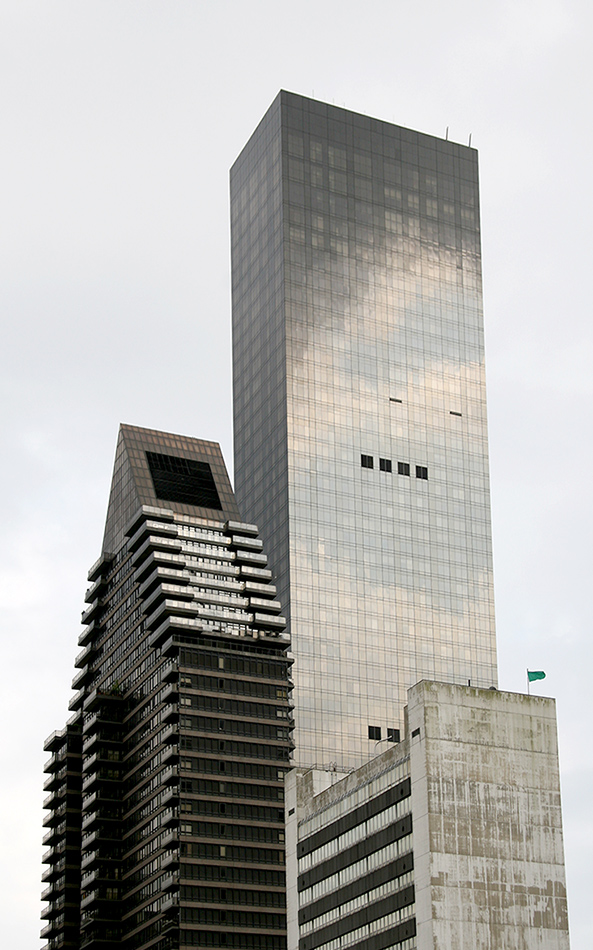
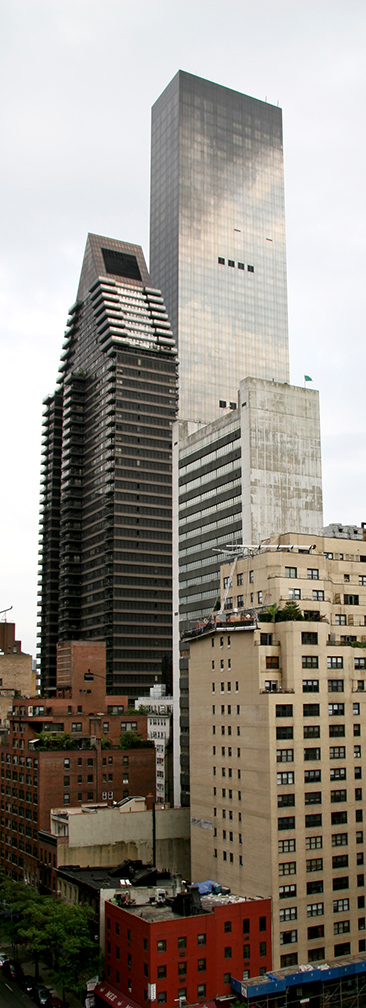
    That said, today I bring you two glass towers (two-for-one to carry you through the weekend). The building in the foreground is the 52-story 100 United Nations Plaza, a luxury condominium tower on the northwest corner of 48th Street and First Avenue, completed in 1986 (click here for 2nd photo). You can’t miss this one, with its signature wedge-shaped roof in eight steps, featuring penthouses with multiple balconies. The building is surrounded by a landscaped plaza with gardens and fountains. It was designed by Der Scutt, an architect with quite a pedigree who has done numerous NYC projects, including Trump Tower on Fifth Avenue, the Grand Hyatt Hotel, and the Corinthian luxury condominium.

    This building was the tallest in the area until it was eclipsed by the 72-story Trump World Tower (seen to its right in the photo) across First Avenue between 47 and 48th Streets. Surprisingly, I have read a number of positive reviews from architecture critics such as Herbert Muschamp. Designed by Polish architect Marta Rudzka and completed in 2001, it was built amid some controversy (of course) concerning its height and impact on views and neighboring buildings, particularly the United Nations. It is the tallest residential tower in the US and was worldwide until the completion of the 21st Century Tower in Dubai (2003) and the Tower Palace Three in Seoul (2004).

    It’s amazing what lawyers and money can do. If the law provides needed loopholes and maneuverable angles, lawyers will find them, and unless laws are changed, projects go though which may puzzle many and not be to the liking of residents. One of the most fascinating concepts is the Transfer of Development Rights (or TDR), a scheme introduced to the city in the 1980s for transferring the unused “air rights” of one building (or more) to another proposed structure, thus allowing for a much taller structure to be erected than the building’s plot alone would allow. Its intention was to save older historic buildings; rather than have to sell a property to capitalize on the value of its land, TDR allows the building to remain with the owner still profiting by selling air rights for the development of a taller structure on a neighboring plot. So Donald Trump gets to dot his i and cross his T again…


  • dinamic_sidebar 4 none

©2026 New York Daily Photo Entries (RSS) and Comments (RSS)  Raindrops Theme