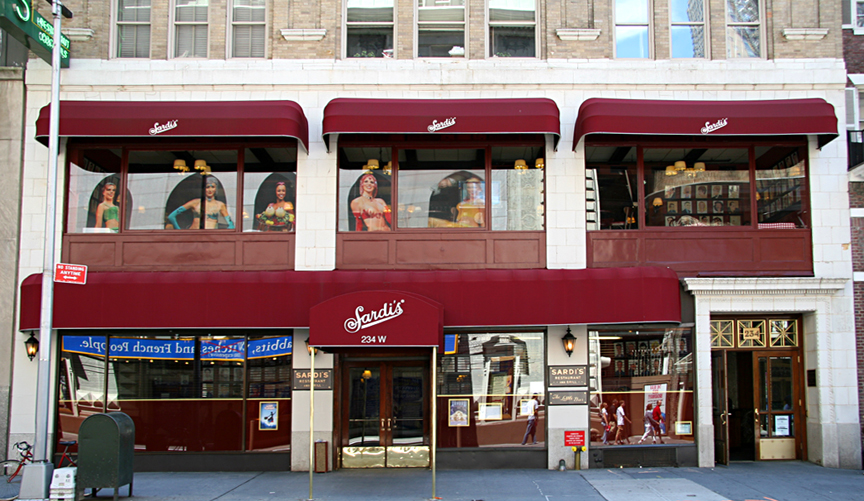
• Sardi’s

    Unfortunately, the story of Sardi’s, like many others of NYC, is best told in past tense. They have not gone out of business, but that which brought the restaurant its notoriety has gone. What’s left is more of a cliche for tourists. Sardi’s, located at 234 West 44th Street, is in the heart of the theater district and was an integral part of the fabric of that world since Vincent Sardi, Sr. opened the Little Restaurant at 246 W. 44th Street in 1921. Patrons referred to it as Sardi’s, and so the name stuck. In 1927, they moved to the current location. In 1947, management was taken over by Vincent Sardi, Jr. The restaurant is known for the hundreds of caricatures of show-business celebrities on its walls, inspired by Joe Zelli’s, a Parisian restaurant and jazz club. The Sardi’s caricatures were done by Alex Gard, a Russian refugee.

    The stories surrounding Vincent Sardi, Jr. are legendary and speak of old New York. Sardi’s became a Broadway landmark – an institution central to the theater world, with actors, agents, and critics utilizing it as a meeting place. Vincent loved theater and has been referred to as the “Mayor of Broadway.” He was totally supportive of the theater world and was known to carry the tabs of out of work actors. Read his obituary in the New York Times (Sardi died on January 4, 2007).

    Broadway has changed. Stephen Sondheim spoke of a dumbing down of theater and that there is no longer a Broadway community: ”There’s none whatsoever. The writers write one show every two or three years. Who congregates at Sardi’s? What is there to congregate about? Shows just sit in theaters and last.”

  • Ellis Island

    It has been estimated that nearly half of all Americans can trace their family history to at least one person who passed through Ellis Island. This island, at the mouth of the Hudson River in New York Harbor, was the point of entry for over 12 million immigrants entering the United States from January 1, 1892 until November 12, 1954.

    There are many fascinating stories about the island, the immigrants, and the immigration process at Ellis Island: the six-second physical examination, the 29 questions which were asked of newcomers, the long transatlantic journey many had to the US as third-class cargo, the tragic fate of the 2% who were rejected from admission and returned to their countries of origin, and the complex dispute between New York and New Jersey over the island’s jurisdiction. This is an enormous subject on which much has been written – for more information, try any of the following sites: the overview at Wikipedia, Ellis Island National Monument official site, and an Ellis Island web site.

    The building itself underwent a major $160 million renovation starting in 1984. The island was reopened to the public in 1990. To visit Ellis Island is something everyone should try to do…


  • The Beresford

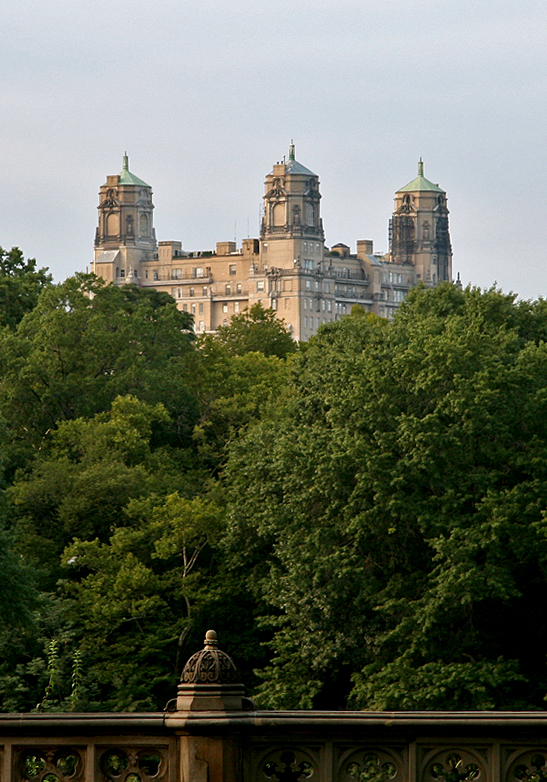
    Many find the subject of architecture “boring”, but as much as anything else, a great city is defined by its buildings. Say the word Paris or London, and images of the Arc de Triomphe, Eiffel Tower, Louvre, and the Tower of London come to mind. Architecture is the crystallization in a point in time of many things – the fashion, folly, trends, inspiration, and perspiration of the men and women who shaped it. To walk this city and appreciate its architecture is to live its history. So, I bring you the Beresford (named for the hotel it replaced), one of the world’s most prestigious residences, as seen from Central Park.

    This massive three-towered edifice occupies the corner of 81st Street and Central Park West and sports three lobbies (and addresses – 211 Central Park West and 1 and 7 West 81st Street). It overlooks the Museum of Natural History, the Hayden Planetarium, and Central Park. The building is a masterpiece of Emory Roth, the architect with the greatest number of buildings in NYC to his credit (click here for my posting on 17 State Street with links to Roth). It is also one of the three most prestigious apartments on Manhattan’s Upper West Side (all on Central Park West), along with the San Remo (also by Roth) and the Dakota. The building was completed a month prior to the stock market crash in 1929, so its early history as a luxury residence started off on rocky footing.

    Built in a late Italian Renaissance style, it has a rusticated limestone base, brick-clad upper floors, and terra cotta trim. There are 175 apartments on 22 Floors and a courtyard with a fountain and a garden. In design, the Beresford is executed in brick with limestone and terra cotta trim. The three towers have pyramid roofs capped with copper lanterns that are brightly lit at night. Click here for more about the building. Of course, the roster of residents reads like a who’s who list, with present and past superstars, celebrities, and moguls: Jerry Seinfeld, John McEnroe, Isaac Stern, Tony Randall, Helen Gurley Brown, Beverly Sills…


  • Shangri-La

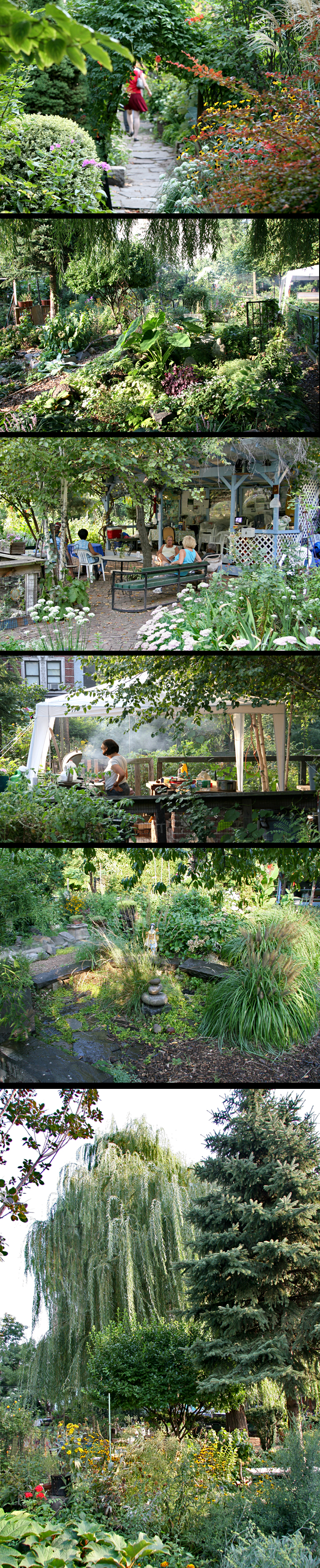
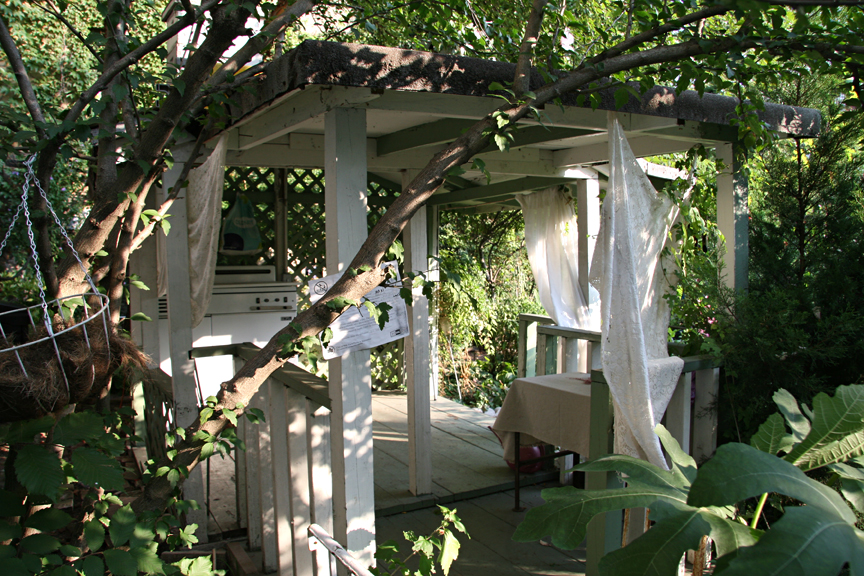
    Isn’t this amazing? This is the most remarkable garden space I have ever seen in NYC. One image does not do it justice, so here are six more photos. All the community gardens I have been to (I have featured most of them here on this site) are wonderful spaces – true oases from the urban world. But nothing beats the 9th Street Community Garden on Avenue C for transporting one to another place (or perhaps I should say places, with its varied environments).

    I recently visited with a friend. Upon entering, we took a pathway through a tunnel of shrubbery which felt like an English country garden. Then we passed through a small cabana (in the photo), which felt like a tiny country cottage. From there and out into the open, much of the garden has a tropical feel, with dense foliage and plantings. I used to travel to the West Indies, and this space truly made me feel like I was there again. There was barbecuing and picnicking going on in a tented area. Nearby, there was a large cabana with a porch, chairs, benches, tables, a kitchen with appliances, and housekeeping accouterments. I spoke with the women relaxing and expressed my awe. They confirmed my feelings that this garden was the best in NYC 🙂


  • The Frying Pan

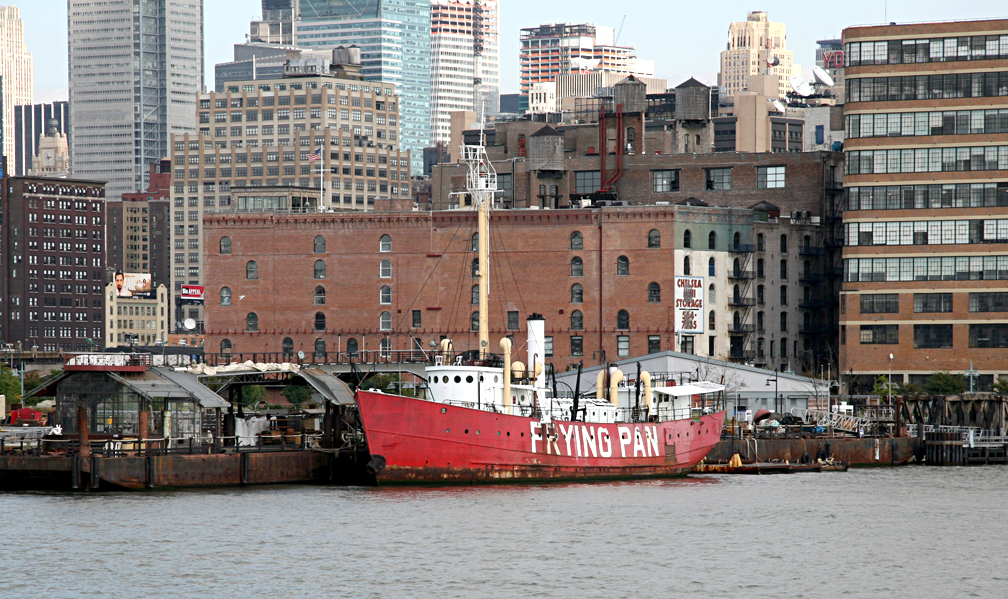
    There appears to be no end to ingenuity and appropriation in this city, particularly when it comes to business. The Frying Pan was unknown to me until Sunday, when I photographed it on a neighborhood boat ride. This historic boat, built in 1929, was used as a lightship at Frying Pan shoals off the coast of Cape Fear in North Carolina, a notoriously hazardous area for ships (lightships or lightvessels are used in place of lighthouses where the water is too deep for a lighthouse). The Frying Pan was finally decommissioned in 1967. It then served a number of uses at various locations until it capsized and sunk in Chesapeake Bay in 1984. The ship remained underwater until 1987, when she was raised, restored, and moved to NYC’s Pier 63 and docked to a Lackawanna railcar barge.

    The pair of ships served a number of maritime functions over the years (Manhattan Kayak Company, New York Outriggers, New York Polo, and the Hudson River Paddler’s Guild). Their lease was lost in 2006, and on April 9, 2007, they relocated a few blocks north at Pier 66 (26th-27th Streets). The barge and the Frying Pan are available for rental for functions, parties, etc. Check out their website and learn more about the boat and its uses.

    Please note: Their website is not up to date. I called this morning to confirm their location at Pier 66, which conflicts with their site…


  • Lonely Clock

    The Colgate Clock is not in NYC but in Jersey City, New Jersey, on the banks of the Hudson River. Although New Yorkers complain and joke about New Jersey, it plays an important part in the city’s economy, services, and labor supply. The New Jersey skyline is the dominant view from Manhattan’s west side, with the Colgate Clock readily visible from lower Manhattan. At 50 feet in diameter, the current clock is claimed to be the largest in the world. It is a replacement for the original clock (38 feet in diameter) from 1904, made by the Seth Thomas Company; it has been relocated to a Colgate factory in Clarksville, Indiana. The octagonal design was based on Colgate’s Octagon Soap. The toothpaste tube was added in 1983. Read more here.

    The clock is the last remnant of the site of the former headquarters of the Colgate-Palmolive consumer products conglomerate. In 1985, all the buildings on the site were leveled, and the entire operation was moved to Kansas and Indiana, leaving the clock alone, rather drab and dreary looking on an empty lot awaiting development…

    Photo Note: This photograph was taken on a neighborhood boat ride on the Hudson aboard the Queen of Hearts.


  • Risk Not Living

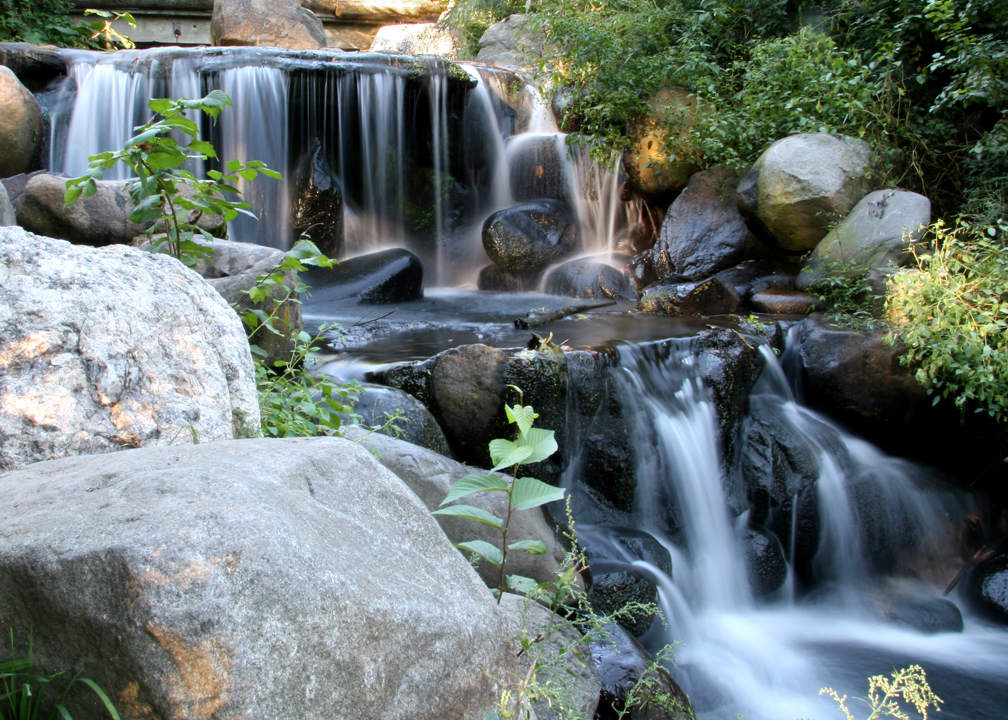
    The danger at these falls is not what you think I mean. Let me explain. I have not been particularly inclined to do nature photography. Perhaps seeing so much mediocre, ordinary, and cliched work (and not wanting to contribute more) or seeing extraordinary work (and not being able to create at that level) has left me on the sidelines.

    Of course, these feelings easily apply to other genres of photography as well, so it all comes down to what type of subjects and work inspires you – where your passion lies. Add to the mix living in a dense urban environment and getting away infrequently. So when I do get to a natural environment, I prefer just experiencing it, not through a camera. For me, this has been the danger of photography: seeing everything as one would through a lens and as a potential photograph. When habituated to this practice, one risks not living…

    Photo note: This photo was taken at Binnen Falls in Prospect Park, Brooklyn, near the Lullwater and Audubon Center. I have seen numerous photographs of waterfalls and streams using a long exposure, which creates a very interesting effect with the moving water. Seeing these falls inspired me to give it a try.


  • Sfera Con Sfera

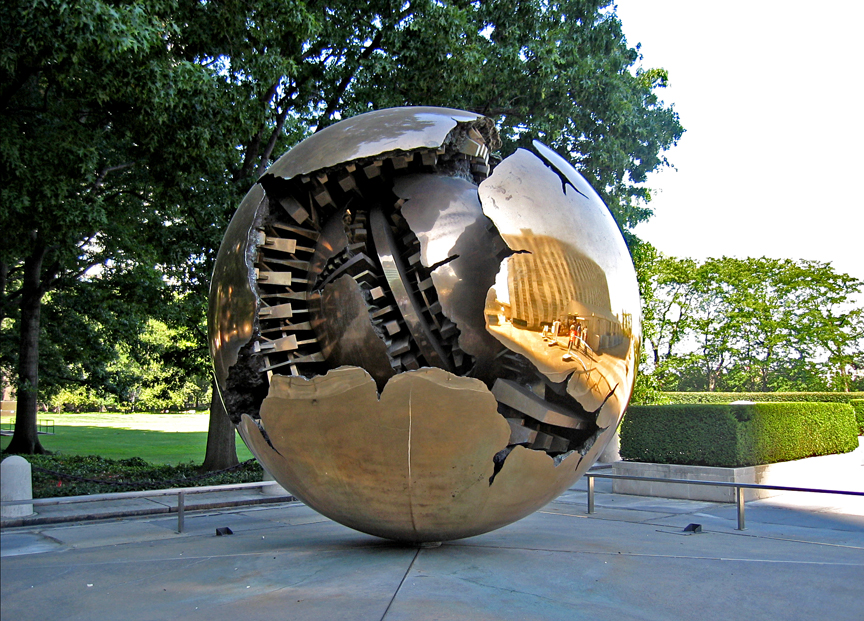
    As I have written in my post on the Knotted Gun, the United Nations is not at the top of the list for residents or independent visitors. On a recent visit, I discovered this beautiful sculpture, Sphere Within a Sphere (Sfera Con Sfera), created by Italian sculptor Arnaldo Pomodoro. He has a long and varied list of achievements and work (click here). This metallic sphere is one of a series of six located throughout the world – at the Vatican, Pesaro (Italy), Dublin, Berkeley (California), Washington, D.C., and this one at the United Nations, donated by the Italian government in 1991.

    I have read a number of interpretations of this work, such as “the fractured outer surface of the sphere reveals a complex inner sphere that represents the harsh difficulties of the modern world at the end of the second millennium.” Or from Lamberto Dini, Minister of Foreign Affairs of Italy: “a sphere growing inside another sphere, as if a world torn asunder by the horrors of war and suffering could still give birth to another world: a more prosperous and just world, within an international frame of peace and progress for generations to come. What better image for illustrating the primary role the United Nations are called upon to play: a global quest to build a new world wherein all peoples can co-exist peacefully and develop in freedom.”


  • Obama

    This is not an endorsement for Barack Obama, the United States Senator from Illinois and Democratic candidate for President of the United States in 2008. I am neither particularly political nor that informed regarding the various candidates. But this was a huge event for Washington Square Park and the first time I recall a presidential candidate having a rally here. Obama’s campaign aides said that 24,000 people attended the event. Initially, crowds were confined to the outer perimeters of the park. At one point, however, frustrated attendees just broke through, with security giving up. The crowd funneled through the openings and metal detectors and into the central plaza, where the speaking platform and press areas had been set up.

    I was able to get a line of sight to Obama and listened to his 41-minute address. The audience was quite mixed, with many NYU students – at 46 years old, he definitely appeals to a younger demographic. He came onto the stage to a song by rapper Kanye West and mentioned hanging out in Washington Square Park when he was younger (he has also admitted to the use of alcohol, marijuana, and cocaine as a teenager). Many attended because it was just something to do.

    Most seemed to find Obama quite charismatic. His background is very interesting. Born in Hawaii in 1963, his father is from Kenya with a Ph.D from Harvard, and his mother is from Kansas. Obama himself has a BA from Columbia, a Harvard Law degree, and a number of other impressive academic and political achievements. Campaign promises were made to a cheering crowd, such as universal health care by the end of his term and ending the war in Iraq. Obama characterized and championed himself as a Washington outsider – not the first time we have heard this claim…


  • La Plaza Cultural Garden

    I have become enamored of community gardens since the start of this website. I was always somewhat aware of them, but like many, I just had a passing interest. Years of living in the city combined with getting away too infrequently can make one yearn for some green space and really appreciate the parks and community gardens that NYC has to offer. And for those of lesser means, these can be the only nature they may have to enjoy. I have featured a number of gardens previously: Albert’s Garden, LaGuardia, FishBridge, and the West Side Community Garden. The East Village/Lower East Side has over 70 of these community gardens – here’s a map.

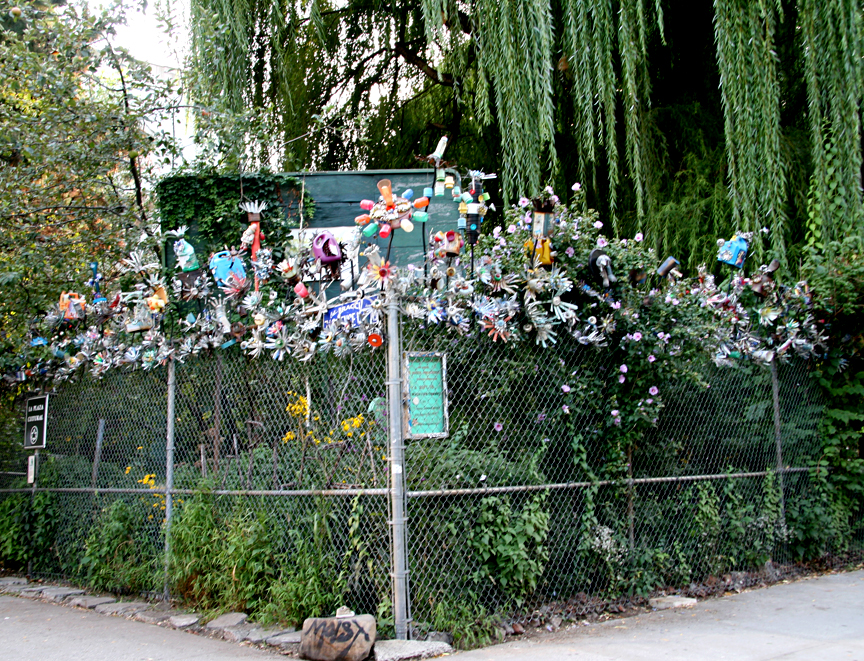
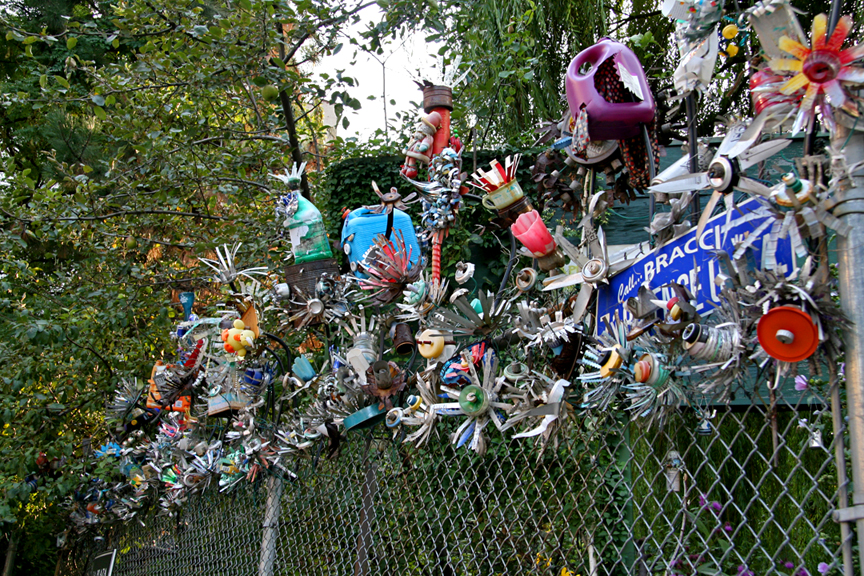
    La Plaza Cultural Garden is located at 9th Street and Avenue C. I have read that the flowers along the fence, created from tin cans, detergent bottles, beer caps, and other junk, were done by a local resident known as the “Flower Man.” It also appears that some or the creations are birdhouses (click here for closeup photo). This garden, established in 1976, has a very complex and extremely fascinating history. Read more here and see their website here. There are many events held here, and the garden functions as a performance space and cultural center.

    La Plaza is a registered Backyard Wildlife Habitat, with huge willow trees which provide shade and shelter to humans and wildlife. La Plaza has been home to artists, including Tito Puente, Gordon Matta Clark, Keith Haring, Robert Wise, and Buckminster Fuller (at one time, there was a geodesic dome built with help). A short film entitled Rock Soup profiled the Garden in its infancy with a dirty, haunting look at the homeless in La Plaza Cultural in the late 80’s. Click here to view it


  • Jersey Girls

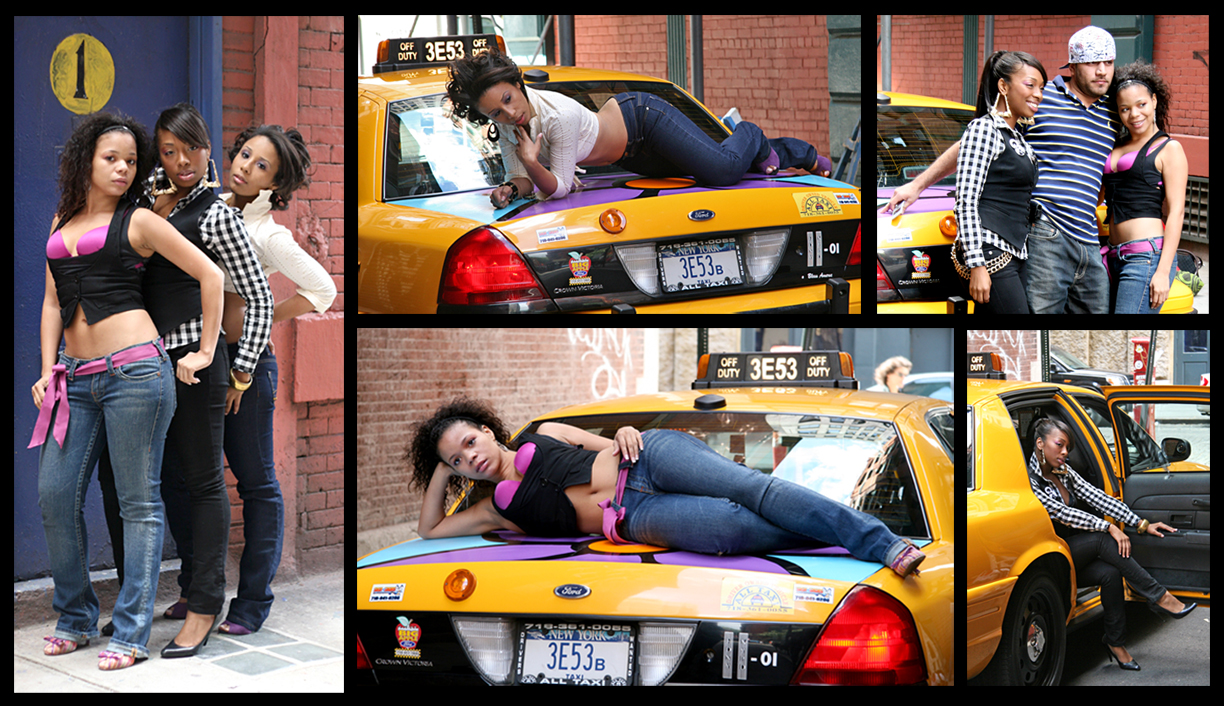
    No, these girls are not from New Jersey, nor are they the 9/11 widows that Ann Coulter accused of “reveling in their celebrity status.” I ran across them on Jersey Street, a short, two-block alley in SoHo, while returning from Pickle Day on the Lower East Side (as interesting as pickles may be, they’re not an all-day commitment). While walking on Lafayette Street and passing by Jersey Street, I was startled to see three women, one lying provocatively on the trunk of a taxi. They were alternately posing and taking photos with their point-and-shoot camera, so, of course, I decided to jump into the fray. They were very accommodating and did some additional posing for me (and have been waiting for these photos and posting).

    The three girls, Erica, Maiy, and Jari, are dancers with a company called Vixens, managed by Torey Nelson. Nine (of approximately 15) members of the company were there for a photo shoot for their portfolios. “We all have dancing experience in different genres including but not limited to Hip Hop, ballet, modern, and jazz. We are a young company with goals of taking the Dance World by storm.”

    BTW, the cab driver was not a prior acquaintance. He just was driving by and asked if they wanted to take photos with his taxi.


  • Kitty

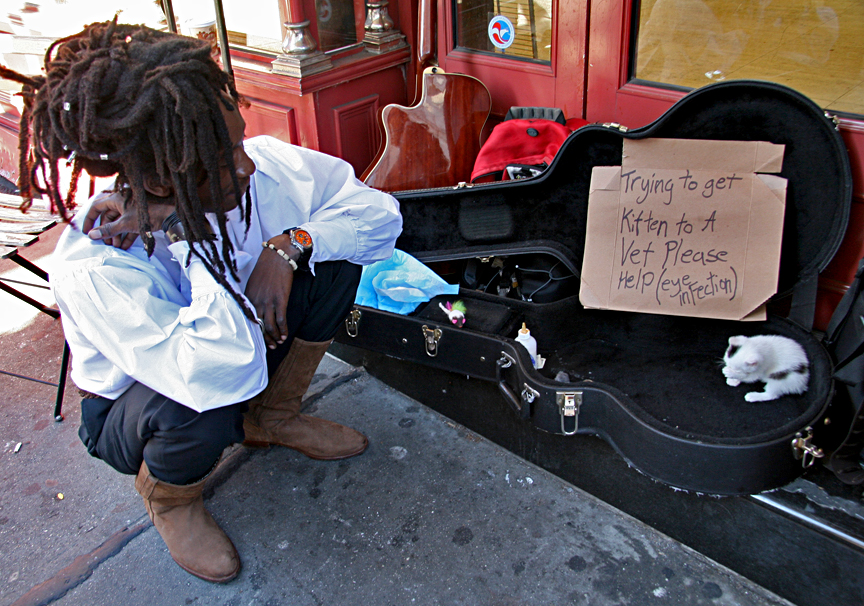
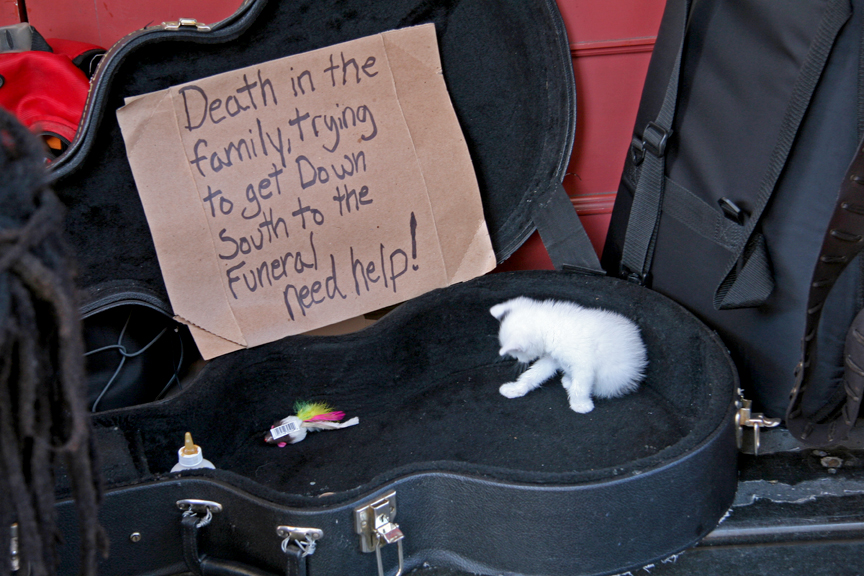
    Jamal is a regular in the neighborhood; I met him last summer when he was working as Pedicab driver. So I was surprised to meet him on Bleecker Street in the West Village with a 4-week old kitten in a guitar case. The kitty, which he had rescued from a subway platform, also had an eye infection. Animals in need will certainly get people to rise to the occasion, even from New Yorkers, who are frequently stereotyped as unsympathetic.

    New Yorkers can be cynical, skeptical, and leery of scams (which are common), but when a legitimate need is perceived, people here, like anywhere else, will respond. Jamal collected $325 in just a few hours the day before, most of which, he said, he used on a visit to the vet and medications for the cat. At one point, Jamal asked me to help, so I held the cat while Jamal administered the eye drops. It was not difficult at all with such a young cat; he offered little resistance compared to an adult cat, where such a procedure can be a real undertaking – cats are notoriously uncooperative taking meds.

    By the way, the sign in the photo had a different message on each side. The message shown is from the previous day used to collect for the vet (he turned the sign over before I shot this to show me the original message used to raise money for the vet. Click here for a photo with the message I saw when I arrived.)


  • Machine

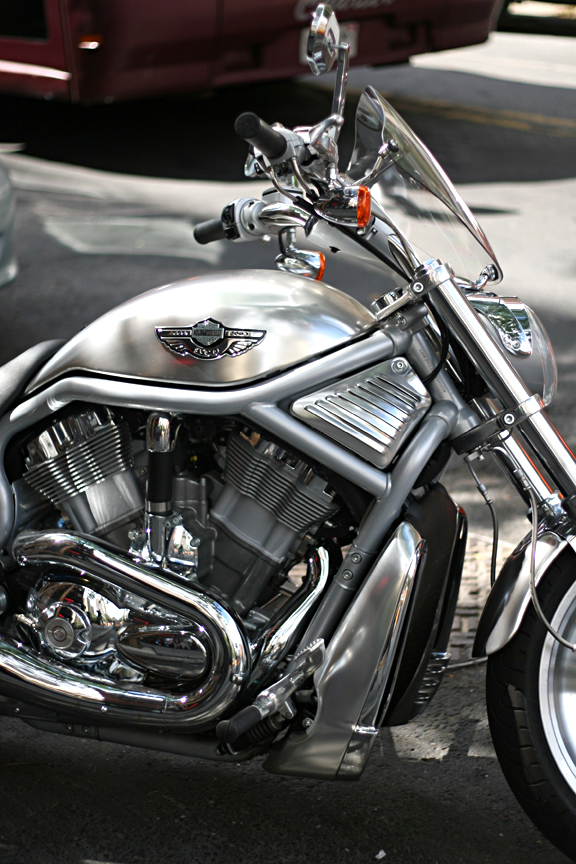
    I am not a biker or part of the biker culture. And I do not enjoy the deafening roar of bikes with straight pipes – a sore point with many city residents. However, I do appreciate a well-engineered and pleasant-looking machine. And this Harley, with its gleam and striking satin finish parked on the Lower East Side, is partly that. Partly, because there are aspects of the engine and bike engineering that are archaic and could be improved (actually, some changes are being made with newer models), but due to the strong cult phenomenon which has grown around Harley, many aspects of the early design have been kept.

    Harley-Davidson as a company is a fascinating story. Founded in 1903, the company was nearly bankrupt by 1969 – the image of the outlaw biker was partly to blame, along with deteriorating quality and proliferation of Japanese motorcycles which were less expensive, better-made, and had superior performance. In the 1980s, the company was resold and, under new management, began its ascent. Rather than attempting to compete with the Japanese, the company marketed Harley’s retro factor. There are many things associated with Harleys: chopper customizations, the unique “potato-potato” sound of the engine, hardtails, etc.

    The marketing of the historic aspect of a product brand is a smart move seen with many legacy businesses such as Levis, Coca Cola, Disney, Lego, etc. It also readily lends itself to product line extension and licensing (Harley sells accessories and apparel). In the late 1990s, there were waiting lists as long as a year for some models. The bike has become an American icon with a certain symbolic iconoclasm. The median age of Harley buyers is now nearly 50, with many affluent, well-known, or powerful individuals as owners: Jay Leno, investor Jim Rogers, etc….


  • Privy

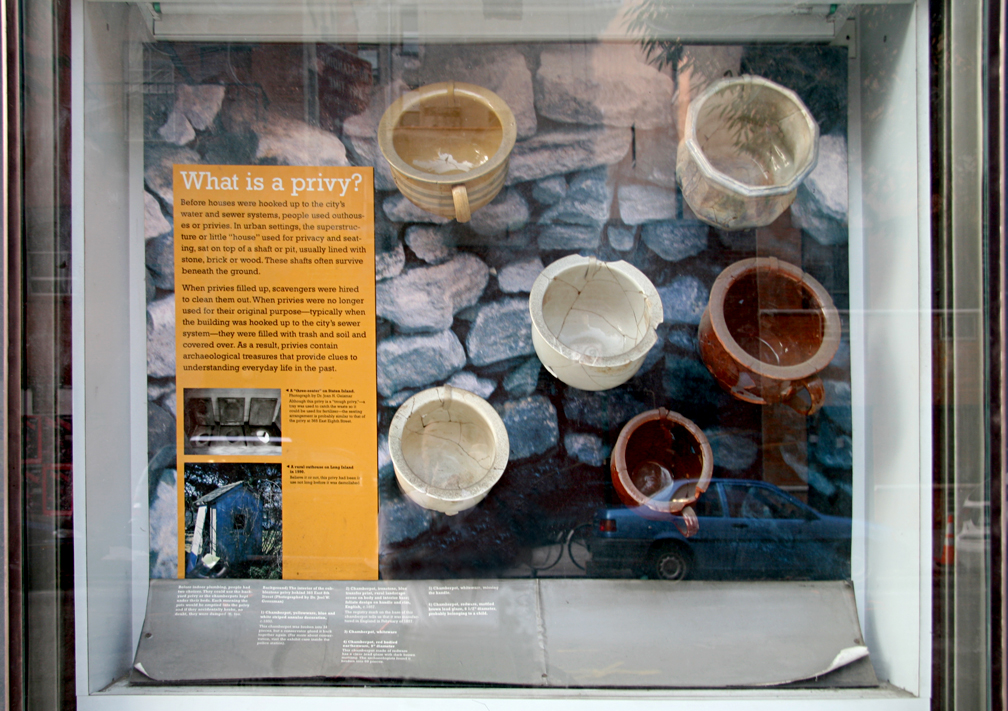
    In the East Village on 8th Street and Avenue C, there is a window display of various archaeological findings divided into several themed sections: The Time to Relax, Setting the Table, What is a Privy?, and The History of Our Block. The artifacts in the displays are circa 1850. Between 1846 and 1850, over 1200 buildings were erected in this area (now known as Alphabet City), which became known as Kleindeutschland or “Little Germany” due to the influx of German immigrants. The photo is of several chamberpots in the display on privies. The caption reads:

    “What is a privy? Before houses were hooked up to the city’s water and sewer systems, people used outhouses or privies. In urban settings, the superstructure or little “house” used for privacy and seating sat on top of a shaft or pit, usually lined with stone, brick or wood. These shafts often survived beneath the ground. When privies filled up, scavengers were hired to clean them out. When privies were no longer used for their original purpose-typically when the building was hooked up to the city’s sewer system-they were filled with trash and soil and covered over. As a result, privies contain archaeological treasures that provide clues to understanding everyday life in the past. Before indoor plumbing, people had two choices. They could use the backyard privy or the chamberpots kept under their beds. Each morning the pots would be emptied into the privy and they accidentally broke, no doubt, they would be dumped in, too.”

    I selected this group of artifacts because people seem fascinated by personal hygiene in other times and places. One of the most asked questions NASA gets involves bathroom use in space. There is even a book: How Do You Go To The Bathroom In Space?, by astronauts William Pogue and John Glenn…


  • Izzy and Art

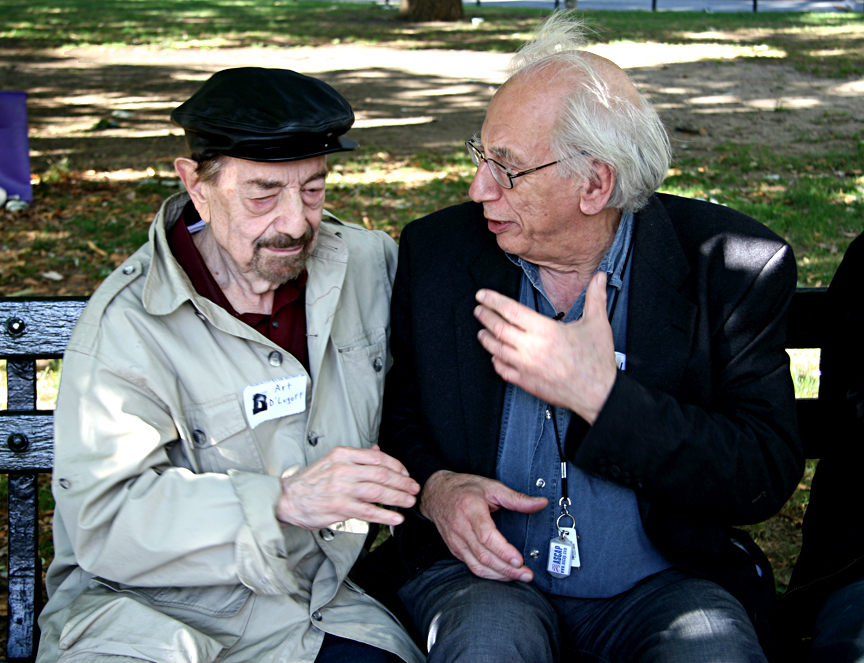
    When I saw these two men being interviewed with a boom mike overhead and a camera rolling at the recent Bluegrass Reunion, I figured that they may be important in the music world. So, I decided to take pictures first and ask questions later. Upon inquiring about their identity, someone very knowledgeable volunteered to educate me. Both were significant figures in the music world. The person on the right is Izzy Young and on the left, Art D’Lugoff.

    Izzy Young, born in NYC in 1928, is noted for his important role in folk music. In 1957, he opened the Folklore Center on MacDougal Street in the Village in NYC, a small walk-up shop, with books and records which became a meeting place, central to everything going on in the local folk scene at the time. Bob Dylan was a frequenter of the shop, listening to music and reading books in the back room. Izzy arranged concerts with folk musicians and songwriters – he produced Dylan’s first concert at Carnegie Chapter Hall in 1961. In 1973, Izzy closed shop here and moved to Stockholm, Sweden, where he opened Folklore Centrum.

    Art D’Lugoff opened the Village Gate in the 1950s. Any New York resident who has been in the city for any time knows of this major nightclub on Bleecker Street. During its 38 years in operation, the Village Gate featured names like John Coltrane, Coleman Hawkins, Billie Holiday, Duke Ellington, Dizzy Gillespie, and even Jimi Hendrix, Jim Morrison, and Allen Ginsberg in a benefit for Timothy Leary. The club closed in 1995, and the space is now occupied by a CVS pharmacy…


  • dinamic_sidebar 4 none

©2026 New York Daily Photo Entries (RSS) and Comments (RSS)  Raindrops Theme