• Salat

    Posted on by Brian Dubé

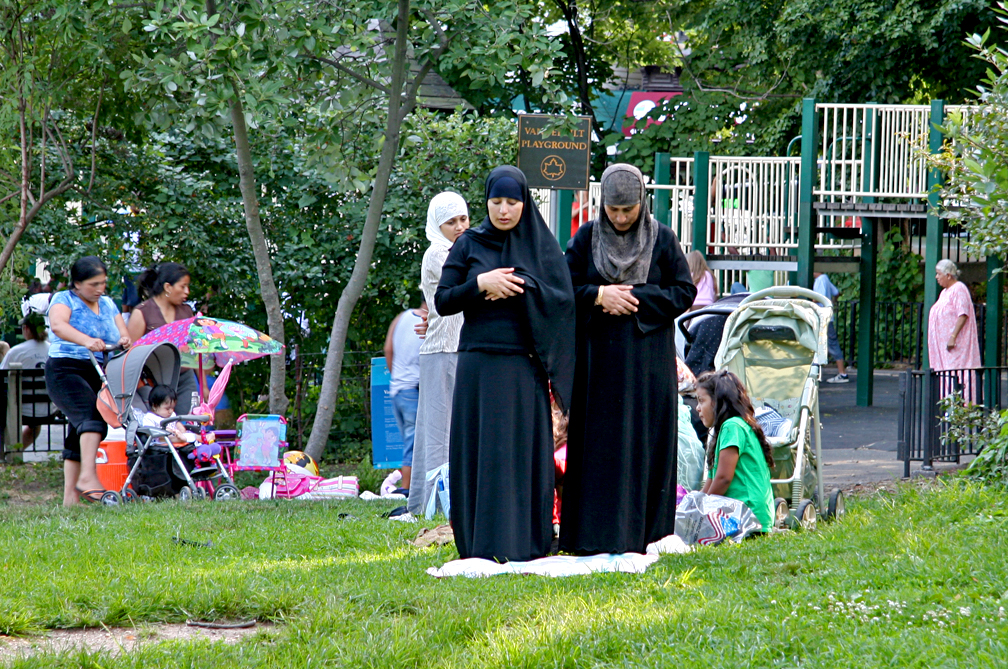
    The temptation to use the word juxtaposition is particularly great in NYC. I was surprised that a search of this blog returns only two uses since its inception. So, I use it again – if there is need for the word juxtaposition, the scene in the photo (taken in Prospect Park, Brooklyn) has to be one of those times. In many decades living here, this is the first time I have witnessed this act in public in NYC.

    Islam, like all major organized religions, has many rituals and laws, and the daily prayers, or salat, are one of the pillars of the faith. The purpose, number, times of day, place, preparation, dress, movements, and positions are all prescribed. These prayers are required of every adult Muslim and are performed on a traditional prayer mat, or musalla, five times a day: 1. Fajr – Before sunrise, 2. Zuhr – After the sun begins to decline from its zenith, 3. Asr – Mid-afternoon, 4. Maghrib – Just after sunset, and 5. Isha – night. The supplicant faces qibla (Arabic for the direction faced when praying), which is towards the Kaaba in Mecca.

    I found the scene encouraging to see such a group together – Islamic women praying, Hispanic families having a picnic, Caucasian children and an older woman in the playground, and two black children fishing in the lake behind me…
    Posted on by Brian Dubé

  • Eeylop Owl Emporium

    Posted on by Brian Dubé

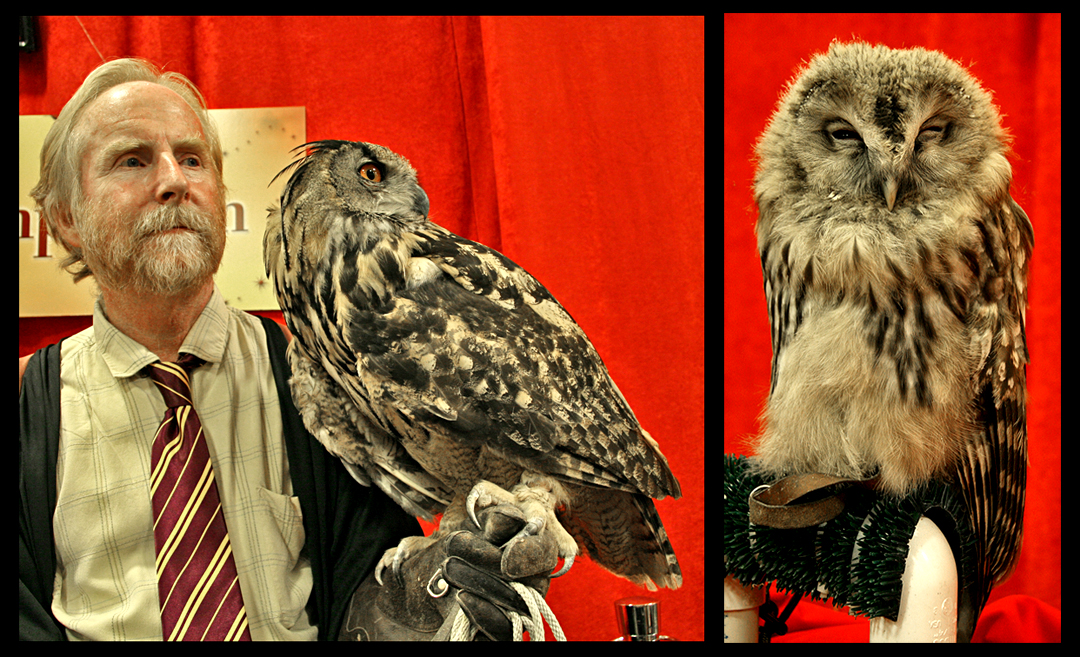
    I hate to contribute any further to the Harry Potter mania, but I thought these rarely seen, remarkable birds deserved a posting – after all, it’s not their fault they were part of a promotion. After strolling through Scholastic’s Harry Potter Place in SoHo on Friday night (see yesterday’s posting), I later passed through Union Square with a friend when we noticed that the Barnes and Noble superstore there was having its own big fest, with special activities on every floor. The place was absolutely mobbed, and at one point wristbands were being distributed to gain access. We decided to make a quick pass through the store and were absolutely shocked when on the ground floor, we saw a huge live owl perched on this man’s arm and a baby companion nearby.

    This was obviously part of the Potter theme. A sign proclaiming this area as “Eeylop Owl Emporium” was prominently displayed, and as fans know, owls play a big part in the Potter series as characters. People were gawking in astonishment to see these two owls in the middle of one of the city’s largest bookstores in Manhattan. I spoke briefly to the owner/handler about this unusual sight – he did acknowledge that owls are not typically domesticated and that he had raised them from birth.

    It is not until afterwards in reading for this article that I learned it is illegal to keep owls without a special permit in most countries and that the United States does not allow private individuals to keep native owls as pets – they may only be possessed by trained, licensed individuals while being rehabilitated or under a number of other special situations (click here). This store is one of my favorites, occupying the entire 6-story, restored, former Century Building at 33 East 17th Street – their windows offer great unobstructed views of Union Square Park…

    Posted on by Brian Dubé

  • Pottery

    Posted on by Brian Dubé

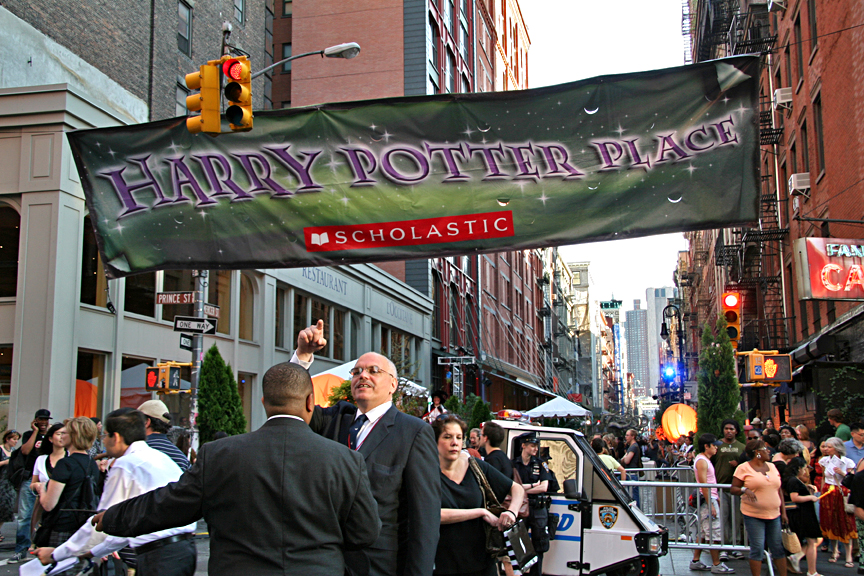
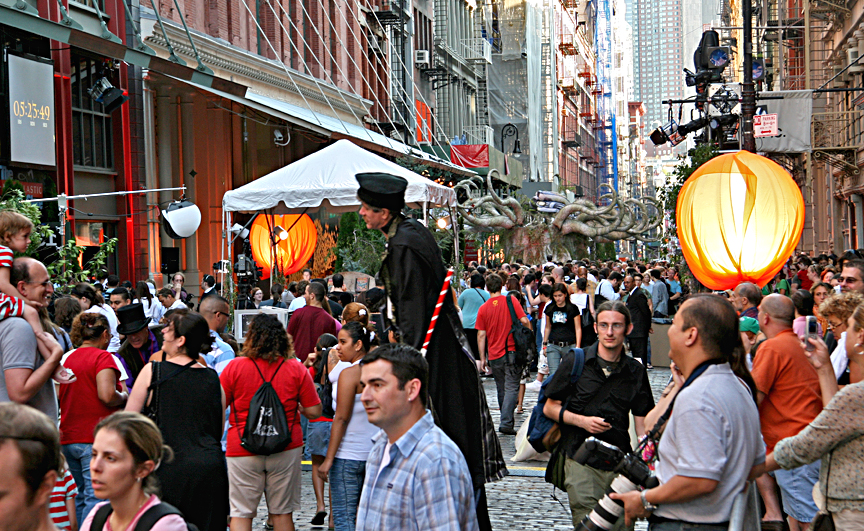
    I imagine by now that most have heard of the release of the 7th Harry Potter book. There were events worldwide for this yesterday, with bookstores participating in numerous ways – contests, raffles, street parties, costuming, face painting, wand and potion making, performers, etc.. And the biggest fete of them all was the block party put on by the publisher, Scholastic, themselves. An entire city block was closed off to traffic – Mercer Street between Prince and Spring Streets in SoHo – with a huge banner that proclaimed it to be Harry Potter Place. The Scholastic building (click here for previous posting) runs through from Broadway to Mercer, so the street festival abutted their Mercer Street entrance – very convenient for this mega-promotional event.

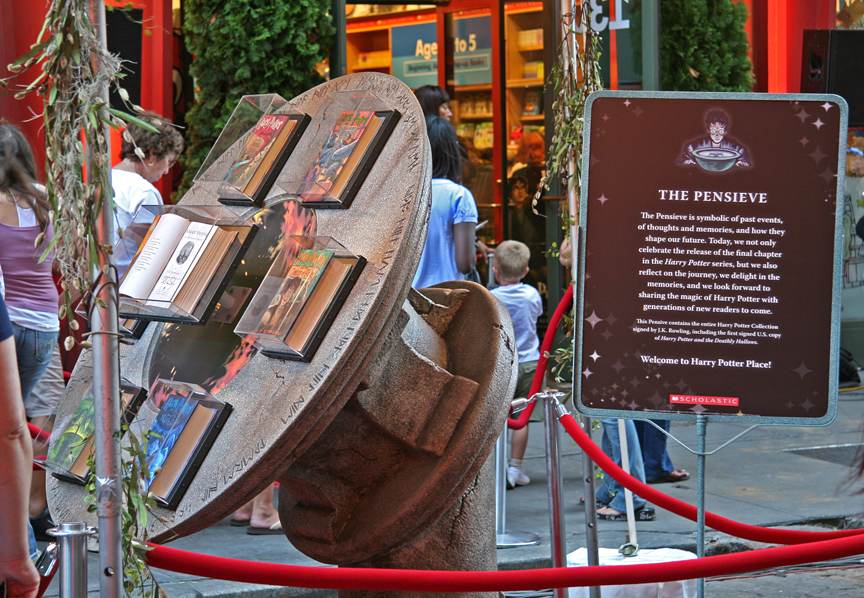
    There was a range of activities and performers – jugglers, stilt walkers – and the requisite countdown clock. There was a stand displaying a copy of each volume in the series, including the newest one, all under glass. People were in line for nearly three city blocks from early evening for the 12:01 AM (Saturday) release of the book. Waiting in line half of the day to buy a book (which will be easily purchased today, I am sure) seems like sheer lunacy to outsiders, but when it comes to cult phenomena, excessive behavior is to be expected. This event parallels the iPhone release, which I previously wrote about. Add to the mix the fact that this is essentially a children’s book, along with indulgent parents, and you really add some fuel to the fire. Ultimately, fun was had by all, and this event fills the desire many have to be part of something and make connections with others who share a passion…

    Posted on by Brian Dubé

  • Bikes

    Posted on by Brian Dubé

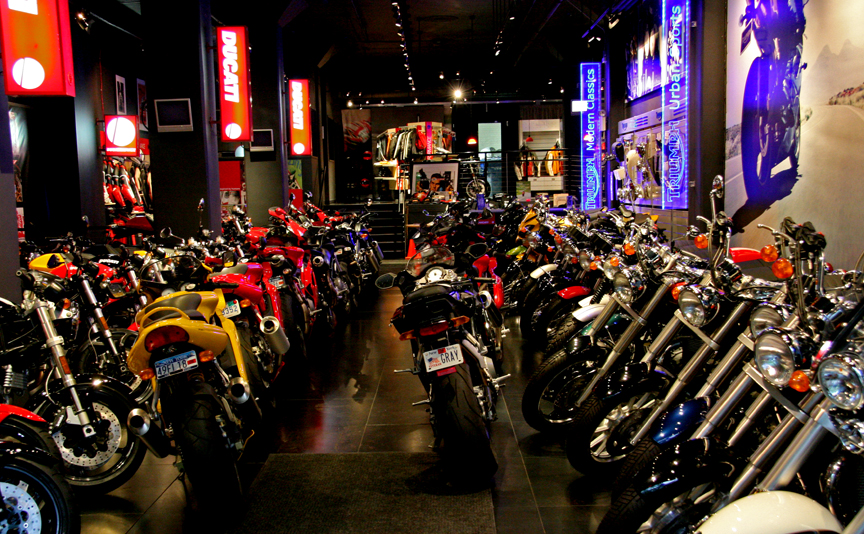
    I am not a motorcycle enthusiast and have never owned one, but I was always impressed by this Ducati/Triumph showroom display visible from street level in SoHo. It is quite interesting that as I write this and look at their website, I see that they have won national showroom awards. And as is typical with many fine European products, design aesthetic and attention to detail stand out in this display.

    It has always appeared to me as an outsider that the design of motorcycles was much more important to the owner than automobiles. Although there are many finely engineered and designed autos, the percentage of very uninteresting and utilitarian products (many of which are strictly price-driven, like the Yugo) seems to be much greater than that in the motorcycle world. This makes sense, since a motorcycle is not as practical as an automobile as far as transportation – the motorcyclist chooses this vehicle for many reasons other than transportation. The experience of being on a bike is one of integration with one’s environment, as opposed to the experience of being in a car, which can be likened to watching TV in comparison. And then there is the issue of power, speed, and exhilaration, again intensified by lack of separation with the environment.

    However, many types of subcultures have developed around biking, and the image of the outlaw biker is strong in people’s minds. There is more risk in riding a motorcycle – the accident rate is nearly 5 to 1 over cars. And in NYC (and elsewhere), the reputation of motorcycles has been further tarnished by those that ride with straight pipes – illegal exhaust systems where noise reducing baffles have been removed and create noise of deafening proportions…

    Posted on by Brian Dubé

  • Spinning

    Posted on by Brian Dubé

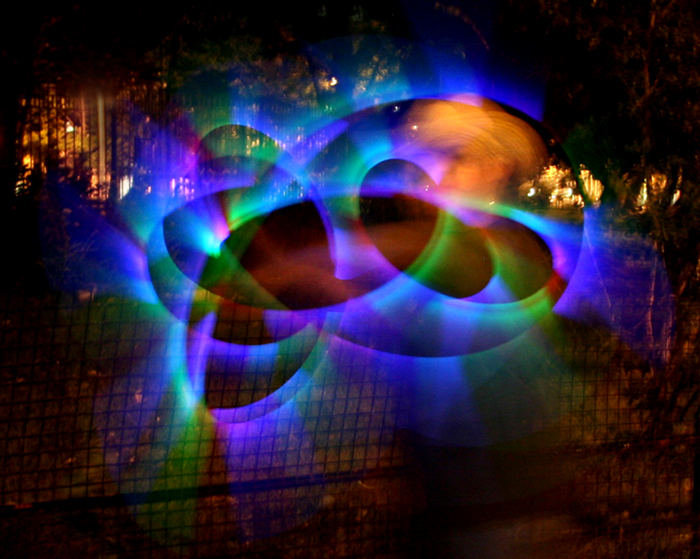
    The spinning of fire and light is everywhere. Of course, there is Burning Man, where twirling of light and fire have been done on a large scale for years. Recently in NYC, there was One Night of Fire, where revelers met on the Brooklyn Bridge to go on a roving street fest – spontaneously moving throughout the city by foot and subway to end up on the beach in Coney Island. This event was organized by the Danger (I did not go because it was the same night as the Sheriff Session).

    The fellow in the photo is Sage (I revealed last year in a comment to a posting my business involvement with the juggling community). The photo is a long exposure of him spinning color changing lighted poi, where the balls slowly change through the color spectrum. Poi, which traces its way back to the Maori of New Zealand, consists of a set of balls each tethered to a cord and finger strap. One is held in each hand, and the pair of objects is swung in various patterns. The balls themselves can be be made in any number of materials/designs, including illuminated or fire versions. Swinging and twirling of poi and other objects (fans, flags, juggling clubs, torches, meteors, glowsticks, ribbons, staff) can be seen in parks, rave parties, juggling festivals, and various planned and unplanned gatherings and events (such as Figment). Entire small businesses have been created which specialize in this type of equipment. The new big thing in the last couple of years: hula hoops – plain, brightly colored, lighted, or fire…

    Posted on by Brian Dubé

  • Sounds of Summer

    Posted on by Brian Dubé


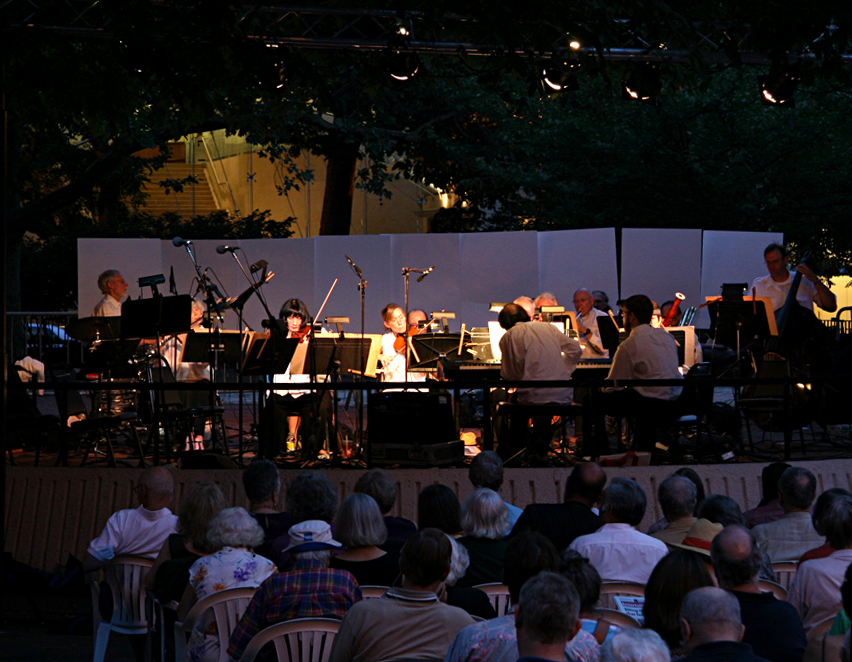
    For many of us who look forward to the summer, spending as much time as possible outdoors can become a preoccupation. Leaving the city is certainly a pleasant solution to heat and humidity, but for those who remain, there are a plethora of activities to enjoy, both physical and cultural and often with less crowding, owing to so many city residents being away. In order to maintain some continuity with indoor life and interests, many take their activities outside – writing, reading, and now with the ubiquitous WIFI, work/play on a laptop. And for music lovers, outdoor summer concerts are a wonderful perk this time of year, and NYC has no shortage, most of them free of charge. The two largest venues are Summerstage in Central Park and Celebrate Brooklyn ($3) in Prospect Park. Both of these get major talent.

    Greenwich Village has a summer series: the Washington Square Music Festival, with Peggy Friedman as executive director and Lutz Rath, music director. The concerts take place on four Tuesday evenings at 8PM. Temporary seating is installed, and music is played on a raised performance space called Teen Plaza (built for the Festival in the 1970s). The repertoire leans towards classical, although jazz and other types of music are featured. The festival was started in 1953 by the Washington Square Association (established in 1903) and Alexander Schneider, a Village resident, violinist, and member of the Budapest String Quartet. The musical talent has been of a high quality from its inception, with its share of luminaries such as Wynton Marsalis and Marilyn Horne. Last night’s theme was Music as Political Statement, with works by Gershwin and Weill. The upcoming (and last) concert of the series on July 31 features the Charles Mingus Orchestra…

    Posted on by Brian Dubé

  • The Sherry

    Posted on by Brian Dubé

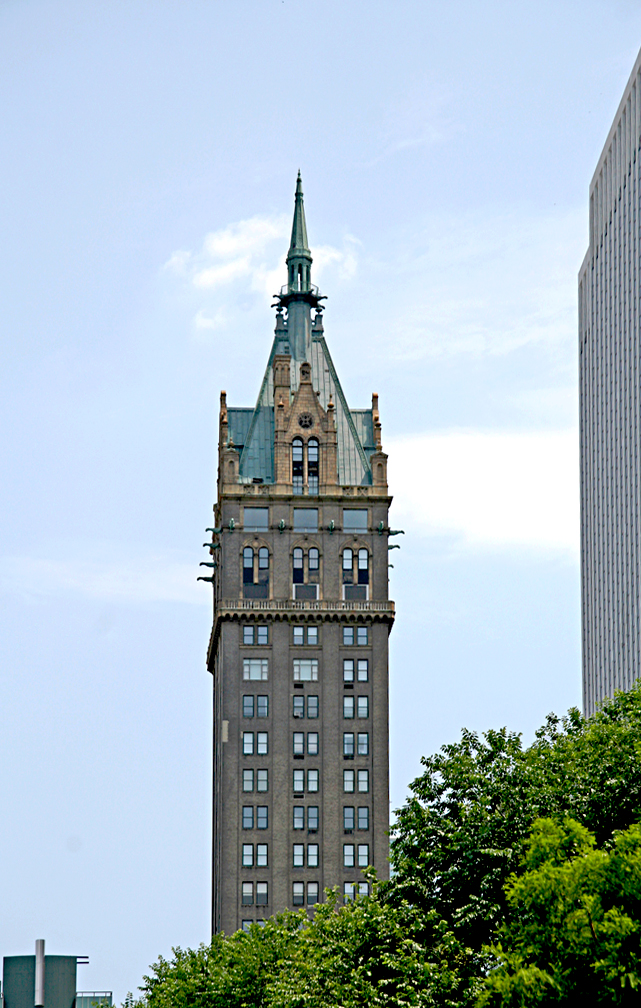
    This is the Sherry Netherland (as seen from Central Park), an absolutely exquisite and remarkable building in the finest location in NYC, at 59th Street and Fifth Avenue with immediate neighbors such as the Metropolitan Club and the Pierre and Plaza Hotels. If you are not familiar with it, this is maybe due to its somewhat understated elegance and small lobby, unlike that of the Waldorf Astoria, e.g. The Sherry does not even have a Wikipedia entry, yet many architects consider it one of the finest skyscrapers in NYC. Built in 1927, it stands at 570 feet/38 stories. The Sherry Netherland is an apartment hotel – there are 53 guest hotel rooms and 97 cooperative apartments ($1.3 – $13.5 million; cash only). Above the 24th floor, there is only one apartment per floor.

    The Sherry was designed by renowned architect Leonard Schultze, along with his partner, S. Fullerton Weaver. Their firm also designed the Pierre, the Waldorf, the Breakers (Palm Beach), and the Biltmore hotels in Atlanta, Coral Gables, and Los Angeles. The Sherry features travertine marble facing on the base and an elaborate Gothic-inspired minaret. Unique touches include the whimsical griffins with hanging lanterns that guard the exterior. Some of the finest retailers grace the street level, such as A La Vieille Russie and Domenico Vacca. The lobby was modeled after the Vatican Library. There are classical friezes rescued from the Cornelius Vanderbilt mansion one block south where Bergdorf Goodman now stands, vaulted ceilings, ornate mirrors, crystal chandeliers, hand-loomed French carpets (removed in the summer, allowing the beautiful marble floors to show), and antique furnishings. Corridors feature vaulted ceilings, as well as faux columns hand-detailed in gold leaf.

    They employ a full-time person to do nothing but reapply gold leaf to the hotel’s many architectural details and hand-paint the exquisite detail on the room numbers and elevators. Attendants are on duty 24 hours a day in the Sherry’s original wood-paneled elevators, embellished with hand-painted Renaissance scenes. Attendants wear full livery and use approximately 140 pairs of white gloves each week. Some of the bathrooms have crystal chandeliers. And then there are the rooms that face Central Park…

    Posted on by Brian Dubé

  • Bastille Day 2007

    Posted on by Brian Dubé

    July 14th is Bastille Day, a commemorative celebration of the storming of France’s Bastille in 1789. This holiday is celebrated by the French and Francophiles around the world. In NYC, there were a number of different celebrations (some on Saturday the 14th and some on Sunday, when these photos were taken), with various activities around town. This year, I chose to check out the Brooklyn scene, where it turns out there were two celebrations, both on Smith Street in the Cobble Hill section of Brooklyn. The larger of the two was sponsored by Bar Tabac at Smith and Dean, where several blocks were closed off for the various activities. Sand was brought in and Pétanque courts were created for the day.

    This celebration was claimed to be the largest outside of France. There was live music and, of course, food and drinks – Ricard and Lillet appeared to be quite well represented. A few blocks down Smith Street, the bistro Provence en Boite was having its own celebration, with the requisite Pétanque contest, food, drink, music, and other activities. Across the river in Manhattan, there was the annual uptown celebration sponsored by the French Institute-Alliance Française, held on 60th Street, between Fifth and Lexington Avenues. Downtown, at Les Halles, the home base of chef Anthony Bourdain, there was a classic waiter’s race. Last year, I went to the celebration on MacDougal Street in SoHo, run by the restaurant Provence (click here for posting, photos and video). If you have never been to a Bastille Day celebration in NYC, I recommend them as some of the better quality street fairs this city has to offer. Vive la France!

    Posted on by Brian Dubé

  • Sheriff Session

    Posted on by Brian Dubé

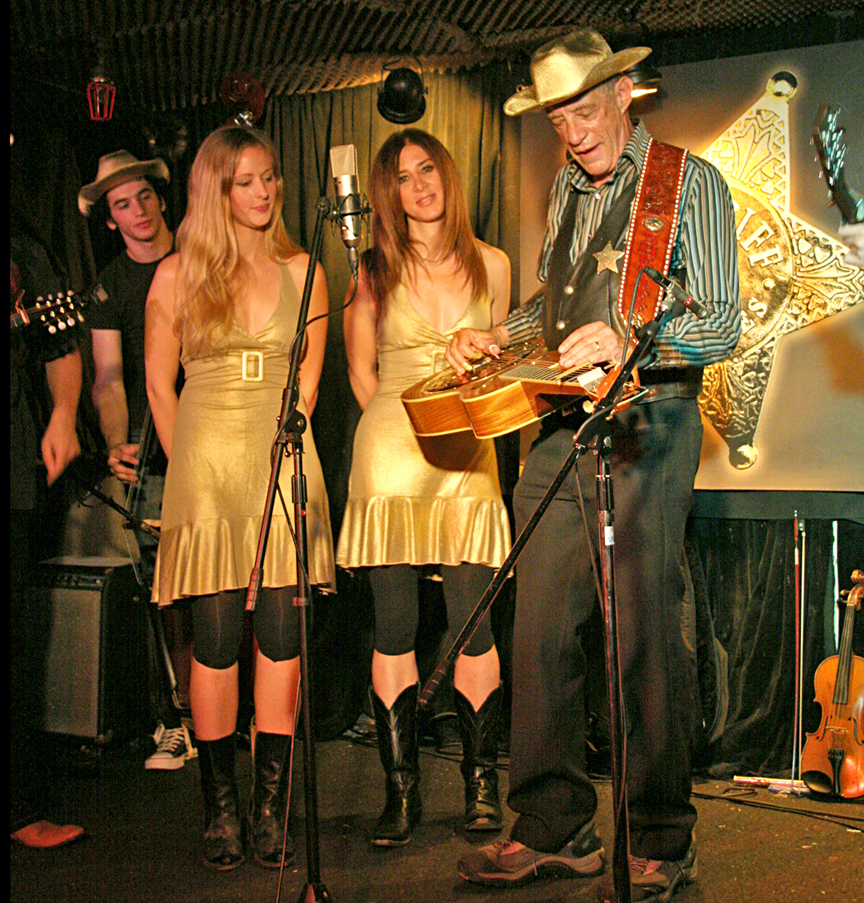
    I do like country and bluegrass music. The longer I live in New York City, the more I look for the occasional respite from the intensity of living here. The energy and and saturation of all the diverse things the city has to offer is the reason most of us live here. Getting away for weekends, day trips, or vacations certainly provides a needed break, but full immersion in a musical experience like a bluegrass or country concert can transport one to a simpler time and provide a virtual trip to the American countryside. Although country and bluegrass have lived with a stigma of being for the musically unsophisticated, an open-minded, closer examination of masters such as Hank Williams or Flat and Scruggs will show this viewpoint to be unfounded. And fans do find the basic themes and lyrics still relevant.

    Bluegrass, however, has never really caught on as mainstream music, but for the seeker, it can still be found. It may come as a surprise that there is a country and bluegrass fan base and performance venues in NYC. In Manhattan, Sheriff Bob (Saidenberg) has been running a Wednesday night bluegrass jam at the Baggot Inn on 3rd Street (free – no cover or minimum) (update: This venue has since closed.). Last night was the annual Sheriff Session – a whole night of Bluegrass and country with a lineup of 4 bands: Vincent Cross & Good Company, Cheatin Hearts (the Sheriff’s new group), Blue Harvest, and Citigrass, with Master of Ceremonies Lindy Loo. There is a high level of musicianship and technical skill in contemporary bluegrass, which was quite evident in last night’s performance. With that badge and leather vest proclaiming “Sheriff of Good Times,” we know the Sheriff means business…

    Posted on by Brian Dubé

  • Wash and Ry

    Posted on by Brian Dubé

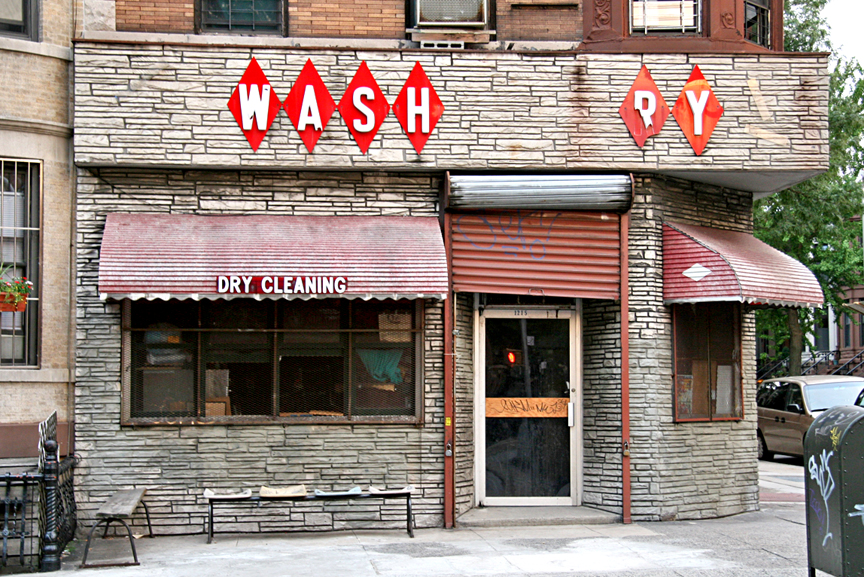
    I’m fascinated by places like this. This laundromat is located in prime Park Slope (13th Street and 8th Avenue) – one of the most expensive neighborhoods in Brooklyn. Yet the place looks third world. All the backs of the chairs outside are broken off, letters from the sign are broken or missing, a slat of plywood covered with graffiti backs the door, and then there’s that hideous faux brick siding. Everything is run down, broken, makeshift, or slightly askew. The inside is not more pleasant – cavernous, dark, and gray. In the suburbs, a place like this would never survive in a good neighborhood. People would drive to a nicer place, and eventually they would go out of business.

    My theory is that in the city, customers patronize essential services which are very local, since most errands are done on foot. These shop owners have a captive audience – customers will put up with a run-down business if it is close to home. Also, most New York City residents are exposed to older buildings and are thus tolerant of the structurally and cosmetically imperfect. Unfortunately, this type of scenario can not always be explained by poor financials – many small business owners view their operations as cash cows, taking out as much as possible without putting anything back in to keep a place in a decent state of repair. I understand from a neighborhood resident that the owner is quite fierce and that her golden retriever has snarled more than once at her own dog…

    Posted on by Brian Dubé

  • Lahore

    Posted on by Brian Dubé

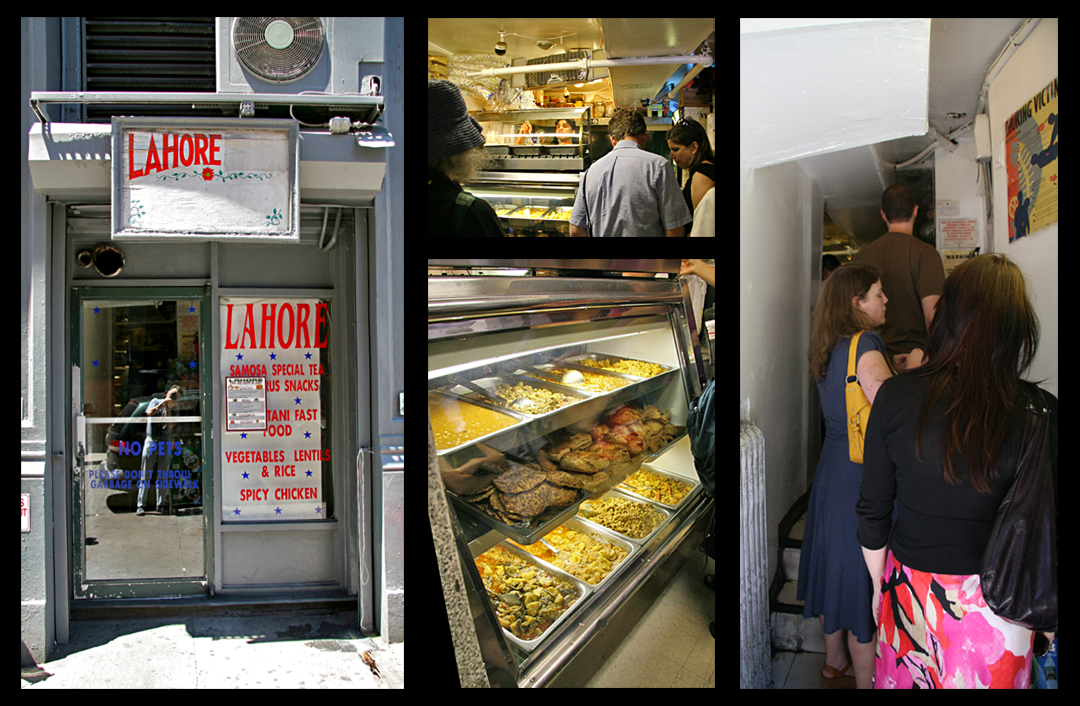
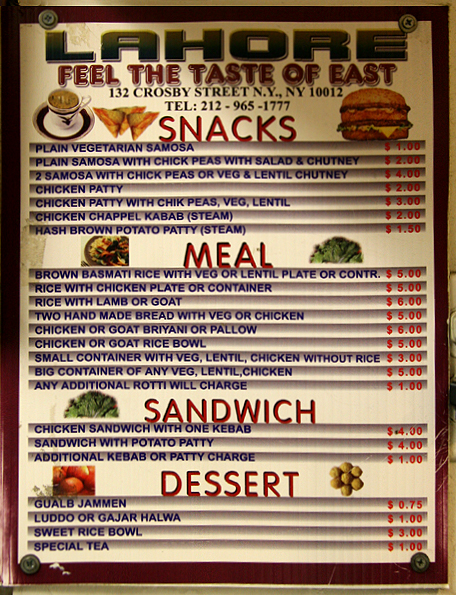
    There is a category of food you really won’t find outside a big city like NYC: that which might be referred to as Pakistani taxi cab cuisine (by and for Pakistanis). Cab drivers have a short list of requirements for their choice of on-the-job food: cheap, fast, and available all hours. In the case of Lahore, which meets these basic requirements, one could add authentic and quite good. For authentic ethnic food, it is safe to place your bets with taxi drivers; they know the entire city, have a vehicle which will take them anywhere at no cost, and are well-networked with other members of their community.

    Many New Yorkers have gone by 132 Crosby Street hundreds of times and not even noticed the place. Lahore is literally a hole-in-the-wall – narrow, cavernous, dark, funky – yet they come (and line up). As far as the atmosphere, for many, the word “scary” would come to mind, but I found the charm of the servers to quite quickly overshadow any misgivings about the roughness. This is primarily a take-out place, although there are a few stools and a tiny counter to sit at. Click here for a photo I took of their menu. Cash only, of course. I can’t say Lahore is a total secret – an online search will turn up a number of reviews (all positive), including one from the New York Times in 2000.

    BTW, I learned today that Lahore is the capital of the Pakistan’s province of Punjab (click here). With its beautiful preserved colonial architecture, gardens, and rich culture, it is sometimes known as the Paris of the East…

    Posted on by Brian Dubé

  • Contrast

    Posted on by Brian Dubé

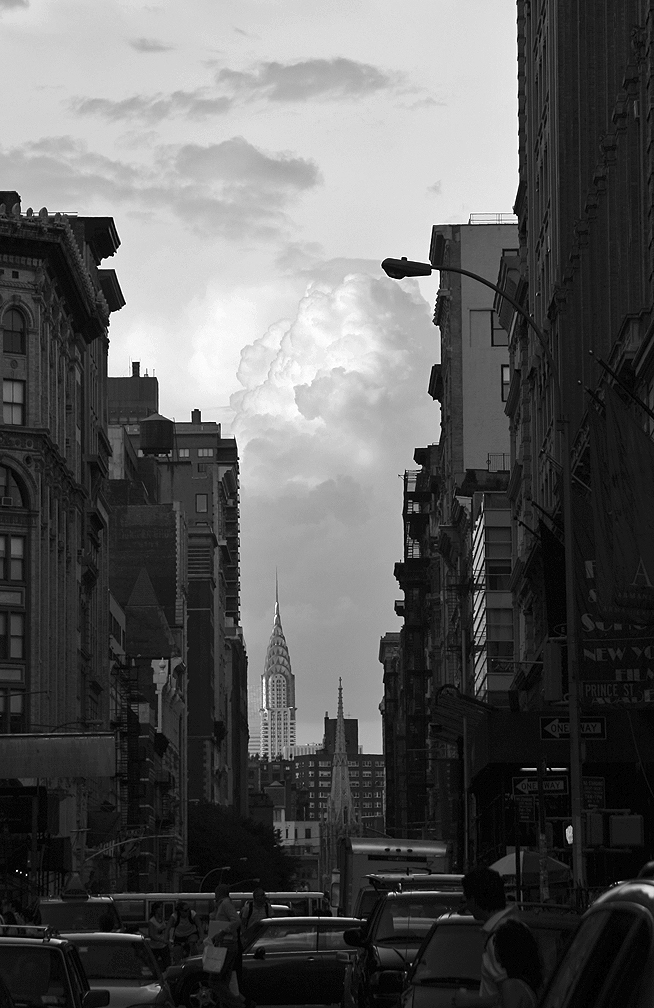
    As I have stated previously in this blog, it is easy to become inured to vistas, regardless of where or how dramatic, and it is no different in New York City. It frequently takes a change in mindset or perhaps conditions to jog ones perception and see something anew. I see the view in the photo on a daily basis – looking uptown from lower Broadway in SoHo, with the Chrysler building and Grace Church framed perfectly by the chasm formed by the buildings. Of course, I do notice, but I really don’t appreciate it the way an unfamiliar observer would.

    On this day however, the cloud formations were spectacular and moving rapidly. In the course of nine minutes, I had six very different photos. This kind of drama between clouds and buildings doesn’t occur that often, and even the jaded, hardened New Yorker can’t help but notice. On June 22, 2006, I posted a most remarkable cloud occurrence and provided a link to the Cloud Appreciation Society. No surprise, I suppose, that there are groups and websites exclusively oriented to clouds. Sorry, today there is no architectural dissertation, social commentary, history, or NYC factoids – just some cloud and vista appreciation. After all, this is supposed to be a photoblog 🙂

    Posted on by Brian Dubé

  • Garment District

    Posted on by Brian Dubé

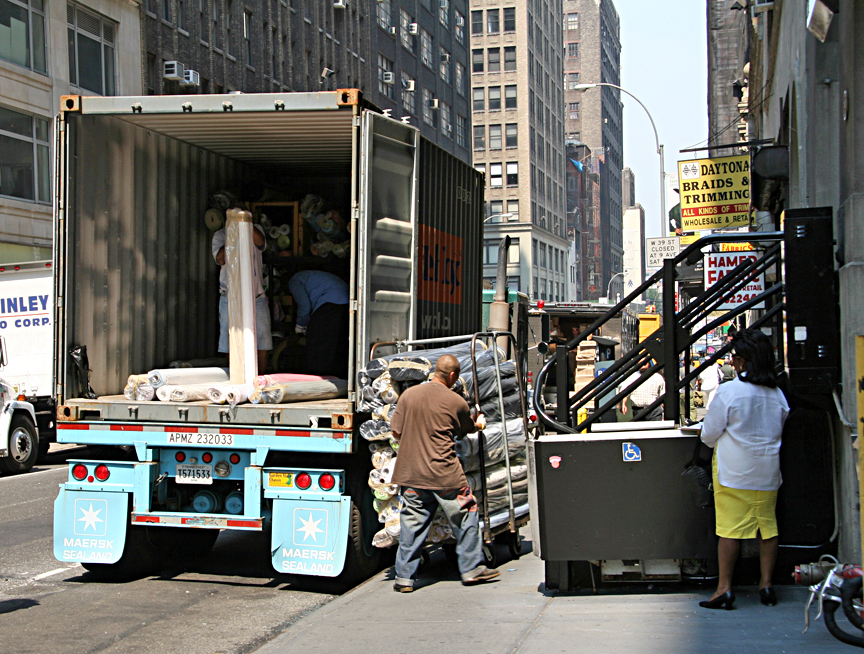
    New York City’s population size and Manhattan’s density has given rise to something unique: business districts. I’ve put together a list: diamond, flower, lighting, restaurant supply, photo, meatpacking, financial, fur, and the garment districts. I am distinguishing these from residential neighborhoods, as they are primarily business to business vendors. Most smaller cities have, perhaps, a downtown business district, but here we have concentrations of suppliers to specific industries occupying substantial geographical areas. The now defunct sewing machine district, e.g., used to occupy the city blocks between 24th and 27th streets between 6th and 7th Avenues – on some blocks, virtually every retail space was occupied by a sewing machine dealer.

    Today’s photo was taken in the Garment District, an area located roughly between 34th and 42nd Streets from 6th and 9th Avenues. The dominance of NYC in this industry goes back to production of clothing for slave owners of Southern plantations. With the invention of the sewing machine in the 1850s, production of clothing became industrialized, with NYC as the center. Although garment manufacturing in Manhattan has declined, there are still many small sewing manufacturers in this district (and Chinatown). The area is now dominated by fabric and notions wholesalers, clothing designers, and showrooms. New York City is the center of fashion in the United States, with names like Donna Karan, Calvin Klein, Liz Claiborne, and Betsy Johnson located here. We are home to trade shows and Fashion Week, a major annual industry event. The area is sometimes referred to as the Fashion District (there is a Fashion District information kiosk at 39th and 7th with a huge sculpture of a needle threading a button).

    Interesting note: Many are puzzled by the fact that competitors will cluster together, as dramatically demonstrated by NYC districts. This counter intuitive phenomenon is explained by Nash Equilibrium and Hotelling’ s Law…

    Posted on by Brian Dubé

  • The Good Word

    Posted on by Brian Dubé

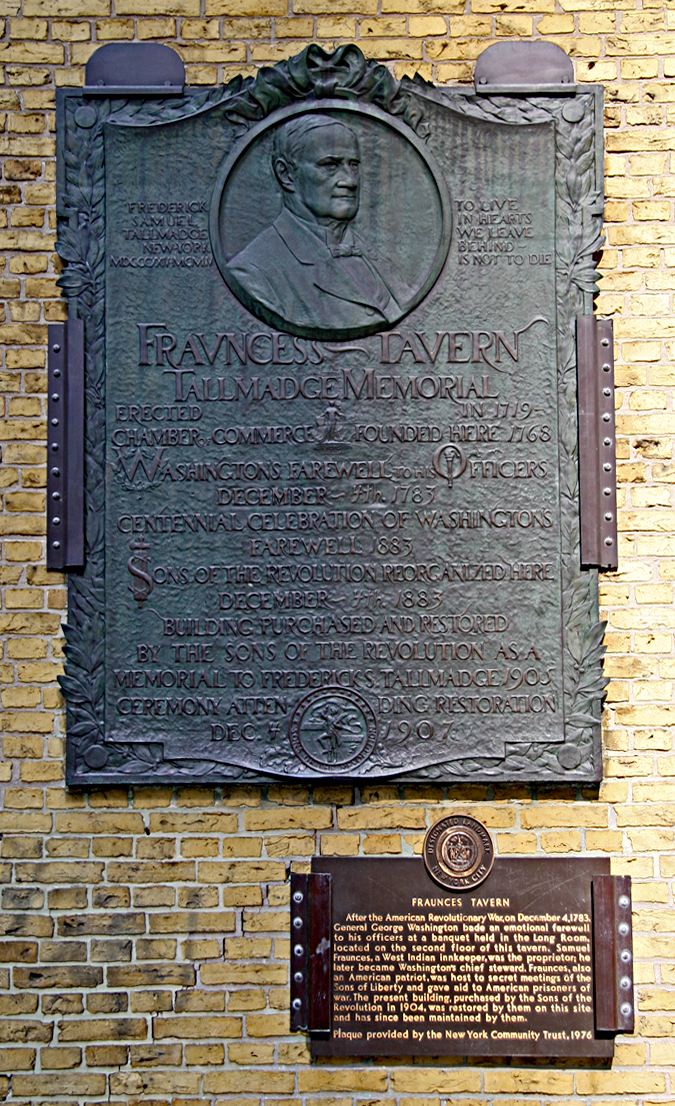
    This is Fraunces Tavern in downtown Manhattan, located at 54 Pearl Street at the corner of Broad Street (click here for a photo of the building plaque). This establishment in the Fraunces Tavern Historic District, both museum and tavern, is a household name to most New Yorkers, being generally considered the oldest building in the city and known as the place where, on December 4, 1783 in the Long Room, General George Washington bid farewell to his officers at the war’s end. However, the age of this building has been the subject of much controversy.

    The present structure is a reconstruction of the original by architect Mersereau in 1907 for the Sons of the Revolution. At the time, critical articles appeared with response from the architect. The original Fraunces Tavern was built as a residence in 1719 by Stephen Delancey. In 1762, it was sold to Samuel Fraunces, who turned it into a tavern. It was used for many pre- and post-revolutionary war purposes. After the war, when NYC served as the nation’s capital, the tavern housed the offices of the Departments of War, Treasury and Foreign Affairs. The building was rebuilt a number of times in the 1800s due to fires – the appearance of the original building is not known with any reasonable certainty. The reconstruction did incorporate remaining portions of the original structure, particularly some interior woodwork. The Fraunces Tavern Museum refers to the 1907 work as a restoration; the AIA guide refers to it as a “highly conjectural construction–not a restoration”; some may perhaps prefer the term reconstruction. What’s the Good Word?

    Posted on by Brian Dubé

  • Figment

    Posted on by Brian Dubé

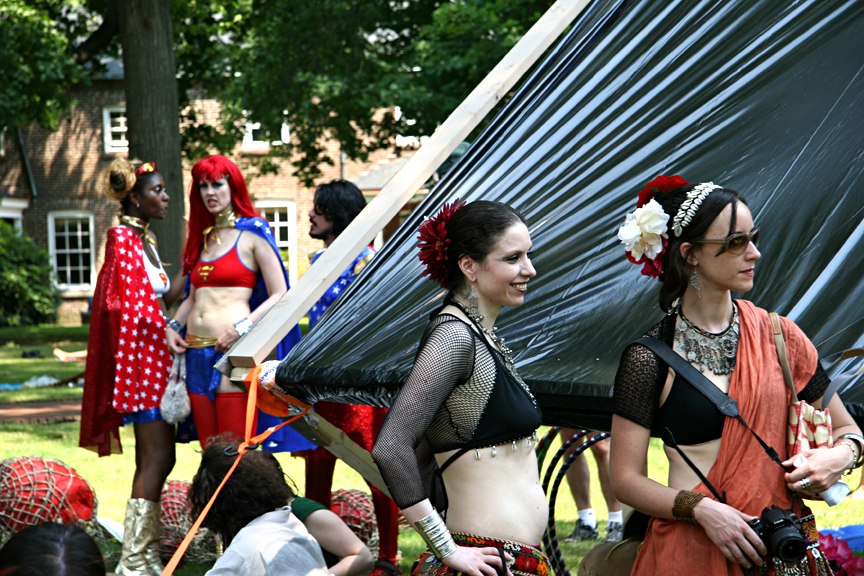
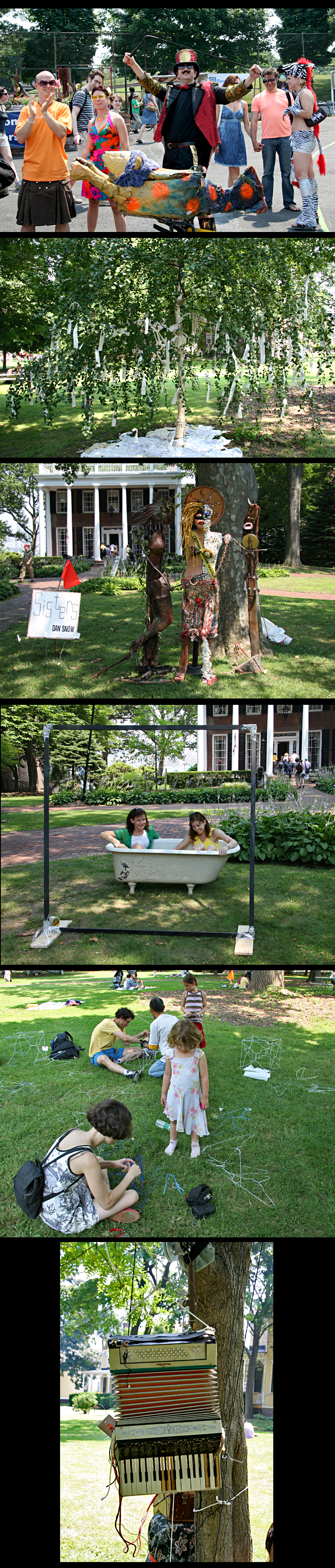
    Figment was a one-day arts festival held on Governors Island (click here for more photos). There was a sense that this was to be a New York-style Burning Man – many of yesterday’s participants have attended, and the organizers have themselves have referenced Burning Man as an influence. The event took place at Nolan Park, a historic district with a shaded green surrounded by period homes. Attendees were encouraged to bring projects, contribute, and participate (at the Burning Man festival, being a spectator is discouraged in keeping with their 10 principles: radical inclusion, gifting, decommodification, radical self-reliance, radical self-expression, communal effort, civic responsibility, leaving no trace, participation, and immediacy.) Over 50 exhibitors attended, with names such as Misericordiam, Limbonade Stand, Krinkl-O-Torn, Groovehoops, Sisters, Earth Paint Tree, the Tub Project, Wish Tree, Zenbend Hanger Reuse Project, etc.

    From the Figment website: ” Expect a dizzying array of fabulous art and activities, spanning a variety of imaginative possibilities ranging from ambitious sculptures to exquisite performance to wild costuming to edgy arts and crafts and beyond.” The goals of Figment would not appear to be so ambitious for a first year festival, given NYC’s large population and arts community. However, although having the fest on Governor’s Island has its merits, having to transport everything and everyone by ferry definitely had a substantial impact. The free 10 minute ferry ride to Governors Island (the subject of a future posting) turned out to be somewhat harrowing. The lines for the ferry were huge, with waits of over an hour – by days end it was clear there would not be enough ferry space and crossings to carry everyone – only 6 ferries were scheduled between 10AM and 3PM. But I imagine this festival will build momentum and I look forward to seeing its growth in future years. Note: The events name “Figment” was inspired by an Andy Warhol quote stating that he would like his own tombstone to be blank: “No epitaph, and no name. Well, actually, I’d like it to say ‘figment’ “

    Posted on by Brian Dubé


  • dinamic_sidebar 4 none

©2026 New York Daily Photo Entries (RSS) and Comments (RSS)  Raindrops Theme