• Category Archives Curiosities of NYC
  • Content Is King

    Here is one secret about New York City: don’t be misled by the user interface, because content is king. In the various stories on this website, I have written of many individuals who have surprised and often awed me once I spoke to them and learned about them. “Don’t judge a book by its cover” has become my modus operandi and not just a hackneyed cliché.

    This extends beyond the skin of people. Institutions, businesses, etc. all have to be approached the same way – look below the surface, if that is where value is to be found. If you prefer the comfort of a Cadillac or plush carpeting, then New York City is probably not your place unless you have lots of money to provide the cushioning and insulation.

    In spite of this, one of the last places where an individual wants to overlook appearances is a hospital. This is a place which provides some of the most important services for the human condition, many of which are life-saving. When it comes to medical treatment, having competent doctors is what really matters – window dressing does not make up for malpractice. But being in a hospital which is showing signs of wear or is dirty or disorganized is not going to help a patient’s confidence.

    I recently visited the Gouverneur Hospital walk-in clinic in lower Manhattan with a friend who had previously been there. The walk itself through an impoverished neighborhood was preparatory. The situation in the clinic was relatively under control – an hour’s wait to see a doctor was to be expected in a walk-in clinic with no appointment on a Sunday afternoon. However, I imagine that those arriving while the front desk was unattended with an “Out to Lunch” sign would not find it heartening, nor would they be assured by the very small cockroach crossing the floor of the waiting room – I believe I was not the only one who noticed it.

    The physician himself was good and, in spite of an overloaded waiting room, did not make us feel rushed, taking the time that was needed. He mentioned that he was moonlighting at Gouverneur and that his regular workplace was New York Hospital Cornell Medical Center on the Upper East Side. I commented that Cornell was like a country club by comparison. He agreed and we both laughed, knowing full well that appearances in a hospital in this city are not a reliable barometer for the medical expertise. In a way, we were both really acknowledging that in New York City, content is king…

    Note: Note the “Out to Lunch” sign in the lower left.


  • Mad as Hell 2

    Do you want to inflame some New Yorkers? Then set up a 9/11 conspiracy presentation on the street. There are several grassroots organizations involved in promoting 9/11 conspiracy theories – i.e. that the United States Government was responsible for 9/11 and the attacks were either a) intentionally allowed to happen or b) a false flag covert operation actually orchestrated and committed by the US Government itself.
    The alleged motives for such an act? To justify the invasion of Afghanistan and Iraq, increase military spending, and/or to restrict civil liberties. The movements are large enough to have grabbed the attention of mainstream media. You may also have seen “9/11 Was an Inside Job” on t-shirts and bumper stickers.

    We Are Change is one group that has appeared on a semi-regular basis in Washington Square Park on Saturday nights. On a recent occasion, a man who identified himself as an architect (and said his wife was also an architect) was so outraged that a major war of words ensued between himself and one of the presenters. Virtually out of control, the man paced to and fro like a wild animal. When approaching his foe, he asserted, “You’re an idiot. I defend your right to be an idiot, but you’re still an idiot.” He turned and attempted to leave repeatedly, but each time he left he was compelled to come back and repeat his mantra.

    The 9/11 conspiracy joins history’s many hoaxes and conspiracy theories:
    NASA faked the moon landings, Paul is dead, Shakespeare was somebody else, global warming is a hoax, Elvis Presley faked his own death, Diana, Princess of Wales was murdered, Holocaust deniers, Jesus conspiracy (ala the Da Vinci code), the AIDS virus was created in a laboratory, the Illuminati control world affairs, a flying saucer crash in Roswell, New Mexico, JFK assassination conspiracy theories, fluoridation is mass medication, Pearl Harbor was allowed to happen.

    One problem with such conspiracies is that the proponents are armed with a myriad of details that the average person is unfamiliar with and thereby unable to refute on the spot. Without opposing viewpoints, the arguments can be persuasive to some. Another problem is that unexplained facts or anomalies do not necessarily invalidate an accepted theory. From Scientific American:

    The mistaken belief that a handful of unexplained anomalies can undermine a well-established theory lies at the heart of all conspiratorial thinking. All the evidence for a 9/11 conspiracy falls under the rubric of this fallacy. Such notions are easily refuted by noting that scientific theories are not built on single facts alone but on a convergence of evidence assembled from multiple lines of inquiry.

    In the case of the 9/11 conspiracy, there are now numerous websites, magazines, and books which debunk the 9/11 conspiracy theories, point by point (and there are websites and books which attempt to debunk the debunkers).

    When conspiracists appear, I’m staying on the sidelines and letting others get mad as hell…

    Note: For another New Yorker pushed to the breaking point, see Mad as Hell here and here.


  • Barbie Girl

    Barbie turned 50 in 2009. According to the New York Times, all 1120 tickets to this year’s celebration in July were sold out within two days after going on sale in July 2008.

    Although officially born in Willows, Wisconsin, I like to think of Barbie as a New York City girl since her birthday is based on her original debut at the International Toy and Trade Fair in New York on March 9, 1959. She attended the fictional Manhattan International High School, based on the renowned Stuyvesant High School.

    The Barbie doll was created by Ruth Handler, the wife of a Mattel co-founder Elliot Handler (Ruth later went on to become President in 1967). Ruth was inspired by her daughter, Barbara, who preferred playing with paper dolls. The design itself was based on a German fashion doll called Bild Lilli (1955-1964), who in turn was based on the German comic-strip character Lilli.

    An icon this huge will, of course, garner its share of controversy, parodies, and comedic spins. Mattel does respond and change her image. Her original physique at 1/6 scale, Barbie would have been 5′ 9″ with measurements estimated at 36-18-33. A 1965 Slumber Party Barbie book entitled How to Lose Weight advised, “Don’t eat.” This gave way to the term Barbie syndrome. In 1997, Barbie’s body mold was redesigned and given a wider waist.

    Barbie is multifaceted. She has had over 40 pets and has owned a wide range of vehicles, including pink Corvette convertibles, trailers, and Jeeps. She also holds a pilot’s license, operates commercial airliners, and serves as a flight attendant. Barbie’s life shows that women can have many careers, including Miss Astronaut Barbie (1965), Doctor Barbie (1988), Nascar Barbie (1998), and an Olympic swimmer.

    In 1997, Mattel filed a defamation lawsuit against MCA Records over the bubblegum pop song “Barbie Girl” by Danish group Aqua. The song was a parody of Barbie and Ken with lyrics loaded with sexual innuendos, such as “You can brush my hair, undress me everywhere.”

    Barbie does keep up with the times. In the most ironic twist ever, Mattel just released its own version of the offending song, renamed The Barbie, using the same melody and some of the same lyrics to promote Barbie Fashionistas – you can see the video here.

    I met the young girl in the photo in August in Washington Square Park. She was sporting an entire Barbie-inspired wardrobe, from head to toe, including a medallion necklace with the letters “BFF” (best friend forever). Now that’s a Barbie Girl 🙂

    Barbie is also an animal rights activist. See my story – Barbie in Furs.


  • Can’t Argue With That

    One thing that comes as a surprise in Manhattan is the occurrence of public gatherings of various Christian groups. I have seen congregations of Mennonites singing gospel in Washington Square Park. We now have two Christian groups that come to the park weekly – one group on Monday nights, the other on Wednesdays. And on a regular but infrequent basis, I see the Quakers in a silent vigil under the Washington Square Arch in the Village.

    In our current society, particularly in a city such as New York, one has to admire any effort to make a statement through silence. This city is just screaming with competition for the eye and ear – what is the likelihood that anyone will pay attention to four Quakers in a silent peace vigil?

    This Quaker group is based in nearby Stuyvesant Square. The brochure being made available is titled Quaker Silent Witness for Peace and Nonviolence. In it, they make their antiwar case with quotes from Gandhi and Martin Luther King, two leaders who were both charismatic enough to effect tremendous change through nonviolent activism. In a violent world, the gentle demeanor and unprogrammed tradition of the Quakers is refreshing and appealing to many.

    I recall seeing a fundamentalist evangelical Christian on a regular basis in Washington Square Park on Sunday afternoons, where he would set up an easel with various pages of information, tables, and charts, building an argument for the existence of God. He came well-armed not only with the Bible but also with books from many spheres of study, including works such as those by evolutionary biologist Stephen Jay Gould. This may come as a surprise, but this man knew that to have any credibility here, he would have to come with a knowledge of contemporary science and skills for lively debate.

    Regardless of preparation, however, he was in the center of an intellectual community and the NYU “campus.” He had his work cut out for him – I saw him battle once with two theology students. (I also once saw a group of Christians who encountered a rabbinical scholar.)

    On one occasion, I approached him, told him I admired his courage, but asked why he would proselytize in an area known for its iconoclasm and extremism – one where he would likely encounter many agnostics, the non-religious, or atheists. Certainly he had chosen the worst place to go. To the contrary, his response was that his mission was to save souls and, in considering where he would be most needed, Greenwich Village would be one of the best places. You can’t argue with that…


  • Electrical Outlets, Part 2

    (see Part 1 here)

    Electricity is one of the fascinations of many young boys, along with fire, motors, cars, trains, and toy guns. But even a young person can easily intuit the special property of electricity. It can supply power and run things. In yesterday’s story, I told of my early shocking experience with electricity.

    Recently, rather than playing with electrical outlets, I decided to take my interest in electricity to the very top of the power chain and visit the Consolidated Edison power generation plant at 14th Street between Avenues C and D. This behemoth dominates the entire immediate area and can be seen from across the East River in Brooklyn and Queens.
    As may be expected, neighborhood residents have not been pleased with the presence of the power plant. There have been protests and allegations of pollution. A settlement was reached in 2002, with Con Edison agreeing to a transition from oil to natural gas.

    Con Edison has only a small number of power-generating plants in the five boroughs of New York City. This one, in the East Village, provides the majority of electrical power for lower Manhattan. Although power is supplied from outside the city (New York State, Connecticut, New Jersey, and Pennsylvania) due to power grid design constraints, 80% of the power requirements for New York City must be satisfied within city limits. Power consumption here is, of course, enormous; added to the typical needs of any populace, power also needs to be provided for the large number of elevators and the city’s extensive subway system.

    Con Edison and New York City have a special legacy with electricity. On September 4, 1882, Thomas Edison opened his first central power-generating station at 257 Pearl Street. Only a few buildings were supplied with electricity (initially 59 customers), but the event demonstrated the viability of power generation and distribution.

    The power we use and this Con Ed power plant are all daily reminders of our reliance on one of the world’s most critical resources. I know that Thomas Edison, like all inventors, had many trials and tribulations, but at least he didn’t start with with his father’s keys in an electrical outlet 🙂

    Related Post: Big Allis


  • Electrical Outlets, Part 1

    I recall a report card as a child where my grade school teacher commented, “Very curious child.” Being curious has its pluses and minuses. Like investing in stocks, there is a risk/reward ratio.

    I paid handsomely once when, curious about the nature of electrical outlets in the wall of our home, I decided to explore the receptacle with a set of my father’s keys. The result was quite shocking. I have been told that I spent some time running around the room fanning my fingers, exclaiming “whew” repeatedly. No additional punishment was necessary – a lesson concerning electrical outlets was learned.

    At other times, I have been well rewarded for my curiosity. My meeting with Walid Soroor in Jackson Heights is a great example, providing not only a story and photos but also a life experience I will remember and retell.
    I have an obsession at times with leaving no stone unturned and pressing myself to the edges or top of a place, uneasy with the thought that in not doing so, something might be missed. At the top of my must-do list were places such as Montauk, Cape May, Provincetown, Key West, the Eiffel Tower, the Washington Monument, the Empire State Building, and the last address on Fifth Avenue.

    Avenue D is the easternmost north/south avenue in Manhattan. The next stop going east is the the FDR drive and the East River. That made traveling to Avenue D in the East Village, of course, de rigueur, and my mission was completed soon after moving to New York City.

    The 1970s, however, was no time to be exploring Alphabet City. This was truly one of the most dangerous areas of the city, so my initial visit was toe-dipping at best. Risk/reward played a strong hand here. Rents were extraordinarily cheap, and I knew many who sought housing in this neighborhood. Residents, however, found themselves sharing not only the neighborhood but also, almost assuredly, their buildings, with drug addicts. Muggings were not just some abstract statistical risk but something that occurred with regularity to residents, both night and day.

    So my true exploration of this area came much more recently. Since the inception of this website, I have uncovered many a gem here, particularly the community gardens. For someone seeking a broad range of eating options, both in food and price, the East Village (and Lower East Side) is hard to beat.

    If you have not visited the far East Village, I would heartily recommend it. The area is ripe with nightlife, music, clubs, and bars. There are things of interest even as far east as the streets between Avenue C and D, but as far as Avenue D itself, it is perhaps the least interesting in Alphabet City. There is no need to actually visit Avenue D unless you have a history of exploring electrical outlets with your father’s keys 🙂

    Note: Tomorrow, we explore the ultimate in electrical power in Part 2.


  • One Word

    There are many things performing vanishing acts in New York City – one is the single-business district and another is manufacturing. At Bari Equipment at 240 Bowery, both are alive and well.

    A unique feature of Manhattan has been the single-business district: diamond, flower, lighting, restaurant supply, photo, sewing machine, meatpacking, fur, and the garment district. Some of these districts are no longer, while others have all but disappeared. A handful still operate, such as the restaurant supply district on the Bowery between Houston and Delancey Streets. Here, you will find New York City’s primary marketplace for restaurant equipment – this is one of the most well-known restaurant supply districts in the country, offering some of the best pricing.

    The Bowery is Manhattan’s oldest thoroughfare, a part of the Lenape footpath prior to European settlement. In the 19th century, the Bowery became known for its music halls and theaters. By the 1920s-30s, the area was known as impoverished and remained a slum until late in the 20th century with the gentrification of the Lower East Side and East Village.

    If you have noticed the brand of pizza ovens while waiting for a slice in New York City, then most likely, you are familiar with the name Bari. Established in the 1940s by Nicola Bari, the business is still family-owned and -operated. It spans the better part of a block of the Bowery and now employs over 50 people. The company makes pizza ovens and refrigeration units used worldwide. Bari also supplies a broad range of restaurant equipment and supplies.
    The ovens are still manufactured in an adjoining building at their Bowery location. The deck oven, lined with stone, is the one typically seen in New York City pizza parlors.

    In the 1980s, I purchased an expensive racing bicycle from a real biking aficionado. Uneasy about making such a substantial purchase and fretting over the nuances and components, he assured me that becoming knowledgeable in the world of bicycles was easy. He told me, “You only need to know one wordCampagnolo.” Perhaps in the world of pizza ovens, you only need to know one word – Bari 🙂

    Note: Campagnolo is a high-end manufacturer of bicycle components from Vicenza, Italy. They have an unbroken record of winners of the Tour de France using Campagnolo from 1968 to 1998.


  • Trash and Treasure

    What, in most places, would be an occasional chore or the domain of established businesses often becomes a cottage industry in New York City for the poor, homeless, disenfranchised, unemployed, or those living an alternative lifestyle: selling umbrellas on rainy days, sidewalk book selling, street vending, dumpster diving, and can/bottle collecting. Many of our problems or unfortunate circumstances in New York City become an Opportunity.

    Contrary to one’s intuition, can/bottle collecting is not necessarily the exclusive realm of the homeless. After reading about a man living in Windsor Terrace, Brooklyn, supporting himself and maintaining a small apartment on bottle/can collecting, I will no longer assume anything about those pursuing this activity. And those who are homeless can not so easily be characterized as a class of human which is insolent and indolent. Many are quite hardworking and ambitious. I would venture to say that “keeping busy” keeps a person sane and also gives a sense of self-respect, societal value, and entrepreneurial independence.

    I caught this older Chinese woman on Spring Street in SoHo during rush hour, her bags of cans and bottles balanced on poles across her shoulders. This mode of transport is not often seen in the city – can collectors typically have smaller caches or use carts when their booties grow.

    At one time, recycling in New York City was threatened – analysis showed that recycling was a net loser from a financial point of view. A well-known cover article appeared in the New York Times in 1996 – Recycling is Garbage by Jack Tierney.

    In 2002, Mayor Bloomberg suspended plastic and glass recycling, which, of course, incited outrage. In 2004, the decision was reversed. Since 2008, NYC has passed a number of recycling bills, making the city’s recycling program one of the most comprehensive and aggressive in the nation, including electronics and plastic bags. Rag picking, can collecting, dumpster diving, or eBay trading – times and techniques may change, but opportunity always lurks for those who seek it. For now, bottle/can collecting looks secure – as always, one man’s trash is another man’s treasure…

    Note: In researching this article, I came across a very interesting blog: invisiblepeople.tv. Here, you will find the stories of many homeless who have startling stories and backgrounds which may challenge stereotypical views of the homeless.


  • Pomp and Circumstance

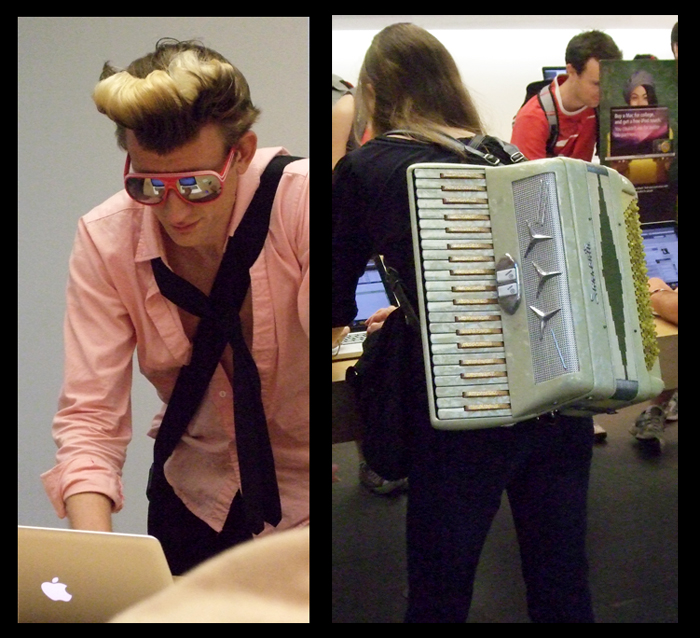
    I have a number of questions when I see people like this, particularly the man with the quiff – questions such as “Where are you going to go looking like that?” and “Where do you work?” Yes, on a Saturday night out or while shopping at the Apple store, you do look cool as hell, but once the novelty wears off at the workplace, who wants to be looking at this day in and day out? Even as a freelance associate or fellow artist, this is going to get old pretty fast. Are you going to be able to hold a conversation with this man and not be distracted by pink glasses, a pink shirt, and a blond-tipped pompadour that looks like the surf’s up at Malibu Beach?

    Now an accordion on your back is much more of a temporal and transitory thing. It’s really just an unusually large accoutrement which is likely not worn this way at home or at the workplace. There is a very good reason this woman is using an Apple computer with an accordion on her back; I just don’t know what it is. She probably was just playing her instrument or will be playing it soon. Or, perhaps she can’t afford a case. Perhaps she doesn’t want a case and finds it more convenient to carry on her back. Perhaps she wants people to know she is an accordionist.

    There are few stores in New York City with as self-assured an attitude (both from the staff and customers) like that of the Apple Stores. Some may bristle at the cult-like atmosphere – there’s a smugness of Apple users as being in the know, using the tool of choice, and willing to pay a premium for it. Iconoclasm has historically been a defining characteristic of both the company and its core adherents.  Apple has had a dominant role in the art community from early on. Under the circumstances, pompadours and accordions fit right in 🙂

    Photo Note: These photos were taken at the Apple Store in SoHo. Both individuals were in the store at the same time. Apple has an extremely liberal attitude regarding use of their computers. All have high-speed Internet access, and no restrictions are placed on use or time. Many stop here to check email or for any other variety of uses.


  • Secret Tunnel

    Did you ever have a nagging thought revolving around something unresolved? I recall reading in a secrets of New York City book that there was an underground tunnel in Chinatown, now some sort of shopping arcade. However, no one I knew had heard of such a place.

    I do love to find secrets in New York City. This is increasingly hard to do, so this mystery would typically make the prospect of search and discovery all the more exciting. However, in this case, all of the individuals I queried, including a long-time resident of Chinatown for 30 years and a few members of the Chinese community, had no idea as to what I was referring to. I began to seriously question whether such a thing existed.

    Some digging did finally uncover the existence of a tunnel on Doyers Street in Chinatown, but no address or precise location was given. I made an excursion to Doyers Street, a one-block alley between Pell Street and Chatham Square. This street, which makes a sharp 90° turn, was once known as the Bloody Angle, owing to the numerous shootings that took place there at one time. From the New York Times:

    Doyers Street, a crooked, one-block street off Pell Street in Chinatown that was near the Bowery and the notorious Five Points intersection, offered an ideal place for ambushes during the wars between the On Leong and Hip Sing tongs in the late 19th and early 20th century. Tabloids of the day christened the angle in the street, and the police said that more murders occurred on that spot than in any other place in an American city.

    I canvassed the entire street. There are many hair cutting salons on the street – it is sometimes known as “hair alley.” At 5 Doyers Street, mid-block, I found a staircase leading down below ground. It did not have the charm of a secret historic tunnel at all, but it was an underground passageway. I learned that this was known as the Wing Fat shopping arcade – a maze of quite nondesrcipt passageways with fluorescent lighting and acoustic tiled ceilings. A variety of merchants line the arcade: acupuncturists, dentists, a philatelic shop, and the office of Tin Sun metaphysics. The tunnel winds it way underground, leaving Doyers Street to exit in the lobby of the Wing Fat Mansion building at Chatham Square.

    This tunnel was apparently the main artery in a network of tunnels used by members of the Tong gangs as escape routes. It is interesting that there is no signage or advertising of this historic tunnel. In a way, it remains undiscovered…


  • Crossing Delancey

    Subcultures have their own languages, and the art community is no different. Over time, I have been privy to bits and pieces of artspeak, with words such as iconography, a word not often used outside the world of the arts. I say bits and pieces, because the special vocabulary is not wasted on the outsider, and perhaps there is even an element of secrecy, lest we learn enough to do an effective job of posing as one who is knowledgeable in the arts, thereby diminishing the special and exclusive nature of the “club.”

    I recall once trying my hand at creative design for my business. Upon presenting it to an artist friend, I was immediately told, in a very critical way, that my efforts did not have to be so literal – a new use of the word for me.

    I must admit, however, that I liked that use of the word and have added it to my arsenal of word weaponry, to be used when necessary. Recently, while crossing Delancey, the film of the same name came to mind, and it occurred to me that taking a photo would be an opportunity for a literal interpretation of the film’s title. Perhaps an art faux pas, but my photography is not being subjected to an art school group crit (see a New York Times article here).

    Literally crossing the street can be an undertaking – Delancey is a major thoroughfare with eight lanes extending from the Bowery to the Williamsburg Bridge, which crosses the East River to Brooklyn.
    The Delanceys were a rich, pre-revolutionary French Huguenot family. Their large estate became what is now the Lower East Side. Read more about the history of the neighborhood here at the New York Songlines website.

    At one time, until the 1920s, Delancey Street was a high-end shopping district. Over time, however, Delancey fell on hard times, and the character of the businesses changed, becoming the primary shopping district of the Jewish Lower East Side, known for discount merchandise and businesses such as Ratner’s Kosher Restaurant (closed 2002), the Bowery Ballroom, and the Essex Street Market.

    Delancey Street is also the site of one of my earliest postings in 2006 – the Live Poultry Market.There has been some gentrification, and the neighborhood is now a blend of older shops, a smattering of Chinatown and discount merchants, and newer retailers and night clubs.

    The film Crossing Delancey is the story of Isabelle, an Upper West Side Jewish resident, who, matched to a pickle maker on the more ethnically authentic Lower East Side, finds love crossing to the south of Delancey Street, literally 🙂


  • Tic-Tac-Toe Playing Chickens

    Spoiler: This story has a happy ending.

    The sign in this photo at the Chinatown Fair at 8 Mott Street, is missing a very critical word: Chickens. The sign used to read “World Famous Dancing & Tic-Tac-Toe Chickens.” Since the 1960s, a number of dancing and tic-tac-toe playing chickens have been home here. Chinatown Fair was originally a museum. In Manhattan’s Chinatown (2008) by Daniel Ostrow, there is a 1958 photo showing Chinatown Fair located at 7-9 Mott Street with an amusement arcade. Reference is made to Clarabelle, a scientifically trained chicken. According to the book, she was trained to play tic-tac-toe when Chinatown Fair relocated across the street to 8 Mott Street. The shop evolved to a gaming shop; today it is a popular video gaming arcade.

    According to a story in the New Yorker from 1999, chickens were trained in Hot Springs Arkansas, by Animal Behavior Enterprises, started by Keller and Marian Breland, both psychologists. After Keller’s death, Marian married animal trainer Bob Brailey. Dr. Marian Bailey was one of B. F. Skinner’s earliest graduate students.

    Animal Behavior Enterprises trained chickens to walk tightrope and trained dolphins for Marineland. In the 1970s, the Bailey’s produced a couple hundred “Bird Brain” chickens who, with the assistance of a primitive version of a computer, could play tic-tac-toe without losing. One was installed in Chinatown Fair in 1974.
    There was also a Dancing Chicken, which was a sadder situation – claims have been made that it danced because of electrical shocks to a metal plate on which the chicken stood.

    But the real attraction was the tic-tac-toe playing chicken. For fifty cents, you could match your wits against the chicken. The chicken was housed in a glass cage which taunted, “Can you Beat This Bird?” Backlit letters indicated “Your Turn” or “Bird’s Turn.” If you won, you got a bag of fortune cookies.

    The New York Times ran a story in 1993 about a chicken named Willy when he died in a heat wave after two years of service, replacing a previous chicken that lived to be eight. The owner was uncertain about replacing the bird, but a tic-tac-toe playing hen named Lily did eventually appear.

    In 1998, there was an article in the Poultry Press which tells the story of the release of Lily, the last tic-tac-toe playing chicken. The rescuer, in a plea to owner Mr. Samuel, was able to win Lily’s release on January 29, 1998. After a few days in the rescuer’s apartment, Lily was moved to Massachusetts to live with other rescued animals. Read the story here.

    Chinatown Fair no longer has any dancing or tic-tac-toe playing chickens 🙂


  • Coup de Grâce

    Irrespective of my interest in photography, sometimes I forget that we live in a world of color. This is easy – it is a full time job to take in all the sights and sounds of this great city. However, on occasion, a color op takes you by surprise and demands attention.

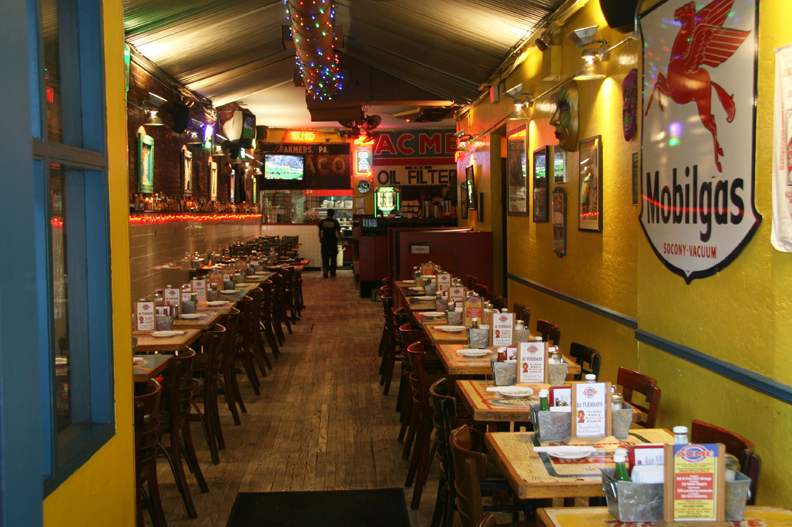
    And so it was on Sunday morning, passing by the Acme Bar and Grill at 9 Great Jones Street, where a number of elements conspired in a riot of color.* Early morning, before businesses start, is often a great time to visit a restaurant. Everything is clean and tidy before the masses arrive.  See the interior here.

    I entered to inquire about the aqua blue Chevrolet truck, assuming, like Caliente Cab, that this was an intentional decorative motif. It turns out that the truck was an employee’s vehicle. I complemented the staff member on the arrangement, but I received a rather nonplussed response – he was unaware of the fortuitous combination of elements that made their establishment so photo worthy.

    This was a tribute to reds and blues. Even the parking sign cooperated with its red lettering, as did the scaffolding and pink fire escape. And, unbeknownst to him, a man nearby with an aqua shirt provided the final coup de grâce…

    *Note on Riot of Color: Fellow photographer Bill Shatto shares a love of color – the phrase “riot of color” has become a frequently uttered pronouncement on our urban travels.

    Related Postings: Tale of Two ColorsHispanic Day Parade, Color Brigade, Flamboyant, Building Gone Wild, That’s Quite a Briefcase,  Fashion Forward, Taste,  Krishna Festival, Police Riot Concert, Narcissism Gone Wild, A Colorful LifeWho See the Red


  • The Tombs

    I’ve never been in prison. I never want to be in prison. And I certainly don’t want to be in a New York City prison called the Tombs.
    I visited the Tombs on Sunday at midday. Why I would do such a thing is a different story: I was in the neighborhood.

    No one looked happy at the detention complex, and there is no way to give this place a happy spin. I spoke to several corrections officers – all polite – but I could sense an air of incredulousness of why I would be there on Sunday, taking photos and asking questions. Virtually every New Yorker has heard of the Tombs, but why would anyone really need to know exactly where or want to visit?  I had never seen the buildings and was curious. So after numerous inquiries (and incorrect directions), I finally arrived at 125 White Street, the home of New York City’s Manhattan Detention Complex, aka The Tombs.

    Like many New Yorkers, I assumed that the colloquial name was given perhaps because the jail facilities are underground or some other grim reality. This is, in fact, not the case. The complex was nicknamed the Tombs after its first structure, built in 1838, designed by John Haviland and based on an Egyptian mausoleum. This complex occupied a full city block and was called the New York Halls of Justice and House of Detention.

    The Tombs has gone through several incarnations: the original from 1838 was replaced with a new building in 1902 and connected to the neighboring Criminal Courts Building by the Bridge of Sighs. That building was replaced in 1941, and in 1974, due to health and security problems, part of the building was taken down and replaced with a new structure. The current complex consists of two buildings connected by a pedestrian bridge: the North Tower from 1990 with 500 beds (seen in the photo) and the South Tower which incorporates part of the original 1941 building.

    The various warnings to visitors posted on the entrances made clear the harsh realities and no-nonsense atmosphere inside:

    POSSESSION
    OF
    CONTRABAND
    (WEAPONS)
    RAZORS KNIVES SHANKS SHIVS BULLETS
    And any other weapon capable of causing injury and/or
    otherwise endangering the safety of the institution
    WILL RESULT IN YOUR IMMEDIATE
    ARREST

    Other prohibitions include chewing gum, electronic devices, camera, mirrors, aluminum foil, pencil sharpeners, glass, and mace. I got the message, loud and clear.

    Many believed, as I did, that this is strictly a detention center, housing those arrested until arraignment. However, I was told that many are here for months or years and that this complex operates as a prison.
    My advice to residents and visitors: stay on the outside…

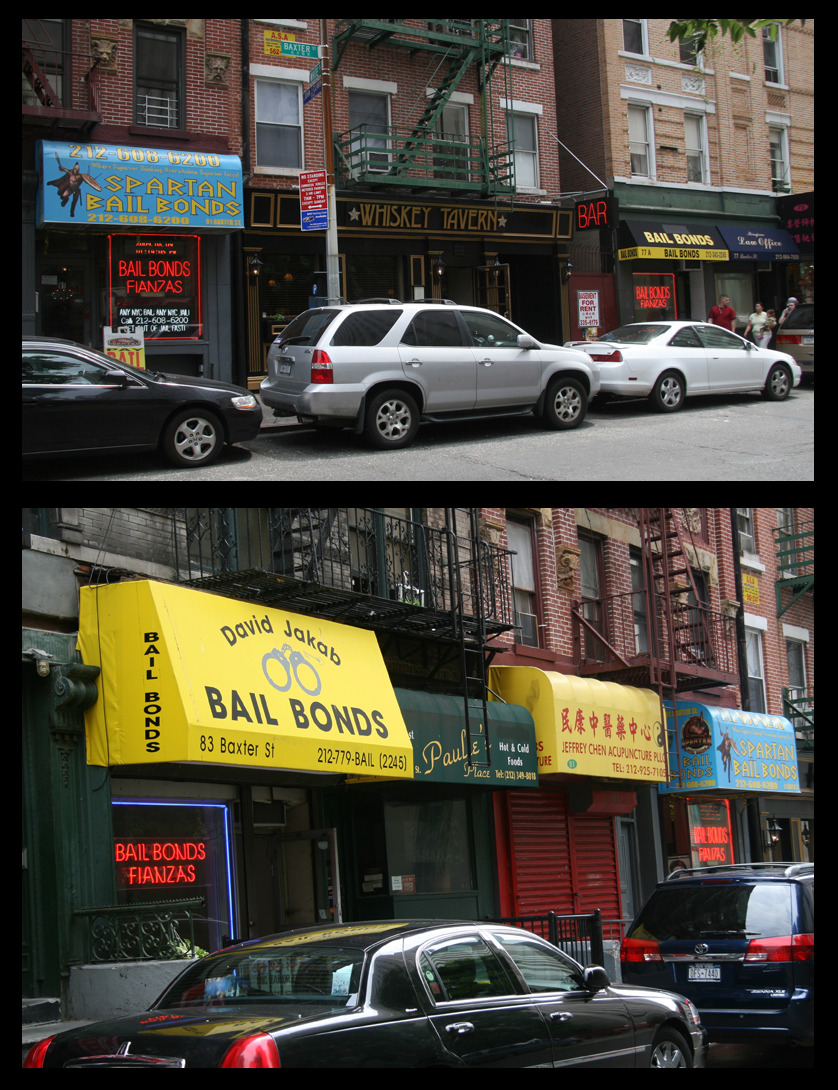
    Note: As one might expect, services for those apprehended were next door on Baxter Street. I found it interesting that sandwiched between three bail bondsmen and a law office was a whiskey tavern. See photos here.


  • Eight Twenty Five

    Posted on by Brian Dubé

    From time to time, early in the morning, I have heard the lone voice of a bagpipe from my window. This is peculiar enough, but what has been even more perplexing is that it frequently happens early on a weekday. This meant that I had to discount many theories – festivals, funerals, or other functions. It has since occurred to me that someone uses the park space as a good location to practice – playing bagpipes at home would not be looked at favorably by significant others or neighbors in an apartment building.

    Of course, the simplest solution to satisfy my curiosity would have been to dress quickly, leave the house, and chase down the sound. But the times when I have heard the bagpipes being played have been rather inauspicious.

    Yesterday, Wednesday at 8:25 AM, on a beautiful sunny morning, I believe I encountered my mystery man taking a nap.
    I do not know where you live, but seeing a man fully clad in Scottish Highland dress at 8:25 AM, snoozing on a park bench, is somewhat startling. I am not sure why a man needs to dress in such a way so early in the morning if he is practicing and not performing, but I am sure that there are things about this man’s musical practice which I do not know.

    Of course, I admit that this search for absolute reason is rather parental. There are many things that people do which are not necessary, particularly in this city, such as being tattooed, eating at midnight, and taking photographs of someone napping on a New York City park bench in Scottish Highland dress early in the morning.

    People come to New York City for many reasons – for an opportunity to make money, to pursue a creative interest, or just to be themselves in any way they want. And the beauty of it is that you can do it here without hardly turning an eye, except, perhaps, by that of a photographer carrying a camera at 8:25 AM 🙂

    Photo Note: The oval-shaped article on the man’s lap is a sporran, a pouch that functions as a pocket when wearing the pocketless Scottish kilt.

    Other People Posts of Interest: TasteOnly In New York, Out There, Spike, Narcissism Gone Wild, A Colorful LifeSpring Madness, Walid SoroorNew Yawk Style, New York NymphSuperheroes, Balsamic VinaigretteFacts and Fiction, Tale of Two ColorsSnake Charmer, ParasolCircus Amok, Piercing Al Fresco, Flamboyant, Color Brigade, New Yorkers Gone Wild, Debutante Ball, Fashion Forward

    Posted on by Brian Dubé


  • dinamic_sidebar 4 none

©2026 New York Daily Photo Entries (RSS) and Comments (RSS)  Raindrops Theme