• Category Archives Curiosities of NYC
  • Rosenwach Wood Tanks

    Posted on by Brian Dubé


    On my recent visit to Williamsburg, Brooklyn, while circumambulating the neighborhood, a sign jumped out from the corner of my eye: Rosenwach Wood Tanks. I realized that this must be the very same manufacturer of wooden water tanks which I wrote about in a story (Tank Worship), one of only two companies in New York City that manufacture wood water tanks.

    I nearly shrieked to my companion who was driving and asked him to please indulge me and circle the block so that I might be able to verify it this was the place. If so, I could perhaps go inside and do some photography.
    ‘Twas done in a jiffy, however, upon arrival at the Wythe Avenue entrance, something looked amiss. Charred, blackened wood was everywhere, and areas were secured with safety tape. Yes, a man confirmed that this was that company.

    However, coincidentally, I had arrived only some days after a major fire. The two-alarm fire occurred on the 4th of July;  the Fire Department of New York said the cause of the fire was illegal fireworks. The gentleman in the yard said that I was welcome to return at a later date, get a tour, and do some photography. However, at that time, fire marshals were everywhere, and it was not the time for a factory tour and photo shoot.

    This location, at 87 North 9th Street at Wythe Avenue, a former stable, is the wood mill for the company where the planks are prepared using equipment dating back to the 1930s. The tanks themselves are assembled at the customer location.

    Rosenwach Tanks was started on the Lower East Side in 1866 by barrel maker William Dalton. In 1894, Dalton hired Polish immigrant Harris Rosenwach. The company is currently under the watch of fourth-generation business owner Andy Rosenwach.
    I am looking forward to going back and touring the place when the dust clears…
    Posted on by Brian Dubé

  • New Yawk Style

    Posted on by Brian Dubé

    I enjoy observing New Yorkers I see in public who make a strong presence, whether brash, eccentric, or unusual in some way. However, drawing conclusions based on a few pieces of information can be dangerous – see my posting on Walid Soroor and Facts and Fiction.

    There is a New York style and a New Yawk accent. This has been depicted in numerous characters of film and television. John Travolta in Saturday Night Fever is classic New York attitude and accent (in this case Brooklyn Italian), as are others such as Fran Drescher (Queens) or journalist Jimmy Breslin.
    The classic New York style is characterized by someone who is confident, tough, blase, brave, street smart, and aggressive. Fierce borough pride. Regardless of gentrification or any other talk of improving conditions and reduction of crime, New York City is still a rough place. For a woman (or a man) who makes her/his way here, working, traveling the trains, and walking the streets requires a certain intestinal fortitude and stoicism just learning to navigate and survive.

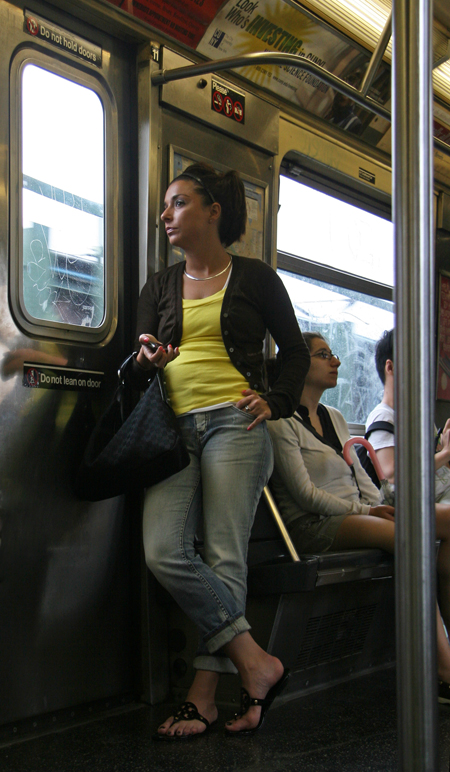
    On my trip to the Coney Island Mermaid Parade, this woman and her friend caught my eye. She had a dash of all the classic elements of New Yawk style – her posture and attitude on the train speaks volumes. A real New Yawker’s gotta have chutzpah…

    Note about the New Yawk accent: Also known as Brooklynese or New Yorkese, the accent consists of dropping r’s (fatha for father), adding oi (like the classic Toidy Toid for Thirty Third), adding r’s where they don’t belong (erster for oyster), pronouncing “th” like “d” or “t” (through as trew or the as da). From the New York Times: “Tawk to a young New Yawkuh dese days and de foist ting you may notice is dat he aw she don’t tawk like dis no maw.”
    Many say the accent, along with Yiddishisms (such as shlemiel or oy vey), is disappearing. Others say it is moving to the suburbs of New Jersey and Long Island. Some believe that NYC police officers are keeping it alive as a badge of honor.

    Related Postings: Out There, Spike, Narcissism Gone Wild, Superheroes, Snake Charmer, Circus Amok, Fashion Forward, Piercing Al Fresco

    Posted on by Brian Dubé

  • Chefs and Plumbers

    Posted on by Brian Dubé

    Trades in America are largely devalued. However, as big an advocate as I am of higher education, not every one is suited for white-collar jobs, and someone has to do the plumbing. Clerks, drivers, and service jobs cannot all be filled with college students and immigrants, and I am not sure that such a world would be desirable. And these jobs cannot be outsourced or automated.

    In New York City, complaints have been made about taxi drivers for time immemorial. The problem is that there is no serious training for this job. The test for a taxi license is laughable – virtually anyone who can drive can get a license. In London, for example, a cabdriver candidate must complete two years of full-time study. I am fascinated by Les Compagnons, French trade guilds dating back to the Middle Ages. See a New York Times article on the Compagnons here.

    Many find the level of craftsmanship in New York to be deplorable – stories abound regarding the poor workmanship in jobs done. Many have horror stories of their own. The problem is that many individuals doing blue-collar work are not trained or poorly trained. The workers are not professionals, as is the case with many waiters, who are working while pursuing other life goals and careers or perhaps feeling that they have no better options.

    None of this is the case at the French Culinary Institute, located in SoHo at 462 Broadway. This extraordinary school provides an intense training in the culinary arts on a par with schools in Europe – many of the faculty and deans are European, trained, renowned chefs. The school offers a very broad spectrum of classes.

    Employment needs are often cyclical. As need develops for a given skill set, people train for those opportunities. Often, an over supply develops, with shortages in other fields. I often speculated that skill tradespeople may see their time come in a world where manual labor is looked down upon and everyone trains for white-collar work. I have often joked that in a world full of web developers, plumbers may rule.
    I love the scene in the film Moonstruck where we have revenge of the tradesman. A couple, needing bathroom work done and lacking knowledge about construction, are persuaded by contractor Cosmo Castorini to buy the most expensive solution:

    “There are three kinds of pipe. There’s aluminum, which is garbage. There’s bronze, which is pretty good, unless something goes wrong. And something always goes wrong. Then, there’s copper, which is the only pipe I use. It costs money. It costs money because it saves money.”

    The future of technology rapidly evolves – who knows what future generations will need and where the jobs may lie? But most likely, there will always be a need for chefs and plumbers 🙂

    Photo Note: This shot was taken on Grand Street, where French Culinary students were on a break from classes. The sight of so many chefs in classic white uniforms on this street is quite startling. The school also runs a highly regarded restaurant – L’Ecole, located at street level at the same address.

    Posted on by Brian Dubé

  • Secret Discovery

    Posted on by Brian Dubé


    On my first trip alone to New York City with a friend, I recall some mutual back patting of how, in traveling without a group, we were able to avoid the touristy and eat in a place which was our own secret discovery. The place? Nathan’s at Times Square. Rather hilarious looking back on it, but being older has not entirely eliminated naivete.

    I “discovered” this unique building standing alone like a haunted mansion on a hill at 3rd Street and 3rd Avenue in Brooklyn. Silly in retrospect – how could anyone miss this anomaly on a major thoroughfare? No one has. I have read no less than two dozen articles on this building which not only stands as a beacon to passersby but also is the center of controversy.

    The surrounding property (but not the building itself) was purchased in 2005 by Whole Foods Market from Richard Kowalski, who still owns the 2 1/2 story Italianate building at 360 Third Avenue/Street near the Gowanus Canal. The Whole Foods project has been stalled for a number of reasons, including discovery that the property, a floodplain, contained toxic material.

    I found a tremendous amount of misinformation about this property, as bits and pieces of facts were cobbled together over the recent years. I believe its history has at last been clarified.

    The building, built by Edwin Clark Litchfield in 1872-3, became important as part of the history of concrete in America. The New York and Long Island Coignet Stone Company Building was landmarked in 2006.
    François Coignet was a pioneer in development of structural and reinforced concrete. In the late 1860s, a group of Americans trained in Coignet’s techniques in France brought his patents to Brooklyn. From the New York City Landmarks Preservation Commission website in 2006:

    The building originally was part of the New York and Long Island Coignet Stone Company, a five-acre factory complex near the Gowanus Canal that manufactured Coignet — or artificial –stone, a type of concrete invented by Francois Coignet in Paris in the 1850s. The factory supplied the arches and clerestory windows in St. Patrick’s Cathedral in Manhattan, the ornamental details for the Cleft Ridge Span in Prospect Park and the building materials for the first stages of construction at the Metropolitan Museum of Art and the American Museum of Natural History.

    Made entirely of concrete, the 25-by-40 foot rectangular structure was built to showcase the durability and versatility of Coignet’s inventive product, also known as “Béton (French for concrete) Coignet.” The company was reorganized and renamed the New York Stone Contracting Company in the mid-1870s, and continued to manufacture Coignet stone until 1882. Shortly after, the building housed the office of the Brooklyn Improvement Company, which was instrumental in Brooklyn’s residential and commercial development during the 19th and 20th centuries.

    I hope you get a chance to make a secret discovery of this property yourself, if you get a chance to pass by 🙂

    Note: The building has often been referred to as the Pippin building – it once housed offices for Pippin, a radiator distribution company.

    Posted on by Brian Dubé

  • Comin Up Comin Up

    Posted on by Brian Dubé

    Before the hegemony of the Korean green grocers, there were far fewer dealers of produce in New York City. And then, as now, many immigrants did the heavy lifting in this city. This was the case in the 1970s on Greenwich Avenue near Avenue of the Americas, where there was a very prominent fruit and vegetable store run by Arabic men. As immigrants are inclined to do, these men had acquired a smattering of American colloquialisms, patched together to make what they thought was the salesman’s perfect proverbial call to action. So a passerby was often subjected to their pitch: “Comin up Comin up. Strawberry. Three for a dollar. Who can believe it.” Hear my impression here. Ironic, because, of course, nothing was being prepared, and hence nothing really was really “comin up.” And often, given the quality of the strawberries, three for a dollar was easy to believe.

    Their intonation and sense of urgency was a great source of amusement for many of us at the time, and I have recounted this story to many close friends who now find opportunity at every moment possible to inject “comin up comin up” or “who can believe it” into any situation where it can possibly be justified – there are many, many moments in daily life where either phrase can be easily worked in.
    But where to use such a story for a photoblog of New York? These men and their fruit stand will not be resurrected. So this experience had been filed away in the recesses of my mind, waiting for an opportunity.

    Fast forward one week ago to a street fair on Waverly Place. As I walked by a seller of watermelon in cups, the man behind the table barked, “Watermelon. Two dollar. Helloooooo!” Hear my version here. The use of Hello with an elongated “o” is recent slang, similar in meaning to “wake up and smell the coffee.”
    So there it was – the perfect analog in our time and place to “comin up comin up.” And as I pulled out my camera, the vendor happily obliged and volunteered a smile with two fingers for two dollars.

    So if you think you recognize me around town and see me walking towards you, you now have the secret password. Just say “comin up comin up” and I’ll be sure to respond “Who can believe it!” 🙂

    Posted on by Brian Dubé

  • Shalom

    Posted on by Brian Dubé

    What is fascinating is the reaction of newcomers to the city to the enormous Jewish population. Businesses such as B&H Photo, run by Satmar Hasidic Jew Herman Schreiber with hundreds of orthodox Jewish employees donning traditional elements of dress such as payot and tzitzis, come as a curiosity to visitors. The 2001 census shows just under one million Jews in New York City – the largest Jewish population in the world outside of Tel Aviv, Israel. That’s 12% of our city population, 15% of the number in the United States, and 7% of the world’s total. For those of us who have been here a long time, it is something that is such a part of the fabric, history, and evolution of the city that it goes virtually unnoticed.

    My first close friends in New York City were Jewish, and from the very beginning, I developed an enormous respect for a group that has survived and prospered against persecution and hardship.
    The Jewish population has a strong representation in so many professions – law, business, finance, local politics, publishing, medicine, and the arts. The recent Mayors of New York City (Beame, Koch, and Bloomberg) have been Jewish, as is the family that owns the New York Times (Salzberger). But make no mistake – these achievements are based on tenacity, hard work, strong families, and education.

    I remember as a high school student in New England, perusing the World Almanac as I was inclined to do, coming across an entry showing average number of years of education completed by ethnic group. As I quickly scanned the list, I noticed the number one group – Jews. The average number of years of school completed: 16+.

    I reflected on this, recalculating and reconfirming that 16+ meant college graduate. Perhaps I misread, misunderstood, or have misremembered the statistic, but nonetheless, in my entire extended family, many had not even graduated high school, and only one uncle had been to college, so this fact was astounding to me and something I always remembered. When I entered university in New York City, the Jewish emphasis on education and its role in their success became abundantly clear. Of course, like any group, some do fall between the cracks, but my experience here has been that members of the Jewish population are achievers. Shalom 🙂

    Photo Note: This was the annual Salute to Israel Parade, starting at 57th Street and continuing north to 79th Street. More at their website here.

    Posted on by Brian Dubé

  • Book Wars

    Posted on by Brian Dubé


    To me, the street life of New York City is one of its defining characteristics and is what separates it from any other place in the world. With the growing domination of the retail sector by national and international retail chains, the character of the retail world has become decidedly less unique. Strolling down Broadway in SoHo is very much like strolling the suburban shopping mall – the only big difference is whether you want your mall shopping experience indoors or out.

    Street vendors often provide a food or product which is difficult to vend profitably in a retail store. For those of us who already spend too much time indoors, browsing a street vendor’s wares is also a way to get more outdoor time. Admittedly, there is a plethora of chatchkas and tacky tourist memorabilia. Like anything else in New York, you must pick your battles and be selective – it is difficult to make any blanket characterizations of the merchandise on the streets. There is better or worse in nearly everything here – places like Canal Street are both bazaars and minefields.

    One of the most worthwhile activities on the street is the sale of books. Here, too, there are some vendors of some extremely poor quality magazines and books, where a cursory examination makes it clear that the primary operative is selling merchandise.

    But there is a small world of street booksellers who are extremely literate and knowledgeable about books, often more so than a bookstore staff member. These vendors are people who are not criminals, drug addicts, derelicts, or thieves. They acquire their books from estate sales, thrift shops, remainder bins, foundations, used bookstores, or trash heaps. A perusal of the titles sold by Everett Shapiro at the tables on West 4th Street (in the photo) in the heart of the NYU “campus” will tell you that the selection here is quality, one that a serious reader can take seriously.

    Everett was one of the featured characters in the independent film Bookwars, which won Best Documentary at the New York Underground Film Festival in 2000. The film was made by filmmaker Jason Rosette, who was a NYU film school graduate and became a street bookseller himself. The 1999 book Sidewalk by Mitchell Duneier also examines the world of the sidewalk booksellers.

    Street booksellers (and sellers of art) are protected by the free speech provision of the First Amendment of the Constitution and are allowed to sell on the streets without a license. However, in spite of this, efforts were made during the Giuliani administration as part of his Quality of Life campaign to crack down. The effort was highly contentious, and eventually the police backed off. The numbers of street booksellers has declined, but there are still those who are passionate about books, and they can still be found here and there…

    Photo Note: These are the tables of Everett, located on West 4th Street in front of NYU’s Bobst Library.

    Posted on by Brian Dubé

  • Salad Bowl

    Posted on by Brian Dubé

    Some argue that the view of America and even New York City as a melting pot is largely a myth and an outmoded idea. Immigrants do not settle across the country or the city in a uniformly distributed way. What we have would be better described as cultural pluralism and multiculturalism, and that a salad bowl is a better analogy than a melting pot.

    New York City is remarkably diverse, but on close examination, a walk through the many neighborhoods of this city will reveal segregation based on ethnicity and social class/income. Remove students and visitors from the equation, and you will find some areas quite homogeneous as far as actual residents.

    I leave it to you to sort out the details and make judgements regarding melting pots, salad bowls, demographics, and the census. If you want to see the best New York City (and some say the world) has to offer as far as ethnic diversity is concerned, head to Jackson Heights, Queens. I wrote a number of articles about this area in 2007 – see the links at the bottom of this article.

    The most striking thing about a visit to this neighborhood is the extraordinary numbers of people who are wearing traditional non-western dress. Turbans, Saris, Burqas, and other unusual dress dominate the streets and shops, which themselves are a menagerie of merchants featuring products and foods catering to these varied cultural groups. Food alone is enough of a reason to visit Jackson Heights.

    As I worked on the numerous photos for today’s collage, I found myself battling and attempting to crop out one thing in many of the photos. The common and unifying element in this multi-cultural extravaganza? The universal constant appears not to be the speed of light but rather an item to carry ingredients of a salad bowl – the ubiquitous plastic shopping bag…

    Related Postings: Jackson Diner, Jackson Heights, Indian Gold, The Patel Brothers

    Posted on by Brian Dubé

  • Attention

    Posted on by Brian Dubé

    “Oh, have I got your attention now? Good.” This line, spoken by Alec Baldwin in his famous sizzling speech in the award-winning film Glengarry Glen Ross, would be appropriate for our friend in the photo, could he only speak. But having a large, inflated rat sitting in front of your business or building will certainly get your and the public’s attention, so no worry that this rat is mute.

    These rats have been seen on New York City streets since 1997. Local 79 of the Construction and General Building Laborers claims to have been the first to introduce the rat to New York City in 1997. They are not unique to the city, but we are the largest consumers and users of the rat invented by Big Sky Balloons and Searchlights of Plainfield, Illinois. At any given time, a number of the union rats are deployed around town to deliver a message about employers whose business practices have bestowed upon them the honor of induction into the family of rats.

    In 1990, Don Newton, an organizer for a Chicago bricklayers union, went to Big Sky looking for a more effective way to to get the attention of nonunion employers. Owner Mike O’Connor proposed the idea of creating a large inflatable rat, and “Scabby the Rat” was born. Big Sky has since produced hundreds of rats used throughout the country, along with hundreds of other inflatables such as the “Greedy Pig,” the “Corporate Fat Cat,” skunks, bulldogs, and cockroaches.

    Some victims have retaliated, such as a larger cat looming over a rat by Radio City in 2005 or the anti-union dinosaur which was placed in front of the AFL-CIO’s headquarters in Washington, D.C. in 2006 by the Center for Union Facts to symbolize their belief that unions were outmoded and would become extinct.
    The numerous articles regarding these rats show the price range escalating – now ranging to nearly $10,000 for the biggest rat. I suppose everything is subject to inflation 🙂

    Film Note: Glengarry Glen Ross – Highly recommended drama, screenplay adaptation from a play of the same name by David Mamet. It will forever change your view of sales. Warning – strong language.

    Posted on by Brian Dubé

  • Men Making Noise

    Posted on by Brian Dubé

    There is a big surprise coming to New York City. I say surprise because many residents are unaware that phase one of the High Line project will open in a few short weeks. Even those who are aware of the project most likely do not have this foremost in their minds. The project is elevated out of view, so it proceeds without notice. The High Line is the conversion of an abandoned elevated railway to parkland. It extends from the Meat Packing District to 34th Street – a distance of 1.45 miles. I wrote about this project previously in High Line Portrait Project. It has been likened to the Promenade Plantée in Paris, built on an abandoned 19th-century railway viaduct. It promises to be a major contribution of greenspace. The figure in the photo is a ironworker who was cutting apart a warehouse abutting the High Line.

    I grew up with a strong work ethic and a family cynicism surrounding most workers. My father was a wood cutter in northern Maine, a remote, sparsely populated area with severe winter weather. The state has a fiercely independent spirit with a strong element of individual self-reliance. After moving south to Connecticut, he viewed most workers whom he typically encountered with disdain. His comment about municipal workers was that you could easily spot them – one man in a hole and 10 men above standing around watching him. My own view of tradesmen is much less harsh.

    There are some things in life that are rarely questioned, such as the benefits of education, the rights of a pregnant woman, and, at one time, the word of a doctor. To that I might add a man making noise. If you look busy and make enough noise, people assume that serious hard work is being done.

    My take on laborers and noise became an an inside joke at my office many years ago. When anyone, hearing some ill defined racket, would ask, “What is that?”, I would respond, “Men making noise. That’s what men do.”
    To those who might question my sanity, I say move aside please. A Mainiac is coming through to do some work 🙂

    Posted on by Brian Dubé

  • Catch a Wave

    In the years I have lived in New York, I have witnessed a myriad of trends and fads. With many of these, it seemed that there was no end in sight and that it would become a permanent part of the city’s cultural landscape. And then as quickly as it came, it was gone – in some cases, it disappeared almost completely, while in others, varying degrees of vestiges remain.

    There was disco fever. I had a friend who took dance lessons with his wife at the very disco in Brooklyn (2001 Odyssey) where John Travolta performed in Saturday Night Fever. Disco roller skating became a popular spinoff, with skating circles in the parks (there is still one in Central Park). For a time, small roller skating clubs opened – skating was done ad nauseum in a circle to DJ music.

    During the same period, enormous boomboxes were toted and seen in the parks and streets. One of the few benefactors was Duracell – most of these required 8 D-cell batteries, which only lasted some part of one day. Supporting your machine became tantamount to a drug habit.
    There was the break dancing phenomenon, with many youths spinning on all parts of their bodies, including their heads, on makeshift stages – cardboard on the sidewalks.

    And then there were those “exclusive” clubs, such as Studio 54 and the Mudd Club, with lines of patrons hoping they were special enough to be chosen for admission by arrogant, power-wielding bouncers. Ironically, in many of these, the throngs on the street were more interesting than the scene in the clubs themselves.

    Even crime appeared trendlike. Graffiti on subway trains became a virtual icon for New York, as seen in movies such as The Taking of Pelham One Two Three and The French Connection. Heroin users graced the parks. Broken car windows for radio theft were daily occurrences.

    Puzzling was the rapid rise and fall of gelaterias. Many of these small shops were beautifully put together only to be dismantled in a short time. Most of the remaining shops (such as Café Dante) were there before the trend and after the dust settled.
    Other trends did become part of mainstream culture, such as skateboarding and the migration to “new” neighborhoods.

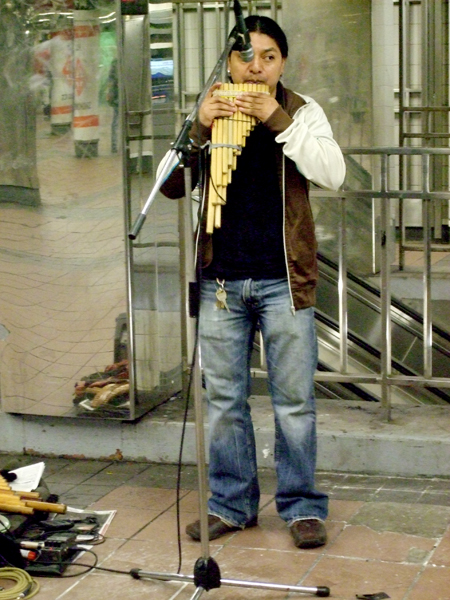
    The man in the photo is reminiscent of the rise of Andean street musicians in the late 1980s. The streets (and subway system) on weekends found many small troupes playing Andean folk music – mostly from Ecuador and Peru, with panpipes, flutes, and strings.

    One of the recent complaints worldwide about street musicians is the use of backing tapes and amplification systems, allowing a solo performer to play with recorded backup. Apart from the typically excessive volume is the rather “muzak” or schmaltzy character of the overall result. But the advantages to the musician are many – no need to organize a group or split tips, becoming a one-man band.

    Every corner of the planet has its trends, fads, and cultural movements, and many of these become global. But in New York City, with the chutzpah of the people, the large numbers of adopters, and the tolerance of the residents, these things take on a larger dimension and are frequently exported.

    Living here is like playing in the ocean. Sometimes I get caught in a wave, other times I just let it pass me by, waiting for the next one…


  • Rear Window

    If you are interested in film and New York City, I would highly recommend the Hitchcock classic Rear Window, starring Jimmy Stewart and Grace Kelly. The film, a virtual shrine to voyeurism, takes place in a Greenwich Village apartment, where Stewart, confined to a wheelchair while recuperating from a broken leg, spies on his neighbor’s apartment and observes a series of activities which lead him to believe that a murder has been committed. The film is very engaging and we get what feels like an added bonus – plenty of time with Grace Kelly on the screen in charming repartee with Stewart. The film has been highly applauded, a winner of 4 Academy Awards and numerous other accolades.
    Many feel that much of the film’s appeal is because of its voyeuristic premise. Some go further to say that part of the appeal of film itself owes to its voyeuristic nature and the inherent desire of most people to watch others secretly.

    People do like people watching, and cities are perfect environments to do so. I recall my surprise at the table arrangements in Parisian cafes, where seats for two are joined side by side facing outwards, rather than each other. This made so much sense that I was immediately puzzled why this practice was (and still is) virtually nonexistent in New York City.

    There’s no better place for people watching than New York, and with millions of residents, there are large numbers who have long given up concern about who’s watching what. Public Displays of Affection (PDA) and all other manner of exhibitionistic behavior abounds, and for the voyeur, this city is the Devil’s Playground.

    The woman in the photo was relaxing on the third floor above Broadway in SoHo, certainly not a place where there is an expectation of privacy. Fire escapes in New York City often function as outdoor terraces, and over the years, our office has been entertained with various activities there (see Window Washer here).

    The scenario is reminiscent of another film, The Time Machine (from 1960), where Rod Taylor, on the start of his many journeys in time, observes a store mannequin and its changing wardrobe. The window and mannequin become icons of stability in a world of changing fashion. In the 19 years I have faced Broadway, the buildings have stayed the same, and only the names and faces have changed. With such unabashed displays from a front window facing a major thoroughfare, there’s no need for a rear window…


  • Banking Crisis

    One thing that can be refreshing at times about children is their brutal honesty and frequent lack of pretension. They say what they think and do what they want without regard to social norms.

    On Saturday, the city hit 79 degrees, and it appeared that every able-bodied New Yorker was on the streets and in the parks. A group of street musicians was performing in Washington Square Park and had an instrument case open for contributions. A father had taken the opportunity to teach his child the ways and means of supporting the arts. His daughter made a number of trips to and from the open case to her father, who supplied her with a coin on each trip. Satisfied with her deposits, she even closed the case for protection.

    Soon, however, this child quickly appeared to see the opportunity and attempted to make a major withdrawal, reopening the case and dipping in some money. Why not just take what is available? Perhaps she, like many others in today’s banking crisis, had concerns over the security of her deposits. The entire thing became a small theater piece for the entertainment of all – the music took a back seat to the performance.
    Some may feel that this was just typical of a child’s behavior, not socialized and left unchecked. It can be debated, however, whether adults are any better or just more covert in their execution.

    Admonitions were not adequate to dissuade her, and the father had to resort to a dragging ritual. But Dad should have realized that one could do much worse in handling money and investments (as most of us have). Perhaps he (and we) should see her actions as a very good way to handle a banking crisis 🙂


  • Get A Life

    We have all heard the taunt or admonition “Get a life.” But what about those less fortunate who, because they have not been dealt a good set of cards or are at a point in life where they are down on their luck, may not have a life to get? And if one does not have the good fortune of an extended family or available friends, the world can be a lonely place.

    I can tell you from having lived alone at various times that I believe being in New York City provides a lot more entertainment and distraction at those needed times. Like it or not, gossip in one form or another occupies a large part of people’s social interactions, particularly those without a life. New York City offers enormous fodder for the lonely yenta.

    Two friends and I sat in a vehicle in a parking spot on Fifth Avenue, waiting for the appointed time indicated on the parking sign to set us free. We became very intrigued by the vehicle in front of us, shown in the photo, so for the duration of our captivity, we began to speculate, becoming amateur detectives. One companion was a former New York City resident, Brooklyn-born and street smart.

    We observed a few things. The vehicle was a car for hire, indicated by the T&LC (Taxi and Limousine Commission) at the bottom of the license plate. The man hovering was obviously the driver waiting for his client. This was not an ordinary client for several reasons. The vehicle was a Mercedes, parked outside an extremely fancy doorman building on Fifth Avenue in one of the most prime locations in the city. Lastly, and most interesting to us, was an odd sequence of letters, FHAAHHMS, which certainly must be a vanity license plate.

    Now I suppose that our indulgence in the minutiae of life is not unique to the city – the occasional interloper in a small town is often subjected to the same scrutiny and speculation by idle gossipers. However, for those without a life, what better place to be than in New York City? Walk out of your door anytime of day or night, and you enter a world that is a veritable circus, with the broadest range of humans on exhibit that you are ever likely to meet. In Spike, I wrote of a man with a unique style and whom I recently met at Astor Hair. Where else could he dress like this, strut with pride and confidence, and be treated like a celebrity? André, who I featured in Out There on August 22, 2007 and Fashion Forward on November 9, 2007, is someone whom I now frequently meet and greet on the streets of NYC. I have since learned a little more about fashionista André Johnson – he graced the cover of French Vogue in 2007.

    Any thoughts about the letters on that license plate, FHAAHHMS?

    Note: According to the Oxford English Dictionary, the first use of “Get a Life” was from a 1983 article in the Washington Post: “Gross me out, I mean, Valley Girls was, like, ohmigod, it was last year, fer sure! I mean, get a life! Say what?”

    Posts of the Unusual: Out There, Spike, Narcissism Gone Wild, Spring Madness, Superheroes, Snake Charmer, Circus Amok


  • Finest

    Posted on by Brian Dubé

    New Yorkers have grown accustomed to a litany of superlatives regarding many facets of human endeavor and achievement in this city. Best, largest, first, oldest, most…
    Conveniently, the NYPD fits right in – the New York Police Department is not only the largest in the United States, it was also the first, established in 1845.
    And here, in today’s photo, we have, appropriately, the 1st precinct, located in lower Manhattan at 16 Ericsson Place at Varick Street. This precinct is also one of the few that stables horses – see my article with photos here.

    The city has used various nicknames for groups of uniformed city employees. New York has the Finest (police), Bravest (fire), Strongest (sanitation), and Boldest (corrections), and recently, a marketing campaign to recruit teachers has asked them to “Join New York’s Brightest.” The use of Finest for the NYPD is, according to etymologist Barry Popik, probably the oldest:

    Several sources claim that it was coined by police chief George W. Matsell. “Finest” probably started life as “Best” and probably dates from 1874. The comedian Gus Williams starred in the play One of the Finest in the early 1880s. I believe that “the finest police in the world” is meant to be a similar phrase to Civil War General Joseph Hooker’s “finest army on the planet.”

    Popik gives many other references from this time period – you can read them at his site here, along with the origins of Bravest, Strongest, and Boldest and their earliest usage in regards to uniformed workers. These terms, including New York’s Finest, are primarily media terms. Citizens rarely use these words, most often just referring to the police as the “cops.”

    Of course, whether or not the NYPD lives up to its nickname given to them 135 years ago is another question. Certainly the NYPD has had its share of scandals, perhaps to be expected allowing for such a large police force, large city population, the number of crimes committed, and the violent nature of America.

    I am sure that working in an environment where an individual is constantly exposed to the dark side has an impact. Also, being in situations which are potentially life threatening means that serious judgements have to be made, often with only a moment to make them, and of course, some of these decisions will be flawed.

    And, of course, there are always the bad apples in the barrel who give others a bad name. Many of them are the raison d’être behind the big public scandals of New York’s Finest…

    TIDBIT: When registering the domain name for this website, New York Daily Photo, I noticed that the initials NYDP used the same four letters as the NYPD. This would make a very short and simple website address. Excited by the prospect of using NYDP.com, a little research turned up the fact that it was, of course, already taken 🙁

    Posted on by Brian Dubé


  • dinamic_sidebar 4 none

©2026 New York Daily Photo Entries (RSS) and Comments (RSS)  Raindrops Theme