• Category Archives Slings and Arrows of NYC
  • Not Really

    The one big thing you need to know about cement or concrete is that YOU GOT TO KEEP IT MOVING. My father knew this better than anyone; for most of his adult life, he worked for a construction company that specialized in concrete. All too often, a newbie driver with the company would break down on the road and not realize that his number one priority was to keep that cement drum moving. Invariably he would return a cement truck with a drum full of hardened concrete. This would require either a entire replacement of the drum or a very laborious removal process – chipping the material out with a jack hammer. I did this for a summer job – one of the most unpleasant tasks I have ever known.

    I endured an extreme stoicism growing up, driven by my parents’ hard times, lean circumstances, and real need, not by an effort to impress. My father had ZERO tolerance for complaining about any hardship, and I witnessed a few severe accidents with no expression of pain. He owned a rifle at 10 years old and was taken out of school at 12 to work full time as a wood cutter in subzero temperatures. There were accidents, misfortune, and real adversity to face. Later in life, many anecdotes would be exchanged – small tales of extreme bravado.

    My family had a custom home built in the mid-1960s. For a family with such austere and impoverished roots, this was a tremendous source of pride. After completion, my father decided that a couple of concrete walkways around the house would be a nice touch and an opportunity to use his knowledge of concrete.

    With all the preparations done, it was time to actually pour the concrete. He had been able to borrow a small portable mixer like that in today’s photo. The mixer was chain-driven, and at one point one of his fingers got caught in the drive, tearing off his knuckle. However, the concrete was wet and needed to be kept moving, and an accident was not to deter him. He looked at me and only said four words: “Get me a rag,” with no cry or any visible sign of discomfort, only frustration that his job was now made more difficult.

    My father instilled in me a great respect for power tools, and to me, one of the most frightening is the table saw. A colleague who built a post and beam home in Maine told me that most of the members of the crew who built his home had a finger or part missing. A supplier of wood parts to whom I once recounted these tales concurred, telling me that sadly, these accidents are generally just a function of time. A very large number of those who work in heavy wood manufacturing industries inevitably have a serious accident resulting in the loss of a finger.

    My father had a basement shopped equipped with a table saw. He was extraordinarily careful and methodical with its use, but time caught up with him. On one occasion, he cut the tip of one finger off. He came up from the basement stairs with his hand wrapped in a bloodied shirt and stood silently before my mother. Surmising the seriousness of the accident, she asked in shock and horror, “Are you alright?” To which he answered, with classic New England stoicism, “Not really…”

    Related Posts: The Book With the Hole In It (Part 1 and Part 2), Pure Chocolate, Men of Steel, Never Cut a Board, Men Making Noise, Work
  • Ask Tommy

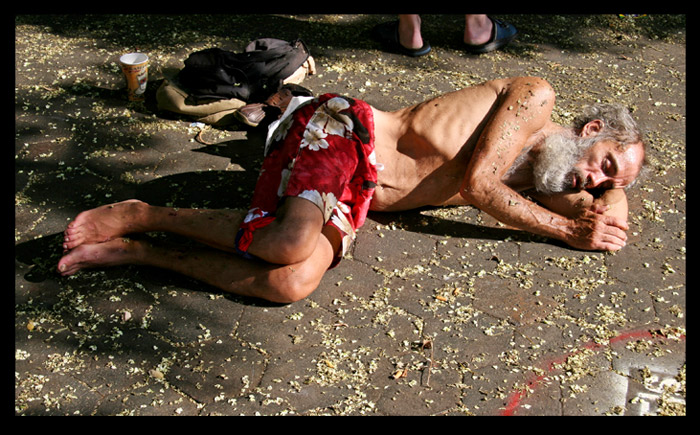
    Were it not for this website, I certainly would not have interacted with the many homeless whom I have in my travels throughout New York City. And I would have concluded, as most have, that their state is a product of lifelong misdoings, drug use, or sheer laziness.

    However, many homeless are quite ambitious, and many of the features I have done here illustrate that very clearly. Others, like Hakan Onor, whom I plan on doing a documentary on, have extraordinary stories and backgrounds, often which beg credibility.

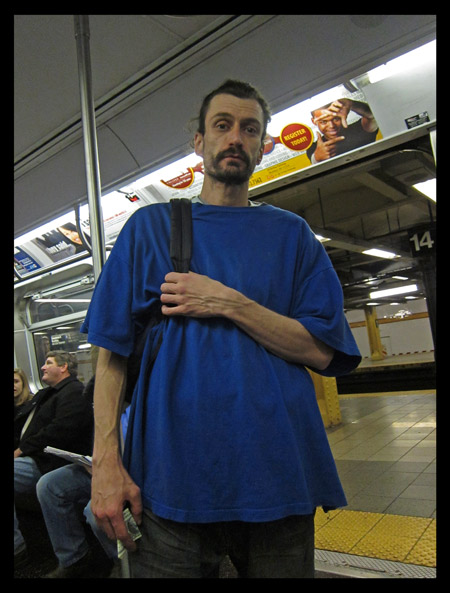
    Recently, on a short subway ride, a man entered our car and, like others, proceeded with a rehearsed solicitation, something that most regular commuters find particularly annoying. Not only do most feel such diatribes to be audibly disturbing, the spiels are also typically viewed with extreme skepticism, with claims and representations dismissed as just being part of another flavor of a New York City hustle or scam for money.

    I gave the man a dollar and introduced myself, telling him of my blog. We only had a few seconds. I learned his name, Tommy, that he was from New Jersey, that he was not a drug user, but, like many in his plight, was mentally disabled. He told me that he was schizophrenic and bipolar and that he typically goes on and off medications. He explained that the side effects from his various medications become intolerable, resulting in his discontinuing their use.

    Thus, his life becomes a roller coaster. This type of scenario can often be evidenced by the dramatically changing wardrobe and hygiene of many homeless, given that one is privy to seeing them on an ongoing basis. They are in and out of drug rehab or in and out of psychiatric treatment. I have seen the aforementioned Hakan looking extraordinarily nice in a sport jacket, well-groomed and sprightly, yet at other times barely able to function, pushing his belongings in a shopping cart, looking no better than Stephanie or Morgan on a bad day. Or, perhaps, they are all bad days, and the good days are just an illusion to the outsider. I forgot to Ask Tommy…

    Related Posts: Looking for an Angel, Usually. Maybe. Probably Not, Sleeping in Jeans, Homeless Art Scene.


  • A Little Complainin’

    I’ve been told that I am a complainer. Convenient, since there is no better place for a complainer than New York City. Here, complaining can be indulged in at any depth or breadth imaginable. One can cut a broad swath or can specialize. For example, a daily commuter traveling on a particularly troubled subway line could confine his or her complaints to just the interminable atrocities committed there on nearly a daily basis.

    Today I discovered an interesting blog – I Hate New York City (.com). There, I found 265 comments over 150 pages, spanning the range of love/hate sentiments of New York City. Within those comments, I found the vitriol and outrage which many have over the city. It is a virtual shrine to complaints. The range of topics was well-covered: noise, dirt, rats, smells, trash, rudeness, crowds, costs, concrete, lack of nature, dangers, crime, hot summers, oppressiveness, and pollution.

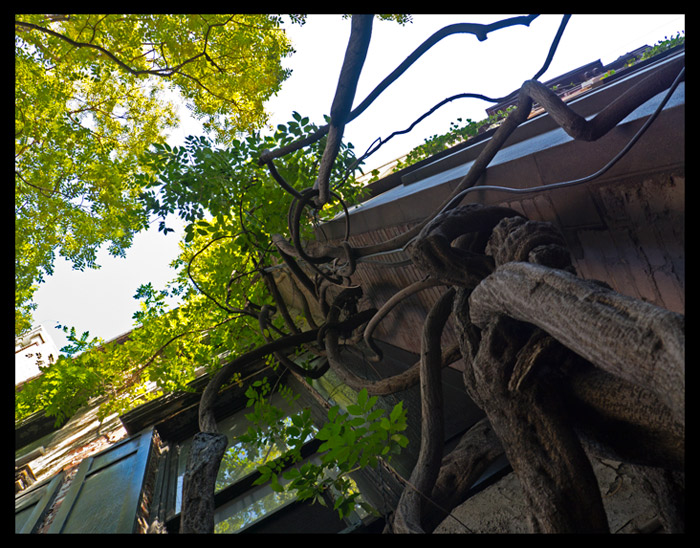
    I might add that even though many of us bemoan the lack of nature, there is still opportunity to complain about plant growth, even when considering plants generally seen as an element of old world charm, such as wisteria and ivy.

    In neighborhoods such as Greenwich Village, with a preponderance of row houses, one can find many brownstones with ivy growing up the face or rear of the buildings. Its growth is, however, quite rapid, and for those who dwell in or manage the building, it is more an irritant than a source of charm. Not only do they grow very rapidly, requiring frequent pruning, but these climbers also are destructive to the masonry where they maintain an aggressive foothold.

    In one apartment where I lived in the 1970s, my windows would slowly become obscured with ivy growing on the exterior of the building. Periodically, this required hanging out the window on a 4th floor and tearing the offending growth away. The task always felt like an annoyance which was someone else’s job, but in New York, to wait for those responsible to tend to a chore is often to wait in perpetuity. I, like many, take things into my own hands. And why not? It just gives me more to complain about – ivy or wisteria creepin’ ’round my window is just perfect for when I don’t want to leave home but still want to do a little complainin’ 🙂


  • Usually. Maybe. Probably Not.

    I once called an ambulance for a college-aged girl who was severely drunk, eyes rolling about and vomiting so badly that I thought she might die. When EMS arrived, I apologized for possibly making an unnecessary call, but they assured me that I had done the right thing and that someone can die from alcohol poisoning.

    On another occasion, a number of us called an ambulance for Danny Mustard, who was so drunk that he appeared to not be breathing. Danny has since cleaned up and gone on to a musical career after his astonishing cover of Creep by Radiohead aired on the Opie and Anthony show, now with 4 million views on YouTube.

    Since the inception of this website, I have befriended a number of homeless individuals, many whom I see on a regular basis such as Stephanie or Morgan. The problem with homelessness is that even with outreach programs, most homeless prefer a life on the streets to that in shelters for a number of reasons. Many are puzzled, as I have been, as to why a homeless person would choose a life on the streets over a shelter. Here is why:

    Lack of beds. Most shelters have a shortage of available beds.

    They are dangerous. There have been many reported murders, assaults and rapes.

    Drugs. Drugs are not allowed, so drug users will avoid them.

    Theft. There is thievery in shelters, so some homeless stop using shelters to protect the few possessions they have.

    Lack of privacy.

    Lack of control. Shelters impose many rules – check in times, meal times, sleep times, curfews. Some homeless work, sometimes with schedules making it impossible to abide by a shelter’s hours.

    Mental Illness. Some people are denied entry to shelters due to mental illness.

    No pets allowed.

    Fear of contracting parasites including lice, scabies or bedbugs.

    Lack of accommodations for the disabled.

    Separation of families. Children can not usually stay in homeless shelters. Men and women cannot be in the same shelter.

    If you fall down in New York City, will someone help you get up? Usually. If you need help in New York City, will someone come to your aid? Maybe. If you are homeless and need a safe place to stay, will you find one? Probably not.

    Related Posts: Sleeping in Jeans, Caught in the Rain, Any Questions?, Down on His Luck, Dead to the World


  • Guardian Angels

    I recently took a subway with a group of friends. As we descended the stairs to the platform, a train was conveniently awaiting. However, as typically is the case, in order to get the train before leaving, there is a stampede for the first car – the one closest from the stairway to the platforms. So, the first car becomes inordinately crowded.

    We jammed in, a la Tokyo (but without the pushers). What may come as a surprise is that we met no resistance, even while pressing our bodies against others. In fact, looking around, I would say there was more smiling than frowning. I felt that there was a sense that like it or not, we’re all in this together. Who would begrudge others the very same thing they want and have for themselves and have to look at the have-nots through windows as the train pulls away?

    I have written a number of stories espousing my dislike and avoidance of crowds in New York City. Yet now, crammed like sardines, I, like the others, actually enjoyed the experience – our shared misery was fun. In times of need, common hardship or common celebration, a crowd of people is just the thing. It is said that one can be lonely in a crowded room, but I find that in times of loneliness, to step out into the world that is New York City can be restorative.

    At one time I used to frequent the beaches at Robert Moses State Park on Fire Island and also Jones Beach. In both cases, I would always trek away from the most crowded areas to those more sparsely populated. On one occasion, I found myself chatting briefly with someone who had parked himself and his friends only steps from the concession buildings in the most crowded area imaginable. I offered my knowledge of the island and my strategy, thinking that perhaps he was not aware how much less crowded the beach gets just a short walk away. He informed me that he and his friends preferred being there.

    This was revelatory and very startling to me. Growing up in New England, my family suffered any pains to avoid crowds, traffic, and cites, always priding themselves on finding those places that were quiet. But now my worldview was being challenged again by this beach denizen. Much as I grew to love the city, I now saw that there were those who preferred not just culture and amenities but crowds themselves.

    There can be a feeling of security amoung a group of people. I often find the same feeling in midtown Manhattan amid buildings, where immersed in the concrete jungle, I am comforted, not overwhelmed, by the structures. Many hate crowds, and some even panic at the prospect of being in New York City with all its horrors, some real and most imagined. I, on the other hand, have been a New Yorker for much too long – I feel safe and secure with the melange of buildings towering over and huddled around me, buffeting the world like my Guardian Angels 🙂

    Related Posts: Steaming Masses of New York, Huddled Masses, Too Too New York, I Know, I’ve Got a Feeling, Caught in the Riptide, Do It in the Road, The Subway.


  • Anything Except First Place Is…

    I had a high school classmate that was a runner of the mile. And he won. Everything. He was a regional champion. It was rumored that his father said he would buy him a car if he broke the 4-minute mile. I often saw him running. He was always training.

    I attended virtually no sports competitions in high school, but on one occasion I stopped in briefly for a track meet. My classmate had won his event, of course, but our team’s win was in doubt. I tried to console him by telling him that it looked good for a third place in a cross-country running event and there was hope. He looked at me and said, “Anything except first place is shit.” Harsh words. The mantra of the overachiever. But I understood, because this was the attitude I encountered growing up.

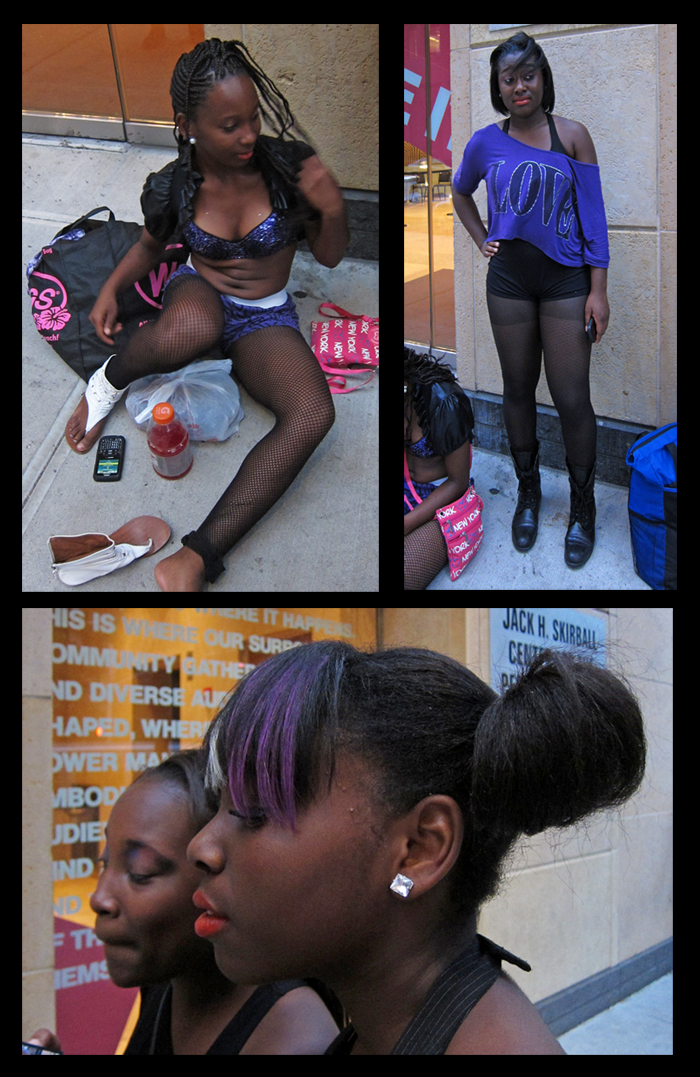
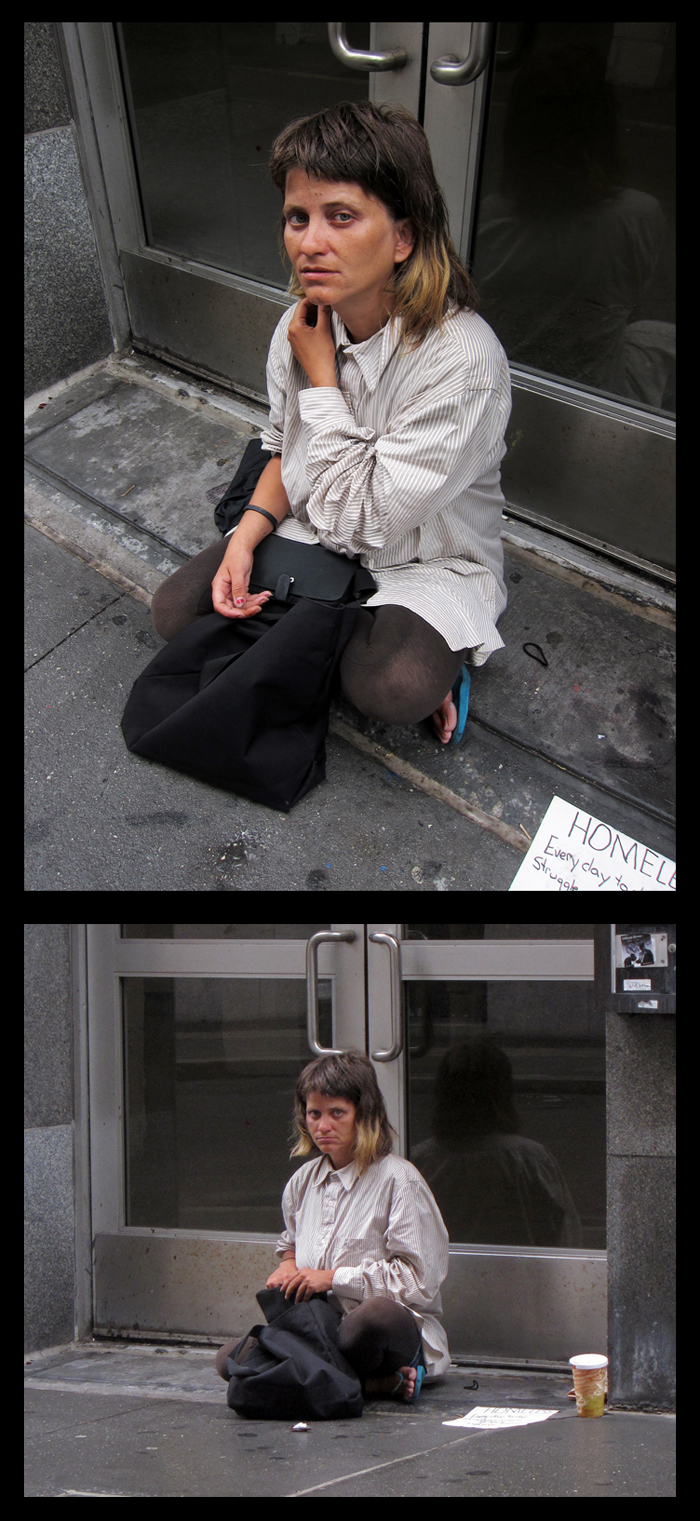
    I met the group of girls in the photo in front of the Skirball Center at New York University. They had just completed a hip hop dance competition, Blaze the Stage. They had LOST and were not pleased. They were from Florida. I asked how they got here, where they stayed, and who paid. They had flown to New York City, booked a hotel, and paid for it all themselves – not a cheap proposition for these girls.

    They were angry and told me they felt that the competition was RIGGED. I tried to get more details on the event, perhaps even to see a video of these girls and the winners to judge for myself. I was unable to find videos for 2011 or confirm the details of the dance competition, even after calling the organization.

    For many, the American dream goes something like: work hard, excel in your home town, come to New York City, audition at Radio City, be chosen to be a Rockette, and cry for joy with makeup running down your face. But there is also the classic shattered dream: work hard, excel in your home town, come to New York City, audition, not be chosen, and cry while removing your makeup alone in the dressing room or sit in the street outside the NYU Skirball Center.

    There are many coveted positions, professions, and competitions in New York City. There are many competitors, and often, only one will be chosen. Often, the level of talent can come as a shock to the newly arrived. I don’t know if these girls knew what they were up against, particularly a hip hop dance event in New York. With all due respect, I do not think that the event was rigged. Unless you mean by rigged that some win and others lose. Or, that only one wins and all the others lose.

    I’m glad my high school classmate was not around to console them. They did not need salt rubbed in their wounds by being told that anything except first place is…


    Related Posts: Have a Beautiful Day, Down to the Cellular Level, Number 1, Not So Kleine


  • The Agony and the Ecstasy

    The first in the family of the city daily photo blogs was Paris Daily Photo, created by Eric Tenin. His vision was to show a slice of daily life in Paris via photos. Inspired by the idea, a friend and I created New York Daily Photo in 2006. Since then, this site has evolved and become an altogether different entity, sharing all manner of people, places, and things through my eyes, not always necessarily to simply show a “slice of everyday life” in New York City. The postings have become much more story-driven.

    On a recent overnight trip, it occurred to me, as it often does, how preparing for a trip by car for the single traveler would be anathema and incomprehensible to anyone outside the city. So, for a basic trip that involves an overnight stay with luggage, and in the spirit of the original city daily photo blog, here is how I do it:

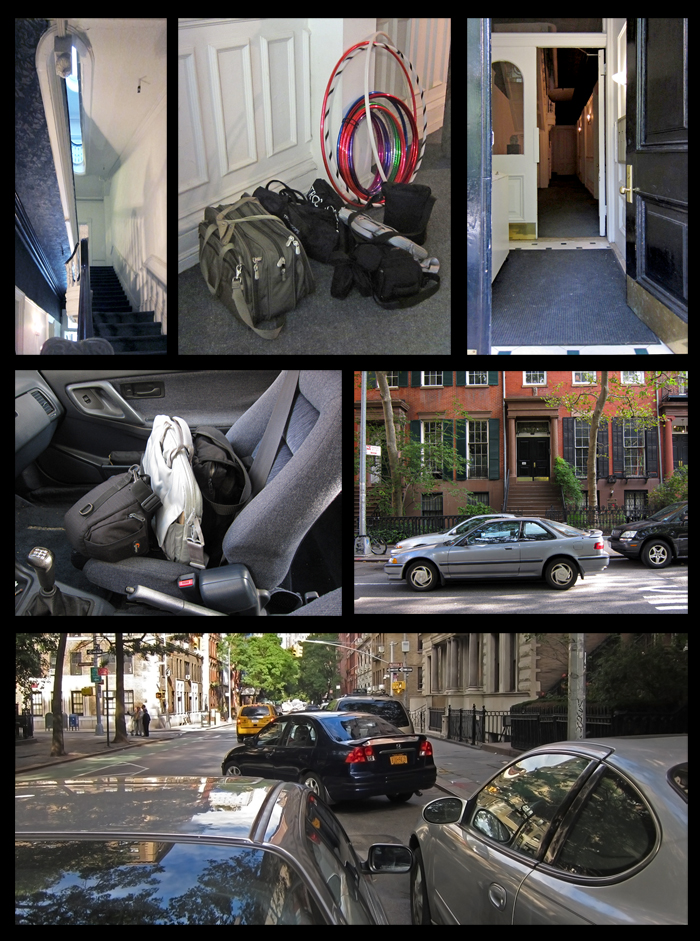
    I call ahead to the garage to get my car – they require at least one hour advance notice, so I have to plan ahead. Take all my belongings, probably two loads, to the lobby, always keeping the most valuable things with me at all times: three bags with shoulder straps containing my laptop, iPad, and cameras. I’m on the fourth floor with no elevator, so it’s up and down four flights of stairs (photo top left).

    I walk about three blocks to the garage, carrying the “valuables” with me and leaving those things which would be least missed if stolen while unattended in the lobby (photo top center).
    Even though I have called ahead, I still have to wait for my car to be delivered by the attendant. I drive to my home. Since it is near impossible most days to find a parking spot near my home, I have to double park in front of my apartment building with my hazard lights flashing (photo middle right). Now, I run in to the building with my valuables still slung around my neck. I unlock the two vestibule doors to the building and prop them open (with floor hooks) for easy in and out access (photo top right).

    I bring out my things, one load at a time, running, opening and closing and locking and unlocking my trunk on each trip, always carrying my valuables the entire time (photo middle left). I make one last trip to close both building doors. During this entire process, I always keep an eye out for the police to avoid ticketing as well as possible thieves.

    On the return of a trip, everything is reversed. Double park, unlock and prop open the vestibule doors, make trips unloading my trunk (keeping my valuables with me) leaving the less bulky and valuable luggage unattended in my building, drive to the garage, drop off the car, walk back three blocks, take the luggage up four flights, one load at a time.

    I open my apartment door and drop off everything. It feels good to be home. However, I reflect on the insane process needed to just load and unload luggage for a short trip and question why I and other New Yorkers go through all of this.

    On my last trip out of town, to add insult to injury, just after I completed my entire ritual, a car pulled out in front of me, leaving a parking spot right in front of my house (bottom photo). Yes, having a car in New York City is a privilege and a luxury. I am appreciative of that. However, it’s New York City, and most pleasures here come with a price, whether monetary or otherwise, and often cut both ways. It’s what’s behind that love/hate relationship with the city, rearing its head as the Agony and the Ecstasy 🙂

    Related Posts: Unforgiving, Ye Who Enter Here, Steaming Masses of New York, Dwanna


  • 212 and 2:12

    Many non-residents cannot fathom why New Yorkers tolerate so many extreme hardships, while life outside the city is in many ways so much easier and less expensive. I have created a category for some of my stories called Slings and Arrows, which illuminates many of these day-to-day dramas. In Dwanna, I told of how one new resident (who hailed from Tennessee) left nearly as quickly as she got here, even though she was ambitious, hard-working, and successful in finding a good job and housing. Her reason for leaving? Life was just too hard.

    But yet there are so many extraordinarily wonderful things about this city, many arguably not found anywhere else, particularly in such close proximity. It is this density of services and culture that led me to coin the phrase Sirens of Convenience to describe the city’s lure in spite of rocky shoals. So therein lies the key to understanding this whole perplexing situation:  New York City is not a place of moderation, it’s one of extremes, and for most, it’s a Love/Hate thing. When Love overrides Hate, then you’re a New Yorker. When Hate overrides Love, you don’t want to live here. Or, in the case of a long-time resident, he or she may be inclined to leave.

    Many New Yorkers who truly love the city obsess over iconic minutiae, such as having a 212 area code. This area code is one of the oldest in the United States, created in 1947. It was assigned to New York City because it could be dialed fastest with a rotary dial (at that time, 0 and 1 were not allowed as the first digit, the second digit was either 0 or 1, and the third digit could not be the same as the second digit).

    Hence, there’s a cachet to 212: it is historic, with implied roots and stability of the owner of the number, both residential or business. New phone numbers with the area code 212 are no longer available; someone interested in the area code must rely on getting a recycled number via luck or purchase such numbers through specialized websites. This prestige associated with a 212 area code was even used as a minor plot thread in a Seinfeld episode, The Maid. So, New Yorkers Love 212. As a long time resident of the city, I am pleased that my home and office numbers all have 212 area codes.

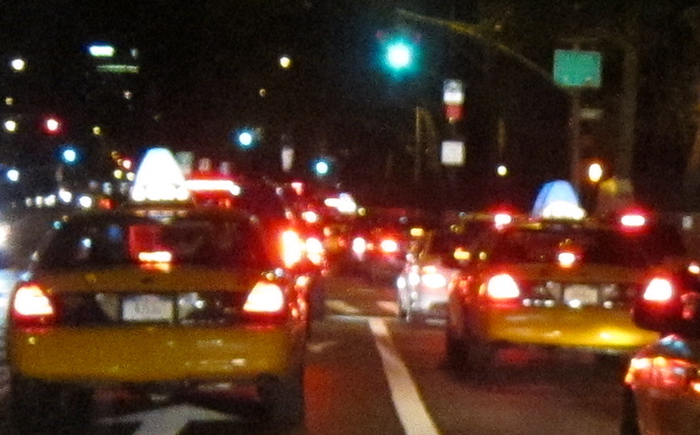
    But this weekend, I even found Love/Hate sides to 212. Saturday night, I was returning to Manhattan via the Manhattan Bridge, which courses up Chrystie Street. I was exhausted, and there was bumper-to-bumper traffic. Incredibly, it was after 2 AM, adding insult to injury. I just wanted to get home and sleep, but I was forced to slog up Chrystie and across Houston Streets behind a sea of yellow cabs and the cars of late night revelers, commuters, and what have you.
    In reviewing the photos this morning for exact time, I found in a serendipitous numerological twist that the exact time my photos were taken was 2:12 AM. I always knew the currency used to pay for New York City was a two-sided Love/Hate coin. Now, carefully examining both sides, I discovered it clearly marked: 212 and 2:12  🙂


  • Not Under the Gowanus

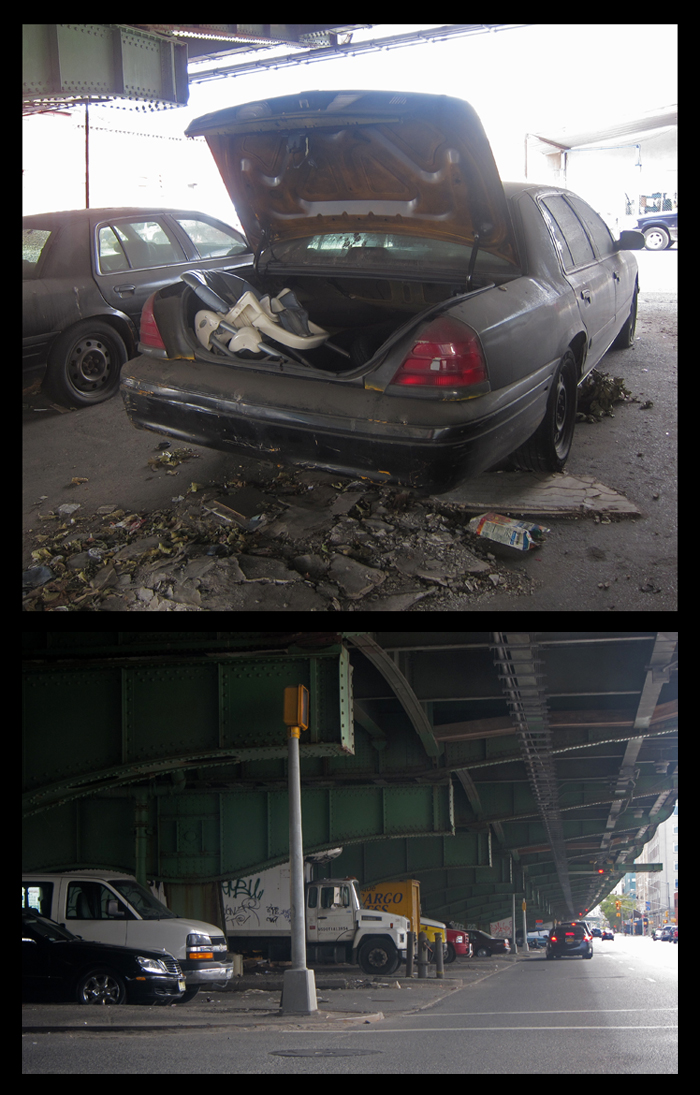
    There’s romance to the classic song Under the Boardwalk – the lyrics describe a tryst under the boardwalk in beloved Coney Island. But not every hiding place under an elevated structure is so romantic, particularly in New York City. I certainly would not want to meet anyone under the Gowanus Expressway, a highway elevated above 3rd Avenue in Brooklyn.

    The word Gowanus does not have a very nice ring to it, certainly not to a New Yorker who knows the Gowanus Expressway or the Gowanus Canal. Even the word itself seems unpleasant to me, if perhaps only by a long association. If you read the Wikipedia entry on the thoroughfare, you will not get the true picture. Take a look at the photos and see this offense to all things visual.

    For those who despise Robert Moses – and there are many – the Gowanus Expressway, built under his auspices, could easily be the poster child for the dark side of urban development. Deterioration has only added insult to injury. It does provide a much needed connection between various boroughs and through Brooklyn, but at a very hefty price, particularly aesthetic. The highway as seen from street level is hideous, blocks light, and dominates the avenue. There have been talks and plans over the years of taking the elevated structure down and replacing it with a tunnel, but, to date, nothing has been decided.

    This city really is a course in juxtaposition. The good abuts the bad, the beautiful abuts the ugly, the polished rubs against the rough. Clean meets filthy and rats run everywhere, unfettered by neighborhood or income. I should not have been so surprised to find these abandoned cars and burnt remnants under the expressway, but the whole scene was particularly shocking owing to the fact that I spent the afternoon in Greenwood Cemetery.

    Around every corner there is often a surprise, and I had just photographed a beautiful structure that has plagued me for years. It was a small surprise, and I will show you that soon (see Part 2 here). And it’s just a short trip around the corner, Not Under the Gowanus 🙂

    Related Posts: A Story About Nothing, There’s Nothing Here, Del Floria’s


  • Roaches

    I hate roaches.

    My friend had been swindled by drug addicts. She had paid “key” money for a low-income housing apartment in a city-owned building. When she went to take occupancy, the door was padlocked. She contacted management, who told her that things did not work the way she planned – these apartments were for welfare recipients and the needy, not a woman who just needed a cheap apartment. Through a miracle of persuasion (which included crying), my friend obtained a lease for an apartment she was not qualified for at a very low, $125-per-month rent. The place was in a small tenement building, but it was in the heart of the West Village. It was the coup of the century.

    I accompanied her on the first visit to her new place. It was disgusting, as would be expected with a place formerly occupied by drug addicts. Nothing, however, prepared us for the bathroom, which was not just roach-infested but where the ceiling was a TAPESTRY of moving cockroaches. So much so that we only peered in to avoid roaches falling on our heads. A roach bomb was required, as well as a cleanup of dead roaches.

    At one time, these kinds of opportunities in Manhattan housing were not uncommon. Most remarkable were the SQUATS. In retrospect, squats are almost unfathomable – apartments for the TAKING. Of course, squats are romanticized. Who really has the fortitude to live in horrific conditions for decades? These buildings had the most awful conditions imaginable. But, after the fact, they certainly are the envy of many a New Yorker, particularly those without substantial means.

    From the Villager:

    The East Village was then full of vacant buildings the city had taken possession of for landlords’ failure to pay property taxes. Many of the properties were severely damaged, needing extensive repairs that would daunt even the most experienced professional contractors. Doing all the work themselves, the squatters were rehabbing the burned-out tenement shells, transforming them into viable living quarters, bringing life back to desolate blocks.

    In a series of high-profile clashes — particularly on E. 13th and E. Fifth Sts. — the city forcibly evicted many of the squatters in the 1990s. But in 2002, City Hall took a radically new approach: Eleven of the 12 remaining East Village squats were sold for $1 apiece to the nonprofit Urban Homesteading Assistance Board. Under the agreement, the squatters, with UHAB’s guidance, would bring their buildings up to code within one year, then buy them — for just $250 per apartment — and the buildings would become permanently affordable, Housing Development Fund Corporation, or H.D.F.C., co-ops.

    The deal between the squatters and the city was historic, making headlines around the world. Now, more than six years later, a number of the 11 squats are set to undergo formal conversion to co-ops in the next few months. All of them should be converted in 18 months to two years, according to UHAB.

    Similarly, although not a squat, my friend also took possession of her apartment; the building was purchased from the city by the tenants for a nominal sum of money and turned into a co-op. Each tenant purchased his or her apartment at an extraordinarily low price. The coup of the century got even better.

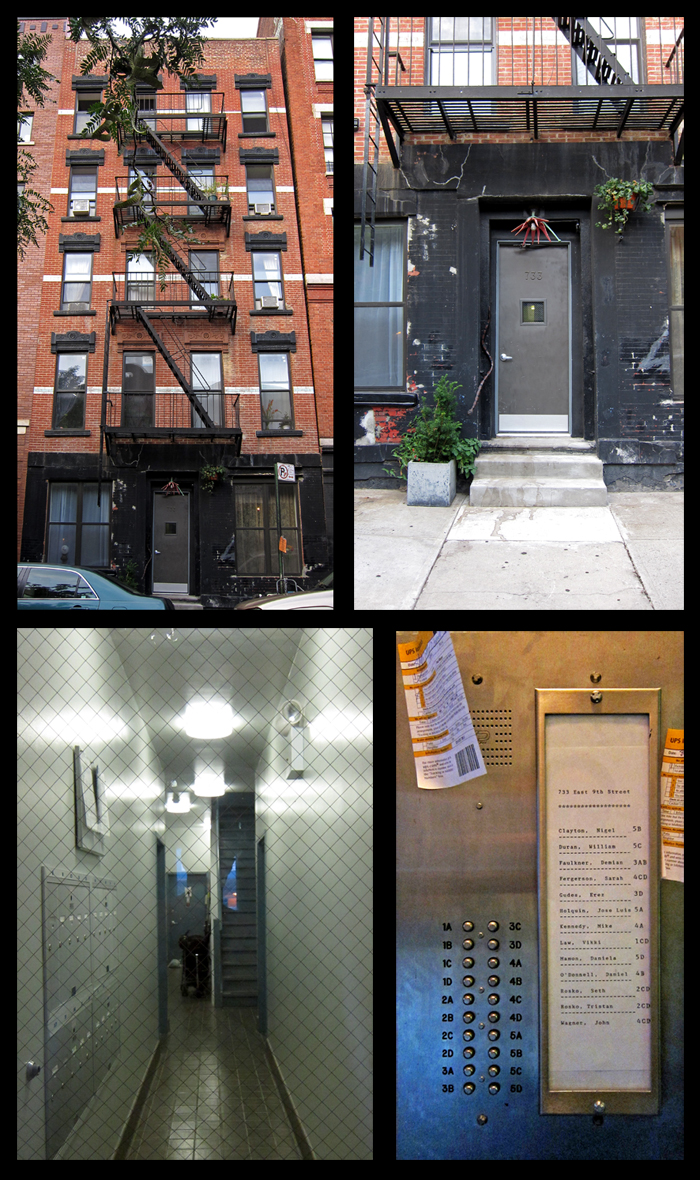
    I recently met Mike Kennedy at a concert in Tompkins Square Park. He currently lives in one of the landmark East Village squats at 733 East 9th Street, one of the properties ceded over by the city to the tenants in 2002 for $1. It has been a long road for them, and whatever “windfall” they may have received was well earned. I am sure that on their long and winding road, there must have been many ROACHES 🙁

    Related Posts: That’s What You Pay For, Mike Fontana Part 1, Old New York Part 2, Listen to the Birds, The Feeling Passes, Every Inch Has a Price, A Place Called Home, Washington Square North


  • Urban Hustle

    I arrived in northern Italy very late one night with a companion. We were not in the best of moods. Our reservation for an inn south of Florence had been placed by mail and was never received. They were booked solid. We drove north to Florence in hopes of securing a place to sleep for the night. We were relegated to the only place in the city with a room: a very overpriced hotel.

    We had rented a car, and the hotel was located across from a train station. Adjoining the station was a municipal parking lot. Attendants in uniforms and caps were busy directing parking and collecting fees for overnight parking. I recall that the cost was around $10 – a fair amount at the time. The next morning, we examined the signs and realized we had been hustled; parking was free. With audacity, aggressiveness, and a few uniforms, those men had established a nice little night business with no overhead or taxes at the expense of ill-informed visitors.

    In New York, the hustle takes on many forms tailored to to the city: chess playing, cigarette sales, subway swipers, three card monte, umbrella sales, highway water, flower sales, etc. Some activities are illegal, while others are just aggressive opportunism.

    One variant of the street hustle is taking advantage of a captive audience dining al fresco on the sidewalks of the city. New York has few restaurants or cafes where outdoor dining is reasonably buffered from non-diners
    (see Insult to Injury). Flower vendors will sometimes accost diners, as well as the homeless asking for money.

    Over the years, I have seen a number of instances where individuals with pets, particularly unusual species, are demanding to be paid by onlookers who want to take photos. In 2006, I wrote Snake Charmer about a man with a snake, alligator, and macaw. More recently, I encountered a man with an enormous pet iguana on a leash in the park, demanding money as we took photos. Of course, photography in a public space for non-commercial use is perfectly legal, but many will try to intimidate amateurs and tourists into paying for the “privilege.”

    Here, in the photo at the Trattoria Spaghetto on Carmine Street, we have a hustle which combines the captive diner with the paid photo op extortion. As diners, passersby, and I took photos, Mr. Zoo York “asked” for payment.

    Whether late night in Florence or by day on the streets of New York, adapted for the time and place, you will always find some variant of the urban hustle…

    Related Post: Fung Wah


  • Caught in the Rain

    One of the constants in New York City is the homeless. And one constant within that world is seeing the same homeless. Most are battling with drug addiction, clinical depression, and any other number of physical and/or mental disabilities, making it very difficult for those individuals to climb out of the hole into which they have fallen.

    I have never battled with severe depression or a feeling of general hopelessness. The brief bouts of depression that we all encounter are enough to provide a glimpse into that dark world of the defeated spirit. And, to be honest about it, how much hope can we hold out to a homeless person? In some cases, they may have been well-schooled and may have had a career. But what about the person who had not even graduated from high school and has no marketable skills at all?

    As an employer, I am saddened to see people in this state. What is the possibility of an individual cleaning themselves up, reschooling, or training and going out to compete against others in the job market? Who would hire someone who is formerly homeless with a poor track record over someone with a better work history? Business owners generally hire on merit and qualification, not on a philanthropic basis.

    On Tuesday, August 14, 2007, I wrote a story about a homeless woman, Stephanie, whom I had seen on a regular basis in SoHo. Since that time, I have seen her in the Village, albeit much less frequently. I have often said hello, reminding her of who I was. She generally acknowledged that, but I have no idea whether she really remembers me.

    I caught up with Stephanie recently on the weekend of our recent tropical storm. She looked much cleaner and better dressed than I have ever seen her. I complemented her and she thanked me. She said she had been spending more time in shelters. I asked if she was a drug user, and she said no. Our conversation was quite short.

    I knowthat misfortune has befallen Stephanie, and as I parted, I had no interest in being disingenuous and leaving her with some cute aphorism laden with false hopes. I went for something useful within her capability: Don’t get caught in the rain.

    Related Posts: Crusties are People Too?, Because It’s Not


  • Have a Beautiful Day

    Please Click and Play Audio Clip to Accompany Your Reading:

    Today I’d like to share with you what it’s really like here. Not some sanitized, candy-coated, pretty, inspiring view of this city with false promises.

    What’s it like to live in New York City? As Professor Gurland would agree, you’re gonna get bruised. It’s an abusive relationship, but in this case, there’s no one to call for professional help.

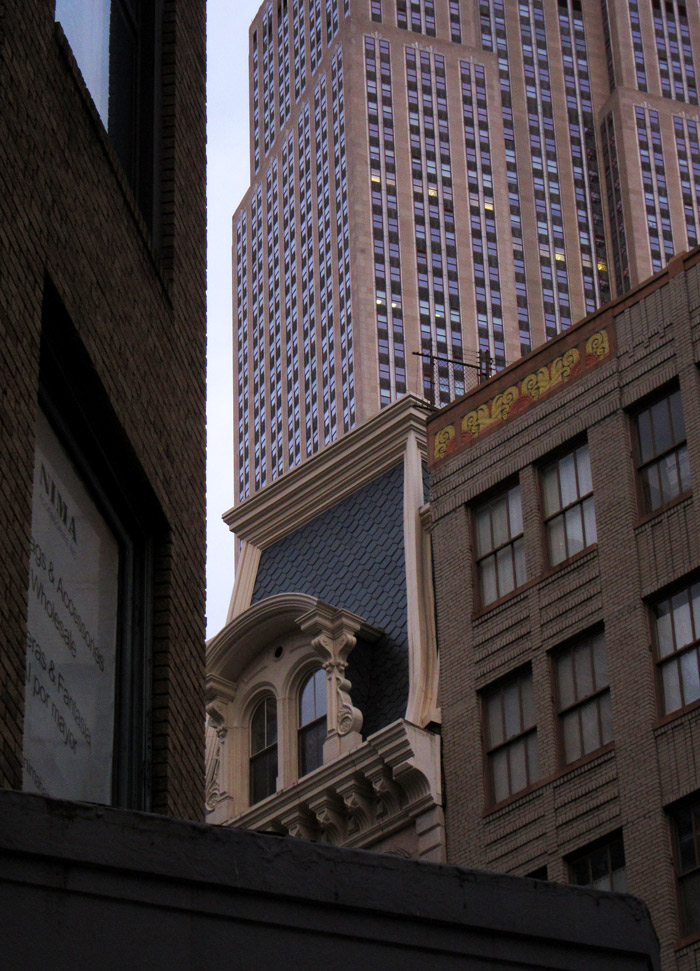
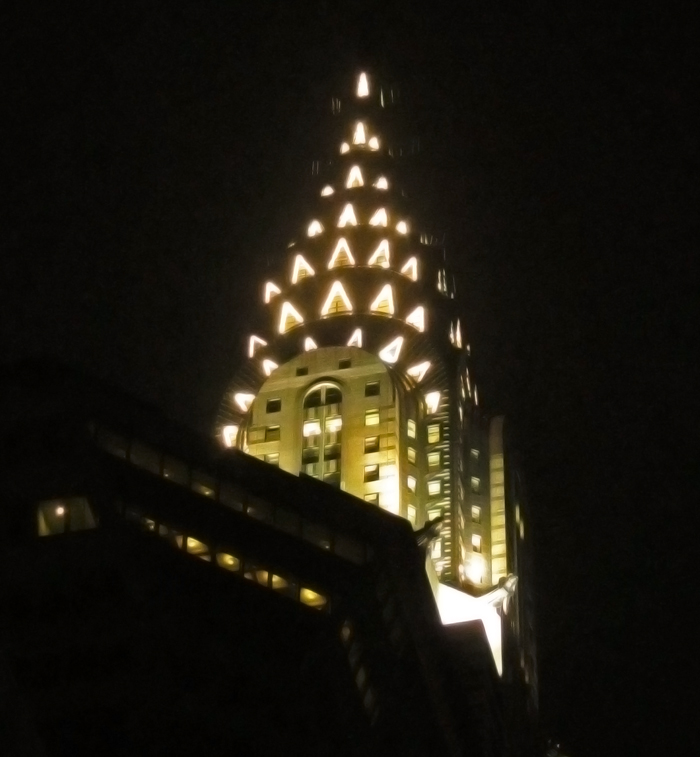
    You’re going to have to look at scenes like that in today’s photo. Why do I say “have to”? Because on some days, you’re going to feel inspired by things like the Chrysler Building, a glorious living testament in steel and stone of what man can achieve. But at other times, you’re going to be asked, do you measure up? Do you have what it takes to live here?

    Giants are everywhere you turn. There’s nowhere to hide. They tower above. You’re silently being judged. Can you make it? Don’t be deluded by Lady Liberty in New York Harbor. Yes, she’s welcoming of all, but she’s a siren, ready to send you back as fast as you got here. The exit door is bigger than the entryway.

    Does it sound angry? Arrogant? I’m sorry, yes it is. Overachievers dominate the landscape. Genius is around every corner. I didn’t make the rules.

    But it’s not hopeless, and the prize is worth being a contestant. If you need encouragement, look a little more closely at Lady Liberty – there may be a wink and a smile.

    Oh, I almost forgot. Have a Beautiful Day 🙂


  • Overblown


    My father used to find news coverage of snowfall in Connecticut to be comical. Coming from northern Maine, one of the most inhospitable winter environments imaginable, the warnings, preparations, and particularly the news coverage of snow seemed rather ridiculous in comparison.
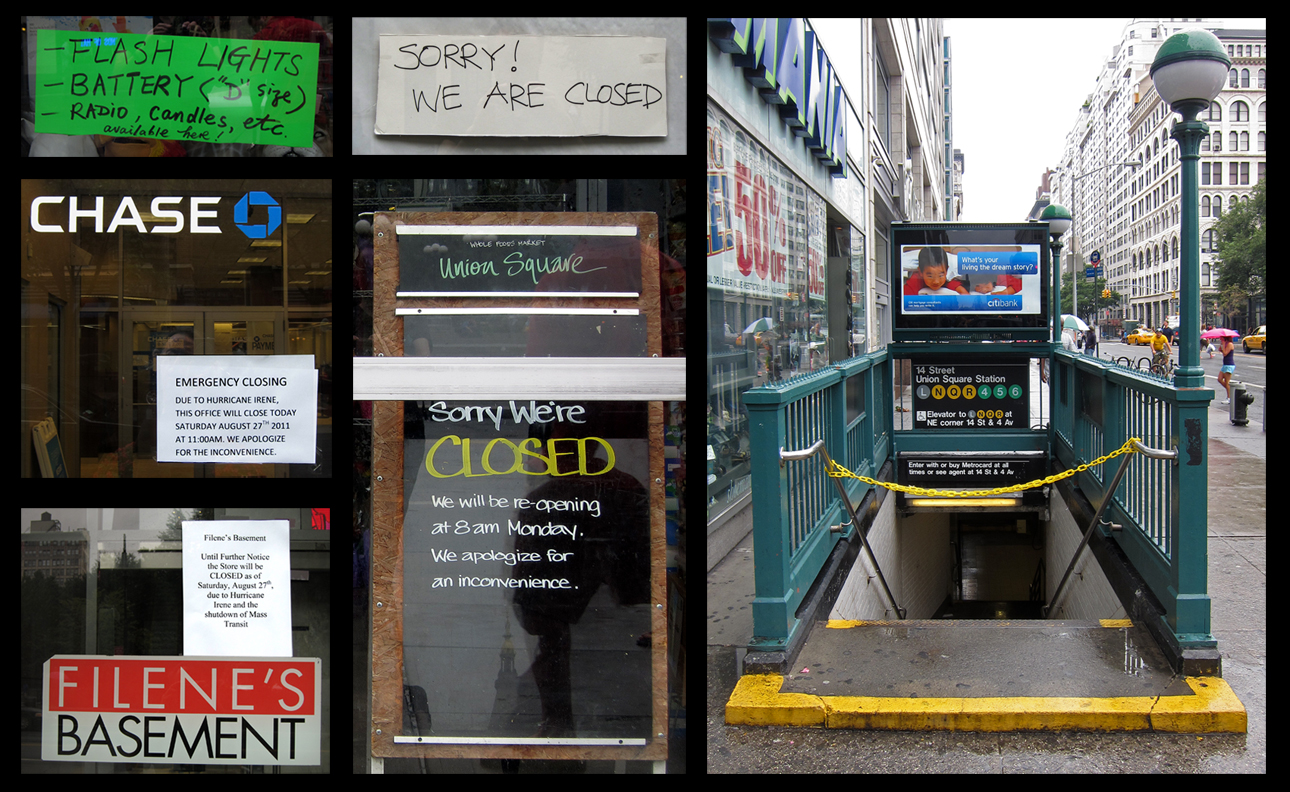
    On Saturday at Union Square, I had an encounter with a woman of similar mind – originally from Florida, she considered the concern to be overblown.

    Admittedly, the city is a complex web of services and systems with an enormous population and businesses. For a natural disaster to occur in New York City, the financial impact as well as human suffering is tremendous. So it is prudent to prepare.

    The problem, however, with “better safe than sorry” is that the cost of preemptive measures is very high and would seem like a huge waste if a storm proves to be much less damaging than expected. The Mayor Bloomberg administration was criticized for its lack of adequate preparation for the blizzard of December 26, 2010. Deputy Mayor Stephen Goldsmith told the City Council, “We owe you and all New Yorkers for that lack of performance our administration’s apology and my personal promise not to let it happen again.”

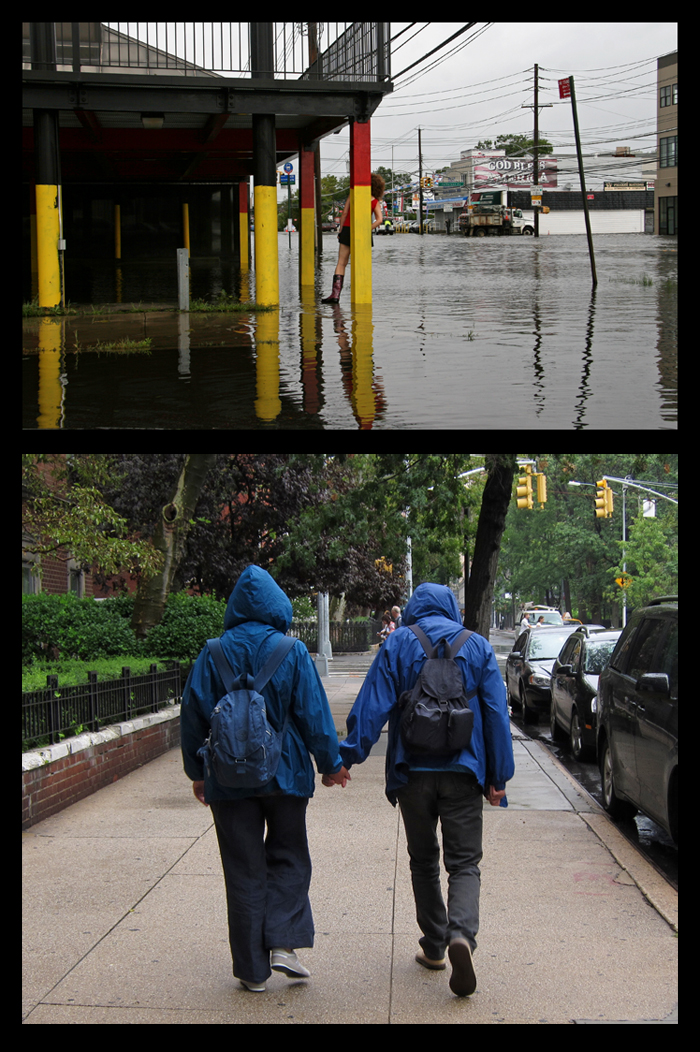
    The city came well prepared for this storm, although many felt that the level of preparation was overdone. Subways and buses were shut down. 370,000 residents were placed in mandatory evacuation zones. By Sunday, the city was the quietest that I have ever seen. With workers without public transportation, business openings were impossible.

    Not to minimize the real damage that the storm caused or the personal misfortune, but in hindsight, where vision is 20/20, Irene has blown over and looks overblown…

    Photo Notes: Top – various locations around Greenwich Village. Center – Hylan Boulevard in Staten Island. Bottom – Washington Square North.

    Related Posts: White by Design 3, We’ve Got Skiing Too, Friends Part 1 and Part 2, Brooding


  • The Comfort Zone

    Comfort Zone: Range of minimum and maximum exposure or risk within which an entity can operate without coming under undue stress.

    For many, living in New York City would be outside their comfort zone. What many visitors or non-residents do not see, however, is that those of us who live here do not live continuously in the world of the visitor. We do not spend large blocks of time checking in and out of hotels, dealing with airport security, fighting crowds in Times Square, waiting in line for various attractions, or packing in an inordinate number of activities in one weekend. Also, consider that only 20% of residents live in Manhattan and that many neighborhoods in other boroughs have a much more relaxed atmosphere.

    Of course, all that said, life in New York City is not as comfortable as suburban or rural life can be. Even the stalwart New Yorker needs a break from time to time. To cope, we seek out and find respite in places, routines, our loved ones, and friends. If you are lucky, perhaps you have a quiet apartment in a peaceful neighborhood. In the last five years, I have shared many of the special or lesser known places that provide escape from the city’s stressors.

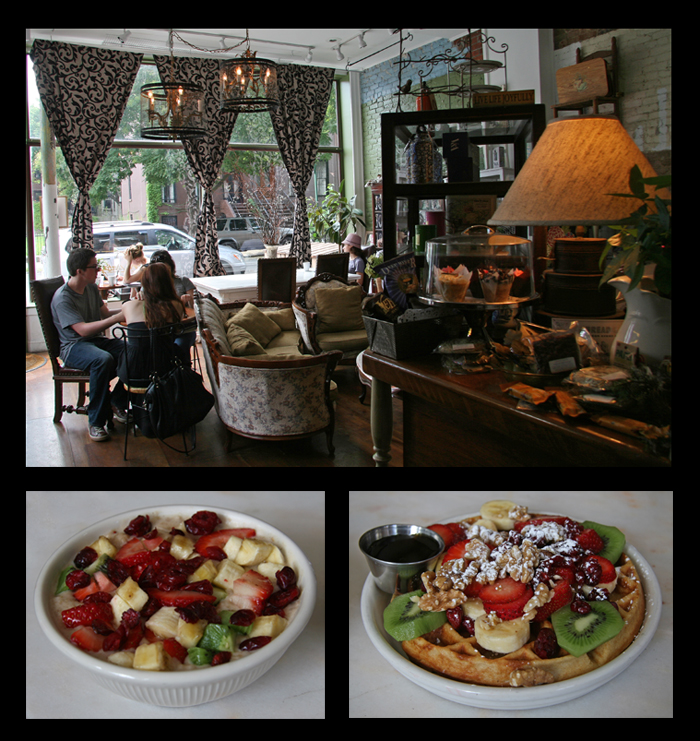
    For many, Sunday in New York City is a day of rest. Or, perhaps better said, a little more rest than usual. To find a comfortable spot and relax. And for comfort, nothing beats breakfast or brunch in a charming cafe in a quiet neighborhood on a tree-lined street on Sunday.
    Like the Urban Vintage Boutique and Cafe at 294 Grand Avenue in Clinton Hill, Brooklyn. Here, the ambiance is like that of a 19th-century French salon.

    Urban Vintage sports a plush interior, with comfy upholstered seating, soft lighting, dark woods, and well appointed touches throughout. The food is very good, and it would be an injustice to call it “comfort food,” as comforting as it may be. My companion who introduced me to this cafe/boutique touted the oatmeal as “the best,” and it certainly was wonderful, as were the Belgian waffles.

    Places like this are small worlds that stand apart from the hustle and bustle of New York City. When entering a place like Urban Vintage, I am reminded of the introduction to the TV series The Twilight Zone, but with a different twist:

    To go through their door is to enter another dimension. Not just a dimension of sight and sound, but a dimension of mind. A journey into a soothing land. You’ve just crossed over into The Comfort Zone.

    Related Posts: The Tide Pool, Grab a Bite to Eat, When Your Name is Mud, Fire and Ice, Worlds Unfolding, Gotta Get Out


  • dinamic_sidebar 4 none

©2026 New York Daily Photo Entries (RSS) and Comments (RSS)  Raindrops Theme