• Category Archives Slings and Arrows of NYC
  • Flailing and Hailing

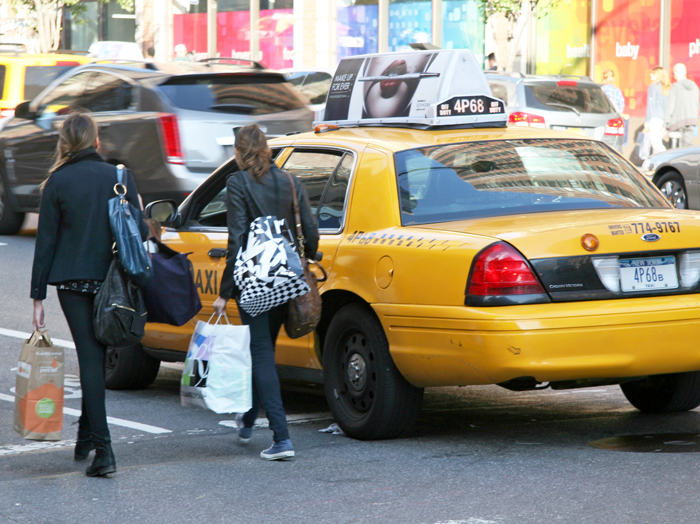
    One of the most frustrating things for me to observe are people in the streets uselessly trying to hail a taxi, either by a) standing with an arm outstretched a la Our Lady of Liberty or b) frantically flailing their arms, when there is either no taxi in site or there are no taxis which are both unoccupied and on duty. I am convinced that very few understand the roof light system in use and its permutations. However, most have better things to do than study the New York City Taxi and Limousine Commission (TLC) rules and regulations files, which run hundreds of pages. So, as a former New York City taxi driver, let me extract the most salient pieces that actually impact the use of taxis, including roof lights.

    On the roof of every taxi, there is a 4-digit taxi license number. When lit, the taxi is available, when unlit, it is occupied. On either side, there are the words “off duty.” When lit, technically the cab is off duty, typically heading back home; when unlit, the cab is available for hire or hired. What no one explains is that these lights can be lit or unlit in all four combinations and their meanings. So in the spirit of Pascal’s Wager, I offer:

    1) Number lit, Off Duty unlit: This is your main target. The taxi is on duty and unoccupied/available.
    2) Number lit, Off Duty lit: Off duty and unoccupied. This is the thorny one. Technically the driver can pick you up if your destination is on route to his garage or home. If you are aggressive and approach a driver who is headed roughly in your direction, he may oblige. However, this is also the scam setting – many drivers will do this in order to be selective about who they pick up and where they will go, a violation of TLC rules.
    3) Number unlit, Off Duty lit: The taxi is occupied as a result of condition 2.
    4) Number unlit, Off Duty unlit: Typical occupied condition. The taxi is on duty and has a passenger.
    Rule of thumb – keep an eye out only for taxis with the center number lit, and in the case of those also with the Off Duty lit, try to grab their attention and negotiate.

    Another important thing to understand is that a yellow medallioned NYC taxi must take you anywhere you want to go in the five boroughs of New York City and by any route you choose. The women in the photo were heading to Brooklyn. The first cab they approached turned them down after they indicated they wanted to go to Brooklyn. It is not necessary to ask a driver on the street if he or she will go to your destination. Get in and tell him where you want to go. In the event of any refusal or other problem, make a note of his ID number, call 311, and report him.
    From the TLC website:

    §2-50 Refusals.

    (a) A driver shall not seek to ascertain the destination of a passenger before such passenger is seated in the taxicab.
    (b) A driver shall not refuse by words, gestures or any other means, without justifiable grounds set forth in §2-50(e) herein, to take any passenger to any destination within the City of New York, the counties of Westchester or Nassau or Newark Airport. This includes a person with a disability and any service animal accompanying such person.

    I hope this mini taxi guide will keep you from unnecessary flailing and hailing 🙂

    Cool Taxi Posts: Taxicab Fever, Garden in Transit, Insults to Injury, Jersey Girls, What numba Kissena, Sea of Yellow
  • Covenant of the Keys


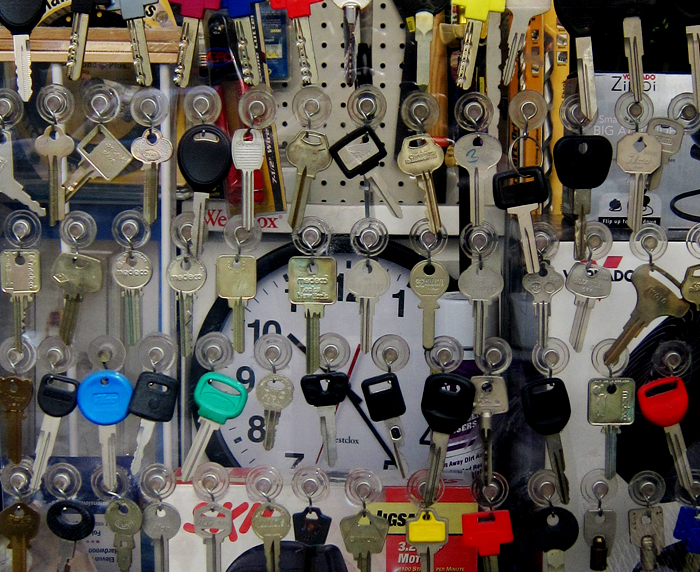
    Where my family grew up, in northern Maine, houses were not locked. If you needed to borrow something, you would just let yourself in to that neighbor’s home, take what you needed, and leave a note. With large families and little means, cooperation was a survival issue, and privacy was not part of the lifestyle. There are still many places where doors are not locked.

    Although New York City is infinitely safer than it was 40 years ago, that does not mean security is no longer an issue, nor does it mean you can let your guard down. I lock car doors everywhere I go, even at my family’s home in the country. If you click here, you will see an extraordinary photo for a New Yorker – the only time I have displayed a photo from out of state on this website to illustrate a point.

    Keys, therefore, take on a much larger meaning here. So much so, that an entire episode of the TV series Seinfeld was about apartment keys. In this episode (The Keys), with complex arrangements of loaning and borrowing, keys take on mythic proportions. In one scene, Kramer says: 

    No, no, no, it’s o.k. I don’t care about the keys. It’s my fault. I gave the keys away with my stupidity. I broke “the covenant of the keys.”

    I don’t want the keys back! No, I’m glad the way things turned out. I was clingin’ to those keys, man! Like a branch on the banks of a raging river. And now I have let go. And I’m free…to go with the current. To float. And I thank you.

    In another scene, Kramer says:

    Because you see, George, having the keys to Jerry’s apartment? That kept me in a fantasy world. Every time I went over to his house, it was like I was on vacation. Better food, better view, better TV. And cleaner? Oh – much cleaner. That became my reality. I ignored the squalor in my own life because I’m looking at life, you see, through Jerry’s eyes. I was living in twilight, George. Living in the shadows. Living in the darkness…like you.

    Although an outsider may see this as a nonsensical, farcical indulgence of one of life’s minutiae, it is not. In a large city like New York, there is no transparency regarding homes or lives. Often you may be acquainted with someone for years and perhaps only know that person’s building address or neighborhood, having never seen his or her apartment. Our homes here are sacrosanct. In tandem with the security issues, to give someone keys to your home is the ultimate act of trust. If someone ever entrusts you with their apartment keys in New York City, please act responsibly, lest you break the covenant of the keys


  • With Impunity

    There are apt metaphors for New York City – readers here know that I am particularly fond of the city as a Jungle (as I wrote in Jungle Lovers). However, there are metaphors, and I do believe there is a lawlessness here that makes this city feel at times like the Wild West.

    I recall in the 1970s being told by a friend that he had been mugged in the West Village for $20. He subsequently saw the perpetrator some days later in the East Village and yelled, “Hey, you owe me 20 bucks.” I don’t recall if my friend was reimbursed, but in less enlightened times, that man would be behind bars very quickly.

    In Washington Square Park, e.g., the police know the drug dealers well, and the dealers know that the police know who they are. They often chat. And they conduct business with impunity. Why? There are a number of reasons, including the fact that the drug sellers know the law and have established a system of steerers, touts, lookouts, and actual dealers, enabling them to work in a way that makes arrests difficult. Also, prisons are overcrowded, and there is community opposition to new facilities. Often, drug dealers who are arrested are back on the streets in a day or two.

    Here, home of the ACLU, police officers must be careful of what they do and how they do it. They know they may face harsh retribution for improper procedures and actions. I have spoken to officers who have said that they feel that their hands are tied and they are often disinclined to make arrests.

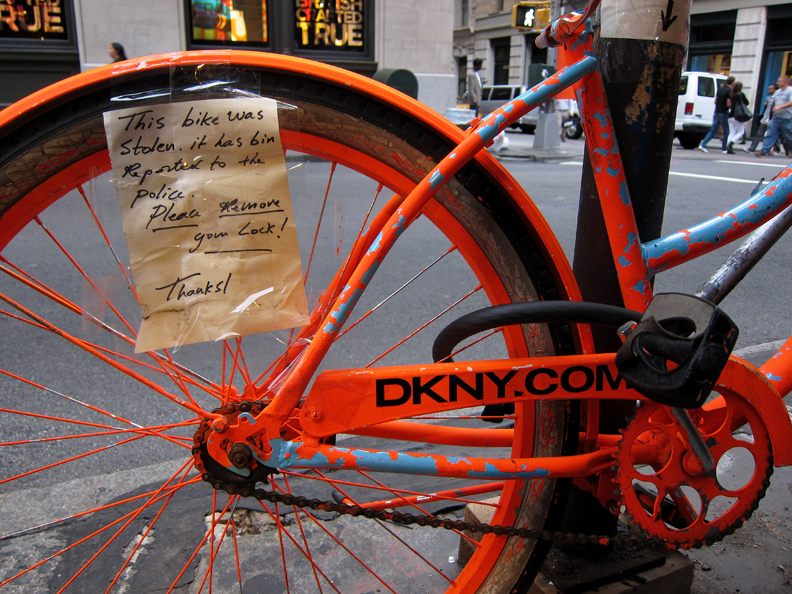
    The New York City criminal is very street smart, savvy, and crafty, and uses all this as a weapon to ply his trade. Thieves know what to do and how to do it. And they steal flagrantly and event flaunt their wares. The bike in the photo was found on Spring Street in SoHo. These orange DKNY bikes were originally part of a promotion, which I wrote about in Orange You Glad. Apparently, the new owner of the bike feels comfortable flaunting his new acquisition on Spring Street. Be glad it is not your bike, because in the Wild West, cowboys often steal with impunity 🙂


  • Veneer of Their Lives

    From time to time, I need a reality check to put things in perspective. At one time, I occasionally turned to a good friend who had moved to the West Coast. He had a very worldly perspective, having traveled extensively to all corners of the globe. See Weather Means Whether here.

    As I have written in stories such as The Dark Ages, New Yorkers often have to tolerate very poor living conditions, even when paying substantial rents or purchase prices for apartments. Among residents, this is often a source of humor, jokes, and sarcasm. The non-resident or visitor often sees displays of wealth in New York, but these glimpses of the city are just a veneer and often do not give the full picture.

    The single biggest factor in living in this city, regardless of whether a person owns or rents, is that with little exception, the vast majority of residents live in multiple-unit dwellings, i.e. apartment buildings. In this environment, you lose control. Tenants above, below, and to the sides of you are a perennial concern and often a source of noise etc., frequently with little recourse.

    On one occasion, said friend was in my apartment when I was feeling particularly shut in and frustrated by my various living conditions. Having a sense, however, that things could be much worse and that perhaps I was rather an ingrate, I asked him his honest assessment of my abode. After a moment or two of thoughtful contemplation, he said that in the scheme of things, I had a pretty good situation.

    Romanticizing the past can also be a case of seeing only a veneer. In Better When, I discussed the illusory sense that times were better in the good old days.
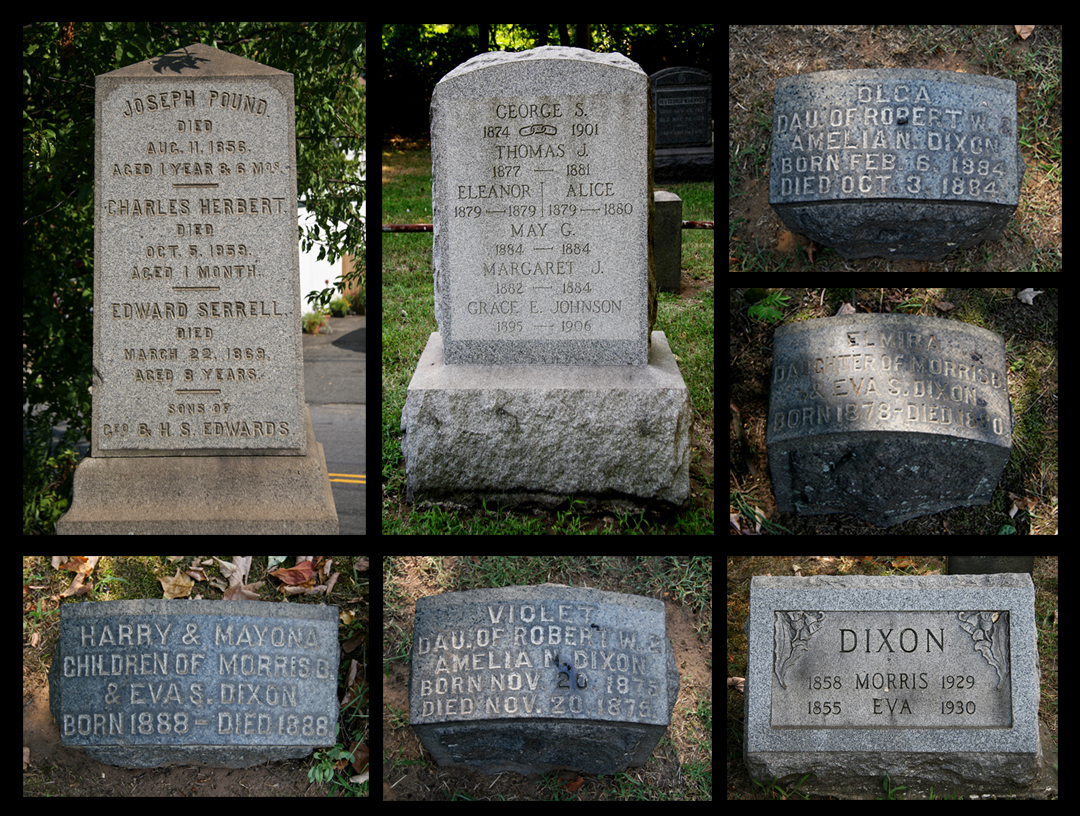
    Strolling through St. Luke’s Cemetery, on Arthur Kill Road in the Rossville section of Staten Island, provided the reality check I needed. A photographer friend who accompanied me pointed out how many grave stones of children there were. (If you click to enlarge the photo, you can read the inscriptions). As we strolled the graveyard, I found it quite sobering, particularly the family of Morris and Eva Dixon, whose many children lived only some months to 3 years. I was heartened by their own headstone (lower right photo), noting that they were born 3 years apart (1855 and 1858) and died within one year of each other (1929 and 1930). I hope the Dixons had their joys as well as misfortunes and that these headstones serve only as a veneer of their lives…


  • Just Like Old Times

    In most places, eight police vehicles and a swarm of officers pursuing a drug bust is a serious event. On Saturday night in Washington Square Park, at 11:30 PM, various vehicles came hurtling at high speed from all directions – two unmarked black cars, a taxi (used by police), and several regular NYPD vehicles. They easily and quickly trapped the perpetrator, who offered no resistance, only saying, “What?”

    It had all the drama of a major arrest of one of America’s Most Wanted, but my understanding was that this huge show of force was just for the arrest of a drug dealer caught making a transaction. I say “just” because selling drugs is an everyday and all day activity in this park.
    If you look at all like a potential customer and are strolling through Washington Square on a busy day, you will be offered drugs by numerous dealers at a number of key locations – strategic intersections where most pedestrians have to pass through. The mantra “smoke, smoke” is familiar to all habitués here and is just laughed off as part of the natural environment and business as usual.

    Drugs have been regularly sold in Washington Square Park since time immemorial. Dealers are well-known by regulars in the park and the police. The miscreants are quite well-versed in the law and know how to operate their business in a way to generally avoid arrest. The activity had virtually disappeared since the recent renovation (see here) but, as would be expected in New York City, and particularly in this park, drug activity has crept back in and often feels just like old times.

    What is ironic, and would be perhaps astounding to nonregulars, is that a regular group of musicians and singers continued their musical activity just steps away from all the commotion, completely undaunted, unfettered, and apparently uninterested.

    Rather than a cause for alarm, surprise, disruption, or curiosity, the whole affair just seemed to add voices to the backup singers. Guns, police running, screeching tires, searchlights in the bushes, sirens, and handcuffs were all part of a comforting ambiance that made everyone feel that it was just like old times 🙂

    Note: On August 6, 2009, I wrote Chess Monsters and told of an incident where I witnessed a shooting, yet incredulously, while players ran for cover, an onlooker stopped the chess clocks during the incident and playing resumed, barely missing a beat. You can read the story here.

    Postings on Washington Square Park: Out There, Conflux, Hawk Fest, Evening Arch, Twelve Tribes Arrive, New York Nymph, Bluegrass Reunion, Cloud Appreciation, I Am Legend, Birds Sing at Night, Rats Gone Wild, Piercing Al Fresco, Police Riot Concert, Artiste Extraordinaire, Comfort and Joy, Livid, Flash of Light, Delivery, Dog Run, Sounds of Summer, Krishna, Spring Madness, Back to Boyhood, Hookah, Lockout, Danger and Caution, Obama, YouTube Meetup, Dachshund Octoberfest, Music Speaks for Itself, Park Night, Petanque, Washington Square North, Nested Embraces, Left Bank New York


  • At Least It’s Water

    Posted on by Brian Dubé

    In Back to Our Main Feature, I wrote that “the gifts nature bestows and the power she wields often feel secondary in a city like New York.” Often, however, does not mean always, and even in the Big Apple, Mother Nature can show a dominant hand and deal a heavy blow – particularly, summer heat. As with other areas of the country, this summer has set all-time records. Nothing is more oppressive than summer in the city – ambition to do anything withers in the blistering heat.

    I had a friend who went to school in Miami, Florida. I asked how anyone could tolerate summers there. He assured me that no one spends time or walks outdoors – all human movement is from one air conditioned environment to another – car, store, home, etc. The problem in New York City is that everything you do involves some walking. Even getting a taxi means standing in the street, sometimes with no success.

    Subway platforms, although underground, offer no respite. They are subterranean infernos. The asphalt streets are like beds of lava, conducting heat to all who dare to stand on them. Tree shaded streets are few, and we walk in the shadows of buildings if the time of day is right.

    Virtually everyone I have spoken to has had the same solution – stay in during the day, go out in the evening (if at all), and wait the heat wave out. Even in this fast-paced city, where residents are undaunted by virtually anything, summer heat is suffocating and its effects visible everywhere and affecting virtually everything – shopping habits, work, and recreation.

    For those who do not leave the city, heading for water is one solution, but New York City has few options. Sprinklers are sometimes mounted on fire hydrants for children. The beaches of Coney Island, Brighton Beach, Jacob Riis Park, and Rockaway are popular. For those who do not live nearby, you could travel there, given that you are willing to make the long journey and be accompanied by (literally) a million other relief seekers. Buses are also available to places such as Jones Beach.

    In Washington Square Park, the newly renovated fountain has been a water park both day and night for adults and children, with spectators sitting around the fountain’s edge, watching the aquatic antics, and cooled by overspray.

    Lincoln Center’s fountain (in today’s photo) lures people in all year, and although immersion is not an option here, no matter how real or illusory its cooling effect is, at times like this, at least it’s water

    Other Fountain Posts: Water Sprites, Bethesda Fountain, Signs of Summer, Bad Hair Day, Trapped in Paradise, Remembering, Double Your Pleasure, Verdant Oasis, Gallivanting, Shag Carpeting, Cup Runneth Over

    Posted on by Brian Dubé

  • Blocks of Ice

    Posted on by Brian Dubé

    Like a pediatric prescriptive for the parent and desperate to show empathy and concern, city officials have made the usual hot weather warnings and announcements with gestures such as mobile cooling stations with free drinking water.

    But what can really be done about a crushing heat wave with temperatures over 100 degrees? Nothing. Just wait it out. You either have air conditioning and/or fans at home or not, and you either work in A/C or not. Plain and simple. The word that best describes New York City’s recent record smashing temperatures is blistering. Direct sun on the skin feels like it is literally being cooked.

    I empathize with those who must work outdoors in this heat. I had a brief conversation with New York City police detective Johnson, who was in Union Square in full uniform with temperatures hovering around 100 degrees. I asked how he could possibly tolerate the heat in full uniform – polyester, bullet proof vest, pants, heavy shoes. He replied that it isn’t easy and he just tries to stay hydrated.

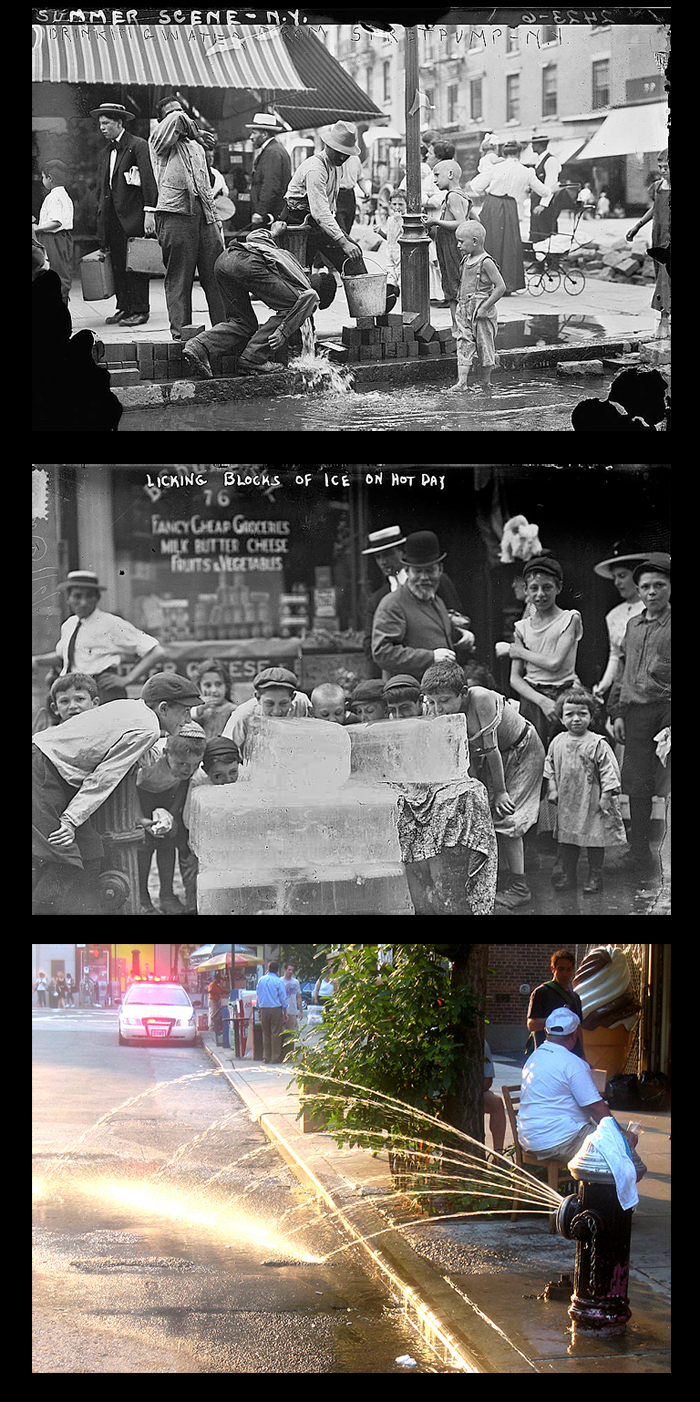
    None of the solutions offered to the populace are particularly new or novel – wear light clothing, stay hydrated, keep your blinds drawn, etc. In a world with extraordinary technology, ubiquitous WiFi, video telephony, organ transplants, and voice recognition, Mother Nature still shows a strong hand when it comes to heat. The drone of bulky, ugly, and noisy window air conditioners becomes our summer music. Looking over a number of historic photos of New York City from the early 20th century, we see the curbside water hydrant scene replayed 100 years later. And with all the suggestions, solutions, and technology, the most refreshing solution to me looks like those street side blocks of ice 🙂

    Photo note: The first two photos are New York City street scenes, circa 1910-15. The bottom photo is from my 2006 posting Heat Wave.

    Posted on by Brian Dubé

  • Signs of Summer

    Posted on by Brian Dubé

    Imagine the perfect summer day. If you find that difficult at all, please join me in looking out my window – today is that day.

    Summer can be extremely unpleasant in the city – the grime and edge is exacerbated by the heat and humidity. Many areas look extremely unattractive. The impact of tourists, excess trash, and hot subway platforms does nothing to improve the experience.
    The iconic sights, sounds and smells of summer are largely unavailable in New York – butterflies, open fields, lawn mowers, cookouts, crickets at night, cicadas.

    Many prefer to leave the city on weekends, for extended vacations or for the entire summer. Neighborhoods like the Upper East Side are virtual ghost towns on a summer weekend. The well heeled have options, and spending the dog days of August in Manhattan is not high on their list. Not unique to New York, the summer exodus of urbanites has been replayed in cities around the world over history.

    Those that remain in the city will find many things to do and enjoy – summer concerts, festivals, parades, programs, the parks, botanic gardens, community gardens, promenades, the rivers, beaches, sampling fabulous gourmet ice cream/gelato, and, perhaps best, just strolling the city streets by day and night. Adjust and adapt to New York City’s brand, and you will easily recognize our own signs of summer…

    Photo Note: This is the fourth of a series of photos, one per season, taken from my window looking out to Washington Square Park. Today’s photo completes the cycle of seasons. Here are the links for Spring (Enchanted April), Fall (Wood, Glass, Brass and Trees), and Winter (White By Design 2).

    Posted on by Brian Dubé

  • Sticky

    Posted on by Brian Dubé

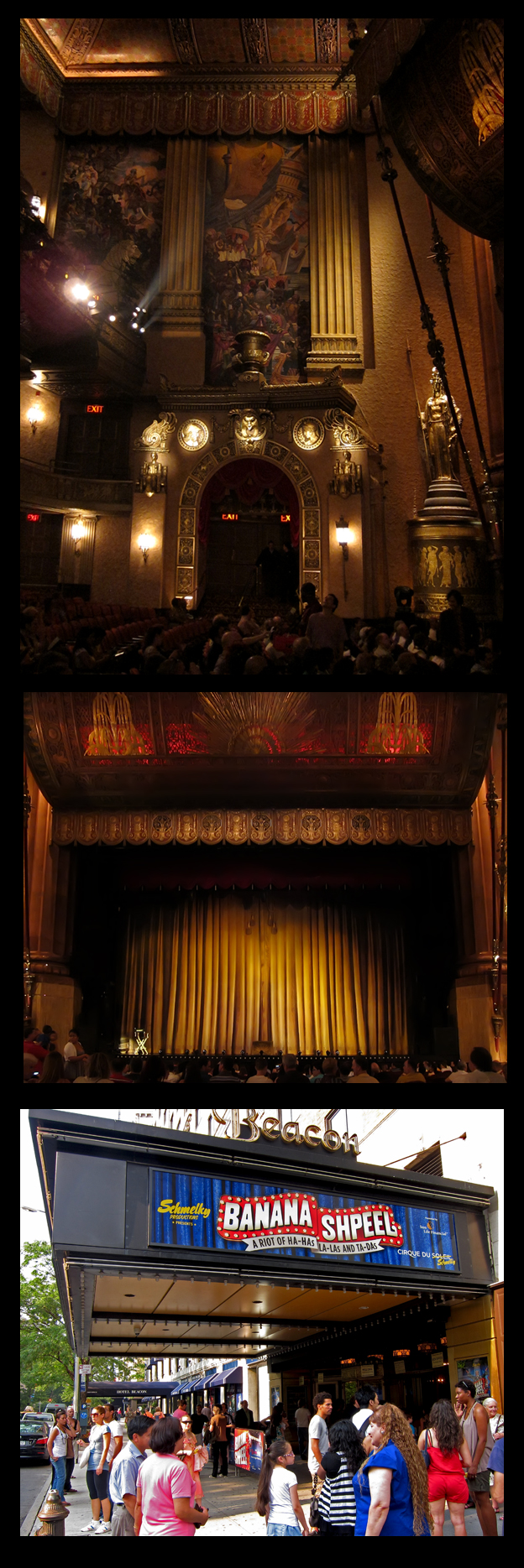
    Skip the exterior. It’s the opulent interior, second only to that of Radio City Music Hall, that counts. Go in, even if you must attend a concert that deafens you – the interior is Greco-Deco-empire with a Tudor palette. -AIA Guide to New York City

    In 1982, I saw the elite Japanese taiko drumming troup Kodo’s first American performance in New York City. My group of friends was absolutely astounded. My last visit to the Beacon Theatre (prior to this Sunday) was a big mistake – to see Kodo a second time and to introduce a friend to the group.

    The Beacon had taken a beating after decades of rock concerts. The balcony seats were filled with people talking, cell phones ringing, and, to add insult to injury, one heavy man repeatedly taking bathroom breaks. The floors were so laden with the sticky residue of spilled drinks that there was a loud ripping sound when lifting his foot after every step.

    We noticed the same effect as we lifted our feet while seated. This whole phenomenon became a source of great amusement and an exercise in controlled laughter. However, the whole experience was extremely disappointing – Kodo requires a quiet listening environment and complete attention to their nuanced performance, not all manner of noise, hilarity, and contained laughter.

    On Sunday, I went to the final performance of Cirque du Soleil’s Banana Shpeel. I was pleasantly shocked to see the Beacon Theatre’s decor after a recent renovation. See more photos here.
    I was able to enjoy the opulent interior in all its former glory without seeing a “concert that deafens you” or listening to feet ripping away from sticky stuff 🙂

    Note about the Beacon Theater: The Beacon was designed by Walter Ahlschlager and opened in 1929. In 1979, the historic venue was designated a national landmark and is on the National Register of Historic Places. Many of the greatest names in music have played the Beacon including the Rolling Stones, Jerry Garcia, Aerosmith, Michael Jackson, James Taylor, Radiohead, and Queen. The Allman Brothers hold an annual rite of spring concert series at the Beacon Theatre known as “The Beacon Run.” Since 1989, they have performed 173 shows at the Beacon.
    Read more about the Beacon here and here.

    Posted on by Brian Dubé

  • Absolution and Indulgences

    Posted on by Brian Dubé

    There are things that are fundamentally unpleasant, and apart from death, serious physical injury, or absolute calamity, about one of the most unpleasant experiences you can have in New York City is to have your vehicle towed.

    As bad as going through any city bureaucracy can be, there is typically some sense of accomplishment, even if it is only renewing a license, obtaining a permit, or having a package shipped via USPS. But the entire premise of the towed vehicle adventure is only to have returned to you what is yours to begin with.

    The “tow pound” is located at Pier 76 at West 38th Street & 12th Avenue, along the Hudson River, so the towee has to make a journey to a very inconvenient location. No one is pleased. Not the police, who have been given the particularly ugly job of towing and have to perform this duty for all to watch on the streets of New York City. Nor are the clerks at the tow pound, who often must battle with inflamed vehicle owners, many of whom have some defense which, as they will learn, will never do them any good at all. Not here at the tow pound.

    The premise is very simple – pay your fines in full, or you do not get your car. The clerk does not have the ability to negotiate or reduce fines. I have been to the tow pound once to retrieve a vehicle and witnessed every manner of negotiation, all to no avail. Regardless of their culpability, everyone feels wronged.

    What is astonishing is the cavalier attitude that visitors have about street parking in New York City, erroneously assuming leniency. But this is a low tolerance situation. The risk is just too high – never leave an auto in New York in an illegal parking spot.

    In a twist unfamiliar to me, I recently watched a very puzzling police action. A number of vehicles were towed but only relocated to a neighboring block. The vehicles were parked on a street, legal for that time but superseded by paper “No Parking Sunday” signs tied below street signs for the annual Gay Pride parade. Filming, festivals, events, and parades often require the clearing of streets. The NYPD adds paper signs on sign posts indicating the temporary change in parking regulation.

    This vehicle relocation policy is relatively unfamiliar to many vehicle owners, particularly visitors, and the Police Department website gives virtually no details.

    I have read of one incident where an individual parked legally (at the time he parked) and no special event signs had yet been posted. When he returned to a missing vehicle, he called the police, and no information was available. He was told that if a vehicle was relocated, look in a 5-block radius, and if he could not find it, call them back.

    The city has gotten more congested over the years, and unless you really need to have a vehicle in the city, using public transportation and taxis will go a long way to providing a much more relaxed time here, not fraught with the continuing stresses and worry associated with parking. Especially in a city where no absolution is given and no indulgences are sold 🙂

    Posted on by Brian Dubé

  • Quito

    Posted on by Brian Dubé

    At one time, I obsessed over climate and owned a compact little tome published by Pan Am. This travel guide cataloged every country in the world and, most importantly, there were climate tables for every capital city. My mission was simple – to find the place with the “perfect” climate. My search, however, was biased.

    At the time, I had also read books by extreme natural foodists who had similar agendas and whose motives were to find paradisaical environments to live off the land and create their own Edens. One writer, Johnny Lovewisdom*, was one of these aspirants, and his quest for the world’s best climate led him to the Andes outside Quito, Ecuador.

    A quick perusal of my Pan Am guide confirmed that Quito was one of the world’s most unique climates, with an average daily high of 71 degrees and average daily low of 41 (other charts measure the average daily high at 65-67 degrees). These temperatures only fluctuate by one to two degrees over twelve months. Quito, at an altitude of 9,186 feet, is the highest legal capital in the world. The city lies within one kilometer of the equator. This unique location in the Andes and along the equator accounts for a climate which can be truly called eternal spring. Moving to Quito became my dream, or more realistically, a fantasy.

    Now I dream of Quito for another reason. I live in a very special and unique older building on Washington Square North. However, like many apartments, there is no cross ventilation. Perhaps the date of the building’s pre-Civil War construction in 1837 explains why segregation is still practiced in my home and bodies of air inside and outside will not mix. With windows wide open, cold air outside, and warm stagnant air inside just coexist across a climactic Mason-Dixon line.

    Today in New York City, we have a break in the recent heat spell. Temperatures this morning moved from 71 through 77, spanning the averages, means, and other ways of measuring the daily high of Ecuador’s capital. The typical high temperature in Quito at noon is 77 degrees. As I write this, the current temperature in Central Park is 77 degrees. When I stand at my window’s edge, lean out, and feel that cool springtime air, for a moment, I’m in Quito…

    *Prior to the existence of the Internet, accurate information on elusive characters like Johnny Lovewisdom was nearly impossible to find. Now, information is readily available – his age, real name, and other biographical details. See his Wikipedia entry here to read about a man at the extreme edge of dietary movements.

    Related Posts: Miracles in Our Midst, Part 1; Miracles in Our Midst, Part 2

    Posted on by Brian Dubé

  • Urban Road Warrior

    Posted on by Brian Dubé

    I thought I had seen the extremes in high heel elevations in New York City, but in reading various articles, I came across the “armadillo” stiletto claws designed by British fashion designer Alexander McQueen as part of his Spring 2010 Plato’s Atlantis shoe collection. These shoes, which number only twenty-one pairs and range from $3900 to $10,000, were worn by Lady Gaga in her “Bad Romance” video.
    The shoes are a staggering 12 inches tall, perhaps the first where height can be measured using an altimeter. Some models refused to wear them, worrying about potential falls.

    High heels themselves are mired in controversy. They are responsible for a litany of health concerns: foot pain, deformities, sprains, fractures, and degenerative knee joint problems. But their allure remains – heels make a person appear taller, legs longer, the foot smaller, and they make leg muscles and the butt more well defined. They alter the posture for a sexier gait.

    Some see other reasons for their popularity:

    There are many theories about sartorial behavior as an economic indicator. In dark times, hemlines go down. Lipstick sales go up. And high heels grow ever higher, an attempt to lift our collective spirits by elevating women a few extra inches off the ground. – Amanda Fortini, The New York Times, December 13, 2009.

    In New York City, we are walkers, and, unlike the suburbs or countryside, the prospect of using shoes which depend on the wearer being transported by auto to and from destinations is largely not realistic.
    But lack of comfort for extensive walking is not the only impediment to wearing high heels. New York City is mired in land mines for the woman wearing heels and engaging in the daily slalom of potholes, sidewalk grates, uneven sidewalks, and subway stairways. The extraordinarily treacherous pedestrian trails make walking more difficult, and the harsh environment guarantees to eventually tear and damage fine shoes. Solution? Simple – wear flats or sneakers on the streets, and change to heels at the office or function. Some women tote dress shoes in their bags, while others may just keep a pair of heels in the office.

    However, arriving at the office in old flats or sneakers does little for a woman dressing for success or allure. Like the woman in today’s photo, changing on the streets is one way of keeping the wardrobe intact for the urban road warrior 🙂

    Posted on by Brian Dubé

  • Cast Iron Stomach

    Posted on by Brian Dubé

    I recall my roommate in 1970, telling me that he was moving to a “loft in SoHo.” My first question was, of course, “Where is SoHo?”, the second was, “What is a loft?” and the last was, “Why?” It may be hard to imagine, but when I first moved to New York City, SoHo was quite undesirable – an industrial backwater with little residential appeal.

    Remarkably, I lived in the Village, and SoHo was just a stone’s throw away – south of Houston Street – yet I had never been there. A visit quickly revealed an industrial neighborhood with little charm at all. Regarding the term “loft”, I was told that this term derived from the large, upper floor “lofty” spaces. And the “why” was simple – cheap rents.
    In hindsight, the explanations of why a New York City neighborhood was “discovered” always appear obvious. However, the individual is rare who will recognize this before it is “discovered” – early adopters are often artists who see the merits shining through the demerits, which are typically many.

    Becoming a pioneer of an unpopular neighborhood is now much more difficult – everyone is looking for the next place, and news moves with extreme rapidity.
    More importantly, all the reasons why a neighborhood looks undesirable and shows little promise are what really prevents most from getting in early. Successful stock investors know this well and have the ability to go against human nature and buy when stocks are going down, much as the pioneer, in spite of popular sentiment, moves to neighborhoods that are downtrodden.

    Another huge issue in “buying in on the ground floor” is waiting until an area improves. This could take decades. Worst of all, many areas never fulfill their promise. I have always felt that housing stock was a key element. This is no guarantee either – areas such as Bedford-Stuyvesant, Brooklyn, and Harlem have beautiful row houses yet have not seen the rapid gentrification that other areas have.
    Despite the improvements in these communities, they often continue to be stigmatized by a lingering public perception left from the rougher times of the past.

    If you believe that you are a person who really can see past a place’s obvious detriments, go to Brooklyn and visit the Gowanus Canal. Some tout this as the future Venice of New York City.
    Once a tidal inlet of creeks, marshland, and meadows, Gowanus Canal was built from Gowanus Creek and completed in 1869. The Gowanus Canal became a hub for Brooklyn’s shipping activity to service the factories, warehouses, tanneries, coal yards, machine shops, chemical plants, flour mills, cement factories, and manufactured gas refineries lining its shores. Industry thrived in the area, and with it, pollutants.
    The area has had an acknowledged problem with industrial pollution for over a century, with cleanup discussions going back decades. On March 4, 2010, the EPA announced that it had placed the Gowanus Canal on its Superfund National Priorities List.

    Gowanus Canal and the surrounding neighborhood have a much greater impasse and many hurdles to becoming a viable residential enclave, much less a charming Venetian-like waterway. There is little charm in oil tanks or scrap metal yards, and improving an area like this is a taller order than cleaning up the cast iron buildings of SoHo or the beautiful brick structures of DUMBO, Brooklyn.

    But a bright future could be in store for those with a long vision and, like anyone waiting out the transformation of an industrial neighborhood, a cast iron stomach 🙂

    Posted on by Brian Dubé

  • All of These Pleasures

    Posted on by Brian Dubé

    In the film The Producers, which is set in New York City, Leo Bloom (Gene Wilder), an innocent accountant, is lured by Max Bialystock (Zero Mostel) into a fraudulent money making scheme. In one scene, Max tempts Leo atop the Empire State Building, enumerating all the wonderful things money can buy in New York City which are laid out before them, whispering over his shoulder, “All of these pleasures can be yours.”
    And, for most, one of these pleasures will be a decent home.

    Conversations in New York City are dominated by apartments and jobs. The cost of an apartment, rental or purchase, is the most difficult financial hurdle to living in this city, particularly for new transplants.
    You will hear and read that prices are up or, on occasion, down slightly. Then up. Average prices, median prices. This year over last. This quarter over same quarter last year, etc., etc.

    Let me simplify. No matter what you read or hear, prices are still high. Very high. Even if prices plunged, they would still be very high. In spite of the economic malaise, apartments in New York City are fetching big numbers. Prices of Manhattan apartments have risen in 2010 over the same period in 2009 – the average one-bedroom is now $1.3 million dollars, typically with a maintenance of over $1000 per month.
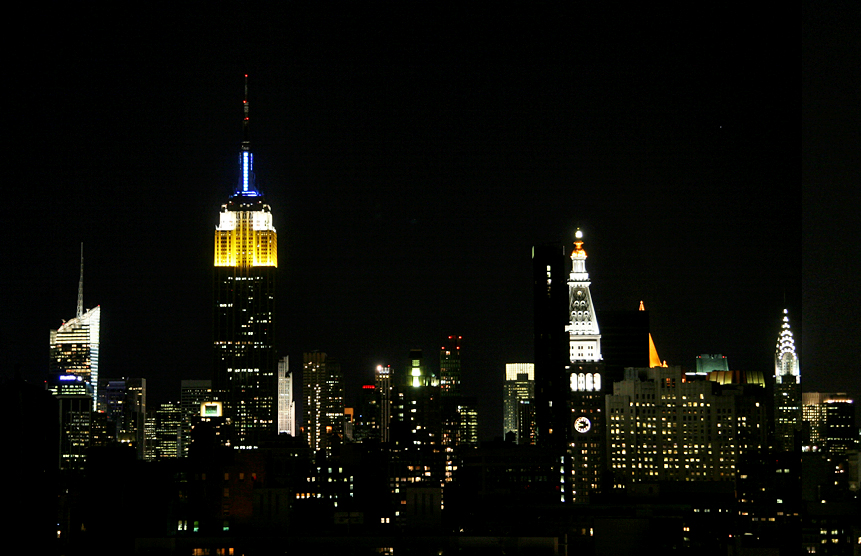
    For that money, you get one privilege and only one: to live in New York City in a habitable place. However, views like those in the photos are far from typical, and for that you will pay a premium. Prices in high-rises typically increase as you move up to higher floors with better views.

    The vista in the photo is looking north from the rooftop of the Brevoort East at University Place and 9th Street in the Village. Friends who live in the building (and have virtually an identical view on a lower floor) gave me roof access recently. Atop the roof, looking out at the spectacular view in the brisk clear night time air, I could feel Max Bialystock at my shoulder whispering, If you have the money, all of these pleasures can be yours 🙂

    Posted on by Brian Dubé

  • The Cable Building

    Posted on by Brian Dubé


    I hated the Cable Building. It was gray and grim, as were the spaces and long hallways ringing the interior atrium. Everything about it was unappealing to me, even its location at 611 Broadway and Houston Streets, now a prime shopping district.

    But when I needed commercial space, my conversations with brokers invariably led to the Cable Building, where, any day of the week, small spaces were readily available at reasonable rents. The mention of “611 Broadway” made me cringe. The idea of traveling through the building’s long serpentine corridors for use of water and a shared bathroom was very unappealing to me. The only real way of securing these amenities en suite was to rent an entire floor of a building, which I finally did.

    Much as someone who has to work through a childhood fear of dogs, it has taken me decades to shake off my feelings about the Cable Building. All so ironic – anyone visiting today would be incredulous that I would reject or have misgivings about this historic structure.

    One of the most difficult things to communicate to those who have no experience of New York City prior to 1980 is how rough a state this city was in. SoHo was a no man’s land, the East Village uninhabitable. Everyone I know had personal experience with being mugged/robbed. Car alarms provided music. Graffiti-painted subway cars were the norm. Glass shards on the street from auto break-ins would be a daily sighting.

    Running a business in New York City has all the typical expenses – salaries, insurances, holiday and vacation pay, staffing, etc. Operating in New York does, however, present things which make it even more onerous – high rents, problems parking or standing for delivery vehicles or visiting customers, freight which will have to be taken to its destination by elevator – generally only retail stores can afford ground floor space. At one time, ground floor industrial was common. No longer.

    When possible, working from home, sans employees, solves many of these problems. I did this for many years. But time came, as it does for many, that working from home was no longer viable – there were just too many activities inappropriate in a residential building for a business of my nature – receiving supplies, shipping goods, and seeing customers meant excessive traffic and noise. So I was forced to shop for commercial space.

    Moving was not the worst prospect – working at home is not the dream life many think it is. Yes, there is no commuting, but working alone every day takes its toll for anyone with any modicum of social needs. I have met some who are happy to work alone. The question is whether you can do this on a full-time basis.

    One big problem in looking for space is that I had been severely spoiled by working at home. The ambiance of a residential building and the amenities of a home, i.e. a kitchen and private bathroom, are all very different in a commercial building. I needed small space and a building that permitted light industrial use – this is a challenge anywhere, including the suburbs.

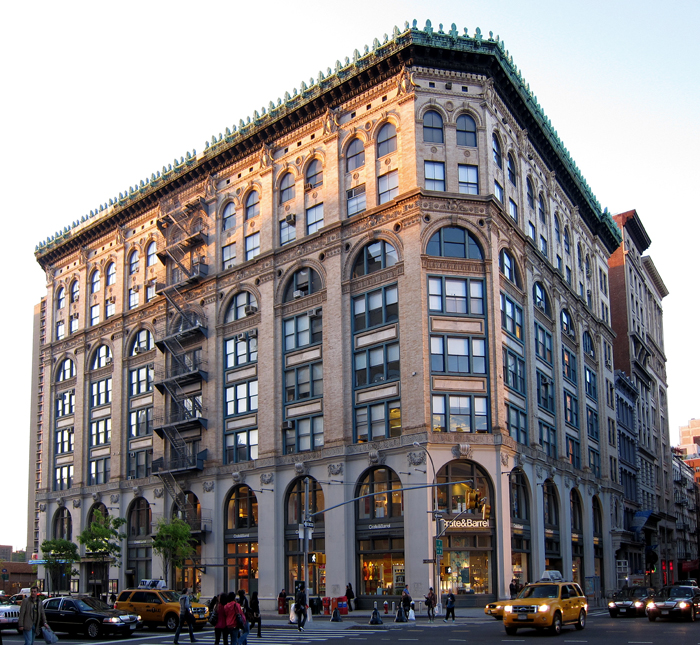
    My office is only two blocks away from the Cable Building, and I often visit Crate and Barrel on the second floor, as much to enjoy its beautiful space and views as to peruse the merchandise.

    Try as I may, there’s no getting away. My fate seems to be intertwined with the Cable Building 🙂

    Note about the building: The Cable building was built in 1893 and designed by McKim, Mead & White. Its name hearkens back to its brief history (less than 10 years) as a power plant for a new cable car system in Manhattan, extending from Bowling Green to 36th Street. The basement, 40 feet below street level, houses enormous steam engines, boilers, and winding wheels. Read Christopher Gray’s Streetscapes article from the New York Times here.

    Posted on by Brian Dubé


  • dinamic_sidebar 4 none

©2026 New York Daily Photo Entries (RSS) and Comments (RSS)  Raindrops Theme