• Category Archives Parks
  • Strike While the Music is Hot

    Posted on by Brian Dubé

    As I stood late night in Washington Square Park, the very faint sounds of violins began wafting over me and friends. Had I heard perhaps Ashokan Farewell, the haunting melody chosen by Ken Burns as the musical theme for his award-winning Civil War film series? I spotted two violinists across the park plaza and walked briskly in their direction. Here, late at night, one must strike while the music is hot. There are no guarantees how long anyone has played or will continue to play. If you like what you hear, better run and enjoy.

    It was apparent that these were no ordinary musicians. I suspected that they were accomplished interlopers, on some mission in New York City, and, given some down time, had decided to grace us with their notes, as visitors are often apt to do. I was right, and I learned that the couple were a brother and sister who were in town to do a commercial recording gig. They had not played together in 20 years, so we were also privy to a family reunion.

    I arrived as they were completing a song, and I asked if they knew Ashokan Farewell. Of course, they replied, and that they had just played it a moment before. They were, however, quite happy to play it again. I recorded a video:

    I spoke to them and was surprised to learn that both were professional classically trained musicians and were in New York City only for some days for the recording session. They were leaving the next day. I learned their names, John and Rebecca Patek, and took their contact information. From John’s website:

    John began playing the violin when he was two years old and hasn’t stopped since. Born and raised in Mequon, Wisconsin (a suburb of Milwaukee), John learned the art of performance at a young age through his involvement with both the Milwaukee Youth Symphony and the Homestead High School Orchestra.

    John continues to perform actively in Switzerland, Italy and in the Midwestern United States. He also teaches several group and private lessons.

    Rebecca Patek, from Wisconsin, began studying violin since she was 2 years old when she saw Itzhak Perlman playing violin on Sesame Street. She grew up playing classical violin and at 10 was playing with the Milwaukee Youth Symphony Orchestra. She became hooked on old time and bluegrass in middle school when her mom took her to a bluegrass jam at a local bar. Patek went on to study jazz violin and has won the Wisconsin state fiddle championship several times.

    From a recent correspondence with John:

    I was born in Milwaukee, WI in 1981 and grew up just north of Milwaukee in Thiensville, WI.

    I am lucky to be a musician.  I have my own private studio in Mequon, WI with about 15 students and I also teach at Milwaukee Montessori School. Currently I am a freelance musician based in Milwaukee but I was a member of the Madison symphony, I work as violinist with two different orchestras in Switzerland and am an active recording artist.  I have worked with television, film scores and various bands contributing violin and cello tracks.  I have worked quite a few non musical jobs but they only make me appreciate my life as violinist even more.  I suppose this is the story for so many musicians but whenever I get to play the violin in know I am one of the luckiest people in the world.

    I did my bachelors degree at the University of Wisconsin as a student of the late Vartan Manoogian, and did my masters degree at the Conservatory of Neuchatel in Switzerland studying under Stefan Muhmenthaler.

    I split my time between Milwaukee and Switzerland.  I have not lived anywhere else.  I have gotten to travel throughout Europe because of the violin touring with orchestras and studying.

    My Mom and Dad made sure that I had the best teachers, an amazing violin that I still play and was able to attend any summer festival i ever wanted. They love music and art and made sure that my sister and I were able to develop our talents and have a great time.  They took us to lessons before school, drove us across the summer camps across the country, to and from youth symphony rehearsals, got us on flights to Europe and made sure we practiced before we wasted time like we wanted to.

    Joan Rooney, one of my first violin teachers and Vartan and Stefan my teachers in College really made me realize how challenging and amazing playing the violin can be.  I have had great teachers in music and my other academic classes and I know that because of them I do a better job teaching.  I am able to combine all of their great guidance and ideas and share them with my students.  I only hope that I can inspire my students the way my great teachers inspired me.

    I was so glad to have made their acquaintance and heard some of their playing. On the streets of New York City, things are in flux, whimsical and temporal. To experiences those serendipitous pockets of joy, don’t deliberate, but Strike While the Music is Hot 🙂

    More music in Washington Square Park: Sirens of Culture, Mzuri Sings, Curse of the Mouth Trumpet, New York is Bluegrass Country, On the Road, Sieve of Darwin, Tune Out, Tune Up, Tune In, Delivery, Bluegrass Reunion, Fete de la Musique, New York State of Mind, Music Speaks for Itself

    Posted on by Brian Dubé

  • Night on Bald Mountain

    Posted on by Brian Dubé

    Fantasia was a highly controversial film for different reasons. Many objected to the strong imagery set to major pieces of classical music. They argued that imagery should be evoked by the music, not chosen and superimposed by a filmmaker, making indelible impressions and associations on the mind, particularly on those new to the music. Others argued, many of them well-seasoned classical musicians, that there is no great harm and that anything which brings the public and great music together is a good thing and worth the price.

    I straddle both sides of this issue – certainly there are pieces of music that I now associate with imagery from that film, i.e. Beethoven’s Pastoral Symphony and the dark, brooding images in Mussorgsky’s Night on Bald Mountain. Whether these associations have damaged my appreciation of this music, I have no idea. But from time to time, dark stormy weather brings back those images from Mussorgsky’s work as interpreted by Disney.

    There is no question that mother nature often plays second fiddle to the creations of men and women in New York City. Whether it is cultural or architectural, people do not come to this city for the climate. In Not Moving to Florida, I dismissed all four seasons in the city. In Weather Means Whether, I discussed how my friend from college, who had moved to California, made the observation that the East Coast has weather while the West Coast has climate.

    Whether this is valid, meteorologically speaking or not, I do not know. However, certainly one of the West Coast’s biggest draws is its pleasant climate and nature’s bounty, whereas on the East Coast, particularly in New York City, weather may enhance or detract from enjoyment of some city attractions, but it is not the allure.

    However, when dramatic natural events occur, their juxtaposition with the cityscape makes even the most resolute of New Yorkers pay attention. One is more likely to notice these events when in a natural setting, such as a public park, and where distraction from nature is at a minimum. When strolling the city streets, for most, it will take nothing short of Armageddon to take one’s eyes off the elements that make New York a great city. In July 2010, I was able to capture a spectacular bolt of lightning – you can see the photo below. In that story, Back to Our Main Feature, I wrote:

    Last night, there was a brief lightning storm dramatic enough to make many of us look up and say wow. But unlike our country brethren, who may spend a pleasant evening watching shooting stars, we rarely indulge these natural phenomenon for very long. Glancing up to the sky, seeing a spectacular display of lightning complemented by a waxing moon, we acknowledge when nature has spoken. Yes, like any great commercial, we hear you, but now, back to our main feature.


    Tuesday was another brooding New York City day. The sky was dark and heavy with well-defined storm clouds. Try as I may, images stormed my mind of Night on Bald Mountain 🙂

    Posted on by Brian Dubé

  • New York Is Raccoon Country

    Posted on by Brian Dubé

    Like most places, there are always things to learn about one’s locale. However, in New York City, not only are there a myriad of things to discover, but many of them are also quite unexpected and seemingly antithetical to urban life. Like hawks or raccoons.

    And, of course, owing to New York’s huge population, there are always a small number for whom these things become more than curiosities or points of interest. For some, these things become a world unto itself, such as the red-tailed hawk, Pale Male, whose family attained a cult following and mythic status. To this day, 21 years after the first siting of Pale Male, an entourage of birders have a virtual encampment on the outer perimeter of the Central Park boat pond with a clear line of sight to the nest at 927 Fifth Avenue.

    Yesterday, at the Central Park Conservatory Garden, amidst one of the most bucolic natural settings in Manhattan, I was puzzled to find a number of people fascinated with a relatively unkempt patch of shrubbery on the outskirts of the garden. Suddenly, I noticed the object of their attention and cameras: a raccoon at close quarters in broad daylight.
    One man I spoke to told me that there were, in fact, many raccoons in Central Park and that residents on the west side of the park were in the habit of leaving food for a group of raccoons who resided in the area.

    By many, raccoons is are a considered a nuisance. Like many of the hardy, aggressive residents of the city, e.g. pigeons or squirrels, the dearth of other wildlife makes these types of scavengers the object of fascination for city residents as well as visitors, who are often found feeding squirrels in the parks.

    Raccoons are highly adaptable omnivores and have populated a large range of environments – I was surprised to learn that they inhabit many urban areas worldwide. It is estimated that as many as 300 live in Central Park.  New York City is a mecca for bookstores, restaurants, museums, architecture, the arts, fashion, music, and ethnic culture. And, for now at least, New York is Raccoon Country…

    Posted on by Brian Dubé

  • Sirens of Culture

    One of the peculiar dilemmas of living in New York City is the compelling feeling that there is a world outside the city and simultaneously no desire to leave it. Often, particularly on a beautiful day, I have a strong desire to take a day trip and explore some rural hinterland to enjoy nature. Then, stepping out my door with a sincere intent to only briefly sample the city, I found myself shipwrecked again on the shores of Manhattan, having been lured by the Sirens of Culture. Often, I make it no further than steps from my home in Washington Square Park, a brewery of local and international talent.

    I sit in cognitive dissonance, torn by the desire to broaden my horizons yet trapped by a menagerie of entertainers, the like of which is to be found nowhere else. Part of me feels that there must be more to life than this plot of 10 acres that landscape architect George Vellonakis referred to as America’s Piazza. Not an exaggeration at all, the park is a meeting place for every imaginable type of individual from sociopaths, lunatics, misfits, geniuses, budding and established artists, painters, chess players, writers, photographers, intellects, local residents, and visitors. It is a place where the conversationalist can meet and engage in conversations on any subject imaginable, both privately or in forums.

    Here, one can find snake charmers, hucksters, drug dealers, professors, political activists, and vendors of products and ideas. Some come to sell their philosophies, but this can come at a price, as when Mennonites meet topless body painted women or when Missionaries Meet Their Match.

    However, the biggest draw here is the music, and with some luck, on a good day, one can find a virtual festival of professional talent. So it was that on Saturday and Sunday, I was lured in by the music of Jessy Carolina and the Hot Mess. I found myself listening for hours along with a large steady crowd who found themselves so engaged that many resorted to Dancing in the Streets. From their website:

    Jessy Carolina & The Hot Mess is a New York City-based ensemble specializing in early American roots and jazz music from the late 1800’s to the 1930’s. The group features Jessy Carolina on vocals and washboard, Jerron “Blind Boy” Paxton on piano, banjo, and vocals, Jordan Hyde on guitar, Jay Sanford on bass, Mario J. Maggio on clarinet and saxophone, and Satoru Ohashi on trumpet and trombone.

    Jessy, who hails from Venezuela, grew up in North Dakota, and later moved to New York City, has a voice and singing style that ropes in passersby who find themselves entranced and engaged. The talent of all the members of the group is exceptional, and it comes as a huge treat to find such talent on the street – Jessy Carolina and the Hot Mess has performed in a variety of venues, both in and out of the city. Catch ’em when you can. I’ll see you in the parks and streets of New York City, lured by the Sirens of Culture 🙂


  • Room With A View

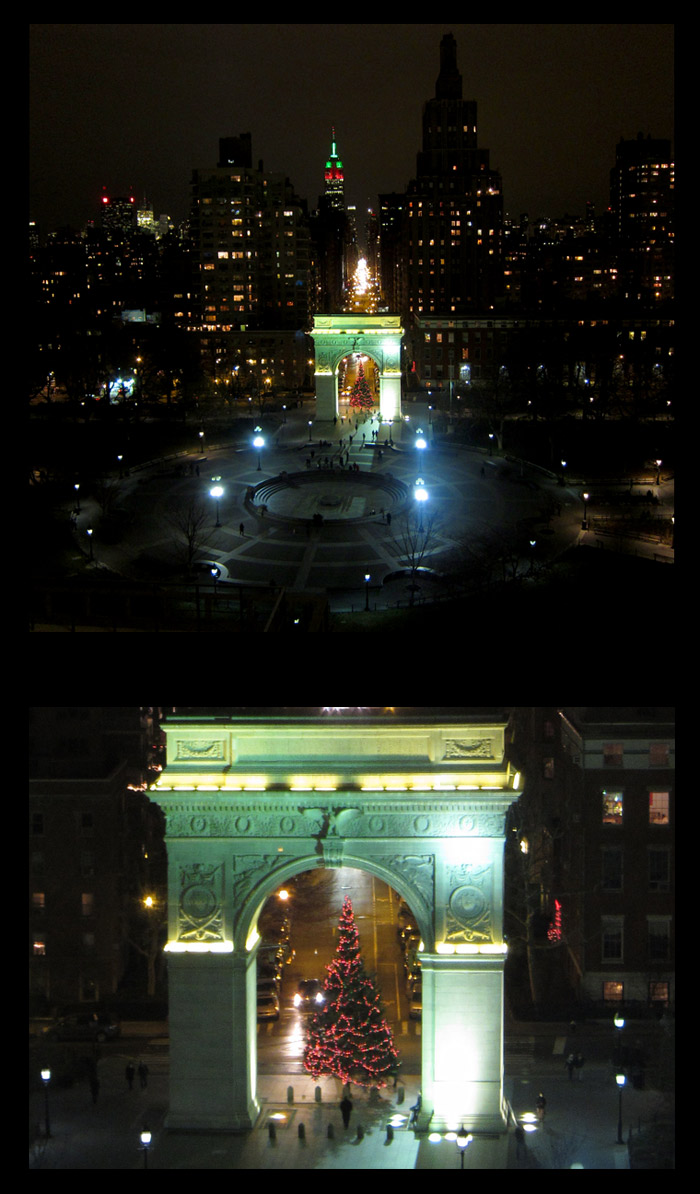
    I recently attended a community board meeting regarding a very hot-button issue for Village residents: the Parks Department’s enforcement of new “expressive matter” rules, created to limit artist vendors in parks in 2010, applied to musicians and artists who take donations. The rules prohibit vending within 50 feet of a monument (includes the fountain) or 5 feet from a park bench, effectively making the park off-limits to performers. The impact of this is huge. Attorneys Norman Siegel (formerly of the ACLU) and Ron Kuby were on hand and poised for litigation.

    The issue is of great personal interest to me as well as others, but I am not much for politics and political process. As a small business owner, I am accustomed to speedy decisions and implementation. We can turn on a dime if necessary and change course rapidly, addressing competition, changing markets and customer needs, streamlining business procedures, and a myriad of other functions. The prospect of decision by committee with long-time horizons for implementing change is anathema to the small business owner.

    But political process is a necessary evil for a democracy with liberty as a cornerstone, and I respect that. However, I also do not relish an evening in a public forum, even on a relevant issue, listening to a large number of community residents making their cases one after another, essentially to be heard by those in agreement. Only if the collective voice becomes large enough, like the Vietnam War protests, and/or legal action or the threat thereof, will the powers that be take notice. Even the Parks Department representative left the meeting early, which I found quite sad.

    A friend suggested that I speak since my entire business life has been supplying performers, many of whom work the parks of New York City. However, everyone in the room was in accord – I saw no change being effected by speaking to the choir, so I slipped out.

    The meeting was in NYU’s Kimmel Center, a newly built student center perfectly situated on the south side of Washington Square Park. I had never been in the student center even once – admittance typically requires a student ID, but not for a public hearing. So as I left the meeting room on the 8th floor, it occurred to me that I was now IN and not being chaperoned or policed. This was a rare privilege and opportunity to scout out spectacular vantage points for some photography.

    The front of the Kimmel Center provides spaces for study, with windows directly overlooking Washington Square Park and facing north towards the fountain area, the arch, the Christmas tree centered below it, and Fifth Avenue running all the way up to the Empire State Building, appropriately lit in green and red, befitting the holiday season. Stairwells were accessible and are glassed, also providing views in a darkened environment.

    I was happy to have left the meeting. I was thoroughly enjoying my exploration – lemonade made from the lemons of political process. As you can see by today’s photos, if you are lucky, Kimmel is the place to go when you seek a Room With A View 🙂

    Related Posts: Pockets of JoyComfort and Joy, Only in New York, Delivery, Nested Embraces


  • Fountains

    Depending on who’s counting, the Palace of Versailles has more than 1,400 fountains. Due to the enormous amount of water required to fuel them, they are turned on infrequently. Even at the time of Louis XIV, the water supply was inadequate to run all of the fountains at once. There was even talk of diverting the River Eure to supply water to the fountains.

    Sunday afternoons from April through October, there is the Grandes Eaux, a musical fountain show in the gardens to the accompaniment of recorded music. Although I have been to Versailles twice, I was not fortunate enough to experience the spectacle. Paris has 350 fountains; to a visitor from the United States, they seem to be at every turn and virtually are.

    New York City has a much less lavish feel to it, as observed by one of my Swedish clients, which I wrote about in Very Practical. Fountains will never be a priority here, although it certainly was for George Vellonakis, architect for the redesign of Washington Square Park. Upon reconstruction, the central fountain was moved to be centered with the Washington Square Arch as viewed coming down Fifth Avenue. George was virtually crucified for this, the cost of which was often misrepresented since the fountain needed to be dug up for plumbing work anyway, with the additional cost of moving being incidental.

    But to me, the entire fiasco and controversy is just indicative of the fixation of Americans on the bottom line, even if at the cost of aesthetics or the occasional jubilant indulgence.
    As I wrote in Let’s Have a Parade, in the light of hardship, it often is hard to justify celebration. After all, there is always a better place to spend money.

    We do not have a large number of fountains in New York City, but there are a handful. Conservatory Garden, the fountain and the gilded statue of Prometheus in the sunken plaza of Rockefeller, the fountain cascade at Rockefeller Center, the fountain at Columbus Circle, the Pulitzer Fountain at 59th and Fifth Avenue, Angel of the Waters Fountain at Bethesda Terrace in Central Park, the Unisphere in Flushing Meadows Corona Park in Queens, Temperance Fountain, Tompkins Square Park, James Fountain at Union Square Park, City Hall Park Fountain, and Washington Square Park.

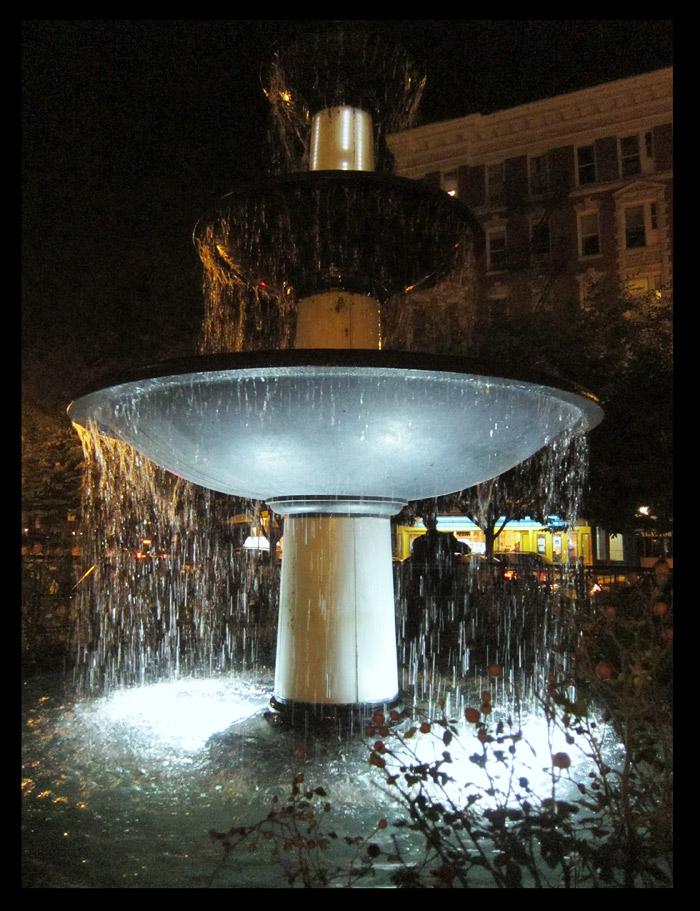
    Here, at Father Demo Square at the intersection of Carmine Street, Bleecker Street, and Sixth Avenue, is a tiny park with a beautiful charcoal gray stone fountain as centerpiece. The park completed a renovation in 2007 and is an ideal resting spot located in one of the most intensely trafficked areas of New York City, surrounded by a plethora of restaurants and shops. It’s ideal for people watching, a rest after dinner, or a place to eat a snack. Or, for those inclined to indulge, enjoy one of New York City’s very few fountains 🙂


  • No Cannibals

    In 1989, Daniel Rakowitz shocked New York City when he murdered and chopped up his ex-girlfriend Monika Beerle, made a soup out of her body, and served it to the homeless in Tompkins Square Park. Rakowitz, the “Butcher of Tompkins Square,” was found not guilty by reason of insanity and moved to a state hospital for the criminally insane.

    It is hard for anyone to imagine, even to those of us who lived in New York City, that not so long ago in the 1970s, the East Village was one of the most frightening areas to live in or visit. Extraordinary, because it was just a stroll away from the center Village and some of the most desirable and expensive real estate in New York City.

    Even through the 1980s, when much of the city had improved considerably, Tompkins Square Park remained a high-crime area, had encampments of homeless people, and was still a center for illegal drug dealing and heroin use. Rents were extraordinarily low – many drug addicts were able to afford apartments there, with lifestyles funded by selling drugs or through burglary and muggings. Virtually everyone I know who lived in the East Village in the 1970s was robbed or assaulted. It was truly a lawless land. Even to walk to St. Marks place at night could be worrisome. Alphabet City was no man’s land. Things escalated, and on August 6–August 7, 1988, the Tompkins Square Park Riot occurred. Since 2004, the annual Police Riot Concert commemorates this event.

    Last week was the first time in my entire life that I walked through Tompkins Square Park at night, something that four decades ago would have been unthinkable to me. In the 2000s, a woman friend I knew regularly attended bars and clubs in Alphabet City. She trekked the area at extremely late hours. I was astonished that a single woman would venture out alone there; when I questioned her, she could not understand my concern that she did such a thing routinely.

    However, even in 2011, Tompkins still has an edge. I find the nondescript, high fences to be very disturbing visually, a reminder that this place’s character is far from the parks of Paris, where a fence a few inches high with a small sign to stay off the grass is adequate to keep trespassers off. Here, even after renovation, I find the atmosphere much like that of a well-manicured prison yard with a feeling that restraint is necessary, lest there be an outbreak or an invasion of some kind. No doubt that many of these impressions are now largely a product of my mind from witnessing decades of decay, horror, and crime there.

    So, on a recent chilly Saturday night, I walked through Tompkins Square Park from one end to another. It was only 8PM, but already the park was deserted with only a few stragglers here and there. The atmosphere was spooky and eerie to me. I was quite uneasy in that small jungle at night, but at least I saw no cannibals.

    Related Posts: Transgendered Jesus, Mike Fontana, Irony Candy, Fluff, Leftover Crack, Bohemian Flavor of the Day, Piercing al Fresco, Gem Spa


  • Last Resort

    Growing up at the time and place that I did, there was not much to do as a teenager and very little that was approved by adults. No Starbucks for us. One of the few activities that was considered “good, clean fun” was bowling. Of course, to bring a girlfriend meant no privacy, which is what made it good and clean, but not much fun.

    Alternatively, a lover’s lane or parking with a girl meant having a driver’s license and vehicle, which was not a small achievement. Avoiding police interrogation was another concern in this endeavor. So it was bowling, and as often as I may have gone (I owned my own bowling shoes), bowling always felt like a LAST RESORT. I grew to hate bowling.

    But everything gets reinvented, marketed, and repackaged. Virtually nothing is uncool – the uncool becomes cool as people exhaust existing cool. Bowling became very cool in the 1980s, but it goes back much further, with various spikes in interest, even to the earliest days of New York City’s founding, when lawn bowling was done in lower Manhattan.
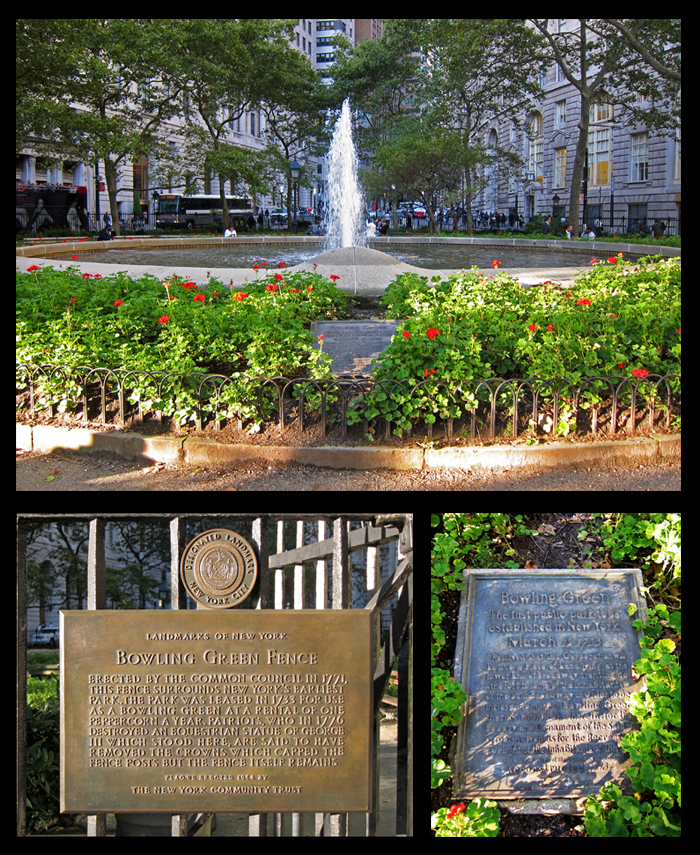
    From the New York City Department of Parks website:

    Bowling Green is New York City’s oldest park. According to tradition, this spot served as the council ground for Native American tribes and was the site of the legendary sale of Manhattan to Peter Minuit in 1626. The Dutch called the area “the Plain” and used it for several purposes. It was the beginning of Heere Staat (High Street, now Broadway)—a trade route which extended north through Manhattan and the Bronx. It was also the site of a parade ground, meeting place, and cattle market. In 1686 the site became public property and was first designated as a park in 1733, when it was offered for rent at the cost of one peppercorn per year. Lessees John Chambers, Peter Bayard, and Peter Jay were responsible for improving the site with grass, trees, and a wood fence “for the Beauty & Ornament of the Said Street as well as for the Recreation & delight of the Inhabitants of this City.” A gilded lead statue of King George III was erected here in 1770, and the iron fence (now a New York City landmark) was installed in 1771. On July 9, 1776, after the first public reading in New York State of the Declaration of Independence, this monument was toppled by angry citizens, dragged up Broadway, sent to Connecticut, melted down, and recast as ammunition.

    By the late 18th century, Bowling Green marked the center of New York’s most fashionable residential area, surrounded by rows of Federal-style townhouses. In the first decade of the 20th century, Bowling Green was disrupted by the construction of the IRT subway. The park was rebuilt as part of citywide improvements made in preparation for visitors to the 1939 World’s Fair. Renovations to Bowling Green included removing the fountain basin, relocating the interior walkways, installing new benches, and providing new plantings.
    A 1976-77 capital renovation restored Bowling Green to its 18th-century appearance. Publisher and philanthropist George Delacorte donated the park’s central fountain.

    Since December 1989 the statue of Charging Bull (1987-89) has been on display at the north end of the park. Its sculptor, Arturo DiModica, says the three-and-a-half-ton bronze figure represents “the strength, power and hope of the American people for the future.” It has also been linked to the prosperity enjoyed by Wall Street in the past decade.

    The park and surrounding area is beautiful and certainly deserves a visit. Although located far from midtown at the southernmost tip of Manhattan, and once a place for bowling, it is far from a Last Resort 🙂

    Related Posts: Trapped in Paradise, New York Stock Exchange, Federal Hall, West Side Community Garden, Esplanade


  • Movie Star

    So many films and TV shows have portrayed New York City as the place where an individual can be discovered, get a big break into showbiz, and make it big, maybe even become a movie star. Of course it happens, but, like depictions of the wild West, the reality is far less glamorous, and shootouts on the streets of Laredo are rare. Making it in the performing arts is mostly a process of auditioning, waiting, and rejection. Who has the staying power for this lifestyle?

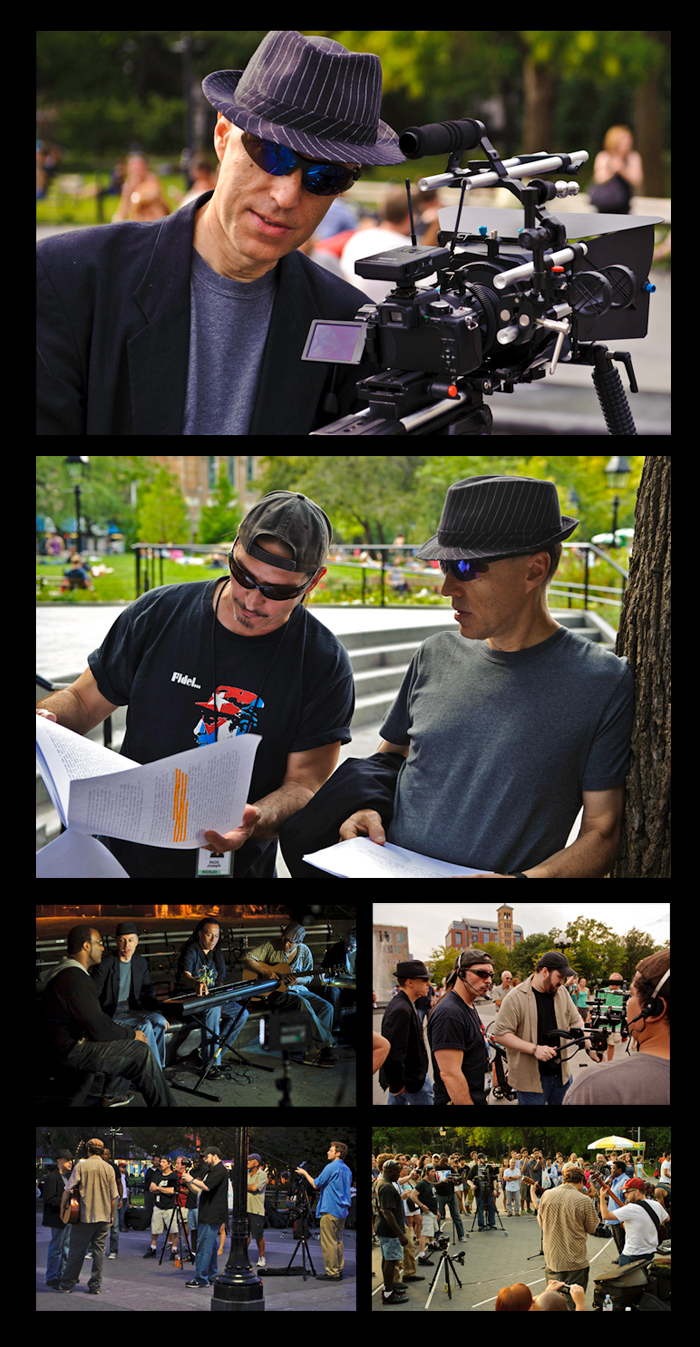
    Many months ago, I was chatting with Joe Rios, an acquaintance from Washington Square Park. At one juncture, I spoke of my experience with Ferris Butler and MNN Cable Access TV. I was surprised to learn that Joe was very involved with the network and was going through training at their facilities. As part of his advancement with the network, there are requirements, including production of a program.

    Talk turned to his personal project, a TV show on the musicians of Washington Square Park. He was looking for a moderator/host, someone who would conduct interviews with the musicians. He offered me the job – he said he had an instinct and implicit faith in me. I was flattered but was not nearly as confident as he was as to my ability to perform well. Nonetheless, I could not turn down the offer – it was just too exciting. I told him I had zero experience with this type of thing, but Joe was undaunted. I said I would give him 130%.

    There would be filming of musicians in the park playing, and I would conduct spot interviews. In October, there will be a panel discussion and music performances in a studio with a live audience, to be broadcast on public access cable and streamed on the Internet. The park footage will be used as field footage and will be shown during the studio airing.

    I had no idea if this project would really happen. There was talk from time to time, but talk is cheap and many talk of lifelong dreams with nary a step in that direction. One day, Joe showed me the paperwork: a formal project description, call sheets, names of the members of a professional and production camera crew, and a schedule with dates and times. Permits had been acquired. This was really going to happen.

    On Thursday, September 1st, the shooting began. This week, there will be more filming.
    Part of the decision to use me was based on the executive producer’s reading of this blog. I was not aware while talking to Joey that this was not just going to be aired on local access cable. It is also being shot as a film documentary and will be presented at film festivals and marketed. I was also told that the project had changed. It was now being filmed as seen through my eyes. There will be some filming done from my apartment which overlooks Washington Square Park.* This is an honor and opportunity beyond my wildest dreams. Time will tell if my work will be well received at all.

    It is the classic New York story. Pay your dues and work your craft with unflagging dedication. Be tenacious as hell. Then one day, with some luck, you will be at the right place at the right time, and next thing you know, you’re a Movie Star 🙂

    Photos courtesy of Sandy Hechtman.

    *Seasonal views from my window: Signs of Summer, Enchanted April, White By Design 2, Wood, Glass, Brass and Trees

    Posts overlooking Washington Square Park: Boxing Al Fresco, Urban Elephants and Hydraulic Tusks, We’ve Got Skiing Too, Meetings With Remarkable Men Part 1, Shifting Gears

    Related Posts: Do It in the Road, Sisterhood, I Am Legend, I Love New York


  • See It To Believe It

    Posted on by Brian Dubé

    Most people are too self-conscious or shy to dance publicly, or for that matter, even privately. But it’s healthy and on occasion, dancing can be seen on the streets and in the parks of New York City. Dancing’s cathartic release is the central theme to a very funny comedy sketch by Dane Cook.
    In the following excerpt, a man speaks to his male friends about dance clubs, women, and dancing:

    We don’t go there to dance. Women go there to dance. They get all ready and in the mirror with their friends.

    “I just need to go I just need to dance! I’m serious tonight – no guys! … I’ve had a rough week and I just need to just dance it out! I just wanna stand in a circle around our pocket books and shoes and just DANCE! DANCE!”

    You will never ever hear a guy say to one of his buddies – “Mike, Mike Mike ! Just listen buddy tonight bro, I gotta dance dude … I gotta DANCE!”

    That is certainly not the case with Zev. I first saw Zev some years ago for the first time while in Union Square, in the midst of a drumming circle. Everyone who has witnessed his vigorous, convulsive style of dancing is stupefied, often just staring in disbelief as he goes on and on, sometimes for HOURS. On the 15th of July, I caught Zev in Washington Square. I took a number of video clips spanning some of his time there. By nighttime, his face was red and flushed. I worried that that the man may suffer a stroke or heart attack. A counterpoint was provided by a woman, an extremely confident dancer who had style and knew how to move.

    A mutual friend learned a little about Zev. He was angry and displeased with life. I overheard him assert that Americans are not free. When asked where they were free, he replied, “nowhere.”

    Watch the short video to get a sample of Zev in action. Keep in mind he often keeps this up for hours. Perhaps there is no worry – his zombie-esque appearance and lack of any signs of pleasure may be a clue that he is no longer alive, only animated. See it to believe it.

    Related Posts: Float Master Part 2, Float Master Part 1, Wallflowers are Welcome, Mad as Hell Part 2, Mad as Hell Part 1, Dance Parade 2009, Silent Rave Part 2, Silent Rave Part 1, Dance Parade 2007

    Posted on by Brian Dubé

  • The Tide Pool

    Posted on by Brian Dubé

    The drama and grandeur of the western United States is extraordinary. One of the great joys of the West is visiting the protected lands, especially the national parks. Names like Yosemite, Grand Canyon, Sequoia, Yellowstone, Death Valley, et. al. are known worldwide.

    There are 58 officially designated national parks in the United States and its dependent areas, however, there is only one in the northeastern United States – Acadia National Park on Mt. Desert Island in Maine. It was here that I scrambled one morning to get to a ranger program exploring the tide pool. It was the first time I had heard the word, and I loved the idea*.

    Park rangers are typically passionate and knowledgeable about the great outdoors and eager to share their love for nature’s bounty and to answer questions. I often enjoyed evening campfire programs with slide shows given at many of the national parks I visited.

    Our park ranger that morning was readied in rubber boots, waiting for us on the rocky Maine coast, an ideal environment for trapping water living creatures in tide pools. Marine life is swept towards the shore by the incoming tide. As the tide leaves, sea creatures are trapped in pools created by rocks and other natural formations. Low tide permits an opportunity to observe these pools close up and a variety of living things not normally visible without diving or snorkeling. The ranger pulled out starfish and sea urchins and pointed out a myriad of living organisms. I never miss a chance when the opportunity presents itself to spend time at the ocean to explore a tide pool or two.

    Every day brings a tide of humanity to New York City. Many are tourists. Others come to stake out their claim for better opportunities. Some are swept here by serendipity. And every day the tide goes out here too, taking away many who have come here for any variety of reasons.

    A few are left behind in a pool of people, places and things, willing victims trapped by the lure of culture and lifestyle not found anywhere else. Whether you are a long or short term resident, visitor – real or virtual, I invite you in person or through these pages to come with me and explore The Tide Pool 🙂

    Photo note: This was taken on Jamaica Bay from the eastern shore of Floyd Bennett Field.

    Other Related Posts: Explorin’ (see here and here), Under the Sun, Umbrella and Chevy, Risk Not Living

    Posted on by Brian Dubé

  • Serenity, Tranquility, Peace

    Posted on by Brian Dubé


    Although technically in the borough of Manhattan, I have always felt it was almost a little undeserving for any New York borough to take claim to something so special as the Cloisters – it is located at the northernmost end of the island, as far as one can get from Uptown, Midtown, Downtown or any other area of that one would typically associate with New York City. Apart from the small number of residents in Washington Heights/Inwood, this area is really a destination for New Yorkers and visitors alike.

    The Cloisters is a museum of medieval art and architecture, a branch of the Metropolitan Museum of Art. Everyone loves this extraordinary complex – it’s a close as you are going to get to genuine French architecture in the city. Germain Bazin, former director of the Musée du Louvre in Paris, described the Cloisters as “the crowning achievement of American museology.”

    The museum buildings were designed by Charles Collens and constructed from elements salvaged from five cloistered abbeys in France: Saint-Michel-de-Cuxa, Saint-Guilhem-le-Désert, Bonnefont-en-Comminges, Trie-en-Bigorre, and Froville. The sections used were disassembled brick-by-brick, shipped to New York City and reassembled between 1934 and 1938. From the Cloisters website:

    Three of the cloisters reconstructed at the branch museum feature gardens planted according to horticultural information found in medieval treatises and poetry, garden documents and herbals, and medieval works of art, such as tapestries, stained-glass windows, and column capitals. Approximately three thousand works of art from medieval Europe, dating from the ninth to the sixteenth century, are exhibited in this unique and sympathetic context.

    Located on four acres overlooking the Hudson River in northern Manhattan’s Fort Tryon Park, the Cloisters is a world apart from the glitter, glamour, hustle bustle and frenetic energy of the city. For most New Yorkers, Fort Tryon Park and the Cloisters is a country getaway, a mini vacation. Visit the Cloisters if you want a small vacation from the city and Serenity, Tranquility and Peace 🙂

    Related Posts: Down to the Cellular Level, Le Petit Chambord, Fire and Ice, Affront to Dignity, Paraiso, Steps From Paradise, Belvedere Castle, Devil’s Playground

    Posted on by Brian Dubé

  • Grace Under Fire

    Posted on by Brian Dubé

    Once privileges are given, they are soon seen as rights – taking them away will not be well received. This scenario is common in New York City, such as in quality of life campaigns when circumstances beg for attention and there is a broader and stricter enforcement of existing laws. This, of course, invariably precipitates public outcry, particularly from those who are more politically active and vigilant concerning civil rights.

    Recently, there was a small show of force and ticketing of street performers in Washington Square Park. This is an extremely contentious issue for a number of reasons, particularly since the area has a history of musical performance, one of the dominant reasons many visit this area. The Village has been known as a center for artists and musicians for a century. Apart from the rights to free speech and expression, however, there are nuances of other laws coming into play regarding busking, solicitation, noise, public disturbance and unlawful assembly.

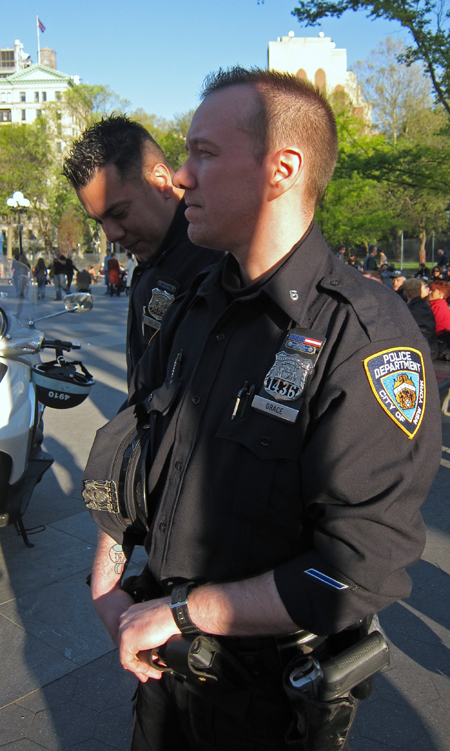
    Shutting down and ticketing performers was met with hostile reaction ranging from anger to outrage. After the recent sweep, the park personnel who had done the ticketing were nowhere to be found – a smart and understandable move. Two officers were on hand however, Alberto Alicea (photo rear) and Tom Grace of the 6th Precinct. The flurry of fury was constant, with a crowd of individuals venting and fuming. Being on the receiving end of a barrage of angry music lovers requires composure because hell hath no fury like an artist warned.

    As is the case with many police actions and the law, most citizens are inadequately informed, misinformed or just too angry to have thought the situation through. I knew I was not dealing with the typical “cop” as I first approached the group where Tom was at work explaining a broad number of concepts including exigent circumstance in United States law.

    I was extremely impressed not only with Tom’s composure and patience, but with his knowledge of the fine details of the law, its intent and interpretation. In addition to his understanding of the academic side of the law, he has a good working knowledge as to its application and the use of common sense and discretion. I spoke with Tom’s partner, Alberto Alicea, during these goings on. Al assured me that Tom’s intellect and talents at interpretation and explanation of the law were well known. Tom told me he loved to read and also informed me that policemen were now required to have at least 60 university credits to become an officer. Born in New Jersey, Tom now lives in Brooklyn and has been on the police force for 8 years.

    He was the perfect spokesperson to have on hand after an event of this nature. I saw one individual after another arrive angry and leave unwillingly satisfied. Tom’s approach was not one of debate, but of discussion with calm and clear explanation of the law, the circumstances and police response, always addressing the individual’s questions directly.

    Being an officer in the New York Police Department is not an easy challenge. Here we have every variant of lawbreaker imaginable, from the innocent tourist committing a minor infraction to seasoned criminals and scam artists who have as good a working knowledge of the law as the police themselves and are often able to ply their trade and evade arrest. Disrespect and defiance is common. I have spent hours conversing with police officers in Washington Square Park. Bicycling in the park is common but a violation, which is clearly stated on numerous signs. Officers typically ask riders to dismount and walk their bikes. Responses vary from polite complicity to open hostile remarks.

    Tom quickly volunteered that he saw a police uniform as clothing, behind which were a broad range of individuals like that seen in the population at large. He was not a man to defend the actions or character of any man in uniform and acknowledged that laws are often improperly or unevenly applied.

    In the case of the ticketing of the street performers by park officers, many felt that quotas may have been a factor and that many performers were unfairly and unjustly targeted in the action. A few may have been overly zealous and aggressive in their solicitation. Others, however, performed as they always had and were exercising their rights, not enjoying privilege. I’m glad I did not have to defend the actions of the park personnel. To stand amongst an angry mob takes composure and guts. By guts, I mean Grace under Fire 🙂

    Note: Some comments for this posting were lost due to a blogger outage.

    Posted on by Brian Dubé

  • I’m Really Good at Paper Mache

    It is slowly becoming abundantly clear to me how artistic abilities are rarely recognized or encouraged in young people. I have a story about a childhood friend so remarkable that we are planning to write and publish a joint memoir as a book. But that’s another story for another time.

    I had another childhood friend, who shall remain nameless, who was quite sarcastic and cynical. Our community was doing a small performance of Alice In Wonderland. I was unaware of this production until it was nearly time for performance – hence, I had no opportunity to audition or perform in the show. I took a last chance to ingratiate myself with the woman in charge and offered my services to make any figures needed from paper mache. I told her in front of my friend, “I’m really good with paper mache and working with wire.”

    Once we were alone, my friend was uproarious and quoted with great pleasure, “I’m really good with paper mache.” Apparently, he found my skill set to be inconsequential and my statement of such, ridiculous. He took every opportunity subsequent to that incident to torture me with that quote. In hindsight, it does smack of a young boy desperately trying to win approval. But what is wrong with a young student who shows a creative interest?

    Supporting a child who has an artistic temperament and abilities is a tough call. On my recent interview with Professor Gurland (see story Part 1 here and Part 2 here), he told me not only of his work as a jazz musician, but also of his son’s interest. He made a deal with his boy – graduate from college and he can do anything he wants as far as pursuing music. A degree will provide a safety cushion for future employment. A reasonable compromise for the concerned parent.

    For myself, it has taken the better part of my adult life to recognize my interest in creative pursuits – writing, photography, and graphic arts. The evidence has been there throughout my life – building a darkroom as a child, crafting various objects and models, origami, and designing products for my business.
    I was, however, steered towards a career in mathematics, as is the case. My life might have been very different however, had someone just recognized that I’m Really Good at Paper Mache 🙂

    Photo Note: Two Too Large Tables are located at Hudson River Park. The two works, designed by Allan and Ellen Wexler, were constructed from stainless steel and ipe wood and fabricated by Polich Art Works. One is comprised of 13 chairs, 7 feet tall, supporting a 16-foot-square plane. The other, also 16-feet-square, is 30 inches tall with integral seating areas. One serves as a shade pavilion and the other a community table.
    “The seemingly random placement of chairs directs and focuses our views of the river, pathways and landscape. Pathways cut into the tabletop lead to clusters of chairs. When people sit they are completely surrounded. Their unconventional placement brings people together in unexpected groupings.”
    Allan Wexler and Ellen Wexler are Chelsea residents and collaborate on public art projects; Allan teaches at Parsons The New School for Design.


  • White By Design 3


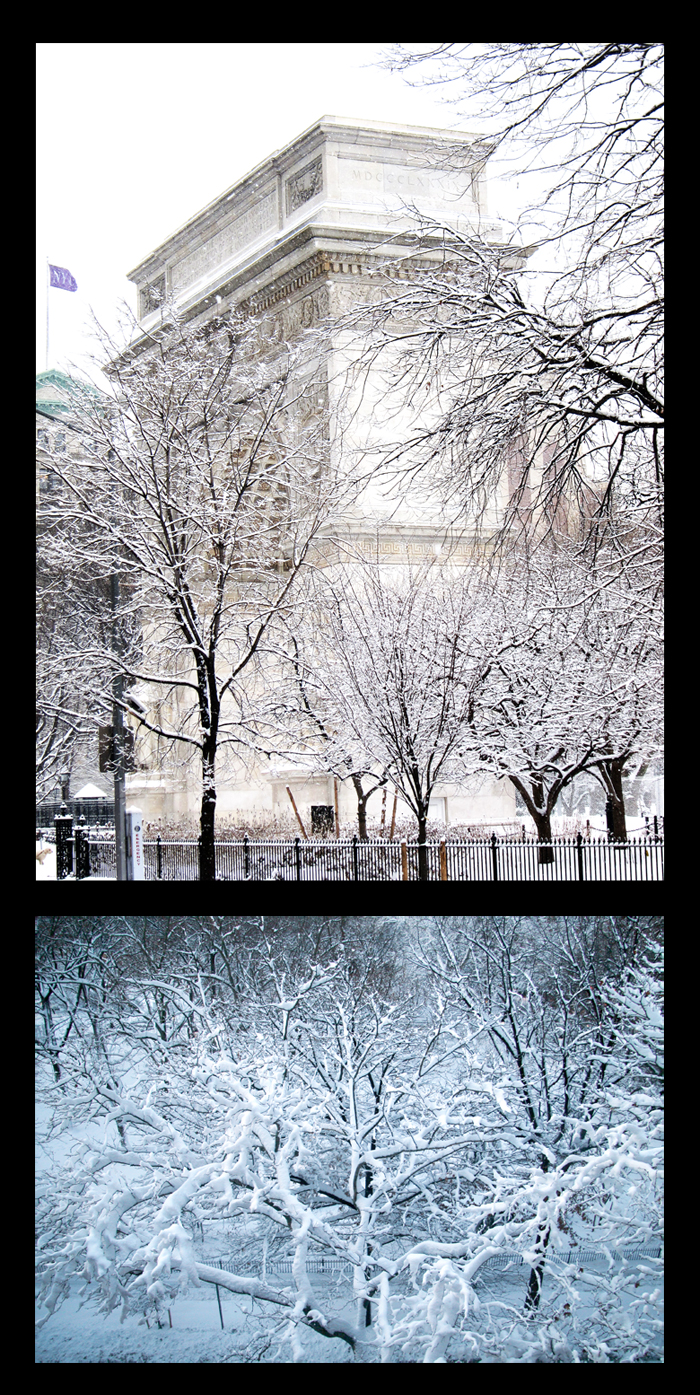
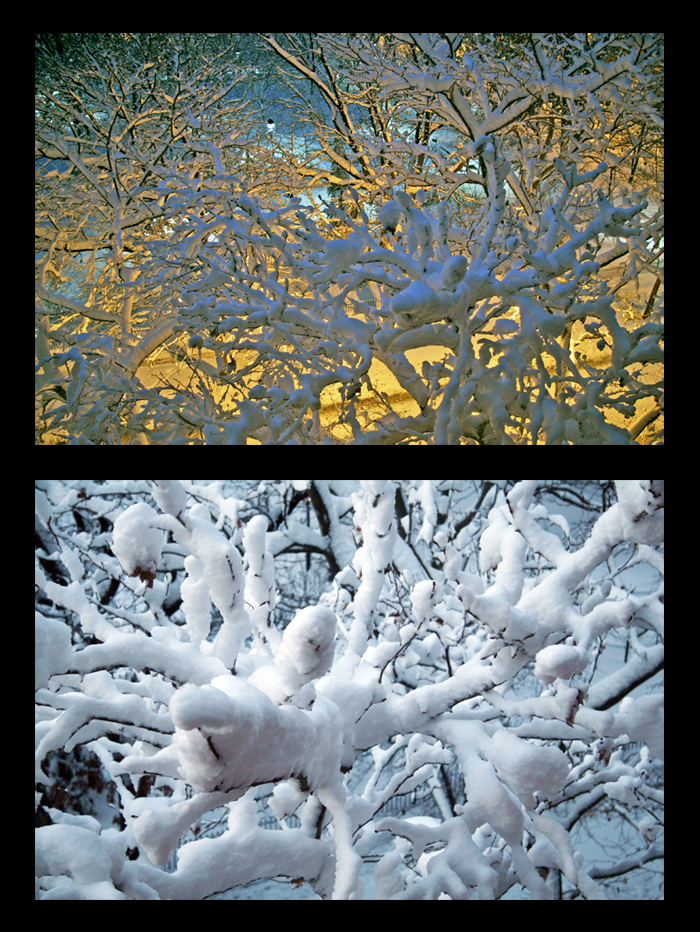
    Another blizzard. Last night I was called at midnight and informed there was a major snowfight going on in Washington Square Park. I was too lazy to bundle up and venture out for the photo op. However, I did begin taking photos yesterday, going into last night and into this morning.

    I have done many stories on this winter’s blizzards and past snowstorms in New York City. I have also done a series of stories called White By Design. See the links below.

    White By Design, White By Design 2, White By Desire, Blizzard, Friends P1, Friends P2, We Got Skiing Too, Shifting Gears, Snow Play, In Like a Lion, Gotta Shoot Village Cigars, Slush Fun


  • dinamic_sidebar 4 none

©2026 New York Daily Photo Entries (RSS) and Comments (RSS)  Raindrops Theme