• Category Archives Stores
  • Teleportation

    Posted on by Brian Dubé


    In New York City, people are driven – it’s the classic work hard, play hard. Regardless of how incongruous it may appear, with ease, ingenuity or great difficulty, you will find city residents participating in the most unlikely activities imaginable, using variants or adaptions as needed.

    No mountains to climb? Then scale buildings instead (see Urban Night Climbers here). In New York you can find cross-country ski during blizzards, windsurfing, tennis, golf, farming, gardening, birding, fishing, biking, swimming, kayaking, canoeing, sledding, jet skiing, sailing, horseback riding, hiking, camping, wind sailing and the flying of radio controlled jets. Of course, whether the big leagues or amateur, the major sports are found here too – football, basketball, baseball, softball and soccer.

    And surfing.

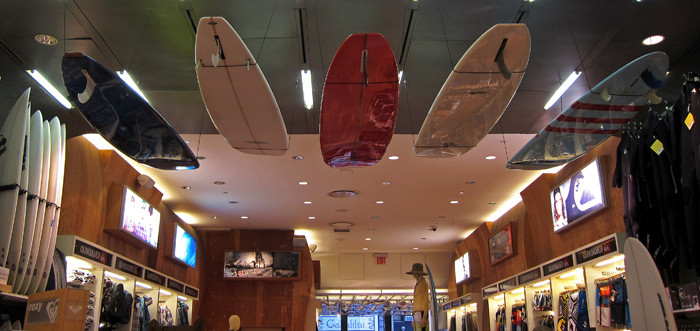
    While in Quiksilver* on Broadway in SoHo with friends from out of town, displays of full size surfboards really surprised them, particularly when they learned that they were not just decorative but that those in racks were actually for sale. I further explained that these were not only sold for those who may travel outside New York to surfing destinations but if you wanted to go ocean surfing, the real thing was available within city limits at Rockaway Beach, Queens.

    Rockaway Beach faces the Atlantic Ocean and is the largest urban beach in the United States. There is a surf community and surf shops. Perhaps the most remarkable, the stretch of beach is directly accessible by subway. In the 1970s, I had a short-lived romance with surfing, influenced by a love of the tropics, the California dream, the Beach Boys, and images of what appeared to be one way to commune with nature and one of the most exhilirating activities.

    I quickly learned that surfing required more skill than I had imagined and more effort than I was willing to expend. To make matters worse, because of storage limitations, I purchased a short board, which I subsequently learned was not the board of choice for beginners. I was told that a very long board, essentially a big boat, made learning much easier. I “surfed” a few of the beaches on Long Island as well as Rockaway Beach.

    In Rockaway, the train is elevated. On return from one outing, I boarded the A train in beach attire and my board. At the start of my ride back, my appearance was not particularly startling, given the proximity to the beach. However, as I approached Manhattan, the closer I got, the more bizarre and inexplicable my appearance was – evidenced by the type and increasing number of stares. At the point I reached Wall Street in a train car during rush hour packed with businessmen in 3-piece suits, I am sure the sight of a surfer in flip-flops and shorts with a wet board dripping on the A train floor looked like nothing short of a teleportation…

    *Quiksilver is based in Huntington Beach, California, and is one of the world’s largest manufacturers of surfwear and other boardsport-related equipment. There is an extensive clothing line and a number of stores can be found in Manhattan.
    Posted on by Brian Dubé

  • Really? Like What?


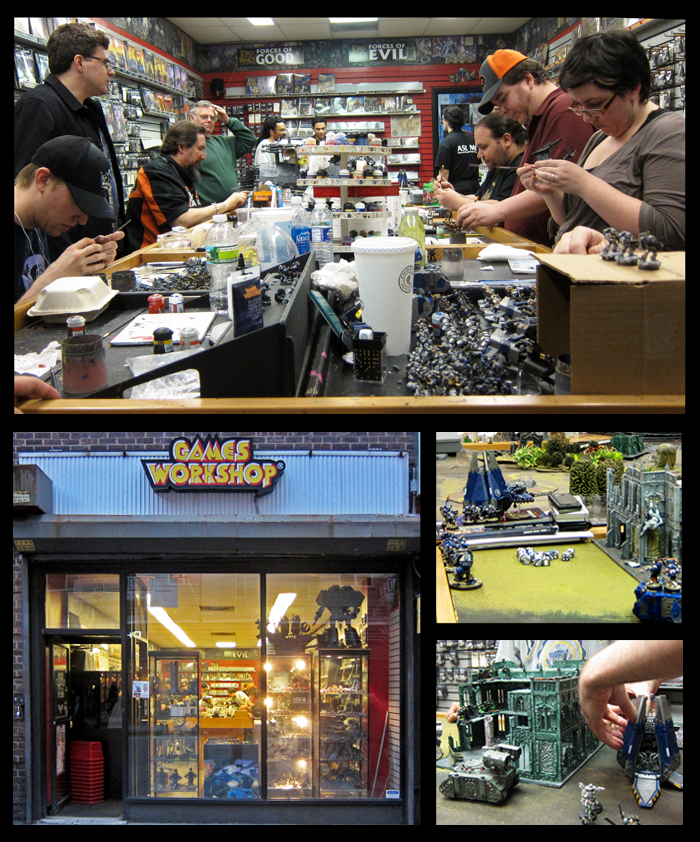
    This place was a real eye-opener for me. I have been by this rather nondescript retail shop for over a decade with nary a thought. Two things drew me to investigate. One is that it is a retail game shop surviving in 2011. There have been others in the Village, but all are now long gone. Two, there always appeared to be a large gathering of customers socializing and/or playing. Peering inside, it appeared that this was some sort of fantasy game environment, ala Dungeons and Dragons. And it is.

    One second in the Game Workshop and it is immediately clear you have entered a world with passionate participants. The cultish feeling was not new to me – in high school, I was a player of both chess and the strategic board games of Avalon Hill and Wff N Proof. The games attracted the nerd crowd, which according to my sister, I was clearly a member of. However, a close friend and fellow game player from those years recently pointed out to me that I had girlfriends (who were not nerds) – I am not sure if that disqualifies me from full membership in nerdom.

    The camaraderie of Games Workshop had the feel of the chess world – indulgence, extreme focus and lively banter – the conversation here was dominated by analysis and commentary on military capabilities of other countries and what-ifs. I was very surprised to learn about the history of this company. Founded in 1975 in the UK, there are now over 380 stores in 19 countries worldwide with thousands more that sell their products. The British based corporation is traded on the London Stock Exchange. Yearly revenues are in excess of $200 million.

    I found this statement from their website:

    A hobby is something people make time for. It is not a pass-time and therefore not usually analogous to watching TV or playing computer games. In our case, as with most hobbies, it involves commitment, collection, craft or manual skills and imagination. Someone who is involved in the Games Workshop Hobby collects large numbers of miniatures, paints them, modifies them, builds terrain and war games with them in our imaginary universe. This involves huge amounts of time.

    Games Workshop Hobbyists play war games with large numbers of metal or plastic miniatures they have carefully chosen and, usually, painstakingly painted, on a table top face to face with their friends. It is a social and convivial activity loved by Hobbyists the world over.

    The game involves a lot of activity rather than passivity – making and decorating figures, creating playing space and learning the daunting amount of information and rules. Much like fantasy role playing games like Dungeons and Dragons, the games become an alternate world.

    I asked the sales staff if they minded I take photos. The response was essentially No Problema and I was already feeling this was another place with a policy of No Negativity. I stayed for some time watching the game playing and work, chatting with the sales staff to get some insight into this world. Game Workshop provides free space for customers to paint their figures and also play their signature proprietary games – Warhammer, Warhammer 40,000 and the newer Lord of the Rings. The wall space displays merchandise for sale – all the various figure model sets and also the voluminous manuals and magazines like their own, White Dwarf. I was told that the shop at 54 East 8th Street is the only store in the Northeast and is one of the largest revenue grossing operations in the United States.

    There are worse ways to spend time than to be actively involved in a social activity and strategic game playing requiring a skill, memory, and imagination. I think the entire experience drew out the nerd deep inside because my first reaction to this place was: These “boys” (and girls) are too old to be playing with toys. They have too much time on their hands. There are much better things to do with one’s time. However, I found myself answering Really? Like What? 🙂


  • Irony Candy

    For an insightful view into the soul of New York City, turn to its comics. If their material really resonates with you, then you’re a New Yorker, if not by address, then in spirit. Some, like Woody Allen, are virtual spokespeople for all that is New York. Shows like Seinfeld capture the essence of city life, right down to the minutiae. One of my favorite New York City comics is Todd Barry. His has a brilliant, understated style, characterized with the necessary ingredients – smug indifference, cynicism, skepticism, sarcasm. Todd effectively illustrates the irony of the high priced accoutrement of defiance in a routine about Kmart coming to New York City:

    Some New Yorkers were pissed off when Kmart came to town. They were outside the store protesting. They didn’t even know what to say. They were like, ‘Down with Kmart and their merchandise that people can afford. Down with Kmart and their 300 gallon drum of laundry detergent for 99 cents. Why don’t you go take your good values to another town?’ Let’s turn that building into a vintage clothing store. The kind that sells used Kmart shirts for $700.

    I had a similar insight in the early 1970s when I saw Jefferson Airplane at the Fillmore East. They were singing one of their popular hits about revolution, Volunteers. Somehow it seemed hypocritical or perhaps to be a bit nicer about it, filled with apparent contradiction. This group had money – limos, mansions, etc. and their lifestyle did not seem to bespeak of those revolting against the world order and materialism. But when the spokesperson is generally perceived as cool, they can get away with a lot of contradiction. On April 8, 2008, I wrote a story called Unguent, about the effects of money: “Money is like an unguent and when applied liberally, it usually is absorbed readily with predictable effects. It doesn’t appear that one has to rub the salve that hard or long to take off most edges.”

    We see that irony replayed here at Search and Destroy at 25 St. Marks Place, with underground, subculture and vintage punk clothing and goods being sold for a king’s ransom. Whether a shopper sees irony or not with merchandise priced as luxury items and taglines like “chaotic and anarchy” or “dangerous clothing store”, explains the wildly disparate ratings at a site like Yelp.com that go from 1 to 5 stars. Many bristle at what they consider outrageous pricing and others appreciate the merchandise, some apparently difficult to find.

    I have zero knowledge regarding the products I saw there – it was primarily eye candy for me. Or perhaps we should say, Irony Candy 🙂


  • Just Shades


    If you want the flavor of New York City, I recommend watching Late Night with David Letterman. Here you will get comedy with an edge and a blend of the New Yorker’s classic traits – smug indifference, elitism, cynicism, skepticism, sarcasm, and impatience, applied to any and all topics, like the world of specialization, which we see more and more in all sectors of life whether business, occupation, or recreation.

    In retail, however, this is an extremely risky proposition. With a large product mix, a retailer can shift gears, i.e. inventory, as trends and consumer demands change. But to have a brick and mortar shop that specializes in a specific product leaves one at tremendous risk – a change in the tastes of the consumer and you are finished. A highly specialized retailer will typically require a very large population to keep a physical shop afloat financially selling one product. New York City offers the best opportunity for success.

    For every specialty survivor, I have seen a hundred casualties, like the gelati craze of the 1980s. We now have a wave of Red Mango and Pinkberry shops seemingly everywhere. Although they may offer a higher quality product, it is reminiscent of TCBY in New York. Now, there is only one left in Manhattan. One has to deal with not only the fickleness of the consumer, but also that of the New Yorker who has their own particular taste.

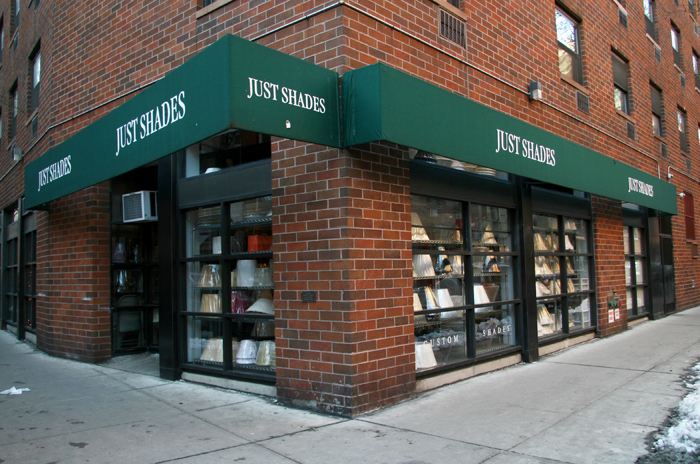
    The specialty shop sells only one product line, like Canal Rubber. The real specialty shop sells only one product – The Doughnut Plant, Kossar’s Bialys, H&H Bagel. But food shops or chains specializing in one product are common. Hard goods much less so. This is the world that surprises. Like Bari pizza ovens. Perhaps the quintessential poster child for real specialization in New York City retail is Just Shades, which, along with Just Bulbs, were the subjects of a brilliant, classic David Letterman skit in 1983. In it, Letterman starts by visiting Just Bulbs, where he persists in asking a salesclerk if they carry anything other than bulbs. Here are excerpts of Letterman’s brand of torture:

    Letterman: Besides bulbs, what do you have here?
    Clerk: Nothing.
    Letterman: How about shades? Could you get shades here?
    Clerk: NO, we are Just Bulbs. If you want shades, maybe you go in a place called Just Shades.

    Then we cut away to a downtown retailer, Just Shades, where Letterman pursues the same relentless questioning with a little old lady:

    Letterman: What is the name of this store?
    Clerk: Just Shades.
    Letterman: And what can you get in here?
    Clerk: What can you get in here? Only shades. That’s why our name is Just Shades.
    Letterman: But seriously, what can you get besides shades here?

    Letterman was able to poke some fun at the expense of extreme specialization, and for that, you need a New Yorker, New York, and a place like Just Shades 🙂


  • Pecking for Pita

    On April 27, 2010, I wrote Tired of Crumbs about the plight of many street performers and other independent artists. However, for many other members of the animal kingdom, crumbs are more than a metaphor, and living off the discards of others is literally the means of survival. In a city with as large a population as New York, the amount of refuse disposed is enormous, affording life support for many.

    A lover of Middle Eastern food, I was pleased to have the good fortune to run into Damascus Bakery while strolling through the Vinegar Hill neighborhood of Brooklyn. It was Sunday, so the business operation was closed, however, just outside the factory, there were a large number of pigeons busy atop dumpsters covered with heavy tarps. They seemed particularly industrious, and I had suspicions as to what was going on. Lifting up a corner of one tarp revealed exactly what I expected – the dumpster was entirely filled with pita bread, all polybagged, which I assume had been disposed of for a good reason.

    The pigeons were undaunted by the tarp and had successfully pecked holes through it and the plastic bags holding the pita. Perhaps not as dramatic as the Hawk Fest I witnessed on my window ledge in 2007, but nonetheless, this was a food fest.

    Damascus Bakeries is a 3rd generation business, currently run by Edward Mafoud, grandson of Hassan Halaby, who started the business on Atlantic Avenue in 1930 and introduced Syrian bread, aka pita, to America. In addition to a variety of flavors and sizes of pita, the bakery also produces Lavash Wraps, Panini, and Roll Ups. I hope to visit and tour their factory in the future.

    In New York City there are many means of survival. At the corner of Gold and Water Streets in Brooklyn, for these pigeons, it’s Pecking for Pita 🙂


  • Toys "R" Us

    Everyone has their comfort zones, and for most, familiarity breeds contentment, not contempt. But I really have a difficult time with visitors who travel all the way to New York City and seek out the same shops and restaurants they have at home. Like eating at McDonalds after shopping at national chain retailers.

    I am quite guilty myself of frequenting a small group of restaurants in a city with tens of thousands. When my stomach calls for refueling, this is typically not the time I want to become a risk taker. I want the tried and true – to eat the things I know are guaranteed to bring satisfaction. But there are limits to living in the comfort zone.

    When I guide visitors brimming with enthusiasm for those things unique to the city, I am galvanized; when I find myself with someone looking for the places that are familiar to them, I begin to short circuit and lose voltage. On one occasion, I had in my custody a woman who rejected every cuisine I offered. She commented, “At this point, McDonalds is starting to look good.” When we finally agreed on Italian, she rejected every entree. The only pasta she would eat was not on the menu.

    The most frustrating outing was one occasion when visited by my nephews when young. Knowing full well what I was dealing with, I put quite a bit of thought into what kids would want and geared the day towards the big and impressive – things like the Brooklyn Bridge and the new planetarium at the Museum of Natural History. What was requested, however, was a visit to the large Toys “R” Us at Times Square. I’ve been in a bad mood ever since.

    If you are a shopper, you could be visiting places like the Morrison Hotel Gallery. There are two locations – the older at 124 Prince Street in SoHo and the newer (seen in the photos) at 313 Bowery, appropriately, the former location of the CBGB Gallery. In my recent visit, I spent some time chatting with Rick Edwards and Vicki Albanese, sharing stories of music venues and encounters with music legends in the past.

    The gallery represents a bevy of renowned photographers, such as the legendary Jim Marshall, who recently passed away. The Morrison Hotel Gallery was founded in 2001 by former record company executive and producer Peter Blachley, former independent record store owner Rich Horowitz, and music photographer Henry Diltz. In 2008, a deal was made with Sony to sell photos from the archives of Columbia Records.

    The Morrison Hotel Gallery has some of the largest collections in the world of historic rock photos. If you are downtown, I recommend you drop in to browse. If you prefer, I also know of another little known place to visit for a unique New York City experience, located in an off-the-beaten-path location. It’s in an area called Times Square, and the place is called Toys “R” Us 🙂


  • Brawling Over Brands

    I hate brawling over brands. In the 1980s, I was shopping for an industrial sewing machine. Juki seemed to be the brand I saw in nearly every factory, so this is what I asked for. “Does it have to be a Juki?” the salesman asked. “No,” I responded, “it does not have to be a Juki, but that is what I want.” Lest some may think this was a salesman just being helpful, it is not. His question is business code for I don’t have what you want, so let me sell you what I have. or I’d rather sell you something else. I bought the Juki.

    Recently, we were still prototyping bags (see story here), and I was now in need of zippers. I only know one thing about zippers – YKK. A coworker called out, “What’s the deal with YKK? Is that a brand or something?” Yes it is. The brand used on virtually every quality sewn product. Samples or not, that’s what I want. Why ask for trouble?

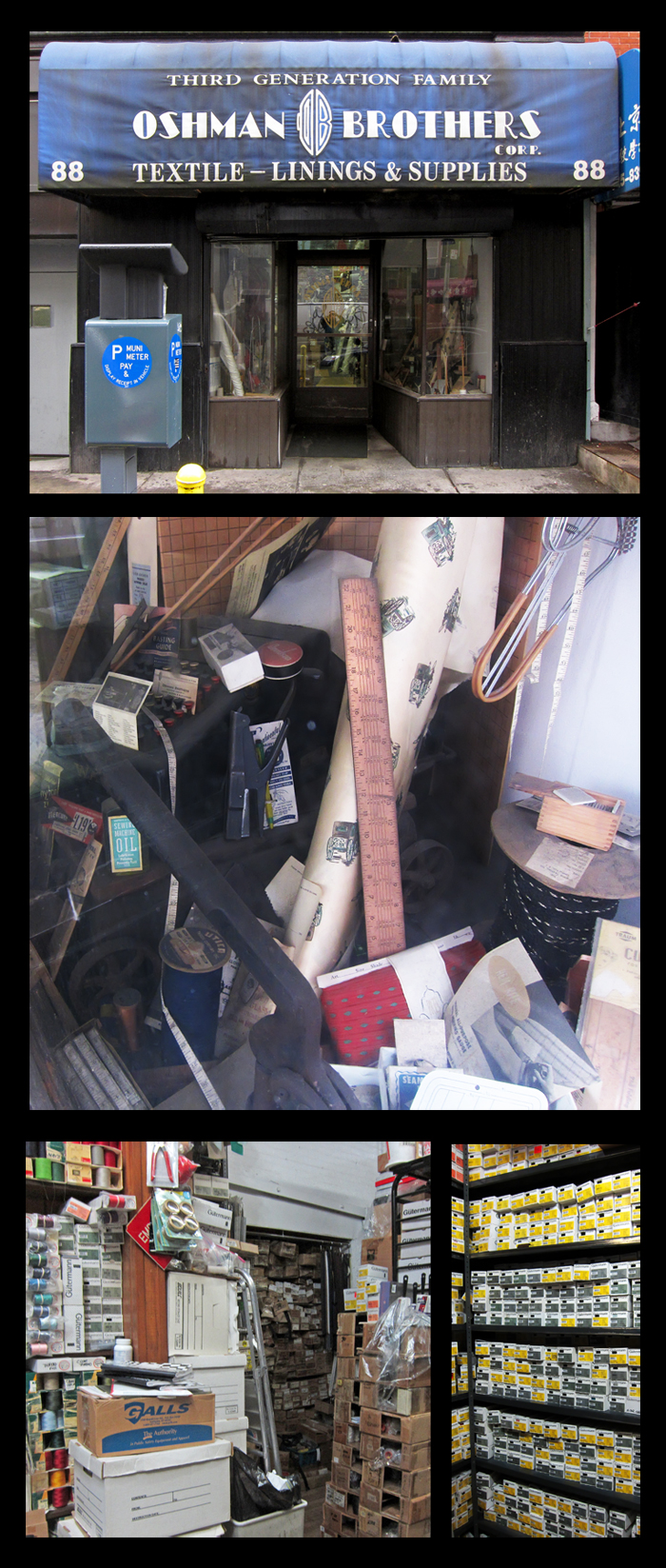
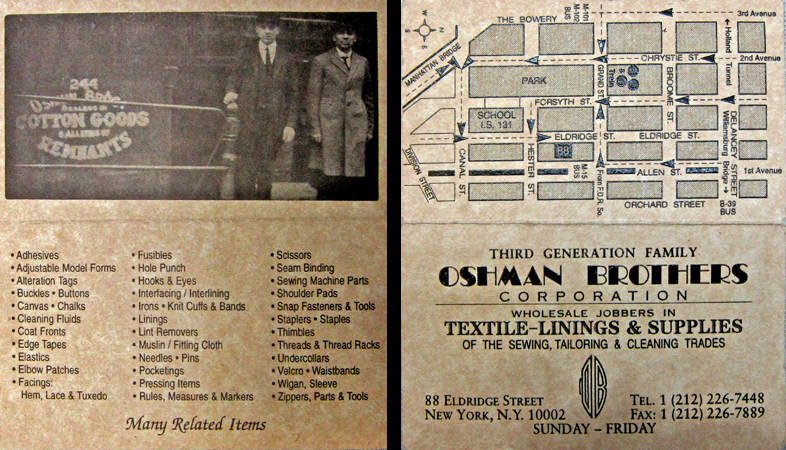
    I called a favorite notions supply shop in the garment district, Steinlauf and Stoller. They did have zippers, but not heavy duty. It occurred to me we had fabric vendors near my office in the Lower East Side. A call to Zarin Fabrics referred me to Oshman tailor supplies. Oshman’s website had small display ads for top brands including Gütermann (thread) and YKK. This looked like a no-nonsense operation. Armed with samples and a camera, I was off to Oshman Brothers, not only to get the sewing supplies I needed, but also perhaps to get photos and a story as well.

    Arriving at 88 Eldridge, I knew this was the type of place I had hoped for – the awning stated “Third Generation Family.” The window displays looked like they had not been touched in three generations, but this was a good omen.

    I have no idea how this type of place is perceived by someone who has not frequented the business or industrial supplier in New York City. It is not a necessary condition for authenticity that a place have this dreary, drab look and feel. A place selling top quality industrial supplies has a customer base whose only concern is getting those goods. Sales, marketing, displays, and imaging has little or no effect on the savvy commercial buyer.

    I was helped by the lone salesperson, Elaine Leong, who I learned was the wife of the owner, Oshman, whose grandfather and grand uncle started the business in 1936. When I showed approval of their thread choice, Elaine proudly showed me their inventory and told me that they stocked all 600 colors of the Gütermann line. She also asked if I had worked with continuous length zippers before, and when I said I had not, she brought out scissors and hardware and gave me a live tutorial.

    Elaine’s style is not that typical for a New York City industrial supplier. There was no upsell or hard sell. She only sold me what I needed – a total of $12.35 for zippers, zipper hardware, bobbins, and needles – and spent more than the time necessary to attend my needs. She was quite pleased when I told her I would be doing this story – she fished out her only remaining antique business card (see photo here).

    Oshman Brothers is the type of unique, specialized business supplier that reflects New York City’s greatness. Many business owners travel here for places like this. They know they will find a broad range of quality supplies, often unavailable elsewhere. There’s business to be done, everyone is on the same page, and there’s no brawling over brands 🙂

    Note: Thanks to Elaine for being such a wonderful mensch.


  • Joe Plourde

    This website would not be complete if I did not mention Joe Plourde. I have ruminated for some years as to whether to include him. You will never meet Joe Plourde, nor will you read of him anywhere. He is, in many ways, an ordinary man of ordinary means. He has seen hardship with an austere upbringing. Appropriately, he lives in a town called Plainville.

    But in other ways, Joe is an extraordinary man. He is disarmingly friendly and loved by everyone he meets. He is, like my family, of French Canadian ancestry, but unlike my parents who were born in Maine, he is from the Province of Quebec, moving to Maine and then later to Connecticut. It was in Hartford that he met my family when they made the same move and helped us find our first apartment.

    I have written a number of times about the demonizing of the present and the praising of the past. That many believe that everything has been dumbed down and that the best was in times past. In Better When, I quoted from Jill Eisenstadt’s New York Times article about this very topic. However, with all due respect to Jill, she (or I for that matter) is not someone who left home at 14 years old from the woods of Canada.

    Joe is quite direct and not always politically correct, but he is a fair and reasonable man and not materialistic at all. He does not champion the past. On one occasion he told my father, “Al, you know what they can do with the good old days. The can shove ’em where the sun don’t shine.” A bit vulgar, but a point I have never forgotten. The few pleasures of the simpler life of days of old did not outweigh the hardships he endured – he much prefers his modern life with simple comforts, like central heating and indoor plumbing.

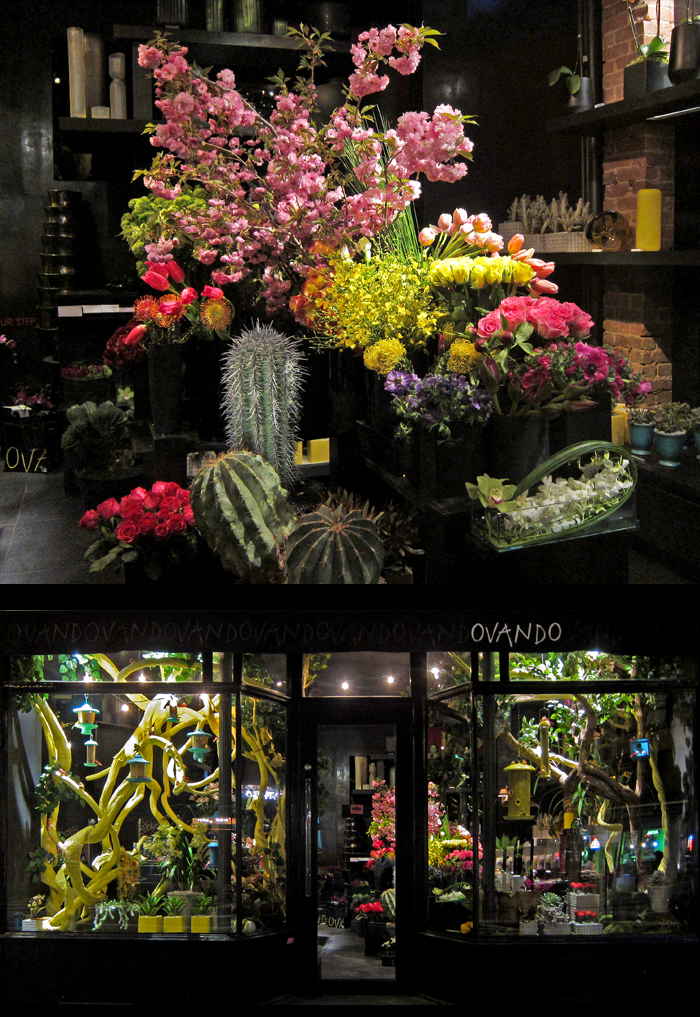
    Flower shops have been around for a long time, and Ovando Flowers, at 337 Bleecker Street, is a good example of how many retailers today excel in the quality of goods offered and presentation. Ovando’s extraordinary window display is itself a tourist attraction. From their website:

    The owner, Sandra de Ovando, was born in Mexico City to Spanish and Russian parents. Sandra fell in love with nature, flowers and bold colors at a very young age when she often spent weekends gardening with her mother.

    Later, in her travels throughout Europe and Asia, Sandra discovered exotic flowers, plants and fruits which she began incorporating into her designs – hence was born the signature style that today defines Ovando’s dynamic compositions.

    Intent on indulging her bright passion for flowers and design, Sandra moved to New York where she soon after opened Ovando in 2003.

    Today, Ovando has blossomed into a full-service Floral and Event Design Company. Sandra’s unique approach, the culmination of her life’s journey, has made her the favorite floral designer of New York’s elite, including celebrities, high-end restaurants, fashion houses and boutique hotels. From stunning bouquets, moody lighting, and the full-scale construction of breathtaking displays and environments, Ovando is a dazzling celebration of form, function, and flowers.

    I don’t expect to find Joe Plourde there, but I know he would like it 🙂


  • Stability In a World of Change

    Professor Gurland (see here) once commented that one of man’s problems was looking for stability in a world of change. Perhaps he was right and this is the reason we find such tremendous comfort in those few enduring icons, legacy businesses, products, and annual holidays and celebrations. And why nostalgia is so strong that we build bridges in our minds between past memories and present experiences, with connections as cables.

    In spite of all the dynamic changes in our world, New York City is a mecca for durable icons. People come the all corners of the earth to see the same buildings, bridges, and attractions that millions have seen before them.
    Over the years in producing this website, I have photographed and written about the fantastic Christmas displays in New York City, known worldwide. Rockefeller Center with its tree and skating rink, Santaland at Macy’s, and the store windows – Macy’s, Bergdorf, Tiffany’s, Barney’s, Saks, and Lord and Taylor. Amidst all the business failures, there really is a miracle on 34th Street, where we find Macy’s year after year and and the same Christmas theme, Believe (see here), with the only change being a digital display.

    We travel, we search, we comb the recesses of our minds for the enduring constants. There’s no better place and time than New York City at Christmas to find those very few things that allow us to Believe there is some stability in a world of change 🙂


  • Sirens of Convenience

    I had a friend, Steve, with whom I shared the same sense of humor. Over time, we developed shtick that we enjoyed doing at every opportunity. One involved the creation of a character who did not care about money – a blowhard, someone like Ralph Cramden of the Honeymooners TV Series who has little but flaunts what he has to appear to be a big man.

    Any time we were together, Steve would typically bring out this character without warning for maximum effect. “Mr. Dubé, I don’t care about money. I throw it away. In fact, here’s some money now [Steve would take out a bill]. I’m throwing it away. [he would crumple it and throw it to the ground].” His delivery and style was superb, and we never tired of this bit.

    Although this character was not based specifically on any New Yorker, it is not too far from how many New Yorkers appear to treat money. The incredibly high cost of business rents in tandem with incomes that are typically higher and the incredible convenience of services and goods all conspire to develop a very cavalier attitude by many New Yorkers concerning money. This leads to outrageous statements like “Their food is ridiculously cheap. Salad is only $7.95 a pound,” or paying more for a product because you are too lazy to cross the street and go to a supermarket.

    Recently, a friend and I noticed small pieces of Divine Organics Raw Chocolate Brittle for $10.89 each in a local natural foods store. We are never daunted by prices in the city, and extreme examples abound and surround us. Nonetheless, we found this product at $10.89 for a 1.6 ounce piece so outrageous (that’s $108.90 per pound), it has become a source of amusement whenever we see it.

    I’ve been to places, and perhaps you have also, where the value of money is taken very seriously, where even a dollar or 50 cents means something. I once ate at a diner in rural Maine where I asked for a substitution in a dinner platter. Since something of lesser cost replaced something of greater cost, the waitress actually volunteered a price reduction of some cents. I can’t dream of such a scenario in New York City.

    New York City is a seductress, with the sirens of convenience ready to lure you in. If you crash upon our shores, the easiest way to spare your life is with money. Just tell the sirens, “I don’t care about money. I throw it away. In fact, here’s some money now. I’m throwing it away.” 🙂


  • Bergdorf Holiday Windows 2010


    Although quite non-traditional, my favorite holiday windows are those at Bergdorf Goodman department store, with three exposures along Fifth Avenue and 57th and 58th Streets. They are highly imaginative and superbly crafted. The window displays are illuminated so they can be seen day or night. See my gallery of photos here. This year’s theme is Wish You Were Here. From Bergdorf’s website:

    Appropriately titled Wish You Were Here, this year’s 2010 Holiday Windows invite its audience to join David Hoey and his talented visual team on a journey through fantasy travel, sly visual wit and far-flung places. With an array of wild mash-ups of unexpected arrivals and departures, each window features visual influences as diverse as Roman mythology, 1940s Hollywood musicals, the original Penn Station, and the very first science fiction film.”

    This year Bergdorf also has provided a short behind the scenes video on the production – “Follow Me: the Making of Bergdorf Goodman’s 2010 Holiday Windows.” You can see the video and read about the window theme and its creation here and here.

    See my previous postings of holiday windows and Christmas postings: Bergdorf Windows 2009, Witty Holiday, Bendel, Christmas 2008, Fifth Avenue Windows, Tiffany’s Windows, Saks Windows, Santacon, White Christmas, Christmas Trees, Comfort and Joy, Believe, Nested Embraces, Dyker Lights, National Tree, Saks Fifth Avenue, Surly Santas


  • Who Your Friends Are


    Things are good when everything is going well, and there usually is no trouble when there are no problems. The test of a friendship or business is how they fare under adversity. Smooth sales are smooth sailing.

    I once read a recommendation from a business CEO who suggested that one of the best ways to assess the customer service of your own business is to call your company, fabricate a problem or complaint, and see how it is handled.

    The business environment is extremely competitive, and over the years, return policies have become more and more lenient. However, although a very liberal return policy is something that most quality businesses want to proudly offer, the true measure of this policy is how readily the company embraces it and in the customer experience of the return process itself.

    In the 1980s, I was located in lower Manhattan near J&R Music World. Prices were competitive, inventory good, and the sales staff very knowledgeable, so this is where I found myself making virtually all of my electronic purchases. Salesmen would extol the lenient return policy in making the sale. However, when we needed to make a visit to their return department, it was with great trepidation.

    The return department was located in the basement – the perfect metaphor for what was often a short hellish experience of being put through a fire of questioning as to why an item was being returned. There was always a “scary guy” serving as gatekeeper to getting the coveted store credit. Telling him that the salesman had said that any reason for return was adequate was apparently no longer really adequate on the day of return. Sometimes a small interrogation and/or debate ensued, with the customer having to justify his or her return. The customer typically prevailed, but the experience served as a warning to the whimsical returner.

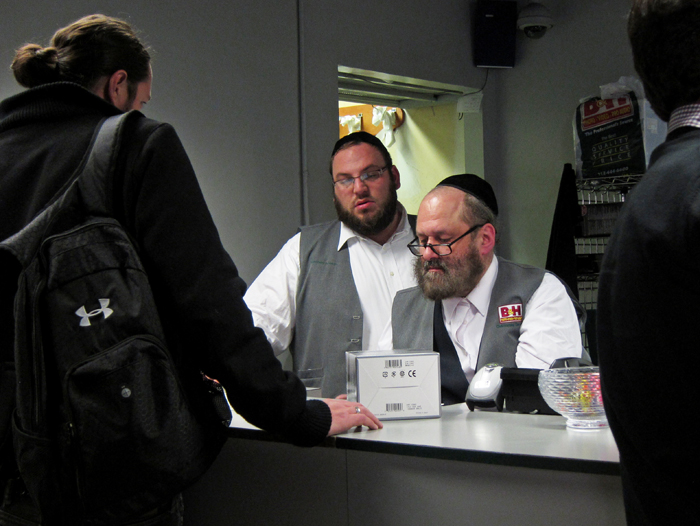
    Things have changed since then – we are in a different world. Most retailers have learned that if you make an offer, don’t punish the customer for accepting it. At B&H Photo (see You’re Not in Kansas) e.g., returns are done without a question (other than perhaps if the product was broken), even with products in the thousands of dollars.

    Retail giants are quite routinized in their handling of returns. The volume of returns prohibits customer interrogation, and the size of the companies allows for absorption of monetary loss. Companies such as Nordstrom’s and LL Bean are legendary, with no time limits on returns. In New York City, Macy’s is well-known for a very liberal return process.

    With the small independent shop, however, taking many returns can be a financial hardship. This is where the customer may find many terms and conditions, difficulties, and charlatans. In times of personal hardship or when returning goods in New York City, you will quickly find out who your friends are 🙂


  • Horse Trading


    The Internet has provided new opportunities, including the ability for individuals to hide easily behind a cloak of anonymity in cyberspace. In the case of online businesses, it has also enabled many to create barriers between customers and live agents, one of the frustrations of the modern consumer.

    I have owned a business for 35 years in New York City. I am old-school when it comes to customer service and believe a business that takes your money has an obligation to provide easy phone access and transparency. Many companies do pride themselves on this and advertise as such on their websites. Others, even though reputable such as Amazon, offer no phone number on their websites. There are sites that do nothing but provide customer service telephone numbers for large companies.

    Unfortunately, even when businesses have a physical presence, a visit in person to the offending store is no guarantee of satisfaction. When it comes to unscrupulous merchants, New York City has had a long history as a place with a fair number of weasels who drastically overcharge, lie, and cheat in a variety of ways. Electronic shops in Times Square are notorious. But overcharging alone is not a crime, so let the buyer beware, even in the world of bricks and mortar.

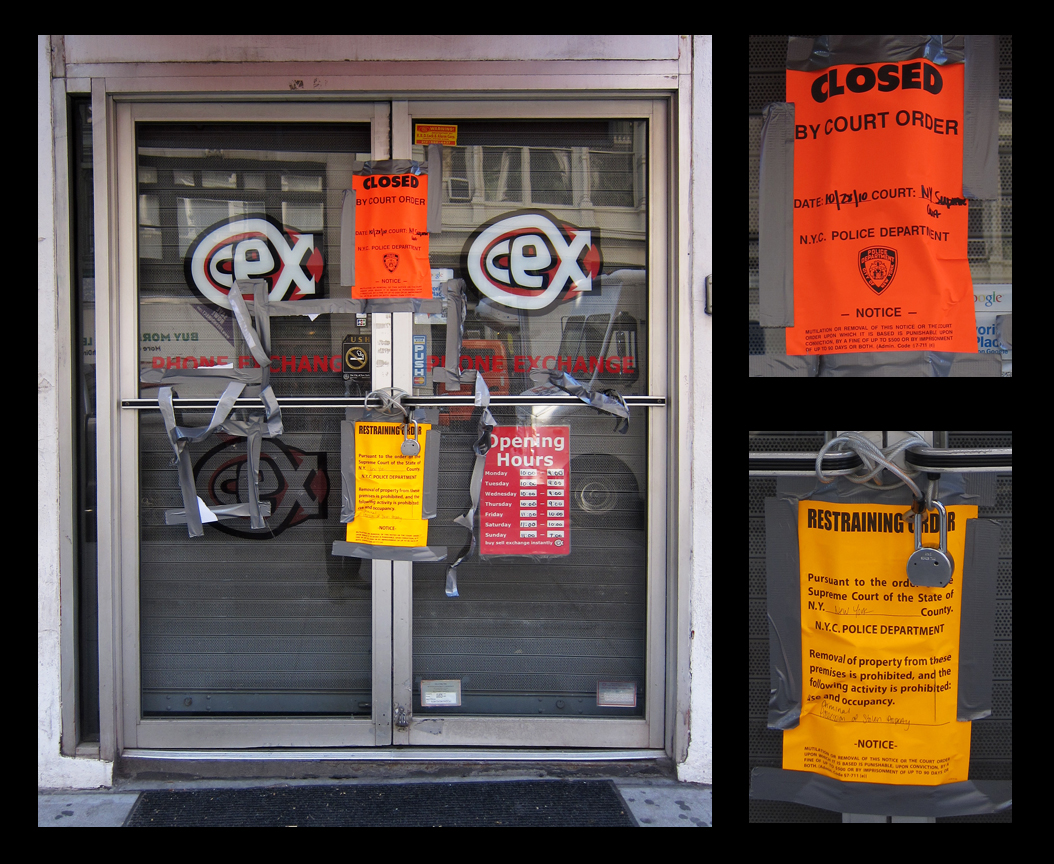
    I was recently in the market for a no-contract cell phone. The phone options for this are often limited. An unlocked phone can be configured by the phone carrier, and just a short stroll away from Verizon and AT&T on Broadway in NoHo is the CeX (Complete Entertainment Exchange), a dealer who buys and sells unlocked cell phones (along with video games, DVDs,CDs, computers, and other digital electronic products).* My single previous experience was when I had accompanied someone who purchased a unlocked iPhone.

    So, before my visit to Verizon, I decided to quickly drop into CeX and peruse the wares. I was greeted with locked doors, gates down and a number of ominous looking documents duct-taped to the shop doors and windows: CLOSED BY COURT ORDER and RESTRAINING ORDER, which warned that “Removal of property from these premises is prohibited, and the following activity is prohibited: use and occupancy.” Below that was the reason: “Criminal possession of Stolen Property.” In looking at online reviews, some alleged that CeX knowingly traded in stolen laptops. Apparently the NYPD was also aware. Whether in cyberspace, Times Square, or any place with the character of the Wild West, beware of horse traders 🙂

    *I was surprised to learn that CeX is not a mom and pop operation but one of over 100 stores in the US, Canada, and the UK, where the corporation was founded in 1992.


  • Up in Smoke

    It is said that in hard times, people turn to small luxuries and vices. Historically, companies dealing in alcohol, tobacco products, and gaming/gambling have fared quite well during recessions or depressions. There is even a vice fund, VICEX, that invests in so called “sin” stocks. Candy and chocolate manufactures also flourish – many of the household names in candy started during the Depression years: Snickers in 1930; Tootsie Pops in 1931, and Mars Bars and Three Musketeers in 1932.

    A close friend who lives out west and visits from time to time is a cigar smoker. Part of his agenda on trips to New York City is always a visit to a cigar shop. On October 10, 2008, I wrote about a wonderful retail excursion in New York Moment.
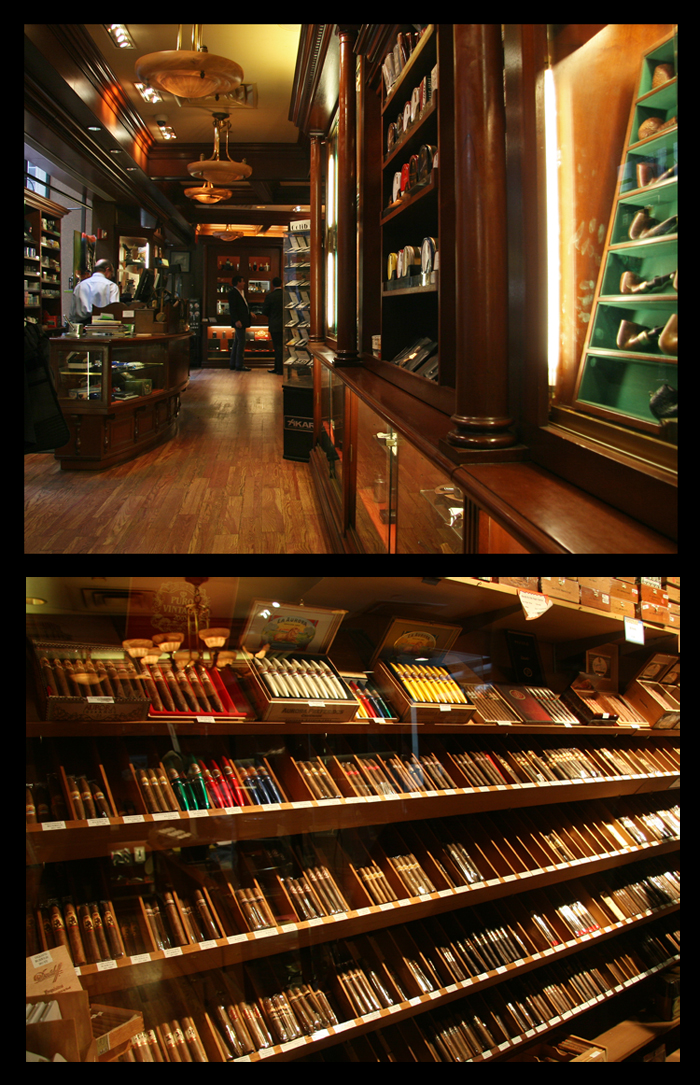
    On his most recent trip, we visited Barclay Rex on Broad Street in the Financial District, new to both of us. As a non-smoker, these establishments are very foreign to me – going there is entering an alien world. Barclay Rex has been in business in New York City for 100 years. The original founder was Vincent Nastri, a pipe maker from Salerno, Italy.

    The store was opened on Barclay and Church Street and taking the cue “a dog is man’s best friend”, Nastri, with his Great Dane Rex in tow, set out to create Barclay-Rex. This partnership was a touching testimonial to Mr. Nastri’s character as he was rarely without his faithful companion Rex, who also served as an ingenious way to advertise the store. The Great Dane wore an emblazoned blanket with the name Barclay-Rex and drew the curious and potential customer.

    The company has three locations in Manhattan and is owned by Vincent Nastri III. You can read more about Barclay Rex at their website here.

    The flagship store at 75 Broad Street is exquisitely done, with a classic, mahogany paneled library and polished cherry oak floors. There is a humidor on site, as well as a smoking lounge.

    There is a tradition, history, and its own vocabulary in the world of cigars. There is also a greater defiance and rebellious spirit to smoking, in a world which is postured against smoking with increased taxes and a very limited number of environments where one is permitted to smoke.

    Good times or bad, when it comes to vices, dollars are found to feed the appetites, whether things are eaten or go up in smoke 🙂


  • Caught in the Riptide


    Have you ever been caught in a flow of traffic so strong that you feel you cannot exit? And to do so would not only be dangerous, but you also fear the ire of those who may be inconvenienced and slowed down by your exit, even for a nanosecond? Or perhaps you have avoided swimming at a beach where dangerous riptides exist.

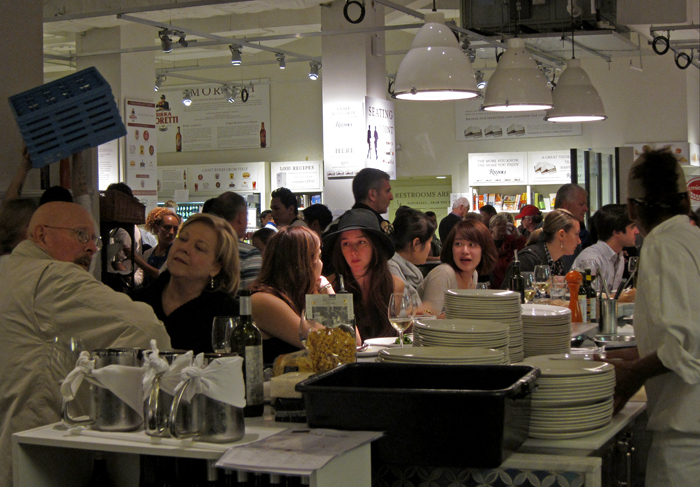
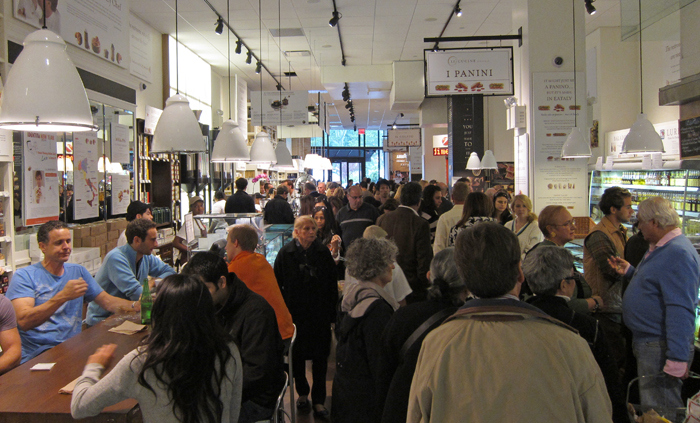
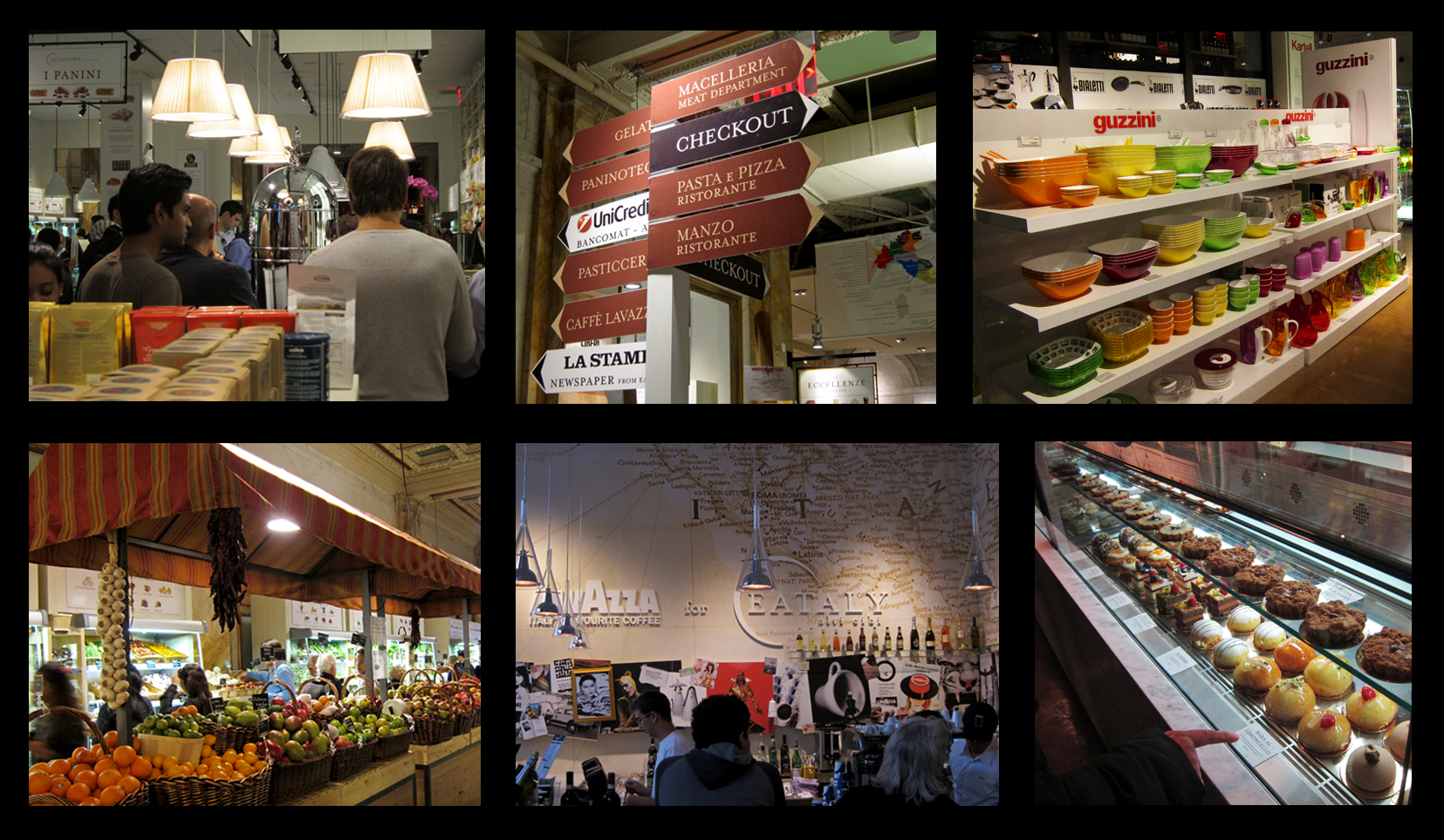
    Unfortunately, I am very narrow-minded when it comes to mob scenes. And there are plenty of mob scenes in New York City, driven by the buzz of the powerfully connected. It is a deal breaker for me. So, regardless of how wonderful and amazing Eataly may be, I can not tolerate being in a place that is like being on a freeway with no exits. I am not afraid of traffic – I have driven in New York City for my entire life here and was a taxi driver for nearly 2 years when I first moved to the city. But I try to avoid crowds and find a little respite when it comes to food shopping. This is why I also tend to visit Whole Foods Market in the city infrequently.

    Eataly is the brainchild of restaurateurs Mario Batali, Joe Bastianich, Lidia Matticchio Bastianich, and Eataly founder Oscar Farinetti, who created the Eataly food emporium in Torino, Italy, opened in 2007. You can read more about them here at their website.
    Eataly in New York City occupies 52,000 square feet on the ground floor in the toy center at 200 Fifth Avenue at 23rd Street. It features multiple restaurants, a Neapolitan pizzeria, and retail shops featuring every imaginable food item from Italy, along with Italian housewares and a cooking school. There is a year-round rooftop beer garden and microbrewery.

    Mario Batali is no poser. He knows his food, and his tremendous success is not smoke and mirrors. I did not examine any of the goods, but I am confident that everything is as represented as far as foodstuffs for sale. The philosophy here is not only to bring in the finest goods direct from Italy, but also to embrace the Slow Foods concept on which the original Eataly is based and which I heartily support.

    Restaurants are, of course, another story entirely. Good service is not a given, particularly in a place overwhelmed with patrons. There are so many negative online restaurant reviews regarding the places in Eataly that I would have to assume, at best, that the experiences here will be uneven.

    However, I do plan on going back to look a little more closely, brave the crowds, and give the place a chance. See you there, caught in the riptide 🙂


  • dinamic_sidebar 4 none

©2026 New York Daily Photo Entries (RSS) and Comments (RSS)  Raindrops Theme