• Category Archives Food and Restaurants
  • DiFara

    Generally, conversation about legendary pizza usually involves a lot of evaluations and comparisons of sauces and crusts. But in the case of DiFara Pizzeria, the conversation these days usually involves a lot of debate about the cost – $5 for one plain slice. It’s funny that people are so passionate in this debate.  On one New York Times forum, someone questioned why diners could not make an allowance for a pricey slice when the world of consumer goods is already filled with very disparate and often accepted pricing on luxury items and gourmet foods.

    Perhaps it is the elevation of what is perceived to be a staple food item in tandem with DiFara being located in a working-class neighborhood that makes the price such an effrontery to so many. Coming from Manhattan, I am used to pricing anomalies, so when my friend and I sat down to eat our slices, we tried to focus on the character and taste of the pizza rather than its value.

    I had heard about this place, particularly after writing my story on John’s Pizzeria on Bleecker Street, when readers commented on the contenders in New York City for their favorite pizza.
    DiFara is located at a very busy corner location in Midwood, Brooklyn. The place is small, and the walls are covered with awards and reviews. Lines are standard at DiFara, often one to two hours. On our visit, mid-week and mid-afternoon, we were lucky – there were no lines at all. We were able to chat with the owner and his daughter, Louisa, who was managing the orders and register.

    One thing that is particularly unique about DiFara is that every single pizza is still personally made by the owner/founder, Domenico DeMarco, age 72, who has been plying his trade here for 45 years. The owner hails from Provincia di Caserta in Italy, near Naples, birthplace of the modern pizza. After starting a pizzeria in Sunset Park, Brooklyn, with his brother, DeMarco opened at his current location in 1964 with partner Farina (hence the name DiFara).

    DeMarco prides himself on the quality of his ingredients, imported from places such as Israel, the Netherlands, and Italy. The pizza uses three cheeses – Buffalo mozzarella from Caserta, Fior di Latte, and Parmigiano Reggiano. His sauce is also homemade, using San Marzano tomatoes from Salerno, Italy. The pies are topped off with olive oil and fresh basil leaves.

    Is the pizza worth $5 for a plain slice? The opinions run the gamut. Some say that no pizza is worth that, while others think it is the best on the planet and worth every penny. You could spend your money more extravagantly – unless $5 is just too extravagant, why not try it and decide for yourself? 🙂

    Location: DiFara Pizzeria is located at 1424 Avenue J, at East 15th Street in the Midwood section of Brooklyn. They are closed Monday and Tuesday (and occasionally at other times if DeMarco is unable to work).

  • Hearts of Palm


    I didn’t know exactly where I was or the reason for going. But, like many social expeditions in college, we often traveled in packs with an ill-defined leader, led to some unknown location for reasons unclear. Not that any of this information was really withheld. It was just that we really didn’t care, because we had confidence that the outing would be an adventure.

    It was a party of sorts and was most likely somewhere on the Lower East Side, where the problem was never rent, only the decision to live in a war zone. Places could be rented for as little as $60 per month, and yes, even at that time, in those dollars, it was very affordable. That amount of money could be earned in one or two days in an unskilled job, something impossible in today’s market.

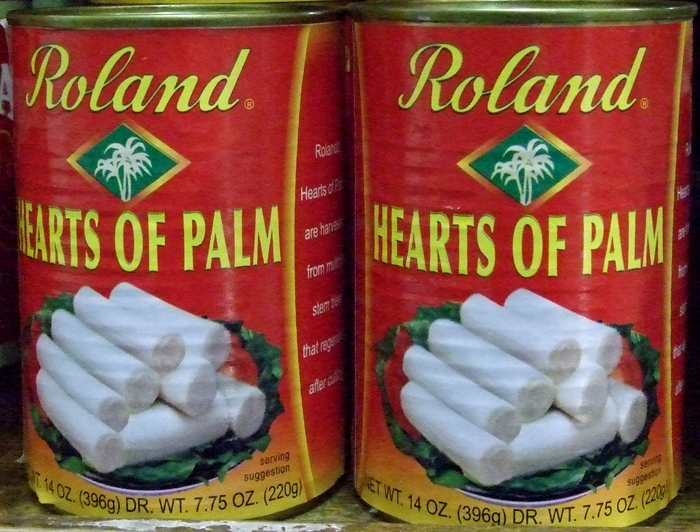
    A woman, who I believe was Brazilian, offered me a long white object from a can. As she slid it out, it reminded me of Vienna sausages, which I ate from a can as a child (and which I loved). These, however, were some type of vegetable, with a texture not so unlike an artichoke.

    But I never knew what they were called, and finding these was not going to be easy. I suspected that they were of South American origin, but at the time, international foods were a relative rarity, relegated to some small section of the supermarket, with each store having what appeared to be a whimsical selection of goods.

    There were no Korean green grocers with all things imaginable. Delicatessens were the convenience stores of choice, and for those of us coming from Anytown, USA, these all-night delis were nothing short of miraculous. We were ecstatic to have places open 24/7. The selection of packaged or canned goods, however was very limited. Fruit would typically consist of a Rome or Delicious apple of unknown age behind glass in the center of a showcase. No one was expected to actually buy it, but at least that food group was represented.

    So it was in this environment that the identity of that smooth, silky, ivory-colored, edible plant remained a mystery for years. A small, nagging, unclosed gestalt. Until I met an older woman from Puerto Rico who, from a loose description, immediately identified the suspect as hearts of palm (or palm hearts).
    Visits to various supermarkets proved successful. There was a bit of sticker shock – these were imported from Brazil and were pricey (I have since learned that they were uncultivated at that time.) But I really had no choice, and I purchased a can. They were as unique and wonderful as I remembered and became a regular (if infrequent) addition to my diet.

    Of course now, hearts of palm are a common ingredient in salads and can be found in virtually any market. For me, seeing a can of these represents closure on a long affair. For everyone else, just hearts of palm 🙂


  • Food Bubbles

    We are in what the online publication Slate calls a Cupcake Bubble, which they predict will soon be followed by a crash. I wrote about cupcakery Magnolia Bakery in September 2009, but I was not aware of the true breadth of this craze – that it is a national and international phenomenon.

    Numerous articles have been written going back several years. There is a cupcake blog, Martha Stewart has a cupcake book, and shops are everywhere: Sprinkles Cupcakes (international chain) based in California, Toot Sweet Cupcakes in Austin, Texas, Lovely Confections in Denver. Crumbs has two dozen locations, with 18 in the New York metro area. Also in New York, there is Sweet Revenge, Babycakes, and Sugar Sweet Sunshine. In Washington, D.C., there is Georgetown Cupcake, Red Velvet, and Hello Cupcake.

    This is not the first time that a food fad with shops specializing in one product has taken New York City by storm. In the 1980s, gelaterias sprouted up everywhere and all closed in a short time. Recently, we have seen a similar thing with frozen yogurt shops such as Pinkberry and Red Mango.

    A recent New York Times blog posting discussed the sustainability of cupcakes as a business and was accompanied by 99 comments. After reading these comments and several other articles, I see that the numerous debates boil down to a few issues: 1) Can all these cupcakeries make it? 2) Is a cupcake worth $3-$4? 3) Why are they so fashionable at a time when health consciousness is at a zenith? And, of course, 4) Who has the best cupcakes? In New York City alone, there are many cupcake shops.

    Many find the confections much too sweet or just not healthy, while others see it as a small guilty pleasure and comfort food, perfect for such times. Some people see buying them at these prices as foolish, particularly in an economic downturn, and others add that the entire restaurant business is built on paying for convenience and that most things made at home cost a fraction of what is charged for the ready-made equivalent. Business experts have entered the debate, with most showing how this is a flawed business model. A few, however, do not agree. And there are many analogies – and critiques of these analogies – made with places such as Starbucks, Krispy Kreme, and Dunkin Donuts.

    Cupcake bakers have used several business approaches – cupcake shops, online selling, wholesale distribution, trucks, kiosks, or any combination of sales avenues.
    The Cupcake Stop is a mobile gourmet cupcake shop in a truck which frequents different locations in Manhattan on different days of the week. It is run by Lev Ekster, and the cupcakes are baked by Manal Mady in Brooklyn. If you just want a small confection, they also offer mini cupcakes for $1 each, as does Baked by Melissa, who sells from a street kiosk on Spring Street in SoHo. Buying a tray of minis in an assortment of flavors is a common solution to the flavor selection dilemma.

    I love the street vending of food and mobile trucks, such as the Dessert Truck or NY Dosas. Making foods available on the street is perfect for the visitor or native New Yorker on the run. Personally, I find cupcakes to be a little too sweet, so an occasional tasting goes a long way…


  • Thank You, Mr. Dupal

    I imagine that there are people who don’t like butter. I am not sure I have met any, and I doubt that you will find many here at Ceci-cela. I love writing about a place like this – there is no worry that I will disappoint you. Along with other places such as Cones, the Doughnut Plant, Eileen’s Cheesecake, Raffetto’s, and Il Laboratorio del Gelato, this place uses only the finest ingredients and is run by a hands-on, uncompromising artisan, Chef Laurent Dupal.

    Ceci-cela is only a couple of blocks from my office – we began patronizing this pastry shop long ago, and it quickly became our regular place to get our cakes for birthday celebrations in our company.
    Ceci-cela was started in 1991 by master chef Laurent Dupal, now partnered with longtime friend and celebrated restaurateur Georges Forgeois. Dupal is, as would be expected, a well-trained and experienced French chef – read about him here.

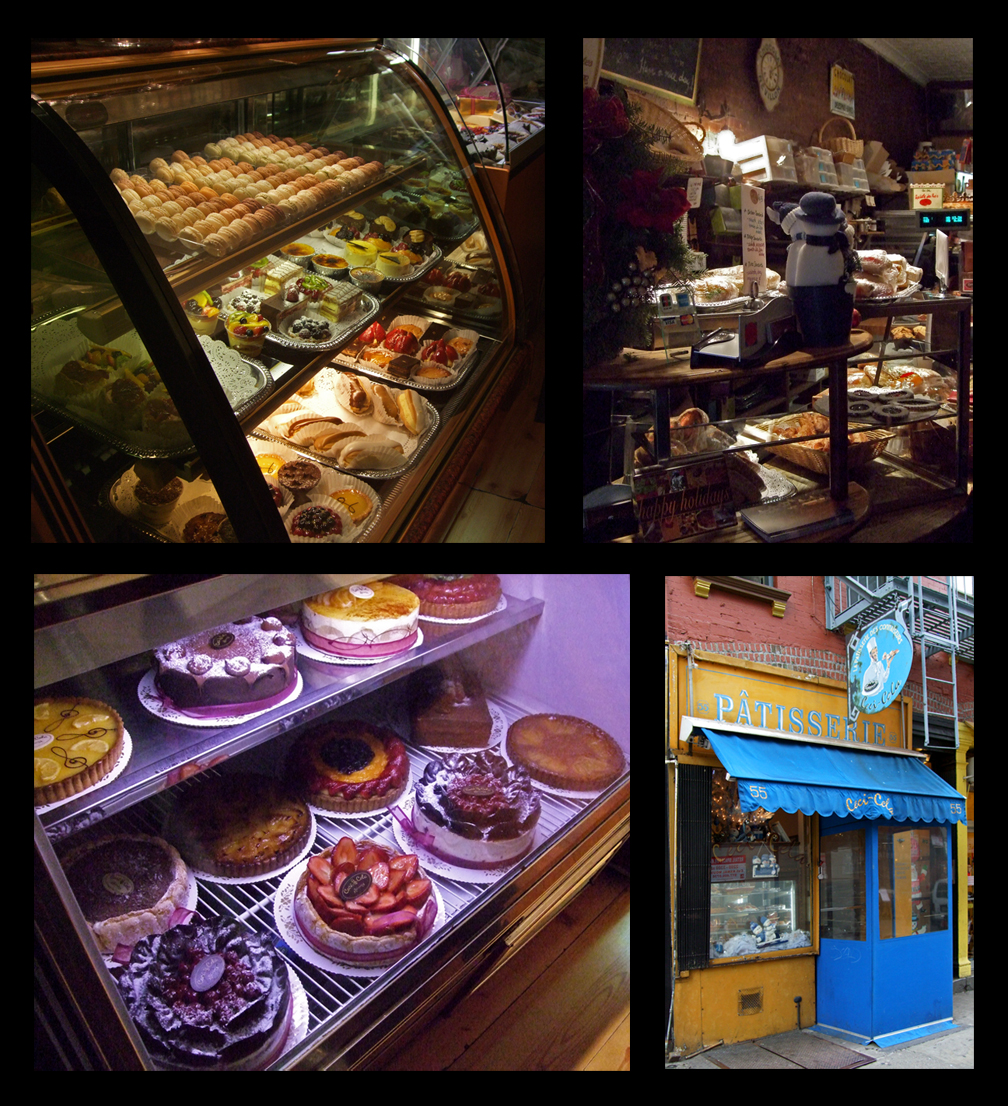
    The shop is located at 55 Spring Street in NoLita (North of Little Italy). The secret of the survival of the character of neighborhoods such as this is the smaller tenement buildings, which permit limited retail space and prohibit larger stores or retail chains (although rents do escalate and there are changing tenancies).

    The exterior of this patisserie is quaint but unassuming. Inside, it is a tiny, narrow place with a Parisian ambiance. Congestion is common as regular patrons jockey for position in line. There is a cafe area in the rear for those wanting to eat on the premises. The bakery also does a wholesale business.

    Everything I have had here is superb. You will find a full gamut of French pastries, cakes, and tarts: éclairs, Napoleons, crème brulée, tartes, chocolate truffles, all manner of croissant, brioche, danishes, and their classic tuiles. From the New York Times:

    TRADITIONALLY, the tuile, the French almond cookie, is a curved concoction of butter, sugar, flour, and almonds that is named after the rounded roof tiles found throughout France. The cookie bakes flat, and as it comes out of the oven, warm and pliable, it is wrapped around a rolling pin to give it the shape. But the tuile from Ceci-Cela is different.

    ”I make them flat,” said Laurent Dupal, the chef and co-owner of the patisserie at 55 Spring Street, ”because they are very, very fragile.”

    In the world of pastry making, fragility is often a sign of excellence.

    The Ceci-Cela tuile is so buttery, and so delicate, that the moment you put it into your mouth, and touch it with your tongue, it begins to crumble into crisp, buttery, almond-flavored morsels. A near-perfect cookie, it can stand alone and be eaten by itself, one after another, until a half-pound box is suddenly empty, or used as an accompaniment to a simple summer dessert of fresh strawberries, mangoes or Asian pear.

    The secret of its evanescence is to use ”as little flour as possible,” Mr. Dupal said, adding, ”The way we make them is to whip the butter and the sugar and make them very light. After that we incorporate the egg whites, one by one, and then a little bit of flour, and finally the minced almonds.”

    Our office favorite is the Paradise Cake – a lady finger and vanilla genoise cake with fresh tropical fruit mix. See the menu here.

    I know that after you sample their delectables, I will look like an expert in discovering the best-kept secrets of New York City. However, let’s give credit where it is due. Thank you, Mr. Dupal 🙂


  • Pork and Power

    When I was in high school, I was steeped in things which were perhaps considered nerdy – the math club, chess club, German club, and the classic game Wff’n Proof. I associated with friends of like mind, but I also had a friend who was very mechanically inclined and who was pursuing trade school. He brought a mechanical mind to our relationship, which always gave me profound appreciation for craftsmanship and a good mechanic. There is often tremendous ingenuity and creativity in people like this, which often goes unseen and unappreciated by outsiders.
    My friend had motorcycles. And a friend.

    This friend, however, was large, fair to say quite obese. His presence was very imposing. I spent no time with him at all – his world was much more singular and focused. I knew he would also be going to trade school, so, knowing nothing about that world and stretching a bit for conversation on my introduction, I asked what his “major” would be. He answered with only one word: Power.

    I ponder the meaning of that to this day – I assume he meant Power Mechanics. But somehow the very nature of the subject begs for one word, and I will always remember the power of his answer.

    Many of the best shops in New York City are equally well-focused, managed by people who have a narrow niche and do it superbly well. Frequently they are family-owned and often multigenerational. At their best, you cannot compete with them. I have written here of many of them – places like Rafetto, Eileen’s Cheesecake, Economy Candy, Faerman’s Cash Register, McNulty’s, Vesuvio (now gone), the Doughnut Plant, or Cones. But as consumers, we are eating, not competing, and we are the winners in any wars or contests.

    Faicco’s Italian Specialties at 260 Bleecker Street (previously Faicco’s Pork Store) has been a landmark in Greenwich Village for over 100 years. This block, Bleecker Street between 6th and 7th Avenues, is a smorgasbord of great, legendary, and iconic shops. Faicco’s was opened in 1900 on Thompson Street by Edward Faicco. In 1940, the shop moved to its current location on Bleecker Street. The current owner is Eddie Faicco, the great-grandson of the original owner. They have no website or menu online, but review sites praise it to no end, so if you are looking for a butcher or Italian specialties, sausages, and the like, it comes highly recommended as one of the best in New York City.

    Although I am not a meat eater and will likely never know Faicco’s sopressata, I have to show respect for a job done well, whether with pork or power…


  • Footprints

    There are still many good reasons to visit or live in New York City, and food is one of them. Certainly the world has changed, and many food specialty products once only available in places like New York are now available elsewhere.

    At one time, it was difficult to find cappuccino outside big cities such as New York. As recently as the 1980s, a coffee aficionado I knew bemoaned his fate when leaving the city to return the suburbs. Now, of course, a cappuccino is only as far away as the nearest Starbucks.

    Visitors to New York City as well as residents look for those special things unique to the city. If this is the type of thing you seek, something unique and authentic, look to New York’s ethnic foods. The large pockets of immigrant groups left many of their cultural roots behind when resettling here, but food was not one of them.

    The bialy is still relatively unknown, even in New York City. The bialy is a bagel-shaped roll. There is no hole in the center, however – only a flattened depression, typically with onions. It is much lighter than a bagel – many prefer it and its onion flavor. The word bialy is a shortened version of bialystoker kuchen, a traditional bread item in Polish Ashkenazi cuisine from Bialystok, Poland. It was introduced to the United States in the late 19th century and was first marketed in New York State by Harry Cohen in the early 1900s.

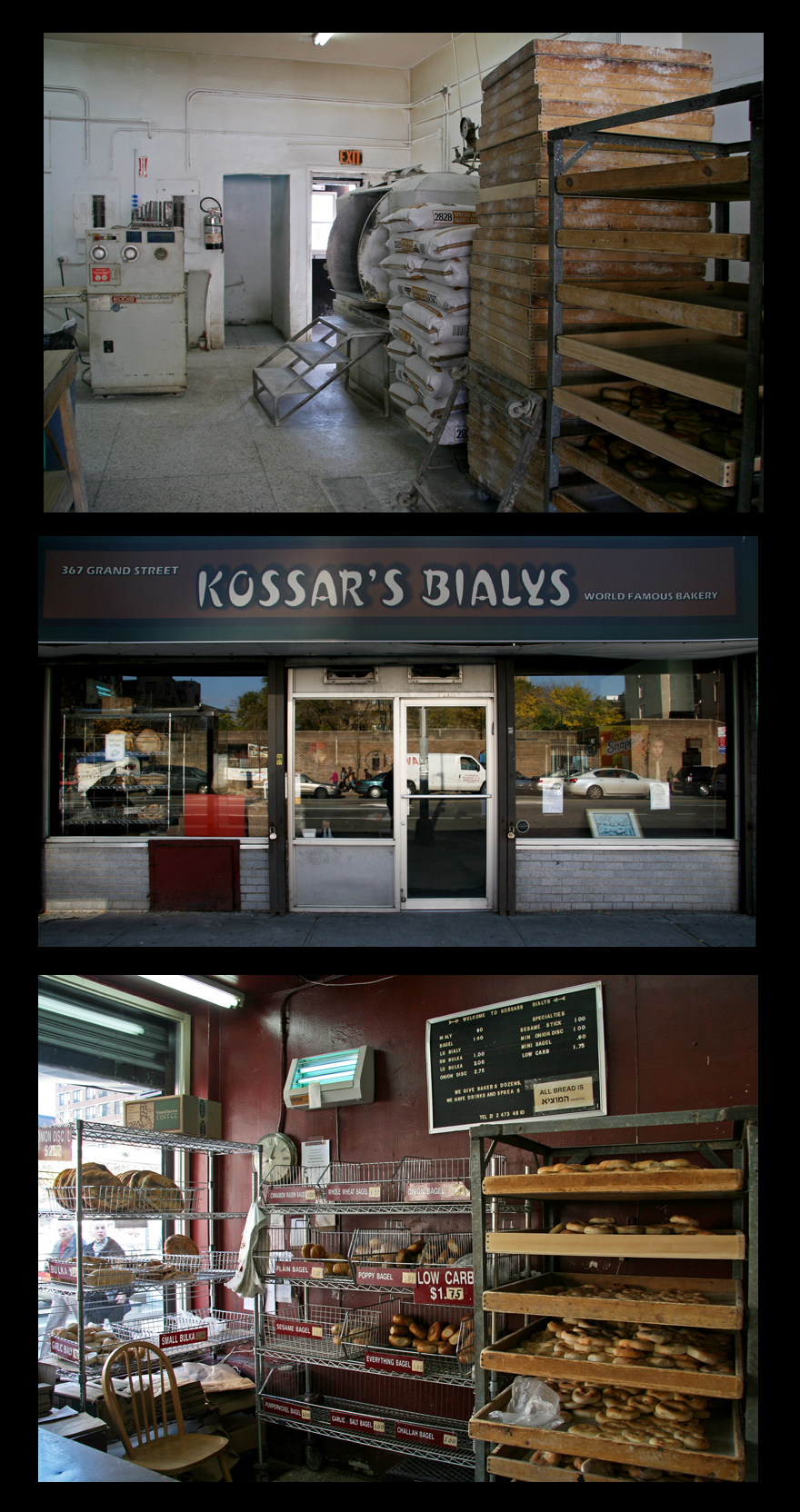
    Kossar’s Bialys is the oldest bialy bakery in the USA. It was founded in 1936 by Isadore Mirsky and Morris Kossar and is located at 367 Grand Street in the Lower East Side. Everything is done right on the premises – the flour, ovens, and machinery are all in plain view – no pretense or nonsense here. See more photos here. Kossar’s also makes bagels, bulka, sesame sticks, and onion discs. See their website here.

    The history and study of this food is literally a book in itself. In 2002, a book was published, The Bialy Eaters: The Story of a Bread and a Lost World (2002), by former New York Times food writer Mimi Sheraton, who used Kossar’s as a base for her research.

    The Jewish population is huge in New York City, and they have left large, indelible footprints in many spheres of our lives. I’ve enjoyed walking in those footprints, and I am following them right to Kossar’s for some genuine bialys 🙂

    Note: How curiously appropriate that the bakery is under the kosher certification of Rabbi Shmuel Fishelis, just a few blocks away at 25 Bialystoker Place.


  • Mamoun’s

    Falafel has gone from being an obscure specialty to one which is familiar to most across the land. The pita bread sandwich is the vehicle most often used to deliver the deep-fried crusty balls or patties, along with salad and tahini sauce.

    To many aficionados, the secret ingredient that separates the good from the mediocre is the use of fava beans. Falafel originated in Egypt, where it was made with fava beans. As falafel migrated north to areas such as Israel and Palestine, chickpeas were substituted for the fava beans. Falafel is now typically made with chickpeas, fava beans (to a much lesser extent), or a mixture of the two. See my story here on Ful Mudammas, a delectable salad made with fava beans.

    Located on MacDougal Street between West 3rd and Bleecker Streets, Mamoun’s is easy to find. Just look for lines spilling out the door. Mamoun’s is famous, and the number of reviews reflects that – on Yelp.com alone, there are over 400 reviews to date. They were the first to introduce falafel to New York City and one of the first Middle Eastern restaurants in the United States.

    Mamoun’s averages high rankings on most food sites. However, there are naysayers – some of the reviewers who were disappointed with the food were puzzled by the lines. But this is usually easy to explain. Restaurants generally have lines for only a few reasons: hype, food quality, quantity, pricing, and overall value. And although many things are subject to debate about Mamoun’s, pricing is not one of them – a falafel sandwich there is only $2.95, explaining why Mamoun’s has been a perennial favorite of college students.

    The place is primarily takeout, and there is very limited seating. It is a tiny, cramped, and not particularly pleasant shop. Turning out the volume of food that the place serves is nothing short of a miracle. To watch the man scooping small balls of falafel into the deep frier is mesmerizing – the unending production must be a mind-numbing task. The menu features a handful of items.

    Mamoun’s, at 119 MacDougal Street, was opened in 1971. They have two other locations – one in the East Village on St. Marks Place and one in New Haven, Connecticut. Some love the place, others deplore it. Many say there are much better places to get falafel, and yet some feel that a full New York experience cannot be had without at least one trip to Mamoun’s…


  • Cones

    Artisanal this and artisanal that – but, as Raul D’Aloiso pointed out last night at Cones, the word does mean something. Only a word, but most purveyors of foods wielding this word are taking it seriously and doing their work carefully. The extent to which most food artisans, such as the Doughnut Plant, are going with ingredient selection is extraordinary. Whether the customer is aware of the details or not, the result speaks for itself.

    Gourmet foods are expected in a city like New York, and in the world of ice cream, expectations are not disappointed. Competition has gotten fierce, with more high-quality individuals sampling the products of the serious artisans. Once you have had the best, there is no going back.

    Cones, Ice Cream Artisans, is located at 272 Bleecker Street in the West Village. The shop was started by brothers Raul and Oscar D’Aloiso, Argentinians of Italian ancestry. Oscar worked in the construction trade as a building site manager and was also a professional classical singer. Raul holds a master’s degree in architecture – he worked in the profession both in Buenos Aires and in New York City after his arrival here in 1989. Inspired by the artisanal gelato of Buenos Aires and their disappointment with Häagen-Dazs (which had a flagship shop in Buenos Aires), the brothers decided to introduce Argentinian-style ice cream to New York City.

    According to an article in the New York Times from 2003, New York City occupies an important place in America’s ice cream history. Reasons cited are America’s first ice cream shop in 1777, the patent for the cone-making machine of Wall Street restaurateur Italo Marchiony in 1903, and Reuben Mattus, a Polish immigrant and small-time ice cream maker in the Bronx responsible for Häagen-Dazs (and its short-lived New York-based imitators, Frusen Glädje and Alpen Zauber, made in Brooklyn). Sedutto’s, the nation’s first so-called superpremium ice cream, was founded in New York in 1922.

    More recently, we have the Cold Stone Creamery, Emack and Bolios (from Boston), the Brooklyn Ice Cream Factory, Ciao Bella Gelato, Fauchon, Grom,  Il Laboratorio Del Gelato, and the Van Leeuwen Artisan Ice Cream truck. There are still a handful of ice cream parlors too – Egger’s in Staten Island, Hinsch’s in Brooklyn, Jahn’s in the Bronx (closed), and Eddie’s Sweet Shop in Queens.
    If you’ve read this article, consider your homework done – go out and try some artisanal ice cream at Cones 🙂

    Note about Cones: The shop has focused entirely on quality of product and word of mouth and reviews (they received a 27 food rating from the Zagat Survey). There has been no advertising or marketing, and currently, Cones has no website.


  • Yonah Schimmel

    The knish is perhaps one of the most distinctly New York City foods, rarely found outside the city environs. Most roads and knish conversations lead to the Yonah Shimmel Knish Bakery on the Lower East Side. You may find the service here a little on the rough side, but this is customer service, olde New York Style, and that means let’s get our business done, you know what you want, we’ve got what you want, we sell it to you, transaction completed. No hand holding. Like the famed Soup Nazi of TV’s Seinfeld.

    You will also find that the interior has an authentic 1910 decor. But the knowledgeable patron comes here for knishes, not service, decor, or ambiance. 

    The knish is essentially a baked or fried dumpling-like snack food – a dough-covered filling which is baked or deep-fried. It has its roots in Eastern Europe and is very similar to many Polish, Romanian, Ukrainian, and Austrian pastry-wrapped dumplings. The modern knish is a New York City creation, a food introduced by Jewish immigrants. Knishes come in basically two varieties – square or round. The square style are fried and reheated. Fillings run the gamut, but the classic and most common is the potato-filled knish. From the Cookstr.com website:

    It’s probably just that most tourists—most New Yorkers, even—don’t know the pleasures of a true knish. And by true I mean not the square, soggy, fried, gluey potato hand pie you still find stuck sadly to the side at most Famous Ray’s, but the round, open-faced, somewhat strudel-y incarnation.

    I concur completely with this view. Ironically, you will see reviews that contradict this and refer to the round style as doughy, etc. The opinions span the spectrum, both of which style is best and how Yonah Schimmel’s knishes stack up.

    Look at it this way – if square fried knishes were the standard by which all knishes are to be measured, then why would Gabila’s, who introduced the square fried knish and has sold over one billion of them since 1921, also make round baked knishes and refer to them as “gourmet style”?

    My first knishes were the square type, which, at one time, were readily available at most hotdog carts on the street. Regulations in 1996 made it much more difficult to sell knishes from street carts, so knishes in New York City are not as commonly available as they used to be. So if you look to have a genuine potato knish, visit Yonah Schimmel 🙂

    Note: Yonah Schimmel was a Romanian immigrant who started selling knishes from a pushcart on the Lower East Side in 1890. A small shop was rented by Schimmel and his cousin, Joseph Berger. In 1910, they relocated the business to 137 East Houston Street, its current location. Much of the business is take out, but there are a few tables and a menu of other items.


  • Doughnuts

    Do you like doughnuts? To me, they are the quintessential American comfort food, soft and benign looking. I rarely eat them, however – doughnuts are typically a fast food and are not known for their health benefits. Nonetheless, a friend and I got a hankering and, having heard of a gourmet doughnut place somewhere downtown, I started to do my research.

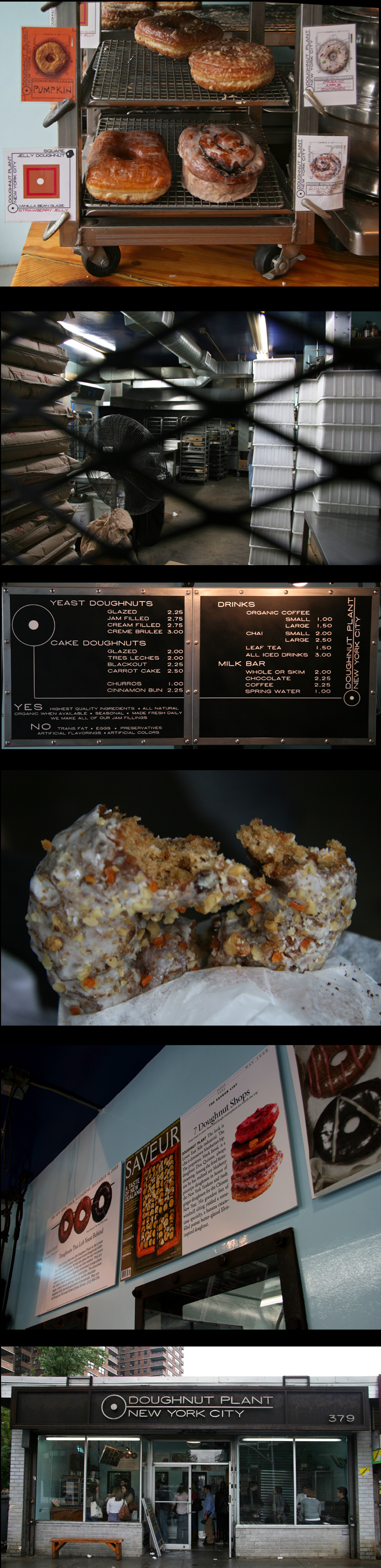
    This was a relatively easy search. Although there were many other contenders for our quest, most roads seemed to lead to the Doughnut Plant at 379 Grand Street (near Essex Street), owned and operated by Mark Israel. Many consider the doughnuts here to be the best in New York City, if not the world.

    The location is off the beaten path – somewhat east from prime Lower East Side and located in a nondescript, quasi-industrial one-story building. It does not have the feel of a place to be seen or concerned with decorative touches, such as Magnolia Bakery.
    But no matter, because this place is a destination. There is a sense of seriousness and intention. A quick look around showed the focus and intensity of customers who knew what they wanted and were here to get it, even at $2-$3 per doughnut. See more photos here.

    This is the type of New York City establishment run by an owner who is driven to make a superior product. He changes his frying oil daily, uses ingredients such as Valrhona chocolate and Tahitian vanilla beans, makes his own fruit preserves, uses fresh coconuts, buys fruit for his glazes from the Union Square Greenmarket, roast and grinds his own peanuts, and has flour milled to his specifications. He uses organic ingredients, and his doughnuts have no trans fats, artificial ingredients, or eggs.

    The Doughnut Plant was founded in 1994 by Mark Israel, using the recipe of his grandfather, Herman, who started working in a St. Paul Minnesota bakery at age 16. During WWI, Herman was stationed in Paris, France, where he baked bread in the Army bakery. From 1935 to 1965, he owned and operated the College Pastry Shop in Greensboro, North Carolina. Mark was born in 1963 in North Carolina and moved to New York City in 1981. He operated from the basement of a Lower East Side tenement until 2000, when he moved to his current location.

    There are blackout doughnuts, lavender-glazed cake doughnuts, and exotic creations with coconut custard filling, creme brulee, tres leches (with 3 sweet creams), rose petal-glazed, banana cream-filled peanut butter-glazed inspired by Elvis Presley’s favorite snack, and blueberry pinstripe doughnuts in honor of the New York Yankees. See their website here.

    The Doughnut Plant turns out over 2000 doughnuts per day and distributes to over 40 shops in New York City, including Dean & Deluca, Citarella, and Zabar’s. The shop closes when they have sold out of the day’s production.
    Mark has collaborated with partners and now has 10 shops in Tokyo and 10 in South Korea. The New York City location is the only one in the USA, but there are plans to open in other locations.
    Doughnuts, anyone?


  • Magnolia Bakery

    How would you like a business where the only indication of a recession is shorter lines to get in? And sales per customer are limited?
    Welcome to Magnolia Bakery, at 401 Bleecker Street in the West Village. This is Sunday morning and, like any weekend, lines await customers, both inside and out, day and night. An employee strolls outdoors and gives advance instructions to the location of goods inside and the shopping procedure. Purchases are actually limited to 12 cupcakes per person.

    There has been a craze for cupcakes in the city, with a number of retail bakeries specializing in them, such as Crumbs, Cupcake Cafe, Burgers and Cupcakes, and Buttercup Bake Shop. There are many theories as to the success of Magnolia Bakery and cupcakes. Childhood nostalgia has to be a big element – cupcakes are certainly an icon of childhood pleasure. A cupcake is also a very convenient food to eat on the street – each one is a self-contained individual serving. And, of course, there is the chic factor of comfort foods. The shop is located on a section of Bleecker Street with fine boutiques and small shops. It is also only a short walk from the meatpacking district.
    Some feel that the cupcake craze is partially driven by the fact that most New Yorkers do not even know how to bake cupcakes and that people would not wait in line like this in most suburban areas – they would just bake cupcakes themselves.

    Magnolia has gotten its share of exposure on TV and film, which certainly has not hurt. The shop and/or its baked goods have been seen on Lazy Sunday, Saturday Night live, Late Night with Conan O’Brien, Sex and the City, Spin City, and the films Prime and The Devil Wears Prada.

    Magnolia Bakery was started in 1996 by Allysa Torey and Jennifer Appel. The original baker, Kathryn McCann, was raised in the South – you will find a southern influence, with pastry selections such as Hummingbird and Red Velvet Cake. See their website here. The homey, kitcheny decor is as comforting as the old-fashioned baked goods.

    Personal taste spans a wide spectrum, as do the reviews and opinions of the Magnolia cupcake. The cupcake itself is not pure artisanal magic – in fact, the recipe is published in their book and is available online. But none of this will dissuade the passionate Magnolia fans – their minds are made up 🙂


  • One Word

    There are many things performing vanishing acts in New York City – one is the single-business district and another is manufacturing. At Bari Equipment at 240 Bowery, both are alive and well.

    A unique feature of Manhattan has been the single-business district: diamond, flower, lighting, restaurant supply, photo, sewing machine, meatpacking, fur, and the garment district. Some of these districts are no longer, while others have all but disappeared. A handful still operate, such as the restaurant supply district on the Bowery between Houston and Delancey Streets. Here, you will find New York City’s primary marketplace for restaurant equipment – this is one of the most well-known restaurant supply districts in the country, offering some of the best pricing.

    The Bowery is Manhattan’s oldest thoroughfare, a part of the Lenape footpath prior to European settlement. In the 19th century, the Bowery became known for its music halls and theaters. By the 1920s-30s, the area was known as impoverished and remained a slum until late in the 20th century with the gentrification of the Lower East Side and East Village.

    If you have noticed the brand of pizza ovens while waiting for a slice in New York City, then most likely, you are familiar with the name Bari. Established in the 1940s by Nicola Bari, the business is still family-owned and -operated. It spans the better part of a block of the Bowery and now employs over 50 people. The company makes pizza ovens and refrigeration units used worldwide. Bari also supplies a broad range of restaurant equipment and supplies.
    The ovens are still manufactured in an adjoining building at their Bowery location. The deck oven, lined with stone, is the one typically seen in New York City pizza parlors.

    In the 1980s, I purchased an expensive racing bicycle from a real biking aficionado. Uneasy about making such a substantial purchase and fretting over the nuances and components, he assured me that becoming knowledgeable in the world of bicycles was easy. He told me, “You only need to know one wordCampagnolo.” Perhaps in the world of pizza ovens, you only need to know one word – Bari 🙂

    Note: Campagnolo is a high-end manufacturer of bicycle components from Vicenza, Italy. They have an unbroken record of winners of the Tour de France using Campagnolo from 1968 to 1998.


  • Randazzo’s

    The first time I went to Randazzo’s Clam Bar many years ago, I was accompanied by a friend who was a born and bred NYC Italian (from the Bronx) who said this food was just like his mother’s home cooking. Two other friends also came along, both born in New York City – one from Manhattan, one from Brooklyn (both Jewish). Three boroughs were represented – that’s very serious street cred. You don’t argue with that, and there was no need to, because we all enjoyed the food and experience.

    Randazzo’s, at 2017 Emmons Avenue in Sheepshead Bay, Brooklyn, has a history of over 75 years. It was founded by Helen Randazzo, and its roots can be traced back to 1916. Read more about them at their website here. The menu is Italian, specializing in seafood: lobster, scungilli, mussels, shrimp, clams, calamari, and Helen’s famous sauce.

    On my second visit, I was with my Brooklynite friend and his brother. They were coming in from out of town, and we had planned to eat at Randazzo’s as part of a day of adventure. Expectations were very high. For me, I wanted to solidify my connections with old, iconic New York City. For my old friends, nostalgia was a big element – to eat in Brooklyn, where they grew up.

    This is a very dangerous formula: high expectations and looking to recreate experiences. We wanted to love it. We had to love it. It was part of our special day, and we would expect nothing less than a great reunion.

    Our food experience was uneven. I’ve read dozens of reviews, all the way from one-star to five-star. I realize that a place like Randazzo’s can travel far on its own momentum and that things change. But I’m going back. And I will find things I like. Because nothing’s going to stop me from liking this place. You gotta problem with that? 🙂


  • Sahadi’s

    In New York City, ethnic diversity takes on different flavors. There are neighborhoods with one large ethnic group or a number of ethnic groups, and there are ethnic enclaves – neighborhoods dominated by one ethnicity. Jackson Heights, Queens, considered one of the most ethnically diverse neighborhoods in the world, is a good example of the former.

    Ethnic pockets, large and small, are scattered throughout the boroughs of New York City: Ukrainians in the East Village, Jamaicans in Jamaica, Queens, Koreans in Koreatown in Manhattan, Greeks in Astoria, Queens, Russians in Brighton Beach, Brooklyn, Hassidic Jews in Borough Park, Brooklyn, Mexicans in Spanish Harlem, Filipinos in Woodside and Flushing, Queens, Dominicans in Washington Heights, Indians in the East Village. There are also concentrations of many older European immigrant groups – e.g. Irish, Italian, and German.

    Along Atlantic Avenue near Clinton Street, in the Cobble Hill neighborhood of Brooklyn, there is a handful of Middle Eastern merchants. There are few Middle Eastern residents in this neighborhood today – there were many early in the 20th century.

    Sahadi’s (updated 12/9/11), at 187 Atlantic Avenue, has been in Brooklyn since 1948 and is the most well known of the Middle Eastern shops in the area. You will also find others here, such as the Yemen Cafe, Damascus Bakery and Bread, Malko Karkanni Brothers, the Oriental Pastry and Grocery Company, and the Lebanese restaurant Tripoli.

    At Sahadi’s, you will find a place that does not pander to the tourist or outsider. This is the real deal, catering to a select clientele of Middle Eastern residents or food aficionados, all looking for authentic foods. Since there founding, Sahadi’s has broadened its selection and has evolved into a gourmet shop where many other products can be found.

    The company has a three-generation Lebanese family history, with its origins when Abrahim Sahadi opened A. Sahadi & Co. on Washington Street in New York City in 1895.
    Sahadi’s is now also a wholesaler, distributor, and manufacturer, known throughout the Middle Eastern community nationwide. This arm of the company, Sahadi Fine Foods, was formed in 1999 and is located in the Sunset Park neighborhood of Brooklyn.

    When it comes to my Middle Eastern training in cuisine, I have had several teachers. One of them was Sahadi’s 🙂

    Related Postings: First Oasis Restaurant, Kalustyan’s, Moustache, Ful Mudammas, Mystery Meat


  • Slummin’

    Posted on by Brian Dubé

    Slumming is a peculiar phenomenon. People work hard to improve their lives economically and socially, yet once they are established, some work just as hard to find and frequent the type of places which they endeavored so desperately to leave behind.

    Or so it appears. There is a cache to slumming. The act of dumbing down ones choices for eating and playing somehow confers authenticity and coolness. But I think what is actually happening is that this type of activity is limited to areas where others of like mind and age have settled. How many actually want to live among the poor, isolated in a neighborhood with none of their peers? There are some, of course, who did move into uncharted territory, paving the way for others. I have always admired the spirit of these early pioneers.

    In fact, it is debatable whether there can be any real slumming in Manhattan. Virtually every neighborhood is fully gentrified, partially gentrified, or populated by some variant of the downtown hipster. There are few neighborhoods left which are strictly the domain of the common, working-class man or woman.

    In the final analysis, a person of means can never really experience the life of the poor or the common man. If nothing else, knowing that one has options and is only a tourist in a disadvantaged world makes all the difference.

    I was surprised to learn that slumming dates back to the late 1800s. According to a recent fascinating New York Times article, When ‘Slumming’ Was the Thing to Do, the practice started in London and had versions in urban America, centered in Chicago and New York City.

    In 1884, a headline in The New York Times proclaimed: “A fashionable London mania reaches New-York. Slumming parties to be the rage this winter.”
    It was one of the early indicators of what grew to be an entertainment phenomenon that lasted decades: well-off white New Yorkers exploring black, Chinese, gay or poor working-class communities. Popular neighborhoods for this voyeuristic pastime included Chinatown, Harlem and the Lowest East Side tenements, home to the “Hebrews.”

    More recently, a new industry has been built around the practice, coined “slum tourism” or “poorism.” The practice is controversial: is it tourism or voyeurism/exploitation? See an article here about the phenomenon.

    Hector’s Diner is authentic. Located at 44 Little West 12th Street under the High Line, it is still patronized by workers from what remains of the local meatpacking industry. The meat packing district was truly the quintessential working-class neighborhood and one which required some intestinal fortitude to visit. Carcasses hanging on hooks, barrels of entrails, and meat refuse was the reality here. I rented storage space here at one time, and early morning visits required a little mental preparation for the visual assault. The neighborhood is now quite ultra chic, but vestiges of the original meat industry still exist, as I explored in Fresh Meat.

    I have not eaten at Hector’s or been inside, but judging from the food reviews (which have been quite favorable), I expect that at the right time of day, along with the common man, you will find some others slummin’ 🙂

    Related Posts: Pastis, Old Homestead, Men Making Noise, Western Beef

    Posted on by Brian Dubé


  • dinamic_sidebar 4 none

©2026 New York Daily Photo Entries (RSS) and Comments (RSS)  Raindrops Theme