• Category Archives Parks
  • Everything is Going To Be Alright

    I was surprised yesterday to hear two young coworkers in their 20s listening to and enjoying the holiday tunes of Bing Crosby. I commented on how there was an extraordinary soothing quality to his voice that just made you feel that, no matter what, everything is going to be alright. At my family holiday gatherings, Christmas isn’t Christmas without the White Christmas of Bing Crosby.

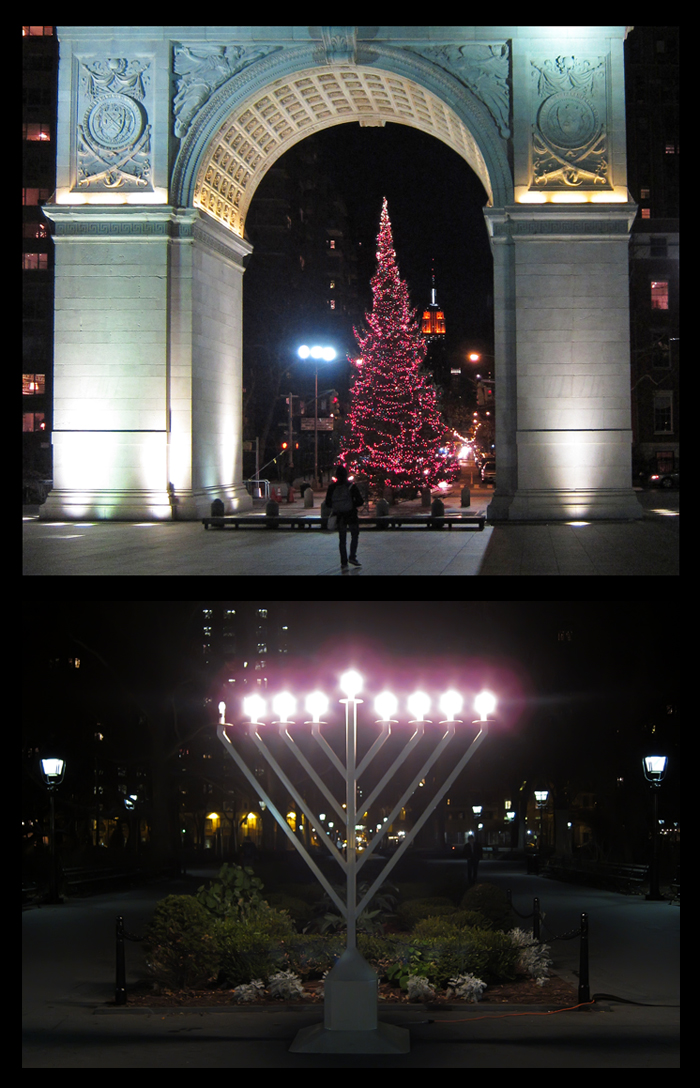
    Whether you see New York City as a melting pot or a salad bowl, pluralism is the reality and tolerance is what holds it together. New York City is where you will find the world’s largest public menorah, located in one of the most prime locations in the entire city – 59th Street and Fifth Avenue, just a few blocks from Rockefeller Center’s national Christmas tree and St. Patrick’s Cathedral. In today’s photos, the Christmas tree at the Washington Square arch (with views of the Empire State Building in the background) is just a short distance from a menorah, also located in Washington Square Park.

    On one hand, pluralism has become much more prevalent in the United States and, in tandem with the doctrine of separation of church and state, it is not unreasonable to revisit the issue of public displays of religious symbols. Bing Crosby or not, we can’t shut our eyes and sweep everything under the umbrella of the “holidays” or the “winter/holiday season” in an effort to obfuscate the very divergent religious practices. Efforts are made to link Christianity and Judaism in an attempt to demonstrate that they are just two sides of the same coin.

    On the other hand, as I wrote in Let’s Have a Parade, celebration is part of the human condition, and to become a curmudgeon during the holidays and dismiss the entire season as nothing but crass commercialism (or to aver how many of the symbols and customs that are associated with Christmas were originally syncretized from pre-Christian pagan festivals and traditions) does nothing to enliven and uplift the human spirit and spread proverbial love and joy throughout the land.

    Managing religious pluralism is difficult. Even the Supreme Court of the United States was very divided in County of Allegheny v. ACLU, where the court considered the constitutionality of the annually recurring displays of a nativity scene (crèche) and a Hanukkah menorah, both placed outside the City-County Building in downtown Pittsburgh, Pennsylvania.

    I don’t want to bury my head in the sand in an effort to oversimplify reality, be disrespectful, and lump everyone together or paint the entire season one color. But for just a moment, please forgive me. I’m just going to relax, let Bing Crosby’s voice wash over me, and feel that everything is going to be alright 🙂
  • Hanging Around


    When I was in grade school, I became intrigued with the hangman’s noose. It was easy to get the attention of fellow classmates presenting such a macabre artifact. It is extremely simple to tie, but its very nature would keep most from even trying. Who would learn to make such a thing and why?

    The entire subject of hanging is fascinating to some and its lure perplexing to others. The facts of hanging, its history, tools, technology, and the anatomical and biological aspects of the condemned are all mired in speculation, exaggeration, mystery, misinformation, and urban myths. The acquaintance I wrote about in my story Power once claimed he had the hangman’s formula – a supposed equation for calculation of rope length based on a person’s body weight. In fact, such a thing does exist as the British Table of drops. The original table of the “Long Drop” or measured drop was worked out by William Marwood in 1872. A revised table was issued in 1913. In is still in use by a few countries to this day. You can read more and see the tables here.

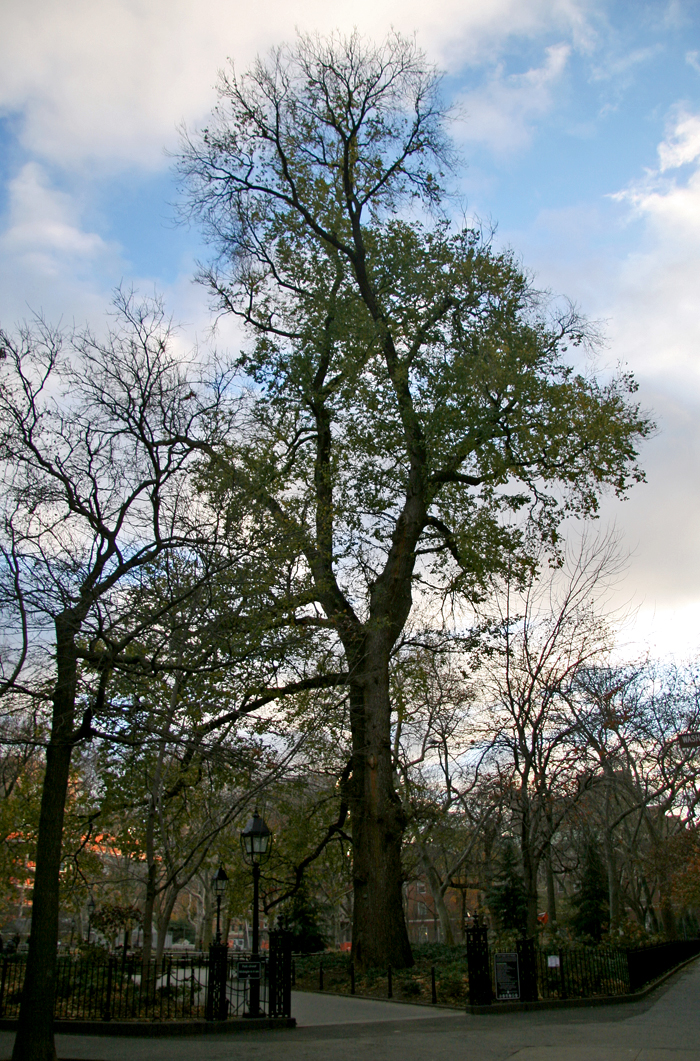
    The best case in point regarding the interest in hanging in New York City is the Hangman’s Elm located in the northwest corner of Washington Square Park which stands 110 feet tall. In 1989, the New York City Department of Parks and Recreation determined that this massive English Elm dates back to 1679, making it over 330 years old and the oldest known tree in Manhattan.

    It is still unclear how many, if any, individuals were hung from this elm in public executions, which did occur in a nearby gallows – the only recorded execution was of Rose Butler, in 1820, for arson. An article in the New York Times sees some hangings there as likely, but other sources cite it all as urban mythology. But the fascination with hanging still exists, and the belief that this elm was used for hanging persists. It all makes for a great sound bite or tour factoid, giving the neighborhood just that much more historical color.

    I have the privilege of seeing this tree from my home daily and much like the cat who brings home the dead mouse as a macabre gift for its owner, I offer my fellow readers this story and photo of the Hangman’s Elm. Whether it’s a tree, a noose, or the Long Drop table, the fascination with this style of execution just keeps hanging around…


  • Not Moving to Florida

    I recall an uncle extolling the virtues of living on Eagle Lake in Maine in the winter, telling me how wonderful it was, about ice fishing, and how you had the entire lake to yourself. Not to offend and retort aloud, I thought to myself – of course you have it to yourself, who would want Eagle Lake in the winter?

    Although not as extreme, the seasons of New York City are never pleasing to me (see Weather Means Whether). I look forward to the spring, the harbinger of all good things to come, but it is always a disappointment. It is often too wet, colder, and windier than I would like. Flying kites or trying to sit on a park bench seems to be an exercise in hand rubbing.

    But not to worry, summer is on the way, certainly the season we wait for and celebrate. Until we have a few unseasonably warm days in late spring and I realize that summer in the city will be oppressive and crowded with tourists and that there is no respite from the heat without leaving – autumn and winter look very appealing now. After all, the solution to cold is quite simple, is it not? Just add more clothing. Summer arrives, and all my worst fears and memories are realized. The teaming masses mixed with high humidity and relentless sun make New York City in the summer virtually unbearable. But summer is actually quite short, and autumn is just over the horizon.

    Autumn, however, is just a tease for what a perfect world might feel like (see Quito here) and a clear reminder that what nature giveth, it also taketh away. Days are often too cool to spend extended periods outdoors, and we now have more of the hand rubbing of spring. Leaves are falling, things are dying, and I am already fearful of the death grip of winter, which is fast arriving.

    Winter arrives, and although we are blessed with little snow in the city, it is more uncomfortable than I remembered. The respite from the heat I wished for in July and August looks foolish now – what was I thinking? The holidays do provide a much needed distraction before the bleak stretch of winter starting in January. Soon I am looking to spring again, only to reflect and reprimand myself for not enjoying what I had last year.

    As winter closes in and I realize that every season in New York City has its shortcomings, the thought of other, perhaps better, places, rather than other seasons, rears its head. But I am a little wiser now. I have been down that road too. No, best I enjoy images of a foliated New York in summer, because, at least for now*, I’m not moving to Florida 🙂

    *Interestingly, my aforementioned uncle, steadfast in his commitment to Maine and its hard winters, eventually became a snowbird and moved to Florida late in life where he lived out his life.

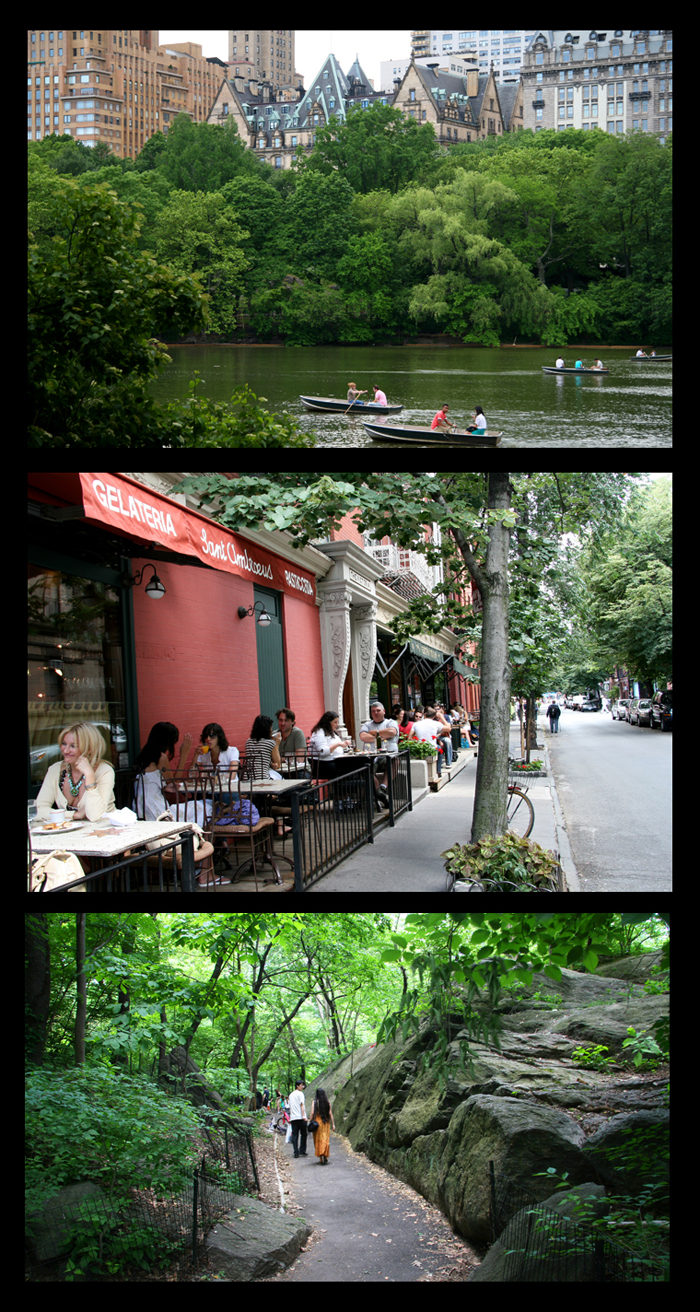
    Photo Notes: Top – The Dakota as seen from the Lake in Central Park. Center – West 4th Street. Bottom – the Ramble in Central Park.


  • When Brian Met Sally…

    A Tale of the Fortuitous, Serendipitous, and a Late Night Offer


    Sally Darling is a regular reader of this website and is one of the most effusive, ebullient individuals who has graced these cyberpages. She lives in Kansas, a virtual metaphor for all that is not New York City.
    On September 9th, 2010, she commented:

    Me again. Sorry, I’m your new stalker now 🙂 I literally can not stop reading your posts. I can’t explain how there is something in my bones that has always, my whole life, made me feel like I belong there, that I should be living there, but life’s events didn’t see it that way. Thank you so much for letting me have my little NYC Oasis right here in Kansas!

    On September 10th she commented, announcing her upcoming visit to New York City:

    Thanks Brian! I stayed up last night and read almost all of your 2010 posts. Not quite through with them, but I’m enjoying every second! I hope you know, my passion and thrill for your fascinating city is only getting fueled by your incredible photos and writing! I can’t wait until we arrive on September 25th! My mind is racing a mile a minute with my itinerary selections!

    But the Plot Thickens.

    On September 24th at 12:41 PM, the day before leaving for New York, Sally commented:

    I just love all your adventures that you have in your splendid park! I can’t wait to be there Saturday! All I want to do is sit, watch, enjoy, and take in all the wonderment WSP [Washington Square Park] has to bring. You are so lucky that you have it at the tip of your fingertips! I’m counting the minutes until I walk through that wonderful Arch!

    A fortuitous turn of events started as a dishwasher disaster at Sally’s home in Kansas the night before leaving for New York City. Read the entire story here in her own words. Prompted by or nearly prevented by this accident, at 4:30 AM with 6 minutes left at home before leaving for the airport, Sally decided to make a quick examination of the comments on the blog with no expectations. She was surprised to find my late night offer posted at 11PM:

    Sally – welcome to our world. Ask for me if ur in the park.

    You’re way ahead of me, I am sure, but the devil is in the details.

    On Saturday night, September 25th, I was in Washington Square Park. The weather was superb and the evening glorious. Music was everywhere to be found, and the park regulars were all there. Jeff, one of the habituĂ©s, approached me and said, “Brian, you have some visitors looking for you.” And there was Sally with her husband and daughter! After a mutual round of OMGs, I told them how they had picked the absolute best night.

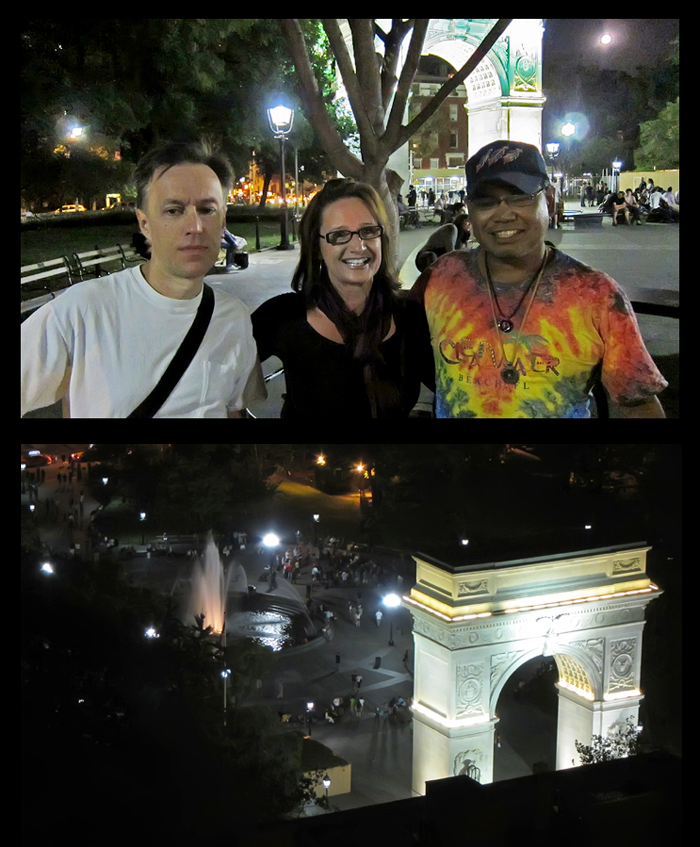
    I gave them a tour of the plaza, introducing them to all the important regulars, some of which have appeared on this website. Gaby, who was featured on September 8th, 2010, was also there. His story is another tale of the serendipitous (read On The Road and Part 2 of his story here). A photo was taken of the three of us, which you see here today.

    Two friends, Hellen and Harvey, a married couple living in a nearby high-rise, met Sally and her family and made a spectacular offer – to take them up to the roof deck on the 26th floor of their apartment building. The views from there are spectacular, a virtual unobstructed 360 degrees, including south views directly to Washington Square Park (lower photo). Sally was, of course, just brimming with enthusiasm. When it was time for our guests to leave, Hellen, the ever gracious hostess, insisted on walking them right to the subway platform.

    On September 28th, after Sally’s return to Kansas, I got this email:

    Hello Brian I hope this is your email, and I hope you don’t mind that I’m sending you this note. I just want to thank you for one of the most amazing evenings I’ve ever experienced. It was literally one of those unexpected moments that one might never experience in their lifetime. Please, Please, pass along my thanks to Harvey & Helen, for opening up their home and allowing us to see something my eyes will never forget! How can I ever repay you and them! And I thank you for not only introducing us to them, but for introducing us to your other wonderful Park friends. Sandy Vitamin, Hans, Gabby…..what a wonderful night! I wish we could have all sat down over a cocktail someplace and continued our visit. I knew my daughter was getting tired, and was not feeling good, so unfortunately we had to end our evening. I only hope that one day our paths will cross again, and we can continue where we left off. Your friend, Sally

    ‘Twas a case of the Fortuitous, Serendipitous, and a Late Night Offer, When Brian Met Sally…*

    Please Note: All correspondence between Sally and myself were reproduced here only after obtaining her permission. Thanks Sally.

    *When Brian Met Sally is a play on the award winning 1989 comedy classic When Harry Met Sally…, starring Billy Crystal and Meg Ryan. Read more here.


  • Guns or Big Heads


    Generally speaking, a man with a head this large playing chess would command quite a bit of attention. The big-headed character, a mascot for Emmy award winner Ted Greenberg’s one-man show*, was available for any players while promotional free tickets for the show were being distributed. The chess playing mascot, however, got little attention for three reasons:

    One, this is New York City, where anything goes and a lot is usually going. Two, this area of Washington Square Park, currently used for chess, is dominated by chess hustlers who are set up for business and playing for money. Three, the best candidates to find interest in chess are chess players. However, serious chess players (or hustlers) really could not care less about anything apart from a player’s skill, and the mascot had mediocre playing ability. Perhaps a joke best illustrates this attitude, common to players and known to those very familiar with the game:

    In a park, people come across a man playing chess against a dog. They are astonished and say: “What a clever dog!” But the man protests: “No, no, he isn’t that clever. I’m leading by three games to one!”

    This character trait of players is the theme in the short story The Chessplayers, about a trained chess playing rat, who, though remarkable on the face of it, leaves players in a club unimpressed because the rat’s playing ability is not that good.

    New York City is a mecca for chess, and anyone who lives here will see this illustrated in many ways. On August 6, 2009, I wrote a true story about a shooting I witnessed in Washington Square Park, where chess players only ducked and hid long enough for the bullets to stop flying before resume their games. See the story, Chess Monsters, here.

    Only good playing will will impress good players. Gimmicks, novelties, Emmy Awards, or non-human players will not. And neither will men with guns or big heads 🙂

    *Ted Greenberg (sitting to the right of his mascot) is an award-winning comedy writer who has written for the David Letterman show. Information about his one-man show, The Complete Performer, can be found here.

    Other Postings on Chess in New York City: Good Fortune, Chess Monsters, Solid as a Rock, Marshall Chess Club


  • Curse of the Mouth Trumpet


    It was September 25, 2005, and and I had the good fortune to be told about the first annual Bluegrass Reunion in Washington Square Park.

    I was astonished to see the “mouth trumpet” technique of Bob Gurland. As an added bonus, I learned that, unbeknownst to me, the woman he began to engage with in a duet was Maria Muldaur. Conveniently, my point and shoot digital camera at the time had video capability. What an opportunity to capture a bit of spontaneous music history! Or so I thought.

    I noticed just before they had nearly completed their duet, that I was not recording at all. I immediately enabled the video recording but only got 15 seconds of them together. This was also the total video footage of Bob :

    I did get to chat with Bob and complemented him on his unique and amazing skill. He told me he had performed and recorded with a number of music bands, including one of the earliest heavy metal groups, Blue Cheer. His name appears on the credit list for their album Oh! Pleasant Hope.

    I am, however, very tenacious, and I never forgot my aborted video. So it was with great pleasure that after 5 years, I saw Bob again at the recent 6th Bluegrass Reunion. Here, I was quite confident. I had much more experience with photo equipment and had several cameras, including a Sony HD camcorder, which I did not bother bringing. The video function of today’s point and shoots is excellent, and I was lazy, sure that I was adequately prepared with my new Canon S90. Or so I thought.

    I was very relaxed, shooting Bob in a number of segments, and even introduced myself and got him to do a short video clip alone. However, there appeared to be a peculiar tinting to all the video. No time to research this now, as I was sure it was a screen display issue. It was not. In making this Canon camera very user friendly, some functions are much too easily changed by brushing against a small function wheel. I had accidentally changed the mode from standard to color accent and color swap. In my panicky state, I tried to find the functions settings for video, to no avail. Once I was home, I learned how childishly simple the mode change is. Too late.

    So, if you would like to enjoy Bob and his fellow musicians in a variety of lurid skin tones and other color abominations, here is my video montage:

    Next time, I am determined to prevail over the Curse of the Mouth Trumpet 🙂

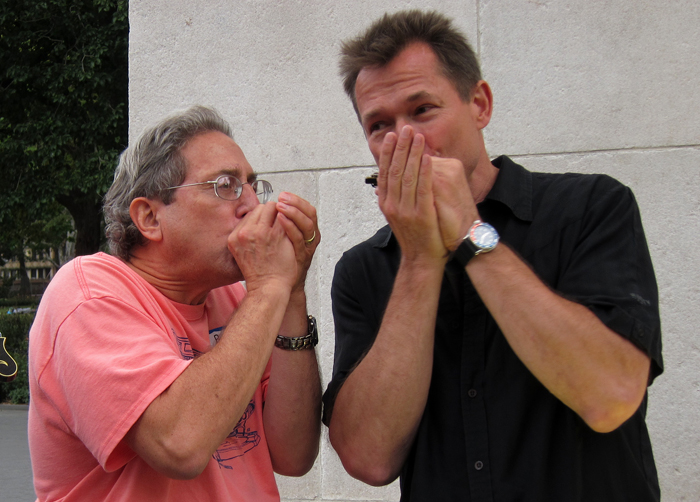
    Photo Note: Bob Gurland is on the left with Trip Henderson on harmonica on the right. Both are New York City residents.

    Related Posts: Izzy and Art, Bluegrass Reunion


  • Urban Night Climbers


    Texte alternatif
    For a full night climbing experience, click and play audio link to accompany your reading.

    Many years ago, in a conversation with a customer, the subject somehow turned to my childhood love of tree climbing. My customer was VERY pleased to hear this, and encouraged me to rekindle this interest, embrace some trees, or perhaps even join him and his friends in their nocturnal sojourns. He was a night climber. Of buildings.

    New York City is a city that never sleeps. We are known for our night clubs, night life, and night people – but night climbers of buildings? I was not aware that there was an underground fraternity of those who practice buildering, aka urban climbing, stegophily, or structuring.

    The press has covered the various climbing spectaculars of the city – Philippe Petit’s legendary walk between the world trade towers on August 7, 1974. George Willig, a mountain-climber from Queens, New York, United States, climbed the South Tower of the World Trade Center on May 26, 1977. Alain Robert is a French rock and urban climber who in 1994 scaled the Empire State Building and on June 5, 2008, climbed the New York Times Building (later that day, Renaldo Clarke also climbed the building). Dan Goodwin, using suction cups and a camming device, climbed the North Tower of the World Trade Center on May 30, 1983.

    But recreational buildering goes back much further than might be expected, at least to Victorian times in England, where students had been climbing the architecture of Cambridge University. Geoffrey Winthrop Young was roof climbing there in the 1890s and published The Roof Climber’s Guide to Trinity in 1900. In 1937, The Night Climbers of Cambridge was written (under the pseudonym Whipplesnaith) about the nocturnal climbing on the town buildings and colleges of Cambridge, England in the 1930s.

    In the United States, two men, George Polley and Harry Gardiner, both nicknamed the Human Fly, pioneered buildering as early as 1905. In 1920, George Polley climbed 30 floors of the Woolworth building before being arrested. Not much, however, is written about current recreational nighttime buildering in New York City, for obvious reasons. In 2008, the New York Times published an article with a little on the activity.

    Apart from legality or prudence, I do understand the lure of urban climbing. Much as the alpine areas of the world are magnets for rock climbers, the buildings and skyscrapers of New York City provide the same challenges and draw in masonry, steel, and glass. Perhaps I may yet get to witness the activities of these urban night climbers…

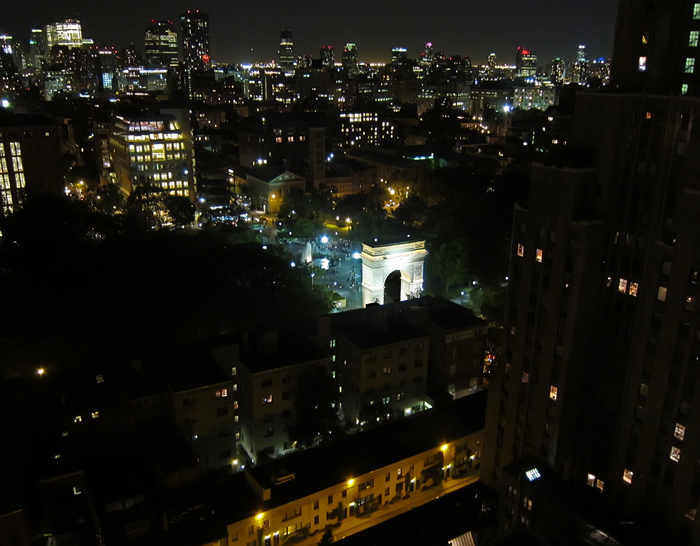
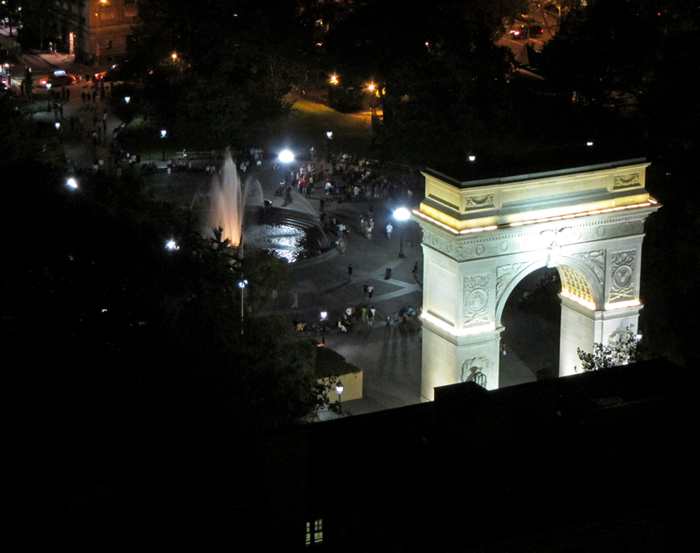
    Photo Note: I was recently privy to access to one of the very few rooftops in the Village affording a direct view of Washington Square Park. The building and friends kind enough to invite me to share the view, will, in the spirit of buildering, remain a secret 🙂


  • The Bathroom Closes in 20 Minutes

    There are innumerable thankless jobs, and many of us worked them when we were young. But for those of us who were college-bound, doing these jobs in high school, no matter how distasteful, was made tolerable by seeing light at the end of the tunnel – knowing full well that this was only a temporary position on a journey to an easier life. There was hope.

    But the masses of the work force are employed in jobs knowing that despite any late-night self-improvement evangelists, the reality is that the thankless job that they have is the end of the tunnel. Despite patronizing platitudes such as “every job has worth,” who of those with a good job and pay will trade it for the thankless job with its purported dignity? “Make the best of it,” we are told, but few of us have the temperament to make lemonade from these kinds of lemons for a lifetime.

    John Henry Black is a maintenance worker in Washington Square Park. He not only has a great attitude, but he also makes a real difference for those who enjoy the park. Complaints about odors emanating from a sewer area where hot dog vendors dump their refuse water daily has John preparing and adding a cleaning solution to douse the odoriferous offensive waters. He is known to warn women tourists to look out after their handbags or to suggest to others that they should move from the bench they are sitting on since it is located below roosting pigeons. John is also a harmonica player and will often take a few moments to join a music jam.

    He is best known for his mantra, which he belts out in the evening making his final rounds: “The bathroom closes in 20 minutes. If you gotta go, you better go.”* We who spend time there regularly find his words and routine to be a palliative, a familiar soothing balm. And, of course, many do appreciate these announcements, which were never made in the past, leaving those in need of a bathroom and unfamiliar with park policy unpleasantly surprised that Washington Square Park is open long after its bathrooms close.

    John Black hails from Florence, South Carolina, and has lived in New York City for 25 years, currently a resident of Harlem. His job as park maintenance worker is seasonal. In the late fall, he fills in his off time with other jobs until the following spring. When I asked his full name, he proudly smiled and answered, “Black.” Seeing that I was doubtful, he produced official identification that did indeed identify him as John Black.

    Today, on Labor Day, September 6, 2010, I nominate John Henry Black for candidate as poster child for the American Worker, an inspiration to make the best you can of what you do. But don’t wait too long, because the bathroom closes in 20 minutes 🙂

    *John actually starts with a series of announcements, typically an hour before, changing his mantra to reflect the time remaining.


  • Sittin’ on Top of the World

    Manhattan has a coordinated traffic signal system. Avenues run north/south and are generally one way, like the majority of crosstown streets. These avenues have traffic lights that are timed progressively so that traffic can move without stopping. In theory. The lights move in a wave – a green wave of about 5 lights traveling below speed limit, sandwiched between red lights behind and in front of this green wave. Driving these avenues is urban surfing – wait for a wave, catch the wave, ride the wave as long as possible, and don’t get caught in the soup. I have often ridden a wave like this for miles down an avenue.

    On other major avenues that are two way, such as Park Avenue, Central Park West, and 11th and 12th Avenues, lights are timed to change simultaneously. This means that the faster you go, the more lights you can make before stopping.

    I drove a taxi in college, as did nearly all of my best friends. On one occasion, the wildest driver of the bunch asked me how many blocks I could make on Park Avenue. I believe he said he could make somewhere in the vicinity of 27 blocks. Without going through the mathematics, I can assure you – that is some fast driving on city streets, somewhere in the neighborhood of at least 60 miles per hour. Unfortunately, a few of us took this as a challenge, later comparing results. Fortunately, there were no fatalities in this short-lived reckless contest.
    The speed limit in Manhattan is 30 mph. Traveling at 60 plus miles per hour on crowded city streets is lunacy. The reason for high auto insurance for those under 25 is abundantly clear.

    Today’s photo was taken looking north from the last Park Avenue mall. The small park extends from 96th to 97th streets, where the Metro North train tracks emerge from underground to travel on an elevated trestle along Park Avenue. Looking at this now, I realize that I could have challenged my college friend to see if, in French Connection style*, he could outrun a commuter train.

    I, however, will keep away from all temptation that Park Avenue may offer, opting instead for First or Second Avenue with the gentle waves of the progressive lights, where, with good conditions, I can catch a wave and ride it all the way. That thrill makes me feel like the ultimate Beach Boy, because in New York City, if you can catch a wave and ride it all the way, you feel like you’re really sittin’ on top of the world* 🙂

    *The French Connection (1971) has what many consider of the greatest car chase scenes ever filmed. The chase was between a hitman on an out-of-control train on an elevated section of a subway line in Bensonhurst, Brooklyn, and a police officer in a car on the streets below the train. Most of the chase sequence was real and filmed without permission from the city of New York. It includes an accidental car crash, which was left in the film.

    *From the Beach Boys song Catch a Wave, with the refrain: “Catch a wave and you’re sittin’ on top of the world.”


  • Pockets of Joy

    Unless you are a saint, someone who has achieved nirvana, satori, or samadhi, or perhaps one of those individuals who is blessed as an eternal optimist, emotional life is an up and down affair. Life is good, but not always that good.
    For those of us mere mortals, it is more reasonable not to expect a life of constant euphoria and bliss, even in New York City, which has so much to offer, but rather, to look for pockets of joy in a less than perfect world.

    One of the unique things about New York, which I have never experienced anywhere else, is that no matter what your interests, passions, ethnicity, color, creed, or education, if you look, you can find others of a similar persuasion. Immerse yourself with these people, and you may find one of New York City’s many pockets of joy.

    For those who love music, this is an easy task. Head to Washington Square Park, and often you will find numerous groups playing at the same time – make the rounds and sample the goods. The New York Times has recently done two articles on the activities here.

    As of late, the park has been invaded by a large group of drummers. Although the experience is rather entrancing to the participant and has added musical variety, it has, however, made the rest of the central plaza difficult for other musicians to play and be heard, such as regulars like Joe Budnick or guitar virtuoso Scott Samuels. Regular street performers add to the din. Hence, splinter groups form on the lawns, on pathways, or tucked away in the folds of foliage. The musical entertainment seeker is well advised to circulate a bit, as I did on Saturday.

    A great number of musicians here are professional, some playing in the park for unstructured musical fun, others looking to play or rehearse outdoors on a beautiful day.
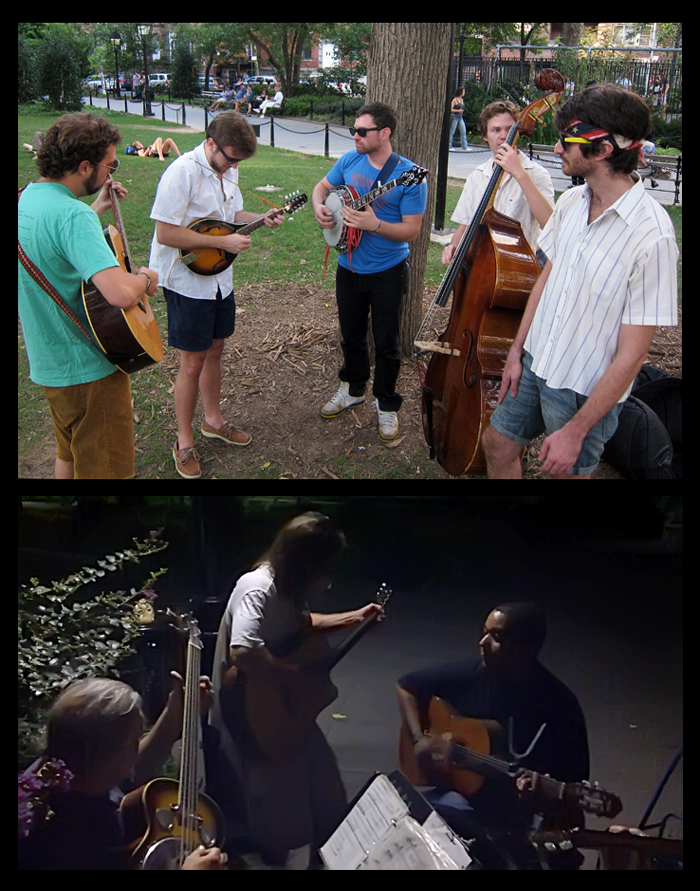
    Some form spontaneous groupings, some play together regularly, and yet others have established bands and work together professionally outside the park. The latter was the case with a bluegrass group, the Bella Boys, whom I encountered on one of the lawns, away from the central plaza hubbub. These boys were quite bella, and their command of repertoire was astounding to me, as was the familiarity of several members with numerous instruments. At various junctures, the mandolin, banjo, and guitar were passed around like musical chairs. I learned that one of the members was leaving for Europe for four months, so I had fortuitously run into them on their last get together for quite some time.

    Later that night, I ran across another grouping (Sage, Peter, Jimmy, and Joe – bottom photo), which included regulars I have known for some time. The singer, Sage, has a masterful, trained, and natural voice, and his occasional forays into the park are always a welcome addition to any group (Sage plays a dozen instruments and has a collection of 100). I had the good sense to record video of these events:

    At one point during the bluegrass jam, I noticed the hair on my arms standing up – a clear sign that life was indeed good and that I had found one of the city’s many pockets of joy 🙂

    Related Music Posts: Sieve of Darwin, Music Speaks for Itself, Sounds of Summer, Police Riot Concert, Bluegrass Reunion, The Conductor


  • Just Like Old Times

    In most places, eight police vehicles and a swarm of officers pursuing a drug bust is a serious event. On Saturday night in Washington Square Park, at 11:30 PM, various vehicles came hurtling at high speed from all directions – two unmarked black cars, a taxi (used by police), and several regular NYPD vehicles. They easily and quickly trapped the perpetrator, who offered no resistance, only saying, “What?”

    It had all the drama of a major arrest of one of America’s Most Wanted, but my understanding was that this huge show of force was just for the arrest of a drug dealer caught making a transaction. I say “just” because selling drugs is an everyday and all day activity in this park.
    If you look at all like a potential customer and are strolling through Washington Square on a busy day, you will be offered drugs by numerous dealers at a number of key locations – strategic intersections where most pedestrians have to pass through. The mantra “smoke, smoke” is familiar to all habituĂ©s here and is just laughed off as part of the natural environment and business as usual.

    Drugs have been regularly sold in Washington Square Park since time immemorial. Dealers are well-known by regulars in the park and the police. The miscreants are quite well-versed in the law and know how to operate their business in a way to generally avoid arrest. The activity had virtually disappeared since the recent renovation (see here) but, as would be expected in New York City, and particularly in this park, drug activity has crept back in and often feels just like old times.

    What is ironic, and would be perhaps astounding to nonregulars, is that a regular group of musicians and singers continued their musical activity just steps away from all the commotion, completely undaunted, unfettered, and apparently uninterested.

    Rather than a cause for alarm, surprise, disruption, or curiosity, the whole affair just seemed to add voices to the backup singers. Guns, police running, screeching tires, searchlights in the bushes, sirens, and handcuffs were all part of a comforting ambiance that made everyone feel that it was just like old times 🙂

    Note: On August 6, 2009, I wrote Chess Monsters and told of an incident where I witnessed a shooting, yet incredulously, while players ran for cover, an onlooker stopped the chess clocks during the incident and playing resumed, barely missing a beat. You can read the story here.

    Postings on Washington Square Park: Out There, Conflux, Hawk Fest, Evening Arch, Twelve Tribes Arrive, New York Nymph, Bluegrass Reunion, Cloud Appreciation, I Am Legend, Birds Sing at Night, Rats Gone Wild, Piercing Al Fresco, Police Riot Concert, Artiste Extraordinaire, Comfort and Joy, Livid, Flash of Light, Delivery, Dog Run, Sounds of Summer, Krishna, Spring Madness, Back to Boyhood, Hookah, Lockout, Danger and Caution, Obama, YouTube Meetup, Dachshund Octoberfest, Music Speaks for Itself, Park Night, Petanque, Washington Square North, Nested Embraces, Left Bank New York


  • Miracle Garden

    In the 1960s and 1970s, the East Village was one of the most dangerous neighborhoods in Manhattan. Even the most brazen college student, carousing with reckless abandon, would think twice before strolling the East Village. Being mugged, even in broad daylight, was not fanciful paranoia; it was reality. I always traveled with at least one other person.

    On one occasion, a very aggressive panhandler, to whom we refused to give money, became extremely menacing, wielding a baseball bat and threatening us. This incident occurred at a pizza parlor on 3rd Avenue and St. Marks Place, a major intersection. Only by begging the shop employee for refuge were we spared a possible battering.

    Alphabet City was truly a no-mans land. The neighborhood was filled with drug addicts – there are only a few ways of feeding a drug habit. Unable to keep a job, most turn to theft or prostitution. For the male heroin or crack addict, a source of income comes down to robbing for money or stealing goods and fencing them. Many Village residents have had their bike stolen, only to see it being sold on the streets of the East Village. Rather than provoke an incident and risk the opportunity of getting it back (by calling the police), some have even resorted to buying their own bicycle back.

    So, in one way, it is surprising to see so many beautiful oases in the form of community gardens in the East Village. On the other hand, it is not surprising at all. This area has had a history of homesteading, squatting, and community takeover of buildings and empty lots. The neighborhood was extraordinarily blighted and largely abandoned by the city. Without the passion, grassroots efforts, and activism of community members, it is doubtful that this neighborhood would have been inhabitable at all. Even with all the gentrification over decades, the East Village still has a decided grittiness.

    Miracle Garden is located at 194-196 East 3rd Street between Avenues A and B. It was founded in 1983. According to New York Songlines, this urban garden was built on the site of a former crack house. What better name than Miracle Garden?

    Note: I have written about and photographed some extraordinary community gardens. See the related links: Shangri-La, Devil’s Playground, La Plaza Cultural Garden, Grapes, Stay Lean Stay Hungry, Urban Oasis, Alberts Garden, West Side Community Garden, Bird Country, Hua Mei Bird Garden, Paraiso


  • With Six You Get Egg Roll

    It was 1968, and I had been told that our family was going to a drive-in movie and that “with six you get eggroll.” We were all very excited, but I was very concerned because our family only numbered five. Anyone could clearly see that. But I trusted that my parents had some strategy – I had never had an eggroll and really wanted to try one.

    The drive-in was created by Richard M. Hollingshead, Jr. in Camden, New Jersey in 1933. In its heyday in the 1950s/60s, there were over 3700 drive-ins in the United States. It was the perfect family outing or place to take a date – an outdoor movie viewed from within your own private environment. Sound was provided via a speaker which could be hung on the inside of the auto’s window. Concessions were a short walk away.

    As my family drove to the entrance of the Drive-In, my heart sank. There it was on the marquis. With Six You Get Eggroll was the title of a film starring Doris Day (I later learned this was her last appearance in a film). No eggrolls for me.
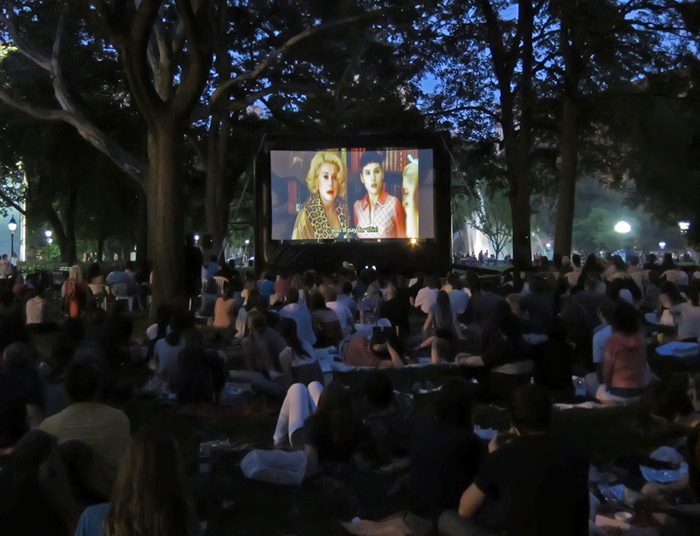
    But once I moved to New York City, closure was achieved – I had many an eggroll. But no drive-ins. However, we have the perfect urban equivalent. For some years, films have been aired around New York City in various parks during the summer. The Bryant Park Summer Film Festival screens films on Monday evenings. The event began in the early nineties and is now sponsored by HBO. What better way to enjoy the season than an outdoor film (or concert)? People bring picnics, chairs, and/or blankets.

    The death of theater has been predicted since the beginning of video and home entertainment systems, yet theater business booms. The numbers of drive-ins has declined dramatically – there are only about 400 nationwide. However, there is an independent revival afoot – groups like mobmov.org and guerilladrivein.org are doing impromptu screenings projected on surfaces like warehouse walls or bridge pillars. One thing missed in many of these fatalistic predictions are social needs. The huge turnouts for outdoor events, sold out theaters, and independent revivals demonstrate this need. People enjoy sharing entertainment with other people, not just from the comfort of their homes.

    On Friday, June 18, Films on the Green presented the French Film 8 Women in Washington Square Park, shown in today’s photo. The cast of eight, with Catherine Deneuve, may appear quite large, but not if With Six You Get Eggroll 🙂

    Note: The Films on the Green series of free screenings is jointly organized by the Cultural Services of the French Embassy and the New York City Department of Parks & Recreation for the third year running.


  • Everything No

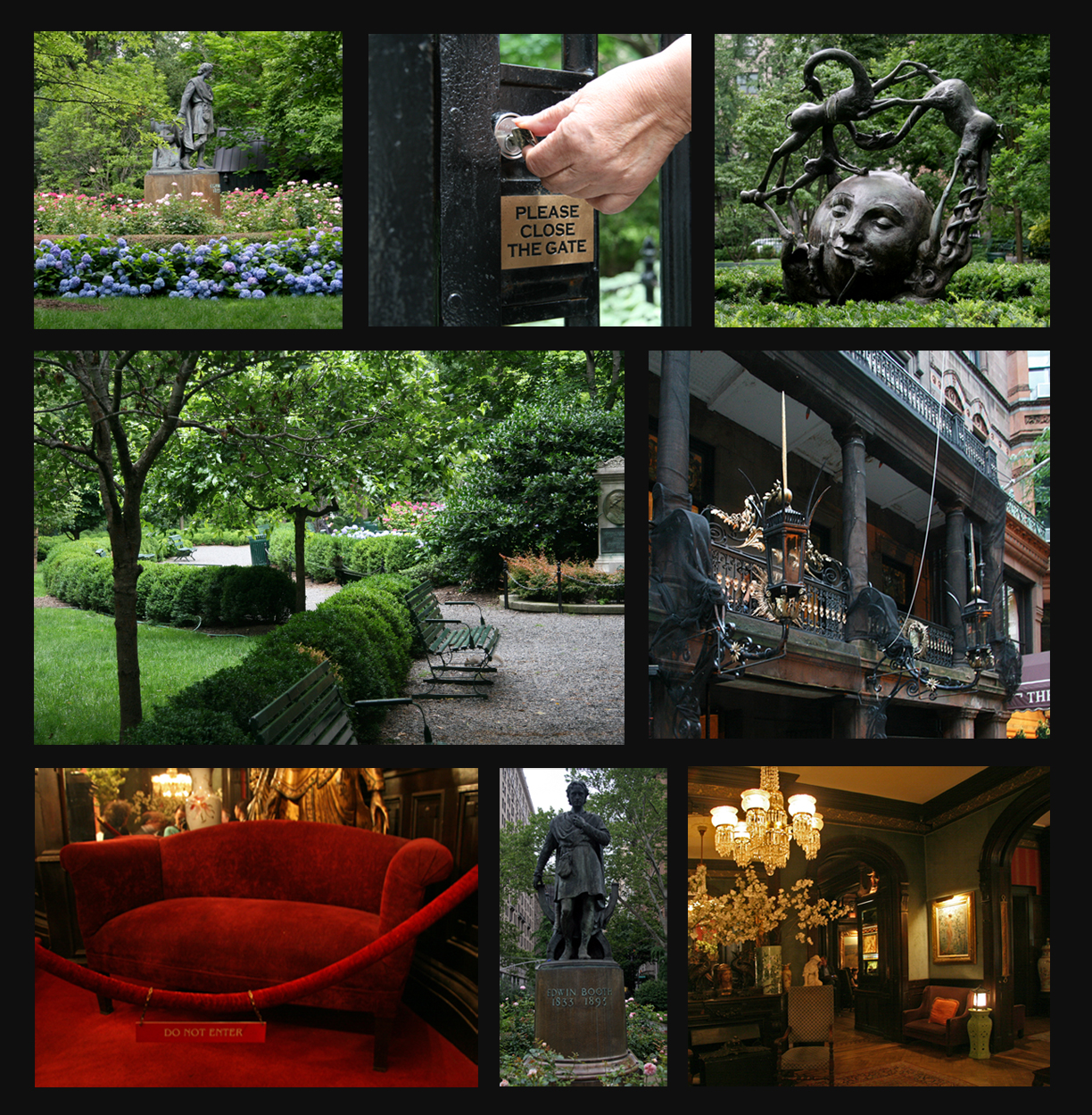
    On April 4, 2008, I wrote Key Privileges, about Gramercy Park – the city’s exclusive private enclave and Manhattan’s only private park. Read the story of the park here. That visit was like that of virtually all New York City residents and visitors – from the outside.

    Recently, a friend, a regular reader of this website and Gramercy neighborhood resident who lives just off the park, let me know that she was in possession of a rare and highly coveted article – a key to Gramercy Park. The key was loaned to her by a friend who was away for a short time, so time was fleeting, and so was my window of opportunity. A number of us were invited for the outing, so we decided to meet at an opening at the National Arts Club on Gramercy Park South.

    The convenient location on the park and a short immersion into the club’s historic structure made it the perfect launching point for our excursion into the park. The National Arts Club, which also abuts the Players Club, is housed in one of New York’s finest mansions, both a designated New York Landmark and a National Historic Landmark. The building, located at 15 Gramercy Park South, is worthy of a visit itself.

    I made a big ceremonial event about the unveiling of the key and the opening of the park gate. Gramercy Park requires a key both to enter and leave. Once inside, we toured the park, spent some time enjoying the extraordinary bucolic ambiance, and alighted on a number of benches for some friendly chatting. See my gallery of photos here.

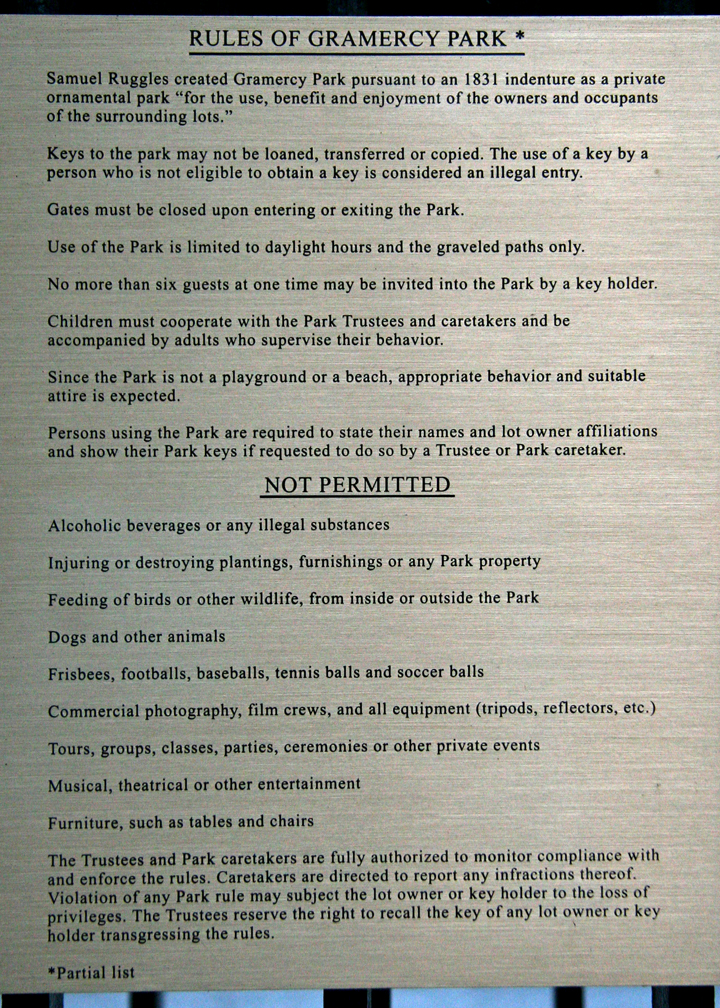
    All of our group was in agreement, however, that although the park’s landscaping and natural beauty was quite exquisite, the park itself, with its list of don’ts, was rather boring. In fact, the park is not heavily used.
    The list of rules is quite long (see them here). After reading them on our way out and observing a nearby “Please No Pets” sign, one of our group was prompted to comment, “Everything no.” A recent immigrant to the USA, we found her outside perspective and slightly broken English to be a charming, succinct, and not altogether inaccurate characterization of the environment. Smiling, I felt compelled to respond, “Yes, everything no…”


  • Trapped in Paradise


    Heaven may not be what you hoped for if you are unable to relax, let go, and appreciate the seraphim and cherubim. Otherwise, you may find yourself like Woody Allen in a taxi in Manhattan – “You look so beautiful I can hardly keep my eye on the meter.”
    I felt very conflicted sitting in the Conservatory Garden – I had an loose agenda for the day, but sitting in this garden just made it nearly impossible to entertain leaving. I was truly trapped in paradise.

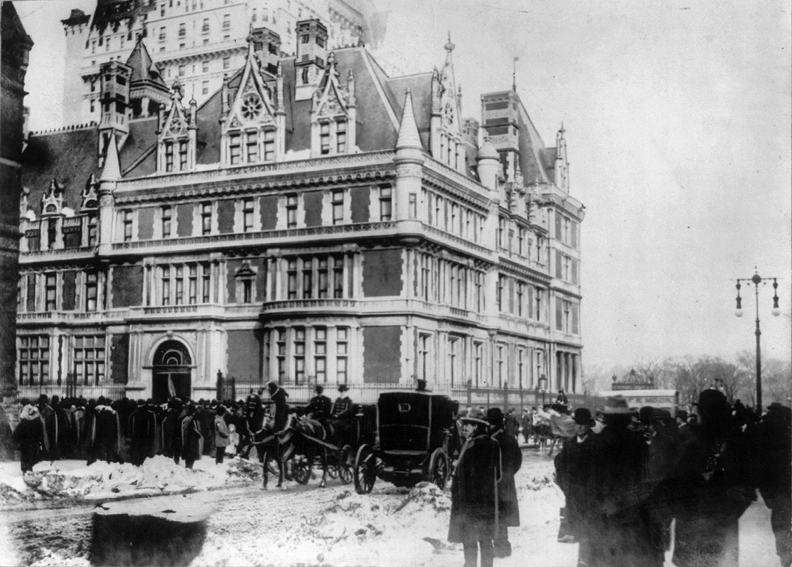
    This is one of New York City’s “secrets” – few will make it this far north on Fifth Avenue. The formal garden was designed by Gilmore D. Clarke, the landscape architect for Robert Moses. The main entrance is through the Vanderbilt Gate at Fifth Avenue and 104th Street. The gate once served as an entrance to the chateau of Cornelius Vanderbilt II, the grandest of the Fifth Avenue mansions (see photo here). It stood at 58th Street and Fifth Avenue near the Plaza Hotel. It was demolished in 1927. The gardens are divided into 3 styles – French, Italian, and English. From the Central Park website:

    Conservatory Garden began as a large, E-shaped greenhouse, or conservatory in 1898. It featured an indoor winter garden of exotic tropical plants and outdoor decorative Victorian flowerbeds. In 1937, the deteriorating structure was demolished and this six-acre formal garden was designed in its place.The Central Park Conservancy began its restoration of the area in 1981, starting with the Garden’s fountains.

    Conservatory Garden is divided into three distinct styles – French, Italian, and English.The northern French-style garden features an ellipse of meandering boxwood and pansies, and showcases spectacular seasonal displays of tulips in spring and chrysanthemums in autumn. In the center is the charming Three Dancing Maidens fountain by German sculptor Walter Schott.The central Italian garden features a wisteria pergola, a large lawn surrounded by clipped hedges of yews, a 12-foot-high jet fountain, and two exquisite allées of pink and white crabapple trees. On the walkway under the wisteria pergola are medallions inscribed with the names of the original thirteen states. The Italian garden serves as a backdrop for hundreds of wedding photography sessions.

    I hope you visit. I’m sure you will enjoy being trapped in paradise 🙂


  • dinamic_sidebar 4 none

©2026 New York Daily Photo Entries (RSS) and Comments (RSS)  Raindrops Theme