• Big Big Mistake

    Part 3 of 3, Back Inside the Box (see Part 1 and Part 2 here)
    She thanked me and appeared to be pleased, but my heart sank. Regardless of her reaction and appreciation, I knew immediately that I had made a Big, Big Mistake. Additionally, I sensed that she may even had hoped that the smaller box was a more traditional gift, but alas, adding insult to injury, my second gift was a wall mount bracket, neither chocolates nor lingerie. I had made many errors in judgement, and one was classic – buying for yourself, not the recipient. There was no avoiding the obvious – this gift was strictly a GUY THING. Nothing more, nothing less. Which woman really wants electronic hardware for Valentine’s Day? What the hell was I thinking?

    Worse, I even had written stories which she had read and we had discussed, one that very morning, demonstrating my insights regarding gift giving to women on this special day and that a smart man should be thinking inside, not outside, the box, with flowers, chocolates, etc.

    I endeavored to install the TV half-heartedly. I was getting very poor quality from an analog box. A call to a Verizon tech was not encouraging – he actually recommended keeping the old TV, something he had done himself. A digital box would be large on a small kitchen table, and the TV was already oversized for the area. I was disgusted with the whole situation. I would leave it a few days, but on my next visit, I would likely pack it up. The TV was going back.

    On my next visit to her home, I reflected on my foolishness, i.e. thinking outside the box on Valentine’s Day. As I approached the Ariemma Garden Center, it occurred to me that stopping would be an opportunity to investigate their flowers, and, if they appeared to be of reasonable quality, perhaps I would pick up a bouquet of roses as a belated gift. Better late than never.

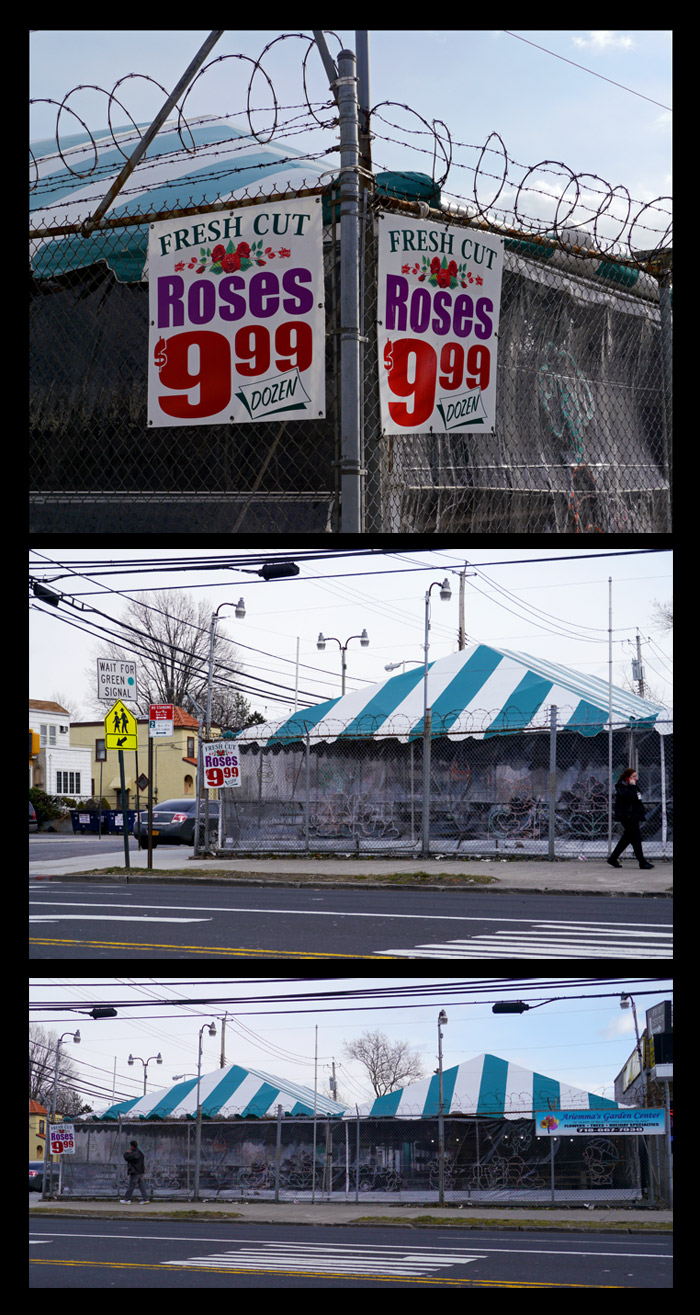
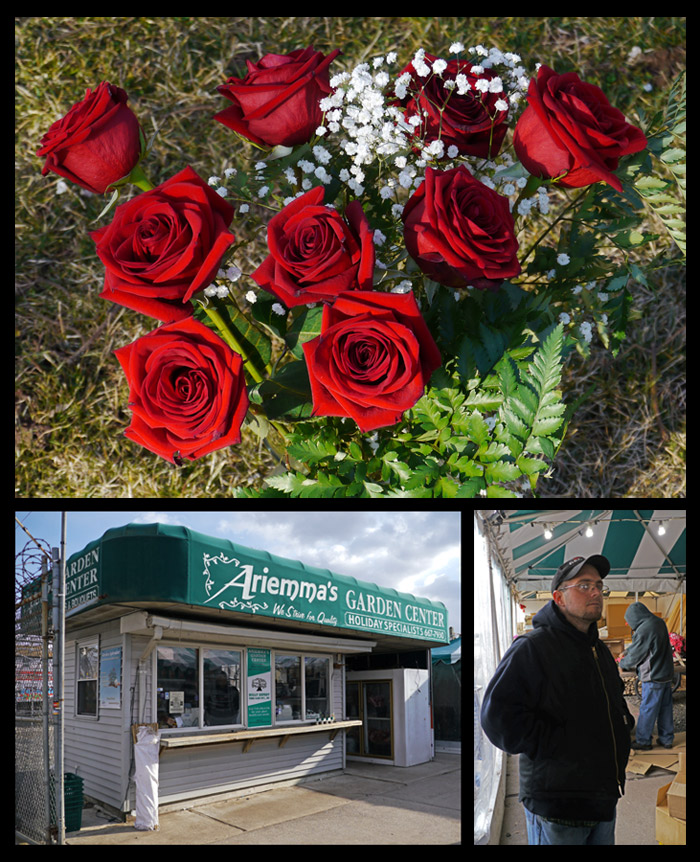
    I met the owner’s son, Mike Ariemma, who informed me that his father had been in business for over 30 years. I discussed his rose quality openly. He assured me that these were fresh cut within days, flown directly from Ecuador. I learned that over the years there has been a tremendous shift and that Colombia and Ecuador now accounted for roughly 90% of all roses sold to the United States.

    Mike did not sell his product at all. He encouraged me to peer into his cooler, where I found bouquets of roses. The quality spoke for itself – the flowers looked great, the buds were tight. This place had all the earmarks of the classic, no frills, no nonsense, New York City business where the focus was strictly on service or the product. A place where Content is King and the savvy shopper can have quality and price. Mike assured me that red roses of identical quality and source could sell in Manhattan for $30 – $40, where the Sirens of Convenience can often propel pricing of products to stratospheric levels. So, for $9.99, I was armed with a dozen red roses.

    I arrived at my girlfriend’s home. My belated gift came as a surprise and was heartily received. I discussed my adventure with the Ariemma family, choosing to reveal my source, regardless of the fact that she would know the price. Actually, her appreciation was not diminished by the $9.99 economy pricing – she praised me for a good purchase.

    Remarkably, the flowers held up well, corroborating Mike’s claim as to their freshness. The top photo shows nine of the remaining roses over one week later. I made a subsequent visit to Ariemma’s to thank Mike, tell him of my blog and story idea, and to get a few more photos.

    I learned a useful lesson, particularly that thinking outside the box can be a Big, Big Mistake. But all’s well that ends well, particularly when a TV and Valentine’s Day gift thinking are both safely Back Inside the Box


  • Big Big Mistake

    Part 2 of 3 (see Part 1 here)

    It was Valentine’s Day, and I loaded my car, very excited to make the presentation of what would assuredly come as an unexpected gift. I had not yet, however, made a decision whether to supplement the TV with flowers. I realized that my options were now very limited, and barring a purchase of inexpensive flowers from a green grocer, it was too late, particularly in Manhattan, to buy quality roses from a flower shop. From my story that morning:

    It was Valentine’s Day in Manhattan many years ago, and I, like the others, had waited until THE LAST MINUTE. We had made the enormous mistake of attempting to buy flowers from a flower shop during the closing hours on Valentine’s Day.

    Certainly, I reasoned, a brand new flat screen TV is a more than adequate gift for Valentine’s Day. Nonetheless, I had been ruminating from the inception of this gift idea over the prudence of giving no flowers on such a holiday. But there was an option.

    My journey through the outer boroughs to my girlfriend’s house takes me by this roadside vendor of flowers. It is a classic New York City juxtaposition – where else will you find a sign for roses at the astonishing price of $9.99 per dozen tacked to a barbed wire fence? I had seen this sign dozens of times, which always prompted me to reflect on the danger of purchasing discounted flowers, an observation which I discussed in my story, Happy Valentine’s Day, that very morning:

    Any astute woman will know quality and where such flowers were purchased.

    As I traveled the last leg of my drive, I agonized over stopping at the $9.99 dealer, Ariemma’s Garden Center. Here was the dilemma: Should I forgo the flowers, relying on the magnitude of the gift I had already purchased? Or should I buy flowers and cover my bases? However, there was risk buying these flowers. What if she discerns that they are CHEAP, and worse, that she recognizes or deduces that they were purchased at the last minute near her home as an afterthought? It could appear desperate, thoughtless and cheap, as well as undermine everything I had done.

    Plus, with only blocks to go, I was anxious to get to her home, so, still a little conflicted, I passed the garden center and forged ahead. I arrived and pulled up, locking all my doors, even in her driveway. This was a New York City reflex for me when parking anywhere, perhaps stronger than the classic physiological knee-jerk reflex itself. The automatic response was permanently etched in my mind from the days of rampant vandalism in the city and No Radio signs.

    The TV box was large, and rather than wrap it, I had decided to leave it in the original B&H shopping bag, a bit lazy on my part. I entered her home empty-handed, made an announcement that I had come bearing gifts, went back to my car and returned with the TV, a wall mount bracket and a handmade card. Voilà. Happy Valentine’s Day! Was she elated? Her reaction will be revealed in Part 3, where you will learn whether or not I had pleased her or made a Big, Big Mistake…


  • Big, Big Mistake

    Part 1 of 3, Thinking Outside the Box

    How very fortunate one is in life to have both good and very useful insights. Even better is to articulate these insights online on one’s website and have them validated by your readers. Best is to be a man, have insights regarding women and gifts of flowers and chocolates, and have those insights validated by women around the world. And what more opportune time to use these insights than on Valentine’s Day, now assured as to exactly what should be done?

    However, as I wrote on December 7, 2007 in Foolish Crash, “there are different kinds of fools.”  In that story, I discussed a specific type of fool, one who neglects simple, prudent computer procedures that everyone knows well and suffers severely. I was that fool.

    But my foolishness comes in different flavors. I am also the type of person who, armed with insight, goes ahead and ignores it in order to look more clever and less cliched than the masses, like in buying a much more useful (aka unromantic) gift on Valentine’s Day.

    Valentine’s Day is not the time to be creative or try thinking outside the box, particularly outside a box of chocolates or a box (or bouquet) of long-stemmed roses. Regardless of any novel gift ideas, at least one box you give should hold the type of gift which most women hold dear on such a day. But I thought I could break the rules and march to the beat of a different box-giver. Big, Big Mistake.

    My girlfriend, in the opinion of a technophile, badly needed an upgrade for a TV located in her kitchen. Outdated technology is common in many households, particularly by those who put other interests first. This was a perfect opportunity to give a much-needed gift of lasting value. But virtually every woman alive who celebrates Valentine’s Day, regardless of what she may say, has an expectation. And that expectation was clearly outlined in my story Happy Valentine’s Day.

    But I was undeterred by my own better judgement and was unflagging in my desire to think outside the box. And what better place than New York City to find a gift, traditional or not? So it was, that on Sunday, February 12, 2012, two days before Valentine’s Day, I made a pilgrimage to B&H Photo to purchase an LCD HDTV and wall mount, in spite of my instincts as to the proper gift to give a woman on this most romantic of holidays.

    My fate was not yet sealed – after all, flowers were still an option as an additional gift. If I elected to supplement the TV, my girlfriend would have the discretion of deciding which gift was primary and which was the icing on the cake. All bases would be covered, both the romantic and the practical.

    Tomorrow, in Part 2, we will see the decision I made, the gifts I gave, her reaction, and whether or not I made a Big, Big Mistake 🙂


  • People Watcher’s Paradise


    On April 21, 2009, I wrote Rear Window, referencing the Hitchcock classic film set in New York City and my similar voyeuristic opportunity. I have the privilege of my office windows facing Broadway, and over the 21 years I have been located there, it has been a virtual Time Machine experience as the neighborhood changes, stores come and go, residential tenants move in and out, various dramas play themselves out, and marches use Broadway as the thoroughfare of choice to make their way to City Hall or the financial district.

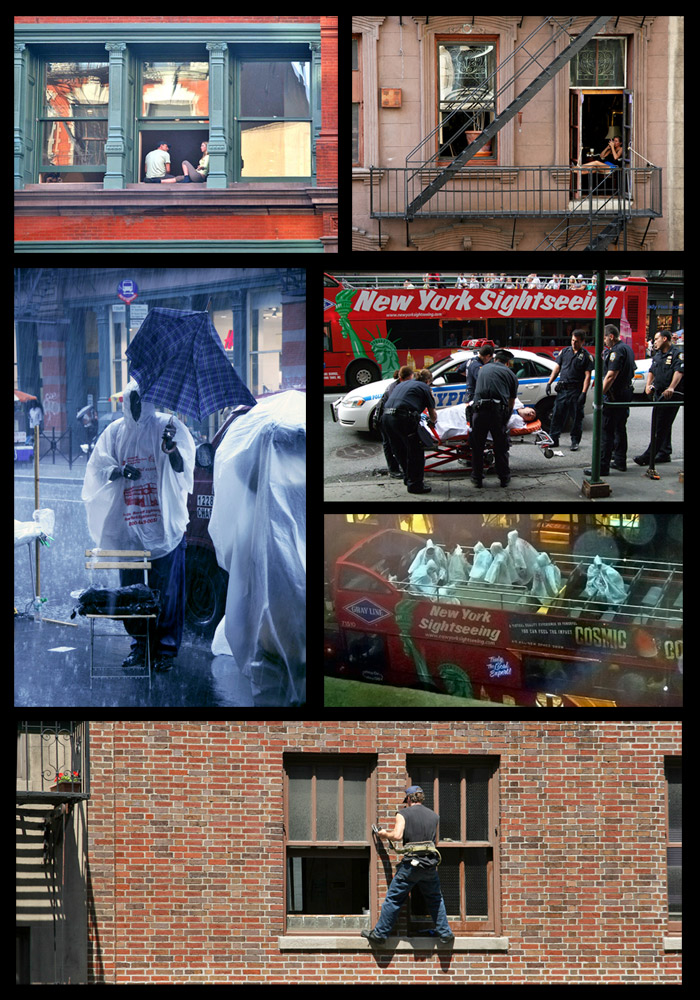
    However, unlike the vista of Jimmy Stewart in Rear Window, a Broadway view for two decades is going to deliver a lot more material than one apartment. It is here that I photographed and wrote about a man who SNAPPED and had to be taken away in an ambulance, tourists caught in a rainstorm atop a tourist bus, a couple enjoying an early spring day precipitously perched on a ledge, an old-school window washer, and an umbrella opportunist. (See these stories by clicking the individual photos in the collage.) SoHo is also a neighborhood where I have shared many experiences and photo ops, which I wrote about in Street Cred and Dead Man Walking.

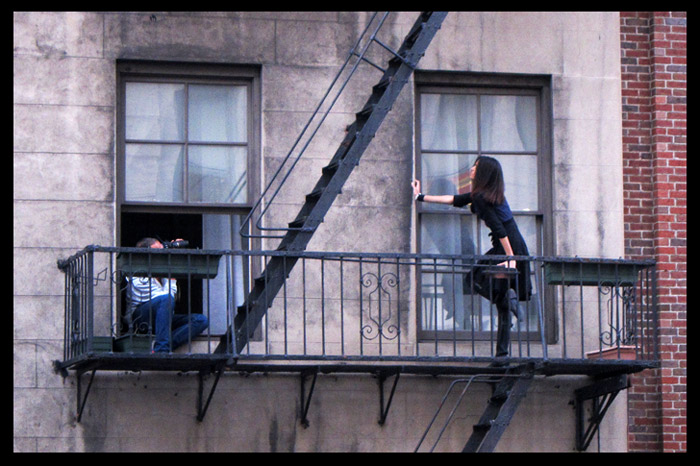
    You can see the rich fodder that I am privy to from just one single New York City perch. In today’s photo (top), I caught a fire escape photo shoot. At the end of the shoot, in an ironic twist, the photographer and model noticed that I was photographing them as well. They smiled and waved approvingly in reciprocal voyeurism.

    The patient observer will be most rewarded. Over time, from a good perch, one can see a changing and varied world go by with an endless parade of characters, many hard to imagine to be found anywhere else. This is New York City, a People Watcher’s Paradise 🙂


  • High Noon

    My tagline for this blog avoids a few very applicable cliches. It could easily read something like “New York City – a place of contrasts and juxtaposition.” True or not, it’s one of those claims that many want to make. I cannot argue that New York City leads the world in contrasts; travelers to places like Egypt speak of the extreme contrasts unknown in the United States, such as disembarking from a plane and seeing the pyramids of Giza, or camels and limos in the streets of Cairo.

    In the United States, we cannot compete with contrasts based on age. However, in New York City, there are remarkable cultural and ethnic pockets, with shops and services often juxtaposed in startling ways. Looking into my vault of photos, I found today’s images from July 2011, when I paid a visit to Woodside, Queens.

    On or near 55th Street, in two short blocks, you can have you taxes done, bookkeeping, find a notary, pray at the local Masjid Fatima mosque, or get your fresh fowl at the Bismillah Live Poultry. From their website:

    We are in business since 2002. All our poultry items are slaughtered Under Muslim rules & regulations (100% Halal). We are a proud member of Shariah Board of USA. All our chicken are naturally grown, no hormone or steroids used and they are tested by USDA.

    In this industrial warehouse district, you will also find Sapori d’Ischia, an Italian foods retailer that becomes a highly regarded restaurant at night. ABC has a rental facility there, as well as Saks Fifth Avenue.

    The live poultry business is always the biggest shocker for me to see in New York City. When I started this blog in 2006, I was particularly driven to show things of dramatically disparate natures. I had recalled passing a live poultry dealer on the Lower East Side, and one of my first postings was of a Live Poultry Market on Delancey Street, which I believe is now closed. At one time, there was even a live poultry dealer in the South Village, only blocks from my home. These things are often taken for granted at the time, and once gone, I begin to question my own memory of something so seemingly out of place in Manhattan.

    As I explored the streets of Woodside that Sunday in the hot summer sun, there was very little activity, even by locals. The streets were deserted. Some of the backroads hearkened to the Old West. At any moment, I expected tumbleweed to blow through, had there been a breeze. And maybe out of that New York-styled Wild West would be our own Wyatt Earp, just back from Masjid Fatima toting a sixshooter on one hip and live poultry from Bismillah on the other. And that’s New York City at High Noon 🙂


  • The Caryatids

    There is much sensory input at street level in New York City that it is easy to miss those things which are above ground. Look up and you can explore the architecture so often overlooked by visitors and residents alike.

    Here, at 91 Fifth Avenue in the Flatiron District of Manhattan, is a commercial loft building built in 1894 and designed by Louis Korn. At the sixth floor level are six caryatids under four Corinthian columns and two matching pilasters. A caryatid is a sculpted female figure serving as an architectural support, taking the place of a column or a pillar supporting an entablature on her head.

    I have been by this property hundreds if not thousands of times, but it took only a friend to point it out on a stroll down lower 5th Avenue. I saw this set of caryatids as a metaphor for the burdens that women have shared in many ways – women’s rights, the glass ceiling, misogyny, women’s right to vote, their role as social enablers, and physical burdens, like the entablatures of The Caryatids

    Related Posts: I Know, I’ve Got a Feeling, Gargoyles, Cybele


  • Pirate, Part 2

    (see Part 1 here)

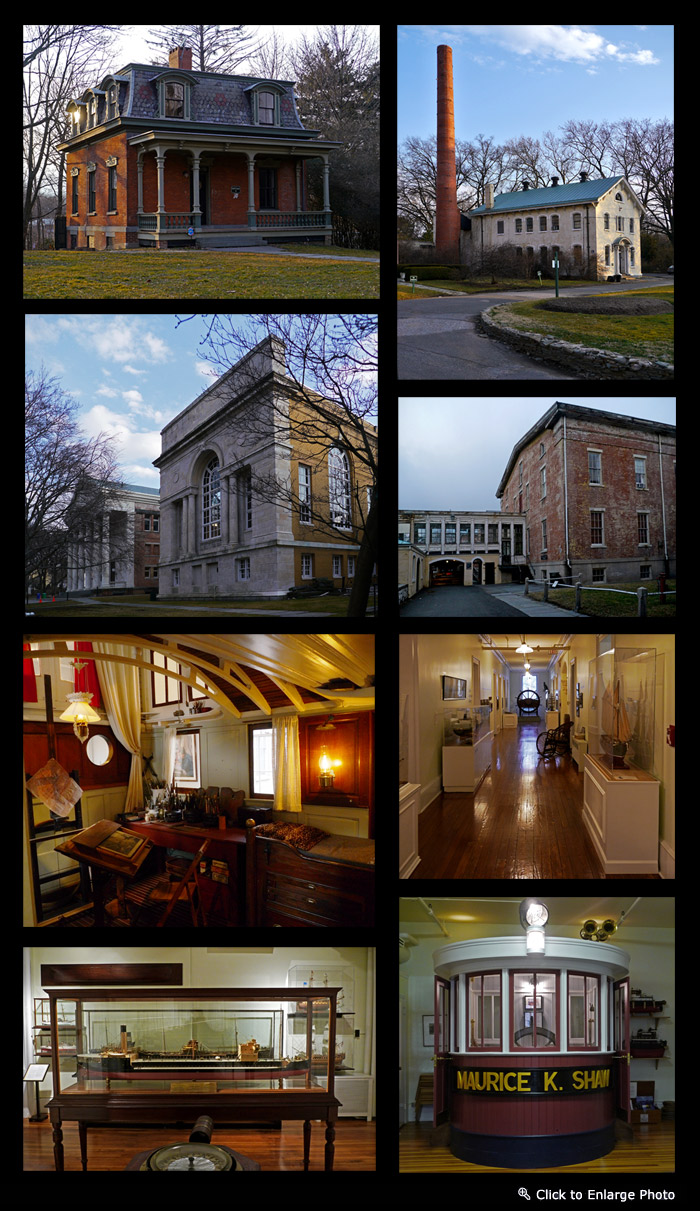
    When I arrived at the Sailors Snug Harbor, it was late afternoon. It was quiet, with no rush or crush of visitors. I was virtually alone on the 83-acre property. There was a sense of authenticity, much like Richmond Town, another historic site on Staten Island which had come as a huge surprise to me.
    There is collection of historic buildings on the site, however, time was fleeting. I made a quick tour by car, parked, and walked to the Noble Museum.

    I approached the entrance of museum, reading the posted hours. There were only fifteen minutes before closing. Ringing the bell was required for entry. An elderly gentleman appeared. Rather than admonish me for being so late or turning me away, he appeared quite easy, letting me know that I did have fifteen minutes.

    As I explored the magnificent building and pristine exhibits, he accompanied me for much of it, a private tour of sorts. There was still adequate natural light for photography, and in fact, it was close to the magic hour, the photographer’s and artist’s most desired time for imaging.

    The Noble Museum has three floors of exhibits – I flew up and down stairs, down corridors, and in and out of the various rooms. There was much more to visit, and I will go back. And if this is the lifestyle one can expect being a “privateer,” I’m going to be a Pirate 🙂

    Looking to explore Staten Island a little more? Check out That’s Giove, A Narrow Path, Quest for Pizza, Picnic Anyone?, Grisly Business, White House of Ill Repute, Veneer of Their Lives, Paint by Number, Todt Hill, Pink Flamingos, Welcoming Committee, Head for the Hills, and Secede.


  • Pirate, Part 1

    This is a city of islands, shoreline, beaches, bays, canals, piers, cruise ships, ocean freight, ferries, tugboats, boardwalks, sailboats, and even jet skis and kayaking. It is not Venice, but water defines and constrains its borders, and the congestion encountered when leaving or entering a borough will make this abundantly clear.

    In Manhattan Island, I wrote:

    It is important to note and easy to forget that, first and foremost, Manhattan is an island, and that its role as a harbor is what led it to become the great city that it is. By the early 1800s, after construction of the Erie Canal, NYC was an international port and the greatest shipping center between Europe and America. Unlike cities like San Francisco or Portland, Maine where the maritime presence is very strong, one could easily go weeks, months or longer in NYC and never see or sense the water.

    New York City is also decidedly NOT New Jersey, a constant in the collective mind of city inhabitants. It’s the place that New Yorkers love to hate but which flanks the West Side of Manhattan, Staten Island, and parts of Brooklyn – from those areas, vistas are nearby communities in New Jersey.

    Recently, while in Staten Island, I decided to make a pilgrimage to Sailors Snug Harbor, a very well known historical site that I was familiar with since my first days in New York City but which I had not yet visited.

    As I worked my way towards the north shore of Staten Island on Richmond Terrace, an opportunity afforded itself for a spectacular view of the waterway between Staten Island and Bayonne, New Jersey. For many, this would neither be a scenic photo opportunity nor a waterway to admire, however, perhaps owing to a lifetime traveling the New York City and New Jersey environs, I do sometimes find that industrial vistas can be dramatic or surreal. The SCALE of structures is often mammoth and the objects themselves foreign.

    A man sat alone at the end of railroad tracks, admiring the vistas and shipping activity. Not knowing whether he was a vagabond, I struck up a conversation. He identified Bayonne for me and the Bayonne Bridge. The seascape was dominated by container ships, tugboats, and petroleum storage facilities.

    Knowing that I would be writing a story, when I asked about his background, he told me that he was a pirate. Hoping this would spice up the story some. I learned that he was a Staten Island native, quite knowledgeable of the area and history of Sailors Snug Harbor, my destination only a short distance away. He informed me that the riches of the Snug Harbor estate was built on piracy. In fact, he was correct.

    Thomas Randall had been a privateer — a legalized pirate of sorts. Thomas was an 18th-century Scottish sea captain and world trader who commandeered any French merchant vessel he could defeat. His son, Robert Richard Randall, became the institution’s founder and bequeathed his 20-acre farm in Greenwich Village to set up a home for “aged, decrepit, and worn-out sailors.” There were twists and turns in the history of Sailors’ Snug Harbor and their parcels of real estate, which we will visit in Part 2. Makes you want to be a pirate…


  • A Classical Revolution

    Play this clip to accompany your reading:

    It was the early 1980s, and I had just purchased my first CD player. I had the future in my hands, however, I had no music on CD whatsoever. What would I get that would be worthy of such a new piece of technology? I had grabbed a copy of Bach’s Toccata and Fugue in D Minor recorded in a church in Europe, but such a short piece only served to assure me that at full volume, my living room could be made to sound like a Gothic cathedral during an organ recital.

    I had heard that the classical genre had the largest musical dynamic range and thus would best take advantage of the CD technology. So, I turned to a friend and performer, William Lee (aka Master Lee), whose mother I knew listened to classical music. My impatience knew no bounds.

    When I met him soon thereafter passing through Washington Square Park, I asked what classical music recordings I should get as a neophyte. He replied, without hesitation, the Brandenburg Concertos by Bach. Hearing a plural, I asked how many concertos there were and which I should buy. Six, he answered, and it does not matter which. So, initially, I purchased the 1-3 and later 4-6. I am forever grateful for his recommendation – it is hard to imagine a better choice for the first-time listener to classical music.

    My interest in classical music grew, and it became my total musical diet for some years. I even dabbled in playing instruments that I came to love, taking lessons in violin and cello. My German-made Pfretzschner cello still sits gathering dust in my closet, testimony to the daunting task of learning an unfretted classical stringed instrument.

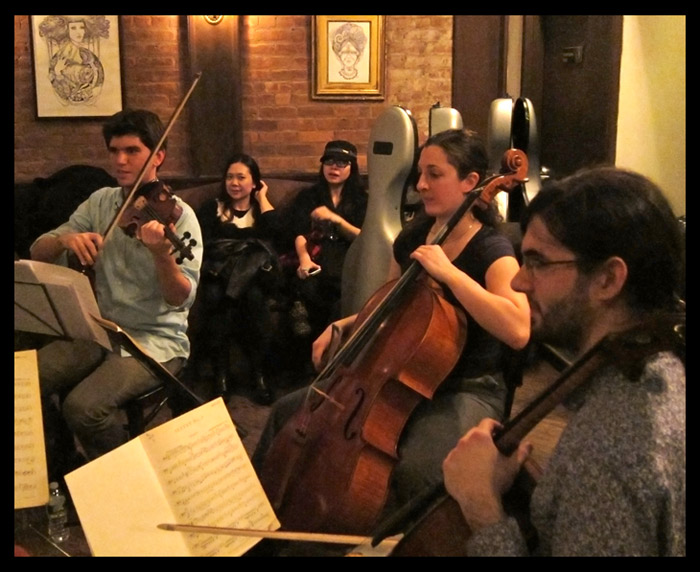
    As I write this, I am listening to Brandenburg Concerto #3, 3rd Movement, and all I can think is what a lively, engaging, absolutely sublime piece of music. My hair is standing on end in full-body goosebumps. So, you can imagine my surprise and elation last night when, walking into Think Coffee cafe, only to get out of the cold on a dreary, drizzly night, a friend and I encountered a string quartet in full swing. They played a Brahms sextet and, in a fortuitous and serendipitous twist of fate, an ensemble of nine players finished with none other than the first movement of Brandenburg Concerto #3.

    I was to learn that this was not a spontaneous or whimsical event but rather the New York City chapter of a group known as Classical Revolution, an organization with 30 chapters worldwide. The organization was formed in 2006 at Revolution Cafe in San Francisco by violist Charith Premawardhana with a mission of presenting classical music in a casual atmosphere. The members are a collective of accomplished classically trained musicians. The performances are jam sessions, and any musician is welcome to join and play along with the core members. I love the concept of chamber music brought to casual venues.

    Good things are even better when they come unplanned as a complete surprise. This was New York City at its best, where culture can be found lurking around any corner – another Pocket of Joy and nothing short of a Classical Revolution

    More on classical music: The Redeemer, Click of a Mouse, Acquired Taste, Free Lunch, Bad Hair Day, Sounds of Summer, Bargemusic, Not So Kleine, Music for 9 Basses and 1 Cello


  • Broadway is Broadway

    I often take calls in the course of business from non-residents of the city, who, unfamiliar with the details of Manhattan, question me about my Broadway address. Is it THE Broadway? they ask. Yes, I reply, it is THE Broadway. However, Broadway, which spans the entire length of Manhattan, varies considerably depending on where you are. At one time, not long ago, Broadway in SoHo was only a quiet commercial/industrial thoroughfare. But it has changed.

    When I say change, I mean radical change. Change that almost defies imagination. Change so substantial that I question my own memory. I wrote of this in Cast Iron Stomach and Six Geese a-Laying. When I first moved to New York City in 1969, SoHo was not even an acronym yet. It was strictly an industrial district, essentially an industrial slum, a neighborhood I only passed through, perhaps on the way to Chinatown or Canal Street. At one time in the 20th century, the area was known as Hell’s Hundred Acres for the frequent fires that arose in the loft warehouses.

    More recently, even after gentrification, alleys such as Crosby Street remained undesirable, yet pushed to ferret out every remaining square inch of what remained, Crosby Street became every bit as desirable as the rest of SoHo. There are no bargains left, or undiscovered backwaters in Lower Manhattan.

    In Bleecker Tower, I wrote:

    The area was dominated by industrial businesses – leather distributors like Marap Leather who occupied an entire building at 678 Broadway or Commercial Plastics at 630 Broadway. In 1980, Unique Clothing Warehouse opened at 718 Broadway at Waverly Place (president Richard Wolland closed it and filed bankruptcy in 1991 with over $2 million in debt), beginning a wave of transition. In 1983, Tower Records opened at 4th Street and Broadway (recently closed). A few months later, the elegant Blue Willow restaurant opened at 644 Broadway in the building shown in the photo.

    There were early pioneers in SoHo, both individuals and businesses – places like the Park Place Gallery. Alison Knowles had rented space as far back as the late 1950s on Broadway north of Canal Street. From Illegal Living: 80 Wooster and the Evolution of SoHo:

    Illegal Living is the story of the building at 80 Wooster Street in New York and the people who lived and worked there. The first of 16 artists coops started by George Maciunas, founder of the Fluxus art movement, Fluxhouse Coop II spurred the development of SoHo and the spread of worldwide loft conversions. … The artists of SoHo, while focused on their art, also built community, participating in the creation of a new form of residential development. The building was a magnet for the avant-garde who were drawn to Jonas Mekas Cinematheque, a ground-floor space that hosted happenings, film screenings, dance and theater performances, concerts, and art shows. Hundreds of artists including Trisha Brown, Richard Foreman, Allen Ginsberg, Philip Glass, John Lennon, Hermann Nitsch, Yoko Ono, Nam June Paik, and Andy Warhol showed their work in and around the building.

    There were a handful of well-known early retailers, such as Dean and DeLuca. One of the earliest that I personally recall visiting was Broadway Panhandler at 520 Broadway, eventually to move due to soaring rents. Little did I know I would come to occupy the 3rd floor of that very same building in 1990, where my business remains to this day.
    When I moved into the building, it was occupied entirely by sweat shops manufacturing clothing. I was the first “upscale” tenant. The landlord was very favorable towards me, seeing it as the first step in a new type of tenancy. Today, the building is occupied by media companies and businesses such as Built NY, Inc., a design firm that manufactures a neoprene bag and case line. The company holds over 180 patents, and its products are sold worldwide.

    In its industrial days, SoHo was deserted at night – a ghost town. There were no retailers – manufacturers and commercial/industrial suppliers occupied even the ground floors which today command a huge premium and would make such use unthinkable. Now, the area is saturated with retailers, both of the common garden variety such as the Gap and also very high-profile merchants, including names such as Louis Vuitton, Bloomingdale’s, Prada, Coach, Apple, and Topshop. Foot traffic is outrageous on a day-to-day basis. Typically the sidewalks are so crowded that I resort to walking in the street, even then to be frustrated by people, vehicles, food carts, and other obstacles. Once, in complete frustration, I took to walking in the center lane against traffic, which I wrote about in Dead Man Walking.

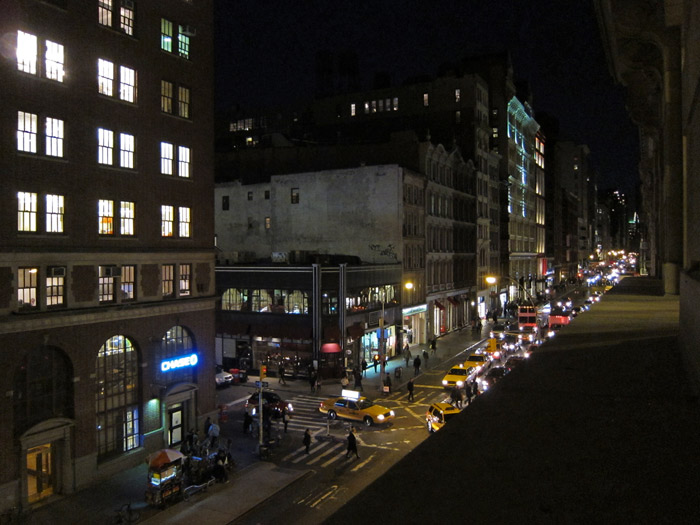
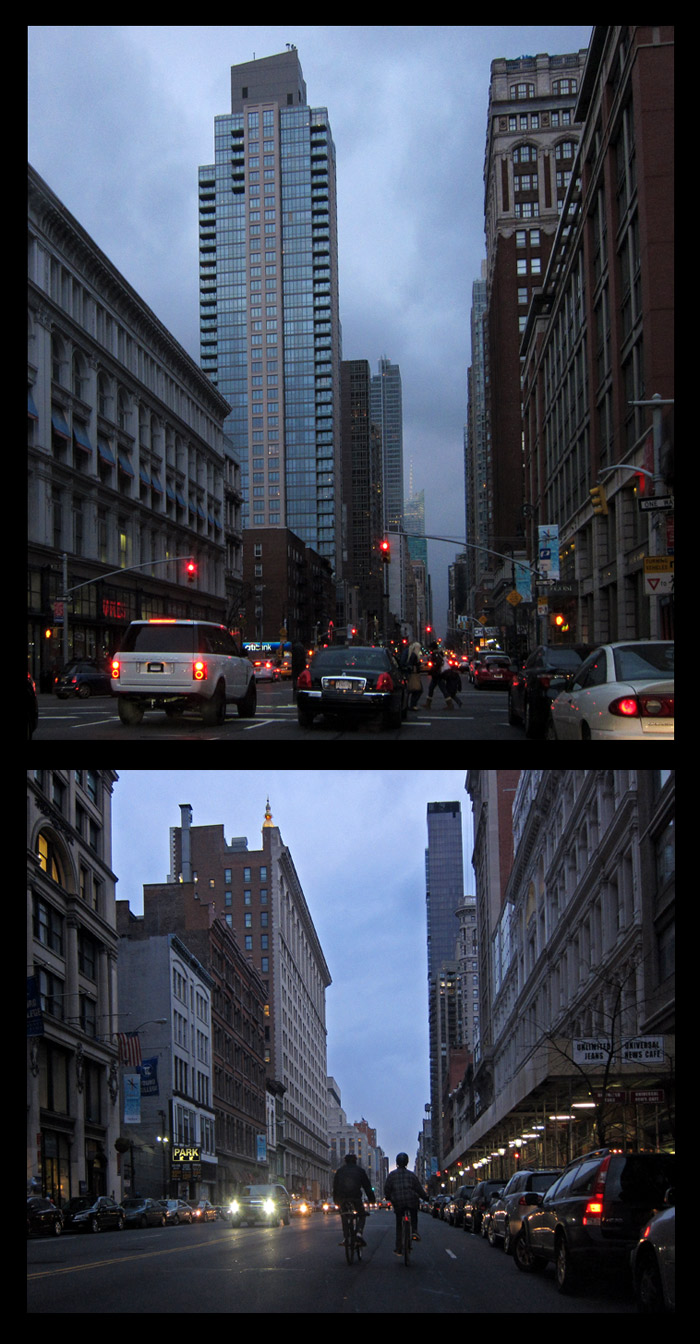
    Today’s photos are taken from my office window looking up Broadway in the evening. In the past, lights on Broadway meant the theater district and Times Square. Now, we have lights here in SoHo too. It seems that everywhere you go, Broadway is Broadway…


  • That’s Giove

    I love a challenge, particularly when told that something can’t be done or there are no good restaurants in Staten Island. Admittedly, Staten Island feels more like the suburban New Jersey than a borough of New York City, primarily because it does not lend itself to walking. It’s the borough that many residents and former residents love to hate.

    There are, however, many good things to be found there, and I have featured a number of places of interest from the borough over the years writing for this website: Todt Hill, Richmond Town, St. Luke’s Cemetery, South Beach, and one of the most remarkable places in the five boroughs – the Tibetan Museum.

    So, when a friend who is a Staten Island resident recently insisted that we must journey to Brooklyn or Manhattan for good food, I rose to the occasion on a search mission for good food in the borough.

    I had heard from another resident about Denino’s. This was my first “discovery” and was hugely successful in impressing said friend that there is more gastronomically in Staten Island than meets the eye. More recently, however, I was not in the mood to traverse across half the island for a second visit to Denino’s, and I relished the challenge to find another pizzeria of merit.

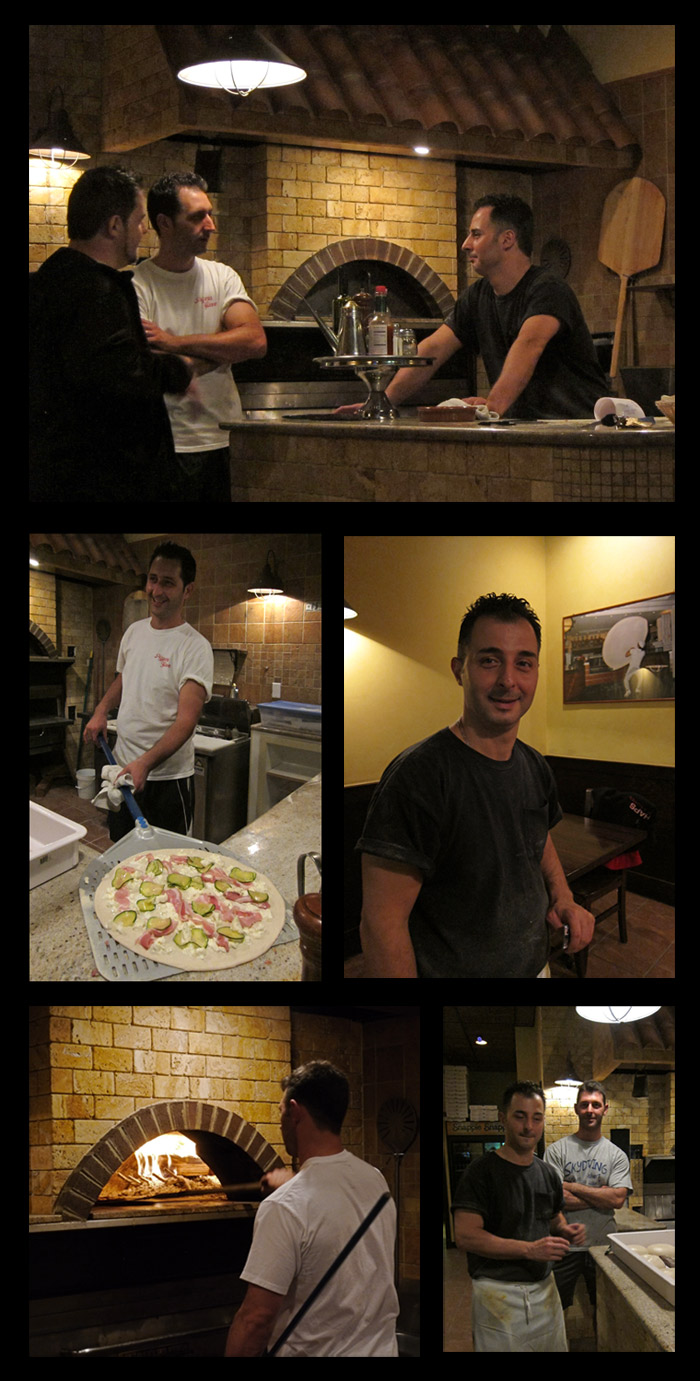
    An online search quickly returned a brand new and well-reviewed establishment only a few blocks away. We were quite hungry, it was late, and some persuasion was necessary to convince my friend that it was worth the culinary risk when we had already found fabulous pizza at Denino’s. I played the ultimate trump card: my authority based on my previous discovery. I said, TRUST ME. After all, this is the man that found you Denino’s. I won the hand, and off we were to New Dorp Lane, where I was pleasantly surprised with a brand new, immaculate sit-down pizzeria with a beautiful open kitchen and wood burning oven.

    It was a Kodak moment – within minutes of arriving, one of the pizza makers was spinning dough in the air. Immediately fascinated by his manipulations, I introduced myself and learned that Giorgio Giove was a thirteen-time CHAMPION pizza acrobat (three-time world champion) who was featured on the Food Network in a Throwdown with Bobby Flay. I also learned that Pizzeria Giove was a family-owned business, and I had the privilege of meeting all three brothers my first visit: Franco, Marco, and Giorgio.

    For the longest time, the popular mantra of pizza lovers is THIN CRUST, and you will find one of the thinnest, crunchiest crusts I have had. This is artisanal pizza. The Giove brothers hail from Italy, where pizza making is a family tradition – Giorgio’s father and grandfather were both pizza makers.

    After just a handful of visits, we are already being treated like family. Great food and service. When the slice hits your eye like a good pizza pie, that’s Giove 🙂

    Want more on pizza? Check out my take on the Best Pizza in New York.


  • Happy Valentine’s Day

    Hear this story as a podcast:

    A salesman paced back and forth along the line like a drill sergeant who has absolute authority and can fire any hostile words he chooses at will while the men must silently endure or face reprimand of epic proportion. The line of men waited quietly like criminals who feel remorse on execution day. There was no defense – we were all BAD BOYS and we knew it.

    It was Valentine’s Day in Manhattan many years ago, and I, like the others, had waited until THE LAST MINUTE. We had made the enormous mistake of attempting to buy flowers from a flower shop during the closing hours on Valentine’s Day.

    The salesman BARKED that we should have $60 in cash, in hand, readied for a purchase of a dozen red roses. NO ONE objected, lest, like victims of the mythical Soup Nazi, they be evicted and left in one of the most horrific states imaginable for any man: Valentine’s Day without a gift for the woman in your life. If her heart will only be won (or kept) by roses, you had better not ruffle the feathers of the MAN IN CHARGE of selling them.

    One may counter that we are blessed with green grocers in New York City and that flowers are available at nearly every corner. This may be true, however, any astute woman will know quality and where such flowers were purchased. It is at her COMPLETE DISCRETION whether such a gift will be appreciated and fully accepted or whether her lover will be EXCORIATED and CRUCIFIED for not making her a priority and treating her like an afterthought.

    And do not for a second believe any woman who purports to let you off the hook in advance, telling you that you do not need to buy her anything. You had better get her something nice, something romantic, because if you neglect to do so, in times of conflict, you WILL be reminded, and this will be ammunition for her until the day you die.

    At one time, I would have found such attitudes among women reprehensible, agreeing with men who defended such behavior by saying that Valentine’s Day is nothing more than an opportunity for commercial interests to co-opt a day, making victims of us all. But over the years, I have had ample time for reflection. I now side with women who often feel that they are shown appreciation far too infrequently by men who see holidays as a time of obligatory gift giving and are resentful of every moment needed to shop.

    So guys, if like me, you have again waited until the last minute, good luck and happy hunting. Enjoy your self-inflicted wounds. To the ladies who deserve something truly thoughtful from the man you love, I sincerely wish you Happy Valentine’s Day 🙂

    Related Posts: Be My Valentine, Jacques Torres


  • A Bit Like You and Me

    I used to have a friend who was an eternal malcontent. He chased happiness, convinced that he would find it first in Hawaii, then in California. But really, he was miserable and managed to find misery everywhere he went. In Hawaii, he found one of the worst areas and left soon after bemoaning his misfortune. Always the victim.

    But he was born and raised in Brooklyn, New York, a city that many aspire or dream to live in. He did not see his own good fortune. More than any other single person or incident, this friend poignantly illustrated the nature of unhappiness and that even in New York City, it is easy to be unhappy, regardless of all the people, places, and culture.

    There are people who actually believe that places, money, or things buy happiness. They may not say it directly, but it is evident in their words. If had this or that, if I lived there instead of here. You know someone like my friend for sure. And perhaps, like the lyrics from Nowhere Man by the Beatles, at times, you may find – isn’t he a bit like you and me?

    I hate when people ask, “How are you doing?” because it is a perfunctory question with no intent to hear the truth. I am going to be honest with you in a way that very few are. I really don’t want to write today, and I have nothing much to say. But the “daily photo” is an obligation, and until such time I change the premise, I will meet that obligation. Worse than Seinfeld’s show about nothing, this is a story about not wanting to write a story.

    Yesterday, I was not in a great mood. I reflected on what I might do for today’s story. I had neither any good ideas nor any good photos. I had a personal conflict and was miserable. How will I possibly keep up the standard for writing and taking photos with an attitude like that?

    As I drove in Manhattan to move my vehicle, I felt weighed down by the leaden skies of the city. It was gray and gloomy with a raw cold. I only left home in the late evening. What little light remained was cast from a winter sun hanging low in the sky behind a solid mass of clouds. New York City was no joy at all. Skyscrapers along Sixth Avenue were not uplifting at all but just seemed to be humiliating and adding insult to injury. So dreary, it was reminiscent of northern Maine, where my family grew up. Only living in the Arctic Circle during the Dark Time seemed worse.

    People were scurrying about in an obligatory way, getting through the cold like our Nordic brethren, killing time while waiting for spring and better weather. The best I could muster is an idea to take a photo of the gray day for a blue story. It’s time for a remake of that song in honor of my old friend and anyone feeling the blues. Let’s call it Unhappy Man with the same refrain – Isn’t he a bit like you and me 🙁

    Related Posts: The Loneliest Number, A Story About Nothing, Not Moving to Florida, Dwanna, Duffy


  • I’ll Take It


    There are big celebrities and small ones. If you’re big, perhaps you will have your name in lights on Broadway, on a movie theater marquee, the front page of the tabloids, magazines, your hand or footprints on Hollywood Boulevard, or a long page in Wikipedia.

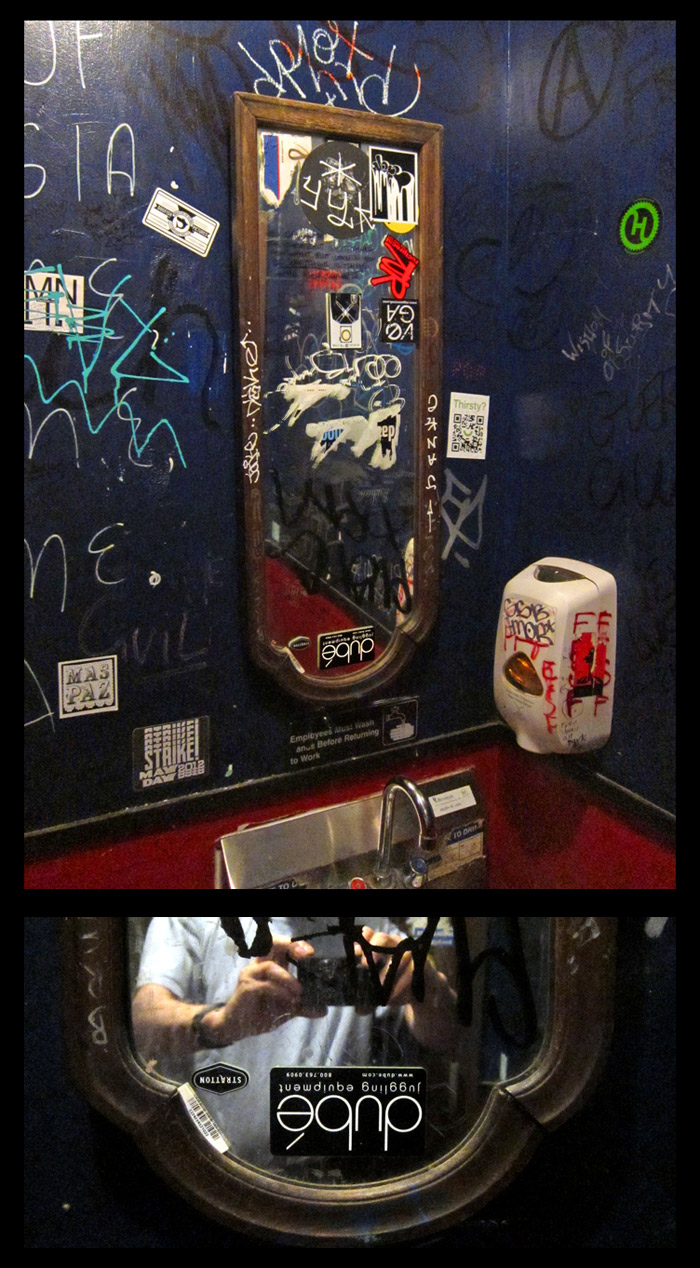
    If you’re a small celebrity or a big fish in a small pond, you take what you can get. If you are lucky, like I was, you may be asked to do a small indie documentary film (which remains in limbo). Or, you may find, like I did last night, your name on the mirror, upside down, in a dirty, graffiti-laden bathroom of a local cafe.

    Yesterday, I agreed to meet a friend and photographer at Boyd Thai for dinner. I left 520 Broadway, where my office and factory are located, and walked through SoHo. On West Broadway, Peter Lik and his gallery struck a troubled chord. I crossed Houston Street – the setting for many photos I have taken and many stories I have written: The Honest Boy, The Wall, The Cable Building, Angelika Film Center, the traffic island where I first chatted with Mark Birnbaum, Time Landscape, St. Anthony’s Church (with its Christmas nativity), Raffetto’s, and Arturo’s.

    Through the South Village, I crossed Bleecker Street – legendary and a destination in itself. I arrived at Boyd Restaurant, featuring Thai cuisine, where we had the early-bird specials. As is often the case, I was given a complementary dessert. After dinner, we agreed to extend our evening out and head for a regular haunt – Think Coffee.

    Leaving Boyd, we strolled up Thompson Street, passing by the renowned Chess Shop. Heading east, we flanked Washington Square Park, a world unto its own. We passed by Kimmel, the new NYU student center, and the massive Bobst Library. Across from Courant Institute of Mathematical Sciences on Mercer Street, we arrived at our destination, Think Coffee, where we always find No Negativity.

    Just before leaving, my friend used the bathroom. On his return, he told me that my name was stickered on a mirror, which was upside down over the sink. I was assured he was joking, but he assured me that he was not. I entered the bathroom to see for myself, and sure enough, a dubé sticker had been affixed to the mirror. In spite of being framed by graffiti and litter, I was pleasantly surprised. It certainly did not dominate an airspace like T for Trump, but it will likely give me at least 15 minutes of fame. I’ll Take It 🙂


  • Essen or Fressen

    It was sometime in the 1990s, and my best friend was my CPA, doing all my business and personal accounting and tax preparation. At one particular meeting, he looked over some numbers, virtually as Zero Mostel did in the Producers, seeing the possibility for greed. My friend observed that for a particular deduction, there was an opportunity to “double dip,” i.e. take the deduction twice.
    The lure of saving money at tax time is a strong motivator, and knowing my friend was very aggressive tax-wise, I asked whether we should do such a thing. He replied with something that neither of us recall exactly but I remember as an English translation of a Yiddish saying: pigs eat and hogs choke. What I am sure about is what he intended: take the deduction once as the law provides, not twice.

    I called my CPA friend and other Jewish friends this morning, and there is no such Yiddishism. The only Yiddish phrase that appears to possibly apply is Tiere fressen, Mensche essen (animals eat, people eat). In German, fressen and essen both mean “to eat,” but fressen is used for animals. In connection with people, fressen is considered derogatory. In Yiddish, however, it means nothing more than enthusiastic overeating. Nonetheless, pigs eat and hogs choke is what often comes to my mind whenever there is opportunity for greed, and such an opportunity presented itself on February 3rd.

    Three of us ate at a local cafe in the Village. Service there has declined – foods are out of stock, things are forgotten, mistakes are made, free WiFi has been eliminated, laptops banned, etc. We love the convenience and live music, so we continue to go.
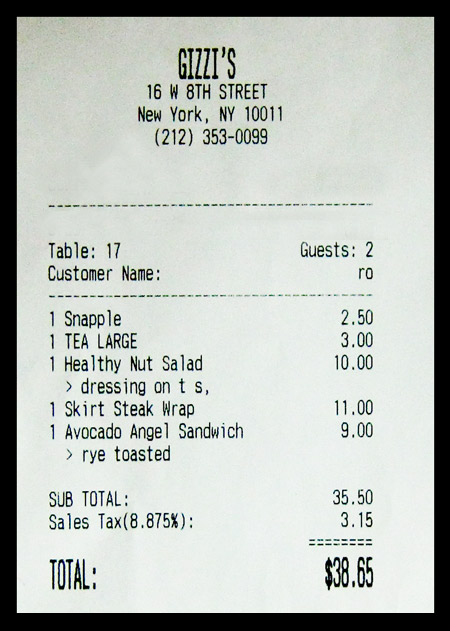
    On February 3rd, I ate dinner there with two friends. Our first disappointment was that they were out of both foccacia and ciabatta bread for the sandwich we chose. It’s not that I am a snob and require these breads, but at $9 for a sandwich, it would be nice for the cafe to have the gourmet breads which they advertise. But alas, this is Gizzi’s, which is forever out of something. When we received the check, there were two errors. One, a large tea had been paid for previously, so $3 should be removed from the bill. However, we had ordered two slices of cherry pie at $4.50 each, which the waiter forgot to add.

    So, this check offered some interesting options. We had three choices:

    1) ESSEN: Ask to accurately correct it – take the tea off and add the slices of pie – pay an additional $6.00 (+ $9.00 – $3.00)
    2) Pay the bill as is – save $6.00 (+ $3.00 – $9.00)
    3) FRESSEN: Ask that the $3 for the tea be removed AND not mention that the two slices of pie – save $12.00 by double dipping (-$3.00 – $9.00)

    The dilemma was furthered compounded by the poor service and lack of breads, making it easy to justify short changing the cafe. So, presented with styles of eating and bill paying, what’s your style? Essen or Fressen?

    Related Posts: The Way You Like It, War Against Disservice (Part 1 and Part 2), Take It, Toches ahfen tish!, Fit-ty Fi, Pick Two


  • dinamic_sidebar 4 none

©2026 New York Daily Photo Entries (RSS) and Comments (RSS)  Raindrops Theme