• The Loneliest Number

    Is one still the loneliest number? New Yorkers should know best – I was shocked to learn that 50.6 % (27% nationally) of Manhattan households are occupied by a single individual. Of the 3,141 counties in the United States, New York County (Manhattan) is the leader in single-individual households. The marriage statistics also deviate from the norm: in Manhattan, 25.6% of households are married, whereas the national average is 49.7%.

    But, given the tenuous nature of relationships and the transient nature of the city, perhaps it should not have come as a surprise. And, the evidence is at my fingertips – on reflection, the vast majority of my friends and acquaintances are in single households.

    The first thought upon hearing such a statistic is that of LONELINESS. However, a number of books, articles, and research are doing much to dispel the idea that living alone means lonely. I have excerpted below parts of a 2008 New York Magazine article. I recommend the article – the comments alone provide a broad insight into the thinking and experience of many New Yorkers who live alone.

    Alone Together

    Manhattan is the capital of people living by themselves. But are New Yorkers lonelier? Far from it, say a new breed of loneliness researchers, who argue that urban alienation is largely a myth.

    “In our data,” adds Lisa Berkman, the Harvard epidemiologist who discovered the importance of social networks to heart patients, “friends substitute perfectly well for family.” This finding is important. It may be true that marriage prolongs life. But so, in Berkman’s view, does friendship—and considering how important friendship is to New Yorkers (home of Friends, after all), where so many of us live on our own, this finding is blissfully reassuring. In fact, Berkman has consistently found that living alone poses no health risk, whether she’s looking at 20,000 gas and electricity workers in France or a random sample of almost 7,000 men and women in Alameda, California, so long as her subjects have intimate ties of some kind as well as a variety of weaker ones. Those who are married but don’t have any civic ties or close friends or relatives, for instance, face greater health risks than those who live alone but have lots of friends and regularly volunteer at the local soup kitchen. “Any one connection doesn’t really protect you,” she says. “You need relationships that provide love and intimacy and you need relationships that help you feel like you’re participating in society in some way.”

    New York State is tied for the fifth-lowest divorce rate in the nation.  New York City’s suicide rate says something even more profound: New York State’s suicide rate is currently the third lowest in the nation.

    Many have made the same allegations about the Internet’s alienating effects, but this has also been challenged. Some see the Internet as analogous to a large city like New York with positive social impact:

    The idea that you’re isolated when you’re online is, to me, just wrong,” says Keith Hampton, a sociologist at the University of Pennsylvania who did an extensive ethnography of “Netville,” a new, 100 percent wired community in suburban Toronto. “It’s an inherently social medium. What starts online moves offline, and what starts offline goes online.” Which explains why the people with whom you e-mail most frequently are your closest friends and romantic partners. “Online and offline life are inherently connected,” he says. “They’re not separate worlds.”

    New York, like the Internet, also offers a rich network of acquaintances, or what sociologists like to call “weak ties.” There are sociologists who will argue that weak ties are the bane of modern life. We are drowning in a sea of them, they’ll say—networking with colleagues rather than socializing with friends, corresponding online with lots of people we know only moderately well rather than catching up with our nearest and dearest on the phone.

    There is even evidence that weak ties simply make us feel better. According to Loneliness, the advice your mother gives you when you’re depressed—Get out of the damn house, would you?—turns out to be right. For most people, being in the simple presence of a friendly person helps us reregulate our behavior if we’re feeling depressed in our isolation. We are naturally wired not just to connect with them but to imitate them—which might be a good idea, if our impulses at that moment are self-destructive.

    Hampton says he views the Internet as the ultimate city, the last stop on the continuum of human connectedness. I’d argue that New York and the Internet are about the same …. what the Internet and New York have in common is that each environment facilitates interaction between individuals like no other, and both would be positively useless—would literally lose their raison d’être—if solitary individuals didn’t furiously interact in each. They show us, in trillions of invisible ways every day, that people are essentially nothing without one another. We may sometimes want to throttle our fellow travelers on the F train. We may on occasion curse our neighbors for playing music so loud it splits the floor. But living cheek-by-jowl is the necessary price we pay for our well-being. And anyway, who wants to ride the subway alone?

    Connectedness takes on many forms, both old and new, and in many places, whether online or in New York City. We can no longer make assumptions based strictly on number. One may no longer be the Loneliest Number 🙂

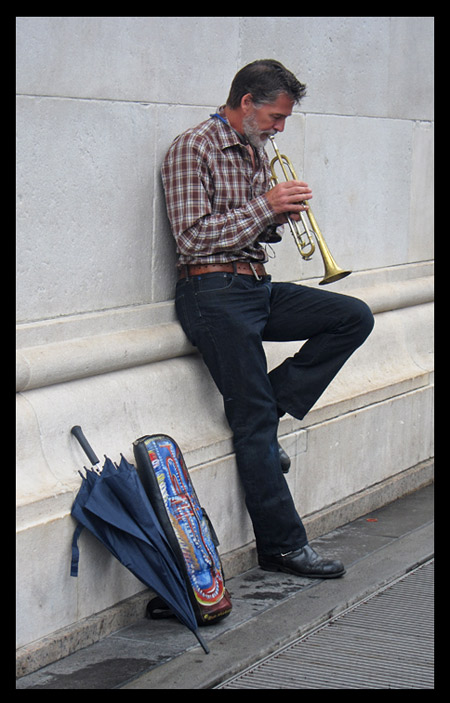
    Photo Note: I happened upon this trumpet player one rainy morning, playing alone in Washington Square Park, shielded from the rain under the arch. See him play in the video above.

    Related Posts: Guardian Angels, Lonely in a Crowded Room, Because It’s Not, The Last Taboo

  • Nice Camel Sweater

    When you grow up under a very tight reign, acts of rebellion are small and narrowly focused. For me, it manifested in the rejection of all things light brown. On my yearly pre-school clothes shopping trips, I would invariably be steered towards clothing that would be in the light brown family – beige, tan, camel, etc.*

    I suspect that the palette was being pushed at me because it spoke calmness, safety, moderation, or neutrality. But I didn’t want to be calm or neutral. I didn’t want to be in a blue-color factory town. I didn’t want to be in the suburbs. I wanted to be in the big city. Bright neon lights and bold colors.

    So in time, I grew to hate the family of light brown – it symbolized parental authority and all things boring. As if they were not only neutral enough, the color names were invariably prefaced with the very unnecessary “nice.” So “recommendations” always took the form of “why don’t you get that in a “nice camel” color.”

    I hated sweaters, too. I felt confined, uncomfortable, and restricted in them, just as I did in my hometown. However, a sweater is a sensible article of clothing and, like the beige family of colors, is another element in the wardrobe of the moderate. So, the sweater became another irritant in my life, something forever being sold to me by family and clothing salesmen. Put all the elements together, and the worst offense imaginable was a family member promoting something like a “nice, camel sweater.” You know what not to buy me as a gift.

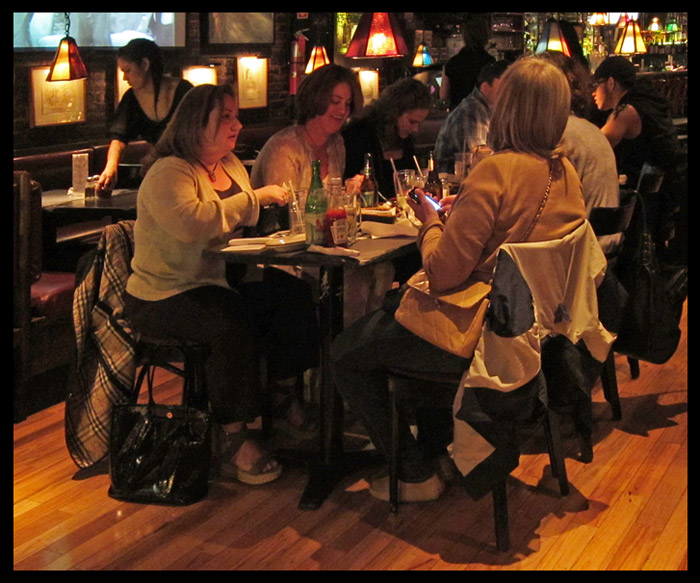
    Recently, while eating dinner with a friend at the Olive Tree Cafe, I spotted a group of women awash in the color of my youth – every variant of beige, tan, cream, light brown, and camel was represented, even in their hair.

    My dining companion that night is an NYU student and team member working on this blog. Inexperienced in the ways and means of the city, she respects the wisdom I have gleaned and trusts my insights based on nearly a half century of observation and study of the peoples of New York. So she listened intently as I began to dissect and analyze this group of women for her and explain how it was obvious that these women were clearly from the suburbs.

    Not only were they wearing every shade of light brown known to humankind, their entire demeanor cried out-of-towners – they were so gentle and benign-looking, with no edge anywhere to be found. I pointed out how one woman wore her bag slung around her neck while eating – the classic fearful tourist. I explained how one of the key elements in identifying visitors is that everything they wear, from footwear to headwear, is about COMFORT, often at the expense of style. And look – one was even sporting a nice, camel-colored sweater.

    Before we left, I wanted to corroborate my theory. In as polite a way as possible, I would tell them that I was a curious New York blogger and ask them where they were from. I would then return to my dining companion with evidence of my superior skills in observation.

    They were quite approachable and friendly, as visitors often are. I introduced myself and gave them my card. “Why are you here?” I asked. “To celebrate a birthday,” they answered. “Where are you from? “We’re native New Yorkers. Upper West Side, Manhattan.” I knew it. What gave it away was that Nice Camel Sweater. 🙂

    *Note: To make matters worse, I love blue, however, when I was in high school, jeans were not allowed.


  • A Little Complainin’

    I’ve been told that I am a complainer. Convenient, since there is no better place for a complainer than New York City. Here, complaining can be indulged in at any depth or breadth imaginable. One can cut a broad swath or can specialize. For example, a daily commuter traveling on a particularly troubled subway line could confine his or her complaints to just the interminable atrocities committed there on nearly a daily basis.

    Today I discovered an interesting blog – I Hate New York City (.com). There, I found 265 comments over 150 pages, spanning the range of love/hate sentiments of New York City. Within those comments, I found the vitriol and outrage which many have over the city. It is a virtual shrine to complaints. The range of topics was well-covered: noise, dirt, rats, smells, trash, rudeness, crowds, costs, concrete, lack of nature, dangers, crime, hot summers, oppressiveness, and pollution.

    I might add that even though many of us bemoan the lack of nature, there is still opportunity to complain about plant growth, even when considering plants generally seen as an element of old world charm, such as wisteria and ivy.

    In neighborhoods such as Greenwich Village, with a preponderance of row houses, one can find many brownstones with ivy growing up the face or rear of the buildings. Its growth is, however, quite rapid, and for those who dwell in or manage the building, it is more an irritant than a source of charm. Not only do they grow very rapidly, requiring frequent pruning, but these climbers also are destructive to the masonry where they maintain an aggressive foothold.

    In one apartment where I lived in the 1970s, my windows would slowly become obscured with ivy growing on the exterior of the building. Periodically, this required hanging out the window on a 4th floor and tearing the offending growth away. The task always felt like an annoyance which was someone else’s job, but in New York, to wait for those responsible to tend to a chore is often to wait in perpetuity. I, like many, take things into my own hands. And why not? It just gives me more to complain about – ivy or wisteria creepin’ ’round my window is just perfect for when I don’t want to leave home but still want to do a little complainin’ 🙂


  • Trimmings for Sale


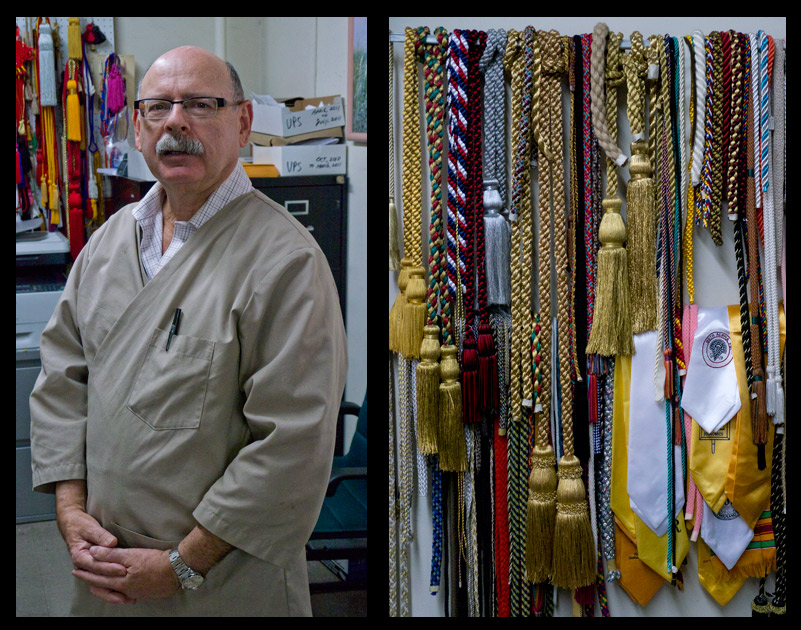
    I was appropriately reprimanded. Marty Silver asked why was I working with a supplier in Georgia when he was the largest tassel manufacturer in the world and was located within walking distance? I had no answer except that I had not done my homework properly. Schoen Trimming and Cord manufactures tassels and cords right in Manhattan at 151 West 25th Street.

    There is no phone tree, messaging systems, extensions, or phone tag at Schoen. On my first call, I was told I needed to speak to the owner, Marty Silver, who immediately picked up the phone. A proud New Yorker and native Brooklynite, he proceeded to tell me about the company and his recent job with Victoria’s Secret, who opted for a local source over China. The order of nearly $100,000 was for over 20,000 pieces and was completed in just a few weeks. I described my own project needs, and he suggested I just drop by. He said that he was open at 7AM, so when was I coming in? Tomorrow morning, I answered.

    It was clear from the brief phone conversation that Schoen was a no-nonsense operation run by a man who gets things done. No meetings, no memos, no marketing plans, no grandiose schemes, no Twitter feeds. A rarity these days, and a perpetual frustration for me in business to ferret out these kinds of operations. Schoen services a niche market, and they address the needs of their customers with the essential ingredients: good quality, service, delivery, and pricing. This is why they have been in business for 72 years.

    When I arrived, Marty was tied up briefly, working with his accountant. He appeared somewhat irritated that this aspect of his business was taking him away from overseeing his production work and meeting with me. We went over my project quickly, and he said he would get back to me.
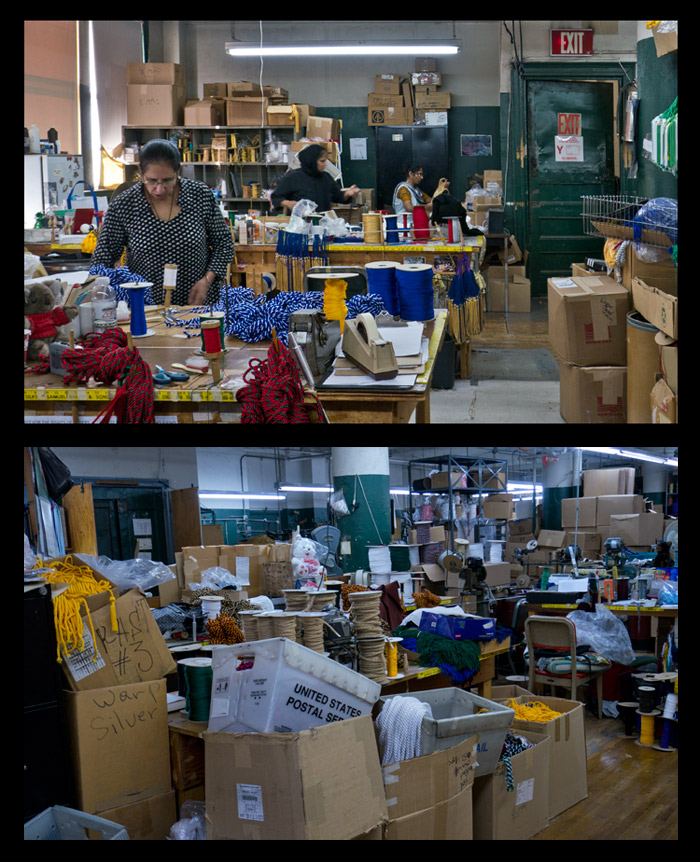
    I was surprised when, only hours later, he called my office to tell me that he had completed some prototypes for me – when did I want to pick them up and discuss them?  Tomorrow morning, I answered. I visited Schoen again, went over my samples, and toured the factory. Marty was quite accommodating regarding my request to take photos. Nothing to hide. I like that. And so it was that in less than 24 hours, Marty Silver did what the factory in Georgia has yet to do in two months.

    I have encountered business owners like Marty in the last 37 years. This breed of men and women are the ones that have been the captains of industry and have stewarded our city to become the world leader that it is in so many arenas. Some are left and, here and there, the spirit lives on. New York City is as hard-edged as it comes, and if you are going to survive 72 years in business, you’re going to need exceptional tenacity, resourcefulness, drive, and the ability to stay focused on the bottom line.

    Schoen typifies the classic old world New York City-style manufacturer or commercial/industrial supplier. They are lean machines, bare bones, and stripped of artifice and excess at every level. The only decorative elements you will find are Trimmings for Sale 🙂

    Related Posts: It’s Perfect, Brawling Over Brands, Because I’m the Best


  • Instincts

    I was a little uneasy writing this story. As a small business owner, I have a very strong feeling as to the key reason for entrepreneurial success. However, I have been reading pages and pages without seeing any validation. I did not find studying the key reasons businesses succeed or fail very useful – if you can think of any reason(s) at all, you will almost certainly find it somewhere in any one of numerous lists of key factors in failure or success. None will come as a surprise – right location, management, adequate capital, cost control, knowledge, luck, persistence, vision, customer service, growth plan, marketing, key vision, etc. With such an enormous number of factors, managing their interplay becomes an impossible task for any human being. How will anyone learn all of the key ingredients and the balancing act necessary to succeed?

    Then I finally found exactly the single word I was looking for in an article on David Geffen in a Stanford School of Business newsletter:

    David Geffen Says Good Instincts Play Better for Him Than Good Plans

    A self-made billionaire, Geffen told Graduate School of Business students that he relies instead on his instincts, his keen eye for talent, honesty, and a knack for surrounding himself with smart people.
    “I wish I could give you a better answer. I didn’t have a clue about managing business. I never went to business school. I was just bumbling through a lot of my life,” said Geffen. “I was like the guy behind the curtain in The Wizard of Oz.”

    The operative word I was looking for was INSTINCTS. Successful business owners have business instincts – an innate sense of what people want or need and how to address those needs. Of course, as a business grows, many of those key factors in the litany of ingredients of success do come into play, but the best strategy is finding talented individuals and delegating.

    In my experience meeting business entrepreneurs, they just seem to be different. You can sense it and see evidence of it even at a very early age. This instinct seems to be the most common thread among  success stories. Most of the great successes I have met have little or no business schooling. Many have been high school graduates or college dropouts.

    Of course, luck is a factor, but opportunity abounds. The entrepreneur not only recognizes opportunity but also seizes that opportunity and capitalizes on it as well. An estimated 80% of restaurants fail in New York City within five years. If learning the key factors of success was the secret, we would not see such an enormous fatality rate.

    Every day in New York City, I see restaurants bulging with customers in lines spilling into the streets. A few doors away, I will often see another neighboring restaurant, even with with identical cuisine, virtually empty. In post game analysis, it is easy to pontificate, analyze, speculate, and theorize as to why some fail and others succeed. Reams have been written. However, reading the Tipping Point or Freakonomics is not going to help the business owner identify the myriad of factors to success and properly deploy and manage them. All of those factors are part of the equation. But to me, the most important is Instincts…

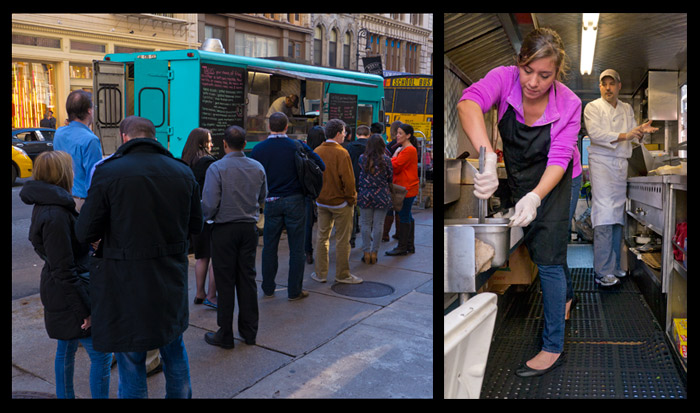
    Photo Note: This is the further incarnation of the food cart I wrote about on August 3, 2007. The cart is now the Tribeca Taco Truck. The truck is owned by Percy, but on this occasion, his daughter Alycia (seen in the photo) informed me that he was purchasing a second, larger truck – one will remain stationed at the original location (Broadway between Prince and Spring Streets) while the other roams. Tenacity is also a key ingredient to success, and Percy has stuck with his endeavor for some years. He now has long lunch lines every day. Get there early and tell him I sent you. Percy and crew are wonderful and will treat you like family.

    Related Posts: Not Enough Dough, Brawling Over Brands, Trucks and Things, You’re Not in Kansas, Pearl Paint, End of an Era, Canal Rubber, Space Surplus Metals


  • Not Enough Dough

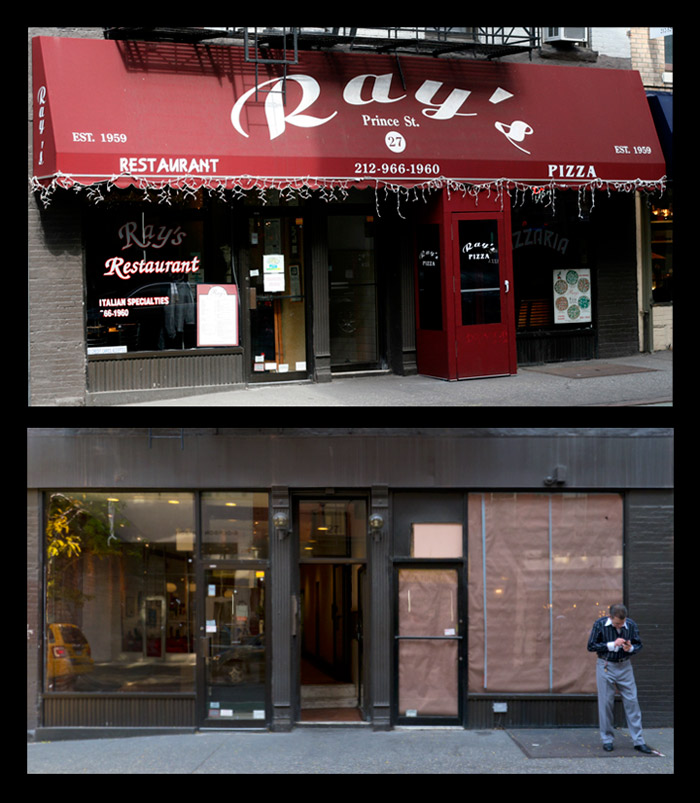
    On March 27, 2009, I wrote of the legendary original Ray’s Pizza at 27 Prince Street. Located around the corner from my office, I have frequented Ray’s for over 20 years. I loved their pizza – classic with a few gourmet touches. Yesterday, when I recommended them to a customer for lunch, one of my employees informed me that would not be possible since Ray’s had closed. When I asked to confirm that it was THE Ray’s on Prince, she said yes, that it was the Ray’s, and this was quite a big thing with plenty of local buzz.

    I jogged out to see for myself with camera in hand, and sure enough, Ray’s was not only closed, but there was absolutely no vestige whatsoever of its prior existence. Neither a smear of sauce nor a faded sign. After 52 years in business, it was another episode in New York City of the End of an Era. The closing involved a legal dispute. From the New York Times:

    The closing, long story short, follows a legal dispute among heirs with various interests in the building at 27 Prince, which includes apartments and the two sides of Ray’s: the pizzeria and an Italian restaurant, each with its separate entrance, but sharing a kitchen and the corporation name, Ray’s of Prince Street. When the Ray in Ray’s, one of the owners of the building, died in 2008, a row arose over whether the restaurant’s lease was valid and whether it should pay rent. A lawsuit was filed in 2009 and settled this year.

    I was sad to have missed their last day on Sunday and to not have met Helen Mistretta, the manager. According to the Times article, she did look for alternate space but cited extraordinary rents and cost of renovation as an impasse to moving to a new location. Instead, equipment will be sold at auction and mementos placed in storage. I will miss their pesto pizza – a rarity in town. The closing due to financial matters is a classic saga with the loss of iconic businesses that has been repeated around New York City many times. That’s how the crust crumbles, when there’s plenty of flour but not enough dough 🙂

    Photo Note: Upper photo taken March 20, 2009; lower photo taken November 8, 2011.

    Related Posts: Quest for Pizza, Best Pizza in New York, Cookies in the Afternoon, Zero Minutes, It’s the Humidity, Walk Like Di Fara, No Problema, DiFara, Roots of Pizza, Two Boots


  • Usually. Maybe. Probably Not.

    I once called an ambulance for a college-aged girl who was severely drunk, eyes rolling about and vomiting so badly that I thought she might die. When EMS arrived, I apologized for possibly making an unnecessary call, but they assured me that I had done the right thing and that someone can die from alcohol poisoning.

    On another occasion, a number of us called an ambulance for Danny Mustard, who was so drunk that he appeared to not be breathing. Danny has since cleaned up and gone on to a musical career after his astonishing cover of Creep by Radiohead aired on the Opie and Anthony show, now with 4 million views on YouTube.

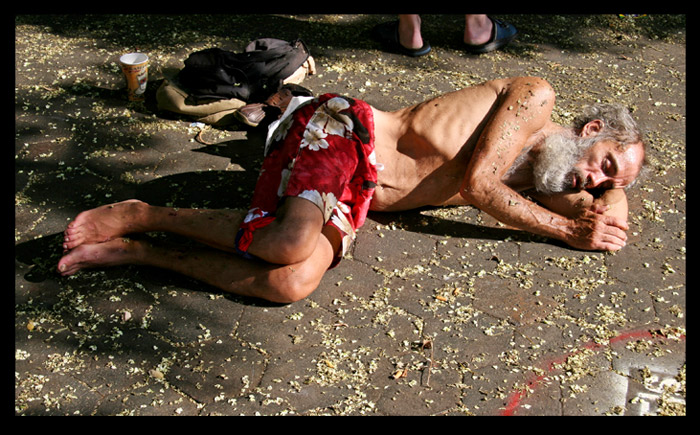
    Since the inception of this website, I have befriended a number of homeless individuals, many whom I see on a regular basis such as Stephanie or Morgan. The problem with homelessness is that even with outreach programs, most homeless prefer a life on the streets to that in shelters for a number of reasons. Many are puzzled, as I have been, as to why a homeless person would choose a life on the streets over a shelter. Here is why:

    Lack of beds. Most shelters have a shortage of available beds.

    They are dangerous. There have been many reported murders, assaults and rapes.

    Drugs. Drugs are not allowed, so drug users will avoid them.

    Theft. There is thievery in shelters, so some homeless stop using shelters to protect the few possessions they have.

    Lack of privacy.

    Lack of control. Shelters impose many rules – check in times, meal times, sleep times, curfews. Some homeless work, sometimes with schedules making it impossible to abide by a shelter’s hours.

    Mental Illness. Some people are denied entry to shelters due to mental illness.

    No pets allowed.

    Fear of contracting parasites including lice, scabies or bedbugs.

    Lack of accommodations for the disabled.

    Separation of families. Children can not usually stay in homeless shelters. Men and women cannot be in the same shelter.

    If you fall down in New York City, will someone help you get up? Usually. If you need help in New York City, will someone come to your aid? Maybe. If you are homeless and need a safe place to stay, will you find one? Probably not.

    Related Posts: Sleeping in Jeans, Caught in the Rain, Any Questions?, Down on His Luck, Dead to the World


  • Guardian Angels

    I recently took a subway with a group of friends. As we descended the stairs to the platform, a train was conveniently awaiting. However, as typically is the case, in order to get the train before leaving, there is a stampede for the first car – the one closest from the stairway to the platforms. So, the first car becomes inordinately crowded.

    We jammed in, a la Tokyo (but without the pushers). What may come as a surprise is that we met no resistance, even while pressing our bodies against others. In fact, looking around, I would say there was more smiling than frowning. I felt that there was a sense that like it or not, we’re all in this together. Who would begrudge others the very same thing they want and have for themselves and have to look at the have-nots through windows as the train pulls away?

    I have written a number of stories espousing my dislike and avoidance of crowds in New York City. Yet now, crammed like sardines, I, like the others, actually enjoyed the experience – our shared misery was fun. In times of need, common hardship or common celebration, a crowd of people is just the thing. It is said that one can be lonely in a crowded room, but I find that in times of loneliness, to step out into the world that is New York City can be restorative.

    At one time I used to frequent the beaches at Robert Moses State Park on Fire Island and also Jones Beach. In both cases, I would always trek away from the most crowded areas to those more sparsely populated. On one occasion, I found myself chatting briefly with someone who had parked himself and his friends only steps from the concession buildings in the most crowded area imaginable. I offered my knowledge of the island and my strategy, thinking that perhaps he was not aware how much less crowded the beach gets just a short walk away. He informed me that he and his friends preferred being there.

    This was revelatory and very startling to me. Growing up in New England, my family suffered any pains to avoid crowds, traffic, and cites, always priding themselves on finding those places that were quiet. But now my worldview was being challenged again by this beach denizen. Much as I grew to love the city, I now saw that there were those who preferred not just culture and amenities but crowds themselves.

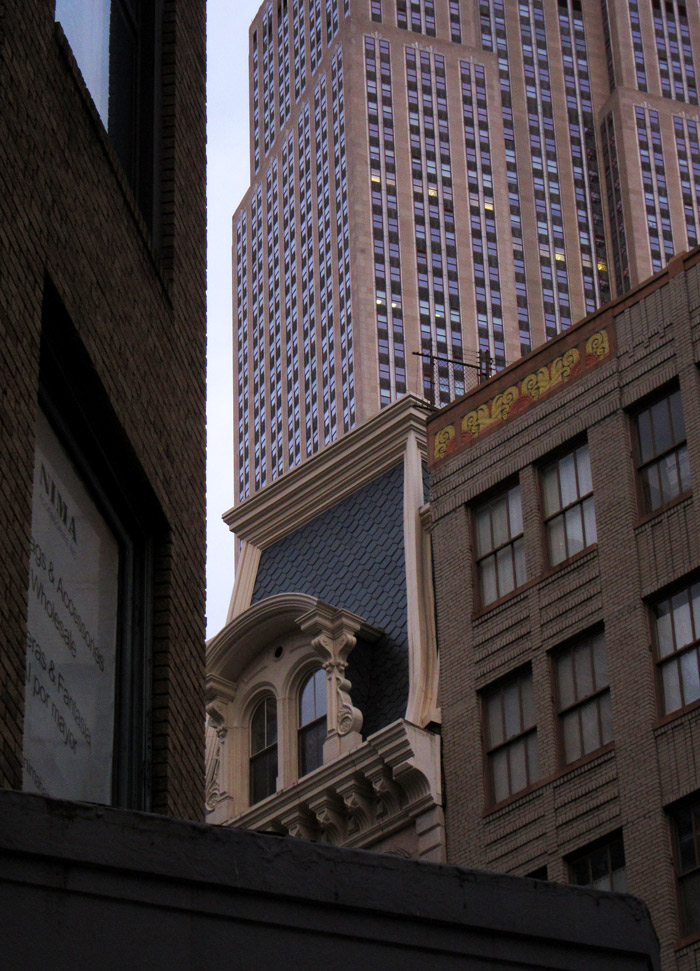
    There can be a feeling of security amoung a group of people. I often find the same feeling in midtown Manhattan amid buildings, where immersed in the concrete jungle, I am comforted, not overwhelmed, by the structures. Many hate crowds, and some even panic at the prospect of being in New York City with all its horrors, some real and most imagined. I, on the other hand, have been a New Yorker for much too long – I feel safe and secure with the melange of buildings towering over and huddled around me, buffeting the world like my Guardian Angels 🙂

    Related Posts: Steaming Masses of New York, Huddled Masses, Too Too New York, I Know, I’ve Got a Feeling, Caught in the Riptide, Do It in the Road, The Subway.


  • Taking The Stairs

    Although humility is a much desired character trait, particularly when found in the rich, famous, or powerful, it is unfortunately not a necessary condition to greatness. One cannot ascertain a person’s level of accomplishment based on his/her humility or lack thereof. There are braggarts who are indeed what they say they are and ones whose words are no more than puffery.

    Conversely, there are humble persons of ordinary means and ones who have achieved much and carry it not as a badge but remain shrouded, such as my late friend, Dave, who, until he was on his deathbed, kept his achievements secret from us all.

    In four decades of living in New York City, and with the privilege of meeting tens of thousands in the course of my business, I have seen all the variants of humility and accomplishment. Of course we all love those who are humble – who amongst us wants the achievements and greatness of others rubbed in our face?

    One of the greatest perks of my business are the occasions when I meet the world’s luminaries, both those known to the public at large and the many who are relatively unknown to the public but are legends within their community.

    But there is even a greater privilege – being graced with meeting those who are humble, accomplished, and NICE, regardless of worldly achievement. It is people like Jamie Adkins, whose unadulterated niceness and gentle manner is so DISARMING that meeting him leaves an indelible impression and a smile on my mind. I am left feeling lighter and am reassured that people are good and my work is worth doing.

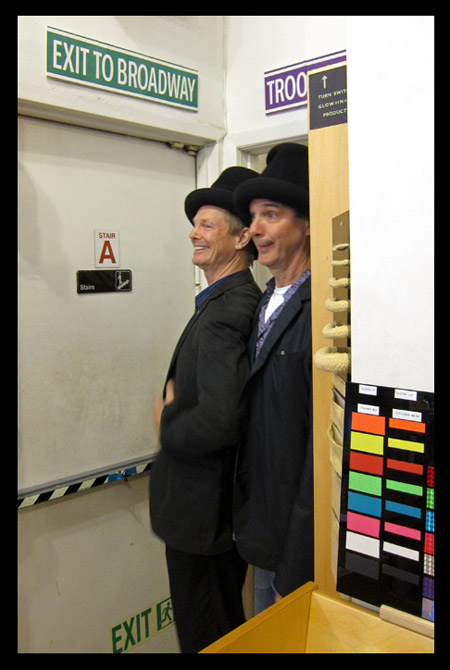
    Recently I was paid a visit by Bill Irwin and David Shiner. I have known Bill since the 1980s. An actor (stage, film, TV), clown, and writer, his accomplishments are many – too many to list besides the highlights here. He has won a Tony Award, an Obie Award, New York Drama Critics Circle Special Citation, Drama Desk Award, an Outer Critics Circle Award, a CFCA Award, and a New Victory Arts Award. He was named a Guggenheim Fellow and received a National Endowment for the Arts Choreographer’s Fellowship. He is most well known for being the first performance artist to receive a MacArthur Fellowship*, often called the Genius Award.

    Bill created a number of highly regarded stage shows that incorporated elements of clowning – The Regard of Flight (1982), Largely New York (1989), Fool Moon (1993), The Harlequin Studies (2003), and Mr. Fox: A Rumination (2004).

    Before leaving my showroom, I asked Bill and David if they were willing to do a little schtick for our company, which he readily agreed to. For those who would like to meet Bill, I would not bother looking for him strutting in the streets of New York or on TV doing interviews. This is not a man inclined to chest-thumping bravado, limousines, or red carpets. You may find him on Broadway, Taking The Stairs 🙂


  • Fountains

    Depending on who’s counting, the Palace of Versailles has more than 1,400 fountains. Due to the enormous amount of water required to fuel them, they are turned on infrequently. Even at the time of Louis XIV, the water supply was inadequate to run all of the fountains at once. There was even talk of diverting the River Eure to supply water to the fountains.

    Sunday afternoons from April through October, there is the Grandes Eaux, a musical fountain show in the gardens to the accompaniment of recorded music. Although I have been to Versailles twice, I was not fortunate enough to experience the spectacle. Paris has 350 fountains; to a visitor from the United States, they seem to be at every turn and virtually are.

    New York City has a much less lavish feel to it, as observed by one of my Swedish clients, which I wrote about in Very Practical. Fountains will never be a priority here, although it certainly was for George Vellonakis, architect for the redesign of Washington Square Park. Upon reconstruction, the central fountain was moved to be centered with the Washington Square Arch as viewed coming down Fifth Avenue. George was virtually crucified for this, the cost of which was often misrepresented since the fountain needed to be dug up for plumbing work anyway, with the additional cost of moving being incidental.

    But to me, the entire fiasco and controversy is just indicative of the fixation of Americans on the bottom line, even if at the cost of aesthetics or the occasional jubilant indulgence.
    As I wrote in Let’s Have a Parade, in the light of hardship, it often is hard to justify celebration. After all, there is always a better place to spend money.

    We do not have a large number of fountains in New York City, but there are a handful. Conservatory Garden, the fountain and the gilded statue of Prometheus in the sunken plaza of Rockefeller, the fountain cascade at Rockefeller Center, the fountain at Columbus Circle, the Pulitzer Fountain at 59th and Fifth Avenue, Angel of the Waters Fountain at Bethesda Terrace in Central Park, the Unisphere in Flushing Meadows Corona Park in Queens, Temperance Fountain, Tompkins Square Park, James Fountain at Union Square Park, City Hall Park Fountain, and Washington Square Park.

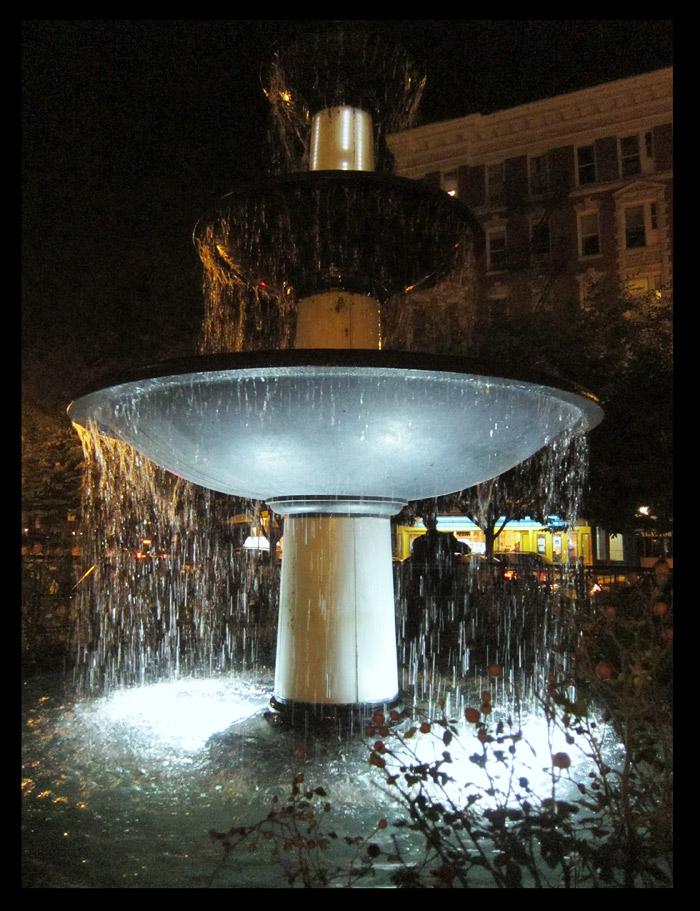
    Here, at Father Demo Square at the intersection of Carmine Street, Bleecker Street, and Sixth Avenue, is a tiny park with a beautiful charcoal gray stone fountain as centerpiece. The park completed a renovation in 2007 and is an ideal resting spot located in one of the most intensely trafficked areas of New York City, surrounded by a plethora of restaurants and shops. It’s ideal for people watching, a rest after dinner, or a place to eat a snack. Or, for those inclined to indulge, enjoy one of New York City’s very few fountains 🙂


  • Simple, But Effective

    I imagine you had to be there to appreciate the humor. The same man who swore that there was no reason not to move to Santa Barbara (see Not Going Anywhere here) was known for his pithy aphorisms. Some years ago, he offered one of my favorites.

    When fanfare, drama, and over-the-top displays are all around, how do you distinguish yourself? If you have traveled to Dyker Heights, Brooklyn, during the Christmas holiday season, you know what I am talking about (see stories here and here; see photo galleries here and here). With fierce pride, ego, and in the one-upmanship style often found among New York City residents, the Christmas displays in Dyker Heights have reached outrageous proportions. You’re certainly not going to stand out or even be noticed unless you take a radically different approach. And not everyone has the financial means or the motivation to stage a Disneyesque extravaganza on their front lawn.

    One holiday season, I was on one of my first visits touring the neighborhood with friends. One of our group was that very same man who made the threat regarding moving to Santa Barbara. As we cruised the area, we would periodically see a nice, elegant, but very modest display.

    As we passed these types of very simple displays, often perhaps just a string of lights in a single color hung elegantly in a tree, our friend would roll down his window in order to show respect, observe seriously as one might admire a fine work of art, and then state very approvingly with the utmost gravitas, “Simple, but effective.” This became the night’s refrain as, from time to time, any one of us spotting an appropriate candidate would call out, “Simple, but effective.” We loved it, and in the context of the evening as we became numbed by the extravagant displays, the phrase became hilarious and a mantra we would use for years to come whenever simple elegance reigned.

    On Monday night at the Village Halloween Parade, I began to weary of the costumes and overwhelming experience of it all – the crowds, traffic, police, media, competing photographers, and noise. I even began to tire of the brilliant creativity and wonderful pageantry. A fellow photographer actually came over to me, said that I looked too serious, and suggested that I enjoy it. After all, it was a parade. Lest I be seen as a burnt out curmudgeon, I will tell you that all of my friends, most of whom are long-time residents of the Village, have not gone to the parade in many eons – it’s just too much work if you have done it already. In my case, only my ability to get a press pass and enter the parade gives me incentive to go.

    I was not particularly focused – the sheer volume of paraders makes it impossible to see even a small number of the best costumes. Invariably, I am disappointed to see the most interesting participants following the parade night when looking at other photos.

    However, in all the mayhem, I spotted one woman who shone through it all with her simple costume. Perhaps you might want to say that this woman’s makeup strains the definition of “simple”. In a vacuum, you may be right, but at the annual Village Halloween Parade, it could easily be considered simple. So, my hat off to her for such a stunning costume amid the night’s festivities, achieved in a manner that we may say is Simple, But Effective 🙂

    Photo Note: This photo was to be included as the featured photo on yesterday’s parade posting, yet ironically, it was overlooked, buried on my computer desktop. When I was busy this morning closing all the parade photos, there it was, having been lost in the fanfare and flurry. This story immediately came to mind as I reflected on how one must be attentive or beauty can be missed, particularly when it is simple, but effective.


  • Halloween Parade 2011

    My fifth year at the annual Village Halloween Parade. A spectacular event. See my previous postings for photos and information about the parade: Halloween Parade 2010, Halloween Parade 2009, Halloween Parade 2008 Part 1 and Part 2, Village Halloween Parade 2007 #1 and #2, Village Parade 2007 Preview, Village Halloween Parade 2006 , Halloween Parade 2006 Preview


  • La CĂ´te Basque

    What an unsophisticated, strong-headed, argumentative, ignorant fool I was – in my 20s, a radical vegetarian, and seriously trying to make a case that carob confections were every bit as good as chocolate. I was arguing with chocaholics – what lunacy. Today, I rarely even hear much about carob, and I have not had it in eons. Far fewer are willing to compromise their taste buds, and chocolate has lost much of its evil connotation, with dark chocolate even being seen as healthy.

    My sister was a chocaholic and in the 1980s, she frequented the city with her husband. They both loved visiting here and savored the opportunity to indulge in the foods and restaurants of New York City. On one sojourn, I had booked them a room at the Plaza Hotel and made reservations for them at La CĂ´te Basque. I had not included myself in the restaurant outing for a number of reasons, primarily because I was too cheap, particularly to pay for a vegetable dinner in one of New York City’s finest restaurants.

    However, as the hour of reckoning arrived, standing in my sister’s hotel room, the conversation turned to their persuading me to accompany them. I had no wardrobe at the time other than elements of the uniform of the 1960s, so I rejected the offer based on my inability to make the dress code. My brother-in-law, however, always traveled armed with additional clothing and was virtually the same size as I was.

    I objected first on the basis of owning no sport jacket. He had an extra. I had no dress pants. He had extra. As we went through all the necessary articles of the well dressed man, I was offered a perfectly suited piece. Finally, in frustration, I pointed out that I could not go to a French restaurant with sneakers, but alas, he had extra dress shoes also.

    OK – what about changing a reservation from two to three? And what about a vegetarian meal? A quick call to the restaurant confirmed that one could be added and that my dietary restrictions was zero issue. The French take food seriously, and restaurateurs seem themselves in business to serve the patron, not make things convenient for themselves – a common irritation among many. I was assured that my waiter would easily accommodate any dietary needs.

    And so it was that I came to have one of the finest dining experiences in my memory. As we sat down, we were immediately asked if anyone would be having the chocolate souffle for dessert. We were being asked upon our seating, since the creation of the dessert was a long process and would take the entire duration of the meal to prepare. My sister obliged, of course. I remember that the entire experience was extraordinary – being young, such fine dining in New York City was an event I would always remember, the details of which I would recount for my entire life.

    When the crusty confection arrived, it was delivered and presented by a team. One carried the dessert while another the chocolate sauce. As one waiter broke the crust and ladled the sauce onto the dessert, I recall my sister overwhelmed, just repeating “Oh my God” over and over.

    I imagine that it was likely around that time that I stopped making the argument that carob was as good as chocolate. And thank God that I had never said such a thing within earshot of a pastry chef at La Côte Basque 🙂

    *La Côte Basque was in operation for over 45 years, closing in 2004. A temple to classic French haute cuisine, the restaurant saw guests such as Jacqueline Kennedy Onassis and Frank Sinatra. The restaurant opened in the late 1950s by Henri Soulé. Chef Jean-Jacques Rachou became owner in 1979. He said he spent more than $2,200 a week on flowers and more than $3,000 on linen.

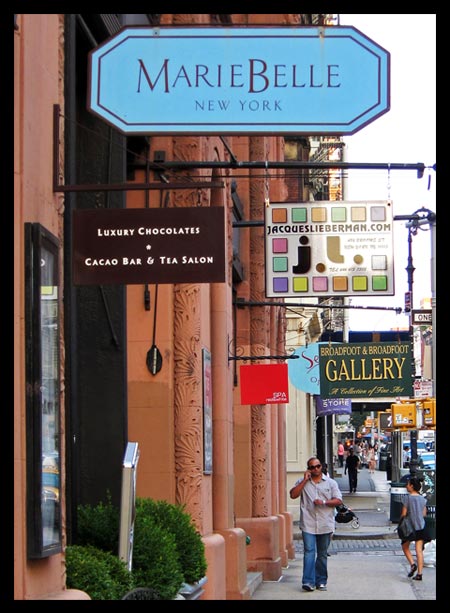
    Photo Note: This is Marie Belle at 484 Broome Street in SoHo. The shop, cacao bar, and tea salon is a shrine to all things chocolate and is a very highly regarded gem of the neighborhood. Unless you prefer carob 🙂

    Related Posts: Pure Chocolate, Sirens of Convenience, Bon Appetit, Economy Candy, Chocolate Bar, Jacques Torres


  • Pretty Rad, Part 3

    Liliane Through Broken Glass (see Part 1 and Part 2 here)

    My occupation often affords me the opportunity for a bit of fun. I occasionally meet individuals using my product who have been to my showroom, know me by name, yet have never met me in person. Through a series of questions, I let them discover our connection for what I hope will be a very surprising first encounter. This was the case with Gaby Lampkey, whom I wrote about on September 8, 2010 in On The Road.

    Recently, I met Liliane le Prévost, hooping in Washington Square Park. I asked about her equipment and where she got it, letting her discover that I was the owner of the manufacturing company who made her hoop. She basically went wild, even stopping passersby to let them know of my celebrity. A big fish in a very small pond, perhaps, but certainly not worthy of public announcements. However, my philosophy is to take your 15 minutes of fame when you can get it.

    I learned that Liliane was born in Bayeux, Normandy – extraordinarily cool to me for two reasons. One, I rarely meet first generation French living in New York City, and two, I am of French ancestry myself. So, overall, this was a remarkable connection in more ways than one. Liliane’s father is a trained chef living in Europe and, although not having trained at a formal school, has worked with some of the world’s greatest chefs and is part of a well-known family in the region, famous for its milk and cheese. I also learned that her mother is a professor.

    A conversation ensued regarding this website and my photo excursions. Lilie seemed very animated by the prospect of exploring the city, so I promised I would include her in a future urban safari. We went on two such trips, and this excursion was our third voyage out at sea in the wilds of New York.

    She was unfamiliar with the piers in Red Hook. The area is quite scenically dramatic and I was up to another visit, so this seemed a good area to introduce someone as well. My intention was not to spend time shopping indoors, but Liliane was unfamiliar with Fairway and in a fortuitous twist, I was very pleased at my decision to explore this most amazing food emporium. So much so, that our experiences there became the subject of the first two parts of this three part story – you can read about Fairway and Charles Knapp.

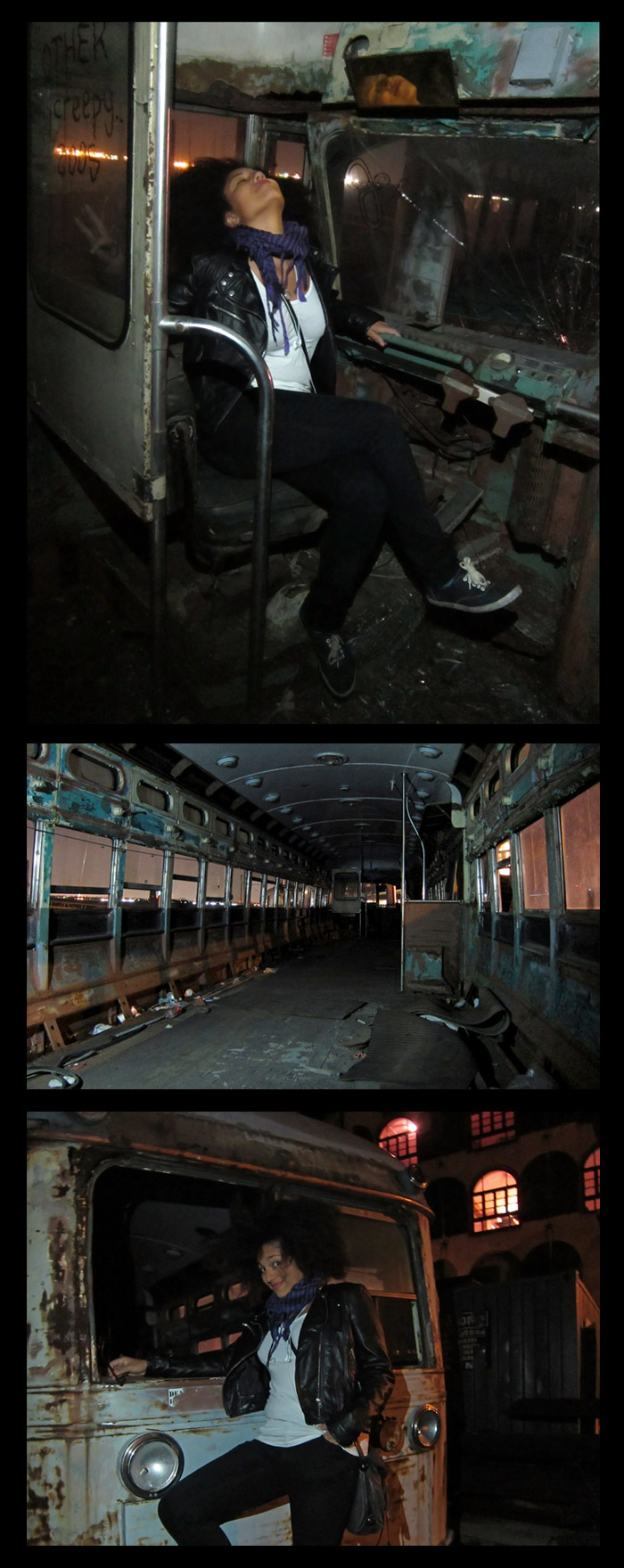
    But it was time to go back to our main feature, so after our exploration of Fairway, we ventured out to the Beard Street piers of Red Hook. Behind Fairway, there are abandoned trolley cars. Using flashlights, the interiors looked like a made to order film set – rusted, delapidated with chipped paint, broken glass, and strewn with trash. Lilie convinced me to crawl through a missing window. Inside, the place was amazing. Ever the impromptu entertainer, Lilie struck a number of poses in the trolley. She is quite photogenic, with a mane of hair that, once unfurled, is a show stopper. See more photos here.

    In a previous email to a friend, Liliane referred to me as pretty rad which, from a 22 year old, I took as a compliment of the highest order. To be able to make any impact on someone her age is not easy. I hope this excursion to Red Hook met her expectations, because I am not sure I am able to keep this level of entertainment up forever. For now though, I hope I remain Pretty Rad 🙂


  • Pretty Rad, Part 2

    A Slice of Charles Knapp (see Part 1 here)

    In Part 1 of Fairway to Heaven, I found myself unexpectedly immersed in a food emporium, the likes of which I had never seen. I traveled there with a friend who you will meet in Part 3 of this adventure in Red Hook, Brooklyn. However, the plot thickened, or perhaps I should say curdled.

    I have written a number of stories with the theme Abandon All Preconceived Notions Ye Who Enter Here. However, looking back, it is fair to say that all of the people I have featured could easily fit under this umbrella. In New York City, more than any place I can imagine, you cannot define or judge a person by color, creed, occupation, lack of occupation, appearance, hygiene, education, or any other outward signs – even those things which a reasonable person may use to reasonably judge someone unfamiliar. This city is a salad bowl of ethnicities, types, and kinds. It’s a magnet for luminaries, geniuses, eccentrics, misfits, artists, and every other imaginable variant on the human condition. But the overlying theme is the number of remarkable individuals hidden behind an unassuming or unprepossessing exterior.

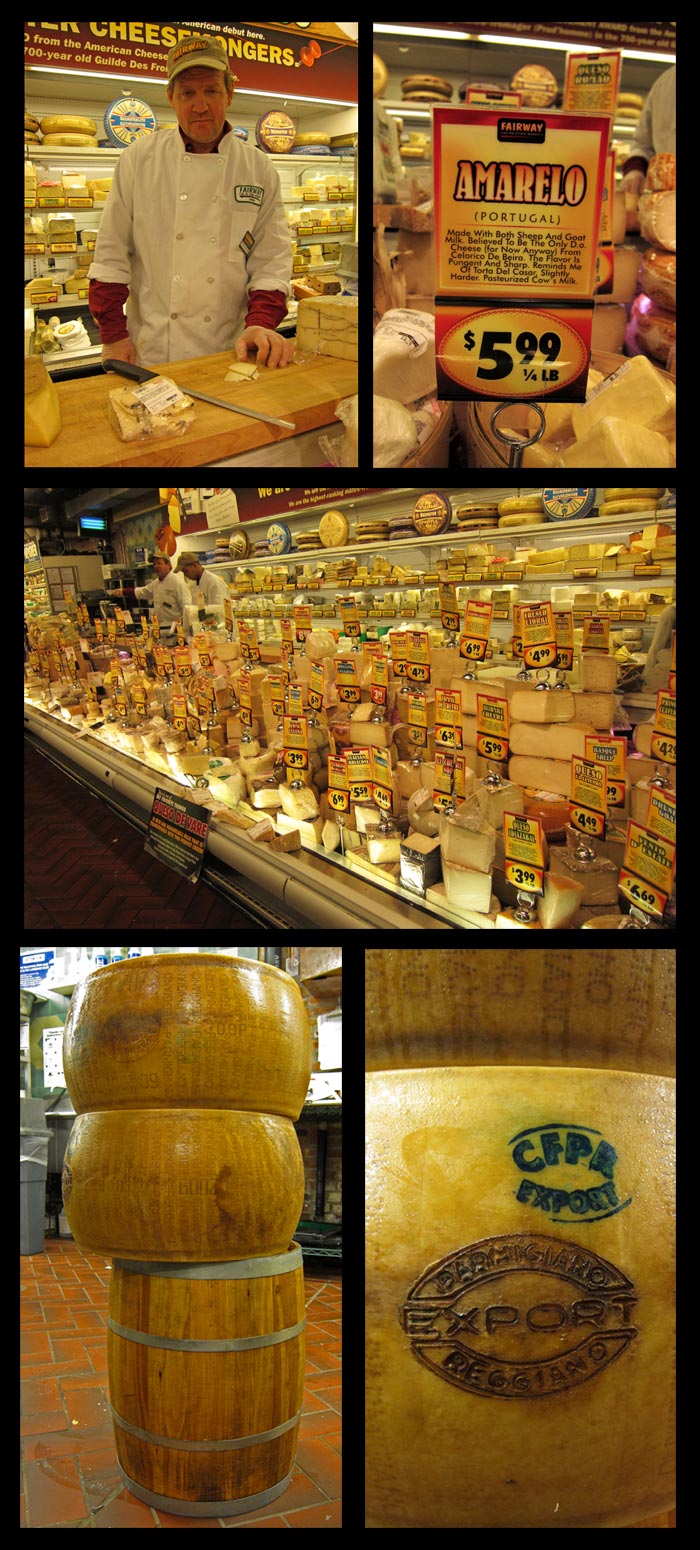
    As we explored the aisles of Fairway, we approached the cheese department. I love cheese but do not keep it in the house, lest I lose control and consume too much. My eye was drawn to two wheels of cheese stacked on a wooden barrel. My interest was immediately spotted by a man behind the counter who told me of the special nature of this authentic Parmigiano Reggiano.

    No sooner did I show interest in a cheese that I was offered a taste. Soon it became a cheese tasting extravaganza with no holds barred. My first and favorite for the night was Amarelo – a strong but extraordinary tasting cheese from Portugal, made with both sheep and goat milk. As conversation ensued, it became abundantly clear that this was not just an ordinary salesperson but also someone who had a passion for cheese and a depth of knowledge. I also knew that this man, who introduced himself as Charles Knapp, would be the subject of a story for this website. Charles gave me a postcard with the details of a wine and cheese tasting that he conducts periodically at botto di vino in Red Hook, Brooklyn (see details here).

    As I was leaving, I asked for his full name and contact information. He informed me that he also had a cheese blog which I perused this morning, along with a number of other blogs he authors.*
    Charles has had a fascinating life and is far from what one might expect from a counter salesman in Fairway. Born as a Catholic, Charles studied atheism and shamanism in college, then became an SGI Buddhist. His father was in the Air Force, so Charles moved a lot as a child.  Here are some ruminations from his website:

    Food Trip
    Born in San Antonio, Texas. Raised in Europe. Love food Mexican Food only in Texas and California. Ate a lot. Parents had to hold me back. Was a husky kid always.Making lunch for school. Traveling to Holland. France, Italy,Spain. Ate diff foods olives,olive oils, meats, bread, wine, beer, and spirits. Always liked sweets. Candy gum cake. chocolate. Hot oatmeal. Strawberry picking, Elmers food and steak house. SOSC Cafeteria. Mom was a great cook. In Europe brotchen bread bratwurst. In spain, Bread and olives, cheese, wine and olive oils. Not only the food, culture and history for the region. It continues. I want to take Ben carlos. Own Business in Catering. Gouda in Holland. manchego in Spain. Quantro for dessert. Flowers and food. We have been on the go for the first 15 years of my life. learned German in first grade. Spain Rain on the plane to Majorca. The italians where so wonderful. Very giving about everything. They wanted top show off their food and history and culture all the time. Naples was wonderful Roma did we see the churches. After awhile it became dull. Humor and sarcasm were always around. Munich oktoberfest. garmische partenkirchen. The Sound of Music was our family we danced, learned a lot and ate a lot and drank a lot throughout chiildhood. Potsdam. Checkpoint Charlie. Our history together. resentments. Golden Child. Ms Griffith. 3rd grade Wizard of Oz. Tam class president. I supported her a lot. I was the class clown and the mischievous one.1975 we cam home to Oregon. Strange time. Came out of the cocoon of military life. Life is some cocoons. go in and out.

    And there you have a Slice of Charles Knapp 🙂

    Note: If you want to be even more astounded with Charles’s transparency and the candid exposure of his rich life, follow the links for his various blogs – 21, manspace, spiritworld2011, and snazzysales2011.


  • dinamic_sidebar 4 none

©2026 New York Daily Photo Entries (RSS) and Comments (RSS)  Raindrops Theme