• That’s What You Pay For

    A Shocking Story of Discarded Peanut Shells
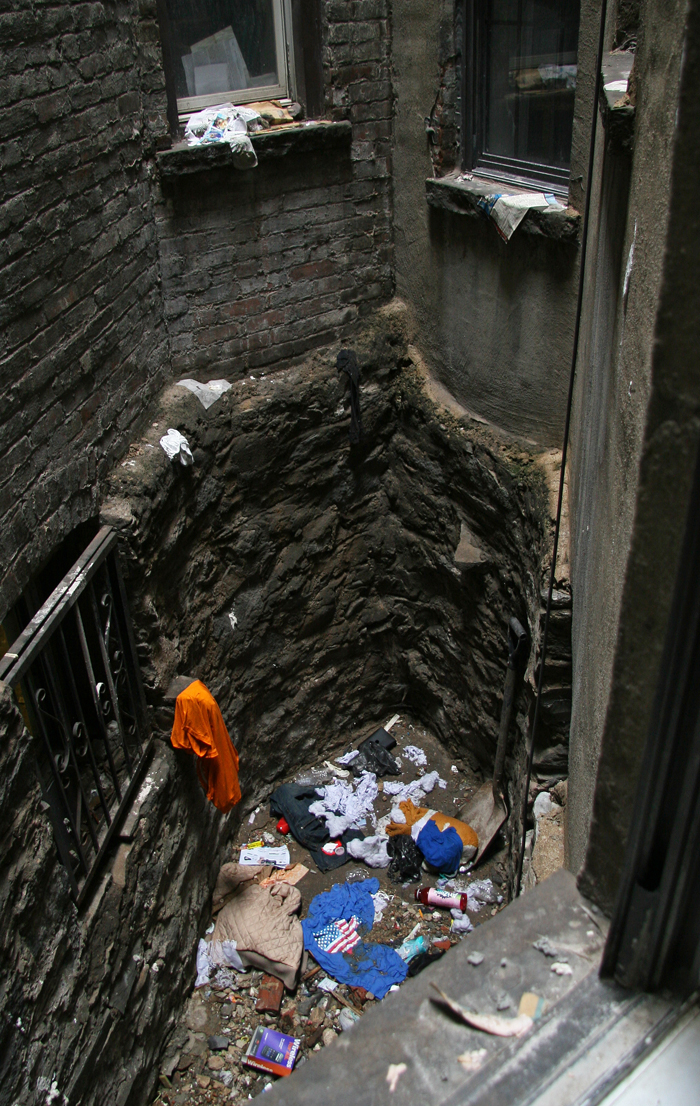
    I was told by a friend who lives in Bedford-Stuyvesant, Brooklyn, about the throwing of trash into the air shaft outside her building. She told me that not only was there an accumulation of trash at the bottom, but also that many articles thrown out find their home on her window sills, air conditioner, etc.
    On a recent visit to her apartment, I was able to look at and photograph the mess. She encouraged me to do so – documenting this would aid her in any action to remedy the situation.

    She told me that the litter was not just the product of things dropped accidentally but also a deliberate throwing of goods. One of those committing the offense is the owner of the neighboring building, making it even more difficult to put a stop to this activity. Among the treasure trove was what appeared to be a used condom.
    One often wonders what drives individuals to behave in such disgusting ways. Let me share with you a story that illustrates one man’s thinking.

    I had a high school classmate whom I did not really know at the time I was attending school. Years later, he opened a shop in my hometown in Connecticut, which I began to frequent. I quickly saw that we had little in common, and I understood why we had different circles of friends in school that did not overlap. As I would learn, however, his values were much further from mine than I could imagine.

    There are always at least a few common interests between any two people, so on my visits shopping at his store, I would have a chat. We maintained a casual acquaintance. As one is sometimes inclined to do, I extended an open invitation to him to stay with me in New York City. The lure of this city is great, and the prospect of a free stay in town is, for many, too much to resist. So, one day, Bob took me up on my offer, and I found him at my doorstep.

    In the time he stayed in my home, he developed a romantic interest with a friend whom I had introduced him to. On one trip to my hometown to visit family, this friend asked to come along to visit Bob.
    I don’t recall why, but they stayed at a cheap motel for that weekend. On my return to New York City, I stopped to pick up my friend. When I entered the room, I witnessed a scene that, to me, was quite shocking.

    Both were dressed and ready to go. Bob, however, was lying clothed on the bed, eating shelled peanuts from a bag. As he ate and conversed, he would take the shells and deliberately throw them one by one on the floor. When I say deliberately, I mean just that. Not dropping them or trying to throw them in a receptacle, but throwing them some distance with GLEE. A pile of shells and debris had formed, and he seemed quite pleased.

    When I confronted him, he responded with one of the most shocking things I have heard in my life. I asked him why he was doing this and, even though he was in a motel with maids, didn’t he feel badly about making such a mess on purpose? And he said:

    “That’s what you pay for.”

    Related Posts: Shortly Before Execution, Random Acts of Consideration, $7.95 a Pound, Insult to Injury, PDA

  • Rhino Rolling in Mud

    Although well acquainted with Webster Hall, in 40 years of living in New York City, I had yet to step inside the place.
    Webster Hall is one of New York City’s most historically and culturally significant large nineteenth-century assembly halls. The building, at 125 East 11th Street, was designed by architect Charles Rentz, Jr. and constructed for Charles Goldstein in 1886-87, with an eastern Annex in 1892.

    Webster Hall was the first nightclub in the United States. It has gone through numerous incarnations since its construction and currently serves as a nightclub, concert hall, corporate events center, and recording venue. It has a capacity of 2,500 people.

    My first visit was on Sunday for the QAS – Quarterly Art Soirée. This extravaganza takes places on all four floors of the space over the course of an entire day, from 3PM to 11PM. There were visual artists throughout the space, along with performances on the stages and in the lounges – music, dance, singing, aerial acts, burlesque, and a big finale by Flambeaux Fire.

    I was particularly impressed with the dress of many of the attendees and also with the masks of Stephan Keating – beautifully designed and crafted. The space was extremely comfortable, with attendees milling about, exploring the various art installations and performances. Overall, the event has a very festive feel. At one juncture, one of the staff members decided to wallow in a glitter spill on the floor, rubbing it over his face and rolling it, much as a rhino rolling in mud 🙂

    Related Posts: I Got Caught, Kristal Palace, Hoopmobile


  • Wonder Why

    I grew up in a family with limited means. However, we triumphed through brute force and tenacity. My father, originally a woodcutter, once in Connecticut, worked a handful of blue collar jobs, often maintaining more than one job at a time. One of his brothers, in addition to his full-time job in construction, worked a second job – mowing grass on highways until 3 in the morning. Work defined a person’s worth. Certainly this ethic has been a factor in my survival in New York City for the last 40 years.

    For people like my folks, who were so determined to make a better life, generics or house brands were signs that a family could not afford to have the best. Brand names were symbolic and tantamount to saying that in a small way, we had made it.

    This type of thinking certainly is not unique to those of lesser means – the sale of premium brands is fueled by this type of thinking.
    However, we now have a world of smart shoppers who not only hunt for discounts but also evaluate products based on a quality and merit basis, not just by brand. Celebrities such as Oprah shop at Costco, conferring that shopping for price and value is nothing to be ashamed of and does not neessarily imply that one is of lesser means. Of course, this price consciousness can be taken to the extreme, something Americans do all too well.

    In the 1960s, Wonder Bread was the premium brand, and our family was proud to eat it. For many today, with an emphasis on health and whole grains, Wonder Bread is virtually a perforative metaphor for white bread and all that is bad with the highly processed.

    On March 18, 2011, the Washington Post ran a story, “Wonder Bread: 90 Years of Spiritual Vacuousness?” Within the article, there is a quote from Warren Belasco’s essay, “Food and the Counterculture: A Story of Bread and Politics”:

    A virtue of brown bread was that it took some time and skill to produce, and this leads to another important contrast, convenience verses craft. Wonder bread represented the ultimate in labor-saving convenience, which was (and is) the food industry’s main product and primary hope for global expansion. It saved time, effort, attention, and money — it even took virtually no time or effort to chew. Sliced white bread thus may have been one of the world’s wonders, but the costs in taste seemed enormous. Thanks to the nutrients added back after processing, it may have been “biochemically adequate,” but was spiritually vacuous.

    From the same Washington Post article:

    Industrialization made great contributions to America but not to American food. Wonder bread may have helped build strong bodies 12 ways but it discouraged taste for bread in all ways. Bread is meant to have a grainy taste and a chewy texture. A traditional sandwich was flavored bread. But Wonder bread’s bland flavor made the bread simply a holder for the fillings. Its softness contributed to the American appetite for foods that “go down easily.” Both had great caloric implications. In fact, I am sorry to say, the name “Wonder bread” is short for “Wonder why anyone thought to call it bread?”

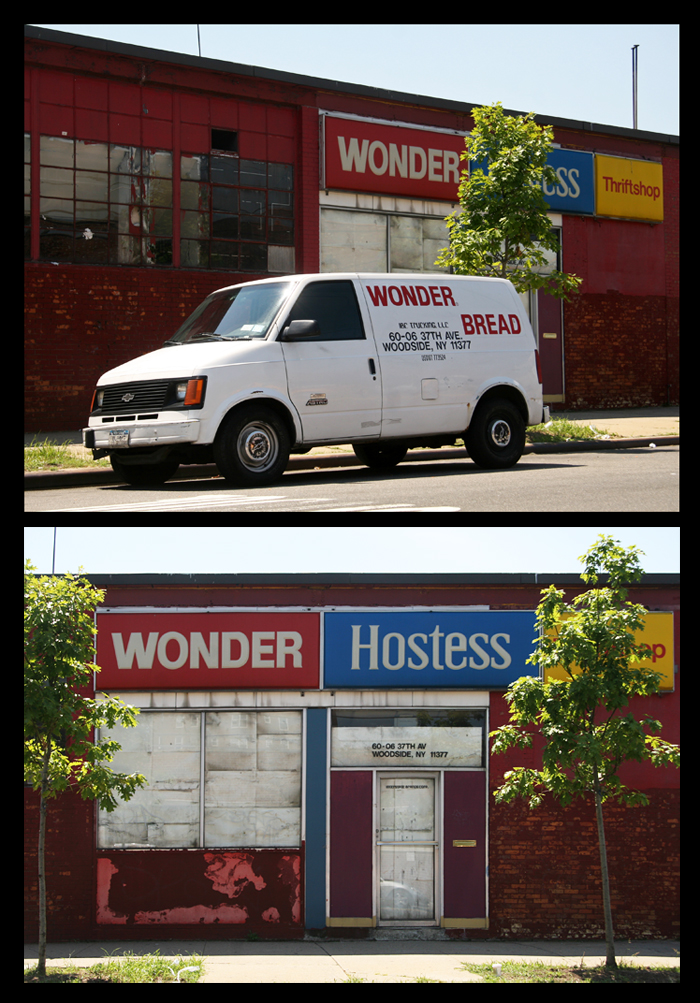
    Looking at the Wonder Hostess Thriftshop facility at 60-06 37th Avenue in Woodside, Queens, makes one Wonder not only why anyone thought to call it bread but also why the bread still exists at all…

    Related Posts: Pecking for Pita, Bagels


  • Mine

    One of my earliest childhood experiences wass flying simple balsa model airplanes with my friend Jaime. Portuguese in ancestry, Jaime’s English as a very young child was virtually non-existent. I only remember him using one word in English, and that was when we flew our planes in our yards together. As we chased them to recover them at the end of their flights, Jaime would run for his saying, “Mine.” What better word to learn for a boy playing with his toys?

    As a child, I was fascinated with all things that could fly – kites, birds, butterflies, damsel flies, rockets, planes, parachutes, balloons. However, lack of money and proper understanding of aeronautics foiled many of these endeavors. I recall jumping from the top of my father’s automobile with an umbrella in a desperate attempt to fly or parachute. I built small parachutes from napkins or pieces of cloth, suspending objects from it. Fabricating kites from found objects – sheets and tree branches – resulted in craft much too heavy to fly. I saw paper hot air balloons in catalogs such as Edmund Scientific but never was able to purchase one.

    Only as a teenager or adult was I able to take these childhood interests to fruition. In high school, I became very actively involved in the model rocketry club. In my 20s, I took ten hours of flight training towards a pilot’s license. In the parks and beaches of New York City, I flew kites of many styles and sizes.

    I still dream of owning a small plane. This and occasional nightly dreams of flying have become metaphors for freedom and release from a life of increasing stresses, responsibilities, and the slings and arrows of urban life.

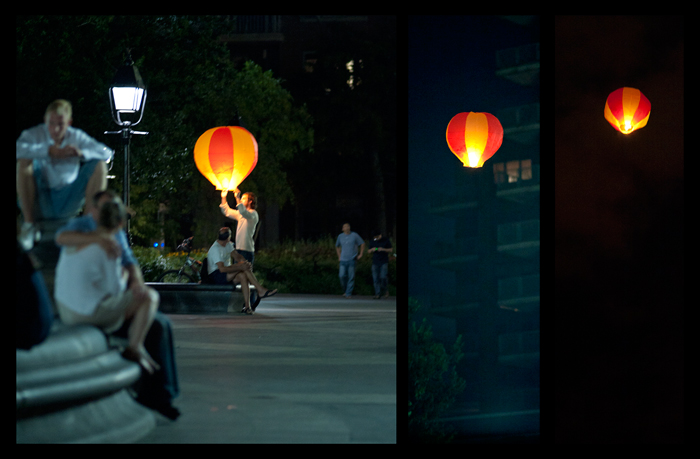
    On Tuesday night, I witnessed something I have never seen before anywhere in New York City – the launch and flight of a paper hot air balloon. The owner appeared suddenly from nowhere, quickly lighting and releasing the balloon, barely allowing time to make our way towards the launch area. Powered and illuminated by a small flame, we watched the glowing orb rise into the clear night sky, becoming smaller and smaller until it finally disappeared.

    Jaime, and I know that you are reading this, please know that as I ran towards that balloon, my mind drifted to those days of childhood when we chased our dreams through the grasses of our yards. I hope you caught some of your dreams, because I have caught a few of mine 🙂

    Photo Note: All the photos on the website are typically taken by me. However, it was impossible for this sequence of balloon photos, since I would have been unable to capture reasonable quality photos at night with a point and shoot camera. My photographer friend, Bill Shatto, had his Nikon D3, a pro camera with extraordinary low light capability, faster focus, tracking, and low noise. Today’s photos are courtesy of Bill Shatto. Photoshop work is mine.

    Related Posts: A Small World, Under the Sun, Floyd Bennett Field


  • A Story About Nothing

    I have been told that in Switzerland, people will always wait for a walk light, even in a small rural town at an intersection with no visible traffic in any direction.

    I have been told that in California, if a pedestrian steps into a street, cars will stop.

    I will tell you that as a New Yorker, it’s every man or woman for himself or herself. Cars, regardless of laws or unfair size advantage, will compete with you for the roadway and will nearly run you down. And, traffic or not, we run through intersections without walk lights in our favor and dodge traffic.

    In addition to issues of impatience waiting for walk lights, we also have a condition here of such severe crowds on the sidewalks, that many resort to walking in the curb or even in the roadway itself. Bicyclists are also aggressive. For some, these brazen acts of pedestrian and vehicular defiance confer Street Cred.

    In 1998, Mayor Rudy Giuliani, as part of his Quality of Life campaign, decided to initiate a crackdown on jaywalking. This short-lived effort was rather laughable and barely enforced, with only 99 tickets being issued that year. New York City is not Singapore.

    The reckless attitude of motorists towards pedestrians does not end with civilians. Police can also be rather overzealous. In Washington Square Park, for example, many are displeased with the rather aggressive habits of many officers speeding through narrow pedestrian walkways inside the park.

    In the 1970s, my girlfriend was arrested for kicking a police car with her roller skates. An altercation had occurred between a police officer and a skater who was tapping electricity from a lamppost to power his boombox for playing music for roller skaters. A chase ensued, backup police were called, and a police vehicle came careening recklessly into the park, nearly hitting pedestrians. My girlfriend, furious at the near hit, kicked and dented the squad car with her skates and was arrested along with the perpetrator.

    Ever the city of opportunity and opportunists, here on the highways, in moving traffic with little clearance, we have sellers of fruit, flowers, and water. I rarely need the flowers or water, but now I regret not having purchased a bag of fruit.* It would have made a nice snack, perhaps a quick chat with the vendor, and not have left me with a story about nothing 🙂

    *I believe the fruit is Melicoccus bijugatus, grown over a wide area of the tropics, including South and Central America, Mexico, the Caribbean, parts of Africa and the Pacific. It is called Spanish lime, chenette, guaya, guinea, genip, genipe, quenepa, mamoncillo, mamón, ackee, skinnip, kenepa, xenepa, canapé, knippa, limoncillo, anoncillo, or honeyberry.

    Related Posts: Hearts of Palm, Bygones Be Bygones, Durian


  • Not For Tourists

    At my business, we have a showroom which adjoins our offices. The separation between the two is an open doorway and a windowed wall, so nothing is hidden from our clientele. We typically have various prototypes, samples, or products for evaluation in the office area.

    Regardless of how much inventory or diversity we have in our showroom, invariably people will fixate on some sample in our office, craning and straining to see the object of their desire from the doorway and being careful not to overstep the demarcation between showroom and office. Upon inquiry, we inform them that the product is not for sale. Then the interest really escalates. On occasion, we have had begging, with the customer making the case that this is, in fact, exactly what they need.

    The scenario is so common that it has become an inside joke in the office. I have suggested that we take sale merchandise and factory seconds from the showroom, move them into storage, display them a few at a time in our office area, describe them as special prototypes when asked, and raise the prices.

    I have often seen a similar phenomenon on the streets of New York City, where a crowd gathers around a street vendor selling from a large bag. No one can see the contents, which fuels a burning desire in many to learn what is being sold. Once they see what is offered, most will leave immediately without buying. Like the morbid curiosity associated with the rubbernecking of highway accidents.

    People just love the secret, the special, the private, and the undiscovered. At least the idea of such.

    There is a very popular guide book called NFT (Not For Tourists), published for a number of cities, including New York City.
    Trust me, this guide is for tourists.

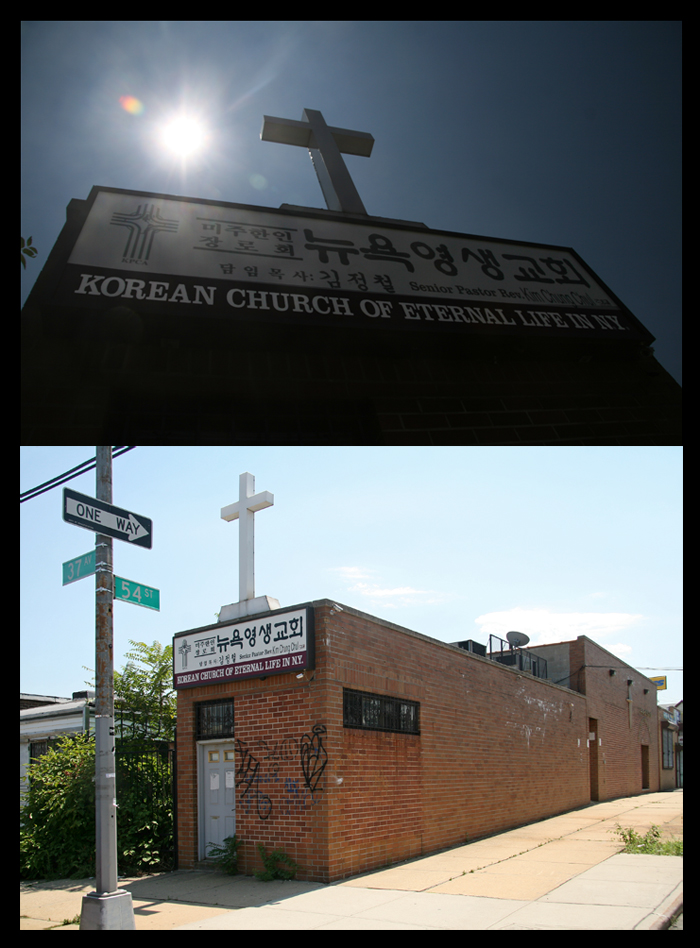
    Virtually no one really wants to see the things that are Not For Tourists. If you really want that, travel with me on a blistering hot summer Sunday to the industrial sector of Woodside, Queens. Specifically to 37th Avenue and 54th Street.
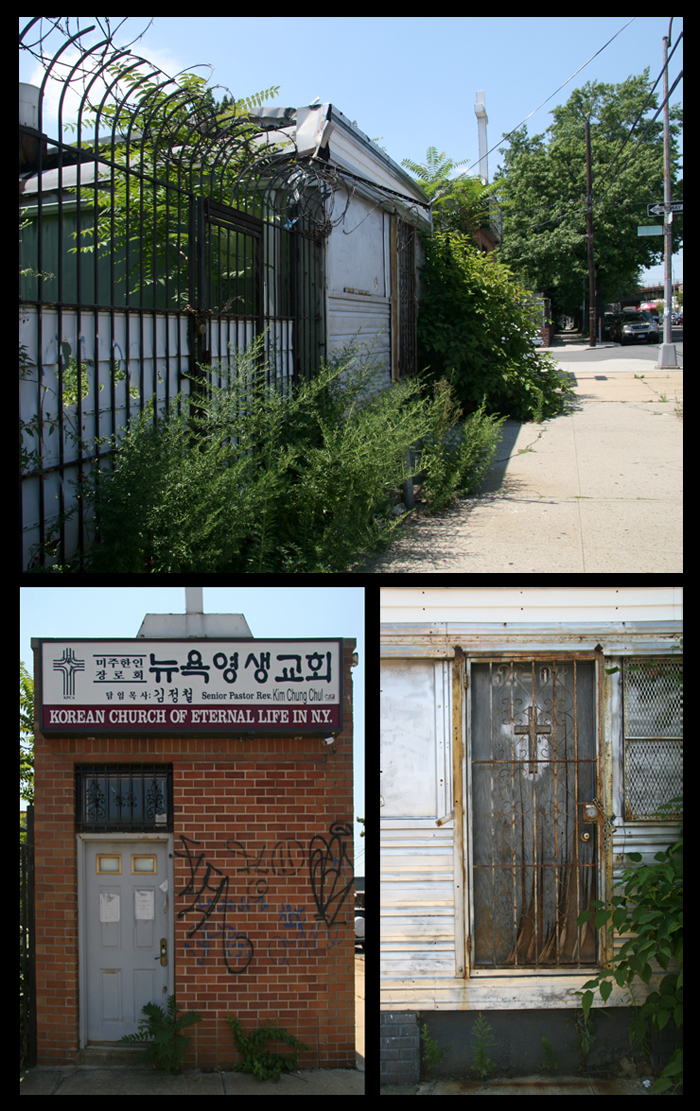
    Here, you will find the Korean Church of Eternal Life. Notices are hanging from the door, graffiti covers the front, and the church property abuts what appears to be an abandoned diner surrounded by a barbed wire fence. All is adorned by overgrown weeds. You won’t find this church in your NFT guidebooks.

    I don’t think you will find any churchgoers either. Actually, you won’t find anyone at all. It is Not For Sale. And, like Ozone Park, Willets Point, Hunts Point, and the Hole, the Korean Church of Eternal Life is Not For Tourists 🙁

    Related Posts: Toys “R” Us, Juxtaposition, I Must Confess, With All Due Respect, We Got Religion


  • ‘Tis a Sight to Behold

    I have made another secret discovery.

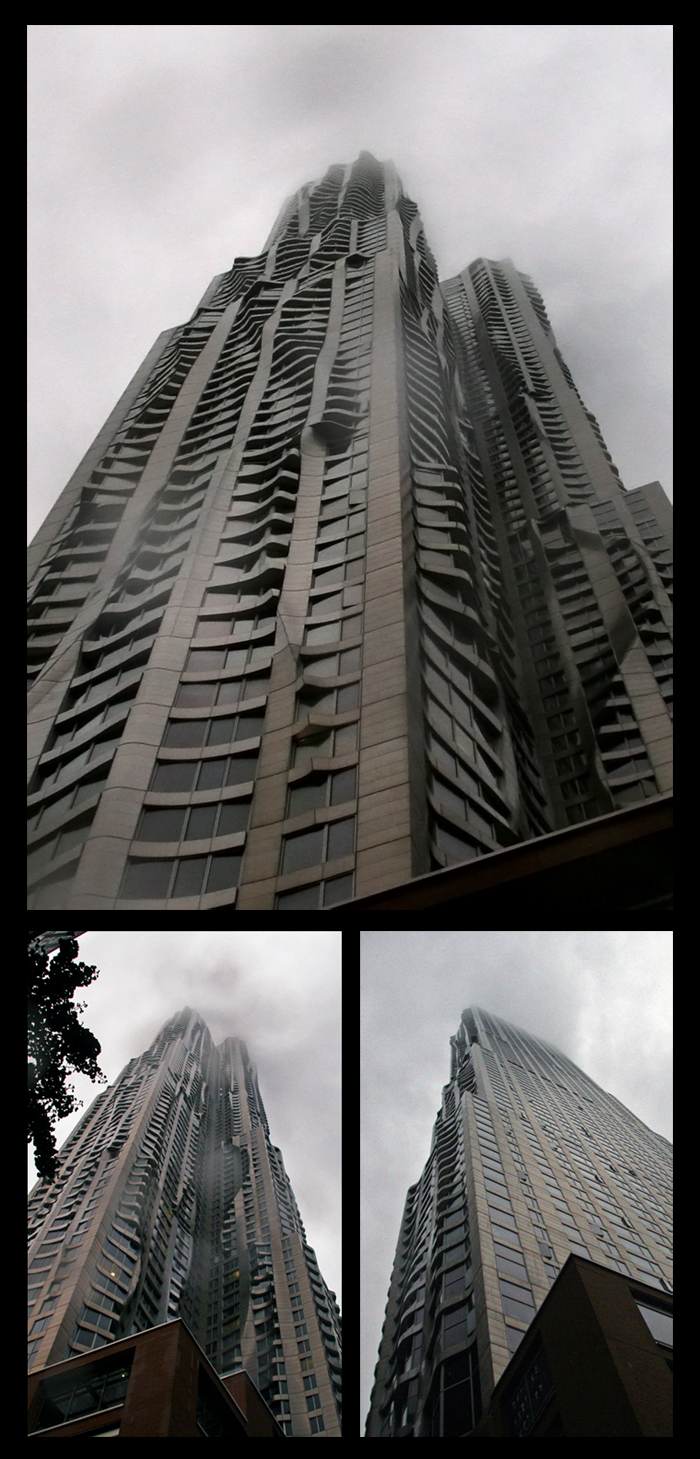
    You could easily find millions of New Yorkers who have no idea that this spectacular structure at 8 Spruce Street exists or that it is the tallest residential structure in the Western Hemisphere. I would be included in that group. However, as I approached the building, I began to recall the media attention surrounding this highly applauded residential tower, formerly the Beekman Tower and currently known as New York by Gehry, designed by renowned architect Frank Gehry.

    I made this secret discovery on a foggy Sunday evening while cruising lower Manhattan – one does not have to look hard to find a 76-story, 867-foot building. A foggy, stormy night is a great time for observing New York City’s skyscrapers. With their heads in the clouds, these towers provide all of the ambiance and drama of Batman’s Gotham city.

    New York Times architecture critic Nicolai Ouroussoff called it “the finest skyscraper to rise in New York since Eero Saarinen’s CBS building went up 46 years ago.” New Yorker magazine’s Paul Goldberger described it as “one of the most beautiful towers downtown.” Goldberger compared Gehry’s tower to the nearby Woolworth Building, completed in 1913, and said that “it is the first thing built downtown since then that actually deserves to stand beside it.” These are extraordinary accolades from New York City’s premier architecture critics who are hard to please and prone to dissect and crucify. But the accolades are justified.

    I circumnavigated it at nearby street level. However, I highly recommend seeing this tower from various vantage points, since one of the primary distinctions about this structure is its changing form when viewed from different perspectives. From the New York Times:

    … once you see the tower in the skyline, a view that seems to lift Lower Manhattan out of its decade-long gloom. The building is particularly mesmerizing from the Brooklyn waterfront, where it’s possible to make out one of the deep setbacks that give the building its reassuringly old-fashioned feel. In daylight the furrowed surfaces of the facades look as if they’ve been etched by rivulets of water, an effect that is all the more dramatic next to the clunky 1980s glass towers just to the south. Closer up, from City Hall Park, the same ripples look softer, like crumpled fabric.

    The building’s exterior is made up of 10,500 individual steel panels, almost all of them different shapes, so that as you move around it, its shape is constantly changing. And by using the same kind of computer modeling that he used for his Guggenheim Museum in Bilbao, Spain, more than a decade ago, he was able to achieve this quality at a close to negligible increase in cost.
    But Mr. Gehry is also making a statement. The building’s endlessly shifting surfaces are an attack against the kind of corporate standardization so evident in the buildings to the south and the conformity that it embodied.

    ‘Tis a sight to behold 🙂

    Other buildings and skyscrapers: New York Rockies, I’ve Got a Feeling, Where Sleeping Giants LieAll of These Pleasures, Color of Money, Trump Soho, Beacon of Hope, Towers, Pan Am Building, Crisis at Citicorp, Hearst Tower, Trumped Again, Time Warner Center


  • Not Of Them

    We live in a time when there is a perception that you can find everything on the Internet. Shopping, dating, socializing, employment, video, film, TV, music, travel arrangements, reviews, activity listings, books, and massive information. Certainly it is one of the most transforming technologies in humankind.

    However, from a different perspective, it is only a tool to better the human condition and facilitate those things that humans love to do. Many still do not use the Internet at all, and others feel that it is a crippling, not enabling, technology. Some who hold these beliefs are quite young – not just old curmudgeons, as one might expect.

    Even in New York City in 2011, there is an underground world of people, places, and things which can not be learned about via the Internet or any way other than by being personally connected. These things are cultish by nature, and the lack of information, either printed or electronic, is part of the allure and a necessary condition for participants to find authentic. A corollary will be, of course, the lack of marketing hype or any commercialization whatsoever. Although well-known at this point, the Burning Man festival very much embodies this spirit.

    What may come as a surprise to many is that there is a burning community in New York City that is alive and well, comprised of individuals who enjoy fire manipulation in all its forms – fire hoops, fire poi, fire staff, fire juggling. Gatherings are very much like flash mobs, occurring spontaneously on short notice with changing venues. Open fire is not legal in this city, so the nefarious nature of these gatherings is further understandable. They are typically late-night and often continue on into the wee hours of the morning. For many, 6 AM typically means it’s bedtime, not a time to wake up.

    Last week, I was told of a burn that was to take place in a park in the far East Village along the East River. Aware of these burns for some time, I decided to make a visit. Performers took turns doing fire routines to a backdrop of vehicles whizzing by on the FDR expressway. There was no hierarchy, structure, or schedule. I lurked in the shadows taking photos and video – no problem, as others were doing the same.

    I left early, at 11:15PM. The person that told me of the gathering arrived after that time and told me they burned until 6AM, wandering to other locations. Many of these participants were customers, and at one time, I may have been inclined to introduce and ingratiate myself. But I am wiser now, and although I was happy to be invited by a member of the community, I know I was only with them, not of them 🙂

    Related Posts: Birds of a Feather Tied Together, Supercute!, Signature, Circus Amok, You Don’t Say


  • Buy Magnesium


    Once lit, magnesium produces light so bright that it will burn the retinas in your eyes. It burns so hot that if water is sprayed on it, rather than putting the fire out, the heat will break the water down and separate the hydrogen and oxygen atoms, which in turn feed the fire. This is the whitest light produced by burning a substance.

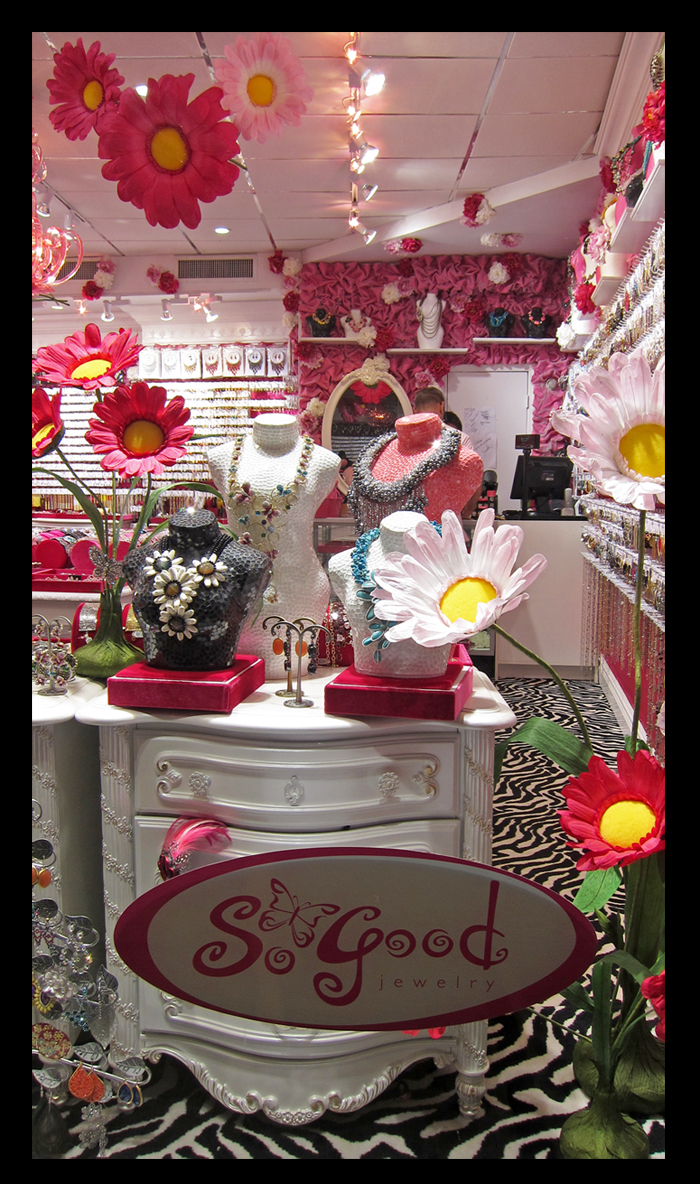
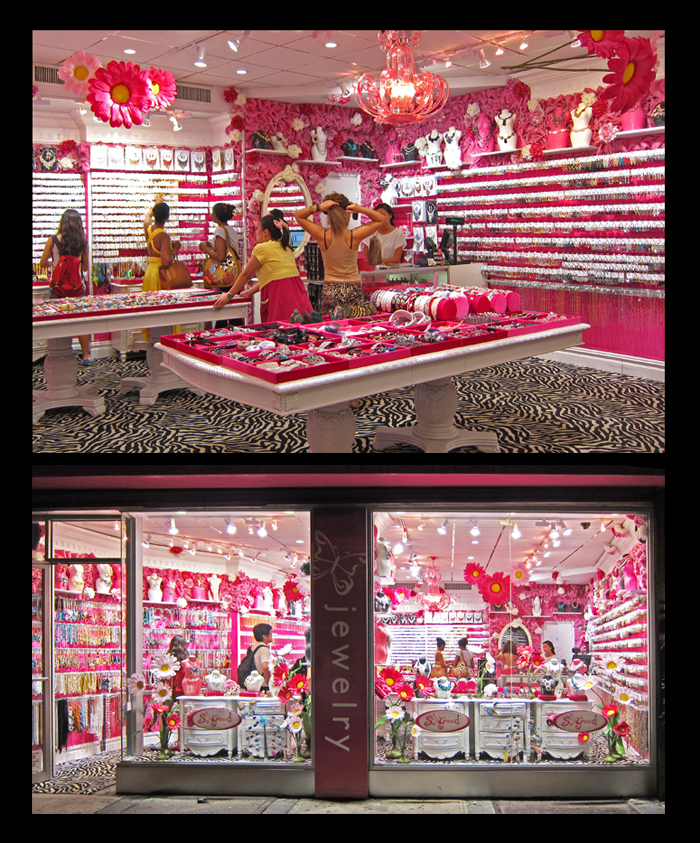
    I think So Good Jewelry must be using magnesium to light their stores. They are BRIGHT.  When I say bright, I don’t mean what you think may be bright. I mean magnesium so bright that it burns the retina and wakes the dead. For photographers, this place is a perfect tutorial for overexposure. Walking down 4th Street at night, I was astounded by the brightness. The place beamed me in.

    Did you ever notice how bright fluorescent lights in delis late at night are not flattering? I find that they bring out the alien green in me. In the event that there is a mirror somewhere, it is a supreme battle to deflect my eyes, lest I discover that I, too, can scare children. There are, however, a small number of people that are so gorgeous that no light is unflattering. These must be the women who shop in the bright lights of So Good Jewelry, at 184 West 4th Street in the West Village.

    But there is more than bright going on here. There is PINK. Lots and lots of pink in a decor that is over-the-top, super cute, and extremely kitschy. But none of this is a death knell. It is a runaway success. Part of the secret is to be unabashed and unapologetic, like Dolly Parton. Take the extreme and run with it. It is when you hold back a little, knowing that perhaps you are a little too cutesy. No, build a shrine to pink and bright. Make it So Bad, it becomes So Good.

    It must work. Located in cities around the United States (and Australia), the place seems to be a success. Reading online, reviews appear to be very favorable towards their line of costume jewelry. The chain is Korean-owned, masters of bling.

    While browsing and taking photos, I saw a woman with a bow in her hand, apparently unable to attach it properly to her hair. In the ultimate endorsement, she said, “It doesn’t stay, but it makes me happy.” I was happy to visit the shop. It really was So Good, because it was there that I learned what must be the key to financial success in these trying times: Have plenty of pink, and don’t buy gold, buy magnesium 🙂

    Fashion Note: More Birds of a Feather Tied Together (see Part 1 here).

    Related Posts: Fashion Trash, La Vie En Rose, A Colorful Life, Soho Treasures


  • I Doubt It

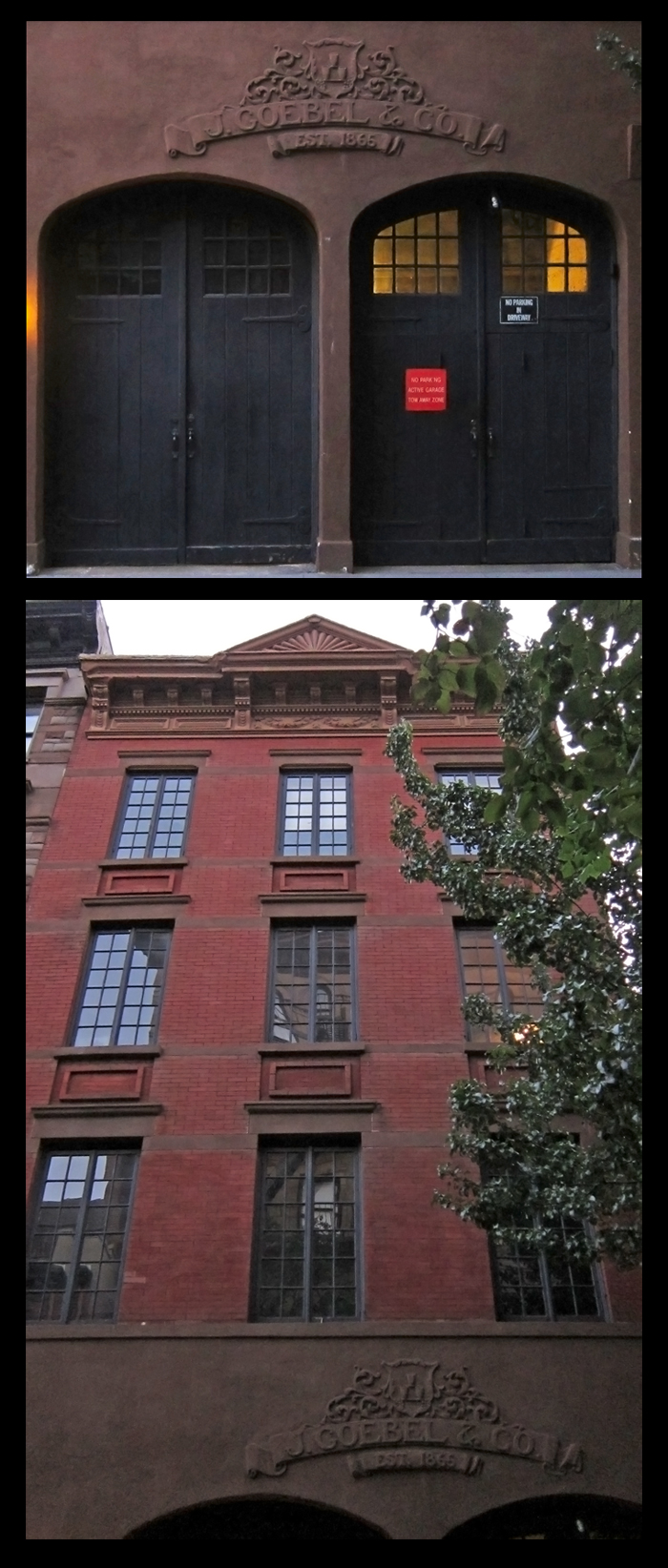
    The story behind 95 Bedford Street is befuddled. Not astounding, really, because no one wants to do primary research anymore. Actual pieces of information, misinformation, conjecture, and extrapolation are all blended together. Pieces are copied and recopied. Variants on all these mixings can be found everywhere. Good luck sorting them out.

    Take this simple historic building at 95 Bedford Street in the West Village. The AIA guide says:

    Originally J. Goebel & Company, 95 Bedford St., between Barrow and Grove Sts. W. Side. 1894. Kurzer an& Kohl.  A stable once used by a wine company, as the lettering on the facade clearly indicates; converted into apartments in 1927.

    I don’t know much about wine, but if they are referring to the 3 vessels in the logo, I believe they are crucibles. From Refining Metal Waste, published in 1940, we have a reference:

    J. Goebel & Co., (crucibles, tongs, fluxes, furnaces, casting equipment) 95 Bedford St., New York.


    The building is engraved 1865. How is that related to 1894? Perhaps the business was founded in 1865?
    I did find a book, Metal Industry, which indicates a location of J.Goebel at 67 Cortlandt Street.

    One website says:

    At 95 is a ground-floor former stables belonging to J. Goebel & Co., whose name and symbol is still displayed above the entrance. The 3 cups are appropriate, since he operated a crucible in the building.

    I don’t think he operated a crucible. I believe they manufactured crucibles.

    Yet another site says:

    This beautiful edifice on 95 Bedford Street, marks the former home of J. Goebal & Co., a factory that produced crucibles–containers for holding molten glass–founded in 1865. Notice the three glasses in the edifice design.

    I would guess that the three “glasses” are crucibles. However, crucibles are often used to melt other materials, and “containers for holding molten glass” appears to be just conjecture.

    From New York Songlines, we have:

    The AIA Guide describes this building as being built as stables in 1894, later serving as a winery before becoming apartments in 1927. A neighbor describes this as “hogwash,” however, saying that the building was actually built by J. Goebel & Company as a factory for crucibles–containers for holding molten glass. Apparently the basement is still full of them.

    After reading numerous websites and a few manuscripts, I am still not certain if this building is dated 1894 or 1865, if Goebel was a wine company, if the logo shows glasses or crucibles, or if this building was a former stable and when. Who will do the leg work and sort all this out?  Does anyone care besides Christopher Gray*?  I doubt it.

    *Christopher Gray is a journalist and architectural historian noted for his column in the New York Times, Streetscapes, about the history of New York architecture and real estate. He is the founder of the Office for Metropolitan History, which provides research on the history of New York buildings.

    Other West Village Posts: Friends Pt. 2, Friends Pt. 1, Zena, Buzz and Bling, Itsy Bitsy, Conflicted, McNulty’s, Nuance, Parfumerie, Abingdon Square, Night Out, Paris in New York, 121 Charles, Gay Liberation Monument, Chocolate Bar, 17 Grove Street, Rubyfruit Bar and Grill, Grove Court, The Garden at Saint Lukes, Cherry Lane Theater, Hess Estate Triangle, Jane Jacobs


  • Read Between the Lines

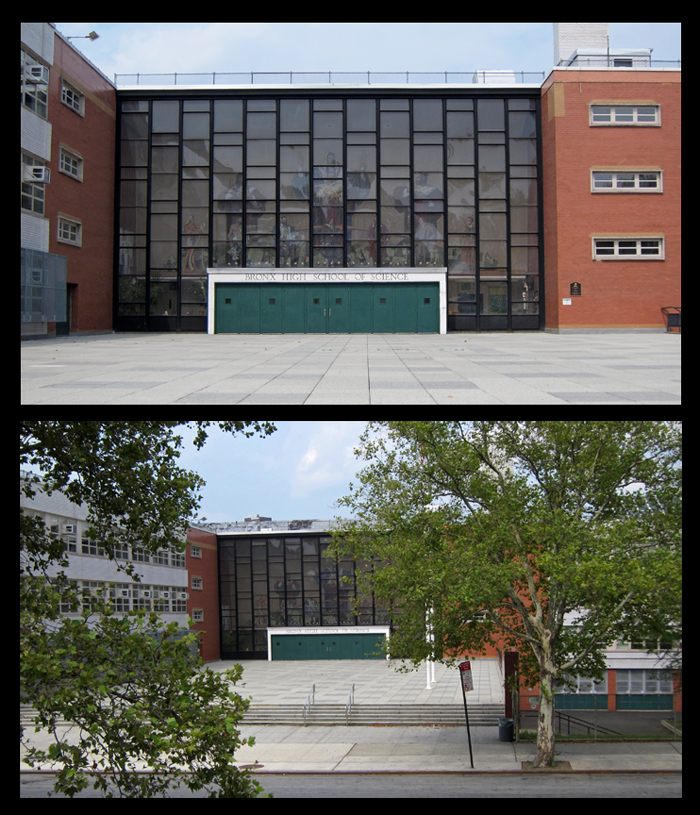
    We had the grounds to ourselves – there literally was not one other person in sight. The city block that fronted the school was entirely free of cars – always worrisome. In New York City, the appearance of numerous legal parking spots (or an entire streets worth) is a warning sign – this typically means you have misinterpreted the signs. I reread the street parking signs carefully several times before parking.

    But on an oppressive, hot, humid Sunday in August, it is understandable that no one is touring a place with all the charm of a prison yard. Nondescript, uninviting, institutional. The grass and trees that were there just seemed to highlight the inhospitable nature of the concrete accretion. A large mural graces the entrance lobby behind the green doors, but I did not even find this to be particularly attractive.
    However, don’t judge this book by its cover.

    Virtually every New Yorker knows the prestigious triumvirate of specialized science high schools for gifted children: Bronx High School of Science, Stuyvesant High School, and Brooklyn Technical High School. I have had a number of friends, acquaintances, and employees who are graduates of these schools. My office manager for 15 years as well as her husband and most of her friends were alumni of Stuyvesant, while my current office manager is a graduate of Bronx Science. One does become spoiled working with young people like this – typically astute, quick, and very smart.

    Admission to these schools is based on an entrance examination, the Specialized High Schools Admissions Test (SHSAT), which is open to all eighth and ninth grade New York City students. Out of the 26,000 students taking the entrance examination each year, only about 700 are admitted to Bronx Science.

    Looking at this place, it seems unimaginable that anything of merit takes place behind those doors. However, Bronx Science is internationally known as one of the best high schools in the United States, public or private. The school is culturally, ethnically, and economically diverse. Seven graduates have won Nobel Prizes, more than from any other secondary education institution in the United States. Six have won Pulitzer Prizes. The school has had 132 finalists in the Intel (formerly Westinghouse) Science Talent Search, the largest number from any high school.

    I expected genius to be oozing from the corridors, but my office manager assures me that school there was like any other – with cliques, gangs, and everything else that typifies high school. In New York City, where Content is King, places like Bronx Science require of us not only to not judge a book by its cover but also, once inside its pages, to go even deeper and read between the lines 🙂

    Related Posts: Little Red, got math?, Keuffel and Esser, Kids


  • The Envoy Motel

    My first big family trip was to Washington, D.C. at the time of the Cherry Blossom Festival. This was also the first large city I was to explore and a major event that greatly influenced my desire to move to New York. Though only 12 years old, I had planned the trip, itinerary, and accommodations and even navigated the driving. I had mailed for brochures and maps and had searched our local library. I was so excited.

    The choice was the Envoy Motel on New York Avenue – how predictive. I recall arriving at the motel and my sisters jumping up and down on the bed with glee. It was the first time we had stayed in a motel or hotel, and this luxury called for indulgence and jubilation. We had no idea as to whether this was the Waldorf Astoria Hotel or a dump, and as children, it mattered not. One of the joys of being a child or being around them is the enjoyment of simple pleasures and immersion in the world without pretense.

    Back at home, for a short time, we had a small plastic pool, much like that in the photo. But it was not inflatable and setting up was a bit of a project, so when our parents agreed to do so, it was a big event. To us, this cheap vinyl pool, barely deep enough to submerge ourselves, was a great source of summer joy. I would watch my young sisters splashing and frolicking about like it was an event in a full-size Olympic pool.

    Recently, while exploring Queens, I stopped to visit a small community park on a hill in Woodside. This was strictly a local park – nothing of note to a visitor, just neighboring residents on a hot summer day. This was not the world of the very affluent with country homes or summers in the Hamptons. This is the real New York of the working class and how the vast majority live their lives and spend their summers. Many city dwellers have no air-conditioning, and there is little respite from from the oppressive summer heat.

    But make no mistake. For the children playing, the joys appeared to be the same as swimming in an Olympic-sized pool or summering in the Hamptons. And I know they would love a room at the Envoy Motel 🙂


  • Unforgiving, Ye Who Enter Here


    I recall seeing physicist Michio Kaku speaking against nuclear power after the Three Mile Island incident. His central argument was that the risk was too great and that nuclear power was an UNFORGIVING technology. Whether or not someone agrees with his assessment, in a world where forgiveness is the hallmark of the loving person, unforgiving is a very powerful word.

    Life is a fragile business, and nothing illustrates that more than living in New York City. Better have all your ducks in row or you will will find yourself on the street rapidly – New York City is an unforgiving environment. I’ve written numerous times about this city’s revolving door nature. They come and they go – only the hardy survive the Sieve of Darwin.

    It is remarkable that such a place as New York City could feel like home to anyone. There is opportunity to make a nest here and have intimate relations with neighbors and merchants. One can find places to relax, even experience nature’s bounty. I seek these respites from urban assault and have featured many of these places in these pages. It is a great city, and there are many great and generous people. But there is a decided edge here, and all these things require work. Dwanna learned that very quickly, and Duffy explained what was needed quite well.

    However, a seasoned New Yorker’s antenna is always up and radar active. I have been conditioned at a core level and permanently rewired. I can fall asleep on a park bench or the subway, but the carrying strap of my bag is woven through crossed arms. I do occasionally walk at night alone on quiet streets, ever wary of those around me. Yes, New York is much safer now, but make no mistake, crime exists in large numbers. In 2010 there were 536 murders, 1,370 rapes, 19,359 robberies, 17,054 assaults, 18,695 burglaries and 38,136 grand larcenies. I lock my car doors everywhere I go, even in a driveway in the suburbs. Even with doors locked, many have returned to their vehicles to be rewarded with an Urban Coral Atoll and No Radio.

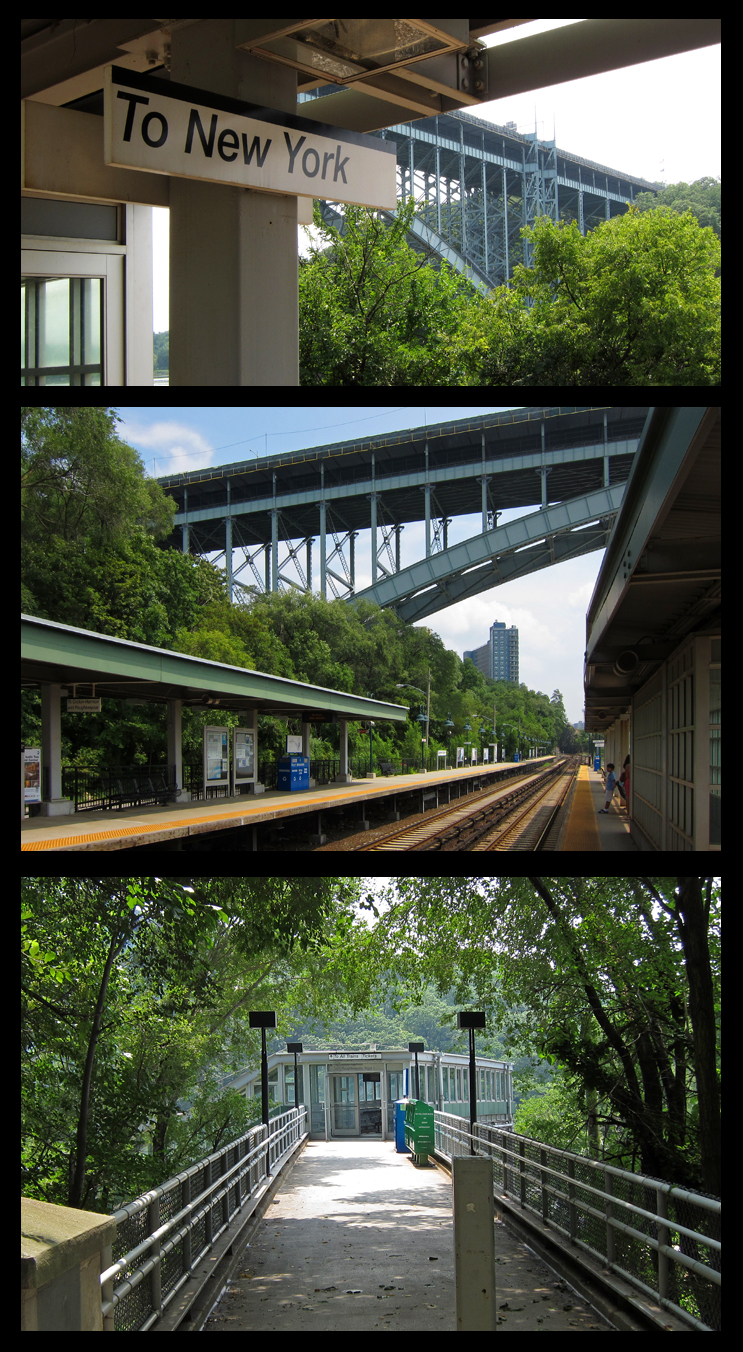
    Here on the Metro-North in the Bronx at the Spuyten Duyvil stop on a hot humid Sunday with virtually no one in sight, I caught this sign framed against the Henry Hudson Bridge spanning Spuyten Duyvil creek to Manhattan. To New York it says – a sight I have seen often. To me, it means home. But it also a warning sign: Unforgiving, Ye Who Enter Here

    Related Posts: Steaming Masses of New York, Afraid of Snakes, Jungle Lovers


  • Mzuri Sings

    Have you ever been assaulted by greatness or arrested by talent? In a city where greatness is everywhere you look, one must use superlatives sparingly, lest one robs them completely of any meaning. But everywhere you look, excellence abounds, often hidden behind unassuming exteriors. It may be a homeless person versed on every subject imaginable, or a man so eccentric-looking he literally stops traffic but has a Ph.D in music composition from Columbia University (see Part 1 here).

    Perhaps you have spent summers on park benches with Dave, a gentle, kind and humble man who, you learn only on his deathbed, has two doctorates in pharmacology. We chat often with a physicist who regularly spends evenings on a park bench, as does park architect George Vellonakis.  I once found myself staring in awe at a man who not only played guitar well but learned to play a lap steel on his first encounter, only to learn that the man was Will Galison – a well-known musician who has a Wikipedia entry and has played with greats such as Barbra Streisand.

    These encounters have inspired me to write series of stories with themes such as Abandon All Preconceived Notions Ye Who Enter Here, Only in New York, and Meetings With Remarkable Men.

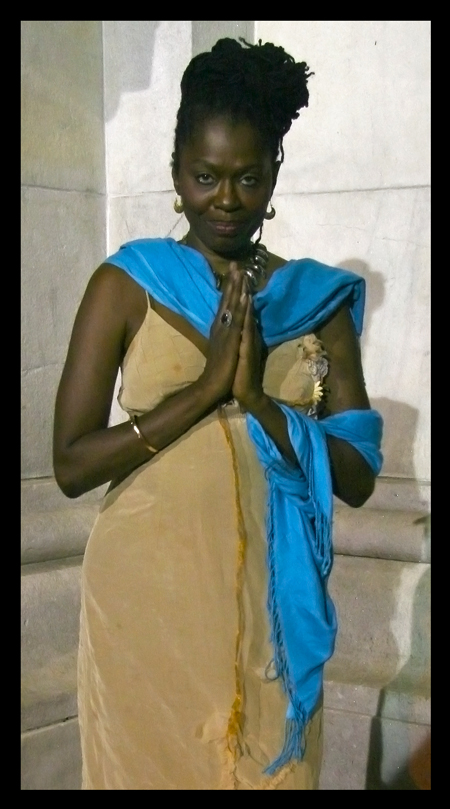
    Last weekend, an unknown woman dropped by Washington Square Park very late on a quiet Sunday night. I met her eating a salad, sitting elegantly on the granite benches with her agent, Lisa Williams. I had seen her sing the previous Friday and was enthusiastic about speaking to her personally.
    I introduced her to Scott Samuels, the reigning guitar wizard of Washington Square. There was a feeding frenzy within moments as virtually everyone in hearing radius scurried to see what the winds of good fortune had blown in. In an extraordinary coup d’etat, park regulars were treated to a number of classics, sung by Mzuri Moyo and accompanied by Scotty:

    We love beatitudes and platitudes, simplifying life’s complexity – sayings such as you can’t have it all. For those who believe such a myth, meet Mzuri Moyo, a woman who has talent, charm and great looks. Her sincere delivery was transparent to all, and every song was met with cheers and whistling.

    Lorraine Theresa Pope was born in Passaic, New Jersey, and was a graduate of Eastside High School, known for its transformation in the mid-1980s under the leadership of principal Joe Clark (the school and Clark were the subject of the 1989 film Lean on Me, starring Morgan Freeman). Mzuri is a Registered Nurse, a field she worked in for 6 years.

    Mzuri speaks of her family:
    I have 2 brothers. I am the oldest. My oldest brother is very musical he writes and sings. He wrote one of the songs on my Christmas CD, I’ll Be Home For Christmas. The title of the song is Maybe We’ll Find Christmas Love. My father was a painter and he loved music. He was  a distant cousin to James Brown. My mother had a beautiful voice – she sang in the church choir.

    Her influences:
    The greatest influence on my life is having lived in Europe, traveling to Africa and Asia, and meeting all kinds of people. That is why I relate to everyone when I’m singing I feel them and I feel as though they are a part of me.

    Her goals and aspirations:
    My goal is to keep music and my artistic ability honest and to make a great living at it. I also would like to bring peace and love into the world with the music I sing. I love yoga. I am a vegetarian. I love languages – I speak a little French and Spanish.

    From her website:
    A writer since childhood, Mzuri has performed in a variety of venues including colleges and universities. Her recent concert debut at Lincoln Center was widely acclaimed. In 2002, Mzuri won the Audelco Award for Best solo performance. A star of both stage and film, a critic once wrote of her, “when Ms. Mzuri sings, God smiles, and angels flap their wings.”

    In this one-woman show, Mzuri presents… Ms. Fannie Lou Hamer, up close and personal. This presentation in word and song, captures a little known but very important moment in history and lays it at your feet.

    Make no assumptions. Investigate closely. Don’t move through the New York City streets so quickly that you miss an opportunity to be arrested by talent when someone like Mzuri sings 🙂

    See Mzuri’s website and additional performances here and here.


  • Signs Were All Around Us

    One of my best friends is a Brooklyn-born Jew turned Christian. How he got there is a long story, perhaps for another time and place. We have a long history, he knows my position, and although he does not proselytize, we do often discuss religion.

    On one occasion, we spoke generally of whether or not I believe in God. I said that essentially, I am agnostic, and that I would like to believe, but I so wish for a sign, any sign at all. He responded that the signs are all around us and that I just don’t see them. I am sure there are signs, but are they really from God or a product of one’s mind?

    These types of theological questions have been asked for millennia, and answers have been thought through and articulated to the point where discussions like this become rather formulaic.

    On a recent day trip with my aforementioned friend, we were making our way towards Floyd Bennett Field and Dead Horse Bay via the Belt Parkway. We briefly pulled into a small turn out area to describe to our fellow travelers the activities that can sometimes be seen here, such as kite flying.

    Upon leaving, I was struck by the appearance of a Hasidic Jew on the roadside combing the area. This type of stark contrast of orthodox religious clothing, particularly on a summer day, though not uncommon, is always startling. On the hottest of Saturdays in Borough Park, Brooklyn, orthodox Jews can be seen strolling fully clothed in black pants, long sleeved shirts, and wool hats.

    As we sped away, I regretted not having stopped quickly and asking what this man was looking for. It seems that we were all searching that day and signs were all around us

    Related Posts: Christ is Risen, Toches ahfen tish, Explorin’ Part 1, Come Together, With All Due Respect, We Got Religion, Sense of Humor, Botánica, Salat


  • dinamic_sidebar 4 none

©2026 New York Daily Photo Entries (RSS) and Comments (RSS)  Raindrops Theme