• Deaf Jam


    Some years ago, I learned of a harmonica festival in New Jersey. This was to be a major event and I was very excited. The schedule was noon to midnight – a full twelve hours of the top players in the country with legends such as Jason Ricci and Howard Levy. Upon arriving, however, my companion and I were greeted with recorded music that was LOUD. So loud that we feared that we would actually have to leave before any performances even began. Desperate, I suggested that we ball up pieces of paper napkins and put them in our ears. It was so uncool, but we survived.

    Following the festival, I discussed my experience with a working musician, who said that excessive sound levels were common and often the fault of the sound crew, even against the wishes of the performers. Regardless of where the fault lies, LOUD and very loud seems to be part of the milieu of amplified music in performance. The most disturbing thing, however, was that in speaking to rock musicians, all admitted to noise induced hearing loss.

    I am happy to report, however, that in my experience, I see a change in climate, and the stereotypical self destructive lifestyle of the musician is not necessarily a badge of honor. Awareness is growing of the irreparable damage done to hearing by excessive noise.

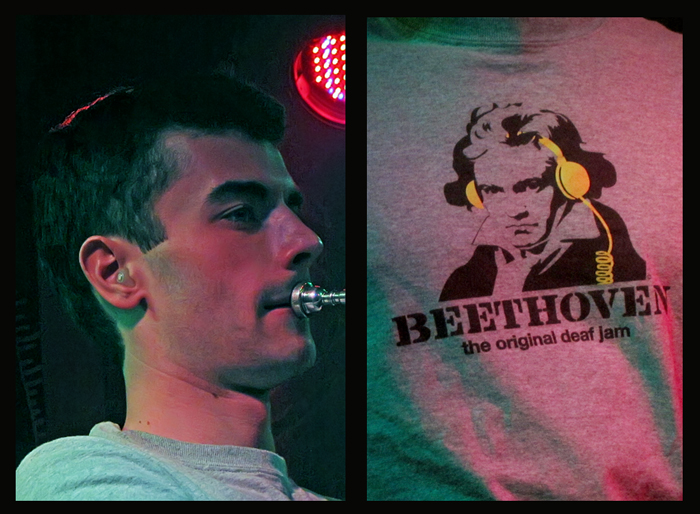
    Recently, I visited Shrine NYC, a music club located in Harlem. During the performance of the Body Electric Afrofunk Band, I moved up to the group’s staging area. I noticed that nearly all the musicians had hearing protectors. I had a good line of sight to the trumpet player, Will Healy, whose ear can be seen in today’s photo.
    Last night I called Will to discuss this. The conversation was short – Will was celebrating his 21st birthday. He did tell me that he had already suffered some hearing loss and was working with Dunshaw, an audiology center in New York City. Dunshaw Audiology and Hearing customizes musician earplugs – an actual impression of the ear is taken and custom molds made.

    This morning, I spoke to Dr. Rhee Rosenman AuD, an audiologist at Dunshaw. I learned many things in our conversation, including the fact that the use of portable music devices like the iPod, at full volume, can deliver 100 db of noise – equivalent to an industrial environment or loud live music. Playing portable devices at full volume is common in New York in order to effectively mitigate ambient noise. This practice will result in hearing loss. Dunshaw works with many musicians and their specialized musician earplugs can attenuate sound by 25 db, but still allow music to be heard clearly with no muffling.

    Early in the performance of the Body Electric, I also noticed Will’s t-shirt with its very clever and ironic tagline: Beethoven – the original deaf jam*. Many things can be learned from Beethoven, and one is that there is no romance in loss of hearing – it is one of the great tragedies that befell this man, one of the greatest composers of all time. By the premiere of his Ninth Symphony, he was completely deaf. During the end of his performance, he had to be turned around to see the tumultuous applause of the audience – hearing nothing, he cried. Sadly, it was the Original Deaf Jam 🙁

    *Deaf used here is a play the older slang term, def, to describe a person or thing that is cool.

  • This Way for a Recharge ->

    To say that electrical power is the backbone of modern industrial society is really an understatement. The world as we know it would grind to a halt without it. Our dependance on electricity only grows with technology leading the way.

    As I write this, I am listening to a YouTube video with a musician playing electric guitar, delivered over the Internet on a laptop, in a room illuminated by an electric light bulb. I am charging a number of portable electrical devices over the ConEd grid. Electrical power and devices permeate our world to such an extent that it is impossible to stand outside it and assess its importance. In New York, public transportation is critical and our subways also run electrically.

    In the world of human interactions, we often speak using words such as chemistry, with electricity as the ultimate metaphor to characterize positive current between people. The electricity generated by the friction of humans rubbing together is one of the biggest lures of New York City. Without the dynamism and synergy of its people, what do we have?

    If you are seeking this type of energy, both literal and metaphorical, human and technological, perhaps no place in the United States better delivers the voltage then midtown Manhattan. This is the electrical generator that powers New York City and where most visitors first start to be properly charged.

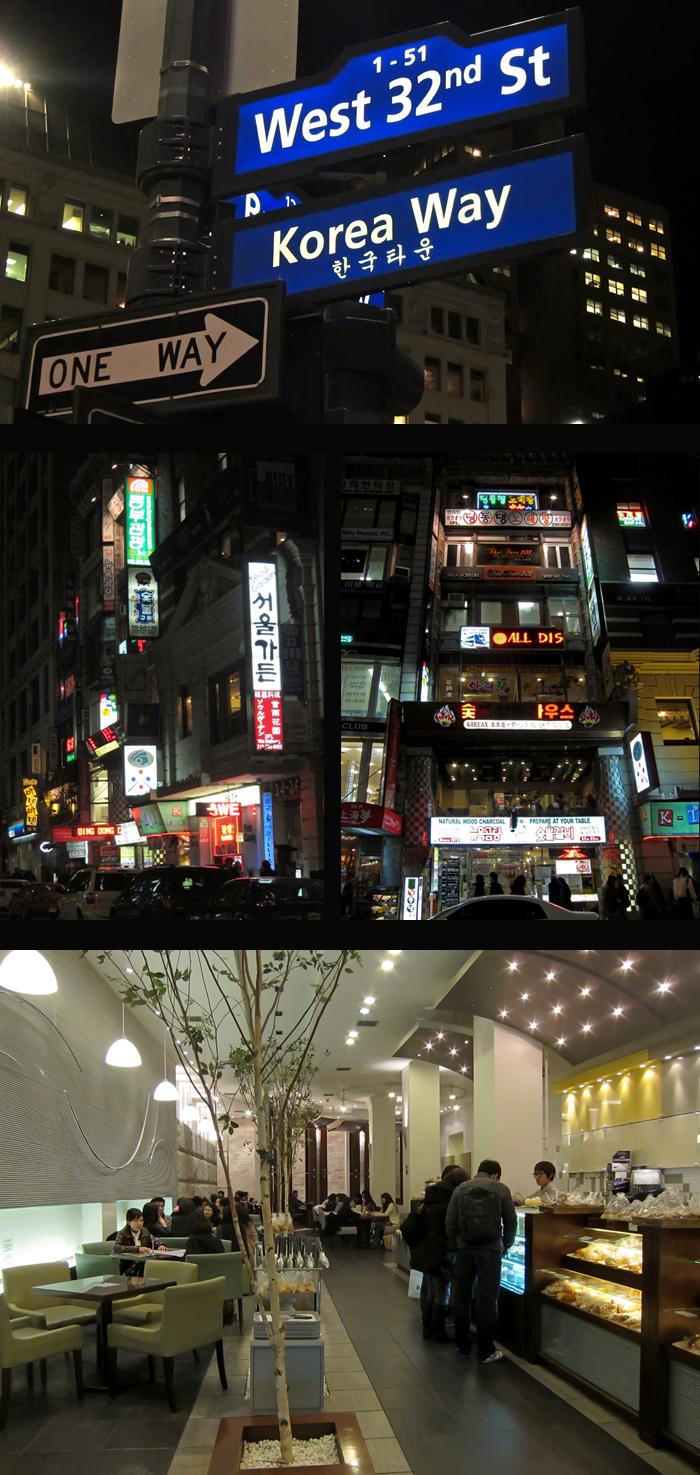
    One of most important things that electrical power has brought mankind is the ability to illuminate our world at night and make possible a 24-hour city. Koreatown is one of the best examples of this in the entire five boroughs. This neighborhood extends from 31st to 36th Streets between Fifth Avenue and Sixth Avenues with 32nd Street as its central artery. It’s a 24 hour extravaganza.
    Here you will find all things Korean – restaurants, tea shops, grocery stores, hair and nail salons, spas, karaoke clubs, internet cafes, banks, and hotels. In the late 1970s, the redevelopment of West 32nd Street was led by Korean business owners – in 1995, Broadway between West 31st and 32nd was officially named Korea Way.

    New York City is home to over 200,000 Korean-Americans – the second largest population outside Korea. Koreatown in Manhattan, is however, largely a commercial/business district with very few residents, although the residential population is growing (the largest Korean residential community is located in Flushing, Queens). K-Town, Manhattan, is attractive to the international business community and ideally suited to a growing number who want to live in Midtown. And those who just want to be energized know that it’s this way for a recharge ->


  • Nice Move, Kid

    I was sweating bullets. It was the road test for my driver’s license, I was 16, and this was the major right of passage into a future of independence and adulthood. There were the responsibilities of driving a motor vehicle with the inherent risks of bodily harm to oneself and others, but most important to a teenager, you now had wheels. And that meant a new found freedom. As long as you had access to a vehicle, of course.

    A road test at that time in the suburbs was remarkably simple, virtually a formality. The expectation was that one would pass unless otherwise proven incompetent. My test consisted of driving a couple roads, a simple turn, and parking in a wide open lot on return.

    However, this still was a major event, and it would be a tragedy to fail. When my examiner asked for a simple right turn, I drove over the curb. His response is engraved in my mind, and I sometimes still hear it to this day: “Nice move, kid.”
    He might as well have said, “Step out, you’re finished.” The rest of the very short road test was trying to live through the embarrassment and humiliation. Upon my return to Motor Vehicles, my instructor told me to go inside the office. He left without saying whether I had passed or failed. I assumed someone inside would be the harbinger of bad news. At the counter, I asked if I had failed. The clerk appeared perplexed and said that she was only told to process my license. Apparently examiners allowed for extreme nervousness.

    Fortunately, parallel parking was not part of the exam. This is a skill that many living outside a city never learn or need to. I have watched many visitors to New York City try to parallel park in a very roomy spot, yet leave in frustration after repeated failed attempts to get in.

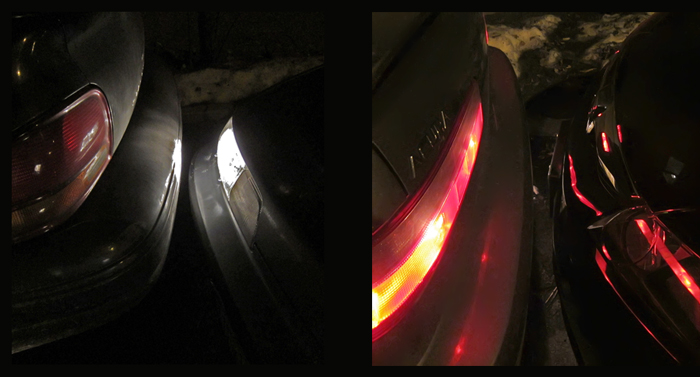
    On a recent journey to Brooklyn, I had great difficulty finding a parking spot. The only thing available within blocks of my destination was a spot so tight that there was only an inch or two of additional space over the length of my car. But duty called. In these tight spots, the first cut you make steering is critical. The rest is finessing mixed with tedium. In a parking space this tight, gentle bumping the other vehicles with every move forward and back is required. Regardless of how gentle you are, best the owners of the neighboring cars are not there to witness this process.

    More extreme circumstances arise where no spot large enough can be found. Can you park in a spot shorter than your vehicle? Yes. I have seen large heavy cars park in spaces like this by pushing and moving cars in front and in back with each iteration as they wedged themselves in.

    A honed skill at parallel parking brings street cred and bespeaks of a seasoned New Yorker. Get it right with a perfect first cut, a minimum of jockeying, and leaving your car within inches of the curb, and perhaps you will hear from an observer what I once did, but without the sarcasm – “Nice Move, Kid.” 🙂


  • Not An Office


    A hamlet is a rural settlement that is considered too small to be a village. One distinction often made is that a hamlet does not have a church, whereas a village does. These details trouble me not, because I love hamlets and small villages. In England, the countryside abounds with small towns, villages, and hamlets, some so picturesque as to be incredulous. Places like Snowshill in the Cotswolds.
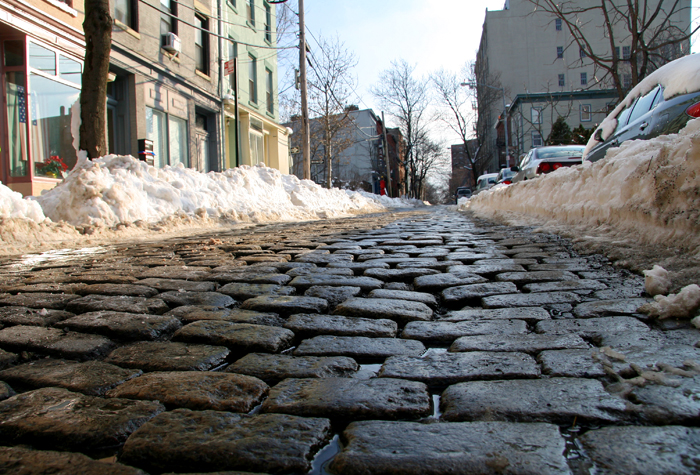
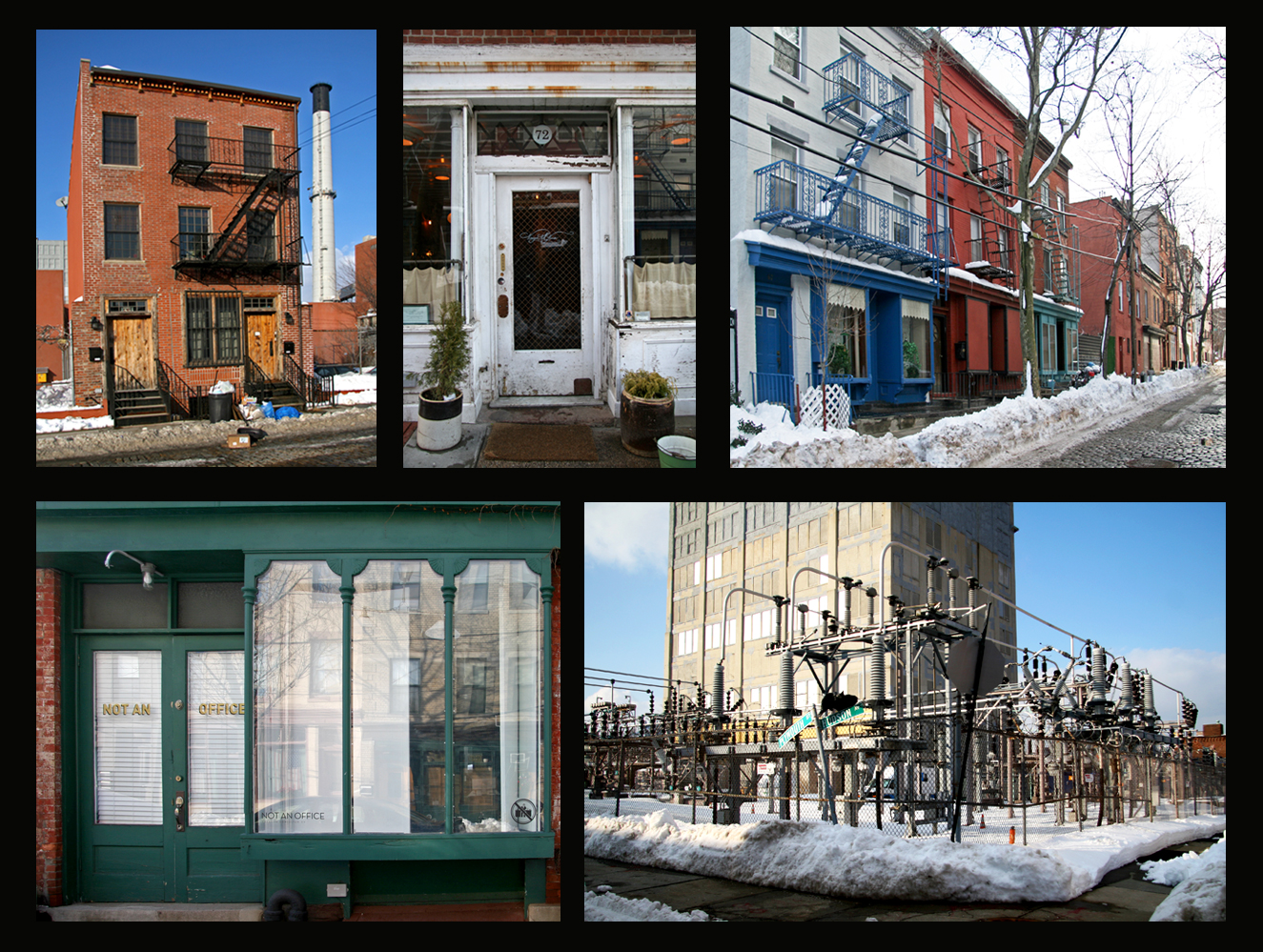
    However, I have never heard of anything in the confines of New York City referred to as a hamlet until I read an article in the New York Times about Vinegar Hill, Brooklyn. The very concept seems insane until you travel to this tiny enclave, only a few blocks in size, with cobblestone streets paved in Belgian Brick. See my full photo gallery here.

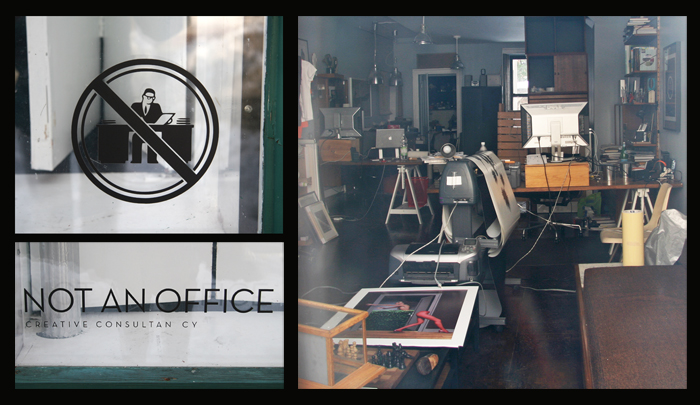
    The neighborhood is bounded by Bridge Street, the Brooklyn Navy Yard, York Street, and the river. The main thoroughfare is Hudson Avenue. There are virtually no shops, and one restaurant is open in the evening. At 54 Hudson, I ran across a business that identified itself as Not An Office. Peeking into the window, I did see evidence of a some sort of workplace.
    In spite of the snowfall, the neighborhood did exude charm, and I can easily see how some would be attracted to this place, which abuts Dumbo and the East River, only one stop from Manhattan on the F train.

    In 2010, the New York Times ran an article about Vinegar Hill called “The Little Town That Prices (Almost) Forgot.” Some readers were furious with all manner of accusations in the comments section, e.g. that the article would ruin the neighborhood and that the Times staff was out of touch with pricing.
    I think articles are more of a barometer of trends and messenger than trendsetters. Anyone investigating the area carefully will realize this place is going to appeal to very few – the serious dearth of services and high prices of real estate there will be a deal breaker for nearly all who chose to live in a city.

    Vinegar Hill feels almost like a hamlet. Almost, until you notice that the neighborhood is circumscribed by the Brooklyn Navy Yard, an huge Con Ed power generating plant, and the BQE (Brooklyn Queens Expressway). But this is New York City, and Vinegar Hill comes awfully close to a hamlet. It has no church, only one restaurant, and just when you think you have located a business, you find that it’s Not An Office 🙂


  • Big Secret on Little Street

    Streets, surprises, and secrets come in different sizes. What better combination is there than a big surprise and secret at the end of a little street? And what if that street is literally named Little Street?
    There is nothing wrong with the beautiful or wonderful that lies in plain view. But somehow it’s the secret discovery that really piques one’s interest and makes it even more special and its secretness feel like it is yours.

    When traveling in Europe, I was often astounded when finding major historical sites located in the midst of contemporary suburban settings. This is common there and, I imagine, is not seen as particularly shocking. When I first visited Versailles, I could not get over the experience of driving through an ordinary town, turning down a street, and seeing something as extraordinary as the palace of Versailles. Or the windmill in the neighborhood of Montmartre in Paris.

    One does get inured to the juxtapositions one lives among, and here, too, in New York City, I tend to overlook the outstanding architecture that I see daily – period homes dating 200 years old intermingled with buildings of every imaginable style and period. This city has a rich historical past, and the evidence is everywhere to be seen. 

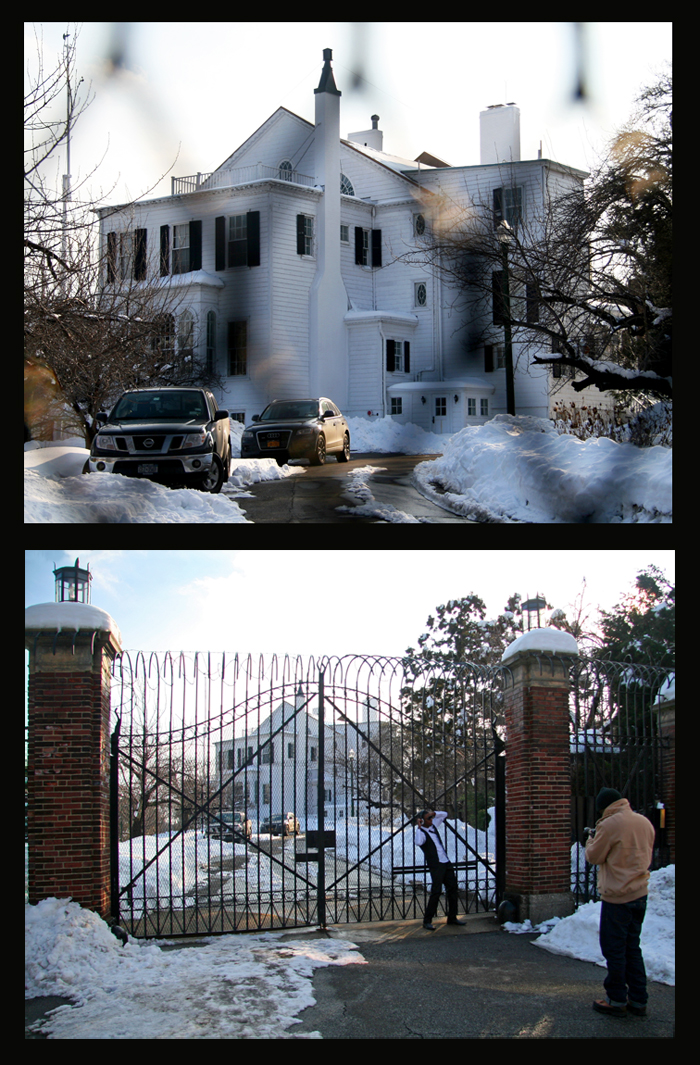
    While carousing through Vinegar Hill, Brooklyn, I plied my way to what appeared on my map to be the outer limits of the neighborhood. I was quite shocked to make a final turn from Evans Street at Little Street and be confronted with a gated mansion. A photographer and male model were busy at work, using this little known cul de sac as backdrop for their photo session. These streets abut the Brooklyn Navy Yard and the large white Federal style residence is Quarters A, the former residence of the commander of the Brooklyn Navy Yard, home to Commodore Matthew C. Perry at the time of his opening of Japan. In 2006, Christopher Gray did a story on the home in Streetscapes for the New York Times. From the article:

    In a New York of secret delights, the Commandant’s House at the Brooklyn Navy Yard is a secret secret. Built early in the 19th century, the big white house, formally known as Quarters A, is the yard’s oldest surviving structure, with exquisite Federal-style detailing.

    In private ownership since the Navy Yard closed in 1964, the three-story house can be glimpsed only in bits and pieces — over walls, through gardens and, distantly, past high gates. Its broad lawn offers a summer fantasy above the East River.

    Just don’t spread the news – that in Vinegar Hill, at the end of Evans Street, there’s a Big Secret on (a) Little Street 🙂


  • Zero Minutes!


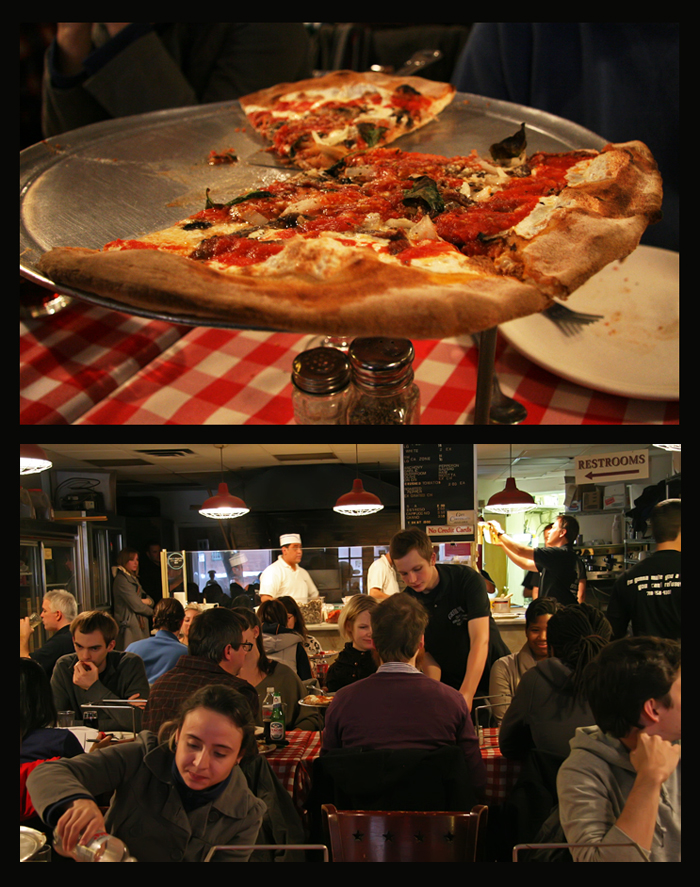
    Nothing can live up to years of expectation. I avoided going to Grimaldi’s Pizzeria for eons, knowing that LINES were what it was best known for. Hours in line.

    Recently, however, I had a plan to explore Vinegar Hill, Brooklyn, and schedule things around what I hoped would be the deadest time of day – the “lull” between lunch and dinner – 3:30 to 4 PM felt just about right. And better on a winter day, i.e., not a warm day (particularly not on a weekend in the summer). This formula worked well for my visit to Totonno’s and Di Fara, two other legendary pizza emporiums in Brooklyn. I have been told that both have tremendous lines in warmer weather, as does John’s in Manhattan (see Roots of Pizza here). Grimaldi’s is one of New York City’s few coal-fired brick-oven pizza parlors (John’s on Bleecker Street is also.

    When you have this kind of following in New York City, like it or not, they set the terms and conditions. The signs on the door clearly proclaim the no nonsense attitude: “TAKE OUT IS THE SAME LINE” and “NO SLICES” “CASH ONLY.” This type of scenario was well parodied on the TV series Seinfeld in an episode called the Soup Nazi. Perhaps signs and policies like this may seem a bit harsh, but in New York City, mayhem would ensue were strict ground rules not enacted.

    The pizza was excellent – much better than I expected from a place that was so highly trafficked, touristed, and written about. Legacy businesses like this can easily thrive on name alone with deterioration of product or food quality. There are naysayers, of course, many of them just wanting to show their New York City culinary expertise. But do not be deterred. Along worth so many awards and accolades, the Zagat restaurant survey rates Grimaldi’s as one of the top pizzerias in New York City. If you can avoid enormous lines, it is worth the visit. The location is quite scenic – at 19 Fulton Street, under the Brooklyn Bridge, steps from the East River and Fulton Ferry landing.

    A New Yorker is often as or more elated with tales of successful navigation or mitigation of typical, known obstacles. I’m not sure what was better – the pizza or my timing coup: Date: January 30, 2011. Day of Week: Sunday. Time of Day: 3:37 PM. Wait in line: Zero Minutes!


  • Pecking for Pita

    On April 27, 2010, I wrote Tired of Crumbs about the plight of many street performers and other independent artists. However, for many other members of the animal kingdom, crumbs are more than a metaphor, and living off the discards of others is literally the means of survival. In a city with as large a population as New York, the amount of refuse disposed is enormous, affording life support for many.

    A lover of Middle Eastern food, I was pleased to have the good fortune to run into Damascus Bakery while strolling through the Vinegar Hill neighborhood of Brooklyn. It was Sunday, so the business operation was closed, however, just outside the factory, there were a large number of pigeons busy atop dumpsters covered with heavy tarps. They seemed particularly industrious, and I had suspicions as to what was going on. Lifting up a corner of one tarp revealed exactly what I expected – the dumpster was entirely filled with pita bread, all polybagged, which I assume had been disposed of for a good reason.

    The pigeons were undaunted by the tarp and had successfully pecked holes through it and the plastic bags holding the pita. Perhaps not as dramatic as the Hawk Fest I witnessed on my window ledge in 2007, but nonetheless, this was a food fest.

    Damascus Bakeries is a 3rd generation business, currently run by Edward Mafoud, grandson of Hassan Halaby, who started the business on Atlantic Avenue in 1930 and introduced Syrian bread, aka pita, to America. In addition to a variety of flavors and sizes of pita, the bakery also produces Lavash Wraps, Panini, and Roll Ups. I hope to visit and tour their factory in the future.

    In New York City there are many means of survival. At the corner of Gold and Water Streets in Brooklyn, for these pigeons, it’s Pecking for Pita 🙂


  • Number 1

    The title of the book was so unusual, that I still see the words on the spine sitting in my library: Horary Numerology of the Turf.
    For the gambler or, if you prefer, the person who enjoys the occasional wager, New York City has not been devoid of betting opportunities, licit or illicit. Off Track Betting was legalized in 1970, and in time, hundreds of betting parlors dotted the city (in December of 2010, the entire business operation closed). And although not on the hit list of most tourists or residents, the city is also home to a major race track: Aqueduct in Ozone Park, Queens, serviced by its own subway stop on the A train. It is a convenient, affordable, and pleasant way to spend a sunny afternoon.

    For a brief time I became very interested in horse handicapping, driven by my interest in mathematics and lured, like others, by the “easy money.” I foolishly believed that somehow the entire endeavor could be stripped of any horse hide and reduced to numbers, akin to the dream of many investors with approaches like Elliot Wave theory, Fibonacci series etc. I was never a gambler at heart, so my interests remained more academic, driven by the challenge of finding a credible method to gain some advantage. My attendance at the racetrack was very infrequent and betting even less so.

    My library of books on handicapping horses ran the gamut, but certainly the most intriguing and arcane was that volume, Horary Numerology of the Turf, by Rosajo, published and printed in 1979 in India. The book had a look and feel of biblical authority. I am sorry to report, however, that Rosajo’s treatise was not a key to the promised land, and I soon learned that although a beatable game, betting horses was far from easy money, and the few that were successful invested their lives. Andrew Beyer was one of these.*

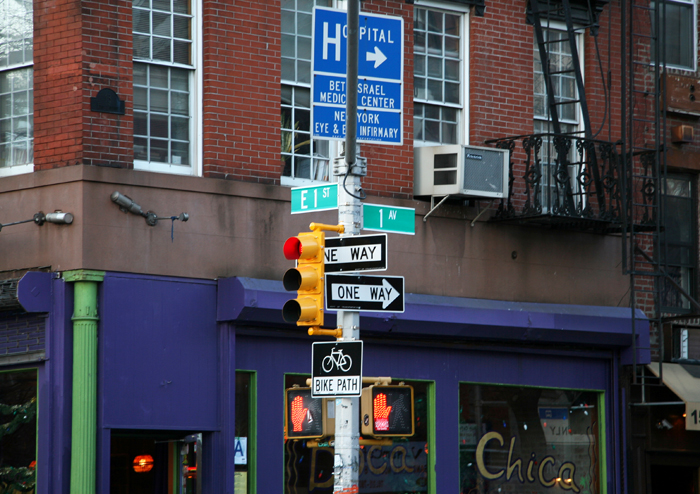
    My interest in numbers has become eclipsed by other life concerns and much more casual, piqued at idle moments, most often when confronted with the numbers of New York City, such as subways lines or the streets. There are only 12 avenues in Manhattan, hence, there are 12 possibilities of intersections where the number of an avenue and street could be the same. And, in fact, there are only two such intersections: 1st Avenue and 1st Street and 2nd Avenue and 2nd Street.

    I normally hate waiting for traffic lights in the city – I feel like each one steals 60, 90, or 120 seconds of my life. But here, at 1st and 1st, I can spend the time pondering the meaning or usefulness of the number 1. The unitary, solitary, and primary significance of the number one always makes me pause and take notice when I am at this intersection. Let’s see – both the first letter of Aqueduct and the A train stopping there share the first letter of the alphabet. Perhaps I should look at the the first race for horse number 1 🙂

    *In 1975, Beyer authored Picking Winners: A Horseplayer’s Guide.
    Beyer, a Harvard graduate and syndicated columnist since 1978, was, however, not a man with a casual interest in racing. He became interested when he was 12 years old. Many consider him to be the most important and best handicapper in America, with a rare, if not singular, ability to have profited consistently betting on the ponies using numbers. His once proprietary edge, now the Beyer Speed Figures, have become an industry standard, are incorporated into the odds – they are no longer adequate for beating the races.


  • View Master

    I grew up with very few photographic images of any sort. We had no coffee table or travel books and few magazines. And, of course, we had no PCs or Internet, so moving images were limited to TV and movies. Our television reception was limited to 3 networks, one of which did not come in well at all. Programming was rather mundane from an imaging perspective – there was no Travel or Discovery Channel. There was no videotapes or DVDs. On rare occasion, we went to a movie theater or drive-in (see With Six You Get Eggroll here).

    There were a few family vacations to scenic destinations and the occasional family Sunday afternoon drive in the country. There was certainly nothing locally.

    Primarily, we had imagination, the world children live in, and it was a ripe fertile ground for me when growing up. And I had a View-Master.
    The only memory I have of any inspiring photos were those from a set of paper disks for my View-Master, with its remarkable stereo 3D images. I never tired of this small device and its ability to awe me with those three dimensional photos. Our collection of disks was small, and I remember viewing them repeatedly, particularly the disk of Switzerland and its alpine wonders.

    The occasional movie, such as Heidi with Shirley Temple, did much to cement my impressions of Switzerland as the dream alpine destination, only to be fulfilled much later in life on a whirlwind tour of Europe. In the 1980s, I made a number of trips to the West Indies, where I always looked for tropical mountains, explaining my obsession with the island of Dominica, as I wrote about in Miracles In Our Midst (see Part 2 here). It was always mountains and vistas – best, of course, were mountain vistas.

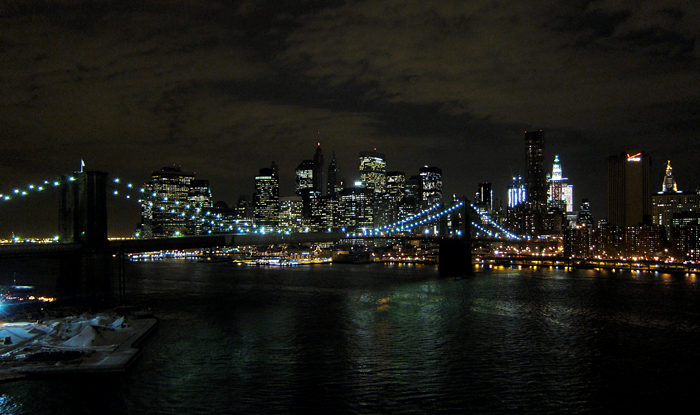
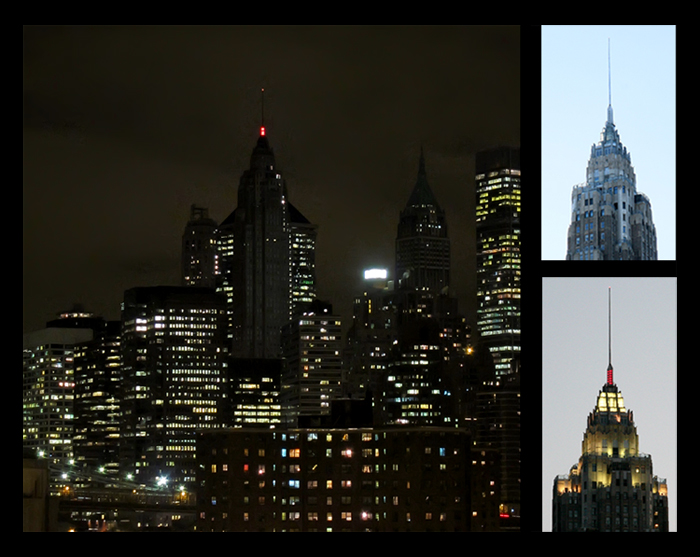
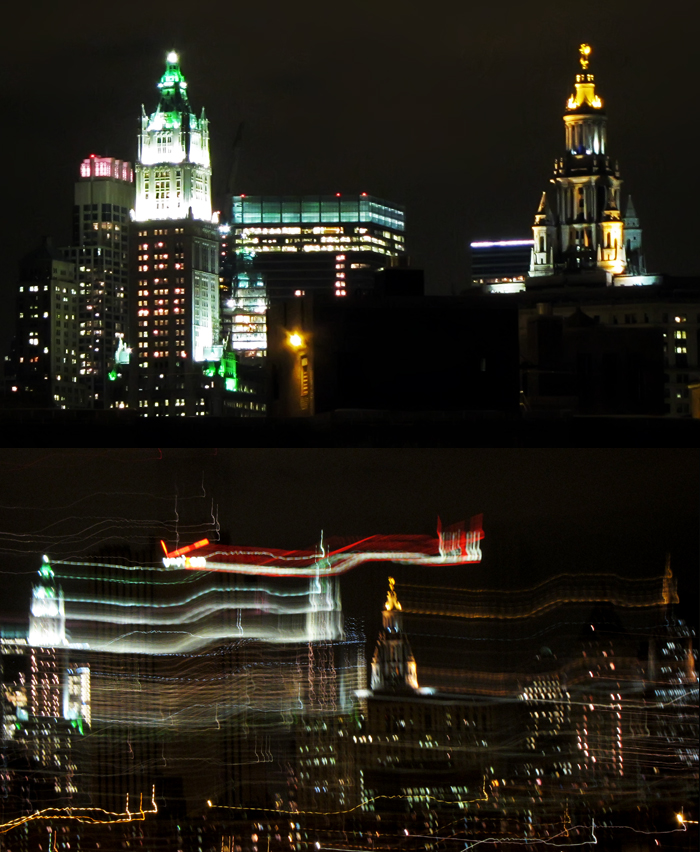
    On my recent excursion via the Manhattan Bridge to photograph the enigmatic 110 York Street, I decided to proceed across to the Brooklyn side, looping around and returning to Manhattan via the footpath on the south side of the bridge, affording spectacular views of the East River, Brooklyn Bridge, South Street Seaport, the Municipal and Woolworth buildings, and the financial district (see more photos here) with the American International Building and its mountain motif (see Magic Mountain here). If you enjoy panoramas, I do recommend a walk or bike ride across the Manhattan Bridge by day or night. You won’t need your View-Master 🙂


  • New York Rockies

    110 York Street – Part 2 (See Part 1 here.) (see complete photo gallery here)

    For years, on return trips home from Brooklyn to Manhattan via the Manhattan Bridge, I have observed this rooftop structure both by day and night. I promised myself that one day I would get to the bottom of this – a literal pursuit since this structure was atop a building located in Brooklyn, meaning I would literally have to venture down and explore under the Manhattan Bridge.
    What was particularly compelling about it was the four exposed white steel truss system on the roof of the building which was illuminated at night, bathed in blues, greens, purples, and reds.
    Recently, this came up in conversation with someone familiar with the structure – he told me that it was occupied by architects and located on York Street. This rekindled my interest to bring this mystery to a close. On my first excursion, I did a cursory drive-by to confirm its location – 110 York Street.

    On Sunday, I made a trip to Vinegar Hill, Brooklyn, with the intent of returning to Manhattan by foot over the Manhattan Bridge and taking a series of photos. I intended to time my afternoon so that I would cross the bridge after dark when the rooftop was illuminated. My return, however, was too early.
    But I was on a mission, and I decided that I would return the following day after work when dark to cross the bridge again by foot. I had a burning desire and intention with my own mantra: Neither snow, nor rain, nor ice, nor gloom of night stays this courageous ambassador from the swift completion of his appointed rounds.*
    There was snow and ice and gloom of night. But was I courageous?

    There are two pedestrian pathways on the Manhattan Bridge – the one the north side is for bicycles – this is the side I needed to view the York Street building. However, a chain link fence obstructs a clear line of sight most of the way, so I found it necessary to climb and stand on a railing for the taking of photos. The roar and vibration of vehicles and the elevated subway was bad enough, but worse was having to use two hands to stabilize the camera while balancing atop a 4″ wide steel railing which may or may not have been icy. See this in better detail at my photo gallery here.

    The building at 110 York Street serves as the offices for a number of construction firms and, most notably, Robert Scarano Architects, who originally occupied the top floor of this 100-year-old former factory building in Vinegar Hill. For a needed expansion, a 5,200-square-foot rooftop two story addition was designed by a member of the Scarano firm, Dedy Blaustein. The addition was completed in 2005. The lights used are a Color Kinetics LED system.

    Blaustein’s inspiration for the rooftop structure was the bridge: “We’re not the main thing here,” he says, gesturing toward the bridge. “That is the main thing here. It’s so dynamic. I had to do something crazy.” Some have referred to it as the “Jetsons Building.” In response to critics, he said: “I didn’t design it for people to like it, I designed it for people not to be able to ignore it.” The project received a 2005 Design Award from Metal Architecture magazine and a 2005 Certificate of Appreciation from the Brooklyn AIA. From the Sarano website:

    The Manhattan Bridge is the most visibly striking element of the site, running parallel to it only 20 feet away. For this reason, we designed an exposed steel truss system for the skeleton to intensify the dialogue between the structures. The design embodies a strong sense of dynamics. The structural axis is separated from the building exterior finish, providing a sense of movement, which is enhanced by the flying roof, sharp angles, and horizontal texture on the surface.

    My affair has finally come to a close. I feel quite worn, perhaps not unlike the mountain climber who finally tastes the bittersweet success of arriving at the summit. Driven by an illuminated outline not unlike that drawn by a friend to describe the mountains of Colorado (see Part 1), I found this journey’s end at 110 York Street in the foothills of the New York Rockies…

    *The original seen on the General Post Office building reads:
    “Neither snow, nor rain, nor heat, nor gloom of night stays these courageous couriers from the swift completion of their appointed rounds.”
    The sentence appears in the works of Herodotus, describing the expedition of the Greeks against the Persians under Cyrus, about 500 B.C.
    Note: The firm of Robert Sarano is the subject of much controversy – both acclaim and official censure. Robert Sarano is a New York City native, born in Brooklyn. He became a registered architect and started his own firm, Scarano Architects PLLC, in 1985. His academic credentials and awards are many. The firm has been responsible for over 600 buildings in New York City. However, sometimes referred to as the bad boy of architecture, Sarano has also seen a loss of self-certification privileges, loss of filing privileges, numerous lawsuits, and worker deaths on 3 of his projects and has been charged with violation of zoning or building codes on 25 projects in Brooklyn.


  • New York Rockies

    ColoradoPart 1 (see Part 2 here)

    I do so love the mountains, and here, in New York City, unlike perhaps San Francisco (a mountain lover’s dream city), I must make do with the skyscrapers of glass and steel. ‘Tis better, I suppose, than the lowlands of Holland. But it pales in comparison to the experience of the American West. I journeyed there in the early 1970s for the first time by car. I cannot imagine a more compelling road trip than going west by auto.

    Before leaving, I discussed my trip with a close friend who vividly described what I would see. “Do you know the way you drew mountains as a kid?” He illustrated with his finger in the air a typical jagged outline. “That’s what it will look like.” “As you drive through Colorado, it will be flat. And suddenly, the Rockies will pop up.” The whole image of a child’s jagged outline and mountains popping into view was burned in my mind forever.

    And it was all true. As we drove through eastern Colorado, the landscape was no different than the flats of Kansas which we had spent a day passing through. Heat waves rose from the road and landscape in a classic mirage. I squinted for hours for those Rocky Mountains, only to find an my eyes fooled in one way or another. It became very tiring. Then there appeared the faintest mountain outline, which did not disappear, but only grew in size, jagged and dramatic beyond belief.
    The first night, the wind howled in the trees with a certain sound only heard in the mountains. I still listen for that sound. Everything was so big and grand. Colorado was everything John Denver had promised in his song Rocky Mountain High.

    We examined our maps the next morning for the steepest roads, the ones marked dangerous for what I assumed would offer the most dramatic views. We navigated the narrowest, most precipitous two lane mountain roads I have ever seen. The unobstructed views through crisp clean air were absolutely astonishing. It seemed unbelievable that motorists would even be allowed to travel such roads at altitudes over 10,000 feet – one tiny error in judgement, and it was sayonara.

    More remarkable was our conversation that night with two fellow campers who were Colorado residents. When we expressed our harrowing but exciting journey of the day, they only laughed as they told how they enjoyed riding at night, driving as fast as possible on the most treacherous of roads. To me, this was sheer lunacy. Not only did one have to contend with serpentine roads and hairpin turns, but Colorado was also PITCH BLACK at night – there were no street lights in those mountains. I certainly was a risk taker, but this couple was truly out of their minds.

    We journeyed on through Wyoming, Oregon, and California that summer in a 30-day, 10,000 mile trip. To this date, it was the longest I have been away from New York City since 1970. For the resident here, spending long periods away from the city really gives a new, fresh perspective. Returning from that trip, I could see and feel its gritty, dirty, and very hard character. The mountains of Manhattan were different now.

    On November 5, 2007, I wrote Magic Mountain, about the American International Building: “It is famous for its motif of a snow-capped mountain – the base of the building is clad in granite while the upper portion, clad in limestone, becomes lighter in color until one reaches the very top, where it is white.” The upper and lower right photos are from that story. A bit of the Rockies, popping up from the canyon floor of lower Manhattan.

    But the night vista from the Manhattan Bridge in today’s photo was not the reason I went on a journey as a Mountain Man, high in the New York Rockies…


  • Pure Chocolate

    My family members are savers – the classic, thrifty New Englanders who waste nothing, where the third R of the waste management triangle, Recycle, was virtually unknown because the first two (Reduce, Reuse) were maximized as much as humanly possible. We wear shoes too small or keep them in the closet in perpetuity (see One Size Too Small here.)
    My father grew up picking potatoes and cutting wood in Maine, often in subzero temperatures. Even to this day, everything he does is defined by an extreme sense of survival. I have seen him scrape burnt toast and clean and fold aluminum foil for reuse.

    In our home, for chocolate milk, we had Nestle’s Quik, not Bosco or Nutella. I have a suspicion that this choice was driven both by compulsive neatness, another hallmark of many a spartan, Shaker-like New England household and the idea that it is easier to extract every last gram of powder from a can than syrup from a bottle. My father would watch our Nestle’s Quik mixing ritual with a very keen eye. Regardless of how vigorously we stirred, there would always be some residue at the bottom of the glass. He would shake his head and in the most disapproving tone would say, “Look at that. Pure chocolate.”

    To this day, on the occasions that I may have some dessert or beverage with chocolate sauce, memories of Nestle’s Quik give me some agita, even in New York City where there is enormous waste. If every citizen practiced the most careful, frugal lifestyle, the sheer size of this metropolis still turns everything into a big thing, be it snow removal, traffic, or the volume of trash. New York City produces an extraordinary 12,000 tons of garbage daily.

    Seeing all the goods in this city, along with all the trash, does give the sense that to be in New York is to live in the horn of plenty. Even the underprivileged or homeless will do better here than in a less populated environment. There are outreach programs, soup kitchens, shelters, and just lots for the picking in the streets of the city. When offered food, I have seen many homeless ask what it is before accepting. On Wednesday nights in Washington Square Park, a Christian group brings free food. But I have seen many homeless turn down food offers from them, saying that they were either full or did not appear interested in the selection. I am not extolling the benefits of the homeless life nor diminishing its hardships. But opportunity is much greater in New York to get by.

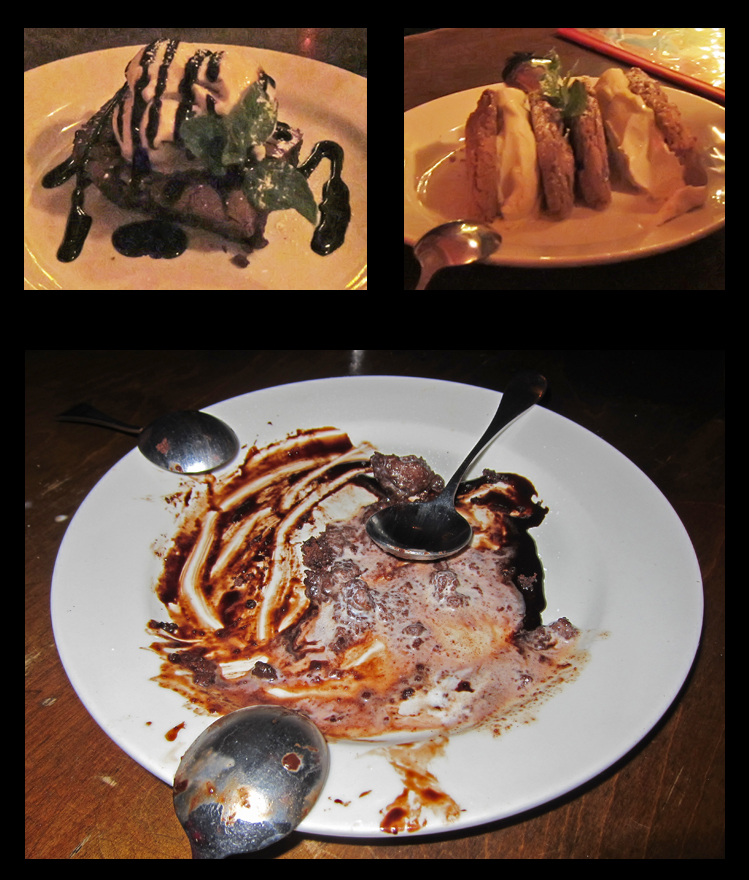
    Recently, I celebrated a friend’s birthday at Mud. The desserts are a little pricey but excellent. Three of us shared two desserts with chocolate sauce. As you can see from the photographic evidence, we did a respectable job of finishing what was served. However, looking at the finished plate with a scrutinizing eye, one can hear a haunting voice that says, “Look at that. Pure Chocolate” 🙂


  • The Perfect Gift

    In 1978, High Tech: The Industrial Style and Source Book for The Home, written by design journalists Joan Kron and Suzanne Slesin, was published. This and White By Design were two hardcover coffee table books that I frequently saw in bookstores and promised myself I would buy but never did. The raison d’etre of the Hi Tech design movement is seen as an evolution of the scientific and technical advances of the 1970s and abundance of high-tech devices in common use, leading to the appropriation of industrial and technical products in the home. The book was seminal and influential in use of the term Hi Tech – read more about it here.

    As a manufacturer for many decades, I found the use of the Hi Tech products in the home to be appealing for other reasons as well – the generally superior construction and cleaner, simpler design of industrial or commercial products. Those who use products in a commercial environment typically value function over form and durability over anything else. The foolishness of saving a few dollars purchasing equipment quickly becomes apparent when having to stop the wheels of production. Someone in business simply needs products that work well and reliably. And although aesthetics does not typically drive the design of commercial equipment, it does evolve towards the simplest form and construction that does the job properly. Often, this design becomes iconic and attractive from a minimalist perspective. One example is the bullet styled garbage can in stainless steel.

    Industrial elements have other appeals. Around New York City, in the outer fringes and edges, one will often find photo shoots with fashion models superimposed over gritty or industrial urban backdrops. The juxtaposition of the very disparate elements is quite effective in making the subject stand out.

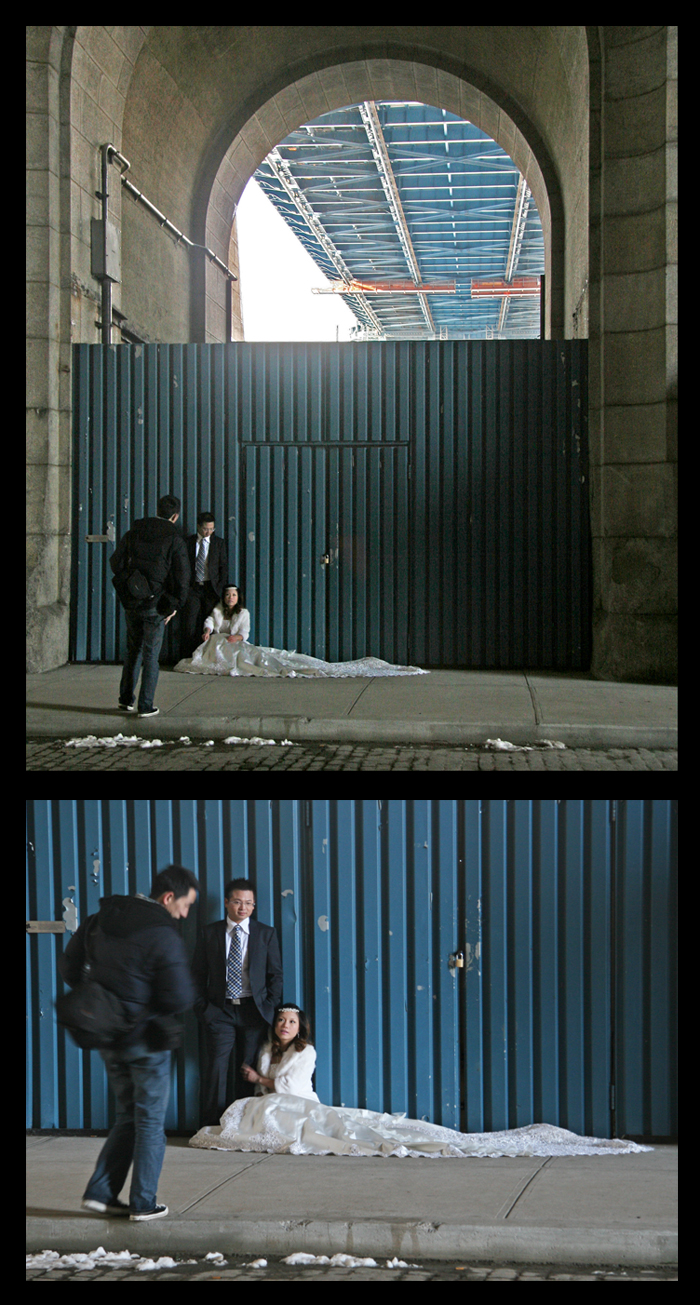
    All this considered, I was stunned to see the couple in today’s photos under the Manhattan Bridge on a freezing cold January day. The wedding is still a rather traditional affair, and this was an extremely radical departure from the ever popular New York City locales used for wedding photo shoots, such as Central Park on a beautiful spring or summer day.

    I wish I was friends with this couple because I have such the perfect wedding gift that I really think they would love: a set of two books – Hi Tech and White by Design 🙂

    Note: For more White by Design, go here and here.


  • Anywhere You Go

    Perhaps my sister should have understood that getting in a car with me means that you had better have your body function requirements taken care of, or be met with a very disagreeable man when requests to stop are made. Actually, it would have been better had she not stepped into a car with me at all. But alas, that was not the case, and in 1998, five family members found ourselves crammed together in a small car for a 10-day road trip to France. On November 12, 2009, I wrote about this family trip in Montmartre and Peillon.

    One day while driving, I heard the usual cry from the bathroom admiration society. However, this was France, not the USA. I was on a divided highway. I saw a petrol station some distance ahead on the opposite side of the road with no apparent way to get there. Or let us fairly say that there was no great motivation to get there. I pulled over and contemplated the logistics of crossing this roadway and the unpleasant prospect of making an unnecessary detour and stop.

    While evaluating the situation curbside in our idling vehicle, a woman in a nearby private residence came out of her home and asked if we needed help. In the best French we could muster, we told her thanks, but we needed a bathroom and wanted to know if the petrol station had public bathrooms and how to get there. Unbelievably, this woman offered her home and escorted my mother and two sisters in.

    We were stunned, and to this day, I retell this tale often. Where were the rude, impolite French we had heard about? Answer: The same place they are anywhere – lying inside reasonable people, only to surface when provoked by someone rude who does not understand their culture and etiquette. Americans often behave quite badly, expecting everything to be like home, as I wrote in So Where’s David?
    This was not an isolated event. Even in Paris, I had people battling to give me the right directions. Everywhere I went, when approaching others with respect, I was treated respectfully.

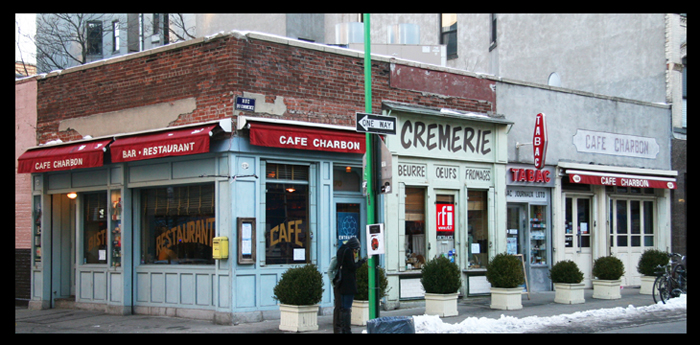
    When I saw Cafe Charbon-Epicerie at 170 Orchard Street in the Lower East Side of New York City, I was immediately charmed by the recreated Parisian street scene with faux storefronts, including a Cremerie and Tabac. This French bistro’s reviews, however, are as mixed as the travel experience to France. I skimmed hundreds of patron and food critic reviews which range the extremes of the spectrum. There were some extraordinarily negative experiences – many said that it was the worst service they have had in a New York City restaurant.

    After nearly a decade, Cafe Charbon is closing, a place where perhaps rudeness came naturally or fuses were short. Some people are just more polite or have a higher tolerance for abuse, like our friend Winnie (see here and here). But rather than seek out places or people where rude service comes naturally, like our friend in So Where’s David?, sharpen your skills provoking people, and you can find rude service anywhere you go 🙂


  • White By Design 3


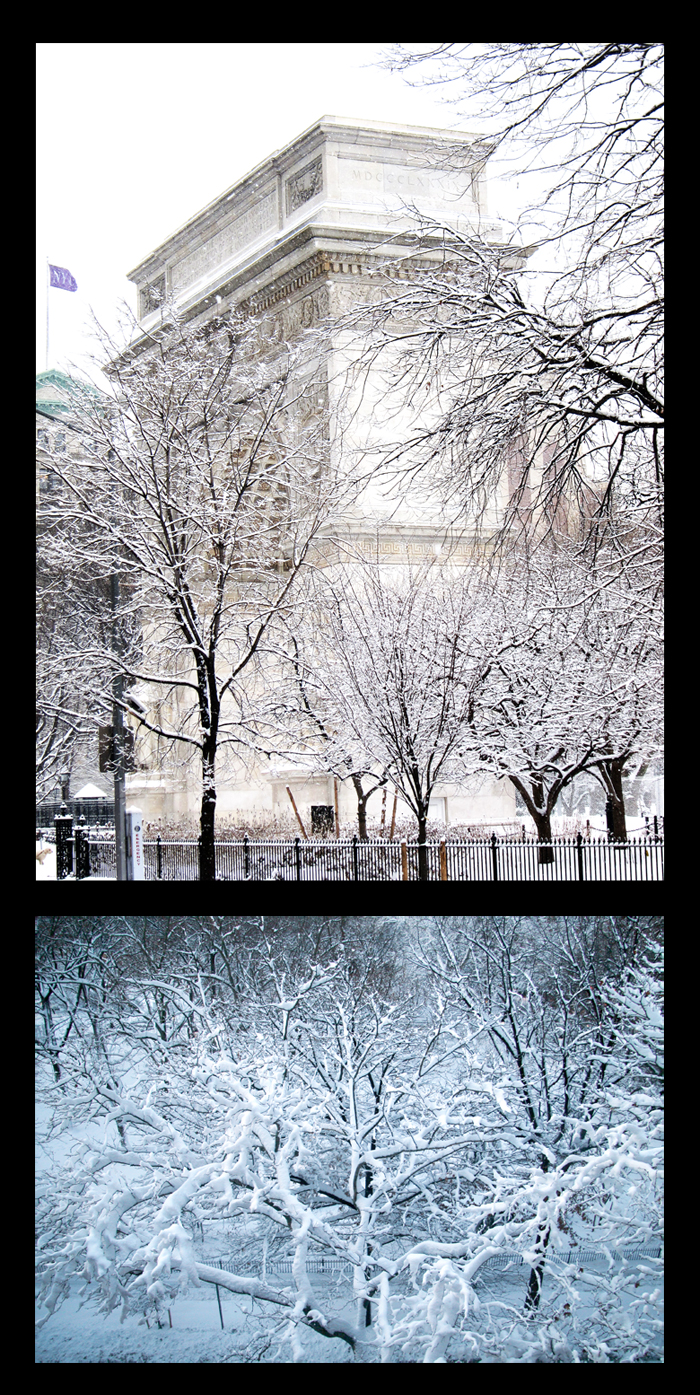
    Another blizzard. Last night I was called at midnight and informed there was a major snowfight going on in Washington Square Park. I was too lazy to bundle up and venture out for the photo op. However, I did begin taking photos yesterday, going into last night and into this morning.

    I have done many stories on this winter’s blizzards and past snowstorms in New York City. I have also done a series of stories called White By Design. See the links below.

    White By Design, White By Design 2, White By Desire, Blizzard, Friends P1, Friends P2, We Got Skiing Too, Shifting Gears, Snow Play, In Like a Lion, Gotta Shoot Village Cigars, Slush Fun


  • dinamic_sidebar 4 none

©2026 New York Daily Photo Entries (RSS) and Comments (RSS)  Raindrops Theme