• Sittin’ on Top of the World

    Manhattan has a coordinated traffic signal system. Avenues run north/south and are generally one way, like the majority of crosstown streets. These avenues have traffic lights that are timed progressively so that traffic can move without stopping. In theory. The lights move in a wave – a green wave of about 5 lights traveling below speed limit, sandwiched between red lights behind and in front of this green wave. Driving these avenues is urban surfing – wait for a wave, catch the wave, ride the wave as long as possible, and don’t get caught in the soup. I have often ridden a wave like this for miles down an avenue.

    On other major avenues that are two way, such as Park Avenue, Central Park West, and 11th and 12th Avenues, lights are timed to change simultaneously. This means that the faster you go, the more lights you can make before stopping.

    I drove a taxi in college, as did nearly all of my best friends. On one occasion, the wildest driver of the bunch asked me how many blocks I could make on Park Avenue. I believe he said he could make somewhere in the vicinity of 27 blocks. Without going through the mathematics, I can assure you – that is some fast driving on city streets, somewhere in the neighborhood of at least 60 miles per hour. Unfortunately, a few of us took this as a challenge, later comparing results. Fortunately, there were no fatalities in this short-lived reckless contest.
    The speed limit in Manhattan is 30 mph. Traveling at 60 plus miles per hour on crowded city streets is lunacy. The reason for high auto insurance for those under 25 is abundantly clear.

    Today’s photo was taken looking north from the last Park Avenue mall. The small park extends from 96th to 97th streets, where the Metro North train tracks emerge from underground to travel on an elevated trestle along Park Avenue. Looking at this now, I realize that I could have challenged my college friend to see if, in French Connection style*, he could outrun a commuter train.

    I, however, will keep away from all temptation that Park Avenue may offer, opting instead for First or Second Avenue with the gentle waves of the progressive lights, where, with good conditions, I can catch a wave and ride it all the way. That thrill makes me feel like the ultimate Beach Boy, because in New York City, if you can catch a wave and ride it all the way, you feel like you’re really sittin’ on top of the world* 🙂

    *The French Connection (1971) has what many consider of the greatest car chase scenes ever filmed. The chase was between a hitman on an out-of-control train on an elevated section of a subway line in Bensonhurst, Brooklyn, and a police officer in a car on the streets below the train. Most of the chase sequence was real and filmed without permission from the city of New York. It includes an accidental car crash, which was left in the film.

    *From the Beach Boys song Catch a Wave, with the refrain: “Catch a wave and you’re sittin’ on top of the world.”


  • $7.95 a Pound

    “There’s a place called Space Market. Their food is ridiculously cheap. Salad is only $7.95 a pound. A pound is a lot of salad.” -said by an upperclassman to a group of incoming freshmen, class of 2014 (this is the week that students are settling in for the fall semester)
    I overheard this at a restaurant last night and was rather stunned. I’ve gone to Space Market for years (it is in the heart of the NYU campus). The food is not ridiculously cheap. Actually, many complain that it is very expensive. They charge $.75 for a glass of ice (even when you purchase a beverage). In fairness, there are some occasional values, the food quality is very good, and their pricing is typical of New York City delis or greengrocers, probably about as expensive as food gets in the United States. And by the way, Mr. Upperclassman of Experience, a pound is not a lot of salad, unless you eat only greens.

    A few years ago, I saw Think Coffee introduce a wine and cheese bar. Think is on NYU’s campus and is dominated by students. I discussed with a friend how wine and cheese seemed a foolish addition to a student hangout and was sure to fail. Shortly after, on a subsequent visit, I saw an employee serve a nice bottle of wine to a group of students and a platter of gourmet cheeses. The offerings have been a success.

    Times have changed. With yearly expenses at $50,000, NYU is no longer a world dominated by starving students. It is common at Think Coffee, Space Market, or elsewhere to see students swipe charge cards for a $5 purchase or less. At the time I went to NYU, it was actually possible to work your way through college and leave with little or no loans. But at this juncture in time, work will have very little impact on the finances and debt load of the NYU student. Some do work part-time, but I surmise the majority just use a credit card supplied by their parents and add only a little more to their college debt. After all, food is ridiculously cheap – salad is only $7.95 a pound 🙂


  • Pockets of Joy

    Unless you are a saint, someone who has achieved nirvana, satori, or samadhi, or perhaps one of those individuals who is blessed as an eternal optimist, emotional life is an up and down affair. Life is good, but not always that good.
    For those of us mere mortals, it is more reasonable not to expect a life of constant euphoria and bliss, even in New York City, which has so much to offer, but rather, to look for pockets of joy in a less than perfect world.

    One of the unique things about New York, which I have never experienced anywhere else, is that no matter what your interests, passions, ethnicity, color, creed, or education, if you look, you can find others of a similar persuasion. Immerse yourself with these people, and you may find one of New York City’s many pockets of joy.

    For those who love music, this is an easy task. Head to Washington Square Park, and often you will find numerous groups playing at the same time – make the rounds and sample the goods. The New York Times has recently done two articles on the activities here.

    As of late, the park has been invaded by a large group of drummers. Although the experience is rather entrancing to the participant and has added musical variety, it has, however, made the rest of the central plaza difficult for other musicians to play and be heard, such as regulars like Joe Budnick or guitar virtuoso Scott Samuels. Regular street performers add to the din. Hence, splinter groups form on the lawns, on pathways, or tucked away in the folds of foliage. The musical entertainment seeker is well advised to circulate a bit, as I did on Saturday.

    A great number of musicians here are professional, some playing in the park for unstructured musical fun, others looking to play or rehearse outdoors on a beautiful day.
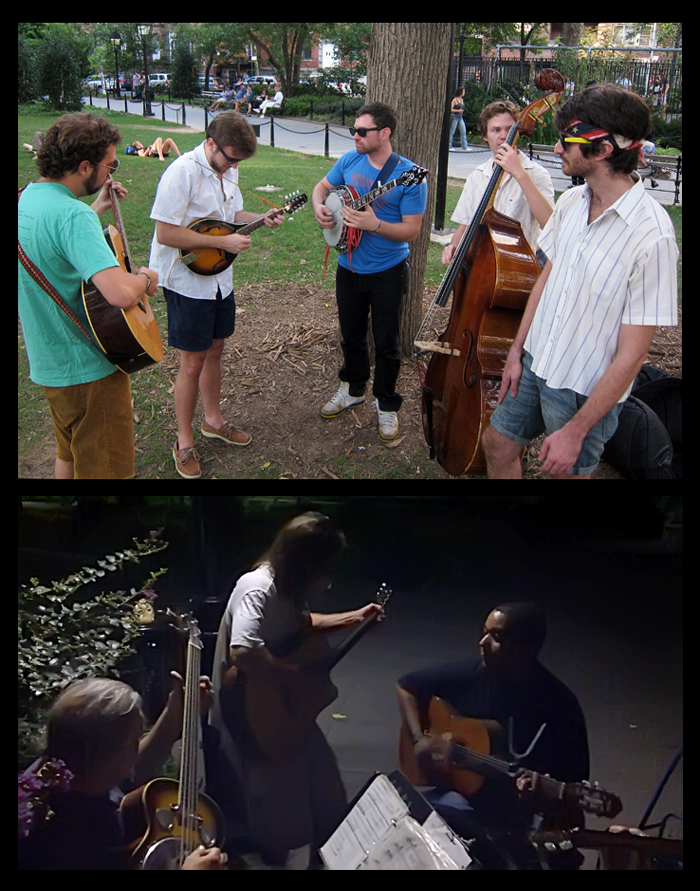
    Some form spontaneous groupings, some play together regularly, and yet others have established bands and work together professionally outside the park. The latter was the case with a bluegrass group, the Bella Boys, whom I encountered on one of the lawns, away from the central plaza hubbub. These boys were quite bella, and their command of repertoire was astounding to me, as was the familiarity of several members with numerous instruments. At various junctures, the mandolin, banjo, and guitar were passed around like musical chairs. I learned that one of the members was leaving for Europe for four months, so I had fortuitously run into them on their last get together for quite some time.

    Later that night, I ran across another grouping (Sage, Peter, Jimmy, and Joe – bottom photo), which included regulars I have known for some time. The singer, Sage, has a masterful, trained, and natural voice, and his occasional forays into the park are always a welcome addition to any group (Sage plays a dozen instruments and has a collection of 100). I had the good sense to record video of these events:

    At one point during the bluegrass jam, I noticed the hair on my arms standing up – a clear sign that life was indeed good and that I had found one of the city’s many pockets of joy 🙂

    Related Music Posts: Sieve of Darwin, Music Speaks for Itself, Sounds of Summer, Police Riot Concert, Bluegrass Reunion, The Conductor


  • Men of Steel

    People love urban myths and recounting them, filled as they often are with drama, mystery, romance, and unusualness. The more atypical they are, the better, and if there is an element of truth to them, they are more easily believed. Few will bother to sort out the “nuances,” separating fact and fiction – such “nuances” may undermine the entire story.

    We also have a love of individuals with supernatural or perhaps superhuman abilities, allowing us to triumph over the day-to-day battles we must all endure. Some urban legends explain things inexplicable to us, such as how anyone could work at dizzying heights as an ironworker on skyscrapers.

    The Mohawk Indian, innately endowed with uncanny capabilities, became the explanation as well as an exotic and enticing concept – the American Indian transported and juxtaposed in the most urban environment imaginable: the steelworks of a Manhattan skyscraper.

    Articles such as The Mohawks in High Steel by Joseph Mitchell in The New Yorker (September 17, 1949) did much to foster the mythical attributes of the Mohawk ironworker, using statements such as “It became apparent to all concerned that these Indians were very odd in that they did not have any fear of heights,” and “They seemed immune to the noise of the riveting.”
    However, Kyle Karonhiaktatie Beauvais (Mohawk, Kahnawake) says, “A lot of people think Mohawks aren’t afraid of heights; that’s not true. We have as much fear as the next guy. The difference is that we deal with it better. We also have the experience of the old timers to follow and the responsibility to lead the younger guys. There’s pride in ‘walking iron.’”

    However, Mohawks have been involved historically as ironworkers since 1886, when they were hired to build the Canadian Pacific Railway bridge over the St. Lawrence River between Canada and Kahnawake Mohawk land in New York State. They developed a reputation as top workers and began “booming out” from their native communities to projects in Canada and in New York City to build skyscrapers. In 1915, a large majority of men in the Kahnawake reservation belonged to the structural steel union.

    Many moved to New York City, settling in the Boerum Hill and Bay Ridge neighborhoods of Brooklyn. In the 1940s-50s, as many as 700 Indians lived in Boerum Hill. Mohawk ironworkers have been involved in building the city’s most notable landmarks, such as the Empire State Building, the Chrysler Building, the Triborough Bridge, the George Washington Bridge, the Waldorf Astoria Hotel, the Henry Hudson Parkway, the RCA Building, the Verrazano Narrows Bridge, and in 1961, the World Trade Center. In September 2001, after the collapse of the twin towers, Mohawk ironworkers dismantled the wreckage. After a building bust, some have returned to the city.

    Along with innate abilities, the percentage of American Indians in the trade has also been exaggerated. The classic photo from 1932 (see Lunchtime on a Skyscraper here) shows ironworkers who were predominantly Irish. My understanding is that American Indians have not dominated the ironworkers union.
    The skyscrapers of New York’s skyline are a celebration and tribute to ironworkers who, Mohawk or not, are New York City’s real supermen, our men of steel

    Photo Note: This construction is located at 58 Washington Square South, where the former NYU Catholic Center was located. The site, on Washington Square South and Thompson Street, will be home to NYU’s Center for Academic and Spiritual Life.


  • With Impunity

    There are apt metaphors for New York City – readers here know that I am particularly fond of the city as a Jungle (as I wrote in Jungle Lovers). However, there are metaphors, and I do believe there is a lawlessness here that makes this city feel at times like the Wild West.

    I recall in the 1970s being told by a friend that he had been mugged in the West Village for $20. He subsequently saw the perpetrator some days later in the East Village and yelled, “Hey, you owe me 20 bucks.” I don’t recall if my friend was reimbursed, but in less enlightened times, that man would be behind bars very quickly.

    In Washington Square Park, e.g., the police know the drug dealers well, and the dealers know that the police know who they are. They often chat. And they conduct business with impunity. Why? There are a number of reasons, including the fact that the drug sellers know the law and have established a system of steerers, touts, lookouts, and actual dealers, enabling them to work in a way that makes arrests difficult. Also, prisons are overcrowded, and there is community opposition to new facilities. Often, drug dealers who are arrested are back on the streets in a day or two.

    Here, home of the ACLU, police officers must be careful of what they do and how they do it. They know they may face harsh retribution for improper procedures and actions. I have spoken to officers who have said that they feel that their hands are tied and they are often disinclined to make arrests.

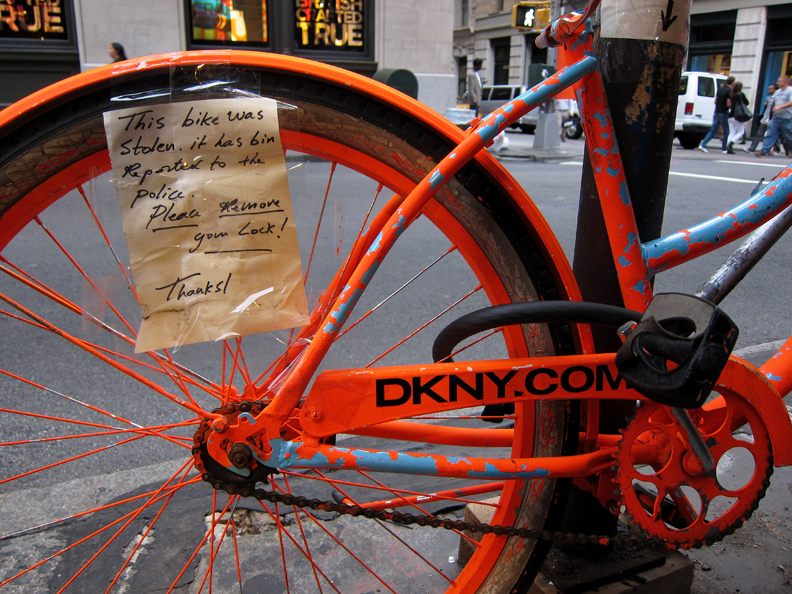
    The New York City criminal is very street smart, savvy, and crafty, and uses all this as a weapon to ply his trade. Thieves know what to do and how to do it. And they steal flagrantly and event flaunt their wares. The bike in the photo was found on Spring Street in SoHo. These orange DKNY bikes were originally part of a promotion, which I wrote about in Orange You Glad. Apparently, the new owner of the bike feels comfortable flaunting his new acquisition on Spring Street. Be glad it is not your bike, because in the Wild West, cowboys often steal with impunity 🙂


  • Keuffel and Esser


    There was nothing that struck fear in the hearts of many high school students like the slide rule. I could never really understand, because I loved mathematics and my slide rule. But so many seemed terrified. Perhaps it was all those numbers.

    Admittedly, the whole device is rather arcane looking – scales with tiny divisions and numbers completely cover both sides. The slide rule is an analog device, and numbers can be read to only three significant digits without any reference to magnitude. In other words, 123 is the same as 12.3, 1.23, .123, etc. So interpretation of answers requires keeping note of and calculating (often just using memory) the magnitude of the answer, which is only a series of digits – i.e., you need to know where to put the decimal point.

    The slide rule was used for multiplication, division, and for functions such as roots, logarithms, and trigonometry, but not for addition or subtraction. These are precision instruments and require careful use – unlike a digital calculator, answers can vary depending on the skill of the user. Keuffel and Esser introduced them to the United States, and I am proud to own one.

    The Keuffel & Esser Co. was founded in 1867 at 79 Nassau Street by two German émigrés, Wilhelm Johann Diedrich Keuffel and Herman Esser, as importers and jobbers of European drawing and drafting materials.

    Early on, the firm was successful and continually expanded, moving locations several times. 4 K&E tentatively started manufacture and published its first instruments catalogue in 1870; opened its first retail store with a showroom in Manhattan in 1872; transferred its manufacturing to Hoboken, N.J., in 1875; moved its headquarters to 127 Fulton Street in 1878; and constructed a new factory building in Hoboken in 1880-81 (which was expanded in 1884, 1892, and 1900). The firm was incorporated in 1889, with Keuffel serving as president until his death. K&E, which had introduced imported slide rules in 1880, began their first American manufacture in 1891. The company became strongly associated with the product as the nation’s foremost manufacturer, credited with popularizing slide rules in the United States. In 1892-93, K&E constructed a new building at 127 Fulton Street to serve as its retail salesrooms and general offices.

    K&E played a nationally significant role in the technological development of the United States. K&E products, which included measuring tapes and compasses, were used in countless construction and engineering projects, such as the Brooklyn Bridge, of the post-Civil War boom years, and K&E surveying equipment is considered to have been critical to the westward expansion and development of the country.

    K&E’s offices and salesrooms had been located at 127 Fulton Street since 1878. This address was close in proximity to the financial district and the offices of many architects and engineering firms. Over the next 13 years,“business increased, doubling and redoubling in volume, year after year,” leading the firm to require larger quarters. In May 1891, the architectural firm of De Lemos & Cordes filed for a new 8-story (plus basement) Keuffel & Esser Co. Building, to house the company’s primary retail salesrooms and general offices. The nearly 25-foot-wide, fireproof steel-and-cast-iron-framed structure was completed in February 1893.

    By 1930, the K&E catalogue carried over 5,000 items. You can read more about the building, its history, and the company here.
    The 8-story building’s upper stories are clad in buff brick and terra cotta. The base has an historic 2-story cast-iron storefront, framed by colonettes with spandrels bearing small shields, the company’s initials, and representations of its products. K&E vacated the premises in 1961. The property will be converted to residential condos.

    A slide rule was the engineer’s tool and companion, often carried in a leather case which could also be used as a belt holster. You can see my original Keuffel and Esser slide rule and molded leather case in the photo. After reading the history of K&E, I am duly impressed, and I have a newly acquired reverence for that slide rule I have, made by Keuffel and Esser 🙂


  • The Last to Know

    There are many kinds of surprises, and one type is that which is caused by Tunnel Vision, a common ailment with New Yorkers. The perennial joke that Village residents never go north of 14th Street is not an exaggeration, only a New York City variant – people who don’t even look past their neighborhoods.

    We typically see ourselves as inventors, or at least very early adopters, but certainly not the last to know. There are a few exceptions – the things we don’t want or the things we just can’t have due to space limitations. Big box stores such as Home Depot were very late comers here, and there is no Wal-Mart in New York City. Large behemoth retailers have had to scale down their operations, shoehorning and tailor-fitting them to the biggest spaces they could find.

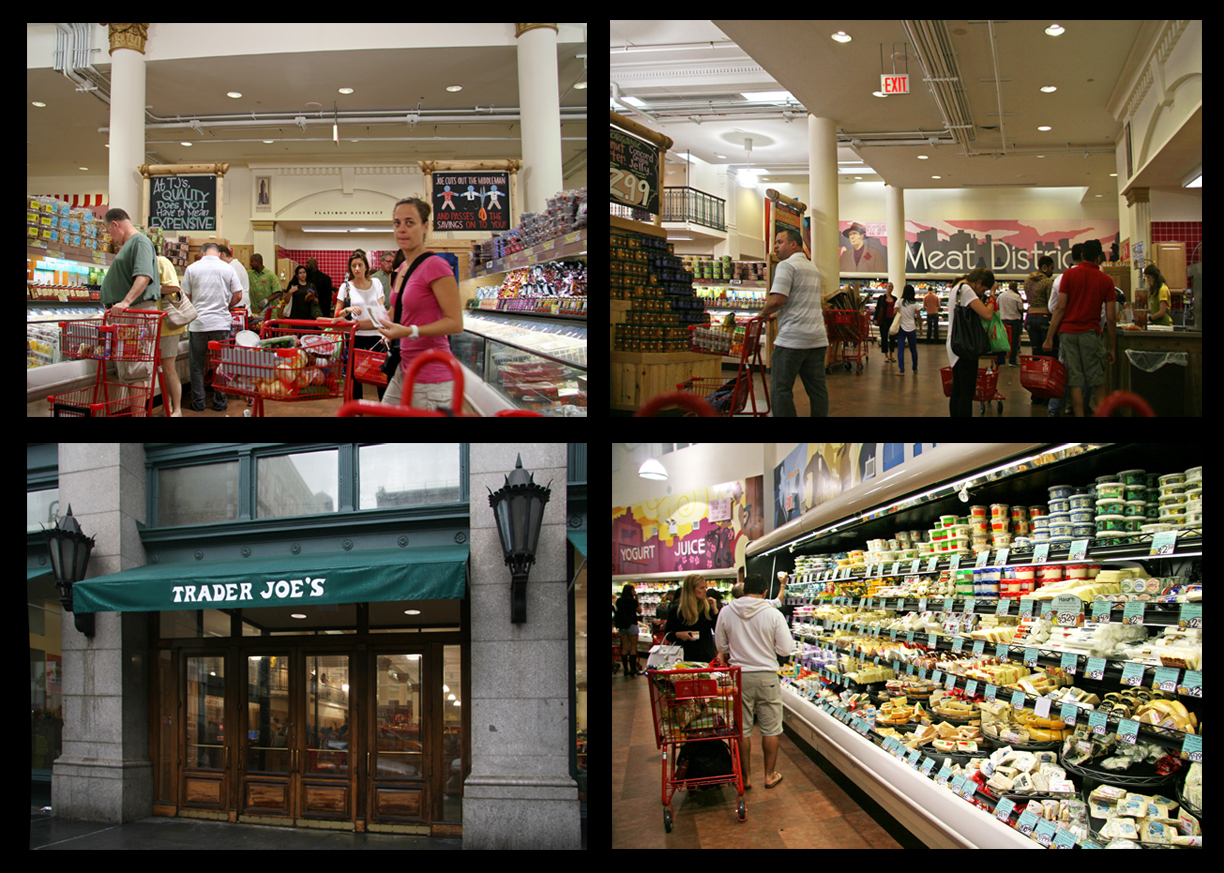
    A California resident told me about the opening of Trader Joe’s first store in New York City, on 14th Street in Manhattan, on March 17, 2006. I was informed that the place had a cult following and was known for their sharp pricing, good quality, and a fan base for their house brand (80% of Trader Joe’s product line is their own brand). The product line is very green conscious, with health oriented foods, including gourmet foods, organic foods, vegetarian items, and an extensive line of frozen and imported foods.

    I assumed that this new opening was a case where New York City was privileged to get a specialty shop that had a location or two elsewhere on the West coast. However, I learned today of the mammoth scale of this retailing operation, with 344 stores nationwide.
    New York City’s first location at 142 East 14th Street opened to much fanfare, with long lines to enter. Recently, however, a new location opened at 20th Street and 6th Avenue (seen in the photos), with a much roomier feel and large aisles. Shopping here is an adventure, particularly for Manhattanites, for whom food shopping in a large space is such an anomaly. Customers push shopping carts around like their suburban brethren.

    So, if a New Yorker brags to you about the wonderment that is Trader Joe’s, as if it were a city creation, humor them and let them believe it. Why spoil the fun and tell us the truth – that actually we are the last to know? 🙂

    About the Company: Trader Joe’s was started in 1958 by Joe Coulombe as the Pronto Market chain in the Los Angeles area. The South Seas motif was inspired while Joe was vacationing in the Caribbean, and the first shop with the Trader Joe’s name opened in 1967 in Pasadena, California. The company expanded, and in 1979, it was purchased by the late Theo Albrecht, one of two brothers behind the German supermarket chain, Aldi. The Aldi chain is comprised of two separate businesses, Aldi Nord (owned by Karl Albrecht) and Aldi Sud (owned by Theo Albrecht). Aldi Nord has stores worldwide, including 1000 locations in the USA. However, Trader Joe’s is owned by Aldi Sud, so there is no business connection between the Aldi stores in the US and Trader Joe’s.


  • Just Around the Corner

    Nooks and crannies are not only the obsession of urban jungle lovers and explorers. They are also big business – Thomas’ has built a $500 million dollar business around the famed nooks and crannies of their English muffins. Chris Botticella is one of only seven people who knows the entire secret process to produce the legendary muffins with signature air pockets marketed as “nooks and crannies.”*

    Finding nooks and crannies in a city like New York is just as delightful as a Thomas’ English muffin. However, unlike the muffin which can be found in any grocer, special pockets of the city are much harder to locate. I have explored many of these on this website.

    The financial district is the oldest area of New York City, and remnants of Nieuw Amsterdam still exist amid the towering structures. In tandem with the areas, extremely narrow streets create a uniquely cavernous feel. The area is largely overlooked by visitors and residents, excepting for the more obvious spots such as South Street Seaport, Ground Zero, and Battery Park.

    It is remarkable that places like Mill Lane and Stone Street were completely unknown to me until Sunday, while combing the streets of the financial district in the rain. Temporary scaffolding on Mill Lane provided the necessary shelter and an opportunity to see a bit of this historic area in a deserted state. Mill Lane is one of the shortest alleys in New York City. It lies between South William and Stone Streets.

    I love turning a corner to a pleasant vista, like coming around a hairpin turn on a mountain precipice that opens to a jaw-dropping panorama. Looking around the corner at Stone Street from Mill Lane was a throwback in time. The restored street is a beauty, what the New York Times called “Turning an Alley into a Jewel.”

    Stone Street was originally known as Brewers Street by the early Dutch settlers. In 1655, when the street was paved with cobblestone, it became known as Stone Street. In the 1980s, the street was divided to make way for the Goldman Sachs building. The short historic block, “a back alley filled with graffiti, a garbage pit; used for low-level drug dealing”, was completely restored with redone buildings, New York bluestone sidewalks, new Deer Isle granite paving blocks, and period street lights. Most of the buildings date to 1836, rebuilt following a fire in 1836. In 1996, the eastern portion of the street and surrounding buildings became protected by the New York City Landmarks Preservation Commission as the Stone Street Historic District. It is pedestrian-only.

    I look forward to going back in better weather. I recommend taking a stroll down the narrow streets of the area, exploring the nooks and crannies, and looking for that surprise just around the corner 🙂

    *Thomas’ was purchased by Bimbo Bakeries USA in 2009. In January 2010, Botticella left the company to work for Hostess Brands, who had been trying to learn the secrets of Thomas’ muffins. Bimbo, however, was successful in getting a court order barring Botticella from taking the new position. See the article here.


  • Guessing Game

    I like guessing games.

    I have had an idea stewing for some time – an experiment of sorts, inspired by an article I read in the 1980s. The author of the article put forth a provocative hypothesis regarding writing, which I have thought about for years and discussed recently with a writer friend and regular reader of this website. Your answers to the last question at the end of this posting will test this hypothesis.

    Today there is something completely unique about the writing of this story, unlike any other since the inception of this blog in 2006.

    This idea, however, preceded any photos taken, and I have not been able to fathom in the least what image to use in conjunction with this idea.

    Appropriately (for a guessing game), I had the image of a butterfly of unknown species archived since August 1, 2010. The butterfly lighted on the pants of a friend in the park. Deprived as we are in New York City of such a rare occurrence of nature, the event became a paparazzi photo op, with the snapping of cameras and jockeying for turns at shooting.

    Recently, I showed this image to my photographer friend Bill Shatto, who identified it immediately (Bill’s specialty is the macro photography of insects – you can see his work here). Strangely enough, in a bizarre twist, the name of this butterfly is perfectly suited to this Guessing Game.

    So, if you like guessing games:
    1) What is the name of this butterfly?
    2) What is unique about the writing of this story?
    Afterthought: It occurred to me after completing this that not only is the identity of the person in the photo also not revealed, but I also don’t recall who it was. Layers of mystery.

    Answers: There were some very interesting analyses. Yes, it was the first time that I asked a question. But the real difference was that this posting was inspired by an article I read by an individual who claimed he could tell the difference between something written on a computer using a word processor versus something written without, the idea being that the need for more careful and thoughtful composition before committing to typewriter or pen/pencil would make itself obvious in the finished product.

    My story was written completely using pencil and paper. There was no editing of any sort on a computer, only the final transcription. I am not sure if I see an apparent difference myself.

    The butterfly is a Question Mark – common to urban parks, and named because of the silver markings under its wings, a curved line and a dot, resembling a question mark. See here.


  • Roode Hoek


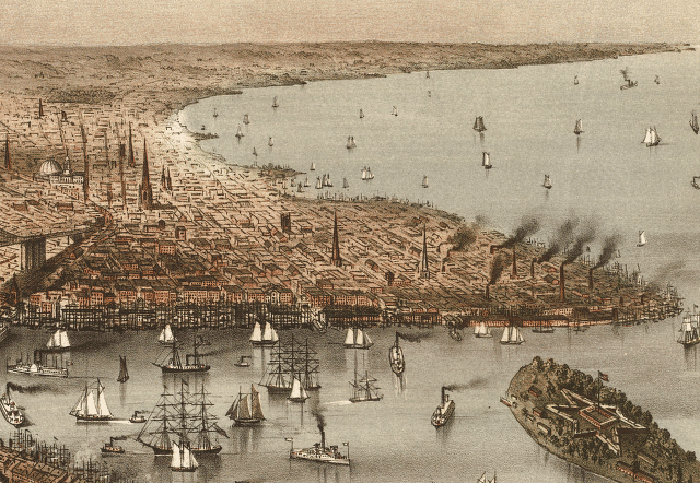
    Red Hook circa 1875I have had so many conversations, ad nauseum, that there is no life after Manhattan and that I did not move to New York City to live in Brooklyn or Queens. I have had many close friends in Brooklyn, the Bronx, and Queens, and I have traveled there hundreds of times.

    I have seen the merits of the boroughs, as readers of this website can attest, yet I have remained steadfast in my resolve that Manhattan is the ne plus ultra of the known universe and that the outer boroughs may be nice places to visit, but I wouldn’t want to live there.

    Until recently.

    This is a city that is still exciting and dynamic, particularly if you are of the generation that has grown up with Blackberries, a six-figure income in your 20s, apartments that sell for over one million dollars or rent for for over $3000 per month, and rapid gentrification of neighborhoods.

    However, Manhattan is losing its character and rapidly becoming the Singapore of the United States. Websites feature forgotten New York, vanishing New York, disappearing New York, and lost New York. For the special and unique, you must dig deeper and look further afield.

    Like Red Hook, Brooklyn.

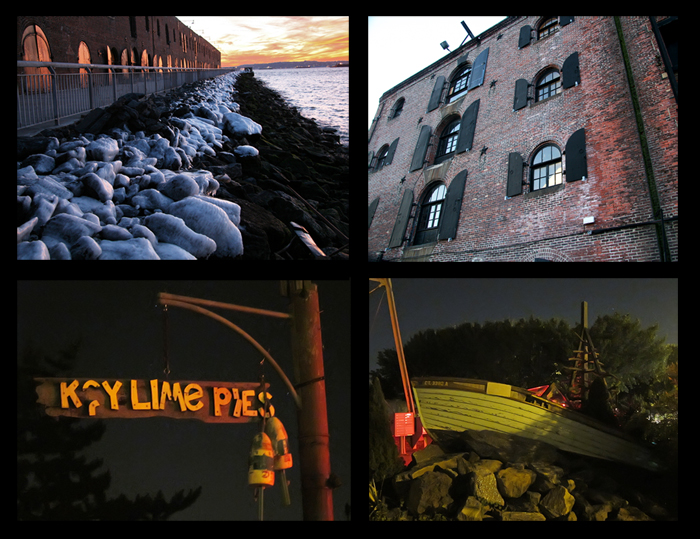
    Red Hook was settled by the Dutch in 1636 and named Roode Hoek (“roode” for the red clay soil of the area and “hoek” meaning point or corner). The neighborhood is really a peninsula, cut off from the rest of Brooklyn by the BQE and Gowanus Expressways. Public transportation is a vital part of New York City life. Red Hook has no subway service to the neighborhood – this relative isolation is one of the key elements that has kept the neighborhood from developing as rapidly as other areas, such as DUMBO. Even as recently as the 1990s, the neighborhood was considered one of the worst neighborhoods in the USA and the “crack capital of America.”

    On June 18, 2008, IKEA opened an enormous store in the neighborhood, amid huge controversy (replacing a 19th century dry dock) and concerns over an increase in congestion.

    The older warehouses, waterfront vistas, and isolation are exactly what makes the neighborhood so desirable and have attracted artists and small businesses for some time. See my photos and story, Fire and Ice. If you have a chance, visit Roode Hoek…


  • Hell. Part 3

    (This is the third and final of a three-part series. Find Part 1 here and Part 2 here.)

    Music has Charms to soothe a savage Breast and Hell has no fury like a woman scorned.*

    We had it all on Saturday – savages, breasts, fury, a scorned woman, music, fury, and a taste of Hell. Just the type of things a jungle lover would expect to find in New York City. And if you are going to enter the jungle smearing blood, you should be prepared for lions and tigers.

    There is no way that you can come to this city, set up in Greenwich Village, sing gospel songs, preach sin and damnation, and not expect a confrontation. The neighborhood is extremely liberal and very tolerant, except of being accused of sin and threatened with eternal damnation for their lifestyle.

    The model, Abigayle, had been provoked – she had been told that she was wicked and had been warned five times. She climbed on the shoulders of a young man, also body painted, and they approached the Mennonite group. It was fair to say that this couple taunted the crowd of Mennonites and the preacher, who launched into a diatribe regarding nudity, hell, and damnation while brandishing his bible. The man in body paint who had shouldered the model read and mocked parts of their leaflet, Boys and Girls & Fornication:

    Whether this confrontation on the part of the model and her supporter was justified was hotly debated. Some were infuriated and saw it as disrespectful and unnecessarily provocative. Others saw it as just desserts or as another circus act to be expected in the Village. At the end, the painted man reconciled with one of the visiting group and shook hands (photo lower right). Perhaps, after all, The road to Hell is paved with good intentions 🙂

    *Heaven hath no rage like love to hatred turned, Nor Hell a fury like a woman scorned. -William Congreve from the Mourning Bride, 1697. Music has charms to soothe the savage breast is also from the same work (the word breast is often misquoted as beast.)


  • Hell. Part 2

    (This is the second of a three-part series. Part 1 is here.)

    At the same time as our Mennonite friends were singing spirituals and preaching to the masses, just a few short steps across the central plaza in Washington Square Park, Andy Golub was busy body painting the nearly nude figure of a woman. See additional photos here.

    Andy is a visual artist who has been body painting men and women in and around New York City for years. You can see more of his artwork and body painting at his website here.

    Although women have the right in New York State to be topless in public, even in New York City, the site of nearly nude men and women in body paint will stop traffic and raise eyebrows. Societal norms have not yet caught up with legislation, and many are angered and perhaps certain that something should be done. Andy and his models, however, are breaking no laws, and even police officers still occasionally need to be educated regarding the legality of toplessness for women in public.

    When the time came and the model moved around the park grounds for various photo settings, a parade of male oglers grew in size, some with cameras, some without, running after her like hungry dogs chasing a rabbit.

    A number of the Mennonites were circulating the park crowds, giving out literature. I happened upon an old friend in the park, and while chatting, I jokingly mentioned that if they were looking to save souls, our model would, from their perspective, need it most.

    My friend took this comment to heart, approaching one of the women from the Charity Ministries and suggesting that she should perhaps consider giving literature to the near naked model – certainly she was the most needful. The leafleteer skirted the suggestion. One of their group referred to her as “wicked,” and another told her that she had been warned FIVE times – apparently there is no salvation for someone who did not heed that number of warnings.

    It became abundantly clear that our model was bound for Hell and eternal damnation, but a very unexpected confrontation ensued; tomorrow we conclude our descent into Hell (see Part 3 here)…


  • Hell, Part 1

    Note: This is Part 1 of a three-part series.

    One of the few family trips I made as a child was to the Amish communities based in rural Pennsylvania. Even coming from a rural area of New England ourselves, the Amish lifestyle, with the shunning of modern conveniences, left impressions that would last a lifetime.

    There is not much that provides a sharper contrast than such a group in traditional clothing in Washington Square Park. This is Charity Ministries*, a group similar to Mennonites. One of the founders, Mose Stoltzfus, was formerly Amish. I have seen them infrequently and was pleased to be able to take photos on this occasion.

    Regardless of any proselytizing or religious creed, there is a gentle and pastoral feeling to a group dressed as they are – the women with light blue and white dresses and the men in light colored khakis. It is as though an Amish farming community was transported through time and space to New York City. And I must say, the voices of the large chorus singing was not at all unpleasant, although hard to be heard above the park din, with competing music groups playing nearby.

    I browsed through and took some of their literature, with titles such as The Sin of Doing Nothing, Improving the Marriage Relationship, Lost in the Church, The Vice of Sexual Immorality, and Boys and Girls & Fornication. A colorful poster on an easel proclaimed Where Will You Spend Eternity? It seemed well-suited for the urban New York City visit, with businesses such as the Pennyless Casino, Abortion Clinic, the Broken Home Night Club, and Divorce Court, all located appropriately near Narrow Avenue and Broadway.

    It is hard to imagine why such a group would subject themselves to such a potentially hostile environment, but I would guess the reasoning is that of an evangelist, Dave, who some years ago used to preach in Washington Square Park on Sundays. When I asked him why he would choose such an inhospitable environment, he answered that he wanted to save souls, and what better place than Greenwich Village? I complemented him on his logic. If you can take the heat, certainly the Village is a great place to rescue the fallen.

    However, the words of this Sunday’s preacher fell mostly on deaf ears. Without knowing specifics, most passersby had a general sense of what this Christian evangelist message was about, and the feeling was not today, thank you. Especially when there is a plethora of competing activities, one that literally made most eyes pop out. There was talk of Love and God and Christ. But as you will see tomorrow in Part 2, we descend into Hell 🙂

    See Part 3 here.

    *Charity Ministries was founded in the 1980s by Denny Kenaston and Mose Stoltzfus and is based in Ephrata, Pennsylvania. They publish a magazine called Heartbeat of the Remnant. You can visit their website here.


  • Toches ahfen tish!

    I cannot tell you what percentage of the population of Bristol, Connecticut, is Jewish. And in a town of over 60,000, I can not locate a temple or synagogue. Growing up in such a place, however, I cannot say that it was riddled with anti-Semitism. With so few Jews, exposure was too limited to really form any opinion. There were a few stereotypes, but no way to corroborate them. Jewish people and culture were an enigma, something I would only experience after moving to New York City.

    My first college roommates were Jewish, my closest friends were Jewish, my first girlfriend in New York City was Jewish. The New England work ethic I inherited was akin to the Jewish work ethic, as was my interest in higher education. All my first and lasting impressions of the Jewish community were positive.

    One out of eight New Yorkers is Jewish – just under 1 million in a city population of 8 million, or 12% (in the late 1950s, the Jews reached a peak of about 2 million, or approximately one fourth of the city’s population). To know New York City, you must be familiar with Jewish culture – it is the fabric of the city. And if your going to be involved with any culture, of course that means learning about their food, language, and religion.

    I grew up with Franglais, an amalgam of French and English spoken in northern Maine, so Yiddish was right up my alley. I was quickly introduced to the requisite Yiddish, which has a wonderful collection of useful words and phrases, many with no good English synonym. Many Yiddish words have been adopted by New Yorkers as well as the general population in the United States.

    Here is a basic list to get you started (you can find Yiddish dictionaries here and here):

    babka, bialys, borsht, bubbellah, bupkis, challah, chutzpah, drek, farklempt, gelt, gesheft, goyem, kasheh varnishkes, kibbitz, knish, kvetch, latke, lox, matzoh, schmuck, schlamiel, schlamazel, shiksa, mazel tov, mensch, mishuggah, mitzvah, nebish, noodnik, nosh, oi vay, putz, schlep, schlock, schmutz, schnoz, schpeel, shabbat, shlub, shlump, shmaltz, shmata, shmear, shmo, shmooze, shnorrer, shrek, shtick, tchatzkah, trombenik, Yarmelkeh, yenta, zaftik.

    When you’ve mastered some of the basic vocabulary and you’re a little tired of academics and want to conclude your studies and put together some phrases, try Toches ahfen tish! 🙂

    Photo Note: This is Central Synagogue at 652 Lexington Avenue at 55th Street. It is one of the oldest in the United States and has been in continuous use by a congregation longer than any other in New York City. It was built in 1872 in the Moorish Revival style, designed by Henry Fernbach after Budapest’s Dohány Street Synagogue. It was designated a National Historic Landmark in 1975.


  • Grisly Business

    Gino Galestro, a member of the Bonanno crime family, ordered Rober McKelvey to be killed. McKelvey had committed crimes with the family but also angered Galestro and owed him money. Former marine Joseph Young was to make the hit, but things did not go well. From the New York Times, 2006:

    The victim was lured to a secluded landmark, a Victorian mansion on a hilltop on Staten Island, but he proved hard to kill. When an effort to strangle him failed, he was stabbed, then dragged to a nearby pond and drowned. His body was dismembered with hacksaws and incinerated in the mansion’s furnace.

    Since that time, all manner of ghostly and poltergeist phenomena have been claimed (and some prior to that murder, where legend has it that a cook killed himself in the kitchen).

    The mansion was built in 1885 as an estate home by New York City brick manufacturer Balthazar Kreischer, a Bavarian immigrant. Two other homes like it were built for his two sons, Charles and Edward, who were partners in the company B. Kreischer & Sons. Only one home remains, shown in the photo and located at 4500 Arthur Kill Road, Staten Island.
    The area, settled by the Androvette family in 1699, was originally known as Androvetteville in the 1700s. It then became known as Kreisherville, a factory town built by Kreischer, who had been attracted by the natural clay deposits in the region*. From the New York Times:

    At the height of its operation in the late 1890’s, B. Kreischer & Sons employed more than 300 workers and turned out more than three million bricks yearly. Kreischer brick, which continued to be produced until the 1930’s, was used on major building projects throughout New York. Kreischer decorative terra cotta was used in the building of Barnard College around 1900.

    The brick factory was built in 1854, destroyed by fire in 1877, rebuilt, and finally closed in 1927. Kreischer brickwork can be seen in neighborhoods as far away as Ridgewood and Astoria, Queens.

    With the anti-German sentiment after WWI, the town name was changed to Charleston, after Kreischer’s son, Charles. In 1996, the home was a restaurant. Currently vacant, there are plans to build a 120-unit senior citizen housing near Kreischer Mansion, which may be used as a center. I hope we are finished with all the grisly business…

    *The 260-acre Clay Pit Ponds State Park Preserve is located on the site that once provided the white kaolin clay in the 19th century for the manufacture of bricks and terra cotta.


  • dinamic_sidebar 4 none

©2026 New York Daily Photo Entries (RSS) and Comments (RSS)  Raindrops Theme