• 1560

    Posted on by Brian Dubé

    I knew that our freelance computer guy, Paul, was a regular crossword doer.
    I subscribe to the New York Times crossword online service – convenient for getting the daily puzzle without having to buy the printed paper. Yesterday, Paul paid us one of his regular visits and worked to day’s end, when I typically download the puzzle. I offered to print any puzzles to his liking. “Perhaps Friday or Saturday?” I taunted. The New York Times crossword increases in difficulty each day, beginning with Monday. The most difficult is Saturday’s (Sunday’s is considered equal to Thursday in difficulty, just larger).
    It was good timing – he had been away for a week and had not done last week’s puzzles. Not daunted by an audience or feeling any performance pressure, he sat at my desk and began to rip through Saturday. I was astounded as he flew through this puzzle in approximately 15 minutes, working in ink with almost no corrections.

    In my opinion, Paul is a genius by any reasonable definition of the word. Now I realize that doing a Saturday New York Times crossword puzzle in 15 minutes does not in itself confer genius. Some may argue that such an ability is something akin to savant syndrome. I would imagine that there are puzzlists who have an extremely narrow skill set, but in my experience, that is the exception, not the rule.

    But I have a lot more evidence than crosswords, and when you put it all together, it becomes difficult to dismiss his talents as a smorgasbord of clever tricks. If you perhaps require elements of a romantic notion of genius, i.e. eccentric behavior or reclusive lifestyle ala renowned mathematician Paul Erd?s, our friend Paul has that covered too. New York City is the perfect environment for the idiosyncratic polymath.

    There was a time when SAT tests were taken without special preparatory courses; if such things existed, none of us knew about it. People just took the test. High scores meant much more. The older SAT (before 1995) had a very high ceiling – in any year, only seven of the million test-takers scored above 1580 (equivalent to the 99.9995 percentile.)

    I had heard through a mutual friend that Paul had done extraordinarily well on his SAT exams, but I never confirmed the scores with him personally. So when I asked yesterday (as he was already completing Friday’s crossword) for the first time about his SAT scores, he thought for a moment and said, “760 Verbal and 800 Math.” You don’t need great math skills to total that in your head: 1560…

    About SAT tests: There is, of course, much controversy about the SAT test. There are bias issues and questions as to the correlation of high scores and intelligence. Some feel that there is too much emphasis placed on the tests, and there is even is an SAT optional movement – a number of prominent small colleges do not require the SAT for college admission. The movement was first instituted by Bates College in 1984.

    Posted on by Brian Dubé

  • Famine and Feast

    Posted on by Brian Dubé

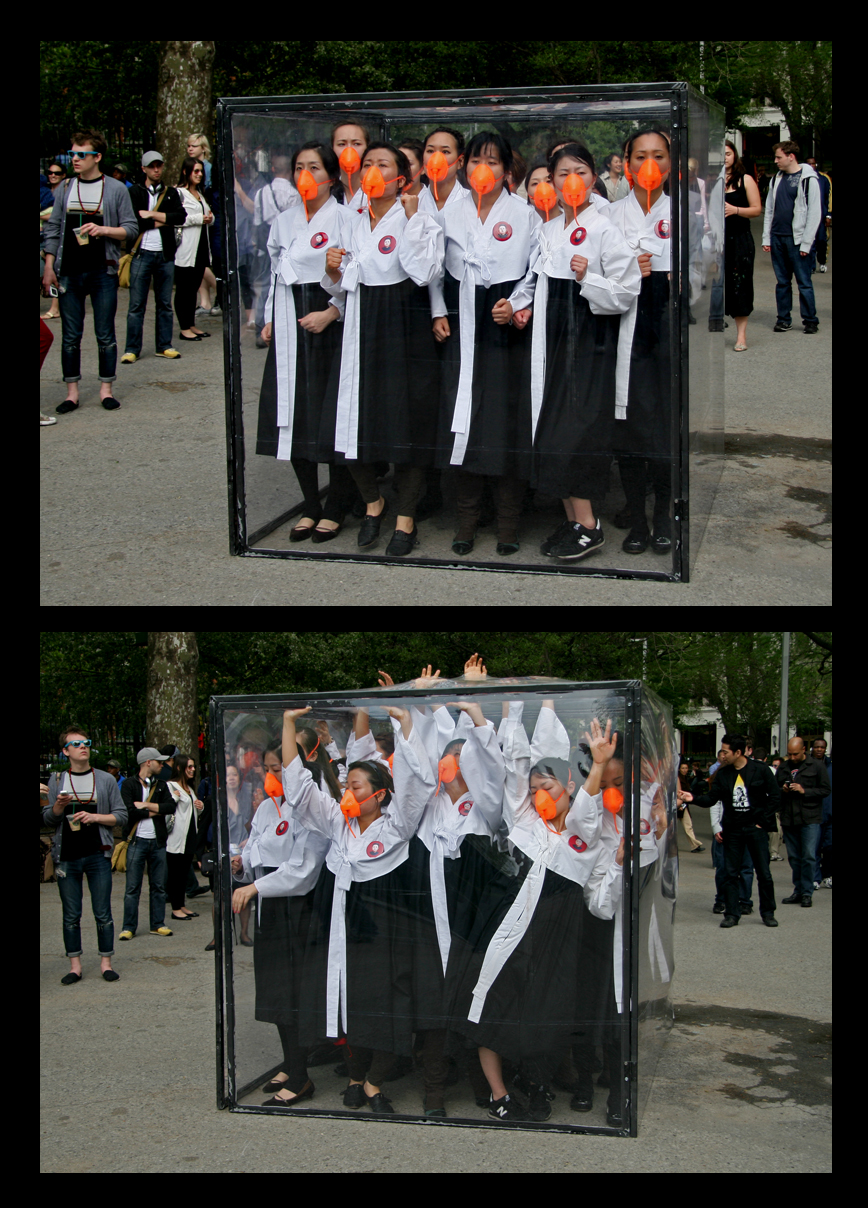
    On Saturday, I happened upon one of the four public performances of Bodies of Pyongyang by artist Yoonhye Park. See more photos here. This is the type of thing you don’t usually see in Kansas, and if you are looking to create public awareness, I am fascinated by North Korea – that in 2009 a regime like this can continue to survive. The statements regarding the treatment of women in North Korea contained in the press release of this public art performance come as no surprise:

    Most people know who is Kim Jong-il, the dictator of North Korea. However, women in North Korea are hidden and veiled in contemporary context. “Bodies of Pyongyang” is a public live visual art performance installation. Around thirty girls wearing North Korean schoolgirl uniforms are situated inside a (70″x70″x70″) clear plexiglass cube box, which is located off a street intersection. These tightly packed schoolgirls try to move about the enclosed cube box expressing their emotional pain and struggle. Red strings symbolizing their dual inner states of suppression and resistance entangle the girls further confining their freedom to move within their already limited and hermetic space.

    Of course, the sight of a large clear plastic box packed with Korean girls in school uniforms with bright orange respirators will attract plenty of attention, even in New York City. So there was plenty of gawking and photography – the freneticism around a photo opportunity, irrespective of its merits, often looks like famine victims faced with a feast. However, unlike many North Koreans, it is unlikely any performers or onlookers were faced with the prospect of famine…

    Note: You can read about the Bodies of Pyongyang here. The last public performance in New York City will be at Tompkins Square Park on Saturday, May 9, 2009 from 2:30-5PM.

    Posted on by Brian Dubé

  • Conflicted

    Posted on by Brian Dubé


    In my tagline for this blog, I promised you a “place of diversity.” Lest I be accused of hollow words and just using a catchy phrase to sell this city and website, today I bring you a park full of flowers after Friday’s meat hanging on hooks. And I did not travel to all ends of the city to find these contrasts. The park in the photo is only a short walk from the meat packing district. This is the fascinating thing about the city – it’s not only the magnitude of contrasts but also the rapid change you can find from one environment to another. Sometimes the change is even within eyeshot, particularly with a neighborhood still in transition.
    Many would argue that the meat packing district has arrived and is completely gentrified. For those who believe that, I suggest that you stroll along West Street at 7AM on a weekday, and you will see many hard at work loading and unloading trucks full of meat parts.

    But that was last week’s story. Today we have flowers. Spring in New York City is a beautiful time of year (when not raining). However, like any city, spring here is not a full immersion experience. There are elements of spring, but these are tempered by the manmade world that dominates the city’s landscape. This is particularly evident when one leaves the city mid-season and is impacted with the sensations, almost overpowering by comparison. One can get close in New York – the wooded areas of the bigger parks go a long way towards capturing that country feeling and communing with nature.

    The park in today’s photo is Abingdon Square in the West Village. While there, a friend who is also new to this city exclaimed that this must certainly be one of the most beautiful parks in all of New York. To which I replied, do not be overly swayed by the display which is primarily tulips. Their life is quite short, and soon this spectacular display will be much more subdued. That said, Abingdon Square is a beautiful pocket park, many of which can be found throughout the city.

    You can see in my posting from October 27, 2007, that my enthusiasm for Abingdon Square was a bit bridled. If my impressions and assessments of aspects, places, people, and things sometimes appear conflicted and contradictory, they are – just like New York City itself…

    Posted on by Brian Dubé

  • Fresh Meat

    Posted on by Brian Dubé

    I was told that meat hanging on hooks streetside in the Meat Packing District was a thing of the past. However, many things are said, not all of which are true, so this morning at 6AM, I left my home with camera in hand to find the truth. I rarely venture out in the morning to shoot for a posting on the same day, but it seemed appropriate that fresh photos accompany fresh meat. Questioning a number of delivery men in the area produced the same answers: I would not find meat hanging on hooks.
    Still not believing what I was told, even by local workers, I began to wander the neighborhood. Sure enough, I arrived to see Weichsel Beef at 525 West Street unloading a delivery of pigs from a refrigerated truck. The owner, Sam Farella (top center in the photo collage), was on the scene and informed me that a large trailer of beef was due to arrive and that I was welcome to take photos, but no photos inside the warehouse. I returned a little later to a huge truck full of beef being unloaded.

    The neighborhood is lined with warehouses – nondescript 2- and 3-story windowless concrete buildings. Most have metal awnings which use conveyor systems, hand pulleys, and hooks to move meat from the trucks to the warehouse. When warehouses in the area are converted for retail use, the distinctive metal awnings are typically restored, but without the hooks.

    Sam was quite congenial and accommodating. He told me of other photographers who have shot around his place – the harsh and edgy look of raw beef is often used for photos with models and advertising where the juxtaposition creates a harsh contrast. He allowed me to step briefly inside his warehouse, an enormous, cold room filled with all manner of hanging carcasses and men at work.

    Weichsel Beef has been in business for over 70 years. Sam started his career as a butcher and has been in the meat packing district since 1957. He has owned Weichsel Beef for over 33 years. The company butchers meat to be resold to shops, restaurants, and retail customers. He also told me that he was a member of the Gun Club on MacDougal Street – a fascinating and curious place that I wrote of in 2007 (see Secret Society here).

    The Meatpacking District is officially known as the Gansevoort Market. By 1900, it was home to over 250 slaughterhouses and packing plants. In the 1980s, it was a center for drug dealing and prostitution (particularly transsexuals), as well as sex clubs such as the Hellfire Club, the Anvil, and the Mineshaft.

    Since that time the area has been gentrified – only a handful of meat processors survive. Weichsel is the last place to get deliveries with full-size carcasses delivered using a hook and conveyor system. Clothing boutiques, nightclubs, bars, restaurants, and other retailers started began to establish themselves in the area in the 1990s. Diane von Furstenberg, Christian Louboutin, Stella McCartney, and numerous others line the Belgian block-cobbled streets. Popular spots include the bar Hogs and Heifers and the restaurant Pastis. One of the most famous area establishments was the French diner Florent, the first restaurant in the area, opened in 1985 by Florent Morellet and closed in 2008.

    The Gansevoort Historic District was established in 2003. If you are looking for action, the neighborhood is teeming with live humans at night. Early morning is the time for fresh meat…

    Note: See Photo Collection Here

    Posted on by Brian Dubé

  • One Short Block

    One of the most interesting and eclectic group of retailers in New York City lives on Bleecker Street between 6th and 7th Avenue. On this one short block, you will find a surprising number of legendary businesses, several of which I have previously written about. Here is a brief highlights walking tour:

    At the corner of 6th Avenue, Carmine Street, and Bleecker Streets, you have Father Demo Square, Trattoria Spaghetto, and the beautiful Our Lady of Pompei church. Starting on the North Side of Bleecker, we have the vinyl (& CD) music emporium – Bleecker Street Records, a kind of bookend to Bleecker Bob’s just across 6th Avenue. Then we have Rocco’s Pastry, L’Occitanea Provence, and Oliviers &Co, an olive oil store.

    At 259 Bleecker lies the former home of Zito’s bakery, a legendary local business for 80 years (1924-2004) that many say fell victim to the anti-carbs movement (along with rising rents). At 269, we have the Neighborhood Church, and at 273 Bleecker Street, we have Matt Umanov Guitars, opened in 1965 and known worldwide with world-class clientele. I personally met Richie Havens there (who opened the 1969 Woodstock Festival). Finishing the block on the north side is Ottomanelli’s Butcher Shop (specializing in wild game).
    Crossing over to the South Side at 7th Avenue, there is Caliente Cab Co – subject of a controversial incident.

    The south side of Bleecker has a number of fish and seafood establishments. Appropriately named, Fish is an excellent restaurant which also retails fish. I have eaten there twice and highly recommend it. At 278 Bleecker, we have John’s, one of the most legendary pizza places in the city. You won’t be able to miss this place with its perennial lines. It was founded in 1929 by John Sasso, and some say this thin crust, coal-fired brick oven pizza is the best in the city (or even the world). Others find it overrated.
    At 272, there is Cones (an artisanal ice creamery), and at 270, there is the Risotteria restaurant, a specialist in Risotto. Aphrodisia is an amazing shop, a survivor since 1967 with a huge selection of herbs, spices, and oils. Next is Trattoria Pesce & Pasta followed by two more vintage operations: Faicco’s Sausage Shop – since 1927 – and Murray’s Cheese Shop – since 1940.

    Rounding out the block is Amy’s Bread and The Lobster Place, seen in today’s photo. The Lobster Place, at 252 Bleecker, was started in 1974 by Roderick and Joan MacGregor, who were inspired to bring the Downeast (Maine) seafood experience to Manhattan. Now retired to Maine, the business has been taken over by their son Ian. I’m looking forward to the whole smoked trout I purchased there on my last visit.

    Don’t be dissuaded by any naysayers who allege the destruction of Bleecker Street through gentrification. Nearly all of the stores on this block are still single location, mom-and-pop type operations. Of course, there have been several newer upscale retailers who have moved to the block. But the impact is nothing like the malling of many areas in the city, like on Broadway in SoHo. You would be hard pressed to find such a varied collection of shops like this (including many legacy businesses) in one short block anywhere in the world…

    Related Postings: Murray’s Cheese, Matt Umanov, Time Misspent, Father Demo Square, Our Lady of Pompei, Donato, Bleecker Bob’s, Bleecker Street, Le Figaro Cafe


  • Little Stuff

    Do not think that all of New York City is paved with gold. There are plenty of ordinary people whose income is modest as well as many minimum wage earners. Seeing this shelf of Spam in Manhattan reminds me of a private joke between a friend and me whose punchline we never tired of using whenever we could.

    When I was much younger, another friend and I were fascinated with fireworks, particularly bottle rockets. Although we did occasionally buy firecrackers, we never were interested in the heavy noise found with M-80s or Cherry Bombs. As foolish as we were, we had a sense of their much more dangerous nature. Also, we did not enjoy extraordinary explosive noise. We were interested in rocketry.
    At the time, at New Year’s Eve or Chinese New Year, fireworks were easily purchased in the city. Vendors were all over the streets in neighborhoods such as the East Village and Chinatown, selling their wares out of garbage cans, auto trunks, bags, etc. The city was much less aggressive about enforcement.

    One night searching for some rockets, all three of us came across a street vendor barking a list of his wares, of course featuring his big stuff. When I asked if he had bottle rockets, he seemed rather taken aback and, with enormous pride and smug confidence, responded, “Hey, we got the little stuff too.” Apparently we were to know that he was a full service retailer. So, that’s the punchline. It loses much in translation because one of the keys here is the delivery – a combination of the very smug, macho posturing with a Brooklyn/Queens accent.

    Thereafter, anytime a conversation provided opportunity to reaffirm the merits of the diminutive and share some insider humor, we added, “We got the little stuff too,” along with our best interpretation of that fireworks vendor.

    This is not an Andy Warhol art piece. This shelf of Spam at a local supermarket tells us that people buy and use the product. We still have large numbers of homeless. Fast-food restaurants and deep discount retailers dot the city. These are not just the haunts of price conscious millionaires, flaunting frugality and good shopping skills, but also the places where many of lesser means shop. New York City requires the same services as anywhere else, and someone has to work those jobs – clerks, gas station attendants, waiters, etc. These positions do not pay the wages of investment bankers or attorneys. Twenty-three percent of New Yorkers live below the poverty line.

    So to those who think the city is only comprised of exclusive high-end retailers, fashion boutiques, costly apartments, expensive restaurants, and gourmet foods, I would like to remind you – we got the little stuff too 🙂

    Note: One night, we witnessed a woman whose hand covered a bleeding eye from being hit by a stray bottle rocket in Chinatown. This convinced us that even bottle rockets had inherent dangers and that fireworks are best kept out of the hands of recreational users.


  • That Color

    Before this site was launched in March of 2006, I had already decided to feature Vesuvio Bakery as my very first posting. There were a number of reasons.
    This place was so absolutely iconic – it had history and charm and was family-owned by a member of the Italian community surrounding it. And it carried a good product. In short, I could think of nothing that could better represent an aspect of the city that New Yorkers love. Its image graced many brochures, along with my business card for this website. Today it becomes the first establishment I feature twice, as an obituary of sorts – Vesuvio closed in February 2009.

    Vesuvio Bakery was opened in 1920 by Nunzio and Jennie Dapolito. Their son Anthony was born the same year on nearby Houston Street. He was the oldest of five boys and began delivering bread from a horse-drawn bread wagon (in 1937, the family acquired a truck). Anthony ran the bakery until 2002, when he sold it to Lisa and Christine Gigante (his sisters-in-law), who reopened it as a bakery/cafe, adding a few tables and small menu. Their bread continued to be baked in their coal oven.

    Anthony became a well-known political activist, carrying the unofficial title “Mayor of Greenwich Village.” His bakery became an informal meeting place for community members. He served on the community board and fought for numerous causes, including work with Jane Jacobs against the highly controversial NYC urban planner Robert Moses.
    Anthony died at age 82 in 2003.

    And I must admit one of the many secret reasons that I (and many others) love this place: that color…


  • Pick Two

    Many years ago, while waiting in line at Corinne Offset at 737 Broadway to pick up a small printing job, my eye caught a sign which expressed a concept unique to me at the time. It said: “Pick two out of three: Fast Good Cheap.”

    As I pondered the possible combinations of two, I saw the cleverness of this trinity of attributes. Make something Fast and Good, but then it will not be cheap.
    Fast and cheap, but it will not be good. Good and cheap but it will take a long time. In design and engineering, the concept of a triangle built on these three constraints is known as the Project Triangle (the Project Management Triangle uses Scope, Time, and Cost.) In these triangles, the constraints are interrelated, and it is not possible to optimize all three.

    With businesses, I do believe it is possible to find all three at a high level, and when you do, these are the places that are exalted. B&H Photo is an example where you can get Good, Fast, and Cheap – that’s why so many love shopping there.

    In the world of restaurants, the Zagat Survey of restaurants grades restaurants with four criteria: Food, Decor, Service, and Cost. However, you could grade restaurants using a Project Triangle by ignoring decor. Many rate restaurants this way, especially where a customer is not looking for a true dining experience.

    L’Annam at 121 University Place has been in business for 7 years. The owner/manager, Michael Zhao, is from China, the host, John, is from Malaysia, and the cook is Vietnamese. It gets some very mixed reviews. Many of the complaints are due to lack of authenticity. Your eating experience there will be much more enjoyable if you do not expect something like authentic Pho – for that, perhaps you should head elsewhere.

    Most agree that this place is Fast and Cheap. How Good the food is is where the disagreements lie. For a place in this price range, I find the atmosphere very roomy and pleasant. I am always treated cordially by host John, with a perpetual smile and whom I have now nicknamed the Happy Man. If you visit, see how it stacks up in the Project Triangle…

    Some Fun: Variations have been applied to many human endeavors.
    College: Work, Sleep, or Play – Pick two
    Men: Handsome, High-Earner, Faithful – Pick two
    Bicycles: Strong, Light, Cheap – Pick two

    Update: L’Annam has since closed.


  • Catch a Wave

    In the years I have lived in New York, I have witnessed a myriad of trends and fads. With many of these, it seemed that there was no end in sight and that it would become a permanent part of the city’s cultural landscape. And then as quickly as it came, it was gone – in some cases, it disappeared almost completely, while in others, varying degrees of vestiges remain.

    There was disco fever. I had a friend who took dance lessons with his wife at the very disco in Brooklyn (2001 Odyssey) where John Travolta performed in Saturday Night Fever. Disco roller skating became a popular spinoff, with skating circles in the parks (there is still one in Central Park). For a time, small roller skating clubs opened – skating was done ad nauseum in a circle to DJ music.

    During the same period, enormous boomboxes were toted and seen in the parks and streets. One of the few benefactors was Duracell – most of these required 8 D-cell batteries, which only lasted some part of one day. Supporting your machine became tantamount to a drug habit.
    There was the break dancing phenomenon, with many youths spinning on all parts of their bodies, including their heads, on makeshift stages – cardboard on the sidewalks.

    And then there were those “exclusive” clubs, such as Studio 54 and the Mudd Club, with lines of patrons hoping they were special enough to be chosen for admission by arrogant, power-wielding bouncers. Ironically, in many of these, the throngs on the street were more interesting than the scene in the clubs themselves.

    Even crime appeared trendlike. Graffiti on subway trains became a virtual icon for New York, as seen in movies such as The Taking of Pelham One Two Three and The French Connection. Heroin users graced the parks. Broken car windows for radio theft were daily occurrences.

    Puzzling was the rapid rise and fall of gelaterias. Many of these small shops were beautifully put together only to be dismantled in a short time. Most of the remaining shops (such as Café Dante) were there before the trend and after the dust settled.
    Other trends did become part of mainstream culture, such as skateboarding and the migration to “new” neighborhoods.

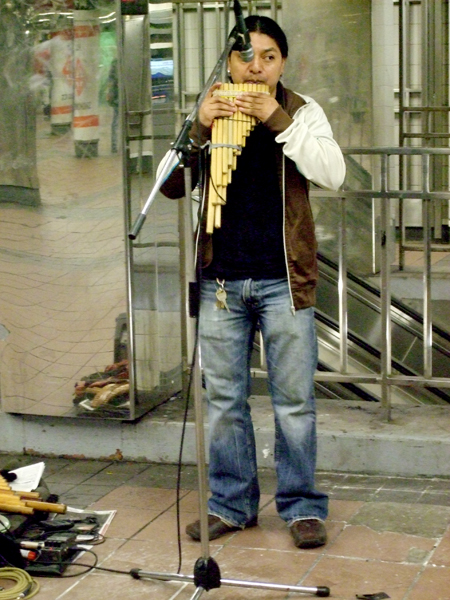
    The man in the photo is reminiscent of the rise of Andean street musicians in the late 1980s. The streets (and subway system) on weekends found many small troupes playing Andean folk music – mostly from Ecuador and Peru, with panpipes, flutes, and strings.

    One of the recent complaints worldwide about street musicians is the use of backing tapes and amplification systems, allowing a solo performer to play with recorded backup. Apart from the typically excessive volume is the rather “muzak” or schmaltzy character of the overall result. But the advantages to the musician are many – no need to organize a group or split tips, becoming a one-man band.

    Every corner of the planet has its trends, fads, and cultural movements, and many of these become global. But in New York City, with the chutzpah of the people, the large numbers of adopters, and the tolerance of the residents, these things take on a larger dimension and are frequently exported.

    Living here is like playing in the ocean. Sometimes I get caught in a wave, other times I just let it pass me by, waiting for the next one…


  • Itsy Bitsy

    In the time I have lived in this city, I have looked off and on at many real estate properties for sale, both apartments and small buildings. In these travels I have been privy to see many places, most of which were only available for tiny windows of time in decades.

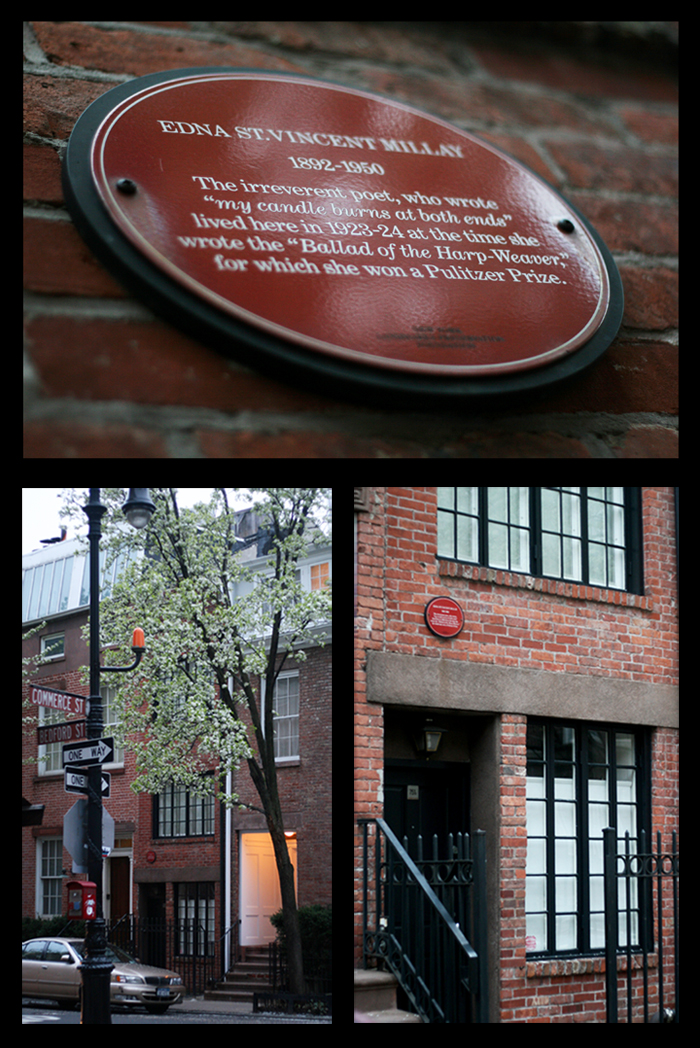
    One of them was 75 1/2 Bedford Street, known as the “Narrowest House in the Village” (or alternately, the narrowest in New York City). The three-story building with its stepped gable roof line was built in 1873, squeezed into a carriage between the neighboring buildings. Its most well-known occupant was Edna St. Vincent Millay, who lived there from 1923 to 1924 – it has often been referred to as the Edna St. Vincent Millay building. Other past occupants include anthropologist Margaret Mead, actor John Barrymore, and cartoonist William Steig. The property has had an interesting cast of occupants and owners – read about it here in Christopher Gray’s article in the New York Times.

    This property is so often written of and included in tours and books that I have left it on the back burner until today. But it is a worthy candidate for this website, and if you have not seen it, you should, sitting as it does in one of the most charming areas in the entire city, around the bend from one of my favorite spots: Commerce Street (an ironic name for one of the quietest streets in the city).

    The building sports a plaque, one of many in this neighborhood, proclaiming its historic heritage. These plaques or medallions are always a worthwhile read, even for the seasoned New Yorker. The former residents of these homes are frequently household names, as are many of the historic facts.

    There are places whose charm, quaintness, and uniqueness do not supersede their problems, and this is one of them. Unique in its size, its width of 9 1/2 feet is the fact always included in even the shortest descriptions. However, being the narrowest building in New York City is not a desirable feature for living, and in fact this property was on the market at one time for a decade before someone could see it as a habitable place. It was at this time that I visited it, and my memory of it is of a horrid, squalid place that was an absolute mess and so claustrophobic as to be uninhabitable. I had been warned by the broker but still expected a place that, with vision, had potential.

    There are several peculiarly proportioned, scaled, and shaped properties in New York. Wedges, slivers, and itsy bitsy places. See the following links for some of them: SkinnyBite, Vilequebrin, 121 Charles, Bomb Factory, 23 Skidoo, Seven Deadly Sins, Tongues and Flames


  • Time Misspent

    A travel book I much enjoyed was Europe Through the Back Door by Rick Steves. It became popular enough to spin off a TV series. Rick has a listing of “Bad Towns & Tourist Traps.” He prefaces it by saying that he is reluctant to make such a list but feels that his readers/travelers likely have too little time, and his list will help avoid time misspent.
    There is merit to this argument, particularly when a place is prominent and likely to be seen by a visitor in his/her travels.

    The same applies to restaurants. There are only so many meals to be had in a day, and it is a shame when a visitor spends time and money only to be disappointed and a much better choice could as easily have been made, had he or she only been forewarned.

    Caliente Cab Co., at 61 7th Ave South, was established in 1984 (the company also franchises, so you may come across other locations). At the Yelp site, there were 65 customer reviews, including too many one-star reviews to dismiss as atypical or the writing of an eccentric. Those who loved the place tended to favor the oversized margaritas and party atmosphere. If you would like more particulars regarding this Greenwich Village Mexican restaurant, read the Yelp reviews here.

    Perhaps more interesting than the food or drinks is an incident in 2007 after the Gay Pride Parade, when a woman, Khadijah Farmer, was thrown out of a women’s bathroom by an employee bouncer who acted on a complaint that there was a man in the women’s bathroom. From the story in the New York Times (see it here):

    “He began pounding on the stall door saying someone had complained that there was a man inside the women’s bathroom, that I had to leave the bathroom and the restaurant,” Ms. Farmer said. “Inside the stall door, I could see him. That horrified me, and it made me feel extremely uncomfortable. I said to him, ‘I’m a female, and I’m supposed to be in here.’ After I came out of the bathroom stall, I attempted to show him my ID to show him that I was in the right place, and he just refused to look at my identification. His exact words were, ‘Your ID is neither here nor there,’ which means that my ID didn’t matter to him.” … “She said the bouncer followed her up the stairs and back to the table, asked her party to pay for the appetizers they had already eaten, and then made them leave the restaurant.”

    According to the article, Farmer experiences being mistaken for a man on a daily basis, but she has never needed to offer identification.

    So if your are lured by the large sculpture, colorful graphics, outdoor seating, the mustachioed 1950s Studebaker taxi, loud music with a party atmosphere, sports TV, and a happy hour with oversized margaritas, and you don’t need to eat or use a bathroom, Caliente Cab Co. may be for you 🙂

    Update: In May 2008, the Khadijah Farmer lawsuit was settled. Farmer was paid $35,000 in damages. $15,000 was also paid to the Transgender Legal Defense and Education Fund, which handled the case.


  • Rear Window

    If you are interested in film and New York City, I would highly recommend the Hitchcock classic Rear Window, starring Jimmy Stewart and Grace Kelly. The film, a virtual shrine to voyeurism, takes place in a Greenwich Village apartment, where Stewart, confined to a wheelchair while recuperating from a broken leg, spies on his neighbor’s apartment and observes a series of activities which lead him to believe that a murder has been committed. The film is very engaging and we get what feels like an added bonus – plenty of time with Grace Kelly on the screen in charming repartee with Stewart. The film has been highly applauded, a winner of 4 Academy Awards and numerous other accolades.
    Many feel that much of the film’s appeal is because of its voyeuristic premise. Some go further to say that part of the appeal of film itself owes to its voyeuristic nature and the inherent desire of most people to watch others secretly.

    People do like people watching, and cities are perfect environments to do so. I recall my surprise at the table arrangements in Parisian cafes, where seats for two are joined side by side facing outwards, rather than each other. This made so much sense that I was immediately puzzled why this practice was (and still is) virtually nonexistent in New York City.

    There’s no better place for people watching than New York, and with millions of residents, there are large numbers who have long given up concern about who’s watching what. Public Displays of Affection (PDA) and all other manner of exhibitionistic behavior abounds, and for the voyeur, this city is the Devil’s Playground.

    The woman in the photo was relaxing on the third floor above Broadway in SoHo, certainly not a place where there is an expectation of privacy. Fire escapes in New York City often function as outdoor terraces, and over the years, our office has been entertained with various activities there (see Window Washer here).

    The scenario is reminiscent of another film, The Time Machine (from 1960), where Rod Taylor, on the start of his many journeys in time, observes a store mannequin and its changing wardrobe. The window and mannequin become icons of stability in a world of changing fashion. In the 19 years I have faced Broadway, the buildings have stayed the same, and only the names and faces have changed. With such unabashed displays from a front window facing a major thoroughfare, there’s no need for a rear window…


  • Banking Crisis

    One thing that can be refreshing at times about children is their brutal honesty and frequent lack of pretension. They say what they think and do what they want without regard to social norms.

    On Saturday, the city hit 79 degrees, and it appeared that every able-bodied New Yorker was on the streets and in the parks. A group of street musicians was performing in Washington Square Park and had an instrument case open for contributions. A father had taken the opportunity to teach his child the ways and means of supporting the arts. His daughter made a number of trips to and from the open case to her father, who supplied her with a coin on each trip. Satisfied with her deposits, she even closed the case for protection.

    Soon, however, this child quickly appeared to see the opportunity and attempted to make a major withdrawal, reopening the case and dipping in some money. Why not just take what is available? Perhaps she, like many others in today’s banking crisis, had concerns over the security of her deposits. The entire thing became a small theater piece for the entertainment of all – the music took a back seat to the performance.
    Some may feel that this was just typical of a child’s behavior, not socialized and left unchecked. It can be debated, however, whether adults are any better or just more covert in their execution.

    Admonitions were not adequate to dissuade her, and the father had to resort to a dragging ritual. But Dad should have realized that one could do much worse in handling money and investments (as most of us have). Perhaps he (and we) should see her actions as a very good way to handle a banking crisis 🙂


  • Get A Life

    We have all heard the taunt or admonition “Get a life.” But what about those less fortunate who, because they have not been dealt a good set of cards or are at a point in life where they are down on their luck, may not have a life to get? And if one does not have the good fortune of an extended family or available friends, the world can be a lonely place.

    I can tell you from having lived alone at various times that I believe being in New York City provides a lot more entertainment and distraction at those needed times. Like it or not, gossip in one form or another occupies a large part of people’s social interactions, particularly those without a life. New York City offers enormous fodder for the lonely yenta.

    Two friends and I sat in a vehicle in a parking spot on Fifth Avenue, waiting for the appointed time indicated on the parking sign to set us free. We became very intrigued by the vehicle in front of us, shown in the photo, so for the duration of our captivity, we began to speculate, becoming amateur detectives. One companion was a former New York City resident, Brooklyn-born and street smart.

    We observed a few things. The vehicle was a car for hire, indicated by the T&LC (Taxi and Limousine Commission) at the bottom of the license plate. The man hovering was obviously the driver waiting for his client. This was not an ordinary client for several reasons. The vehicle was a Mercedes, parked outside an extremely fancy doorman building on Fifth Avenue in one of the most prime locations in the city. Lastly, and most interesting to us, was an odd sequence of letters, FHAAHHMS, which certainly must be a vanity license plate.

    Now I suppose that our indulgence in the minutiae of life is not unique to the city – the occasional interloper in a small town is often subjected to the same scrutiny and speculation by idle gossipers. However, for those without a life, what better place to be than in New York City? Walk out of your door anytime of day or night, and you enter a world that is a veritable circus, with the broadest range of humans on exhibit that you are ever likely to meet. In Spike, I wrote of a man with a unique style and whom I recently met at Astor Hair. Where else could he dress like this, strut with pride and confidence, and be treated like a celebrity? André, who I featured in Out There on August 22, 2007 and Fashion Forward on November 9, 2007, is someone whom I now frequently meet and greet on the streets of NYC. I have since learned a little more about fashionista André Johnson – he graced the cover of French Vogue in 2007.

    Any thoughts about the letters on that license plate, FHAAHHMS?

    Note: According to the Oxford English Dictionary, the first use of “Get a Life” was from a 1983 article in the Washington Post: “Gross me out, I mean, Valley Girls was, like, ohmigod, it was last year, fer sure! I mean, get a life! Say what?”

    Posts of the Unusual: Out There, Spike, Narcissism Gone Wild, Spring Madness, Superheroes, Snake Charmer, Circus Amok


  • Gorillas and Cookies

    NYU is seen by many Greenwich Village residents as the neighborhood 800-pound gorilla. Every real estate move it makes is highly contentious and seen by opponents as the act of an avaricious behemoth whose appetite for properties is never sated. Perhaps a new variant of an old joke might be, “What real estate does an 800-pound gorilla buy?” “Whatever it wants.”

    New York University is located in Manhattan and is fully integrated into the fabric of the city. Unlike a rural University with land, in order to expand, NYU acquires many real estate properties and demolishes them. To purchase prime properties which are located in the heart of its campus, NYU must compete and throw its weight around.

    When renovating properties it already owns, it still runs into problems. Some of NYU’s properties lie within the Greenwich Village Historic District, so it has regulations to conform to. Others not protected by the landmark district still lie in a neighborhood very sensitive to architectural change and rife with community activists and preservationists.

    In 2001, NYU demolished the brick house where Edgar Allen Poe last lived in 1844-45 for expansion of the law school. This was met with huge community opposition, but efforts to preserve the home were derailed. Read about it here.

    The building in the photo is of 22 Washington Square North, previous home of the NYU admissions office, where 37,026 applications were processed in 2008, the largest number of any private university in the United States. The place is being entirely gutted and will be used by the NYU law school as a research facility. I was amazed at the extent of work – the entire interior has been completed removed – only the shell remained. Note the sky which can be seen from the front entrance. This property (along with #19) is part of one of the finest rows of Greek Revival townhouses in the United States and is located on Washington Square Park, one of the most desirable locations in New York City. The location is also important because the park is NYU’s de facto campus.

    Recently, NYU has made plans to demolish the four buildings and theater which housed the Provincetown Playhouse at 133-139 MacDougal Street. The redevelopment of the playhouse will be the first time that planning will be done with support of the Community Task Force on NYU Development. Hopes are that this new approach will bring harmony between NYU and Village neighbors. Perhaps NYU can upgrade its image from the 800-pound Gorilla to that of Sesame Street’s Cookie Monster:)

    Related Postings: Washington Square North, Lights, Camera, Action!, Evening Arch, Washington Mews, MacDougal Alley, Left Bank New York


  • dinamic_sidebar 4 none

©2026 New York Daily Photo Entries (RSS) and Comments (RSS)  Raindrops Theme