• A Special Serendipitous Meeting

    In the Wake of Hurricane Sandy


    Many of us who live in lower Manhattan and lost power during Hurricane Sandy, found ourselves leaving our neighborhoods and heading uptown, where there was power. Many stores and restaurants were open, and in some locations, it was business as usual – one would barely notice evidence of a major power blackout. Many photos were taken and articles written about this bizarre bifurcation in Manhattan – in parts of the Village, one needed a flashlight to walk, yet midtown was all aglow and abuzz.

    Two days after the hurricane, while on a journey midtown to a pharmacy, I spotted none other than Hovey Burgess.* He too found the blackout conditions quite depressing and was wandering in a world of light to pass time and brighten his day.
    Hovey is one of my very earliest customers, going back to the very inception of my business in 1975. He often came to my home (where I ran my business for the first 6 years) with his wife Judy to pick up juggling equipment. Hovey is one of the greatest supporters of his fellow artists and suppliers I have ever met. When I have called him over the years to tell him of some new prop or publication as a point of information, I would often find him at the shop immediately to peruse and purchase. Money was never a consideration – purchasing new juggling-related equipment or books, or attending juggling- or circus-related shows of merit, was always his number one priority. He is well known to often attend numerous performances of the same show. He is the quintessential patron of the arts and, if possible, he is someone that, ideally, you want to have interested in what you do. He was one of my earliest customers and advisors. I owe him a great deal.
    And so, that is why it was no ordinary occurrence –  it was a Special Serendipitous Meeting 🙂

    *Note about Hovey: For those who do not know him, Hovey is a circus aficionado, performer, juggler, and educator. For over 30 years, Hovey has taught circus arts at NYU’s Tisch School of the Arts. He is the author of the book Circus Techniques. Hovey has a B.A. in Theatre Arts from Pasadena Playhouse College of Theatre Arts.

    His skills and work includes clowning, juggling, equilibristic and trapeze work with Circo Dell’Arte, Clyde Beatty-Cole Brothers Circus, Electric Circus, Patterson Brothers Circus, and Toledo Zoo Wild Animal Show. He is a former President of the International Jugglers Association.

    He taught at American Conservatory Theatre, Juilliard, National Theatre School of Canada, Ringling Brothers and Barnum and Bailey Clown College, and Sarah Lawrence College. He was circus choreographer for Robert Altman’s Popeye (Paramount). Hovey is currently a member of Circus Flora, based in St. Louis. In 1999, he was inducted into the People’s Hall of Fame, which honors living cultural treasures and is housed at the Museum of the City of New York.

    More on Hurricane Sandy: Yesterday’s Muddy Pants, Seeing Scenes Rarely Seen


  • Yesterday’s Muddy Pants

    I’ve been learning a lot lately about disaster relief – insurance adjusters, the Red Cross, FEMA, tree cutters, water mitigation services, professional drying, pumping water. And shoveling mud. As many as 40,000 New Yorkers have been left homeless after Hurricane Sandy. 80,000 have already filed for Federal relief. Gas stations, often supervised by police, still have lines as long as 6 hours. Many are closed for lack of power.

    I spent most of the last week in Staten Island, helping friends with a home located in a flood zone. It truly is a DISASTER, with over 20 dead in Staten Island alone and houses entirely swept away. In the worst hit areas, entire contents of homes sit on front yards, one home after the next, waiting for pickup by sanitation. Generators are everywhere, used to pump water from basements. There is the occasional sound of chainsaws as residents cut their way out of this disaster.

    Seawater mixed with raw sewage means that for most, little is salvageable. Carpets must be ripped out, floors completely removed, walls cut away, mold remediated, basements pumped, dried, and sanitized. Electrical systems are completely damaged, as well as appliances and, in many cases, furniture. Many families with extensive damage will take what insurance money they may get, if any, and walk away from their homes.
    Emergency public services are OVERLOADED – no one responds or answer phones. The most effective road to recovery in all this? Neighbors, volunteerism or, as a fireman suggested to me, pay for things out of pocket and hope to recover the costs from insurance later. Volunteer groups are everywhere. Michael Blyth, a school teacher at Michael Petrides school, was manning the street I was on with student volunteers able and ready for any task. Vehicles with water and every manner of household cleaners and supplies passed through the neighborhood, as did Army jeeps.

    I spent the weekend filling 33 gallon trash bags and rummaging through household belongings, sorting the dry and the damp from those articles soaked with seawater and raw sewage in a house without power, light, or heat. Even when power is restored by the utilities, in homes with heavily flooded basements (as my friend’s was), power cannot be turned on without the risk of explosion. Entire panels and electrical systems need to be replaced. On Sunday, clocks were set back to Daylight Savings time, so we raced against an earlier setting sun in the late afternoon, finishing the day’s work by flashlight as temperatures dipped in a cold house. But as bad as this home had been hit, there was still much worse, and at the day’s end, I was lucky to have a warm, dry apartment to return to with my possessions intact. I can’t exactly say it is joyful, because the experience has left an indelible imprint on my mind.

    In the morning, it’s easy getting ready for the day’s work ahead. Rubber boots are the only sensible footwear choice. And you might as well just put on Yesterday’s Muddy Pants…


  • One Candle Power

    For those wondering what New York City is like in lower Manhattan, try no electricity, no heat, no hot water, no subway, no lights, no Internet for most. No elevators, no cooking for many, no refrigeration. It’s cold, dark, and primitive. It has been days and will be days longer. For now, it’s One Candle Power 🙁


  • Seeing Scenes Rarely Seen

    Nothing beats the drama of nature’s fury and nothing fuels it like anticipation, particularly when driven by the constant hammering of the media. The coming of hurricane Sandy has dominated conversation, thoughts, and television. Since yesterday, New York City has been a virtual ghost town, dead and eerily quiet. Streets are deserted, stores closed, extremely light vehicular traffic. Yet as I write this, 9:30AM on Monday morning, we have yet to see more than light rain and an occasional gust of wind. Of course, the weather forecasts must be taken seriously and authorities must err on the side of caution and preparation, with forced evacuations, shelters, and public warnings.

    Last night, after spending the bulk of the weekend indoors, cabin fever finally drove me out for a late night walk. Parks were officially closed and the entire transit system shut down, forcing businesses to close since most employees rely on transit to commute to their workplace. I circumambulated through Washington Square Park, where a musician I know was playing guitar alone in the central fountain. I enjoyed the private concert and the absolute peace that one does not find here excepting times of extreme conditions – hurricanes, blizzards, or a rare event like 9/11.
    The starkest contrasts are to be found where there is almost always perpetual activity – like on MacDougal Street or Sixth Avenue in the Village. It was there that I strolled, Seeing Scenes Rarely Seen

    More weather: Shifting Gears, In Like a Lion, Deep Freeze, Opportunity, Small Gestures, Weather Means Whether, Brooding


  • Folk Festival 2012

    What is commonly thought of as folk music does not have the lure or following of other genres of music. Most of the big names have passed their prime or are no longer with us. Pete Seeger, Woody Guthrie, Joan Baez, and Bob Dylan may come to mind for those who know them and their music. But one is not likely to see legends like these at a local Folk Festival, an event that can easily slip in under the radar. I would not have known about the 2nd Annual Washington Square Park Folk Festival had it not been for a friend who asked if I was aware that Blind Boy Paxton would be playing in the park on Sunday, September 16. I knew not the artist nor the festival.

    My friend assured me that Blind Boy Paxton was the “real deal” and a must-see. However, I was unsure about my liking of the rest of the day’s music, so, without much expectation and camera in hand, I sauntered into the park a little late at 2PM at the start of the 2nd act. The festival was a two-day event (there were six acts Saturday and seven on Sunday, from 1PM – 7PM with a different act hourly).

    On stage when I arrived was Piedmont Bluz. I love blues and realized looking through the program that this festival’s definition of folk was the dictionary one and broad – including blues, bluegrass, country, old time, and actually very little of the stereotypical folk artist – the solo singer/acoustic guitarist.

    The lineup for Sunday was Mamie Minch and Tamar Korn, Piedmont Bluz, Unnamed Hillbilly Orchestra w/ John Cohen, Ginny Hawker and Tracy Schwarz, Blind Boy Paxton, 4 O’Clock Flowers, and Feral Foster. I video-recorded the acts, and you can watch a montage below.
    The acts were all phenomenal – I salute those who produced this event for bringing together such a group of talent for a free festival.

    The whole thing came as a big surprise to me – the caliber of performer and music was much greater than I expected. Every act was SOLID. All were working professionals, typically with CDs and websites. A few had their own Wikipedia pages. A number of the acts had traveled some distance to make this event. I was only disappointed that I had not gone to the entire festival and that I had missed Saturday. I hope the festival returns. I hope to see you there next year at the 3rd Annual Folk Festival 🙂


  • Wreck on the Highway

    There are areas of New York City that go virtually unseen by both residents and visitors. Places like The Hole and Dead Horse Bay are anomalies and perfect for the urban explorer looking for the atypical. The city’s enormous population requires a staggering infrastructure of supporting services – food distribution, wholesale markets, and small manufacturers. These businesses can neither afford prime real estate nor do they need to be in those neighborhoods. So, areas like Hunt’s Point are also found off the beaten path, rarely seen except to those who have specific business there. Or to writers looking to risk arrest for a story about a floating prison.

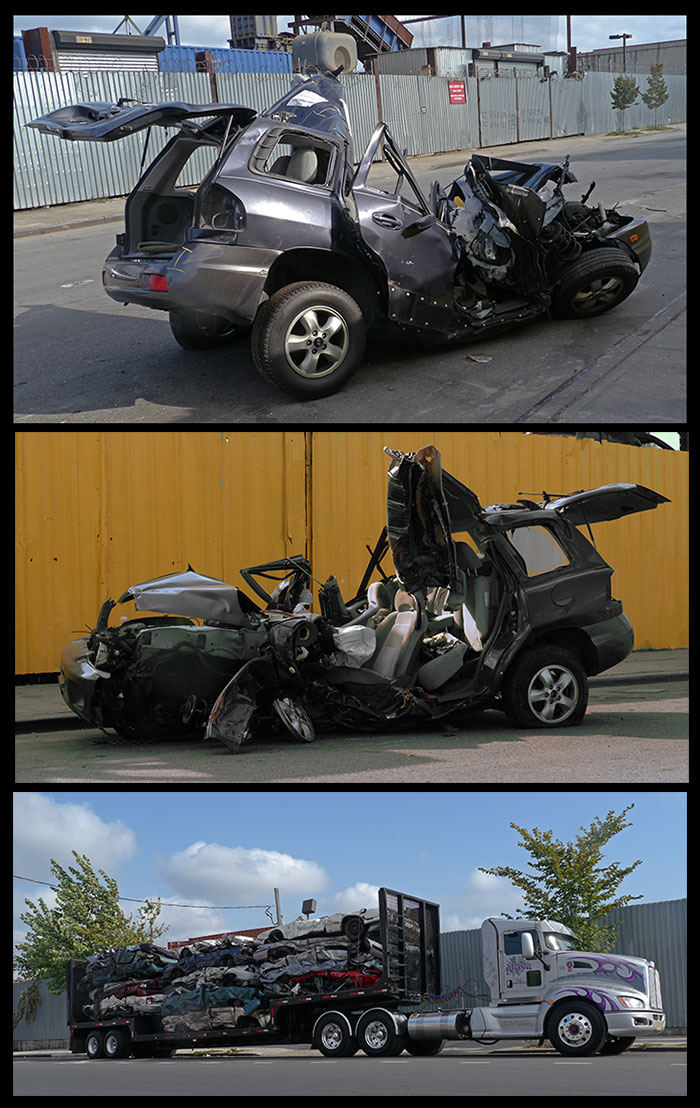
    The Bronx is home to many auto service and supply businesses. On my recent excursion to the Vernon C. Bain jail barge, I witnessed the sight in today’s photo. Here, in the South Bronx on Drake Street, surrounded by metal shops and auto wreckers, I spotted this completely wrecked automobile. I was reminded of the song The Wreck on the Highway, recorded by Roy Acuff in 1942*. Although quite morose, the song became a national country hit. Here are the lyrics:

    Who did you say it was brother?
    Who was it fell by the way?
    When whiskey and blood run together
    Did you hear anyone pray?

    CHORUS
    I didn’t hear nobody pray, dear brother
    I didn’t hear nobody pray
    I heard the crash on the highway
    But, I didn’t hear nobody pray.

    When I heard the crash on the highway
    I knew what it was from the start
    I went to the scene of destruction
    And a picture was stamped on my heart.

    There was whiskey and blood all together
    Mixed with glass where they lay
    Death played her hand in destruction
    But I didn’t hear nobody pray.

    I wish I could change this sad story
    That I am now telling you
    But there is no way I can change it
    For somebody’s life is now through.

    Their soul has been called by the Master
    They died in a crash on the way
    And I heard the groans of the dying
    But, I didn’t hear nobody pray.

    I hope the occupants of this vehicle did not meet a fate as dire as that described by Roy Acuff. Things have changed since Roy’s time in the 1930s-40s – some worse, some better, like safety belts and airbags. Examining the photos, it does appear that airbags were deployed in this Wreck on the Highway…

    *The song was actually the subject of a legal dispute. “I Didn’t Hear Anybody Pray”, about a fatal car accident, was written by Dorsey Dixon and recorded by the Dixon brothers in 1938. It was later recorded as “The Wreck on the Highway” by country musician Roy Acuff in 1942. Acuff did not remember where he knew the song from but claimed it as his own. “Wreck on the Highway” became a national country music hit, but Dixon received no royalties. At his family’s insistence, in the mid-1940s, Dixon filed a lawsuit against Acuff, and in 1946 an out-of-court settlement was reached. Dixon was granted ownership of “Wreck on the Highway”, a third of the existing $5,000 royalties, and an “undisclosed percentage” of future royalties. Dixon later adopted Acuff’s title, and “Wreck on the Highway” became his “best-known and arguably his greatest composition.”


  • Fountains of Success

    I worked for years on a 4,000 year history of juggling, to be published by my company. The original manuscript ran hundreds of pages and was accompanied by thousands of archival photos. The author was German and had written the text in English. The work was understandably very Eurocentric and, understandably, many jugglers were missing or had sketchy bios that needed fleshing out. The text was badly in need of editing. I, along with others whom I recruited for the task, took it upon ourselves to contact every living juggler of merit to ensure that their entries and photos were as accurate and complete as possible. The book was virtually rewritten over the course of 10 years and, sadly, was never completed.

    One of the entries was a man named Fritz Grobe. As was the original author’s style, his entry in the book focused almost exclusively on his juggling talents. However, I was interested in knowing more about the man and his life. I quickly learned that I was not dealing with an ordinary individual at all. Fritz was born into a family of academics – his mother and father were both math professors at Bowdoin College in Maine. Here is what Bill Giduz from the International Jugglers Association wrote in 1993:

    As a high school student at Brunswick High, he had the second highest score in North America on the American High School Math Exam, qualifying him for the American Invitational Math Exam. The national average of the 3,700 students invited to take that test was a 3.6. Fritz scored a 10! That qualified him for the 1986 U.S.A. Mathematics Olympiad, the highest honor for a math student in the country. He finished 14th out of the 93 students invited to that trial, a feat he considered his finest hour in the discipline.

    Fritz was admitted to Yale University and became involved with the school’s juggling club.  With a bout of mononeucleosis, Fritz went back home to Maine.  He took a few math classes at Bowdoin. He never returned to Yale, instead following his passion for juggling. As a former mathematics major myself who had a brief and harrowing experience at NYU’s Courant Institute, I was a bit jealous of someone so gifted mathematically, yet would toss those talents aside to become a juggler. But, such is life and just as one man’s meat is another man’s poison, one person’s dream is often another person’s boredom.

    In 2002, I attended the International Jugglers Convention in Reading, PA. As I crossed the street one evening on the way to the public performance, someone caught my eye who I thought maybe Fritz Grobe. I barked out – “hey, you’re that guy, right?” Absurdly cryptic, but Fritz understood that I was asking if he was the subject of our phone and mail correspondence for the juggling history book. It was he.

    Nearly forgotten, I was shocked to run across Fritz completely by accident 5 years later, nearly at my front door in Washington Square Park. He was there for the YouTube gathering on 7/07/07 – his YouTube videos have gone viral with over 60 million views. I was more stunned to learn that he would not be juggling, but that his genius had been redirected to experimentation and exploitation of the Coke and Mentos effect. Unfortunately, I was not to see his act in 2007 – permit problems prevented him from performing.

    In 2005, his first experiments were done, as well as the creation of the entertainment company, Eepybird, with his partner Stephen Voltz (an attorney and grad from NYU Law). They have developed nothing short of an operatic theater piece using hundreds of bottles of Diet Coke. The act has won four Webby Awards and have been nominated for two Emmys. They had been featured on TV – David Letterman, The Today Show. Only days after EepyBird released their first video, “The Extreme Diet Coke and Mentos Experiments”, the Wall Street Journal reported that Mentos had already received over $10 million worth of publicity. The video generated a 5-10% spike in the sales of 2 litre bottles of Diet Coke and a 20% spike in U.S. Mentos sales, the biggest sales increase in company history. In the first 9 months, 10,000 copycat videos were posted online.

    So, I was surprised but not perplexed to find Eepybird as a featured act at the 2012 World Maker Faire in New York City. I spoke with Fritz briefly while he was setting up for the show. When I returned, I was joined by a massive shoulder-to-shoulder crowd. Fritz and Voltz appear dressed as scientists in lab coats, explain the chemistry of Coke and Mentos, describe the bottle cap technology they developed for optimal geysers, and then the show begins – a well-choreographed and syncopated shower of geysers set to music. I took video and still images overhead in Hail Mary style.*

    Eepybird’s act is a roaring success and brings out the child in everyone. They perform the act worldwide, full-time, doing an average of 12 shows per year. But these are not childhood antics nor cheap tricks – a lot of creative thinking has gone into this act. Never underestimate Fritz Grobe. His geysers are merely metaphors for genius gushing forth and fountains of success 🙂

    *A Hail Mary is a photo taken blind, without using the viewfinder, typically overhead in a crowded situation. The term “Hail Mary” is used owing to the idea a prayer is needed to get a good photo.


  • World Maker Faire New York 2012


    A long-time customer dropped into my office recently to chat. The conversation was dominated by making products – old and new. He inquired if I was attending the Maker Faire, to which I responded, “What’s the Maker Faire?”
    He was shocked that a small manufacturer, based in New York City, would not be aware of an event that was the pinnacle of the DIY (Do It Yourself) movement. As I investigated the Maker Faire, I learned that it was created by Make Magazine, a quarterly magazine now owned and published by O’Reilly Media. It appeared that it was a big deal. So, I purchased a ticket and on Saturday, September 29, I spent 7.5 hours perusing this fair, without sitting.

    The two-day event was held at the New York Hall of Science, occupying one of the few remaining structures of the 1964 New York World’s Fair in Flushing Meadow-Corona Park in Queens. There were over 650 makers exhibiting. The inaugural Maker Faire was held in San Mateo, Calif., in 2006. The 3rd Annual World Maker Faire New York occupied the Hall of Science, Rocket Park, and the neighboring outdoor grounds. Tents housed many exhibitors, and some were dedicated to entire areas of interest, such as the 3D pavilion and Arduino (open source electronic circuit).

    The biggest buzz and draw appeared to be 3D printing – a technology that has been around in various forms for some time but now has entered the mainstream owing to its affordability and DIY for those who are so inclined, such as the Replicator by MakerBot, a Brooklyn-based company. For those unfamiliar with the technology, it really does look like magic. Computer design files are used to layer plastic and create virtually any 3D part imaginable. The parts are created for modeling, prototyping, or even limited run production.

    Much of the fair was oriented towards younger people, but there was something for everyone and anyone interested in DIY and science. There was a working Theremin on display, robots galore, a Steampunk area, Arduino, 3D printing demonstrations with samples, a quadcopters flyzone at the Brooklyn Aerodrome, Life Size mousetrap, Toothpick Village, Wearable Tech, Bio Art, Kinetic Sculptures, the Madagascar Institute, Lockpick Village, Hackerspaces, Farm Hack, Power Racing, and the Acme Flea Circus. There were speakers throughout both days at the NYSCI auditorium and performances at various stages – my personal favorite, Eepy Bird, is the subject of a future story. If any of this sounds of interest, plan to meet me in 2013 at the next World Maker Faire New York 🙂

    See my complete photo gallery here.


  • Crossing Over

    I vividly recall a statement made by my uncle, a voracious reader of the classics. The subject of hopelessness came up, and he quoted from the inscription in Dante’s Inferno over the gate of hell – “Lasciate ogne speranza, voi ch’intrate”, or “Abandon all hope, ye who enter here.” My uncle ruminated how he could imagine nothing worse than a life without hope. Over the years, I have reflected many times over his statement and that hope is indeed the fuel that keeps the human spirit running in the face of adversity and misfortune.

    Nothing frightens me more than the idea of prison. Here, with this fate, we have at least two abhorrent conditions – number one, taking away a fundamental right of a human being, something that most individuals hold most dear: freedom, the cornerstone of American society and government. And, number two, given a serious crime and a lifetime sentence without parole, is the prospect of experiencing Dante’s promise here on earth – a life without hope. I have watched numerous prison documentaries on television, hoping to get an understanding of how a prison inmate can get through day to day life, knowing that there is no hope of regaining the freedom they once had and that the average citizen enjoys.

    Recently, Gothamist ran a story on the relatively unknown Vernon C. Bain jail barge – a prison floating in the East River off the South Bronx. I read the article, perused the photos, and located the prison via an aerial map view online. The Department of Corrections built the barge in 1992 for $161 million to deal with overcrowding in the Rikers Island jail complex. The jail barge houses approximately 800 inmates, medium to maximum security. There are 100 cells within 16 dormitories, a law library, recreation rooms, and a basketball court on top of the barge’s deck. The place seemed fascinating, so I corralled a friend to join me on an excursion to see the place firsthand with the hopes of getting a few photos.

    When we arrived near our destination in the Bronx, my map indicated only one street leading to the prison – Halleck Road. It did not appear that one could park on this street, which reached a dead end at the prison entrance gate. So, we chose to park around the corner on Ryawa Avenue and walk down Halleck Street towards the prison.
    On the way, we met a man sitting alone at the side of the road, who introduced himself as Glenn Mercado. I asked if he was familiar with the prison and any possible restrictions regarding photography. He had been inside – he was there to visit an inmate he knew. He assured me that it was permissible to walk to the fence and take a photo of the prison.
    We also learned that Glenn had intimate first hand knowledge of prison life. He had served 15 years from age 13 to 28. I was very heartened to learn that he had, however, turned his life around. He was now married with a family and employed as a union carpenter making a substantial wage. We bid our farewells and continued walking towards the end of Halleck Road.

    I pressed my camera against the chain link fence. Unfortunately, I was very close to the entrance/exit gate and security booth. The attending police officer was not pleased with my behavior and barked at me from afar that I was not to take photos, adding, “That camera has got to go.” I was not sure of the exact meaning of his statement, quite worried that perhaps he was threatening confiscation of my equipment.
    I was also terrified that my activity might lead to arrest and that I would no longer have to watch programs on prison life but I would learn first hand what a place like the Vernon C. Bain jail barge was really like. My friend and I scurried away from the fenced area without any response to the corrections officer. Silence was my only prayer. Unlike psychic mediums such as John Edward, I was not interested in learning what was on the other side by Crossing Over 🙂

    More prisons: The Tombs


  • Fashion’s Night Out

    If you’re the type of person who likes a party and trusts the advice of Justin Bieber, Taylor Swift, and Kendall Jenner, campaigners for the event, Fashion’s Night Out might be to your liking. Over 700 stores throughout New York City participate in this annual, international event. Here, in SoHo, the streets were overflowing and abuzz with fashionistas.

    Participating stores are open late – it’s an opportunity to shop of course, and there are also musical performances, free drinks, special deals, and fashion designers and celebrities like Kanye West, Kim Kardashian, Kate Spade, and Cyndi Lauper. From Manhattan to Milan, Atlanta to Australia, the after hours shopping extravaganza celebrated its fourth year. With stores in over 500 cities nationwide, FNO was bigger and better than ever before. Their mission statement:

    Fashion’s Night Out is an unprecedented global initiative created in 2009 to celebrate fashion, restore consumer confidence, boost the industry’s economy during the recession, and put the fun back in shopping! In the United States, the program is a collaboration between American Vogue, the Council of Fashion Designers of America, NYC & Company, and the City of New York.

    New York City, along with Paris, Milan, and London, is one of the world’s principal fashion capitals. New York is headquarters to more than 900 fashion companies and hosts one of four major Fashion Weeks. It is home to many Creative Experts and top fashion design schools, such as Pratt Institute, Parsons School of Design, and FIT. Fashion is a major part of the city’s economy – fashion manufacturing is 31% of all manufacturing jobs in New York City. The garment district is one of the few remaining manufacturing industries left in New York. The city’s fashion retail market is the country’s largest, generating over $15 billion in sales annually.

    Personally, I do not partake in the event, but for those that do, it’s the biggest party in town. Fashion’s Night Out…


  • Look How Tall He Is

    Mike McGuigan and the Bond Street Theatre Coalition

    I have a nephew who is quite tall. As he was growing up and it was clear that he was going to be very tall, it became the popular subject on my visits home. My mother could not refrain from pointing out how big and tall her grandson was, just beaming with pride, repeating ad nauseum things such as look how tall he is, or he is going to be really big, or he is bigger than his father already, etc. I also grew up in an era where I had to hear about men who were tall, dark, and handsome, like movie star icons or my father. However, being of average height, I did not grow up with any major psychological damage, only occasional lingering curiosity as to the nature of an alternate life had I been very tall.

    Apparently, there is merit to all this madness about height. I just finished reading “6 reasons why tall people are better than you,” which includes the facts that tall people earn more money, are considered more attractive, are better athletes, are leaders, and that women prefer tall men. According to a study by the National Bureau of Economic Research, both men and women who are above average height — 5 ft. 10 in. for males, 5 ft. 4 in. for females — report higher levels of happiness than smaller people.
    And, of course, the most often cited benefits for taller men is that women choose them because they are seen as more powerful and can better protect them and their children from other males. One study has shown men hit hardest when striking downwards and that the blows of a taller man are more powerful than those of a short man. Scientists have found that our prehistoric ancestors punched hardest when they stood on two legs – it is thought that fighting was the driving force behind the evolution of upright walking and that males would be better at beating and killing each other when competing for females. If taller is better, then perhaps it would explain one of the appeals of stilt walking.

    Recently, while sitting with friends in Washington Square Park, a group of stilt walkers appeared unexpectedly. Not the most common of sights, even in New York City. I scurried over to one of the group that I recognized from afar – Michael McGuigan, the managing director of the Bond Street Theatre Coalition. The other members of the group were interns. I asked if he would come say hello to my group of comrades. He happily obliged, as is his nature. Not a surprise for a man who, along with his wife Joanna Sherman, have spent a lifetime in programs of a philanthropic nature. Read more about them and their organization here. I made the introductions and we all chatted briefly, looking up at the very tall man. As Michael rejoined his group, I went with them, capturing a few photos along with a short video you can see below.

    It occurred to me today as I wrote this, that perhaps I should have become a stilt walker and put to rest for good any concerns about being tall enough or missing any possible commensurate benefits. What better place to aspire to great heights than New York City, where everything and everyone towers above and looms large?
    And my nephew, no longer king of the hill, would have to learn to play second fiddle. I would enter the ranks of the high and mighty, laugh at the world below like Mike McGuigan, and begin to hear something new wherever I roamed – Look How Tall He Is 🙂

    Want to learn more about what I do for a living? Check out Just Like ThemShop ClassSmile By FireNot Of ThemPlease Rub Off On Me, Just Like Steve MillsOn the RoadSupercute!Viktoria’s SecretSignatureSpinning, and Juggle This, as well as my websites for my juggling equipment and hoops.


  • Whence She Came

    I once had the privilege of knowing and employing an individual who was intelligent, well-educated, talented, hard working, and a great human being. Apart from his day jobs, he was also an accomplished musician, from a musical family and married to a musician. This was a great privilege for me – I was able to ask a myriad of questions regarding music, which he was always happy to indulge.

    On one occasion, I asked the reasoning for male rock vocalists to often sing in falsetto or head voice. He answered that strong, high-pitched sounds are physically exciting. This applies to women as well as men, and the physiological reasons have actually been documented.*

    I have spent time in Washington Square Park for many years. Those who are regulars there will, from time to time, be rewarded with cameos and surprises by performing individuals and groups who come from all corners of the earth. On the evening of September 15, a newcomer caught my eyes and ears. She appeared to be quiet and shy, sitting with a group of musicians who were doing their rendition of Let It Be by the Beatles.

    At one point in the song, she was encouraged to solo (from about 1 min 10 seconds into the video). I am not an expert in the vocal ranges of sopranos, but her controlled and sustained high register was beautiful and astonishing. I can’t speak for the others, but I felt like an angel from high had come to rest for a moment and grace us with the voice of a nightingale.

    I know nothing about her other than her name was Margaret. She was given a rose for her efforts and went as mysteriously as she arrived. All that was left were notes on high. As she sang, beautiful and beatific, her fingers pointed skywards where angels reside, letting us know Whence She Came

    *When singers sing high and loud, the brain releases the hormones epinephrine and norepinephrine, causing a general increase in physiological arousal – higher heart rate, faster respiration, increased perspiration, and greater attentiveness.

    More musical cameos in Washington Square Park: Up Up We Go, Strike While the Music is Hot, Esai is Taken, Mzuri Sings, Only in New York


  • Babies, Flowers and Kittens

    I have endeavored to write intelligent, provocative, entertaining stories and take photos that illuminate life in New York City. I spend mornings slaving over my text and working in Photoshop tweaking images. My stories get decent readership and, here and there, occasionally cited. Some of my photos have been featured online or in print. A few have been purchased. At one level, the appreciation from readers is rewarding and fulfilling. However, the website has certainly not “gone viral,” and often, I am disappointed that more readers do not find it and share my enthusiasms.
    But one particular day, I needed to vent my frustration regarding a website I had learned of. I turned to my graphic artist, who had been supportive of New York Daily Photo from its inception, helping with graphics and giving me suggestions to attract more readers.

    The website was called Cute Overload. Before even visiting it, merely based on its name, I sensed that it was a clever idea and likely would be a roaring success. And it has been, now sporting 1.6 million visitors per month. And the content is provided by others. Images of cute things – puppies, kittens, children – dominate the site, and readers by the millions apparently have an insatiable appetite for such things and just cannot get enough of it.

    I discussed my discovery with my graphic artist and that no matter the quality of my site, there was no way I would attract even a fraction of the visitors that a site like Cute Overload would. And she summarized my dilemma well. Apart from sex, she said, people loved to see three things – babies, flowers, and kittens. The triumvirate of ultimate human appeal became a private joke around our office. She was right, of course. The masses want the benign, the adorable, the cuddly. They want the untainted, the innocent. And what is more innocent or untainted than babies, flowers or kittens?

    A somewhat lesser benefactor of one of the trinity is Alan Neil Moriarity, a street performer whom I met at night on 6th Avenue in the Village. Neil is very approachable and chatty. I spoke to him for quite some time and recorded some of our conversation and his playing. See the video below.

    Neil has numerous young cats which travel with him. One or two of the pride make home on his head and shoulders while he plays harmonica and chats passersby. In all honestly, those that stop appear to be more interested in fawning over his cats than listening to music.

    Having had numerous cats, I complemented Neil. Cats are not typically enamored to accompany an owner outdoors, much less sit on one’s head without trying to jump off and hide in the shadows. But these cats seemed extraordinarily attached to him, unusually calm, comfortable, and content. Neil says they really like to listen to him play music by the Doors. He told me that his cats have been life savers for him. I suggested that he needed more exposure and that in the future he might want to take his act to Washington Square Park, rather than work late night in dreary weather on a commercial strip. He seemed receptive to the idea. Perhaps he will find greater success if he works in at a better time and place, where he will learn the power and allure of Babies, Flowers and Kittens 🙂

    More cats: The Engine Room (Part 1 and Part 2), That Last Ball, Urban Mitts, Kitty

    More cuteness: Just Like Them, Buy Magnesium, Supercute!, The Last Taboo, Bubbles, Heart Warming


  • The List

    Thelewala Restaurant at 112 MacDougal Street

    Some time ago, a friend and fellow diner began to routinely ask of a new place, “So, are we putting it on The List“? The List is now one that is shared between a number of friends I typically eat with.
    Any New Yorker who eats out frequently (or every meal) typically keeps a mental list of restaurants. Such a list is dynamic, changing organically over time as places are added and others dropped. Eating becomes an exercise in balancing mood and desire with deciding which place or cuisine should be next in the rotation. Exploring new restaurants becomes not just a quest for variety for one meal but also simultaneously judging whether the place is a candidate to be added to The List. Of course in the case of a group list, not every member is equally enamored with every restaurant, so the choice of where to eat as a group also takes into consideration places that may be less liked or be the favorites of others.

    Historically, MacDougal Street (between West 3rd Street and Bleecker) has not been a place to canvas if you are looking for quality merchandise or good food. It is arguably one of the tackiest and most touristy streets in New York City. There are a handful of places that have found favor with locals such as Olive Tree, Mamoun’s Falafel, and Panchito’s, but generally, I have avoided the block. However, in the past year or so, there have been quite a number of shop openings, all newly and nicely done, and I have dabbled down the block, discovering a few places of note.

    I love Indian food, and a tiny place, Thelewala at 112 MacDougal, recently caught my eye one evening – the street outside the restaurant was overflowing with a large number of young Indian Americans. Any ethnic restaurant dominated by customers of that ethnicity is a good sign. The window was virtually wall papered with glowing reviews from reputable sources such as the New York Times, which called it one of the 10 best inexpensive restaurants of 2011. Trying it out was necessary, and I was not disappointed.

    I have eaten Indian cuisine for decades but did not recognize the words Thelewala, Nizami, or many of the entrees. I learned that Thelewala is a street cart vendor in India, so, as I suspected, this food offering was a departure from standard Indian fare that I was acquainted with. From the New York Times:

    This is street food at its brightest and most fresh. Thelewala is nominally a restaurant — it has a counter, a few stools — but the menu is short (six rolls, three platters, four chaats, no desserts) and cheap (the most expensive item is $8). According to the owner, Shiva Natarajan, whose portfolio of restaurants includes Dhaba and Bhojan, it’s the kind of late-night fare that vendors hawk to idling cars in his native Kolkata (formerly Calcutta).

    Like everything at Thelewala, the chaats are painstakingly made to order. There is no holding pattern here, no steam tables or heat lamps. Order a Thelewala chicken roll ($4.50), and strips of hormone-free chicken are pulled out of a marinade of green chile, cilantro, ginger and garlic, and cooked on the griddle. It’s what you’d expect in the middle of the day; it’s dazzling to find such care and craft at 4 a.m.

    The food is delicious, and without consultation or the vote of my friends, I have added Thelewala to The List 🙂


  • Do The Right Thing

    It was very big news. So big, that my best friend called during the workday specifically to tell me. And what was this news? That he had eaten in a very nice restaurant the night before in South Carolina, a small mistake was made with his order, and he was not charged for the entire meal.

    In a small town, businesses live on repeat customers, and bad news travels quickly. But here, in New York City, with an endless flow of visitors, or shall we say unknowing victims, a restaurant can survive with poor service. On April 29, 2011, I wrote War Against Disservice (see Part 2 here), about a restaurant experience that was so bad to me, that it is still fresh in my mind years later. My friend’s story about his experience in South Carolina was quite remarkably serendipitous as it came on the heels of an experience I had just days before.

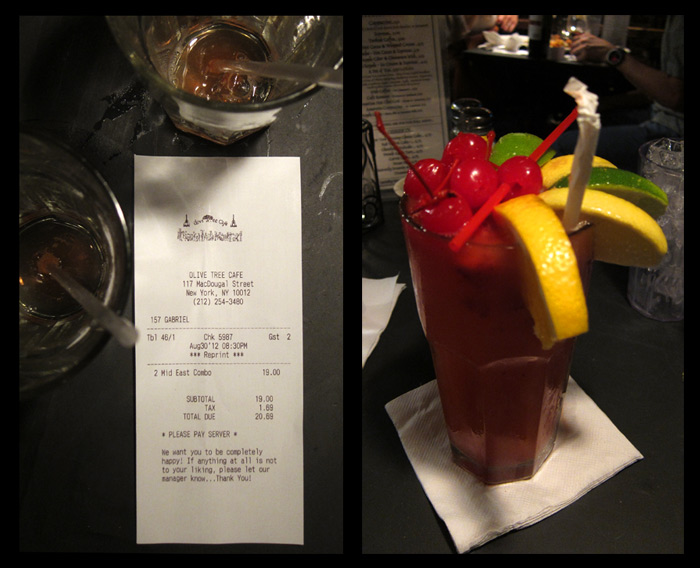
    The Setup: I was in Olive Tree Cafe with a friend. We needed no menu – we typically order the same things, which includes one of my favorite drinks – Passion Punch. We order this virgin, i.e. no alcohol. The drink is made by the bartender or sometimes the waiter, depending on the bartender’s workload. The drink is full of fresh fruit and maraschino cherries. It is extra wonderful is Gerald is our waiter. We placed our order for food and drinks as soon as we were given the menu.

    Round one: The drinks arrive. On this occasion, however, the Passion Punch was particularly sad, with nearly no fruit at all, only the juices. I am one who rarely complains in a restaurant or sends things back, as is my dining companion. However, in this case, our expectations and disappointment both being great, we did call over the waiter and, as politely as we could, pointed out the dearth of fresh fruits. The waiter apologized and promptly took the drinks away.

    Round Two: He returned shortly with drinks that looked wonderful. However, one sip and I noticed there was a problem. He had mistakenly made the replacement drinks with alcohol. We were reluctant to complain again, but we had no choice if we were to have beverages – neither of us drink alcohol (in fact, my companion is technically a minor who cannot be served legally). The waiter, now very concerned at his bigger mistake, removed the drinks from our table.

    Round Three: Our new drinks were everything we had ever expected and more. They were virtual meals with so many maraschino cherries we could barely finish them. But there was an even more pleasant end to the meal.

    The manager, who must have been informed of the ordeal by the waiter, came over to our table personally to apologize and ask if everything was now to our liking. I was thoroughly impressed – Olive Tree is a busy place with lots of tourists. This type of extra consideration came unexpected. But there was more.

    I speculated that there was an extremely remote possibility that we could be comped for the drinks. Unlikely, because one, we were in New York City and two, replacing drinks for three rounds without any hesitation from the waiter was certainly adequate compensation for their mistakes. Our check arrived. I was stunned. I had big news of my own and had to share it here. The drinks were nowhere on the bill.

    I asked for the manager again to thank him personally. He assured me that their job was to serve their customers properly and that we should not pay for mistakes made. I photographed the check and told him the good deed would be the subject of a story for all to read and which I had already titled in my mind. I wish that more restaurants would follow the example of that place in South Carolina and Olive Tree Cafe and when there is a mistake with an order, just Do the Right Thing 🙂


    Related Posts: War Against Disservice, War Against Disservice Part 2

    More from the Olive Tree Cafe: Just Another Loud Mouth, All About Skin Tone (Part 1 and Part 2), Nice Camel Sweater, Timbuktu, Guam, and Siberia, Random Acts of Consideration


  • dinamic_sidebar 4 none

©2026 New York Daily Photo Entries (RSS) and Comments (RSS)  Raindrops Theme