• Horn of Plenty

    Apart from the traveling, I find Thanksgiving to be a comforting time of year, very comfy as far as eating is concerned. It is a time of year where family, friends, and food come to the foreground and other responsibilities can be pushed aside. Thanksgiving Day is still rather non-commercial, with the emphasis on thanks and giving. This is a nice respite from the over-the-top commercialization that has affected virtually everything. It also is the day where overeating is not only allowed but also encouraged and expected. An old Saturday Night Live skit comes to mind where wives were virtually force-feeding their husbands (who could eat no more) in their plush upholstered chairs on Thanksgiving Day. And then there is the famous scene in Monty Python’s the Meaning of Life where the enormous Mr. Creosote is persuaded to eat one last wafer-thin after-dinner mint, whereupon he literally explodes.

    The photo shows the scene at Dean and DeLuca, the gourmet emporium in SoHo, the evening before Thanksgiving. There was a time when places like this inspired awe and wonder with residents and visitors. This food mecca has been a destination for many. But we are all a little jaded now, given places such as the ubiquitous national chain Whole Foods and exposure to a myriad of goods and services via various media and the Internet. The kind of things which these iconic NYC gourmet shops were renowned for have become much more available outside the city. For most, America has become the horn of plenty…

    Note about the Horn of Plenty or Cornucopia: There are many variations on the telling of this Greek myth. In one telling, Zeus was raised by Amalthea on the milk of a goat. In return, Zeus presented her with the horn of the goat, which had the magical power to be filled with whatever the holder desired. The modern cornucopia is now a wicker basket with the shape of a goat’s horn.
  • Luxury

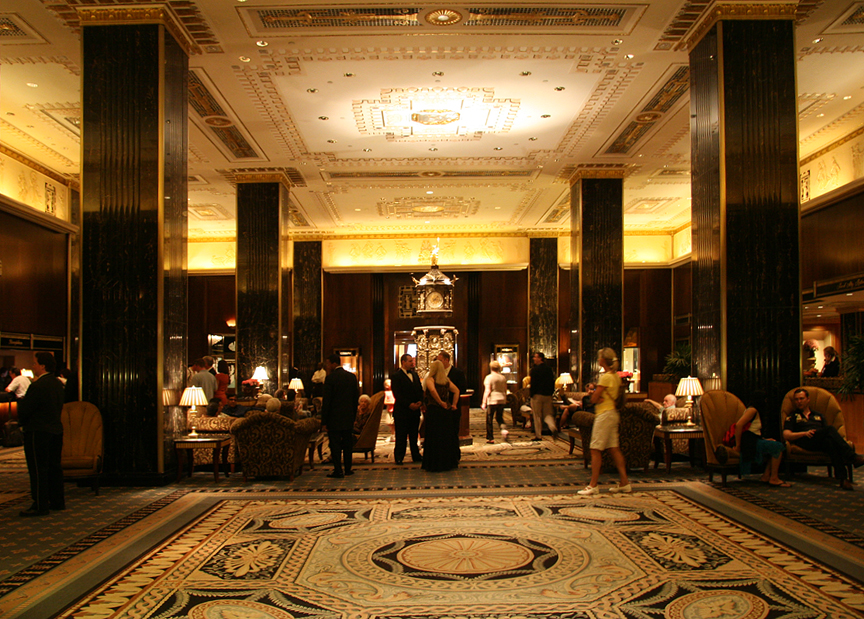
    I have not done a posting on the Waldorf Astoria Hotel per se (I will do a more in-depth piece in the future) but did feature their famed clock earlier this year. The Waldorf epitomizes classic, iconic New York. If you want to see a place that just exudes old world charm and luxury, New York style, this is it: the Palace of New York and art deco masterpiece. Of course, the Plaza (no longer a hotel) and the Pierre give it a run for the money, but if I had to pick one hotel that says “New York,” this would be it. There are so many historical associations, including ringing in the New Year with dance band leader Guy Lombardo. Presidents, Queens, dignitaries, and celebrities of all types – the roster, past and present, reads like a who’s who. The hotel has the largest elegant ballroom in the city – four stories high. This is home to the annual International Debutante Ball.

    The U.S. government maintains a large suite on the 42nd floor as a residence for its United Nations ambassador. The presidential suite has been home to every President of the US when visiting New York since 1931. If, by the way, you have never been (whether resident or visitor), I highly recommend that you visit and wander about. The main lobby is a must-see. Have no concern about visiting as a non-guest – there is too much traffic for anyone to police. Act like you belong, and you will…


  • Fuerzas Irresistibles

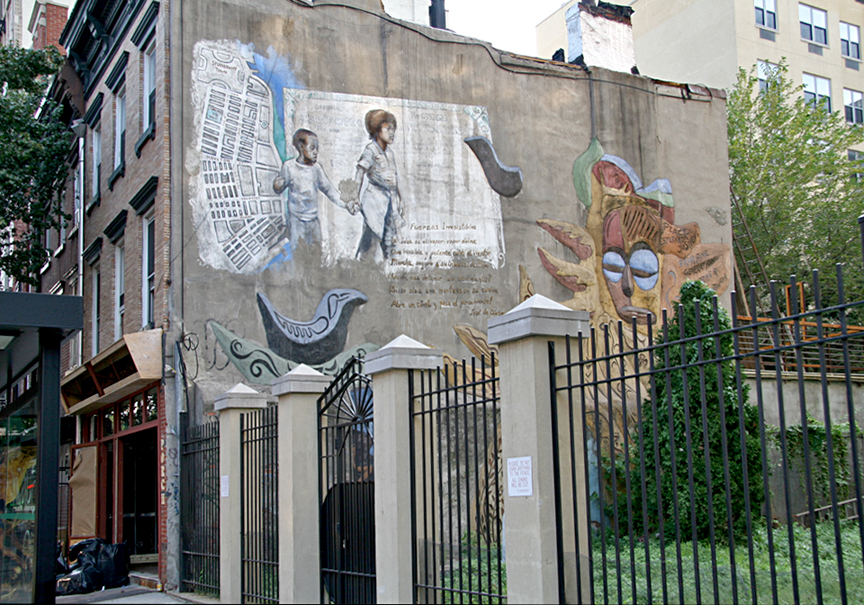
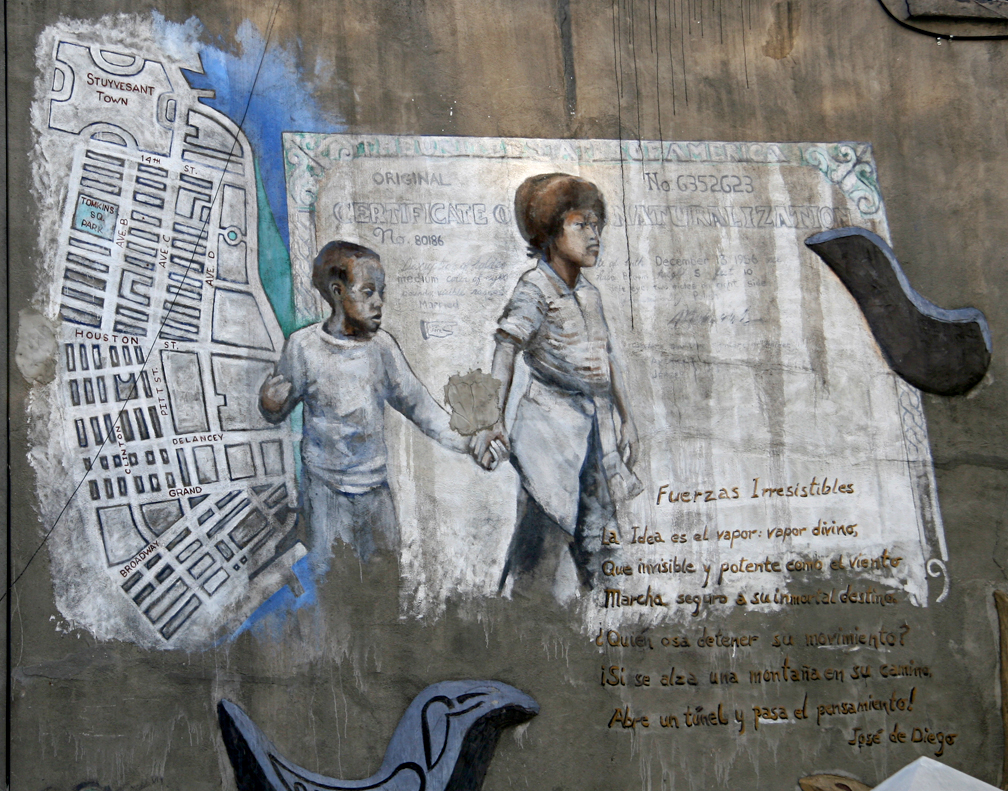
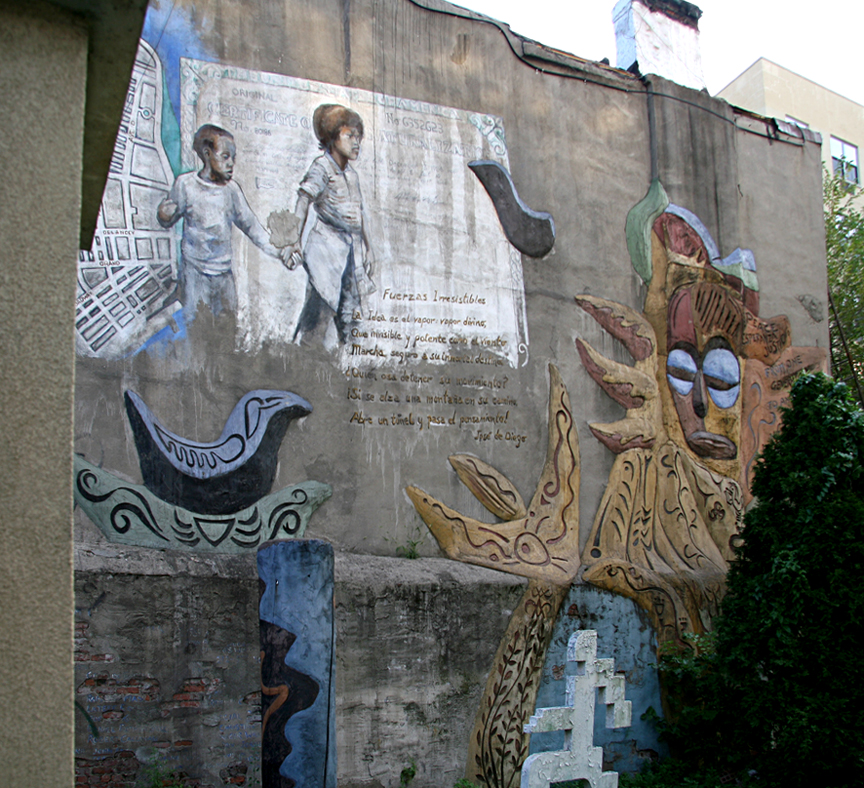
    Today I became acquainted with José de Diego (April 16, 1866 – July 16, 1918), statesman, lawyer, journalist, and poet. Born in Aguadilla, Puerto Rico, Diego spent time between Spain and Puerto Rico and was an advocate and leader of the movement for Puerto Rico’s independence from Spain. An important figure in Puerto Rico’s history, many things have been named in his honor – roadways, schools, and his birth date as an official holiday. He was also known as father of the modern Puerto Rican poetry movement. The last six lines of his poem, Fuerzas Irresistibiles, are on the wall of the public community garden:

    La idea es el vapor: vapor divino,
    que invisible y potente, como el viento,
    marcha seguro a su inmortal destino.

    ¿Quién osa detener su movimiento?
    Si se alza una montaña en su camino,
    abre un túnel y pasa el pensamiento!

    The poem and bas relief speak to community solidarity in this neighborhood, which has a large Hispanic community and Puerto Rican heritage. The community garden, Bello Amanecer Borincano, was started in 1984 by Carmen Pabon (it was later partially bulldozed). Click here for photo. The location is at 119 Avenue C (in Alphabet City), which has the official alternate name Loisaida Avenue (Loisaida is Spanglish for Lower East Side). The term was originally coined by poet and activist Bittman “Bimbo” Rivas (1939-1992) in his 1974 poem “Loisaida.” The renaming of Avenue C was a token of appreciation for his contributions to the Lower East Side, his home, and for his people…

    Photo note: I only noticed on close examination that the illustration’s background is a replica of a Certificate of Naturalization of the United States of America. Click here for close-up.


  • Titans

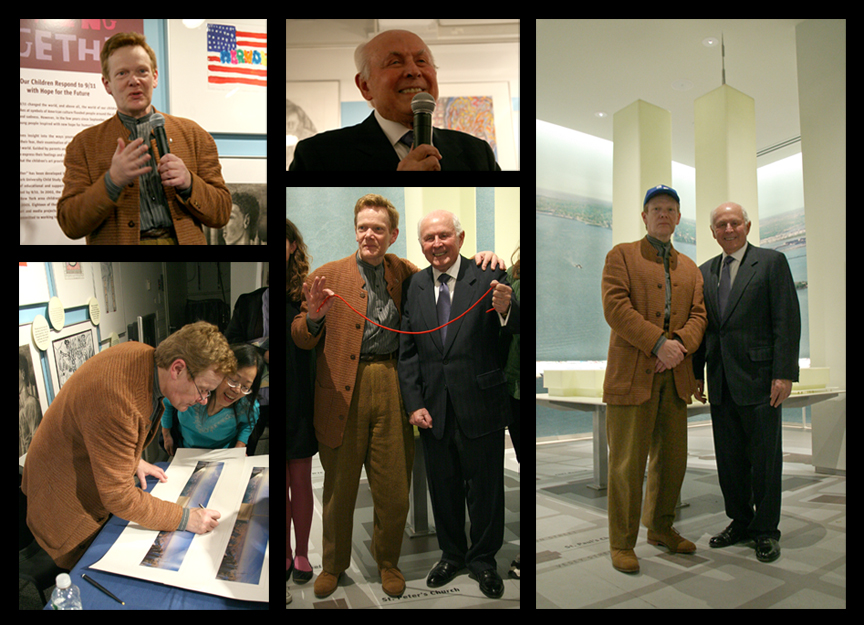
    Yesterday afternoon, I was privileged to attend a public program at the Tribute World Trade Center with Guy Tozzoli and Philippe Petit entitled A Conversation About Bold Imagination. The program was held in a small cozy room with 75 or so attending – it had the feeling of an intimate family gathering. I had the sense that everyone there knew more about one or both of these men than would be typical people. The audience was mesmerized – I know I was. I have written before of Philippe in Artiste Extraordinaire.

    Since writing this blog in the last one and a half years, I have become much more attentive to the words of others. Philippe is extraordinary – I have not seen anyone who speaks so poetically in an extemporaneous fashion. He told of his notorious walk between the Twin Towers on August 7, 1974 and how he planned this in secret over the course of 6 years. Philippe is a man of many talents – tight-rope walker, unicyclist, magician, juggler, pantomime artist, pickpocket, street juggler, writer, illustrator, and speaker. At the time of Philippe’s walk, Guy Tozzoli was the director in charge of overseeing the creation and building of the two towers. His stories and anecdotes of the process of becoming director, meeting Philippe, and dealing with his arrest were wonderful. He always comes across as a warm, positive human being. At the time prior to Philippe’s walk, the towers were really seen in as monsters without soul, but Philippe’s act made them human. Guy is President of the World Trade Centers Association, an organization of nearly 300 world trade centers in almost 100 countries.

    Philippe described his walk as an artistic crime – one that did not take from anyone, but was a gift. Many thoughts and feelings came to mind as I listened to these inspiring individuals and thought of the towers, but one word really jumped out and made titling this article so easy: Titans…


  • Advertising Gone Wild

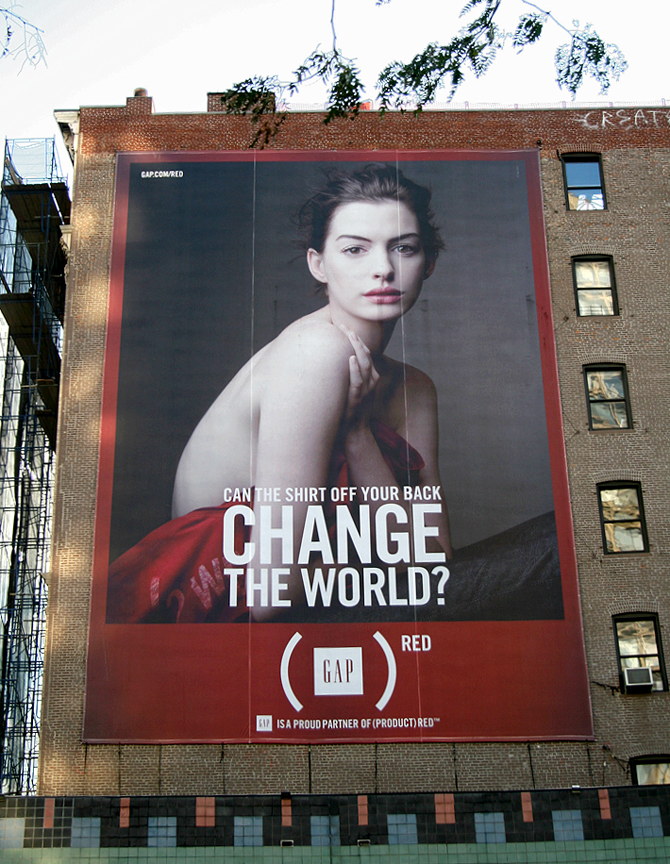
    New York City has always been a place where commerce and advertising have been prominent in the landscape; Times Square is a good example. However, the combination of digital technology (with the ability to print enormous signs on vinyl) and the lure of advertising revenue has taken it to new heights with building walls in the city being blanketed by ad murals, not to mention advertising in a myriad of other variations – newsboxes, ads projected on streets, etc.

    What the smug New Yorker always saw as a blighted feature of the suburbs, and believing that the sophisticated culture of NYC provided immunity from the same, has now become a prominent feature of the city. Commercial interests are relentless and tenacious, however, and keeping them in check requires, if I may borrow from the ACLU motto, eternal vigilance. Commerce usually wins – even in France, Apple Computer managed to hang Think Different banners, featuring Gustave Eiffel and Pablo Picasso, on the facade of the Louvre. The Gap ad in this photo hangs on Houston Street, a few blocks from The Wall.

    Houston Street is ideal for this type of ad – the street is heavily trafficked and has many large building facades. What surprises me most is that in many cases, these murals are placed over apartment windows, obstructing views and light (in some cases, you see cutouts for the windows). But alas, the issue of billboards is not new. I ran across this article in the New York Times which I thought was recent: BILLBOARD COMMISSION ADVISES DRASTIC REFORMS; Fire Hazard Is Increased, Real Estate Values Depreciated, and the Beauty of the City Marred, It Reports, by Many of the Big Signs and Their Structures.
    Date of article: 1914

    Related Postings: Big and Beautiful?, Manhattan Mural


  • Boyd Thai

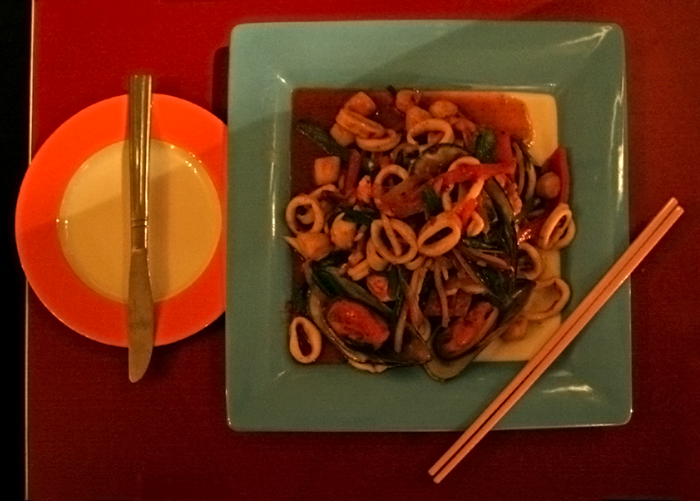
    Boyd is a tiny Thai restaurant at 210 Thompson Street in the center Village. After my meal there last night with a friend, I spoke to the owner, who was most cordial, and gave him my NYDP card. Owner/chef Boyd has had previous restaurant experience; he owned a restaurant in Thailand prior to coming to the US and has worked in Thai restaurants in NYC, including the well-known, stylish Planet Thailand in Williamsburg, Brooklyn. In the last year I have been eating there, I have found the food consistently excellent and the staff to be attentive and friendly. Reviews in publications such as MenuPages, Timeout New York, Yelp, and New York Magazine are overwhelmingly positive.

    One thing that stands out about this place is the creative flair they bring to the menu offerings, going beyond the standard Thai fare with dishes like Chile Crusted Tuna with Grape Asparagus Curry, Tuna and Mango Salad, and Roasted Duck with Avocado Orange Salad. I love the exotic spices and use of tropical fruits such as papaya, mango, tamarind, lime, coconut, avocado, orange, pineapple, and lychee. The cuisine is seafood oriented, but there are plenty of Thai standards (like Pad Thai), curries, and vegetarian entrees. There are also many nice small touches (like the dinnerware) all too uncommon in places in this price range – most inexpensive restaurants tend to treat dining in a very utilitarian manner. There are Early Bird specials before 7 PM – a full dinner with appetizers for only $9.95/$10.95. A real find…


  • The Wall

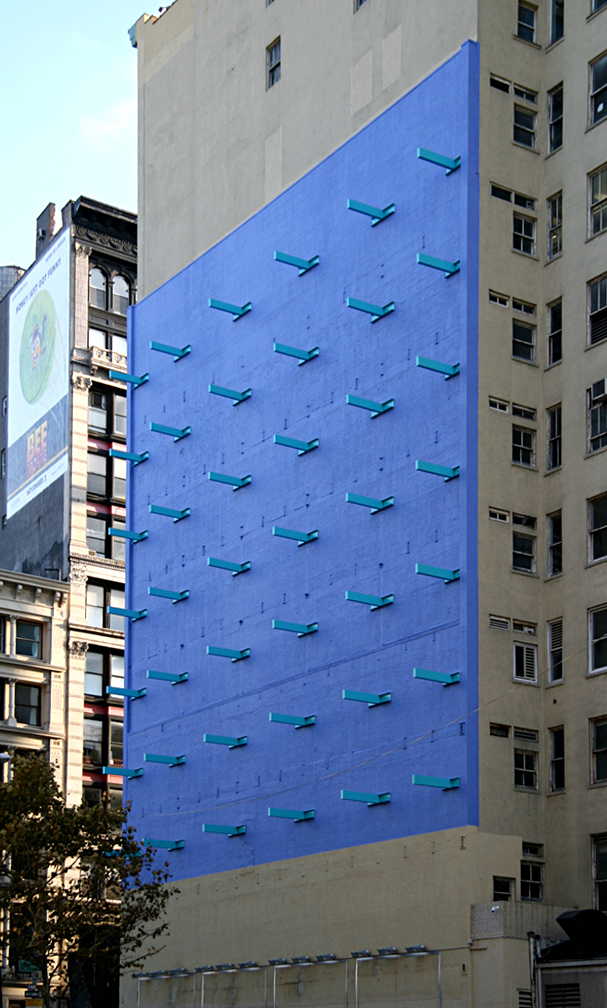
    The Wall in SoHo is one of the most well-known pieces of installation art in NYC. Its size, brilliant colors (turquoise aluminum beams on a lavender wall), and location at the intersection of two of the busiest major thoroughfares, Broadway and Houston Street, all give this piece enormous visibility.

    In reading for this article, I have found egregious errors, heinous omissions, misinterpretations, and conflicting facts, typical in online sources. And in the case of long and complex sagas, like the story of this wall, the situation worsens as people pick up a fact or two and fill in the blanks, extrapolating as they see fit. To add insult to injury, the misinformation is then copied.

    All that being said, it appears that The Wall was installed in 1973 by Forrest “Frosty” Myers. According to the New York Times:

    “The building at 599 Broadway was constructed in 1917. The building next door, No. 603, was razed in 1944 as Houston Street was widened. That building’s abutting wall was anchored to 599 Broadway with 42 steel tie rods ending in 42 exposed channel braces.

    This architectural scar endured until 1972, when Mr. Myers was commissioned to undertake ”The Wall” by Doris C. Freedman of City Walls, an organization that placed large-scale artworks on the blank facades of buildings. The project was welcomed by Charles J. Tanenbaum, who then owned 599 Broadway. Mr. Myers devised four-foot aluminum extrusions affixed with stainless-steel bolts to the channel braces, forming T-shaped projections from the wall plane. The background was painted blue-gray and the metal elements were green.”

    In 1984, the building was converted to commercial condominiums. The artist has been battling the condominium since 1997.
    In 2002, the work was taken down for repairs to the building – damage was being done by water penetrating through the artwork. The condo also wanted to generate income via billboard advertising, estimated to be $600,000 per year, and was not interested in reinstalling the art. The work sat in storage for 5 years until a compromise agreement was finally reached in 2007. You can read about it here. The newly reinstalled wall will now also be illuminated at night…


  • No Local Color

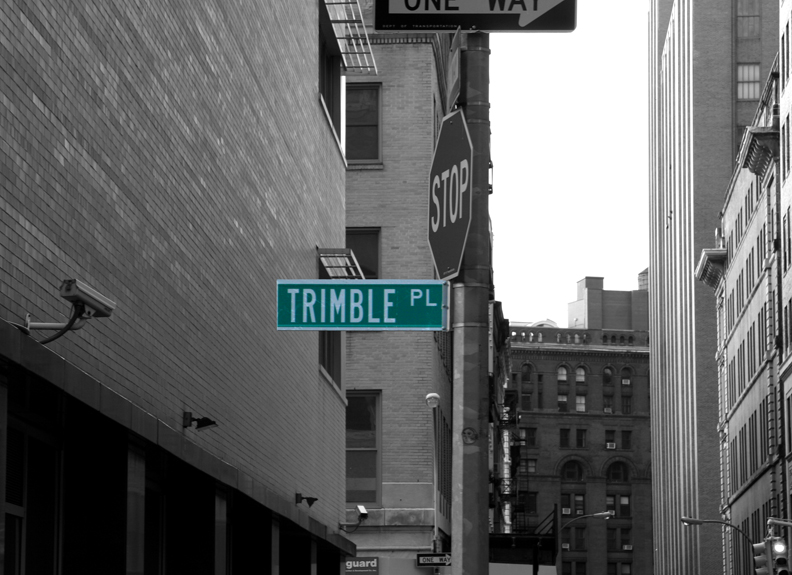
    What can be said about this obscure little private, one-block alley which lies between Duane and Thomas Streets, parallel to Church Street and Broadway in lower Manhattan? Not much at all. Would I recommend visiting it? No, not unless, like myself, you like to visit alleys. Are there any interesting tidbits or stories? None that I could find.

    Trimble Place is very uninteresting and drab, with no outstanding features or businesses and very little history other than it was named in 1874 for George Trimble, a 19th-century merchant, director of New York Hospital and an officer of the Public School Society. The most interesting things about the alley are the buildings that surround it, like the controversial 52-story residential tower next door and the bizarre, 550-foot, monolithic, windowless AT&T Long Lines Building at 33 Thomas Street. There are actually many small alleys like this in lower Manhattan: Mosco Street, Florence Place, Benson Street, Ryders Alley, Mill Lane, Mechanics Alley, and Jersey Street. And in the Village, there are several which are residential and much more bucolic and historic in nature, such as Grove Court, MacDougal Alley, and Washington Mews. Unlike most of Manhattan, the mayhem of small streets and alleys downtown is due their creation prior to the Commissioners’ Plan of 1811, which established an orthogonal grid north of 14th Street.

    I find the very TRULY nondescript interesting just for that reason – it’s not easy being that featureless, like the tract housing of Levittown, NY, or luggage areas at the airport. But there is always hope that Trimble Place may have its day. Look at what happened to Seinfeld, a show reputedly about nothing…


  • It Shines For All

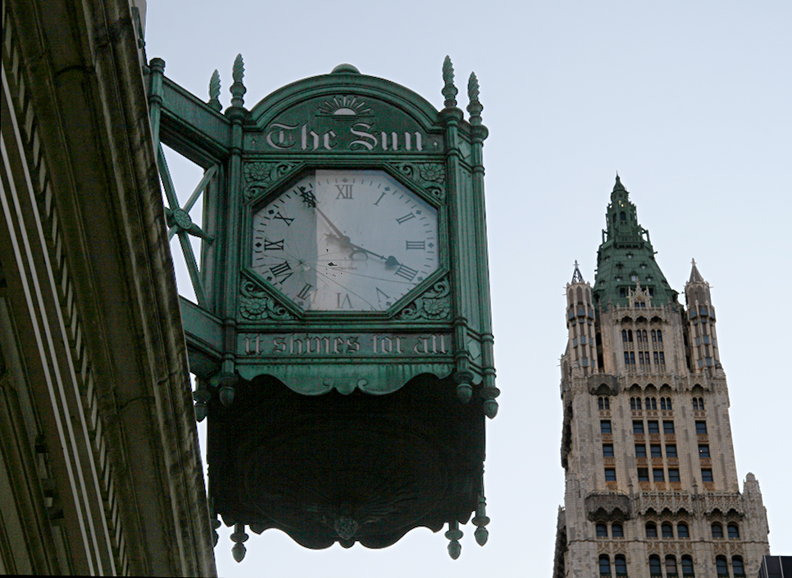
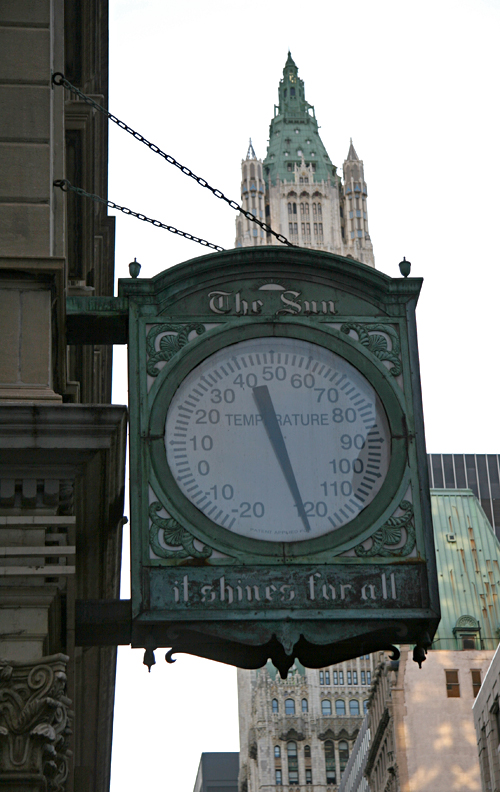
    Who can resist an antique bronze clock and thermometer with the slogan The Sun It shines for All, mounted against a historic landmark white marble building, on Broadway with the Woolworth Building as backdrop? Images of old New York and the romance of days past flood my mind with a vista like this one. Click here for a photo of the thermometer.

    The 7-story building is located at 280 Broadway at Chambers Street near City Hall. The white marble Italian palace was originally erected in 1846 as the A.T. Stewart Dry Goods Store – America’s first department store. This grand palace of commerce was quite dazzling at the time. The structure is of major historic architectural significance – it is one of the first Italianate commercial buildings in the United States. In 1917, it was taken over by the New York Sun. The bronze clock and thermometer were added in 1930. The Sun occupied the building until 1950; in 1970, it was taken over by the City of New York. Sadly, the building remained in shabby condition for many, many years, and the clock itself stopped functioning in 1967, was repaired, stopped working in 1987, and was repaired again. The building was renovated during the Giuliani administration. Now the sun, clock, thermometer, and building shine for all…


  • Bird Country

    Regular readers of this site are aware of the spots of country I have featured, particularly the numerous community gardens. I, like many other New Yorkers, look for pieces and reminders of the country for any number of reasons, and evidence of seasonal change is one of them.

    It is easy to go through seasons in the city with little to mark them except temperature and changing light. But to witness the other changes nature has to offer – leaves turning color, migratory birds, etc. – requires more work and looking in special places such as gardens and parks.

    In seeking out the natural in the city, one frequently discovers surprises like grapes growing on vines in the center of the Village, red-tailed hawks eating their prey, butterflies, waterfalls, spectacular sunsets (such as Manhattanhenge), a Time Landscape, a microclimate in the Garden at Saint Lukes, turtles, squirrels, and birds.

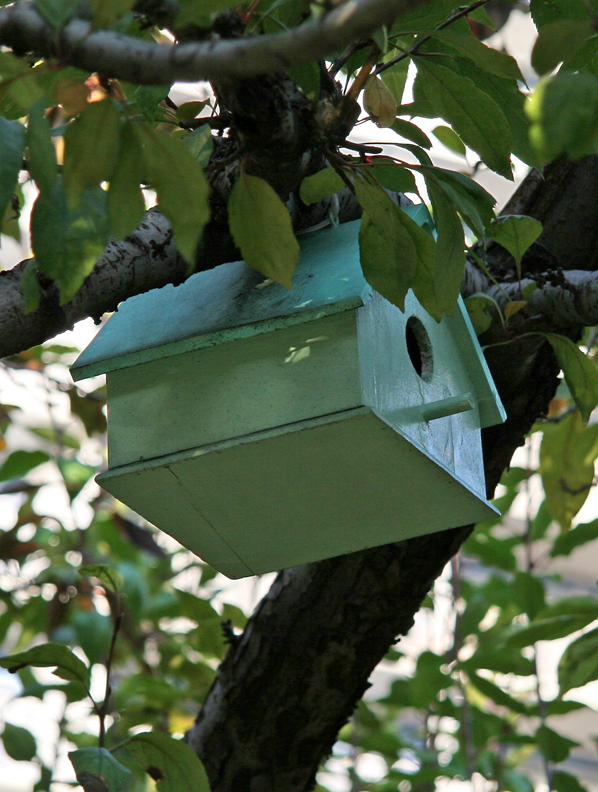
    New York City is actually one of the most important bird areas on the East Coast. It lies along the Atlantic Flyway and draws numerous species from places as far away as Patagonia and Greenland each spring and fall, which is why Central Park is a great area for bird watching. This birdhouse was in the LaGuardia Corner Gardens in a tree laden with apples (I have picked many here when it is open). I can see a new city festival – New York Is Bird Country


  • Front Street

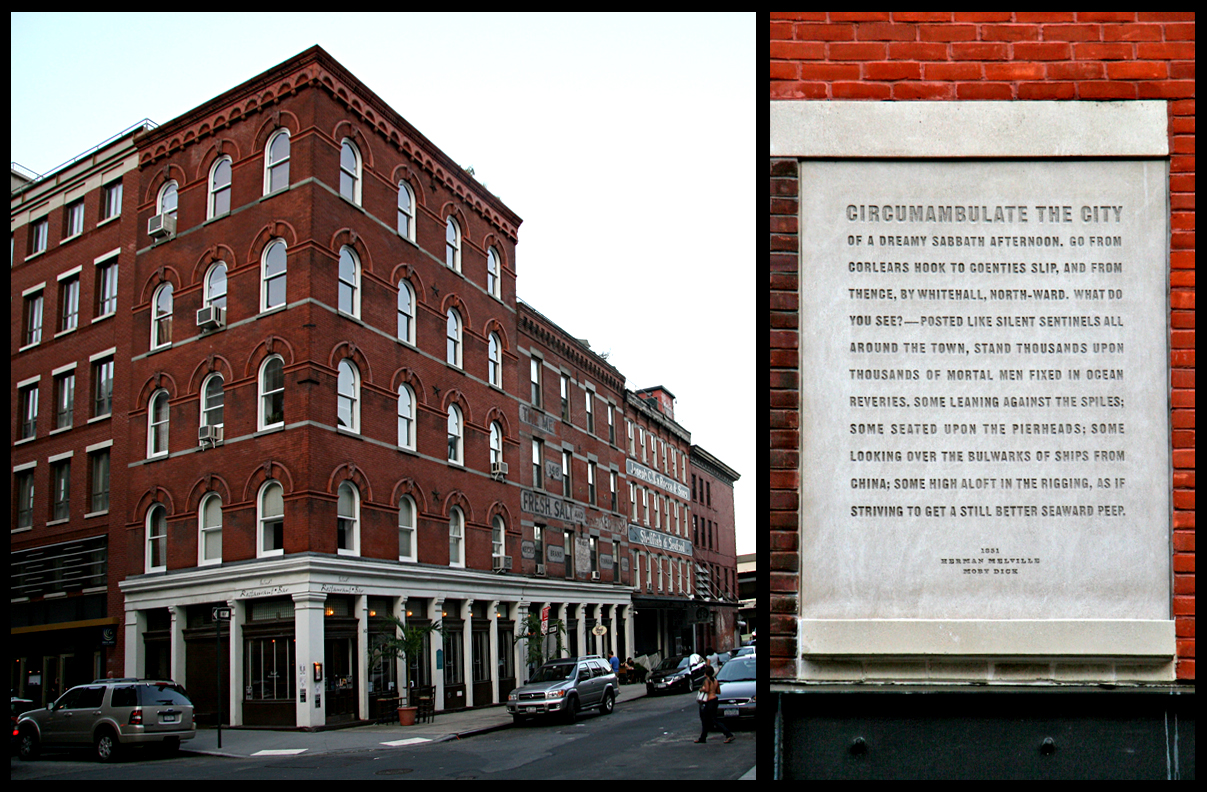
    Front Street is part of the Historic Cobble Stone District in South Street Seaport. The area has been renovated, gentrified, and developed (by the Rouse company); I discuss the cloned look with other areas of the country in my posting on South Street Seaport. The original architecture, however, has been preserved, as you can see by the signage on the buildings in the photo above left. A walk down any of the streets is rewarding, and the area’s history can still be felt.

    I like the quote from Moby Dick which is inscribed on a placard on Front Street. It captures the spirit of New York City at a time and in a place where its true nautical nature must have been preeminent:

    “Circumambulate the city of a dreamy Sabbath afternoon. Go from Corlears Hook to Coenties Slip, and from thence, by Whitehall, northward. What do you see?- Posted like silent sentinels all around the town, stand thousands upon thousands of mortal men fixed in ocean reveries. Some leaning against the spiles; some seated upon the pier-heads; some looking over the bulwarks of ships from China; some high aloft in the rigging, as if striving to get a still better seaward peep.”

    I have done several postings on aspects of this neighborhood: Belle de Jour, Dead to the World, Fishbridge Garden, Spiegeltent


  • Fashion Forward

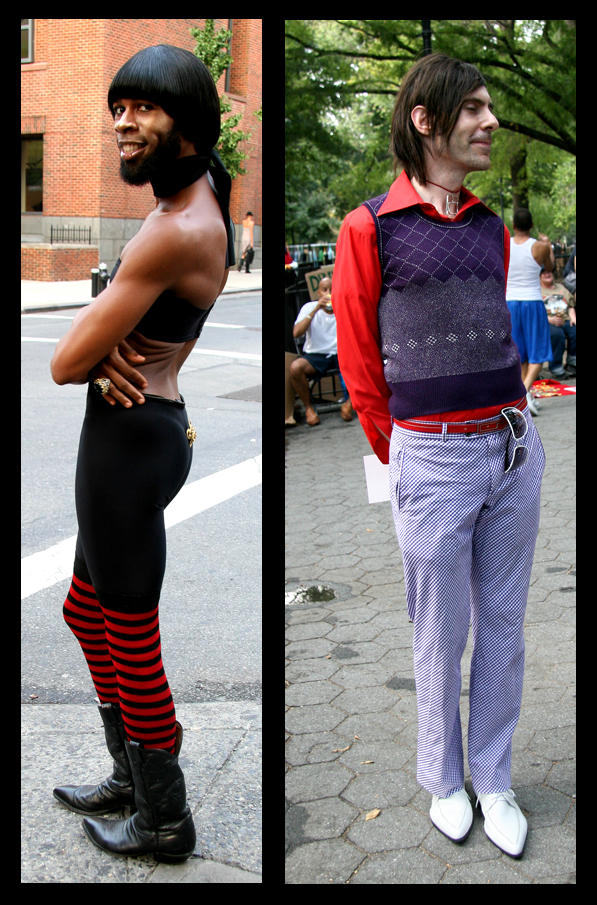
    I thought you might like an update on my close encounters with the other kind. Some of you may recall the posting I did, Out There, which got quite a response. I have since met the mystery man: André, who always seems to be outrageously dressed – that’s him on the left sporting a new outfit. I see him regularly in the neighborhood and we always say hi – he is most cordial. On my first meeting after the posting I did, I introduced myself, gave him my card, told him that he had been featured on this site, and that I had entitled it “Out There,” saying bluntly but in a complimentary tone, “You have to admit – you are rather out there.”

    Friends cringed when I told them about my remark, but he was pleased to have been featured, and his response was quite positive (as I expected): “I like to think of myself as Fashion Forward.” I love that. Most recently, I saw him in the most outrageous, fanciful outfit – glittering, futuristic style – but unfortunately, I did not capture it on camera.

    The other person on the right photo I found to be very smartly dressed. I met him in Tompkins Square Park. I have posted on a number of individuals who, let’s say, are rather unconventional and exhibitionistic, most notably Spike and Narcissism Gone Wild. Of course, some may consider these people rather tame in the world of body alteration: tattooing, piercing, branding, scarification, subdermal implants, and even cornea tattooing. Katzen the Tiger Lady, e.g. has full body tattoos resembling that of a tiger, with whiskers attached via piercings on her face (I have met her and have photos of the two of us). She was once married to The Enigma, a sideshow performer who has had extensive body modification, including horn implants and a full-body jigsaw-puzzle tattoo…

    More Posts of the Unusual: Spring Madness, Superheroes, Snake Charmer, Circus Amok


  • Garden in Transit

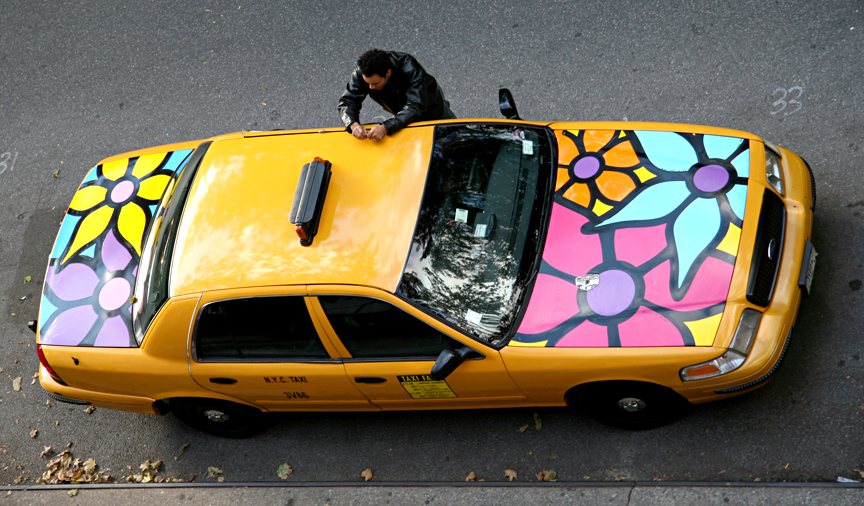
    When I first started seeing cabs with these floral patterns, I assumed that it was some sort of trend that drivers and the public would soon regret, with the art deteriorating over time and the subsequent shabby looks and bad repainting jobs. I was relieved to find out that the decorations are stickers and can be easily removed.

    Apparently taxi drivers as well as the public share confusion as to the meaning of the flowers – many (incorrect) rumors have been circulating. Garden in Transit is a privately financed $5 million art, education, and creative therapy project as part of TAXI 07, a celebration of the 100th anniversary of the first metered taxicab in NYC. 23,000 children in schools and hospitals – in addition to many adult volunteers – have painted 80,000 flowers on 750,000 square feet of adhesive panels. The project is sponsored by the community art organization Portraits of Hope, founded by Bernard and Ed Massey. It was 7 years in the making (first conceived and proposed to the city in 2000) and approved by the Taxi and Limousine Commission in 2006 – the Mayor’s press release and formal announcement was made July 18, 2006.

    Garden of Transit workers approach cab drivers at night at their various haunts – diners, Kennedy Airport, etc. – and persuade them to participate. The decals are installed on the spot for free. The moving exhibition is for four months – September through December 31, 2007. After that, it is up to drivers/owners to remove the decals when and if they choose…

    Technical Note: The material used was MACtac IMAGin® B-Free vinyl with a patent-pending bubble-free air egress adhesive. This sophisticated material is frequently used for vehicle wraps and other surfaces with complex curves.


  • teany

    It’s always a pleasant surprise to do research for an article not knowing what to expect and to find that there is a really interesting story behind something that, on first glance, appeared to be relatively ordinary. You could argue that one can find something of interest in everything and that a great writer can make perspiration riveting, but I think ordinary mortals would agree that some things are just inherently more interesting than others. Like teany.

    Teany is a beverage company – many who live in the NYC area are probably familiar with their tea/juice products, as they are widely distributed in the New York and New Jersey area. Teany is also a small tea house and restaurant, shown in the photo, at 90 Rivington Street on the Lower East Side. The company was started in 2002 by Kelly Tisdale and musician Moby (they were boyfriend/girlfriend at the time). The shop offers 98 varieties of loose tea and vegan food (Kelly is vegetarian, Moby is vegan). Moby, who started his recording career as a techno artist, has a certain mystique and cultish following. It reminds me of the aura around David Bowie, who, coincidentally, lived across the street from Moby in Little Italy for a decade.

    Moby (Richard Melville Hall) was born in Harlem and brought up in Darien, CT – a startling contrast, with Darien and the neighboring communities of Connecticut being some of the wealthiest in the country. Never surprising when a life of privilege leads to rebellion – Moby was in a hardcore punk band in the early 1980s called the Vatican Commandos. Read Moby’s bio on his website here. His name, by the way, was a nickname given to him by his parents, referencing the novel Moby Dick, written by Herman Melville, his great-great-great-great uncle. Rumors of the closing of the tea shop in 2006 turned out to be untrue. There was, however, a business change with a focus more on teas and less on food and Kelly taking full ownership of the company…

    Note about the company name: The company proclaims that “you can pronounce it however you like. tea-knee. tee-nee. tea-enn-why,” and that Moby and Kelly themselves pronounce it “teenie,” because they are “small,” both in stature and in status.


  • Landlubber

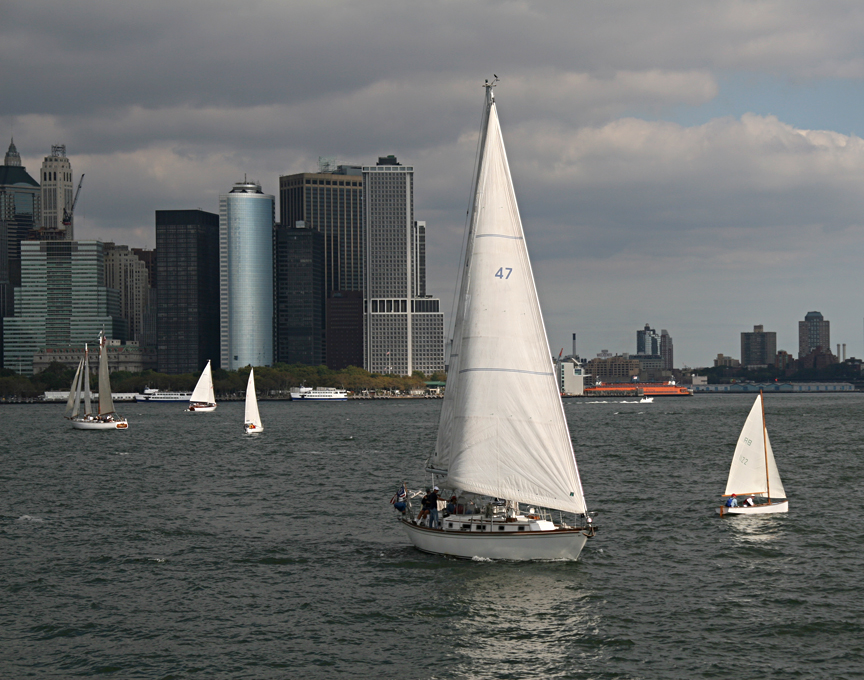
    Three rough rides on the sea let me know that I was a landlubber. At one time, I had thought that sailing as a hobby would be something I might pursue. The romance of the sea, as conveyed via books, photos, films, smells, the beach, vistas of and from the ocean – everything about the sea – is compelling to me, except the experience of actually being on the water. I was going to qualify that by adding “especially when it’s rough,” but at this point, apprehension of seasickness and its extremely unpleasant queasiness gives me cause to approach every nautical trip with trepidation. Of course, the world abounds with suggestions for prevention and cure, but once you have motion sickness, suggestions of the well-intended around you just add insult to injury. I have been OK, however, on ferry and riverboat rides around the city. Distraction can be helpful, and the vistas around the island of Manhattan are spectacular enough to keep one’s mind off any pitch, roll, or yaw.

    This photo was taken of lower Manhattan from a river boat. The highly reflective, rounded building just left of center in the photo is 17 State Street, about which I have previously posted. I love the quote from a story by Isaac Asimov. In it, there is an anecdote about a seasick passenger whom a steward assures, “Nobody ever dies from seasickness.” The passenger responds, “For Heaven’s sake, don’t say that. It’s only the hope of dying that’s keeping me alive.'”

    A note about the word landlubber: I misunderstood the derivation of this word, thinking the word lubber to be a play on lover. Lubber dates back to the 1300s and means a clumsy person. Landlubber dates back to 1690 and refers to an unseasoned sailor or someone unfamiliar with the sea and is a sailor’s term of contempt for a landsman. I’m OK with the insult 🙂


  • dinamic_sidebar 4 none

©2026 New York Daily Photo Entries (RSS) and Comments (RSS)  Raindrops Theme