• Out There

    Oh yes, this person is way out there. An infrequent regular to Washington Square Park, I caught him styling through one morning. Those of us who spend some time in the neighborhood have caught him in a variety of wardrobes, always walking tall and proud – no shy demeanor or closet behavior here. I know nothing about him. This is the latest in a series of exhibitionistic regulars and other flagrant and unusual acts which I have documented in this park: Spike, Narcissism Gone Wild, Water Sprites, Wood Nymph, War and Peace, Spring Madness, The Dance Parade, The Krishna Fest, PDA, Dyke March, Singing Bowls, Spinning, Twelve Tribes, Penny Farthing, Homeless Art, Superheroes, Snake Charmer, and Circus Amok.

    There are many which I have not documented: the 9/11 Mysteries group who believes that 9/11 was a the result of a controlled demolition; Wednesday nights we have the Christians preaching and giving out free food; Mennonites singing and preaching to passersby (one of the most startling contrasts is to see wholesome religious folk in their classic attire in Manhattan); the ritual sacrifice of a chicken on 6/6/06. And we have a stable of regulars who are genuinely askew. We sometimes jokingly refer to the place as an asylum…

    For more of André, go here.

  • Spiegelworld

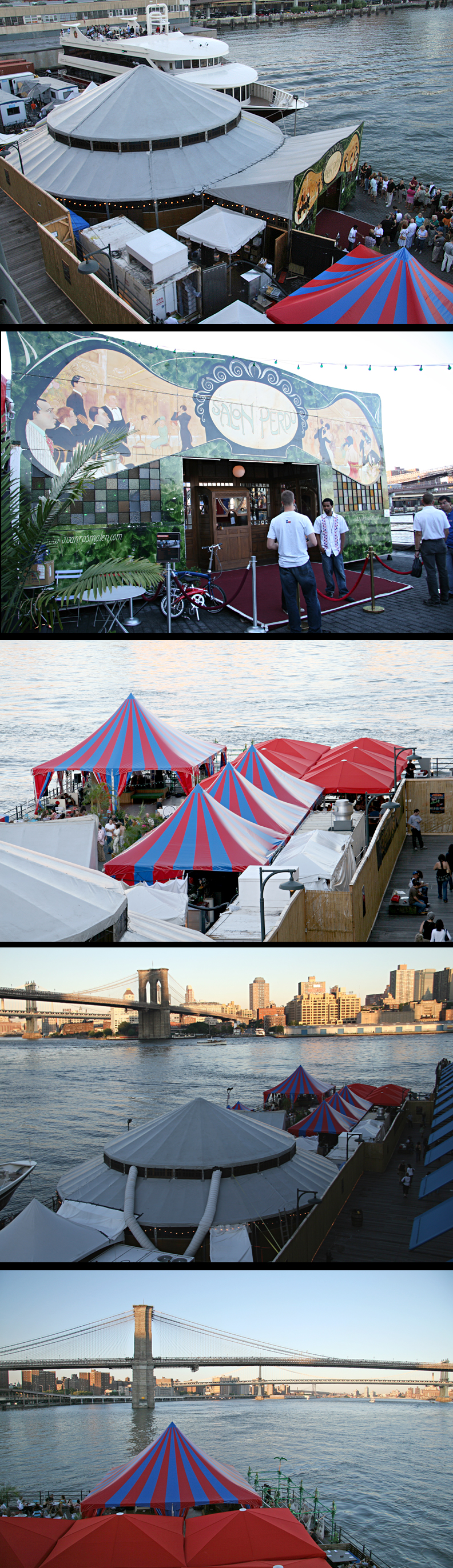
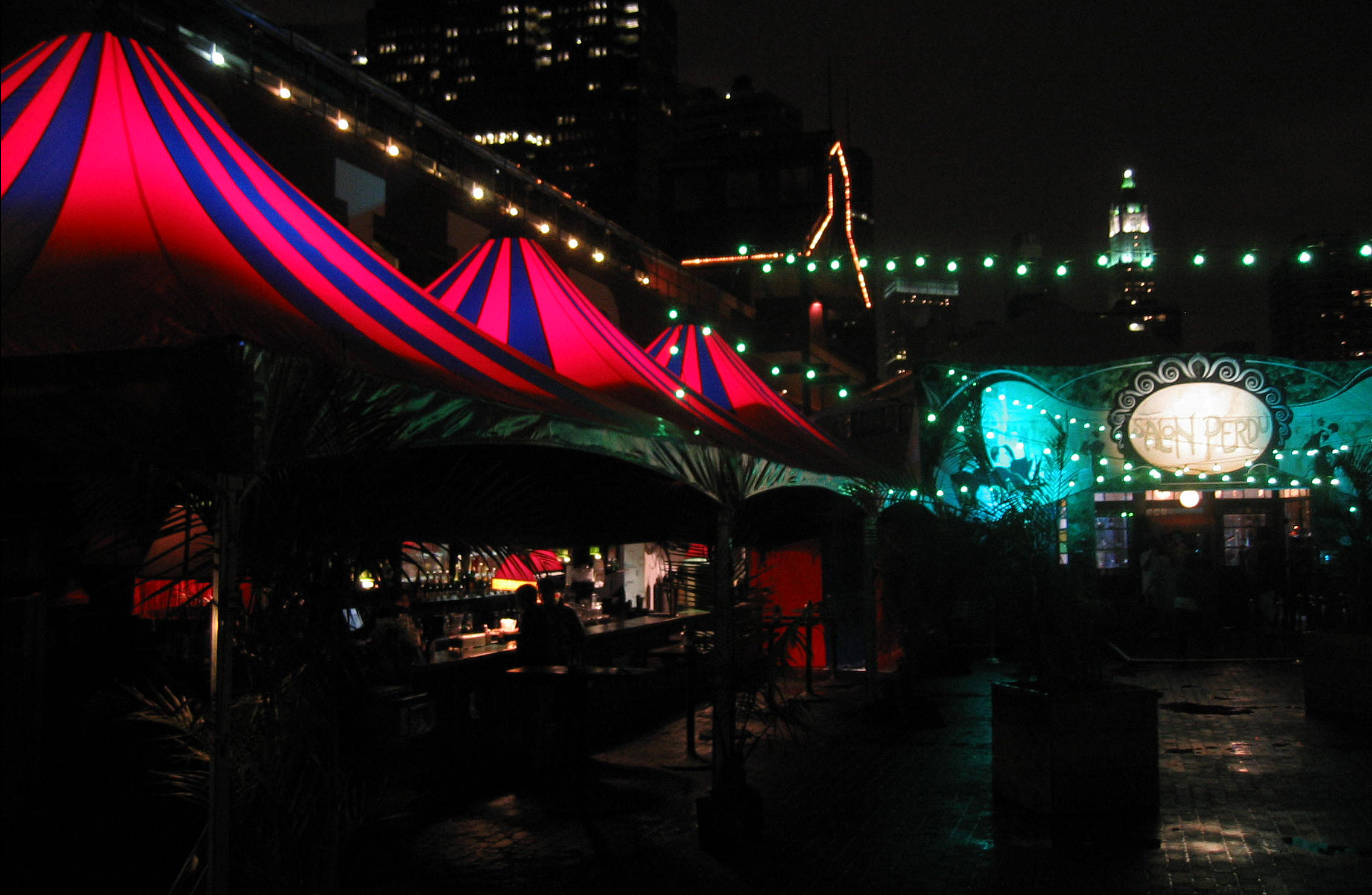
    Spiegelworld is a traveling venue currently installed on Pier 17 at South Street Seaport, running the summer through the end of September. Click here for more photos, taken during daylight. This is a small, European-styled circus meets burlesque/cabaret with acts that span the spectrum of variety arts entertainment at its best. I hate to use the word “circus” since this connotes many things to different people, most likely nothing like the two shows currently running, Absinthe and La Vie. The shows are quite edgy and erotic, with a a fair amount of sexual content – implicit and explicit, as well as some nudity (however, I found none of it gratuitous). There are hand balancing acts, an amazing diabolo act, various aerial acts, contortionists, cabaret singing, comedy, and juggling. In addition to the two shows mentioned, Spiegelworld features live music acts, dance parties (with DJs), an outdoor restaurant, and a bar (with tents for inclement weather). Click here for their website.

    The main shows are held in the antique Spiegeltent, the Salon Perdu, with its opulent decor of mirrors and brocade and intimate setting (only 350 seats). All with spectacular vistas of the cityscape, the East River, and the bridges. I attended with a friend for her birthday; we saw both shows back-to-back. I was thoroughly impressed – the shows were well choreographed, the acts are solid, and the talent and skill level was outstanding. The two shows are quite different – I wouldn’t want to choose between them. La Vie is performed by Montreal’s circus company The 7 Fingers. The acts are woven together with a story line involving death and purgatory. Absinthe resembles more closely a variety arts show. What is most remarkable about both of these shows is the depth and breadth of talents of the cast members, many of whom perform in different acts atypical in an age of specialization. Don’t miss these shows – see them both…


  • Spiegeltent

    The Spiegeltent is a traveling European mirror tent. These are hand-hewn pavilions built of wood, mirrors, canvas, leaded glass, and detailed in velvet and brocade. They have been used as traveling dance halls, bars, and entertainment salons since they were created in the early 20th century in Belgium. One of the last remaining Belgian Spiegeltents is The Famous Spiegeltent, which travels around the world to various venues, such as the Edinburgh Fringe, the Melbourne International Arts Festival, the Belfast Festival at Queen’s, and Just for Laughs in Montreal, Canada. The Famous Spiegeltent was built in 1920 by master craftsmen Oscar Mols Dom and Loius Goor. Marlene Dietrich sang “Falling In Love Again” on its stage in the 1930s.

    There are only a few remaining spiegeltents worldwide at this time (one of the largest is the Grand Spiegeltent). The one in the photo is located at South Street Seaport as part of Spiegelworld. In tomorrow’s posting, I will tell of the spectacular shows I saw there with exterior shots of the tent and the environment they have created…


  • Lotos Club

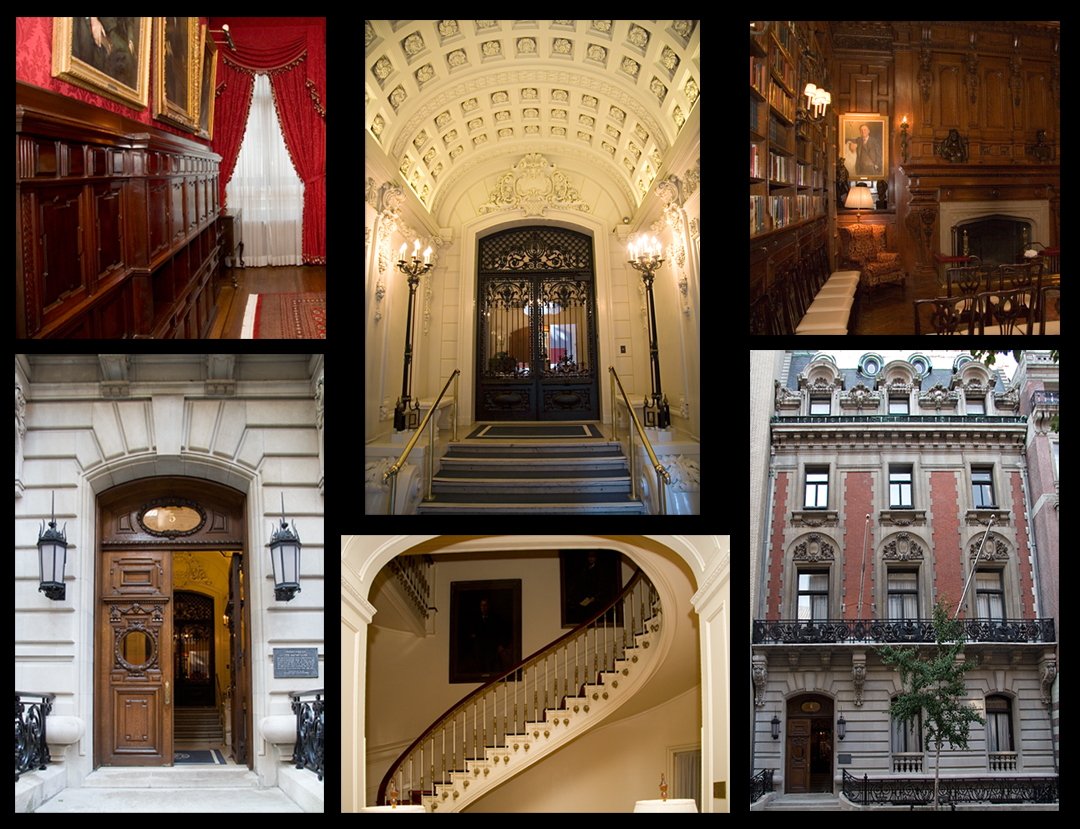
    I was fortunate yesterday to be able to attend a function (the wedding of a friend) at the Lotos Club, one of the oldest literary clubs in the U.S. This private club is located at 5 East 66th Street in a brick and limestone French Renaissance building, designed by Richard Howland Hunt and built in 1900 by the daughter of William H. Vanderbilt.

    The club dates back to 1870 when a group of young New York journalists met in the office of the New York Leader. These men were De Witt Van Buren of the Leader (the first president), Andrew C. Wheeler of the Daily World, George W. Hows of the Evening Express, F. A. Schwab of the Daily Times, W. L. Alden of the Citizen, and J. H. Elliot of the Home Journal. Previous failures at creating a strictly literary organization had demonstrated that this was not viable, so membership to a broader group was decided upon. The stated primary object of the club was “to promote social intercourse among journalists, literary men, artists, and members of the theatrical profession.” The club has a long list of well-known members, such as Mark Twain. It has had a number of locations, from its first home at 2 Irving Place off 14th Street to its current location at 5 East 66th Street.

    NOTE: The selection of the name The Lotos Club was to convey “an idea of rest and harmony.”. The spelling of Lotos comes from Alfred Lord Tennyson’s poem, The Lotos Eaters, two lines of which were selected as the motto of the club:

    In the afternoon they came unto a land
    In which it seemed always afternoon

    The endless afternoon setting provided the ideal atmosphere to indulge in creative and stimulating thought and conversation…


  • 17 Monitors

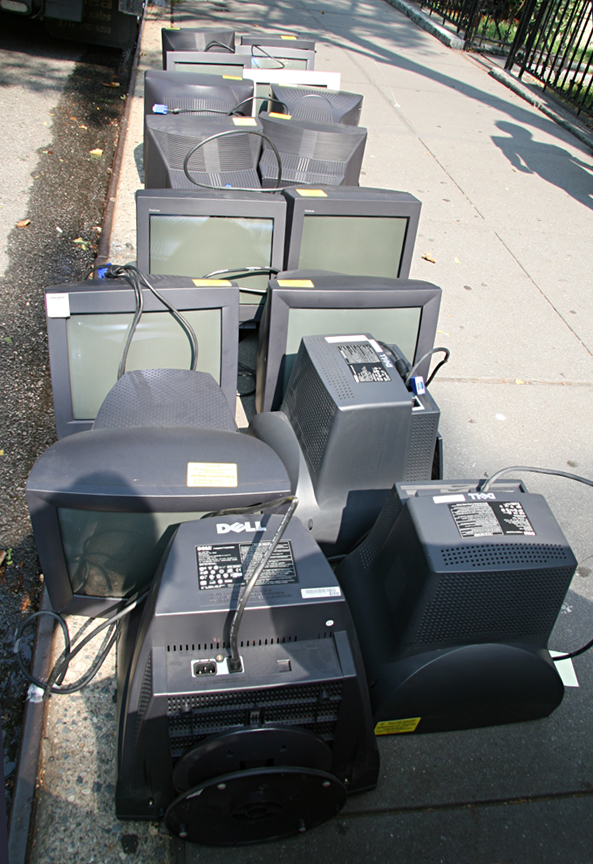
    I really wanted to try and grab all these monitors and find homes for them, but their time on the street (outside an NYU office) was short – they were being loaded on a truck for recycling. I spoke to one of the truckers and asked about their condition. He was fairly vague and non-specific. My gut feeling, though, was that these were being tossed and replaced by flat-screen LCD monitors, a common scenario nowadays. After all, what is the likelihood of 17 virtually identical monitors failing at the same time or failing over time and being stored? I have acquired many CRT monitors recently for free, including high-end graphics models – many excellent quality monitors are being given away or being sold very cheaply (check out craigslist in your area) as people replace them with more compact LCDs.

    Disposal of electronics in NYC is a huge problem. In my office, it took us at least a year to find a way to dispose of our computers, printers, etc.. Our first choice was to donate the working items for reuse (many of the items still functioned.) No luck at all – our computers were even rejected by an agency that donates computers to the underprivileged in Africa because they were too old for them to accept. When the reuse approach was clearly not viable, we decided to recycle them. We still had difficulty – we tried non-profit organizations and private for-profit companies.

    The city does have a recycling program, but it requires dropping off, has infrequent recycling days, and limits individuals to one item at a time – impractical for a business with many items to dispose of. We finally found a wonderful non-profit organization to work with (Per Scholas) that even arranged to pick up. However, we did have to pay per component to get them recycled…


  • Gang Wars

    Between 1823 (with the formation of the New York Gas Light Company), and 1877, there were six competing gas companies in NYC – at times employees literally battling for customers in the streets, leading to the term “gas house gangs.” Add to this brew Edison’s invention of the electric light bulb in 1879 and the creation of Equitable Gas, backed by Rockefeller. The competing gas companies were forced to remarket and promote gas for other purposes. In 1884 came the inevitable merger of the six companies, forming the Consolidated Gas Company of New York. Offices were established at 4 Irving Place (where the current offices and tower are located) at the home of the Manhattan Gas Light Company in an Italianate brownstone. Acquisitions of various electric companies were made, including the New York Edison Company. In 1936, the name was changed to the Consolidated Edison Company.

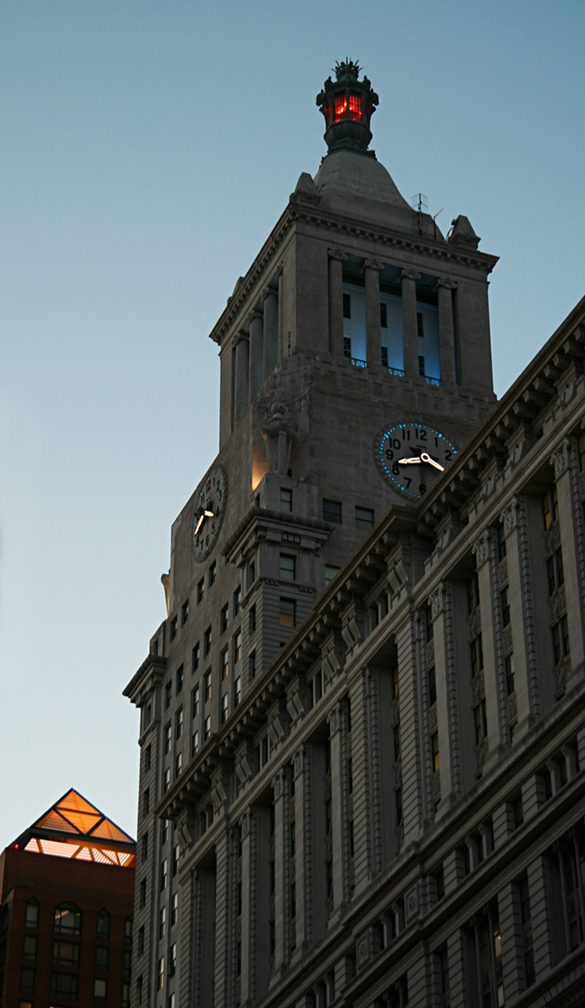
    ConEd is the product of acquisitions and mergers of more than 170 companies. The office buildings of ConEd are a assemblage of structures built at different times, starting with a 12-story building designed by Henry Hardenbergh in 1910 at 15th and Irving, culminating in the 26-story building (seen in the photo) designed by Warren and Wetmore, known for their Beaux-Arts work such as Grand Central. The limestone clad building is quite prominent in the night skyline of NYC with its numerous illuminated features: a 3-story tower with Doric colonnade, four clock faces, and a 38-foot bronze lantern. This is one of a handful of iconic Manhattan buildings which can be seen from many vantage points, along with the Met Life Tower, the New York Life Tower, the Chrysler Building, the Empire State Building, and the Zeckendorf Towers. Please learn your illuminated buildings – there will be a quiz 🙂


  • High Line Portrait Project

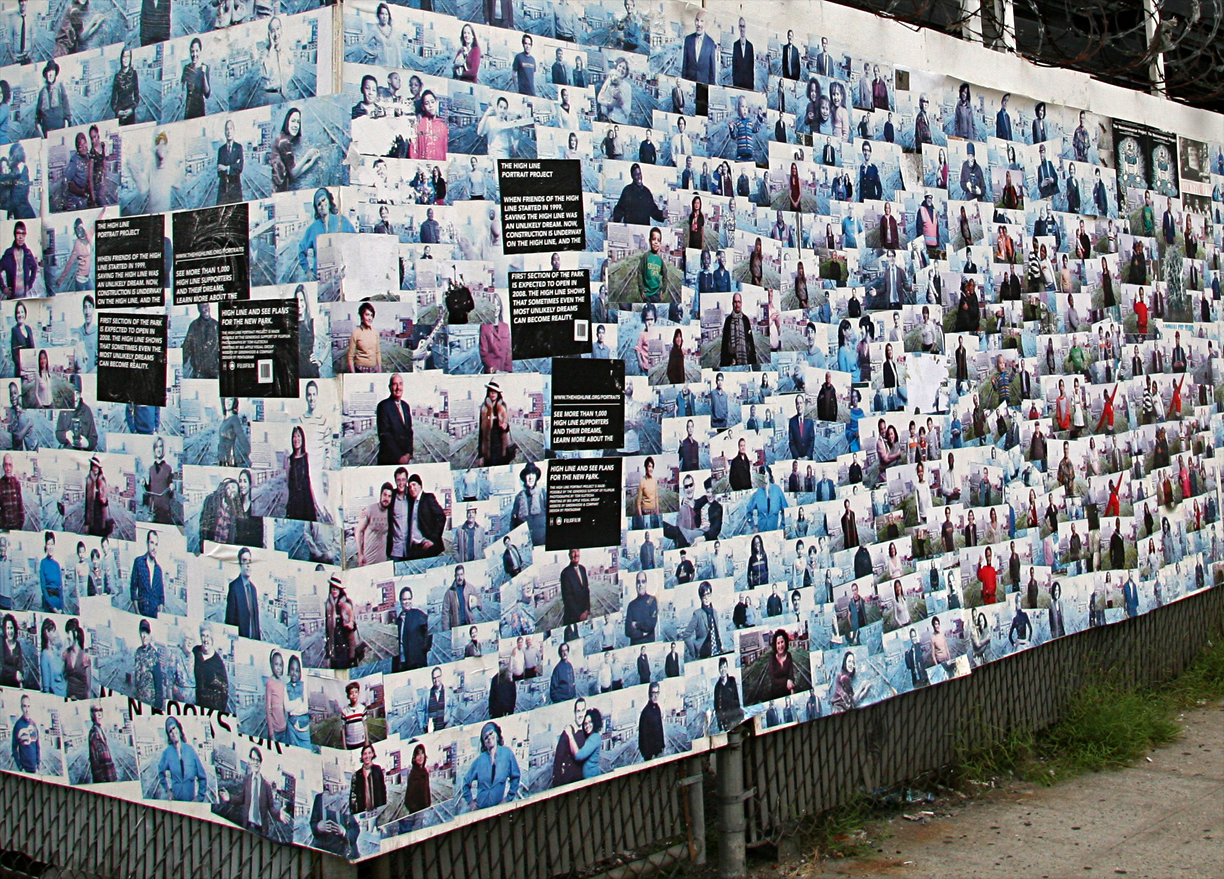
    I ran across this display unexpectedly while carousing Chelsea on 10th Avenue near the High Line, a 1.45 mile elevated rail structure running through the west side of Manhattan from the Meatpacking District all the way to 30th Street. Click here to see a short film. This rail line was originally built in the 1930s to elevate trains from the city streets. The line, which has been unused since 1980 and which left an abandoned elevated structure overgrown with weeds, is being converted to a huge park to open in 2008. Until recently, the High Line has been unknown to many New Yorkers and visitors, but this unique project promises to be a major contribution to parkland and quality of life in the city. It can be easily seen overhead on 10th Avenue in Chelsea. From the projects website:

    “The High Line Portrait Project was inspired by the many High Line supporters who have helped bring the project from an unlikely dream to a reality. When Friends of the High Line was founded in 1999, the High Line was a rusty industrial relic under threat of demolition. Now construction is underway to transform the structure into a one-of-a-kind public open space, the first section of which is expected to open in 2008. Photographer Tom Kletecka created portraits of more than 800 High Line supporters in front of a backdrop by Joel Sternfeld. Each participant was asked to share his or her dream.”

    Click here to go to their site to view the photos…


  • Pied-à-Aire

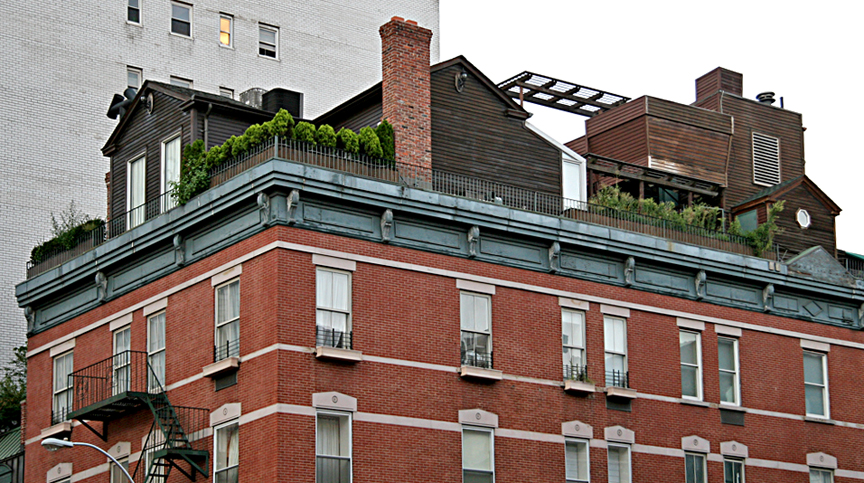
    There are many secret worlds in New York City, and rooftop houses are one of them. I am sure that having a private little Shangri-la in the city is a fantasy that many have had, but few realize that these pied-à-aires have been actualized by a fortunate few. I was somewhat surprised to find out how little information is available on this phenomenon – one would not expect a lot in print, allowing for the fact that photographing these properties is going to be difficult without an invitation, but typically one would expect a few feature articles. I found none (I do recall an article many years ago about a rooftop cabin).

    The gabled structure in the photo is not strictly a rooftop house – it is an extension of a top-floor apartment. It sits atop the building at 203 East 13th Street on the corner of 3rd Avenue in the East Village. The building itself was built in 1910 and was converted to condominiums in 1986. In the early ’90s, the owner of the top floor apartment built the cedar-shingled structure. Originally, a spiral staircase led to a small rooftop room; this was torn down and replaced with the rooftop complex, which includes a master bedroom and bath, a small greenhouse, a darkroom, a hot tub, outdoor decks, and plantings. I wish I had closeups and interior photos of the property but alas, I could not find any…


  • Stephanie

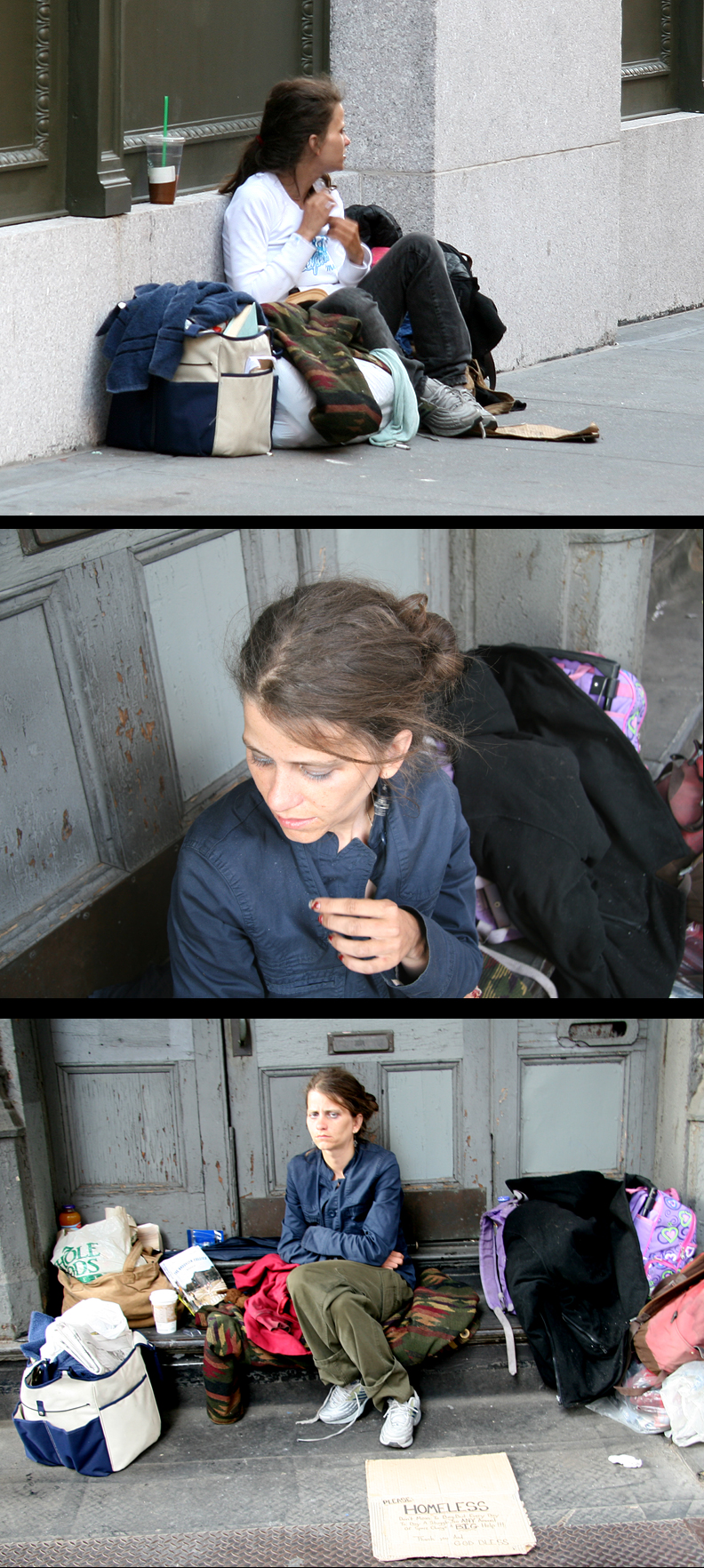
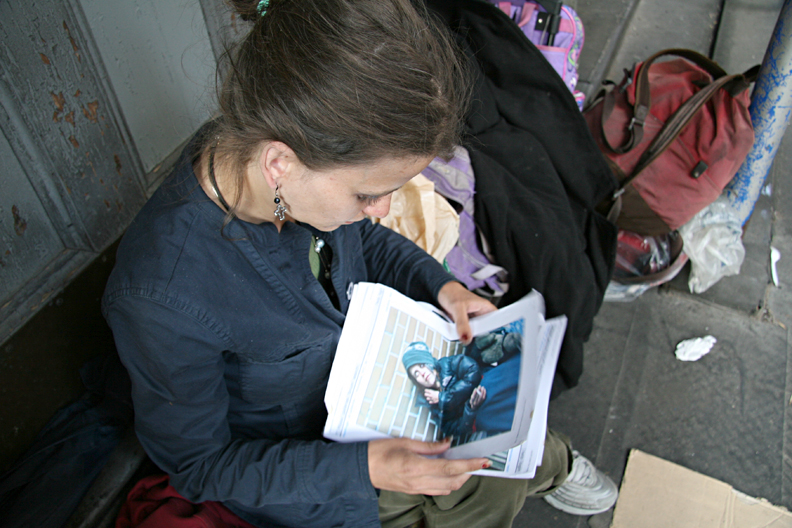
    Stephanie Green is a homeless woman who reads voraciously. That is what intrigued me most about her – she is nearly always reading – quality books, including classics, most given to her by various people who have made her acquaintance. For the last year, I have seen her at this spot nearly every day, living in front of a vacant store in SoHo, partially sheltered by overhead scaffolding. Click here for more photos. She wears jewelry, and at times I have seen her put on makeup. I had naively thought that this would be the first story I would write based entirely on a personal interview. I spoke to her on a few occasions, being the first to ask if she would be willing to talk about herself and be photographed for this website. She agreed. However, the “interview” was extremely awkward, and she was not as forthcoming as I had hoped.

    I did learn that she was from Santa Monica, California, born February 5, 1980. She has not had contact with her family. She occasionally stays in homeless shelters. I did not learn much else – how did she become homeless, does she have any hopes, does she bathe and where, does she have drug problems, do any of her belongings get stolen when she leaves them? In addition to her own efforts at collecting money, she did tell me she has a boyfriend (also homeless) who scavenges for food and money which they share. When I asked if anyone else had taken photos of her, she showed me some color printouts from pbase (an online photo site) (click here). She recently moved – I saw her in the Village on University Place. So it was time for these photos to be posted…


  • FishBridge Garden

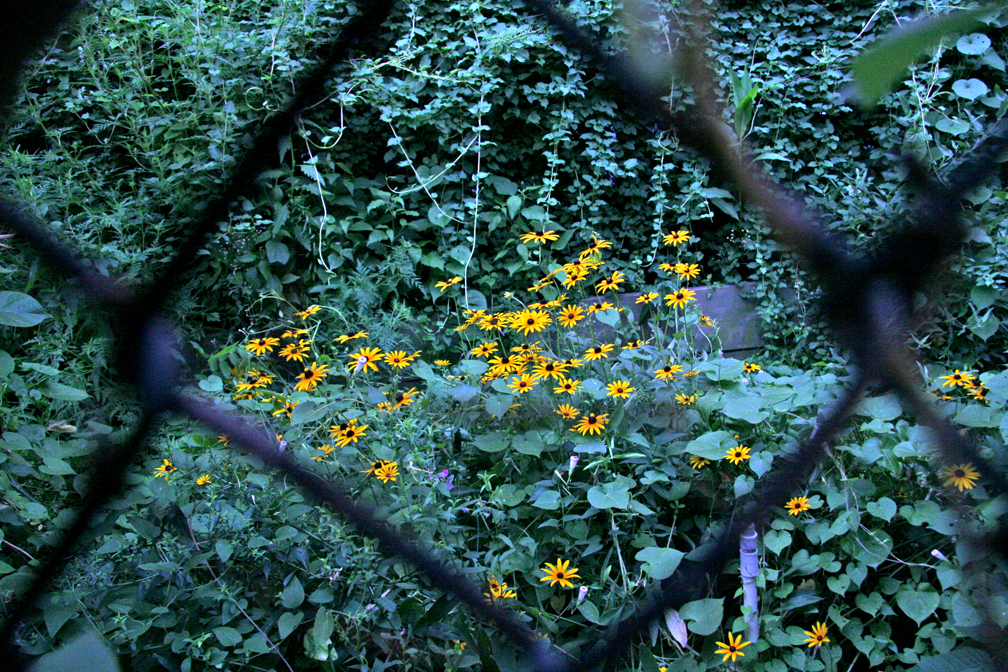
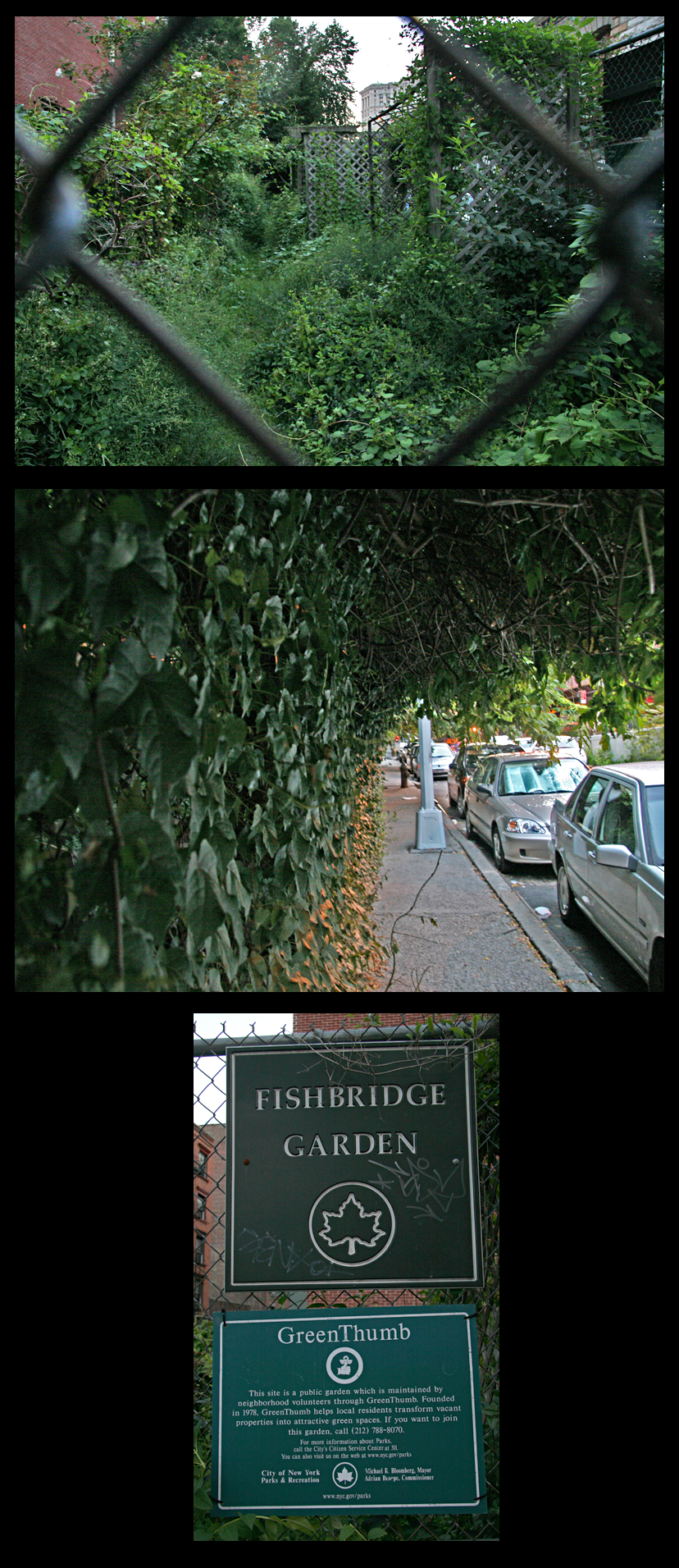
    Fishbridge Garden is REALLY off the beaten path; I did not find it in any secret or hidden New York sites or guides. Online, you will find a description on the Parks Department website (click here). A friend and I stumbled into this place while walking the South Street Seaport area on Front Street. At the Fulton Street end, you have shops, the Pier 17 complex, and ships, all well-known to tourists. This area was the home of the Fulton Fish Market, one of the country’s (and world’s) largest. It was also one of the last working areas of the Manhattan waterfront and one of the last of the city’s outdoor wholesale markets. Six days a week, from midnight until about 9 a.m., the Fulton Fish Market was a dynamic bedlam of rubber-booted workers cleaning, boning, icing, unpacking, and repacking fish from throughout the world. Walking away from Fulton Street along Front Street towards the Brooklyn Bridge, one is treated with impeccably restored buildings of the neighborhood; one can see many signs of former fish dealers. Some may find the area over-gentrified, with too many nationally known retailers at the street level. But we chose to enjoy the architecture of this area on a beautiful day and leave the nay saying at home.

    At the end of Front Street at Dover Street, one will find a tiny park/garden running a short block to Water Street. Click here for more photos. This park/garden was built between 1990 and 1992 on the site of a former parking lot and rat-infested garbage dump. Local volunteers cleaned up the site and built a garden, children’s play area, barbecue area, and dog run. Unfortunately, the garden was closed when we got there, so we only go to peer through the fence. Next time…


  • Jet Ski

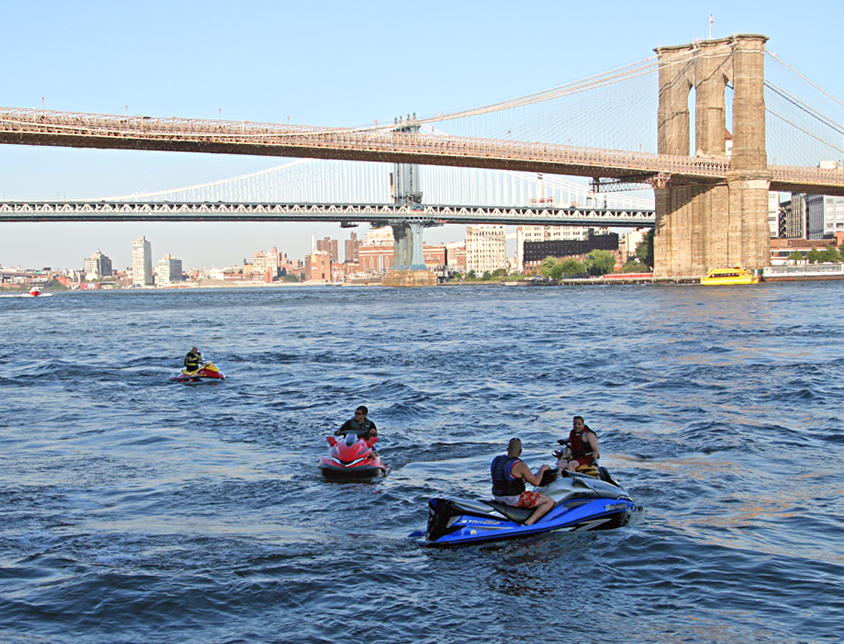
    It may come as a surprise to see these watercraft in the waters on NYC, but along with canoeing and kayaking, the city is seeing more water-related activites in the rivers as they become cleaner. Jet Skis, Waverunners, Sea Doos, water scooters, personal watercraft, “thrill craft” – whatever the name, these vehicles are controversial. Many communities and locales have bans, and the watercraft industry lobbies to keep them legal. They have been banned in National Parks. The issues are obvious to anyone who has observed them in action – noise pollution, water pollution, and danger. These vehicles can travel at 70 miles per hour.

    Canoers and Kayakers generally dislike any powered craft, not just because of the noise but also the wake they create, making capsizing a risk. Accidental deaths have occurred with personal watercraft, and in 2006, a teen killed another teen in Brooklyn and was charged with manslaughter – a first for an NYC boating accident (click here for article). The industry, however, has made efforts to design cleaner, quieter, and safer craft. Of course, I imagine that from the point of view of the jet skiers, being out on the East River on a beautiful summer afternoon, one might see things differently – the exhilaration, the vistas, the water…

    Note: the photograph was taken at South Street Seaport, Pier 17, on the East River. The vista is looking Northeast towards the Brooklyn Bridge with the Manhattan Bridge behind it.


  • Kiehl’s

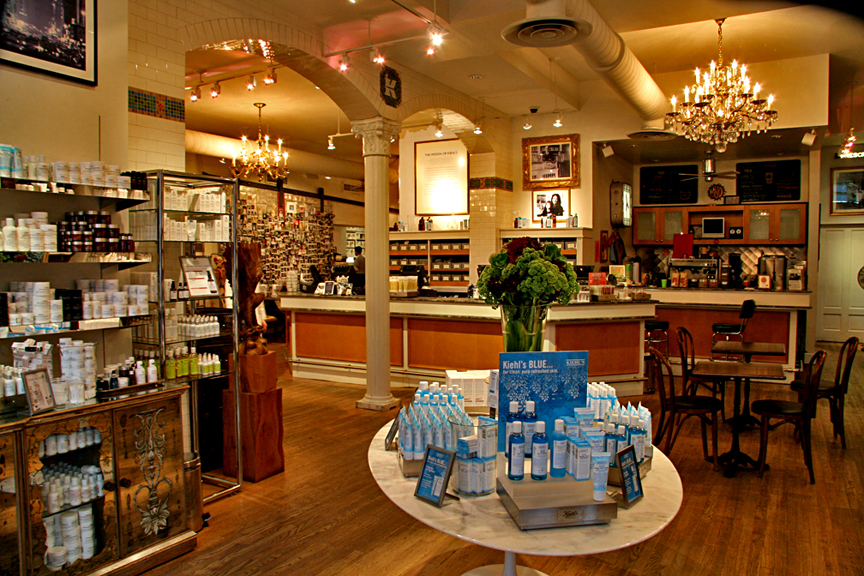
    Kiehl’s Pharmacy is legendary. I will give only a brief synopsis here of this remarkable company, since their history is long with many details; I recommend you click here for an in-depth article about Kiehl’s and try to visit the original shop. This NYC institution was established in 1951 at its current location in the East Village at 109 Third Avenue as an apothecary by John Kiehl, selling a variety of herbal and homeopathic remedies. Irving Morse, the son of a Russian immigrant family, apprenticed to Kiehl and obtained a degree in pharmacology from Columbia University. He purchased the store in 1921. His son, Aaron, also studied pharmacology at Columbia and in the 1950s became active in the business; in the 1960s, he took over the business. In the 1960s, the pharmacy was phased out, and Kiehl’s began developing its own natural care products for which they are famous today. In time, Kiehl’s began selling to upscale stores, beginning with Neiman Marcus in 1975. In 1988, Aaron’s daughter Jami took over with her husband, Olympic skier Klaus Heidegger.

    Kiehl’s has a very distinct character going back to its inception. Historically, the focus has been on high-quality, natural products with a lack of emphasis on packaging and marketing, They have had a virtual cult following of patrons, including many celebrities. In 2000, the company was purchased by L’Oreal. There are now stores worldwide. However, efforts have been made to maintain a commitment to Kiehl’s roots and the imprint made by Aaron Morse and the family…


  • Old Homestead

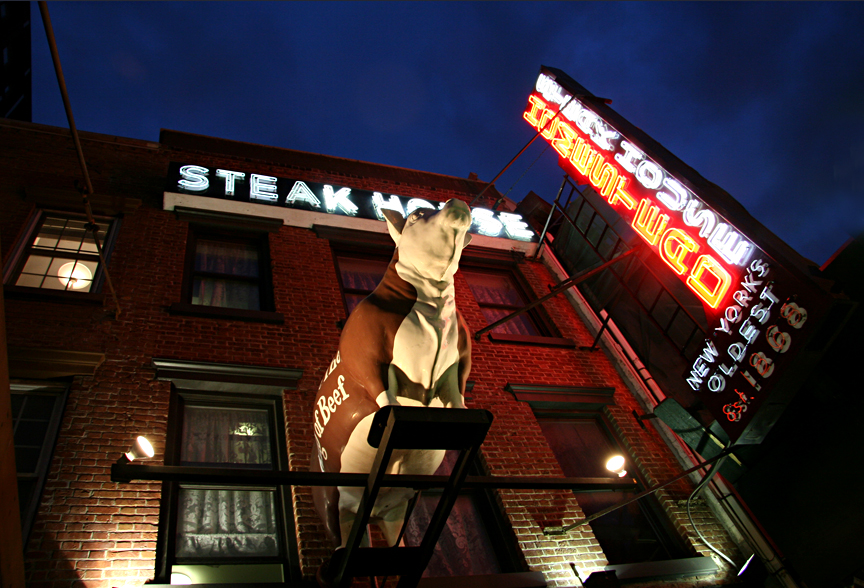
    The neon signs and large cow mounted prominently over the entrance to the Old Homestead Steakhouse have been an NYC icon for ages. Located at 56 9th Avenue in the meat packing district on a major thoroughfare, most New Yorkers have seen this landmark many times traveling downtown (click here for photo). It is the city’s oldest steakhouse and one of the oldest restaurants, dating back to 1868, with humbler origins as a popular place to eat for workers in the neighboring wholesale meat market.

    As you can see from their website and pricing, this is no longer the place for the common worker. The specialty here is Kobe steak, or, more properly, Kobe-style beef. Kobe beef was traditionally raised in the Kobe region of Japan from the Wagyu breed of cattle and is renowned for tenderness and flavor. It has a high degree of fat marbling, enhanced by the traditional secret methods of raising Kobe beef, including beer in the diet and massage. However, nearly all Kobe beef in the United States, known as Kobe-style beef or American Kobe beef, is raised domestically by ranchers who have crossbred Wagyu cattle with Angus cattle. To my understanding, any claims of beer in the diet or massaging cattle in this country is a myth, one that that restaurants do not necessarily try to dispel. In 2003, Old Homestead introduced the first Kobe burgers, which will set you back $41.

    Most reports regarding the food seem to be still favorable, always a difficult feat to maintain when a place becomes a legend. Of course, there are naysayers, and the debate goes on regarding NYC’s best steakhouse, with many contenders: Peter Luger, Sparks, Palm, Smith and Wollensky, Keens…


  • More Air

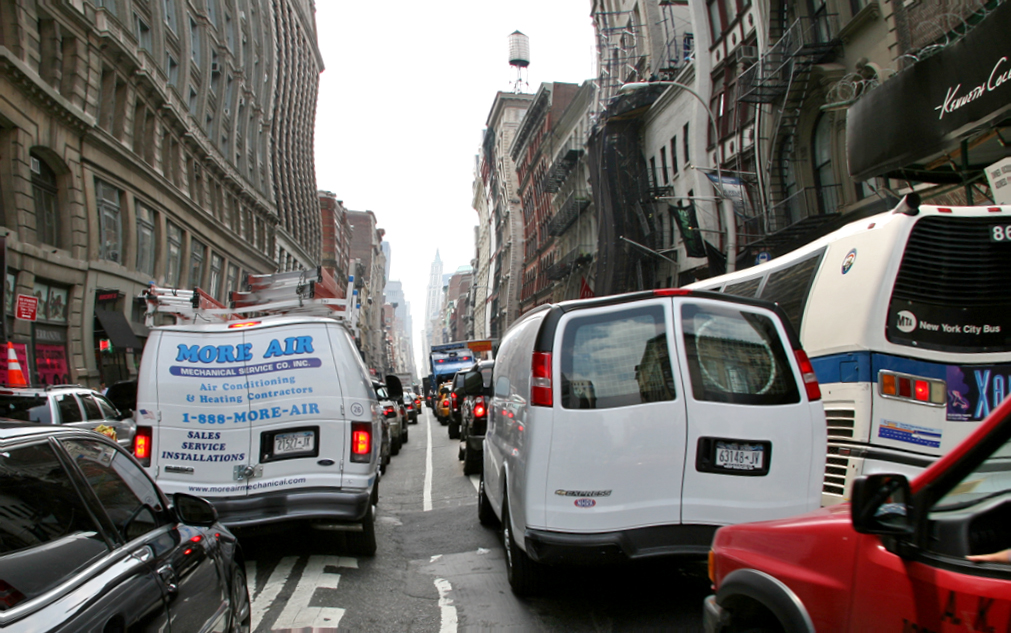
    Hot summer days are never a picnic in any big city, but yesterday, NYC was particularly nightmarish. Start with a torrential rainstorm overnight that dropped 3 inches of rain in an hour, causing massive flooding of roadways and the subway system, where service was seriously disrupted – in some cases, actually suspended – leaving many New Yorkers with essentially no way of getting to work. Resorting to auto transportation was not the best idea either. Traffic snarls were everywhere, as seen in the photo looking down lower Broadway.

    A tornado (confirmed by the National Weather Service) hit the Sunset Park and Bay Ridge areas of Brooklyn (the first there since 1950), ripping up building roofs and felling trees. Click here for the Gothamist’s story of Wild Wednesday. As a result of the heavy rain, the combined sewer overflow (CSO) system (which I wrote about in Waterworld) dumped tons of sewage into the ocean and waterways around the city – there may be beach closings due to contamination. And we had blistering heat in the 90s with humidity typical of a hot, steamy, August day. It was stifling. More Air, anyone?


  • Night Out

    Yesterday I attended NYC’s participation in National Night Out in Father Demo Square in the Village, sponsored by the 6th precinct. The National Night Out campaign involves citizens, law enforcement agencies, civic groups, businesses, neighborhood organizations, and local officials from over 10,000 communities across the country. The event is designed to heighten crime awareness and strengthen local anticrime programs and police-community partnerships. In NYC, the event has evolved to one where the focus is on officers who have lost their lives in the last five years.

    Among those in attendance at this event were Mayor Bloomberg, NYPD police commissioner Raymond Kelly, Manhattan Borough President Scott Stringer, City Council Speaker Christine Quinn, and NYPD sixth precinct commander Theresa Shortell. David Gruber (see posting on the reopening of Father Demo Square) was on hand and introduced me to a number of attendees, including the Borough President, Scott Stringer, to whom I gave a New York Daily Photo card – I hope he visits this site. One block of Carmine Street was closed to traffic, where the 6th precinct had a cookout (with free food) and tables of literature related to crime prevention.

    Although all the officials that were present have a record of public service, I must say that I have been extraordinarily impressed by police commissioner Raymond Kelly. A self-made man of humble background (his father was a milkman), he has several academic degrees, is a former marine, and has had numerous awards and citations. I would highly recommend reading his bio. Through his stewardship, along with efforts of others, such as former Mayor Rudy Giuliani and the CompStat system (started in 1994 by Police Commissioner William Bratton and Deputy Commissioner Jack Maple), crime is now the lowest it has been in NYC since 1963. I know Kelly is only human, but it’s nice to see they come like this sometimes…


  • dinamic_sidebar 4 none

©2026 New York Daily Photo Entries (RSS) and Comments (RSS)  Raindrops Theme