• Category Archives Curiosities of NYC
  • In His Hand


    In the 1970s, I used to frequent the neighborhood Brentano’s Bookstore, located in the Village at 20 University Place and Eighth Street. On one occasion, I met a man who astounded me – he read entire books in one afternoon while standing or slowly ambulating in the shop. I doubt he was reading the likes of Ulysses, but this was still particularly remarkable, not just in the reading feat itself, but also given the nature of bookstores at the time. Even though bookshops have historically been liberal in their reading policies, it still was not a time with bookstore’s cafes, various seating areas, or where one could find customers researching while virtually camping out on the floors and tolerated by the management. And, apart from libraries, it was not a world of free content, just a few keystrokes away.

    Ebook readers have been around for much longer than many might imagine* – since 1998, with early pioneers in portable eBook readers, such as the eBookman by Franklin and the Rocket eBook. I was given one of these devices over ten years ago. It sat unused. Issues of content, moving files in and out, lack of wireless Internet, low-contrast screens, and other technical shortcomings of the devices all conspired against the wholesale adoption of ebooks and readers. But ebooks appear to be ready for prime time, fueled by the eInk technology with its high contrast paperlike readability, lightweight devices, low power requirements, and Internet integration. Devices like the Barnes and Noble Nook, the Amazon Kindle, and Apple’s iPad are selling well and can be seen throughout the city.

    In my own business here in New York City, we publish a small selection of highly specialized books. With some titles, this necessitates inventorying print runs for years. Recently, we made the big decision to go digital with some of our titles. One of our first candidates was Circus Techniques by Hovey Burgess (you can read about him in Fish and Ponds). We dragged out a copy of the printed book from my library as well as the original film flats, all shown in the photo – this is how printers worked and prepared books for offset printing. After evaluation, we decided that it would be easier to OCR scan the entire text, so the flats are back in storage, a relic of a time gone by.

    New York is book country, and arguably the epicenter of publishing in the United States. I doubt that printed books, magazines, and newspapers are going to diminish as quickly as did music CDs or that bookstores will disappear like CD merchants did. The development of electronic media is, however, sure to impact New York. Recently, Barnes and Noble announced the closing of their massive store near Lincoln Center. The company itself is for sale.

    I’d love to meet that reader from Brentano’s now. Although the end of an era is close at hand, I am sure he would be overjoyed with an eReader and a few thousand titles in his hand 🙂

    *The earliest digitization of a document was that of the United States Declaration of Independence by Michael Hart in 1971, then a student at the University of Illinois who had obtained access to a Xerox Sigma V mainframe computer in the university’s Materials Research Lab. Hart then went on to establish Project Gutenberg, a voluntary effort, now with over 33,000 titles available free, primarily public domain books.
  • The Little


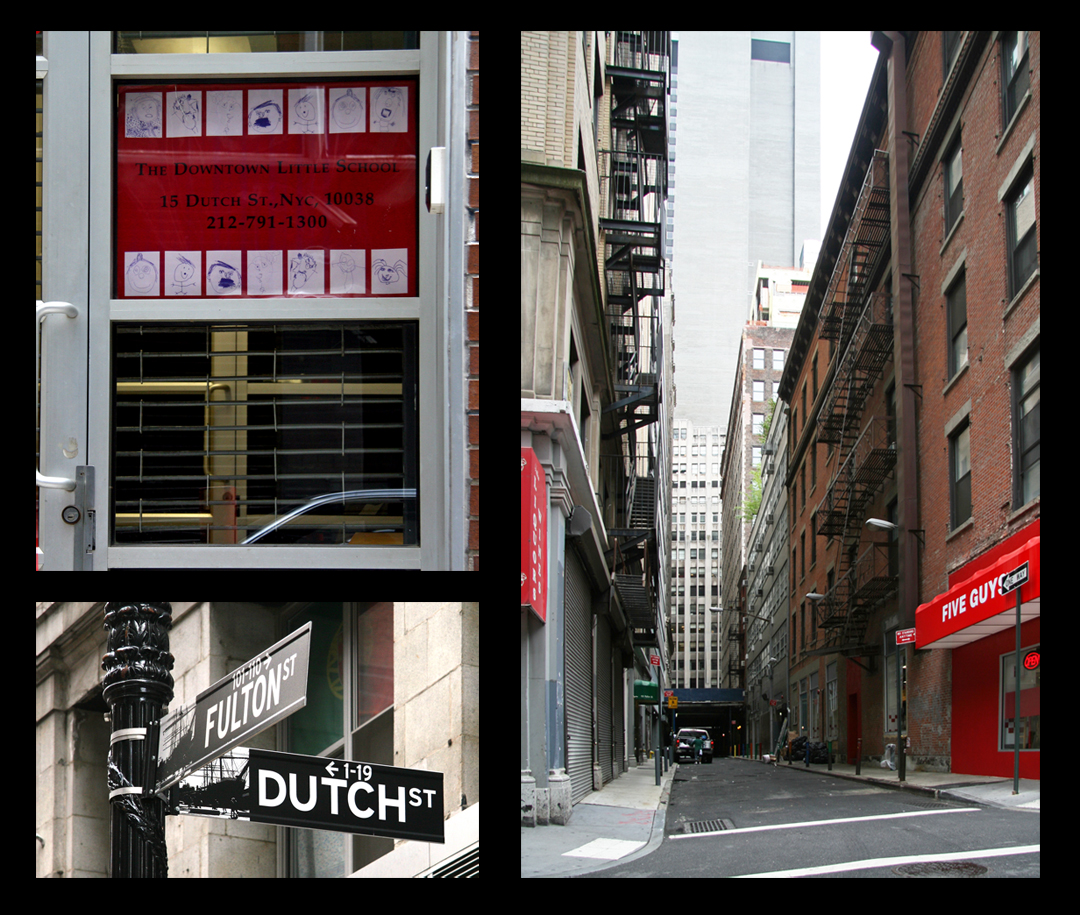
    Here, in lower Manhattan, way under the radar and not touristed at all, I discovered a little school on a little alley. In New York City, this is how I find solace, in the diminutive. A little alley, a little crook in the street, a little shop, a little building, a little garden. Feeling a little tired, because one can never really become exhausted from exploring the little, and if it is a beautiful day, perhaps one may enjoy a little rest and a little snack. This is why I choose to live in Greenwich Village, because the scale is so much smaller and so much more human.

    I have been in many high-rises, and there is nothing quite like the ambiance of a classic prewar building and, if one is so privileged, the views that may come with a residence on an upper floor. Icons like the Waldorf Astoria Hotel or the Plaza just exuded charm. And there is nothing quite so noble as the Chrysler Building at night. But for me, when it comes to a place I call home, I choose the small townhouse.

    I have not been to the new Vegas, and I imagine I will get there at some time. And, like Dubai, I also imagine that there will be some shock and awe. However, living in New York City for the last 40 years, I do not seek out the mammoth or the overwhelming when it comes to man-made environments. And although I live in the country’s largest city, in my business life I have carved out a little niche. It is much easier to succeed in the proverbial small pond.

    At 15 Dutch Street, I was very surprised to find the Downtown Little School. From reading, parents rave about this nursery school, and I think the word Little (like the Little Red Schoolhouse on Bleecker Street) is a signal that this place emphasizes caring, personal attention, and the human touch, embracing all that was good in the old school.

    I was also very surprised to learn that the huge multinational giant, Colgate-Palmolive, had its roots on Dutch Street. In 1806, at 6 Dutch Street, William Colgate opened up a starch, soap, and candle factory, a reminder that not only the good, but also the big germinates from the Little 🙂


  • Waiting to be Sold

    The door-to-door salesman has never been a welcome visitor, but somewhere around 1963, a knock on my family’s door changed my life. Whoever and wherever he is, I thank that salesman for selling and my parents for being either too easy, very astute, or both, and for buying.
    He was selling the World Book Encyclopedia – a big thing for a family with essentially no books and little money. I have no recollection of the event, really, only the result. As a promotion, we were given a mechanical learning device. This is how I learned to play chess, a game I still enjoy to this day.

    I devoured those books as a child. There were, of course, school books and an occasional jaunt to the public library. But nothing could compare to that mountain of information. It felt that I had all the world’s knowledge at my fingertips. 

    As an adult around 1980, living in New York City, I made a phone call and invited a Britannica salesman to my home. I had no idea that unless you are ready to buy, that man is not leaving your house. It was quite an evening. I did eventually buy a copy – the cost for the 30 volumes was nearly $1000, a major investment. But I did love those books, and until the Internet became commonly used, the Britannica was my primary source for research. I also purchased the CD-ROM version. I recently gave the printed set away.

    Until recently, at most trade shows, somewhere in the last rows where fees were cheapest, there was typically a nondescript booth, a spartan table, and a hungry Britannica salesman with no prospects. Who would voluntarily subject themselves to an encyclopedia salesman or even walk closely enough to be ensnared? Whether the show theme was conducive to selling encyclopedias was no matter. There was always a Britannica booth – an outpost in the far reaches of the trade show tundra.

    I now see the same phenomena with The New York Times. Their booths can be found at trade shows and street festivals all over the city. The Internet boom has had an expected impact on all print media. Many are worried about the survival of the New York Times. This would be quite sad to lose them. They also have a special place for me, as I wrote about in New Yorkers Gone Wild. The publisher, Arthur Sulzberger, announced in September: “We will stop printing the New York Times sometime in the future, date TBD.” Revenue will come from their online version. In 2011, the Times will begin charging for some content based on a metered model.

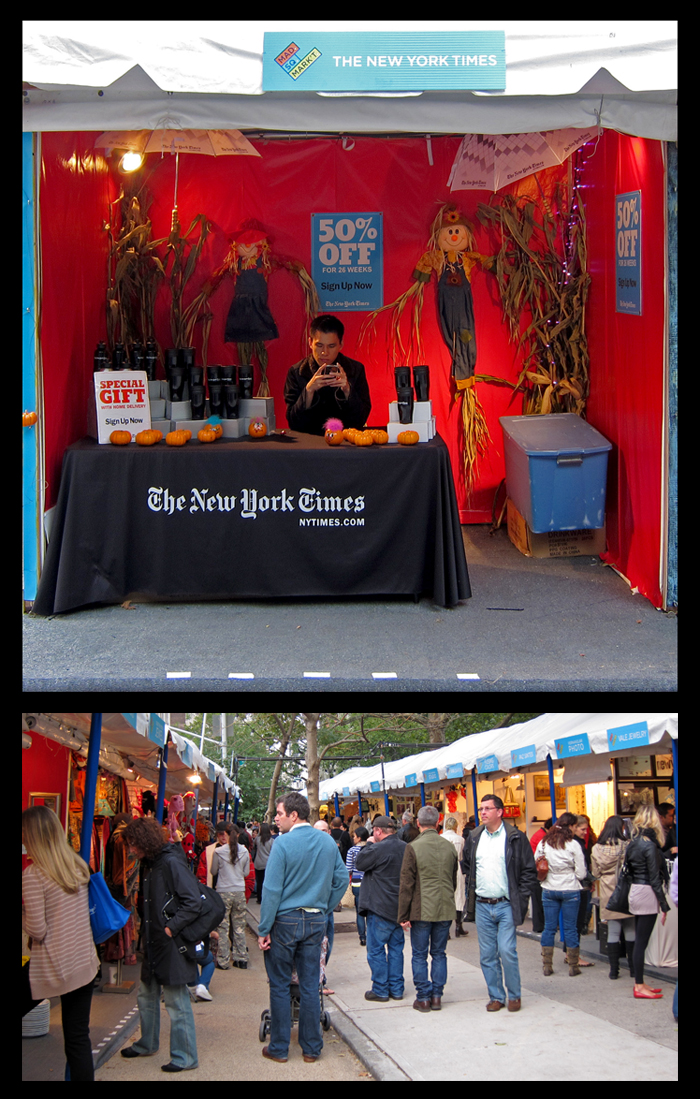
    On a recent visit to the Madison Square outdoor market, I came across a New York Times booth. It was a beautiful day and the other vendors were quite busy with shoppers (lower photo). Transfixed with his smartphone, the lone salesman did not notice that before him stood his best hope for the day. A dinosaur. A man with a love of print, just waiting to be sold 🙂


  • Impossible

    There are people who are so hypercritical, so persnickety, so picky, so cynical, and such perfectionists, that to see them at dinner, whether it be fast food or haute cuisine, will result in a virtual forensic investigation of the dish’s ingredients. Rather than embrace life, they appear to have a disdain for it, because it almost never meets their standards. Their negativity fills the air like a heavy cloud. Laughter itself is carefully meted out, only at worthy moments. I have met such people, and perhaps you have also.

    There are people who have a joie de vivre that permeates everything they see and do. For them, life is wonderment, and their love is absolutely infectious. Most who are fortunate enough to be around them are happy to be infected. They befriend everyone, and most welcome the friendship. They are truly alive and easily become the life of the party. Laughter is their signature, and they are perpetually signing life’s events.

    I have met such people too, and although some may find their unbridled enthusiasm wearing, better a night spent with the life affirmer than walking on eggshells and having your balloons deflated by the disgruntled life disdainer. Although personalities and people are complex mixtures and do not fit these two boxes so conveniently, those at the polar ends of the spectrum do approach these characterizations rather well.

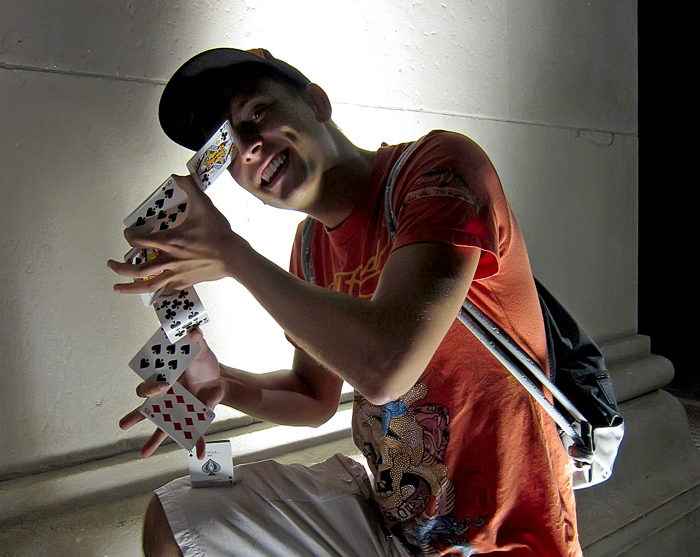
    Constantin is from the Ukraine and is currently performing at Webster Hall in its Saturday night show, Circus. He approached us unexpectedly while sitting in Washington Square Park and asked if he could demonstrate some magic. Fortunately for him, he had just approached a group of life affirmers and had an audience poised for applause. We were hungry to show our love and appreciation.

    I have seen a number of professional magicians, but Constantin’s presence and speed was something to behold. A member of our group, JoSsS, is one of the world’s great life affirmers, and you can see him in the video I shot that night (look for the man with the curly white hair). 1 minute and 20 seconds into the video, you will see his ebullient, effusive, effervescent reaction to a particularly amazing trick, where, incredulous at the outcome, he repeats, “Impossible!” over and over, with his charming manner and Argentinian accent. I know he loves that word, and it is so appropriate, because for a life affirmer, a day without love, hugs, and laughter is like a day without critical examination for the life disdainer – impossible 🙂


  • Covenant of the Keys


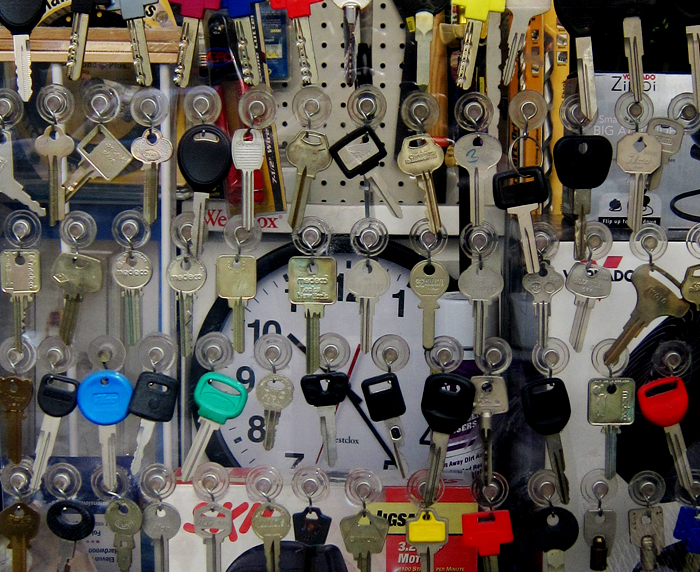
    Where my family grew up, in northern Maine, houses were not locked. If you needed to borrow something, you would just let yourself in to that neighbor’s home, take what you needed, and leave a note. With large families and little means, cooperation was a survival issue, and privacy was not part of the lifestyle. There are still many places where doors are not locked.

    Although New York City is infinitely safer than it was 40 years ago, that does not mean security is no longer an issue, nor does it mean you can let your guard down. I lock car doors everywhere I go, even at my family’s home in the country. If you click here, you will see an extraordinary photo for a New Yorker – the only time I have displayed a photo from out of state on this website to illustrate a point.

    Keys, therefore, take on a much larger meaning here. So much so, that an entire episode of the TV series Seinfeld was about apartment keys. In this episode (The Keys), with complex arrangements of loaning and borrowing, keys take on mythic proportions. In one scene, Kramer says: 

    No, no, no, it’s o.k. I don’t care about the keys. It’s my fault. I gave the keys away with my stupidity. I broke “the covenant of the keys.”

    I don’t want the keys back! No, I’m glad the way things turned out. I was clingin’ to those keys, man! Like a branch on the banks of a raging river. And now I have let go. And I’m free…to go with the current. To float. And I thank you.

    In another scene, Kramer says:

    Because you see, George, having the keys to Jerry’s apartment? That kept me in a fantasy world. Every time I went over to his house, it was like I was on vacation. Better food, better view, better TV. And cleaner? Oh – much cleaner. That became my reality. I ignored the squalor in my own life because I’m looking at life, you see, through Jerry’s eyes. I was living in twilight, George. Living in the shadows. Living in the darkness…like you.

    Although an outsider may see this as a nonsensical, farcical indulgence of one of life’s minutiae, it is not. In a large city like New York, there is no transparency regarding homes or lives. Often you may be acquainted with someone for years and perhaps only know that person’s building address or neighborhood, having never seen his or her apartment. Our homes here are sacrosanct. In tandem with the security issues, to give someone keys to your home is the ultimate act of trust. If someone ever entrusts you with their apartment keys in New York City, please act responsibly, lest you break the covenant of the keys


  • There’s Nothing Here

    Don’t ever try to sell a place to an unwilling buyer. On a brief trip once with my parents, we were traveling from Colorado to New Mexico. I had made the mistake of extolling, to no end, the wondrous beauty of New Mexico.
    Those who have been to Colorado know that, despite any naysayers, this place is spectacular and dramatic. So traveling to the Southwest, i.e. Arizona or New Mexico, and appreciating these states will require an adjustment. Not a lowering of standards, just an adjustment to a very different type of beauty. For a New Yorker, all the empty space alone is novel and beautiful.

    My mother, however, did not see it that way at all. Growing up in northern rural Maine, space was no novelty. It was a place better to shun and leave, as she had, by moving to southern New England. And her perennial cynicism, skepticism, and negativism know no bounds and can be infuriating at times. We had only just barely crossed the border seeing the sign “Welcome to New Mexico – Land of Enchantment” when she started in. “I don’t see anything here.”

    That’s true. Inches from a border crossing is not a good barometer of an entire state. We were hours from our first destination, and I hoped the serene beauty would overtake her, as it does to most who visit there. I asked her to wait and see how patience would pay off. It did not.

    We had not gone much further when we heard a confident reminder. “I told you, there’s nothing here.” Variants on this refrain never stopped, and soon I was contemplating suicide or murder. I never should have sold New Mexico at all. In fact, it would have been better that I had not even taken them there. The beauty of big sky country and open land was my thing, perhaps more greatly appreciated because I came from New York City, where empty space itself was a thing to behold.

    Emptiness is not abundant in New York City, and we marvel, revel in, and even tell of the joys of emptiness. How we found an empty bench, empty seats at a concert, empty stretches of highway, an empty street(s), an empty parking spot, an empty area of a park. These finds are bragging rights as well as a soothing balm to the soul of a New Yorker, where quiet moments and places are special indeed. See my stories Small Gestures and Quietude.

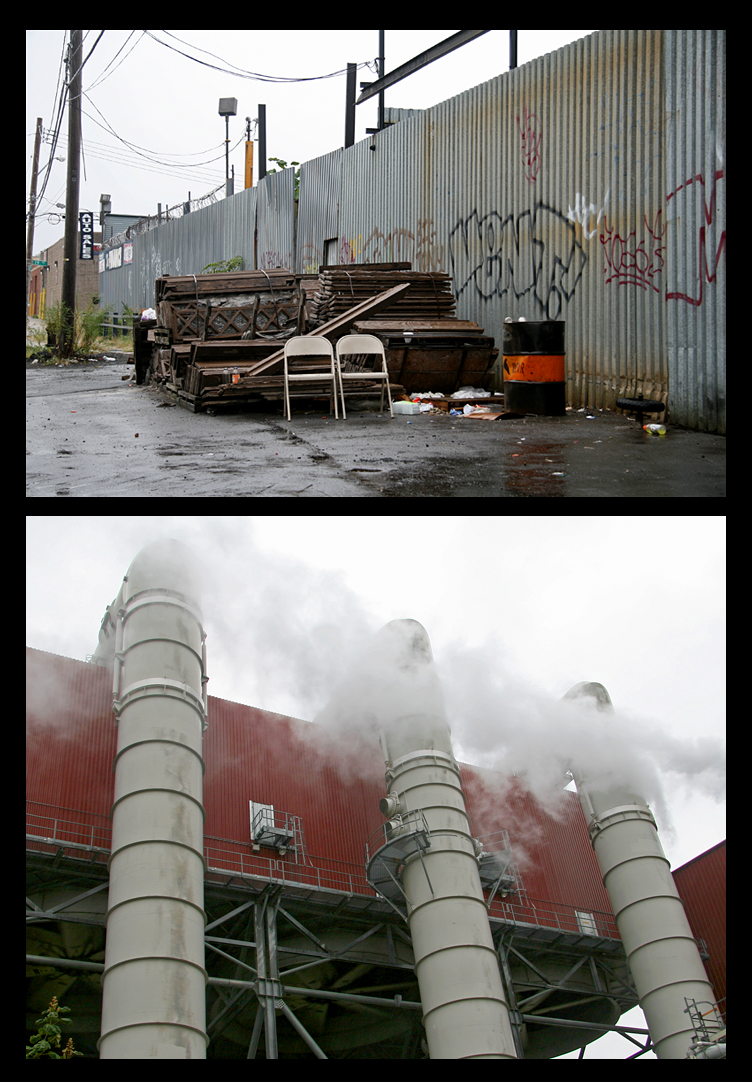
    In northern Astoria, Queens, there is an enormous Con Ed power plant. Visiting this area on a dreary, drizzly Sunday is a sure way to experience some peace and quiet. I found entire streets with not a soul in sight. Two empty, front row seats were available, as I suspect they might always be, because truly, there’s nothing here 🙂


  • Drive-by Shooting

    Silvercup Studios, with its huge iconic sign, has been an elusive enemy of mine for some years. On February 7, 2007, I did a story on the studios located at at 42-22 22nd Street in Long Island City, Queens, and its history as a conversion of the former Silvercup Bakery building (circa 1920). However, all the photos from that time were taken from across the river in Manhattan. I had yet to see the sign and studios close up.
    My experience of war and enemies is limited to Avalon Hill board games, such as Stalingrad and chess or Go, both of which I played in high school and where circling the enemy is an effective, if not necessary, strategy. So Sunday, armed with cameras for shooting, flashcards as ammunition, and board games as experience, I hunted that sign down.

    Fortunately, for the inexperienced warrior that I am, Silvercup Studios is a very slow moving target, and a drizzly Sunday is the perfect time to go to Long Island City. The neighborhood is very quiet, essentially deserted. Public transportation will get you there easily, but covering large tracts of the outer boroughs becomes impractical by foot – best is by bicycle or car. If you have the luxury of a car, driving is a breeze, and parking is everywhere to be found on Sunday.

    There are many subjects in New York City that, for any number of reasons, are best photographed from an automobile. Many vistas and vantage points are from roadways – often, stopping is not even an option – so shooting through an open driver’s or passenger’s window, open sunroof, or straight through the windshield becomes the modus operandi. However, if not limited to necessary situations, this can become a dangerous habit, leading to a lazy style of photography which I like to call drive-by shooting.

    There are numerous good vantage spots for shooting the Silvercup Studios sign, and I explored the options, combining the few skills I have and what I know, past and present, about capturing the enemy by circling the building and neighborhood numerous times in my covered wagon for an afternoon of drive-by shooting 🙂

    Note: The ultimate view of the sign is from the on ramp to the upper roadway of the Queensboro Bridge, returning to Manhattan. Here, the road makes a complete 360 degree circle completely around Silvercup, affording close views of the sign from front, back, and side. However, this busy traffic loop is somewhat treacherous to drive one-handed while shooting with the other. Another time, perhaps.


  • Collection Day

    We were so naive. One day, when I was in college, a roommate said he had learned something incredibly invaluable: the city streets were a virtual bazaar of quality goods on the sidewalks at night before bulk trash collection days. The explanation was that there were people of enormous wealth in areas such as the Upper East Side who, due to whimsy and boredom, put out quality items they no longer fancied. And all we had to do was know the collection days and scavenge the streets the night before.
    Nothing could have been further from the truth. Do you think that expensive, high-quality merchandise would be 1) thrown out and 2) survive on the sidewalks of New York City for more than one second? Obviously, this merchandise would be given away to friends, family, sold at auction or to dealers, or donated to charity. Very little of real value makes it to the streets.
    That’s why we have auctions houses, used merchandise dealers, and flea markets.

    In a way, flea markets in New York City are redundant – the city itself is a virtual open-air bazaar. Perhaps that is why these places can be easily overlooked, as well as why I have never been through the NoHo market at 688 Broadway, even though it is located a stone’s throw from my home and I have passed it thousands of times.
    Despite soaring real estate in the city, permanent open air and indoor flea markets still exist, even in Manhattan. You can find every spin imaginable as far merchandise goes – used, antique, new, arts and crafts. Remarkably, the NoHo market sits in an open lot in prime real estate territory, flanked by large buildings on either side.

    The huge city population provides for the seemingly endless array of goods available at low prices. For city residents, the issue becomes not only do I need it or want it, but also do I have a place to put it? At one time, I had some interest in collecting in a few areas, predominantly books. My mother, a compulsive cleaner and person who enjoys getting rid of things, made a comment that we are just passing through and temporary caretakers of our things. Over the years, the truth in this has settled in my mind, and I now get more joy from getting rid of things than I do from collecting them.

    There are values to be found in flea markets, and if this is your cup of tea, you can find online lists of hundreds of flea markets in the five boroughs (see listing here). It certainly will save you the work of scavenging the sidewalks of the Upper East Side at night before collection day 🙂


  • Picnic Anyone?

    In the early days of the Windows operating system, when it was making heavy inroads into the graphical interface market, Apple devotees began to find themselves in a very defensive posture. A typical response was that Windows was built over MS-DOS and that the Windows user experience and computing suffered for it. 

    I recall an Apple Computer salesman once arguing for the superiority of the Macintosh interface over Windows by saying that you can dress a gorilla in a tuxedo, but underneath, you still had a gorilla. Salesmen love these clever little general quips – they sound good, avoid the specifics, and minimize arguments. 

    During that same time, I was evaluating Apple vs PC/Windows and was discussing this with an acquaintance who was very experienced in both platforms. I suggested something which I had heard in defense of the economy of a PC running Windows over the premium charged by Apple: anything you can do with an Apple computer you can do on a PC. He immediately retorted: Yes, and you can also do it with pencil and paper

    Although his response was an exaggeration, he did make a good point for the value of aesthetics/design over utility. This debate still rages on, with many seeing the purchase of Apple computers as foolishly overpaying for an unnecessary luxury and Apple users more than happy to pay a premium for what they feel is a superior user experience and industrial design. 

    I can’t imagine a much better example of utility over aesthetic than what I saw recently on Muldoon Avenue in Staten Island: a metal table with chairs, unshaded, roadside, in the blistering heat in front of a NYC Department of Sanitation garage near the Fresh Kills landfill. The immediate surroundings are shown in the lower two photos. A online map street view shows this lawn as empty, so it appears this is a recent addition. Perfect for Labor Day weekend. Picnic, anyone?


  • $7.95 a Pound

    “There’s a place called Space Market. Their food is ridiculously cheap. Salad is only $7.95 a pound. A pound is a lot of salad.” -said by an upperclassman to a group of incoming freshmen, class of 2014 (this is the week that students are settling in for the fall semester)

    I overheard this at a restaurant last night and was rather stunned. I’ve gone to Space Market for years (it is in the heart of the NYU campus). The food is not ridiculously cheap. Actually, many complain that it is very expensive. They charge $.75 for a glass of ice (even when you purchase a beverage). In fairness, there are some occasional values, the food quality is very good, and their pricing is typical of New York City delis or greengrocers, probably about as expensive as food gets in the United States. And by the way, Mr. Upperclassman of Experience, a pound is not a lot of salad, unless you eat only greens.

    A few years ago, I saw Think Coffee introduce a wine and cheese bar. Think is on NYU’s campus and is dominated by students. I discussed with a friend how wine and cheese seemed a foolish addition to a student hangout and was sure to fail. Shortly after, on a subsequent visit, I saw an employee serve a nice bottle of wine to a group of students and a platter of gourmet cheeses. The offerings have been a success.

    Times have changed. With yearly expenses at $50,000, NYU is no longer a world dominated by starving students. It is common at Think Coffee, Space Market, or elsewhere to see students swipe charge cards for a $5 purchase or less. At the time I went to NYU, it was actually possible to work your way through college and leave with little or no loans. But at this juncture in time, work will have very little impact on the finances and debt load of the NYU student. Some do work part-time, but I surmise the majority just use a credit card supplied by their parents and add only a little more to their college debt. After all, food is ridiculously cheap – salad is only $7.95 a pound 🙂


  • Keuffel and Esser


    There was nothing that struck fear in the hearts of many high school students like the slide rule. I could never really understand, because I loved mathematics and my slide rule. But so many seemed terrified. Perhaps it was all those numbers.

    Admittedly, the whole device is rather arcane looking – scales with tiny divisions and numbers completely cover both sides. The slide rule is an analog device, and numbers can be read to only three significant digits without any reference to magnitude. In other words, 123 is the same as 12.3, 1.23, .123, etc. So interpretation of answers requires keeping note of and calculating (often just using memory) the magnitude of the answer, which is only a series of digits – i.e., you need to know where to put the decimal point.

    The slide rule was used for multiplication, division, and for functions such as roots, logarithms, and trigonometry, but not for addition or subtraction. These are precision instruments and require careful use – unlike a digital calculator, answers can vary depending on the skill of the user. Keuffel and Esser introduced them to the United States, and I am proud to own one.

    The Keuffel & Esser Co. was founded in 1867 at 79 Nassau Street by two German émigrés, Wilhelm Johann Diedrich Keuffel and Herman Esser, as importers and jobbers of European drawing and drafting materials.

    Early on, the firm was successful and continually expanded, moving locations several times. 4 K&E tentatively started manufacture and published its first instruments catalogue in 1870; opened its first retail store with a showroom in Manhattan in 1872; transferred its manufacturing to Hoboken, N.J., in 1875; moved its headquarters to 127 Fulton Street in 1878; and constructed a new factory building in Hoboken in 1880-81 (which was expanded in 1884, 1892, and 1900). The firm was incorporated in 1889, with Keuffel serving as president until his death. K&E, which had introduced imported slide rules in 1880, began their first American manufacture in 1891. The company became strongly associated with the product as the nation’s foremost manufacturer, credited with popularizing slide rules in the United States. In 1892-93, K&E constructed a new building at 127 Fulton Street to serve as its retail salesrooms and general offices.

    K&E played a nationally significant role in the technological development of the United States. K&E products, which included measuring tapes and compasses, were used in countless construction and engineering projects, such as the Brooklyn Bridge, of the post-Civil War boom years, and K&E surveying equipment is considered to have been critical to the westward expansion and development of the country.

    K&E’s offices and salesrooms had been located at 127 Fulton Street since 1878. This address was close in proximity to the financial district and the offices of many architects and engineering firms. Over the next 13 years,“business increased, doubling and redoubling in volume, year after year,” leading the firm to require larger quarters. In May 1891, the architectural firm of De Lemos & Cordes filed for a new 8-story (plus basement) Keuffel & Esser Co. Building, to house the company’s primary retail salesrooms and general offices. The nearly 25-foot-wide, fireproof steel-and-cast-iron-framed structure was completed in February 1893.

    By 1930, the K&E catalogue carried over 5,000 items. You can read more about the building, its history, and the company here.
    The 8-story building’s upper stories are clad in buff brick and terra cotta. The base has an historic 2-story cast-iron storefront, framed by colonettes with spandrels bearing small shields, the company’s initials, and representations of its products. K&E vacated the premises in 1961. The property will be converted to residential condos.

    A slide rule was the engineer’s tool and companion, often carried in a leather case which could also be used as a belt holster. You can see my original Keuffel and Esser slide rule and molded leather case in the photo. After reading the history of K&E, I am duly impressed, and I have a newly acquired reverence for that slide rule I have, made by Keuffel and Esser 🙂


  • Guessing Game

    I like guessing games.

    I have had an idea stewing for some time – an experiment of sorts, inspired by an article I read in the 1980s. The author of the article put forth a provocative hypothesis regarding writing, which I have thought about for years and discussed recently with a writer friend and regular reader of this website. Your answers to the last question at the end of this posting will test this hypothesis.

    Today there is something completely unique about the writing of this story, unlike any other since the inception of this blog in 2006.

    This idea, however, preceded any photos taken, and I have not been able to fathom in the least what image to use in conjunction with this idea.

    Appropriately (for a guessing game), I had the image of a butterfly of unknown species archived since August 1, 2010. The butterfly lighted on the pants of a friend in the park. Deprived as we are in New York City of such a rare occurrence of nature, the event became a paparazzi photo op, with the snapping of cameras and jockeying for turns at shooting.

    Recently, I showed this image to my photographer friend Bill Shatto, who identified it immediately (Bill’s specialty is the macro photography of insects – you can see his work here). Strangely enough, in a bizarre twist, the name of this butterfly is perfectly suited to this Guessing Game.

    So, if you like guessing games:
    1) What is the name of this butterfly?
    2) What is unique about the writing of this story?
    Afterthought: It occurred to me after completing this that not only is the identity of the person in the photo also not revealed, but I also don’t recall who it was. Layers of mystery.

    Answers: There were some very interesting analyses. Yes, it was the first time that I asked a question. But the real difference was that this posting was inspired by an article I read by an individual who claimed he could tell the difference between something written on a computer using a word processor versus something written without, the idea being that the need for more careful and thoughtful composition before committing to typewriter or pen/pencil would make itself obvious in the finished product.

    My story was written completely using pencil and paper. There was no editing of any sort on a computer, only the final transcription. I am not sure if I see an apparent difference myself.

    The butterfly is a Question Mark – common to urban parks, and named because of the silver markings under its wings, a curved line and a dot, resembling a question mark. See here.


  • Toches ahfen tish!

    I cannot tell you what percentage of the population of Bristol, Connecticut, is Jewish. And in a town of over 60,000, I can not locate a temple or synagogue. Growing up in such a place, however, I cannot say that it was riddled with anti-Semitism. With so few Jews, exposure was too limited to really form any opinion. There were a few stereotypes, but no way to corroborate them. Jewish people and culture were an enigma, something I would only experience after moving to New York City.

    My first college roommates were Jewish, my closest friends were Jewish, my first girlfriend in New York City was Jewish. The New England work ethic I inherited was akin to the Jewish work ethic, as was my interest in higher education. All my first and lasting impressions of the Jewish community were positive.

    One out of eight New Yorkers is Jewish – just under 1 million in a city population of 8 million, or 12% (in the late 1950s, the Jews reached a peak of about 2 million, or approximately one fourth of the city’s population). To know New York City, you must be familiar with Jewish culture – it is the fabric of the city. And if your going to be involved with any culture, of course that means learning about their food, language, and religion.

    I grew up with Franglais, an amalgam of French and English spoken in northern Maine, so Yiddish was right up my alley. I was quickly introduced to the requisite Yiddish, which has a wonderful collection of useful words and phrases, many with no good English synonym. Many Yiddish words have been adopted by New Yorkers as well as the general population in the United States.

    Here is a basic list to get you started (you can find Yiddish dictionaries here and here):

    babka, bialys, borsht, bubbellah, bupkis, challah, chutzpah, drek, farklempt, gelt, gesheft, goyem, kasheh varnishkes, kibbitz, knish, kvetch, latke, lox, matzoh, schmuck, schlamiel, schlamazel, shiksa, mazel tov, mensch, mishuggah, mitzvah, nebish, noodnik, nosh, oi vay, putz, schlep, schlock, schmutz, schnoz, schpeel, shabbat, shlub, shlump, shmaltz, shmata, shmear, shmo, shmooze, shnorrer, shrek, shtick, tchatzkah, trombenik, Yarmelkeh, yenta, zaftik.

    When you’ve mastered some of the basic vocabulary and you’re a little tired of academics and want to conclude your studies and put together some phrases, try Toches ahfen tish! 🙂

    Photo Note: This is Central Synagogue at 652 Lexington Avenue at 55th Street. It is one of the oldest in the United States and has been in continuous use by a congregation longer than any other in New York City. It was built in 1872 in the Moorish Revival style, designed by Henry Fernbach after Budapest’s Dohány Street Synagogue. It was designated a National Historic Landmark in 1975.


  • Water 4 Dogs

    One of the problems with dogs in New York City is using the word dog in the same sentence as problem. I have done that twice in the first sentence, so I imagine that I am in trouble already with dog owners.

    Lest I be characterized as a dog hater, which is in the same realm as child haters, I do like dogs. New York City has 1.4 million dogs, which, I think it’s fair to say, poses numerous problems and difficulties, the issues of toiletry being one of the biggest to non-owners.

    In 1978, New York City, under Mayor Koch’s administration, passed Health Law 1310, the first enforced “poop scoop law” in the country. Prior to that time, the city streets were a virtual minefield of animal waste, and a walk on the sidewalks or in the streets necessitated constant vigilance and agility, or you had to be prepared for the unpleasant task of shoe cleanup.

    The city is not particularly hospitable to living creatures, be they plants or animals, dogs included. Days alone at home in small apartments and leash laws do little for their psychological well being. Dogs need off-the-leash time, and now parks have hours and specific locations for this activity. Many parks have also provided dog runs which include toilets.

    New York is a city of work-arounds, accommodation, innovation, adaptation, and resourcefulness. Dogs need drinking water, and in this summer’s heat wave, the need is often dire. Owners prepare and respond to this need in a variety of ways, often carrying water. Others, caught unprepared, often enter retail shops and ask for a cup. Recently, I have noticed the frequency of a preemptive solution: many shop owners providing a bowl on the street with a sign like that in the photo, Water 4 Dogs 🙂

    Other Dog Postings: a la Chien, Wolf Dog, Dog Run, Dog Dating, Robin Kovary Run for Small Dogs, Pet Pride Parade, Spring Madness


  • We Read at Night

    Posted on by Brian Dubé

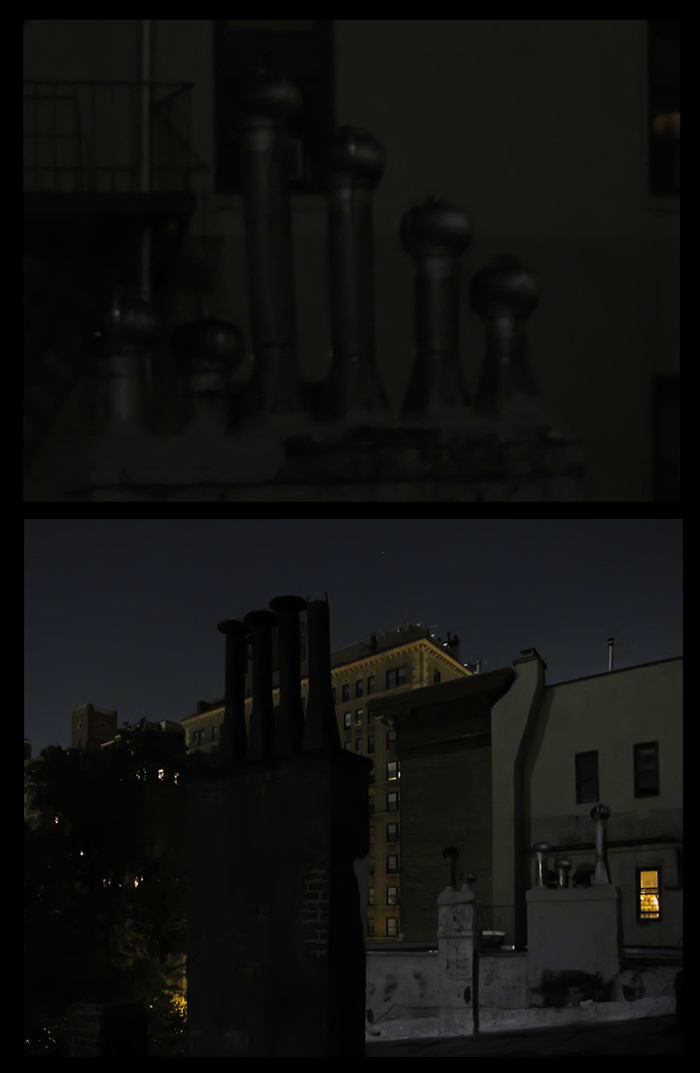
    I have been to some of those places so dark at night that you can not see your own hand. I don’t like those places. I will confess that after living in New York City most of my life, I am somewhat afraid of the dark because I don’t really know what it is anymore. A case of Fear of the Unknown.

    I have read about the health benefits of sleeping in total darkness. I am sure it is healthier, but I find greater comfort with light. I can sleep in well-lit rooms, a bedroom at night without shades drawn, at the beach, or on park benches during the day. It’s much easier to see anyone sneaking up on you, and vampires hate the light.

    Although there are conveniences of living in a place where it is well lit at night, this plethora of illumination is light pollution, and it is a well-documented problem worldwide, particularly in urban areas like New York City. The Dark-Sky Association (IDA) defines light pollution as any adverse effect of artificial light, including sky glow, glare, light trespass, light clutter, decreased visibility at night, and energy waste.

    Links have been found between light pollution and cancer, increase in blood pressure, alertness, and mood. Sleep and circadian disruption, along with melatonin suppression, may have long-term health risks. In a larger sphere, ecosystems are disrupted. On March 26th, 2009, I wrote of the effect on our fine feathered friends in Birds Sing at Night.

    We grow accustomed to the everlasting light of the city. In most areas, it is easy to read at any hour of the night in the parks or on the streets. Bill Hayes, a writer for the New York Times, in a piece called “Insomniac City,” describes a phenomenon he discovered – people who took to the parks on summer nights to read all manner of printed materials – books, newspapers, novels, and poetry.

    On summer trips when I have vacationed in rural areas, I found a flashlight a necessary tool to carry at night. In the city, I use my flashlight during the day to find that lost item that has rolled under a desk and rarely to illuminate my way at night.

    In a city that never sleeps, and where everything is illuminated, birds sing and we read at night…

    Posted on by Brian Dubé


  • dinamic_sidebar 4 none

©2026 New York Daily Photo Entries (RSS) and Comments (RSS)  Raindrops Theme