• Category Archives People
  • Crusties are People Too?

    Part 2 (see Part 1 here)

    I had hoped to learn a little more about Morgan and her background. In a way, one could say I had made her acquaintance. When I approached her lying in the grass on Sunday, greeting her with “Morgan Maginnis,” she jumped and ran as if she had seen the devil incarnate. It took some conversation and persuasion to convince her that I was the man who had photographed her only a few days earlier.

    She told me a little about her past – that she was from Los Angeles and that her parents had died from a combination of alcohol and an auto crash. She said that she was a college graduate with two degrees and has a job in demolition. I was told that she had just been featured in Vice Magazine and that this was her big break. Her pet rat had already died.

    I told her that I had written part one of a crustie story, that I was featuring her and that I had referred to her as “cuddly and disgusting.” I hoped she was not insulted, but it was my honest reaction to having her arms encircle me from behind while correcting an email address. She was charming, cute and filthy all together.
    She and her friends laughed and found it an apt description. One said that they were all disgusting. Perhaps, in her world, cuddly, even with a qualifier, was quite a complement, because she seemed rather pleased, repeating the phrase several times to her friends.

    On Sunday, however, things took a turn for the worse. I looked for Morgan to speak to her and glean a few more details of her life. When I found her, she was crying and recounting her day. Trying to get more drugs to supplement her methadone. Food stolen, as well as other incidents common to the homeless. Morgan is clearly angry and frustrated.

    A confrontation with a black man spun out of control. She grabbed his bag, throwing it at him as well as away from them. She accused him of being like other blacks who had raped her. The ranting, vulgarity and drama escalated. She was running through the park, screaming and throwing things. Bystanders were running scattershot in fear of being a victim. I was wary myself. Although the acting out was largely drama, Morgan is not incapable of inflicting bodily harm and I learned that she has been arrested numerous times.

    Like those who naively believe they can domesticate a wild animal, I left feeling a little foolish, thinking that a relationship approaching normalcy could be had with a drug addicted crust punk. I had descended to the bottom, and I am saddened by what I see there. Drugs are unforgiving, and their allure is a cruel mirage. It’s a world of false promises of peer respect and the charm of nihilism and anarchy.

    The future is dim for these individuals, and their lives will likely be quite short. No one wants to invest time in fanning dying embers. They are the trash of contemporary society and the only talk I hear is where to relocate them. They are filthy, disgusting, and violent, so get them away from here. Only the sanctity of human life and the 5th/6th Commandment prevents many from suggesting the simplest solution while asking the rhetorical, Crusties are People Too?

    Other Related Posts: Jenn Kabacinski Part 2, Jenn Kabacinski Part 1, Misfits, Stephanie, Police Riot Concert


  • Crusties are People Too, Part 1

    Christian Meets Chaucer and Crusties


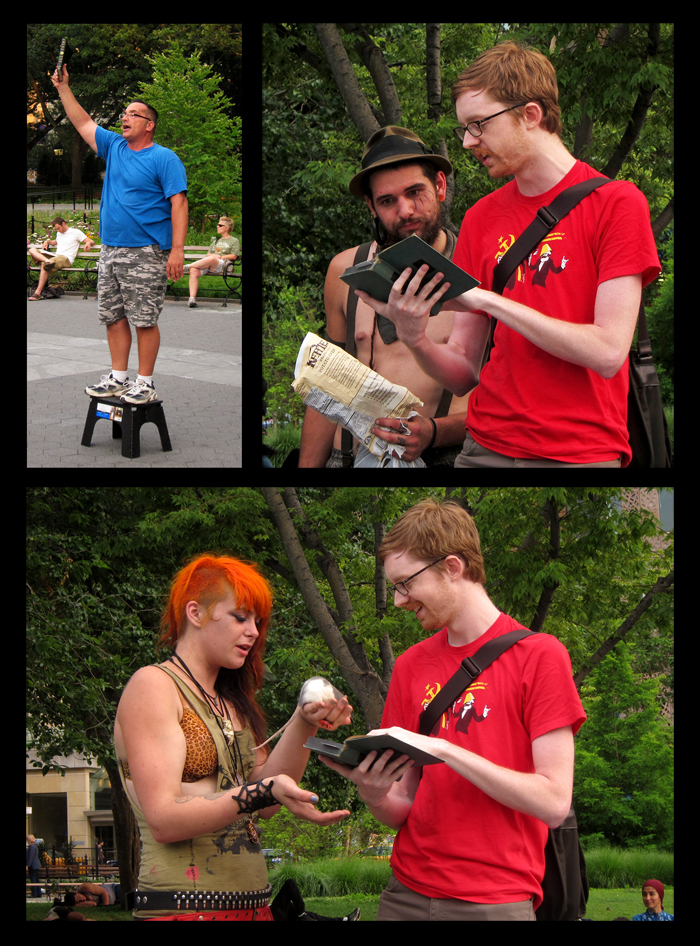
    Let’s create an impossible scenario. Start with a Bible-thumping preacher standing on a small stool, screaming scripture aloud in a park using amplification. The police arrive after a noise complaint by a hostile man with a long white beard and hair – the incarnation of Mr. Natural ala R. Crumb. He also complains that he does not believe the preaching is biblically accurate (not an arrestable offense). The preacher informs the police that there is case law that says preaching with amplification is not illegal and that only volume can be regulated. He looks for the court ruling on his iPhone and will fax it to the police precinct. The police back off.

    Another preacher begins, his voice volume greater than that generated by the small amplifier used previously. Simultaneously, a young man is reading loudly from a text, directed at the preacher. I cannot recognize the language – I assume it is a religious text, perhaps in Hebrew and ask him about it. He is an English literature student and is reading the Canterbury Tales in the original Middle English at full volume. It’s a war of words…

    A crust punk eating potato chips takes an interest in the Canterbury Tales and stands near the student, following the reading. Another crusty in bright orange hair joins them and eagerly introduces her newly acquired pet rat to the student. Christian meet Chaucer with crusties. It is like a family reunion.

    I become too friendly with the crusties, particularly the one with orange hair. I ask if she minds if we take photos. She grants my wish, and my photographer friend Bill and I go into overdrive, shooting away. I learn that the woman’s name is Morgan Maginnis. She is very nice, as is her friend, Hays. I ask her a few questions and I videotape her. They give me their email addresses. I am both warmed and disgusted when she wraps her arms around me from behind and takes my pen to clarify one letter in the email address. She is cute, cuddly and very dirty.

    Late that night, I run across Morgan, Hays and a group of their friends several blocks from the park behind a luxury highrise apartment building. They recognize me. I stop, say hello and chat. One has an iPhone and asks me to take group photos of them. I take photos with my own camera and assure them that I will email them photos. I ask them direct questions about sex and drugs. They give me direct answers. Are we becoming friends now?

    Crusties have been a big problem in the parks. They have been unruly, troublesome, belligerent, drug addicted, homeless, typically jobless and leave garbage strewn everywhere with a virtual campsite in Washington Square Park. You’re not supposed to like them. But I learn that Crusties are People Too

    Note: In Part 2, we get a little closer to Morgan through text and video.

    Related Posts: Jenn Kabacinski Part 2, Jenn Kabacinski Part 1, Misfits, Cosmetics, Crustie, Stephanie, Police Riot Concert


  • Mike Fontana

    Part 2 – Surrender to the Music (see Part 1 here)


    Immersion took on a new meaning for me when virtual reality technologies were developed and became surrounded by media buzz. The operative phrase became total immersion experience. For something to truly feel real, input to all five senses must reach a level where the user perceives them to be real.

    In on our non-virtual world, I believe we have an analogous situation. When we reach sensory overload and the stimuli are positive, we feel euphoria, exhilaration, or pure joy. We lose the ability to intellectualize, analyze and stand outside the experience as observer. You are fully IN the experience.

    My first meeting with Mike Fontana was short but exciting. Here was a working artist on St. Marks Place between 2nd and 3rd Avenue, the historical nexus of the East Village. A brief moment standing on his 2nd floor balcony connected me with that past. While there, friends dropped in, seemingly unannounced, reminiscent of my childhood, where making rounds visiting relatives (often unannounced) was de rigueur. I was informed by the friend who made the introduction that Mike hosted regular music jams and every first Wednesday of the month, there was a open megajam.

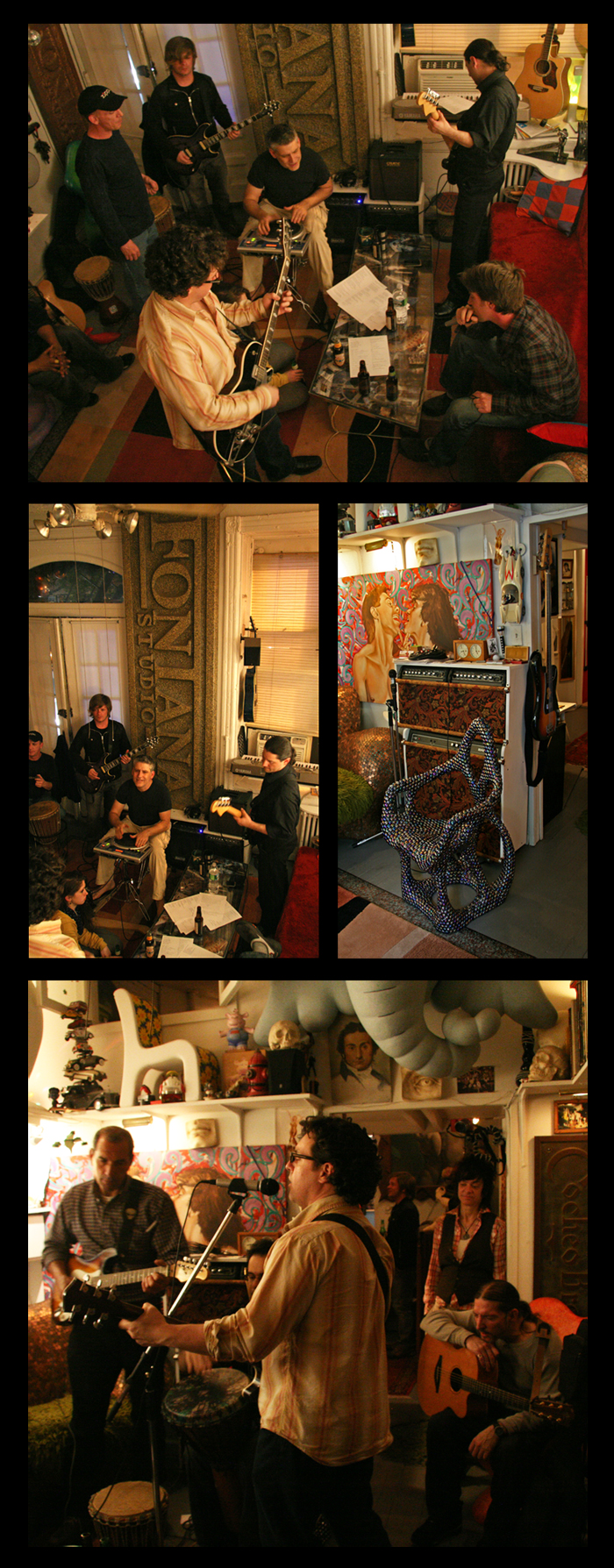
    On Wednesday May 4, 2011, I went to Mike Fontana’s, armed with cameras and camcorder. Mike is disarmingly cordial, convivial and generous. His home is your home. There is an openness rarely found in New York City. He welcomed me to make use of his loft bed which had a windowed opening through a wall, permitting a treehouse view of the living room which was filled with musicians. Many of the photos for part 1 of this story were taken from this aerie.

    In short order, the entire apartment was teaming with musicians. This was a full-fledged rock and roll extravaganza, the likes of which I have never seen in a private home:

    Mike assured me that the neighbors were not always as pleased as the jam participants. The living room is well outfitted with amplifiers – guitarists only need to bring their axes and plug in. Mike was busy on his drum pads with all the enthusiasm of a boy who just unwrapped his first set at Christmas.

    It is easy to get caught up in an urban life filled with agendas and completely lose touch with your own humanity. As I wrote in Duffy , when life’s routines begin to take over, it’s time to recharge your batteries. Grab a surfboard and jump in. Immerse and lose yourself. Take off your armor. Fall in love, head over heels. Find a music jam, sing out and surrender to the music


    Note: You can find Mike Fontana’s website here.

    Related Posts: I Got Caught, New York Is Bluegrass Country, Pockets of Joy, The Conductor,  Paddy Reilly’s, Park Night


  • Mike Fontana

    Part 1


    In May, I was asked by a friend if I would be willing to guest host a local access TV program which he will be producing using the facilities at MNN, a local access cable television network based in New York City. This is an exciting opportunity and I readily agreed.

    The show is being put together as a final project for my friend’s training at the network. His plan is a 28 minute program consisting of 2 interviews with two artists. One of those men is Mike Fontana. We agreed to visit Mike together for a preliminary meeting. Mike lives in one those unlikely locations – a street so well known for its shops that the prospect of an artist living on St. Marks Place between 2nd and 3rd Avenue is hard to imagine.

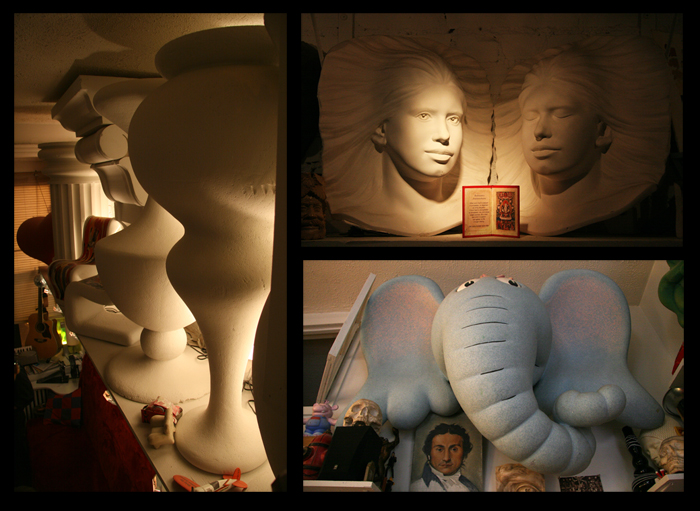
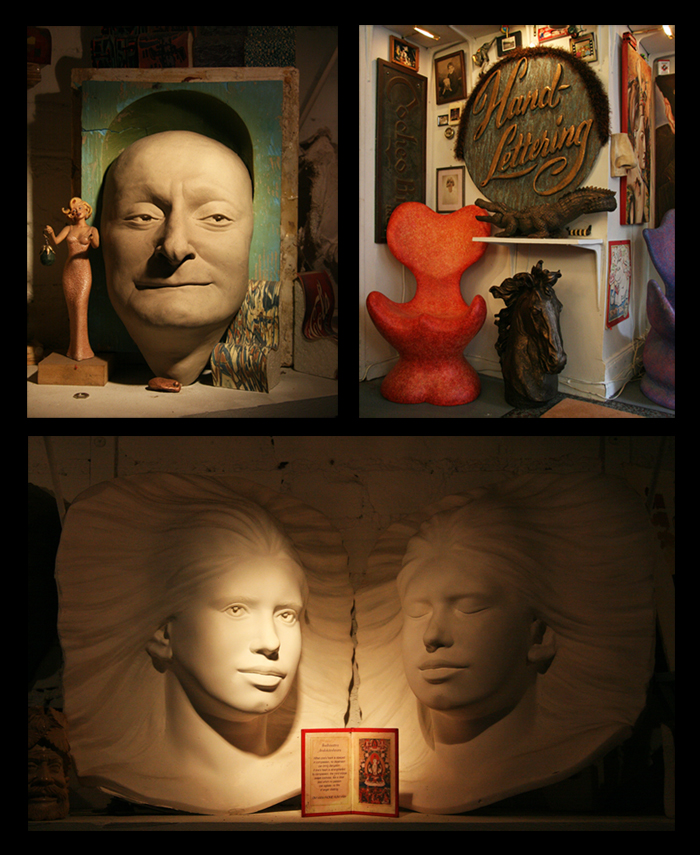
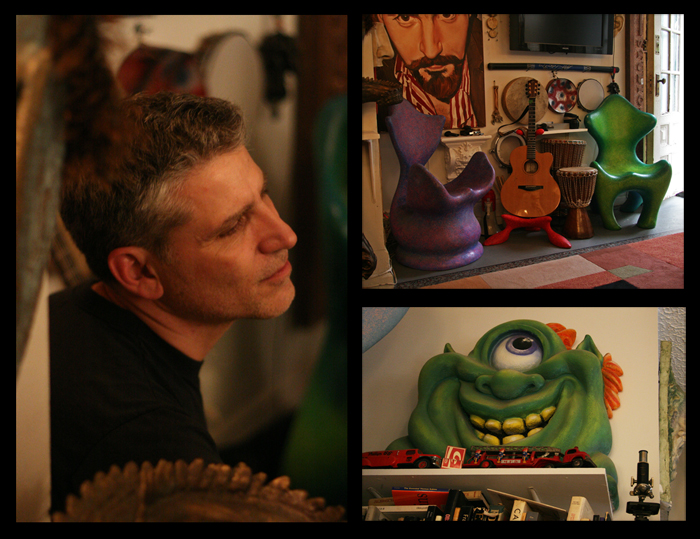
    Mike’s home is a shrine to his sculptural work – every wall, corner, shelf, room, piece of furniture. A small balcony a the front of the building overlooks St. Marks from the second floor.
    Mike is a native New Yorker, born here in 1961. As I typically do with my profiles, I corresponded with Mike by email to learn more about him and his background. Mike spent a semester at SVA and a year and a half at Art Student’s league. There, he was a drawing and anatomy major. Mike says:

    I dropped out of high school to work with my families photographic retouching studio. I’d spent some years in construction, mostly as a carpenter, building houses, apartments, renovation etc… All the while making paintings. Found work with Macy’s Thanksgiving Parade Studio where I ended up becoming Chief Sculptor and Associate designer. Many long stories there. I stayed 12 years. Since then I’ve pursued all kinds of sculpting and design endeavors from props and display to major historical monuments, museum figures, fabrication for major artists ( “I don’t have to finger paint any more.”) and, my own stuff.

    I was amazed to learn about Mike’s family background:

    Father: Illustrious family origin, aristocracy, 700 year old name. Grand father: famous opera star early 20th century. Caruso was my dad’s step father. Dad’s mom: Spanish Countess. Title originally conferred on family by King Ferdinand. That and half a sawbuck gets me on the subway.
    Mother: East European peasant stock but, her mom’s rise to the American dream is quite extraordinary.

    Mike speaks of his interests and the importance of his daughter in his life:

    Interests: Painting, Sculpture, Design, Illustration, Photography, Industrial design and architecture, Music, Film, Animation, Rapid prototyping. It goes on and on. I think that my biggest achievement is the relationship that I have with my daughter. Strip away everything else and she is the center of my everything. I’ve never known a comparable love. Of all of the interesting and or beautiful things that I’ve had my hand in creating, all pales before her. She is my angel.

    But there is another fascinating side to Mike’s life that I had the opportunity to participate in. We will see that in part 2…

    Related Posts: Penny’s From Heaven, I’m Really Good at Paper Mache, Horticulture, traPt, Bovine Love, Koons Balloons, Tower of Toys, Yaffa Cafe, Astor Place Cube, Gem Spa

    Other Interesting Individuals: Mark Birnbaum (see here and here), Ferris Butler (see here and here), Nicole Dubuc (see here and here), Professor Robert Gurland (see here and here), Bex Burton, Gaby Lampkey (see here and here), Jenn Kabacinski (see here and here), Driss Aqil, Walid Soroor


  • Abandon All Preconceived Notions Ye Who Enter Here

    The Story of Mark Birnbaum, Part 2 (see Part 1 here)


    I know what you are asking because everyone I know has asked the same things, as I have. I have now spent a total of about six hours in conversation with Mark.

    Would you like everything you believe about people brought into question? Do you feel you are a good judge of people? If so, do not come with me into the world of Mark Birnbaum. To be with Mark Birnbaum is challenging and disturbing. To spend time with him will impose a shift in thinking. There is just no way around it.

    On my first meeting (Part 1 of this story), I tactfully asked Mark about his background. He was immediately forthcoming. The biggest surprises were his educational achievements. I asked for a follow up interview, anywhere there was a piano. He generously offered to meet in his home. I recorded our entire 3 hour conversation together and video recorded some of his piano playing.

    I met him at his home on East 48th Street Sunday afternoon at 2:30 PM. He was on time, waiting for me in the lobby of the doorman building he lives in. My first thoughts were to corroborate his claims and ask about this in as tactful a manner as possible. The New York Times had already done a story on Mark, so I asked if they had questioned his claims. He said absolutely – they had done their homework. When I suggested that I might also want to see evidence, he readily agreed. He volunteered that people can say anything and that I should ask for such things.

    He showed me his college diplomas, the purchase contract and proprietary lease for his apartment and his birth certificate showing his birth in Switzerland in 1952 (where he lived for just three years before returning with his parents home to their home in Brooklyn, New York). He allowed me to photograph any documents that I wanted to. I asked direct questions, he gave direct answers. It was refreshing.

    In 1974, Mark graduated Summa Cum Laude from Brooklyn College. He then applied and was admitted to Columbia University, where he obtained a masters degree in one year. He spent about an year and a half in Paris and on his return, he reentered Columbia, where he received his PhD in music composition in 1982. Mark also successfully made all the hurdles for admission to Juilliard, one of the most difficult schools in the world to gain entry to. However, at the time of his admission, there was only one vacancy in musical composition and he was not chosen.

    I spent much of our time together multi-tasking. As I listened closely and we conversed, I simultaneously searched for evidence of lunacy or some serious psychological disorder. I could find none. His home, which I expected to be a shrine to squalor, befitting the artist eccentric, was nothing of the sort. It was extremely tidy and minimalistic, with his Yamaha baby grand piano as centerpiece.

    Not yet knowing about his work and career as a musical performer, I was very curious about his source of income. I was surprised that he owned his own apartment. He had already told me, “I know how to play the game.” I was to learn that he had.
    Mark grew up in Brooklyn. His interest in music started at an early age with a focus on piano. He was for a time a rock and roll drummer and played in a band. His interest in musical genres spans the gamut – classical, rock, blues, jazz, country and the area of his particular interest, ragtime.

    Mark has worked successfully as a performer and teacher in his adult life. He had the typical assortment of odd jobs prior to his days as a student, when he worked as a bartender. From 1989 to 1993, he was musical host on the Joe Franklin TV show. At Manhattan’s 13th Street Theater, he had a weekly show “Hot Piano! Ragtime Blues and Jazz” – five months running. From that time, Mark has worked in music as performer and teacher. See his other credits, music, videos, and bio at his website here.

    I was rapidly losing ground on my initial assessment of this man. At times I felt my sanity was coming into question, not his. Here was a man who was cordial, brilliant, insightful, generous of spirit, gentle, open, talented, articulate and well educated. Apart from his manner of dress, he was normal by any definition. But to spend substantial time with a man dressed this way while having an extraordinary conversation was very disorienting – I was suffering from a severe case of cognitive dissonance. Mark also gone through many incarnations regarding look, as can be seen in my collage of photos from his archives. I asked if he expected that he may reinvent his dress some day, and he said most likely.

    We shared so many insights and connections, it was eerie. We had numerous instances of nearly finishing each others sentences. I also share one of Mark’s passions, that of walking the streets of New York City. It is one of the most important parts of living in this city to me. You may see Mark around town walking in his very slow, deliberate, signature cadence. Mark sees his long daily walks as “integral to his playing, teaching and composing, a tie to New York’s street vibe.” From the New York Times:

    “The street is my inspiration, and if you want to remain immersed in New York you have to walk its streets. I’m a New York street guy, and Manhattan has the best energy in the world.”
    Mr. Birnbaum said he realized the musical importance of the daily walk after meeting the immortal ivory tickler Vladimir Horowitz who told him, “Make sure you walk 40 blocks a day, because if you don’t walk, your fingers don’t run.”

    Mark told me of his influences. One of his life mentors is Bill Schimmel, whom I saw perform, met and wrote a story about (see The Redeemer here). Mark cited several other major influences – Vladimir Horowitz (whom he met) and Artur Rubenstein.

    Ah, you still have the lingering question – “Why does he dress that way?” Let Mark respond:

    Perhaps my purpose in dressing the way I do is to spread joy (cheer people
    up). When someone sees or says something negative—they are not seeing me…
    Or speaking about me. Perhaps I am a mirror or magnifying glass (like Socrates).

    I asked Mark if he was gay. He said no. I asked about his ability to find a partner, dressed as he is:

    My manner of dress is a plus in meeting a partner as far as I know.
    It is a screening process; if someone doesn’t “get it” (like it or appreciate
    it), she would not appreciate me where it counts.

    Mark goes on to say:

    This dress code is an outer manifestation of who I am: an apostle of
    freedom, Zen and Socratic/Orwellian thought).
    Dress Code helps me practice piano, listen, study Zen and the Art of War and
    is done out of self-respect. I respect others as such.

    I dress this way every day– once I am up, whether I am going out in an
    hour, later that day, or (very rarely) staying in. When I had a cold months
    ago and didn’t go out one day. I dressed the same way.
    More a uniform than a costume.

    People see what they like (about themselves) or see what they don’t. It’s less about me than them.
    Some see rock n roll: Elton John, David Bowie, Aerosmith or Kiss–the ’70’s.
    Some see religious significance, spirituality, Shamanism or royalty.

    Some think I am a pimp.
    Some don’t see at all.

    I never explain it much; it would be like explaining jazz.
    One has to experience it, be with it.
    And….People hear what they see; everyone has their own window.

    I know – you’re not quite satisfied. But then this is New York City where there are not only many wonderful and miraculous things, but there are many puzzles and enigmas too. It’s a place where we expect the unexpected. Isn’t that why you’re here?

    Thanks, Dr. Mark Birnbaum, for a look inside your window…

    Note: From a recent email conversation with Mark on June 21, 2011:

    Hi Brian.

    Fabulous article keeps getting better!
    Yes, I walk to the village and back.
    When we met on Houston St, that’s often as far south as I go.
    Bill Schimmel says hello and loves your blog,-calling it the best! (he) considers your article on me the next best thing to being in the NY Times, and that it is the best blog he has seen anywhere.
    I agree with him.

    I’ll see you soon—on one of our walks.

    View Mark’s Youtube channel, Flickr photostream, and website here.

    Other stories from Abandon All Preconceived Notions series: Gaby Lampkey (see here and here), Jenn Kabacinski (see here and here), Driss Aqil

    Other Interesting Individuals: Ferris Butler (see here and here), Professor Robert Gurland (see here and here), Susan Goren, Creative Expert Criminal Suspect, Misfits, Jim Vehap, Walid Soroor, Flamboyant, Street Revival, André (see here and here), Dave, Reverend Billy, Narcissism Gone Wild, Spike


  • Abandon All Preconceived Notions Ye Who Enter Here

    The Story of Mark Birnbaum, Part 1.   (See Part 2 here.)


    There are many outlandishly dressed characters in New York City. I find the extreme cases rather sad – to me, they appear like a cry for love and attention from a lonely person reaching out. I have seen some of these as regulars at multiple parades where their outfits are completely inappropriately themed, appearing at the Easter, Halloween and Mermaid parades, dressed in the same attire.

    Yet I have been proven wrong in my judgement more times than not, inspiring a series of stories Abandon All Preconceived Notions Ye Who Enter Here – the title being more self-talk than admonition to others.

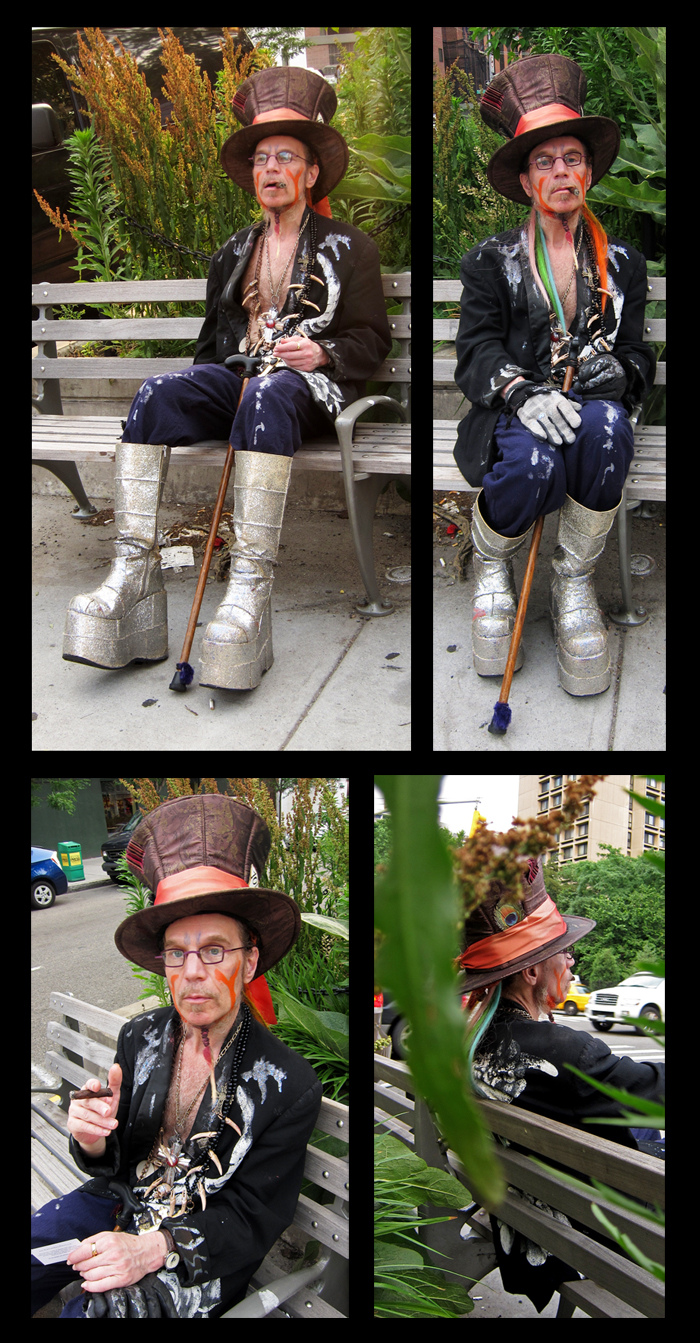
    I had caught a glimpse of the man in today’s photo just a few times, always walking with a very slow, deliberate, confident gait. I quickly characterized him as the Mad Hatter incarnate, likely a deranged, pathetic, lunatic. At one time, I had taken a photo of him leaving a park. It was blurry and unusable, but just as well, since I had no opportunity to speak to him and find out who he was. I don’t feature anonymous individuals and brand them as lunatics. Another time perhaps.

    Another time presented itself in the most remarkable circumstance. On Friday evening while strolling home from work, I crossed Houston Street, the largest crosstown street in Manhattan. It looks and functions virtually like a divided highway with a landscaped median. At the end of one median at West Broadway, a park bench has been installed in what can easily be argued as one the most visible and inauspicious places. It is unimaginable that anyone would want to sit between 6 lanes of traffic, whooshing by in two directions. I have never seen it used.

    But there he was, carefully composed sitting on a bench, a photo begging to be taken. Brightly colored hair extensions, an enormous mad hatter style hat, face paint, necklaces with skulls and bones, heavy gloves on a hot day, a sport jacket with no shirt, a knotted tuft of hair under his chin, his enormous signature silver-glittered platform boots, a cane and smoking a cigar. Calm, cool and collected.

    Approaching someone like this can be very tricky with unpredictable response. So far my experience has only been positive – I have concluded that anyone so outlandishly dressed is certainly not averse to attention and quite used to others taking photos. See the list of links below which feature profiles of some of the most interesting individuals I have encountered in my travels in New York City: Ferris Butler, Professor Robert Gurland, Gaby Lampkey, Jenn Kabacinski, Driss Aqil, Susan Goren, the Creative Expert, the Swaggertist in Blue, Hector, the Misfits, Jim Vehap, Walid Soroor, Flamboyant, Todd Bentley, AndrĂ©, Dave, Reverend Billy, the Dance Parade, Narcissism Gone Wild, and Spike.

    Although permission to take a photo in a public place to be used for editorial purposes is not legally necessary, I prefer to seek the consent and cooperation of subjects when they are featured in a story. So, I opted to ask permission. His response “of course” was surprising. He was extraordinarily cordial and a small mini-photoshoot ensued. He was so accommodating, I decided take a seat next to him.

    An hour and a half passed, interrupted by the myriad of passengers and pedestrians stopping to take photos. I could see that if one is interested in drawing attention, dressing like this and sitting on a bench on Houston Street will certainly achieve that. I recorded over 40 minutes of a conversation so engaging, that at its end, my companion said “we rocked.” It was a real life My Dinner With AndrĂ© meets Alice in Wonderland, New York City style.

    In Part 2, you will meet Mark Birnbaum. Trust me – he is not the man you think he is at all


    Note: To those who have asked, Mark’s shoes were purchased at Trash and Vaudeville.

    Related Posts: Ferris Butler Part 1, Professor Gurland Part 1, Jenn Kabacinski Part 1, On the Road, Fashion Forward


  • Grace of a Boombox God

    Those of us who lived in New York City in the 1970s and 80s can testify to the very serious quality of life issues – graffiti covered subways, vandalism, garbage, crime, noise, drugs. The streets were minefields of dog poop just waiting for the next victim – those unfamiliar with the terrain or seasoned New Yorkers who had a momentary lapse of attention to the sidewalks. It was a very rough time and not the promised land at all. The most common question I was asked at the time about my choice to live in New York City was “Why?”

    In hindsight, those times are examined at arms length, analyzed, discussed, debated, romanticized and even missed. A case in point is a recent book reviewed in the New York Times:

    Mr. Owerko’s interest grew into a book, “The Boombox Project: The Machines, the Music, and the Urban Underground,” published this month by Abrams Image. It features his lovingly detailed close-up photographs of vintage portable stereos, as well as commentary by Spike Lee, L L Cool J and members of the Beastie Boys and the Fugees about the role the devices played in New York’s street culture from the late 1970s to the mid-’80s.

    In shot after full-page shot, Mr. Owerko — best known for his image of the smashed World Trade Center on the cover of Time magazine on Sept. 14, 2001 — venerates an audio technology that, to eyes accustomed to the iPod’s futuristic smoothness, seems practically steampunk: hard, square-edged metal casing; wheel-size speakers protected by silvery-black grilles; lots of clunky knobs and buttons. And at the heart of every boombox is a cassette deck.

    Many who bemoan the loss of the edge, grit, authenticity, lack of over gentrification, etc., were either not there or perhaps with selective memory, forget that living in that environment was in numerous ways quite awful. Many of the pleasant memories of that era often have more to do with the youthful enthusiasm and a spirit of reckless abandon and fearless adventure of young urban cowboys than any inherent charm of the city. New York City provided its own flavor of the lawless wild west.

    One of the most annoying and dreadful elements of the late 1970s and 1980s was the boombox. This portable party machine could be cranked to deafening levels, even outdoors against the ambient din of the city. At times it felt like there was no escaping it – the ghetto blasters were everywhere to be found including spaces where one expected quiet enjoyment like parks. To make matters worse, the music played was very limited, typically disco, a genre I quickly grew to abhor, or hip hop. You would not hear anything else, certainly not classical, country, blues or classic rock. We prayed for the death of disco and these infernal machines. Our wishes were eventually granted but it was an interminable wait of a decade.

    Boomboxes were HEAVY. It was a job to carry them all day. Some required as many as 20 D-cell batteries, which, allowing for continuous play and volumes, would only last the day. The cost of these batteries became major budgetary items for those who carried their boxes daily. They were essentially the Walkmans or iPods of their day, but as a broadcast device, they could hardly be considered personal audio players.

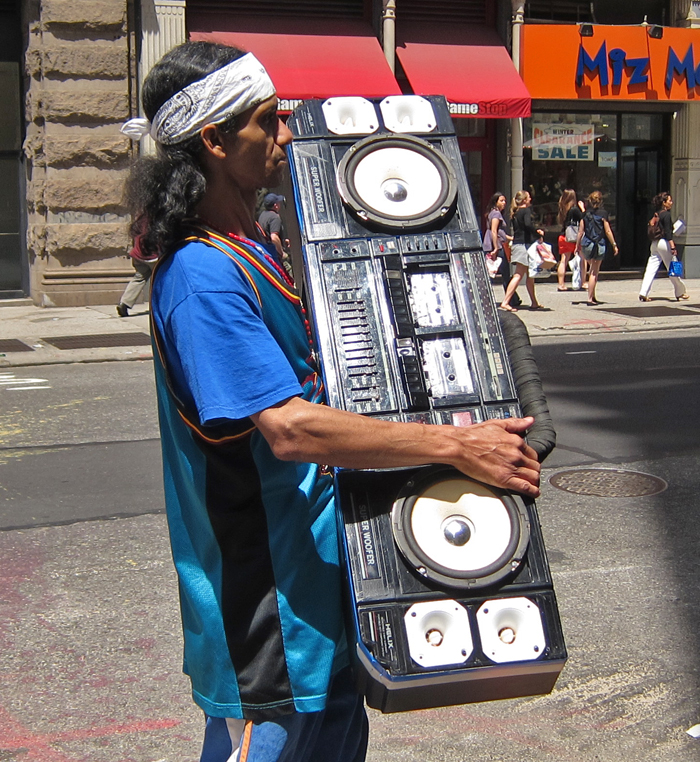
    On Monday, while walking on Broadway, I encountered what had to be the largest boombox I have ever seen. A pedestrian nearby commented to me “I feel like its the 90s again.” Perhaps he was not aware that if his only experience of boomboxes was the in the 90s, then he had not enjoyed true noise pollution.

    The owner was walking very briskly. I fumbled for my camera and ran after him, asking if he would permit a photo. With a pompous attitude and only a side glance, he made a beckoning motion with one hand, indicating I follow him as we both ran through Broadway traffic. He stopped for a second, giving me no time to compose a decent photo. I was a bit frustrated, however, I had to remind myself, that even though it was only for a brief moment, I had gotten a free trip in time and had been granted the Grace of a Boombox God 🙂

    Related Posts: Float Master, Part 2, Float Master, Part 1, Too Too New York, Deaf Jam, I’ve Got a Feeling, 5 Pointz, Columbo, Monk and CSI, Men Making Noise, New York State of Mind


  • Just Click Here

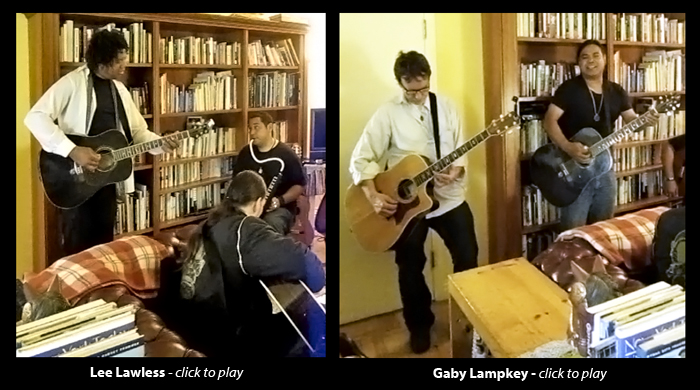
    The photos above are stills which link to videos taken at the recent party from my story, Myra’s Isle. Many terrific musicians attended – John Leonard, Ali Abidin, Sage Logan, Joe Rios, Rigel Sarjoo, Lori Behrman, Rene Logeais, Lee Lawless and Gaby Lampkey. The photo link on the left is that of the inimitable Lee Lawless playing Stormy Monday Blues. The photo link on the right is that of Gaby Lampkey playing She Talks to Angels by the Black Crowes.

    I have done two stories involving my meeting with Gaby and the incredible connection we shared, unbeknownst to both of us. See On the Road and When Brian Met Sally. I am happy to report that Gaby is no longer on the streets of NYC. Congrats to his new life.

    ‘Twas a great party with spontaneous groupings of musicians. If you want a taste of what it was like to be there, courtesy of Lee Lawless and Gaby Lampkey, just click here 🙂

    Note: I have created a YouTube channel for New York Daily Photo videos. I will add all the video clips associated with stories on this website. I also plan to add more video content to New York Daily Photo in the future. It will be Live From New York 🙂

    Related Posts: Ferris Butler Part 2, Ferris Butler Part 1, Gaby Lampkey Part 2, Curse of the Mouth Trumpet, Impossible, The Bathroom Closes in 20 Minutes, Pockets of Joy, Just Like Old Times, Dave, Smile, The Conductor, Sounds of Summer, Spinning, Park Night


  • Myra’s Isle


    As regular readers well know, I am a habitué of Washington Square Park, my front and back yard. Here, I have met many remarkable people, some of whom have been featured on the website. It has, for a number of us who live in the neighborhood, become a veritable social club.

    However, this environment is certainly not for the average palate, and admittedly, as is often the case in New York City, one must tolerate a spectrum of people – the violent, hostile, drug addicts and dealers, crusties, homeless, and every manner of misfit, social outcast, and criminal known to humankind. Any park regular will by necessity, at least occasionally, encounter, or should I say be accosted by, very unsavory individuals, particularly late at night, which will certainly remove any doubt that werewolves, zombies, or vampires do in fact exist.

    Building a social life in such an environment tests one’s ability to maintain a balance, giving all the benefit of the doubt – being polite and respectful yet cautious. It is a harsh educational experience – one of the many courses for those attending New York’s Sidewalk University. The trials and tribulations of being homeless are clearly illuminated – I have learned what this really means on a day to day basis.

    Some time ago, I had a conversation about these matters with Myra, a neighborhood resident, who owns an apartment with one of the finest locations I have ever seen in the Village – a four-bedroom corner duplex penthouse that fronts both Fifth Avenue and Washington Square North with a private 1,400 square foot outdoor roof deck and additional terraces in front. You can virtually touch the Washington Square arch from nearly every window and space. At night, the illuminated monument is absolutely stunning.

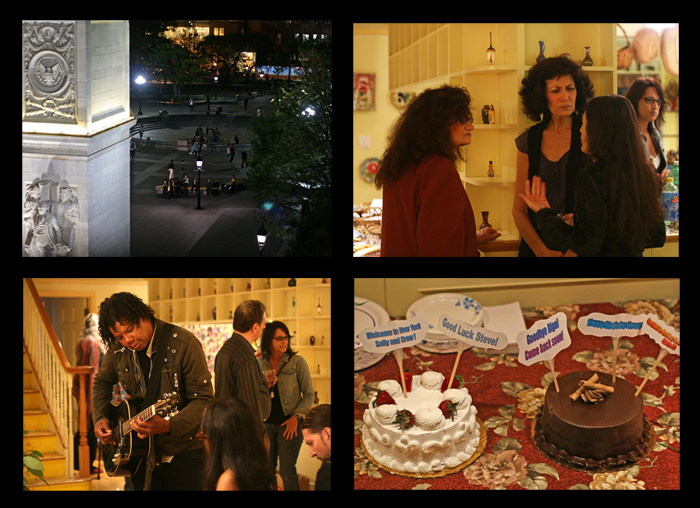
    Myra is well aware of the privileged residence she has. In fact, she expressed her desire to share it more with others. This, in tandem with conversations about taking our park social group indoors from time to time, led Myra to graciously offer her place as venue for a party. The conversation was recently further explored with another local resident, Hellen. Our mutual enthusiasms knew no bounds, and in short order, a three person party planning committee was formed.

    A spreadsheet was created to manage the names and RSVPs. As any party planner will attest, managing the number of invitees becomes a big challenge – there is no end to who should rightfully be invited, and soon our party list numbered 47. Individuals of every imaginable background were in attendance with a heavy representation of musicians, important to all those attending. Music is one of the best loved features of the park’s culture.

    Initially, the party was to wish a friend farewell who was leaving for the summer – an NYU student who has befriended our group, particularly the musicians (herself a guitarist and singer). Coincidentally, this was also the birthday for Harvey, Hellen’s husband, and a celebration for Steve, who had just started a new job. Remarkably, Sally, with whom I had a chance encounter in 2010, was coming to New York the very same weekend with her family. It was also the first time I had ever actually planned and co-hosted a party, a cause for celebration in its own right. Hellen provided celebratory tags and placed them on dessert cakes for this amazing serendipitous occurrence of five events.

    Among the attendees whom I have written about previously were: Sally Darling, Gaby Lampkey, Ferris Butler (see here and here), Susan Goren, and Sage. George Vellonakis, a noted landscape architect responsible for the park redesign, was also aboard. Ferris was accompanied by Beverly Ross, singer-songwriter responsible for the hit song “Lollipop.”

    Unbeknownst to us, George brought a friend, Tina Louise, an actress who is best known for her role as the movie star Ginger on the TV series Gilligan’s Island – quite appropriate to round out our own cast of characters. We now had a professor (Steve), Mary, a millionaire and his wife, a movie star (the real Ginger), and even a Tiny Louise. Two members of our party planning group certainly qualified as skipper and mate and did their very best to make our group of 47 castaways in self-exile very happy and comfortable in Myra’s Isle 🙂

    Go here for more footage from this party.

    Related Posts: Curse of the Mouth Trumpet, Impossible, On the Road, The Bathroom Closes in 20 Minutes, Pockets of Joy, Just Like Old Times, Dave, The Conductor, Sounds of Summer, Park Night


  • Grace Under Fire

    Once privileges are given, they are soon seen as rights – taking them away will not be well received. This scenario is common in New York City, such as in quality of life campaigns when circumstances beg for attention and there is a broader and stricter enforcement of existing laws. This, of course, invariably precipitates public outcry, particularly from those who are more politically active and vigilant concerning civil rights.

    Recently, there was a small show of force and ticketing of street performers in Washington Square Park. This is an extremely contentious issue for a number of reasons, particularly since the area has a history of musical performance, one of the dominant reasons many visit this area. The Village has been known as a center for artists and musicians for a century. Apart from the rights to free speech and expression, however, there are nuances of other laws coming into play regarding busking, solicitation, noise, public disturbance and unlawful assembly.

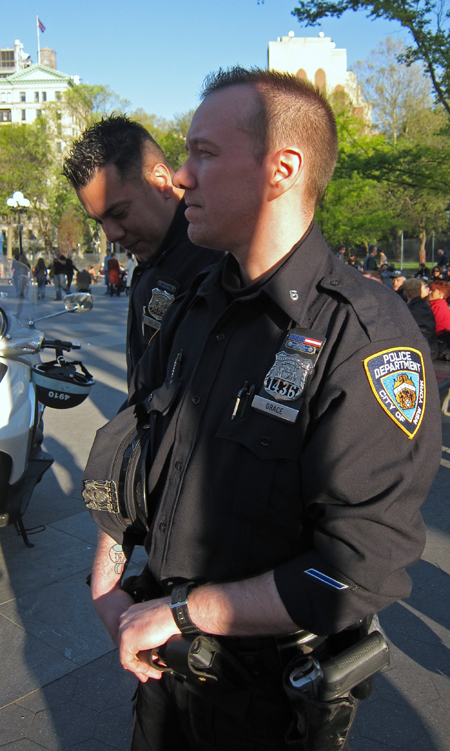
    Shutting down and ticketing performers was met with hostile reaction ranging from anger to outrage. After the recent sweep, the park personnel who had done the ticketing were nowhere to be found – a smart and understandable move. Two officers were on hand however, Alberto Alicea (photo rear) and Tom Grace of the 6th Precinct. The flurry of fury was constant, with a crowd of individuals venting and fuming. Being on the receiving end of a barrage of angry music lovers requires composure because hell hath no fury like an artist warned.

    As is the case with many police actions and the law, most citizens are inadequately informed, misinformed or just too angry to have thought the situation through. I knew I was not dealing with the typical “cop” as I first approached the group where Tom was at work explaining a broad number of concepts including exigent circumstance in United States law.

    I was extremely impressed not only with Tom’s composure and patience, but with his knowledge of the fine details of the law, its intent and interpretation. In addition to his understanding of the academic side of the law, he has a good working knowledge as to its application and the use of common sense and discretion. I spoke with Tom’s partner, Alberto Alicea, during these goings on. Al assured me that Tom’s intellect and talents at interpretation and explanation of the law were well known. Tom told me he loved to read and also informed me that policemen were now required to have at least 60 university credits to become an officer. Born in New Jersey, Tom now lives in Brooklyn and has been on the police force for 8 years.

    He was the perfect spokesperson to have on hand after an event of this nature. I saw one individual after another arrive angry and leave unwillingly satisfied. Tom’s approach was not one of debate, but of discussion with calm and clear explanation of the law, the circumstances and police response, always addressing the individual’s questions directly.

    Being an officer in the New York Police Department is not an easy challenge. Here we have every variant of lawbreaker imaginable, from the innocent tourist committing a minor infraction to seasoned criminals and scam artists who have as good a working knowledge of the law as the police themselves and are often able to ply their trade and evade arrest. Disrespect and defiance is common. I have spent hours conversing with police officers in Washington Square Park. Bicycling in the park is common but a violation, which is clearly stated on numerous signs. Officers typically ask riders to dismount and walk their bikes. Responses vary from polite complicity to open hostile remarks.

    Tom quickly volunteered that he saw a police uniform as clothing, behind which were a broad range of individuals like that seen in the population at large. He was not a man to defend the actions or character of any man in uniform and acknowledged that laws are often improperly or unevenly applied.

    In the case of the ticketing of the street performers by park officers, many felt that quotas may have been a factor and that many performers were unfairly and unjustly targeted in the action. A few may have been overly zealous and aggressive in their solicitation. Others, however, performed as they always had and were exercising their rights, not enjoying privilege. I’m glad I did not have to defend the actions of the park personnel. To stand amongst an angry mob takes composure and guts. By guts, I mean Grace under Fire 🙂

    Note: Some comments for this posting were lost due to a blogger outage.


  • Random Acts of Consideration

    A Mild-Mannered Man of Manners

    (Note: this is Part 2. For Part 1, see here.)
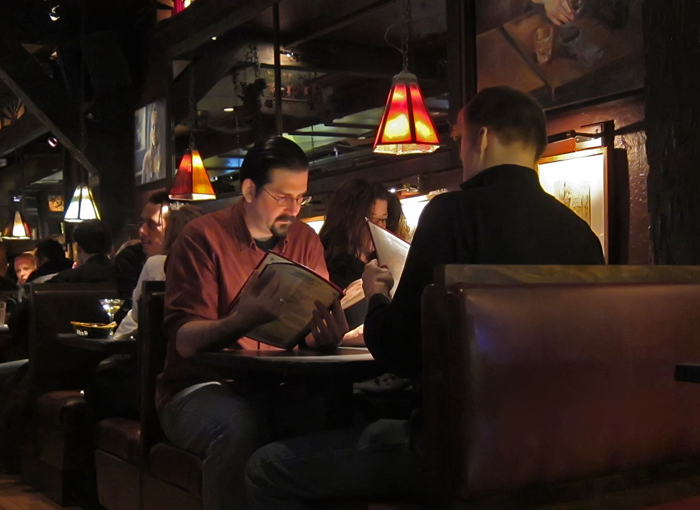
    We sat in the jet stream – a literal wind tunnel as cold wintry air blasted in from the curtained entry only a few feet from our table. Customers entering the restaurant would push the curtain aside, invariably leaving it open. Occasionally, a staff member, if in our neighborhood, would draw it closed, only to be opened seconds or minutes later by new arrivals.

    I had been observing this situation for quite some time and a very large number of people had entered. NO ONE, not one, had considered pulling this curtain closed. Even those who were waiting to be seated and stood for some time just inches away from us. Of course it was not the responsibility of customers to tend to the failed windscreen, so I cannot really accuse these passersby of any rudeness, only a surprising lack of consideration on the part of all who entered in not pulling the curtain back behind them. However, this is a restaurant, it was incredibly busy and chaotic, and hunger called out for those arriving, not Emily Post, Ann Landers, or Randy Cohen*.

    I passed the time with a friend, an NYU student, writing on our chalk table while she told me of her high school classmates’ use of the word Guam to describe the remote, as I told her of the term Siberia which I had seen used in a New York Magazine article to refer to poorly located restaurant tables (see Timbuktu, Guam and Siberia here). Surprisingly, she had never heard of Timbuktu used in this manner, perhaps more common at the time I grew up. Every generation has its own potpourri of slang, influenced by societal and cultural elements of the time. Words and phrases like Queen of Sheba, shindig, floozy, and skinny balink are not popular in today’s lexicon. The rise of the Internet, gaming, electronic media, and personal computers has given rise to a new world of language and idioms, both written and spoken – acronyms, initialisms, leetspeak, and others.

    A group of three entered the restaurant, where a blond haired gentlemen of the group immediately turned and closed the curtain – so quickly as to appear to be an automatic reflex action. This, I thought, is a man cut from a different cloth. An interloper. A stranger in a strange land, or at least a man with roots other than New York City. As he was heading to a table to be seated, I asked, “Are you from the Midwest?” To which he replied, “Yes I am.”
    I was elated, not so much at his considerate act, but in feeling and looking brilliant at my accurate identification of this mild-mannered man of manners. I went to his table, introduced myself, and learned that his name was Jerry. He was as unimpressed with my feat as he was with his standout behavior – perhaps not surprising from a man who was likely brought up to see this as expected behavior, not an act so unusual as to beg a story to be written.

    The evening had been tantamount to a crude, informal study on human behavior. And although the results were rather dismal for mankind as a whole, in the final act or our small drama, Jerry illuminated the darkness of the room with his Random Act of Consideration 🙂

    *Randy Cohen writes an informative and provocative column, The Ethicist, for the New York Times.


  • Hair

    On our recent warm spell, people flooded the parks and streets like it was a spring day. A woman with quite the head of hair immediately caught my eye. Thinking I was now an expert in yarn falls after meeting Bex Burton (see The Women here), I took a brisk walk, met Shannon Moran, and asked if I could photograph her and her yarn falls. I was informed, however, that I was in error. These were not yarn falls at all, but in fact entirely her own hair, which go down to her knees.

    There is probably nothing that can define, change, or improve a person’s appearance as simply and dramatically as a hairstyle. The face is the mirror of the mind and the window to the soul. Hair frames the face. It is the part of our physical makeup that we can most easily alter. And alter again. Of course, there are limitations to control – hair loss and baldness for most men is a nagging horror.

    Some may leave home in any number of unimaginable modes of dress, but few will leave without combing their hair. For many, what appears to be lack of concern or no style, is itself a style. Hair care ranges from simple grooming to an obsession. It’s an industry. For most women, hair is paramount in their daily grooming rituals and, understandably, a source of perpetual dissatisfaction and frustration. It can make or break a look.

    As incredulous as it may seem, when I attended high school in the late 1960s, a boy’s hair that just touched one’s ears was grounds for a formal reprimand and parental notification. Long hair could even lead to expulsion. The Beatles were a scandal as much for their mop-top haircut as their music. Short by today’s standards, a Beatles haircut was an outrage and was banned in schools. Beatles mop-top wigs were available, as well as even a Beatles’ hair care line.

    In New York City, 1967, we had Hair: The American Tribal Love-Rock Musical, conceived and written by actors James Rado and Gerome Ragni. Many cast members were recruited from the streets. Joe Papp, who ran the New York Shakespeare Festival, opened his new Public Theater in the East Village with a production of the show. Hair was Papp’s first non-Shakespeare offering.

    Hair was a tribute to the hippie movement and the protests of all that was wrong with America – racism, environmental destruction, poverty, sexism and sexual repression, politics, and the Vietnam war. There was drab clothing, rejection of materialism, nudity, sexual freedom, drugs, pacifism, environmentalism, and astrology.
    But in this huge panoply of themes, symbols, and philosophies, none was more more important than the name of the show itself, Hair – an ever present, visible statement about personal beliefs. Long hair almost always signified defiance, rejection of the societal norm, and the evils of the “military industrial complex.”

    Today, the role of hair (along with skin treatment, i.e. tattoos and piercing) is just as important. Perhaps somewhat more a fashion statement, hair and tattoos will still often say something about a person’s lifestyle.

    Shannon says:

    I got my dreads 9 years ago – at the time we were squatting, train hopping and causing mayhem around the country. They go to my knees and are 100% real, natural and home grown. I have many tattoos and will continue to chace my goal of becoming a completely illustrated lady. I have over 30 hours of work scattered all over my body – my favorite being Nick Cave lyrics “Come into my sleep” on my ribs – but I do adore my recent addition – a mustache on my finger.

    I learned that Shannon, 22, was born in Shirley, New York and is currently a resident of Astoria, Queens. She is a photographer, having studied at FIT and Cooper Union.

    I am very interested in vintage erotic photography and obsessively produce my own. I have an alter ego – Lux Berlin – you may have seen my work exhibited in galleries in Chelsea, Brooklyn and the UK. I can be found drinking red wine, swearing like a sailor and dishing out bad advice on the beaches of Fire Island, marching topless down a board walk in Coney Island or shimmying and shaking somewhere in the Lower East Side.

    For now, my work is done here. And I need to check my hair 🙂

    Note: If you are comfortable viewing erotic material, you can see Shannon’s website here.


  • Meetings with Annoying Men

    Poor Winnie – Part 2 (see Part 1 here)
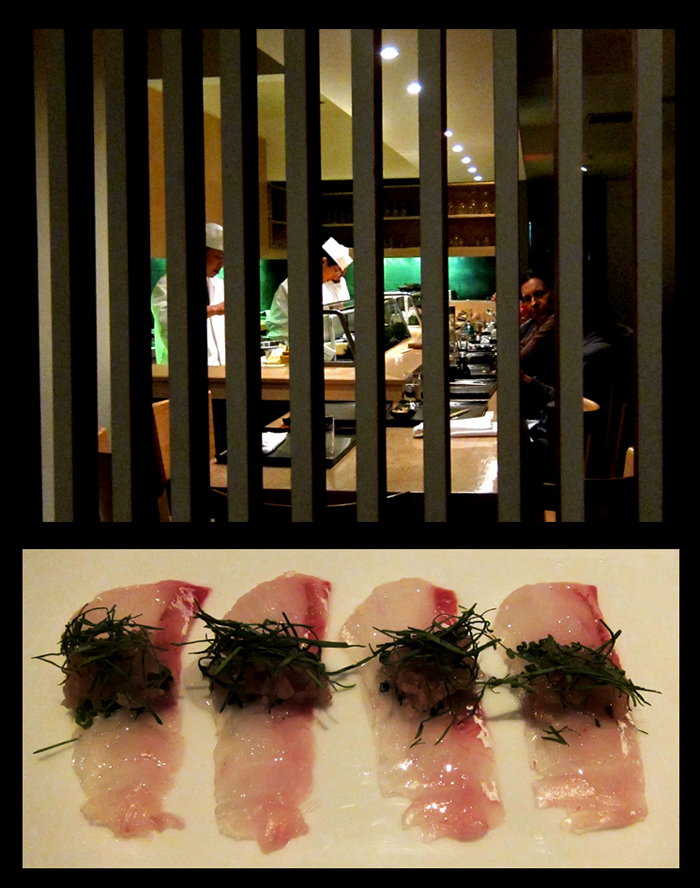
    I had been passing the nondescript storefront (near my home) at 357 6th Avenue for some years. Previously, Ony was located here, a Japanese restaurant I frequented, featuring delicious noodle soups. Now, there is neither signage nor a menu posted. Peeking in through the cutouts, I was able to see that it was also a Japanese restaurant. See photo in Part 1 here.

    I was intrigued, however, a number of friends and I are regulars at Marumi. We all love the food there and have been eating there for so long, it feels like a second home. There was no compelling reason to investigate another Japanese restaurant, particularly with no menu posted.
    One does tire of the same routine, though, so on Tuesday, a friend and I stopped by and asked to see a menu. The restaurant’s name was Soto. Surprisingly, the prices seemed reasonable. We decided to try it the following night. When we arrived, we were asked if we had a reservation, which on the surface seemed rather silly, since the place was virtually empty.

    After ordering, we were informed by the waitress that what we had selected were actually very small appetizers. She recommended following with something from the next page of the menu. Now we were beginning to see the full picture. We asked the waitress to give us a few moments to regroup. My dining companion offered to leave if I felt we were getting in too deep for a casual dining decision. I suggested we stay – the pricing would still not break the bank.

    We shared an extraordinary parade of dishes as they came out, one by one. I will not describe each dish here but suffice it to say that the food was truly sublime and exotic – nothing like anything I have seen before. It was easily the finest Japanese food I have ever had. My companion, who has had much more experience eating in upscale restaurants, agreed.

    A man arrived alone and sat at the table immediately next to us. This gentleman (and I use the term loosely), however, did not appear pleased with anything he ordered. He complained about and returned every single item brought to him without exception. Some items were returned twice. He complained that the soy sauce was too salty, the Sake was not to his liking, and he did not want wasabi in his sushi. Every bite he took appeared to be an exercise in scrutiny – this was not dining, it was a forensic autopsy. It was excruciating to watch, but the waitress did an admirable job trying to please him. The customer also made trouble regarding the bill, which totaled $142 for one person (our check was $133 for two).

    My friend and I both felt compelled to speak to the waitress and offer our condolences. After he left, we pulled her aside. Winnie, a young girl who hailed from Indonesia, appeared very eager and pleased to talk. We apologized for her customer and assured her that this man was completely unreasonable. I told her that not only was the food amazing, but this was a man who could not be pleased and perhaps someone who needs to show off his “sophisticated” palate for all to see. She had maintained composure throughout this entire affair, but now put her hand on her stomach and politely told us how stressed and tense this experience had made her. We concurred.

    That night at home, I did a little research on Soto. I learned that it is owned by celebrity chef Sotohiro Kosugi. It is considered one of the two finest Japanese restaurants in New York City and one of only 10 restaurants in the city to hold the coveted Michelin two star rating (much harder to earn than a one star rating). Only four restaurants hold the highest rating of three stars. Soto is also one of a tiny group of restaurants to get a Zagat survey food rating of 28 – the highest possible.

    The stakes are high for all in a restaurant of this caliber. Diners are quite experienced and often much more critical and demanding, voicing their complaints about things that, to most, might appear to be extremely picky. In spite of the fact that I believe our diner was unreasonable, this type of person and his behavior is to be expected in a restaurant of this caliber.

    Some may argue that the owner and staff are well compensated for incidents of this nature and that it comes with the territory. However, regardless of any expectations or diner’s rights, the behavior we observed was excessive and, in my opinion, mean. I don’t believe that customer was so much displeased as he was trying to inflate his ego – at other people’s expense. Poor Winnie 🙁


  • Meetings with Annoying Men

    Poor Winnie – Part 1

    He was one of the most annoying people I have ever met – the mold for the New Yorker everyone loves to hate. Every human descriptive with “self” as a preface could easily apply. I was introduced by a friend and learned that He was a translator for the United Nations – a perfect job for someone who wants professional tools to cut others with precision. A person like this will, however, need a constant audience to fan his ego and will likely run through unsuspecting victims rather quickly. I was one of them.

    He believed everything had a price and that it could be quantified. One only needed to ascertain whether the value of a thing or proposition was worth the price to any given person. His favorite question to me was always, “How much is it worth to you?”

    He lived on the Upper East Side. I visited His apartment once. On a tour of His home, every furnishing was pointed out and named, always prefaced by the brand or designer. I was to know that the ordinary or inexpensive did not belong here.

    He had an outdoor garden (of course). It was here that I saw a moment of merit when He got into an argument over grammar with His close friend, also a translator for the UN. At one point, His friend, furious, declared that you absolutely could not use words in a particular way. He grabbed a paper napkin and began diagramming the sentence, something I had not seen since grade school. I don’t remember the outcome, but it did not involve the brand or cost of the napkin or pen – the weaponry of the argument.

    At that time in New York City, nothing to me conferred status more than gaining admittance to the various hot clubs, places such as the Mudd Club, Xenon, and the most well-known, Studio 54. These places had arbitrary admission policies, and potential admitees were chosen from the throngs outside the door, completely at the whim of the bouncer and his criteria.

    On one occasion, I became extremely excited to learn that He was a regular at Studio 54. When I asked about the prospect of getting in, He asked what it was worth to me. $10? $20? He also surveyed my appearance, knowing full well that I would be a challenge.

    A large number of us made an excursion to Studio 54 with Him. I recall very little except carrying a crumpled bill in my sweaty hand and following Him in a line with the others like victims of river blindness. At one point He looked back and told me to run my fingers through my hair and “look rich.” I think He sensed the futility of getting our motley crew in before the bouncer rejected us, telling Him there were just too many to admit to the club. It did appear, however, that He did have rapport and clout with the bouncer. We failed, nonetheless.

    In my few brief encounters, I did take away one thing of value, and that is about restaurants – dining is a business transaction. He had no tolerance for those restaurants that had menus without prices (such places do exist) or the common practice of waiters reciting specials without prices. You have the right to know the prices and asking is not improper. The management has already priced the offerings, so why hide it from the customer? I now never hesitate to ask a waiter the price of any special(s) I am interested in.

    But as annoying as He was, I was to meet much worse in what is one of the finest (and most mysterious) restaurants in New York City and the waitress that had to serve him. My dining companion and I felt so badly for her. See why in Part 2 that we felt and said Poor Winnie 🙂


  • Meetings with Unusual Men

    The Story of Ferris Butler, Part 2 (see Part 1 here)

    I have just begun to review four huge emails with numerous attachments sent to me last night from Ferris Butler, including chapters of his upcoming memoir, biographical notes, outlines of his comedy writing, and stories of just the most extraordinary melange of life encounters I have ever read. Perhaps you are thinking, if he is that interesting, why haven’t they written a book or made a movie about him?

    Oh, did they forget to tell you? They already did. Kind of. But no one knows for sure. Are you familiar with the film Ferris Bueller’s Day Off? Then meet Ferris Butler, who is believed to have inspired the film character and the name and someone much more interesting than Ferris Bueller. Most of what I am about to tell you is as much a surprise to me as it will be to you. Ferris was extremely generous to give me the entire texts of chapters he has worked on for future publication in his memoirs.

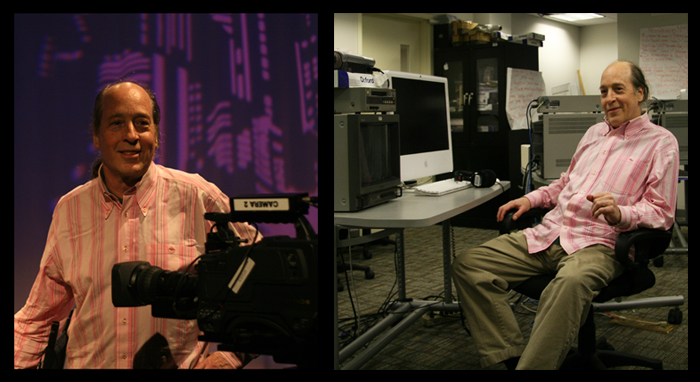
    In the interview I conducted with Ferris in the corridors of MNN, my nagging question was that of the relationship between Ferris Bueller and Ferris Butler. I was told by Ferris that he knew comedy legend Del Close, who not only found Ferris intriguing, but also once remarked to him that he would like to do a screenplay based on the character of Ferris Butler. Later, Del was not only in association with John Hughes, writer and director of the film, but appeared in the film as an actor. Paramount Pictures denies any such connection of course, saying the film was a creative work of fiction. Both Hughes and Close have passed away, so each of us will have to solve our own equation on this one. Personally, I believe Bueller = Butler.

    When I met Ferris in 1970, he was an NYU senior in the film school and a frequent visitor to our dorm room. In the event we were eating anything, we were ALWAYS greeted with, “What are you guys eating?” Regardless of our response, he would invariably reply, “mm mm, my favorite.” Because FREE was really his favorite food and mooching his favorite currency, to be expected from a man who was always broke.

    Sifting through the enormous amount of data Ferris supplied me with today reminded me of an occasion when he entered our dorm room and said he loved the Led Zeppelin song we were listening to – Dazed and Confused. So appropriate. After graduation from NYU, Ferris worked at Vita Herring in the consumer complaint department. Proud of his position of power, he told us how we could frame a letter to him at his new post and obtain free herring. What college student gets excited about free herring?

    Welcome to the world of Ferris Butler. A man who is not easily forgotten and is still remembered by Martin Scorsese, one of his teachers at NYU film school and where Billy Crystal was also a classmate.
    Ferris’ greatest solo creative endeavor was Waste Meat News, a half-hour satiric revue series, featured on local access cable TV from 1976-1980, which he wrote, directed, and produced. The inspiration came from his part-time office position at Channel 7’s Eyewitness News, where he came to the conclusion that “TV news is nothing but throwaway scraps, like sausages or hot dogs. Very little protein, like waste meat.” One of his signature pieces was the Leather Weather, later to be used by Saturday Night Live. Waste Meat News rose to the number one spot on cable at that time.

    Some of his material, like the Trough Restaurant, appears to have been appropriated by others, such as Saturday Night Live. After failed attempts, Ferris was hired in 1980 as a comedy writer by Saturday Night Live (where he rewrote his classic Leather Weather skit) in its historic sixth season. A major moment in the life of any comedy writer.

    But Ferris Butler, unlike the film character, has had more of a Life Off than a Day Off. Born in New York City in 1949, his life includes an extraordinary cast of characters, travels, residences, women, sexcapades, experiences, and jobs – taxi driver, office boy at ABC, work at the Metropolitan Opera, photographer, PR man for a chain of discos, press release writer/coordinator for Columbia Artists Management in 1986, comedy writer for SNL and the Playboy Channel, and his own TV cable series. He has lived in a number of cities – Las Vegas, New Mexico, London, San Francisco, and New York. In skimming over his accounts, I am honestly overwhelmed with his tales, like that of his meeting a woman named Roach (whom he introduced us to in college), who was living in the East Village with Jerry Garcia of the Grateful Dead, whom Ferris also met.

    In 1974, Ferris married Beverly Ross, a “voluptuous, intense brilliant artist, one of rock’s founding females.” Best known for her big hit song from the 1950s, “Lollipop,” Beverly has been a prolific songwriter and stage writer (they were later divorced and are now living together again in Manhattan).

    In 1987, Ferris received a family inheritance of $500,000. A life of indulgence and gambling quickly disposed of this booty, leaving Ferris in a position he knew best – penniless and on the brink of disaster. Ferris would file for personal bankruptcy more than once.

    Since December 2003, the Ferris Butler Program has been running on Manhattan Time Warner Cable Television, Channel 57 at 11:30 PM on Sundays. This program originally consisted of Ferris doing monologue comedy and satire on various news and cultural subjects, and several songs of a Sinatra style. It now has a cast that consists of Ferris, co-host, standup comedian Mike Fine, and a variety of other guest characters.

    In interviewing Ferris, I was astounded at the people he has met, known, or worked with. A veritable who’s who in entertainment, comedy, and public life – Bella Abzug, Philip Roth, Larry David, Jerry Stiller, Jackie Mason, David Frost, Milton Berle, James Earl Jones, Matthew Broderick (who played Ferris Bueller), John Lennon, Rosie O’Donnell, Howard Stern, Quentin Tarantino, Gloria Steinem, Truman Capote, Andy Warhol, Gov. Elliot Spitzer, the Pointer Sisters, Gloria Gaynor, and Jerry Garcia, to name a few.

    This story could just as easily fallen under the umbrella of my story series “Abandon All Preconceived Notions Ye Who Enter Here” or “Meetings with Remarkable Men” (see Part 1 here) – as long as multiple bankruptcy or near hits and misses do not preclude remarkableness. You are not going to find Ferris under any single umbrella, and he is not going to fit in any box very well. This story has only been a rough sketch, an outline. I’m waiting for the book and the movie, Ferris Butler’s Life Off. You saw the trailer here. I’ll meet you in line 🙂

    Related Abandon All Preconceived Notions stories: Gaby Lampkey, Jenn Kabacinski Part 2, Jenn Kabacinski Part 1, Driss Aqil


  • dinamic_sidebar 4 none

©2026 New York Daily Photo Entries (RSS) and Comments (RSS)  Raindrops Theme