• Category Archives Scenic NYC
  • The Ride from Hell

    Posted on by Brian Dubé

    Preparation

    I do believe that one of the reasons that civic improvements are not made in a timely manner is that legislators do not suffer the slings and arrows on a daily basis. The comfort of insulation will do a lot for apathy, and mornings outside in January without a coat will do a lot to propel someone to light a fire.

    Even for those who grew up poor or working class, once removed, the frustrations become distant memories for those in office. But if they, like their constituency, had to rely on mass transit for their daily commute and experienced delays, rerouting, and other abuses, they would likely be first at bat for change. To depend 100% on public transportation and suffer the anxiety, stresses, and horrors of the system on a long term basis will grind many down, even the seasoned, tolerant New Yorker with a cast-iron stomach. I have known many residents who have been driven to near wit’s end over a life time of transit travel. Some, as several of my employees, have sworn off subways entirely, opting for bicycle travel, even in winter.

    Saturday, April 21, was a beautiful sunny day, and I was to visit a friend in Staten Island. My car was in disrepair, so this would be the first time in my life where I would travel to a destination within Staten Island using public transportation. The X1 express bus was the logical choice, providing nearly door-to-door service for $5.50 one way. My friend warned me that this was the only sensible option.

    However, I decided that given the weather, I would take the ferry and the SI Railway.  I had never taken the SIR, and I was particularly excited to do so and document the trip. This means a three-legged trip: a subway to South Ferry, the ferry itself, and the Staten Island Rail to my final destination.

    Descent to Hell

    It started out innocently enough, with plenty of good cheer. It was, however, to become the ride from hell. Distracted with my cameras, iPad, and trip planning, my first mistake was getting on the subway on the uptown rather than downtown side. This was infuriating because at the Sheridan Square station, there is no underpass, so anyone making this mistake must leave the station, exit to the street, and reenter the other side, paying another fare – there is no provision for a free transfer under these circumstances. I was pissed as hell at my stupidity and even more so to give the NYC Transit Authority another $2.50 for no good reason.

    As I descended the downtown stairway, I had just missed a train. Adding insult to injury, I was angrier yet, and my first leg to South Ferry was already delayed waiting for the next train. The change to the ferry at South Ferry went smoothly, and the ride at sea afforded ample opportunity for scenic photos and video. The Staten Island Ferry comes highly recommended – it is FREE and affords vistas of the East River bridges, the Manhattan skyline, Ellis Island, Brooklyn, New Jersey, the Verrazano Bridge, and the Statue of Liberty.

    I had been warned by my friend that the travel option of choice was the X1 bus, not a three-legged workaround. I had told her that in this instance, I preferred the scenic route and, apart from my mishap taking the wrong train, it was looking like I would be heir to bragging rights for my decision to take the ferry. I was armed with photos and video to show her, which would just be further evidence that in NYC, there are different strokes for different folks. I had calmed down appreciably and was ready for my rail trip.

    Hell Hath No Trains

    When I arrived in Staten Island at the St. George terminal, I learned that due to construction, the SI Railway was not running from the ferry station. BIG disappointment. I was informed that there was a free shuttle bus to the first station on the line. This would make it a 4-legged trip. Additionally, no one could tell me where the shuttle bus was, including every driver of the local buses I could find. My patience had worn thin, and I decided to forgo the railway and take the local bus, the S79. Another big disappointment, and I was fed up.

    Hell Hath No Buses

    I was alone at the bus stop with one other passenger. It was desolate, and as I waited, time crawled by. I tried to ameliorate my anger, looking to my friend waiting at home for sympathy by making more and more frequent cellphone calls to her to complain. She was the perfect and willing shoulder to cry on, a classic New York cynic who hates all things New York City and has nothing good to say about public transportation. Of course, I got the obligatory “I told you sos,” but even she became incensed as the delay became nearly inexplicable. Over an hour had passed, and there was no S79 bus to be seen. The crowd of passengers had become large, but virtually no one appeared agitated at all.

    All’s Hell That Starts and Ends Hell

    The delay became extreme, and I paced like a wild animal. It was nearly ONE HOUR AND 30 MINUTES to wait for a local bus on a Saturday night! As I was to return that night and it was now after 9PM, I even considered getting back on the ferry and returning to Manhattan. My friend was not pleased with the prospect of an aborted visit, and neither was I. I continued to wait, and at last an S79 pulled up.

    There was still little show of anger even amongst those who had waited for nearly as long as I had. There was neither an apology nor an explanation from the driver nor confrontations from the passengers as they silently boarded the bus. On board, I tried to recruit a sympathizer or two for what seemed to be an unconscionable act. In my conversation with one resident, I learned that delays like this are not uncommon, and he seemed resigned to his plight. He, as well as his fellow passengers, looked calm and collected. For them, it was business as usual for the ride home. For me, and I wish for a public servant, it was truly The Ride From Hell 🙁

     

    Posted on by Brian Dubé

  • In a Fog

    I have done numerous stories featuring nature’s impact on the city. In some cases, more prominent, in some, less. But always that the city is juxtaposed against nature. How the manmade contrasts the natural, but rarely mother nature on her own. On July 20, 2010, I wrote Back to Our Main Feature with a lucky capture of a spectacular thunderstorm and lightning bolt. In it, I said:

    Please understand that I, like most New Yorkers, do love Mother Nature, but the gifts nature bestows and the power she wields often feel secondary in a city like New York.

    Last night there was a brief lightning storm dramatic enough to make many of us look up and say wow. But unlike our country brethren, who may spend a pleasant evening watching shooting stars, we rarely indulge these natural phenomenon for very long. Glancing up to the sky, seeing a spectacular display of lightning complemented by a waxing moon, we acknowledge when nature has spoken. Yes, like any great commercial, we hear you, but now, Back to Our Main Feature.

    Even on a foggy night, a spectacular fog is often more obstacle or at best backdrop to the city’s structures. Today’s photos were taken in Union Square during the ongoing Occupy Wall Street, now a daily social phenomenon. As I marveled at the beautiful effect of the various illuminated buildings filtered by the misty air, I surveyed the hundreds of park occupants and could see no eyes drawn to nature’s show. Surprising, because heavy fogs are rare and spectacular, the delight of many a filmmaker.

    However, this is New York City, and from time to time, without knowing it, the average New Yorker will find himself or herself In a Fog

    More nature: Come Back for Jupiter, The Tide Pool, This Is Not New Mexico, We’ve Got Skiing Too, White Birch Canoe, Trapped in Paradise, Conflicted, Mother Nature, Brooding, Risk Not Living


  • Broadway is Broadway

    I often take calls in the course of business from non-residents of the city, who, unfamiliar with the details of Manhattan, question me about my Broadway address. Is it THE Broadway? they ask. Yes, I reply, it is THE Broadway. However, Broadway, which spans the entire length of Manhattan, varies considerably depending on where you are. At one time, not long ago, Broadway in SoHo was only a quiet commercial/industrial thoroughfare. But it has changed.

    When I say change, I mean radical change. Change that almost defies imagination. Change so substantial that I question my own memory. I wrote of this in Cast Iron Stomach and Six Geese a-Laying. When I first moved to New York City in 1969, SoHo was not even an acronym yet. It was strictly an industrial district, essentially an industrial slum, a neighborhood I only passed through, perhaps on the way to Chinatown or Canal Street. At one time in the 20th century, the area was known as Hell’s Hundred Acres for the frequent fires that arose in the loft warehouses.

    More recently, even after gentrification, alleys such as Crosby Street remained undesirable, yet pushed to ferret out every remaining square inch of what remained, Crosby Street became every bit as desirable as the rest of SoHo. There are no bargains left, or undiscovered backwaters in Lower Manhattan.

    In Bleecker Tower, I wrote:

    The area was dominated by industrial businesses – leather distributors like Marap Leather who occupied an entire building at 678 Broadway or Commercial Plastics at 630 Broadway. In 1980, Unique Clothing Warehouse opened at 718 Broadway at Waverly Place (president Richard Wolland closed it and filed bankruptcy in 1991 with over $2 million in debt), beginning a wave of transition. In 1983, Tower Records opened at 4th Street and Broadway (recently closed). A few months later, the elegant Blue Willow restaurant opened at 644 Broadway in the building shown in the photo.

    There were early pioneers in SoHo, both individuals and businesses – places like the Park Place Gallery. Alison Knowles had rented space as far back as the late 1950s on Broadway north of Canal Street. From Illegal Living: 80 Wooster and the Evolution of SoHo:

    Illegal Living is the story of the building at 80 Wooster Street in New York and the people who lived and worked there. The first of 16 artists coops started by George Maciunas, founder of the Fluxus art movement, Fluxhouse Coop II spurred the development of SoHo and the spread of worldwide loft conversions. … The artists of SoHo, while focused on their art, also built community, participating in the creation of a new form of residential development. The building was a magnet for the avant-garde who were drawn to Jonas Mekas Cinematheque, a ground-floor space that hosted happenings, film screenings, dance and theater performances, concerts, and art shows. Hundreds of artists including Trisha Brown, Richard Foreman, Allen Ginsberg, Philip Glass, John Lennon, Hermann Nitsch, Yoko Ono, Nam June Paik, and Andy Warhol showed their work in and around the building.

    There were a handful of well-known early retailers, such as Dean and DeLuca. One of the earliest that I personally recall visiting was Broadway Panhandler at 520 Broadway, eventually to move due to soaring rents. Little did I know I would come to occupy the 3rd floor of that very same building in 1990, where my business remains to this day.
    When I moved into the building, it was occupied entirely by sweat shops manufacturing clothing. I was the first “upscale” tenant. The landlord was very favorable towards me, seeing it as the first step in a new type of tenancy. Today, the building is occupied by media companies and businesses such as Built NY, Inc., a design firm that manufactures a neoprene bag and case line. The company holds over 180 patents, and its products are sold worldwide.

    In its industrial days, SoHo was deserted at night – a ghost town. There were no retailers – manufacturers and commercial/industrial suppliers occupied even the ground floors which today command a huge premium and would make such use unthinkable. Now, the area is saturated with retailers, both of the common garden variety such as the Gap and also very high-profile merchants, including names such as Louis Vuitton, Bloomingdale’s, Prada, Coach, Apple, and Topshop. Foot traffic is outrageous on a day-to-day basis. Typically the sidewalks are so crowded that I resort to walking in the street, even then to be frustrated by people, vehicles, food carts, and other obstacles. Once, in complete frustration, I took to walking in the center lane against traffic, which I wrote about in Dead Man Walking.

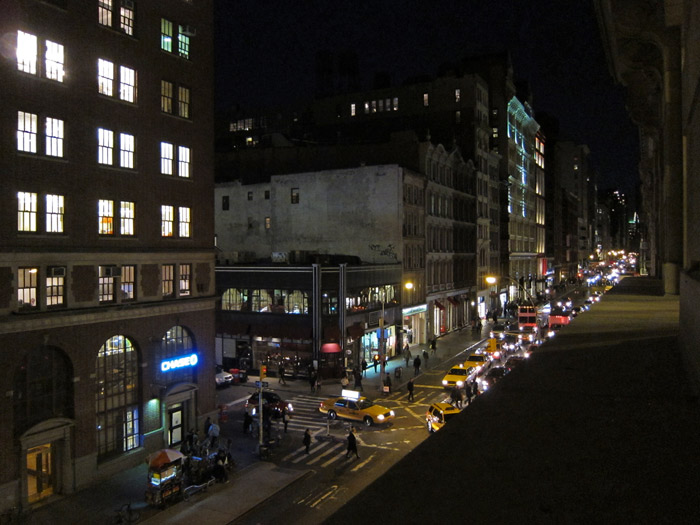
    Today’s photos are taken from my office window looking up Broadway in the evening. In the past, lights on Broadway meant the theater district and Times Square. Now, we have lights here in SoHo too. It seems that everywhere you go, Broadway is Broadway…


  • A Narrow Path

    Many years ago, I became entangled in an argument regarding aspects of Christianity with a cousin and his wife in my family’s home in Connecticut. It was Christmas time, and I felt particularly bad to have gotten into a heated debate with family about their faith. I learned that they were born-again Christians. At one point, I expressed my dismay and told them that I was very sorry. However, they said that they were not upset at all but that, to the contrary, they valued the opportunity to defend their faith and that debates of this nature only made them more resolute in their beliefs.

    I only recall one small part of that evening’s conversation – a point where, after a litany of their dos and don’ts, I said to them that following their road appeared to me to be an absurdly narrow path, virtually unwalkable. They were pleased by this comment and concurred, telling me that Christ said exactly that in Matthew 7:13-14 :

    Enter through the narrow gate. For wide is the gate and broad is the road that leads to destruction, and many enter through it. But small is the gate and narrow the road that leads to life, and only a few find it.

    This passage was unbeknownst to me at the time and certainly gave me cause for reflection. After millennia of debate, argument, and discussion, well-schooled Christians, like others who are serious about their faith, are well-armed with answers to the myriad of objections and issues with biblical matters. Religious doctrine is not so easily dismissed as dogma of the unthinking masses.

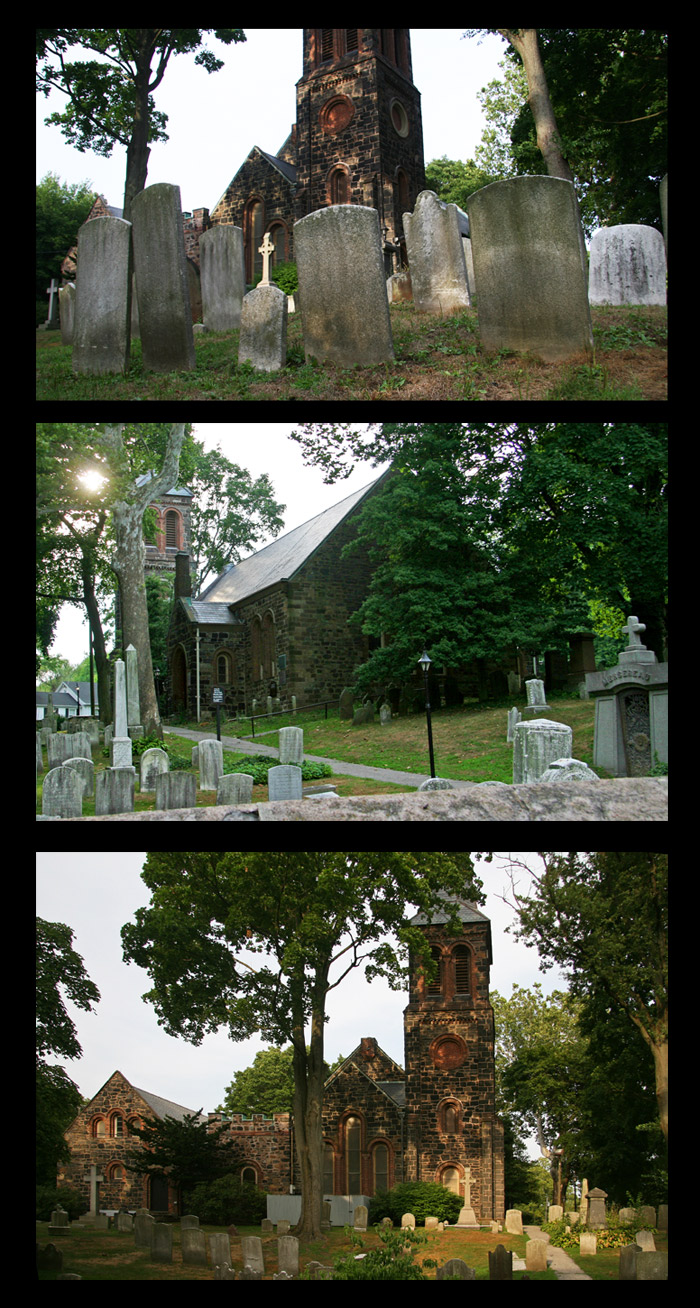
    In 2010, I made a trip through historic Richmond Town in Staten Island. The area is replete with beautiful antique structures in bucolic settings. I featured a number of postings on Staten Island and decided to leave the images of The Church of St. Andrew for a later time. Today I discovered the images in my archives of this 300-year-old church in the Richmond Town section of Staten Island.

    The Church of Saint Andrew was founded in 1708 and chartered by Queen Anne in 1713. The Church  served as a hospital and headquarters for the British soldiers as the New Colonies fought for their freedom. The Rev. Richard Charlton served as the Rector of Saint Andrew’s during this time. He was the maternal grandfather of Elizabeth Ann Bayley Seton, who was the first canonized American Saint of the Roman Catholic Church. Along with her grandparents; her father, brother and sister are buried in our historic cemetery. The Rev. Samuel Seabury was called to be the first Bishop of the Episcopal Church while he was serving as Rector of the Church of Saint Andrew from 1777 until 1780.

    I toured the church property. Everything conspired to persuade me that my cousins were right; as I navigated the sidewalks and walked between the headstones of the departed, indeed it did appear that good things lay along a narrow path 🙂

    Related Posts: Not Under the Gowanus (Part 1, Part 2, and Sorry About That), Green-Wood, Everything Yes, Veneer of Their Lives, Cold Stone, Little Church Around the Corner, St. Mark’s Church-in-the-Bowery


  • Intelligent Design

    Creationists often use one of the three classic arguments for the existence of God: that of Intelligent Design, going back centuries. In the 13th century, Thomas Aquinas argued that natural things act to achieve the best result, and as they cannot do this without intelligence, an intelligent being must exist. William Paley in 1802 used the watchmaker analogy to argue that complexity and adaptation in nature demonstrated God’s benevolent and perfect design for the good of humans.

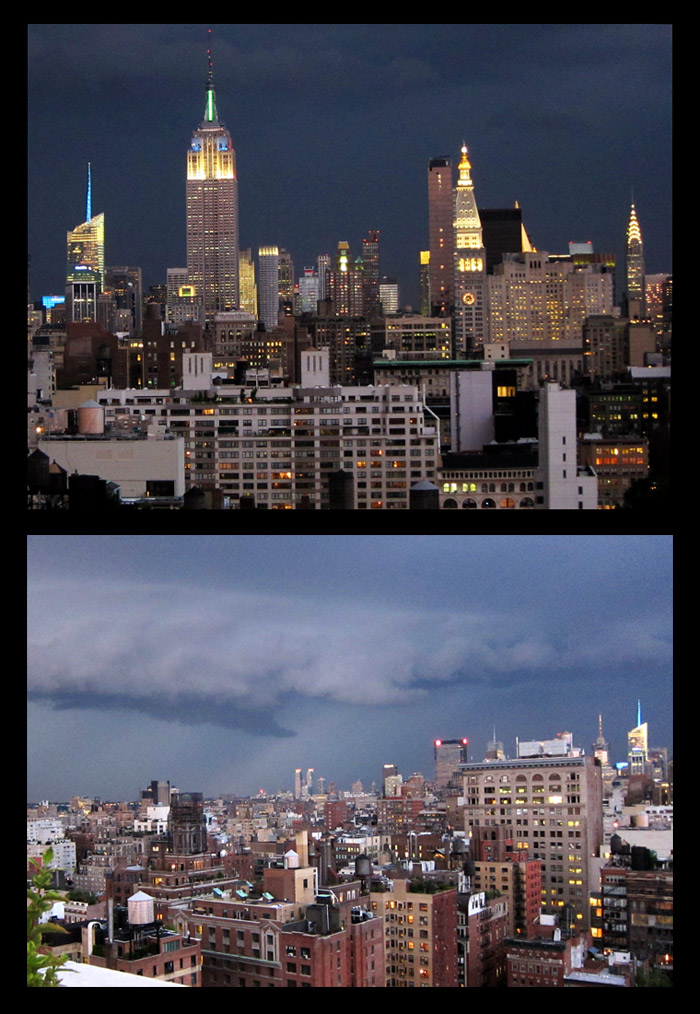
    When I look out onto a vista like the one in today’s photos, I am reminded of the watchmaker analogy. New Yorkers may not be godlike, but certainly such things that lie before me must be evidence of an application of industriousness and ambitiousness, not to mention our own brand of intelligent design. And seriousness. Many say that it is important to have a sense of humor and the ability to laugh at oneself, even disparaging seriousness as a veil. We have quotes such as:

    Seriousness is the only refuge of the shallow. Oscar Wilde

    Seriousness is stupidity sent to college. P. J. O’Rourke

    There is truth to the concept that levity, humor, and not taking oneself too seriously at times is important. However, as a New Yorker, I prefer:

    It is not so important to be serious as it is to be serious about the important things. The monkey wears an expression of seriousness which would do credit to any college student, but the monkey is serious because he itches. Robert M. Hutchins

    In France, although a sense of humor exists, it is very important that a person is considered sérieux in the right way about the right things. The exact meaning includes an element of sincerity. New York City is not an easy place. People come and go, passing through the revolving door in the house of shattered dreams. In reality, it is brutal here, and a life of levity is not going to get you through that door.

    When someone champions a sense of humor above all else and makes a point that someone is too serious, I question what might be achieved with such a lassez-faire attitude. Good or great things cannot be left to happenstance. Look at that New York City skyscape and all the great things this city offers, not just its architecture but also the culture and people those structures house. To survive and flourish like this city has, at least in this case, someone was sérieux and there had to be some Intelligent Design 🙂

    Related Posts: ‘Tis a Sight to Behold, I Know, New York Rockies, Where Sleeping Giants Lie, No Sir, All of These Pleasures, World Domination, Contrast, Etched in Stone, Towers


  • Dyker Heights, 2011

    As this website has evolved, I have added more video. I have created a YouTube channel for New York Daily Photo where all the videos can be seen in one place. Looking into the future, I intend to create more videos and short documentary films of New York City.

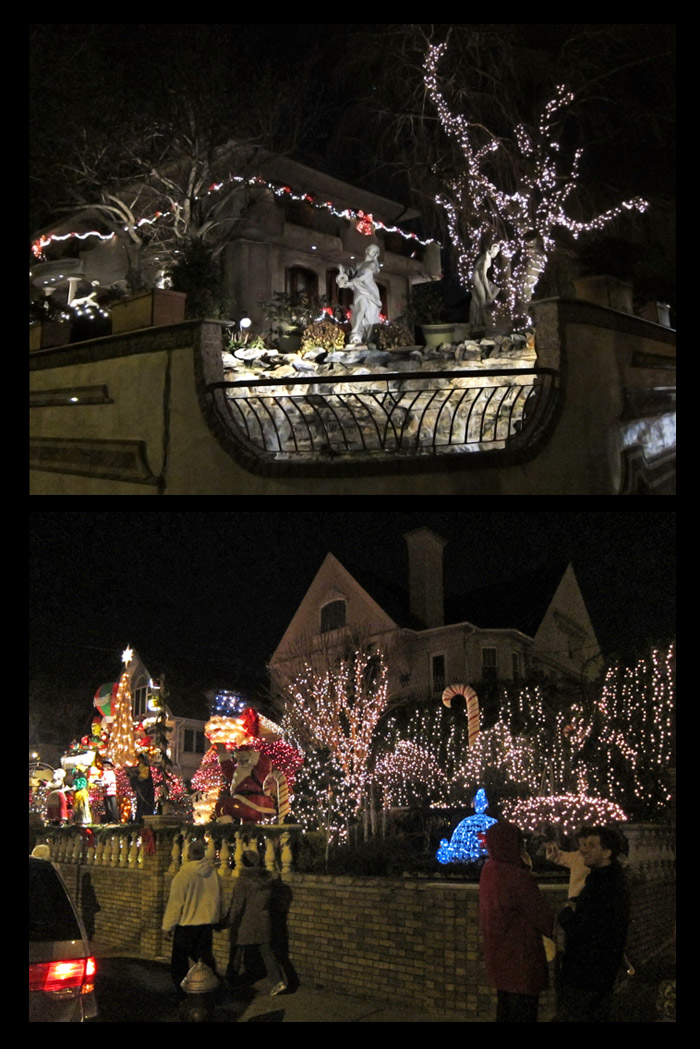
    Recently, I took another excursion to Dyker Heights, Brooklyn, with a friend. Although the displays are relatively the same from year to year, I enjoy the ritual, as I do the Christmas window displays on Fifth Avenue.
    This year, I shot and compiled a short video of my tour of 84th Street between 11th and 12th Avenues – see below. This block is literally the show stopper, with bumper-to-bumper car traffic during the holiday season. Recommended to all who have not toured the area. Enjoy Dyker Heights 2011 !

    Related Post: Simple, But Effective


  • The Magic Hour

    I grew up in New England, and even for residents, fall foliage was loved by all. The beauty in sparsely populated states, such as Vermont with large stands of deciduous trees, is such that many travel to and tour the area during “leaf peeping” season. When the conditions were right, my family would sometimes take a country drive. If the leaves and light were right, we were sometimes treated to jaw-dropping scenery.

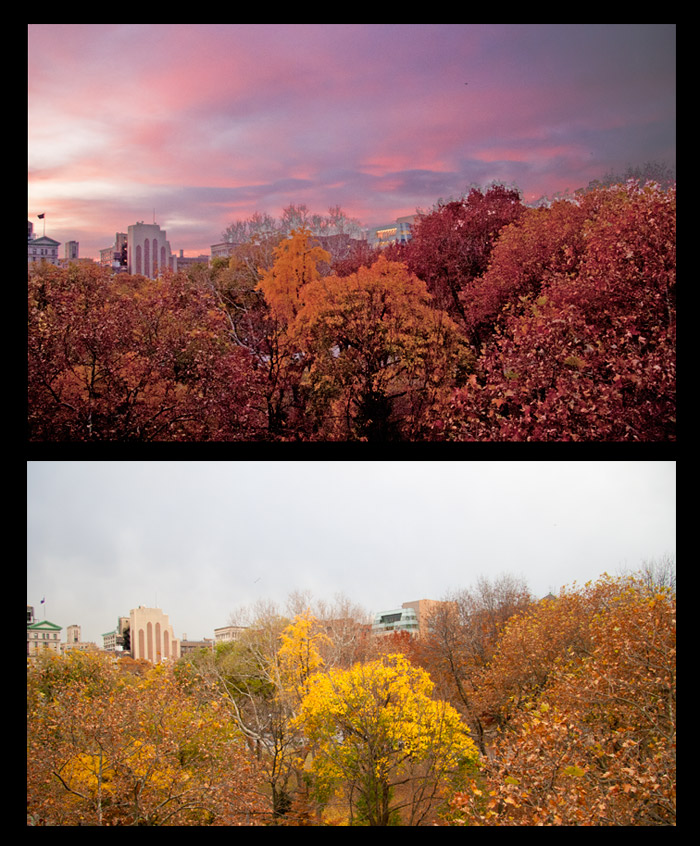
    A popular cliche amongst photographers is that “it’s all about the light.” It is overused, but it is quite true. If you are around artists or photographers enough, you may also hear the phrases “magic hour” or “golden hour” – the period before sunrise and after sunset when the light is reddish. This light during autumn can lead to exceptionally beautiful vistas.

    Prior to the inception of this website and my photographic interest here, I paid little attention to the properties of ambient light – intensity, color, and changing quality over the time of day or cloud cover.
    Many of one’s intuitions about photography are wrong. A bright, sunny day is the worst time for shooting, particularly midday. Cloudy days give much better color. And the most coveted times for most landscape photographers is during the magic hour.

    Some, like photographer Ken Rockwell, will make claims of a rather extreme nature regarding the magic hour: “Glorious light only happens for 60 seconds or less any particular day, if it happens at all. If it happens at all, it usually happens sometime in a window 15 minutes before or after sunrise or sunset.” One must, of course, allow that not every photographer wants this particular golden light for every photo.

    Capturing this morning light requires being up at a very early hour, which I typically am. Two mornings ago, I was up before dawn and witnessed the extraordinary light of the magic hour illuminating the vestiges of autumn foliage. Everything was aglow in oranges and pinks, begging for a photo. Today, two hours later in the morning, you can see the dramatic difference (lower photo).
    Many New York City residents will never see this phenomenon, particularly in the morning – they are not at the right place at the right time to happen upon a natural setting during the magic hour…

    Related Posts: In a Different Light, Wood, Glass, Brass and Trees, Light and Lights, Mother Nature, Risk Not Living, Manhattanhenge


  • Last Resort

    Growing up at the time and place that I did, there was not much to do as a teenager and very little that was approved by adults. No Starbucks for us. One of the few activities that was considered “good, clean fun” was bowling. Of course, to bring a girlfriend meant no privacy, which is what made it good and clean, but not much fun.

    Alternatively, a lover’s lane or parking with a girl meant having a driver’s license and vehicle, which was not a small achievement. Avoiding police interrogation was another concern in this endeavor. So it was bowling, and as often as I may have gone (I owned my own bowling shoes), bowling always felt like a LAST RESORT. I grew to hate bowling.

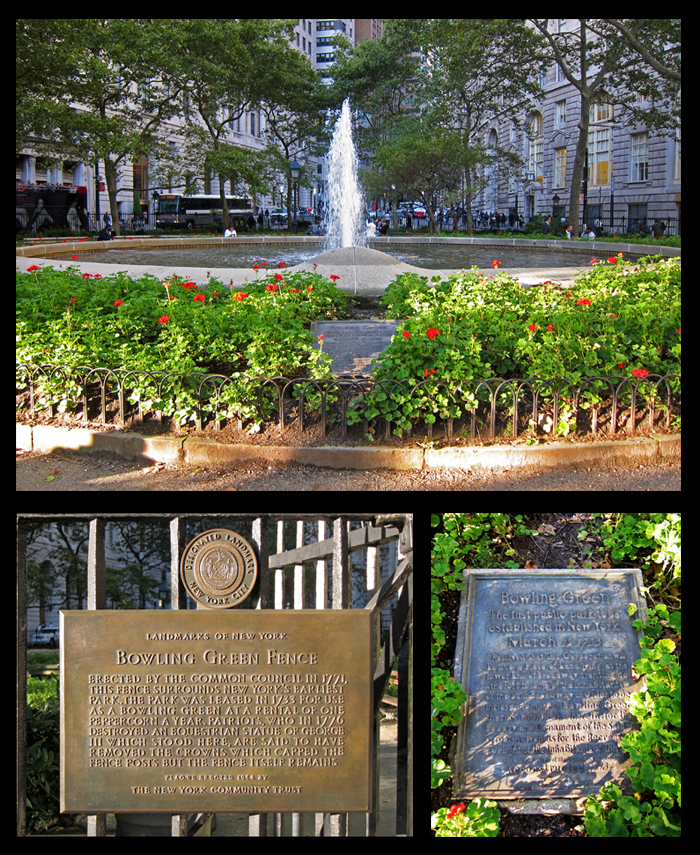
    But everything gets reinvented, marketed, and repackaged. Virtually nothing is uncool – the uncool becomes cool as people exhaust existing cool. Bowling became very cool in the 1980s, but it goes back much further, with various spikes in interest, even to the earliest days of New York City’s founding, when lawn bowling was done in lower Manhattan.
    From the New York City Department of Parks website:

    Bowling Green is New York City’s oldest park. According to tradition, this spot served as the council ground for Native American tribes and was the site of the legendary sale of Manhattan to Peter Minuit in 1626. The Dutch called the area “the Plain” and used it for several purposes. It was the beginning of Heere Staat (High Street, now Broadway)—a trade route which extended north through Manhattan and the Bronx. It was also the site of a parade ground, meeting place, and cattle market. In 1686 the site became public property and was first designated as a park in 1733, when it was offered for rent at the cost of one peppercorn per year. Lessees John Chambers, Peter Bayard, and Peter Jay were responsible for improving the site with grass, trees, and a wood fence “for the Beauty & Ornament of the Said Street as well as for the Recreation & delight of the Inhabitants of this City.” A gilded lead statue of King George III was erected here in 1770, and the iron fence (now a New York City landmark) was installed in 1771. On July 9, 1776, after the first public reading in New York State of the Declaration of Independence, this monument was toppled by angry citizens, dragged up Broadway, sent to Connecticut, melted down, and recast as ammunition.

    By the late 18th century, Bowling Green marked the center of New York’s most fashionable residential area, surrounded by rows of Federal-style townhouses. In the first decade of the 20th century, Bowling Green was disrupted by the construction of the IRT subway. The park was rebuilt as part of citywide improvements made in preparation for visitors to the 1939 World’s Fair. Renovations to Bowling Green included removing the fountain basin, relocating the interior walkways, installing new benches, and providing new plantings.
    A 1976-77 capital renovation restored Bowling Green to its 18th-century appearance. Publisher and philanthropist George Delacorte donated the park’s central fountain.

    Since December 1989 the statue of Charging Bull (1987-89) has been on display at the north end of the park. Its sculptor, Arturo DiModica, says the three-and-a-half-ton bronze figure represents “the strength, power and hope of the American people for the future.” It has also been linked to the prosperity enjoyed by Wall Street in the past decade.

    The park and surrounding area is beautiful and certainly deserves a visit. Although located far from midtown at the southernmost tip of Manhattan, and once a place for bowling, it is far from a Last Resort 🙂

    Related Posts: Trapped in Paradise, New York Stock Exchange, Federal Hall, West Side Community Garden, Esplanade


  • Sorry About That

    On September 21, 2011, I wrote Not Under the Gowanus, about a church which had nagged me as an enigma for years. Or so I thought. Our Lady Of Czestochowa / St Casimir, located at 183 25th Street in Brooklyn, can be seen from the Gowanus Expressway.
    However, on a recent excursion through Brooklyn, I realized that a much more imposing structure closer to a highway is what I had seen so many times on this stretch of highway and that this was the image that was stored in the recesses of my mind: the Sacred Hearts of Jesus and Mary – St. Stephen Church, located at Summit Street and Hicks Street, fronting the Brooklyn-Queens Expressway before the Gowanus Expressway.

    The parish was established in 1882, the first Italian parish established in Brooklyn. I have yet to tour this church, having been “distracted” by Our Lady Of Czestochowa. Only in New York – larger than life, historic, architecturally significant. A place that, elsewhere, would be an unforgettable icon. But here, in New York City, where the extraordinary can become ordinary, I confused one beautiful church with another. Sorry about that 🙂


  • Come Back For Jupiter

    If you spend enough time on the streets of New York City and mingle, you are going to experience a depth and breadth of humanity that boggles the mind. Not only will you find an absolutely astonishing number of people with incredible talent, but likely, you will on occasion find the serendipitous meetings to be even more amazing.

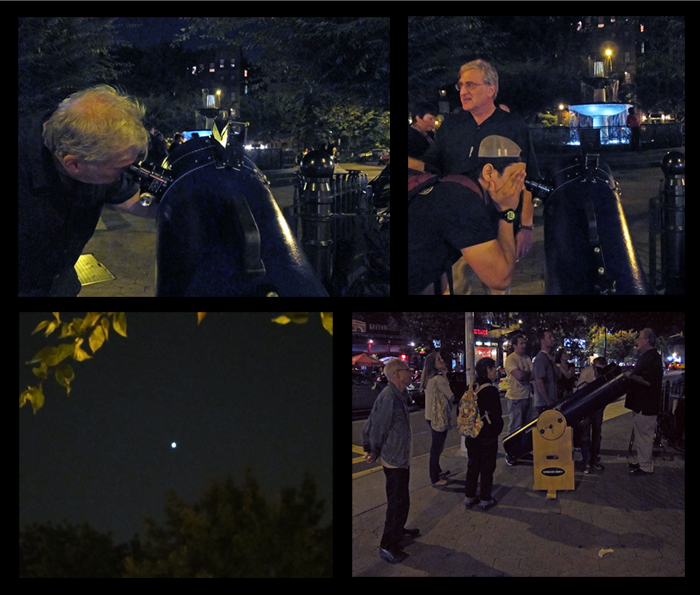
    On Saturday night, I ate dinner at my favorite local Italian restaurant, Trattoria Spaghetto (as mentioned in my story, Donato), conveniently located on Father Demo Square. It was an exquisite evening. Strolling out and through the small park, I saw a man with an enormous telescope, welcoming all to observe and partake in the wonders of the universe for free. There were no shortage of lookers.

    Our master of ceremonies on Saturday night was Jeffrey Jacobs, who acquainted me with the organization, The Sidewalk Astronomers. Examples of “sidewalk astronomy” date back over 100 years. One of the popularizers of the sidewalk movement is John Dobson, who pioneered the design for the large, portable, low-cost Newtonian reflecting telescope known as the Dobsonian telescope.

    The telescope was set up to observe the moon. However, I was informed that in approximately an hour and a half, Jupiter would be visible above the roofline of the neighboring buildings. Jeffrey encouraged me to “come back for Jupiter.” I intended to wander, stroll, and return, but instead found myself drawn into the social scene that grew around the telescope set up for observing the moon. The time passed quickly.

    However, this is New York City, and the evening would not be complete without upping the ante in some more remarkable chance occurrence. A man who, coincidentally, had also eaten at Trattoria Spaghetto introduced himself. Employed at Columbia University, both he and Jeffrey bonded over their mutual acquaintance and reverence for John Dobson.

    Soon, Jupiter made its presence, and I was excited to observe it in a telescope for the first time. My turn in line came. I was able to see Jupiter’s bands and its four moons. Jeffrey was ever the patient educator, helping each onlooker to identify the features and moons.

    It was an exciting evening, with lovely surprises, chance meetings, and a fortuitous planetary alignment – just another miraculous night in what could easily be another episode in the series Only In New York or Sidewalk University, but for me, more appropriately called Come Back For Jupiter 🙂

    Related Posts: This Is Not New Mexico, Back to Our Main Feature, Full Moon, Gothic Night


  • Not Under the Gowanus, Part 2

    (see Part 1 here)

    I have driven the roadways around this metropolis for decades and, like anyone else who drives highways repeatedly, there are a myriad of familiar structures, most of which one has never actually visited. Over the years, a number of buildings have intrigued me, such as the enigmatic property with illuminated triangular trusses as seen from the Manhattan Bridge. This rooftop haunted me for decades until if finally occurred to me: why not get off the roadway one day, investigate and see what this landmark actually is about? You can find the mystery solved here.

    The landscape as seen from the Gowanus Expressway (see Part 1 here) is generally of little interest, much of it commercial/industrial. However, as it runs through Greenwood Heights, Brooklyn, a beautiful green trimmed church spire makes its presence known. As I go fleeting by, a recurring thought to visit someday fleets by as well. I finally decided to bring these fleeting thoughts to an end after a recent excursion to nearby Green-Wood Cemetery, when I paid the church a visit.

    Regardless of how significant a structure turns out to be, this type of exploration provides me with the necessary closure of a long-seated curiosity. As a side benefit, the experience also provides a resource which can be used when traveling with others to identify the landmark – wielding knowledge that you are not only familiar with the structure but also have visited said structure confers credibility that you know New York City. (Tip: Recount the most extraordinary details that you can remember in a nonplussed manner to be seen as a smug New Yorker. This insures that in the future, your authority will not be questioned.)

    The church in question is Our Lady Of Czestochowa / St Casimir located at 183 25th Street in Brooklyn. The property spans the width of a city block, from 25th to 24th Street. I circumnavigated the block and was impressed by the gothic structure – so distinctive, contrasting against nondescript surroundings. In a previous post, I told of how one can see the spire of Czestochowa from the automobile graveyard and that good things are often found just around the corner, but Not Under the Gowanus 🙂

    About the Church: The parish of Our Lady of Czestochowa Church was established in 1896 to serve Polish Catholics. A frame church was built on 24th Street but was destroyed by fire in 1904. On July 17 of the same year, construction began for the present church, designed in Gothic style and built with Belleville gray stone and brick. The steeple rises 175 feet, flanked by shorter towers on each corner. In 1980, the parish of St. Casimir’s was merged into Our Lady of Czestochowa.

    Related Posts: Down to the Cellular Level, Pyramid Power, Eldridge Street, Gothic Night, Little Church Around the Corner


  • Moonrise Over Hernandez


    It took a trip to Italy to learn that the desire for respite from city life and the countryside was not unique to our time or to New York City. Romans built villas millennia ago. These lavish homes were built by the wealthy elite and were used to escape the city and summer heat. In Florence, the Medicis built villas – country homes that served as alternate living spaces to their urban palazzo. Not so much is new under the sun, particularly in the realm of basic human desires, and I suppose it was rather foolish and ethnocentric of me as a New Yorker to expect that escape from the stresses of urban life and the desire for a more spacious country home with grounds, etc., would be limited to recent times.

    At one time, Manhattan was seen as a place to work and make money, not necessarily as a place to live. Many wealthy chose to live in the boroughs, particularly Brooklyn, seeing Manhattan as a place of business, but not necessarily the place where one would choose to live. One of those places was Bay Ridge, Brooklyn.

    At one time, Bay Ridge was just another Brooklyn neighborhood to me. I had not explored it enough to understand its identity. This is a typical problem for any outsider to a place. Cursory examination and reading will only give a surface knowledge. It will take many visits and substantial time to really understand the heart and soul of any place. Meeting residents is necessary to get a full picture.

    This process started for me with visits to First Oasis restaurant, having known the owner for 30 years, starting when his restaurant was located in Manhattan. Over the recent years, I became more acquainted with the various features of the neighborhood: its architecture, parks, vistas, ethnic enclaves, and restaurants.
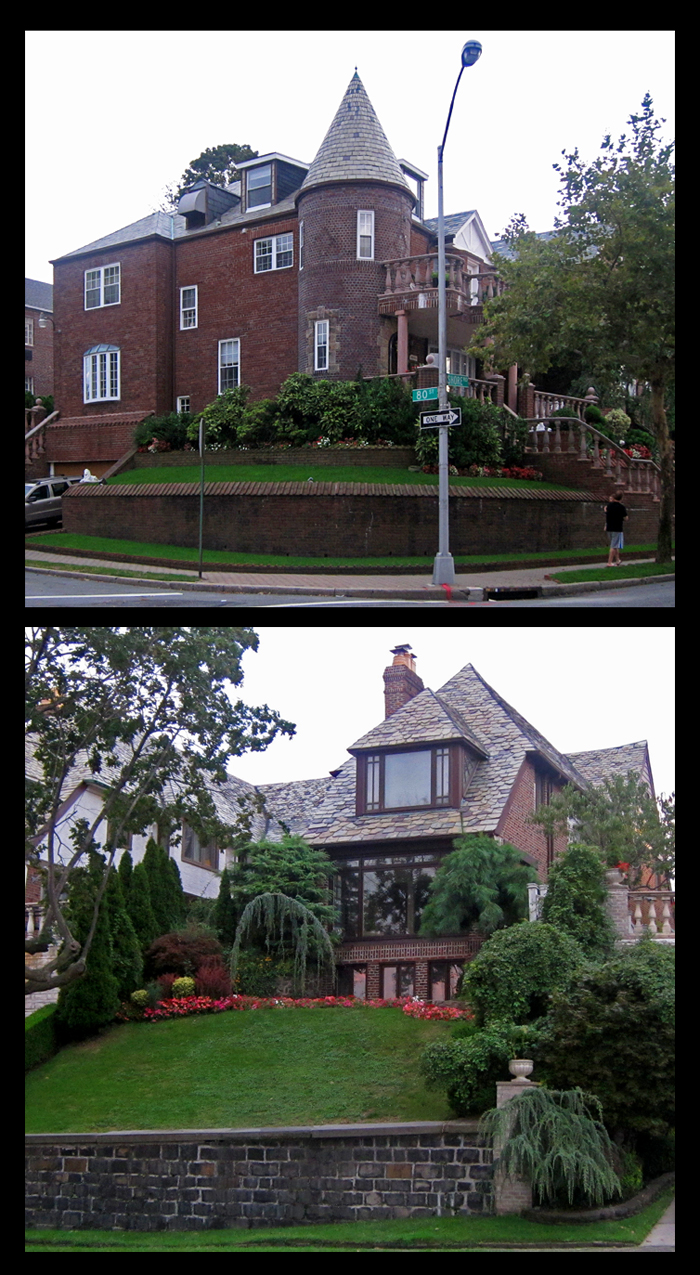
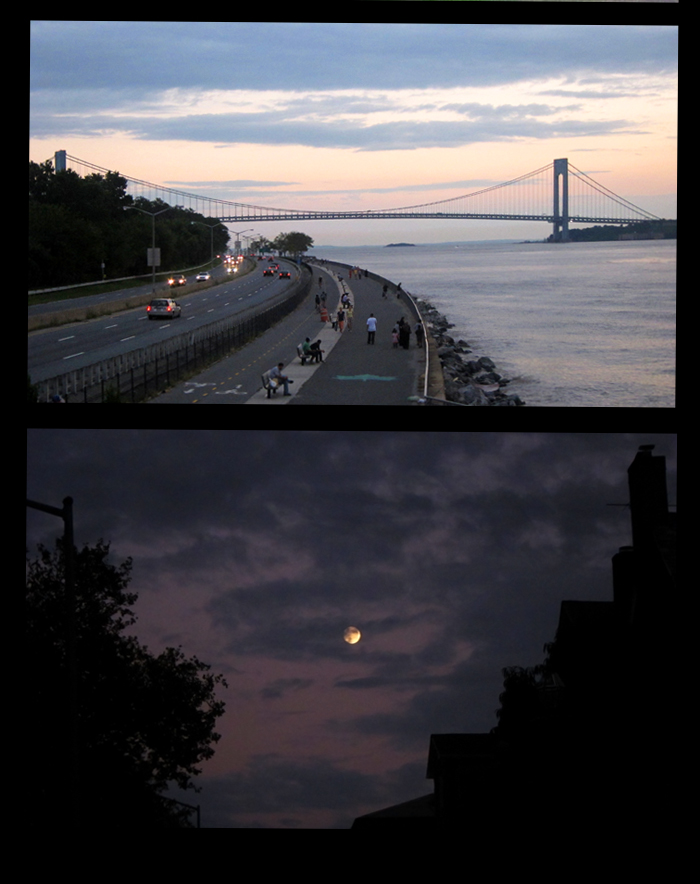
    Western Bay Ridge fronts the Narrows, the strait that separates Brooklyn from Staten Island, spanned by the Verrazano-Narrows Bridge. This is where Shore Road lies, originally fronting and following the shoreline. In the mid-1800s, the neighborhood functioned as a country resort for the wealthy who built huge mansions near the water. After 1940s, the Belt Parkway and accompanying landfill separated Shore Road from the actual shore.

    On this particular visit, I was accompanied by a friend who grew up in Bay Ridge.  She told me stories of her childhood and of her vivid memories. We strolled along Shore Road, where the photos were taken. This gave me a real human connection to the neighborhood for the first time. As we left at sunset, a moon shone brightly over one of the streets. I’m sure for her, it was no less than Moonrise Over Hernandez 🙂

    Related Posts: Fire Island, The Total Call


  • Green-Wood


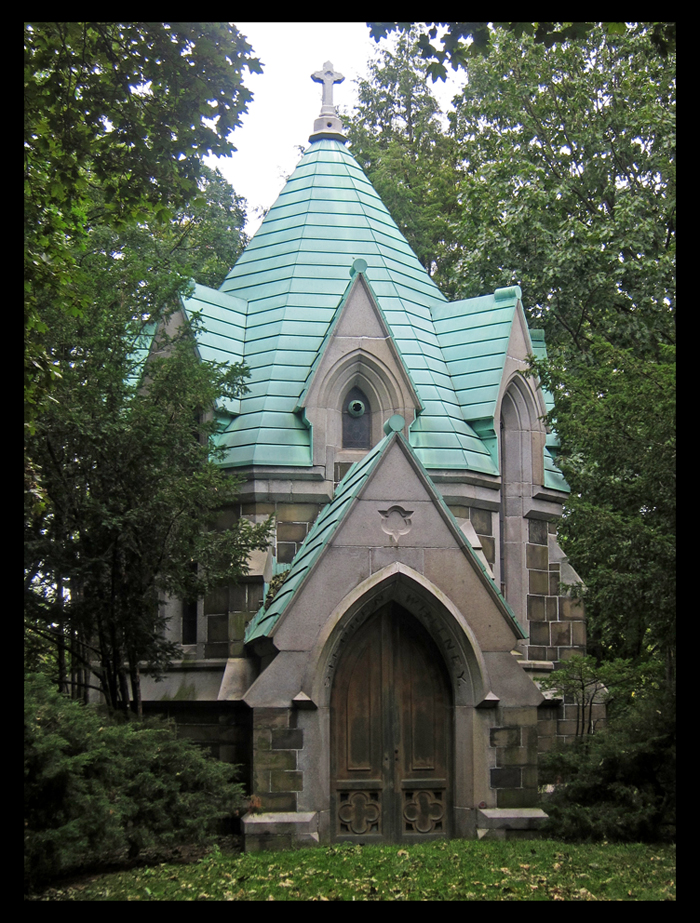
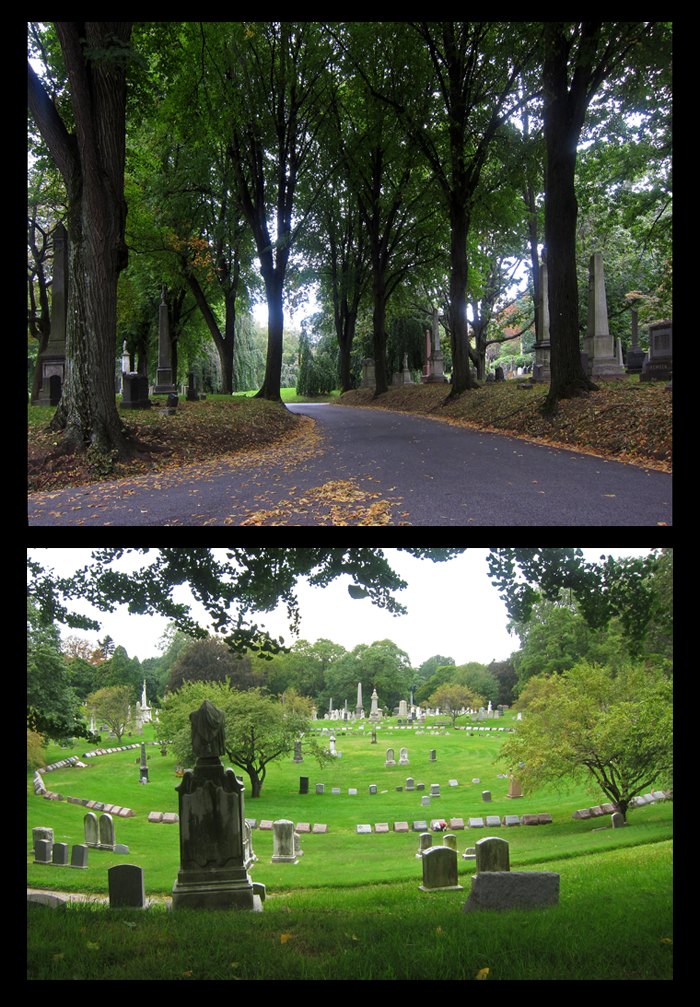
    When you have mausoleums the size of trophy homes, you know you are not in an average cemetery. This National Historic Landmark is enormous – 600,000 graves spread out over 478 acres. It is the final resting place of many of New York City’s illuminati: Leonard Bernstein, Boss Tweed, Charles Ebbets, Jean-Michel Basquiat, Louis Comfort Tiffany, Horace Greeley, et. al.

    Here in New York City, you will have to work to find places not inundated with people. Yet on my recent visit to Green-Wood cemetery, I traversed the place without encountering one other vehicle, only encountering one couple exploring on foot. See my photo gallery of images here.

    The place is extraordinary, and is a must see. Paul Goldberger of The New York Times wrote that it was said to be “the ambition of the New Yorker to live upon the Fifth Avenue, to take his airings in the Park, and to sleep with his fathers in Green-Wood.” I suggest perusing the official Green-Wood site for everything about the place – visiting, location, tours, events, maps, history, burial search, and famous residents. For a restful, beautiful, contemplative experience, visit Green-Wood…

    Related Posts: Veneer of their Lives, Cold Stone, Hidden Cemetery


  • Fatu Hiva

    I have always had a fascination with and love of islands. At one time, I pursued that interest much more actively. My fascination was fulfilled with many trips to the West Indies, Fire Island, Martha’s Vineyard, Nantucket, and Monhegan Island (Maine), as well as with readings on islands around the world.

    My favorite armchair travel book is Fatu Hiva. The author, Thor Heyerdahl, was a Norwegian adventurer and ethnographer. In Fatu Hiva, Heyerdahl chronicles his hunt for paradise in the Marquesa Islands in the South Pacific. With his wife Liv in 1937, they embarked on one of the earliest back-to-nature experiments. However, tropical diseases and difficulties with natives led to a short stay of only one and a half years and an embittered view of the entire effort.

    Now, my island intrigue and explorations are closer to home: Manhattan and the many relatively unknown small islands in the waters surrounding New York City. On September 15, 2010, I wrote of U Thant Island, a small outcropping in the East River.

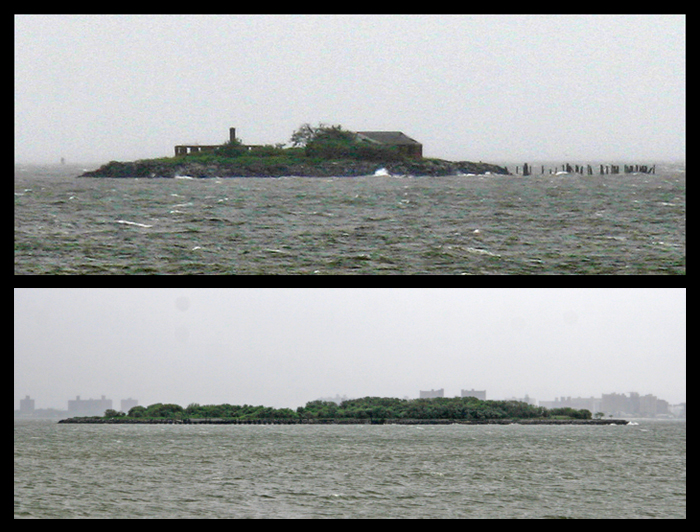
    Recently, on an excursion to Ocean Breeze Fishing Pier on South Beach in Staten Island, I spotted two islands which were unfamiliar to me. Two local fishermen told me they were Hoffman and Swinburne Islands. The names were not familiar to me either, so they were ripe fodder for photos and investigation.

    In the early 1800s, Staten Island had been the dumping ground for people with deadly contagious diseases – cholera, yellow fever, typhus, and smallpox. The New York Quarantine Hospital, built in 1801, was burned to the ground in 1858 by angry mobs. Two islands were constructed in the Orchard Shoals of New York Harbor. The man-made islands, Hoffman and Swinburne, were used as quarantines until 1929.

    At the start of World War II, the United States government used both islands for various military purposes – the Quonset huts built during this period still stand on Swinburne Island. Various proposals have been made over the years for use of the exiled islands. The islands are currently managed by the National Park Service as part of the Staten Island Unit of the Gateway National Recreation Area. Both islands are still off-limits to the general public to protect the islands’ avian habitat. Perhaps they would be a nice place to settle for awhile.

    Although they are not idyllic or tropical, as Heyerdahl learned quite painfully, paradise is where your heart is, not in Fatu Hiva 🙂

    Related Posts: Secede, Manhattan Island, ReWarded, City Island, Ellis Island, Governor’s Island, The Shore, Statue of Liberty


  • Have a Beautiful Day

    Please Click and Play Audio Clip to Accompany Your Reading:

    Today I’d like to share with you what it’s really like here. Not some sanitized, candy-coated, pretty, inspiring view of this city with false promises.

    What’s it like to live in New York City? As Professor Gurland would agree, you’re gonna get bruised. It’s an abusive relationship, but in this case, there’s no one to call for professional help.

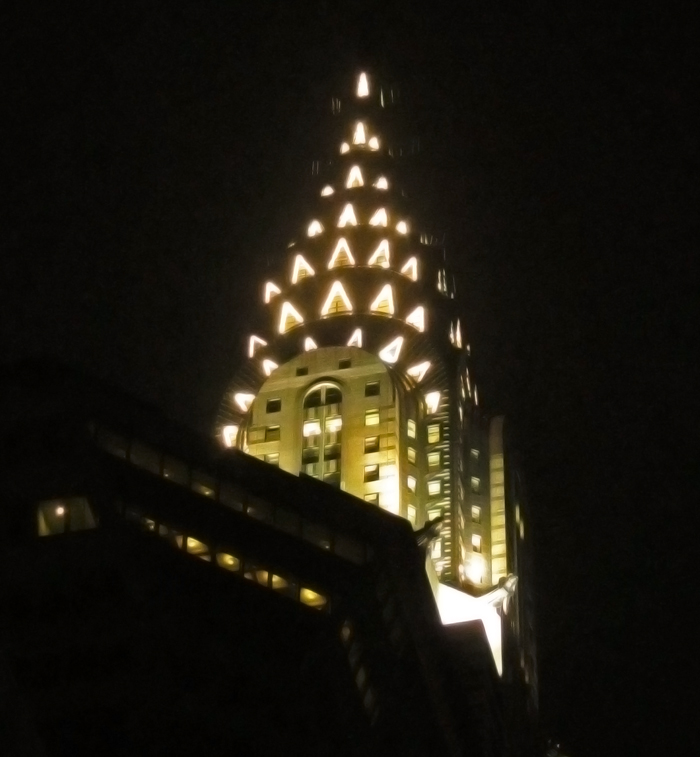
    You’re going to have to look at scenes like that in today’s photo. Why do I say “have to”? Because on some days, you’re going to feel inspired by things like the Chrysler Building, a glorious living testament in steel and stone of what man can achieve. But at other times, you’re going to be asked, do you measure up? Do you have what it takes to live here?

    Giants are everywhere you turn. There’s nowhere to hide. They tower above. You’re silently being judged. Can you make it? Don’t be deluded by Lady Liberty in New York Harbor. Yes, she’s welcoming of all, but she’s a siren, ready to send you back as fast as you got here. The exit door is bigger than the entryway.

    Does it sound angry? Arrogant? I’m sorry, yes it is. Overachievers dominate the landscape. Genius is around every corner. I didn’t make the rules.

    But it’s not hopeless, and the prize is worth being a contestant. If you need encouragement, look a little more closely at Lady Liberty – there may be a wink and a smile.

    Oh, I almost forgot. Have a Beautiful Day 🙂


  • dinamic_sidebar 4 none

©2026 New York Daily Photo Entries (RSS) and Comments (RSS)  Raindrops Theme