• Category Archives Only in New York
  • Roode Hoek


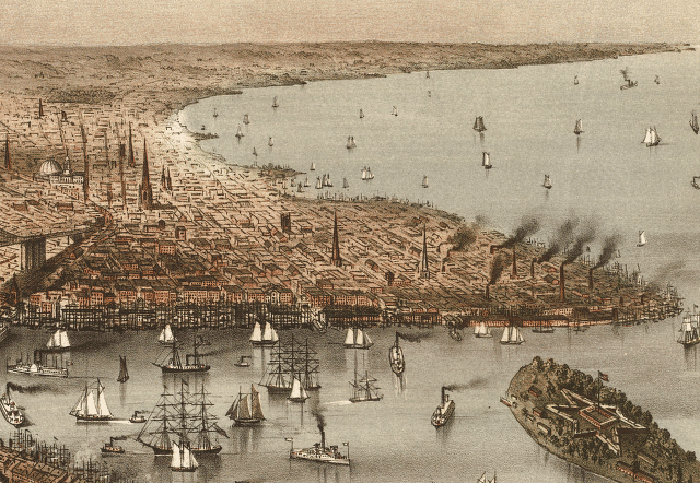
    Red Hook circa 1875I have had so many conversations, ad nauseum, that there is no life after Manhattan and that I did not move to New York City to live in Brooklyn or Queens. I have had many close friends in Brooklyn, the Bronx, and Queens, and I have traveled there hundreds of times.

    I have seen the merits of the boroughs, as readers of this website can attest, yet I have remained steadfast in my resolve that Manhattan is the ne plus ultra of the known universe and that the outer boroughs may be nice places to visit, but I wouldn’t want to live there.

    Until recently.

    This is a city that is still exciting and dynamic, particularly if you are of the generation that has grown up with Blackberries, a six-figure income in your 20s, apartments that sell for over one million dollars or rent for for over $3000 per month, and rapid gentrification of neighborhoods.

    However, Manhattan is losing its character and rapidly becoming the Singapore of the United States. Websites feature forgotten New York, vanishing New York, disappearing New York, and lost New York. For the special and unique, you must dig deeper and look further afield.

    Like Red Hook, Brooklyn.

    Red Hook was settled by the Dutch in 1636 and named Roode Hoek (“roode” for the red clay soil of the area and “hoek” meaning point or corner). The neighborhood is really a peninsula, cut off from the rest of Brooklyn by the BQE and Gowanus Expressways. Public transportation is a vital part of New York City life. Red Hook has no subway service to the neighborhood – this relative isolation is one of the key elements that has kept the neighborhood from developing as rapidly as other areas, such as DUMBO. Even as recently as the 1990s, the neighborhood was considered one of the worst neighborhoods in the USA and the “crack capital of America.”

    On June 18, 2008, IKEA opened an enormous store in the neighborhood, amid huge controversy (replacing a 19th century dry dock) and concerns over an increase in congestion.

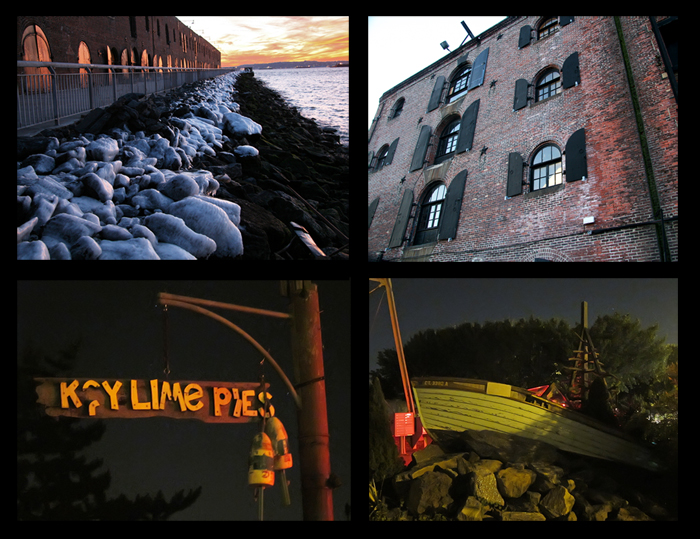
    The older warehouses, waterfront vistas, and isolation are exactly what makes the neighborhood so desirable and have attracted artists and small businesses for some time. See my photos and story, Fire and Ice. If you have a chance, visit Roode Hoek…


  • Hell. Part 3

    (This is the third and final of a three-part series. Find Part 1 here and Part 2 here.)

    Music has Charms to soothe a savage Breast and Hell has no fury like a woman scorned.*

    We had it all on Saturday – savages, breasts, fury, a scorned woman, music, fury, and a taste of Hell. Just the type of things a jungle lover would expect to find in New York City. And if you are going to enter the jungle smearing blood, you should be prepared for lions and tigers.

    There is no way that you can come to this city, set up in Greenwich Village, sing gospel songs, preach sin and damnation, and not expect a confrontation. The neighborhood is extremely liberal and very tolerant, except of being accused of sin and threatened with eternal damnation for their lifestyle.

    The model, Abigayle, had been provoked – she had been told that she was wicked and had been warned five times. She climbed on the shoulders of a young man, also body painted, and they approached the Mennonite group. It was fair to say that this couple taunted the crowd of Mennonites and the preacher, who launched into a diatribe regarding nudity, hell, and damnation while brandishing his bible. The man in body paint who had shouldered the model read and mocked parts of their leaflet, Boys and Girls & Fornication:

    Whether this confrontation on the part of the model and her supporter was justified was hotly debated. Some were infuriated and saw it as disrespectful and unnecessarily provocative. Others saw it as just desserts or as another circus act to be expected in the Village. At the end, the painted man reconciled with one of the visiting group and shook hands (photo lower right). Perhaps, after all, The road to Hell is paved with good intentions 🙂

    *Heaven hath no rage like love to hatred turned, Nor Hell a fury like a woman scorned. -William Congreve from the Mourning Bride, 1697. Music has charms to soothe the savage breast is also from the same work (the word breast is often misquoted as beast.)


  • Hell. Part 2

    (This is the second of a three-part series. Part 1 is here.)

    At the same time as our Mennonite friends were singing spirituals and preaching to the masses, just a few short steps across the central plaza in Washington Square Park, Andy Golub was busy body painting the nearly nude figure of a woman. See additional photos here.

    Andy is a visual artist who has been body painting men and women in and around New York City for years. You can see more of his artwork and body painting at his website here.

    Although women have the right in New York State to be topless in public, even in New York City, the site of nearly nude men and women in body paint will stop traffic and raise eyebrows. Societal norms have not yet caught up with legislation, and many are angered and perhaps certain that something should be done. Andy and his models, however, are breaking no laws, and even police officers still occasionally need to be educated regarding the legality of toplessness for women in public.

    When the time came and the model moved around the park grounds for various photo settings, a parade of male oglers grew in size, some with cameras, some without, running after her like hungry dogs chasing a rabbit.

    A number of the Mennonites were circulating the park crowds, giving out literature. I happened upon an old friend in the park, and while chatting, I jokingly mentioned that if they were looking to save souls, our model would, from their perspective, need it most.

    My friend took this comment to heart, approaching one of the women from the Charity Ministries and suggesting that she should perhaps consider giving literature to the near naked model – certainly she was the most needful. The leafleteer skirted the suggestion. One of their group referred to her as “wicked,” and another told her that she had been warned FIVE times – apparently there is no salvation for someone who did not heed that number of warnings.

    It became abundantly clear that our model was bound for Hell and eternal damnation, but a very unexpected confrontation ensued; tomorrow we conclude our descent into Hell (see Part 3 here)…


  • Hell, Part 1

    Note: This is Part 1 of a three-part series.

    One of the few family trips I made as a child was to the Amish communities based in rural Pennsylvania. Even coming from a rural area of New England ourselves, the Amish lifestyle, with the shunning of modern conveniences, left impressions that would last a lifetime.

    There is not much that provides a sharper contrast than such a group in traditional clothing in Washington Square Park. This is Charity Ministries*, a group similar to Mennonites. One of the founders, Mose Stoltzfus, was formerly Amish. I have seen them infrequently and was pleased to be able to take photos on this occasion.

    Regardless of any proselytizing or religious creed, there is a gentle and pastoral feeling to a group dressed as they are – the women with light blue and white dresses and the men in light colored khakis. It is as though an Amish farming community was transported through time and space to New York City. And I must say, the voices of the large chorus singing was not at all unpleasant, although hard to be heard above the park din, with competing music groups playing nearby.

    I browsed through and took some of their literature, with titles such as The Sin of Doing Nothing, Improving the Marriage Relationship, Lost in the Church, The Vice of Sexual Immorality, and Boys and Girls & Fornication. A colorful poster on an easel proclaimed Where Will You Spend Eternity? It seemed well-suited for the urban New York City visit, with businesses such as the Pennyless Casino, Abortion Clinic, the Broken Home Night Club, and Divorce Court, all located appropriately near Narrow Avenue and Broadway.

    It is hard to imagine why such a group would subject themselves to such a potentially hostile environment, but I would guess the reasoning is that of an evangelist, Dave, who some years ago used to preach in Washington Square Park on Sundays. When I asked him why he would choose such an inhospitable environment, he answered that he wanted to save souls, and what better place than Greenwich Village? I complemented him on his logic. If you can take the heat, certainly the Village is a great place to rescue the fallen.

    However, the words of this Sunday’s preacher fell mostly on deaf ears. Without knowing specifics, most passersby had a general sense of what this Christian evangelist message was about, and the feeling was not today, thank you. Especially when there is a plethora of competing activities, one that literally made most eyes pop out. There was talk of Love and God and Christ. But as you will see tomorrow in Part 2, we descend into Hell 🙂

    See Part 3 here.

    *Charity Ministries was founded in the 1980s by Denny Kenaston and Mose Stoltzfus and is based in Ephrata, Pennsylvania. They publish a magazine called Heartbeat of the Remnant. You can visit their website here.


  • Toches ahfen tish!

    I cannot tell you what percentage of the population of Bristol, Connecticut, is Jewish. And in a town of over 60,000, I can not locate a temple or synagogue. Growing up in such a place, however, I cannot say that it was riddled with anti-Semitism. With so few Jews, exposure was too limited to really form any opinion. There were a few stereotypes, but no way to corroborate them. Jewish people and culture were an enigma, something I would only experience after moving to New York City.

    My first college roommates were Jewish, my closest friends were Jewish, my first girlfriend in New York City was Jewish. The New England work ethic I inherited was akin to the Jewish work ethic, as was my interest in higher education. All my first and lasting impressions of the Jewish community were positive.

    One out of eight New Yorkers is Jewish – just under 1 million in a city population of 8 million, or 12% (in the late 1950s, the Jews reached a peak of about 2 million, or approximately one fourth of the city’s population). To know New York City, you must be familiar with Jewish culture – it is the fabric of the city. And if your going to be involved with any culture, of course that means learning about their food, language, and religion.

    I grew up with Franglais, an amalgam of French and English spoken in northern Maine, so Yiddish was right up my alley. I was quickly introduced to the requisite Yiddish, which has a wonderful collection of useful words and phrases, many with no good English synonym. Many Yiddish words have been adopted by New Yorkers as well as the general population in the United States.

    Here is a basic list to get you started (you can find Yiddish dictionaries here and here):

    babka, bialys, borsht, bubbellah, bupkis, challah, chutzpah, drek, farklempt, gelt, gesheft, goyem, kasheh varnishkes, kibbitz, knish, kvetch, latke, lox, matzoh, schmuck, schlamiel, schlamazel, shiksa, mazel tov, mensch, mishuggah, mitzvah, nebish, noodnik, nosh, oi vay, putz, schlep, schlock, schmutz, schnoz, schpeel, shabbat, shlub, shlump, shmaltz, shmata, shmear, shmo, shmooze, shnorrer, shrek, shtick, tchatzkah, trombenik, Yarmelkeh, yenta, zaftik.

    When you’ve mastered some of the basic vocabulary and you’re a little tired of academics and want to conclude your studies and put together some phrases, try Toches ahfen tish! 🙂

    Photo Note: This is Central Synagogue at 652 Lexington Avenue at 55th Street. It is one of the oldest in the United States and has been in continuous use by a congregation longer than any other in New York City. It was built in 1872 in the Moorish Revival style, designed by Henry Fernbach after Budapest’s Dohány Street Synagogue. It was designated a National Historic Landmark in 1975.


  • Bridge and Tunnel

    Whenever I look at or cross the Verrazano Narrows Bridge, I can not help but reflect on the 1977 film Saturday Night Fever, starring John Travolta, who plays the lead character, Tony Manero, a 19-year-old Bay Ridge, Brooklyn, resident. This coming-of-age story is laden with metaphors, with the Verrazano Bridge being, literally, the largest one. It is also the location of a tragic suicide of one of Tony’s friends, Bobby C., who cannot cope with his girlfriend’s pregnancy. In one climatic scene, Tony and his friends engage in a series of acrobatic antics on the Verrazano Bridge. Feeling hopeless and hungering for attention, Bobby C. falls to his death in a final display of one-upmanship.

    The bridge is an apt metaphor for the link between juvenile and adult behavior. The Verrazano also serves as a visual metaphor for the pejorative slang expression, bridge and tunnel, an elitist phrase used by Manhattanites to characterize those as “lesser class,” who commute in from the outer boroughs, New Jersey, and Long Island for cultural or social reasons. Appropriately, this term first appeared in print in the same year as the making of the film, 1977, in the New York Times.*

    In the final scenes of the film, Tony confides in his girlfriend, who lives in Manhattan, that he wants to make a break with his past and move there also. Tony’s recognition of his behavior and redemption is a refreshing break from what at times feels like a monument to misogyny.

    If you have not seen this film, I recommend it. It was both a mirror of and an influence on the culture of the time. The film is steeped in New York City imagery as well as clothing styles, disco, and the Italian American subculture of New York City (specifically Brooklyn) of the time.

    Saturday Night Fever is really quite a dark film, with teenage pregnancy, rape, suicide, and Tony’s brother doing the unthinkable – leaving the priesthood. The year was 1977, and the crowd was bridge and tunnel…

    *”On the weekends, we get all the bridge and tunnel people who try to get in,” he said.
    Elizabeth Fondaras, a pillar of the city’s conservative social scene, who has just told Steve Rubell she had never tried to get into Studio 54 for fear of being rejected, asked who the bridge and tunnel people were.
    “Those people from Queens and Staten Island and those places,” he said.

    Other Posts on the Verrazano Bridge: Del Floria’s, Cooperation, The Total Call, Secede


  • Just Like Old Times

    In most places, eight police vehicles and a swarm of officers pursuing a drug bust is a serious event. On Saturday night in Washington Square Park, at 11:30 PM, various vehicles came hurtling at high speed from all directions – two unmarked black cars, a taxi (used by police), and several regular NYPD vehicles. They easily and quickly trapped the perpetrator, who offered no resistance, only saying, “What?”

    It had all the drama of a major arrest of one of America’s Most Wanted, but my understanding was that this huge show of force was just for the arrest of a drug dealer caught making a transaction. I say “just” because selling drugs is an everyday and all day activity in this park.
    If you look at all like a potential customer and are strolling through Washington Square on a busy day, you will be offered drugs by numerous dealers at a number of key locations – strategic intersections where most pedestrians have to pass through. The mantra “smoke, smoke” is familiar to all habitués here and is just laughed off as part of the natural environment and business as usual.

    Drugs have been regularly sold in Washington Square Park since time immemorial. Dealers are well-known by regulars in the park and the police. The miscreants are quite well-versed in the law and know how to operate their business in a way to generally avoid arrest. The activity had virtually disappeared since the recent renovation (see here) but, as would be expected in New York City, and particularly in this park, drug activity has crept back in and often feels just like old times.

    What is ironic, and would be perhaps astounding to nonregulars, is that a regular group of musicians and singers continued their musical activity just steps away from all the commotion, completely undaunted, unfettered, and apparently uninterested.

    Rather than a cause for alarm, surprise, disruption, or curiosity, the whole affair just seemed to add voices to the backup singers. Guns, police running, screeching tires, searchlights in the bushes, sirens, and handcuffs were all part of a comforting ambiance that made everyone feel that it was just like old times 🙂

    Note: On August 6, 2009, I wrote Chess Monsters and told of an incident where I witnessed a shooting, yet incredulously, while players ran for cover, an onlooker stopped the chess clocks during the incident and playing resumed, barely missing a beat. You can read the story here.

    Postings on Washington Square Park: Out There, Conflux, Hawk Fest, Evening Arch, Twelve Tribes Arrive, New York Nymph, Bluegrass Reunion, Cloud Appreciation, I Am Legend, Birds Sing at Night, Rats Gone Wild, Piercing Al Fresco, Police Riot Concert, Artiste Extraordinaire, Comfort and Joy, Livid, Flash of Light, Delivery, Dog Run, Sounds of Summer, Krishna, Spring Madness, Back to Boyhood, Hookah, Lockout, Danger and Caution, Obama, YouTube Meetup, Dachshund Octoberfest, Music Speaks for Itself, Park Night, Petanque, Washington Square North, Nested Embraces, Left Bank New York


  • All Is Not Lost

    Posted on by Brian Dubé

    Much of the art and music world in New York City has disappeared, but all is not lost. In the East Village and the outer boroughs, the arts live on, the product of tenacity and resourcefulness. If you are looking for arts on a smaller scale than the major museums, or for music on a smaller scale than Lincoln Center, then you will have to look a little harder and concentrate your efforts in neighborhoods such as DUMBO and Williamsburg in Brooklyn and the East Village and Lower East Side in Manhattan.

    The East Village still has a substantial number of community gardens, art galleries, music clubs, and other small venues. I have featured a number of community gardens here, and more recently, the Nuyorican Poets Cafe. These types of places are virtually nonexistent elsewhere in the city.

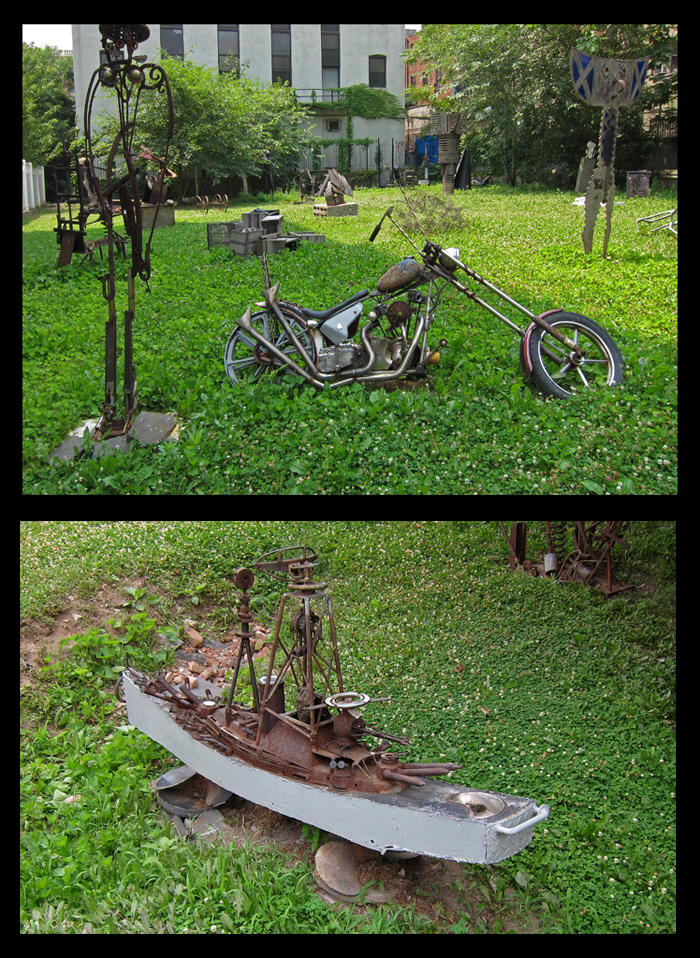
    The KenKeleba House Sculpture Garden spans an entire city block from East 2nd and 3rd Streets.

    Kenkeleba House Garden has an extraordinary mix of large African sculptures as well as local sculptures made out of scrap, or bricolage, a specialty of the Lower East Side art scene since the 1970s. Situated in a large plot, the net effect is that of viewing an outdoor museum with both permanent and temporary pieces on exhibit. Some of the outdoor pieces on loan are from local artists who used to belong to the much beloved Rivington Street Sculpture Garden, which had two incarnations in the neighborhood before it was pushed out by a new apartment building.

    Double back to Avenue B, continue south for one block, and turn left onto to East 2nd Street. Since the whole garden runs from East 3rd to East 2nd between Avenue B and Avenue C, closer to Avenue B, it needs to be approached from both sides. The separate planted garden area, can be accessed from the East 2nd Street side entering during the designated posted hours when the garden gate is open. At other times, take a look around to see if anyone is in the gallery at 219 East 2nd Street who could open the garden for you. It is worth trying to gain entry to the planted garden, particularly since this also allows entry to the sculpture garden.

    All is not lost…

    Posted on by Brian Dubé

  • Micronations

    Posted on by Brian Dubé

    I purchased a book some time ago called Micronations. I was very intrigued yet disappointed. The book was entertaining but somehow did not fulfill the dreams I had as an armchair traveler. Perhaps I needed to look closer to home.

    The newsstand in today’s photo, taken in Bay Ridge, Brooklyn, is not an uncommon sight in New York City, particularly in the boroughs such as Brooklyn or Queens, where there are large concentrations of ethnic groups. Bay Ridge has a population which is 11% Arab and 5% Greek.

    On May 12, 2009, I wrote Salad Bowl about the failure of the metaphor of New York City as a melting pot to accurately describe the discreet ethnic groups. There are many people in New York who get along speaking virtually no English who are so prevalent here. Chinatown is a good example of a very insular neighborhood, with so many services and products catering to the Chinese community that many residents never have to leave or learn another language.

    These ethnic enclaves have places of worship, books, periodicals, schools, parades, festivals, restaurants, markets, and foods and products imported from their homeland. Doctors, lawyers, accountants, and other professionals have established businesses in these communities, providing services and working in the native languages of the residents. There are often tiny pockets of immigrants of ethnicities rarely seen in the United States. No need to leave the Big Apple when looking for Micro Nations 🙂

    Posted on by Brian Dubé

  • Pink Flamingos

    Posted on by Brian Dubé

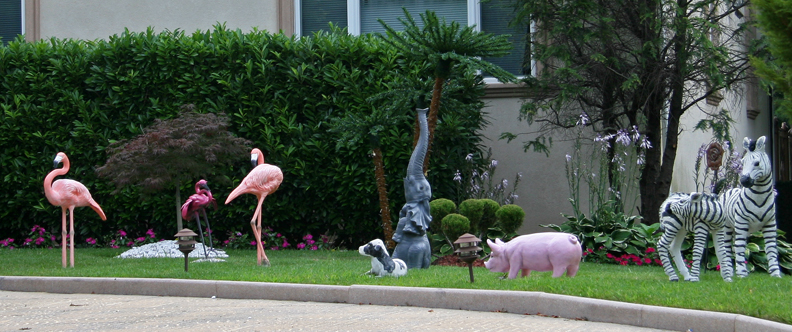
    I was once gifted the book The Encyclopedia of Bad Taste, many parts of which I found hilarious. The writers, Michael and Jane Stern, have selected the most egregious infractions on good taste in American culture. There are chapters on Easy Cheese (in a spray can), Spam, Velvet Paintings, Chia Pets, celebrity death cars, lava lamps, etc. One article highlighted lawn ornaments.

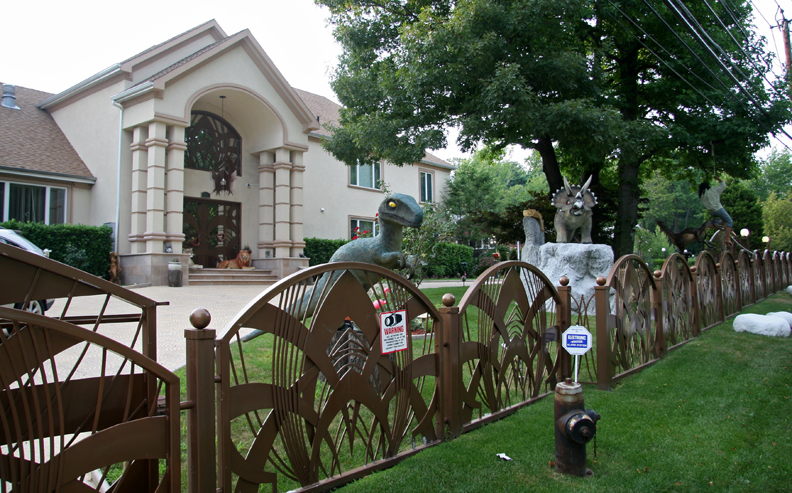
    Most of us have seen a lawn display featuring classics such as the plastic flamingo. I thought I was well-versed in lawn displays (particularly after seeing the Dyker Heights Christmas displays). That is, until I saw the display in front of the mansion of Alla and Alex Shchegol at 724 Todt Hill Road, Staten Island.

    I was happy to find a little information online about the house and the Shchegols, who have been collecting these lawn statues for years. However, I was not prepared to find a small uproar in Dongan Hills/Todt Hill, Staten Island, one of the wealthiest communities in New York City. An article in SI Live voices the concerns some have about the danger of distraction to motorists. It certainly comes as very startling to drive by this property and encounter Tarzan hanging from a tree over a lawn full of statues in a loosely themed jungle and Jurassic Park. There are dinosaurs, jungle animals, and other creatures.

    The many comments to the SI Live article range the gamut – see the article and comments here. Some say the huge ornaments are terribly distracting and dangerous, while other locals say the concerns are exaggerated. The vast majority of naysayers are just horrified at what they consider to be one of the supreme examples of tacky, bad taste.

    Actually, I was very surprised to read about the congeniality of the owners. Apparently, many passersby stop, some even knocking on the door for information about the display. Others ask permission to take photos with their children on the various animals, which the owners typically grant. A number of people, like the Shchegols themselves, just see this as harmless fun and encourage the outraged to lighten up.

    Most will agree, however, that no Encyclopedia (or lawn) of Bad Taste would be complete without Pink Flamingos 🙂

    Posted on by Brian Dubé

  • World of Sheep

    Posted on by Brian Dubé

    I once dated a woman just after college for a short time. A very short time. Actually, if I recall, it may have been only one date. This woman had been highly affected by her readings of the existentialists. I can’t say I liked her much, and I remember very little, except her assertion that “people were sheep.” She suggested, “Let’s do something different,” as if difference, in and of itself, insured a better experience. I vaguely recall her quoting some French philosopher, a role model of hers I imagine, to substantiate her negative views of humankind and extemporaneous living as the only antidote.

    Had it been 2010, her life would be considerably more difficult, if not near impossible. She would be a very unhappy camper for sure. Flash mobs, Twitter, email, texting, Facebook, satellite TV, blogs, ezines – everything conspires to disseminate information, literally at the speed of light. Whether it’s the latest, greatest neighborhood, product, or event, no stones are left unturned. Nothing of any interest to anyone remains secret for very long.

    In 2007, when I first heard about the biannual solar event coined Manhattanhenge by astrophysicist Neil deGrasse Tyson, I really felt privy to a very special near-secret event. And although I was not the lone photographer my first time seeing this spectacular New York City occurence, the experience I had in midtown Manhattan did not have the flavor of a feeding frenzy fueled by electronic networking or the feeling that one was part of a flock of sheep.

    I created a photo triptych which I posted along with my article on this blog on May 21, 2007. The photo collage was picked up and featured by Gothamist online. This year, I see a massive amount of imaging online – it is doubtful now that any given photo would be easily singled out for a media feature as mine was in 2007. B & H Photo now organizes an annual Manhattanhenge Gathering for photographers. On the photosharing website Flickr.com, there are two special photogroups for Manhattanhenge alone (2009 and 2010), and a search of images returns over 3000 results. Websites abound with stories, photos, and information about this natural occurrence.

    I have, of late, become very enamored of sheep – they are wonderful animals that do really appear to love the company of people. They may not be known as independent thinkers, but perhaps they are the new paradigm for our fast-moving world. I have not given up completely on creative or independent work, but I am preparing for the future and learning as much as I can now about the world of sheep 🙂

    Photo Note: I stumbled across this year’s Manhattanhenge unknowingly. The photo was taken just before sunset, looking west down 23rd Street.

    Posted on by Brian Dubé

  • Rocket Man

    Posted on by Brian Dubé

    Note: Please click and play audio link to accompany your reading.

    I recently discussed with my cousin the fireworks displays we saw as children in Pope Park, Hartford, Connecticut. These Fourth of July outings were all-night affairs – our families arrived early with blankets and picnics, staking out ground for a display which seemed like it lasted forever. Perhaps the childhood memory of this spectacular event looms larger than it really was for both of us, but we agreed that it lasted nearly one hour and was the best thing we had ever seen.

    As I grew up, I was no stranger to the boyhood love of pyrotechnics. This followed me into high school, where I became involved in the rocketry club. In my early years in New York City, we managed to put on our own bottle rocket displays for the Fourth of July.

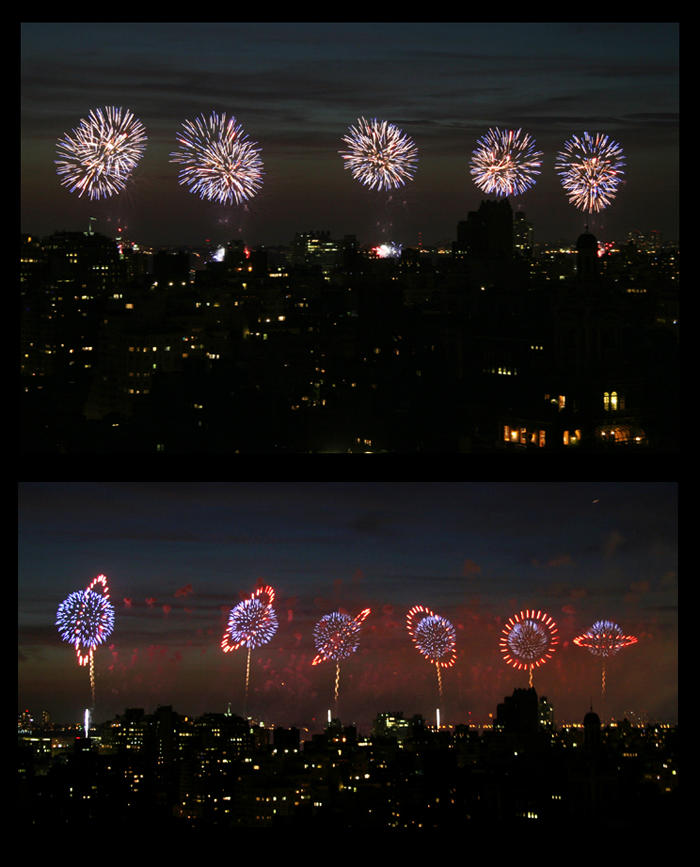
    Of course, little compares to Fireworks by Grucci or Pyro Spectaculars by Souza, which has been putting on the annual Macy’s fireworks display since 1982. Last night’s display was beautiful as always, with many new pyrotechnic effects.

    This year, my spectating experience was particularly pleasant. Rather than battle the masses on the west side of Manhattan for Hudson River views, I was invited by friends to the 26th floor rooftop deck of their apartment building. We were joined by a small number of building residents for a pleasant, trouble-free bird’s-eye view.

    In a extraordinary twist of fate, I learned today that Pope Park was designed by the Olmsted Brothers Landscape Architects in 1898. This company, the nation’s first landscape architecture company, was founded by Frederick Law Olmsted, designer of Central Park and Prospect Park in New York City. Olmstead’s sons, John Charles Olmsted and Frederick Law Olmsted, Jr. inherited the firm from their father. This company has an enormous portfolio of projects to their credit, including Pope Park. I have been unknowingly following the footsteps of the Olmstead Brothers.

    I am pleased to have echos of pyrotechnics and the Olmstead legacy here in New York City, because leaving my home and childhood behind is the fate of any Rocket Man 🙂

Posted on by Brian Dubé

  • Explorin’ Part 2 – Dead Horse Bay

    Posted on by Brian Dubé

    (see Part 1 here)


    The name Dead Horse Bay is provocative enough, and the place easily lives up to its name.

    A coworker told me about this beach in Brooklyn, along with a requisite piece of information – go during low tide. So, I examined the tide tables for Jamaica Bay, New York City, and timed my trip accordingly. I parked my vehicle at the ranger station at Floyd Bennett Field. A walk across the main thoroughfare and short hike through the beach forest trail opens up to the bay. Surprisingly, none of the rangers had made the hike and were eager to hear my report upon return.

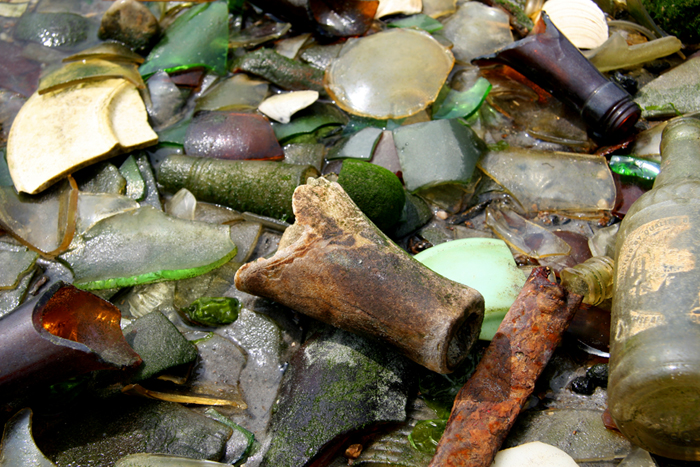
    The beach is strewn with a myriad of artifacts – primarily glass bottles, forming a blue-green carpet of glass. Make no mistake, however – Dead Horse Bay is essentially a beach of trash, albeit very interesting trash. There are dishes, toys, parts of sinks, rusted metal devices, and even mating horseshoe crabs. See my gallery of photos here. The history of this bizarre place is always the first question asked. From the New York Times:

    Dead Horse Bay sits at the western edge of a marshland once dotted by more than two dozen horse-rendering plants, fish oil factories and garbage incinerators. From the 1850’s until the 1930’s, the carcasses of dead horses and other animals from New York City streets were used to manufacture glue, fertilizer and other products at the site. The chopped-up, boiled bones were later dumped into the water. The squalid bay, then accessible only by boat, was reviled for the putrid fumes that hung overhead.

    Once marshland, the area became slowly filled with trash and the landfill capped. The cap burst in the 1950’s, spewing articles from the early 20th century into the surrounding beach water.

    After walking the entire beach, I was prepared to leave. However, the fact that I had seen no evidence of dead horses was nagging at me, so I decided to backtrack and question a woman who, I had noticed earlier, had been combing with the intent of a repeat visitor. Alas, good that I did – Angela pointed out that horse bones were, in fact, everywhere – you just had to know what to look for. Sure enough, once they were pointed out to me and my companion, we saw them everywhere. Angela had found what appeared to be a 32-sided game die and asked if I could take photos for her. You can see it here.

    If you visit Dead Horse Bay, remember to wear good shoes/boots to protect you from all the shards of glass and other sharp objects. Oh, and happy explorin’ 🙂

    Posted on by Brian Dubé

  • Explorin’ Part 1

    Posted on by Brian Dubé

    We learned to travel through the forest canopy ala Tarzan (sans vines) by climbing atop young saplings and swinging side to side, gaining enough movement to grab a neighboring tree and cross over. We crossed swamps, jumping from one tufted outcropping to another. We fell from trees and into swamps too.
    We found snakes under hot rocks – we learned that they loved to bask in the heat of the summer sun. We found newts, tadpoles, turtles, and salamanders. We marveled at nature’s iridescence in the damsel fly. We believed in the dangers of a dragon fly sewing your eyes shut, as well as other myths, not knowing they were myths at all.

    My summer days were filled with exploring, from sunup to sundown, until my mother’s call brought me back from the wild. More correctly, I should say explorin’, because that is precisely what we called it – the lack of a “g” conferring a certain sense of casual authority of the experienced adventurer. “Explorin'” was always the answer to the daily “Whataya want to do?”

    Later, I read the wonderful tales of African adventure by Jean Pierre HalletCongo Kitabu and Animal Kitabu. Although my native habitat was not Africa and no real treasures were ever found, it mattered not in the least.
    We made primitive toys and weapons. With crudely fashioned bows that rarely worked, we stalked the woods like Robin Hood. We made kites that would not fly from salvaged fabric and twigs. A string, stick, and small hook was enough to spend a day fishing lost items from below the steps of a basement hatchway. We rolled down hills in reclaimed appliance boxes. There was no particular agenda or mission when explorin’ – just the joy of looking. And we loved the woods best of all.

    These days, although I have yet to travel to the Amazon or Congo, I find New York City serves as a fine place for any Jungle Lover with a hankerin’ for explorin’. There are plenty of woods, beaches, alleys, rivers, lakes, bays, wildlife, and backroads.

    On Saturday, armed with that childhood spirit of explorin’ and on the recommendation of a coworker, I set out to explore a most bizarre place, the result of a strange twist in New York City history. Tomorrow, I will show you what I found on the other side of those dunes in Part 2 of Explorin’…

    Posted on by Brian Dubé

  • Eyes on the Signs

    Posted on by Brian Dubé

    As Jerry Seinfeld once pointed out in one of his comedy routines, the beauty of clothing is that adjustments and improvements can always be made. But in the case of nudity, no tweaks are possible. Essentially, the naked person is saying, this is the best that I can do.

    In the classic episode The Apology, the distinction is made between good naked and bad naked – they were not talking about morality, only aesthetics. And when you get a large group who come from the general population and not the world of modeling or body building, you are sure to get plenty of bad naked. I know there are those who defend all bodies as beautiful, but I think in this case, I side with Seinfeld over artistic idealists.

    Appropriate or inappropriate, legal or illegal, good naked or bad naked, public nudity is sure to draw attention, which is just what demonstrators get when “clothing optional” is part of the equation. See more of my photos of this event here.

    However, anyone inclined to this type of strategy to make a political point had better realize that what will be remembered is often only the nudity. Lively discussions will occur during and after such a protest, but mostly over the details of how naked any participants were and how various body parts were covered or decorated. In fact, after the members of this ride left Washington Square Park, I showed a number of friends some of the photos I had taken – there was surprise regarding the rider who had painted “Oil is dead” on his back. Apparently the message and numerous signs regarding oil did not make itself clear.

    Many observers will likely believe that this ride is just an expression of personal freedom or wild reckless abandon. There is an element of that, of course, once an event like this is under way. It is doubtful a ride like this will be dominated by the shy or prudish. The event does become an exhibitionist theater on wheels. However, the World Naked Bike Ride is an international annual event “to celebrate cycling and the human body. The ride demonstrates the vulnerability of cyclists on the road and is a protest against oil dependency.”

    The demonstration went smoothly in the park – there was plenty of reveling in the park’s fountain. The police were quite tolerant, even though many of the male participants were completely nude and technically breaking the law. One officer was making his compulsory rounds, chanting an obligatory “Put your clothes back on.” The event is best served if riders keep their eyes on the road and observers keep their eyes on the signs 🙂

    Posted on by Brian Dubé


  • ©2026 New York Daily Photo Entries (RSS) and Comments (RSS)  Raindrops Theme