• Category Archives Only in New York
  • World Domination

    Posted on by Brian Dubé

    There is an episode of the Twilight Zone, The Little People, where astronauts William Fletcher and Peter Craig are marooned on another planet. In exploring the planet, Craig discovers a Lilliputian city with miniature people. Soon, Craig becomes an obsessed lunatic and appoints himself as a god over these people, terrorizing them into submission. At one point, he even forces the populace to build a life-size statue of himself. In an ironic ending, Craig himself becomes a victim when two enormous spacemen visit the planet. One of them picks up the ant-sized Craig, accidentally crushing him to death.

    We can easily understand Craig’s dark side – what child (or child within the adult) is not fascinated observing people and cars from extreme heights? Can’t you just hear them remarking to one another how tiny they are and how they look like toys? As if they could reach down and pick them up.

    I recall my first visit to the Empire State Building, where, at the observation deck on the 86th floor, I was able to squeeze my head through the fencing and look straight down, seeing for the first time the toylike world I had only imagined or seen on TV.
    There’s a touch of megalomania in many of us, and viewing the world from atop skyscrapers gives just the vantage point to fantasize our domination over the world below. And what better place to reign than New York City? 

    Many urban jungle lovers (see Jungle Lovers and Urban Safari) relish exploration of the city, following the beaten paths or cutting their own swaths. But from time to time, there comes a desire to see the forest from the treetops. New York City affords a myriad of opportunities to do this via observation decks, bridges, and high-rise apartment and office buildings. Today’s photo is a rooftop view looking straight down from the 26th floor of a luxury high-rise apartment building in Greenwich Village.

    I love the culture, arts, architecture, and people of the city, but from time to time I want to see the little cars and people below. So, next time you get the chance, take a trip to the top of a New York City skyscraper and join Peter Craig and me in a game of World Domination 🙂

    Posted on by Brian Dubé

  • Every Inch Has a Price

    Posted on by Brian Dubé

    We price apartments and commercial space in dollars per square foot. We pay for loss factors (unusable space not usable but included as rentable space). Messengers squeeze through tiny spaces (see story here). Subways are overcrowded. Cars are jockeyed in lots and garages at extraordinary rates. People have been murdered over parking spots on the street.

    Some store pots and pans in the oven. Why not leave them in the dishwasher? Who has room for a dishwasher? We move the toaster a few inches to make space for the blender to make space for the dish rack.
    Bicycles hang from hooks in the ceiling. Many pay for off site storage. There is typically no room for washer/dryers in apartments, so most carry their laundry to a laundromat. There are very few tennis courts and rates can run to $100 per hour.

    In New York City, every inch is spoken for, and in that type of environment, every inch has its price – a hefty price. Everything is designed around space constraints. We think vertically. Everything is stacked – apartments, businesses, and their contents. Air rights are bought and sold.

    Hot dog vendors pay extraordinary fees to operate outside the Metropolitan Museum of Art. This is the premier spot in the entire city for street vending of hot dogs. Pasang Sherpa contracted for $642,702.19 per year to the New York City parks department for the right to sell hot dogs there (to close shortly after opening). Then, in 2007, disabled Vietnam veteran Dan Rossi set up shop, acting on an 1894 state law that allows disabled veterans to sell in restricted areas. For free. On a recent visit to the Metropolitan Museum steps (see story here), I spoke to Jose Cabrera, who works for Rossi. Jose is also a disabled vet, having served two tours in Iraq.

    Of course, other veterans have followed suit, and the whole situation is a mess. The city claims that there is room for only one vendor. From the New York Times:

    …there is room for only one vendor because of regulations regarding the location of the carts and because bus and taxi boarding zones must be kept clear.

    Two weeks ago, officers began handing out summonses, in most cases saying the carts were too far from the curb. Vendors said they were in a bind: If they were near the curb, they would be ticketed for obstructing the bus and taxi stops, and if they were farther out on the sidewalk, they would be ticketed for being too far from the curb.

    Dan Rossi has weathered the police ticketing and hot dog vendor battles. Recently, however, the city has been looking to diversify the food options outside the Met and has leased vendor space to Cake & Shake of Long Island City, Queens for $659,350 for a five year period. Read the whole New York Times story here.

    I assumed once someone acquired a license to vend on the streets, they would not be hampered by space constraints most New Yorkers face. But even in the great outdoors of New York City, every inch is spoken for and every inch has a price

    Note: The name Sgt. David Gonzales across the top of the cart is not the owner’s name, but rather that of a Vietnam vet killed in action and friend of cart owner Dan Rossi.

    Posted on by Brian Dubé

  • Sardines

    Posted on by Brian Dubé


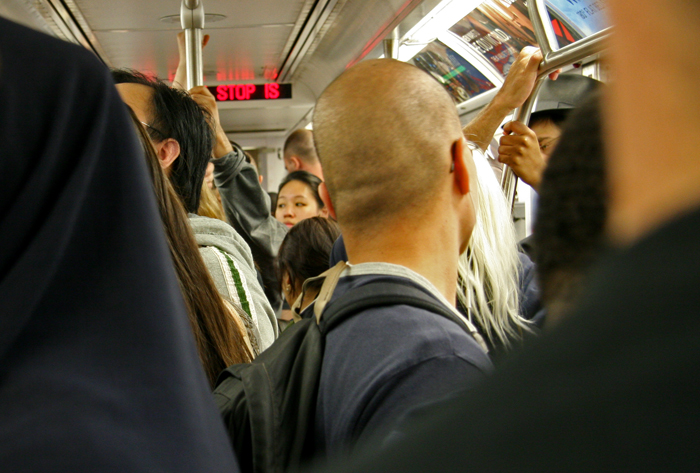
    I’ve been reading a lot about sardines today and the origin of the expression “packed like sardines” – I could think of nothing else on Sunday while traveling on the Lexington Avenue subway.

    This trip to the Upper East Side and, ultimately, Central Park, illustrated beyond a doubt the need for the Second Avenue subway. Construction has finally begun this week on this much-needed subway line – proposals go back over 80 years. The massive boring machine has begun digging and, according to the transit system, will not be shut down until the project is completed (2016).

    The Upper East Side of Manhattan and east midtown is essentially serviced by one subway line – the IRT Lexington Avenue 4, 5, and 6 trains. This line is so heavily used that it has become not only the busiest in the NYC transit system – it is now the most used transit line in the United States, with more riders that the entire transit systems of San Francisco and Boston combined.

    What may come as particularly surprising is the overcrowding on Sundays. The East Side not only has the typical density of residents found in Manhattan but also is home to many attractions, particularly museums along Fifth Avenue, aka Museum Mile, so this subway is heavily used by tourists on weekends.

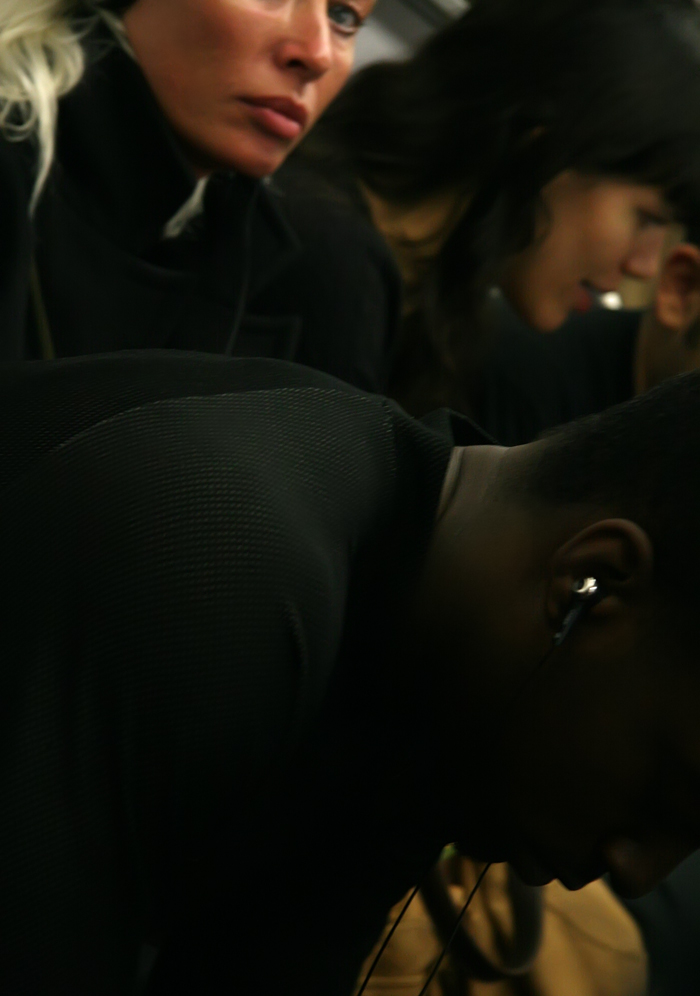
    This trip was also an experience in extreme diversity. On this one car of the train, there were two Islamic women in black Burkhas. An extremely tall orthodox Jewish man with a wide-brimmed black hat towered over two young black girls. A young Asian woman stood next to me with makeup so heavy that she had the look of a traditional Thai or Burmese dancer. A woman with very striking white hair and surreal skin tone took a seat near a black man completely hunched over listening to music.

    My thinking was that sardines was a convenient metaphor, but I assumed that there was much more variety of humans in that one subway car than in a can of sardines. Now I have learned that sardines are actually several types of oily fish related to herrings, so actually, a fair variety are used. Everything considered, I think it is reasonable to say that we’re still packed like sardines 🙂

    Note: Nothing compares to overcrowding of subways in Tokyo – if you want to see the most outrageous subway packing/stuffing, see a video here.

    Posted on by Brian Dubé

  • Creative Expert

    Posted on by Brian Dubé

    Years ago, I used to spend many summer afternoons in Washington Square Park watching Dave, a Christian evangelist, make a presentation arguing for the existence of God. Anyone was invited to join the discussion, which, at times, became a quite lively debate. On one occasion, in frustration with someone who was making a number of unfounded statements, Dave retorted, “Saying it doesn’t make it so.” This was the first time I had heard this adage, and I liked it. It applied to so many scenarios, particularly regarding assertions made when asking about someone’s livelihood and answering by giving one’s aspirations.

    Pardon my cynicism, but in New York City, I am forever meeting individuals who are self-proclaimed artists, writers, composers, producers, and recently, fashion designers. I say self-proclaimed because saying it doesn’t make it so and in the art world, credentials can be as simple as a proclamation or business card.

    I once met a fellow tenant in my office building who worked for a company specializing in branding. He offered his services and card – below his name was printed “Creative Expert.” Rather incredulous that anyone would not only make such a bold assertion but then commit it to print, I showed my graphic artist the card.

    Unfettered, my friend assured me that many people will believe what you say, particularly if it is printed on your card. She told me of an instance where she was called for a job – the client had been told that she was a Photoshop expert, which she was not. But it had been said. To this day, we use the phrase Creative Expert as a source of amusement in our office.

    So when I met Geary Marcello and he told me he was a fashion designer in the ensuing conversation, I just filed it for future investigation. His business card read, “Creative Director. Couture Women’s Wear Special Occasion and Costume Design.” Now my antenna went up. Creative director. Fashion designer. These are real jobs, not the more incredulous and nebulous Creative Expert. And certainly a man with a septum curl, tongue chain, goatee, and tattoos is not an ordinary man. But none of this saying makes it so.

    Some online searching and a visit to his website certainly showed that Geary was, in fact, who he said he is. I’m giving him the benefit of the doubt. After all, this is New York, center of the American fashion industry and a city whose streets are populated with many exceptional people. This website is filled with examples of celebrated individuals whom I have met in ordinary places. I am reminded of my encounter with Afghan popstar Walid Soroor, whom I met in an Indian restaurant in Jackson Heights, Queens.

    Of course, the eternal cynic sees the Internet as just another incarnation of the devil’s playground – a new place where saying it doesn’t make it so and a forum for the Creative Expert 🙂

    Note: Geary was extremely congenial and happy to pose for passersby like myself. He hails from Los Angeles, California. His long list of clients includes: Lucy Liu, Bill Cosby, Lena Horne, Lindsay Lohan, Jim Carrey, et. al. You can find his website here.

    Posted on by Brian Dubé

  • Window of Opportunity

    Posted on by Brian Dubé

    This is a daily photo website, and although it has evolved to become much more story- and text-driven than at its inception (where the text served as more of a caption), I assume that many of you are interested in photography and imaging.

    The advent of digital cameras has brought many more individuals into photography. The Internet and digital media have provided a myriad of online forums, all easily available to the masses. Camera technology has made it much easier for the average person to get very good results. Preview screens provide immediate feedback, providing an excellent learning tool for identifying problems, rather than having to wait for film processing.

    The cost of photos is essentially free, less amortization of the equipment. This means more photos can be taken, important in difficult shooting situations where a number of shots increases the chances of capturing that special moment. Post-processing on a PC with applications such as Photoshop essentially brings the darkroom to the desktop. For me, this is one of the most important tools in the digital photography process.

    So, with all this technology and increasing numbers of photographers, one problem remains – how do you differentiate your photos?
    Subject and setting. If you are interested in color photography, for example, it is going to be difficult to get the kinds of results Steve McCurry gets just by being in India, Kashmir, Tibet, or another exotic locale, and getting such unique subjects and settings.

    However, few have the ability to travel to locations like these very frequently, if at all. It is unlikely that one will find many unique subjects in and of themselves – in a city like New York, nearly everything has been combed over. A rarely seen subject will require research and travel – places such as the Hole, the Black Cowboys, etc.

    One strategy is to shoot familiar subjects from different vantage points (see Dachshund Octoberfest here) and at different times. Although the magic hour (early morning and at sunset) is often celebrated as the optimal time of day for shooting because of the quality of light (see Light on Bobst here), I also see the early morning as a time to capture activities particular to the early morning (such as deliveries to the meat packing district) or familiar subjects in an atypical way – quieter settings free of traffic and pedestrians and subjects illuminated by the sun in a unique way, like today’s photo of the Washington Square Arch with light pouring through it.
    See you in the morning for that window of opportunity 🙂

    Posts taken in the morning: Hawk Fest, Quietude, 23 Skidoo, Homeless Art Scene, You Don’t Say, Out There, Little in the Middle, Kristen, For Whom the Knell Tolled, Hua Mei Bird Garden, Coup De Grace, Eight Twenty Five, Slummin’, Fresh Meat, True North, Snow Play

    Posted on by Brian Dubé

  • Look at Them Go


    Please click and play audio link to accompany your reading.

    One of the most startling differences between New York City and most other places is the life at night. It is late at night, you are alone, and perhaps you are in need of some human companionship. Step out into the streets of New York City and see signs of activity everywhere.

    My family loves the city and has visited on a regular basis. At one time, they would camp out in my living room. My mother was fascinated with all the activity. She would stand, stare out my window, and exclaim, “Look at them go. They don’t stop going. They go all night.” As if it was one person or one group with insomnia who patrol the city 24/7, perhaps to die of exhaustion. The city never sleeps, however, individuals do – but why tell her that when she was having so much fun?

    Visiting my family in Bristol, CT, and driving the streets on a Sunday or especially on a Saturday evening before returning home, I was astounded as to how dead this suburban town of over 60,000 could be – it was a virtual ghost town with nary a person in sight.

    Two hours later and back home, particularly in the summer, I would find Manhattan mobbed. In the Village, I would encounter bumper-to-bumper traffic jams. Reflecting back on the town I had just left, it was impossible to fathom – after every trip, I would question my memory of the town I had left.

    Of course, I realize that it is unfair to compare the two places, but nonetheless, it was the extreme contrast that to this day still astounds me. Driving through that suburban town where almost no one walks the streets and there are no cafes and no signs of life at all at night, minus perhaps a gas station or all night convenience store. That is why the discovery of the Tangerine Dream coffee house in high school was nothing short of a miracle.

    I was once discussing all these matters with a friend, now living in the city, who for a time lived in a neighboring town in CT. He can be rather caustic and blunt with his opinions – in this case, his response was that the “suburbs are death.” Dislike of the suburbs is one of the most commonly shared feelings you will find in this city.

    If you are a visitor, you may never be privy to this sentiment. A polite person will show due respect, and a reasonable person is aware that there are different strokes for different folks and that the city is not to everyone’s liking. And, admittedly, there are tremendous conveniences of living in the suburbs. See my story of Dwanna here.

    My parents no longer live in Bristol, but from time to time, I still like to pass through for nostalgic reasons. On a bleak winter night, I am intrigued by the deadly quiet. Soon I will be home, where, if I want to see human activity, I will only need to step out onto to the streets or even just peer out my window, and any time, day or night, I can Look at Them Go

    Photo Note: The photos were taken at 10 PM at Union Square – a major subway hub, a nexus of streets, and a major shopping district. The area is active day and night. The lower photo is of the mezzanine cafe at Whole Foods Market.


  • Swaggertist in Blue

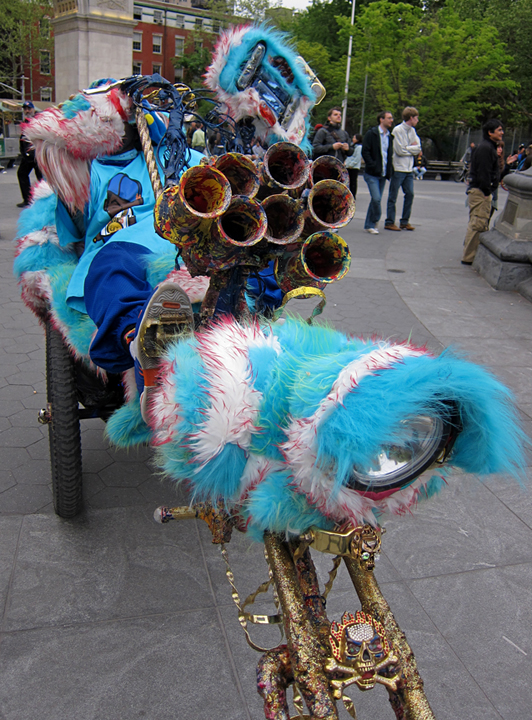
    Where would you find a man who is a roller skater, saxophonist, writer, composer, recording artist, and inline skate trainer, who had a hit single on Billboard for 13 weeks (“Funky Bebop”), has a Masters degree in group therapy (with work done towards a Ph.D), and travels on an outrageous fur-covered trike? In New York City. See additional photo here.

    And, of course, a man with this many incarnations would be expected to have had as many names – Bladie aka Bladie Flowness, Vin Zee, Vinzerelli, Vincent Brown. Now reinvented on his trike as the Swaggertist. I cannot attest to all his claims, but it would be fair to say that the man is a one-man self promotional campaign on wheels.

    Bladie was involved in musifying the roller skating scene in Central Park, what he calls the ultimate dance party on wheels. The New York Times wrote: “There are the old-timers, like Bladie Flowness, who has dreadlocks and a dyed beard and sails against traffic doing tai chi in multicolored Bedouin pants.”

    After meeting Bladie and introducing myself, Bladie gave me one of his music CDs and a DVD compilation of various clips of him. This bike is not his first, and he has been known for colorful dress since his early days on the skating scene.

    However, it takes more that just chutzpah, bright colors, and a turquoise fur-covered trike to become successful or get attention in New York City. Although Bladie certainly gets attention when he cruises the city, park regulars barely give him a glance. After all, he has to compete with Piercing Al Fresco, Hector, André (Out There), Spike, Narcissism Gone Wild, Water Sprites, Wood Nymph, the Misfits, the Dance Parade, Flamboyant, the Krishna Fest, the Dyke March, Singing Bowls, Eight Twenty Five, Twelve Tribes, Penny Farthings, Superheroes, Snake Charmer, Circus Amok, and Fashion Forward.

    And Bladie has plenty of musical talent to deal with. For now, Gershwin has not to worry about the Swaggertist in Blue 🙂


  • Squadron A Armory

    I try not to overuse the word juxtaposition, because if I was not vigilant in its use, I could easily justify using it ad nauseum in regards to the diversity of structures in New York City.

    One of the supreme examples of juxtaposition is the palace of Versailles and the town of Versailles in France. In the area neighboring the palace, one finds a town that is pleasant but nothing to prepare one for the grandeur of the palace.
    For the residents of Versailles, however, I imagine the palace becomes just another fixture, something one becomes inured to over time. At least that is the experience I have often in New York City. I certainly appreciate our iconic structures, but often it takes spectacular or unusual conditions to bring these things to one’s attention.

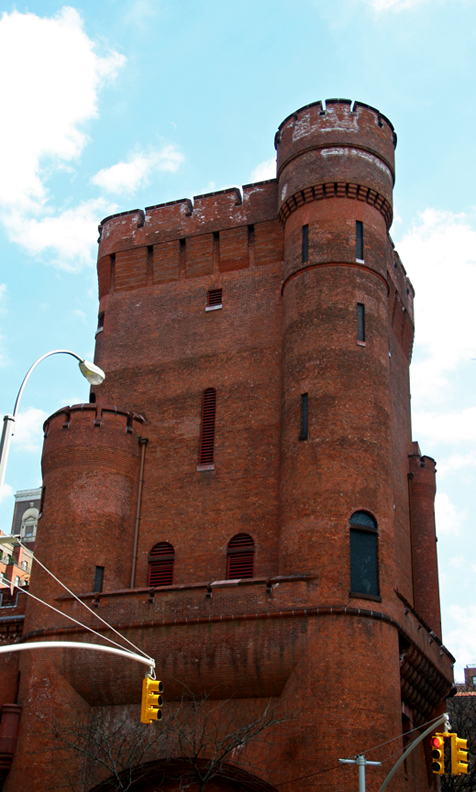
    Where else but in New York City could you discover something this large, having never been aware of its existence? I don’t recall even seeing this medieval behemoth, which occupies a full city block on Madison Avenue between 94th and 95th Streets. See 2nd photo here.

    This is the Squadron A Armory facade. Facade, because in 1966, demolition began to make way for a new junior high school and apartment complex. However, the Landmarks Preservation Commission intervened, and the demolition was stopped.
    Squadron A refers to an historic cavalry unit based out of New York City’s Upper East Side. It was formed by a group of wealthy young men with an interest in equestrianism. Read more here.

    If you travel up Madison Avenue, don’t be so distracted by all the high-profile boutiques that you miss Rhinelander’s Dream and the medieval ruins of Squadron A Armory…


  • White Sauce

    Posted on by Brian Dubé

    One of the extraordinarily fascinating facets of New York City life is the ethnic concentration that you often find in various businesses and enterprises. And one of those enjoyed by all is the cuisine. This is what makes New York a literal smorgasbord of delectable food from all corners of the globe and one of the biggest allures of the city to visitors.

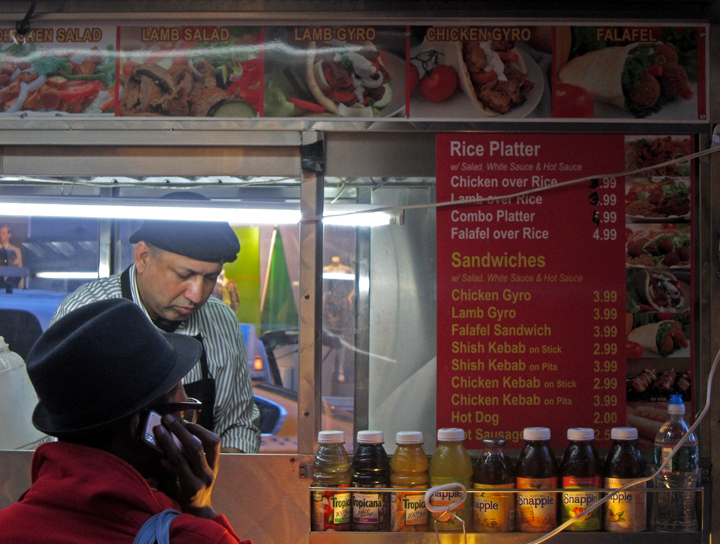
    Halal food carts are to be found everywhere in the city. I was perplexed at the large number featuring a cuisine governed by Islamic dietary stricture- Halal is a term meaning lawful or permissible according to Islamic law, and, as applied to food, is analogous to kosher dietary laws. The number of Halal carts would seem to be disproportionate to the number of potential patrons, but, like many things in this city, the explanation is as much, if not more, about the nature of the vendors than it is by customer demand.

    New immigrant groups come to New York City in waves. One barometer is taxi and car service drivers who, in recent years, have been predominantly Bangladeshi (see Lahore here). These drivers account, in large part, for the initial success of the Halal carts. An article from The New York Times explains the evolution:

    Sidewalk wisdom holds that Muslims took over the street-cart business in the 1990s from Greeks, who had themselves inherited it from Italians and Germans. Census data broadly supports this chronology. In an analysis of data from 1990, the Queens College sociology department found that 306 first-generation German and Italian New Yorkers identified themselves as members of an occupational category that included the job “street vendor”; by 2005, that figure had dropped to zero. During that period, the number of Greeks in the field rose to 200 from 120, while the number of Egyptians, Bangladeshis and Afghans surged to 563 from 69.

    Of course, hungry New Yorkers and visitors are happy to adapt to any new well-prepared cuisine. The Halal cart at 53rd and 6th Avenue is now legendary, with lines as long as 2 hours. They have been finalists in the annual Vendy awards. Initially patronized by those of Middle Eastern and South Asian descent, this cart, like others, is now frequented by many others.
    What’s particularly nice about Halal food carts is that they offer complete meals, such as chicken and rice, not just a snack item such as the ubiquitous hot dog from small pushcarts. See a Halal menu here.

    And then there is the mysterious, semi-secret white sauce, which has spawned discussions and articles – see here. New Yorkers love this kind of thing – what’s better than a secret, mysterious, ethnic, delicious white sauce?

    Posted on by Brian Dubé

  • Lemonade Maker

    This story was going to be called Switchin’, but on reflection, I realized that this would do a disservice to our subject. Let me explain.

    One day, in the 1980s, I found myself with a California real estate broker in his luxury automobile. He was showing off his hands-free cell phone mounted to the interior of his car – a big deal at the time. He received a call from his office regarding a particularly difficult situation with a client. Not to worry, he said, because he was adept at turning lemons into lemonade.

    It was the first time I had heard this old saying, and I loved it. The broker could be perhaps better characterized as someone who could sell refrigerators to Eskimos, but nonetheless, turning lemons to lemonade became a popular code phrase in my office when help was needed in dealing with a particularly difficult customer situation. When these calls were forwarded to me, I liked the challenge of making lemonade.

    Subway service disruption is one of the most frustrating things that NYC commuters face on weekends. You can read about the reasons for this here. On Saturday evening, a friend and I decided to travel to Bay Ridge, Brooklyn, by subway (rather than drive) to eat at First Oasis Restaurant, which is conveniently located on a subway line. Weekend travel on the train can actually be relaxing. However, no sooner had we started our journey that the service disruption monster raised its head, with a litany of arcane and sometimes unintelligible instructions barked from a poor speaker system over the ambient din.

    Our fellow rider seen in the photo (who we learned on parting was Reverend Branch) immediately volunteered a translation and interpretation. He was going our way, and soon we were taken under his wing. He was a warm, avuncular human being and we took to him immediately. He parsed all the subway speak and disruption details and informed us of every train change and switching option. Switching trains (local to express and vice versa, etc.) from one track to another across station platforms is a common strategy used by experienced riders to save travel time.

    At one point, the Reverend proposed running across the platform to catch another train that was pulling in, and we happily followed. Soon we were criss-crossing platforms, with the Reverend explaining every possible scenario and station detail. Where many would groan about disruption, the Reverend was turning lemons into lemonade, and we were drinking as fast as we could. This was actually fun.

    Never believe what you hear about New Yorkers. Reach out when the opportunity presents itself, and I will guarantee that most often you will find warm humans and, if you are lucky, a Lemonade Maker 🙂

    About Reverend Branch: The Reverend is Community Liaison for the High School of Sports Management Celebrity/Charity Softball Game.

    Note: I certainly do not want appear insensitive to those commuters who have to put up with subway service disruption on a regular basis. I know that our journey was not fraught with the anxiety of getting to work or another destination in a timely manner.


  • When Your Name is Mud

    Posted on by Brian Dubé


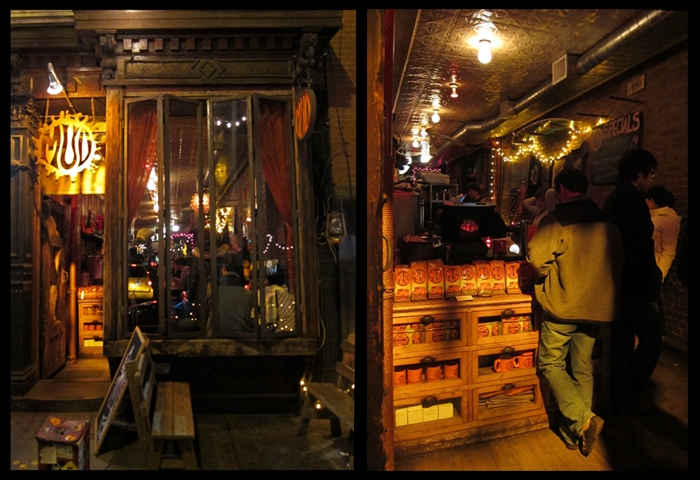
    As much as I dislike chasing the latest trends or frequenting the latest scenes, I also don’t want to be the last on the block to know about a place that is genuinely a great find. All of my friends had recently discussed the coffee and ambiance of Mud, and on a recent visit to Doma, I overheard someone tell his companion that Mud in the East Village was also a cool place, inhabited by writers. So it was on the must-visit list.

    And so I was quite pleased that on a friend’s birthday celebration on Saturday night, a decision was made at dinner to go somewhere else for dessert. This is a common phenomenon in New York City, because a specialist in desserts and (and coffee) is usually just around a corner or a short stroll away, particularly in downtown Manhattan. This dessert somewhere else, akin to bar hopping or a pub crawl, is motivated by any number of reasons – change of scenery, better desserts, or better value.

    At Mud, the desserts are quite pricey, so I would not encourage value shoppers to seek this place out. However, being in the cafe business is tough these days. It is not only competitive, but with the rain (or reign of laptops), these places have become second living rooms. Some customers may buy one drink and spend the afternoon. At this point in time, in small cafés like this, pricing reflects more a space rental fee than the value of food or beverage.

    But the ambiance is tres cool, there is a garden in the back (glass topped in winter), the desserts are excellent, and the coffee – well, Mud gets raves, but I leave you to decide. I am not a coffee drinker, and even at that, coffee must be up at the top of the list of most contentious topics in New York City, along with pizza and Japanese restaurants.

    Mud was launched as Mudtruck in 2001 by husband and wife Nina Kay Berott and Greg Northrop. Mudtruck was immediately compared to the green giant of coffee – Starbucks. The pricing from the Mudtruck was significantly less than the Starbucks surrounding it. Add a quality brew, and the place quickly became a regular stop for many.

    The orange vehicle, a converted Con Ed truck, can be found at Astor Place (and now a second location on Greenwich Avenue). At the Café, they sell their own custom blend of coffee beans, along with mugs and Mud branded apparel. There’s a mini industry here with the Mudspot, Mudtruck, Mudshop, and Mudmusic. It gives a new meaning to your name is Mud 🙂

    Photo Note: Orange is a dominant color theme at Mud. Appropriately, our birthday boy also loves orange – that’s his T-shirt in the upper right corner of the lower photo 🙂

    Posted on by Brian Dubé

  • Miracles In Our Midst, Part 2

    Posted on by Brian Dubé

    (see Part 1 here)

    At one time, Greenwich Village and SoHo had a large number of independent natural food stores, virtually all of which have closed. Whole Foods (no relation to the existing national chain Whole Foods Market), at 117 Prince Street, stood for 3 decades, from 1970 to 2000. This and a second Upper West Side location were owned by Charles Rosenblum. The Prince Street location was the largest natural foods store in New York City in dollar sales and became a mini mecca of sorts. My own business was located only a few short blocks away and my walk to work took me by the shop daily, so I frequented it often over many years.

    It was here in the early 1990s that I met David Miller, a man who worked the vitamin department. He was extraordinarily and curiously knowledgeable – the reason became immediately apparent once I learned that his intention was to enter medical school. At a later point, while in medical school, the demand for his expertise became even greater for David in vitamins at Whole Foods.

    David appeared to have a West Indian accent, so I inquired as to his background. I was stunned when he told me he was from Dominica. If you have read Part 1 of this story, you know of someone rather obsessed with this island nation. The tiny population of the island made it unlikely that I would ever meet a native by chance in New York City, so this discovery was a major event. Of course, I told him of my romance with the island, but words are cheap, and it is easy to imagine that I might be perhaps trying to ingratiate myself with him.

    How was I to demonstrate the sincerity of my special interest in Dominica? Quite simple – exhibit A from Part 1 of this story should do rather nicely, so I announced to David that I would return the following day with something special that I assured him he would never see in New York City.

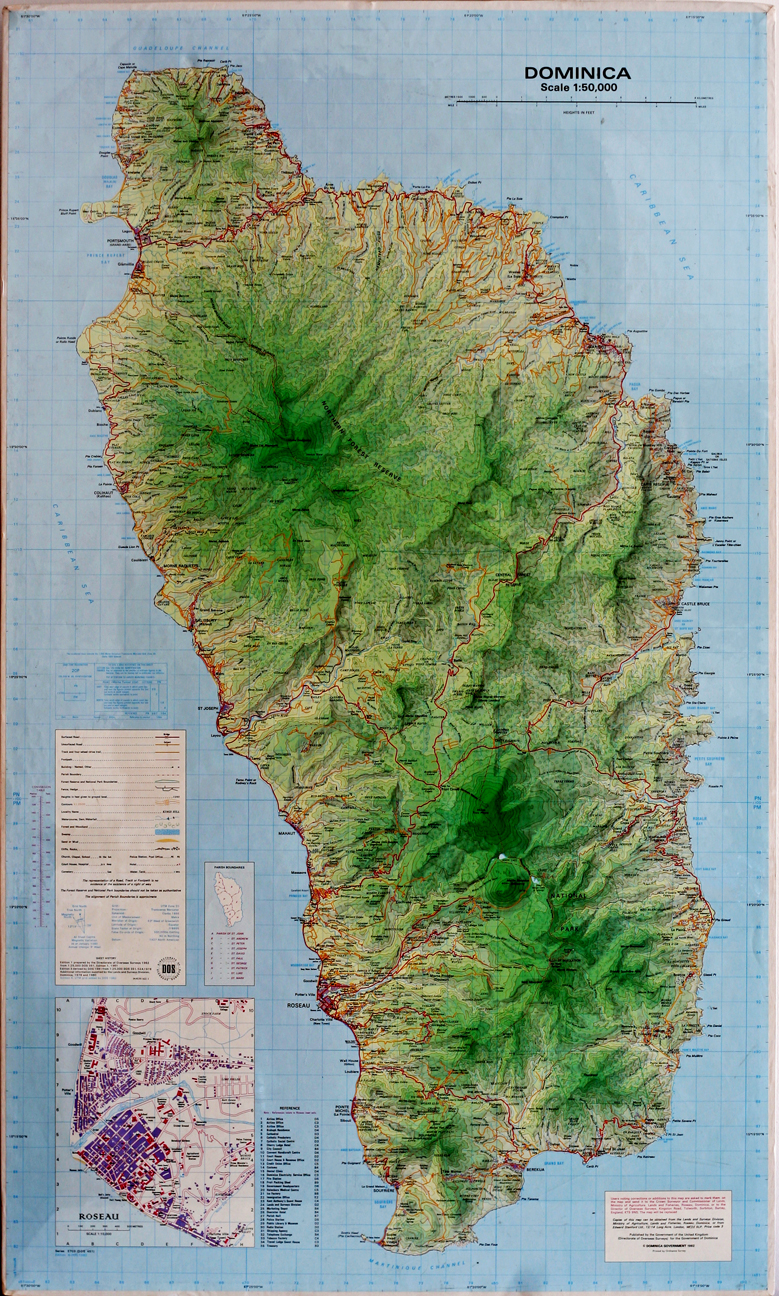
    The next day, I strolled buoyantly down Prince Street with my 24″ x 41″ British Ordinance Survey map of Dominica and showed it to David. He was astounded and said he had not seen a map like that outside of the classroom when growing up on the island. That day cemented our unique connection.

    Recently, after 10 years of losing contact, I ran across David in a white lab coat with his stethoscope at Lifethyme, a natural foods shop in the Village. I was pleased to learn that he is now Dr. David I. F. Miller, M.D., a graduate of Ross School of Medicine in Dominica, and is currently looking for a residency. David works at the shop several days per week, helping hundreds of individuals who query him on every imaginable ailment.

    In the time I was in the shop to take photos of him, I spoke with a long time devotee who championed David as no less than a miracle worker, having helped him through ailments. He detailed to me his medical treatment at Memorial Sloan-Kettering and the improvements he saw with David’s recommendations. He knew of many others who had similar experiences.

    In an amazing twist, David told me of a recent discovery in Dominica. There are 22 centenarians out of the island’s almost 70,000 population – three times the average incidence in developed countries. The reasons for this phenomenon are the subject of current research at the Ross University School of Medicine.

    Perhaps this was the island Eden I was searching for. But with a doctor from Dominica dispensing free advice, why look so far from home when we have miracles in our midst? 🙂

    Note about David: Dr. David I. F. Miller, M.D. was born in Roseau, Dominica in 1966. After the devastating Hurricane David of 1979, David lived for a time in Montserrat, West Indies. He moved to the US in 1987 and returned to Dominica, where he attended Ross School of Medicine from 2004-2008. He currently is married and living in Brooklyn, New York.

    Posted on by Brian Dubé

  • Miracles In Our Midst, Part 1

    Posted on by Brian Dubé

    Part 2 of the story is here.

    In the 1970s, New York City was not particularly hospitable to the vegetarian or natural foods devotee. Granted, it was better than the suburbs, where anyone with such a dietary regime was regularly cross examined as to the reasons why. Vegetarianism did not have the cache it does today, where Hollywood stars adopt it as the latest fashion, like a pair of Birkenstocks or Buddhism.

    Natural food stores and a handful of vegetarian restaurants existed, but outside of these outposts, natural foods did not permeate the fabric of the American culture the way is does today. Soy milk, tofu, brown rice, whole grain cereals, bottled smoothies – these items are common today in virtually every grocery shop and deli in New York City, but at that time, they were hard to come by and had to be ferreted out, tantamount to panning for gold.

    There were books such as Survival Into the 21st Century (over 1 million copies sold) by Viktoras Kulvinskas and Man’s Higher Consciousness by Hilton Hotema, which became nearly biblical with the vegetarian community and members of the health food movement. The authors espoused various dietary philosophies such as fruitarianism, mucusless diets, liquidarianism, sproutarianism, raw foodism, veganism, and even breatharianism. On occasion, one of these gurus might visit the city for a presentation of sorts. There were health expos at the convention centers.

    This environment, along with the idealism of youth and a desire for an idyllic Eden, led to my long obsession with tropical islands, where I dreamed a person might live on the fruits of nature. Stories of dietary extremists such as Johnny Lovewisdom and his attempt at recreating a paradisaical life in the Andes of South America were the inspiration for many.

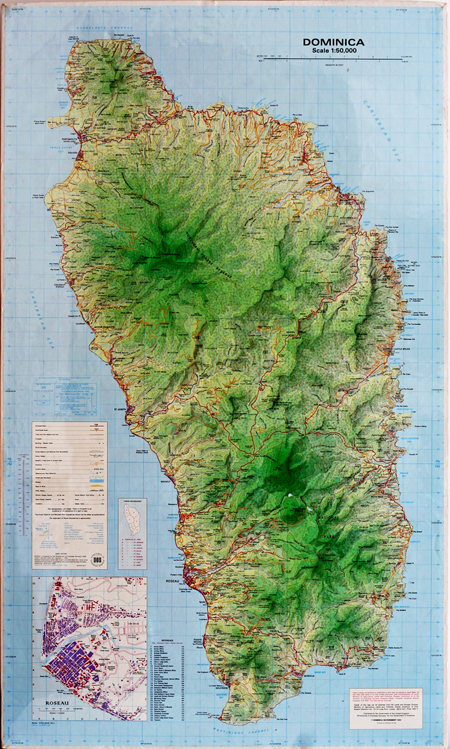
    Cold, dreary New York City winters seemed antithetical to visions of tropical paradise, and soon I needed to claim my own Eden, even if for only 10 days at a time. However, my flavor of Eden included hot showers, air conditioning (or at least fans), and flush toilets. So, I opted for tropics close to home with some modcons – the West Indies. I visited many of these islands over several years, but none had the impact of Dominica (not to be confused with the Dominican Republic). This lush island was home to rain forests, rare birds, waterfalls, daily rainbows, and mountains – Morne Diablotins rises to 4,747 feet – quite dramatic for an island of only 291 square miles.

    It was the botanic garden I had been searching for, and I made three visits. I had the island virtually to myself – the scarcity of beaches is one of the primary reasons that the island is little known and the least visited of the Caribbean islands (around nearly the entire island, green covered mountains plunge to the sea). You can read more about this remarkable little island gem here.

    Is there a stronger connection between Dominica and New York City than my ruminations and obsession? Yes, there certainly is, but for that, you have to meet David Miller. We will do that tomorrow in Part 2 🙂

    Photo Note: This is a British Ordinance survey map of the island, dated 1982. I purchased this large map (24 in. x 41 in.) on one of my visits to the island and, on my return, had it mounted on foam core.

    Posted on by Brian Dubé

  • Someone is There

    If today’s photos look rather unassuming, welcome to another episode of Content is King. This is one of New York City’s best examples of all work and no fanfare.

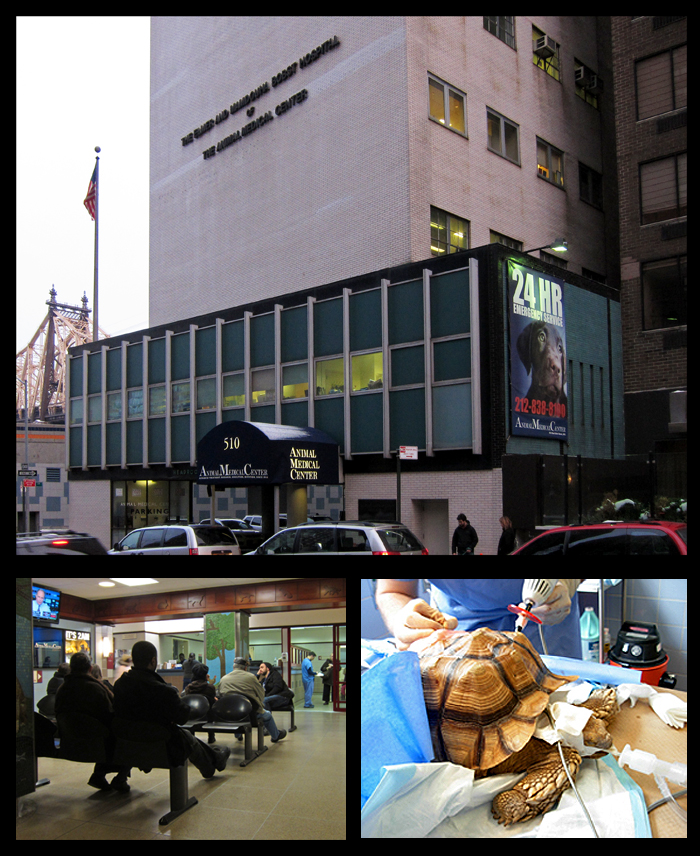
    This nondescript, 9-story building at 510 East 62nd Street, sandwiched between the back of the Bentley Hotel and the FDR Drive, is home to the Animal Medical Center, a place that for the last hundred years has been “the place to go” for emergency animal care and treatment of exotic pets. It has been best known for those who want to treat their pets and for whom money is no object.

    The Animal Medical Center is not just a veterinary clinic. It is is a full-blown hospital with MRIs, CT scans, radiation therapy, cancer treatment, hemodialysis clinic for pets with kidney disease, and a rehabilitation clinic with an underwater treadmill. There is a full range of specialties – dermatology, diabetes, endocrinology, hematology, neurology, oncology, radiology, etc. There is an Avian and Exotic Pet Service, which treats birds, rabbits, ferrets, guinea pigs, turtles, snakes, lizards, and small rodents.

    One of the huge pluses here is that the hospital is open 24/7, and anyone can walk in for emergency care at any time without an appointment. Until very recently, the center has essentially been the only game in town. But recently, competitors have entered the arena: NYC Veterinary Specialists and Fifth Avenue Veterinary Specialists, both offering a 24-hour emergency room and high-tech equipment. See a New York Times article here on the competition.

    Experiences at Animal Medical Center are extremely varied – pet owner reviews range the gamut. Many feel that the center has rested on its laurels a bit too long. Some are furious, while others sing nothing but the highest praises. With so many vets, interns, and patient load, it can be expected that patient experience will vary. A frequent complaint is the high fees generally incurred there. However, it should be understood that many of the procedures taken are not typically done for pets at all and have the same costs as those done for human patients. Ironically, I also see many negative reviews and similar complaints for the NYC Veterinary Specialists, surprising for the new man on the block.

    Pet owners are a very touchy bunch. Many are intolerant of anything less than the best care and attention. AMC is a large facility and definitely has a bureaucratic feel, with layers between the pet owner and doctors. Long hours in the waiting room, a more impersonal reception, and surprises at the cashier’s window, although not excusable, are also not surprising with such a large operation in a big city and an international reputation. News has it that there will be a campaign to improve patient relations.

    Everything said and done, it is still comforting that places like this exist and that day or night, when there is an emergency, someone is there…

    Photo Note: The photo at the lower right is from the AMC website.


  • Anywhere You Want

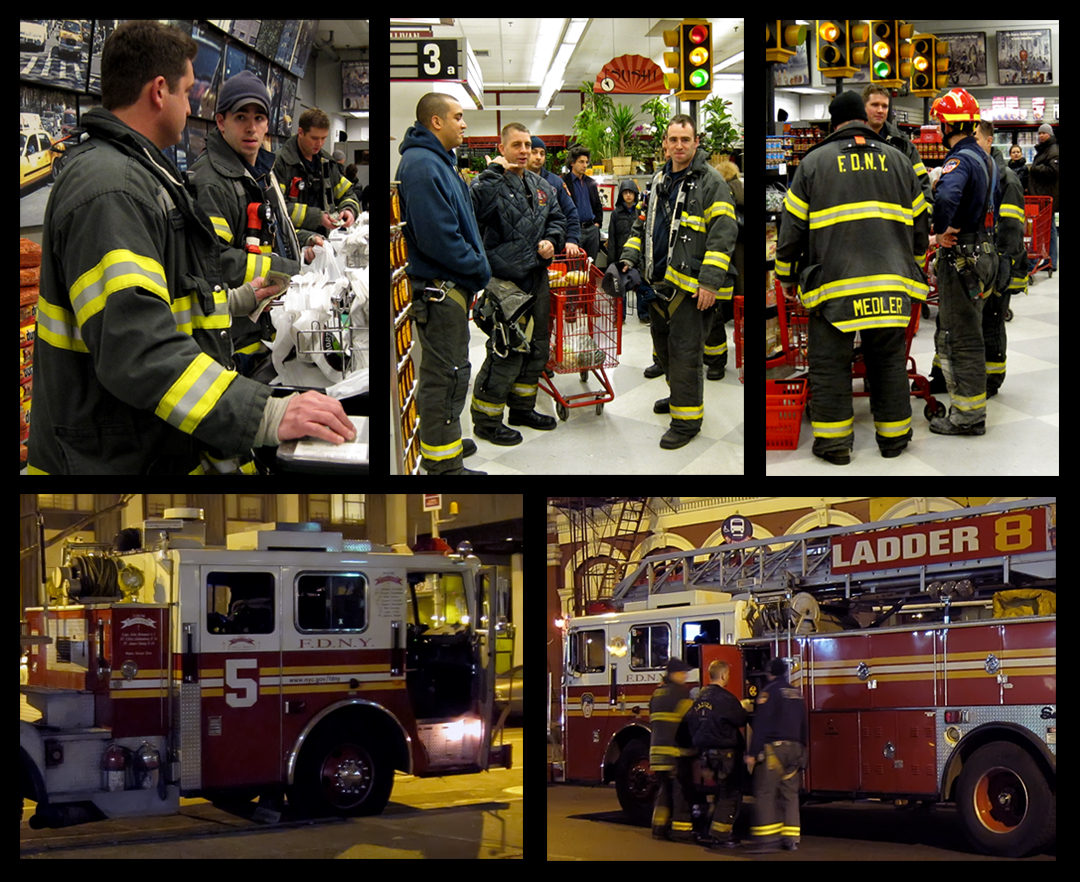
    Sometimes you get what you want, and on rare occasion, doubled. For a long time, I have waited for an opportunity to photograph members of the New York Fire Department on one of their supermarket shopping trips.

    At a neighborhood supermarket, Morton Williams on LaGuardia Place in Greenwich Village, I had noticed that one company drove and parked a full-size firetruck outside the store on a regular basis, did their shopping as a group, and drove back to their station. The first time I sighted a group of firemen with their uniforms in the aisles, it was quite startling – everything about them seemed so large and imposing. The men are big, further enhanced by the bulky, protective clothing.

    Post-9/11, photography is a much more delicate issue, so, rather than try a clandestine approach, I gave out a few cards and asked them directly about taking photos. They were very accommodating and told me that there were two companies shopping, not just one. I had really hit the jackpot.
    There was a lot of joking and jibing between companies, particularly when I asked about the firefighter wearing a red helmet and whether it was standard gear. I’m not sure if I got a straight answer – there was a lot of inside humor that I was not privy to.

    Firehouse dinners are an international tradition. Long shifts and lots of down time between calls has resulted in many unique rituals. However, like any tradition, there are rules and protocols – who shops, who cooks, who pays, what to cook, etc., with variations depending on the particular firehouse.

    With a job providing such a vital service, there comes a few privileges. For the FDNY, it’s a nice home-cooked dinner and easy parking. Where do you park a full size hook and ladder in Manhattan? When you’re the FDNY, the answer is anywhere you want 🙂


  • dinamic_sidebar 4 none

©2026 New York Daily Photo Entries (RSS) and Comments (RSS)  Raindrops Theme