• Category Archives People
  • Look How Tall He Is

    Mike McGuigan and the Bond Street Theatre Coalition

    I have a nephew who is quite tall. As he was growing up and it was clear that he was going to be very tall, it became the popular subject on my visits home. My mother could not refrain from pointing out how big and tall her grandson was, just beaming with pride, repeating ad nauseum things such as look how tall he is, or he is going to be really big, or he is bigger than his father already, etc. I also grew up in an era where I had to hear about men who were tall, dark, and handsome, like movie star icons or my father. However, being of average height, I did not grow up with any major psychological damage, only occasional lingering curiosity as to the nature of an alternate life had I been very tall.

    Apparently, there is merit to all this madness about height. I just finished reading “6 reasons why tall people are better than you,” which includes the facts that tall people earn more money, are considered more attractive, are better athletes, are leaders, and that women prefer tall men. According to a study by the National Bureau of Economic Research, both men and women who are above average height — 5 ft. 10 in. for males, 5 ft. 4 in. for females — report higher levels of happiness than smaller people.
    And, of course, the most often cited benefits for taller men is that women choose them because they are seen as more powerful and can better protect them and their children from other males. One study has shown men hit hardest when striking downwards and that the blows of a taller man are more powerful than those of a short man. Scientists have found that our prehistoric ancestors punched hardest when they stood on two legs – it is thought that fighting was the driving force behind the evolution of upright walking and that males would be better at beating and killing each other when competing for females. If taller is better, then perhaps it would explain one of the appeals of stilt walking.

    Recently, while sitting with friends in Washington Square Park, a group of stilt walkers appeared unexpectedly. Not the most common of sights, even in New York City. I scurried over to one of the group that I recognized from afar – Michael McGuigan, the managing director of the Bond Street Theatre Coalition. The other members of the group were interns. I asked if he would come say hello to my group of comrades. He happily obliged, as is his nature. Not a surprise for a man who, along with his wife Joanna Sherman, have spent a lifetime in programs of a philanthropic nature. Read more about them and their organization here. I made the introductions and we all chatted briefly, looking up at the very tall man. As Michael rejoined his group, I went with them, capturing a few photos along with a short video you can see below.

    It occurred to me today as I wrote this, that perhaps I should have become a stilt walker and put to rest for good any concerns about being tall enough or missing any possible commensurate benefits. What better place to aspire to great heights than New York City, where everything and everyone towers above and looms large?
    And my nephew, no longer king of the hill, would have to learn to play second fiddle. I would enter the ranks of the high and mighty, laugh at the world below like Mike McGuigan, and begin to hear something new wherever I roamed – Look How Tall He Is 🙂

    Want to learn more about what I do for a living? Check out Just Like ThemShop ClassSmile By FireNot Of ThemPlease Rub Off On Me, Just Like Steve MillsOn the RoadSupercute!Viktoria’s SecretSignatureSpinning, and Juggle This, as well as my websites for my juggling equipment and hoops.


  • Babies, Flowers and Kittens

    I have endeavored to write intelligent, provocative, entertaining stories and take photos that illuminate life in New York City. I spend mornings slaving over my text and working in Photoshop tweaking images. My stories get decent readership and, here and there, occasionally cited. Some of my photos have been featured online or in print. A few have been purchased. At one level, the appreciation from readers is rewarding and fulfilling. However, the website has certainly not “gone viral,” and often, I am disappointed that more readers do not find it and share my enthusiasms.
    But one particular day, I needed to vent my frustration regarding a website I had learned of. I turned to my graphic artist, who had been supportive of New York Daily Photo from its inception, helping with graphics and giving me suggestions to attract more readers.

    The website was called Cute Overload. Before even visiting it, merely based on its name, I sensed that it was a clever idea and likely would be a roaring success. And it has been, now sporting 1.6 million visitors per month. And the content is provided by others. Images of cute things – puppies, kittens, children – dominate the site, and readers by the millions apparently have an insatiable appetite for such things and just cannot get enough of it.

    I discussed my discovery with my graphic artist and that no matter the quality of my site, there was no way I would attract even a fraction of the visitors that a site like Cute Overload would. And she summarized my dilemma well. Apart from sex, she said, people loved to see three things – babies, flowers, and kittens. The triumvirate of ultimate human appeal became a private joke around our office. She was right, of course. The masses want the benign, the adorable, the cuddly. They want the untainted, the innocent. And what is more innocent or untainted than babies, flowers or kittens?

    A somewhat lesser benefactor of one of the trinity is Alan Neil Moriarity, a street performer whom I met at night on 6th Avenue in the Village. Neil is very approachable and chatty. I spoke to him for quite some time and recorded some of our conversation and his playing. See the video below.

    Neil has numerous young cats which travel with him. One or two of the pride make home on his head and shoulders while he plays harmonica and chats passersby. In all honestly, those that stop appear to be more interested in fawning over his cats than listening to music.

    Having had numerous cats, I complemented Neil. Cats are not typically enamored to accompany an owner outdoors, much less sit on one’s head without trying to jump off and hide in the shadows. But these cats seemed extraordinarily attached to him, unusually calm, comfortable, and content. Neil says they really like to listen to him play music by the Doors. He told me that his cats have been life savers for him. I suggested that he needed more exposure and that in the future he might want to take his act to Washington Square Park, rather than work late night in dreary weather on a commercial strip. He seemed receptive to the idea. Perhaps he will find greater success if he works in at a better time and place, where he will learn the power and allure of Babies, Flowers and Kittens 🙂

    More cats: The Engine Room (Part 1 and Part 2), That Last Ball, Urban Mitts, Kitty

    More cuteness: Just Like Them, Buy Magnesium, Supercute!, The Last Taboo, Bubbles, Heart Warming


  • White By Design 5

    White On The Road
    Why so many stories about white, you may ask. Well, apart from any historical, symbolic, or spectral aspects of the white, choosing this color for articles of clothing or anything subjected to the elements, particularly in New York City, makes a big statement. Here are some snippets from my previous White By Design stories:

    There are many things to love about the color WHITE. For some, use of the color in their homes and wardrobe borders obsession, like that of the good friend of mine whom I wrote about in White By Design.
    In New York City, choosing white takes on a spirit of defiance. Analogous to She’s Too Tough To Care, wearing white is like saying I don’t care that white makes no sense in New York City. We have rats, graffiti, pollution, dirt, and grime, but I will wear white anyway.
    Wearing white also sends a message that a person is willing and able to go the extra mile in maintaining such a color choice in the city.

    Used badly, white can be a horrific choice – everything is mercilessly revealed with white. It is also deliberately and conspicuously impractical, making a statement about luxury and the ability and willingness for maintenance. The decision to use white in an unforgiving city like New York makes a particularly strong statement.

    Yes, go the extra mile. And what extra mile is longer than that of a homeless person who chooses white for her wardrobe? The woman in today’s photo, who is a recent habitué of Washington Square Park, is garbed day and night in a wardrobe entirely in white – pants, socks, sandals, shirt, jacket, gloves, ski hat, and the final piece de resistance that drew my eye to her originally – white rimmed glasses. I have seen her rummaging through her travel suitcase for her hat or gloves. The contents? Articles of clothing which are 100% white and, like what she wears, all appears to be scrupulously clean.

    I did speak to her one evening, but approached her cautiously. As a friend pointed out – look at her body language. Conversation was a bit awkward. She was quite reticent and very guarded, understandable for someone living on the streets of New York City. I discussed my blog and my previous series of stories, White By Design. I showed her a number of photos on my iPad. Seeing hard evidence that I genuinely had an interest in those who love white, she let her guard down a bit. She told me that she has been in NYC only about a week, living in the park. She has been an itinerant traveler, but I got no details as to where she was from, where she had traveled, or when and where she would be going next.

    I complemented her on choosing white and the willingness to do the work it must involve to maintain her wardrobe so meticulously. She did not elaborate on her choice of color but responded that she does like cleanliness and does her laundry about every three days. And that’s the drill for someone who not only embraces the spirit of White By Design, but also keeps things White On the Road 🙂

    More on white: White by Design 4, Off-White by Design, The Perfect Gift, White by Design 3, White by Desire, White by Design 2


  • Humanity Comes in Small Bites

    New York City is much loved by many. However, it is no paradise, and the slings and arrows can easily outweigh the pleasures. I cannot speak to the experience of living full-time anywhere else, but this is no heaven and unless a masochist, the resident is best to lower their expectations for bliss and look for Pockets of Joy and Small Gestures, not Eden. Random Acts of Consideration will stand out and become noteworthy events, set against Acts of Rudeness. Here, acts of humanity come in small bites, not large meals.

    Yesterday was Labor Day and for many New Yorkers, the last hurrah of the summer season. The desire to get away is great, and much of the city is peculiarly quiet. For those who have not made the mass exodus, it is an opportune time to indulge in the luxury of leisure with a minimum of neurotic energy. I opted for a day with no agenda, perhaps atypical of the city denizen who seems eternally driven to some purposeful activity.

    So it was, that I found myself exploring the city by car with my girlfriend, much as I did as a child with family on the classic Sunday afternoon drive. Our ride took us to the Upper East Side, originally with a mind to visit Central Park. The threat of rain, however, became a deterrent to any out of car strolling, so we agreed that we would spend the afternoon exclusively riding around. I zigzagged the cross streets of the neighborhood, primarily those blocks between 5th and Madison Avenues, often referred to in real estate parlance as the “park blocks,” owing to their abutting Central Park. It is here, along with 5th Avenue itself, that one will find some of the world’s finest residential buildings. I particularly love the limestone mansions and the gracious elegant pre-war apartment buildings. Here, peering into the occasional window, one will often find beautiful cinched drapes as window treatment, not the more common unadorned window or vinyl roller shades.

    I dream of the luxury behind those windows – tall ceilings, plaster moldings, ornamental crown moldings, foyers and spacious rooms lit by chandeliers. Architectural details and roomy comfort define these places, and to have the privilege of living in such a home is to enjoy being in what feels like a refuge from the city and a veritable fortress from its ills. Although the stereotypical snooty resident of the Upper East Side would indicate that this neighborhood is likely not my style, I remain fascinated and desirous of a place that is quiet and free of so much of the tacky, touristy shops and crowds that one must tolerate in the Village, where I have lived for over 4 decades.

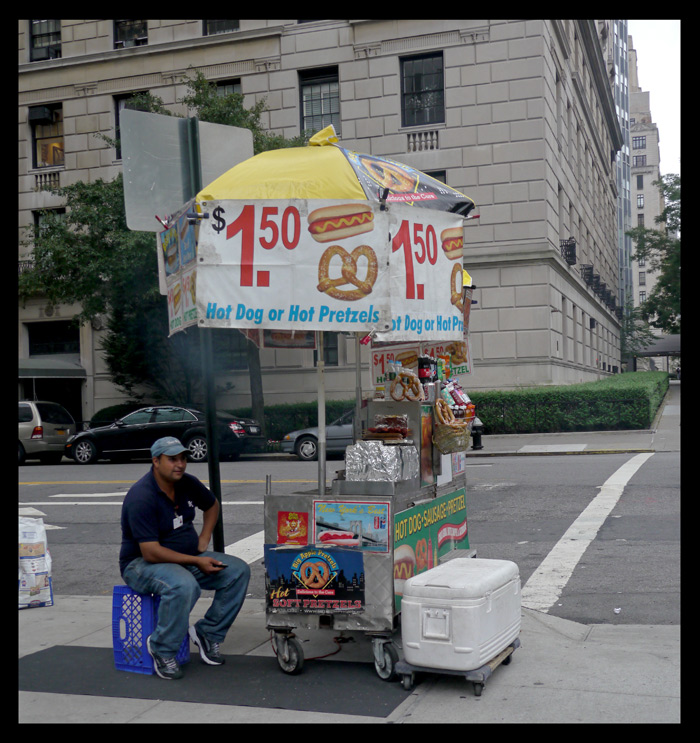
    As we drove, my girlfriend, who herself prefers a diet of small bites and snacks over large meals, expressed her desire for a pretzel. The classic New York City street pretzel is to be found in carts everywhere, and as we turned the corner at 86th Street and 5th Avenue, my girlfriend pointed out a cart boldly advertising $1.50 pretzels. I left her in my vehicle in front of a fire hydrant – this is legal for standing in New York City and typically the only free spots available in most areas of the city.

    As I approached the food cart, there was a small altercation. Apparently a member of a group of individuals was bargaining the vendor from $1.50 to $1 for a bottle of spring water, claiming they had only the single dollar between all of them. The vendor acquiesced. I empathized with him and I told him that it seemed to be an impossibility that an entire group of well-dressed people would not have an additional 50 cents between them. We both agreed that is was just a typical negotiating ploy. The vendor, however, told me that business was painfully slow and that he took what he could get. I purchased a pretzel and immediately noticed how warm and soft it felt – unusually fresh for a street pretzel these days. My girlfriend confirmed, and went further to say that it was perhaps one of the best pretzels she had ever had. I concurred.

    As I drove away, I reflected on the entire experience – Mohammed’s generosity and kind manner in spite of the rude and aggressive disposition of his previous customers. Although not a momentous event, it seemed worthy of a story. I circled the block, parked again, and I approached the vendor, who I learned was Mohammed Hussien Abdelmohsen and hailed from Egypt. I took a photo, gave him my card, and informed him I would be doing a story. I told him that in the course of the time to circle the block, the story title had already made itself very quickly obvious because here, in New York City, whether it be acts of kindness or well-made pretzels, Humanity Comes in Small Bites 🙂


  • My Religion is Kindness

    Have you ever repeated a word or phrase until it loses meaning? I imagine you have and, perhaps like most, discovered this as a child, marveling, sharing, and testing the phenomenon with your peers. It’s been studied and is called semantic satiation. Today, for me, I am experiencing this with the word kindness.

    I had been in Phurpa Lama’s shop a number of times before and on my last visit, agreed with the owner to return to do a story with photos and a short video interview. Last night, I walked to the shop with camera in tow. As I arrived and examined his window display, I noticed a sign for the first time which said, “My Religion is Kindness.” I was sunk. I became fixated on the word kindness, which began running through my head as I entered the shop, spoke with Phurpa, videotaped him, walked home, contemplated this story, and drifted off to sleep, recalling Jamie Adkins’s use of the phrase Kind Words

    This morning, kindness was still on my mind. The power of words reminded me of a television segment I saw with John Lennon and Yoko Ono, calling someone at random on the phone to tell them “I love you” and encouraging the listener to do the same, eventually creating a chain of love. This, they averred, would spread love and peace throughout the world. Perhaps a bit of youthful naiveté, particularly if one allows for how much callers may indulge John and Yoko, as opposed to you or I.

    Phurpa Lama’s aspirations are much less ambitious, or at least not fueled by celebrity. I learned that Phurpa was born in the small village of Ganggyul in the Hyolmo region of Nepal. At age 7, he became a Buddhist monk. It is as a monk that he emigrated to the United States and New York City. He now owns the small shop Padma Tibetan Handicrafts at 234 Thompson Street in the Village for the last two years.

    To enter the shop is to feel an extraordinary wave of peacefulness and calm in the eye of the storm called New York City. He told that many visitors to his shop also spoke of the incredible soothing ambiance. The merchandise is a riot of color – beautiful fabrics, jewelry, and other Himalayan artifacts. I was fascinated by the brass singing bowls, something I am compelled to listen to on each visit. These bowls are hand hammered bronze. They are played by rubbing a wood mallet around the rim of the bowl to produce a continuous ‘singing.’ The unique sound, accompanied by harmonic overtones and vibrations, is remarkable to experience first hand. Phurpa is always happy to demonstrate. He told me that the singing can be used as a meditation, a practice he does daily with the frequent lulls in business in his small shop.

    Phurpa is is occasionally assisted by his wife, Pema Yeba, who I have yet to meet. Her presence there is now more infrequent, owing to her care for their newborn child. Phurpa works 7 days, 11AM to 11PM.
    Our conversation turned to kindness and its value in a world of hostility, anger, and conflict. He affirmed the importance in his life of the words I had seen in the window, made famous by the 14th Dalai Lama, Tenzin Gyatso: My Religion is Kindness


  • Just Another Loud Mouth

    Click to listen to the loudmouth:

    I have discussed from time to time with a close friend a personal irritation of mine, and that is the sense of false importance that many individuals have. In reality, in the grand scheme of things, how much does any one person really matter? Of course, to loved ones and family, we are very important. But, to hear or overhear some, a conversation could lead one to believe that the universe hinges on their being. There are many manifestations of such, like the character whom a friend and I painfully witnessed in my story Poor Winnie (see Part 1 here and Part 2 here).

    There is perhaps no better example of such a person than the LOUD MOUTH or BIG MOUTH, in a restaurant, not far from your ear, where you are a captive audience member, forced to listen to their diatribes, rants, and assertions, which could lead one to conclude that they are genius in many areas of life, much like the self-proclaimed Creative Expert. There is no doubt that you are listening to such an individual – the word “I” dominates their sentences, and additionally, a particular emphasis is typically added to the personal pronoun. Pepper the conversation with a loud, distinctive, very confident, self-congratulatory laugh and now you have a someone with a big stick, much like a judge’s gavel, that will command attention, regardless of any conversation you may be having.

    And what better place than New York City, where the sense of self-importance and community pride can rise to uncanny heights, to breed such individuals?  The classic arrogant New Yorkers, who, even though they may not have achieved any particularly noteworthy life achievements, can have tremendous attitude, as if their very existence as a native confers superiority over all those who were not fortunate enough to have been born in New York City.

    Such was the case recently, sitting in Olive Tree Cafe in the Village, where a number of us were painstakingly exposed to a woman who was about as bad as it gets. She had neither a sense of propriety nor appropriate voice volume, oblivious to her surroundings as her booming voice and irritating caustic laugh rose above the din, so distracting that it became difficult to do anything but listen. The content of the conversation was not particularly important. It was “I” think this and “I” feel that. And no one really cared, because it was Just Another Loud Mouth 🙁


  • Easily Washed Off

    Pouring over old books some years ago, I happened across my 1965 Boy Scout manual. I never got particularly far in the scouts, but reading the manual, apart from learning a bit about scouting, is a window into the attitudes prevalent in America at that time. Skimming the section on Scout Law, I reviewed the 12 points – A scout is: Trustworthy, Loyal, Helpful, Friendly, Courteous, Kind, Obedient, Cheerful, Thrifty, Brave, Clean, Reverent.

    I found the exposition on being CLEAN, particularly fun to read. Here, we are told what this means to a scout: “He keeps clean in body and thought; stands for clean speech, clean sport, clean habits; and travels with a clean crowd.” A boy is shown in the shower. However, we are warned that there are different kinds of dirt. Most can be removed easily with soap and water. However, one type is much more difficult to rid oneself of: the dirt that gets in your mind. The two sides of this admonition are no better vocalized than by Pigeon Paul, a habitué of Washington Square Park.

    For those not accustomed to city life, Pigeon Paul will come as a quite a novelty. New Yorkers, however, intimately familiar with these urban denizens, will find his behavior either charming or revolting, depending on whether one loves pigeons or, as many have characterized them, find them to be “rats with wings.”

    Paul, a Lebanese man who grew up in the Bronx, can regularly be found in the same spot on one of Washington Square Park’s walkways. There, sitting on a park bench, Paul is literally covered with pigeons – they sit on his head, his lap, his chest, his arms. He holds them with his hands. He knows many of the birds by sight and has named some. He communes with the birds, something he has been doing for over 10 years.

    A bag of seed at his side, Paul feeds the birds. Trusting and tamed by his feeding and presence, passersby can typically be found to be joining Paul in his activity. An enormous flock surrounds him. Periodically, the birds, startled by some occurrence, will take to the air, giving the area a feeling reminiscent of Hitchcock’s The Birds – I actually overheard one individual walking through a fluttering flock, muttering disapprovingly how the experience compared to the classic film.

    One video I reviewed shows Paul in a hostile verbal encounter with the videographer, who asked how Paul could deal with pigeon excrement, which certainly must be all over his body. Paul’s response would be well understood by any Boy Scout: people like his landlord shit on him all the time, but with birds, it could be Easily Washed Off 🙂


  • Culture Fix

    Posted on by Brian Dubé

    I grew up in a town where, regardless of the fact that it has a population of 61,000, THEY ROLL UP THE STREETS AT NIGHT. Even on Saturday, it is like visiting a ghost town of the West. There is virtually nowhere to eat other than fast food and nothing to do except cruise the streets in despair. No wonder the youth of America is bored out of their minds in suburban USA and turn to drugs and sex. And no wonder that places like New York City became a mecca for those who crave culture in all its variants. I understand that there are many options out of the city and also an inner world to explore – I was an avid reader and also extremely active and social. However, there are limits to how much blood one can extract from a stone, and many of our suburbs are virtually devoid of cultural activities.

    So, in 1969, I, like many, made my way to a somewhat bigger town called New York City. Here, I found everything I had dreamed of and more. That young boy still lurks within, starry eyed and excitement bound, and, from time to time, I need a jolt of electric current and a culture fix. I rekindle those first moments when everything was ALIVE at any hour, day, or night and the feeling that anything is possible. Perhaps you even have a hankering to see a grown man dressed as a macaw, dancing about, while accompanied by a band called Moon Hooch, featuring a saxophonist with an enormous cardboard tube shoved into it.

    I took a walk recently to Union Square, where, regardless of season, time, or weather, you are guaranteed to see humans in all manner of activities. Steps from street level to the park on the south side of Union Square provide impromptu stadium seating and is one of the best spots in New York City for people watching. The square is surrounded by merchants and is one of the city’s major transportation hubs. Historically it has also been a major meeting ground, a place to see and be seen and ideal for those with a political agenda or need to bring a message to the masses. The place is abuzz with people and energy.

    It was here, on July 4th, 2012, at 12:17 AM that I found a grown man dancing in a macaw suit accompanied by a rock band. I was to learn that the performance was not spontaneous nor the product of birdbrains. It was a campaign on the part of Rock the Osa to raise awareness about the development threats facing Costa Rica’s Osa Peninsula, home to the area’s last virgin rainforest and “the most biologically intense place on earth.”  Marco Bollinger the Macaw and Eytan Elterman the Sea Turtle have nearly reached their target of $25,000 by dancing to produce the documentary project, 2.5 Percent, a film promoting conscious travel in Costa Rica.

    Moon Hooch is a Bushwick, Brooklyn, based band which has played regularly in the NYC subway system. The three band members, James Muschler, Mike Wilbur, and Wenzl McGowen, met at the New School, where they studied music. Moon Hooch plays cave, a style of house music. After only a year, they have produced an album, toured nationally, and worked for a TV company.

    As with everything else in New York City, things are often more than they seem. It’s where preconceived notions are best left in the checkroom. And all the better – it just means more opportunity for someone needing a Culture Fix 🙂

    Posted on by Brian Dubé

  • The Big Mouth Does

    Posted on by Brian Dubé

    Philip Garbarino promoting his book, The Devil Repents.

    Many people do not like New Yorkers for a number of reasons. In all fairness, for a number of good reasons. New York is a city that is brash with people who are aggressive and competitive. It’s a sieve for success, filtering out those who can’t make it here or, like Dwanna, those who just don’t want to make it here. It is the ideal home for the self-centered, the narcissist who wants the largest possible audience to fan his or her flames. It is perfect for attention mongers and drama queens. And for those who prevail, it is a place where someone can make it big.

    I am always astounded at how the real estate market here manages to be buoyed up regardless of the economy. The average 2-bedroom apartment in Manhattan sells for $2 million. A New York Times article reports that in Brooklyn, there is a shortage of single family brownstones with bidding wars driving up prices beyond the listing price. With pricing like this, obviously this is a city where many have achieved material success. It is also a home to the megalomaniacal or where it may at times be difficult to distinguish between the enormous success and the megalomaniac. It is a place where one truly must abandon preconceived notions or be faced with people like Mark Birnbaum, who, despite appearances and notions to the contrary, is who says he is and has done what he said he has.

    Recently while in Washington Square Park, my attention was drawn to a man with a huge crucifix, dressed as the devil. Such a thing will provoke interest and garner attention. There was no shortage of onlookers or those seeking photo ops with Satan. I learned that this was Philip Garbarino, promoting his first book of a trilogy, The Devil Repents. The book is selling directly from Philip’s website. Chapter One can be found for free there as well. An ebook is available from Amazon. I spoke to Philip briefly and videotaped the conversation. Garbarino was eager to mention his acting credit in the film The Bronx Tale, directorial debut of Robert De Niro.

    I have no idea as to the quality of the writing or what Philip’s aspirations are. Although perhaps not a necessary condition to success, in a city where everyone and everything is screaming to be heard and seen, self-promotion is a more likely road to success than a quiet unassuming demeanor or the meek, with Donald Trump as perhaps the best example. I do like real estate magnate Barbara Corcoran’s pithy and poignant remark:

    In New York City, the meek don’t inherit the earth. The big mouth does.

    Posted on by Brian Dubé

  • The Engine Room, Part 2

    Posted on by Brian Dubé

    The Pratt Cats (see Part 1 here)

    The Pratt Cats

    As we entered the very first Pratt building, I was greeted by a cat slinking from a classroom into the hallway. A curious sight, I was informed by our guide Leslie that this was one of the Pratt Cats. Pratt Cats? I was intrigued.

    Later, when we toured the Engine Room, we encountered another cat. My attention was drawn to a windowed wall in the engine room where there was an entire display of championship ribbons from the numerous awards won by Pratt cats at cat shows. Nearby was a collage of photos, names, and descriptions of a number of these cats – Nicky, Willy, Higgie, Art School, Teddy, Prancy, Big Momma, and Lestat.

    Chief Engineer Conrad Milster informed that each cat tended to be somewhat territorial, occupying a particular building or area. The cats are fed and tended for privately. As I left the East Building and the Engine Room, I encountered Conrad outdoors, who pointed out the lilliputian Feline Staff Entrance at the base of the building’s exterior wall.

    The naming, championship ribbons, poster, informative article, and the small entrance made it clear that the feline population at the institute is not a loosely associated, changing population of strays. Quite the contrary. These cats are well-known amongst the student population and have names, identities, recognition, and social status. They have a bit of attitude, expected of any New Yorker, particularly when associated with one of the world’s finest design schools. They’re not just any cats, they’re The Pratt Cats 🙂

    More cats: The Catman, Urban Mitts, Lost and Found, Kitty

    Posted on by Brian Dubé

  • The Engine Room, Part 1

    Posted on by Brian Dubé

    A Meeting With Conrad Milster

    I recently spent a day exploring Brooklyn with two longtime friends, Leslie and Greg.  I had desperately wanted to revisit and introduce to others both the Wilburg Cafe and Salerno Service Station, which I recently featured. The cafe offered a great brunch menu, and Salerno Service was one of the most remarkable businesses I have been to in New York City. I now had two victims willing to retrace my steps. On our ride towards Williamsburg, we approached Pratt Institute. Leslie, a regular reader of this blog and subject of the story White By Design, offered a guided tour of some special spots within a few of the buildings. She had spent time as a student doing graduate work at Pratt. Visiting the school at this time of year turned out to be a great suggestion. It was a hot summer day and the campus was quiet with virtually no security, and so, our tour of the interior of some of the university’s buildings went unfettered.

    I have been to Pratt a number of times for the annual juggling festival, and my experience there was limited to the exterior grounds with their sculptures and the ARC Sports Complex. On this outing, I toured the campus, a number of buildings, and the library with its magnificent stairwell. But, in the East Building (bottom photo), there was a treasure known to most students but only to a handful of outsiders – the engine room. I had been told that the room was noteworthy, however, I was quite taken upon actually entering.

    The place exuded old world charm and history. A gallery surrounded the dark-red reciprocating steam engines. The power plant is one of the most historic in the region and has been designated as a National Mechanical Engineering Landmark by the American Society of Mechanical Engineers. The three generators, which burned number 6 oil and produced 120 volts of direct current, were installed in 1900. They were some of the last operating in the United States. The plant ceased generating power in 1977, remaining for standby emergency power until very recently. It is now fully retired.

    At one end of the room, a lit office behind a windowed door beckoned. As I approached, I saw hand lettering on the glass which read: Chief Engineer C. Milster. It was the perfect photo op – an older man sat in direct view framed by the lettering. His demeanor certainly spoke engineer, but given the age of the facility and the door’s typography, it seemed rather unlikely that this man was the very same C. Milster. As I stood outside the office for a moment contemplating, the man waved for me to enter. I went in.

    Conversation ensued, and I quickly learned that my gracious host was, in fact, Conrad Milster, now 76, who has run the facility since 1958. Conrad now maintains the school’s mechanical systems. As we chatted, it became abundantly clear that Conrad was quite passionate about the engine room and answered any and all questions.

    I felt quite privileged to meet him – Conrad is more than an employee. He is a legend and integral part of the fabric of this wonderful antique environment. But I also had noticed that other things were afoot, and I was to learn, as you will in Part 2 of this story, about the curious nature of inhabitants of numerous buildings of Pratt and The Engine Room

    Posted on by Brian Dubé

  • Mermaid Parade 2012, Part 2

    Posted on by Brian Dubé

    Pièce de Résistance (see Part 1 here)

    The costuming efforts of marchers in the annual Mermaid Parade run the gamut, from the simple but effective to the outlandish where no detail is left to chance. This year, as always, there were all the requisite sea creatures, maritime themed costumes, and, of course, plenty of mermaids. But in all the years I have attended, I have never seen the attention to detail as that in the costuming of Darrell Thorne and his partner.

    I strolled the boardwalk after the parade’s completion – a better time and opportunity to mingle and see closeup the various paraders and their costumes. I became aware of a huge throng. As I approached and worked my way into the crowd, I found what was essentially a feeding frenzy of photographers, elbowing and jockeying for position. I found the subjects of everyone’s fancy and awe – two individuals posing with the deliberate movements of experienced showmen and models, enjoying every bit of the attention, as they rightfully deserved for their extraordinary efforts.

    I spoke to one of the pair, who gave me his card which stated: Darrell Thorne –  Costume Makeup Performance. I subsequently learned that this was not Darrell’s first parade, nor was he a novice at his craft. As his card implied, this was the work of a professional, and in New York City, one expects the bar to be raised quite high in the world of fashion, costuming, and makeup.* For the 2012 Mermaid Parade, I had reached the summit with this Pièce de Résistance

    *I communicated with Darrell by email, and, typical of the many challenges to preconceived ideas one may have about New Yorkers, here is what I learned, in his own words:

    I was born the youngest of five boys in Branson, Missouri in 1976. When I was eight months old my father decided it was time to follow his dream of living off the land. He and my mother packed up their five children (the oldest being five years old) and moved to a tiny village called Red Devil, 300 miles north of Anchorage, in the Alaskan “bush”.

    The first five years of my life were spent living like the Swiss Family Robinson, but set in the pristine wilderness of Alaska, without running water, electricity, telephones, or many people to speak of, for that matter. One of my earliest memories is my father being away (on a hunting trip, I believe) and my mother at the window of our log cabin with a shotgun, all of us kids huddled around her as a black bear prowled in our front yard. The rest of my childhood was spent in tiny country towns in Missouri and Arkansas.

    I’m highly uneducated with no degrees beyond my high school diploma.  I studied dance seriously for several years and attended the Art Institute of Chicago for 1 (until I realized I didn’t actually have any money to do that).

    I’ve been in NY for 10 years – living in Bushwick for the past 3 (which I love).  After high school I spent time in Colorado, three years in Chicago, three in LA, and then to NY.

    I currently work as a hospital administrator by day at Beth Israel.  My hope and desire is to transition to a more creative career within the next few years.

    I have four older brothers and no sisters.  My parents are fundamental christians – my mother a retired school teacher and my father a jack of all trades.  My brothers are spread far and wide – one in LA, one in Denver, one in Portland and one in Helsinki.

    Growing up incredibly repressed in an extreme fundamental christian environment had a tremendous impact.  We never had a television, weren’t allowed to listed to pop music, and were largely isolated (psychologically) from our peers growing up. My parents belong to a small Calvinist religion called Independent Missionary Baptists, an extremely fundamentalist group who believe in Predestination and a 100% literal interpretation of the bible. Growing up there was no question that God was a stern and judgmental figure who would not hesitate to strike down and condemn to hell any and everyone who did not follow his commandments.

    WOW, Darrell, thanks for your candid revelations. Another lesson that in New York City, regardless of one’s instincts or insightfulness, it is best to Abandon All Preconceived Notions, Ye Who Enter Here.

    Previous Mermaid Parade posts: Mermaid Parade 2006 P1, Mermaid Parade 2006 P2, Mermaid Parade 2007 Part 1, Mermaid Parade 2007 Part 2, Mermaid Parade 2009, Mermaid Parade 2010, Mermaid Parade 2011 Part 1, Mermaid Parade 2011 Part 2

    Posted on by Brian Dubé

  • The Hollowest of Victories

    Posted on by Brian Dubé

    They may not have hopes and dreams, but they do have trials and tribulations. There are arguments, debates, frustrations, jealousy, yelling, and crying. There are attachments, relationships, and concern for others. There is a pecking order and one-upmanship. Be assured, that although this is the world of the homeless – disenchanted and disenfranchised – in many ways, it is no different than any other world.

    It was gray, rainy, and cold. Much too cold to be swimming outdoors. As I walked through Washington Square Park, a homeless woman was determined to go in the fountain pool. Her friend was not gaining any ground trying to dissuade her.

    She screamed over and over that she wanted to go into the water as he tried to talk to her and restrain her. She sat on the fountain’s interior steps and descended one at a time. She was severely drugged and unstable but strong enough to resist her friend’s efforts at keeping her out of the water. At one juncture, he looked at me and threw his hands in the air in frustration. I said to him that it was too cold and she may likely get sick. He responded by telling me he had told her just that, but he had given up. In a world where no one cares whether she lives or dies, what is she to do? Make a scene and try to capture the attention of any willing to watch and listen.

    Yes, this predicament – the drugs, her friends, her dead end life – are all her own doing. It would be unfair to say that she is down on her luck – better said, she is just down on her butt. But no matter, because at that moment in time, her pain and frustration was just as real as yours or mine. The three of us were alone in the rain, with an occasional passerby. No one seemed to care. She is disposable and will likely not live long. We are better off without her, are we not? Out of sight, out of mind. In this type of conflict, which I have seen played out often enough, even if violence erupts, the police will not arrest her – to what end? They would be told to leave and take their misery elsewhere.

    She finally reached the bottom, soaked by rain, immersing herself into that cold pool of water. Like an obstinate child having a tantrum, I could see that she was not really happy at all. She had won a hollow victory, making the whole thing even sadder. Here, in a fountain surrounded by one of the world’s most affluent neighborhoods, it is likely that some watched this entire ordeal from apartments averaging 2 million dollars.

    Telling this story makes me feel a little worse. I kid no one if I try to pretend that I feel their pain. I have never been so down that I sat soaking wet, crying as I descended into a cold pool of water on a gray rainy day at the end of my rope with no hope. It was The Hollowest of Victories

    Afternote: Later that night, I saw them under the park’s arch, playing out another confrontation, her soaking wet, lying on the grates with her friend trying to reason with her.

    More stories of the homeless: Ask Tommy, Looking for an Angel, Usually. Maybe. Probably Not., Caught in the Rain, Any Questions?, Crusties Are People Too? (Part 1 and Part 2), On the Road, Cosmetics, Crustie, Dead to the World, Stephanie, Caravan of Dreams, Extreme Camping, Homeless Art Scene, The Art of Kissing

    Posted on by Brian Dubé

  • Walter Mitty

    Posted on by Brian Dubé

    In New Yorkers Gone Wild, I wrote of my high school English teacher, an extremely iconoclastic, outspoken, and controversial figure. He was, in many ways, our version of Dead Poets Society’s John Keating. He made a number of observations and recommended readings, all of which I took to heart, some more poignant and relevant in my life than others. Upon reading the Secret Life of Walter Mitty by James Thurber, he pointed out the value of becoming familiar with the character, telling us that we would encounter references to Walter Mitty later in life.

    This turned out to be one of the things of lesser value in my life – I never recall anyone referencing Walter Mitty. I have, however, met many New Yorkers who do have a secret life, an alternate persona, or a cover that does not reflect the book’s contents. These individuals were the inspiration for a series of stories I have written entitled Abandon All Preconceived Notions Ye Who Enter here.

    I have attended the annual HOWL! festival for a number of years. You can read more about it in my 2007 posting on the festival. Invariably I find something of interest, whether a band playing live music, a performance, a work of art, or an interesting character.

    It was at this year’s festival that I encountered a Mittyesque character exhibiting his work at the festival’s Art Around the Park. Exhibiting is the appropriate word to describe Rolando Vega, an attendee of the festival since its inception. Rolando’s getup was certainly flamboyant, reminiscent of André Johnson, aka André J., a man I wrote about in Out There and Fashion Forward.
    Rolando, however, is not in the fashion business, nor does he live an “artsy” lifestyle. He holds a high-level position in the corporate world and is a family man with two children. Rolando told me that he has worked since he was 14 and is a native New Yorker, having grown up in the projects of Red Hook, Brooklyn. Here, in today’s photos, you can see him as his alter ego, Chickinman, aka Walter Mitty 🙂

    Abandon All Preconceived Notions stories: Mark Birnbaum (Part 1 and Part 2), Gaby Lampkey (Part 1 and Part 2), Jenn Kabacinski (Part 1 and Part 2), Driss Aqil

    Posted on by Brian Dubé

  • The Show Must Go On

    Posted on by Brian Dubé

    Chapter 1

    It’s Friday evening at the workday’s end. A coworker, Rigel Sarjoo, and I decide to have dinner. However, her time is limited – she also moonlights as a singer with a local band and must leave Manhattan by subway at 7:30PM for a show in Brooklyn. It is 6:30 PM, and we have exactly one hour to get to walk to a restaurant, eat, and pay our bill. We both were thinking the same two options – the newly discovered Meatball Shop, recommended by mutual friend Bill Shatto, or the old standby, Saigon Grill (now Saigon Market). They are both in the Village, but some distance apart. Here’s the dilemma: Saigon Grill is very good with lightning-fast service. However, we LOVE Meatball, but it is typically PACKED and it is Friday night. But it is also Memorial Day weekend – which means it may be dead. We take our chances with our first choice.

    Chapter 2
    It’s a long walk in the warm, humid weather – about one mile and we are nearly sprinting. Nothing worse than summer heat and humidity in the city. Meatball rarely has no wait. This is a big risk and we agree if they are too crowded that we will try Thali, a micro-restaurant nearby, saving us from a long walk to Saigon Grill. Thali is a new Indian restaurant located in a tiny space, formerly the home of another Indian restaurant. They specialize in Thali – a selection of different food items, served in small bowls on a round tray. It’s a great way to sample a variety of Indian dishes. We have eaten at the new incarnation once. It’s the backup plan.

    Chapter 3
    We arrive at Meatball. It’s MAYHEM as usual, with at least a 30 minute wait. I tell the hostess to forget it, and we leave. We walk a few doors down Greenwich Avenue, arrive at Thali, and the door is open. There is no A/C, and it is hot inside. Forget it. We are off to Saigon Grill, where we both agree we should have gone in the first place. It has the fastest service I have ever had in a restaurant in New York City. I have seen entire dinners served before friends have returned from the bathroom after ordering. We need that speed now, because it will be 7PM by the time we arrive.

    Chapter 4
    It’s another long hike to Saigon Grill. It’s 7PM, and now we have only 30 minutes. But we are greeted and taken to be seated immediately. There is A/C, the place is spacious, and there are numerous empty tables. This is why Saigon Grill is an old reliable. They never fail us for large groups or when in a hurry.

    Chapter 5
    As we are about to sit down, we hear our names being called. Our mutual friends Harvey and Hellen Osgood and Myra Smolev are eating nearby. We are, of course, invited to sit with them. The five of us cram around a table for four. No problem. It’s a nice follow up to a long hike in the heat and a series of restaurant disappointments. Dinner with friends. We are, however, still in a rush. Time is fleeting. My coworker and I do not need menus – we both know what we want and order immediately. Within a few minutes, our meals arrive. Friendly banter dominates the meal. It occurs to me now that all four of my dinner companions have been the subject of stories for this website.

    Chapter 6
    Our check has been ordered, received and the bill paid. It is 7:30PM on the dot. Rigel makes the rounds getting her good luck hugs and leaves for her show in Brooklyn. She should make it on time. It was a job well done, if not a bit harrowing.  My cell phone rings – I miss the call. It’s a number I do not recognize. I decide to return the call anyway. It is Kyle Petersen, a freelance worker who handles all of our social networking. He is a professional juggler and unicyclist. There is an emergency.

    Chapter 7
    He is scheduled to go on stage at 8PM at the Bowery Poetry Club. However, he is missing two silicone handsticks that he must have for a juggling routine in his show. There is nowhere that these can be had except at my shop, conveniently only a few blocks from the club. He is there now on the street – can I come down right now and open my shop and get him two handsticks?

    Chapter 8
    Oh man, I REALLY don’t want to do this now. I just left work 60 minutes ago. After all the running and sweating that I did, I do not want to go back to my office. It will take me 15 minutes to get there if I really hustle and leave instantly. But it’s his show, and it would be unconscionable for me to refuse. I tell my friends of the dilemma, my intentions, and the challenge in getting there in time. But there is good news.

    Chapter 9
    Myra conveniently happens to have her bicycle chained outside the restaurant and offers it to me! After that, I can ride it to her apartment building and just hand it to her doorman. No fuss. And she lives steps from my home, near Washington Square Park. We leave the restaurant and she unbolts her bike. However, a problem remains: I have a very heavy bag and a DSLR camera with no bag for it, and it’s not the best idea to bike with an unprotected camera. Hellen immediately offers to take both to her apartment, also one block away. I can pick both items up on my return. Excellent. Now every detail has been taken care of and I ride off, heading towards Broadway. I have owned and ridden bikes in NYC for my entire life here, and I love bike riding in Manhattan. This lemon is turning to lemonade. The ride to 520 Broadway in SoHo from Saigon Market is a breeze by bike. And fun. I am there in minutes.

    Chapter 10
    I arrive at my office. Kyle is nowhere to be seen outside. He is, however, inside the lobby. Perfect. He is shocked at how fast I made it. I tell him of my luck regarding Myra’s bike. He is fully dressed for his performance and ready for stage with a headphone mic on. This is like the NYC of moviedom. I hand him the bike. I take the elevator to the 3rd floor, unlock the door, disarm the security system, grab two black handsticks, rearm the security system, and run out the exit door and down 3 flights of stairs – all in one big sweeping motion. Kyle is nothing short of ELATED. He assures me: “You’re the man!” Thanks to the bike, it is only 7:45PM, and Kyle has a full 15 minutes to show time. We have seconds to burn.

    Chapter 11
    One more thing, Kyle, before you go. Give me a few SECONDS and pose for a photo with that bike because this evening’s events make one hell of a story. I snap a couple of shots, and he is off and running to the Bowery Poetry Club. My job is complete. I bike back towards the Village, arrive at Myra’s residence, hand the bike to her doorman, and walk two blocks to Hellen and Harvey’s. A quick elevator ride to the 11th floor, and I retrieve my camera and bag. Mission accomplished – it’s time for a stroll in the park and then home.

    Chapter 12
    By the next morning, I have nearly forgotten the episode. I examine my cellphone and find that my text memory is full. After deleting a few messages, I receive a text which had been sent by Kyle at 10:32 PM the evening before, apparently after his show. It proclaims: “Smash success. You saved my life.”

    Postscript

    It was a real New York City adventure, replete with frenetic rushing, two performers who have showtime pressures, turned away at a restaurant so trendy and crowded that patrons were waiting in the streets, a serendipitous meeting of friends, the fortuitous availability and offering of a bicycle, the helping hands of others, and someone who literally goes the extra mile – on Broadway. It’s what goes on behind the scenes in New York City when we say The Show Must Go On.

    Posted on by Brian Dubé


  • dinamic_sidebar 4 none

©2026 New York Daily Photo Entries (RSS) and Comments (RSS)  Raindrops Theme