• Category Archives Slings and Arrows of NYC
  • No Sense of Urgency

    It was the 1980s, and my business was going through growing pains. I was forever frustrated with employees who were often too lackadaisical – they just didn’t share my view of the importance of tasks and the need to get things done promptly. On one occasion when I was especially frustrated, I turned to a friend to vent. I chose this friend because she was of similar mind and temperament – someone who was very driven, efficient, and strove to get things done right and quickly. She could cut to the chase in any matter and was very intolerant of those who did not share her worldview. I was struggling for the right words when, understanding my sentiments, she interjected and articulated my feelings exactly, using the phrase that I had been searching for in vain. “They have no sense of urgency,” she said. Ahh, that was it. A phrase I would never forget and use often – no sense of urgency.

    In the time of crisis, adrenaline flows and people rise to the occasion. Support is everywhere to be found as many of those unscathed empathize with the plight of victims. Unfortunately, crisis does not change people, and the sense of urgency, largely driven by extreme circumstances, soon fades as people lose steam over time. With those further removed, such as government agencies, concern seems to take the form of rhetoric, news bites, posturing, and paperwork, as evidenced by the anger of victims in any of these events at the slowness and ineffectiveness of government response. In the days and weeks immediately after Hurricane Sandy, I experienced a broad range of responses by neighbors, sanitation, fire and police departments, city agencies, insurance companies, adjusters, contractors, and volunteer groups.

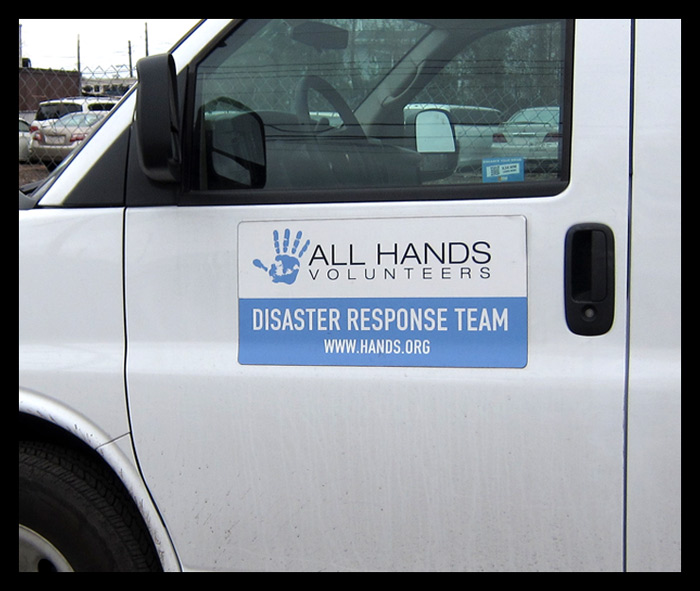
    The NYC Rapid Repairs program has been far from rapid. The group only visited my friend’s home in Staten Island one month after the hurricane. Paperwork was filed on site, and we were assured that work would be completed by “the holidays.” We only received a call letting us know that the crews would be in my friend’s neighborhood on January 13th to discuss the beginning of work. Needless to say, most Staten Island and Brooklyn residents have taken repairs into their own hands, rather than suffer the torture of delays and broken promises. This is why, ultimately, my friend whose house I have assisted in rebuilding has resorted to volunteer groups such as All Hands, who was the only group (other than private contractors) that responded in a timely manner and was willing to take on a large cleanup.

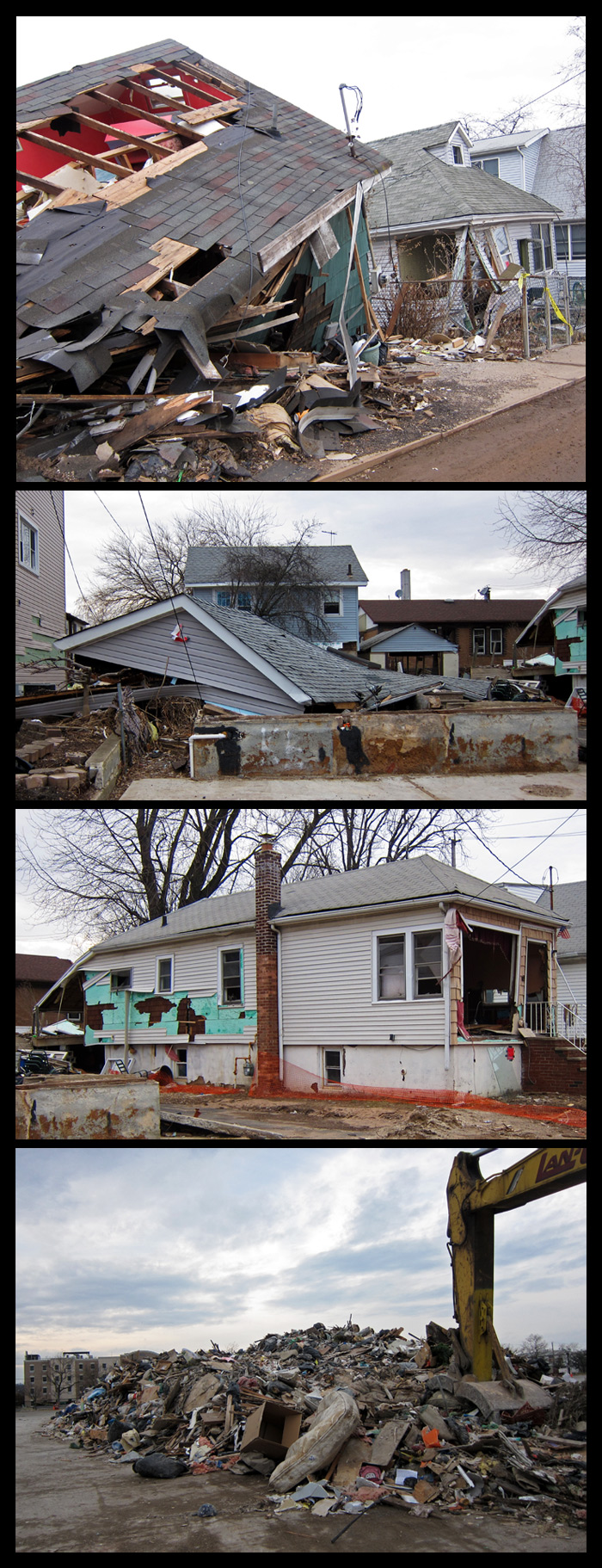
    Yesterday, I drove through one of the worst hit areas on Staten Island, New Dorp Beach, which still looks and feels like a war zone. Police vehicles are everywhere, patrolling the neighborhood. Many homes remain unoccupied, with red, green, and yellow placards taped to their home by the Department of Buildings, identifying their occupancy status. Some homes appear to have been largely renovated while others still await repairs. And there are those which are beyond repair.

    It has been over eight weeks since the hurricane, yet I saw people still shoveling debris. The work of rebuilding is far from over. There is however, a general malaise and despondency hanging in the air. Spirits have been beaten down. Volunteer groups and aid vehicles have largely left the area. Understandably, as time passes, the attention of outsiders is directed elsewhere as the entire disaster is largely seen as “over.” However, things are far from over, and rebuilding will go on for some time to come. The damage wrought by Hurricane Sandy is still at hand, along with the same need for verve and work. But sadly, there is No Sense of Urgency


  • Flies or No Flies

    It takes a lot to raise the eyebrows of a New Yorker. However, in 2007, I wrote Rats R Us about one of the most outrageous displays of rats gone wild in New York City and how it caught the attention of residents and even made national news. New Yorkers stood outside a Taco Bell/KFC in Greenwich Village and watched rats cavorting on the floors and tables while local news media sent reporters to the location and filmed the incident – you can see the video here. I featured a photo of the closure notice by the Department of Health which had a myriad of humorous comments scrawled over it by passersby. It was a classic New York response – a blend of sarcasm with a super tolerant attitude of the slings and arrows of the gritty side to this city.
    On December 11, to the surprise and chagrin of many, John’s Pizzeria was closed by the Department of Health. Here is the report from the DOH website:

    Violation points: 45
    Sanitary Violations

    1) Raw, cooked or prepared food is adulterated, contaminated, cross-contaminated, or not discarded in accordance with HACCP plan.

    2) Evidence of mice or live mice present in facility’s food and/or non-food areas.

    3) Filth flies or food/refuse/sewage-associated (FRSA) flies present in facility’s food and/or non-food areas. Filth flies include house flies, little house flies, blow flies, bottle flies and flesh flies. Food/refuse/sewage-associated flies include fruit flies, drain flies and Phorid flies.

    4) Facility not vermin proof. Harborage or conditions conducive to attracting vermin to the premises and/or allowing vermin to exist.

    5) Pesticide use not in accordance with label or applicable laws. Prohibited chemical used/stored. Open bait station used.

    I was not particularly shocked. Irrespective of the quality of their pizza, John’s is far from the paradigm of cleanliness. The place is quite run down, and attention to detail never appeared to be the order of the day. It’s a money machine that swallows patrons daily who wait in long lines to get in. It is nationally known and on the “must do” list of many visitors to the city who care nothing about how the place looks or manages its food and premises. With such a deluge of patrons, who has time or need to worry about vermin, flies, or proper food handling? I am sure it will reopen soon and, undaunted, New Yorkers will line up again, Flies or No Flies 🙂

    Another recently closed pizzeria: Ray’s (Not Enough Dough)


  • Floating Pool Lady


    In October 2012, I made an excursion to the South Bronx to visit the Vernon C. Bain floating prison. My confidence in photographing the facility was rather foolhardy, as I wrote about in Crossing Over. On that particular excursion, I explored the immediate area, driven by my interest in seeing the enigmatic North Brother Island, which sits in the East River and is generally off-limits to visitation. From studying maps, it appeared that one of the best potential viewing locations of the island would be from nearby Barretto Point Park, a place I had never visited nor heard of. A big feature here is the Floating Pool Lady, a seven-lane, 25 meter pool on a barge. I had the luxury of driving to the park and pool, so my visit was relatively blissful and the park a surprising jewel in a daunting land. Accounts of those who have taken public transportation (the nearest subway is over one mile away), however, sound rather harrowing. Here are excerpts from one woman’s account of the journey:
     

    My friend and I decided not to be put off by others’ fear of the Bronx or derision of public pools as being “ghetto.”
    We surfaced to a dirty street full of no-name discount businesses. No big deal – it looked just like North Williamsburg or something, and there were plenty of people going about their daily business. Walking East, we went under the Bruckner Expressway, and suddenly it was like the post-apocalypse. The pockmarked streets got super wide and empty, and there was not another human being around. There was a four-way intersection with no lights or stop signs. Random trucks and low-riding cars with lights creepily on slowed, honked, and stared.One dude screamed, “Goin’ to the POOL???”
    At an intersection where there were apartment buildings, hope was restored. But then we took a right onto Tiffany, and then it was all junkyards, auto shops, and warehouses with broken (or bulleted? Seriously…) windows. Here, the catcalls from groups of men, whether they looked like kind grandfathers or teenage thugs, became worse. A couple times, they followed us , making sucking noises, clapping their hands, and shouting. Staring at the stains on the ground, I wondered if they were blood or rust as a montage of every mafia and gangster movie I had ever seen ran through my head. In a moment of hilarity, we saw a wholesome looking “Baby Spinach and Arugula” truck  up on a curb…with a shattered windshield. For the first time in my life, my heart palpitated with fear in broad daylight (and I’ve walked alone in rough and poverty-stricken areas all around the world before.)
    The last 100-yard stretch was permeated with an incredible stench of trash and opened up to a tiny little park with a ribboned gazebo. Someone was actually having a wedding reception there, and there were women and children frolicking in fountains. So weird.
    As we walked towards the boat, a young girl with a park shirt on screeched “HEY! Over HERE!” We walked to the entrance, where she was standing with a woman who asked us if we were wearing bathingsuits. “Show me your bottoms,” she commanded.
    The locker room was spotless. One freezing cold spigot in the showers spurted water endlessly. I asked a guard if it was possible to shut the water off. “It’s just running,” she said with indifference.
    A ramp led us to a blue 82′ x 52′ rectangle of 4-foot deep water filled with tattooed men in wifebeaters and exultant children. I asked how they’d all gotten there, and they’d done The Walk, too. There was no other way.
    And my friend had her breasts touched by the 12-year old fatty perv. But no matter; we did what we came to do. We saw that the pool existed, and that some locals can get there.
    Hey, this is a great, well managed pool, but if you have a vagina, pack a crowbar and some thugs to get to it. I worry about what the people in the East Bronx (especially women and children) have to go through to get to their local pool. As for me, having a choice in the matter, I will probably never come here again.

     
    As for me and the friend that accompanied me, by driving and visiting off-season, we found our journey uneventful and the park quiet and serene. The pool was closed, so I have neither direct experience with swimming there nor tales of public pool horrors. Men were fishing on the adjoining pier and children were playing on nearby beach.  The sirens of North Brother lured me in the distance. It was a perfect day and a beautiful spot in one of the most unlikely spots in the entire five boroughs of New York City  – the South Bronx, a neighborhood more known for urban decay and crime than anything else (two vendors I use in my business are located there and actually park their vehicles INSIDE their factory facilities, which have no windows).

    Like so many of life’s arenas, it is often true that there is nothing new under the sun. I was surprised to learn that the floating baths and pools in New York City waters date back to the 1800s (shown in the collage of vintage photos). You may need a bit of nerve to get there, but here, in the South Bronx, behind a chained link fence, on a barge with views of Rikers Island (prison), you can have a swim in the Floating Pool Lady 🙂

    Another NYC pool: Page or McCarren


  • Road to Salvation

    I grew up in New England, where self-reliance reigned supreme. In that environment, “neither a lender nor a borrower be” defined the attitude towards assistance. Help was a four-letter word and asking for help showed a weakness of character. Charity and philanthropy were at best necessary evils and a sense of entitlement was a despicable character trait. No one deserved anything, excepting perhaps the right to work. Do-it-yourself was not some trendy moniker, appropriated by Maker Magazine. DIY, was a necessary condition in a world driven by hard times, lean circumstances, and real need. In a harsh, rural, sparsely populated environment, embracing such an extreme view of self-reliance makes sense and is arguably necessary for survival.

    Recently, however, I have learned a poignant lesson on the nature of HELP. Today marks one month since Hurricane Sandy ravaged New York City. For the last four weeks, I have helped a friend in Staten Island, one of the worst hit areas. The borough is literally a disaster that will take an untold time to restore. Many will be digging out and repairing for months or years to come – some will never see their homes in its former state. In the house I have worked in, nearly every task necessary on the road to recovery has required a team effort. In our case, clearing a basement with belongings drenched with seawater and sewage was a mammoth job, inconceivable for one or two people. We could find no one really willing and able to do the job, even as work for hire.

    We were nearly at wit’s end until meeting Leticia Remauro at the volunteer table in Miller Field in Staten Island. Leticia, I was to learn later, is chair of Community Board 1 for that borough. When I told her of our cleaning dilemma, she wrote out her cell phone number as well as that of Jeremey Horan (a volunteer) on a card and handed it to me, telling me with the utmost confidence that Jeremy would handle any work that needed to be done. But Jeremey was associated with not just any volunteer group, of which there are numerous, typically loosely banded as a response to a crisis. No, the group who finally and thoroughly cleared the basement was All Hands Volunteers, a non-profit group doing work worldwide, and Jeremey was Director of Operation. There is too much good to be said about this group of men and women who are undaunted by any task, regardless of how unpleasant it may be, and, with energy that can only be described as indefatigable, apply themselves and carry through these thankless jobs to completion. Members come from all walks of life, most typically with day jobs, often driving in on weekends from out of state, just to help. I was privileged to meet Travis Gibson, US Field Operations, who personally came to inspect the project. Travis is one of a few full-time staff with the organization.

    The response and value of government or insurance agencies has been anywhere from useless to disgraceful (apart from The Department of Sanitation, who has done a tremendous job), when viewed from the perspective of URGENT NEED at the time of crisis. With tens of thousands rendered homeless, bureaucratic process with forms and applications does virtually NOTHING to address many of the immediate needs of those hit by a monumental catastrophe. Many with enough cash pay out of pocket, hoping to be reimbursed by insurance. Everyone else must rely on wits, resourcefulness, and volunteers to see themselves through. It was only seeing the situation first hand that I quickly learned the value of Help. Volunteerism has been the saving grace in Staten Island after Hurricane Sandy.

    In my case, All Hands Volunteers not only cleared any and all debris, but also volunteered to completely gut the interior of the home, a process that only takes one team about two days – ripping out carpeting, floors, and walls and removing appliances and furniture. It was astonishing to see them work. Without All Hands Volunteers, we truly would have been at a loss. The entire experience is harrowing owing to time pressure – every day that a home that has been flooded sits idle, mold continues to grow and makes the restoration process worse.

    And so it was how Leticia Remauro and All Hands Volunteers taught me that HELP is not just a desperate plea while drowning nor a four-letter word, but, in time of catastrophic need, Help is The Road to Salvation 🙂


  • War Rations

    New York City is noted worldwide for its cuisine. It is, arguably, perhaps one of its strongest suits, with tens of thousands of restaurants in the five boroughs, spanning the gamut from fast food to haute cuisine. You can enjoy a great falafel from Mamoun’s for $2.50 or spend $100 per person or more at places like Babbo. In all cases, you will at least be provided with light, seating, and a temperature controlled environment, unless you opt for al fresco dining, which is not typically seen near the beginning of December. Unless you are working outdoors with no other options – like gutting a house on Staten Island in the wake of Hurricane Sandy, which is where I found myself this past weekend.

    Saturday, I ordered Chinese for delivery for a work crew of 10 which we ate truck side (bottom photo), my first experience with “tailgating”, sans the grill, coolers, tables, or summer weather. Sunday, a work crew member opened two cases of MREs – my first ever experience with war rations. MREs (Meals Ready-to-Eat) are self-heating emergency meals. Ours were A Pack, made by AmeriQual group, the largest provider of MREs to the U.S. Military. Each meal pack comes in 6 varieties and includes an entrée with a self-heating unit, side dishes, beverage mix, condiment, utensil, and towelette.

    The crew was a stoic bunch and enjoyed their rations sitting on the ground in Tyvek suits soiled with every manner of dirt and sewage.  There were no complaints, just perhaps a bit of impatience as we struggled to open the various foil packs, read the instructions for heating, and tried to execute them, while standing in the cold. I was far from my home in Manhattan in many ways, where it was business as usual with shopping and eating out. This was not Shake Shack nor dining New York style. We were only a public bus ride away, yet some of Staten Island is still a disaster zone, where for some, today’s lunch is War Rations


  • Unfettered not Defeathered

    On my last visit to Staten Island in the wake of Hurricane Sandy, I was stunned to see a flock of wild turkeys crossing Hylan Boulevard, one of the busiest thoroughfares in the entire borough. Such a sight would not perhaps raise an eyebrow in rural America, but the last thing one expects in New York City is a flock of turkeys crossing a busy street in a heavily populated area midday.

    Virtually every news source has covered this story and reading about the birds, apparently they are not loved by neighborhood residents who find them a menace. The birds are very aggressive with a myriad of tales and complaints. Articles with titles such as: Turkeys Terrify Staten Island Residents Trap Woman in Car; Scourge of Staten Island: Turkeys terrorize residents as they roam neighborhood; Staten Island’s wild turkeys flourish despite Sandy’s woes; Wild Turkeys Get a Taste of Domesticity; Much to a Borough’s Chagrin, Staten Island Locals Fear Wild Turkeys!; Wild Turkeys Push Staten Island Homeowners to the Breaking Point, et. al.

    Estimates of the turkeys numbers range in the hundreds. Officials say that the turkeys are not indigenous to the island. It is thought that the presence of wild turkeys in Staten Island dates back to 1999, when nine turkeys were released onto the grounds of the South Beach Psychiatric Center by a local resident who had held them in captivity.

    As to dealing with the menace, The New York Times says:

    The state has rejected efforts to transfer the flocks to more rural counties, where turkeys normally forage — but where the Staten Island flocks, officials fear, might not adjust well after acclimating to a human habitat. The Staten Island turkeys cannot be hunted, either, because they are protected with prescribed seasons and areas, none of which are within the city limits.

    At this time of year, many Staten Island residents think like Allan Barnhardt: “I have the perfect spot for these turkeys. Right between my mashed potatoes and cranberry sauce.” However, hunting turkeys is illegal in New York City, and so, the birds, like many a New Yorker, walk through the city streets with attitude and a touch of arrogance. They’re not going to be on anyone’s plate this Thanksgiving. For now, the turkeys of Staten Island go Unfettered not Defeathered 🙂

    More wild and unexpected animals in NYC: That Should Cover It, Lost in that Wool, Bronx Zoo, Warm and Fuzzy, Parrots, Rain Forest, Horsing Around, Albino Burmese Python


  • Shabby is Not Chic


    It was high school gym class, and a classmate, looking to validate his negative assessment of my mode of dress with our gym teacher who stood nearby, pointed out to him how absurd I looked with my T-shirt tucked into my gym shorts. The teacher, rather than side with my classmate, defended me, saying that I looked neat and that my classmate might want to see me as an example of someone to emulate, not deride. It was a small triumph.

    Growing up, I was tidy and neat, always preferring the well-kept, the organized, pristine, the newly made. Over time, I have grown to appreciate old world charm and antiques, even if they are less than “perfect.” I have come to know many artists, who typically prefer the unmeasured, unmanicured, unkempt – flaws that in some way give things character.
    My exploration of this alternate universe reached its pinnacle when I was introduced to the decorative world of Rachel Ashwell by a friend. I was impressed with the ambiance of the store and wrote Off-White By Design. I began to investigate Rachel’s world of Shabby Chic as well as French country decor. I even had employees from the Ashwell team come to my home and make a proposal for a badly needed redecoration of my apartment.

    However, I never went through with their plan. Their solution seemed quite pricey and honestly, the old neat and tidy man came out – I found many of the articles just too rough, poorly made, and overpriced. I guess one could say that I ultimately just found the look too shabby, or at least did not want to pay good money for that which I did not find particularly chic.

    Recently, I found myself in the very same home of the friend who introduced me to Rachel Ashwell. I was helping sift and sort through her possessions in her residence in Staten Island, which had been flooded in Hurricane Sandy. The entire experience has been unpleasant. While in her living room, I was stunned when I came across a badly damaged, water-soaked copy of the classic Shabby Chic by Rachel Ashwell. There it sat on the water logged carpet, the ultimate in irony – the modern day bible for the celebration of all things shabby, sitting amidst rubble soaked in seawater with traces of sewage.

    In the showrooms of SoHo and the homes of the well-healed, the deliberate selection and placement of the aged and worn may in fact be charming. But here, in Staten Island, amidst the wholesale damage left by Sandy, at least for now, Shabby is Not Chic 🙁

    A similar scene: Kind Of


  • A Special Serendipitous Meeting

    In the Wake of Hurricane Sandy


    Many of us who live in lower Manhattan and lost power during Hurricane Sandy, found ourselves leaving our neighborhoods and heading uptown, where there was power. Many stores and restaurants were open, and in some locations, it was business as usual – one would barely notice evidence of a major power blackout. Many photos were taken and articles written about this bizarre bifurcation in Manhattan – in parts of the Village, one needed a flashlight to walk, yet midtown was all aglow and abuzz.

    Two days after the hurricane, while on a journey midtown to a pharmacy, I spotted none other than Hovey Burgess.* He too found the blackout conditions quite depressing and was wandering in a world of light to pass time and brighten his day.
    Hovey is one of my very earliest customers, going back to the very inception of my business in 1975. He often came to my home (where I ran my business for the first 6 years) with his wife Judy to pick up juggling equipment. Hovey is one of the greatest supporters of his fellow artists and suppliers I have ever met. When I have called him over the years to tell him of some new prop or publication as a point of information, I would often find him at the shop immediately to peruse and purchase. Money was never a consideration – purchasing new juggling-related equipment or books, or attending juggling- or circus-related shows of merit, was always his number one priority. He is well known to often attend numerous performances of the same show. He is the quintessential patron of the arts and, if possible, he is someone that, ideally, you want to have interested in what you do. He was one of my earliest customers and advisors. I owe him a great deal.
    And so, that is why it was no ordinary occurrence –  it was a Special Serendipitous Meeting 🙂

    *Note about Hovey: For those who do not know him, Hovey is a circus aficionado, performer, juggler, and educator. For over 30 years, Hovey has taught circus arts at NYU’s Tisch School of the Arts. He is the author of the book Circus Techniques. Hovey has a B.A. in Theatre Arts from Pasadena Playhouse College of Theatre Arts.

    His skills and work includes clowning, juggling, equilibristic and trapeze work with Circo Dell’Arte, Clyde Beatty-Cole Brothers Circus, Electric Circus, Patterson Brothers Circus, and Toledo Zoo Wild Animal Show. He is a former President of the International Jugglers Association.

    He taught at American Conservatory Theatre, Juilliard, National Theatre School of Canada, Ringling Brothers and Barnum and Bailey Clown College, and Sarah Lawrence College. He was circus choreographer for Robert Altman’s Popeye (Paramount). Hovey is currently a member of Circus Flora, based in St. Louis. In 1999, he was inducted into the People’s Hall of Fame, which honors living cultural treasures and is housed at the Museum of the City of New York.

    More on Hurricane Sandy: Yesterday’s Muddy Pants, Seeing Scenes Rarely Seen


  • Yesterday’s Muddy Pants

    I’ve been learning a lot lately about disaster relief – insurance adjusters, the Red Cross, FEMA, tree cutters, water mitigation services, professional drying, pumping water. And shoveling mud. As many as 40,000 New Yorkers have been left homeless after Hurricane Sandy. 80,000 have already filed for Federal relief. Gas stations, often supervised by police, still have lines as long as 6 hours. Many are closed for lack of power.

    I spent most of the last week in Staten Island, helping friends with a home located in a flood zone. It truly is a DISASTER, with over 20 dead in Staten Island alone and houses entirely swept away. In the worst hit areas, entire contents of homes sit on front yards, one home after the next, waiting for pickup by sanitation. Generators are everywhere, used to pump water from basements. There is the occasional sound of chainsaws as residents cut their way out of this disaster.

    Seawater mixed with raw sewage means that for most, little is salvageable. Carpets must be ripped out, floors completely removed, walls cut away, mold remediated, basements pumped, dried, and sanitized. Electrical systems are completely damaged, as well as appliances and, in many cases, furniture. Many families with extensive damage will take what insurance money they may get, if any, and walk away from their homes.
    Emergency public services are OVERLOADED – no one responds or answer phones. The most effective road to recovery in all this? Neighbors, volunteerism or, as a fireman suggested to me, pay for things out of pocket and hope to recover the costs from insurance later. Volunteer groups are everywhere. Michael Blyth, a school teacher at Michael Petrides school, was manning the street I was on with student volunteers able and ready for any task. Vehicles with water and every manner of household cleaners and supplies passed through the neighborhood, as did Army jeeps.

    I spent the weekend filling 33 gallon trash bags and rummaging through household belongings, sorting the dry and the damp from those articles soaked with seawater and raw sewage in a house without power, light, or heat. Even when power is restored by the utilities, in homes with heavily flooded basements (as my friend’s was), power cannot be turned on without the risk of explosion. Entire panels and electrical systems need to be replaced. On Sunday, clocks were set back to Daylight Savings time, so we raced against an earlier setting sun in the late afternoon, finishing the day’s work by flashlight as temperatures dipped in a cold house. But as bad as this home had been hit, there was still much worse, and at the day’s end, I was lucky to have a warm, dry apartment to return to with my possessions intact. I can’t exactly say it is joyful, because the experience has left an indelible imprint on my mind.

    In the morning, it’s easy getting ready for the day’s work ahead. Rubber boots are the only sensible footwear choice. And you might as well just put on Yesterday’s Muddy Pants…


  • One Candle Power

    For those wondering what New York City is like in lower Manhattan, try no electricity, no heat, no hot water, no subway, no lights, no Internet for most. No elevators, no cooking for many, no refrigeration. It’s cold, dark, and primitive. It has been days and will be days longer. For now, it’s One Candle Power 🙁


  • Tardy to the Party, Part 1

    I had never been to the new Yankee Stadium, a replacement for the Yankees’ previous home, the original Yankee Stadium, which opened in 1923 and closed in 2008. Friends had purchased a set of four highly coveted Madonna tickets. One of their family, however, was unable to attend, leaving them with one ticket, which I was offered. I am not intimately familiar with Madonna’s music and so, I was somewhat unsure that I wanted to spend $189 to see a woman whom I was not particularly a fan of.  My friends persuaded me to go – after all it would be a Saturday night out, an opportunity to see Yankee Stadium, and an arena concert, something I had not done in many decades. To sweeten the deal, they said that I could decide after the concert what it was worth to me and pay what I like – essentially a ticket on consignment. It was a deal I could not refuse, and so, on Saturday, September 8, I found myself at my friends’ apartment in the Village, readying ourselves for the Madonna concert.

    There was a pre-show, but none of us were driven to see it, so a group decision was made to depart at 8:30PM. With travel time, this would leave about an hour before Madonna was to go on stage at 10PM. It was raining, but the concert was rain or shine. We planned and collected our raingear: umbrellas, ponchos, plastic bags, and raincoats, fully prepared for the worst – an evening sitting for two hours in the rain.

    We made the short walk to Union Square at 8:30PM, walking briskly in the rain. Our train arrived promptly, however, there was congestion, and our train stopped abruptly. To add insult to injury, the train was mobbed, hot, and humid, and we learned that due to equipment failure, there was no air conditioning between 96th and 125th Streets. Everyone made the best of it as we enjoyed a joint roast. Finally, after what seemed to be an interminable journey, we arrived at our destination in the Bronx – 161st Street/Yankee Stadium. As the train pulled into the station, Hellen, shepherdess of the tickets, made the most disturbing announcement that could be imagined. Yes, she had forgotten the tickets.

    So now, with only 45 minutes to concert time, we were in the very unenviable position of being at Yankee Stadium in the Bronx for a Madonna concert with $760 of tickets in Hellen’s closet in lower Manhattan, a distance that, even with the best of train fortune, was a long journey. To make the round trip journey seemed unthinkable, but the tickets were purchased via Ticketmaster, and with no recourse or ability to reprint them, only two options remained. Scrap the concert, or make the round trip and see what remained of the concert. A group management decision was made to do what we could to salvage the evening.

    So back on the #4 to Union Square. A nice connection to the #6 to Astor Place was making the affair look more promising. A jog to their home, a swift elevator ride up to their apartment, and a beeline to the closet, where, as Hellen predicted, four tickets laid waiting. It was 9:40PM. I took a quick photo of Hellen gleefully brandishing four tickets, and we bolted out the door to retrace our steps. The subway ride was uneventful, however, we had become quite weary of train travel – this was now our third subway ride between the Village and Yankee Stadium.

    We arrived at the stadium at 10:10, not bad, and in our seats approximately at 10:23 PM. Madonna had not gone on stage and so, through a miracle of fate, we had actually arrived 5 minutes before her portion of the concert. We had, with decisiveness and good fortune, accomplished our mission, avoiding what Hellen’s daughter had hoped – that we would not be Tardy to the Party 🙂

    See Part 2 here for the conclusion to the story and a video.


  • White By Design 5

    White On The Road
    Why so many stories about white, you may ask. Well, apart from any historical, symbolic, or spectral aspects of the white, choosing this color for articles of clothing or anything subjected to the elements, particularly in New York City, makes a big statement. Here are some snippets from my previous White By Design stories:

    There are many things to love about the color WHITE. For some, use of the color in their homes and wardrobe borders obsession, like that of the good friend of mine whom I wrote about in White By Design.
    In New York City, choosing white takes on a spirit of defiance. Analogous to She’s Too Tough To Care, wearing white is like saying I don’t care that white makes no sense in New York City. We have rats, graffiti, pollution, dirt, and grime, but I will wear white anyway.
    Wearing white also sends a message that a person is willing and able to go the extra mile in maintaining such a color choice in the city.

    Used badly, white can be a horrific choice – everything is mercilessly revealed with white. It is also deliberately and conspicuously impractical, making a statement about luxury and the ability and willingness for maintenance. The decision to use white in an unforgiving city like New York makes a particularly strong statement.

    Yes, go the extra mile. And what extra mile is longer than that of a homeless person who chooses white for her wardrobe? The woman in today’s photo, who is a recent habitué of Washington Square Park, is garbed day and night in a wardrobe entirely in white – pants, socks, sandals, shirt, jacket, gloves, ski hat, and the final piece de resistance that drew my eye to her originally – white rimmed glasses. I have seen her rummaging through her travel suitcase for her hat or gloves. The contents? Articles of clothing which are 100% white and, like what she wears, all appears to be scrupulously clean.

    I did speak to her one evening, but approached her cautiously. As a friend pointed out – look at her body language. Conversation was a bit awkward. She was quite reticent and very guarded, understandable for someone living on the streets of New York City. I discussed my blog and my previous series of stories, White By Design. I showed her a number of photos on my iPad. Seeing hard evidence that I genuinely had an interest in those who love white, she let her guard down a bit. She told me that she has been in NYC only about a week, living in the park. She has been an itinerant traveler, but I got no details as to where she was from, where she had traveled, or when and where she would be going next.

    I complemented her on choosing white and the willingness to do the work it must involve to maintain her wardrobe so meticulously. She did not elaborate on her choice of color but responded that she does like cleanliness and does her laundry about every three days. And that’s the drill for someone who not only embraces the spirit of White By Design, but also keeps things White On the Road 🙂

    More on white: White by Design 4, Off-White by Design, The Perfect Gift, White by Design 3, White by Desire, White by Design 2


  • Skillful Management and Careful Husbandry

    In my favorite film, Bedazzled (1967 starring Peter Cook and Dudley Moore), the Devil, on the first meeting with his victim, convinces him that he is indeed the Devil incarnate by telling him details and facts of his life that no mortal could know. He gives a brief genealogy of the victim, and at one point in the lineage he says:

    Your great-great-great grandfather, Ephraim Moon, sailed to Australia in 1782 on a ship of the Line. Set himself up as an apothecary. The business flourished, and by the time he died it was worth something in the region of 2,000 pounds – a large amount in those days.

    Your great-great-grandfather, Cedric Moon, by skillful management and careful husbandry, increased that sum a hundredfold.

    The Devil, in his devious and duplicitous ways, goes on to tell his victim that, unfortunately, all such wealth was frittered away by his grandfather, leaving the victim in his present plight – “penniless and on the brink of suicide.” The solution is, of course, to avail himself of the Devil’s services by selling his soul for seven wishes.

    I have always loved the phrase “skillful management and careful husbandry,” but I find no occasion to use it. After all, who and how many have the character, temperament, tenacity, and have, through their example,  made themselves worthy of such a descriptive? Not many. Perhaps some of  New York City’s more ambitious can collectors merit such words.

    This is a city of extremes – extreme contrasts and people taking things to extremes. Things unfamiliar, infrequently seen, or of a perfunctory nature elsewhere can become enterprises and industries here, like the collection and redemption of bottles and cans for recycling.  On February 1, 2010, I wrote Down on His Luck about a can redemption center in Harlem.
    On the collection side, bottles must be harvested, bagged, and transported from place to place and eventually to a redemption center. For greater efficiency and productivity, these treasure troves must be guarded and shepherded through the city streets. Accumulations are neatly stacked – these urban armadas and flotillas are relatively common sights in the city. On April 5, 2007, I wrote Caravan of Dreams, and on August 28, 2009, I wrote Trash and Treasure. On September 5, 2008, I witnessed a veritable wagon train and featured it in Property Owner.

    Recently, while walking on MacDougal Street, I encountered a can collector who took the enterprise to dizzying heights. Cans and bottles were neatly bagged and precariously stacked, in an enormous cache that could only have been done through Skillful Management and Careful Husbandry 🙂


  • Just Another Loud Mouth

    Click to listen to the loudmouth:

    I have discussed from time to time with a close friend a personal irritation of mine, and that is the sense of false importance that many individuals have. In reality, in the grand scheme of things, how much does any one person really matter? Of course, to loved ones and family, we are very important. But, to hear or overhear some, a conversation could lead one to believe that the universe hinges on their being. There are many manifestations of such, like the character whom a friend and I painfully witnessed in my story Poor Winnie (see Part 1 here and Part 2 here).

    There is perhaps no better example of such a person than the LOUD MOUTH or BIG MOUTH, in a restaurant, not far from your ear, where you are a captive audience member, forced to listen to their diatribes, rants, and assertions, which could lead one to conclude that they are genius in many areas of life, much like the self-proclaimed Creative Expert. There is no doubt that you are listening to such an individual – the word “I” dominates their sentences, and additionally, a particular emphasis is typically added to the personal pronoun. Pepper the conversation with a loud, distinctive, very confident, self-congratulatory laugh and now you have a someone with a big stick, much like a judge’s gavel, that will command attention, regardless of any conversation you may be having.

    And what better place than New York City, where the sense of self-importance and community pride can rise to uncanny heights, to breed such individuals?  The classic arrogant New Yorkers, who, even though they may not have achieved any particularly noteworthy life achievements, can have tremendous attitude, as if their very existence as a native confers superiority over all those who were not fortunate enough to have been born in New York City.

    Such was the case recently, sitting in Olive Tree Cafe in the Village, where a number of us were painstakingly exposed to a woman who was about as bad as it gets. She had neither a sense of propriety nor appropriate voice volume, oblivious to her surroundings as her booming voice and irritating caustic laugh rose above the din, so distracting that it became difficult to do anything but listen. The content of the conversation was not particularly important. It was “I” think this and “I” feel that. And no one really cared, because it was Just Another Loud Mouth 🙁


  • Largesse of Spirit

    I was once accused by a friend during an argument of not having a “largesse of spirit.” This always bothered me, because what if it was true? I supposed there must likely be some truth to it, or else why would a generous person, which she was, say it?

    And so, although I am far from a philanthropist, I have endeavored, as much as my character has allowed, to start the process of payback for the good fortune that life has given me so far. This has become a problem for those who know me best, such as family members, who now wonder what is wrong with me, perhaps a bit resentful that they have been left out as beneficiaries in the past.

    In the parks and streets of New York City, one will find a largesse of spirit – acts of generosity by street performers – as a daily occurrence. Many work for free or crumbs, yet are happy to share their talents without resentment. Quite noble. And, of course, there is the desire by those who are enamored of their performances to take photos and videos. On rare occasion, problems arise, owing to misunderstandings regarding photography in a public space. The key here is whether or not the person has a reasonable expectation of privacy. If in a public space, the answer is nearly always not (if a person is in their home in a bathroom, it would not be legal to take a photo from the street. In that case, the person would have a reasonable expectation of privacy).

    Certainly, a PERFORMER in a public park, particularly in New York City, would be quite unreasonable to have an expectation of privacy and demand that no one take photos or video. Yet that is how the guitarist in today’s photo spent his afternoon multitasking – playing while snarling, asking if onlookers were videotaping him and barking orders for all to STOP. If anyone persisted, his demand become more emphatic. Ironically, the band leader, Rasheed Richard Howard, who has always been gracious (and was the subject of one of my stories, Delivery) remained neutral as his guitarist became more belligerent and made reprimanding listeners part of his performance. Rasheed focused on playing and discouraged no one from recording his talents on the trumpet (or two). ‘Twas an awkward afternoon for a bandleader to have to endure an accompanist whose demands were uncharitable, embarrassing, and not legally enforceable.

    Although I understand the fear that recordings of a band may diminish the desire for music lovers to purchase their music or attend their shows in clubs, in reality, video and photos will do more to promote them then hurt them. Those seeking success as performers generally welcome exposure. The face and demeanor of the guitarist were enough to dissuade most from continuing. I imagine they were not clear about whether such a thing was permitted, and for those who were, why risk the ire of a performer so hostile? And who wants a recording of a man who could perhaps make the top ten list of those with no Largesse of Spirit 🙂

    Check out more New York City street performers here.


  • dinamic_sidebar 4 none

©2026 New York Daily Photo Entries (RSS) and Comments (RSS)  Raindrops Theme