web analytics

  • Category Archives Art and Sculpture
  • Island Nation

    Recently, while in Queens, I took a quick spin around Roosevelt Island. It had been years since my last visit, and the lure of an island is irresistible to me. Most of the city’s other smaller islands are inaccessible to the public. Roosevelt Island is located in the East River under the 59th Street (Queensboro) Bridge. However, the island is not accessible from the bridge directly. From Manhattan, the island can be accessed by the Roosevelt Island Tramway or, since 1989, the F train subway. Getting there by motor vehicle will necessitate a trip to Queens and then the short lift bridge, Roosevelt Island Bridge, which connects Astoria, Queens, to the island.

    Traffic is permitted on the island, however, auto traffic was not part of the island’s planning, and a number of the island’s primary sights, such as the lighthouse and the smallpox hospital, are accessible only by foot, bicycle, or public bus. The big draw here for the visitor are the spectacular vistas from around the island – Manhattan, the river, bridges, the tram, Big Allis, Queens, U Thant Island. On the island, there is the historic Blackwell House (1796), the Octagon (once the main entrance to the New York City Lunatic Asylum), the Blackwell Island Lighthouse, the Chapel of the Good Shepard, and the amazing, enigmatic ruins of the Smallpox Hospital.

    I always loved islands. At one time, I dreamed of visiting the South Pacific, perhaps living on a remote, idyllic tropical isle like Fatu Hiva. But New York City is the archipelago I have chosen, a world unto itself and virtually an Island Nation :)

    Related: Manhattan Island


  • Fudge Time

    It was some years ago when an employee came into my office with very bad news. Our shop vac appeared seriously damaged and was no longer working. When I asked about the nature of the damage, I was told that there appeared to be a problem with the wire connection near the plug. This was laughable, and I responded that I would just pick up a new plug for a couple dollars and rewire it. To which my employee was so impressed, he commented, “Wow, I have to see that.” I asked where he had grown up – the suburbs of Miami. I joked how he was a sad man, that he would be stupefied with such a simple repair. He watched, fascinated, as I replaced the plug in just a few minutes’ time.

    The whole affair was indicative of how many Americans are estranged from even the most basic repairs. With such a strong emphasis on white-collar work and getting a college education (both laudable goals) and such a lack of dignity for blue-collar work, fewer and fewer people use their hands. My high school was very well equipped in the industrial arts, but, being tracked for college, I never set foot in the school’s tech wing. A disappointment to me now – I would have enjoyed a few classes in machining.

    The situation in New York City is much worse. Without space for storage of tools and workspace to use them, most urbanites have limited ability to do their own repairs. Most handiwork in apartment buildings is done by superintendents who wear many hats and do repairs in a variety of trades, none of which they are qualified to do. Most of the work ranges from mediocre to horrific. This is sad to me for so many reasons. There is a real shortage of labor doing quality work and great difficulty in finding someone to do small jobs. On the flip side, there are pluses to the do-it-yourself approach – a cost savings and satisfaction of working with your own hands.

    At one time, I ran into a number of fudge shops in shopping malls that made fudge on the premises. The process of pouring, cooling, cutting, and serving was such a big attraction to shoppers that the shops turned the making into theater. Just before pouring, employees would run through the mall ringing a bell and announcing, “Fudge time!” Shoppers would run and flock, much like sheep, to witness the remarkable event – someone pouring hot fudge into a tray. They remained entranced, as if witnessing the height of artisanship.

    Certainly there is value in seeing quality demonstrations of skilled craft, and there seems to be no dearth of fascination with the watching of things made. However, the audiences are often undiscriminating, watching virtually anything, regardless of how unskilled or inane. People will stand fixated as if watching the miraculous.

    On the streets of New York City, you will from time to time find individuals spray painting works using objects as stencils and tools. I have waited some years to photograph one for this website. On Easter Sunday, returning from the parade, I had the good fortune to run across the spray paint artist in today’s photo. He was surrounded by a flock of tourists, admiring his command of schlock art. Watching, I could almost hear a bell and the cry of “Fudge Time” :)


  • The Tipping Point

    It was a year ago or so that a friend recommended The Tipping Point by Malcolm Gladwell. I had long ruminated and been very perplexed as to the reason that certain phenomenon, trends, etc, suddenly and inexplicably hit critical mass and really took off. Things such as the hula hoop – invented in 1957 and a fad by 1958. Then, interest lay relatively dormant for over 40 years. In the last few years, there has been a renaissance in hooping, but now with a much more serious interest for exercise and dance. Yet, it is difficult to ferret out any particular reasons to explain the resurgence in interest now. One may cit interest in exercise, material availability, etc., yet all these elements have been in place for decades.
    Gladwell seeks to explain such mysterious sociological agents of change that mark everyday life with his three rules of epidemics: The Law of the Few, the stickiness factor, and the power of context. Gladwell’s thinking is also based on the 1967 Six Degrees of Separation study by social psychologist Stanley Milgram. However, despite the books popularity and Gladwell’s financial success (over $1 million dollar advance for the book and subsequent speaking at $40,000 per lecture), the scientific community is not in full agreement as to the validity of Gladwell’s analyses and for many, the reasons for a tipping point in social phenomena still remains a mystery.

    I see this tipping point concept in my business as well as the innumerable trends I have witnessed in the last 44 years I have lived in New York City. Frozen yogurt shops, gelato, and most recently, aerial arts – a relatively difficult and somewhat dangerous activity to gain an audience with the general populace. Until recently, such interest in things like trapeze, wire walking, lyra, and silks has been limited to circus professionals. People such as Hovey Burgess have been steadfast in training a small number of those with a passion for flying high.

    On Sunday, January 13, 2013, I had been wandering the streets of Williamsburg, Brooklyn, on a trip to visit the Domino Sugar refinery. I was intrigued by a one-story industrial building with a colorfully painted door with the words The Muse Performance Center brandished across its face, the huge Domino Sugar building in the distance looming over the place. I wondered what may lie behind this door when I heard my name called. I am recognized on occasion by a customer from the large number of contacts I have made over the last 38 years in business. But nonetheless, it is quite infrequent and certainly unexpected on a Sunday afternoon on a deserted street in an industrial area of Williamsburg, Brooklyn.
    I did not recognize the individual, but he was in fact a customer and informed me that he had just been to my place of business in the last week. He was, quite conveniently, associated with The Muse. I asked if it would be possible to enter the space and take photos, to which he said yes. He introduced himself as Ryan and gave me his card: Ryan Shinji Murray, it said, along with the words: pleasure to meet you. let’s keep in touch. I learned that Ryan is a very talented working professional and was leaving for a 3-month tour that week – I was fortunate to have met him just before leaving.
    I entered the small industrial space and saw that it was, in fact, one of a number of spaces I had heard of that was used for the training and teaching of aerial arts. In the last few years, there has been a renaissance in interest in all manner of aerial circus arts. Studios in inauspicious locations around New York City provide space for such activity. In the five boroughs of New York City, you will find STREB, The Trapeze School of New York, Circus Warehouse, Skybody System, Aerial Arts NYC, Helium Aerial Dance, Kiebpoli’s Aerial Class,The Sky Box, Body and Pole, the Manhattan Movement & Arts Center, and The Muse, located at 32D South First Street in Williamsburg, Brooklyn. STREB, one of the most well known, is only two blocks away from The Muse.

    I thank Ryan and the cordial staff of The Muse for letting me take photos of their space. And I will let others explain why now, among the other particular current trends and fashions of New York City, that aerial arts has reached The Tipping Point :)


  • Makin’ Glass

    As a child, I had once inserted house keys into a power outlet, as I wrote in Electrical Outlets. When I was a bit older, I had upped the ante and was being hit with a stick on my butt for blowing a fuse, the first and only time I received that kind of punishment. I don’t recall any real serious pain, only humiliation at being a little too old to be whooped.

    This time, I was trying to make glass. It was another failed experiment. I had found instructions on building a arc furnace using carbon rods from dry cell batteries, a clay flowerpot as a crucible, and a train transformer as a power source. Unfortunately, I knew nothing of the proper power requirements, and my only result was a blown fuse and a bruised butt.

    The fact that common sand could be melted in a homemade arc furnace to make glass was nothing less than amazing to me. It still is. Later in life, I built a stained glass Tiffany-styled lamp from a kit. However, I never did venture into glass making, forming, or blowing.
    I love glass. I respect plastic, which I work with every day in the manufacture of products. However, glass is virtually antithetical to plastic which, in spite of all the remarkable manmade resins, remains a metaphor for all things cheap. Everything about glass is extraordinary – its amorphous non-crystalline structure, its ability to refract, reflect, and transmit light, its chemical resistance, cleanability, and its tremendous versatility.

    Last night, after a very good meal on Indian row in the East Village, a friend and I happened upon a mecca for colored glass. A brand new shop, Mosaic Lamps at 208 East 6th Street, features an array of handblown glass lamps decorated with mosaics. The lamps are imported from Turkey, where centuries of tradition go into the making of these beautiful works. I met the owner, Melissa Benovic, who with her boyfriend Ilker Arslan, were inspired by the grand bazaar in Istanbul where Ilker once worked.

    To my surprise, although these lamps are common in Turkey, they are virtually non-existent in New York City, until the opening of Mosaic Lamps. I wish them the best of luck. I’m pleased to see that somewhere in Istanbul, rather than blow fuses, someone is good at Makin’ Glass :)


  • Shabby is Not Chic


    It was high school gym class, and a classmate, looking to validate his negative assessment of my mode of dress with our gym teacher who stood nearby, pointed out to him how absurd I looked with my T-shirt tucked into my gym shorts. The teacher, rather than side with my classmate, defended me, saying that I looked neat and that my classmate might want to see me as an example of someone to emulate, not deride. It was a small triumph.

    Growing up, I was tidy and neat, always preferring the well-kept, the organized, pristine, the newly made. Over time, I have grown to appreciate old world charm and antiques, even if they are less than “perfect.” I have come to know many artists, who typically prefer the unmeasured, unmanicured, unkempt – flaws that in some way give things character.
    My exploration of this alternate universe reached its pinnacle when I was introduced to the decorative world of Rachel Ashwell by a friend. I was impressed with the ambiance of the store and wrote Off-White By Design. I began to investigate Rachel’s world of Shabby Chic as well as French country decor. I even had employees from the Ashwell team come to my home and make a proposal for a badly needed redecoration of my apartment.

    However, I never went through with their plan. Their solution seemed quite pricey and honestly, the old neat and tidy man came out – I found many of the articles just too rough, poorly made, and overpriced. I guess one could say that I ultimately just found the look too shabby, or at least did not want to pay good money for that which I did not find particularly chic.

    Recently, I found myself in the very same home of the friend who introduced me to Rachel Ashwell. I was helping sift and sort through her possessions in her residence in Staten Island, which had been flooded in Hurricane Sandy. The entire experience has been unpleasant. While in her living room, I was stunned when I came across a badly damaged, water-soaked copy of the classic Shabby Chic by Rachel Ashwell. There it sat on the water logged carpet, the ultimate in irony – the modern day bible for the celebration of all things shabby, sitting amidst rubble soaked in seawater with traces of sewage.

    In the showrooms of SoHo and the homes of the well-healed, the deliberate selection and placement of the aged and worn may in fact be charming. But here, in Staten Island, amidst the wholesale damage left by Sandy, at least for now, Shabby is Not Chic :(

    A similar scene: Kind Of


  • Niki de Saint Phalle

    New York City is a mecca for public art. Recently, while driving on Park Avenue, I was stunned by a visually outstanding display of sculpture. The works, along Park Avenue from 52nd to 60th Street, have been installed in memory of the late renowned artist Niki de Saint Phalle. The sculptor, painter, and film maker was born in born in 1930 in Neuilly-sur-Seine, Hauts-de-Seine, near Paris, France. Her public work can be found worldwide. From NY1:

    The installation is presented by the Parks Department, the Fund for Park Avenue and Nohra Haime Gallery which represents de Saint Phalle’s work. The display marks 10 years since the French-American artist passed away, but her work remains very much a celebration of life.

    “She celebrates African American heroes such as Michael Jordan, Miles Davis, and Louie Armstrong. And Niki made a lot of sculptures about women — the successful, independent, powerful woman, the New York woman,” said Nohra Haime Gallery Director Ana Maria de la Ossa.

    The sculpture will be on display through mid-November. If you are in the area, it’s a great opportunity to go no further than the streets of Manhattan to see the work of Niki de Saint Phalle

    See my complete photo gallery here.


  • Nice Snowing You

    I was once visiting a friend in Boulder, Colorado. Her friends all seemed to be gainfully employed in various types of new age or non-specific occupations. One man seemed to be particularly evasive. When I asked exactly what he DID, he said: Oh, you know, a little bit of this, a little bit of that. No, I don’t know. I have worked many odd jobs when younger, but they had titles or descriptions. If you live on the streets of New York City, not with a home in Boulder, a little bit of this and a little bit of that is likely an apt description for a life of foraging, scrounging, and other methods of acquiring food, money, and things.

    I have met many such individuals in the city, and Hans Honschar may be one of them. The details of Hans’ life are few and sketchy as is his source of income. He told me that he was born in Halifax, Nova Scotia, and grew up in Tampa, Florida. He states his occupation as poet and artist. I sent a biographical questionnaire to the two email addresses he provided some time ago. I received no response. An Internet search returns primarily mug shot photos and arrest documents from minor infractions committed in Florida. Not uncommon for someone who lives by his wits.

    Hans is a man of many pithy remarks, quips, and quotations. These can be seen in his chalk work on the streets and in the parks of New York City. His chalk is surprisingly durable, particularly given the heavy load of pedestrians in the city. He told me that one of his secrets was to wet the chalk, which gives his work much more longevity.

    I asked about his motivation for his work. He said that he did it to inspire, put a little color on the ground in a gray city, and to edify and enliven people. Hans appears to be a member in good standing of New York City’s Sidewalk University – both as student and faculty.

    We chatted for some time, and I recorded some of the conversation on video. I love what Hans told me he had said when he left Canada in 2003, because it reminded me of what that acquaintance in Colorado had essentially said to me – Nice Snowing You :)


  • Your Best Friend


    I recently paid a business visit to Pulse Plastics in the Bronx. The dismal look of their windowless building along with that of Streamline Plastics prompted me to do a story on April 16, 2010, We Don’t Do Windows, after my first visit there. So I was particularly stunned upon my recent arrival to see that one entire wall of the one-story building had been completely transformed by “graffiti.”

    I say “graffiti” because this type of painting, historically very controversial, has been going through a transition. I have written several stories on the phenomenon. From Unconditional Love on October 8, 2010:

    Most see the problem as vandalism, pure and simple… What complicates the matter, however, is that like anything else, there is a spectrum of quality – some of the work is extraordinary. Some of the buildings are in industrial neighborhoods, have stood unoccupied for decades, and are dreadful looking – drab architecture, no exterior maintenance and a dismal setting. And often they are vastly improved by aerosol paint. But, nonetheless, these buildings are not “public” property.
    However, many building owners permit the work to be done. This seems to be a growing trend. And, in Long Island City, 5Pointz Aerosol Art Center, Inc., “The Institute of Higher Burnin’,” is an outdoor art exhibit space which is considered to be the world’s premiere “graffiti Mecca,” where aerosol artists from around the globe paint colorful pieces on the walls of a 200,000-square-foot factory building. The founder says, however, that “Graffiti is a label for writers who vandalize. Aerosol art takes hours and days. It’s a form of calligraphy.”

    Certainly cooperation is best for all, allowing more time for better work and even working with the owners for things like incorporation of company signage elements.

    The major epicenter of this type of sanctioned aerosol art is the block-long, 200,000-square-foot (19,000 m2) factory building complex in Long Island City, Queens, known as 5 Pointz (includes a link to the photo gallery).

    The mural done at Pulse Plastics shown in today’s photo was the work of Tats Cru. The artists who form the group and their work are impressive. Some have been commissioned by major international corporations. You can read more about Tats Cru and see their work here.

    The owner of Pulse Plastics, Alan Backleman, sanctioned the work on his building and is pleased with the result. He agreed with me that the building-long mural is an improvement and welcome facelift for the previously drab structure. Already, Alan told me that the building has been used as a backdrop for film and commercial work.

    It is questionable, of course, whether covering every neglected structure in the five boroughs of New York City with aerosol art would be desirable. Without some sort of cooperation and coordination, the urban landscape could end up looking like a cacophony of circus posters. But we are a long way from that concern.

    The Bronx’s image has been troubled, however, the borough was not as blighted as it appears today. The period from 1920-1950 was documented in The Beautiful Bronx by historian Lloyd Ultan. The book came out in 1979 two years after President Carter visited the South Bronx, a visit that did much to project a negative image of the borough across the nation.

    At one time, the borough used a wastebasket and the slogan “Don’t Dump on the Bronx” for their anti-littering campaign. In 2001, the Bronx replaced the image with one of a Day Lily and the slogan “The Beautiful Bronx,” inspired by Ultan’s book title, as part of a beautification program and effort to improve the Bronx’s image.

    Unwanted graffiti was a large part of the visual blight that dominated most vistas in the borough. As everyone knows, however, tools can be used for good or bad, and when seen in this light, it is perhaps not so ironic that the aerosol spray demonstrates quite clearly that in times of need, your worst enemy can become Your Best Friend :)

    More graffiti and aerosol art: Rattus rattus, Skame, Columbo, Monk and CSI, TMNK, Unguent, Unkindest Etch of All, Scrap Yard, 11 Spring Street, Dumbo Arts Festival, Mars Bar, Totem


  • A Blank Slate

    I once had a long discussion with a woman making the case for creative writing being so much more difficult than writing commercial copy. I had been slaving over writing catalog copy for our product line, and it was excruciating to say what I wanted in the space allotted. I disagreed with her viewpoint and countered that the constraints and parameters of writing advertising can be extremely challenging, more so than writing fiction. She said it could not compare to writing a novel, where you start with a blank slate.

    True, but there is no law that says that the results of a blank slate which has been filled by a fine artist is more creative than a piece of advertising meeting a host of requirements. Artistic brilliance or lack thereof can be found in fine arts or commercial art.

    New York City is a mecca for artists and art schools. Anyone here long enough will be exposed to art at various levels – galleries, art students, and working artists in every genre: writing, painting, illustration, sculpture, film, TV, video, architecture, dance, and music. We are blessed with numerous well-regarded schools – Juilliard, Manhattan School of Music, Mannes, Parsons, SVA, and NYU Film, as well as world-renowned venues, such as Lincoln Center and Carnegie Hall.

    However, everyone has got to earn a buck, and whether born of necessity or by choice, much of the world’s artistic talent finds work outside fine arts, either in commercial art or in jobs unrelated to art altogether. It is the rare artist that is able to support him or herself through fine art alone. Very serious talent is funneled into the commercial arts and media, and I am never one to disparage genres such as TV. Writers for comedy and TV often hail from some of the finest schools, and networks such as HBO are showcases for artistic talent that compares creatively to fine film.

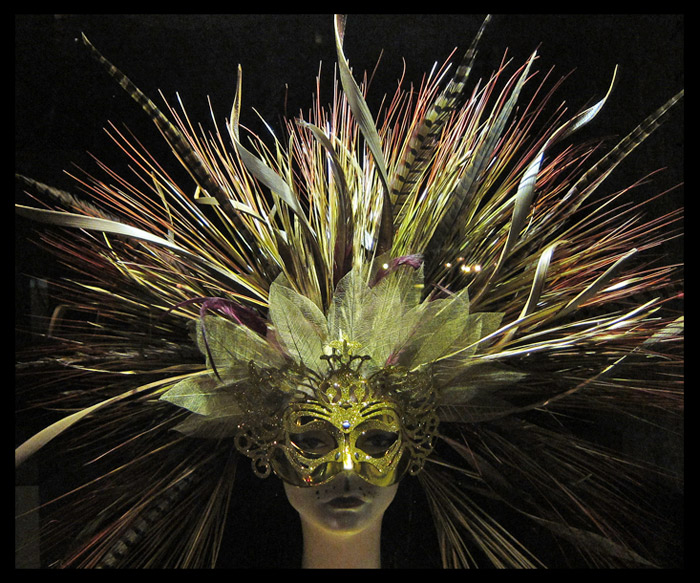
    Here, on Greenwich Avenue in the Village, is a spectacular window display at the Rizza Hair Salon. Behind this work, there is likely an artist applying his or her talents and expressing him/herself given the constraints of the shop owner’s needs. It’s creative and well done, even though he/she likely started with more than a blank slate :)

    More on art and artists: Leave It to the Critics, Mark Birnbaum (Part 1 and Part 2), Creative Expert, So Where’s David?, Finger Painting, Fusion Arts Museum


  • The Caryatids

    There is much sensory input at street level in New York City that it is easy to miss those things which are above ground. Look up and you can explore the architecture so often overlooked by visitors and residents alike.

    Here, at 91 Fifth Avenue in the Flatiron District of Manhattan, is a commercial loft building built in 1894 and designed by Louis Korn. At the sixth floor level are six caryatids under four Corinthian columns and two matching pilasters. A caryatid is a sculpted female figure serving as an architectural support, taking the place of a column or a pillar supporting an entablature on her head.

    I have been by this property hundreds if not thousands of times, but it took only a friend to point it out on a stroll down lower 5th Avenue. I saw this set of caryatids as a metaphor for the burdens that women have shared in many ways – women’s rights, the glass ceiling, misogyny, women’s right to vote, their role as social enablers, and physical burdens, like the entablatures of The Caryatids

    Related Posts: I Know, I’ve Got a Feeling, Gargoyles, Cybele


  • Good That’s Olde Too

    At one time, modern high-rise buildings were marketed as “luxury.” The apartments were sterile and devoid of character, with the most boring cookie-cutter layouts imaginable. They sported only the basic modcons, nothing luxurious at all. In New York City, luxury really just meant the absence of squalor. Not roach- or rat-infested, not a tenement, not a railroad flat, not dilapidated, not in a ghetto. In short, luxury was about what a place was NOT.

    As I have written in numerous stories, in New York, like anywhere else, old or new is not necessarily better or worse. However, there are many wonderful features in old homes and apartment buildings, things now rarely seen. In New York City prewar apartments, higher ceilings, larger room sizes, and more generous floor plans all hearken back to a time when the human experience was valued above maximizing usable space. By today’s standards, the common elements of prewar construction, if seen in modern construction, are now considered to be luxury.

    Love of the old abounds here, with good reason. There are many neighborhoods where one will find a historic uniformity: row houses in Park Slope, Brooklyn Heights, Carroll Gardens, Greenwich Village, et. al. The aesthetic charm in these areas where there are blocks of antique homes is what makes the areas so well-known and highly coveted. The architectural charm and bucolic nature of the tree lined streets makes these neighborhoods some of the finest living experiences in the five boroughs.

    But new can be great too. A family member just completed a McMansion custom home. The home took 38 months to complete, and I was privy to seeing it go up step by step and in detail what went into its construction. The owner, like myself, is involved in manufacturing and was very particular about every element. The quality of construction, appliances, and materials I see in that house is unsurpassed, new or old.

    And everything WORKS. The modern heating, plumbing, and electrical systems far exceed the typically primitive systems seen in old construction. Where is the quality in age-old single pane glass windows with poor insulation and leaks? My landlord recently replaced my French windows after decades. The new windows with low-e glass, etc. are air tight and a joy compared to the old construction. I have lived with steam heat in New York City for over 40 years and can say nothing good about it other than it supplies heat.

    Recently, I passed a truck on 6th Avenue with a sign: Olde Good Things. The company has a number of retail locations and a warehouse. I don’t know if the business name is an acknowledgement that there are olde bad things too.

    In homes and furnishings, there is a romance with the old. But when someone says they love old houses, old places, and old furniture, good is implied. Good is what ultimately counts, and if you’re predisposed to days gone by and lucky, you can find Good That’s Olde Too :)

    Related Posts: Old New York Part 2, Old New York Part 1


  • Leave it to the Critics

    One of my first art “discussions” was regarding a piece of work I saw on the streets in SoHo in the early 1970s. I recall it was a flat surface with an array of bolts – essentially looking like a bed of nails.

    Having done carpentry work, I felt that I did know something about bolts and that someone driving them into a board at different heights did not constitute art.

    However, an artist friend at the time, in a futile attempt to educate my boorish manner, informed me that what made it art was conceptual, not reducing it to its material elements. Like the defense once made by Marcel Duchamps, whom I did not know at the time – it was art because he said so. I was, nonetheless, not impressed – to me, bolts were just bolts.

    This type of installation art is controversial, even amongst those who are schooled and knowledgeable about fine arts. To put it bluntly, coming from someone who was originally a science guy, my question is whether there is any objective criteria for art and, if so, where does artisanship end and art begin?

    Recently, I have noticed a number of lamp posts around Astor Place/ Cooper Union bedecked with colorful plastic cable ties. This, like the bed of nails, also challenges my beliefs of what constitutes art, since cable ties are another area of great familiarity to me – we use them regularly in my business.

    During my first exposures, it appeared to be whimsical, but after taking a number of photos, it occurred to me that there might be more to it. Sure enough, this is part of an art installation called Flaming Cactus. The Animus Arts Collective utilized 32,000 fluorescent colored wire ties around approximately 15 lamp and sign posts in Cooper Square. The project was done with cooperation from the Department of Transportation. It is permitted to remain in place until June of 2012.

    One person commented:

    The same art just went up on Spring St and in the Urban Plaza by Trump on Spring. It actually looks very nice in solid colors on the Trump lamp poles.

    However, another said:

    To me it’s cheap looking. It’s simplistic and inane, exactly the sum of its parts–zip ties on a light pole. It would look gaudy in a suburban shopping plaza. If bits of brightly colored cheap plastic brightens up your day then more power to you.

    Bolts, plastic cable ties, art, or craft – I leave it to the critics…

    Related Posts: I’m Really Good at Paper Mache, Surfaces and Surfing, Finger Painting, Acquired Taste, Real? Fake? Why?


  • Shop Class

    I was given the choice of making the pump lamp or a flying horse. I asked about making other things but was told those were the choices. I really didn’t want to make a pump lamp that much, but it was better than a flying horse wall plaque. I understand the need for discipline, training, and honing skills. This was shop class in 8th grade, where no independent thinking or creative expression is allowed. But it’s a shame, because I liked making things and would have gotten more involved in class. Eventually I would become a manufacturer.
    So, yesterday, I was very pleased to get the following email invitation for The Calling, a theater of fire and song:

    You are being called to a relatively secret place for a meeting of believers – a ritual for the arising. Out in gritty Gowanus in Brooklyn is an industrial complex down by the canal where much of the sculpted art you see in swanky galleries actually gets created. It’s a vast place, owned by ex-squatters and descended from the renegade forges and welding spaces of the LES of the 90s, and it opens it’s doors to Flambeaux Fire, Kai Altair and to you this coming Thursday. You will see it become a WONDERLAND.
    A landscape of flames, machines, and beautiful women as spiritual guides, set to the live music of Kai Altair, written & directed by Flambeaux and Kai.

    The email invite went on to say:

    Flambeaux presents The Calling, a Fire-and-Song Ritual with siren Kai Altair.
    A Journey into Seduction, Spirit and Transformation with ritual shows by Lady C, Serafina, Fayzah Fire, Ali Luminescent, Flambeaux, Tribal Bellydance by Angelys and Serena. Featuring the sculpture art of Adrian Landon and Doumbek byt Natalia Perlaza.

    What really intrigued me, was the location and venue, The Gowanus Ballroom. Gowanus is a very industrial neighborhood, and it certainly is not the type of place where one would expect to find ballrooms, chandeliers, and formal attire. The invitation also specified Serett Metalworks, so perhaps it would be a ballroom of a different sort. And it was.

    The space was difficult to find, as might be expected. There was no ballroom or 55 9th Street. I saw two women on the street and asked if they knew of this place – they did and directed me. The space was down, around, and behind.

    I never read the email closely enough or thought about it, so I was surprised to find that the ballroom was actually an industrial space along the Gowanus Canal. I was greeted with an open factory space and an open cauldron of fire burning outdoors beneath a sign for Serett Metalworks. I knew we had arrived at the right place when I found Gowanus Ballroom written on a chalkboard.

    Inside was every manner of metalworking machinery along with a variety of metal sculptures, as promised in the email. There was an enormous loft space which afforded viewing from above and a wooden structure reminiscent of the Tower of Toys.

    Chris Flambeaux was busy milling about, making preparations for the show he had written. Performers and attendees began to filter in, dominated by the edgy artistic with the requisite piercings, metal, fanciful dress, dreaded hair, and skin art.

    The show started in a ritualistic, nearly occult manner, setting the tone for the entire night’s performances. Some of the acts I had seen at the QAS. This show, however, had a much more industrial flavor – fork lift trucks were used to deliver acts and even performed on them. One act featured villainous characters aboard a Harley-Davidson motorcycle, driven around the space. See my photo gallery here.

    Space being so precious a commodity in New York, this in not the type of event one would expect in the city. For years I had heard of these types of happenings – somewhat impromptu and unadvertised. I was always desirous to be in the loop and attend. There was drama, fire, seductive sirens, metal, and machinery. These guys should open a real ballroom or run a Shop Class :)

    Related Post: Not Of Them


  • Fountains

    Depending on who’s counting, the Palace of Versailles has more than 1,400 fountains. Due to the enormous amount of water required to fuel them, they are turned on infrequently. Even at the time of Louis XIV, the water supply was inadequate to run all of the fountains at once. There was even talk of diverting the River Eure to supply water to the fountains.

    Sunday afternoons from April through October, there is the Grandes Eaux, a musical fountain show in the gardens to the accompaniment of recorded music. Although I have been to Versailles twice, I was not fortunate enough to experience the spectacle. Paris has 350 fountains; to a visitor from the United States, they seem to be at every turn and virtually are.

    New York City has a much less lavish feel to it, as observed by one of my Swedish clients, which I wrote about in Very Practical. Fountains will never be a priority here, although it certainly was for George Vellonakis, architect for the redesign of Washington Square Park. Upon reconstruction, the central fountain was moved to be centered with the Washington Square Arch as viewed coming down Fifth Avenue. George was virtually crucified for this, the cost of which was often misrepresented since the fountain needed to be dug up for plumbing work anyway, with the additional cost of moving being incidental.

    But to me, the entire fiasco and controversy is just indicative of the fixation of Americans on the bottom line, even if at the cost of aesthetics or the occasional jubilant indulgence.
    As I wrote in Let’s Have a Parade, in the light of hardship, it often is hard to justify celebration. After all, there is always a better place to spend money.

    We do not have a large number of fountains in New York City, but there are a handful. Conservatory Garden, the fountain and the gilded statue of Prometheus in the sunken plaza of Rockefeller, the fountain cascade at Rockefeller Center, the fountain at Columbus Circle, the Pulitzer Fountain at 59th and Fifth Avenue, Angel of the Waters Fountain at Bethesda Terrace in Central Park, the Unisphere in Flushing Meadows Corona Park in Queens, Temperance Fountain, Tompkins Square Park, James Fountain at Union Square Park, City Hall Park Fountain, and Washington Square Park.

    Here, at Father Demo Square at the intersection of Carmine Street, Bleecker Street, and Sixth Avenue, is a tiny park with a beautiful charcoal gray stone fountain as centerpiece. The park completed a renovation in 2007 and is an ideal resting spot located in one of the most intensely trafficked areas of New York City, surrounded by a plethora of restaurants and shops. It’s ideal for people watching, a rest after dinner, or a place to eat a snack. Or, for those inclined to indulge, enjoy one of New York City’s very few fountains :)


  • Off-White by Design

    At the risk of sounding ungrateful, I must tell you that I really don’t like being in my apartment much. I say ungrateful because although I have worked hard like many, I have also been lucky. And to live in an 1837 landmark townhouse on Washington Square is one of the rare privileges afforded very few in New York City.

    Notice that I said apartment rather than home. The reason is simple: my place does not feel much like a home, for which I take full responsibility. It has not been decorated at all. Even the Shaker style, for all its spartan utilitarianism, at least has a style, grace, and aesthetic. I’m embarrassed to say and hate to admit, perhaps my place has devolved into a bachelor pad with a hint of hope.

    Recently I was strolling home from my office via Mercer Street. An exquisitely appointed retail interior caught the eye of a friend, who immediately recognized the furnishings as the Shabby Chic style of Rachel Ashwell, a woman whom she much admired and many of whose books she had acquired. She wandered inside. I waited outside at first but soon decided to explore the store myself. The shop had an extraordinary feel. Truly inviting and homey, a place you want to just linger in. And we did. See my photo gallery here.

    I was pleased to learn that Rachel Ashwell herself would be present for a book signing in just a few days, so I discussed with the staff my desire to return for the signing, meet Rachel, take photos, and do a story. The staff was extremely amenable, befitting my entire experience there. I was given a green light, and so, with cameras in tow, I returned last night for the small happening. It amazes me how so many such fetes with notables are going on concurrently in New York City.

    I know nothing of the Shabby Chic style, but it is immediately apparent that although there is a casual nature to the decor, nothing is really left to whim. The messy, mushy, wrinkled, and time-worn comfort is deliberate – every element is given thoughtful consideration, even down to the white pencils, offered free. The lighting in the SoHo shop is soft with a yellow cast. Intrigued about the details of the decor, particularly the colors, I asked about the paint, and, as I expected, the precise shade was known and written down for me as per my request – Winbourne White by Farrow and Ball.

    The turnout was not too large or too small. Free appetizers and wine were made available. Everything seemed just right. I waited in line and met Rachel briefly, telling her of this website. She was charming and cordial. I told her of my intentions and left my card.

    We often like our things crisp and clean with hard edges, particularly in a world ruled by the precision of modern technology. We like bright and bold colors and harsh contrasts. In my lifetime, painting a place white meant a pure white. On November 17, 2009, I wrote White by Design. But that’s white, not off-white. My apartment is now painted Atrium white – a stark, bluish white. I never understood the desire for off-white. Why be so muted? I understand now. The world can be a harsh place at times. Who wants to come home more of that? I have seen the light, and it’s a little yellower. I want to come home to a place that evokes the comfort of a time gone by. A place that is soft and Off-White by Design :)

    About Rachel Ashwell: Rachel Ashwell, was born Rachel Greenfield on October 30, 1959, in Cambridge, England and raised in London. Rachel is an author and interior designer who created the Shabby Chic style, opening her first store in 1989 in Santa Monica, California. Her mother restored antique dolls and teddy bears, and her father was a secondhand rare books dealer. While in her teens, Rachel began selling antiques at London outdoor markets, later pursuing a career as in England as a wardrobe and prop stylist for TV commercials and photo shoots. She currently resides in Los Angeles, California.

    Related Posts: White by Design 3, Yellow by Design, White by Desire, Rhapsody in Blue, White by Design 2, Coup de Grace, Soho Treasures


  • dinamic_sidebar 4 none

©2013 New York Daily Photo Entries (RSS) and Comments (RSS)  Raindrops Theme