web analytics

  • Category Archives Parks
  • You’re Not Gonna Find in Bristol

    ‘Tis a bit unfair, but among close friends, the town where I grew up, Bristol, CT, has become the butt of a private joke – a metaphor for all things boring, a place devoid of culture and nightlife. Whenever I see something particularly unusual, crowded (as I wrote in 212 and 2:12), or abuzz, I sometimes remark that it is certainly something you’re not gonna find in Bristol.
    In this town of 60,000, there is little to do but visit strip malls and eat fast food. My family never ate in Bristol, opting instead to travel for our infrequent restaurant outings. Although it does have a surprising number of claims to fame – Lake Compounce (the oldest amusement park in continuous operation in the US), national headquarters for ESPN, hos of Little League New England, a Clock Museum ( one of a very few museums in the United States dedicated solely to horology), the New England Carousel Museum, and the Otis Elevator Company test  tower – the largest in the United States. Nonetheless, these are things of little import on a day-to-day basis, and most residents will only partake of these places once or twice in a lifetime, if at all. But for culture or shopping quality merchandise, most residents will find themselves traveling. My high school English teacher, a rebel, advised us not to read the local paper, something he found tantamount to trash. He recommended that we leave Bristol altogether. There are staunch supporters of my hometown, I am sure. In my lifetime, I have seen Bristol alternately on lists of best and worst places to live in America. But I yearned to live in New York City and, in 1969, undeterred by my guidance counselor (as I wrote about in Jungle Lovers), I came to the big city.

    In the 7 years that I have written for the pages of this website, I have featured many unusual and remarkable people, places, and things – people such as Mark Birnbaum or pianist Colin Huggins, who performs with a baby grand in Washington Square Park. But, as typifies the New Yorker, I have become inured to the lunacy of a man assembling and disassembling a baby grand piano daily, hauling it many city blocks to and from storage, setting it up, and playing for hours, even in the most inhospitable weather. Most recently, Colin upped the ante considerably by performing during the winter months in frigid weather. Neither biting cold nor a slim audience deters him from his daily grind.

    As I traversed the park on the morning of Friday, February 15, the bar for novelty in New York City was raised again – a piano turner wearing roller blades was busy tuning Colin’s baby grand piano, with banks of snow as backdrop. It was decidedly a scene uniquely New York and certainly something You’re Not Gonna Find in Bristol :)


  • Floating Pool Lady


    In October 2012, I made an excursion to the South Bronx to visit the Vernon C. Bain floating prison. My confidence in photographing the facility was rather foolhardy, as I wrote about in Crossing Over. On that particular excursion, I explored the immediate area, driven by my interest in seeing the enigmatic North Brother Island, which sits in the East River and is generally off-limits to visitation. From studying maps, it appeared that one of the best potential viewing locations of the island would be from nearby Barretto Point Park, a place I had never visited nor heard of. A big feature here is the Floating Pool Lady, a seven-lane, 25 meter pool on a barge. I had the luxury of driving to the park and pool, so my visit was relatively blissful and the park a surprising jewel in a daunting land. Accounts of those who have taken public transportation (the nearest subway is over one mile away), however, sound rather harrowing. Here are excerpts from one woman’s account of the journey:
     

    My friend and I decided not to be put off by others’ fear of the Bronx or derision of public pools as being “ghetto.”
    We surfaced to a dirty street full of no-name discount businesses. No big deal – it looked just like North Williamsburg or something, and there were plenty of people going about their daily business. Walking East, we went under the Bruckner Expressway, and suddenly it was like the post-apocalypse. The pockmarked streets got super wide and empty, and there was not another human being around. There was a four-way intersection with no lights or stop signs. Random trucks and low-riding cars with lights creepily on slowed, honked, and stared.One dude screamed, “Goin’ to the POOL???”
    At an intersection where there were apartment buildings, hope was restored. But then we took a right onto Tiffany, and then it was all junkyards, auto shops, and warehouses with broken (or bulleted? Seriously…) windows. Here, the catcalls from groups of men, whether they looked like kind grandfathers or teenage thugs, became worse. A couple times, they followed us , making sucking noises, clapping their hands, and shouting. Staring at the stains on the ground, I wondered if they were blood or rust as a montage of every mafia and gangster movie I had ever seen ran through my head. In a moment of hilarity, we saw a wholesome looking “Baby Spinach and Arugula” truck  up on a curb…with a shattered windshield. For the first time in my life, my heart palpitated with fear in broad daylight (and I’ve walked alone in rough and poverty-stricken areas all around the world before.)
    The last 100-yard stretch was permeated with an incredible stench of trash and opened up to a tiny little park with a ribboned gazebo. Someone was actually having a wedding reception there, and there were women and children frolicking in fountains. So weird.
    As we walked towards the boat, a young girl with a park shirt on screeched “HEY! Over HERE!” We walked to the entrance, where she was standing with a woman who asked us if we were wearing bathingsuits. “Show me your bottoms,” she commanded.
    The locker room was spotless. One freezing cold spigot in the showers spurted water endlessly. I asked a guard if it was possible to shut the water off. “It’s just running,” she said with indifference.
    A ramp led us to a blue 82′ x 52′ rectangle of 4-foot deep water filled with tattooed men in wifebeaters and exultant children. I asked how they’d all gotten there, and they’d done The Walk, too. There was no other way.
    And my friend had her breasts touched by the 12-year old fatty perv. But no matter; we did what we came to do. We saw that the pool existed, and that some locals can get there.
    Hey, this is a great, well managed pool, but if you have a vagina, pack a crowbar and some thugs to get to it. I worry about what the people in the East Bronx (especially women and children) have to go through to get to their local pool. As for me, having a choice in the matter, I will probably never come here again.

     
    As for me and the friend that accompanied me, by driving and visiting off-season, we found our journey uneventful and the park quiet and serene. The pool was closed, so I have neither direct experience with swimming there nor tales of public pool horrors. Men were fishing on the adjoining pier and children were playing on nearby beach.  The sirens of North Brother lured me in the distance. It was a perfect day and a beautiful spot in one of the most unlikely spots in the entire five boroughs of New York City  - the South Bronx, a neighborhood more known for urban decay and crime than anything else (two vendors I use in my business are located there and actually park their vehicles INSIDE their factory facilities, which have no windows).

    Like so many of life’s arenas, it is often true that there is nothing new under the sun. I was surprised to learn that the floating baths and pools in New York City waters date back to the 1800s (shown in the collage of vintage photos). You may need a bit of nerve to get there, but here, in the South Bronx, behind a chained link fence, on a barge with views of Rikers Island (prison), you can have a swim in the Floating Pool Lady :)

    Another NYC pool: Page or McCarren


  • Folk Festival 2012

    What is commonly thought of as folk music does not have the lure or following of other genres of music. Most of the big names have passed their prime or are no longer with us. Pete Seeger, Woody Guthrie, Joan Baez, and Bob Dylan may come to mind for those who know them and their music. But one is not likely to see legends like these at a local Folk Festival, an event that can easily slip in under the radar. I would not have known about the 2nd Annual Washington Square Park Folk Festival had it not been for a friend who asked if I was aware that Blind Boy Paxton would be playing in the park on Sunday, September 16. I knew not the artist nor the festival.

    My friend assured me that Blind Boy Paxton was the “real deal” and a must-see. However, I was unsure about my liking of the rest of the day’s music, so, without much expectation and camera in hand, I sauntered into the park a little late at 2PM at the start of the 2nd act. The festival was a two-day event (there were six acts Saturday and seven on Sunday, from 1PM – 7PM with a different act hourly).

    On stage when I arrived was Piedmont Bluz. I love blues and realized looking through the program that this festival’s definition of folk was the dictionary one and broad – including blues, bluegrass, country, old time, and actually very little of the stereotypical folk artist – the solo singer/acoustic guitarist.

    The lineup for Sunday was Mamie Minch and Tamar Korn, Piedmont Bluz, Unnamed Hillbilly Orchestra w/ John Cohen, Ginny Hawker and Tracy Schwarz, Blind Boy Paxton, 4 O’Clock Flowers, and Feral Foster. I video-recorded the acts, and you can watch a montage below.
    The acts were all phenomenal – I salute those who produced this event for bringing together such a group of talent for a free festival.

    The whole thing came as a big surprise to me – the caliber of performer and music was much greater than I expected. Every act was SOLID. All were working professionals, typically with CDs and websites. A few had their own Wikipedia pages. A number of the acts had traveled some distance to make this event. I was only disappointed that I had not gone to the entire festival and that I had missed Saturday. I hope the festival returns. I hope to see you there next year at the 3rd Annual Folk Festival :)


  • Largesse of Spirit

    I was once accused by a friend during an argument of not having a “largesse of spirit.” This always bothered me, because what if it was true? I supposed there must likely be some truth to it, or else why would a generous person, which she was, say it?

    And so, although I am far from a philanthropist, I have endeavored, as much as my character has allowed, to start the process of payback for the good fortune that life has given me so far. This has become a problem for those who know me best, such as family members, who now wonder what is wrong with me, perhaps a bit resentful that they have been left out as beneficiaries in the past.

    In the parks and streets of New York City, one will find a largesse of spirit – acts of generosity by street performers – as a daily occurrence. Many work for free or crumbs, yet are happy to share their talents without resentment. Quite noble. And, of course, there is the desire by those who are enamored of their performances to take photos and videos. On rare occasion, problems arise, owing to misunderstandings regarding photography in a public space. The key here is whether or not the person has a reasonable expectation of privacy. If in a public space, the answer is nearly always not (if a person is in their home in a bathroom, it would not be legal to take a photo from the street. In that case, the person would have a reasonable expectation of privacy).

    Certainly, a PERFORMER in a public park, particularly in New York City, would be quite unreasonable to have an expectation of privacy and demand that no one take photos or video. Yet that is how the guitarist in today’s photo spent his afternoon multitasking – playing while snarling, asking if onlookers were videotaping him and barking orders for all to STOP. If anyone persisted, his demand become more emphatic. Ironically, the band leader, Rasheed Richard Howard, who has always been gracious (and was the subject of one of my stories, Delivery) remained neutral as his guitarist became more belligerent and made reprimanding listeners part of his performance. Rasheed focused on playing and discouraged no one from recording his talents on the trumpet (or two). ‘Twas an awkward afternoon for a bandleader to have to endure an accompanist whose demands were uncharitable, embarrassing, and not legally enforceable.

    Although I understand the fear that recordings of a band may diminish the desire for music lovers to purchase their music or attend their shows in clubs, in reality, video and photos will do more to promote them then hurt them. Those seeking success as performers generally welcome exposure. The face and demeanor of the guitarist were enough to dissuade most from continuing. I imagine they were not clear about whether such a thing was permitted, and for those who were, why risk the ire of a performer so hostile? And who wants a recording of a man who could perhaps make the top ten list of those with no Largesse of Spirit :)

    Check out more New York City street performers here.


  • Tanglewood Anyone?

    The same teacher who was the subject of my story Cello Class was also the woman who warned me one spring that there she would NOT be giving lessons over the summer because she refused to spend summers in New York City. Anyone here on a full time basis sees ample evidence of a mass exodus of many residents during the summer months, with benefits to those willing to stick it out. Restaurants that typically require reservations now have empty tables, streets now have readily available parking spots, tickets are available for shows normally sold out.

    Of course, nothing comes without a price, and much as Vermont looks like paradise until one spends a winter there, New York City is quiet and easy during the summer for good reason. The relentless heat turns the city literally into a concrete jungle, now including steamy tropical weather, without any respite, save air-conditioned spaces.  Nearly everyone on foot finds themselves making pit stops in cool shops, many nearly vacant with unusually attentive salespeople who well understand your reason for visiting – after all, they are also likely thinking the same thing – why I am in New York City during the summer heat? In this jungle, one will not find fruit hanging from trees but instead will find the waste of such foods littering the streets, where walking becomes a slalom between shoppers and mountains of garbage. The season that so many love can be a living hell in New York. After all, the best thing about summer is being outdoors, the very thing near impossible to enjoy here most days here until evening, if that. There are no cool mountains to ascend and no refreshing ocean breezes.

    Summer music festivals, which combine the joys of the season outdoors with musical performance, can be found throughout the world. We do have such in the parks of New York – Central Park’s Summer Stage, Prospect Park’s Celebrate Brooklyn, Washington Square Park Music Festival, Tompkins Square Park Police Riot Concert, among the larger. There are also many many other music festivals as there are street fairs, parades, and a plethora of activities. The problem is that a blistering day makes these all but intolerable, and years of attending these makes one realize that although, as I have heard many a New Yorker extol, there are perks of summer festivities here, nonetheless, the environment leaves much to be desired. The seasoned New Yorker who has spent too many summers here begins to ruminate on where one would have, could have, and should have been, like Tanglewood.

    If you have been to an outdoor concert like Tanglewood in the Massachusetts Berkshire mountains, you know what I mean. Here, one can lie on a clean lawn with a candlelit picnic, perhaps with wine, while lying under a black sky popping with stars on a summer evening and the sounds of world-class musicians wafting over, accompanied by cool evening breezes. On the other hand, for many, the urban equivalent will be lying on the hard, filthy asphalt ground of a well-lit park, trying to listen to musicians who compete with others in a small space as well as deflecting crusties, the homeless, drug addicts, and miscreants of every persuasion. Fights occasionally break out between many of the disenfranchised, understandably frustrated by their lot in life, only exacerbated by the unabated summer heat and humidity which lingers all night. The occasional police vehicle arrives to settle the differences of those who would be pointless to arrest, while at other times, an ambulance arrive to collect the maimed who will only be repaired and released to replay the same violent scenarios at another time. Tanglewood Anyone?


  • Page or McCarren

    If I was a lucky boy, I was given 20 cents and could go TWICE. Two swim sessions of childhood bliss. Each session at the Page Park Pool in Bristol, Connecticut, was 10 cents and lasted one and a half hours – two sessions back to back meant 3 hours. There was a 3-meter diving board and an area that was marked DEEP, 9 feet and 11 feet in the center of the diving area.  The pool was gifted to the city of Bristol in 1950 by Dewitt Page, industrialist and philanthropist. It was 110 feet by 75 feet – quite huge by any standards and for a small town, a rarity and nothing less than a dream come true.

    We swam every way imaginable. We threw our brass locker tags into that pool to see who could retrieve it first. We swam under water with our eyes open and looked around. We did tricks. We held our breath as long as possible while swimming under water, pretending we were any of a number of ocean creatures. We swam laps. We lay on the bottom of the pool, under 11 feet of water looking straight up. By the time the whistle for the session’s end was blown, our eyes were bloodshot. My hair was so thick from chlorine-rich water that for a day or more, I was unable to run my fingers through it, even with shampoo.

    We climbed and jumped off the 3-meter diving board. Standing at the edge of a board at such a height was frightening, and the jump, for all to see, was a job well done. The 3-meter board is no longer there – only a single 1-meter board. There was a viewing mezzanine where I enjoyed watching as much as my parents enjoyed watching the antics of me, my sisters and friends. There was an evening session for adults. And, of course, there was a concession stand.

    We splashed as much as humanly possible. In fact, we endeavored to turn jumping into water into a science, doing cannon balls, swan dives, belly flops, and our tour de force, the can opener or Jack Knife, which, when done properly, can create an enormous geyser.

    Growing up without air conditioning left few options for relief from the summer’s heat. There was running through the sprinkler if Mom was gracious enough to set it up and turn it on. But everything paled in comparison to that pool. Once I moved to New York City, I confined my swimming to the ocean, something I had grown up without, with visits to Fire Island, Jones Beach, Rockaway, and Coney Island.

    There is something a tad creepy about the public pool, particularly in New York City where, much like the shag carpeting of a cheap motel, one wonders what acts have been committed, the former hygiene of its occupants, and what really is in that water. Best not let the imagination run wild.
    On June 28th, 2012, the enormous McCarren Pool reopened after a 50 million dollar renovation. The public pool, on the Greenpoint/Williamsburg border of Brooklyn, opened during the depression under the administration of Mayor Fiorello Laguardia and parks commissioner Robert Moses. It had lay dormant for 21 years, and used alternately as a performance venue:

    McCarren Pool was the eighth of eleven giant pools built by the Works Progress Administration to open during the summer of 1936. Mayor Fiorello LaGuardia attended the dedication on July 31, 1936. With an original capacity for 6800 swimmers, the pool served as the summertime social hub for Greenpoint and Williamsburg. The building’s vast scale and dramatic arches, designed by Aymar Embury II, typify the expansive and heroic spirit of New Deal architecture. The pool was closed in 1984 but in 2005 the site was resurrected as a performance space, first through a modern-dance performance by Noemie Lafrance, and subsequently as a world-renowned music venue that saw many high-profile concerts until the summer of 2008, when Parks began work to renovate the pool.

    Sadly, and some would say expectedly, within a week of the pool’s opening, enthusiasm was dampened by a fight between bathers and lifeguards, necessitating police action. Other incidents have occurred. Harsh critics predict the pool will see a slide back into its former decline.

    In 2010, I returned to Page Park and was pleased to see the pool refurbished and still in operation. The attendant was very gracious, allowing me into the locker room and pool area while fully dressed. As I took photos, I reflected on those glorious days where the pool was the highlight of my summers. I had always sensed as a child that this pool was a great gift to have in one’s hometown. As I grew older, I saw how truly special and what a privilege it was to have grown up with such a public amenity, affordable to all in the community. I hope those children in New York City, as well as elsewhere, will have fond memories they will carry for life of a summer pool, whether Page or McCarren

    For another variant on the public pool, go here.


  • Sunners and Shunners

    One of the most popular summer activities of my generation was to go to the beach to get tan. Women lubricated their skins with baby oil and virtually fried under a blazing sun, rotating to roast every square inch, sure to leave no skin untanned. Men strutted about with tan musculature, also perfectly and evenly toasted.

    New York City has a plethora of beaches – Coney Island, Brighton Beach, Manhattan Beach, Riis Park, and the Rockaways, all accessible by public transportation. My personal choice was always to venture a bit further out of city limits to Jones Beach and Robert Moses on Fire Island. For those who did not want to leave home, there was tar beach – the NYC rooftop. From the New York Times:

    “Tar beach,” as all roof rats know, is the urban alternative to the Hamptons on a hot summer day; it’s as near as the flight of stairs outside the apartment door. The 1930′s seem likely as a birth date, because it was around then that the suntan became fashionable for the masses. According to “The City in Slang” by Irving Lewis Allen, getting a tan on tar beach was often the preparation for a trip to Coney Island. “By the 1940′s,” he wrote, “city rooftops, those ersatz beaches, were given the fictitious place name tar beach, alluding to the black tarred and graveled rooftops.

    And absolutely de rigueur was the need to get color. Come springtime, examination of each other’s skin invariably led to comments like you need some color, I need to get some color, or some other variant expressing the dire need of a suntan. The desire for light or dark skin color is both time and culture based. Dark skin has been associated with the lower class, where work would have commonly been outdoors. In Asia, light skin is still prized for this reason. White skin has been desirable until the 20th century, when the therapeutic benefits of the sun and vitamin D began to be recognized. Coco Chanel is often credited with the desire for darker skin when she accidentally got sunburnt visiting the French Riviera in the 1920s. From that time on, sunbathing became popular as we saw the bikini of the 1940s and Coppertone’s iconic ad with a little blond girl and her cocker spaniel tugging on her bathing suit bottoms, sunglasses, sunscreens, and SPF.

    Recently, an old college friend and native New Yorker (now transplanted out west) was making one of his periodic visits to NYC. Inevitably, his love of the ocean means a requisite visit somewhere to a city beach. On this visit, three of us found ourselves touring the beautiful seaside community of Belle Harbor on the Rockaway Peninsula of Queens.

    After decades of seeking the suntan, we now live in a world of ozone depletion and concerns of premature aging and skin cancer. Whereas 30 years ago we would have set ourselves up on the beach in order to maximize sun and get some color, we now canvassed the boardwalk for any scrap of shade.

    At Beach 118th Street, we found a small spot against the back railing of the boardwalk by a lone conifer tree with just enough shade for the three of us. Here, we spent the afternoon in gorgeous weather chatting about old times, relationships, and other matters, some grave and some inconsequential, enjoying the peacefulness and beauty – rare commodities in New York City. As the day passed and conversation ensued, I reflected how, as always, some things remain the same, some change, and some change back. A lone lifeguard under a bright orange umbrella joined us in a world that has seen Sunners and Shunners

    More on beaches: Teleportation, The Hamptons, Plum Beach, The Shore


  • Culture Fix

    I grew up in a town where, regardless of the fact that it has a population of 61,000, THEY ROLL UP THE STREETS AT NIGHT. Even on Saturday, it is like visiting a ghost town of the West. There is virtually nowhere to eat other than fast food and nothing to do except cruise the streets in despair. No wonder the youth of America is bored out of their minds in suburban USA and turn to drugs and sex. And no wonder that places like New York City became a mecca for those who crave culture in all its variants. I understand that there are many options out of the city and also an inner world to explore – I was an avid reader and also extremely active and social. However, there are limits to how much blood one can extract from a stone, and many of our suburbs are virtually devoid of cultural activities.

    So, in 1969, I, like many, made my way to a somewhat bigger town called New York City. Here, I found everything I had dreamed of and more. That young boy still lurks within, starry eyed and excitement bound, and, from time to time, I need a jolt of electric current and a culture fix. I rekindle those first moments when everything was ALIVE at any hour, day, or night and the feeling that anything is possible. Perhaps you even have a hankering to see a grown man dressed as a macaw, dancing about, while accompanied by a band called Moon Hooch, featuring a saxophonist with an enormous cardboard tube shoved into it.

    I took a walk recently to Union Square, where, regardless of season, time, or weather, you are guaranteed to see humans in all manner of activities. Steps from street level to the park on the south side of Union Square provide impromptu stadium seating and is one of the best spots in New York City for people watching. The square is surrounded by merchants and is one of the city’s major transportation hubs. Historically it has also been a major meeting ground, a place to see and be seen and ideal for those with a political agenda or need to bring a message to the masses. The place is abuzz with people and energy.

    It was here, on July 4th, 2012, at 12:17 AM that I found a grown man dancing in a macaw suit accompanied by a rock band. I was to learn that the performance was not spontaneous nor the product of birdbrains. It was a campaign on the part of Rock the Osa to raise awareness about the development threats facing Costa Rica’s Osa Peninsula, home to the area’s last virgin rainforest and “the most biologically intense place on earth.”  Marco Bollinger the Macaw and Eytan Elterman the Sea Turtle have nearly reached their target of $25,000 by dancing to produce the documentary project, 2.5 Percent, a film promoting conscious travel in Costa Rica.

    Moon Hooch is a Bushwick, Brooklyn, based band which has played regularly in the NYC subway system. The three band members, James Muschler, Mike Wilbur, and Wenzl McGowen, met at the New School, where they studied music. Moon Hooch plays cave, a style of house music. After only a year, they have produced an album, toured nationally, and worked for a TV company.

    As with everything else in New York City, things are often more than they seem. It’s where preconceived notions are best left in the checkroom. And all the better – it just means more opportunity for someone needing a Culture Fix :)


  • The Big Mouth Does

    Philip Garbarino promoting his book, The Devil Repents.

    Many people do not like New Yorkers for a number of reasons. In all fairness, for a number of good reasons. New York is a city that is brash with people who are aggressive and competitive. It’s a sieve for success, filtering out those who can’t make it here or, like Dwanna, those who just don’t want to make it here. It is the ideal home for the self-centered, the narcissist who wants the largest possible audience to fan his or her flames. It is perfect for attention mongers and drama queens. And for those who prevail, it is a place where someone can make it big.

    I am always astounded at how the real estate market here manages to be buoyed up regardless of the economy. The average 2-bedroom apartment in Manhattan sells for $2 million. A New York Times article reports that in Brooklyn, there is a shortage of single family brownstones with bidding wars driving up prices beyond the listing price. With pricing like this, obviously this is a city where many have achieved material success. It is also a home to the megalomaniacal or where it may at times be difficult to distinguish between the enormous success and the megalomaniac. It is a place where one truly must abandon preconceived notions or be faced with people like Mark Birnbaum, who, despite appearances and notions to the contrary, is who says he is and has done what he said he has.

    Recently while in Washington Square Park, my attention was drawn to a man with a huge crucifix, dressed as the devil. Such a thing will provoke interest and garner attention. There was no shortage of onlookers or those seeking photo ops with Satan. I learned that this was Philip Garbarino, promoting his first book of a trilogy, The Devil Repents. The book is selling directly from Philip’s website. Chapter One can be found for free there as well. An ebook is available from Amazon. I spoke to Philip briefly and videotaped the conversation. Garbarino was eager to mention his acting credit in the film The Bronx Tale, directorial debut of Robert De Niro.

    I have no idea as to the quality of the writing or what Philip’s aspirations are. Although perhaps not a necessary condition to success, in a city where everyone and everything is screaming to be heard and seen, self-promotion is a more likely road to success than a quiet unassuming demeanor or the meek, with Donald Trump as perhaps the best example. I do like real estate magnate Barbara Corcoran’s pithy and poignant remark:

    In New York City, the meek don’t inherit the earth. The big mouth does.


  • Up Up We Go

    I was tipped off by a friend that I might want to hurry to see this group of musicians from New Orleans. He referred to them as a “crusty” band. They certainly have the signature attendant dog, and there is a vagabond character to the group which is hard to define in many ways. The group is a moving target with a non-specific stable of individual members. However, regardless of any nomadic similarities, Up Up We Go did not appear to me to embrace the hapless, nihilistic lifestyle of the crust punks.

    The core member of Up Up We Go is Salvatore Geloso, originally from Brooklyn, New York. His unique, impassioned style of delivery with highly animated facial expressions is what prompted my friend to bring them to my attention.

    My first encounter with them was in Washington Square Park. A full ensemble was playing with an acoustic upright bass, accordion, violin, guitar, and a saw. Salvatore plays guitar, kazoo, and provides the lead vocals. I have seen saw players before, but they always seemed to be more of a novelty or curiosity. Here, in Up Up We Go, the saw was truly used melodically, adding a wonderful musical element to the melange. I was entranced by the music and must say that this was one of the most entertaining music ensembles I have seen on the streets of New York City. Their music, original or that of fellow musicians, was very catchy – I have been listening to The Pony Song for over 3 weeks.

    Unfortunately, the group is hard to nail down, as they are not based in New York. Being the magnet that this city is means that this is a place where talent comes and goes. The group’s name is an apt metaphor for the vanishing act we will see soon. I hope it applies as well to future success for Salvatore and the band members of Up Up We Go :)

    More street performers in Washington Square Park: Strike While the Music is Hot, Sirens of Culture, Mzuri Sings, Crooks and Perverts, Curse of the Mouth Trumpet, Impossible, Catch Em If You Can, Sieve of Darwin, Tune Out, Tune Up, Tune In, Artiste Extraordinare, One-Man Band, New York State of Mind, Music Speaks for Itself


  • Jack and Jill

    Are you familiar with a “Jack and Jill” party? No? Good. Because I don’t suggest you learn about them first hand, unless you want to see how love and marriage can be reduced to the almighty dollar. I have been to several, and not to seem insensitive to those of lesser means, I found them tacky and embarrassing. A Jack and Jill is essentially a wedding shower, however, unlike the traditional bridal shower, it is attended both by the bride, groom, men, and women. Essentially, anyone who wants to come can – the more the better, because the Jack and Jill (sometimes called a stag and doe) is a party and fundraiser to raise cash for the engaged couple. Often, a ticket must be purchased to attend, and all manner of games and activities are to be had, including raffles and the dollar or money dance.

    At the last I attended, I had to suffer through a money dance, a ritual that can also be found at some wedding receptions. Here, guests get the opportunity to dance with the bride-to-be for a dollar. After a spin around the dance floor, typically, another male guest cuts in by tapping the shoulder of the man dancing and takes over. After a time, the money accumulates, and our bride can be seen to be gleefully clutching a wad of one dollar bills. At the Jack and Jill I attended some years ago, the groom stood before a microphone after the dance, shaking the bundle of bills in the air while announcing specifically how much had been made, while guests applauded and cheered. I was mortified.

    When I was younger, there seemed to be an unabated parade of weddings, showers, and other marriage-related events. Invariably, Jack and Jills were mentioned in a matter-of-fact way, intoned to signify that such a thing was de rigueur. Jack and Jills are behind me now, and although some variety of them may exist somewhere in New York City, I have not heard of them, nor been invited. The only wedding celebrations I witness these days are those that I see in public places – in the streets, in the parks, and coming in and out of churches. If you spend enough time in the parks of New York City, you will invariably encounter wedding parties in photo sessions, particularly Central Park, a perennial favorite.

    It is not surprising that couples would want to utilize Central Park as it is replete with romantic, idyllic spots for wedding photos – the Loeb Boathouse, the Bow Bridge, the Shakespeare Garden, Belvedere Castle, Strawberry Fields, Cherry Hill, Cedar Hill, the Pond, the Harlem Meer, Bethesda Terrace, and the Conservatory Gardens. A permit is required for parties over 20 and can be had for $400. On a recent visit to the gardens, a group was galloping down the green with the bride and groom joyfully bounding along with them. Although I did not ask, I expect they had no Jack and Jill :)

    More weddings: Speaking in Tongues, Just Married, The Perfect Gift, Love Is All Around Part 2


  • The French Connection

    I had read that it was the dream of many Parisians to retire in Aix-en-Provence in the south of France, sometimes referred to as the city of a thousand fountains. It is also a city known for its many educational institutions. Its idyllic Mediterranean climate befits the Cours Mirabeau, the central artery running through the town. The wide street is beautifully shaded with double rows of plane-trees and flanked by elegant mansions built by nobility in the 16th, 17th, and 18th centuries.

    This tunnel of greenery is accented by fountains and lined with cafes. It was here, on one visit to France, that I witnessed what I told was a tradition in town among students. A group of recent grads was cavorting along the Cours near a fountain. Soon it became a virtual water park, with boys grabbing girls, shrieking and writhing, and dowsing them in the fountain pool. I had mixed feelings about the entire happening, which tasted a bit like involuntary fraternity hazing. Were they really having fun or bending to peer pressure? But I make an effort to be as non-critical as I can of cultural differences when traveling, lest I become another ugly American, like the man I featured in So Where’s David?

    The last two days have been intolerably hot, with daytime temperatures near 100 degrees. There is little escape from summer heat in the city – New Yorkers find themselves shopping or staying indoors until the heat passes. Many, whether owing to lack of air conditioning or cabin fever, take to the streets and parks, invariably gravitating towards water. Such was the case last night in Washington Square Park.

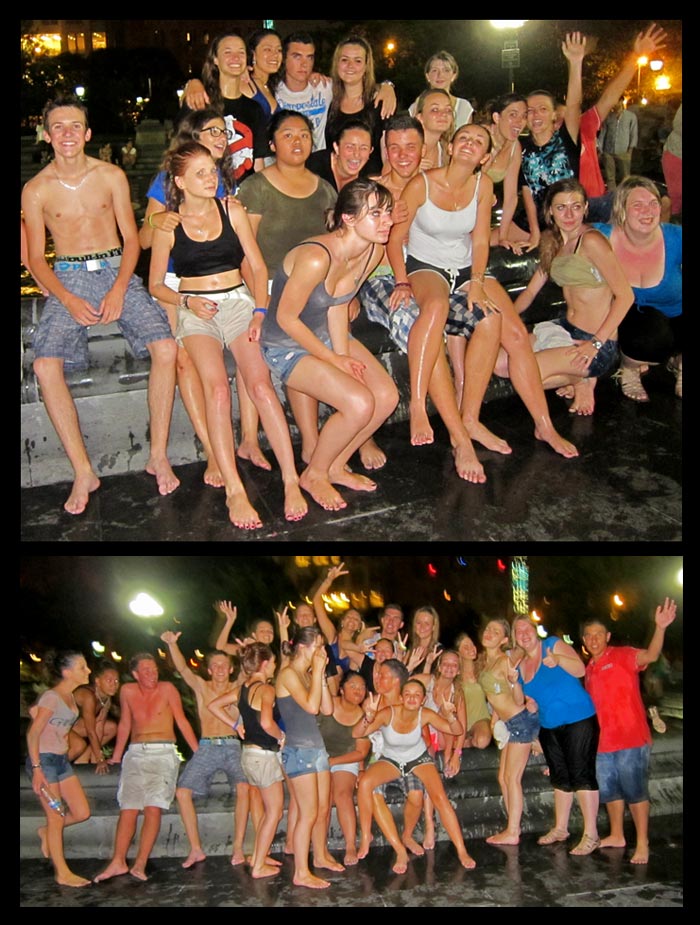
    I was taken by surprise to see an enormous group of teenagers replaying the Aix tradition. Although cavorting in the fountain in Washington Square Park becomes de rigueur during heat waves, I have rarely seen instances of forced dunking and certainly not like Thursday night. Soon, dunked or not, virtually everyone was soaking wet.  I was also surprised that in 2012, it was still a guy-gets-girl thing, owing perhaps to France’s greater tenacity to customs rather than cultural change.

    I was intrigued at the grouping and asked a number where they were from. I was told Monaco. I learned, however, that this was said as a matter of convenience, since they expected few to know the smaller town they were actually from. I met Christophe Boule, a teacher of English, who was one of the four adults supervising this group of high school students. The students had finished their academic year and were on a class trip to New York City – an annual tradition for their school. They were staying at the youth hostel in Manhattan on the Upper West Side. They were in fact not from Monaco but from Menton, near the Italian border. Menton is a delightful small city on the coast which boasts the warmest climate in France. I had passed through it once and always wished to attend their annual lemon festival.

    When I initially approached Christophe and the other adults, they were understandably reticent and suspect of a stranger in New York City asking many questions. Their fears became slowly assuaged – my business card did a lot to establish credibility as a writer and photographer. After all, these things are often claimed by miscreants looking to get over on the innocent. One adult noticed that my last name was French. I confirmed that heritage. Now the attitude was rapidly changing.Our discussion turned to my enthusiasms about France, particularly my obsessions with medieval perched villages in the south. Now I appeared to be sérieux and truly interested in French culture.

    Soon, all was well. The Cours Mirabeau in Aix, the customary fountain dunkings, my passion for all things French, my obsession with French villages, my visit to Menton. How serendipitous and fortuitous. New York City is such a befitting set for a remake of The French Connection :)


  • The Hollowest of Victories

    They may not have hopes and dreams, but they do have trials and tribulations. There are arguments, debates, frustrations, jealousy, yelling, and crying. There are attachments, relationships, and concern for others. There is a pecking order and one-upmanship. Be assured, that although this is the world of the homeless – disenchanted and disenfranchised – in many ways, it is no different than any other world.

    It was gray, rainy, and cold. Much too cold to be swimming outdoors. As I walked through Washington Square Park, a homeless woman was determined to go in the fountain pool. Her friend was not gaining any ground trying to dissuade her.

    She screamed over and over that she wanted to go into the water as he tried to talk to her and restrain her. She sat on the fountain’s interior steps and descended one at a time. She was severely drugged and unstable but strong enough to resist her friend’s efforts at keeping her out of the water. At one juncture, he looked at me and threw his hands in the air in frustration. I said to him that it was too cold and she may likely get sick. He responded by telling me he had told her just that, but he had given up. In a world where no one cares whether she lives or dies, what is she to do? Make a scene and try to capture the attention of any willing to watch and listen.

    Yes, this predicament – the drugs, her friends, her dead end life – are all her own doing. It would be unfair to say that she is down on her luck – better said, she is just down on her butt. But no matter, because at that moment in time, her pain and frustration was just as real as yours or mine. The three of us were alone in the rain, with an occasional passerby. No one seemed to care. She is disposable and will likely not live long. We are better off without her, are we not? Out of sight, out of mind. In this type of conflict, which I have seen played out often enough, even if violence erupts, the police will not arrest her – to what end? They would be told to leave and take their misery elsewhere.

    She finally reached the bottom, soaked by rain, immersing herself into that cold pool of water. Like an obstinate child having a tantrum, I could see that she was not really happy at all. She had won a hollow victory, making the whole thing even sadder. Here, in a fountain surrounded by one of the world’s most affluent neighborhoods, it is likely that some watched this entire ordeal from apartments averaging 2 million dollars.

    Telling this story makes me feel a little worse. I kid no one if I try to pretend that I feel their pain. I have never been so down that I sat soaking wet, crying as I descended into a cold pool of water on a gray rainy day at the end of my rope with no hope. It was The Hollowest of Victories

    Afternote: Later that night, I saw them under the park’s arch, playing out another confrontation, her soaking wet, lying on the grates with her friend trying to reason with her.

    More stories of the homeless: Ask Tommy, Looking for an Angel, Usually. Maybe. Probably Not., Caught in the Rain, Any Questions?, Crusties Are People Too? (Part 1 and Part 2), On the Road, Cosmetics, Crustie, Dead to the World, Stephanie, Caravan of Dreams, Extreme Camping, Homeless Art Scene, The Art of Kissing


  • Strike While the Music is Hot

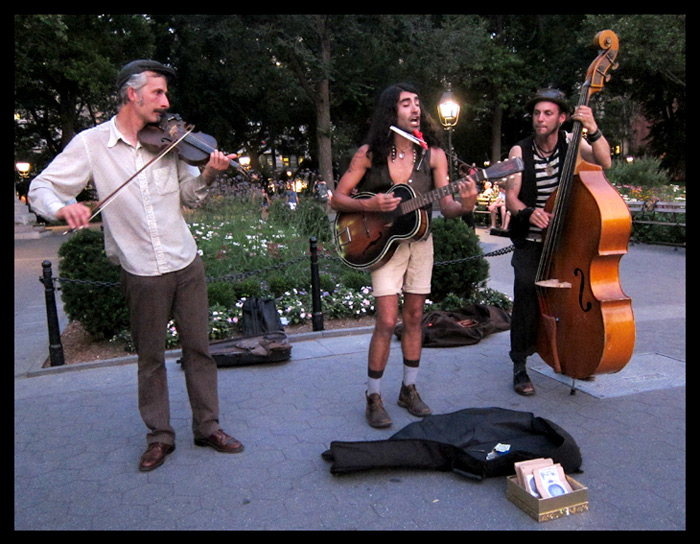
    As I stood late night in Washington Square Park, the very faint sounds of violins began wafting over me and friends. Had I heard perhaps Ashokan Farewell, the haunting melody chosen by Ken Burns as the musical theme for his award-winning Civil War film series? I spotted two violinists across the park plaza and walked briskly in their direction. Here, late at night, one must strike while the music is hot. There are no guarantees how long anyone has played or will continue to play. If you like what you hear, better run and enjoy.

    It was apparent that these were no ordinary musicians. I suspected that they were accomplished interlopers, on some mission in New York City, and, given some down time, had decided to grace us with their notes, as visitors are often apt to do. I was right, and I learned that the couple were a brother and sister who were in town to do a commercial recording gig. They had not played together in 20 years, so we were also privy to a family reunion.

    I arrived as they were completing a song, and I asked if they knew Ashokan Farewell. Of course, they replied, and that they had just played it a moment before. They were, however, quite happy to play it again. I recorded a video:

    I spoke to them and was surprised to learn that both were professional classically trained musicians and were in New York City only for some days for the recording session. They were leaving the next day. I learned their names, John and Rebecca Patek, and took their contact information. From John’s website:

    John began playing the violin when he was two years old and hasn’t stopped since. Born and raised in Mequon, Wisconsin (a suburb of Milwaukee), John learned the art of performance at a young age through his involvement with both the Milwaukee Youth Symphony and the Homestead High School Orchestra.

    John continues to perform actively in Switzerland, Italy and in the Midwestern United States. He also teaches several group and private lessons.

    Rebecca Patek, from Wisconsin, began studying violin since she was 2 years old when she saw Itzhak Perlman playing violin on Sesame Street. She grew up playing classical violin and at 10 was playing with the Milwaukee Youth Symphony Orchestra. She became hooked on old time and bluegrass in middle school when her mom took her to a bluegrass jam at a local bar. Patek went on to study jazz violin and has won the Wisconsin state fiddle championship several times.

    From a recent correspondence with John:

    I was born in Milwaukee, WI in 1981 and grew up just north of Milwaukee in Thiensville, WI.

    I am lucky to be a musician.  I have my own private studio in Mequon, WI with about 15 students and I also teach at Milwaukee Montessori School. Currently I am a freelance musician based in Milwaukee but I was a member of the Madison symphony, I work as violinist with two different orchestras in Switzerland and am an active recording artist.  I have worked with television, film scores and various bands contributing violin and cello tracks.  I have worked quite a few non musical jobs but they only make me appreciate my life as violinist even more.  I suppose this is the story for so many musicians but whenever I get to play the violin in know I am one of the luckiest people in the world.

    I did my bachelors degree at the University of Wisconsin as a student of the late Vartan Manoogian, and did my masters degree at the Conservatory of Neuchatel in Switzerland studying under Stefan Muhmenthaler.

    I split my time between Milwaukee and Switzerland.  I have not lived anywhere else.  I have gotten to travel throughout Europe because of the violin touring with orchestras and studying.

    My Mom and Dad made sure that I had the best teachers, an amazing violin that I still play and was able to attend any summer festival i ever wanted. They love music and art and made sure that my sister and I were able to develop our talents and have a great time.  They took us to lessons before school, drove us across the summer camps across the country, to and from youth symphony rehearsals, got us on flights to Europe and made sure we practiced before we wasted time like we wanted to.

    Joan Rooney, one of my first violin teachers and Vartan and Stefan my teachers in College really made me realize how challenging and amazing playing the violin can be.  I have had great teachers in music and my other academic classes and I know that because of them I do a better job teaching.  I am able to combine all of their great guidance and ideas and share them with my students.  I only hope that I can inspire my students the way my great teachers inspired me.

    I was so glad to have made their acquaintance and heard some of their playing. On the streets of New York City, things are in flux, whimsical and temporal. To experiences those serendipitous pockets of joy, don’t deliberate, but Strike While the Music is Hot :)

    More music in Washington Square Park: Sirens of Culture, Mzuri Sings, Curse of the Mouth Trumpet, New York is Bluegrass Country, On the Road, Sieve of Darwin, Tune Out, Tune Up, Tune In, Delivery, Bluegrass Reunion, Fete de la Musique, New York State of Mind, Music Speaks for Itself


  • Night on Bald Mountain

    Fantasia was a highly controversial film for different reasons. Many objected to the strong imagery set to major pieces of classical music. They argued that imagery should be evoked by the music, not chosen and superimposed by a filmmaker, making indelible impressions and associations on the mind, particularly on those new to the music. Others argued, many of them well-seasoned classical musicians, that there is no great harm and that anything which brings the public and great music together is a good thing and worth the price.

    I straddle both sides of this issue – certainly there are pieces of music that I now associate with imagery from that film, i.e. Beethoven’s Pastoral Symphony and the dark, brooding images in Mussorgsky’s Night on Bald Mountain. Whether these associations have damaged my appreciation of this music, I have no idea. But from time to time, dark stormy weather brings back those images from Mussorgsky’s work as interpreted by Disney.

    There is no question that mother nature often plays second fiddle to the creations of men and women in New York City. Whether it is cultural or architectural, people do not come to this city for the climate. In Not Moving to Florida, I dismissed all four seasons in the city. In Weather Means Whether, I discussed how my friend from college, who had moved to California, made the observation that the East Coast has weather while the West Coast has climate.

    Whether this is valid, meteorologically speaking or not, I do not know. However, certainly one of the West Coast’s biggest draws is its pleasant climate and nature’s bounty, whereas on the East Coast, particularly in New York City, weather may enhance or detract from enjoyment of some city attractions, but it is not the allure.

    However, when dramatic natural events occur, their juxtaposition with the cityscape makes even the most resolute of New Yorkers pay attention. One is more likely to notice these events when in a natural setting, such as a public park, and where distraction from nature is at a minimum. When strolling the city streets, for most, it will take nothing short of Armageddon to take one’s eyes off the elements that make New York a great city. In July 2010, I was able to capture a spectacular bolt of lightning – you can see the photo below. In that story, Back to Our Main Feature, I wrote:

    Last night, there was a brief lightning storm dramatic enough to make many of us look up and say wow. But unlike our country brethren, who may spend a pleasant evening watching shooting stars, we rarely indulge these natural phenomenon for very long. Glancing up to the sky, seeing a spectacular display of lightning complemented by a waxing moon, we acknowledge when nature has spoken. Yes, like any great commercial, we hear you, but now, back to our main feature.


    Tuesday was another brooding New York City day. The sky was dark and heavy with well-defined storm clouds. Try as I may, images stormed my mind of Night on Bald Mountain :)


  • dinamic_sidebar 4 none

©2013 New York Daily Photo Entries (RSS) and Comments (RSS)  Raindrops Theme