In Back To Our Main Feature, I wrote of how, in New York City, Mother Nature takes a back seat to the people and everything that people make and do. Certainly, no one lives in this city for nature’s splendor, nor do they visit as ecotourists. And at its extreme, I have heard remarks that champion its dirt and edge. During the battle over the renovation of Washington Square Park, some accused architect George Vellonakis as wanting to turn the park into a flower garden. Yes, it was an accusation, not praise – many of his opponents bristled at the thought of the park losing its edge by being beautified and, as they saw it, sanitized. In 2009, I wrote in Toronto:
But many defend the edginess and grit of New York City as important, defining characteristics. I remember reading an article years ago speaking to this. The article was defending the edginess and made a suggestion for those who did not see the grit’s charm: “There’s a place for you. It’s called Toronto.”
However, in small and large ways, there are many, many here who work to improve the quality of life through nature. There are community gardens, botanic gardens, flower shops, zoos, and parks, including some of the world’s most outstanding such as Central and Prospect Parks. Of course, nature’s cup does not runneth over in New York, and those seeking such things must look a little harder. For urban explorers willing to travel to New York’s hinterlands, one’s journey may be rewarded by beautiful places like Jamaica Bay Wildlife Refuge.
The efforts can be seen everywhere. Abutting a nondescript brick wall aired by a building’s exhaust, isolated and forgotten in a small patch roadside choked with car fumes, within a park surrounded by towering glass and steel, flanking a dog run and public toilets, or growing along side an electrical junction box in Staten Island – make no mistake. Here, as everywhere, the human spirit can and will, like flowers in spring, Blossom.
Perusing my archives, I came across this series of images, unused for this website. All were taken in DUMBO in 2006, the inaugural year for New York Daily Photo. The photo series illustrates the dramatic scenery in this Brooklyn neighborhood and what draws people there. The Brooklyn and Manhattan Bridges, East River and Manhattan vistas, a rocky beach, superb post-industrial architecture, and cobbled streets, all packaged in a sequestered corner of New York City, yet so conveniently located by public transportation. With so many pluses, it’s so easy to sell. You can hear the broker’s pitch now, flaunting his trump card – and it’s only One Stop from Manhattan…
Recently, while in Queens, I took a quick spin around Roosevelt Island. It had been years since my last visit, and the lure of an island is irresistible to me. Most of the city’s other smaller islands are inaccessible to the public. Roosevelt Island is located in the East River under the 59th Street (Queensboro) Bridge. However, the island is not accessible from the bridge directly. From Manhattan, the island can be accessed by the Roosevelt Island Tramway or, since 1989, the F train subway. Getting there by motor vehicle will necessitate a trip to Queens and then the short lift bridge, Roosevelt Island Bridge, which connects Astoria, Queens, to the island.
Traffic is permitted on the island, however, auto traffic was not part of the island’s planning, and a number of the island’s primary sights, such as the lighthouse and the smallpox hospital, are accessible only by foot, bicycle, or public bus. The big draw here for the visitor are the spectacular vistas from around the island – Manhattan, the river, bridges, the tram, Big Allis, Queens, U Thant Island. On the island, there is the historic Blackwell House (1796), the Octagon (once the main entrance to the New York City Lunatic Asylum), the Blackwell Island Lighthouse, the Chapel of the Good Shepard, and the amazing, enigmatic ruins of the Smallpox Hospital.
I always loved islands. At one time, I dreamed of visiting the South Pacific, perhaps living on a remote, idyllic tropical isle like Fatu Hiva. But New York City is the archipelago I have chosen, a world unto itself and virtually an Island Nation
I was standing in my brother-in-law Alan’s shop in front of his mechanical beast – a drag racing motorcycle capable of over 200 miles per hour speed. Alan was telling me about the details of drag racing – races that only last seconds, engines powered by rocket fuel – nitromethane – and that needed to be rebuilt after every run. I was particularly fascinated when he told me that the roar of engines was so loud that race goers can see their shirts flutter when hammered by shockwaves. All the numbers he was citing were extraordinary and off the charts – horsepower per cylinder, decibel levels, speed, G-force from acceleration, and races won or lost by hundredths of a second. It sounded like an experience worth having at least once, however, I have yet to attend a drag race in person.
When I commented that much of his life seemed defined by speed, he corrected me adding “and power.” In a world where we often feel powerless against Mother Nature and in our feeble efforts to combat her, the quest for power is understandable. I immediately reflected back on my high school acquaintance who had told me that upon graduation he was going to trade school to major in power (as I wrote about in Pork and Power).
Do vehicles sporting tremendous power and speed seem to be a world apart from New York City? Perhaps not. Circle Line Sightseeing Cruises, the company that operates the well-known boat tours around the city, also runs New York’s only jet powered thrill-ride speedboat attraction – The Beast. For $27 you can experience a roller coaster ride atop a neon green, shark-toothed, 70-foot, 140-passenger monster machine traveling at 45 miles per hour to blasting music. The 30-minute ride, replete with 180-degree hairpin turns is guaranteed to get you wet while seeing the sites of New York City from the Hudson River.
For a tamer tour via the city’s waterways, there is kayaking, sailing, or the classic Circle Line tour which circumnavigates the entire isle of Manhattan. There are many ways to see the city as there are modes and methods of transport. For some, it’s a stroll in the park, a walk down Fifth Avenue, a ferry ride to Staten Island, crossing the Brooklyn Bridge by bike, a Water Taxi, flying down the Cyclone, or atop the Wonder Wheel of Coney Island. For others, Power and Speed are necessary components, and whether atop a nitro-powered drag racer or perhaps aboard a jet-powered tour boat, no vehicle will do it short of a mechanical Beast
I am willing to take risks, however, I am not interested in being arrested or going to jail. Unfortunately, this means it is unlikely that I will get firsthand the types of photos had by trespassers who visited the abandoned Domino Sugar Refinery in Williamsburg as reported by the Gothamist. The series of illicit photos can be seen in their article. A 2010 media tour did NOT include access to the refinery interior. According to the insurance companies, as reported by the Gothamist,
“the majority of the buildings are filled with large machinery, much of which spans multiple floors. Also, the majority of the buildings do not have solid floors, and instead, machinery is connected to walls and pillars with cat-walks and metal flooring.”
This type of environment is a dream for many a photographer, what some are calling “ruin porn.” I recently toured the area and photographed the property street side, keeping to the outside of the chain link fence.
Incredibly, this massive sugar refinery was in operation for over 150 years and only closed as recently as 2004. The plant was built in 1856, and by 1870 it was processing more than 50% of the sugar used in the United States. Who would fancy that this 11 acre, 5 block, industrial site with its iconic Domino Sugar sign would sit along the East River all in plain view from Manhattan? A large mixed-use residential and retail development is planned for the property. The Community Preservation Corporation (CPC) sold the property to Two Trees for $185 million in 2012.
The image of sugar has been tainted for some time. On the one hand, sugar is synonymous with sinfully sweet goodness; on the other hand, it has over the last decades been pointed to for many health-related ills. Diabetes, obesity, tooth decay, etc. Whether by William Duffy, author of Sugar Blues, published in 1975, Gary Taubes of the New York Times’ article “Is Sugar Toxic,” or by Mayor Bloomberg with his recent ban on large sugary drinks (over 16 ounces) in New York City, the white crystalline substance has been likened by many to a poison.
As I toured the Brooklyn property, I came across a large sign with the classic Domino packaging. The words “Pure Cane Granulated Sugar” brought back memories of the pure white ingredient of candies and confections, not poison. The complex of industrial properties in Williamsburg, like sugar itself, is likely here to stay. That’s the enduring power of The Domino Effect
Things look better or worse at different times of day or night, season or weather conditions, particularly New York City with its very uneven landscape. It is especially unattractive on hot, humid summer days when the dirt, litter, and grime become foreground and little beauty remains. When blizzards blanket the city, it can be seen with a rare pristine quality – everything unsightly is hidden from view, leaving a fresh, new, white wonderland where everything is enhanced. In the spring, we share the feeling of renewal with our country brethren. In the autumn, cool weather and clear skies provide a welcome respite from a hot summer in the city.
Recently, friends from Kansas were visiting the city. As is typically the case, their prior visits were dominated by the attractions in Manhattan. I volunteered my services and suggested a personal tour of Brooklyn. One member of the family had a long time interest in seeing Coney Island. Perfect – it was a beautiful summer evening, and I would time it for sunset. On the trip back, I would make certain to travel via the Belt Parkway, with vistas of the Verrazano Bridge, the Statue of Liberty, and spectacular views of Manhattan from the promenade in Brooklyn Heights. We also toured Dumbo and returned via the Brooklyn Bridge. Such an itinerary is guaranteed to elate any visitor and affords prime photo opportunities.
Coney Island has been in decline since the 1950s. Recent efforts at revitalization has improved the area, however a seedy pall still hangs over the area, and depending on time and one’s mood, the amusement park can still be depressing. The boardwalk, abutting the Atlantic Ocean, is a constant positive, as are some of the historic rides, such as the Wonder Wheel and the Cyclone. We took a ride on the Wonder Wheel – always a joy with spectacular vistas of the ocean, boardwalk, the Manhattan skyline, and, of course, the amusement park itself.
This particular outing was my first in the evening, and we were blessed with a extremely spectacular sunset. The dimming light was just perfect to obscure the area’s blemishes while the bright lights of Nathan’s and the various attractions turned the entire environment into a menagerie of lights, all bathed in a red aura with deep blue sky and pink/orange highlights and clouds. We were all taken by Coney Island at Sunset
Nothing gives a good overview like a view over. I have always gravitated towards tall structures – some readers are familiar with my obsession over the Washington Monument, the Chrysler Building, the Arc de Triomphe, et. al. These aerial overviews give a good sense of the lay of the land. So many people have little sense of direction or scale – in New York City, it is particularly easy to get lost in the forest or jungle. I am frequently asked which direction is north in Manhattan, when anyone who has glanced at a map of the city would immediately see that the long axis of Manhattan and its major avenues are oriented north-south. And, of course, a glance at the sun’s position will often easily provide that answer, but this approach to orienting oneself is virtually nonexistent in the urban world.
My first act as a child before coming to New York City was to acquaint myself with the city by looking at street maps. I was fascinated with locating (and hopefully later seeing in person) places I had heard of or depicted on TV. I was particularly intrigued with the opening sequence of The Man From U.N.C.L.E., which showed a nondescript laundromat that was secret headquarters for an international spy organization. Sadly, I was to learn that even the exterior shots were all done in a backlot in Hollywood.
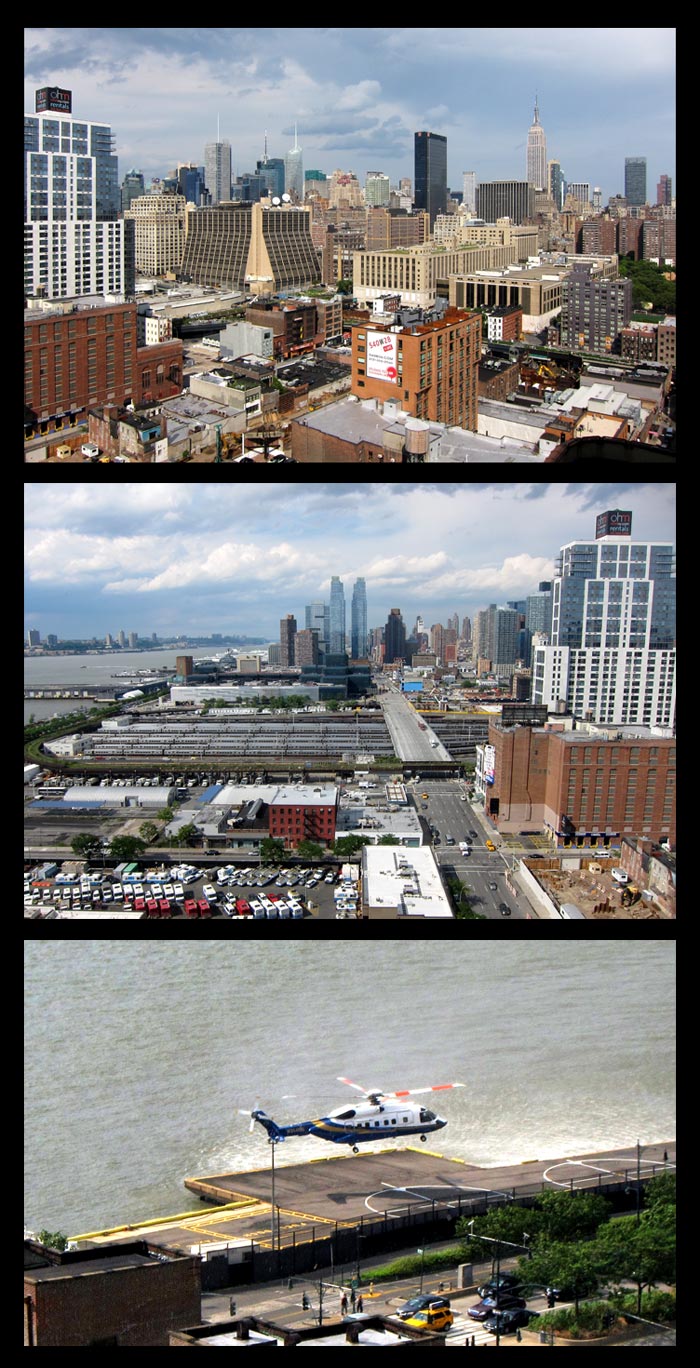
In my travels through the myriad of businesses I have visited over the decades in Manhattan, I am sometimes privy for some moments to a spectacular view from an office or industrial space on a high floor. I was recently shopping for a sofa in the Starrett-Lehigh Building in Chelsea at 601 West 26th Street. The property is enormous, spanning an entire city block between Eleventh and Twelfth Avenues and between 26th and 27th Streets. The full-block freight terminal, warehouse, and office building was built in 1930-31.
It was a Sunday afternoon, June 3rd. The neighborhood and building were essentially deserted. The showroom was small and spare. The whole experience was rather depressing until I moved towards the windows, which had unobstructed views North, East, and West. Helicopters were taking off and landing from the heliport, affording me the kinds of views I had hoped for when I originally visited. Looking northeast were the Chrysler and Empire State Buildings, as well as many lesser-known players in the game of one-upmanship by New York City’s tall buildings.
With a view of midtown like this, I am often reminded of one of my favorite scenes in the film The Producers and the words of Zero Mostel as he tries to lure Gene Wilder into a moneymaking scheme and whispers over his shoulder, “All of these pleasures can be yours.” Like a small boy or girl looking down from atop the Empire State Building, where cars look like toys that can be picked up, when one has a sweeping vista of Manhattan’s cityscape like those in today’s photos, the industry, ambitions, drive, and achievements of generations of New Yorkers seems so tangible, Just There for the Taking
I do believe that one of the reasons that civic improvements are not made in a timely manner is that legislators do not suffer the slings and arrows on a daily basis. The comfort of insulation will do a lot for apathy, and mornings outside in January without a coat will do a lot to propel someone to light a fire.
Even for those who grew up poor or working class, once removed, the frustrations become distant memories for those in office. But if they, like their constituency, had to rely on mass transit for their daily commute and experienced delays, rerouting, and other abuses, they would likely be first at bat for change. To depend 100% on public transportation and suffer the anxiety, stresses, and horrors of the system on a long term basis will grind many down, even the seasoned, tolerant New Yorker with a cast-iron stomach. I have known many residents who have been driven to near wit’s end over a life time of transit travel. Some, as several of my employees, have sworn off subways entirely, opting for bicycle travel, even in winter.
Saturday, April 21, was a beautiful sunny day, and I was to visit a friend in Staten Island. My car was in disrepair, so this would be the first time in my life where I would travel to a destination within Staten Island using public transportation. The X1 express bus was the logical choice, providing nearly door-to-door service for $5.50 one way. My friend warned me that this was the only sensible option.
However, I decided that given the weather, I would take the ferry and the SI Railway. I had never taken the SIR, and I was particularly excited to do so and document the trip. This means a three-legged trip: a subway to South Ferry, the ferry itself, and the Staten Island Rail to my final destination.
Descent to Hell
It started out innocently enough, with plenty of good cheer. It was, however, to become the ride from hell. Distracted with my cameras, iPad, and trip planning, my first mistake was getting on the subway on the uptown rather than downtown side. This was infuriating because at the Sheridan Square station, there is no underpass, so anyone making this mistake must leave the station, exit to the street, and reenter the other side, paying another fare – there is no provision for a free transfer under these circumstances. I was pissed as hell at my stupidity and even more so to give the NYC Transit Authority another $2.50 for no good reason.
As I descended the downtown stairway, I had just missed a train. Adding insult to injury, I was angrier yet, and my first leg to South Ferry was already delayed waiting for the next train. The change to the ferry at South Ferry went smoothly, and the ride at sea afforded ample opportunity for scenic photos and video. The Staten Island Ferry comes highly recommended – it is FREE and affords vistas of the East River bridges, the Manhattan skyline, Ellis Island, Brooklyn, New Jersey, the Verrazano Bridge, and the Statue of Liberty.
I had been warned by my friend that the travel option of choice was the X1 bus, not a three-legged workaround. I had told her that in this instance, I preferred the scenic route and, apart from my mishap taking the wrong train, it was looking like I would be heir to bragging rights for my decision to take the ferry. I was armed with photos and video to show her, which would just be further evidence that in NYC, there are different strokes for different folks. I had calmed down appreciably and was ready for my rail trip.
Hell Hath No Trains
When I arrived in Staten Island at the St. George terminal, I learned that due to construction, the SI Railway was not running from the ferry station. BIG disappointment. I was informed that there was a free shuttle bus to the first station on the line. This would make it a 4-legged trip. Additionally, no one could tell me where the shuttle bus was, including every driver of the local buses I could find. My patience had worn thin, and I decided to forgo the railway and take the local bus, the S79. Another big disappointment, and I was fed up.
Hell Hath No Buses
I was alone at the bus stop with one other passenger. It was desolate, and as I waited, time crawled by. I tried to ameliorate my anger, looking to my friend waiting at home for sympathy by making more and more frequent cellphone calls to her to complain. She was the perfect and willing shoulder to cry on, a classic New York cynic who hates all things New York City and has nothing good to say about public transportation. Of course, I got the obligatory “I told you sos,” but even she became incensed as the delay became nearly inexplicable. Over an hour had passed, and there was no S79 bus to be seen. The crowd of passengers had become large, but virtually no one appeared agitated at all.
All’s Hell That Starts and Ends Hell
The delay became extreme, and I paced like a wild animal. It was nearly ONE HOUR AND 30 MINUTES to wait for a local bus on a Saturday night! As I was to return that night and it was now after 9PM, I even considered getting back on the ferry and returning to Manhattan. My friend was not pleased with the prospect of an aborted visit, and neither was I. I continued to wait, and at last an S79 pulled up.
There was still little show of anger even amongst those who had waited for nearly as long as I had. There was neither an apology nor an explanation from the driver nor confrontations from the passengers as they silently boarded the bus. On board, I tried to recruit a sympathizer or two for what seemed to be an unconscionable act. In my conversation with one resident, I learned that delays like this are not uncommon, and he seemed resigned to his plight. He, as well as his fellow passengers, looked calm and collected. For them, it was business as usual for the ride home. For me, and I wish for a public servant, it was truly The Ride From Hell
I have done numerous stories featuring nature’s impact on the city. In some cases, more prominent, in some, less. But always that the city is juxtaposed against nature. How the manmade contrasts the natural, but rarely mother nature on her own. On July 20, 2010, I wrote Back to Our Main Feature with a lucky capture of a spectacular thunderstorm and lightning bolt. In it, I said:
Please understand that I, like most New Yorkers, do love Mother Nature, but the gifts nature bestows and the power she wields often feel secondary in a city like New York.
Last night there was a brief lightning storm dramatic enough to make many of us look up and say wow. But unlike our country brethren, who may spend a pleasant evening watching shooting stars, we rarely indulge these natural phenomenon for very long. Glancing up to the sky, seeing a spectacular display of lightning complemented by a waxing moon, we acknowledge when nature has spoken. Yes, like any great commercial, we hear you, but now, Back to Our Main Feature.
Even on a foggy night, a spectacular fog is often more obstacle or at best backdrop to the city’s structures. Today’s photos were taken in Union Square during the ongoing Occupy Wall Street, now a daily social phenomenon. As I marveled at the beautiful effect of the various illuminated buildings filtered by the misty air, I surveyed the hundreds of park occupants and could see no eyes drawn to nature’s show. Surprising, because heavy fogs are rare and spectacular, the delight of many a filmmaker.
However, this is New York City, and from time to time, without knowing it, the average New Yorker will find himself or herself In a Fog…
I often take calls in the course of business from non-residents of the city, who, unfamiliar with the details of Manhattan, question me about my Broadway address. Is it THE Broadway? they ask. Yes, I reply, it is THE Broadway. However, Broadway, which spans the entire length of Manhattan, varies considerably depending on where you are. At one time, not long ago, Broadway in SoHo was only a quiet commercial/industrial thoroughfare. But it has changed.
When I say change, I mean radical change. Change that almost defies imagination. Change so substantial that I question my own memory. I wrote of this in Cast Iron Stomach and Six Geese a-Laying. When I first moved to New York City in 1969, SoHo was not even an acronym yet. It was strictly an industrial district, essentially an industrial slum, a neighborhood I only passed through, perhaps on the way to Chinatown or Canal Street. At one time in the 20th century, the area was known as Hell’s Hundred Acres for the frequent fires that arose in the loft warehouses.
More recently, even after gentrification, alleys such as Crosby Street remained undesirable, yet pushed to ferret out every remaining square inch of what remained, Crosby Street became every bit as desirable as the rest of SoHo. There are no bargains left, or undiscovered backwaters in Lower Manhattan.
The area was dominated by industrial businesses – leather distributors like Marap Leather who occupied an entire building at 678 Broadway or Commercial Plastics at 630 Broadway. In 1980, Unique Clothing Warehouse opened at 718 Broadway at Waverly Place (president Richard Wolland closed it and filed bankruptcy in 1991 with over $2 million in debt), beginning a wave of transition. In 1983, Tower Records opened at 4th Street and Broadway (recently closed). A few months later, the elegant Blue Willow restaurant opened at 644 Broadway in the building shown in the photo.
There were early pioneers in SoHo, both individuals and businesses – places like the Park Place Gallery. Alison Knowles had rented space as far back as the late 1950s on Broadway north of Canal Street. From Illegal Living: 80 Wooster and the Evolution of SoHo:
Illegal Living is the story of the building at 80 Wooster Street in New York and the people who lived and worked there. The first of 16 artists coops started by George Maciunas, founder of the Fluxus art movement, Fluxhouse Coop II spurred the development of SoHo and the spread of worldwide loft conversions. … The artists of SoHo, while focused on their art, also built community, participating in the creation of a new form of residential development. The building was a magnet for the avant-garde who were drawn to Jonas Mekas Cinematheque, a ground-floor space that hosted happenings, film screenings, dance and theater performances, concerts, and art shows. Hundreds of artists including Trisha Brown, Richard Foreman, Allen Ginsberg, Philip Glass, John Lennon, Hermann Nitsch, Yoko Ono, Nam June Paik, and Andy Warhol showed their work in and around the building.
There were a handful of well-known early retailers, such as Dean and DeLuca. One of the earliest that I personally recall visiting was Broadway Panhandler at 520 Broadway, eventually to move due to soaring rents. Little did I know I would come to occupy the 3rd floor of that very same building in 1990, where my business remains to this day.
When I moved into the building, it was occupied entirely by sweat shops manufacturing clothing. I was the first “upscale” tenant. The landlord was very favorable towards me, seeing it as the first step in a new type of tenancy. Today, the building is occupied by media companies and businesses such as Built NY, Inc., a design firm that manufactures a neoprene bag and case line. The company holds over 180 patents, and its products are sold worldwide.
In its industrial days, SoHo was deserted at night – a ghost town. There were no retailers – manufacturers and commercial/industrial suppliers occupied even the ground floors which today command a huge premium and would make such use unthinkable. Now, the area is saturated with retailers, both of the common garden variety such as the Gap and also very high-profile merchants, including names such as Louis Vuitton, Bloomingdale’s, Prada, Coach, Apple, and Topshop. Foot traffic is outrageous on a day-to-day basis. Typically the sidewalks are so crowded that I resort to walking in the street, even then to be frustrated by people, vehicles, food carts, and other obstacles. Once, in complete frustration, I took to walking in the center lane against traffic, which I wrote about in Dead Man Walking.
Today’s photos are taken from my office window looking up Broadway in the evening. In the past, lights on Broadway meant the theater district and Times Square. Now, we have lights here in SoHo too. It seems that everywhere you go, Broadway is Broadway…
Many years ago, I became entangled in an argument regarding aspects of Christianity with a cousin and his wife in my family’s home in Connecticut. It was Christmas time, and I felt particularly bad to have gotten into a heated debate with family about their faith. I learned that they were born-again Christians. At one point, I expressed my dismay and told them that I was very sorry. However, they said that they were not upset at all but that, to the contrary, they valued the opportunity to defend their faith and that debates of this nature only made them more resolute in their beliefs.
I only recall one small part of that evening’s conversation – a point where, after a litany of their dos and don’ts, I said to them that following their road appeared to me to be an absurdly narrow path, virtually unwalkable. They were pleased by this comment and concurred, telling me that Christ said exactly that in Matthew 7:13-14 :
Enter through the narrow gate. For wide is the gate and broad is the road that leads to destruction, and many enter through it. But small is the gate and narrow the road that leads to life, and only a few find it.
This passage was unbeknownst to me at the time and certainly gave me cause for reflection. After millennia of debate, argument, and discussion, well-schooled Christians, like others who are serious about their faith, are well-armed with answers to the myriad of objections and issues with biblical matters. Religious doctrine is not so easily dismissed as dogma of the unthinking masses.
In 2010, I made a trip through historic Richmond Town in Staten Island. The area is replete with beautiful antique structures in bucolic settings. I featured a number of postings on Staten Island and decided to leave the images of The Church of St. Andrew for a later time. Today I discovered the images in my archives of this 300-year-old church in the Richmond Town section of Staten Island.
The Church of Saint Andrew was founded in 1708 and chartered by Queen Anne in 1713. The Church served as a hospital and headquarters for the British soldiers as the New Colonies fought for their freedom. The Rev. Richard Charlton served as the Rector of Saint Andrew’s during this time. He was the maternal grandfather of Elizabeth Ann Bayley Seton, who was the first canonized American Saint of the Roman Catholic Church. Along with her grandparents; her father, brother and sister are buried in our historic cemetery. The Rev. Samuel Seabury was called to be the first Bishop of the Episcopal Church while he was serving as Rector of the Church of Saint Andrew from 1777 until 1780.
I toured the church property. Everything conspired to persuade me that my cousins were right; as I navigated the sidewalks and walked between the headstones of the departed, indeed it did appear that good things lay along a narrow path
Creationists often use one of the three classic arguments for the existence of God: that of Intelligent Design, going back centuries. In the 13th century, Thomas Aquinas argued that natural things act to achieve the best result, and as they cannot do this without intelligence, an intelligent being must exist. William Paley in 1802 used the watchmaker analogy to argue that complexity and adaptation in nature demonstrated God’s benevolent and perfect design for the good of humans.
When I look out onto a vista like the one in today’s photos, I am reminded of the watchmaker analogy. New Yorkers may not be godlike, but certainly such things that lie before me must be evidence of an application of industriousness and ambitiousness, not to mention our own brand of intelligent design. And seriousness. Many say that it is important to have a sense of humor and the ability to laugh at oneself, even disparaging seriousness as a veil. We have quotes such as:
Seriousness is the only refuge of the shallow. Oscar Wilde
Seriousness is stupidity sent to college. P. J. O’Rourke
There is truth to the concept that levity, humor, and not taking oneself too seriously at times is important. However, as a New Yorker, I prefer:
It is not so important to be serious as it is to be serious about the important things. The monkey wears an expression of seriousness which would do credit to any college student, but the monkey is serious because he itches. Robert M. Hutchins
In France, although a sense of humor exists, it is very important that a person is considered sérieux in the right way about the right things. The exact meaning includes an element of sincerity. New York City is not an easy place. People come and go, passing through the revolving door in the house of shattered dreams. In reality, it is brutal here, and a life of levity is not going to get you through that door.
When someone champions a sense of humor above all else and makes a point that someone is too serious, I question what might be achieved with such a lassez-faire attitude. Good or great things cannot be left to happenstance. Look at that New York City skyscape and all the great things this city offers, not just its architecture but also the culture and people those structures house. To survive and flourish like this city has, at least in this case, someone was sérieux and there had to be some Intelligent Design