• No Negativity

    In 2006-7, a friend and I were regulars at Think Coffee (see here). Looking to vary our cafe experience, one evening I suggested that we try Cafe Dante. He readily agreed. We knew that unlike Think Coffee, Dante was not self-service, the atmosphere would not be quite as casual, and certainly there would be some time limit on how long one could park without continuing to buy food or drinks.
    We were not, however, prepared for the sign in the window: NO LAPTOPS. This was not a problem for us, since we did not have laptops, but nonetheless, it certainly did emit a rather negative vibe for a Village cafe.

    Thoughts and conversation turned to the new realities of laptops in cafes and restaurants and how their use can lead to hours spent at a table, with the financial impact and new policy considerations for owners and management. Some cafes now impose limits or ban the use of laptops during certain hours. Think Coffee, on the other hand, was extraordinarily liberal, and I pondered what their official policy was regarding time versus money spent to occupy a table or seat.

    On my next visit to Think Coffee, I told the counter person of our Dante experience. I asked if there was any policy at all regarding purchases necessary to spend time in the cafe. For example, since Think offers free water, could I pour myself a cup and spend the day without making any purchase? Her response surprised us and became an inside joke and an oft repeated catchphrase: “Let’s just say the management has a policy of No Negativity.” Wow. So essentially the policy is anything goes.

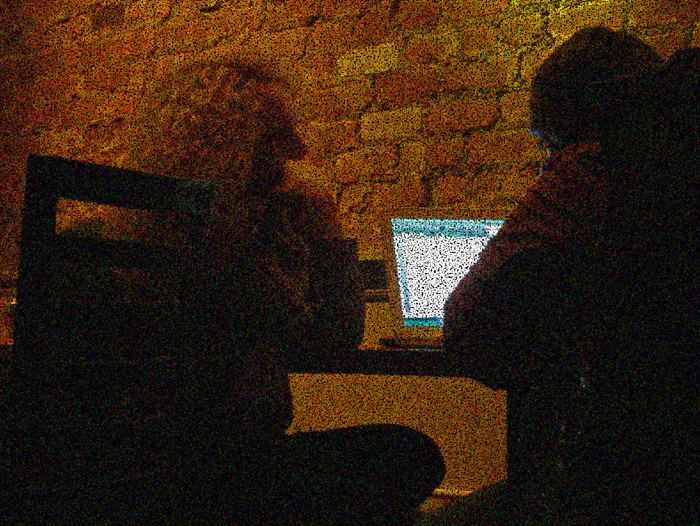
    Last night in a Village restaurant, I witnessed what to me was a rather egregious act. Two women were sitting at a table. One pulled out a laptop. The other moved her chair into the aisle to share the screen. She then folded her knees, bringing them up towards her chin, and put both of her feet on the seat of the chair. I am not talking about crossing legs – she had the soles of both shoes squarely planted on the surface of the chair seat which was covered in fabric. This seemed so inappropriate, I countered by pulling out my camera and taking a photo. However, she moved her legs, so I did not catch the offending act specifically.

    But it is no matter. We are in a different world now. Business is very competitive and must extend very liberal policies to keep customers. There is no need to buy anything in a cafe, and perhaps you can even put your feet up on the table in a restaurant. We have one new policy now – No Negativity 🙂

    Note: Since this photo was taken in a restaurant, I have processed it to protect the privacy of the individuals.

  • Take It

    Payback, payola, quid pro quo, freebies, gratuities – New York City is mired in the various forms of “free” or discounts. The small business owner should express gratitude to the regular customer in some way. In the world of restaurants, policy and practices span the gamut in New York City, from one extreme to another. I am currently experiencing both extremes. In one case, a restaurant I have frequented weekly for over ten years has never offered me anything free other than the requisite water. Nothing. At the other end, a new restaurant I am currently frequenting has been offering me free appetizers and/or desserts at every visit for nearly a year. The owner is rolling out the red carpet, and I am being treated like family.

    Free, however, may not always be the best thing for either party. I have given a lot of thought to this because of a very poignant incident that happened when I was much younger. At the time, I was making handcrafted items, and a close friend told me that he wanted to buy one of my products. I was pleased, and in the conversation that ensued, I mentioned that I would, of course, give him some sort of discount. To which he replied that he wanted no discount, but insisted on paying full retail. I was very perplexed by this and asked why. Isn’t a discount to be expected with business between friends? His answer still lingers in my mind today, decades later. No, he said, if you are truly a friend, then you want to see your friends do well and succeed. A friend should be the most willing to pay full price and refuse a discount. Of course, the individuals’ affluence relative to one another needs to be taken into account also.

    This philosophy was echoed many, many years later, when another friend, who was a consultant and on the board of directors for a small performance group, told me that he paid for admission to all of the group’s performances. This appeared to be insane to me. When I asked why, his reasoning was the same as my aforementioned friend – he was a patron of the arts and wanted them to succeed. He pointed out that the idea of refusing freebies also serves the customer or patron – helping a business survive provides a continued source of a product or service.

    The issue of freebies in restaurants, however, poses a dilemma with regards to all these issues of showing customer appreciation and the customer’s reciprocal support. Once an owner or staff member surprises with free food, such as an appetizer or dessert, it would be insulting (and perhaps wasteful) to refuse it. Insisting that it be added to the bill will most likely be met with refusal. And leaving an unusually large tip does not compensate the ownership, where ultimately, the act of generosity lies. So, in the case of restaurant offerings, I follow the advice of someone who once suggested: if someone offers you a gift, take it 🙂

    Photo Note: This free piece of Tiramisu was offered to my dining companion and myself last night at Boyd Thai, a great little place that I wrote about in 2007.


  • Listen to the Birds

    The range of housing options in New York City is truly staggering – railroad flats in tenements, prewar high rises, modern towers, single and two family houses, mini-mansions, historic 19th century brownstones.

    However, the cost of housing is so extraordinarily high that for most, neighborhood choice, housing, and lifestyle is severely compromised by financial concerns. Where as in the suburbs, most working individuals own their own home at a relatively young age, in New York City, many share apartments with roommates, even into retirement years. Others may continue to live with an ex-spouse while one or both date and cohabit with others. In the case where parents live in New York City, many live with their family through college and beyond, often until marriage. It is also common for younger people to move to neighborhoods completely alien to them, often as outsiders in ethnic enclaves such as Astoria.

    The equation is simple – housing cost is a function of distance from Manhattan, a park or other desirability, and safety/crime. When the lack of positives and a plethora of negatives conspire against a neighborhood, it then becomes a reasonably priced option. There still are some hinterlands, such as Far Rockaway, which have yet to appear in the media as the new SoHo.

    The equation, when viewed with Einsteinian relativity, still applies at all income and wealth levels. On the Upper East Side, proximity to Fifth Avenue and Central Park will determine cost. For residents in the Village, undesirable will mean too close to 14th Street or 6th Avenue. In Park Slope, Brooklyn, the formula is simple – the closer to Prospect Park, the better.

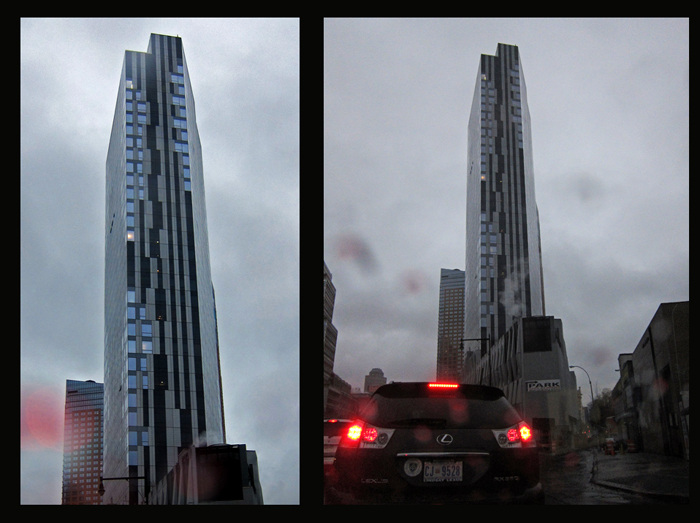
    Downtown Brooklyn along Flatbush Avenue was never considered particularly desirable, certainly not for residential use. I have been through this area thousands of times by car. Recently, I have noticed a cluster of four towers on/near Flatbush Avenue close to the Manhattan Bridge. All of these are new residential projects – Oro, Avalon Fort Greene, DKLB BKYN, and Toren (seen in today’s photo). I am not a fan of modern high rise apartment buildings, but I find this tower quite beautiful architecturally and it has attracted my attention on every passing.

    I personally live in a landmark townhouse. In spite of its tremendous charm and ambiance (which, along with below market rent, is what keeps me here), I do have to tolerate a litany of antiquated services and living conditions – poor ventilation, excessive heat, poor windows, poor heating and cooling, plumbing leaks, roof leaks, no elevator, and things that don’t work.

    Looking at the floor plans and list of amenities in a project like the Toren can make one envious. The 35 story property has an indoor heated swimming pool, a fitness center, tiered two story roof decks, a library, outdoor movie theater/screening room, on site parking, storage, elegant kitchens, large living spaces with high ceilings, curtain walls of glass, doorman, 24 hour concierge, Pilates studio room, saunas, and laundry facilities. The interiors are exquisitely appointed with high quality cabinetry, appliances, flooring etc. And of course there are extraordinary vistas of the city. The building was designed by Skidmore, Owings and Merrill LLP (SOM), the award winning, one of the world’s largest architectural firms.

    The Toren does look so beautiful, inside and out. I do love vistas. But I don’t want to look out to a bejeweled cityscape from behind a floor to ceiling glass window, in a climate controlled apartment. Spring is around the corner – soon I will want to throw open my windows, look out to green and budding flowers, and walk the tree lined crooked little streets of the West Village. And listen to the birds 🙂


  • The Real New York


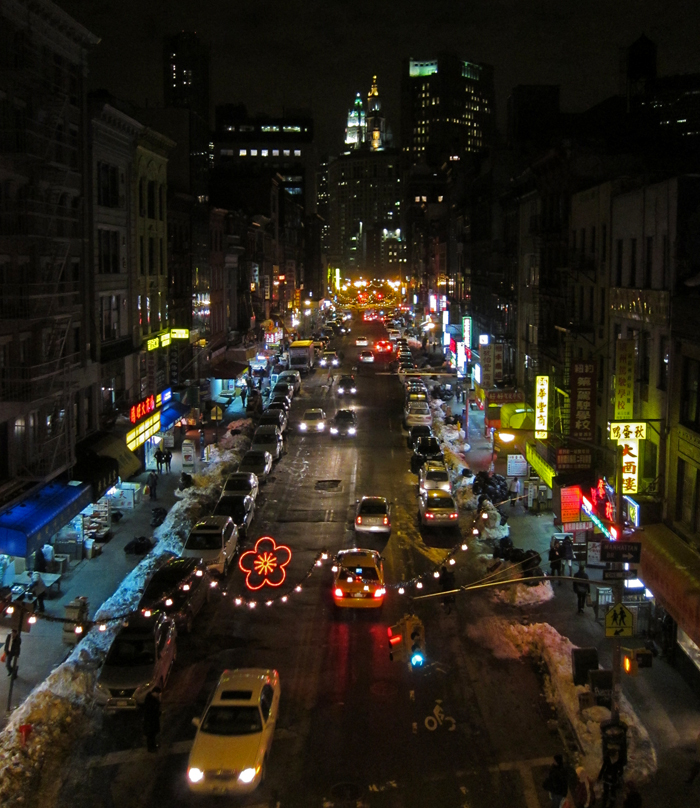
    One of my favorite childhood toys was the homemade periscope. With this, one could spy, i.e. see other people secretly in a candid state. Media often tries to provide a periscopic look at the world with the investigative report, the behind the scenes inside look, and with programs such as 20/20 or 60 Minutes.
    We want to see people, places and things in their natural setting. We want it all and we want it unadulterated, unexpurgated, uncensored, uncut. We want to see what’s behind the curtain or that closed door.

    There is a New York City guidebook called Not For Tourists Guide to New York City, as well as a little tome I really enjoy from 2002: City Secrets – New York City. There are numerous websites promising to show you the hidden side of New York City: forgotten-ny, vanishing new york, Lost City, Ephemeral New York, Undercity, and Overheard in New York.

    In this website, I have endeavored to show you New York City in as real a light as possible. I am not a particularly private person and have revealed to you many aspects of my personal life, work, family, background, and interactions with others, as well as my personal perspectives and experiences in the city.
    Whether visitor or native, we grasp at all the things promising to show us the secrets because we want to see the Real New York – unvarnished, unsanitized, and uncolored by the Curse of Trade. The city we have read about, heard about, dreamed about, and portrayed in film. We want to see what lurks behind the shadows and fog and experience The Real New York…

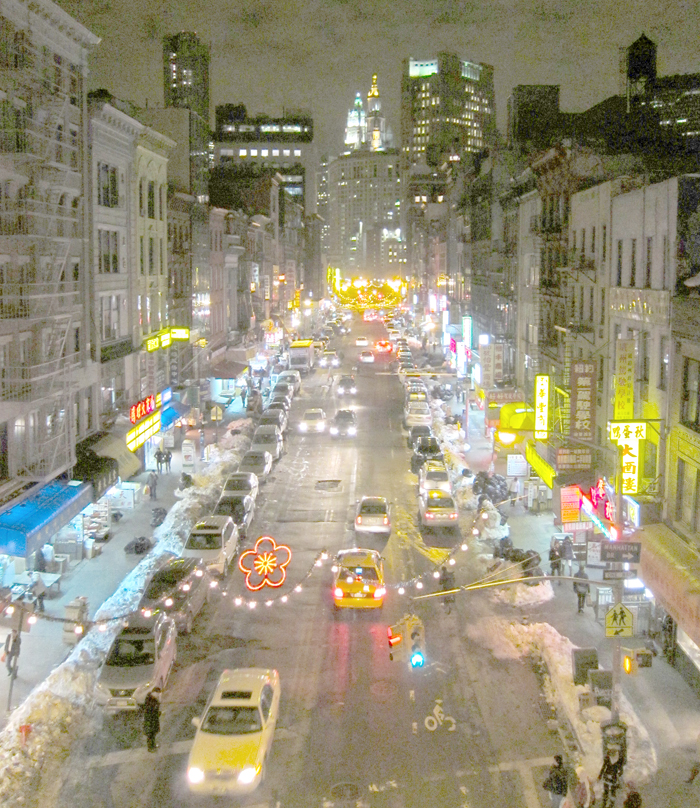
    Photo Note: this is a view looking south along East Broadway from the Manhattan Bridge. The two illuminated towers in the rear center are the Woolworth and Municipal Buildings. The photo effect was achieved using a Photoshop filter to remove the shadows and reveal all.


  • Lured by the Luxuriant

    One of the most interesting things about New York City is that, in spite of the myriad of groups and individuals who are militant regarding so many issues, there is still tremendous tolerance.
    The sale and wearing of fur is a hotly debated and highly contentious matter, yet it is very surprising that an individual can sell or wear furs in Manhattan and survive unscathed.

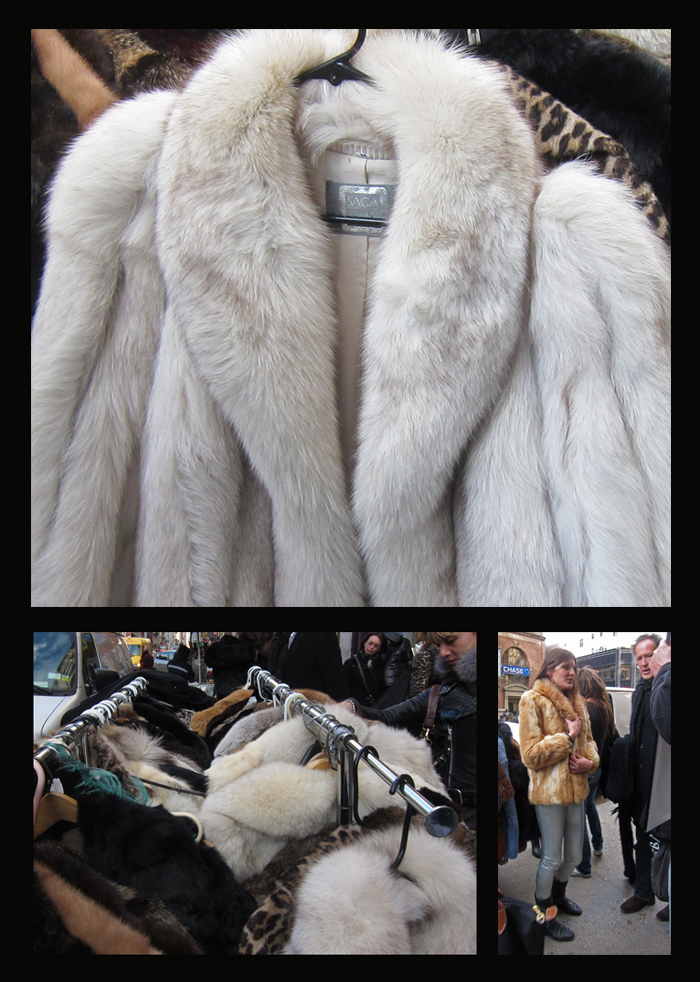
    On Broadway and Spring Street, I witnessed an unusual occurrence – the sale of genuine vintage furs on the street. The vendors informed me that these were purchased from a theater company which had gone out of business. The subject of used or vintage furs is also debated – some feel the damage has been done, so why not recycle and use the furs? Others feel that wearing of fur of any type sends the wrong message, that fur is OK – how would others know that you wear a fur for that reason?
    The prices ranged in the low hundreds for furs which would have originally cost in the low thousands. There was a flurry of interest and activity with women trying on furs. Always prepared and equipped with the necessary sales accoutrement, this street vendor also had a full length mirror. One coat being tried on had a tear in the stitching. No worry here either – the vendor said he had sewing materials and could easily repair it.

    I brushed my hand against a number of these coats – nothing feels so extraordinarily luxuriant as genuine fur. The white fox was particularly beautiful. However, I can never fully “enjoy” the experience of fur, feeling a bit like Cruella de Vil. Too many protests, anti-fur campaigns, and awareness of how they got to that rack makes the whole thing feel like the epitome of fetishistic self-indulgence. Much like a chocoholic looking to control their intake, if you have misgivings about furs, best to stay away. Otherwise I can assure you, you will be Lured by the Luxuriant…

    Other Stories about Furs: Barbie in Furs, Surrounded by Fur


  • Penny’s from Heaven


    I have seen people get in very long lines at trade shows for free things, not even knowing what was being given away. I have seen people fight like wild animals over a few free T-shirts thrown to audience members. I have seen people who have money eat food that is virtually inedible because it is free.

    I have seen street vendors very frustrated with me as I show resistance to a purchase as they keep lowering the price with no effect. They just don’t seem to understand – if I really don’t want it, cheap will not change my desire.

    Free or cheap, particularly for entertainment, is not a big incentive for me. In New York City, there are so many cheap and free options for performances that a person who values their time at all has to be selective. However, as I wrote in Free Lunch, values do exist, and there is quality to be found in New York City for free or cheap in places like Under St. Marks (see story here). However, I had not yet been to Penny’s Open Mic until last night, when I went to a show for the first time.

    Penny’s Open Mic was started in 2007 by Penny Pollak and collaborators Milazzo and Marsha Brown. Penny is an actress, writer ,and performer. See more about her here and the venue here.
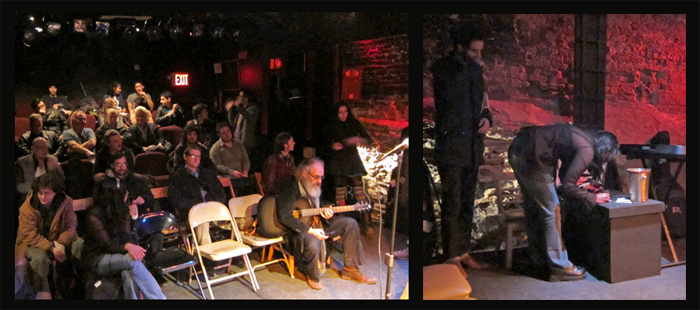
    Every Tuesday night, at 9PM, performers of every ilk show up at this tiny underground theater – musicians, singers, actors, poets, dancers, comedians, monologists. They sign up to perform, and their names are dropped in a bucket – 30 are chosen at random to determine who will perform and the order of performing. They are given 7 minutes to showcase before a live audience. Penny acts as emcee and timekeeper. A large number of the audience members are performers themselves, so the atmosphere is one of camaraderie and support.

    The talent and level of experience varies, as would be expected. I found last night’s performance outstanding. The live band and accompanying guitar are very strong elements. It was clear that many of the acts I saw had been fine tuned over a long period of time. Pieces from Frigid New York were done.

    It is critical that venues like this exist for budding/aspiring performers or for the more seasoned to showcase new material. The admission charge is only $3. The focus is on performing, not business. Downstairs at 94 St. Marks Place, on Tuesday nights, the Curse of Trade has not attached to this enterprise and, as both audiences and performers concur, Penny’s from Heaven 🙂


  • Hair

    On our recent warm spell, people flooded the parks and streets like it was a spring day. A woman with quite the head of hair immediately caught my eye. Thinking I was now an expert in yarn falls after meeting Bex Burton (see The Women here), I took a brisk walk, met Shannon Moran, and asked if I could photograph her and her yarn falls. I was informed, however, that I was in error. These were not yarn falls at all, but in fact entirely her own hair, which go down to her knees.

    There is probably nothing that can define, change, or improve a person’s appearance as simply and dramatically as a hairstyle. The face is the mirror of the mind and the window to the soul. Hair frames the face. It is the part of our physical makeup that we can most easily alter. And alter again. Of course, there are limitations to control – hair loss and baldness for most men is a nagging horror.

    Some may leave home in any number of unimaginable modes of dress, but few will leave without combing their hair. For many, what appears to be lack of concern or no style, is itself a style. Hair care ranges from simple grooming to an obsession. It’s an industry. For most women, hair is paramount in their daily grooming rituals and, understandably, a source of perpetual dissatisfaction and frustration. It can make or break a look.

    As incredulous as it may seem, when I attended high school in the late 1960s, a boy’s hair that just touched one’s ears was grounds for a formal reprimand and parental notification. Long hair could even lead to expulsion. The Beatles were a scandal as much for their mop-top haircut as their music. Short by today’s standards, a Beatles haircut was an outrage and was banned in schools. Beatles mop-top wigs were available, as well as even a Beatles’ hair care line.

    In New York City, 1967, we had Hair: The American Tribal Love-Rock Musical, conceived and written by actors James Rado and Gerome Ragni. Many cast members were recruited from the streets. Joe Papp, who ran the New York Shakespeare Festival, opened his new Public Theater in the East Village with a production of the show. Hair was Papp’s first non-Shakespeare offering.

    Hair was a tribute to the hippie movement and the protests of all that was wrong with America – racism, environmental destruction, poverty, sexism and sexual repression, politics, and the Vietnam war. There was drab clothing, rejection of materialism, nudity, sexual freedom, drugs, pacifism, environmentalism, and astrology.
    But in this huge panoply of themes, symbols, and philosophies, none was more more important than the name of the show itself, Hair – an ever present, visible statement about personal beliefs. Long hair almost always signified defiance, rejection of the societal norm, and the evils of the “military industrial complex.”

    Today, the role of hair (along with skin treatment, i.e. tattoos and piercing) is just as important. Perhaps somewhat more a fashion statement, hair and tattoos will still often say something about a person’s lifestyle.

    Shannon says:

    I got my dreads 9 years ago – at the time we were squatting, train hopping and causing mayhem around the country. They go to my knees and are 100% real, natural and home grown. I have many tattoos and will continue to chace my goal of becoming a completely illustrated lady. I have over 30 hours of work scattered all over my body – my favorite being Nick Cave lyrics “Come into my sleep” on my ribs – but I do adore my recent addition – a mustache on my finger.

    I learned that Shannon, 22, was born in Shirley, New York and is currently a resident of Astoria, Queens. She is a photographer, having studied at FIT and Cooper Union.

    I am very interested in vintage erotic photography and obsessively produce my own. I have an alter ego – Lux Berlin – you may have seen my work exhibited in galleries in Chelsea, Brooklyn and the UK. I can be found drinking red wine, swearing like a sailor and dishing out bad advice on the beaches of Fire Island, marching topless down a board walk in Coney Island or shimmying and shaking somewhere in the Lower East Side.

    For now, my work is done here. And I need to check my hair 🙂

    Note: If you are comfortable viewing erotic material, you can see Shannon’s website here.


  • Twinship

    Their first names seemed to be only a formality – they were always the twins. They lived in the same house and seemed to be forever destroying the same things, banging on the same drums, or involved in equally uninteresting things. They were identical twins and, to me, identical. They were my first cousins on my father’s side and about my age. However, the truth of the matter is that I had little desire to know them well enough to tell them apart or know them as individuals.

    I have a large extended family of aunts, uncles, and first cousins. My twin cousins had three other siblings. On the occasional visit to their home, invariably there were other families and cousins as well, so I had many options for socializing. I barely knew the twins.

    Twins have a unique bond and relationship that most of us will never know. Many older school identical twins saw themselves as a unit even through adulthood, living together, wearing identical clothes, etc. My twin cousins were not that extreme, however, they were addressed and treated as a unit for as long as I can remember.

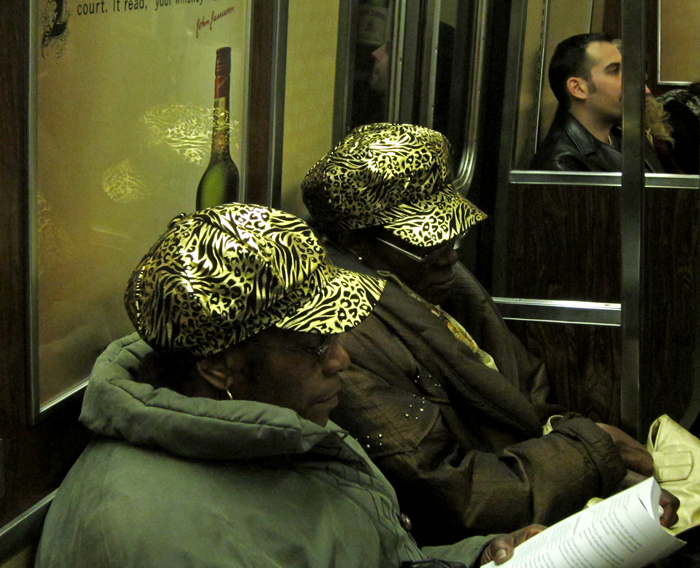
    Recently on my way to a taping session of the Ferris Butler Program (see here and here), I was taken aback by two women who just exuded twinship. I loved their hats – they were so striking. They both had very similarly styled full-length down jackets, one brown, one green. Everything was bathed in a yellow/green light. I did not get the opportunity to chat with these women on my short subway ride and learn about their relationship. We share a twinship on this one, because your guess is as good as mine 🙂

    Note: I am very happy to report that I have begun to know the twins better as adults. I recently spent an afternoon chatting with one and found him to be one of the nicest, most thoughtful people I have met. Now that I think about it, I’m not absolutely sure which one it was and also, I think his brother might be really nice too 🙂


  • I’m Really Good at Paper Mache

    It is slowly becoming abundantly clear to me how artistic abilities are rarely recognized or encouraged in young people. I have a story about a childhood friend so remarkable that we are planning to write and publish a joint memoir as a book. But that’s another story for another time.

    I had another childhood friend, who shall remain nameless, who was quite sarcastic and cynical. Our community was doing a small performance of Alice In Wonderland. I was unaware of this production until it was nearly time for performance – hence, I had no opportunity to audition or perform in the show. I took a last chance to ingratiate myself with the woman in charge and offered my services to make any figures needed from paper mache. I told her in front of my friend, “I’m really good with paper mache and working with wire.”

    Once we were alone, my friend was uproarious and quoted with great pleasure, “I’m really good with paper mache.” Apparently, he found my skill set to be inconsequential and my statement of such, ridiculous. He took every opportunity subsequent to that incident to torture me with that quote. In hindsight, it does smack of a young boy desperately trying to win approval. But what is wrong with a young student who shows a creative interest?

    Supporting a child who has an artistic temperament and abilities is a tough call. On my recent interview with Professor Gurland (see story Part 1 here and Part 2 here), he told me not only of his work as a jazz musician, but also of his son’s interest. He made a deal with his boy – graduate from college and he can do anything he wants as far as pursuing music. A degree will provide a safety cushion for future employment. A reasonable compromise for the concerned parent.

    For myself, it has taken the better part of my adult life to recognize my interest in creative pursuits – writing, photography, and graphic arts. The evidence has been there throughout my life – building a darkroom as a child, crafting various objects and models, origami, and designing products for my business.
    I was, however, steered towards a career in mathematics, as is the case. My life might have been very different however, had someone just recognized that I’m Really Good at Paper Mache 🙂

    Photo Note: Two Too Large Tables are located at Hudson River Park. The two works, designed by Allan and Ellen Wexler, were constructed from stainless steel and ipe wood and fabricated by Polich Art Works. One is comprised of 13 chairs, 7 feet tall, supporting a 16-foot-square plane. The other, also 16-feet-square, is 30 inches tall with integral seating areas. One serves as a shade pavilion and the other a community table.
    “The seemingly random placement of chairs directs and focuses our views of the river, pathways and landscape. Pathways cut into the tabletop lead to clusters of chairs. When people sit they are completely surrounded. Their unconventional placement brings people together in unexpected groupings.”
    Allan Wexler and Ellen Wexler are Chelsea residents and collaborate on public art projects; Allan teaches at Parsons The New School for Design.


  • Just Shades


    If you want the flavor of New York City, I recommend watching Late Night with David Letterman. Here you will get comedy with an edge and a blend of the New Yorker’s classic traits – smug indifference, elitism, cynicism, skepticism, sarcasm, and impatience, applied to any and all topics, like the world of specialization, which we see more and more in all sectors of life whether business, occupation, or recreation.

    In retail, however, this is an extremely risky proposition. With a large product mix, a retailer can shift gears, i.e. inventory, as trends and consumer demands change. But to have a brick and mortar shop that specializes in a specific product leaves one at tremendous risk – a change in the tastes of the consumer and you are finished. A highly specialized retailer will typically require a very large population to keep a physical shop afloat financially selling one product. New York City offers the best opportunity for success.

    For every specialty survivor, I have seen a hundred casualties, like the gelati craze of the 1980s. We now have a wave of Red Mango and Pinkberry shops seemingly everywhere. Although they may offer a higher quality product, it is reminiscent of TCBY in New York. Now, there is only one left in Manhattan. One has to deal with not only the fickleness of the consumer, but also that of the New Yorker who has their own particular taste.

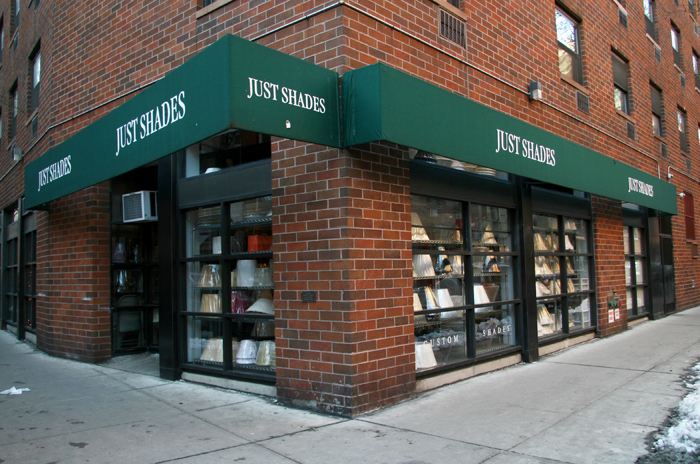
    The specialty shop sells only one product line, like Canal Rubber. The real specialty shop sells only one product – The Doughnut Plant, Kossar’s Bialys, H&H Bagel. But food shops or chains specializing in one product are common. Hard goods much less so. This is the world that surprises. Like Bari pizza ovens. Perhaps the quintessential poster child for real specialization in New York City retail is Just Shades, which, along with Just Bulbs, were the subjects of a brilliant, classic David Letterman skit in 1983. In it, Letterman starts by visiting Just Bulbs, where he persists in asking a salesclerk if they carry anything other than bulbs. Here are excerpts of Letterman’s brand of torture:

    Letterman: Besides bulbs, what do you have here?
    Clerk: Nothing.
    Letterman: How about shades? Could you get shades here?
    Clerk: NO, we are Just Bulbs. If you want shades, maybe you go in a place called Just Shades.

    Then we cut away to a downtown retailer, Just Shades, where Letterman pursues the same relentless questioning with a little old lady:

    Letterman: What is the name of this store?
    Clerk: Just Shades.
    Letterman: And what can you get in here?
    Clerk: What can you get in here? Only shades. That’s why our name is Just Shades.
    Letterman: But seriously, what can you get besides shades here?

    Letterman was able to poke some fun at the expense of extreme specialization, and for that, you need a New Yorker, New York, and a place like Just Shades 🙂


  • The Curse of Trade

    I carry two quotes with me in my wallet from Walden by Thoreau. One is quite well known and often cited – a portion was in fact used in the film Dead Poet Society (see it here). The other, concerning the nature of business, seems so often applicable to my daily life as to lead me to be frequently disturbed:

    But I have since learned that trade curses everything it handles; and though you trade in messages from heaven, the whole curse of trade attaches to the business.

    I once witnessed an incident at the origami convention held annually at the Fashion Institute of Technology that illustrated this all too well, and I have never forgotten it. I had a passion for origami at one time – as a young boy, I borrowed the World of Origami from the local library. In the small blue collar town I grew up in, origami was virtually unknown, and my folded creatures were as fascinating to others as they were to me. I once gifted a girl a small bag of origami animals. It made quite an impression.

    There is a small area for vending at the origami convention. A married couple left their table, leaving their son in charge. While gone, this very young boy handled the sales quite adeptly, perhaps too much so. I sensed he had sold often and had learned his trade well, likely imitating his parents. I saw in him the desire to sell, irrespective of what was really being sold – selling to people who did not really want to buy anything, buy origami items or specific things he was trying to sell. I could sense that whether the things he was saying were true or not was secondary to the sale. Not a mortal sin, but it was just that he looked like a huckster hawking his wares. And so young. What was particularly upsetting was that I saw myself in that boy, and that Thoreau quote reared its ugly head again and immediately came to mind.

    That quote is a very strong assertion, one that many, particularly those in business, will bristle at. I have shown it to both business owners and non-owners and I have gotten a variety of reactions. One man, an owner of a prominent New York City architectural firm said, “I don’t agree with that at all.” I was not surprised by his reaction. Architecture is a noble profession, and the prospect that the work could be seriously compromised by commerce is, I am sure, quite distasteful.
    I fully understand the sentiment, however, finding something distasteful or disagreeable does not make it untrue, much as the harsh tenets of a particular religious faith do not, in itself, make that faith or its doctrine invalid.

    I have been in business or self-employed my entire adult life. I well understand the necessity of commerce and even some sales and marketing. How else to keep the machinery of businesses running to make the goods we actually do need? But as my business has grown, I have become aware how the nature of business shapes my decisions and my daily activities. When I first started and my business was more an adjunct to a hobby, I had the luxury of indulging my whims.

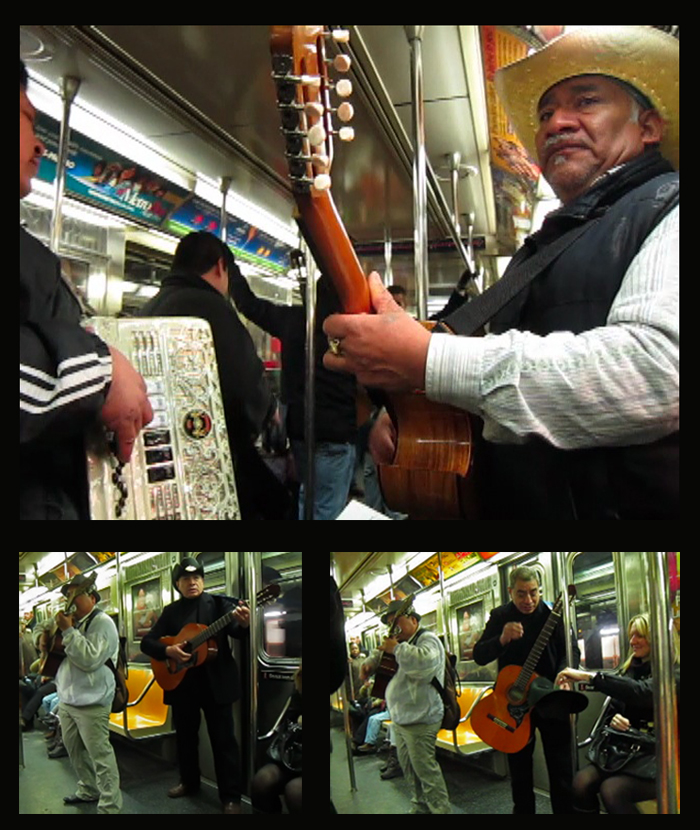
    I reflect on this problem often, as I did on the subway recently when a group of Mexican musicians entered my car. Their playing and money collection was extremely routinized, virtually stripping any joy or entertainment from the process. Their playing seemed to be nothing other than a way of legitimizing their collection of money:

    But these men need to make a living too, and perhaps music is what they do best. As they moved hurriedly to the next car, only to repeat the process, I was saddened and could not help but think that they too, were doing their best to trade in songs from heaven but at least in some small way, their business of entertaining riders suffered from the curse of trade…


  • Clement Clarke Moore


    Chelsea is the former home of the man who brought Christmas to America with A Visit from St. Nicholas (also known as The Night Before Christmas and ‘Twas the Night Before Christmas from the first line of the poem). This poem, first published anonymously in 1823, and now attributed to Clement Clarke Moore, is responsible for the conception of Santa Claus from the mid 1800s to today, including his physical appearance, the night of his visit, his transportation by sleigh, the number and names of his reindeer and the tradition of bringing toys to children.

    Clement Clarke Moore, a graduate and professor at Columbia College, inherited a large family owned estate which lay north of Houston Street. This area of the city was mostly undeveloped countryside at the time. Clement fought development of New York City as it moved north from lower Manhattan. The proposed street grid in the Commissioner’s Plan of 1811 would run through the Moore estate. In 1818, the city’s Common Council agreed to spare the area from Houston to 14th Street, west of Sixth Avenue. This is the reason that this neighborhood, the West Village, has such a quaint mĂ©lange of narrow streets with curves and oblique angles.
    Moore did, however, begin to develop Chelsea, dividing it into lots and selling them to prosperous New Yorkers. An apple orchard was donated to the Episcopal Diocese, now home of the General Theological Seminary, which spans an entire city block and where Moore served as the first professor of Oriental Languages.

    Regarding the name Chelsea, according to the New York Times, “It was Moore’s grandfather Thomas Clarke, a retired British naval officer, who had bought an old farm in 1750 for his retirement and named it Chelsea after the Royal Chelsea Hospital for veterans in London.”

    Chelsea is largely a residential enclave with streets lined with historic townhouses. This neighborhood was the location of my first apartment in New York City – you can see it here. The western area of Chelsea, along 10th and 11th Avenues was industrial and in the 1990s, there was a migration of galleries and art studios from SoHo to this area, where there are now several hundred galleries.

    Apart from the gallery district, Chelsea is not heavily touristed. However, there are numerous places of interest – the Chelsea Market, Chelsea Piers, the High Line Park, Hotel Chelsea, London Terrace, the Empire Diner, the IAC Building designed by Frank Gehry, the Rubin Museum of Art, the Joyce Theater, Dance Theater Workshop and the Kitchen.

    In today’s photo you can see a small group of historic buildings on Ninth Avenue. The corner property (at 183 Ninth Avenue at 21st Street) is the Royer-Wells House, the second oldest house in Chelsea. This Federal-style home was completed in 1832.

    I owe the charm of my first residence and my love of the West Village to Clement Clarke Moore 🙂


  • Urban Elephants and Hydraulic Tusks

    We have many many sounds in the city, some unique and some we share with our suburban and country brethren. For those whose apartments face the street, there is the unabated sound of street traffic, less or more depending on where one faces and the time of day. There are also birds, dogs barking, or the occasional screams and shouts of children at play. At night, there is the sound of taxis dropping off passengers – usually identifiable by the longer time between opening and closing of doors and the conversations that sometimes ensue between passengers and driver. There is the walk of the lone and confident woman with every step of her hard heels clearly audible. 

    Then there is the occasional late night revelry, screaming, or fighting of the severely inebriated. The sounds of these individuals getting into vehicles is not a pleasant prospect. The vehicle often jettisons away with squealing tires.

    In the early morning we have the trumpeting of urban Elephants, i.e. garbage trucks, and the crunching and groaning of debris caught in their hydraulic tusks.
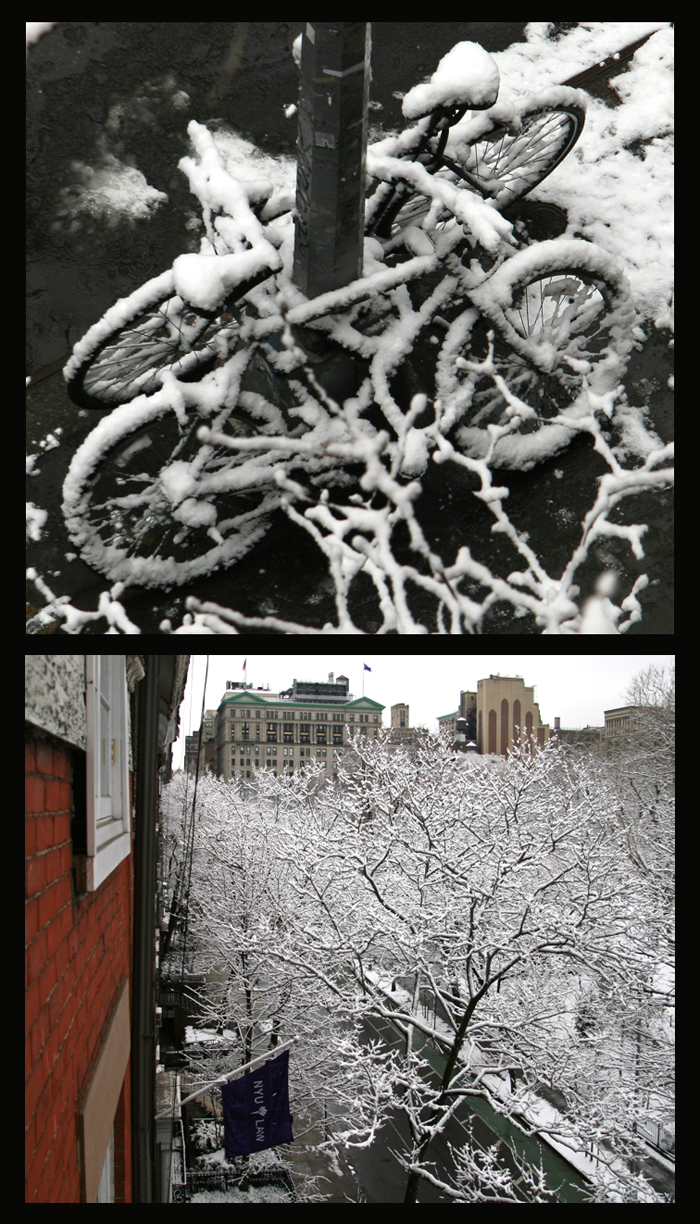
    In the case of new, substantial snow, there are giveaway sounds – the reduced frequency of cars, the telltale echo of snow shovels, and the unmistakable grind of the snowplow against the pavement. In the event of rain, I can hear the spray of water against tires and the roadway.

    I have windows facing a park which I have featured in the four seasons: Spring (Enchanted April), Signs of Summer, Fall (Wood, Glass, Brass and Trees), and Winter (White By Design 2). In the mornings, however, I often rise before sunrise and immediately go to my laptop, typically without even looking out the window. Instead I rely on the sounds of the city. – perhaps for any number of reasons, including a growing reliance on the Internet and also being out of tune with the outdoors and nature from living in such a high urbanized environment. This morning, I had no idea we had another in a series of snowstorms until I heard a snow shovel.

    On an Apple computer, the F4 key immediately displays the dashboard, a group of widgets which can be custom configured. I currently have mine to include the weather which displays the current conditions and the week’s weather forecast. I can see if the sun is shining without turning around.

    But not everything can be experienced through the Internet, the F4 key, or even the sounds of the city. You’ve got to look out your window if you want to see the snow, and you have to step into the streets and follow the trumpeting if you want to see Urban Elephants and their Hydraulic Tusks 🙂


  • Ride to Hell

    You think you know tenacity? You do not know tenacity until you are acquainted with the Hands On A Hard Body competition and men like Benny Perkins and Philip Calhoun. I do hold tenacity in high regard (see my story Perfect Attendance here) – but the Hands on a Hard Body competition is horrifying and extreme.

    In 1997, a documentary film was made about this annual endurance contest in at a Nissan dealership in Longview, Texas, where 24 contestants see who can keep one hand on a Nissan pickup truck for the longest time. No leaning, no crouching. There are five minute breaks every hour and fifteen minute breaks every six hours. The last one standing wins the truck. There are many repercussions, including hallucinations and worse.* The record was 92 hours and 40 minutes in 1998 by Calhoun.

    Benny Perkins won in 1992. I first heard of Benny and this contest in a radio program and interview. A person that wins a contest like this is much more than just tenacious, perhaps a little frightening. This is best illustrated by Benny’s remark to one remaining competitor:
    “I told Dan, the guy I was with, I said, ‘You’re standing next to the devil and this is the ride to hell. I’ll stand here ’til the day you die, so you might as well drop out now.”
    When I heard him say this in his own voice, along with things like “You go slowly insane. Your mind has got to rest – the body can work 24 hours a day, but your mind has got to rest,” I had many thoughts, including just give him that truck.

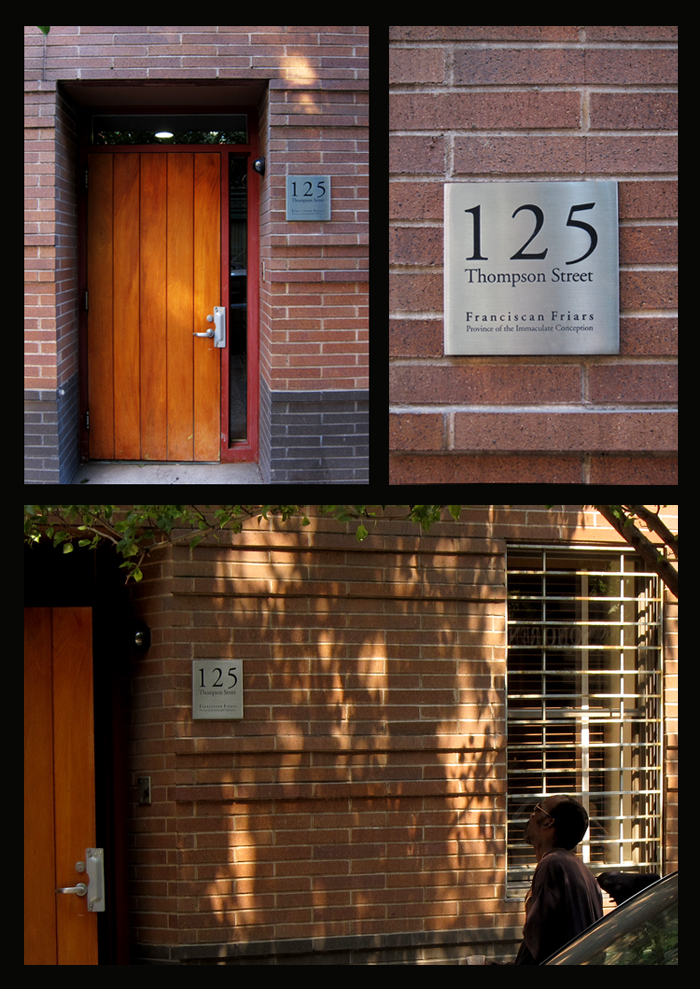
    If I had the tenacity of Perkins or Calhoun, perhaps I could have waited outside 125 Thompson Street with my hands on the door until someone came or left. For decades I have walked by this large nondescript building in SoHo, hoping for some human activity but only seeing the small brass plaque: 125 Thompson Street. Franciscan Friars. Province of the Immaculate Conception.

    Some, who love a good mystery or conspiracy, might imagine something like the Illuminati, with a covert masterplan for a New World Order. Others, like my mother, would feel that I am wasting my time and that There’s Nothing Here. A phone call confirmed the more reasonable – that 125 Thompson Street serves as a monastery and offices for the local Franciscan congregation, who have been in the area for 150 years. The Franciscan Brothers are a tenacious group, working hard and quietly, living a life in the manner of Francis of Assisi to bring their ministry around the world and, like Benny’s admonition, trying to save others from the ride to hell…

    *The contest was discontinued in 2005 because one contestant, Richard Thomas Vega II, crossed a street, broke into a Kmart store, took a gun from a case, and shot himself. His wife sued and settled in 2008 with Patterson Nissan of Longview. His wife alleged that the dealership was negligent in organizing and conducting the contest and likened the stress and sleep deprivation to “brainwashing.” She said the Nissan dealership failed to provide a safe environment for contestants who “temporarily lost their sanity.”


  • I Got Caught

    Closing time for bars in New York City is 4 AM. In the United States, only a handful of states or municipalities offer later closings. In those cases, there are typically no statewide mandated closing times at all, like in Nevada, where bars may remain open 24 hours a day, 7 days a week. But the majority of bars in the United States close between 12-2 AM.
    For many, party = alcohol and bars, so, the later the bars stay open, the better the party. For those where 4 AM is still too early, there are after hours clubs. For many, this is the biggest attraction of New York – at any moment, somewhere, it’s party time.

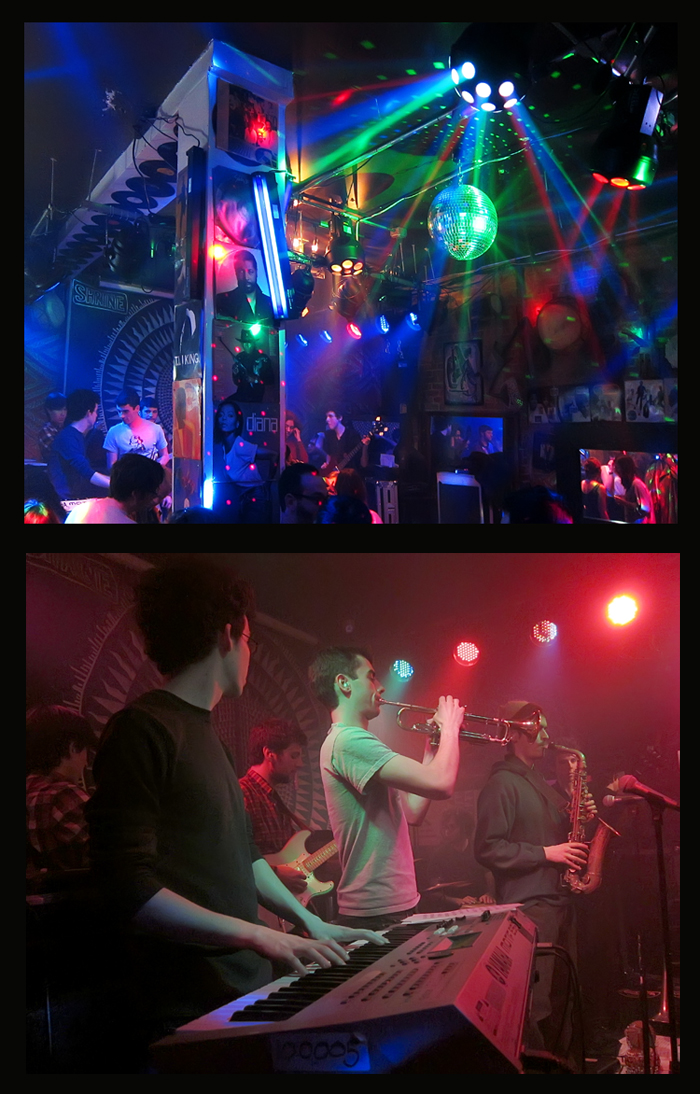
    A small band that I saw perform recently in the Village announced that they would be performing at Shrine NYC. I had heard of this bar/club, and in conversation with one of the musicians, he said that Shrine had some of the best music in the entire city. It is located in Harlem, at 2271 Adam Clayton Powell Boulevard near 134th Street. Visiting Shrine Bar & Restaurant sounded like a good way to broaden my horizons – for most Manhattan residents, Harlem is a remote outpost they will never visit. I asked two friends to accompany me on Saturday night for music.

    The club serves food, and we had decided to eat there as well as go for the music. Hunger called, and we arrived at 7PM – very early for a Saturday night bar scene, but already nearly every table was taken, and a performance was in progress. Our waitresses were disarmingly friendly. I am not sure if this is typical at Shrine or not, but it was not the perfunctory type of service one might expect in a place so boisterous and busy.

    A number of bands were booked there – soon the place was packed, and we no longer had a line of sight to the music. I suggested moving into the throngs for a full immersion experience when the Body Electric Afrofunk Band* was on. From the Body Electric website:

    We are a group of Students, 9 strong, with a shared passion for playing music. Like Fela Kuti, we believe music can invoke a trancelike state and convey meaning and emotion to the listener through the sheer auditory quality of the sound. One of the most important things about seeing live music is the interplay that takes place between audience and artist; we strive to break down the barrier created by “the stage” at every performance we can.

    This was certainly true. We had moved forward towards the group until we were inches from the keyboard player. We were IN the band. Women nearby were dancing or writhing.

    After their performance, I spoke with the trumpet player, Will Healy (see Deaf Jam here). I told him how I would never seek out any music described as funk. However, I absolutely loved Body Electric. They were superb technicians with entrancing music. When I told Will how much I enjoyed their set unexpectedly, he smiled and suggested “You got caught.” Well put I thought, and with no resistance or regrets. Yes, I Got Caught. 🙂

    *The band members are students at Vassar College, Poughkeepsie, NY. See their Facebook page here and Myspace page here.


  • dinamic_sidebar 4 none

©2026 New York Daily Photo Entries (RSS) and Comments (RSS)  Raindrops Theme